EP1034464B1 - Dispositif servant a predire une anomalie dans un systeme et a prendre des mesures permettant de corriger cette anomalie - Google Patents
Dispositif servant a predire une anomalie dans un systeme et a prendre des mesures permettant de corriger cette anomalie Download PDFInfo
- Publication number
- EP1034464B1 EP1034464B1 EP98963325A EP98963325A EP1034464B1 EP 1034464 B1 EP1034464 B1 EP 1034464B1 EP 98963325 A EP98963325 A EP 98963325A EP 98963325 A EP98963325 A EP 98963325A EP 1034464 B1 EP1034464 B1 EP 1034464B1
- Authority
- EP
- European Patent Office
- Prior art keywords
- information flow
- comparison
- test
- abnormality
- arrangement according
- Prior art date
- Legal status (The legal status is an assumption and is not a legal conclusion. Google has not performed a legal analysis and makes no representation as to the accuracy of the status listed.)
- Expired - Lifetime
Links
- 230000005856 abnormality Effects 0.000 title claims description 44
- 230000009471 action Effects 0.000 title claims description 23
- 238000012360 testing method Methods 0.000 claims description 26
- 238000000034 method Methods 0.000 claims description 23
- 238000013528 artificial neural network Methods 0.000 claims description 12
- 238000012549 training Methods 0.000 claims description 11
- 230000005684 electric field Effects 0.000 claims description 10
- 230000002159 abnormal effect Effects 0.000 claims description 9
- 238000011161 development Methods 0.000 claims description 8
- 230000000739 chaotic effect Effects 0.000 claims description 6
- 238000005259 measurement Methods 0.000 description 23
- 206010010904 Convulsion Diseases 0.000 description 15
- 206010015037 epilepsy Diseases 0.000 description 15
- 208000028329 epileptic seizure Diseases 0.000 description 14
- 210000004556 brain Anatomy 0.000 description 9
- 101000798015 Homo sapiens RAC-beta serine/threonine-protein kinase Proteins 0.000 description 6
- 102100032315 RAC-beta serine/threonine-protein kinase Human genes 0.000 description 6
- 230000018109 developmental process Effects 0.000 description 5
- 108091008611 Protein Kinase B Proteins 0.000 description 4
- 238000013459 approach Methods 0.000 description 4
- 238000001514 detection method Methods 0.000 description 4
- 238000010304 firing Methods 0.000 description 4
- 210000002569 neuron Anatomy 0.000 description 4
- 230000008569 process Effects 0.000 description 4
- 230000006399 behavior Effects 0.000 description 3
- 230000008859 change Effects 0.000 description 3
- 206010000117 Abnormal behaviour Diseases 0.000 description 2
- 230000006978 adaptation Effects 0.000 description 2
- 230000010354 integration Effects 0.000 description 2
- 230000001537 neural effect Effects 0.000 description 2
- 101100162366 Caenorhabditis elegans akt-2 gene Proteins 0.000 description 1
- 241001295925 Gegenes Species 0.000 description 1
- 238000007476 Maximum Likelihood Methods 0.000 description 1
- 239000000654 additive Substances 0.000 description 1
- 230000000996 additive effect Effects 0.000 description 1
- 238000010009 beating Methods 0.000 description 1
- 230000008901 benefit Effects 0.000 description 1
- 230000007177 brain activity Effects 0.000 description 1
- 230000001419 dependent effect Effects 0.000 description 1
- 238000013461 design Methods 0.000 description 1
- 230000000694 effects Effects 0.000 description 1
- 230000001037 epileptic effect Effects 0.000 description 1
- 238000001914 filtration Methods 0.000 description 1
- 230000006870 function Effects 0.000 description 1
- 230000007246 mechanism Effects 0.000 description 1
- 230000033764 rhythmic process Effects 0.000 description 1
- 238000000528 statistical test Methods 0.000 description 1
- 230000001360 synchronised effect Effects 0.000 description 1
- 230000009897 systematic effect Effects 0.000 description 1
Images

Classifications
-
- G—PHYSICS
- G05—CONTROLLING; REGULATING
- G05B—CONTROL OR REGULATING SYSTEMS IN GENERAL; FUNCTIONAL ELEMENTS OF SUCH SYSTEMS; MONITORING OR TESTING ARRANGEMENTS FOR SUCH SYSTEMS OR ELEMENTS
- G05B23/00—Testing or monitoring of control systems or parts thereof
- G05B23/02—Electric testing or monitoring
- G05B23/0205—Electric testing or monitoring by means of a monitoring system capable of detecting and responding to faults
- G05B23/0218—Electric testing or monitoring by means of a monitoring system capable of detecting and responding to faults characterised by the fault detection method dealing with either existing or incipient faults
- G05B23/0224—Process history based detection method, e.g. whereby history implies the availability of large amounts of data
- G05B23/024—Quantitative history assessment, e.g. mathematical relationships between available data; Functions therefor; Principal component analysis [PCA]; Partial least square [PLS]; Statistical classifiers, e.g. Bayesian networks, linear regression or correlation analysis; Neural networks
-
- G—PHYSICS
- G05—CONTROLLING; REGULATING
- G05B—CONTROL OR REGULATING SYSTEMS IN GENERAL; FUNCTIONAL ELEMENTS OF SUCH SYSTEMS; MONITORING OR TESTING ARRANGEMENTS FOR SUCH SYSTEMS OR ELEMENTS
- G05B23/00—Testing or monitoring of control systems or parts thereof
- G05B23/02—Electric testing or monitoring
- G05B23/0205—Electric testing or monitoring by means of a monitoring system capable of detecting and responding to faults
- G05B23/0259—Electric testing or monitoring by means of a monitoring system capable of detecting and responding to faults characterized by the response to fault detection
- G05B23/0286—Modifications to the monitored process, e.g. stopping operation or adapting control
- G05B23/0289—Reconfiguration to prevent failure, e.g. usually as a reaction to incipient failure detection
-
- A—HUMAN NECESSITIES
- A61—MEDICAL OR VETERINARY SCIENCE; HYGIENE
- A61N—ELECTROTHERAPY; MAGNETOTHERAPY; RADIATION THERAPY; ULTRASOUND THERAPY
- A61N1/00—Electrotherapy; Circuits therefor
- A61N1/18—Applying electric currents by contact electrodes
- A61N1/32—Applying electric currents by contact electrodes alternating or intermittent currents
- A61N1/36—Applying electric currents by contact electrodes alternating or intermittent currents for stimulation
- A61N1/36014—External stimulators, e.g. with patch electrodes
- A61N1/36025—External stimulators, e.g. with patch electrodes for treating a mental or cerebral condition
Definitions
- the invention relates to an arrangement for predicting a abnormal state of a system and to perform a action counteracting the abnormal condition.
- the flow of information marks a loss of information in a dynamic system and describes decaying statistical dependencies between the entire past and a time of p steps in the future lies as a function of p.
- the benefit of the flow of information exists among other things in that a dynamic behavior of a complex system can be classified, what about this leads to a suitable parameterized model being found is a modeling of complex dynamic data Systems enables.
- a neural network and the training of a neural network are known from [3].
- Methods for detecting irregularities are from [6] and [7] in a heartbeat using neural Known networks.
- the object of the invention is to provide an arrangement which, on the one hand, makes it possible to predict an abnormality in a system and carries out an action which counteracts the abnormality.
- the aim of the invention is a systematic approach to the general problem and a solution derived from this general problem of determining a quantity (hereinafter referred to as prediction quantity) which is suitable for predicting dynamic events of a system.
- prediction quantity a quantity which is suitable for predicting dynamic events of a system.
- steps (2) and (3) form an endless loop in the processor unit.
- the predetermined abnormality is a flow of information with a Dynamic is below a given limit.
- the action may be to make the system noise supply. It is possible to measure the noise using a corresponding electrical field or a corresponding to supply magnetic field. Both can electrical field as well as the magnetic field at least one electrode are fed to the system.
- An additional training is that the given abnormality an information flow of one Dynamic is above a given limit. On it can be reacted in such a way that the system with a regular Signal is excited. This can be done using an electrical or a magnetic field. The electric field and / or the magnetic field can each be based on at least one electrode are fed to the system.
- FIG. 1 shows an arrangement for predicting an abnormality of a system and performing an action counteracting the abnormality.
- the measurement data recorder MDA records measurement data of a system S. on.
- the measurement data recorder is preferably MDA for this purpose arranged within the system S to spot the measurement data take.
- the measurement data are sent to a processor unit PRE directed and processed there.
- the Processor unit PRE a neural network NN that according to a Training further recorded by the MDA Analyzes measurement data appropriately.
- a Actuator AKT caused by the processor unit PRE, a perform the specified action.
- the actuator AKT points preferably at least one electrode directly from the processor unit PRE is controlled.
- processor unit in the system S ' is arranged, as in Figure 1 with the dashed lines Line and the associated identification of the system S ' is indicated.
- the system S preferably comprises the measurement data recorder MDA and / or the actuator AKT in order to allow direct access by the Measurement data recorder MDA on the measurement data and the actuator AKT to ensure the system.
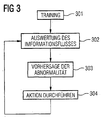
- a neural network NN is trained. For this purpose, measurement data of a suitable size are specified in order to after completing the training make a statement about it whether new measurement data is an abnormality of the system Show.
- a step 302 after the completion of the Training based on current measurement data an information flow (see [1] or [2]) evaluated. From this Information flow can indicate an abnormality in the system Occurrence of this abnormality.
- Step 303 predicts the abnormality
- in one Step 304 performed an action that occurred Counteracts abnormality. Then preferably jumped to step 302.
- An application relates to the possible prediction of a fibrillating heart.
- the abnormality is that the heart beats almost chaotically.
- EKG measurement data are used to determine the dynamics of a patient’s heart (training phase of the neural network NN).
- the dynamic of the heart varies to a very large extent, depending for example, the time of day and the type of Activity that a person is currently performing.
- a change in Prediction size enables an abnormality to be predicted of the heart.
- a Control mechanism started, which is the normal one Restores heart rhythm.
- the prediction size represents an illustration of a sudden Variation represents the complexity of the dynamics, and the actuator is realized in the form of an electrode, the small electrical Feeds impulses to the heart.
- EEG measurement data Represent brain activity
- it is a task that Interpret signals appropriately and if necessary to tie predetermined measures to it.
- EEG measurement data Represent brain activity
- it is a task that Interpret signals appropriately and if necessary to tie predetermined measures to it.
- So is one epileptic seizure characterized by a synchronous Firing a group of neurons around a center point are centered. This synchronicity reduces the Complexity of brain dynamics and is measured by EEG data displayed.
- the Normal state i.e. the normally working brain, one State from irregularly firing neurons.
- the early detection of an epileptic seizure becomes possible by finding a continued simplification of the Dynamics of the brain.
- the actuator to restore the Normal state has the task of this synchronicity, the obviously responsible for the epileptic seizure is to counteract. This is preferably done by Create a field, as will be deepened below.
- the idea is to extend the statistical approximation according to [2] to detect a Markov character that is inherent in a given empirical time series. It is a goal to separate a deterministic part from a stochastic part of a dynamic system in the context of statistical test theory by analyzing the information flow of the system.
- the statistical development of dynamics is tested against a hierarchy of null hypotheses that correspond to nonlinear Markov processes with increasing order n.
- the Markov process with order n is defined by its conditional probability densities
- the deterministic part is implemented by a neural network NN, which is trained according to the maximum likelihood principle [4] and trained on the probability densities according to equation (2).
- the stochastic component u is described by Gaussian noise, where the variance ⁇ 2 is related to a defined mean last quadratic error.
- the null hypotheses include not only the order of the Markov process, but also an actual deterministic structure.
- EED engl .: E E ffective mbedding DIMENSION
- the approach presented here does not require that the underlying dynamics is messy (even if they are could), but rather focuses on one Period before the epileptic seizure to one on the Dynamics of the system based prediction size for the to determine epileptic seizure.
- An epileptic seizure can be suppressed by one constant electric field is supplied to the regions that are affected by the epileptic seizure (see [5]).
- the supply of this noise is preferably by Application of an electric field or a magnetic one Field in the immediate vicinity (as close as possible) of the place of the event.
- electrodes are preferably used to generate an electric field or coils Magnetic field generation used.
- the abnormal Behavior is detected by means of a prediction variable, is reacted appropriately.
- This reaction exists depending on Field of application, e.g. in creating a messy or in the creation of a regular field.
- This Action performed by the actuator depends on the the respective area of application.
- Common is that different variants of the method dynamic learning, with a significant abnormality is assigned to a prediction variable and this Prediction size a detection of an impending Allows abnormality. It is convenient to do so within a predetermined period of time before the abnormality occurs (epileptic seizure or chaotic beating Heart) a suitable action by means of an actuator perform.
- the prediction size thus enables Detection of an abnormality before it actually occurs.
Landscapes
- Physics & Mathematics (AREA)
- Engineering & Computer Science (AREA)
- General Physics & Mathematics (AREA)
- Automation & Control Theory (AREA)
- Artificial Intelligence (AREA)
- Evolutionary Computation (AREA)
- Mathematical Physics (AREA)
- Chemical & Material Sciences (AREA)
- Chemical Kinetics & Catalysis (AREA)
- Measurement And Recording Of Electrical Phenomena And Electrical Characteristics Of The Living Body (AREA)
- Management, Administration, Business Operations System, And Electronic Commerce (AREA)
Claims (17)
- Dispositif servant à prédire un état anormal d'un système dynamique et à prendre des mesures permettant de corriger cet état anormal en utilisant un flux d'informations qui décrit un développement d'une prédictibilité de plusieurs états futurs de systèmes,a) dans lequel est prévu un capteur de données de mesures qui capte des données de mesures comparatives du système lors d'une phase de formation et des données de mesures d'essai du système lors d'une phase de mise en oeuvre,b) doté d'une unité centrale paramétrée pour l'exécution des étapes suivantes :(1) un réseau neuronal décrivant le système est formé en utilisant les données de mesures comparatives ;(2) un flux d'informations comparatif, décrivant une dynamique comparative du système, est défini en utilisant le réseau neuronal formé ;(3) un flux d'informations d'essai, décrivant une dynamique d'essai du système, est défini en utilisant les données de mesures d'essai ;(4) l'anomalie est alors indiquée comme étant prédite en utilisant le flux d'informations comparatif et le flux d'informations d'essai, lorsque le flux d'informations comparatif se différencie clairement du flux d'informations d'essai, et l'anomalie n'est alors pas indiquée comme étant prédite lorsque le flux d'informations comparatif ne se différencie pas clairement du flux d'informations d'essai ;(5) si l'anomalie du système est indiquée comme étant prédite, l'action est exécutée ;c) dans lequel est prévu un acteur qui exécute l'action.
- Dispositif selon la revendication 1, dans lequel les étapes (2) et (5) de l'unité centrale forment une boucle sans fin.
- Dispositif selon la revendication 1 ou 2, dans lequel l'anomalie est indiquée comme étant prédite lorsque le flux d'informations d'essai est clairement plus petit que le flux d'informations comparatif.
- Dispositif selon la revendication 3, dans lequel l'action consiste à démarrer le système avec un signal chaotique.
- Dispositif selon la revendication 4, dans lequel l'action consiste à amener un bruit au système.
- Dispositif selon la revendication 5, dans lequel le bruit est amené à l'aide d'un champ électrique correspondant.
- Dispositif selon la revendication 6, dans lequel le champ électrique est alimenté à l'aide d'au moins une électrode.
- Dispositif selon la revendication 5, dans lequel le bruit est amené à l'aide d'un champ magnétique correspondant.
- Dispositif selon la revendication 8, dans lequel le champ magnétique est alimenté à l'aide d'au moins une électrode.
- Dispositif selon la revendication 1 ou 2, dans lequel l'anomalie est indiquée comme étant prédite lorsque le flux d'informations d'essai est clairement plus grand que le flux d'informations comparatif.
- Dispositif selon la revendication 10, dans lequel l'action consiste à amener un signal régulier au système.
- Dispositif selon la revendication 11, dans lequel le signal régulier est amené à l'aide d'un champ électrique.
- Dispositif selon la revendication 12, dans lequel le champ électrique est alimenté à l'aide d'au moins une électrode.
- Dispositif selon la revendication 11, dans lequel le signal régulier est amené à l'aide d'un champ magnétique.
- Dispositif selon la revendication 14, dans lequel le champ magnétique est amené au système à l'aide d'au moins une électrode.
- Procédé servant à prédire un état anormal d'un système dynamique et à prendre des mesures permettant de corriger cet état anormal en utilisant un flux d'informations qui décrit un développement d'une prédictibilité de plusieurs états futurs de systèmes,(a) dans lequel des données de mesures comparatives du système sont mesurées lors d'une phase de formation et des données de mesures d'essai du système lors d'une phase de mise en oeuvre,(b) dans lequel un réseau neuronal décrivant le système est formé en utilisant les données de mesures comparatives ;(c) dans lequel un flux d'informations comparatif, décrivant une dynamique comparative du système, est défini en utilisant le réseau neuronal ;(d) dans lequel un flux d'informations d'essai, décrivant une dynamique d'essai du système, est défini en utilisant les données de mesures d'essai ;(e) dans lequel l'anomalie est alors indiquée comme étant prédite en utilisant le flux d'informations comparatif et le flux d'informations d'essai, lorsque le flux d'informations comparatif se différencie clairement du flux d'informations d'essai, et l'anomalie n'est alors pas indiquée comme étant prédite lorsque le flux d'informations comparatif ne se différencie pas clairement du flux d'informations d'essai ;(f) dans lequel l'action est exécutée lorsque l'anomalie du système est indiquée comme étant prédite.
- Procédé servant à prédire un état anormal d'un système dynamique en utilisant un flux d'informations qui décrit un développement d'une prédictibilité de plusieurs états futurs de systèmes,(a) dans lequel des données de mesures comparatives du système sont mesurées lors d'une phase de formation et des données de mesures d'essai du système lors d'une phase de mise en oeuvre,(b) dans lequel un flux d'informations comparatif, décrivant une dynamique comparative du système, est défini en utilisant les données de mesures comparatives ;(c) dans lequel un flux d'informations d'essai, décrivant une dynamique d'essai du système, est défini en utilisant les données de mesure d'essai ;(d) dans lequel l'anomalie est alors indiquée comme étant prédite en utilisant le flux d'informations comparatif et le flux d'informations d'essai, lorsque le flux d'informations comparatif se différencie clairement du flux d'informations d'essai, et l'anomalie n'est alors pas indiquée comme étant prédite lorsque le flux d'informations comparatif ne se différencie pas clairement du flux d'informations d'essai.
Applications Claiming Priority (3)
| Application Number | Priority Date | Filing Date | Title |
|---|---|---|---|
| DE19749373 | 1997-11-07 | ||
| DE19749373 | 1997-11-07 | ||
| PCT/DE1998/003229 WO1999024884A1 (fr) | 1997-11-07 | 1998-11-05 | Dispositif servant a predire une anomalie dans un systeme et a prendre des mesures permettant de corriger cette anomalie |
Publications (2)
| Publication Number | Publication Date |
|---|---|
| EP1034464A1 EP1034464A1 (fr) | 2000-09-13 |
| EP1034464B1 true EP1034464B1 (fr) | 2002-06-12 |
Family
ID=7848014
Family Applications (1)
| Application Number | Title | Priority Date | Filing Date |
|---|---|---|---|
| EP98963325A Expired - Lifetime EP1034464B1 (fr) | 1997-11-07 | 1998-11-05 | Dispositif servant a predire une anomalie dans un systeme et a prendre des mesures permettant de corriger cette anomalie |
Country Status (4)
| Country | Link |
|---|---|
| US (1) | US7006866B1 (fr) |
| EP (1) | EP1034464B1 (fr) |
| DE (1) | DE59804462D1 (fr) |
| WO (1) | WO1999024884A1 (fr) |
Families Citing this family (6)
| Publication number | Priority date | Publication date | Assignee | Title |
|---|---|---|---|---|
| US7831532B2 (en) | 2004-11-16 | 2010-11-09 | Microsoft Corporation | Precomputation and transmission of time-dependent information for varying or uncertain receipt times |
| US7698055B2 (en) * | 2004-11-16 | 2010-04-13 | Microsoft Corporation | Traffic forecasting employing modeling and analysis of probabilistic interdependencies and contextual data |
| US7519564B2 (en) * | 2004-11-16 | 2009-04-14 | Microsoft Corporation | Building and using predictive models of current and future surprises |
| TW201222431A (en) * | 2010-11-26 | 2012-06-01 | Inst Information Industry | Behavior pattern recognition method, system and computer application program thereof |
| WO2019183136A1 (fr) * | 2018-03-20 | 2019-09-26 | SafetySpect, Inc. | Appareil et procédé de détection analytique multimode d'articles tels que des aliments |
| US11271795B2 (en) * | 2019-02-08 | 2022-03-08 | Ciena Corporation | Systems and methods for proactive network operations |
Family Cites Families (13)
| Publication number | Priority date | Publication date | Assignee | Title |
|---|---|---|---|---|
| US4889526A (en) * | 1984-08-27 | 1989-12-26 | Magtech Laboratories, Inc. | Non-invasive method and apparatus for modulating brain signals through an external magnetic or electric field to reduce pain |
| US5092343A (en) * | 1988-02-17 | 1992-03-03 | Wayne State University | Waveform analysis apparatus and method using neural network techniques |
| US5862304A (en) * | 1990-05-21 | 1999-01-19 | Board Of Regents, The University Of Texas System | Method for predicting the future occurrence of clinically occult or non-existent medical conditions |
| US5251626A (en) | 1990-07-03 | 1993-10-12 | Telectronics Pacing Systems, Inc. | Apparatus and method for the detection and treatment of arrhythmias using a neural network |
| US6117066A (en) * | 1992-12-04 | 2000-09-12 | Somatics, Inc. | Prevention of seizure arising from medical magnetoictal non-convulsive stimulation therapy |
| US5465321A (en) * | 1993-04-07 | 1995-11-07 | The United States Of America As Represented By The Administrator Of The National Aeronautics And Space Administration | Hidden markov models for fault detection in dynamic systems |
| US5408406A (en) | 1993-10-07 | 1995-04-18 | Honeywell Inc. | Neural net based disturbance predictor for model predictive control |
| DE4337110C1 (de) * | 1993-10-29 | 1994-11-03 | Michael A J Dietl | Verfahren und Vorrichtung zum Betreiben eines Defibrillators |
| DE19604803A1 (de) | 1995-02-10 | 1996-10-10 | Meidensha Electric Mfg Co Ltd | Vorrichtung zur Systemzustandsüberwachung |
| CA2217024A1 (fr) * | 1995-05-01 | 1996-11-21 | Ep Technologies, Inc. | Systemes et techniques de releve des temperatures subsuperficielles des tissus de l'organisme lors d'une ablation pratiquee avec des electrodes activement refroidies |
| DE19531967C2 (de) | 1995-08-30 | 1997-09-11 | Siemens Ag | Verfahren zum Training eines neuronalen Netzes mit dem nicht deterministischen Verhalten eines technischen Systems |
| DE69723899T2 (de) * | 1996-02-12 | 2004-06-17 | St. Jude Medical Ab | Taktempfindlicher Herzschrittmacher |
| IT1289809B1 (it) * | 1996-12-27 | 1998-10-16 | Ist Trentino Di Cultura | Procedimento e sistema automatico per ottenere mappe di contenuto d'acqua e/o di permettivita'elettrica da immagini di risonanza |
-
1998
- 1998-11-05 DE DE59804462T patent/DE59804462D1/de not_active Expired - Fee Related
- 1998-11-05 EP EP98963325A patent/EP1034464B1/fr not_active Expired - Lifetime
- 1998-11-05 US US09/530,983 patent/US7006866B1/en not_active Expired - Fee Related
- 1998-11-05 WO PCT/DE1998/003229 patent/WO1999024884A1/fr not_active Ceased
Also Published As
| Publication number | Publication date |
|---|---|
| EP1034464A1 (fr) | 2000-09-13 |
| DE59804462D1 (de) | 2002-07-18 |
| WO1999024884A1 (fr) | 1999-05-20 |
| US7006866B1 (en) | 2006-02-28 |
Similar Documents
| Publication | Publication Date | Title |
|---|---|---|
| DE60005861T2 (de) | Verfahren und system zur analyse von kontinuirlichen parameterdaten für diagnostik und reparaturen | |
| DE112019000806T5 (de) | Erkennen und vorhersagen von epilepsieanfällen unter verwenden von techniken wie methoden des tiefen lernens | |
| Olshausen et al. | How close are we to understanding V1? | |
| Aarabi et al. | Seizure prediction in hippocampal and neocortical epilepsy using a model-based approach | |
| DE102016203546B4 (de) | Analysator zur verhaltensanalyse und parametrisierung von neuronaler stimulation | |
| DE112012003110T5 (de) | Verfahren, Programmprodukt und System zur Datenidentifizierung | |
| EP2165296B1 (fr) | Procédé et dispositif de prédiction assistée par calcul de déplacements intentionnels | |
| EP0582885A2 (fr) | Procédé pour la classification de modèles de champ | |
| EP1527407A2 (fr) | Procede et programme informatique a moyens de code programme et produit programme informatique pour l'analyse d'une activite d'une preparation pharmaceutique | |
| Kehri et al. | Techniques of EMG signal analysis and classification of neuromuscular diseases | |
| EP1384199A2 (fr) | Procede de determination de risques concomitants | |
| EP1034464B1 (fr) | Dispositif servant a predire une anomalie dans un systeme et a prendre des mesures permettant de corriger cette anomalie | |
| EP1456798A2 (fr) | Evaluation d'images du cerveau obtenues par tomographie par resonance magnetique fonctionnelle | |
| Stam et al. | Dynamics underlying rhythmic and non-rhythmic variants of abnormal, waking delta activity | |
| Le Van Quyen et al. | Exploring the nonlinear dynamics of the brain | |
| DE102023200969A1 (de) | Verfahren und Vorrichtung zum automatisierten Erstellen von Suchmustern | |
| WO2009015655A2 (fr) | Procédé et dispositif de reconnaissance automatique de motifs | |
| EP0978052B1 (fr) | Selection assistee par ordinateur de donnees d'entrainement pour reseau neuronal | |
| DE19610847C1 (de) | Verfahren zur Klassifikation einer meßbaren Zeitreihe, die eine vorgebbare Anzahl von Abtastwerten aufweist, beispielsweise eines elektrischen Signals, durch einen Rechner und Verwendung des Verfahrens | |
| DE102024104333A1 (de) | Adaptiv zentrierte darstellung für nulltreffer-anomaliedetektionsverfahren | |
| DE102019102299A1 (de) | Verfahren und Vorrichtung zum automatisierten Erfassen von Fehlern in Computersystemen | |
| EP1114398B1 (fr) | Procede pour entrainer un reseau neuronal, procede de classification d'une sequence de grandeurs d'entree au moyen d'un reseau neuronal, reseau neuronal et dispositif pour l'entrainement d'un reseau neuronal | |
| Petrosian et al. | Classification of epileptic EEG using neural network and wavelet transform | |
| Asai et al. | Reconstruction of underlying nonlinear deterministic dynamics embedded in noisy spike trains | |
| WO2002017127A2 (fr) | Procede et dispositif d'analyse de correlation de sequences de donnees |
Legal Events
| Date | Code | Title | Description |
|---|---|---|---|
| PUAI | Public reference made under article 153(3) epc to a published international application that has entered the european phase |
Free format text: ORIGINAL CODE: 0009012 |
|
| 17P | Request for examination filed |
Effective date: 20000417 |
|
| AK | Designated contracting states |
Kind code of ref document: A1 Designated state(s): DE FR GB IT |
|
| 17Q | First examination report despatched |
Effective date: 20001020 |
|
| GRAG | Despatch of communication of intention to grant |
Free format text: ORIGINAL CODE: EPIDOS AGRA |
|
| GRAG | Despatch of communication of intention to grant |
Free format text: ORIGINAL CODE: EPIDOS AGRA |
|
| GRAH | Despatch of communication of intention to grant a patent |
Free format text: ORIGINAL CODE: EPIDOS IGRA |
|
| GRAH | Despatch of communication of intention to grant a patent |
Free format text: ORIGINAL CODE: EPIDOS IGRA |
|
| GRAA | (expected) grant |
Free format text: ORIGINAL CODE: 0009210 |
|
| RIN1 | Information on inventor provided before grant (corrected) |
Inventor name: DUBE', LOUIS-J. Inventor name: DECO, GUSTAVO |
|
| AK | Designated contracting states |
Kind code of ref document: B1 Designated state(s): DE FR GB IT |
|
| REG | Reference to a national code |
Ref country code: GB Ref legal event code: FG4D Free format text: NOT ENGLISH |
|
| REF | Corresponds to: |
Ref document number: 59804462 Country of ref document: DE Date of ref document: 20020718 |
|
| GBT | Gb: translation of ep patent filed (gb section 77(6)(a)/1977) |
Effective date: 20020912 |
|
| ET | Fr: translation filed | ||
| PLBE | No opposition filed within time limit |
Free format text: ORIGINAL CODE: 0009261 |
|
| STAA | Information on the status of an ep patent application or granted ep patent |
Free format text: STATUS: NO OPPOSITION FILED WITHIN TIME LIMIT |
|
| 26N | No opposition filed |
Effective date: 20030313 |
|
| PGFP | Annual fee paid to national office [announced via postgrant information from national office to epo] |
Ref country code: DE Payment date: 20070122 Year of fee payment: 9 |
|
| PGFP | Annual fee paid to national office [announced via postgrant information from national office to epo] |
Ref country code: IT Payment date: 20071128 Year of fee payment: 10 |
|
| PGFP | Annual fee paid to national office [announced via postgrant information from national office to epo] |
Ref country code: GB Payment date: 20071115 Year of fee payment: 10 Ref country code: FR Payment date: 20071116 Year of fee payment: 10 |
|
| PG25 | Lapsed in a contracting state [announced via postgrant information from national office to epo] |
Ref country code: DE Free format text: LAPSE BECAUSE OF NON-PAYMENT OF DUE FEES Effective date: 20080603 |
|
| GBPC | Gb: european patent ceased through non-payment of renewal fee |
Effective date: 20081105 |
|
| PG25 | Lapsed in a contracting state [announced via postgrant information from national office to epo] |
Ref country code: IT Free format text: LAPSE BECAUSE OF NON-PAYMENT OF DUE FEES Effective date: 20081105 |
|
| REG | Reference to a national code |
Ref country code: FR Ref legal event code: ST Effective date: 20090731 |
|
| PG25 | Lapsed in a contracting state [announced via postgrant information from national office to epo] |
Ref country code: GB Free format text: LAPSE BECAUSE OF NON-PAYMENT OF DUE FEES Effective date: 20081105 |
|
| PG25 | Lapsed in a contracting state [announced via postgrant information from national office to epo] |
Ref country code: FR Free format text: LAPSE BECAUSE OF NON-PAYMENT OF DUE FEES Effective date: 20081130 |