EP1035201B1 - Kulturgefass - Google Patents
Kulturgefass Download PDFInfo
- Publication number
- EP1035201B1 EP1035201B1 EP20000301452 EP00301452A EP1035201B1 EP 1035201 B1 EP1035201 B1 EP 1035201B1 EP 20000301452 EP20000301452 EP 20000301452 EP 00301452 A EP00301452 A EP 00301452A EP 1035201 B1 EP1035201 B1 EP 1035201B1
- Authority
- EP
- European Patent Office
- Prior art keywords
- wall
- lid
- dish
- base
- base portion
- Prior art date
- Legal status (The legal status is an assumption and is not a legal conclusion. Google has not performed a legal analysis and makes no representation as to the accuracy of the status listed.)
- Expired - Lifetime
Links
- 230000002093 peripheral effect Effects 0.000 claims description 13
- 230000000295 complement effect Effects 0.000 claims description 5
- 230000000284 resting effect Effects 0.000 claims 2
- 239000007789 gas Substances 0.000 description 27
- 238000000034 method Methods 0.000 description 4
- 238000012258 culturing Methods 0.000 description 3
- 239000011521 glass Substances 0.000 description 2
- 244000005700 microbiome Species 0.000 description 2
- QVGXLLKOCUKJST-UHFFFAOYSA-N atomic oxygen Chemical compound [O] QVGXLLKOCUKJST-UHFFFAOYSA-N 0.000 description 1
- 238000010276 construction Methods 0.000 description 1
- 238000011109 contamination Methods 0.000 description 1
- 238000005516 engineering process Methods 0.000 description 1
- 239000000463 material Substances 0.000 description 1
- 239000001301 oxygen Substances 0.000 description 1
- 229910052760 oxygen Inorganic materials 0.000 description 1
- 239000007787 solid Substances 0.000 description 1
Images


Classifications
-
- C—CHEMISTRY; METALLURGY
- C12—BIOCHEMISTRY; BEER; SPIRITS; WINE; VINEGAR; MICROBIOLOGY; ENZYMOLOGY; MUTATION OR GENETIC ENGINEERING
- C12M—APPARATUS FOR ENZYMOLOGY OR MICROBIOLOGY; APPARATUS FOR CULTURING MICROORGANISMS FOR PRODUCING BIOMASS, FOR GROWING CELLS OR FOR OBTAINING FERMENTATION OR METABOLIC PRODUCTS, i.e. BIOREACTORS OR FERMENTERS
- C12M23/00—Constructional details, e.g. recesses, hinges
- C12M23/50—Means for positioning or orientating the apparatus
-
- C—CHEMISTRY; METALLURGY
- C12—BIOCHEMISTRY; BEER; SPIRITS; WINE; VINEGAR; MICROBIOLOGY; ENZYMOLOGY; MUTATION OR GENETIC ENGINEERING
- C12M—APPARATUS FOR ENZYMOLOGY OR MICROBIOLOGY; APPARATUS FOR CULTURING MICROORGANISMS FOR PRODUCING BIOMASS, FOR GROWING CELLS OR FOR OBTAINING FERMENTATION OR METABOLIC PRODUCTS, i.e. BIOREACTORS OR FERMENTERS
- C12M23/00—Constructional details, e.g. recesses, hinges
- C12M23/02—Form or structure of the vessel
- C12M23/10—Petri dish
-
- C—CHEMISTRY; METALLURGY
- C12—BIOCHEMISTRY; BEER; SPIRITS; WINE; VINEGAR; MICROBIOLOGY; ENZYMOLOGY; MUTATION OR GENETIC ENGINEERING
- C12M—APPARATUS FOR ENZYMOLOGY OR MICROBIOLOGY; APPARATUS FOR CULTURING MICROORGANISMS FOR PRODUCING BIOMASS, FOR GROWING CELLS OR FOR OBTAINING FERMENTATION OR METABOLIC PRODUCTS, i.e. BIOREACTORS OR FERMENTERS
- C12M23/00—Constructional details, e.g. recesses, hinges
- C12M23/02—Form or structure of the vessel
- C12M23/12—Well or multiwell plates
-
- C—CHEMISTRY; METALLURGY
- C12—BIOCHEMISTRY; BEER; SPIRITS; WINE; VINEGAR; MICROBIOLOGY; ENZYMOLOGY; MUTATION OR GENETIC ENGINEERING
- C12M—APPARATUS FOR ENZYMOLOGY OR MICROBIOLOGY; APPARATUS FOR CULTURING MICROORGANISMS FOR PRODUCING BIOMASS, FOR GROWING CELLS OR FOR OBTAINING FERMENTATION OR METABOLIC PRODUCTS, i.e. BIOREACTORS OR FERMENTERS
- C12M23/00—Constructional details, e.g. recesses, hinges
- C12M23/38—Caps; Covers; Plugs; Pouring means
Definitions
- the present invention relates, generally, to growth containers such as petri dishes. More particularly, the invention relates to petri dishes having a lid that can be oriented and placed on a dish in a number of predetermined positions to either restrict or permit gas exchange between the interior and exterior of the petri dish.
- a petri dish is a small shallow dish of thin glass or plastic with a loose cover that is used to grow tissue cultures and microorganisms on a solid culture.
- the lid covers the dish to prevent or minimize contamination during the culturing process.
- gas exchange is important for the culturing processes, and is especially important for anaerobic culturing processes in which oxygen-containing gas is removed or replaced from the petri dish.
- the lid is either completely removed or is only partially inserted over the dish when it is desired to expose the culture to ambient gas. It can be difficult to retain the desired position of a lid partially inserted on the dish when the petri dish is moved. Because large quantities of petri dishes may be used for some processes or experiments, the lid should be able to be quickly, effectively, and accurately placed, removed, and replaced on the dish. Additionally, it may be desirable to stack these petri dishes on top of each other because of space constraints.
- U.S. Patent No. 5,520,302 discloses a petri dish comprised of a generally rectangular dish and a lid. Two ' adjacent comers of both the dish and the lid are rounded and the other two adjacent corners of both the dish and the lid are notched.
- the lid has two positions on the dish. In a first position, the notched corners of the lid lie on the rounded comers of the dish and the rounded corners of the lid lie on the notched comers of the dish. The differently-shaped corners prevent the lid from being fully inserted over the dish in this position, allowing gas flow between the dish and the lid.
- U.S. Patent No. 4,675,298 discloses a petri dish that has projections formed on the periphery of the inner surface of the cover and has matching depressions on the rim of the lower dish. The projections and depressions provide an adjustable gap between the interior of the petri dish and the atmosphere.
- EP-A-0 171 174 discloses a Petri dish having abutments and positioning members located in confronting side walls of the base and the cover lid for locking the dish at different positions, wherein each position admits the entrance of ambient atmosphere into the dish at different rates.
- EP-A-0 119 984 discloses a Petri dish having position members located on the inner surface of the top wall of the cover lid and corresponding grooves located on an upper surface of the side wall of the base member, such as to allow entrance of ambient atmosphere into the dish when the position members and the grooves are mismatched. These Petri dishes allow a control of the rate of gas exchange with the outer environment depending on the relative position of the cover lid with respect to the base portion by means of a key/keyway mechanismus.
- US-A-3,597,326 discloses a stackable square-shaped multi-well Petri dish. The construction of this Petri dish does not allow to control the rate of gas exchange.
- Applicants' invention provides a petri dish which is believed to constitute an improvement over existing technology.
- the present invention provides an improved container or petri dish for growing tissue cultures and microorganisms.
- the petri dish generally comprises a base or dish portion covered by a lid portion.
- the dish portion has a surface and a peripheral dish wall around the surface.
- the lid portion has a ceiling plate and a peripheral lid wall around the ceiling plate.
- the lid wall has a complementary shape with respect to the dish wall to retain the lid portion on the dish portion in a number of predetermined or desired positions.
- the petri dish has a selector or selection features that an individual may use to quickly, effectively and accurately orient and place the lid portion on the dish portion in one of the desired positions to either restrict or permit a desired gas flow between the dish portion and the lid portion.
- These selection features may permit a desired gas flow in either a stackable or non-stackable configuration.
- These selection features include a key / keyway combination and a plurality of notched areas along the edge of one of the walls.
- the key is preferably a protrusion formed on the interior of the lid wall, and the keyway is preferably a small channel formed in the exterior of an upper wall portion of the dish wall.
- the lid portion is oriented with respect to and placed on the dish portion to restrict gas flow when the key fits within the keyway because the lid can be fully inserted over the dish.
- the key rests on the top edge of the dish wall when it is not aligned with the keyway so that the lid is only partially inserted over the dish to form a small vent opening that will permit a desired gas flow in a non-stackable configuration.
- the complementary shapes of the lid wall and dish wall retain the lid portion on the dish portion.
- the notched areas are formed along an edge of one of the walls and contact the edge of the other wall when the lid portion is oriented with respect to and placed on the dish portion to form uniformly spaced and larger vent openings.
- the lid portion and dish portion form these vent openings in a stackable configuration.
- These notched areas are preferably formed on the bottom edge of the lid wall.
- the notched areas have a predetermined vertical dimension and have a predetermined length to span across adjacent sides or segments of the dish wall when the lid portion is rotated with respect to the dish portion.
- the notches in the lid wall cooperate with the dish wall to retain the lid portion in the desired "rotated" position on the dish portion to permit a desired gas flow.
- the lid portion rests on the dish portion in a stable or secure manner, allowing other dishes to be stacked on top.
- Figure 1 is a top plan view of the dish portion of the petri dish of the present invention.
- Figure 2 is a bottom plan view of the lid portion of the petri dish of the present invention.
- Figure 3 is a side view of the petri dish of the present invention, wherein the lid portion is oriented with respect to and is being placed on the dish portion in a predetermined position to restrict gas flow.
- Figure 4 is a side view of the petri dish of Figure 3, wherein the lid portion is placed on the dish portion in a predetermined position to restrict gas flow.
- Figure 5 is a side view of the petri dish of the present invention, wherein the lid portion is oriented with respect to and is being placed on the dish portion in a predetermined position to permit gas flow in a non-stackable configuration.
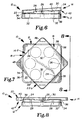
- Figure 6 is a side view of the petri dish of Figure 5, wherein the lid portion is placed on the dish portion and the key of the lid portion rests on the top edge of the dish wall in a non-stackable configuration.
- Figure 7 is a top plan view of the petri dish of the present invention in a predetermined position to permit gas flow in a stackable configuration, wherein the lid portion is rotated an offset amount and the notched areas of the lid portion span across adjacent dish walls.
- Figure 8 is a side plan view of the petri dish of Figure 7.
- the petri dish 10 is described below first in terms of its major structural elements and then in terms of its secondary structural and/or functional elements which cooperate to provide an economical petri dish that an individual can quickly, effectively, and accurately orient and place, remove, and replace a lid portion on a dish portion in a desired position to either restrict or permit a desired gas flow.
- the container or petri dish 10 generally comprises a base or dish portion 12 covered by a lid portion 14.
- the dish portion 12 has a surface 16 and a peripheral base or dish wall 18 around the surface 16, and the lid portion 14 has a ceiling plate 20 and a peripheral lid wall 22 around the ceiling plate 20.
- the lid wall 22 and the dish wall 18 have complementary shapes with respect to each other. The shapes of these walls 18 and 22 retain the lid portion 14 on the dish portion 12 in a number of predetermined positions to either restrict or permit a desired gas flow between the interior and exterior of the petri dish 10.
- the petri dish 10 has a selector or selection features that help an individual orient and place the lid portion 14 on the dish portion 12 in one of the desired positions to either restrict or permit a desired gas flow between the dish portion 12 and the lid portion 14. These features include a key 24 and a keyway 26 and a plurality of notched areas 28 in one of the walls.
- the petri dish 10 is preferably constructed or formed from a clear plastic. However, glass or other materials may be used.
- the surface 16 of the dish portion 12 is preferably a raised surface extending from the top edge 30 of the dish wall 18.
- the raised surface 16 may have a plurality of recessed wells 32 in which separate and distinct cultures may be grown within same petri dish 10.
- the dish wall 18 is an endless wall that extends around the periphery of the surface 16, and comprises a lower wall portion 34 and an upper wall portion 36.
- the lower wall portion 34 has a perimeter greater than the upper wall portion 36 and forms a lip 38 between the two wall portions.
- the lid wall 22 of the lid portion 14 is preferably an endless wall that extends down from the periphery of the ceiling plate 20.
- the petri dish 10 is about 7.62 cm (3 inches) long, 7.62 cm (3 inches) wide, and 1.27 cm (1 ⁇ 2 inch) high.
- the petri dish 10 has six recessed wells 32 positioned in a circular pattern in the dish portion 12.
- the wells 32 are approximately 1.27 cm (1 ⁇ 2 inch) deep and have a diameter of approximately 1.905 cm (3 ⁇ 4 inch)
- the top surface of the top or ceiling plate 20 preferably has ridges 48 that cooperate with the dish wall 18 of a stacked petri dish 10. The ridges 48 promote proper alignment between the lid portions and dish portions of stacked petri dishes, and prevent a stacked petri dish from slipping of the lid of the bottom petri dish.
- the figures show the key 24 and keyway 26 formed in the lid portion 14 and the dish portion 12, respectively.
- the key 24 is preferably a small protrusion, 0.159 cm (1/16 inch) in the illustrated embodiment, formed on the interior of the lid wall 22, and the keyway 26 is preferably a small channel formed in the exterior of the dish wall 18 and sized to receive the key 24.
- the key 24 could be formed in the dish portion 12 and the keyway 26 could be formed in the lid portion 14.
- the lid portion 14 and dish portion 12 of the petri dish 10 have a generally square configuration or footprint that allow the lid portion 14 to fit over the dish portion 12 at four rotational positions (0°, 90°, 180°, and 270°) with respect to each other.
- the corners of the lid portion 14 and dish portion 12 are preferably rounded.
- Other symmetrical shapes that have adjacent sides, such as triangles or pentagons, would function similarly to the illustrated embodiment as described below.
- the lid portion 14 is ' oriented with respect to and placed on the dish portion 12 at 0°, for example, where the key 24 fits within the keyway 26.
- Gas flow is restricted in this position because the lid portion 14 can be fully inserted over the dish portion 12 where the bottom edge 40 of the lid wall 22 abuts against the lip 38 of the dish wall 18.
- the key 24 is not aligned with the keyway 26 when the lid portion 14 is oriented with respect to and placed on the dish portion 12 at 90°, 180°, or 270°. In these positions, as illustrated in Figures 5-6 , the key 24 rests on the top edge 30 of the dish wall 18. A relatively small vent opening 42 is formed to permit a desired gas flow.
- the bottom edge 40 of the lid wall 22 abuts against the lip 38 of the dish wall 18.
- the remainder of the lid wall 22 retains the lid portion 14 on the dish portion 12 in the desired position because, as shown in Figures 3 and 6 , the bottom of the key 24 is higher than the bottom edge 40 of the lid wall 22.
- Multiple keys 24 and / or multiple keyways 26 may be used to provide additional positions where the lid portion 12 would be fully inserted over the dish portion 12 to restrict gas flow.
- the petri dishes are not stackable in this configuration.
- the notched areas 28 are formed on one of the walls and contact the other wall when the lid portion 14 is oriented with respect to and placed on the dish portion 12 to form uniformly spaced and larger vent openings 42 that will permit a desired gas flow.
- the notched areas 12 are formed on the bottom edge 40 of the lid wall 22 and contact the top edge 30 of the dish wall 18 in a preferred embodiment.
- the notched areas 12 could be formed in the top edge 30 of the dish wall 18 and contact the bottom edge 40 of the lid wall 22, or both walls 18 and 22 could be formed with notched areas 12 on their respective edges.
- the notched areas 28 have a predetermined vertical dimension and, as shown in Figures 7-8 , have a predetermined length to span across adjacent sides or segments of the dish wall 18 when the lid portion 14 is rotated with respect to the dish portion 12.
- the notched areas 28 in the lid wall 22 extend across adjacent sides or segments of the dish wall 18 when the lid portion 14 is oriented at about 45°, 135°, 225°, and 315° with respect to the dish portion.
- a notched area 28 is generally centered along each side of the lid wall 22, and each notch area has a length of approximately 1 1/8 inch in the illustrated embodiment.
- the lid wall 22 retains the lid portion 14 on the dish portion 12 in the desired "rotated" position to form vent openings 42 that will permit a desired gas flow.
- the positioning of the lid portion 14 illustrated in Figure 8 provides vent openings 42 that are uniformly spaced and are relatively larger than the vent openings formed by the positioning of the lid portion 14 illustrated in Figure 6 .
- the petri dishes are stackable in this configuration.
Landscapes
- Health & Medical Sciences (AREA)
- Organic Chemistry (AREA)
- Life Sciences & Earth Sciences (AREA)
- Engineering & Computer Science (AREA)
- Bioinformatics & Cheminformatics (AREA)
- Chemical & Material Sciences (AREA)
- Zoology (AREA)
- Wood Science & Technology (AREA)
- Sustainable Development (AREA)
- Microbiology (AREA)
- Biotechnology (AREA)
- Biomedical Technology (AREA)
- Biochemistry (AREA)
- General Engineering & Computer Science (AREA)
- General Health & Medical Sciences (AREA)
- Genetics & Genomics (AREA)
- Clinical Laboratory Science (AREA)
- Apparatus Associated With Microorganisms And Enzymes (AREA)
Claims (11)
- Petrischale (10), die folgendes umfaßt:(a) einen Basisteil (12) mit einer Bodenfläche (16) und einer Umfangswand (18) um die Fläche (16),(b) einen Deckelteil (14) mit einer Deckplatte (20) und einer Umfangswand (22) um die Deckplatte (20), wobei die Deckelwand (22) eine komplementäre Form in Bezug auf die Basiswand (18) hat, um den Deckelteil (14) auf dem Basisteil (12) in einer Vielzahl von vorher festgelegten Positionen zu halten, und(c) eine Auswahlvorrichtung zum Ausrichten und Positionieren des Deckelteils (14) auf dem Basisteil (12) in einer der Positionen, um einen Gasfluß zwischen dem Basisteil (12) und dem Deckelteil (14) entweder zu beschränken oder zu ermöglichen, dadurch gekennzeichnet, daß die Auswahlvorrichtung eine Keilnut (26) in der Umfangswand (18) des Basisteils (12), eine Vielzahl von gekerbten Bereichen (28), die in der Umfangswand (22) des Deckelteils (14) gebildet werden, um einen Gasfluß zwischen dem Basisteil (12) und dem Deckelteil (14) zu ermöglichen, wenn der Deckelteil (14) in einer ersten Position in Bezug auf den Basisteil (12) ausgerichtet und auf demselben positioniert ist, und einen Keil (24) umfaßt, der durch die Deckelwand (22) gebildet wird, um in die Keilnut (26) zu passen, wenn der Deckelteil (14) in einer zweiten Position in Bezug auf den Basisteil (12) ausgerichtet und auf demselben positioniert ist, um einen Gasfluß zu beschränken.
- Petrischale nach Anspruch 1, bei der die Basiswand (18) eine untere Wand (34) einschließt, die durch einen Rand (38) von einer oberen Wand (36) getrennt wird, wobei die untere Wand (34) einen Umfang hat, der größer ist als derjenige der oberen Wand (36) und annähernd gleich groß wie derjenige der Deckelwand (22), wobei die Deckelwand (22) um die obere Wand (36) verläuft und an den Rand (38) anstößt, wenn der Deckelteil (14) den Basisteil (12) bedeckt, um einen Gasfluß zwischen dem Basisteil (12) und dem Deckelteil (14) zu beschränken.
- Petrischale nach Anspruch 1 oder Anspruch 2, bei welcher der Keil (24) nicht mit der Keilnut (26) ausgerichtet ist und auf der Oberkante (30) der Umfangswand (18) des Basisteils (12) ruht, wenn der Deckelteil (14) in wenigstens einer der Positionen in Bezug auf den Basisteil (12) ausgerichtet und auf demselben positioniert ist, um einen Gasfluß zu ermöglichen.
- Petrischale nach Anspruch 3, bei welcher der Basisteil (12) und der Deckelteil (14) in einer nicht-stapelbaren Konfiguration sind, wenn der Keil (24) nicht mit der Keilnut (26) ausgerichtet ist.
- Petrischale nach einem der vorhergehenden Ansprüche, bei der die Bodenfläche (16) eine erhöhte ebene Fläche ist, die von der Oberkante (30) der Basiswand (18) vorsteht, wobei die erhöhte Fläche (16) wenigstens einen ausgesparten Schacht (32) enthält.
- Petrischale nach einem der vorhergehenden Ansprüche, bei der die gekerbten Bereiche (28) die Oberkante (30) der Basiswand (18) kontaktieren, wenn der Deckelteil (14) in der ersten Position in Bezug auf den Basisteil (12) ausgerichtet und auf demselben positioniert ist, um einen gewünschten Gasfluß zu ermöglichen.
- Petrischale nach Anspruch 6, bei der die Basiswand (18) Seiten hat und bei der die gekerbten Bereiche (28) eine vorher festgelegte vertikale Abmessung im Vergleich mit dem Rest der Deckelwand (22) haben und eine vorher festgelegte Länge haben, um sich über aneinandergrenzende Seiten der Basiswand (18) zu erstrecken, wenn der Deckelteil (14) in Bezug auf den Basisteil (12) ausgerichtet und auf demselben positioniert ist, um einen gewünschten Gasfluß zu ermöglichen.
- Petrischale nach Anspruch 6 oder Anspruch 7, bei der die Deckelwand (22) und die Basiswand (18) eine allgemein quadratische Konfiguration haben, die aus vier Seiten besteht, wobei die Deckelwand (22) vier gekerbte Bereiche (28) hat, wobei sich jeder der gekerbten Bereiche (28) allgemein mittig längs einer der Seiten der Deckelwand (22) befindet.
- Petrischale nach einem der vorhergehenden Ansprüche, bei welcher der Basisteil (12) und der Deckelteil (14) in einer stapelbaren Konfiguration sind, wenn die gekerbten Bereiche (28) die Umfangswand (18) des Basisteils (12) kontaktieren.
- Petrischale nach einem der vorhergehenden Ansprüche, bei der die Deckplatte (20) eine Deckfläche mit Stegen (48) hat, die positioniert und angeordnet sind, um mit der Umfangswand (18) des Basisteils (12) eines gestapelten Behälters zusammenzuwirken, wobei die Stege (48) ein Rutschen des gestapelten Behälters verhindern.
- Petrischale (10), die folgendes umfaßt:(a) einen Basisteil (12) mit einer Fläche (16) und einer Umfangswand (18) um die Fläche (16),(i) wobei die Basiswand (18) eine untere Wand (34) einschließt, die durch einen Rand (38) von einer oberen Wand (36) getrennt wird, wobei die untere Wand (34) einen Umfang hat, der größer ist als derjenige der oberen Wand (36) und annähernd gleich groß wie derjenige der Deckelwand (22), wobei die Deckelwand (22) um die obere Wand (36) verläuft und an den Rand (38) anstößt, wenn der Deckelteil (14) in Bezug auf den Basisteil (12) ausgerichtet und auf demselben positioniert ist, um einen Gasfluß zwischen dem Basisteil (12) und dem Deckelteil (14) zu beschränken,(ii) wobei die Basiswand (18) eine Keilnutkerbe (26) hat, die von der Basiswand (18) nach außen gerichtet ist, und(iii) wobei die Fläche (16) eine erhöhte ebene Fläche ist, die von einer Oberkante (30) der Basiswand (18) vorsteht, wobei die erhöhte Fläche (16) wenigstens einen ausgesparten Schacht (32) enthält, und(b) einen Deckelteil (14) mit einer Deckplatte (20) und einer Umfangsdeckelwand (22) um die Deckplatte (20), wobei die Deckelwand (22) eine komplementäre Form in Bezug auf die Basiswand (18) hat, um den Deckelteil (14) auf dem Basisteil (12) in einer Zahl von vorher festgelegten Positionen zu halten,(i) wobei sowohl die Deckelwand (22) als auch die Basiswand (18) eine allgemein quadratische Konfiguration haben, die aus vier Seiten besteht,(ii) wobei die Deckelwand (22) einen gekerbten Bereich (28) auf jeder Seite der Deckelwand (22) hat, wobei jeder der gekerbten Bereiche (28) eine kürzere vorher festgelegte vertikale Abmessung im Vergleich mit dem Rest der Deckelwand (22) hat, wobei sich jeder der gekerbten Bereiche (28) allgemein mittig längs einer der Seiten der Deckelwand (22) befindet, wobei die gekerbten Bereiche (28) des Deckels (14) auf einer Oberkante (30) der Basiswand (18) ruhen, wenn der Deckel (14) in einer der Positionen in Bezug auf den Basisteil (12) ausgerichtet und auf demselben positioniert ist, um einen Gasfluß zu ermöglichen, wobei jeder der gekerbten Bereiche (28) eine vorher festgelegte Länge hat und sich über aneinandergrenzende Seiten der Basiswand (18) erstreckt, wenn der Deckelteil (14) in einer der Positionen in Bezug auf den Basisteil (12) ausgerichtet und auf demselben positioniert ist, um einen Gasfluß zu ermöglichen,(iii) wobei die Deckelwand (22) einen Keil (24) hat, der in dem Deckelteil (14) gebildet wird, wobei der Keil (24) durch die Keilnutkerbe (26) aufgenommen wird, wenn der Deckelteil (14) in einer der Positionen in Bezug auf den Basisteil (12) ausgerichtet und auf demselben positioniert ist, um einen Gasfluß zu beschränken, wobei der Keil (24) auf einer Oberkante (30) der Basiswand (18) ruht, wenn der Deckelteil (14) in einer der Positionen in Bezug auf den Basisteil (12) ausgerichtet und auf demselben positioniert ist, um einen Gasfluß zu ermöglichen, und(iv) wobei die Deckplatte (20) eine Deckfläche mit Stegen (48) hat, die positioniert und angeordnet sind, um mit der Basiswand (18) des Basisteils (12) eines gestapelten Behälters zusammenzuwirken, wobei die Stege (48) ein Rutschen des gestapelten Behälters verhindern.
Applications Claiming Priority (2)
| Application Number | Priority Date | Filing Date | Title |
|---|---|---|---|
| US26455299A | 1999-03-08 | 1999-03-08 | |
| US264552 | 1999-03-08 |
Publications (2)
| Publication Number | Publication Date |
|---|---|
| EP1035201A1 EP1035201A1 (de) | 2000-09-13 |
| EP1035201B1 true EP1035201B1 (de) | 2002-09-25 |
Family
ID=23006572
Family Applications (1)
| Application Number | Title | Priority Date | Filing Date |
|---|---|---|---|
| EP20000301452 Expired - Lifetime EP1035201B1 (de) | 1999-03-08 | 2000-02-24 | Kulturgefass |
Country Status (4)
| Country | Link |
|---|---|
| EP (1) | EP1035201B1 (de) |
| AU (1) | AU777177B2 (de) |
| DE (1) | DE60000485D1 (de) |
| NZ (1) | NZ502949A (de) |
Families Citing this family (5)
| Publication number | Priority date | Publication date | Assignee | Title |
|---|---|---|---|---|
| FR2961525B1 (fr) | 2010-06-22 | 2012-12-28 | Aes Chemunex | Boite de petri comportant des moyens de verrouillage en vue de la constitution d'une pile |
| FR2961524B1 (fr) * | 2010-06-22 | 2012-08-17 | Aes Chemunex | Boite de petri pourvue de moyens formant temoins d'utilisation |
| US10174277B1 (en) | 2017-01-04 | 2019-01-08 | John L. Sternick | Media tray system |
| US11306282B1 (en) | 2017-03-30 | 2022-04-19 | John L. Sternick | Modular multiple media tray system |
| EP3492575A1 (de) | 2017-11-30 | 2019-06-05 | Corning Incorporated | Dünne, gleichförmige, stapelbare petrischale |
Family Cites Families (4)
| Publication number | Priority date | Publication date | Assignee | Title |
|---|---|---|---|---|
| US3597326A (en) * | 1968-07-26 | 1971-08-03 | John Liner | Multi-dish laboratory unit |
| US4072577A (en) * | 1974-05-31 | 1978-02-07 | Samson Helfgott | Method and miniaturized apparatus for cultivating bacteria |
| AT378202B (de) * | 1983-02-22 | 1985-07-10 | Greiner & Soehne C A | Einen naehrboden aufweisende petrischale |
| EP0171174A3 (de) * | 1984-08-06 | 1986-04-23 | James W. Gorman | Petrischale mit verschiedenen Verschlusspositionen zur Einstellung des Kontaktes mit der Aussenluft |
-
2000
- 2000-02-18 NZ NZ502949A patent/NZ502949A/en unknown
- 2000-02-21 AU AU18473/00A patent/AU777177B2/en not_active Ceased
- 2000-02-24 EP EP20000301452 patent/EP1035201B1/de not_active Expired - Lifetime
- 2000-02-24 DE DE60000485T patent/DE60000485D1/de not_active Expired - Lifetime
Also Published As
| Publication number | Publication date |
|---|---|
| AU777177B2 (en) | 2004-10-07 |
| AU1847300A (en) | 2000-10-12 |
| DE60000485D1 (de) | 2002-10-31 |
| EP1035201A1 (de) | 2000-09-13 |
| NZ502949A (en) | 2001-06-29 |
Similar Documents
| Publication | Publication Date | Title |
|---|---|---|
| US5534227A (en) | Thermoform dish insert | |
| US4355485A (en) | Stacking containers | |
| JP4467271B2 (ja) | マルチウェル装置 | |
| EP0183973A1 (de) | Gewebekulturschale mit einer Mehrzahl von Vertiefungen mit Anordnungen für reduzierte Medienverdampfung | |
| CA1207288A (en) | Specimen dish | |
| JP2573793B2 (ja) | 培養容器 | |
| US7972842B2 (en) | Lockable cell growth chamber | |
| EP1467917B1 (de) | Ineinander stapelbare behälterdeckel und behälterboden | |
| EP1528100B1 (de) | Verriegelbare Kontaktplatte | |
| AU592950B2 (en) | Substrate and media carrier | |
| US6764850B2 (en) | Sample contact plate with latchable cover | |
| EP0902084A2 (de) | Mehrgefäss-Kulturschalenanordnung | |
| US5795775A (en) | Culture vessel and assembly | |
| EP0790300B1 (de) | Wachstumsvorrichtung und Verfahren für seine Anwendung | |
| US5856176A (en) | Culture dish | |
| EP1035201B1 (de) | Kulturgefass | |
| JPH0775553A (ja) | 生体外で組織培養物を成長させる装置 | |
| US7112241B2 (en) | Protein crystallography hanging drop multiwell plate | |
| US6284531B1 (en) | Multi-compartment device for cultivating microorganisms | |
| US5048714A (en) | Cover for an open-topped receptacle | |
| JPH09187271A (ja) | 細胞成長又は組織培養のためのアセンブリ | |
| JP2565994Y2 (ja) | 栽培用ポット | |
| CN216712079U (zh) | 一种互锁型培养皿 | |
| KR102563500B1 (ko) | 회전형 페트리 접시 | |
| KR950008290Y1 (ko) | 버섯종균 배양용기 뚜껑 |
Legal Events
| Date | Code | Title | Description |
|---|---|---|---|
| PUAI | Public reference made under article 153(3) epc to a published international application that has entered the european phase |
Free format text: ORIGINAL CODE: 0009012 |
|
| AK | Designated contracting states |
Kind code of ref document: A1 Designated state(s): DE FR GB |
|
| AX | Request for extension of the european patent |
Free format text: AL;LT;LV;MK;RO;SI |
|
| 17P | Request for examination filed |
Effective date: 20000927 |
|
| AKX | Designation fees paid |
Free format text: DE FR GB |
|
| 17Q | First examination report despatched |
Effective date: 20010618 |
|
| GRAG | Despatch of communication of intention to grant |
Free format text: ORIGINAL CODE: EPIDOS AGRA |
|
| GRAG | Despatch of communication of intention to grant |
Free format text: ORIGINAL CODE: EPIDOS AGRA |
|
| GRAH | Despatch of communication of intention to grant a patent |
Free format text: ORIGINAL CODE: EPIDOS IGRA |
|
| GRAH | Despatch of communication of intention to grant a patent |
Free format text: ORIGINAL CODE: EPIDOS IGRA |
|
| GRAA | (expected) grant |
Free format text: ORIGINAL CODE: 0009210 |
|
| AK | Designated contracting states |
Kind code of ref document: B1 Designated state(s): DE FR GB |
|
| PG25 | Lapsed in a contracting state [announced via postgrant information from national office to epo] |
Ref country code: FR Free format text: LAPSE BECAUSE OF FAILURE TO SUBMIT A TRANSLATION OF THE DESCRIPTION OR TO PAY THE FEE WITHIN THE PRESCRIBED TIME-LIMIT Effective date: 20020925 |
|
| REG | Reference to a national code |
Ref country code: GB Ref legal event code: FG4D |
|
| REF | Corresponds to: |
Ref document number: 60000485 Country of ref document: DE Date of ref document: 20021031 |
|
| PG25 | Lapsed in a contracting state [announced via postgrant information from national office to epo] |
Ref country code: DE Free format text: LAPSE BECAUSE OF FAILURE TO SUBMIT A TRANSLATION OF THE DESCRIPTION OR TO PAY THE FEE WITHIN THE PRESCRIBED TIME-LIMIT Effective date: 20021228 |
|
| EN | Fr: translation not filed | ||
| PLBE | No opposition filed within time limit |
Free format text: ORIGINAL CODE: 0009261 |
|
| STAA | Information on the status of an ep patent application or granted ep patent |
Free format text: STATUS: NO OPPOSITION FILED WITHIN TIME LIMIT |
|
| 26N | No opposition filed |
Effective date: 20030626 |
|
| GBPC | Gb: european patent ceased through non-payment of renewal fee |
Effective date: 20070224 |
|
| PG25 | Lapsed in a contracting state [announced via postgrant information from national office to epo] |
Ref country code: GB Free format text: LAPSE BECAUSE OF NON-PAYMENT OF DUE FEES Effective date: 20070224 |
|
| PGFP | Annual fee paid to national office [announced via postgrant information from national office to epo] |
Ref country code: GB Payment date: 20060222 Year of fee payment: 7 |