EP1035537A2 - Identification de régions de recouvrement d'unités pour un système de synthèse de parole par concaténation - Google Patents
Identification de régions de recouvrement d'unités pour un système de synthèse de parole par concaténation Download PDFInfo
- Publication number
- EP1035537A2 EP1035537A2 EP00301625A EP00301625A EP1035537A2 EP 1035537 A2 EP1035537 A2 EP 1035537A2 EP 00301625 A EP00301625 A EP 00301625A EP 00301625 A EP00301625 A EP 00301625A EP 1035537 A2 EP1035537 A2 EP 1035537A2
- Authority
- EP
- European Patent Office
- Prior art keywords
- time
- region
- statistical model
- series data
- speech
- Prior art date
- Legal status (The legal status is an assumption and is not a legal conclusion. Google has not performed a legal analysis and makes no representation as to the accuracy of the status listed.)
- Granted
Links
Images

Classifications
-
- G—PHYSICS
- G10—MUSICAL INSTRUMENTS; ACOUSTICS
- G10L—SPEECH ANALYSIS TECHNIQUES OR SPEECH SYNTHESIS; SPEECH RECOGNITION; SPEECH OR VOICE PROCESSING TECHNIQUES; SPEECH OR AUDIO CODING OR DECODING
- G10L13/00—Speech synthesis; Text to speech systems
- G10L13/06—Elementary speech units used in speech synthesisers; Concatenation rules
- G10L13/07—Concatenation rules
Definitions
- the present invention relates to concatenative speech synthesis systems.
- the invention relates to a system and method for identifying appropriate edge boundary regions for concatenating speech units.
- the system employs a speech unit database populated using speech unit models.
- Concatenative speech synthesis exists in a number of different forms today, which depend on how the concatenative speech units are stored and processed. These forms include time domain waveform representations, frequency domain representations (such as a formants representation or a linear predictive coding LPC representation) or some combination of these.
- concatenative synthesis is performed by identifying appropriate boundary regions at the edges of each unit, where units can be smoothly overlapped to synthesize new sound units, including words and phrases.
- Speech units in concatenative synthesis systems are typically diphones or demisyllables. As such, their boundary overlap regions are phoneme-medial.
- the word "tool” could be assembled from the units 'tu' and 'ul' derived from the words “tooth” and "fool.” What must be determined is how much of the source words should be saved in the speech units, and how much they should overlap when put together.
- TTS text-to-speech
- Short overlap has the advantage of minimizing distortion. With short overlap it is easier to ensure that the overlapping portions are well matched. Short overlapping regions can be approximately characterized as instantaneous states (as opposed to dynamically varying states). However, short overlap sacrifices seamless concatenation found in long overlap systems.
- the present invention employs a statistical modeling technique to identify the nuclear trajectory regions within sound units and these regions are then used to identify the optimal overlap boundaries.
- time-series data is statistically modeled using Hidden Markov Models that are constructed on the phoneme region of each sound unit and then optimally aligned through training or embedded re-estimation.
- the initial and final phoneme of each sound unit is considered to consist of three elements: the nuclear trajectory, a transition element preceding the nuclear region and a transition element following the nuclear region.
- the modeling process optimally identifies these three elements, such that the nuclear trajectory region remains relatively consistent for all instances of the phoneme in question.
- the beginning and ending boundaries of the nuclear region serve to delimit the overlap region that is thereafter used for concatenative synthesis.
- the presently preferred implementation employs a statistical model that has a data structure for separately modeling the nuclear trajectory region of a vowel, a first transition element preceding the nuclear trajectory region and a second transition element following the nuclear trajectory region.
- the data structure may be used to discard a portion of the sound unit data, corresponding to that portion of the sound unit that will not be used during the concatenation process.
- the invention has a number of advantages and uses. It may be used as a basis for automated construction of speech unit databases for concatenative speech synthesis systems.
- the automated techniques both improve the quality of derived synthesized speech and save a significant amount of labor in the database collection process.
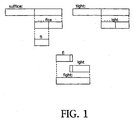
- Figure 1 illustrates the concatenative synthesis process through an example in which sound units (in this case syllables) from two different words are concatenated to form a third word. More specifically, sound units from the words "suffice” and "tight" are combined to synthesize the new word "fight.”
- sound units in this case syllables
- time-series data from the words "suffice” and “tight” are extracted, preferably at syllable boundaries, to define sound units 10 and 12 .
- sound unit 10 is further subdivided as at 14 to isolate the relevant portion needed for concatenation.
- the sound units are then aligned as at 16 so that there is an overlapping region defined by respective portions 18 and 20 .
- the time-series data are merged to synthesize the new word as at 22 .
- the present invention is particularly concerned with the overlapping region 16 , and in particular, with optimizing portions 18 and 20 so that the transition from one sound unit to the other is seamless and distortion free.
- the invention achieves this optimal overlap through an automated procedure that seeks the nuclear trajectory region within the vowel, where the speech signal follows a dynamic pattern that is nevertheless relatively stable for different examples of the same phoneme.
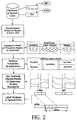
- FIG. 2 A database of speech units 30 is provided.
- the database may contain time-series data corresponding to different sound units that make up the concatenative synthesis system.
- sound units are extracted from examples of spoken words That are then subdivided at the syllable boundaries.
- two speech units 32 and 34 have been diagrammatically depicted. Sound unit 32 is extracted from the word "tight" and sound unit 34 is extracted from the word "suffice.”
- the time-series data stored in database 30 is first parameterized as at 36 .
- the sound units may be parameterized using any suitable methodology.
- the presently preferred embodiment parameterizes through formant analysis of the phoneme region within each sound unit. Formant analysis entails extracting the speech formant frequencies (the preferred embodiment extracts formant frequencies F1, F2 and F3). If desired, the RMS signal level may also be parameterized.
- speech feature extraction may be performed using a procedure such as Linear Predictive Coding (LPC) to identify and extract suitable feature parameters.
- LPC Linear Predictive Coding
- a model is constructed to represent the phoneme region of each unit as depicted at 38 .
- the presently preferred embodiment uses Hidden Markov Models for this purpose. In general, however, any suitable statistical model that represents time-varying or dynamic behavior may be used. A recurrent neural network model might be used, for example.
- the presently preferred embodiment models the phoneme region as broken up into three separate intermediary regions. These regions are illustrated at 40 and include the nuclear trajectory region 42 , the transition elements 44 preceding the nuclear region and the transition element 46 following the nuclear region.
- the preferred embodiment uses separate Hidden Markov Models for each of these three regions.
- a three-state model may be used for the preceding and following transition elements 44 and 46
- a four or five-state model can be used for the nuclear trajectory region 42 (five states are illustrated in Figure 2 ).
- Using a higher number of states for the nuclear trajectory region helps ensure that the subsequent procedure will converge on a consistent, non-null nuclear trajectory.
- the speech models 40 may be populated with average initial values. Thereafter, embedded re-estimation is performed on these models as depicted at 48 .
- Re-estimation constitutes the training process by which the models are optimized to best represent the recurring sequences within the time-series data.
- the nuclear trajectory region 42 and the preceding and following transition elements are designed such that the training process constructs consistent models for each phoneme region, based on the actual data supplied via database 30 .
- the nuclear region represents the heart of the vowel
- the preceding and following transition elements represent the aspects of the vowel that are specific to the current phoneme and the sounds that precede and follow it.
- the preceding transition element represents the coloration given to the 'ay' vowel sound by the preceding consonant 't'.
- the training process naturally converges upon optimally aligned models.
- the database of speech units 30 contains at least two, and preferably many, examples of each vowel sound.
- the vowel sound 'ay' found in both "tight" and "suffice” is represented by sound units 32 and 34 in Figure 2 .
- the embedded re-estimation process or training process uses these plural instances of the 'ay' sound to train the initial speech models 40 and thereby generate the optimally aligned speech models 50 .
- the portion of the time-series data that is consistent across all examples of the 'ay' sound represents the nucleus or nuclear trajectory region. As illustrated at 50 , the system separately trains the preceding and following transition elements. These will, of course, be different depending on the sounds that precede and follow the vowel.
- step 52 the optimally aligned models are used to determine the overlap boundaries.
- Figure 2 illustrates overlap boundaries A and B superimposed upon the formant frequency data for the sound units derived from the words "suffice" and "tight.”
- the system then labels the time-series data at step 54 to delimit the overlap boundaries in the time-series data.
- the labeled data may be stored in database 30 for subsequent use in concatenative speech synthesis.
- the overlap boundary region diagrammatically illustrated as an overlay template 56 is shown superimposed upon a diagrammatic representation of the time-series data for the word "suffice.” Specifically, template 56 is aligned as illustrated by bracket 58 within the latter syllable “...fice.” When this sound unit is used for concatenative speech, the preceding portion 62 may be discarded and the nuclear trajectory region 64 (delimited by boundaries A and B) serves as the crossfade or concatenation region.
- the time duration of the overlap region may need to be adjusted to perform concatenative synthesis.
- This process is illustrated in Figure 3 .
- the input text 70 is analyzed and appropriate speech units are selected from database 30 as illustrated at step 72 .
- the system may select previously stored speech units extracted from the words “tight” and "suffice.”
- the nuclear trajectory region of the respective speech units may not necessarily span the same amount of time.
- the time duration of the respective nuclear trajectory regions may be expanded or contracted so that their durations match.
- the nuclear trajectory region 64a is expanded to 64b .
- Sound unit B may be similarly modified.
- Figure 3 illustrates the nuclear trajectory region 64c being compressed to region 64d , so that the respective regions of the two pieces have the same time duration.
- the data from the speech units are merged at step 76 to form the newly concatenated word as at 78 .
- the invention provides an automated means for constructing speech unit databases for concatenative speech synthesis systems.
- the system affords a seamless, non-distorted overlap.
- the overlapping regions can be expanded or compressed to a common fixed size, simplifying the concatenation process.
- the nuclear trajectory region represents a portion of the speech signal where the acoustic speech properties follow a dynamic pattern that is relatively stable for different examples of the same phoneme. This stability allows for a seamless, distortion-free transition.
- the speech units generated according to the principles of the invention may be readily stored in a database for subsequent extraction and concatenation with minimal burden on the computer processing system.
- the system is ideal for developing synthesized speech products and applications where processing power is limited.
- the automated procedure for generating sound units greatly reduces the time and labor required for constructing special purpose speech unit databases, such as may be required for specialized vocabularies or for developing multi-lingual speech synthesis systems.
Landscapes
- Engineering & Computer Science (AREA)
- Computational Linguistics (AREA)
- Health & Medical Sciences (AREA)
- Audiology, Speech & Language Pathology (AREA)
- Human Computer Interaction (AREA)
- Physics & Mathematics (AREA)
- Acoustics & Sound (AREA)
- Multimedia (AREA)
- Information Retrieval, Db Structures And Fs Structures Therefor (AREA)
- Machine Translation (AREA)
- Electrically Operated Instructional Devices (AREA)
- Measurement Of Velocity Or Position Using Acoustic Or Ultrasonic Waves (AREA)
Applications Claiming Priority (2)
| Application Number | Priority Date | Filing Date | Title |
|---|---|---|---|
| US09/264,981 US6202049B1 (en) | 1999-03-09 | 1999-03-09 | Identification of unit overlap regions for concatenative speech synthesis system |
| US264981 | 1999-03-09 |
Publications (3)
| Publication Number | Publication Date |
|---|---|
| EP1035537A2 true EP1035537A2 (fr) | 2000-09-13 |
| EP1035537A3 EP1035537A3 (fr) | 2002-04-17 |
| EP1035537B1 EP1035537B1 (fr) | 2003-08-13 |
Family
ID=23008465
Family Applications (1)
| Application Number | Title | Priority Date | Filing Date |
|---|---|---|---|
| EP00301625A Expired - Lifetime EP1035537B1 (fr) | 1999-03-09 | 2000-02-29 | Identification de régions de recouvrement d'unités pour un système de synthèse de parole par concaténation |
Country Status (7)
| Country | Link |
|---|---|
| US (1) | US6202049B1 (fr) |
| EP (1) | EP1035537B1 (fr) |
| JP (1) | JP3588302B2 (fr) |
| CN (1) | CN1158641C (fr) |
| DE (1) | DE60004420T2 (fr) |
| ES (1) | ES2204455T3 (fr) |
| TW (1) | TW466470B (fr) |
Cited By (3)
| Publication number | Priority date | Publication date | Assignee | Title |
|---|---|---|---|---|
| EP1394769A3 (fr) * | 2002-03-29 | 2004-06-09 | AT&T Corp. | Segmentation automatique en synthèse de parole |
| EP1860645A3 (fr) * | 2002-03-29 | 2008-09-03 | AT&T Corp. | Segmentation automatique dans la synthèse vocale |
| CN101178896B (zh) * | 2007-12-06 | 2012-03-28 | 安徽科大讯飞信息科技股份有限公司 | 基于声学统计模型的单元挑选语音合成方法 |
Families Citing this family (27)
| Publication number | Priority date | Publication date | Assignee | Title |
|---|---|---|---|---|
| US7369994B1 (en) * | 1999-04-30 | 2008-05-06 | At&T Corp. | Methods and apparatus for rapid acoustic unit selection from a large speech corpus |
| JP2001034282A (ja) * | 1999-07-21 | 2001-02-09 | Konami Co Ltd | 音声合成方法、音声合成のための辞書構築方法、音声合成装置、並びに音声合成プログラムを記録したコンピュータ読み取り可能な媒体 |
| AU2003255914A1 (en) * | 2002-09-17 | 2004-04-08 | Koninklijke Philips Electronics N.V. | Speech synthesis using concatenation of speech waveforms |
| US7280967B2 (en) * | 2003-07-30 | 2007-10-09 | International Business Machines Corporation | Method for detecting misaligned phonetic units for a concatenative text-to-speech voice |
| US8583439B1 (en) * | 2004-01-12 | 2013-11-12 | Verizon Services Corp. | Enhanced interface for use with speech recognition |
| US20070219799A1 (en) * | 2005-12-30 | 2007-09-20 | Inci Ozkaragoz | Text to speech synthesis system using syllables as concatenative units |
| US9053753B2 (en) * | 2006-11-09 | 2015-06-09 | Broadcom Corporation | Method and system for a flexible multiplexer and mixer |
| EP2279507A4 (fr) * | 2008-05-30 | 2013-01-23 | Nokia Corp | Procédé, appareil et programme informatique pour fournir une synthèse améliorée de la parole |
| US8315871B2 (en) * | 2009-06-04 | 2012-11-20 | Microsoft Corporation | Hidden Markov model based text to speech systems employing rope-jumping algorithm |
| US8438122B1 (en) | 2010-05-14 | 2013-05-07 | Google Inc. | Predictive analytic modeling platform |
| US8473431B1 (en) | 2010-05-14 | 2013-06-25 | Google Inc. | Predictive analytic modeling platform |
| JP5699496B2 (ja) * | 2010-09-06 | 2015-04-08 | ヤマハ株式会社 | 音合成用確率モデル生成装置、特徴量軌跡生成装置およびプログラム |
| US8595154B2 (en) | 2011-01-26 | 2013-11-26 | Google Inc. | Dynamic predictive modeling platform |
| US8533222B2 (en) * | 2011-01-26 | 2013-09-10 | Google Inc. | Updateable predictive analytical modeling |
| US8533224B2 (en) * | 2011-05-04 | 2013-09-10 | Google Inc. | Assessing accuracy of trained predictive models |
| US8489632B1 (en) * | 2011-06-28 | 2013-07-16 | Google Inc. | Predictive model training management |
| JP5888013B2 (ja) | 2012-01-25 | 2016-03-16 | 富士通株式会社 | ニューラルネットワーク設計方法、プログラム及びデジタルアナログフィッティング方法 |
| JP6524674B2 (ja) * | 2015-01-22 | 2019-06-05 | 富士通株式会社 | 音声処理装置、音声処理方法および音声処理プログラム |
| JP6235763B2 (ja) * | 2015-05-28 | 2017-11-22 | 三菱電機株式会社 | 入力表示装置、入力表示方法及び入力表示プログラム |
| CN106611604B (zh) * | 2015-10-23 | 2020-04-14 | 中国科学院声学研究所 | 一种基于深度神经网络的自动语音叠音检测方法 |
| KR102313028B1 (ko) * | 2015-10-29 | 2021-10-13 | 삼성에스디에스 주식회사 | 음성 인식 시스템 및 방법 |
| RU2698153C1 (ru) | 2016-03-23 | 2019-08-22 | ГУГЛ ЭлЭлСи | Адаптивное улучшение аудио для распознавания многоканальной речи |
| WO2017168252A1 (fr) * | 2016-03-31 | 2017-10-05 | Maluuba Inc. | Procédé et système de traitement d'une requête d'entrée |
| MX2020012276A (es) | 2018-05-14 | 2021-01-29 | Quantum Si Inc | Sistemas y metodos para unificar modelos estadisticos para diferentes modalidades de datos. |
| US11967436B2 (en) | 2018-05-30 | 2024-04-23 | Quantum-Si Incorporated | Methods and apparatus for making biological predictions using a trained multi-modal statistical model |
| US11971963B2 (en) | 2018-05-30 | 2024-04-30 | Quantum-Si Incorporated | Methods and apparatus for multi-modal prediction using a trained statistical model |
| CN112513990A (zh) * | 2018-05-30 | 2021-03-16 | 宽腾矽公司 | 使用经训练的统计模型进行多模态预测的方法和装置 |
Family Cites Families (7)
| Publication number | Priority date | Publication date | Assignee | Title |
|---|---|---|---|---|
| US5400434A (en) * | 1990-09-04 | 1995-03-21 | Matsushita Electric Industrial Co., Ltd. | Voice source for synthetic speech system |
| KR940002854B1 (ko) * | 1991-11-06 | 1994-04-04 | 한국전기통신공사 | 음성 합성시스팀의 음성단편 코딩 및 그의 피치조절 방법과 그의 유성음 합성장치 |
| US5349645A (en) * | 1991-12-31 | 1994-09-20 | Matsushita Electric Industrial Co., Ltd. | Word hypothesizer for continuous speech decoding using stressed-vowel centered bidirectional tree searches |
| US5490234A (en) * | 1993-01-21 | 1996-02-06 | Apple Computer, Inc. | Waveform blending technique for text-to-speech system |
| US5751907A (en) | 1995-08-16 | 1998-05-12 | Lucent Technologies Inc. | Speech synthesizer having an acoustic element database |
| US5684925A (en) * | 1995-09-08 | 1997-11-04 | Matsushita Electric Industrial Co., Ltd. | Speech representation by feature-based word prototypes comprising phoneme targets having reliable high similarity |
| US5913193A (en) * | 1996-04-30 | 1999-06-15 | Microsoft Corporation | Method and system of runtime acoustic unit selection for speech synthesis |
-
1999
- 1999-03-09 US US09/264,981 patent/US6202049B1/en not_active Expired - Lifetime
-
2000
- 2000-02-29 DE DE60004420T patent/DE60004420T2/de not_active Expired - Fee Related
- 2000-02-29 ES ES00301625T patent/ES2204455T3/es not_active Expired - Lifetime
- 2000-02-29 EP EP00301625A patent/EP1035537B1/fr not_active Expired - Lifetime
- 2000-03-09 JP JP2000065106A patent/JP3588302B2/ja not_active Expired - Fee Related
- 2000-03-09 CN CNB001037595A patent/CN1158641C/zh not_active Expired - Fee Related
- 2000-04-10 TW TW089104179A patent/TW466470B/zh not_active IP Right Cessation
Cited By (7)
| Publication number | Priority date | Publication date | Assignee | Title |
|---|---|---|---|---|
| EP1394769A3 (fr) * | 2002-03-29 | 2004-06-09 | AT&T Corp. | Segmentation automatique en synthèse de parole |
| US7266497B2 (en) | 2002-03-29 | 2007-09-04 | At&T Corp. | Automatic segmentation in speech synthesis |
| EP1860645A3 (fr) * | 2002-03-29 | 2008-09-03 | AT&T Corp. | Segmentation automatique dans la synthèse vocale |
| EP1860646A3 (fr) * | 2002-03-29 | 2008-09-03 | AT&T Corp. | Segmentation automatique dans la synthèse vocale |
| US7587320B2 (en) | 2002-03-29 | 2009-09-08 | At&T Intellectual Property Ii, L.P. | Automatic segmentation in speech synthesis |
| US8131547B2 (en) | 2002-03-29 | 2012-03-06 | At&T Intellectual Property Ii, L.P. | Automatic segmentation in speech synthesis |
| CN101178896B (zh) * | 2007-12-06 | 2012-03-28 | 安徽科大讯飞信息科技股份有限公司 | 基于声学统计模型的单元挑选语音合成方法 |
Also Published As
| Publication number | Publication date |
|---|---|
| EP1035537B1 (fr) | 2003-08-13 |
| JP3588302B2 (ja) | 2004-11-10 |
| US6202049B1 (en) | 2001-03-13 |
| TW466470B (en) | 2001-12-01 |
| ES2204455T3 (es) | 2004-05-01 |
| DE60004420T2 (de) | 2004-06-09 |
| CN1266257A (zh) | 2000-09-13 |
| JP2000310997A (ja) | 2000-11-07 |
| CN1158641C (zh) | 2004-07-21 |
| DE60004420D1 (de) | 2003-09-18 |
| EP1035537A3 (fr) | 2002-04-17 |
Similar Documents
| Publication | Publication Date | Title |
|---|---|---|
| US6202049B1 (en) | Identification of unit overlap regions for concatenative speech synthesis system | |
| USRE39336E1 (en) | Formant-based speech synthesizer employing demi-syllable concatenation with independent cross fade in the filter parameter and source domains | |
| Black et al. | Generating F/sub 0/contours from ToBI labels using linear regression | |
| US6266637B1 (en) | Phrase splicing and variable substitution using a trainable speech synthesizer | |
| KR100811568B1 (ko) | 대화형 음성 응답 시스템들에 의해 스피치 이해를 방지하기 위한 방법 및 장치 | |
| US20020193994A1 (en) | Text selection and recording by feedback and adaptation for development of personalized text-to-speech systems | |
| US20050119890A1 (en) | Speech synthesis apparatus and speech synthesis method | |
| US20050149330A1 (en) | Speech synthesis system | |
| JP4038211B2 (ja) | 音声合成装置,音声合成方法および音声合成システム | |
| CN110459202A (zh) | 一种韵律标注方法、装置、设备、介质 | |
| Savargiv et al. | Study on unit-selection and statistical parametric speech synthesis techniques | |
| JPH08335096A (ja) | テキスト音声合成装置 | |
| EP1543500B1 (fr) | Synthese vocale par concatenation d'ondes acoustiques | |
| Valentini-Botinhao et al. | Intelligibility of time-compressed synthetic speech: Compression method and speaking style | |
| EP1589524B1 (fr) | Procédé et dispositif pour la synthèse de la parole | |
| EP1640968A1 (fr) | Procédé et dispositif pour la synthèse de la parole | |
| Oliver et al. | Creation and analysis of a Polish speech database for use in unit selection synthesis. | |
| Teixeira et al. | Automatic system of reading numbers | |
| JP3241582B2 (ja) | 韻律制御装置及び方法 | |
| Hinterleitner | Speech synthesis | |
| Szklanny et al. | Automatic segmentation quality improvement for realization of unit selection speech synthesis | |
| Latacz et al. | Novel textto-speech reading modes for educational applications | |
| Lutfi et al. | Adding Emotions to Malay Synthesized Speech Using Diphone-based templates | |
| Fernandez et al. | The 2006 TCSTAR evaluation of the IBM text-to-speech synthesis system | |
| Esquerra Llucià et al. | A bilingual Spanish-Catalan database of units for concatenative synthesis |
Legal Events
| Date | Code | Title | Description |
|---|---|---|---|
| PUAI | Public reference made under article 153(3) epc to a published international application that has entered the european phase |
Free format text: ORIGINAL CODE: 0009012 |
|
| 17P | Request for examination filed |
Effective date: 20000329 |
|
| AK | Designated contracting states |
Kind code of ref document: A2 Designated state(s): AT BE CH CY DE DK ES FI FR GB GR IE IT LI LU MC NL PT SE Kind code of ref document: A2 Designated state(s): DE ES FR GB IT |
|
| AX | Request for extension of the european patent |
Free format text: AL;LT;LV;MK;RO;SI |
|
| RAP1 | Party data changed (applicant data changed or rights of an application transferred) |
Owner name: MATSUSHITA ELECTRIC INDUSTRIAL CO., LTD. |
|
| PUAL | Search report despatched |
Free format text: ORIGINAL CODE: 0009013 |
|
| AK | Designated contracting states |
Kind code of ref document: A3 Designated state(s): AT BE CH CY DE DK ES FI FR GB GR IE IT LI LU MC NL PT SE |
|
| AX | Request for extension of the european patent |
Free format text: AL;LT;LV;MK;RO;SI |
|
| AKX | Designation fees paid |
Free format text: DE ES FR GB IT |
|
| GRAH | Despatch of communication of intention to grant a patent |
Free format text: ORIGINAL CODE: EPIDOS IGRA |
|
| GRAH | Despatch of communication of intention to grant a patent |
Free format text: ORIGINAL CODE: EPIDOS IGRA |
|
| GRAA | (expected) grant |
Free format text: ORIGINAL CODE: 0009210 |
|
| AK | Designated contracting states |
Designated state(s): DE ES FR GB IT |
|
| REG | Reference to a national code |
Ref country code: GB Ref legal event code: FG4D |
|
| REG | Reference to a national code |
Ref country code: IE Ref legal event code: FG4D |
|
| REF | Corresponds to: |
Ref document number: 60004420 Country of ref document: DE Date of ref document: 20030918 Kind code of ref document: P |
|
| REG | Reference to a national code |
Ref country code: ES Ref legal event code: FG2A Ref document number: 2204455 Country of ref document: ES Kind code of ref document: T3 |
|
| ET | Fr: translation filed | ||
| PLBE | No opposition filed within time limit |
Free format text: ORIGINAL CODE: 0009261 |
|
| STAA | Information on the status of an ep patent application or granted ep patent |
Free format text: STATUS: NO OPPOSITION FILED WITHIN TIME LIMIT |
|
| 26N | No opposition filed |
Effective date: 20040514 |
|
| REG | Reference to a national code |
Ref country code: IE Ref legal event code: MM4A |
|
| PGFP | Annual fee paid to national office [announced via postgrant information from national office to epo] |
Ref country code: DE Payment date: 20070222 Year of fee payment: 8 |
|
| PGFP | Annual fee paid to national office [announced via postgrant information from national office to epo] |
Ref country code: ES Payment date: 20070228 Year of fee payment: 8 Ref country code: GB Payment date: 20070228 Year of fee payment: 8 |
|
| PGFP | Annual fee paid to national office [announced via postgrant information from national office to epo] |
Ref country code: IT Payment date: 20070529 Year of fee payment: 8 |
|
| PGFP | Annual fee paid to national office [announced via postgrant information from national office to epo] |
Ref country code: FR Payment date: 20070208 Year of fee payment: 8 |
|
| GBPC | Gb: european patent ceased through non-payment of renewal fee |
Effective date: 20080229 |
|
| REG | Reference to a national code |
Ref country code: FR Ref legal event code: ST Effective date: 20081031 |
|
| PG25 | Lapsed in a contracting state [announced via postgrant information from national office to epo] |
Ref country code: DE Free format text: LAPSE BECAUSE OF NON-PAYMENT OF DUE FEES Effective date: 20080902 |
|
| PG25 | Lapsed in a contracting state [announced via postgrant information from national office to epo] |
Ref country code: FR Free format text: LAPSE BECAUSE OF NON-PAYMENT OF DUE FEES Effective date: 20080229 |
|
| REG | Reference to a national code |
Ref country code: ES Ref legal event code: FD2A Effective date: 20080301 |
|
| PG25 | Lapsed in a contracting state [announced via postgrant information from national office to epo] |
Ref country code: GB Free format text: LAPSE BECAUSE OF NON-PAYMENT OF DUE FEES Effective date: 20080229 |
|
| PG25 | Lapsed in a contracting state [announced via postgrant information from national office to epo] |
Ref country code: ES Free format text: LAPSE BECAUSE OF NON-PAYMENT OF DUE FEES Effective date: 20080301 |
|
| PG25 | Lapsed in a contracting state [announced via postgrant information from national office to epo] |
Ref country code: IT Free format text: LAPSE BECAUSE OF NON-PAYMENT OF DUE FEES Effective date: 20080229 |