EP1035703B1 - Procédé et dispositif pour repartition de charge dans un réseau étendu - Google Patents
Procédé et dispositif pour repartition de charge dans un réseau étendu Download PDFInfo
- Publication number
- EP1035703B1 EP1035703B1 EP00301561A EP00301561A EP1035703B1 EP 1035703 B1 EP1035703 B1 EP 1035703B1 EP 00301561 A EP00301561 A EP 00301561A EP 00301561 A EP00301561 A EP 00301561A EP 1035703 B1 EP1035703 B1 EP 1035703B1
- Authority
- EP
- European Patent Office
- Prior art keywords
- redirector
- server
- servers
- requests
- delay
- Prior art date
- Legal status (The legal status is an assumption and is not a legal conclusion. Google has not performed a legal analysis and makes no representation as to the accuracy of the status listed.)
- Expired - Lifetime
Links
Images
Classifications
-
- H—ELECTRICITY
- H04—ELECTRIC COMMUNICATION TECHNIQUE
- H04L—TRANSMISSION OF DIGITAL INFORMATION, e.g. TELEGRAPHIC COMMUNICATION
- H04L67/00—Network arrangements or protocols for supporting network services or applications
- H04L67/01—Protocols
- H04L67/10—Protocols in which an application is distributed across nodes in the network
- H04L67/1001—Protocols in which an application is distributed across nodes in the network for accessing one among a plurality of replicated servers
- H04L67/1004—Server selection for load balancing
- H04L67/1008—Server selection for load balancing based on parameters of servers, e.g. available memory or workload
-
- H—ELECTRICITY
- H04—ELECTRIC COMMUNICATION TECHNIQUE
- H04L—TRANSMISSION OF DIGITAL INFORMATION, e.g. TELEGRAPHIC COMMUNICATION
- H04L67/00—Network arrangements or protocols for supporting network services or applications
- H04L67/01—Protocols
- H04L67/10—Protocols in which an application is distributed across nodes in the network
- H04L67/1001—Protocols in which an application is distributed across nodes in the network for accessing one among a plurality of replicated servers
-
- H—ELECTRICITY
- H04—ELECTRIC COMMUNICATION TECHNIQUE
- H04L—TRANSMISSION OF DIGITAL INFORMATION, e.g. TELEGRAPHIC COMMUNICATION
- H04L67/00—Network arrangements or protocols for supporting network services or applications
- H04L67/01—Protocols
- H04L67/10—Protocols in which an application is distributed across nodes in the network
- H04L67/1001—Protocols in which an application is distributed across nodes in the network for accessing one among a plurality of replicated servers
- H04L67/1004—Server selection for load balancing
- H04L67/101—Server selection for load balancing based on network conditions
-
- H—ELECTRICITY
- H04—ELECTRIC COMMUNICATION TECHNIQUE
- H04L—TRANSMISSION OF DIGITAL INFORMATION, e.g. TELEGRAPHIC COMMUNICATION
- H04L67/00—Network arrangements or protocols for supporting network services or applications
- H04L67/01—Protocols
- H04L67/10—Protocols in which an application is distributed across nodes in the network
- H04L67/1001—Protocols in which an application is distributed across nodes in the network for accessing one among a plurality of replicated servers
- H04L67/1004—Server selection for load balancing
- H04L67/1012—Server selection for load balancing based on compliance of requirements or conditions with available server resources
-
- H—ELECTRICITY
- H04—ELECTRIC COMMUNICATION TECHNIQUE
- H04L—TRANSMISSION OF DIGITAL INFORMATION, e.g. TELEGRAPHIC COMMUNICATION
- H04L67/00—Network arrangements or protocols for supporting network services or applications
- H04L67/01—Protocols
- H04L67/10—Protocols in which an application is distributed across nodes in the network
- H04L67/1001—Protocols in which an application is distributed across nodes in the network for accessing one among a plurality of replicated servers
- H04L67/1034—Reaction to server failures by a load balancer
Definitions
- This invention relates to apparatus and methods for use in a system which system processes client requests through at least one redirector to a plurality of servers connected on a communications network.
- logical items such as the web documents, or objects
- physical devices such as web servers, cache servers, ftp servers, etc.
- This mapping takes as an input the access rates of each web document, the number of replicas of these web documents that need to be made on the physical devices, such as document servers or caches, and the capacity of each of the physical devices, and produces a mapping between the web documents and the physical devices.
- any change in the system parameters that affects the load balance is handled using a network flow load balance algorithm to determine new probabilities (or weights) with which the redirection server will then thereafter redirect requests from/to web documents to one of the physical devices to which they are mapped.
- the load is re-balanced by changing the probability with which requests to each replicated web document is redirected to one of the plurality of physical devices to which that physical item is mapped.
- parameters that may change in the system include the load on each physical device and the capacity of each of the physical devices, the latter of which can instantly become zero upon the failure of a device.
- the goal of load balancing, as described, is to balance across all physical devices the sum of the access rates of requests to the web documents redirected to each physical device.
- the latency, or delay, incurred in providing a response from a physical device to a request for a web document made by a client has not been previously considered.
- minimization of request latency on a wide area network is the goal rather than pure load balancing.
- the load sharing methodology of the present invention minimizes delay by determining the probabilities, or weights with which web requests are redirected over the wide area network to the web servers so as to minimize the average delay of all connections across all servers per unit of time.
- Such redirection to the different servers is effected as a function of a logical item, the logical item being the factor that the redirector uses in determining where and with what weights the request is to be directed.
- the network delay associated with accessing a server and the server delay, which itself is a function of the access rate on that server, are taken into account
- the following are determined: (1) the access rates, which are equal to the number of requests per unit time associated with each redirector-logical item pair; (2) the network delay, which is equal to the sum of the propagation and the transmission delays between the client and the server; and (3) the server delays incurred in processing a web request.
- a/k/a hot sites are mapped to particular caching servers dispersed in a wide area network, with each hot site being mapped to one or more caching servers.
- Statistics of access rates to each hot site are dynamically determined by each redirector in the network from the traffic flow and reported to a central management station (CMS).
- CMS central management station
- Network delay is similarly measured by each redirector and reported to the CMS and server delay at each server is computed using a queuing model of each server.
- the CMS solves a network flow problem to determine the weights with which each redirector will then probabilistically forward requests for a hot site to the different plural servers which are responsible for that requested site.
- the CMS using the network flow algorithm, recalculates the weights and forwards the adjusted weights back to each redirector.
- the weights with which each redirector forwards requests for specific documents to a particular server are therefore continually modified in a manner that minimizes the average delay based on the most recent access rate, network delay and server delay statistics.
- the present invention is illustrated below in conjunction with exemplary client/server connections established over the Internet using the Transmission Control Protocol/Internet Protocol (TCP/IP) standard. It should be understood, however, that the invention is not limited to use with any particular type of network or network communication protocol. The disclosed techniques are suitable for use with a wide variety of other networks and protocols.
- the term "web” as used herein is intended to include the World Wide Web, other portions of the Internet, or other types of communication networks.
- client request refers to any communication from a client which includes a request for information from a server. A given request may include multiple packets or only a single packet, depending on the nature of the request.
- the term "document” as used herein is intended to include web pages, portions of web pages, computer files, or other type of data including audio, video and image data.
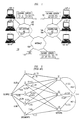
- FIG. 1 shows an exemplary web server system 100 in accordance with an illustrative embodiment of the invention.
- the system includes a first redirection server R1 (101) local to local area network 102 and a second redirection server R2 (103) local to local area network 104.
- Local area networks 102 and 104 are separated and connected over a wide area network (Internet 105).
- a plurality of clients, 106-1 - 106-N are connected to local area network 102 and a plurality of clients, 107-1 - 107-M, are connected to local area network 104. All requests for web documents made by clients 106-1 - 106-N are passed through their local redirection server 101 and redirected to a caching server on system 100.
- a first caching server S1 (110) is connected local to local area network 102
- a second caching server S2 (111) is connected to the wide area network Internet 105
- a third caching server S3 (112) is connected to local area network 104.
- each of these caching servers is responsible for particular hot sites, or web sites to which a large number of client requests are directed.
- Each caching server is responsible for one or more of such hot sites and each such hot site may be associated with more than one of the caching servers.
- system 100 communication between clients and caching servers is effected over TCP/IP connections established over a network in a conventional manner.
- Each of the elements of system 100 may include a processor and a memory.
- the system 100 is suitable for implementing Hypertext Transfer Protocol (HTTP)- based network services on the Internet in a manner well known to one skilled in the art.
- HTTP Hypertext Transfer Protocol
- a client may generate an HTTP request for a particular web document on a hot site by designating a uniform resource locator (URL) of that document at the domain name of the hot site.
- URL uniform resource locator
- Such a request is passed through the requesting client's local redirection server and redirected to one of the caching servers, S1, S2 or S3, which is responsible for that hot site.
- a TCP/IP connection is then established between the requesting client and the particular caching server responsible for that hot site as selected by the local redirection server. If the particular requested document is available at that caching server, it is supplied to the requesting client. If not, a separate TCP/IP connection is established by the caching server to the actual hot site from where a copy of the requested web document is obtained and forwarded to the client.
- a load distribution algorithm for determining an initial distribution of a set of documents across servers and a determination of the probabilities, or weights, with which a redirector server should redirect requests to those particular servers that contain a replica of a requested document.
- Such load distribution is undertaken to balance the load on the set of servers where the definition of load balance is that the sum of access rates of requests to the documents redirected to each of the servers containing the documents is balanced across all the servers.
- an initial distribution algorithm uses as input the access rates of each document, the number of replicas of these documents that need to be made on the servers, and the capacity of each server, an initial distribution algorithm, described in the aforenoted co-pending application, produces a mapping between the documents and the servers as well as producing as output the probabilities (or weights) to be used by a redirecting server to redirect requests from/to replicated documents to one of the severs to which they are mapped to achieve the desired load balance.
- FIG. 2 shows a flow network model in the co-pending patent application between a source and a sink for five documents, numbered 1 - 5 distributed on three servers, S1, S2 and S3, which each have equal scaled capacities of 333.
- the flow network is of a type described in, for example, R. K. Ahuja et al., "Network Flows: Theory, Algorithms and Applications", Prentice Hall, 1993.
- the scaled access rates to each of the documents, totaling 1, are shown on the five arcs between the source node and the redirector/document nodes. These access rates represent the probabilistic proportion of requests arriving at the redirector for each of the five documents.
- server S1 has stored replicas of document 1, 2, 3 and 4
- server S2 has stored replicas of documents 1, 2, 4 and 5
- server S3 has stored replicas of documents 2, 3 and 5.
- the numbers on the arcs between the redirector/document nodes and the servers nodes represent the network flow solution for dividing the incoming access rate to the redirector/document nodes for each document to the servers that contain the document so that the total load to the servers S1, S2 and S3 is balanced.
- the redundant arcs from the servers to the sink represent arcs that have infinite capacity but have a "high" cost associated with them. The cost on all the other arcs is equal to zero.
- the "high" cost arcs are used for overflows that may result when a change occurs in the system.
- the distribution represented in FIG. 2 is a maximum-flow minimum-cost solution to the corresponding network flow problem that models the load balancing problem which must be solved to determine the desired solution.
- the solution is obtained using the mathematical language AMPL as described by R. Fourer et al., "AMPL: A Modeling Language for Mathematical Programming," The Scientific Press, 1993, in conjunction with a non-linear program solver such as MINOS.
- the numbers on the arcs between the redirector/document nodes and the server nodes represent the portions of the access rates for each document that are redirected to each server that contains the document. Thus, for example 0.175 of the 0.35 access rate requests for document 1 is redirected to server S1, and a similar portion is redirected to server S2.
- requests for document 1 received by the redirector should be redirected to servers S1 and S2 with equal weights or probabilities.
- 0.113 of the 0.5 access rate for document 2 should be redirected to server S1
- 0.108 of the 0.5 access rate should be redirected to server S2
- 0.279 of the 0.5 access rate should be redirected to server S3.
- the corresponding weights, or probabilities, for redirection of a request for document 2 are thus 0.226, 0.216 and 0.558 for servers S1, S2 and S3, respectively.
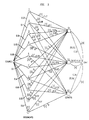
- FIG. 3 models the same web server system as in FIG. 2, but includes two redirectors, as in the system of FIG. 1.
- redirector/document nodes 1 through 5 now represent requests for documents 1 through 5, respectively, which are redirected to the servers S1, S2 and S3 by redirector 1
- redirector/document nodes 1' through 5' represent requests for documents 1 through 5, respectively, which are redirected to the servers S1, S2 and S3 by redirector 2.
- the scaled access rate of each document is now, however, divided between the two redirectors.
- the scaled access rate for document 1 which in FIG. 2 is 0.35, is divided between the two redirectors so that the access rate to document 1 redirected through redirector 1 is 0.25 and the access rate redirected through redirector 2 is 0.1.
- the access rates for document 2 through redirectors 1 and 2 are 0.1 and 0.4, respectively; for document 3 through redirectors 1 and 2 are 0.04 and 0.01, respectively; for document 4 through redirectors 1 and 2 they are each 0.02; and for document 5 through redirects 1 and 2 they are 0.05 and 0.01, respectively.
- redirector 1 should redirect requests for a document to server S1 if it is available there and redirect requests for a document to server S2 and then S3 only if the capacity of S1 is exceeded.
- costs are assigned to the arcs between the redirector/document nodes and the server nodes according to the distance between the redirector and the server. For example, requests for document 2 from redirector 1, if redirected to nearby server S1 are designated as having a cost per unit flow of 1, if redirected to mid-distance server S2 are designated as having a cost per unit flow of 2, and if redirected to distant server S3 are designated as having a cost per unit flow of 3. These same costs are assigned between the other redirector/document nodes associated with redirector 1 and the three servers.
- redirector 2 is considered local to server S3, as shown in FIG. 1, is separated from S2 by a mid-range distance, and is separated from S1 by a long distance.
- the numerals in the square parentheses represent the costs on the arcs between the redirector/document nodes and the server nodes that contain replicas of the documents.
- the cost on the overflow arcs from the servers to the sink needs to be carefully controlled. If load balance is the primary objective, then the costs on these arcs are chosen such that they are larger than the largest cost on the arcs that connect the redirector/document nodes to the server nodes. Otherwise, the network solution will lead to redirecting a flow to a close proximity device even if the load balance condition is violated as opposed to redirecting the flow to a device that is further away without violating the load balance requirement.
- the cost on the overflow arc from node S1 to the sink is chosen to be between 2 and 3, for all documents that are available in S1 and S3, redirector 1 will deterministically send the request to S1 possibly overflowing the capacity of server S1 even if server S3 has spare capacity. If the cost on the overflow arc is less than 2, requests for documents available on S1 and elsewhere will always be sent to S1 even if it overflows the capacity of S1. Where load balance is the primary objective, therefore, the costs on the overflow arcs are chosen to be 4, which is larger than the cost on any of the arcs between the redirector/document nodes and the server nodes.
- the redirection probabilities, or weights, with which a request is forwarded to a particular server that has a stored copy of the requested document can be determined.
- the flow on the arc from the redirector 1/document 1 node to S1 specifies that of the 0.25 units of scaled flow for the document 1/redirector 1 pair, 0.17 units should be redirected to server S1.
- a request for document 1 arrives at redirector 1, with a probability of 0.17/0.25, it will be directed to server S1 and with probability 0.08/0.25 it will be directed to server S2.
- FIG. 1 is the network model of a preferred embodiment of this invention. As previously noted, hot sites rather than individual documents are mapped to servers S1, S2 and S3, which, in this embodiment, are proxy cache devices.
- the network delay which is the sum of the round-trip propagation and the transmission delays, is modeled by specifying them in the network flow model as costs on the arcs from the redirector/logical item nodes to the proxy cache server nodes, where the logical items are the different cached hot sites.
- the links from the proxy cache server nodes to the sink have a cost associated with them which is a function of the flow through these links. This cost models the device delay.
- the capacities of these links are not now used to specify a balance of load among the server devices, but to specify a limit on the average number of connections per time unit sent to the server device above which the connections may be dropped.
- the proxy cache server delay and the capacity of the proxy cache server are calculated using a queuing model.
- the caching server is modeled as an M / M / 1 / K queue to which connection requests arrive with a Poisson arrival rate.
- the service time at the device is exponentially distributed.
- Server capacity is determined by the allowed dropping probability of connection requests.
- a connection request arrives at a server, the request is dropped if there already are K connections being served by the server.
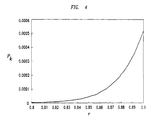
- the probability that an arriving request sees K existing connections at the server is given by P K .
- the load sharing algorithm is illustrated using an example applied to the proxy caching hot site network arrangement of FIG. 1.
- the queuing module previously discussed is used to compute the server delay at each proxy caching server.
- This server delay will be a function of the amount of flow sent to that server (which represents the number of connection requests per time unit sent to that server).
- the maximum flow that can be sent to a server (which represents the maximum rate at which connection requests are redirected to a server) such that the specified condition on the connection dropping probability is satisfied is also computed.
- the maximum number of simultaneous connections that can be handled by a proxy caching server ( K ) is set to 50. This means that if the proxy caching server is handling HTTP requests, it can handle 50 such requests simultaneously. It drops extra connection requests that come in if it is already handling 50 requests.
- the maximum connection loss probability, P d is set to be 0.0001, which means that on an average only 1 in 10000 connections is not completed and is dropped at the server.
- the maximum flow F that can be sent to that server can be computed.
- the service rate ⁇ at a server specifies the rate at which HTTP connection requests are satisfied. Assuming that on an average each object is 4K bytes and that proxy servers are connected through a 10 Mbit/sec ethernet, it can be reasonably assumed that the bottleneck is the bandwidth of the network and not the CPU performance. Then, to transmit a 4K byte object over a 10 Mbit/sec network requires 3.2 ⁇ 10 -3 seconds, which means that the service rate ⁇ is 1 / 3.2 ⁇ 10 -3 ⁇ 312. Thus, the proxy cache server can handle approximately 312 HTTP connection requests per second.
- the server delay as a function of the flow ⁇ sent to the cache is given by Equation (1) above.
- the server delay R( ⁇ ) is given by: For purposes of the example, it is assumed that the network delay from redirector 101 to nearby caching server S1 on the same local network is 10 ms, to mid-distance caching server S2 on the Internet 105 is 40 ms, and to caching server S3 on the distant local network 104 is 200 ms. Similarly, the network delay from redirector 103 to nearby caching server S3 is assumed to be 10 ms, to mid-distance caching server S2, 40 ms, and to distant caching server S1, 200 ms.
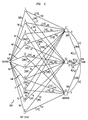
- FIG. 5 illustrates a network flow model 500 of the server system 100 in FIG. 1 in which the parameter values noted above have been incorporated.
- caching server S1 is responsible for hot sites 1, 2, 3 and 5;
- caching server S2 is responsible for hot sites 1, 3, 4 and 5;
- caching server S3 is responsible for hot sites 2, 3 and 5.
- This mapping is noted in FIG. 1 within the S1, S2 and S3 caching servers. This is parallel to the mapping of documents on the three servers used in conjunction with the description of FIG. 2 for load balancing. From source 501, a total of 800 connection requests per second are generated for all hot sites.
- the requests flowing through redirector 101 are represented by the arcs between the source 501 and the redirector/hot site nodes 1 - 5 and the requests flowing through redirector 103 are represented by the arcs between the source 501 and the redirector/hot site nodes 1' - 5'.
- the numbers associated with the arcs from source 501 to the redirector/hot site nodes 1 - 5, and 1' - 5' specify the connection requests flowing through each respective redirector to each hot site.
- the cost representing the network delays are shown in the square brackets on the arcs between each redirector/hot site node and the server nodes.
- Each caching server is assumed, as noted above, to support up to 50 connections per time unit without dropping any connections. If more requests are directed to these devices, then some connections may be dropped.
- the cost parameter chosen for these arcs should be chosen to be a larger number than the cost on all other arcs.
- the server delay at the proxy caches shown as the cost on the arcs between each proxy cache server and the sink 502, is given by R( ⁇ 1 ), R( ⁇ 2 ), and R( ⁇ 3 ), where ⁇ i is equal to the connection requests directed to caching server Si and R( ⁇ i ) is calculated using equation (4).
- the model in FIG. 5 is solved using the aforenoted AMPL mathematical programming language and the MINOS non-linear program solver with a goal of finding a solution to the non-linear problem such that the average response time for all of the 800 connections arriving per second is minimized.
- AMPL is a mathematical programming language that can be used to specify different optimization problems. It is used here to specify a minimum cost network flow optimization problem.
- the load sharing network flow model of FIG. 5 can be modeled using the program shown in Appendix 1.
- the program defines the nodes in lines 101 -103, the connectivity of the node in lines 104 - 106, specifies that the flow in must equal the flow out at line 107, specifies various criteria line 108-113, the function to be minimized in line 114 (postulated in the program as a minimization of total cost), and the different constraints of the problem in lines 115 - 118.
- the different parameters of this network such as the number of hot sites, the number of redirectors and the number of proxy cache servers can be varied by specifying them in a data file with which the program is associated. Further, the input parameters of the model such as access rates, delays and capacities are also specified in this data file.
- the data file for the example in FIG. 5 is shown in Appendix 2.
- the AMPL environment takes the model file and data file and uses one of several different solvers to solve the optimization problem depending on the nature of the problem.
- the MINOS solver is used to solve the problem.
- the output of the solver provides the flow on each link between the redirector/hot-site nodes to the server. These flow values, noted on these arcs are then used by the redirectors to determine the probability or weights with which a request for a hot site is redirected by that redirector to a particular proxy cache server that is responsible for that requested hot site.
- the solution indicates that 123 requests are redirected to caching server S1 and 77 requests are redirected to caching server S2. This means that when a subsequent request for hot site 1 arrives at redirector 1, it should be redirected to server S1 with a probability of 123/200 and to S2 with a probability of 77/200. Similarly, when a subsequent request for hot site 5 arrives at redirector 2, it is redirected to server S2 with a probability of 33/56 and to server S3 with probability 23/56.
- the solution illustrated in FIG. 5 results in all the other requests arriving at a redirector being redirected to the closest server.
- All the requests that do arrive at server S2 in the example are those that cannot be served at a closer server because a) the request hot site is not cached at the closer server; or b) redirecting the request to the closer server will violate its capacity requirement.
- the flow, the ⁇ values, going into each server are shown on the arcs from the server nodes to the sink node 502. The capacity of each such node is shown on these same arcs in the curved parentheses.
- servers S1 and S3 are filled to their capacity while server S2 still has some spare capacity available.
- the load is now not balanced but shared among the servers such that the average delay is minimized.
- the total minimized delay of all the 800 connections is calculated to be 15860 ms for an average delay of 19.825 ms per connection.
- the number of connections redirected to each device is noted to be less than or equal to the maximum number of connections that can be handled and thus the condition on the probability of dropped connections is satisfied.
- a connection management station (CMS) 115 performs a network flow computation to calculate the weights with which redirectors 101 and 103 will redirect further incoming requests for one of the five numbered hot sites. Once the calculation is performed, the resultant weight values are sent back to the appropriate redirector over, for example, a TCP/IP connection.
- CMS 115 is shown connected to the Internet 105 but in actuality can be connected anywhere on the network in FIG. 1, such as on local network 102 or on local network 104. In order for the CMS 115 to perform a network flow calculation it periodically collects access rate and network delay information from redirectors 101 and 103 and server delay information from the caching proxy servers S1, S2 and S3.
- Access rate information to each hot site is determined by each redirector by associating the destination address in the SYN packets with a set of hot site IP addresses. Alternatively, this information can be collected by examining, at the redirectors, the HOST field in the GET packets.
- redirector 101 In the network configuration of FIG. 1 in which redirector 101 is local to clients 106-1- 106-N and redirector 103 is local to clients 107-1 - 107-M, the redirectors do not have to treat traffic from different local clients in different manners. Network delay can therefore be accounted for by just considering the delay from a each redirector to each of the different caching servers. For a symmetric flow of traffic in which packets from the clients to the caching servers and from the caching servers to the clients flow through the redirector, network delay can be tracked by each redirector by computing the time between redirecting a SYN packet to a particular caching server and receiving the corresponding SYN ACK packet back from that server.
- Server delay at each of the caching proxy servers S1, S2 and S3 is calculated using the aforedescribed queuing model which resulted in equation (4) from which the server delay R( ⁇ l ) is determined as a function of the flow ⁇ l into server Si.
- CMS 115 performs a network flow computation for purposes of load sharing to determine the weights with which the redirectors should redirect requests to replicated hot site caches. Using these determined weights at each redirector minimizes the average delay of all connections across all of the caching servers per unit of time.
- This load sharing network flow computation is continually updated by periodically collecting current access rate and network delay information from each redirector and server delay information from the cache servers. Thus, the weights are continually updated based on the latest access rate, network delay and server delay information. Further, if the CMS 115 detects a failure of a caching server, it will trigger a network flow computation.
- the corresponding node is removed from the network flow model as well as all arcs incident upon it.
- the service rate, ⁇ may change at a caching server if, for example, one of two processors fails or if a device is replaced by another device with a higher performance CPU. This will affect two parameters: a) the delay at a server given that a specific number of connections are redirected to that server; and b) the capacity of the server in terms of the maximum flow that can be redirected to that server.
- a network flow computation can be triggered. Even further, if the access rate to a particular hot site suddenly and dramatically changes, a redirector will trigger a network flow computation.
- the flows on the arcs from the source to the redirector/hot site nodes are changed on the network flow model. Changes in other parameters can also affect the network flow computation.
- the relative round-trip delay from the redirectors to the caching servers changes, the costs associated with the arcs from the nodes representing the redirectors to the server nodes are changed.
- server load and server delay are determined by the number of requests redirected to a caching server, a change in such number of requests per second redirected to a server will change the server delay parameter.
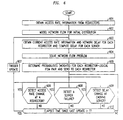
- FIG. 6 is a flowchart detailing the steps of the method of the present invention.
- access rate information is obtained by CMS 115 from each redirector.
- an initial distribution of hot sites on the caching servers is determined using the prior art load balancing network flow algorithm.
- CMS 115 obtains current access rate and network delay information for each redirector, and the server delay of each server is calculated.
- a network flow problem for load sharing is solved.
- the probabilities (or weights) for each redirector for each hot site pair are determined and sent to each redirector.
- decision step 606 a determination is made whether there has been an access rate change at a redirector.
- an update is triggered at step 607, which in turn causes the current access rate, network delay, and server delay to be determined or calculated back at step 603.
- a determination is made whether a server failure is detected. If yes, an update is triggered again at step 607. Further, at decision step 609, a determination is made whether or not a change in the delay at a caching server is detected. If yes, an update is triggered at step 607. If an access rate change, a server failure, or a caching server delay change are not detected at either decision steps 606, 608 or 609, respectively, then, at decision step 610, a determination is made whether the elapsed time since the last update has exceeded a threshold period of time, T. If not, the flow returns to the inputs of decision steps 606, 608 and 609. If the elapsed time has exceeded T, then an update is triggered at step 607.
- CMS 115 performs a centralized data gathering and network flow analysis function. Such functions could alternatively be performed at either redirector through TCP/IP communication between both such redirectors for exchanging access rate and delay information. Further, server delays need to be communicated to the redirectors.
- the present invention is not limited to such an arrangement.
- the logical items could be any group of hot documents which are mapped onto a plurality of local caching servers in accordance with the document's origin server IP addresses.
- the origin server IP addresses of the documents are hashed to different groups. The different groups are then considered the logical items which are mapped onto the plural caching servers.
- the hashing function is chosen so that the all IP addresses for an origin server are mapped to the same group out of a possible 256 different groups. Since origin servers normally use a contiguous block of IP addresses, then if the hashing is based on the first 8 bits of the origin server IP address, this contiguous block of IP address will be automatically mapped to the same group.
- the logical items could be any group of hot documents identified by the URLs, as might be done if a content-smart switch is used as the redirector.
- documents may be grouped according to the type of objects requests, such as .html, .jif, .jpeg, etc.
- Another way to perform the group mapping could be based on the logical names of the origin servers. Different logical names could be mapped to different groups. This requires looking at the HOST field found in the GET packets to keep track of the access rates to the different servers, and thereby to the groups.
- the initial distribution algorithm can then be used to decide where the logical items should be distributed. Alternatively, the initial distribution can be performed based on other information such as the proximity of the cache to the clients requesting a specific document.
- the load sharing algorithm of the present invention is performed to minimize the average delay of all connections across all of the caching servers per unit of time. Thus, access rate information to each formed group, network delay and server delay are determined as inputs to the network flow problem.
- the optimum weights for each redirector/group of documents for the desired load sharing are determined. These weights, then determine the probabilities with which the redirector directs a request for a document within one of the replicated logical items, the latter being one of the formed groups of origin server IP addresses.
- the redirectors In the embodiments discussed hereinabove, it has been assumed that the clients are local to one of the redirectors. Therefore, the network delay between the client and the redirector has not been considered as a factor in the solution to the load sharing problem.
- the other possibility is for the redirectors to be closer to a plurality of servers.
- a client's request for a logical name is resolved by a Domain Name Server into a redirector's IP address, which in turn redirects the request to a server in a cluster of essentially duplicated servers.
- server side load balancing is achieved, in accordance with the present invention, so as to minimize the average delay per unit of time of all requests of all connections across all the servers in the cluster.
- client IP addresses are mapped into groups by a simple hashing function.
- the first 8 bits of the client IP addresses can be used to determine which of 256 client groups a client is mapped into.
- Other hashing functions could be found that evenly distribute the clients among the groups such that the access rate of clients allocated to each of the groups are evenly distributed among the groups.
- each group becomes a logical item which is mapped onto the physical devices, which are, in this case, the back-end servers.
- the initial distribution algorithm can be used to map these logical items to the servers.
- the network flow based algorithm can then be used to compute the redirector probabilities associated with each redirector/logical item pair, which in this case is a redirector/client group pair.
- the arcs between the source and each redirector/client group pair represent the requests generated from each group that need to be redirected to one of the back-end servers.
- the load sharing solution to the network flow problem will produce the weights with which the redirectors direct requests from each of the client groups to the plural servers.
- the cost associated with each arc represents the delay.
- the cost on an arc between the source and one of the redirector/client group nodes represents the network delay encountered between a client group and the redirector
- the cost on an arc between a redirector/client group node and a server represents network delay between the redirector and one of the servers, plus that server's delay.
- the network delay computation does not have to include the delay from the redirector to the servers.
- the clients within each group are likely to be geographically proximate.
- the network delay can be determined for each group of clients and a specific server by determining the network delay from each client group to the redirector.
- the delay from the client group to the redirector can be calculated at the redirector by keeping track of the time between redirecting a SYN ACK packet from the server to the client group and the time an ACK packet for the SYN ACK packet is received at the redirector as part of the three-way TCP handshake.
- the redirector can periodically PING one or more clients in a client group to calculate the delay from that client group to the redirector. Further, the redirector separately keeps track of the access rates from each client group in order to solve the network flow for load sharing.
- the redirector rather than being local to the back-end servers, functions as a virtual server which, upon receipt of a request, redirects the request to one of a plurality of servers located in different locations on the wide area network, then the delay between the redirector and each server also needs to be taken into account in addition to the delay between each client group and the redirector.
- the redirector can calculate the network delay from a client group to a server by adding the delay from the client group to the redirector to the delay from the redirector to the server. The delay from the redirector to the server can be calculated as previously described by keeping track of the time between redirecting a SYN packet to a server and receiving the corresponding SYN ACK packet.
- the delay from the client group to the redirector can be calculated at the redirector by keeping track of the time between redirecting the SYN ACK packet from the server to the client group and the time an ACK packet for this SYN ACK packet is received at the redirector.
- the delay on the traffic that flows directly from the server to the client is of interest.
- the client to server delay is not as an important parameter since most of the HTTP traffic flows from the servers to the clients.
- the mechanism used for the symmetric flow case can be used as an approximation for the server-to-client delay or it can be estimated by the redirector using geographical information, such as that provided by IANA as used in Classless Inter-Domain Routing Protocol.
- the network flow model can thus be used to solve the load sharing problem when the logical item in the redirector/logical item pair is associated with the clients making requests to a server or the servers providing responses to requests from clients. Further, the network model is flexible to provide a solution when a delay is associated with the link between a client group and the redirector, on the link between the redirector and the server, or on both links.
- processors may be provided through the use of dedicated hardware as well as hardware capable of executing software in association with appropriate software.
- the functions may be provided by a single dedicated processor, by a single shared processor, or by a plurality of individual processors, some of which may be shared.
- explicit use of the term "processor” or “controllers should not be construed to refer exclusively to hardware capable of executing software, and may implicitly include, without limitation, digital signal processor (DSP) hardware, read-only memory (ROM) for storing software, random access memory (RAM), and non-volatile storage. Other hardware, conventional and/or custom, may also be included.
- DSP digital signal processor
- ROM read-only memory
- RAM random access memory
- any switches shown in the FIGS. are conceptual only. Their function may be carried out through the operation of program logic, through dedicated logic, through the interaction of program control and dedicated logic, or even manually, the particular technique being selectable by the implement as more specifically understood from the context.
- any element expressed as a means for performing a specified function is intended to encompass any way of performing that function including, for example, a) a combination of circuit elements which performs that function or b) software in any form, including, therefore, firmware, microcode or the like, combined with appropriate circuitry for executing that software to perform the function.
- the invention as defined by such claims resides in the fact that the functionalities provided by the various recited means are combined and brought together in the manner which the claims call for. Applicant thus regards any means which can provide those functionalities as equivalent to those shown hereinabove.
Landscapes
- Engineering & Computer Science (AREA)
- Computer Networks & Wireless Communication (AREA)
- Signal Processing (AREA)
- Computer Hardware Design (AREA)
- General Engineering & Computer Science (AREA)
- Computer And Data Communications (AREA)
Claims (29)
- Appareil destiné à être utilisé dans un système, lequel système traite des requêtes de clients via au moins une unité de réacheminement vers une pluralité de serveurs connectés sur un réseau de communications, susceptibles de satisfaire à ces requêtes, l'appareil déterminant un ensemble de poids avec lesquels les requêtes de clients sont transmises de façon probabiliste par ladite au moins une unité de réacheminement vers ladite pluralité de serveurs susceptibles de satisfaire à ces requêtes, l'appareil comprenant :caractérisé parun moyen permettant de déterminer un retard de serveur encouru lors du traitement d'une requête de client au niveau de chacun de la pluralité de serveurs ;un moyen permettant de déterminer un retard de réseau entre chacun d'une pluralité de clients et la pluralité de serveurs ;
l'aptitude de certaines au moins des requêtes de clients à être satisfaites par plus d'un parmi la pluralité de serveurs ;
un moyen permettant de déterminer un taux d'accès de requêtes associé à chacune d'une pluralité de paires unité de réacheminement - élément logique ; et
un moyen permettant de résoudre un problème d'optimisation de programmation non linéaire en vue de déterminer un ensemble de poids associés à chacune de la pluralité de paires unité de réacheminement - élément logique en utilisant comme entrées du problème les taux d'accès de requêtes déterminés, les retards de réseau déterminés, et les retards de serveurs déterminés, dans le but de minimiser le retard moyen des requêtes de clients. - Appareil selon la revendication 1, dans lequel le moyen permettant de résoudre un problème d'optimisation non linéaire comprend un moyen permettant de formuler et de résoudre un problème de flux de réseau avec un coût minimal.
- Appareil selon la revendication 2, dans lequel le moyen permettant de résoudre le problème d'optimisation non linéaire détermine périodiquement un nouvel ensemble de poids associés à chaque paire unité de réacheminement - élément logique appelés à être utilisés par la suite par l'au moins une unité de réacheminement, ou détermine un nouvel ensemble de poids lorsqu'une variation d'un taux d'accès est détectée au niveau d'une unité de réacheminement, ou détermine un nouvel ensemble de poids lorsqu'une défaillance d'un serveur est détectée, ou détermine un nouvel ensemble de poids lorsqu'une variation de retard de réseau est détectée, ou détermine un nouvel ensemble de poids lorsqu'une variation du retard au niveau d'un serveur est détectée.
- Appareil selon la revendication 2, comprenant en outre un moyen permettant de transmettre les poids déterminés à l'au moins une unité de réacheminement.
- Procédé destiné à être utilisé dans un système, lequel système traite des requêtes de clients via au moins une unité de réacheminement vers une pluralité de serveurs connectés sur un réseau de communications, le procédé déterminant un ensemble de poids avec lesquels l'au moins une unité de réacheminement transmet de façon probabiliste des requêtes de clients vers la pluralité de serveurs susceptibles de satisfaire à ces requêtes, le procédé comprenant les étapes consistant à:a) déterminer un retard de réseau entre chacun d'une pluralité de clients et la pluralité de serveurs (603); etb) déterminer un retard de serveur encouru lors du traitement d'une requête de client au niveau de chacun de la pluralité de serveurs (603);
caractérisé par
l'aptitude de certaines au moins des requêtes de clients à être satisfaites par plus d'un parmi la pluralité de serveurs ;c) déterminer un taux d'accès de requêtes associé à chacune d'une pluralité de paires unité de réacheminement - élément logique (603) ; etd) en utilisant comme entrées les retards de réseau déterminés à l'étape a), les retards de serveurs déterminés à l'étape b), et les taux d'accès de requêtes déterminés à l'étape c), résoudre un problème d'optimisation de programmation non linéaire en vue de déterminer l'ensemble de poids associés à chacune de la pluralité de paires unité de réacheminement - élément logique dans le but de minimiser le retard moyen associé aux requêtes de clients (604, 605). - Procédé selon la revendication 5, dans lequel l'étape d) comprend l'étape consistant à formuler et à résoudre un problème de flux de réseau avec un coût minimal.
- Procédé selon la revendication 6, dans lequel les éléments logiques sont une pluralité de sites Internet.
- Procédé selon la revendication 7, dans lequel les serveurs sont des serveurs d'antémémorisation dupliquant chacun l'un au moins des sites Internet.
- Procédé selon la revendication 6, dans lequel les éléments logiques sont des groupes de clients.
- Procédé selon la revendication 9, dans lequel les groupes de clients sont déterminés par leurs adresses IP.
- Procédé selon la revendication 6, dans lequel les éléments logiques sont des groupes de documents.
- Procédé selon la revendication 11, dans lequel les groupes de documents sont déterminés par leurs adresses IP de serveur d'origine.
- Procédé selon la revendication 11, dans lequel l'au moins une unité de réacheminement est un commutateur « Content Smart » et les groupes de documents sont déterminés par leurs URL.
- Procédé selon la revendication 10 ou 12, dans lequel les serveurs sont des serveurs Web.
- Procédé selon la revendication 10 ou 12, dans lequel les serveurs sont des serveurs d'antémémorisation.
- Procédé selon la revendication 6, dans lequel l'au moins une unité de réacheminement est un serveur virtuel pour une pluralité de serveurs Web.
- Procédé selon la revendication 6, dans lequel les étapes a) à e) sont répétées périodiquement en vue de déterminer un nouvel ensemble de poids associés à chaque paire unité de réacheminement - élément logique appelés à être utilisés par la suite par l'au moins une unité de réacheminement.
- Procédé selon la revendication 6, dans lequel les étapes a) à e) sont répétées lorsqu'une variation d'un taux d'accès de requêtes est détectée au niveau d'une unité de réacheminement, ou lorsqu'une défaillance d'un serveur est détectée, ou lorsqu'une variation de retard de réseau est détectée, ou lorsqu'une variation du retard au niveau d'un serveur est détectée.
- Procédé selon la revendication 6, dans lequel une station de gestion centrale (CMS) connectée sur le réseau de communications recueille les taux d'accès de requêtes déterminés à l'étape a) et le retard de réseau à l'étape b) auprès de l'au moins une unité de réacheminement, et le retard de serveur à l'étape c) auprès de la pluralité de serveurs, et exécute ensuite l'étape d), le procédé comprenant en outre l'étape consistant à transmettre les poids déterminés à l'au moins une unité de réacheminement.
- Appareil selon la revendication 2, dans lequel les éléments logiques sont une pluralité de sites Internet.
- Appareil selon la revendication 20, dans lequel les serveurs sont des serveurs d'antémémorisation dupliquant chacun l'un au moins des sites Internet.
- Appareil selon la revendication 2, dans lequel les éléments logiques sont des groupes de clients..
- Appareil selon la revendication 22, dans lequel les groupes de clients sont déterminés par leurs adresses IP.
- Appareil selon la revendication 2, dans lequel les éléments logiques sont des groupes de documents.
- Appareil selon la revendication 24, dans lequel les groupes de documents sont déterminés par leurs adresses IP de serveur d'origine.
- Appareil selon la revendication 24, dans lequel l'au moins une unité de réacheminement est un commutateur « Content Smart » et les groupes de documents sont déterminés par leurs URL.
- Appareil selon la revendication 23 ou 25, dans lequel les serveurs sont des serveurs Web.
- Appareil selon la revendication 23 ou 25, dans lequel les serveurs sont des serveurs d'antémémorisation.
- Appareil selon la revendication 2, dans lequel l'au moins une unité de réacheminement est un serveur virtuel pour une pluralité de serveurs Web.
Applications Claiming Priority (2)
| Application Number | Priority Date | Filing Date | Title |
|---|---|---|---|
| US09/266,339 US6314465B1 (en) | 1999-03-11 | 1999-03-11 | Method and apparatus for load sharing on a wide area network |
| US266339 | 1999-03-11 |
Publications (2)
| Publication Number | Publication Date |
|---|---|
| EP1035703A1 EP1035703A1 (fr) | 2000-09-13 |
| EP1035703B1 true EP1035703B1 (fr) | 2002-05-22 |
Family
ID=23014163
Family Applications (1)
| Application Number | Title | Priority Date | Filing Date |
|---|---|---|---|
| EP00301561A Expired - Lifetime EP1035703B1 (fr) | 1999-03-11 | 2000-02-28 | Procédé et dispositif pour repartition de charge dans un réseau étendu |
Country Status (5)
| Country | Link |
|---|---|
| US (1) | US6314465B1 (fr) |
| EP (1) | EP1035703B1 (fr) |
| CA (1) | CA2298908A1 (fr) |
| DE (1) | DE60000172T2 (fr) |
| IL (1) | IL134895A0 (fr) |
Families Citing this family (180)
| Publication number | Priority date | Publication date | Assignee | Title |
|---|---|---|---|---|
| JP3786328B2 (ja) * | 1998-07-27 | 2006-06-14 | 株式会社日立製作所 | サーバおよび通信制御方法 |
| US6701415B1 (en) | 1999-03-31 | 2004-03-02 | America Online, Inc. | Selecting a cache for a request for information |
| US6587881B1 (en) * | 1999-04-09 | 2003-07-01 | Microsoft Corporation | Software server usage governor |
| US6571288B1 (en) * | 1999-04-26 | 2003-05-27 | Hewlett-Packard Company | Apparatus and method that empirically measures capacity of multiple servers and forwards relative weights to load balancer |
| US6928656B1 (en) * | 1999-05-14 | 2005-08-09 | Scientific-Atlanta, Inc. | Method for delivery of IP data over MPEG-2 transport networks |
| US6601098B1 (en) * | 1999-06-07 | 2003-07-29 | International Business Machines Corporation | Technique for measuring round-trip latency to computing devices requiring no client-side proxy presence |
| US7483967B2 (en) * | 1999-09-01 | 2009-01-27 | Ximeta Technology, Inc. | Scalable server architecture based on asymmetric 3-way TCP |
| US6721780B1 (en) | 1999-11-09 | 2004-04-13 | Fireclick, Inc. | Predictive pre-download of network objects |
| US6978257B1 (en) * | 2000-01-31 | 2005-12-20 | International Business Machines Corporation | System and method for measuring and pricing midrange computer server outsourcing services |
| US6865601B1 (en) * | 2000-02-11 | 2005-03-08 | Hewlett-Packard Development Company L.P. | Method for allocating web sites on a web server cluster based on balancing memory and load requirements |
| US7313616B1 (en) * | 2000-02-17 | 2007-12-25 | International Business Machines Corporation | Web site management in a world wide web communication network through periodic reassignment of the server computers designated for respective web documents related to document weight based on byte count and program content |
| US6658473B1 (en) * | 2000-02-25 | 2003-12-02 | Sun Microsystems, Inc. | Method and apparatus for distributing load in a computer environment |
| US20020116444A1 (en) * | 2000-02-29 | 2002-08-22 | Imran Chaudhri | Method and system for providing intelligent network content delivery |
| US7506034B2 (en) * | 2000-03-03 | 2009-03-17 | Intel Corporation | Methods and apparatus for off loading content servers through direct file transfer from a storage center to an end-user |
| US7281168B1 (en) | 2000-03-03 | 2007-10-09 | Intel Corporation | Failover architecture for local devices that access remote storage |
| US7428540B1 (en) | 2000-03-03 | 2008-09-23 | Intel Corporation | Network storage system |
| US6952737B1 (en) | 2000-03-03 | 2005-10-04 | Intel Corporation | Method and apparatus for accessing remote storage in a distributed storage cluster architecture |
| US7203731B1 (en) * | 2000-03-03 | 2007-04-10 | Intel Corporation | Dynamic replication of files in a network storage system |
| US7266555B1 (en) | 2000-03-03 | 2007-09-04 | Intel Corporation | Methods and apparatus for accessing remote storage through use of a local device |
| US7552233B2 (en) * | 2000-03-16 | 2009-06-23 | Adara Networks, Inc. | System and method for information object routing in computer networks |
| US7162539B2 (en) * | 2000-03-16 | 2007-01-09 | Adara Networks, Inc. | System and method for discovering information objects and information object repositories in computer networks |
| US7565450B2 (en) * | 2000-03-16 | 2009-07-21 | Adara Networks Inc. | System and method for using a mapping between client addresses and addresses of caches to support content delivery |
| AU2001259075A1 (en) * | 2000-04-17 | 2001-10-30 | Circadence Corporation | System and method for web serving |
| US7908337B2 (en) * | 2000-04-28 | 2011-03-15 | Adara Networks, Inc. | System and method for using network layer uniform resource locator routing to locate the closest server carrying specific content |
| US7725596B2 (en) * | 2000-04-28 | 2010-05-25 | Adara Networks, Inc. | System and method for resolving network layer anycast addresses to network layer unicast addresses |
| US7577754B2 (en) * | 2000-04-28 | 2009-08-18 | Adara Networks, Inc. | System and method for controlling access to content carried in a caching architecture |
| US7343422B2 (en) * | 2000-04-28 | 2008-03-11 | Adara Networks, Inc. | System and method for using uniform resource locators to map application layer content names to network layer anycast addresses |
| US6928481B1 (en) * | 2000-05-05 | 2005-08-09 | International Business Machines Corporation | Method, apparatus and program to optimize the network distribution of digital information based on hierarchical grouping of server topology and code distribution |
| US7020698B2 (en) * | 2000-05-31 | 2006-03-28 | Lucent Technologies Inc. | System and method for locating a closest server in response to a client domain name request |
| US6850980B1 (en) * | 2000-06-16 | 2005-02-01 | Cisco Technology, Inc. | Content routing service protocol |
| US6763372B1 (en) * | 2000-07-06 | 2004-07-13 | Nishant V. Dani | Load balancing of chat servers based on gradients |
| WO2002007395A1 (fr) * | 2000-07-19 | 2002-01-24 | Hitachi, Ltd. | Systeme de transfert preferentiel d'informations sur le web |
| US7054931B1 (en) * | 2000-08-31 | 2006-05-30 | Nec Corporation | System and method for intelligent load distribution to minimize response time for web content access |
| US6850984B1 (en) * | 2000-09-08 | 2005-02-01 | Intel Corporation | System for isolating other clients that experience different connection performance than the client and directing the other clients to another different mirrored server |
| US7272653B2 (en) * | 2000-09-28 | 2007-09-18 | International Business Machines Corporation | System and method for implementing a clustered load balancer |
| US6820123B1 (en) * | 2000-09-28 | 2004-11-16 | Cisco Technology, Inc. | Method and apparatus for assigning hot objects to server load balancer |
| US7792923B2 (en) * | 2000-10-13 | 2010-09-07 | Zhe Khi Pak | Disk system adapted to be directly attached to network |
| US7801978B1 (en) | 2000-10-18 | 2010-09-21 | Citrix Systems, Inc. | Apparatus, method and computer program product for efficiently pooling connections between clients and servers |
| AU2002228861A1 (en) * | 2000-11-03 | 2002-05-15 | The Board Of Regents Of The University Of Nebraska | Load balancing method and system |
| US6609126B1 (en) | 2000-11-15 | 2003-08-19 | Appfluent Technology, Inc. | System and method for routing database requests to a database and a cache |
| US7231445B1 (en) * | 2000-11-16 | 2007-06-12 | Nortel Networks Limited | Technique for adaptively distributing web server requests |
| US20020078222A1 (en) * | 2000-12-14 | 2002-06-20 | Compas Jeffrey C. | Updating information in network devices |
| US6643357B2 (en) * | 2000-12-14 | 2003-11-04 | Nortel Networks Limited | Distributed redirect server |
| US7266556B1 (en) | 2000-12-29 | 2007-09-04 | Intel Corporation | Failover architecture for a distributed storage system |
| US7421489B2 (en) * | 2000-12-29 | 2008-09-02 | Nortel Network Limited | Network protocols for distributing functions within a network |
| US20020133616A1 (en) * | 2001-01-17 | 2002-09-19 | Richard Yoza | Method and apparatus for using a known address to gain access to a service provider having an unknown address |
| US7269784B1 (en) | 2001-01-22 | 2007-09-11 | Kasriel Stephane | Server-originated differential caching |
| US20020120743A1 (en) * | 2001-02-26 | 2002-08-29 | Lior Shabtay | Splicing persistent connections |
| US7720996B2 (en) * | 2001-03-27 | 2010-05-18 | Microsoft Corporation | Internet protocol (IP) address proximity and application to peer provider location |
| EP1271878A1 (fr) * | 2001-05-22 | 2003-01-02 | Alcatel Alsthom Compagnie Generale D'electricite | Procédé pour un système distribué pour délivrer un service, et client, client-service-gestion-module et database correspondants |
| KR20020089945A (ko) * | 2001-05-25 | 2002-11-30 | 드림인텍 주식회사 | 웹가속기를 가지는 네트워크 시스템 및 그 동작방법 |
| US7185063B1 (en) | 2001-06-22 | 2007-02-27 | Digital River, Inc. | Content delivery network using differential caching |
| US7783761B2 (en) * | 2001-07-16 | 2010-08-24 | Zhe Khi Pak | Scheme for dynamically connecting I/O devices through network |
| US6981029B1 (en) * | 2001-07-17 | 2005-12-27 | Cisco Technology, Inc. | System and method for processing a request for information in a network |
| US7111074B2 (en) * | 2001-07-24 | 2006-09-19 | Pluris, Inc. | Control method for data path load-balancing on a data packet network |
| US7774492B2 (en) * | 2001-07-26 | 2010-08-10 | Citrix Systems, Inc. | System, method and computer program product to maximize server throughput while avoiding server overload by controlling the rate of establishing server-side net work connections |
| US7092997B1 (en) | 2001-08-06 | 2006-08-15 | Digital River, Inc. | Template identification with differential caching |
| US7188214B1 (en) | 2001-08-07 | 2007-03-06 | Digital River, Inc. | Efficient compression using differential caching |
| US20030055971A1 (en) * | 2001-09-19 | 2003-03-20 | Menon Rama R. | Providing load balancing in delivering rich media |
| US7260644B1 (en) | 2001-09-26 | 2007-08-21 | Cisco Technology, Inc. | Apparatus and method for re-directing a client session |
| US7373644B2 (en) | 2001-10-02 | 2008-05-13 | Level 3 Communications, Llc | Automated server replication |
| DE60116318T2 (de) * | 2001-10-08 | 2006-08-31 | Alcatel | Verfahren zur Lastverteilung zwischen mehreren gemeinsamen Betriebsmitteln in einem Kommunikationsnetzwerk und Netzwerk zur Anwendung des Verfahrens |
| US20050149682A1 (en) * | 2001-10-09 | 2005-07-07 | Han-Gyoo Kim | Virtual multiple removable media jukebox |
| US20030073439A1 (en) * | 2001-10-17 | 2003-04-17 | Wenzel Peter W. | Home agent redundancy in a cellular system |
| US20030079027A1 (en) | 2001-10-18 | 2003-04-24 | Michael Slocombe | Content request routing and load balancing for content distribution networks |
| FR2831741B1 (fr) * | 2001-10-26 | 2003-12-19 | Thales Sa | Procedes et systemes d'enregistrement et lecture synchronisee de donnes provenant d'une pluralite d'equipements terminaux |
| US7984110B1 (en) * | 2001-11-02 | 2011-07-19 | Hewlett-Packard Company | Method and system for load balancing |
| US7284067B2 (en) * | 2002-02-20 | 2007-10-16 | Hewlett-Packard Development Company, L.P. | Method for integrated load balancing among peer servers |
| US7487261B1 (en) | 2002-02-22 | 2009-02-03 | Digital River, Inc. | Delta caching service |
| GB2386033B (en) * | 2002-03-01 | 2005-08-24 | Parc Technologies Ltd | Traffic flow optimisation system |
| US20030188188A1 (en) * | 2002-03-15 | 2003-10-02 | Microsoft Corporation | Time-window-constrained multicast for future delivery multicast |
| US7085848B2 (en) | 2002-03-15 | 2006-08-01 | Microsoft Corporation | Time-window-constrained multicast using connection scheduling |
| JP2003281140A (ja) * | 2002-03-20 | 2003-10-03 | Hitachi Ltd | コンテンツ配信方法および配信システム |
| US7076544B2 (en) * | 2002-04-08 | 2006-07-11 | Microsoft Corporation | Caching techniques for streaming media |
| US7178144B2 (en) * | 2002-04-23 | 2007-02-13 | Secure Resolutions, Inc. | Software distribution via stages |
| US8554929B1 (en) * | 2002-05-03 | 2013-10-08 | Foundry Networks, Llc | Connection rate limiting for server load balancing and transparent cache switching |
| US8819252B1 (en) | 2002-05-03 | 2014-08-26 | Foundry Networks, Llc | Transaction rate limiting |
| US7707295B1 (en) | 2002-05-03 | 2010-04-27 | Foundry Networks, Inc. | Connection rate limiting |
| US7209444B2 (en) * | 2002-05-15 | 2007-04-24 | Avaya Technology Corp. | Methods and devices for balancing communications using match rates |
| US7020706B2 (en) * | 2002-06-17 | 2006-03-28 | Bmc Software, Inc. | Method and system for automatically updating multiple servers |
| US20040143670A1 (en) * | 2002-07-02 | 2004-07-22 | Pratik Roychowdhury | System, method and computer program product to avoid server overload by controlling HTTP denial of service (DOS) attacks |
| AU2003262688A1 (en) * | 2002-08-16 | 2004-03-03 | Utstarcom, Incorporated | System and method for home agent load balancing |
| US20030149581A1 (en) * | 2002-08-28 | 2003-08-07 | Imran Chaudhri | Method and system for providing intelligent network content delivery |
| US7822810B2 (en) * | 2002-09-17 | 2010-10-26 | Hewlett-Packard Development Company, L.P. | Method and system for peer to peer common channel collaboration |
| US7774325B2 (en) * | 2002-10-17 | 2010-08-10 | Intel Corporation | Distributed network attached storage system |
| JP4098610B2 (ja) * | 2002-12-10 | 2008-06-11 | 株式会社日立製作所 | アクセス中継装置 |
| US20040249939A1 (en) * | 2003-05-23 | 2004-12-09 | International Business Machines Corporation | Methods and apparatus for dynamic and optimal server set selection |
| US7185096B2 (en) * | 2003-05-27 | 2007-02-27 | Sun Microsystems, Inc. | System and method for cluster-sensitive sticky load balancing |
| GB0312171D0 (en) * | 2003-05-28 | 2003-07-02 | Ibm | Workload balancing |
| US7363342B1 (en) * | 2003-07-08 | 2008-04-22 | Microsoft Corporation | Method and apparatus for providing web services in a collaborative computing system |
| US20050171428A1 (en) * | 2003-07-21 | 2005-08-04 | Gabor Fichtinger | Registration of ultrasound to fluoroscopy for real time optimization of radiation implant procedures |
| WO2005017735A1 (fr) * | 2003-08-19 | 2005-02-24 | Fujitsu Limited | Systeme et programme destines a detecter un congestionnement au niveau d'un dispositif de pile de disques |
| US7457880B1 (en) * | 2003-09-26 | 2008-11-25 | Ximeta Technology, Inc. | System using a single host to receive and redirect all file access commands for shared data storage device from other hosts on a network |
| US7693991B2 (en) * | 2004-01-16 | 2010-04-06 | International Business Machines Corporation | Virtual clustering and load balancing servers |
| US7664836B2 (en) * | 2004-02-17 | 2010-02-16 | Zhe Khi Pak | Device and method for booting an operation system for a computer from a passive directly attached network device |
| US20050193017A1 (en) * | 2004-02-19 | 2005-09-01 | Han-Gyoo Kim | Portable multimedia player/recorder that accesses data contents from and writes to networked device |
| US20060069884A1 (en) * | 2004-02-27 | 2006-03-30 | Han-Gyoo Kim | Universal network to device bridge chip that enables network directly attached device |
| US7428588B2 (en) * | 2004-04-08 | 2008-09-23 | International Business Machines Corporation | Method for distributing and geographically load balancing location aware communication device client-proxy applications |
| US8057307B2 (en) * | 2004-04-08 | 2011-11-15 | International Business Machines Corporation | Handling of players and objects in massive multi-player on-line games |
| US8089972B2 (en) | 2004-05-03 | 2012-01-03 | Level 3 Communications, Llc | Registration redirect server |
| US20060064478A1 (en) * | 2004-05-03 | 2006-03-23 | Level 3 Communications, Inc. | Geo-locating load balancing |
| US7434087B1 (en) | 2004-05-21 | 2008-10-07 | Sun Microsystems, Inc. | Graceful failover using augmented stubs |
| US8601101B1 (en) | 2004-06-28 | 2013-12-03 | Oracle America, Inc. | Cluster communications framework using peer-to-peer connections |
| US7757236B1 (en) | 2004-06-28 | 2010-07-13 | Oracle America, Inc. | Load-balancing framework for a cluster |
| US7746900B2 (en) * | 2004-07-22 | 2010-06-29 | Zhe Khi Pak | Low-level communication layers and device employing same |
| US7860943B2 (en) * | 2004-08-23 | 2010-12-28 | Zhe Khi Pak | Enhanced network direct attached storage controller |
| US20060067356A1 (en) * | 2004-08-23 | 2006-03-30 | Han-Gyoo Kim | Method and apparatus for network direct attached storage |
| US8024483B1 (en) | 2004-10-01 | 2011-09-20 | F5 Networks, Inc. | Selective compression for network connections |
| US7734952B1 (en) * | 2004-10-27 | 2010-06-08 | Unisys Corporation | System and method for maintaining a constant processor service level in a computer |
| GB0426125D0 (en) * | 2004-11-27 | 2004-12-29 | Ibm | The connection of an application to a resource manager selected from a plurality of resource managers |
| US8768350B2 (en) | 2004-12-09 | 2014-07-01 | Level 3 Communications, Llc | Systems and methods for locating endpoints in a communication network |
| US7734019B1 (en) * | 2004-12-09 | 2010-06-08 | Level 3 Communications, Llc | Systems and methods for third party emergency call termination |
| US9843557B2 (en) | 2004-12-09 | 2017-12-12 | Level 3 Communications, Llc | Systems and methods for dynamically registering endpoints in a network |
| US7849257B1 (en) | 2005-01-06 | 2010-12-07 | Zhe Khi Pak | Method and apparatus for storing and retrieving data |
| JP2007193436A (ja) * | 2006-01-17 | 2007-08-02 | Fujitsu Ltd | ログ検索プログラム、ログ管理装置、情報処理装置およびログ検索方法 |
| US7873065B1 (en) | 2006-02-01 | 2011-01-18 | F5 Networks, Inc. | Selectively enabling network packet concatenation based on metrics |
| US8443372B2 (en) * | 2006-03-23 | 2013-05-14 | International Business Machines Corporation | Methods and systems for partitioning data in parallel processing systems |
| US8793361B1 (en) * | 2006-06-30 | 2014-07-29 | Blue Coat Systems, Inc. | Traffic synchronization across multiple devices in wide area network topologies |
| US8141164B2 (en) * | 2006-08-21 | 2012-03-20 | Citrix Systems, Inc. | Systems and methods for dynamic decentralized load balancing across multiple sites |
| US8116207B2 (en) | 2006-08-21 | 2012-02-14 | Citrix Systems, Inc. | Systems and methods for weighted monitoring of network services |
| US8312120B2 (en) | 2006-08-22 | 2012-11-13 | Citrix Systems, Inc. | Systems and methods for providing dynamic spillover of virtual servers based on bandwidth |
| US8493858B2 (en) | 2006-08-22 | 2013-07-23 | Citrix Systems, Inc | Systems and methods for providing dynamic connection spillover among virtual servers |
| US9137287B2 (en) * | 2006-08-28 | 2015-09-15 | Avaya Inc. | High availability for voice enabled applications |
| US8103783B2 (en) | 2007-03-12 | 2012-01-24 | Citrix Systems, Inc. | Systems and methods of providing security and reliability to proxy caches |
| US8037126B2 (en) | 2007-03-12 | 2011-10-11 | Citrix Systems, Inc. | Systems and methods of dynamically checking freshness of cached objects based on link status |
| US8701010B2 (en) | 2007-03-12 | 2014-04-15 | Citrix Systems, Inc. | Systems and methods of using the refresh button to determine freshness policy |
| US7809818B2 (en) | 2007-03-12 | 2010-10-05 | Citrix Systems, Inc. | Systems and method of using HTTP head command for prefetching |
| US7783757B2 (en) | 2007-03-12 | 2010-08-24 | Citrix Systems, Inc. | Systems and methods of revalidating cached objects in parallel with request for object |
| US7720936B2 (en) | 2007-03-12 | 2010-05-18 | Citrix Systems, Inc. | Systems and methods of freshening and prefreshening a DNS cache |
| US8504775B2 (en) | 2007-03-12 | 2013-08-06 | Citrix Systems, Inc | Systems and methods of prefreshening cached objects based on user's current web page |
| US7584294B2 (en) | 2007-03-12 | 2009-09-01 | Citrix Systems, Inc. | Systems and methods for prefetching objects for caching using QOS |
| US8127235B2 (en) | 2007-11-30 | 2012-02-28 | International Business Machines Corporation | Automatic increasing of capacity of a virtual space in a virtual world |
| US20090164919A1 (en) | 2007-12-24 | 2009-06-25 | Cary Lee Bates | Generating data for managing encounters in a virtual world environment |
| US7783731B2 (en) * | 2008-05-27 | 2010-08-24 | Microsoft Corporation | Firmware cache coherence |
| US7788351B2 (en) * | 2008-05-27 | 2010-08-31 | Microsoft Corporation | Scalable transfer feedback |
| US8260926B2 (en) * | 2008-11-25 | 2012-09-04 | Citrix Systems, Inc. | Systems and methods for GSLB site persistence |
| US20110040893A1 (en) * | 2009-08-14 | 2011-02-17 | Broadcom Corporation | Distributed Internet caching via multiple node caching management |
| US9304826B2 (en) * | 2009-08-23 | 2016-04-05 | Aspect Software Inc. | System and method for improved dynamic allocation of application resources |
| US20110153828A1 (en) * | 2009-12-17 | 2011-06-23 | Korea Advanced Institute Of Science And Technology | Load balancing apparatus and method for regulating load using the same |
| US9205328B2 (en) | 2010-02-18 | 2015-12-08 | Activision Publishing, Inc. | Videogame system and method that enables characters to earn virtual fans by completing secondary objectives |
| US8606756B2 (en) | 2010-04-09 | 2013-12-10 | Ca, Inc. | Distributed system having a shared central database |
| US9682324B2 (en) | 2010-05-12 | 2017-06-20 | Activision Publishing, Inc. | System and method for enabling players to participate in asynchronous, competitive challenges |
| ES2525297T3 (es) * | 2010-09-07 | 2014-12-19 | Bae Systems Plc | Asignación de recursos a entidades que utilizan recursos |
| US9158586B2 (en) * | 2011-10-10 | 2015-10-13 | Cox Communications, Inc. | Systems and methods for managing cloud computing resources |
| US8897135B2 (en) * | 2012-02-10 | 2014-11-25 | Cisco Technology, Inc. | Recursive load balancing in a loop-free routing topology using routing arcs |
| JP6008518B2 (ja) * | 2012-03-05 | 2016-10-19 | 国立研究開発法人科学技術振興機構 | 無線通信ネットワークにおけるネットワーク選択方法及び、無線通信ネットワークシステム |
| CN104221326A (zh) * | 2012-04-04 | 2014-12-17 | 瑞典爱立信有限公司 | 用于在双向主动测量协议(twamp)实体之间的连接性的可扩展的测量的方法 |
| US8948177B2 (en) | 2012-07-30 | 2015-02-03 | Hewlett-Packard Development Company, L.P. | Policy based routing |
| US9240948B2 (en) * | 2012-10-22 | 2016-01-19 | Electronics And Telecommunications Research Institute | Method for managing and sharing symmetric flow and asymmetric flow in duplexed network |
| US10137376B2 (en) | 2012-12-31 | 2018-11-27 | Activision Publishing, Inc. | System and method for creating and streaming augmented game sessions |
| US10376792B2 (en) | 2014-07-03 | 2019-08-13 | Activision Publishing, Inc. | Group composition matchmaking system and method for multiplayer video games |
| US11351466B2 (en) | 2014-12-05 | 2022-06-07 | Activision Publishing, Ing. | System and method for customizing a replay of one or more game events in a video game |
| US10118099B2 (en) | 2014-12-16 | 2018-11-06 | Activision Publishing, Inc. | System and method for transparently styling non-player characters in a multiplayer video game |
| US10315113B2 (en) | 2015-05-14 | 2019-06-11 | Activision Publishing, Inc. | System and method for simulating gameplay of nonplayer characters distributed across networked end user devices |
| US10471348B2 (en) | 2015-07-24 | 2019-11-12 | Activision Publishing, Inc. | System and method for creating and sharing customized video game weapon configurations in multiplayer video games via one or more social networks |
| US10099140B2 (en) | 2015-10-08 | 2018-10-16 | Activision Publishing, Inc. | System and method for generating personalized messaging campaigns for video game players |
| US11185784B2 (en) | 2015-10-08 | 2021-11-30 | Activision Publishing, Inc. | System and method for generating personalized messaging campaigns for video game players |
| US10245509B2 (en) | 2015-10-21 | 2019-04-02 | Activision Publishing, Inc. | System and method of inferring user interest in different aspects of video game streams |
| US10232272B2 (en) | 2015-10-21 | 2019-03-19 | Activision Publishing, Inc. | System and method for replaying video game streams |
| US10376781B2 (en) | 2015-10-21 | 2019-08-13 | Activision Publishing, Inc. | System and method of generating and distributing video game streams |
| US10300390B2 (en) | 2016-04-01 | 2019-05-28 | Activision Publishing, Inc. | System and method of automatically annotating gameplay of a video game based on triggering events |
| US10500498B2 (en) | 2016-11-29 | 2019-12-10 | Activision Publishing, Inc. | System and method for optimizing virtual games |
| US10489074B1 (en) * | 2017-01-19 | 2019-11-26 | Tintri By Ddn, Inc. | Access rate prediction in a hybrid storage device |
| US10956196B1 (en) | 2017-01-19 | 2021-03-23 | Tintri By Ddn, Inc. | Load balancing VM selection and movement |
| US10564998B1 (en) | 2017-01-19 | 2020-02-18 | Tintri By Ddn, Inc. | Load balancing using predictive VM-based analytics |
| US10509667B1 (en) | 2017-01-19 | 2019-12-17 | Tintri By Ddn, Inc. | Modeling space consumption of a migrated VM |
| US11040286B2 (en) | 2017-09-27 | 2021-06-22 | Activision Publishing, Inc. | Methods and systems for improved content generation in multiplayer gaming environments |
| US10561945B2 (en) | 2017-09-27 | 2020-02-18 | Activision Publishing, Inc. | Methods and systems for incentivizing team cooperation in multiplayer gaming environments |
| US10974150B2 (en) | 2017-09-27 | 2021-04-13 | Activision Publishing, Inc. | Methods and systems for improved content customization in multiplayer gaming environments |
| US10765948B2 (en) | 2017-12-22 | 2020-09-08 | Activision Publishing, Inc. | Video game content aggregation, normalization, and publication systems and methods |
| US10579432B1 (en) | 2018-08-13 | 2020-03-03 | Twitter, Inc. | Load balancing deterministically-subsetted processing resources using fractional loads |
| CN111083244B (zh) * | 2018-10-22 | 2022-09-06 | 浙江宇视科技有限公司 | 集群地址分配方法及装置 |
| US11679330B2 (en) | 2018-12-18 | 2023-06-20 | Activision Publishing, Inc. | Systems and methods for generating improved non-player characters |
| CN111382344B (zh) * | 2018-12-27 | 2023-04-28 | 阿里巴巴集团控股有限公司 | 为对象提供页面加载服务的方法、装置及客户端 |
| US11025713B2 (en) * | 2019-04-15 | 2021-06-01 | Adobe Inc. | Dynamic allocation of execution resources |
| US11097193B2 (en) | 2019-09-11 | 2021-08-24 | Activision Publishing, Inc. | Methods and systems for increasing player engagement in multiplayer gaming environments |
| US11712627B2 (en) | 2019-11-08 | 2023-08-01 | Activision Publishing, Inc. | System and method for providing conditional access to virtual gaming items |
| US11351459B2 (en) | 2020-08-18 | 2022-06-07 | Activision Publishing, Inc. | Multiplayer video games with virtual characters having dynamically generated attribute profiles unconstrained by predefined discrete values |
| US11524234B2 (en) | 2020-08-18 | 2022-12-13 | Activision Publishing, Inc. | Multiplayer video games with virtual characters having dynamically modified fields of view |
| CN113055460B (zh) | 2021-03-09 | 2024-04-19 | 百果园技术(新加坡)有限公司 | 一种服务器的选择方法、装置、设备及介质 |
Family Cites Families (13)
| Publication number | Priority date | Publication date | Assignee | Title |
|---|---|---|---|---|
| US5031089A (en) * | 1988-12-30 | 1991-07-09 | United States Of America As Represented By The Administrator, National Aeronautics And Space Administration | Dynamic resource allocation scheme for distributed heterogeneous computer systems |
| US5329619A (en) * | 1992-10-30 | 1994-07-12 | Software Ag | Cooperative processing interface and communication broker for heterogeneous computing environments |
| US5495426A (en) * | 1994-01-26 | 1996-02-27 | Waclawsky; John G. | Inband directed routing for load balancing and load distribution in a data communication network |
| US6185619B1 (en) * | 1996-12-09 | 2001-02-06 | Genuity Inc. | Method and apparatus for balancing the process load on network servers according to network and serve based policies |
| US5644720A (en) * | 1995-07-31 | 1997-07-01 | West Publishing Company | Interprocess communications interface for managing transaction requests |
| US5572643A (en) * | 1995-10-19 | 1996-11-05 | Judson; David H. | Web browser with dynamic display of information objects during linking |
| US5828837A (en) * | 1996-04-15 | 1998-10-27 | Digilog As | Computer network system and method for efficient information transfer |
| US5774660A (en) * | 1996-08-05 | 1998-06-30 | Resonate, Inc. | World-wide-web server with delayed resource-binding for resource-based load balancing on a distributed resource multi-node network |
| US5933606A (en) * | 1997-02-19 | 1999-08-03 | International Business Machines Corporation | Dynamic link page retargeting using page headers |
| CA2206616A1 (fr) * | 1997-05-30 | 1998-11-30 | Robert Hugh Holt | Commande centralisee des communications dans un service de transport et d'acces (dats) |
| US6192408B1 (en) * | 1997-09-26 | 2001-02-20 | Emc Corporation | Network file server sharing local caches of file access information in data processors assigned to respective file systems |
| US6070191A (en) * | 1997-10-17 | 2000-05-30 | Lucent Technologies Inc. | Data distribution techniques for load-balanced fault-tolerant web access |
| US6006259A (en) * | 1998-11-20 | 1999-12-21 | Network Alchemy, Inc. | Method and apparatus for an internet protocol (IP) network clustering system |
-
1999
- 1999-03-11 US US09/266,339 patent/US6314465B1/en not_active Expired - Lifetime
-
2000
- 2000-02-17 CA CA002298908A patent/CA2298908A1/fr not_active Abandoned
- 2000-02-28 DE DE60000172T patent/DE60000172T2/de not_active Expired - Lifetime
- 2000-02-28 EP EP00301561A patent/EP1035703B1/fr not_active Expired - Lifetime
- 2000-03-06 IL IL13489500A patent/IL134895A0/xx unknown
Non-Patent Citations (1)
| Title |
|---|
| GOLDSZMIDT G., HUNT G.: "NETDISPATCHER: A TCP CONNECTION ROUTER", IBM RESEARCH REPORT, vol. RC 20853, 19 May 1997 (1997-05-19) - 19 May 1997 (1997-05-19), NEW YORK, pages 1 - 31 * |
Also Published As
| Publication number | Publication date |
|---|---|
| DE60000172T2 (de) | 2002-11-14 |
| US6314465B1 (en) | 2001-11-06 |
| EP1035703A1 (fr) | 2000-09-13 |
| IL134895A0 (en) | 2001-05-20 |
| DE60000172D1 (de) | 2002-06-27 |
| CA2298908A1 (fr) | 2000-09-11 |
Similar Documents
| Publication | Publication Date | Title |
|---|---|---|
| US6314465B1 (en) | Method and apparatus for load sharing on a wide area network | |
| Wang et al. | The effectiveness of request redirection on CDN robustness | |
| US7321926B1 (en) | Method of and system for allocating resources to resource requests | |
| US7774492B2 (en) | System, method and computer program product to maximize server throughput while avoiding server overload by controlling the rate of establishing server-side net work connections | |
| US8171139B2 (en) | Hierarchical load balancing | |
| US20020059170A1 (en) | Load balancing between multiple web servers | |
| Carofiglio et al. | LAC: Introducing latency-aware caching in information-centric networks | |
| US11895009B2 (en) | Intelligently routing internet traffic | |
| Gilly et al. | An up-to-date survey in web load balancing | |
| KR20030019900A (ko) | 분산 처리 및 피어 대 피어 통신을 이용한 네트워크 상의정보 전송 병렬화 방법 및 그 시스템 | |
| WO2000074347A1 (fr) | Selection dynamique d'un protocole d'antememoire et resolution d'interrogations dans un serveur d'antememoire | |
| EP3665893A1 (fr) | Calcul et sélection de chemin sensible au contexte | |
| WO2002098058A2 (fr) | Systeme et procede d'acheminement efficace de reseau longue portee | |
| Kontogiannis et al. | ALBL: an adaptive load balancing algorithm for distributed web systems | |
| Shuai et al. | A cost-based distributed algorithm for load balancing in content delivery network | |
| Bhat et al. | A load balancing approach for adaptive bitrate streaming in information centric networks | |
| Yoshida | Dynamic CDN against flash crowds | |
| Liang et al. | Transparent distributed Web caching | |
| Kencl | Load Sharing for Multiprocessor Network Nodes | |
| Lin et al. | An efficient load balancing strategy for scalable WAP gateways | |
| Jaseemuddin et al. | TE-friendly content delivery request routing in a CDN | |
| Wang | Caching, routing and congestion control in a future information-centric internet | |
| KR20040076660A (ko) | 분산 처리 및 피어 대 피어 통신을 이용한 네트워크 상의정보 전송 병렬화 방법 및 그 시스템 | |
| Aymaz et al. | Load Balancing with a New Approach for Dynamic Server Selection in Software Defined Network | |
| Trajano et al. | uLoBal: Enabling In-Network Load Balancing for Arbitrary Internet Services on SDN |
Legal Events
| Date | Code | Title | Description |
|---|---|---|---|
| PUAI | Public reference made under article 153(3) epc to a published international application that has entered the european phase |
Free format text: ORIGINAL CODE: 0009012 |
|
| 17P | Request for examination filed |
Effective date: 20000309 |
|
| AK | Designated contracting states |
Kind code of ref document: A1 Designated state(s): DE FR GB |
|
| AX | Request for extension of the european patent |
Free format text: AL;LT;LV;MK;RO;SI |
|
| 17Q | First examination report despatched |
Effective date: 20001023 |
|
| AKX | Designation fees paid |
Free format text: DE FR GB |
|
| GRAG | Despatch of communication of intention to grant |
Free format text: ORIGINAL CODE: EPIDOS AGRA |
|
| GRAG | Despatch of communication of intention to grant |
Free format text: ORIGINAL CODE: EPIDOS AGRA |
|
| GRAH | Despatch of communication of intention to grant a patent |
Free format text: ORIGINAL CODE: EPIDOS IGRA |
|
| GRAH | Despatch of communication of intention to grant a patent |
Free format text: ORIGINAL CODE: EPIDOS IGRA |
|
| GRAA | (expected) grant |
Free format text: ORIGINAL CODE: 0009210 |
|
| REG | Reference to a national code |
Ref country code: GB Ref legal event code: FG4D |
|
| REF | Corresponds to: |
Ref document number: 60000172 Country of ref document: DE Date of ref document: 20020627 |
|
| PLBE | No opposition filed within time limit |
Free format text: ORIGINAL CODE: 0009261 |
|
| STAA | Information on the status of an ep patent application or granted ep patent |
Free format text: STATUS: NO OPPOSITION FILED WITHIN TIME LIMIT |
|
| 26N | No opposition filed |
Effective date: 20030225 |
|
| REG | Reference to a national code |
Ref country code: GB Ref legal event code: 732E Free format text: REGISTERED BETWEEN 20131031 AND 20131106 |
|
| REG | Reference to a national code |
Ref country code: FR Ref legal event code: CD Owner name: ALCATEL-LUCENT USA INC. Effective date: 20131122 |
|
| REG | Reference to a national code |
Ref country code: FR Ref legal event code: GC Effective date: 20140410 |
|
| REG | Reference to a national code |
Ref country code: FR Ref legal event code: RG Effective date: 20141015 |
|
| REG | Reference to a national code |
Ref country code: FR Ref legal event code: PLFP Year of fee payment: 16 |
|
| REG | Reference to a national code |
Ref country code: FR Ref legal event code: PLFP Year of fee payment: 17 |
|
| PGFP | Annual fee paid to national office [announced via postgrant information from national office to epo] |
Ref country code: DE Payment date: 20160218 Year of fee payment: 17 |
|
| PGFP | Annual fee paid to national office [announced via postgrant information from national office to epo] |
Ref country code: GB Payment date: 20160217 Year of fee payment: 17 Ref country code: FR Payment date: 20160218 Year of fee payment: 17 |
|
| REG | Reference to a national code |
Ref country code: DE Ref legal event code: R119 Ref document number: 60000172 Country of ref document: DE |
|
| GBPC | Gb: european patent ceased through non-payment of renewal fee |
Effective date: 20170228 |
|
| REG | Reference to a national code |
Ref country code: FR Ref legal event code: ST Effective date: 20171031 |
|
| PG25 | Lapsed in a contracting state [announced via postgrant information from national office to epo] |
Ref country code: FR Free format text: LAPSE BECAUSE OF NON-PAYMENT OF DUE FEES Effective date: 20170228 Ref country code: DE Free format text: LAPSE BECAUSE OF NON-PAYMENT OF DUE FEES Effective date: 20170901 |
|
| PG25 | Lapsed in a contracting state [announced via postgrant information from national office to epo] |
Ref country code: GB Free format text: LAPSE BECAUSE OF NON-PAYMENT OF DUE FEES Effective date: 20170228 |