EP1035724A1 - Telefonabrechnungssystem in Echtzeit zur automatischen Ermittlung der besten Abrechnung und des besten Abrechnungsprofils eines Benutzers - Google Patents
Telefonabrechnungssystem in Echtzeit zur automatischen Ermittlung der besten Abrechnung und des besten Abrechnungsprofils eines Benutzers Download PDFInfo
- Publication number
- EP1035724A1 EP1035724A1 EP99830125A EP99830125A EP1035724A1 EP 1035724 A1 EP1035724 A1 EP 1035724A1 EP 99830125 A EP99830125 A EP 99830125A EP 99830125 A EP99830125 A EP 99830125A EP 1035724 A1 EP1035724 A1 EP 1035724A1
- Authority
- EP
- European Patent Office
- Prior art keywords
- unit
- record
- referred
- file
- processing unit
- Prior art date
- Legal status (The legal status is an assumption and is not a legal conclusion. Google has not performed a legal analysis and makes no representation as to the accuracy of the status listed.)
- Withdrawn
Links
Images






Classifications
-
- H—ELECTRICITY
- H04—ELECTRIC COMMUNICATION TECHNIQUE
- H04M—TELEPHONIC COMMUNICATION
- H04M15/00—Arrangements for metering, time-control or time indication ; Metering, charging or billing arrangements for voice wireline or wireless communications, e.g. VoIP
- H04M15/44—Augmented, consolidated or itemized billing statement or bill presentation
-
- H—ELECTRICITY
- H04—ELECTRIC COMMUNICATION TECHNIQUE
- H04M—TELEPHONIC COMMUNICATION
- H04M15/00—Arrangements for metering, time-control or time indication ; Metering, charging or billing arrangements for voice wireline or wireless communications, e.g. VoIP
-
- H—ELECTRICITY
- H04—ELECTRIC COMMUNICATION TECHNIQUE
- H04M—TELEPHONIC COMMUNICATION
- H04M15/00—Arrangements for metering, time-control or time indication ; Metering, charging or billing arrangements for voice wireline or wireless communications, e.g. VoIP
- H04M15/80—Rating or billing plans; Tariff determination aspects
- H04M15/8044—Least cost routing
-
- H—ELECTRICITY
- H04—ELECTRIC COMMUNICATION TECHNIQUE
- H04M—TELEPHONIC COMMUNICATION
- H04M15/00—Arrangements for metering, time-control or time indication ; Metering, charging or billing arrangements for voice wireline or wireless communications, e.g. VoIP
- H04M15/80—Rating or billing plans; Tariff determination aspects
- H04M15/8083—Rating or billing plans; Tariff determination aspects involving reduced rates or discounts, e.g. time-of-day reductions or volume discounts
-
- H—ELECTRICITY
- H04—ELECTRIC COMMUNICATION TECHNIQUE
- H04M—TELEPHONIC COMMUNICATION
- H04M2215/00—Metering arrangements; Time controlling arrangements; Time indicating arrangements
- H04M2215/01—Details of billing arrangements
- H04M2215/0104—Augmented, consolidated or itemised billing statement, e.g. additional billing information, bill presentation, layout, format, e-mail, fax, printout, itemised bill per service or per account, cumulative billing, consolidated billing
-
- H—ELECTRICITY
- H04—ELECTRIC COMMUNICATION TECHNIQUE
- H04M—TELEPHONIC COMMUNICATION
- H04M2215/00—Metering arrangements; Time controlling arrangements; Time indicating arrangements
- H04M2215/01—Details of billing arrangements
- H04M2215/0184—Details of billing arrangements involving reduced rates or discounts, e.g. time-of-day reductions, volume discounts, cell discounts, group billing, frequent calling destination(s) or user history list
-
- H—ELECTRICITY
- H04—ELECTRIC COMMUNICATION TECHNIQUE
- H04M—TELEPHONIC COMMUNICATION
- H04M2215/00—Metering arrangements; Time controlling arrangements; Time indicating arrangements
- H04M2215/42—Least cost routing, i.e. provision for selecting the lowest cost tariff
-
- H—ELECTRICITY
- H04—ELECTRIC COMMUNICATION TECHNIQUE
- H04M—TELEPHONIC COMMUNICATION
- H04M2215/00—Metering arrangements; Time controlling arrangements; Time indicating arrangements
- H04M2215/74—Rating aspects, e.g. rating parameters or tariff determination apects
- H04M2215/745—Least cost routing, e.g. Automatic or manual, call by call or by preselection
Definitions
- the present invention relates to a telephone billing system for real-time automatic detection of the best bill and of the best billing profile of a user.
- a lowest-value telephone bill will be generated, which takes into account all the parameters that can be associated to the user according to the various tariff plans and services.
- a telephone company produces various tariff plans to meet the demand of a variety of market "profiles", creating therefore tariff models for companies, households, single user, attitudes for day or night, national, international calls etc.
- a generic single or aggregated (e.g. a company) user can vary his own “profile” over time, thus adopting an unsuitable tariff plan. Therefore this entails a markedly higher cost for the user.
- it can be very useful for a user to be provided with information regarding an optimal tariff profile and the value of the best bill calculated accordingly.
- a first category of such systems is capable of detecting a number of optimal parameters, obtainable however only after the calculation of a telephone bill, by means of off-line type calculation systems.
- the determination of such a best bill is not an intrinsic part of the bill calculation process, as acting in a second phase with respect to the productive process, its use being therefore rather limited.
- a second category of such systems allows the calculation of some "better” (not optimal) parameters, this time during the bill calculation process.
- the number of parameters calculated is anyhow small, usually smaller than the number of the parameters calculated using systems of the first category. In fact, this is due to the fact that the calculation of the optimal parameters is such as to require an exhaustive processing of an enormous amount of data, wherefore there are memory occupation and processing time problems not solved by the systems known in the art.
- a first object of the present invention is that of producing the best telephone bill, intended as lowest-value bill, analyzing the tariff plans configured in the system and basing its own economic processing both with respect to physical parameters like time (time-based, time duration), number (calling number, called number), zone (origin zone, destination zone), typology (information type), transmission media (transmission media type) as well as with respect to aggregated configurations as friend-and-family service (F&F), "user group”, “closed user group”, “large account”, in observance of the logics adopted for the configuration of the tariff plans adopted by the telephone company.
- time time-based, time duration
- number calling number, called number
- zone oil zone
- typology information type
- transmission media transmission media type
- the present invention analyzes from the economical point of view the user "profile" and is capable not only of indicating him the optimal tariff plan, but also to make him migrate automatically from a tariff plan to another, so as to minimize the amount of the bill.
- An object of the present invention is therefore that of not forcing the users to choose a particular tariff plan which is binding in respect of the bill calculation anymore, the users having on the contrary the possibility of declaring a simple reference tariff plan that will not be necessarily the one actually implemented for the payment of the services they enjoyed.
- the actual amount due and the relevant optimal tariff plan detected will be highlighted for every produced bill, together with the amount that could have been due by the user, had he been using the reference tariff plan of his choice, so as to point out the resulting saving.
- a second object of the present invention is that of a real-time providing of the amount of the two bills described above (the one according to the reference tariff plan and the optimal one), accrued until the moment of the user request, so that he can acknowledge his "Profile" assessed up to that day.
- the values presented will be extremely precise, as the present invention is capable of producing these information including services used with a great readiness, within minutes.
- a third object of the present invention is that of providing the possibility to assess exactly the "market share" of the competitors, allowing the prevention of user migration to other providers.
- a fourth object of the present invention is that of providing the possibility of performing business simulations, determining new tariff plans starting from the configurations existing on the telephone market.
- the present invention provides a telephone billing system for real-time automatic detection of the best bill and of the best billing profile of a user on the basis of any number of tariff plans, characterized in that it comprises:
- a first advantage of the present invention lies in the capability to analyze the user profile according to all the configured tariff plans and services.
- a second advantage lies in the capability of selecting and producing the lowest-value bill .
- a third advantage lies in the capability of performing the processing steps by chains of on-line subsequent ratings, distributing the CPU engagement homogeneously and reducing the required memory amount.
- Each chain process is activated when needed, i.e. when a call data record (CDR) file is made available from the network.
- CDR call data record
- a processing system of the on-line type is obtained.
- the processes are chain-linked in such a way that the outputs of a processing level are the input of the subsequent processing level, so as to allow the disposal of the partial data and the resulting reduction of memory use.
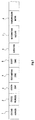
- the CDR consists of a series of fields, in particular: a Calling Number field 1, a Called Number field 2, an Origin Zone field 3, a Destination Zone field 4, a Start Time field 5, a Duration field 6, an Information Nature field 7, and a Transmission Media field 8.
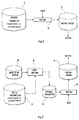
- next figures 2 and 3 show first of all, for the sake of clarity, a series of elemental components of the system according to the present invention.
- a memory unit 9 containing a known rating parameter, of the conditional or unconditional type.
- a rating parameter is nothing else than a factor of a calculation rule to apply on a set of data, for instance the data contained in the CDR.
- a parameter of the conditional type a parameter is understood, whose entity depends on the configuration of a set of services included in the contract of the particular user selected, e.g. a parameter whose entity depends on the field 2 (Called Number)of the CDR.
- a parameter is instead understood, that does not depend on the aforesaid configuration.
- the parameter application on the data takes place in a rating unit 10, and the rating result is stored in a memory unit 11, whose contents will be accessible to further units of the system according to the invention.
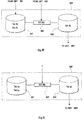
- a Tariff Plan 1 For example, a Tariff Plan 1, a Tariff Plan 2 and a "SMS Cost" (short-message-service) parameter equal to ITL 100/message, independent of the tariff plan is taken into consideration.
- SMS Cost short-message-service
- Such a parameter will be a single type parameter (i.e. not depending on the tariff plan) and of the unconditional type (i.e. not depending on the value of any of the CDR fields).
- a parameter of the "National Voice" type equal to ITL 300/minute for Tariff Plan 1 and to ITL 500/minute for Tariff Plan 2 is now taken into consideration.
- Such a parameter is a multiple type parameter (i.e. depending on the tariff plan) and of the unconditional type (i.e. not depending on the value of any of the CDR fields).
- a parameter of the "Called Number Discount” type such parameter being e.g. 0% when the called number first integers are not 06 and otherwise being 25% is taken into consideration.
- Such a parameter is a single type parameter (it does not depend on the tariff plan) and conditional (it depends on the Called number field rating).
- the next figure 3 differs from figure 2 in that the parameter to apply is not known and has to be previously determined, on the basis of an optimum criterion or on the basis of a certain statistical criterion.
- the calculation of the parameter to be applied might depend both on the data set treated by this parameter, and on the peculiar sort and aggregation routines that are activated.
- a sort routine is a process starting from an initial data set and enabling to obtain a final data set, sorted according to a certain logic. In the case wherein, besides the sort, aggregation operations are performed as well, the number of elements of the final data set might be lower than the one of the initial set.
- Figure 3 shows to this purposes a memory unit 12 containing a set of the possible parameters to apply, a memory unit 13 containing a data set to sort and a calculation unit 14 wherein, one of the possible parameters among those contained in unit 12 will be detected, optimal according to a certain criterion distinct from case to case, based on the data to sort and on instructions output from a control unit, not shown in figure and to be described below.
- the optimal parameter determined (and therefore the optimal factor to apply on the data) is stored in a memory unit 15. From now on the pattern is identical to that of the preceding figure 2. Thus, the application of such optimal parameter on the data takes place in a rating unit 16, and the rating result is stored in a unit 17 wherefrom is made accessible to the further units of the system according to the invention.
- a switching unit 100 in charge of the creation of the files that will be processed in three chains, represented by lines D, E and F outputting from the unit 100.
- the unit 100 receives as an input the files 30 generated from the network, containing a set of CDR records related to events resulting from telephone traffic. For each CDR record the unit 100 detects the type of service represented (national voice, SMS, international voice etc.) and outputs two types of file.
- the first type of file comprises all and only all the records having a single economic interpretation for all the tariff plans. Such records relate for instance to services like SMS and VoiceMail (Answering Service).
- the records contained in such first type of file are fed, along a line D, to a unit 200.
- the second type of file comprises all and only all the records having several economic interpretations for the different tariff plans considered.
- the records contained in such second type of file are copied and fed, along lines E and F, to respective units 50 and 500.
- the unit 100 To perform the aforesaid distinction between first and second type of file, the unit 100 must know which telephone traffic services (and therefore the relevant records) are to be fed along line D and which along lines E and F. This information as well comes from the aforementioned control unit.
- a memory unit 101 is associated, comprising a table Tab1c wherein the telephone traffic services codes (national voice, international voice etc.) are present together with a two values marker indicating whether the record is to be fed towards line D or towards lines E, F. These values can be varied dynamically by the control unit.
- the units 50, 200 and 500 are first level units, performing processing operations on the various records, as evidenced from the caption RECORD of figure 4.
- the unit 200 is realized according to a generic structure as the one previously represented in figure 2. A more detailed structure of the unit 200 is represented in figure 5, to which reference will now be made for sake of clarity.
- Figure 5 shows how the unit 200 comprises respective memory units 201 and 203 and a rating unit 202.
- the memory unit 201 contains a price table Tab2a, wherein to each service the unit price according to the measuring unit configured for the same service is associated. For each record switched by the unit 100 along line D the relevant price is adopted (rating step) and an addition record R1, contained in a table Tab2b present in the memory unit 203, is updated.
- the record R1 is associated to each user and contains a value that will be included in the bill calculation.
- R2 a generic record fed along line D from the unit 100, in the unit 200 the following operations are carried out:
- the number of fields of record R1 depends on the number of the processing parameters of the services processed in the unit 200. Such processing parameters can anyway be summed up in taxation parameters referring to the telephone traffic or in discount parameters referring to the telephone traffic.
- the record R1 can be imagined to be formed by m + n + 1 fields, wherein m relates to the number of different taxes, n relates to the number of different discounts, while the last field relates to the subscriber ID.
- the memory unit 201 comprises a table Tab2c wherein the codes of the traffic services managed by unit 200, together with an (n + m) value marker, which indicates for each parameter which is the field of record R1 whose sum is to be updated as a function of the parameter itself.
- a sorting according to the subscriber ID is advantageously provided in the sense that all the records pertaining to the same subscriber are sorted consecutively.
- only one reading will be needed from the Tab2b for each single user generating telephone traffic recorded on the input file.
- the case that a user has performed four events resulting from traffic is supposed. This means that in the file inputting in the unit 200 there will be four records, and from what was reported heretofore it follows that the unit 200 should perform four memory accesses.
- sorting the input file only one memory access will be needed and the record R1 will be updated four times (corresponding to the four consecutive records), to reinsert it afterwards in the table Tab2b of the memory unit 203.
- figure 6 represents a detailed diagram of this unit.
- Object of the unit 50 is that of determining and rating the set of optimal parameters referring to CDR's relating to a certain user. This determination and rating will be carried out at the same time with the determination and rating of the parameters actually taxable to that user, a task assigned to the unit 500 of figure 4 and to the units chained thereto.
- the unit 50 With reference to the unit 50, it has to be mentioned that the set of parameters wherein the optimal statistical parameters will be detected varies with the different tariff plans.
- the unit 50 will use the sort routines introduced in the preceding figure 3, so as to detect the optimal statistical parameters (e.g. the F&F numbers) to be applied on data fed from the unit 100 along the line E.
- the optimal statistical parameters e.g. the F&F numbers
- the unit 50 comprises a control and memory unit 300, a detection unit 700 of the optimal parameters by use of the sort routines, as well as two rating and memory units 400 and 800.
- control and memory unit 300 will be described in detail, with reference to figures 7 and 8.
- the unit 300 comprises a control unit 301 and a memory unit 302.
- the control unit 301 has the task of guiding the sort and rating processes within the entire chain of the unit 50 for the data selective processing.
- the sort routines and the rating units of block 700 of figure 5 will take from memory unit 302 all and only all the data declared from the control unit 301.
- the various records will be sorted by calling number (subscriber's ID), so as to create a set of record groups, wherein every record group is detected through the subscriber's ID and through the number of records related to that subscriber to input in memory.
- each of the 2 N leaves 20 of the tree refers to a particular set of subscribers.
- a set of files 21 is associated, each related to a precise time interval corresponding to the billing period.
- These files will be organized as stacks, so that the first two months period be the last file, i.e., the one on the bottom of the stack.
- the file 22 on the stack surface (surface file) will be the one related to the most recent billing period, usually corresponding to the current one. If the current billing period has not ended yet, that file will be marked with the .TMP extension (temporary), as illustrated in the figure. At the moment of the billing period cut-off that file will be renamed erasing the .TMP extension and a new file .TMP will be created, as a new billing period will begin. All files within the stack will be organized as index files, so as to allow to know the indexes of the first and of the last records defining the single files.
- access during reading requires the extraction of one or more consecutive files. This will be performed by commands of the POP-UP type, corresponding to the reading instructions of all data comprised between start and end indexes. Thus, it will not be necessary to specify the record indexes one by one, as would instead happen in a normally structured database.
- the surfacing file extraction (usually the most frequent operation) is translated into machine language with an instruction like "read all records comprised between .tmp_start and .tmp_end indexes", instruction that can be performed by a MOVE command and not by a read and copy sequence.
- a first table (Database Control Table) will describe the entire memory, while a second table (File Control Table) will describe only data that will be retrieved in the processing steps (sort routines and rating unit).
- the DataBase Control Table will be updated through the updating of a table containing the path and the start- and end-file indexes for all the Database files.
- this is generated by indicating the path in the binary tree (and therefore the path related to a certain subscriber) together with the start- and end-file indexes of the surfacing files, or, if needs be, of the further files in case more files are to be taken for the analysis of a longer period only for the subscribers concerned by the last CDR file fed from the unit 100.
- DataBase Control Table is devolved to the system administrator or in case to an automatic unit system.
- the unit 302 could be implemented by a DataBase of the OracleTM or InformixTM type. Although having the advantage of possessing a high stability in terms of resource allocation, there would be the disadvantage of having to operate with a very high memory access time, as every single record should be read, and the abovecited Move instruction would not apply.
- the unit 400 shall now be disclosed, receiving as an input the file sorted by unit 100 along line E.
- the unit 400 is made according to a generic structure as the one previously represented in figure 2. A more detailed structure thereof is represented in figure 9, to which reference will be made for sake of clarity.
- Figure 9 shows how the unit 400 comprises respective memory unit 401 and 403 and a rating unit 402. An operation completely similar to that of the unit 200 is carried out.
- the memory unit 401 is therefore such as to contain tables Tab4a and Tab4c similar to the respective tables Tab2a and Tab2c of the unit 200.
- the operations of the unit 400 are adopted to a different service typology, according to several prices.
- a service is switched by unit 100 to line E (or F) it is because this can be rated in different ways (i.e. with different unit prices), according to the tariff plans.
- Table Tab4a shown in unit 401 contains the unit prices according to the tariff plans for each code of the service provided.
- the number of fields of record R3 depends on the number of the different prices applicable to a service contemplated by the unit 400 and on the number of different discounts referring to the telephone traffic as well as the different taxes referring to the telephone traffic devoted to each service processed by the unit 50 and by the subsequent units chained thereto.
- a record sort of the input file for Calling Subscriber ID can be advantageously performed for the unit 400 as well, prior to the start of the processing, so as to reduce the memory accessing time, as already described for the unit 200.
- the design of the record R3 depends on various factors, concerning aggregation rules determined by the control unit, as will be explained below.
- the number of fields contained inside the record R3 shall suffice to discriminate all the voices of telephone traffic interpretable unequivocally with the cost parameters of the tariff plan.
- the unit 700 (sort routine unit) is a multiprocess system whose elements can be assembled dynamically, as a function of the sort logics deriving from the structures of the Tariff Plans and Services.
- This table will be read by the subsequent unit 800 for the application of the discounts on records related to the optional service F&F.
- the unit 800 is responsible of the application of the optimal services, obtained statistically by the unit 700, so as to modify the records outputting from the unit 400 on the basis of such parameters.
- the unit 800 is made according to a generic structure as the one previously represented in figure 2. A more detailed structure of the unit 800 is represented in figure 10, to which reference will now be made for sake of clarity.
- Figure 10 shows how the unit 800 comprises respective memory units 801 and 803 and a rating unit 802. Data input to rating unit 802 are retrieved from Table Tab4b of the memory unit 403 of the unit 400.
- the memory unit 801 therefore is such as to contain tables Tab8a and Tab8c similar to the respective tables Tab4a and Tab4c, while the memory unit 803 contains a table Tab8b similar to the table Tab4b.
- the task of the unit 800 is that of updating the values determined by the unit 400 and contained in the memory unit 403, regenerating new records R5, to be stored in the table Tab8b contained in the memory unit 803.
- the parameters contained inside the memory unit 801 have been selected by the above described unit 700.
- the sort routines detect the optimal values of the statistical parameters through the use of the traffic (related to entities of a physical as well as of an economic type), providing those results to the memory unit 801.
- each plan is such as to have, for ease of explanation, the same discount and taxation parameters.
- the number of fields of each record R3 generated by the unit 400 is equal to 3 (one field related to the user ID, one field related to the first tariff plan and one field related to the second tariff plan).
- the F&F service requires a monthly fee, assumed to be not taxable.
- Both the normal telephone traffic comprising the F&F service and the normal telephone traffic without the F&F service shall have to be rated (by units 1210 and 1220, disclosed below) in order to assess the optimal value.
- the record to be stored in the unit 803 will have to indicate a first total $ as well as a second total $° therefore taking the following form Subscriber ID Total1 Total2 Total1° Total2° Xxxx1 $1,1 $2,1 $°1,1 $°2,1 ............ ............ ............ ............ ............ ............ ............ ............ ............ ............ XxxxN $1,N $2,N $°1,N $°2,N
- the unit 800 receives as an input two distinct types of record:
- the unit 800 updates the input records of the first of the aforesaid types adopting the input records of the second type as updating parameters.
- the results thus generated will be stored in the table Tab8b of the memory unit 803.
- the design of the record in the table Tab8b depends on the control unit. Should the case in which the (above disclosed) condition that the F&F service requires a fee occur, for which the design of the record disclosed hereinafter is required, Xxxx1 $1,1 $2,1 $°1,1 $°2,1 it can be remarked that the system tends to generate redundant information. In fact, the values $ are repeated, as they are stored in the memory Tab4b of the unit 403 as well as in memory Tab8b of the unit 803. It is apparent that such redundancy can advantageously be eliminated by erasing one of the redundant information. In particular, such a control type is managed by the control tables Tab8c which control the data production processes.
- a marker is associated to each service of the table Tab8c, indicating the record field of the table Tab8b that is to be updated.
- the tables Tab8c contained in the unit 801, can be updated dynamically through the control unit.
- figure 11 is a detailed diagram of such unit.
- the unit 500 is responsible of the taxations referred to a traffic service (pricing record level) using in particular the reference plan chosen by the user when drawing up the contract with the telephone company. In this case as well, for each single record CDR of the input file input from the unit 100, every possible "full price” is applied, compatibly with the discounts (when known) that were actually declared by the user.
- the unit 500 is made according to a generic structure as the one previously represented in figure 2. A more detailed structure of the unit 500 is represented in figure 11, to which reference will now be made for sake of clarity.
- Figure 11 shows how the unit 500 comprises respective memory units 501 and 503 and a rating unit 502. Data input in the rating unit 502 are the data output from the switching unit 100 along line F.
- the table Tab5a contained in a memory unit 501, contains all the prices related to the basic services for all the tariff plans and moreover contains (when known) the configurations of the optional services chosen by the user.
- the table Tab5b contained in the memory unit 503 contains the results of the rating operation performed on the data input in the unit 502 are shown, in this case intended as well as the update of a value by a summing operation.
- a control table Tab5c is provided, contained in the memory unit 501, for which table the record field of the table Tab5b to update is indicated beside each service.
- the control table Tab5c is generated and dynamically varied by the control unit, as is the case for the other processes.
- the units 1010 and 1020 are second level units, apt to perform processing operations on the traffic volume, as evidenced by the caption VOLUME of figure 4. In particular, the discount parameters related to the volume of telephone traffic are calculated.
- the unit 1010 receives as an input data outputted from the units 50 and 200, while the unit 1020 receives as an input data outputted from the units 500 and 200.
- the unit 1010 will calculate the discount parameters on the optimal volumes, while the unit 1020 will calculate the discount parameters on the volumes that can actually be adopted, based on the contract drawn up by the user.
- the unit 1010 will receive as an input both the data related to the chain E (output from the unit 50) and the data related to the chain D (output from the unit 200).
- the unit 1020 will receive as an input both the data related to the chain F (output from the unit 500) and the data related to the chain D (output from the unit 200).
- Figures 12 and 13 show a more detailed representation of the respective units 1010 and 1020.
- Figure 12 shows the memory units 1011 and 1013 and a rating unit 1012.
- the memory unit 1011 comprises tables Tab10a1 and Tab10c1.
- the memory unit 1013 comprises a table Tab 1 Ob 1.
- the rating unit 1012 receives as an input the records outputted from the units 200 and 800, together with possible taxable volume costs not proportional to the traffic, indicated with the caption "other".
- Figure 13 shows memory units 1021 and 1023 and a rating unit 1022.
- the memory unit 1021 comprises tables Tab10a2 and Tab10c2.
- the memory unit 1023 comprises a table Tab10b2.
- the rating unit 1022 receives as an input the records output from the units 200 and 500, together with possible taxable volume costs not proportional to the traffic, indicated with the caption "other".
- the records input to the units 1010 and 1020 express the total volume of traffic of the clients, rated according to different criteria. This rated total can be easily reconverted in terms of a physical entity (number of seconds, bytes etc.) and therefore a possible existing "volume level pricing" will be easily applicable instead of the record level pricing adopted so far.
- the pairs of tables Tab10a1-Tab10a2, Tab10b1-Tab10b2, Tab10c1-Tab10c2, can also be considered as single tables Tab10a, Tab10b, Tab10c, in which a marker is shown indicating the type of record to which the parameters are to be applied, i.e. if it is a case of records output from the unit 500 or records output from the unit 800.
- the units 1110 and 1120 are third level units, performing processing operations on the taxation parameters. Therefore, these units receive as an input the records rated by the preceding level and will apply all the taxes provided for by the law.
- the unit 1110 receives as an input the data output from the unit 1010, while the unit 1120 receives as an input the data output from the unit 1020.
- the unit 1110 will calculate the taxation parameters based on optimal data, while the unit 1120 will calculate the taxation parameters based on the data referring to the contract drawn up by the user.
- Figures 14 and 15 show a more detailed representation of the units 1110 and 1120, respectively.
- Figure 14 shows memory units 1111 and 1113 and a rating unit 1112.
- the memory unit 1111 comprises tables Tab11a1 and Tab11c1.
- the memory unit 1113 comprises a table Tab11b1.
- the rating unit 1112 receives as an input the records output from the unit 1010.
- Figure 15 shows memory units 1121 and 1123 and a rating unit 1122.
- the memory unit 1121 comprises tables Tab11a2 and Tab11c2.
- the memory unit 1123 comprises a table Tabllb2.
- the rating unit 1122 receives as an input the records outputted from the unit 1020.
- the structure and the operation modes of the units 1110 and 1120 are similar to those of the respective units 1010 and 1020, with the only difference that the cost parameters will be tax-related and not discount-related.
- the unit 1110 will receive as an input the results of table Tab10b1 and the unit 1120 will receive as an input the results of table Tab10b2.
- the adding units 1210 and 1220 are fourth level units, advantageously performing adding operations on the data received through the outputs of the units 50, 1010 and 1110 and respectively 500, 1020 and 1120.
- the adding unit is to be intended as a logical entity and not as a physical entity. This means that the sum of the values reported above might occur at the fourth level, as well as being distributed to the preceding levels, according to different modes, advantageous from case to case.
- a memory unit comprising tables, Tab12b1 and Tab12b2 respectively, wherein the various sum records thus obtained are stored.
- a specific profile compatible with a certain existing contract will be used, consisting of a basic service plus an optional service.
- the inputs coming from the chain generated by the data coming along line E are those determined by the sort routines and therefore optimal under the point of view of the traffic. It cannot be said that the same are optimal under the point of view of the cost, and hence of the bill, because the activation cost thereof is provided by unit the 1010 or by the unit 1210 (depending on whether those costs are taxable or not). This does not mean that the statistical parameters are not optimal, it means instead that it is not known whether it is convenient for the user to activate the optional services or not and that, should he have to do so, the optimal values are those determined during the processes related to the data fed along line E.
- the unit 900 is responsible for the detection of the best bill. Such unit receives as an input a series of multiple-field records, wherein each record identifies a certain customer and the set of the fields of each record is related to the number of different tariff plans adopted.
- the record CUST_ID BILL1-PT1 BILL1.1-PT1+F&F BILL2-PT2 BILL2.1-PT2+ F&F this is composed of five fields: the first field indicates the user's ID, the second field indicates the bill value calculated by associating the tariff plan 1, the third field indicates the bill value associating the tariff plan 1 and taking into consideration the F&F conditions, the fourth field indicates the bill value associating the tariff plan 2, the fifth field indicates the bill value associating the tariff plan 2 and taking into consideration the F&F conditions.
- the basic functions related to the unit 900 are the calculation of the minimum tariff concerning single accounts, as well as the calculation of the minimal tariff concerning multiple accounts (the so-called "large accounts").
- a further function of the unit 900 is that of taking into account discounts on the tariff plans, where the discount applicability depends on the economical amount accrued and its value is independent therefrom (assuming for instance that a discount of ITL 200,000 is allowed when the total amount is more than ITL 1,000,000), i.e. the application of a default discount in the case where the bill total value fulfills some conditions (e.g. value higher than a predetermined entity).
- cost voices usually discounts taken into account by unit 900 are not proportional to the realization of events, regardless of their being expressed in a rated or instead in a physical form, and have to be considered as a further calculation parameter.
- the selection of an appropriate optimization method becomes important, in order to reduce the machine time as much as possible.
- n the number of the input record fields (i.e., apart from the field related to the user ID, the number of the possible bills that can be associated to a user) and with k the number of the users constituting a "large account”
- the number of possible bills that can be associated to a large account equals n k . Therefore, over such number of bills the abovementioned discount applicability shall have to be verified, the discount itself adopted in the cases considered, and lastly the lowest rating detected.
- control unit of the system according to the present invention shall be described hereinafter.
- a first task of said unit is that of managing the working "front-ends" that configure the system from the functional point of view, thus providing an access point for the operators in charge.
- an operator in charge may have predefined displaying modes, through which a service can be configured, and to which a price, discount, taxes etc. voice can be assigned.
- the steps that can be performed through the front-end section can be for example:
- the main task of the control unit is anyhow related to the configuration processes of the Data Base related to the Tables Tabxa, Tabxb, Tabxc described in the course of the present description.
- the detection of its logical scheme and the dimensioning of all the tables thereof is intended.
- the set of the Relation Tables is intended (allowing the various associations among the information) and the assignation of all the keys.
- the logical scheme is the one allowing the "navigation" inside the data base in order to reach the data.
- control unit allows to detect dynamically the table designs in order to minimize the dimension of the memory required by the entire system. Firstly, the generation of the control table Tab1c related to the switching unit 100 shall be described.
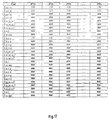
- the cost parameters grid is introduced in figure 17, wherein with #### a numerical value or a formula and with PTi the generic tariff plan is intended.
- the table Tab1c shall therefore assume the form S.a 0 S.k 1 ... ... S.n. ###
- the unit 100 of figure 4 reads, for each record generated from the network, the code of the service (S.x.) and enters a table reading the related marker. If the value of such marker is 0, then the record will be fed along line D, if the value is 1 then it will be fed along lines E and F.
- table Tab1c Each time any user enters the grid of figure 17 in writing (therefore a potential modification is being performed) the generation process of table Tab1c will be automatically re-executed (by a command from the operating system that has loaded the "write" instruction). This happens every time a new service or a new tariff plan is inserted, or every time a parameter value is modified.
- control unit The subsequent operations of the control unit concern the design of the records of tables Tabxc of the units having a level lower than the level of the switching unit 100.
- a sub-grid is extracted.
- such sub-grid does not comprise the cost centers that are not proportional to the traffic such as the Monthly fee, the Subscription fee etc.
- the insertion of such values, assumed not to be taxable, in the bill calculation will take place in the adding units 1210 and 1220, as better explained hereinafter.
- the table of figure 18 shows that for the "Voice" service of PT1, the cost (S.voice.r.p) is of ITL 350/minute, the discount rate on the single call (S.voice.r.d) is 0, the volume price (S.voice.v.p) is 0 (there is no default price), the discount rate on the total expense (S.voice.v.d) is 25%, the on-call answer fee unit (S.voice.oc.a.f) costs ITL 130, the taxes (S.voice.t) are 19% and the value of other not taxable costs (S.voice.onc.) is 0. Similar descriptions are valid for other services with respect to the PT2.
- the (S.voice.v.p), (S.voice.v.d) parameters can instead be applied to the second level volume-referred units 1010 and 1020.
- the (S.voice.t) parameter can be applied to the third level tax-referred units 1110, 1120.
- the (S.voice.onc.) parameter can be applied to the fourth level adding units 1210, 1220 as it represents a non taxable cost type.
- Such path sketched by way of example for the "voice" service, can be expressed for every service and identifies the calculation parameters contained in tables Tab2a, Tab4a, Tab5a for level 1, Tab10a1, Tab10a2 for level 2, Tab11a1, Tab11a2 for level 3.
- the voice dimension equals 2.
- the path of the voice with respect to the tariff plan 1 is given by the sequence (arc1,node1,arc5,node5,arc9,node7,arc11,node8).
- the path of the voice with respect to the tariff plan 2 is given by the sequence (arc2,node2,arc6,node5,arc9,node7,arc11,node8).
- the SMS dimension equals 1.
- the path of the SMS with respect to the tariff plan 1 is given by the sequence (arc3,node3,arc7,node5,arc9,node7,arc11,node8).
- the path of the SMS with respect to the tariff plan 2 is the same of the tariff plan 1. In fact, this condition is consistent with the SMS dimension that equals 1.
- the grade of the voice mail in levels 1 (arc 4), 2 (arc 8), 3 (arc 10) and 4 (arc 11) equals 1.
- the voice mail dimension equals 1.
- the path of the voice mail with respect to the tariff plan 1 is provided by the sequence (arc4,node4,arc8,node6,arc10,node7,arc11,node8).
- the path of the voice mail with respect to the tariff plan 2 is the same of the tariff plan 1. In fact, this condition is consistent with the voice mail dimension, which equals 1.
- Consclusion 1 Horizontal Aggregation: the format of the record needed for the representation of the service "j” valid for “all levels” of the “configured forest” provides a number of fields equaling the "service dimension” plus in case a field necessary for the code of the service itself.
- This conclusion is called of horizontal aggregation because it enables to replace more records representing the same service (in a number equaling the number of the tariff plans) with a single multi-field record (in a number equaling the service dimension). Moreover, for each level it exists only one association between a tariff plan and a field of the record. This association is not biunivocal, in the sense that in general to a field of a record cannot be associated only a single Tariff Plan.
- the horizontal aggregation can be represented geometrically by a projection of the Set of the tariff plans onto the Set of the fields of the record.
- the value "1" of the Voice code under the PT1 column indicates that the first field of the Voice code is related to the Tariff Plan 1
- the value "2" of the Voice code under the PT2 column indicates that the second field of the Voice code is related to the Tariff Plan 2.
- the minimum required record taking into account the service ID code as well, is a three-field record for the voice, a two-field record for the SMS and, lastly, a two-field record for the voice mail.
- Conclusion 1 provides a design rule of the record that is valid in the hypothesis wherein every service is represented by a dedicated record thereof.
- conclusion 1 introduces a further concept, defined hereinafter with the term "Vertical Aggregation".
- the voice service will be taken into consideration.
- a record coming from the network and representing the voice shall be transformed inside the system into a two-field record (disregarding the field related to the code of the service for the sake of simplicity).
- Such two-field record suffices to represent the voice service in all the levels of the system.
- One of such levels is the one related to the Volume of traffic, and therefore what reported is tantamount to say that the single record taken from the network representing a single "voice" telephone call shall update a record representing the total of the "voice” telephone calls, thus obtaining an aggregation of the vertical type, i.e. intended as the sum of all the single voice records.
- the single path associated thereto (as the SMS grade equals 1) is (arc3,node3,arc7,node5,arc9,node7,arc11,node8).
- a complete terminal sub-path is given for example by (arc9,node7,arc11,node8) because node 8 pertains to the terminal level (level 4) and moreover nodes 7 and 8 pertain to two consecutive levels (level 3 and 4).
- SMS (arc3,node3,arc7,node5,arc9, node7,arc11,node8 )
- voice mail (arc4,node4,arc8,node6,arc10, node7,arc11,node8 )
- the records related to the SMS and to the voice mail can be summed in the node 7 because both are subject to the same operations with the same parameters from the node 7 onwards.
- the SMS record is multiplied by 0,19, while in the node 8 this result is added to 0.
- the voice mail record is multiplied by 0,19, while in the node 8 this result is summed to 0.
- the summability of the SMS and of the voice mail records in the node 7 is thus apparent, given the distributive and the associative properties of the product and of the sum.
- SMS (arc3,node3,arc7,node5,arc9,node7,arc11,node8)
- Voice-1 (arc1,node1,arc5, node5,arc9,node7,arc11,node8 )
- Voice-2 (arc2,node2,arc6, node5,arc9,node7,arc11,node8 )
- the voice has two paths, and accordingly its dimension equals 2. From Conclusion 1 it follows that the record representing the voice is a two-field record, while the record representing the SMS is a one-field record, since the SMS dimension is 1.
- the sum record is determined following the rules indicated in the table Concl1.
- the sum record dimension equals the largest dimension of the addend records so as to avoid the loss of information.
- the first column of the table Concl1 shall be read at the Voice line obtaining the value 1, the first column of the table Concl1 will then be read at the SMS line obtaining the value 1, thus extracting the content of the voice record in the field number 1, the content of the SMS record will be extracted in the field number 1 and those two values shall be added, writing this addition in the sum record of the field 1.
- the second column of the table Concl1 shall be read at the Voice line, obtaining the value 2
- the second column of the table Concl1 shall then be read at the SMS line obtaining the value 1, thus extracting the content of the voice record in the field number 2, the content of the SMS record will be extracted in the field number 1 and those two values shall be added, finally writing such addition in the sum record in the field 2.
- Each one of such tables is related to the unit x of every level "j". Such tables have been indicated in the present description with the terminology Tabxc (with x being variable depending on the type of unit).
- voice mail (arc4,node4,arc8,node6,arc10, node7,arc11,node8 ) SMS (arc3,node3,arc7, node5,arc9,node7,arc11,node8 ) Voice-1 (arc1,node1,arc5, node5,arc9,node7,arc11,node8 ) Voice-2 (arc2,node2,arc6, node5,arc9,node7,arc11,node8 )
- the adding units 1210 and 1220 will be such as to provide control tables Tab12c1 and Tab12c2, which will indicate the design of the records stored in the memory units, wherein the higher level units 1110 and 1120 input the results (Tab11b1 and Tab11b2), and will be generated in the subsequent step.
- the nodes of level 3 will now be analyzed. In this case as well there is only one node (node 7) and therefore a "Vertical Aggregation" will be obtained.
- the arcs inputting in the node 7 will now be detected and their number determined. In this case there are two inputting arcs, number 9 and 10. Since the node of level 3 is single, there will be only one result record whose dimension equals 3.
- Such result record is the one stored in the tables Tab11b1 and Tab11b2 (described in the preceding figures 14 and 15) that in this example will contain the same information.
- the control tables of the lower level are now generated (i.e. the units 1210 and 1220 of the previous step).
- the result records are indicated as rec11b1 and rec11b2 and such tables are indicated as Tab12c1 and Tab12c2.
- the third level units 1110-1120 would expect 2 input records, and in particular one representing the voice mail service (arc 10) and the other representing the voice plus the SMS (arc 9). Actually, the process Proc2 will generate only one of them, as it will be apparent hereinafter. Likewise to what happens in the preceding step, the control tables are generated during the analysis of the higher level.
- nodes of level 2 will be analyzed. In this case there are 2 nodes (node 5 and node 6) and therefore the Vertical Aggregation cannot be applied to all the services, in the sense that not all the services can be summed therebetween.
- the first node i.e. the node 5
- the voice and the SMS can be summed therein (the node 5 is the origin node of a complete admitted intersection) and therefore the result record generated by the node 5 will be the product of a Vertical Aggregation between voice and SMS and its dimension is 2.
- Such first result record will be indicated hereinafter with R5voice_sms.
- the second node i.e. node 6 will now be analyzed.
- the only incident arc is related to the voice mail service, and therefore the result record generated by the node 6 will be of dimension 1.
- Such second result record shall be indicated hereinafter with R6voicemail.
- the process Proc2 will then apply a "Horizontal Aggregation" on the results of the partial Vertical Aggregations, generating as an output of the level 2 a three-field record obtained putting together the record R5voice_sms and the record R6voicemail. Let us indicate this final record with the term Rec10. This will be stored in the tables of the unit 10 indicated as Tab10b1 and Tab10b2.
- the process Proc2 applied to the level 2 will generate the control tables for the unit of level 3 indicated in the figures 13 and 14 as Tab11c1 and Tab11c2, here shown:
- the number of the arcs inputting to the nodes of level 2 equals 4, and moreover such arcs are all different. It will be seen how for the next step the process Proc2 shall have to manage the associability among the records compatibly with the operations performed by the switching unit 100, the subsequent level being the initial one.
- level 1 corresponds the level of the rating obtained directly on the record generated by a network file and therefore related to the single telephone service. It is assumed for sake of simplicity that operations of statistical processing of the F&F or Local Area type do not exist, or that more in general such optional services are not at all provided.
- the unit 800 of figure 6 will provide exactly the same results of the unit 400 and thus, for sake of simplicity it can be assumed that the unit 400 writes its results directly in the tables Tab8b.
- the unit 100 realizes a switching of the records on the various chains (D, E and F lines) as indicated in table Tab1c, here reported for convenience.
- the voice service is analyzed by the chains related to the lines E and F, while the SMS and Voice mail services are analyzed by the chain related to the line D.
- both the aggregation types have to be conditioned by the switching markers, because only those services having the same value of the field Val will be mutually aggregated. In fact, if two services have different markers they will be processed by different processing chains, and therefore the pertaining results will be stored in different memory tables. Their aggregation is physically impossible.
- control tables of the nodes of level 1 are realized starting from the table Tab1c.
- the marker of the first service e.g. of the voice will be read. Its value is 1 and therefore it will be processed by the units 400 and 500. It is known that the service dimension equals 2 and therefore the results outputted from the units 400 and 500 will be 2-field records. Such results are indicated as Rec5b and Rec4b (or Rec8b). Such results will be stored in the tables Tab4b (or Tab8b) and Tab5b.
- the voice service is the only one inputting in the chains related to lines E and F and therefore cannot be aggregated to any other service.
- the marker of the second service i.e. of the SMS will be read. Its value is 0. It is known that the relative dimension equals 1 and therefore the result will be composed by a one-field record. However, this is not the only service inputting in the chain related to the line D. In fact, the value of the marker of the Voice mail is 0 as well.
- the vertical aggregation condition between the two will now be verified. This condition is not fulfilled as no complete admitted intersection exists in level 1. Then, the horizontal aggregation that can be obtained just by virtue of the fact that the two services are inputted in the same chain will be applied.
- the voice mail dimension equals 1 and therefore its result record should be a one - field one. From the adoption of the horizontal aggregation it follows therefore that the result record generated from the unit (chained to the line D) will be a 2-field record. This result will be stored in the table Tab2b and therefore might be named Rec2b.
- the second level units 1010, 1020 will have to read in three memory tables where the results are contained, and therefore three control tables will exist. Due to the aforesaid, these will take the following form
- level 1 The description of level 1 will be concluded identifying the control tables of the corresponding units (units 200, 400 and 500). These tables are similar to the Tab10cx, with the peculiarity of referring to the single traffic service.
- control tables Tabxc of the single processing units have been explained in detail.
- the design of the tables Tabxa of the parameters and of the tables Tabxb of the results will be described.
- the Process Proc2 easily assigns the calculation parameters to each unit of the system, as each of those corresponds to a node of the configured forest.
- the table Tab4a is the table extracted from the Tariff profiles grid reading the various record for all the services having the marker of the Tab1c equal to one.
- the aforedisclosed concerns the treatment of the record of the single service required to minimize the memory use in the system. Accordingly, the Vertical Aggregation and the Horizontal Aggregation have been mentioned in order to allow the propagation along the whole system of the single record coming from the network. Therefore the format of the control tables and of the processing parameters has been detected, and for every unit (level) the format of the record accepted as an input and output as a result has been also determined. None has been said about the number of records existing in every table.
- any event related to the telephone contract can be represented by a specific record series in which the fields are dynamically designed by the process Proc2.
- This record series has a particular feature related to the level it belongs to.
- the "result records" generated by level 1 are 3 (Rec2b, Rec4b and Rec5b) and are stored in the tables Tab2b, Tab4b and Tab5b.
- the results of the other levels can be similarly described.
- Each Record-Merging represents a telephone bill state and, due to the system design, its propagation from a level to another is univocal.
- the Record-Merging of the level 1 is to be identified with A1.
- This record is inputted in level 2 and processed, determining a result record.
- the result Record-Merging of the level 2 is to be identified with A2.
- the sequence A1, A2, A3 and A4 is obtained.
- each record can be positioned in any line of the hosting table.
- a "Unique” element can be found which associates the hosting table to every record and vice versa (associated every table to the hosted record). This element is a "Key”, i.e. a relation between two objects.
- the identifying element of a sequence is nothing else than a Telephone Contract, i.e. the Subscriber's ID.
- the unit 100 recognizing the Customer_ID in the input CDR, searches the line indicated as Mem_line in the Table and passes this number to the other processes as a parameter.
- the unit 100 will perform an exhaustive search over the entire Customer_Mem_ID table, using an appropriate technique as a function of the number of subscribers (a technique with good performances for a number of subscribers exceeding the million can be the hash type one). All the other units will receive directly as parameters the line number of the memory whereto they may access, and therefore they will perform a direct key access.
- a Telephone Contract consists of two sections, the first related to the basic services and the second comprising the optional services.
- the optional services usually require the user to configure some parameters.
- Object of the present invention is also that of calculating the best Tariff Plan taking into account the presence of the optional services.
- a telephone contract is nothing but a statement on how the services chosen by the user, to the use of which he will be entitled, will be rated. Obviously, the fruition of a service requires means allowing the use thereof. In the telecommunications sector this means is the network, be it related to the mobile radio technology or to the stationary technology. Activating a contract therefore entails two main actions:
- Point 2 means to write in a memory assigned to the network control all and only all the services to the use of which the user will be entitled.
- Point 1) instead means to write in a memory assigned to the billing control system (i.e., assigned to a system as the one according to the present invention) all and only all the services the user shall be billed for (even at nil price).
- the two control memories are mutually consistent, in the sense that it is impossible for a user to receive a CDR from the network related to a service he did not choose.
- the service in object is said to be "barred" to that user.
- the present invention is capable of processing all those optional services linked to services already configured for the user.
- the tariff plan table will be re-examined, this time including also the F&F optional service, whose optimal configuration requires a statistical analysis.
- Such table expresses simply the price of the F&F service, not indicating anything about its logic. Such fact takes into account the cascade disposition of the units 700 and 800 of figure 6.
- the unit 700 operates by determining the optimal configuration of the service on the basis of its logic, while the unit 800 applies the review of the price of the basic service by which the F&F originates.
- the unit 700 of the sort routine will detect the friendly numbers and then the "re-rating" unit 800 will apply a retroactive discount to the voice service in the field of the record that represents it.
- Such mask shows how the F&F service is applied only to the voice (as the flag equals 1), consists of three friendly numbers that have to be declared, and moreover is a service subject to statistical analysis from the unit 700.
- the sort routine assigned to the statistical detection of the "Called-Number" for the CDR of Voice-type "Information Nature”, if activated, will receive as a parameter the quantity of numbers to find, in this case equal to 3.
- control tables of the sort routine actually do not exist, as the sort routines themselves contain the controls.
- the real control table of the unit 700 of the sort routines is the one selecting the specific sort routine that is to be activated, replaced however by a compiler's command.
- the activation of a particular sort routine takes place through an operative system, that receives the compile and creation command of the executable program for the particular sort routine directly from the front-end of the service configuration.
- the voice service can be interpreted both with its full price and with its F&F tariff. How this happens has already been disclosed above. With reference to the PT1 Tariff Plan, two possible interpretations of the voice will be possible: one as PT1 and the other one as PT1+F&F. A similar remark applies to the adoption of the F&F service to the tariff plan PT2.
- the unit 800 for applying the record-referred discount will receive as an input the data outputted from the unit 400 (Tab4b) and therefore its control table will be as follows:
- Such unit will output a result composed by a four-field record for the units 1010 and 1020, modifying the control table of the units 1010 and 1020 as follows
- dim 2 dim 1 ⁇ 2
- dims indicates the dimension of that service obtained without taking into account the optional services of step 2.
- the unit 800 whose only task is the processing of the data pertaining the record taxation and the record discount level, will show the following information with regard to the voice service: Service Code PT1 PT1+FF PT1+Local PT1+FF+Local Voce 1 2 3 4
- the first field indicates the rating of the voice without the adoption of any optional service
- the second field indicates the adoption of F&F only
- the third indicates the adoption of Local only
- the fourth indicates the adoption of F&F + Local.
- the number of fields therefore can become too high, so as not being manageable by a normal Data Base.
- the present invention minimizes the number of objects in the system whenever they can be associated according to the aggregation conditions. However, if no associability condition is respected then the minimization operation will have no effects. Anyhow, the present invention is structured to manage the cases of high dimensions of the problem, thanks to the particular architecture adopted, but also thanks to the application of optimal accessing rules, in particular direct key access (when referring to the "memory" resource) both for design techniques e.g. as the simplex algorithm for the detection of the optimum (when referring to the "machine time” resource).
- This design technique therefore enables to obtain records having a very large number of fields.
- Tab8 will be as follows: Tab8-1 Tab8-2 Tab8-3 Tab8-4 Tab8-5 Tab8-6 Tab8-7 Tab8-8 Tab8-9 Tab8-10
- Such table is a working table that is always used by the application program Proc2 as a consequence of the "provisioning" actions.
- the replacement of a Sim card is a manual operation, entailing the logging of a per "event” cost, i.e., of provisioning.
- control unit relate to the configuration processes of the access rights to the Data Base as well as to the I/O processes for the integration with other systems. Techniques known to a man skilled in the art can be used for both the latter cases.
- a billing system known to the art can process the user data solely by use of a set of parameters that have already been configured. This means that, in case wherein there are n distinct tariff plans, such processing system will process each record through n different cost parameters, thus creating n distinct rated records. Moreover, such a system will process the data record by record. This means that the dimension of the data will vary from one tariff plan to another, depending also on the number of calls made by the users. It is also to be noted that a rated record is certainly bigger than an unrated one.
- the table of figure 21 indicates the memory space occupied by the records, depending on the number of the tariff plans and on the number of subscribers. Assuming to have a maximum on-line memory capability equal to 7 Terabytes (which is already extremely high by itself) the only allowed combinations are those represented in gray.
- Other disadvantages of such a system known to the art derive from the impossibility of managing a variable tariff plan, and therefore from the impossibility of managing a service of the F&F or Local type, as the parameters representative thereof are not known.
- the tables of figures 22 and 23 refer instead to the system according to the present invention.
- the table of figure 22 refers to the rough unrated traffic, i.e., the dimension of DataBase 302.
- the table of figure 23 instead has a structure identical to the table of figure 21. However, the difference is apparent. In particular, it can be noted how even in the most complex case taken into consideration (3.500.000 users and 50 distinct tariff plans) the 7 Terabyte threshold is far from being reached.
- the present invention proves particularly suitable for the management of a high number of users and of a high number of tariff plans.
- FIG 24 illustrating a hardware structure (e.g. a structure of the Digital DEC Server type) for the system according to the present invention, to be understood as contained in a chain of the "batch" type, represented by the processors 2001 and 2002.
- the system composed by the units 2003, 2004 represents a billing system known to the art, collecting and rating information from the network through an ATM switch 2005 and related secondary switches and hubs 2006 and 2007 respectively.
- a collecting buffer 2008 can be provided, sending the CDR's to both the billing systems.
- One of the possible uses of the present invention is that of being adoptable for a subset of the telephone company users. This use refers just to a structure like the one represented in the figure, i.e. in which there is a storage buffer 2008.
- the processor 2001 implements exhaustively the system according to the invention, while the processor 2002, linked thereto by a port controller 2009, may implement an integrated system for the printing of a bill detailed according to the needs.
- Vji the value of the potential bill 'i' for the subscriber 'j'
- the minimization unit 900 processes the input data by solving the following optimum problem
- the present optimum problem can be solved using several solving methods (Knapsack method, Simplex method, Ellipsoid method, etc. according to the actual tariff plan structures of the company) if and only if the admissibility condition can be represented as a convex function.
- the imposed admissibility condition can consist in overcoming an expense threshold of ITL xxxx and applying a retroactive discount of ITL zzz on the whole sum
- the constraint is linear and constant, and therefore convex.
- the Simplex Method in general does not ensure the existence of a boolean solution, as it implies the variables pertinence to the field of the real numbers.
- the admissibility matrix assumes an extremely advantageous form, being practically a diagonal block matrix (with the exception of the last line) with unitary values, whose storing does not require a remarkable memory occupation.
- the system resources shall therefore store only a vector coinciding with the last line, i.e. with all the Customer Bill Records contained in memories Tabl2b1 and Tab12b2 of the adding units related to the Large Account at issue .
- the adoption of the Simplex Method is preferable, as it always ensures in a deterministic way, in case of existence of a valid solution, the detection of a solution that will be managed as in the cases indicated hereinafter.
Landscapes
- Engineering & Computer Science (AREA)
- Computer Networks & Wireless Communication (AREA)
- Signal Processing (AREA)
- Meter Arrangements (AREA)
Priority Applications (1)
| Application Number | Priority Date | Filing Date | Title |
|---|---|---|---|
| EP99830125A EP1035724A1 (de) | 1999-03-09 | 1999-03-09 | Telefonabrechnungssystem in Echtzeit zur automatischen Ermittlung der besten Abrechnung und des besten Abrechnungsprofils eines Benutzers |
Applications Claiming Priority (1)
| Application Number | Priority Date | Filing Date | Title |
|---|---|---|---|
| EP99830125A EP1035724A1 (de) | 1999-03-09 | 1999-03-09 | Telefonabrechnungssystem in Echtzeit zur automatischen Ermittlung der besten Abrechnung und des besten Abrechnungsprofils eines Benutzers |
Publications (1)
| Publication Number | Publication Date |
|---|---|
| EP1035724A1 true EP1035724A1 (de) | 2000-09-13 |
Family
ID=8243304
Family Applications (1)
| Application Number | Title | Priority Date | Filing Date |
|---|---|---|---|
| EP99830125A Withdrawn EP1035724A1 (de) | 1999-03-09 | 1999-03-09 | Telefonabrechnungssystem in Echtzeit zur automatischen Ermittlung der besten Abrechnung und des besten Abrechnungsprofils eines Benutzers |
Country Status (1)
| Country | Link |
|---|---|
| EP (1) | EP1035724A1 (de) |
Cited By (4)
| Publication number | Priority date | Publication date | Assignee | Title |
|---|---|---|---|---|
| WO2003005693A1 (en) * | 2001-07-05 | 2003-01-16 | Janusz Nowak | Method for determining the optimum tariff plan for users of telecommunication services |
| WO2005050967A1 (en) * | 2003-10-31 | 2005-06-02 | Koninklijke Kpn N.V. | Method and system for dynamic tariffing |
| WO2005076589A1 (en) * | 2004-01-30 | 2005-08-18 | Koninklijke Kpn N.V. | Method and system for dynamic tariffing and billing |
| DE102006056198A1 (de) * | 2006-11-27 | 2008-05-29 | Vodafone Holding Gmbh | Verfahren und System zur elektronischen Optimierung eines Kostenansatzes in einem Kommunikationsnetzwerk |
Citations (3)
| Publication number | Priority date | Publication date | Assignee | Title |
|---|---|---|---|---|
| WO1996041492A1 (en) * | 1995-06-07 | 1996-12-19 | Coral Systems, Inc. | An apparatus for preventing telecommunication subscriber termination |
| US5659601A (en) * | 1995-05-09 | 1997-08-19 | Motorola, Inc. | Method of selecting a cost effective service plan |
| EP0876047A2 (de) * | 1997-05-01 | 1998-11-04 | AT&T Corp. | Abrechnungssystem für aggregierte Telefonleitungen |
-
1999
- 1999-03-09 EP EP99830125A patent/EP1035724A1/de not_active Withdrawn
Patent Citations (3)
| Publication number | Priority date | Publication date | Assignee | Title |
|---|---|---|---|---|
| US5659601A (en) * | 1995-05-09 | 1997-08-19 | Motorola, Inc. | Method of selecting a cost effective service plan |
| WO1996041492A1 (en) * | 1995-06-07 | 1996-12-19 | Coral Systems, Inc. | An apparatus for preventing telecommunication subscriber termination |
| EP0876047A2 (de) * | 1997-05-01 | 1998-11-04 | AT&T Corp. | Abrechnungssystem für aggregierte Telefonleitungen |
Cited By (5)
| Publication number | Priority date | Publication date | Assignee | Title |
|---|---|---|---|---|
| WO2003005693A1 (en) * | 2001-07-05 | 2003-01-16 | Janusz Nowak | Method for determining the optimum tariff plan for users of telecommunication services |
| WO2005050967A1 (en) * | 2003-10-31 | 2005-06-02 | Koninklijke Kpn N.V. | Method and system for dynamic tariffing |
| WO2005076589A1 (en) * | 2004-01-30 | 2005-08-18 | Koninklijke Kpn N.V. | Method and system for dynamic tariffing and billing |
| DE102006056198A1 (de) * | 2006-11-27 | 2008-05-29 | Vodafone Holding Gmbh | Verfahren und System zur elektronischen Optimierung eines Kostenansatzes in einem Kommunikationsnetzwerk |
| DE102006056198B4 (de) * | 2006-11-27 | 2010-02-11 | Vodafone Holding Gmbh | Verfahren und System zur elektronischen Optimierung eines Kostenansatzes in einem Kommunikationsnetzwerk |
Similar Documents
| Publication | Publication Date | Title |
|---|---|---|
| US6885997B1 (en) | Apparatus and method for comparing rate plans on a net-net basis | |
| US5659601A (en) | Method of selecting a cost effective service plan | |
| US7578439B2 (en) | System and method for authorizing stored value card transactions | |
| US5915006A (en) | Telephone line aggregated billing | |
| US7184749B2 (en) | System and method for analyzing wireless communication data | |
| US6574465B2 (en) | System and method for determining optimal wireless communication service plans | |
| US6396913B1 (en) | System and method for processing call detail records | |
| CA2206468C (en) | Communications apparatus | |
| US6813488B2 (en) | System and method for determining optimal wireless communication service plans based on spectrum licenses | |
| KR0173052B1 (ko) | 서비스 가입자별 정보료 수납대행 서비스의 정보료 할인율 처리 방법 | |
| US7653187B2 (en) | Method and system for presenting billing information according to a customer-defined hierarchal structure | |
| US5481600A (en) | Instant calling card provisioning system | |
| WO2000007354A1 (en) | Decision network based event pricing system in a component based, object oriented convergent customer care and billing system | |
| US7072639B2 (en) | System and method for determining optimal wireless communication service plans based on historical projection analysis | |
| US20070155383A1 (en) | System and method for verifying subscriber data records in a telephone system | |
| US20010037269A1 (en) | System and method for analyzing wireless communication records and for determining optimal wireless communication service plans | |
| CN109408067A (zh) | 一种基于单体应用的数据管理方法和服务器 | |
| US5970129A (en) | Administrative monitoring system for calling card fraud prevention | |
| EP1035724A1 (de) | Telefonabrechnungssystem in Echtzeit zur automatischen Ermittlung der besten Abrechnung und des besten Abrechnungsprofils eines Benutzers | |
| US6188753B1 (en) | Method and apparatus for detection and prevention of calling card fraud | |
| AU3312600A (en) | Bill image generation | |
| US6373935B1 (en) | Workstation for calling card fraud analysis | |
| US20020087341A1 (en) | Customer care and billing system | |
| KR100340022B1 (ko) | 요금 청구서 발행을 위한 통화 기록 메시지 처리 방법및장치 | |
| Jukić et al. | The use of call detail records and data mart dimensioning for telecommunication companies |
Legal Events
| Date | Code | Title | Description |
|---|---|---|---|
| PUAI | Public reference made under article 153(3) epc to a published international application that has entered the european phase |
Free format text: ORIGINAL CODE: 0009012 |
|
| AK | Designated contracting states |
Kind code of ref document: A1 Designated state(s): AT BE CH CY DE DK ES FI FR GB GR IE IT LI LU MC NL PT SE |
|
| AX | Request for extension of the european patent |
Free format text: AL;LT;LV;MK;RO;SI |
|
| AKX | Designation fees paid | ||
| STAA | Information on the status of an ep patent application or granted ep patent |
Free format text: STATUS: THE APPLICATION IS DEEMED TO BE WITHDRAWN |
|
| 18D | Application deemed to be withdrawn |
Effective date: 20010314 |
|
| REG | Reference to a national code |
Ref country code: DE Ref legal event code: 8566 |