EP1036825B1 - Colorants réactifs, procédé pour leur préparation et leur utilisation - Google Patents
Colorants réactifs, procédé pour leur préparation et leur utilisation Download PDFInfo
- Publication number
- EP1036825B1 EP1036825B1 EP20000810188 EP00810188A EP1036825B1 EP 1036825 B1 EP1036825 B1 EP 1036825B1 EP 20000810188 EP20000810188 EP 20000810188 EP 00810188 A EP00810188 A EP 00810188A EP 1036825 B1 EP1036825 B1 EP 1036825B1
- Authority
- EP
- European Patent Office
- Prior art keywords
- substituted
- alkyl
- sulfo
- formula
- unsubstituted
- Prior art date
- Legal status (The legal status is an assumption and is not a legal conclusion. Google has not performed a legal analysis and makes no representation as to the accuracy of the status listed.)
- Expired - Lifetime
Links
- 238000000034 method Methods 0.000 title claims description 15
- 238000002360 preparation method Methods 0.000 title claims description 4
- -1 sulfo, carbamoyl Chemical group 0.000 claims description 227
- 150000003254 radicals Chemical class 0.000 claims description 83
- 125000000020 sulfo group Chemical group O=S(=O)([*])O[H] 0.000 claims description 65
- 229910052736 halogen Inorganic materials 0.000 claims description 58
- 150000002367 halogens Chemical class 0.000 claims description 56
- 125000002887 hydroxy group Chemical group [H]O* 0.000 claims description 52
- 150000001875 compounds Chemical class 0.000 claims description 46
- 125000003178 carboxy group Chemical group [H]OC(*)=O 0.000 claims description 44
- 125000001997 phenyl group Chemical group [H]C1=C([H])C([H])=C(*)C([H])=C1[H] 0.000 claims description 44
- 229910052739 hydrogen Inorganic materials 0.000 claims description 41
- 239000001257 hydrogen Substances 0.000 claims description 41
- 239000000460 chlorine Substances 0.000 claims description 38
- 229910052801 chlorine Inorganic materials 0.000 claims description 38
- ZAMOUSCENKQFHK-UHFFFAOYSA-N Chlorine atom Chemical compound [Cl] ZAMOUSCENKQFHK-UHFFFAOYSA-N 0.000 claims description 35
- 239000000985 reactive dye Substances 0.000 claims description 34
- 125000002496 methyl group Chemical group [H]C([H])([H])* 0.000 claims description 30
- 125000004178 (C1-C4) alkyl group Chemical group 0.000 claims description 28
- 229910052757 nitrogen Inorganic materials 0.000 claims description 27
- 229920000742 Cotton Polymers 0.000 claims description 26
- 125000001424 substituent group Chemical group 0.000 claims description 26
- 229910052731 fluorine Chemical group 0.000 claims description 24
- 239000011737 fluorine Chemical group 0.000 claims description 24
- 150000002431 hydrogen Chemical class 0.000 claims description 23
- 238000004043 dyeing Methods 0.000 claims description 22
- WKBOTKDWSSQWDR-UHFFFAOYSA-N Bromine atom Chemical compound [Br] WKBOTKDWSSQWDR-UHFFFAOYSA-N 0.000 claims description 19
- 125000000217 alkyl group Chemical group 0.000 claims description 19
- GDTBXPJZTBHREO-UHFFFAOYSA-N bromine Substances BrBr GDTBXPJZTBHREO-UHFFFAOYSA-N 0.000 claims description 19
- 229910052794 bromium Inorganic materials 0.000 claims description 19
- 125000000229 (C1-C4)alkoxy group Chemical group 0.000 claims description 18
- UHOVQNZJYSORNB-UHFFFAOYSA-N Benzene Chemical compound C1=CC=CC=C1 UHOVQNZJYSORNB-UHFFFAOYSA-N 0.000 claims description 18
- PXGOKWXKJXAPGV-UHFFFAOYSA-N Fluorine Chemical group FF PXGOKWXKJXAPGV-UHFFFAOYSA-N 0.000 claims description 18
- 125000001495 ethyl group Chemical group [H]C([H])([H])C([H])([H])* 0.000 claims description 18
- UFHFLCQGNIYNRP-UHFFFAOYSA-N Hydrogen Chemical compound [H][H] UFHFLCQGNIYNRP-UHFFFAOYSA-N 0.000 claims description 16
- 125000004093 cyano group Chemical group *C#N 0.000 claims description 15
- 125000000391 vinyl group Chemical group [H]C([*])=C([H])[H] 0.000 claims description 15
- 125000003917 carbamoyl group Chemical group [H]N([H])C(*)=O 0.000 claims description 14
- 229920002554 vinyl polymer Polymers 0.000 claims description 14
- 125000000956 methoxy group Chemical group [H]C([H])([H])O* 0.000 claims description 12
- 125000002924 primary amino group Chemical group [H]N([H])* 0.000 claims description 11
- 125000001624 naphthyl group Chemical group 0.000 claims description 10
- 239000000835 fiber Substances 0.000 claims description 8
- VGGSQFUCUMXWEO-UHFFFAOYSA-N Ethene Chemical compound C=C VGGSQFUCUMXWEO-UHFFFAOYSA-N 0.000 claims description 7
- 239000005977 Ethylene Substances 0.000 claims description 7
- 125000001951 carbamoylamino group Chemical group C(N)(=O)N* 0.000 claims description 7
- 125000001309 chloro group Chemical group Cl* 0.000 claims description 7
- 125000000449 nitro group Chemical group [O-][N+](*)=O 0.000 claims description 7
- 125000004769 (C1-C4) alkylsulfonyl group Chemical group 0.000 claims description 6
- UFWIBTONFRDIAS-UHFFFAOYSA-N Naphthalene Chemical compound C1=CC=CC2=CC=CC=C21 UFWIBTONFRDIAS-UHFFFAOYSA-N 0.000 claims description 6
- 239000000463 material Substances 0.000 claims description 6
- 125000005184 naphthylamino group Chemical group C1(=CC=CC2=CC=CC=C12)N* 0.000 claims description 6
- 125000004397 aminosulfonyl group Chemical group NS(=O)(=O)* 0.000 claims description 5
- 125000000043 benzamido group Chemical group [H]N([*])C(=O)C1=C([H])C([H])=C([H])C([H])=C1[H] 0.000 claims description 5
- NAWXUBYGYWOOIX-SFHVURJKSA-N (2s)-2-[[4-[2-(2,4-diaminoquinazolin-6-yl)ethyl]benzoyl]amino]-4-methylidenepentanedioic acid Chemical compound C1=CC2=NC(N)=NC(N)=C2C=C1CCC1=CC=C(C(=O)N[C@@H](CC(=C)C(O)=O)C(O)=O)C=C1 NAWXUBYGYWOOIX-SFHVURJKSA-N 0.000 claims description 4
- IJGRMHOSHXDMSA-UHFFFAOYSA-N Atomic nitrogen Chemical compound N#N IJGRMHOSHXDMSA-UHFFFAOYSA-N 0.000 claims description 4
- GLUUGHFHXGJENI-UHFFFAOYSA-N Piperazine Chemical compound C1CNCCN1 GLUUGHFHXGJENI-UHFFFAOYSA-N 0.000 claims description 4
- 125000000664 diazo group Chemical group [N-]=[N+]=[*] 0.000 claims description 4
- 150000002790 naphthalenes Chemical class 0.000 claims description 4
- 125000000951 phenoxy group Chemical group [H]C1=C([H])C([H])=C(O*)C([H])=C1[H] 0.000 claims description 4
- 125000000843 phenylene group Chemical group C1(=C(C=CC=C1)*)* 0.000 claims description 4
- WLFXSECCHULRRO-UHFFFAOYSA-N pyridine-2,6-diol Chemical compound OC1=CC=CC(O)=N1 WLFXSECCHULRRO-UHFFFAOYSA-N 0.000 claims description 4
- 125000001931 aliphatic group Chemical group 0.000 claims description 3
- 239000000987 azo dye Substances 0.000 claims description 3
- 238000006482 condensation reaction Methods 0.000 claims description 3
- 125000005842 heteroatom Chemical group 0.000 claims description 3
- 125000004955 1,4-cyclohexylene group Chemical group [H]C1([H])C([H])([H])C([H])([*:1])C([H])([H])C([H])([H])C1([H])[*:2] 0.000 claims description 2
- GAWIXWVDTYZWAW-UHFFFAOYSA-N C[CH]O Chemical group C[CH]O GAWIXWVDTYZWAW-UHFFFAOYSA-N 0.000 claims description 2
- 230000008878 coupling Effects 0.000 claims description 2
- 238000010168 coupling process Methods 0.000 claims description 2
- 238000005859 coupling reaction Methods 0.000 claims description 2
- JEXVQSWXXUJEMA-UHFFFAOYSA-N pyrazol-3-one Chemical compound O=C1C=CN=N1 JEXVQSWXXUJEMA-UHFFFAOYSA-N 0.000 claims description 2
- 125000001153 fluoro group Chemical group F* 0.000 claims 6
- KCNKJCHARANTIP-SNAWJCMRSA-N allyl-{4-[3-(4-bromo-phenyl)-benzofuran-6-yloxy]-but-2-enyl}-methyl-amine Chemical group C=1OC2=CC(OC/C=C/CN(CC=C)C)=CC=C2C=1C1=CC=C(Br)C=C1 KCNKJCHARANTIP-SNAWJCMRSA-N 0.000 claims 3
- JYNZIOFUHBJABQ-UHFFFAOYSA-N allyl-{6-[3-(4-bromo-phenyl)-benzofuran-6-yloxy]-hexyl-}-methyl-amin Chemical group C=1OC2=CC(OCCCCCCN(C)CC=C)=CC=C2C=1C1=CC=C(Br)C=C1 JYNZIOFUHBJABQ-UHFFFAOYSA-N 0.000 claims 2
- 125000004435 hydrogen atom Chemical group [H]* 0.000 claims 1
- 239000000975 dye Substances 0.000 description 42
- HEMHJVSKTPXQMS-UHFFFAOYSA-M Sodium hydroxide Chemical compound [OH-].[Na+] HEMHJVSKTPXQMS-UHFFFAOYSA-M 0.000 description 39
- XLYOFNOQVPJJNP-UHFFFAOYSA-N water Substances O XLYOFNOQVPJJNP-UHFFFAOYSA-N 0.000 description 23
- 239000002253 acid Substances 0.000 description 14
- 239000004744 fabric Substances 0.000 description 14
- 125000001449 isopropyl group Chemical group [H]C([H])([H])C([H])(*)C([H])([H])[H] 0.000 description 11
- 239000000203 mixture Substances 0.000 description 10
- 0 CN**(N1CCN(C)CC1)=C Chemical compound CN**(N1CCN(C)CC1)=C 0.000 description 9
- WMFOQBRAJBCJND-UHFFFAOYSA-M Lithium hydroxide Chemical compound [Li+].[OH-] WMFOQBRAJBCJND-UHFFFAOYSA-M 0.000 description 9
- 238000006243 chemical reaction Methods 0.000 description 9
- SGHZXLIDFTYFHQ-UHFFFAOYSA-L Brilliant Blue Chemical compound [Na+].[Na+].C=1C=C(C(=C2C=CC(C=C2)=[N+](CC)CC=2C=C(C=CC=2)S([O-])(=O)=O)C=2C(=CC=CC=2)S([O-])(=O)=O)C=CC=1N(CC)CC1=CC=CC(S([O-])(=O)=O)=C1 SGHZXLIDFTYFHQ-UHFFFAOYSA-L 0.000 description 8
- 239000002657 fibrous material Substances 0.000 description 8
- 239000011541 reaction mixture Substances 0.000 description 7
- 125000000999 tert-butyl group Chemical group [H]C([H])([H])C(*)(C([H])([H])[H])C([H])([H])[H] 0.000 description 7
- KIWBPDUYBMNFTB-UHFFFAOYSA-N Ethyl hydrogen sulfate Chemical compound CCOS(O)(=O)=O KIWBPDUYBMNFTB-UHFFFAOYSA-N 0.000 description 6
- WCUXLLCKKVVCTQ-UHFFFAOYSA-M Potassium chloride Chemical compound [Cl-].[K+] WCUXLLCKKVVCTQ-UHFFFAOYSA-M 0.000 description 6
- FAPWRFPIFSIZLT-UHFFFAOYSA-M Sodium chloride Chemical compound [Na+].[Cl-] FAPWRFPIFSIZLT-UHFFFAOYSA-M 0.000 description 6
- 125000000738 acetamido group Chemical group [H]C([H])([H])C(=O)N([H])[*] 0.000 description 6
- 150000001412 amines Chemical class 0.000 description 6
- 239000003599 detergent Substances 0.000 description 6
- 125000004108 n-butyl group Chemical group [H]C([H])([H])C([H])([H])C([H])([H])C([H])([H])* 0.000 description 6
- 125000004123 n-propyl group Chemical group [H]C([H])([H])C([H])([H])C([H])([H])* 0.000 description 6
- VEXZGXHMUGYJMC-UHFFFAOYSA-N Hydrochloric acid Chemical compound Cl VEXZGXHMUGYJMC-UHFFFAOYSA-N 0.000 description 5
- 125000001301 ethoxy group Chemical group [H]C([H])([H])C([H])([H])O* 0.000 description 5
- 125000004573 morpholin-4-yl group Chemical group N1(CCOCC1)* 0.000 description 5
- CDBYLPFSWZWCQE-UHFFFAOYSA-L Sodium Carbonate Chemical compound [Na+].[Na+].[O-]C([O-])=O CDBYLPFSWZWCQE-UHFFFAOYSA-L 0.000 description 4
- 125000000753 cycloalkyl group Chemical group 0.000 description 4
- 125000000959 isobutyl group Chemical group [H]C([H])([H])C([H])(C([H])([H])[H])C([H])([H])* 0.000 description 4
- 239000002244 precipitate Substances 0.000 description 4
- 125000002914 sec-butyl group Chemical group [H]C([H])([H])C([H])([H])C([H])(*)C([H])([H])[H] 0.000 description 4
- 239000002562 thickening agent Substances 0.000 description 4
- 210000002268 wool Anatomy 0.000 description 4
- 125000004760 (C1-C4) alkylsulfonylamino group Chemical group 0.000 description 3
- SHUWSJMFBJZTLH-UHFFFAOYSA-N 5-amino-2-(2-aminopropylamino)benzenesulfonic acid Chemical compound CC(N)CNC1=CC=C(N)C=C1S(O)(=O)=O SHUWSJMFBJZTLH-UHFFFAOYSA-N 0.000 description 3
- IHYTUNWVHWYAPK-UHFFFAOYSA-N 5-amino-2-(2-hydroxyethylamino)benzenesulfonic acid Chemical compound NC1=CC=C(NCCO)C(S(O)(=O)=O)=C1 IHYTUNWVHWYAPK-UHFFFAOYSA-N 0.000 description 3
- OKKJLVBELUTLKV-UHFFFAOYSA-N Methanol Chemical compound OC OKKJLVBELUTLKV-UHFFFAOYSA-N 0.000 description 3
- VNMGVBPCESRCOG-UHFFFAOYSA-N OC(=O)ClS(O)(=O)=O Chemical compound OC(=O)ClS(O)(=O)=O VNMGVBPCESRCOG-UHFFFAOYSA-N 0.000 description 3
- 239000004952 Polyamide Substances 0.000 description 3
- 125000002490 anilino group Chemical group [H]N(*)C1=C([H])C([H])=C([H])C([H])=C1[H] 0.000 description 3
- 125000000732 arylene group Chemical group 0.000 description 3
- 229920002678 cellulose Polymers 0.000 description 3
- 239000001913 cellulose Substances 0.000 description 3
- PPSZHCXTGRHULJ-UHFFFAOYSA-N dioxazine Chemical compound O1ON=CC=C1 PPSZHCXTGRHULJ-UHFFFAOYSA-N 0.000 description 3
- 125000006125 ethylsulfonyl group Chemical group 0.000 description 3
- 125000004170 methylsulfonyl group Chemical group [H]C([H])([H])S(*)(=O)=O 0.000 description 3
- 229920002647 polyamide Polymers 0.000 description 3
- 239000011780 sodium chloride Substances 0.000 description 3
- LJRGBERXYNQPJI-UHFFFAOYSA-M sodium;3-nitrobenzenesulfonate Chemical compound [Na+].[O-][N+](=O)C1=CC=CC(S([O-])(=O)=O)=C1 LJRGBERXYNQPJI-UHFFFAOYSA-M 0.000 description 3
- 125000002023 trifluoromethyl group Chemical group FC(F)(F)* 0.000 description 3
- LZKGFGLOQNSMBS-UHFFFAOYSA-N 4,5,6-trichlorotriazine Chemical compound ClC1=NN=NC(Cl)=C1Cl LZKGFGLOQNSMBS-UHFFFAOYSA-N 0.000 description 2
- CYJRNFFLTBEQSQ-UHFFFAOYSA-N 8-(3-methyl-1-benzothiophen-5-yl)-N-(4-methylsulfonylpyridin-3-yl)quinoxalin-6-amine Chemical compound CS(=O)(=O)C1=C(C=NC=C1)NC=1C=C2N=CC=NC2=C(C=1)C=1C=CC2=C(C(=CS2)C)C=1 CYJRNFFLTBEQSQ-UHFFFAOYSA-N 0.000 description 2
- UIIMBOGNXHQVGW-UHFFFAOYSA-M Sodium bicarbonate Chemical compound [Na+].OC([O-])=O UIIMBOGNXHQVGW-UHFFFAOYSA-M 0.000 description 2
- XSQUKJJJFZCRTK-UHFFFAOYSA-N Urea Chemical compound NC(N)=O XSQUKJJJFZCRTK-UHFFFAOYSA-N 0.000 description 2
- 239000003513 alkali Substances 0.000 description 2
- 229960001506 brilliant green Drugs 0.000 description 2
- HXCILVUBKWANLN-UHFFFAOYSA-N brilliant green cation Chemical compound C1=CC(N(CC)CC)=CC=C1C(C=1C=CC=CC=1)=C1C=CC(=[N+](CC)CC)C=C1 HXCILVUBKWANLN-UHFFFAOYSA-N 0.000 description 2
- 239000004202 carbamide Substances 0.000 description 2
- 238000009833 condensation Methods 0.000 description 2
- 230000005494 condensation Effects 0.000 description 2
- VMKJWLXVLHBJNK-UHFFFAOYSA-N cyanuric fluoride Chemical compound FC1=NC(F)=NC(F)=N1 VMKJWLXVLHBJNK-UHFFFAOYSA-N 0.000 description 2
- 125000002510 isobutoxy group Chemical group [H]C([H])([H])C([H])(C([H])([H])[H])C([H])([H])O* 0.000 description 2
- 125000003253 isopropoxy group Chemical group [H]C([H])([H])C([H])(O*)C([H])([H])[H] 0.000 description 2
- 125000003506 n-propoxy group Chemical group [H]C([H])([H])C([H])([H])C([H])([H])O* 0.000 description 2
- QJGQUHMNIGDVPM-UHFFFAOYSA-N nitrogen group Chemical group [N] QJGQUHMNIGDVPM-UHFFFAOYSA-N 0.000 description 2
- 239000001103 potassium chloride Substances 0.000 description 2
- 235000011164 potassium chloride Nutrition 0.000 description 2
- 239000000843 powder Substances 0.000 description 2
- QQONPFPTGQHPMA-UHFFFAOYSA-N propylene Natural products CC=C QQONPFPTGQHPMA-UHFFFAOYSA-N 0.000 description 2
- 230000009257 reactivity Effects 0.000 description 2
- 229920006395 saturated elastomer Polymers 0.000 description 2
- LPXPTNMVRIOKMN-UHFFFAOYSA-M sodium nitrite Chemical compound [Na+].[O-]N=O LPXPTNMVRIOKMN-UHFFFAOYSA-M 0.000 description 2
- JWZZKOKVBUJMES-UHFFFAOYSA-N (+-)-Isoprenaline Chemical compound CC(C)NCC(O)C1=CC=C(O)C(O)=C1 JWZZKOKVBUJMES-UHFFFAOYSA-N 0.000 description 1
- VCGRFBXVSFAGGA-UHFFFAOYSA-N (1,1-dioxo-1,4-thiazinan-4-yl)-[6-[[3-(4-fluorophenyl)-5-methyl-1,2-oxazol-4-yl]methoxy]pyridin-3-yl]methanone Chemical compound CC=1ON=C(C=2C=CC(F)=CC=2)C=1COC(N=C1)=CC=C1C(=O)N1CCS(=O)(=O)CC1 VCGRFBXVSFAGGA-UHFFFAOYSA-N 0.000 description 1
- 125000003161 (C1-C6) alkylene group Chemical group 0.000 description 1
- IXPNQXFRVYWDDI-UHFFFAOYSA-N 1-methyl-2,4-dioxo-1,3-diazinane-5-carboximidamide Chemical compound CN1CC(C(N)=N)C(=O)NC1=O IXPNQXFRVYWDDI-UHFFFAOYSA-N 0.000 description 1
- GUXXHONLTOWSMD-UHFFFAOYSA-N 2,3,5-trichloro-6-methoxycyclohexa-2,5-diene-1,4-dione Chemical compound COC1=C(Cl)C(=O)C(Cl)=C(Cl)C1=O GUXXHONLTOWSMD-UHFFFAOYSA-N 0.000 description 1
- 125000000022 2-aminoethyl group Chemical group [H]C([*])([H])C([H])([H])N([H])[H] 0.000 description 1
- YADSWTKOIHUSDX-UHFFFAOYSA-N 4,6-diaminobenzene-1,3-disulfonic acid Chemical compound NC1=CC(N)=C(S(O)(=O)=O)C=C1S(O)(=O)=O YADSWTKOIHUSDX-UHFFFAOYSA-N 0.000 description 1
- WDJHALXBUFZDSR-UHFFFAOYSA-N Acetoacetic acid Natural products CC(=O)CC(O)=O WDJHALXBUFZDSR-UHFFFAOYSA-N 0.000 description 1
- 244000025254 Cannabis sativa Species 0.000 description 1
- 235000012766 Cannabis sativa ssp. sativa var. sativa Nutrition 0.000 description 1
- 235000012765 Cannabis sativa ssp. sativa var. spontanea Nutrition 0.000 description 1
- 229920003043 Cellulose fiber Polymers 0.000 description 1
- GHKOFFNLGXMVNJ-UHFFFAOYSA-N Didodecyl thiobispropanoate Chemical compound CCCCCCCCCCCCOC(=O)CCSCCC(=O)OCCCCCCCCCCCC GHKOFFNLGXMVNJ-UHFFFAOYSA-N 0.000 description 1
- DGAQECJNVWCQMB-PUAWFVPOSA-M Ilexoside XXIX Chemical compound C[C@@H]1CC[C@@]2(CC[C@@]3(C(=CC[C@H]4[C@]3(CC[C@@H]5[C@@]4(CC[C@@H](C5(C)C)OS(=O)(=O)[O-])C)C)[C@@H]2[C@]1(C)O)C)C(=O)O[C@H]6[C@@H]([C@H]([C@@H]([C@H](O6)CO)O)O)O.[Na+] DGAQECJNVWCQMB-PUAWFVPOSA-M 0.000 description 1
- IOVCWXUNBOPUCH-UHFFFAOYSA-M Nitrite anion Chemical compound [O-]N=O IOVCWXUNBOPUCH-UHFFFAOYSA-M 0.000 description 1
- PMZURENOXWZQFD-UHFFFAOYSA-L Sodium Sulfate Chemical compound [Na+].[Na+].[O-]S([O-])(=O)=O PMZURENOXWZQFD-UHFFFAOYSA-L 0.000 description 1
- VMHLLURERBWHNL-UHFFFAOYSA-M Sodium acetate Chemical compound [Na+].CC([O-])=O VMHLLURERBWHNL-UHFFFAOYSA-M 0.000 description 1
- UIIMBOGNXHQVGW-DEQYMQKBSA-M Sodium bicarbonate-14C Chemical compound [Na+].O[14C]([O-])=O UIIMBOGNXHQVGW-DEQYMQKBSA-M 0.000 description 1
- JJLKTTCRRLHVGL-UHFFFAOYSA-L [acetyloxy(dibutyl)stannyl] acetate Chemical compound CC([O-])=O.CC([O-])=O.CCCC[Sn+2]CCCC JJLKTTCRRLHVGL-UHFFFAOYSA-L 0.000 description 1
- 230000002378 acidificating effect Effects 0.000 description 1
- 125000002947 alkylene group Chemical group 0.000 description 1
- 125000003277 amino group Chemical group 0.000 description 1
- 229940040526 anhydrous sodium acetate Drugs 0.000 description 1
- 125000003118 aryl group Chemical group 0.000 description 1
- 238000009835 boiling Methods 0.000 description 1
- 125000000484 butyl group Chemical group [H]C([*])([H])C([H])([H])C([H])([H])C([H])([H])[H] 0.000 description 1
- 235000009120 camo Nutrition 0.000 description 1
- 235000005607 chanvre indien Nutrition 0.000 description 1
- 239000007795 chemical reaction product Substances 0.000 description 1
- 239000003795 chemical substances by application Substances 0.000 description 1
- 238000004040 coloring Methods 0.000 description 1
- 125000006310 cycloalkyl amino group Chemical group 0.000 description 1
- 125000004956 cyclohexylene group Chemical group 0.000 description 1
- WOWBFOBYOAGEEA-UHFFFAOYSA-N diafenthiuron Chemical compound CC(C)C1=C(NC(=S)NC(C)(C)C)C(C(C)C)=CC(OC=2C=CC=CC=2)=C1 WOWBFOBYOAGEEA-UHFFFAOYSA-N 0.000 description 1
- 238000009792 diffusion process Methods 0.000 description 1
- BNIILDVGGAEEIG-UHFFFAOYSA-L disodium hydrogen phosphate Chemical compound [Na+].[Na+].OP([O-])([O-])=O BNIILDVGGAEEIG-UHFFFAOYSA-L 0.000 description 1
- 125000003754 ethoxycarbonyl group Chemical group C(=O)(OCC)* 0.000 description 1
- 125000004705 ethylthio group Chemical group C(C)S* 0.000 description 1
- 125000005843 halogen group Chemical group 0.000 description 1
- 239000011487 hemp Substances 0.000 description 1
- 125000000623 heterocyclic group Chemical group 0.000 description 1
- 238000010409 ironing Methods 0.000 description 1
- 239000010985 leather Substances 0.000 description 1
- 235000021190 leftovers Nutrition 0.000 description 1
- LNOPIUAQISRISI-UHFFFAOYSA-N n'-hydroxy-2-propan-2-ylsulfonylethanimidamide Chemical compound CC(C)S(=O)(=O)CC(N)=NO LNOPIUAQISRISI-UHFFFAOYSA-N 0.000 description 1
- 125000006606 n-butoxy group Chemical group 0.000 description 1
- 125000004708 n-butylthio group Chemical group C(CCC)S* 0.000 description 1
- 125000004706 n-propylthio group Chemical group C(CC)S* 0.000 description 1
- 125000004433 nitrogen atom Chemical group N* 0.000 description 1
- 125000004430 oxygen atom Chemical group O* 0.000 description 1
- 125000000587 piperidin-1-yl group Chemical group [H]C1([H])N(*)C([H])([H])C([H])([H])C([H])([H])C1([H])[H] 0.000 description 1
- 229920000728 polyester Polymers 0.000 description 1
- 239000004814 polyurethane Substances 0.000 description 1
- 229920002635 polyurethane Polymers 0.000 description 1
- USHAGKDGDHPEEY-UHFFFAOYSA-L potassium persulfate Chemical compound [K+].[K+].[O-]S(=O)(=O)OOS([O-])(=O)=O USHAGKDGDHPEEY-UHFFFAOYSA-L 0.000 description 1
- 235000019353 potassium silicate Nutrition 0.000 description 1
- 239000000047 product Substances 0.000 description 1
- 230000001737 promoting effect Effects 0.000 description 1
- 125000001436 propyl group Chemical group [H]C([*])([H])C([H])([H])C([H])([H])[H] 0.000 description 1
- 125000004805 propylene group Chemical group [H]C([H])([H])C([H])([*:1])C([H])([H])[*:2] 0.000 description 1
- 238000010992 reflux Methods 0.000 description 1
- 239000004627 regenerated cellulose Substances 0.000 description 1
- 150000003839 salts Chemical class 0.000 description 1
- 239000013535 sea water Substances 0.000 description 1
- 125000005920 sec-butoxy group Chemical group 0.000 description 1
- 239000002002 slurry Substances 0.000 description 1
- 239000000344 soap Substances 0.000 description 1
- 229910052708 sodium Inorganic materials 0.000 description 1
- 239000011734 sodium Substances 0.000 description 1
- 239000000661 sodium alginate Substances 0.000 description 1
- 235000010413 sodium alginate Nutrition 0.000 description 1
- 229940005550 sodium alginate Drugs 0.000 description 1
- 235000017557 sodium bicarbonate Nutrition 0.000 description 1
- 229910000030 sodium bicarbonate Inorganic materials 0.000 description 1
- 235000017550 sodium carbonate Nutrition 0.000 description 1
- 229910000029 sodium carbonate Inorganic materials 0.000 description 1
- 235000010288 sodium nitrite Nutrition 0.000 description 1
- 239000001488 sodium phosphate Substances 0.000 description 1
- NTHWMYGWWRZVTN-UHFFFAOYSA-N sodium silicate Chemical compound [Na+].[Na+].[O-][Si]([O-])=O NTHWMYGWWRZVTN-UHFFFAOYSA-N 0.000 description 1
- 229910052938 sodium sulfate Inorganic materials 0.000 description 1
- 235000011152 sodium sulphate Nutrition 0.000 description 1
- 238000010025 steaming Methods 0.000 description 1
- 239000000126 substance Substances 0.000 description 1
- 239000000725 suspension Substances 0.000 description 1
- 125000004213 tert-butoxy group Chemical group [H]C([H])([H])C(O*)(C([H])([H])[H])C([H])([H])[H] 0.000 description 1
- 125000003396 thiol group Chemical group [H]S* 0.000 description 1
- RYFMWSXOAZQYPI-UHFFFAOYSA-K trisodium phosphate Chemical compound [Na+].[Na+].[Na+].[O-]P([O-])([O-])=O RYFMWSXOAZQYPI-UHFFFAOYSA-K 0.000 description 1
- 229910000406 trisodium phosphate Inorganic materials 0.000 description 1
- 235000019801 trisodium phosphate Nutrition 0.000 description 1
- ORGHESHFQPYLAO-UHFFFAOYSA-N vinyl radical Chemical compound C=[CH] ORGHESHFQPYLAO-UHFFFAOYSA-N 0.000 description 1
- 238000005406 washing Methods 0.000 description 1
- 230000004584 weight gain Effects 0.000 description 1
- 235000019786 weight gain Nutrition 0.000 description 1
- 239000000080 wetting agent Substances 0.000 description 1
Classifications
-
- C—CHEMISTRY; METALLURGY
- C09—DYES; PAINTS; POLISHES; NATURAL RESINS; ADHESIVES; COMPOSITIONS NOT OTHERWISE PROVIDED FOR; APPLICATIONS OF MATERIALS NOT OTHERWISE PROVIDED FOR
- C09B—ORGANIC DYES OR CLOSELY-RELATED COMPOUNDS FOR PRODUCING DYES, e.g. PIGMENTS; MORDANTS; LAKES
- C09B62/00—Reactive dyes, i.e. dyes which form covalent bonds with the substrates or which polymerise with themselves
- C09B62/02—Reactive dyes, i.e. dyes which form covalent bonds with the substrates or which polymerise with themselves with the reactive group directly attached to a heterocyclic ring
- C09B62/021—Specific dyes not provided for in groups C09B62/024 - C09B62/038
-
- C—CHEMISTRY; METALLURGY
- C09—DYES; PAINTS; POLISHES; NATURAL RESINS; ADHESIVES; COMPOSITIONS NOT OTHERWISE PROVIDED FOR; APPLICATIONS OF MATERIALS NOT OTHERWISE PROVIDED FOR
- C09B—ORGANIC DYES OR CLOSELY-RELATED COMPOUNDS FOR PRODUCING DYES, e.g. PIGMENTS; MORDANTS; LAKES
- C09B62/00—Reactive dyes, i.e. dyes which form covalent bonds with the substrates or which polymerise with themselves
- C09B62/02—Reactive dyes, i.e. dyes which form covalent bonds with the substrates or which polymerise with themselves with the reactive group directly attached to a heterocyclic ring
- C09B62/04—Reactive dyes, i.e. dyes which form covalent bonds with the substrates or which polymerise with themselves with the reactive group directly attached to a heterocyclic ring to a triazine ring
- C09B62/043—Reactive dyes, i.e. dyes which form covalent bonds with the substrates or which polymerise with themselves with the reactive group directly attached to a heterocyclic ring to a triazine ring containing two or more triazine rings linked together by a non-chromophoric link
-
- C—CHEMISTRY; METALLURGY
- C09—DYES; PAINTS; POLISHES; NATURAL RESINS; ADHESIVES; COMPOSITIONS NOT OTHERWISE PROVIDED FOR; APPLICATIONS OF MATERIALS NOT OTHERWISE PROVIDED FOR
- C09B—ORGANIC DYES OR CLOSELY-RELATED COMPOUNDS FOR PRODUCING DYES, e.g. PIGMENTS; MORDANTS; LAKES
- C09B62/00—Reactive dyes, i.e. dyes which form covalent bonds with the substrates or which polymerise with themselves
- C09B62/02—Reactive dyes, i.e. dyes which form covalent bonds with the substrates or which polymerise with themselves with the reactive group directly attached to a heterocyclic ring
- C09B62/20—Reactive dyes, i.e. dyes which form covalent bonds with the substrates or which polymerise with themselves with the reactive group directly attached to a heterocyclic ring to a pyrimidine ring
- C09B62/205—Specific dyes not provided for in groups C09B62/22 - C09B62/26
-
- C—CHEMISTRY; METALLURGY
- C09—DYES; PAINTS; POLISHES; NATURAL RESINS; ADHESIVES; COMPOSITIONS NOT OTHERWISE PROVIDED FOR; APPLICATIONS OF MATERIALS NOT OTHERWISE PROVIDED FOR
- C09B—ORGANIC DYES OR CLOSELY-RELATED COMPOUNDS FOR PRODUCING DYES, e.g. PIGMENTS; MORDANTS; LAKES
- C09B62/00—Reactive dyes, i.e. dyes which form covalent bonds with the substrates or which polymerise with themselves
- C09B62/44—Reactive dyes, i.e. dyes which form covalent bonds with the substrates or which polymerise with themselves with the reactive group not directly attached to a heterocyclic ring
- C09B62/4401—Reactive dyes, i.e. dyes which form covalent bonds with the substrates or which polymerise with themselves with the reactive group not directly attached to a heterocyclic ring with two or more reactive groups at least one of them being directly attached to a heterocyclic system and at least one of them being directly attached to a non-heterocyclic system
- C09B62/4403—Reactive dyes, i.e. dyes which form covalent bonds with the substrates or which polymerise with themselves with the reactive group not directly attached to a heterocyclic ring with two or more reactive groups at least one of them being directly attached to a heterocyclic system and at least one of them being directly attached to a non-heterocyclic system the heterocyclic system being a triazine ring
Definitions
- the present invention relates to new asymmetrical dioxazine dyes which are fiber-reactive, processes for their preparation and their use for dyeing or Printing on fiber materials.
- the present invention is therefore based on the object of new, improved fiber-reactive dioxazine dyes for dyeing and printing fiber materials find which possess the qualities characterized above to a high degree.
- the new Dyes should especially be characterized by high levels of exhaustion, high fixation yields and high Characterize fiber-dye binding stabilities. You should also dye with good General fastness properties, for example light and wet fastness properties.
- the present invention thus relates to reactive dyes of the formula (1) wherein R 1 , R 2 , R 3 and R 4 independently of one another are hydrogen or optionally substituted C 1 -C 4 -alkyl, (R 5 ) 0-2 and (R 6 ) 0-2 independently of one another for 0 to 2 identical or different substituents from the group C 1 -C 4 alkyl, C 1 -C 4 alkoxy, C 2 -C 4 - Alkanoylamino, halogen, carboxy, sulfo, carbamoyl, NC 1 -C 4 alkylcarbamoyl, N, N-di-C 1 -C 4 alkylcarbamoyl, C 1 -C 4 alkylsulfonyl, sulfamoyl, NC 1 -C 4 alkylsulfamoyl and Are N, N-di-C 1 -C 4 alkylsulfamoyl, A is hydrogen or C 1
- the radicals R 1 , R 2 , R 3 and R 4 are straight-chain or branched as alkyl radicals.
- the alkyl radicals can be further substituted, for example by hydroxy, sulfo, sulfato, cyano or carboxy.
- the following radicals may be mentioned as examples: methyl, ethyl, n-propyl, isopropyl, n-butyl, isobutyl, sec-butyl or tert-butyl, and the corresponding radicals substituted by hydroxyl, sulfo, sulfato, cyano or carboxy.
- a radical of the formula - (CH 2 ) 2 -SO 2 - (CH 2 ) 2 -Cl is also suitable for the radical R 4 .
- C 1 -C 4 alkyl for (R 5 ) 0-2 , (R 6 ) 0-2 , V 1 and V 2 independently of one another, for example methyl, ethyl, n-propyl, isopropyl, n-butyl, sec. -Butyl, tert-butyl or isobutyl, preferably methyl or ethyl and in particular methyl, into consideration, the meanings and preferences mentioned also apply to the following C 1 -C 4 -alkyl radicals.
- C 1 -C 4 alkoxy for (R 5 ) 0-2 , (R 6 ) 0-2 , V 1 , V 2 and X 1 independently of one another are, for example, methoxy, ethoxy, n-propoxy, isopropoxy, n-butoxy or isobutoxy, preferably methoxy or ethoxy and in particular methoxy, into consideration, where the meanings and preferences mentioned also apply to the following C 1 -C 4 alkoxy radicals.
- Suitable C 2 -C 4 alkanoylamino for (R 5 ) 0-2 and (R 6 ) 0-2 are, for example, acetylamino or propionylamino, in particular acetylamino, the meanings and preferences mentioned also for the following C 2 -C 4 -alkanoylamino residues apply.
- Halogen suitable for (R 5 ) 0-2 , (R 6 ) 0-2 , V 1 and V 2 independently of one another are, for example, fluorine, chlorine or bromine, preferably chlorine or bromine and in particular chlorine.
- NC 1 -C 4 -alkylcarbamoyl for (R 5 ) 0-2 and (R 6 ) 0-2 independently of one another are, for example, N-methyl, N-ethyl, N-propyl, N-isopropyl, N- Butyl-, N-sec-butyl-, N-tert-butyl- or N-isobutylcarbamoyl, preferably N-methyl- or N-ethylcarbamoyl and in particular N-methylcarbamoyl.
- N, N-Di-C 1 -C 4 -alkylcarbamoyl for (R 5 ) 0-2 and (R 6 ) 0-2 are independently of one another, for example N, N-di-methyl-, N, N-di-ethyl -, N, N-di-propyl, N, N-di-isopropyl, N, N-di-butyl, N, N-di-sec-butyl or N, N-di-isobutylcarbamoyl, preferably N, N-di-methyl- or N, N-di-ethylcarbamoyl and in particular N, N-di-methylcarbamoyl, into consideration.
- C 1 -C 4 alkylsulfonyl for (R 5 ) 0-2 and (R 6 ) 0-2 independently of one another, for example methyl, ethyl, n-propyl, isopropyl, n-butyl, sec.- Butyl, tert-butyl or isobutylsulfonyl, preferably methyl or ethylsulfonyl and in particular methylsulfonyl, into consideration.
- NC 1 -C 4 alkylsulfamoyl for (R 5 ) 0-2 and (R 6 ) 0-2 independently of one another are, for example, N-methyl, N-ethyl, N-propyl, N-isopropyl, N- Butyl-, N-sec-butyl-, N-tert-butyl- or N-isobutylsulfamoyl, preferably N-methyl- or N-ethylsulfamoyl and especially N-methylsulfamoyl.
- N, N-Di-C 1 -C 4 -alkylsulfamoyl for (R 5 ) 0-2 and (R 6 ) 0-2 are, for example, independently of one another, for example N, N-di-methyl, N, N-di-ethyl -, N, N-di-propyl, N, N-di-isopropyl, N, N-di-butyl, N, N-di-sec-butyl or N, N-di-isobutylsulfamoyl, preferably N, N-di-methyl- or N, N-di-ethylsulfamoyl and in particular N, N-di-methylsulfamoyl, into consideration.
- A denotes C 1 -C 4 -alkyl optionally substituted by hydroxy, sulfo, carboxy or sulfato, optionally by C 1 -C 4 -alkyl, C 1 -C 4 -alkoxy, C 2 -C 4 -Alkanoylamino, hydroxy, carboxy, carbamoyl, sulfo or halogen-substituted phenyl or naphthyl, in particular phenyl optionally substituted by the radicals mentioned, optionally in the phenyl ring by C 1 -C 4 -alkyl, C 1 -C 4 -alkoxy, C 2 -C 4 -alkanoylamino, hydroxy, carboxy, sulfo, carbamoyl, ureido or halogen-substituted phenyl-C 1 -C 4 -alkylene, or C 5
- a in the reactive dyes according to the invention particularly preferably denotes C 1 -C 4 -alkyl optionally substituted by hydroxy, sulfo, carboxy or sulfato, preferably hydroxyl or sulfato and in particular sulfato.
- the substituted alkyl radicals are preferred.
- the aliphatic bridge member is B, for example a C 2 -C 12 alkylene radical, in particular a C 2 -C 6 alkylene radical, which is composed of 1, 2 or 3 members from the group -NH-, -N (CH 3 ) - or in particular -O- can be interrupted and is unsubstituted or substituted by hydroxy, sulfo, sulfato, cyano or carboxy.
- Suitable substituents for said B 1 for alkylene radicals are hydroxyl, sulfo or sulfato, in particular hydroxyl or sulfato, is preferred.
- Possible aliphatic bridge members for B for example C 5 -C 9 cycloalkylene radicals, in particular cyclohexylene radicals.
- the cycloalkylene radicals mentioned can optionally be substituted by C 1 -C 4 alkyl, C 1 -C 4 alkoxy, C 2 -C 4 alkanoylamino, sulfo, halogen or carboxy, in particular by C 1 -C 4 alkyl.
- aliphatic bridge members for B 1 methylene cyclohexylene, ethylene cyclohexylene or methylene cyclohexylene methylene radicals optionally substituted in the cyclohexylene ring by C 1 -C 4 alkyl, in particular methyl, may also be mentioned.
- alk is C 1 -C 4 alkylene, for example ethylene.
- B 1 is, for example, C 1 -C 4 -alkyl, C 1 -C 4 -alkoxy, C 2 -C 4 -alkanoylamino, sulfo, halogen or carboxy-substituted C 1 -C 6 -alkylenephenylene, for example methylenephenylene , C 1 -C 4 alkylene phenylene-C 1 -C 4 alkylene, such as methylene phenylene methylene or phenylene or a radical of the formula wherein the benzene rings I and II are optionally substituted by C 1 -C 4 alkyl, C 1 -C 4 alkoxy, C 2 -C 4 alkanoylamino, sulfo, halogen or carboxy and L is the direct bond or a C 2 -C 10 -alkylene radical, which can be interrupted by 1, 2 or 3 oxygen atoms, or L is a bridge member of the formula -
- B 1 is preferably a C 2 -C 12 alkylene radical which can be interrupted by 1, 2 or 3 members from the group - NH-, -N (CH 3 ) - or -O- and is unsubstituted or by hydroxyl, sulfo, Sulfato, cyano or carboxy is substituted; a C 5 -C 9 cycloalkylene radical, C 1 -C 6 alkylenephenylene radical or phenylene radical which is optionally substituted by C 1 -C 4 alkyl, C 1 -C 4 alkoxy, C 2 -C 4 alkanoylamino, sulfo, halogen or carboxy ; or the rest of the formula is a remainder of the formula
- B 1 is particularly preferably a C 2 -C 12 alkylene radical which can be interrupted by 1, 2 or 3 members -O- and is unsubstituted or substituted by hydroxyl, sulfo, sulfato, cyano or carboxy, or a phenylene radical optionally substituted by C 1 -C 4 alkyl, C 1 -C 4 alkoxy, C 2 -C 4 alkanoylamino, sulfo, halogen or carboxy.
- B is very particularly preferably a C 2 -C 12 alkylene radical, in particular a C 2 -C 6 alkylene radical, such as, for example, 1,2-ethylene, 1,3-propylene, 1,2-propylene, 1,4-butylene , 1,3-butylene, 1,5-pentylene, 3,5-pentylene, 1,6-hexylene, 2,5-hexylene, 4,6-hexylene or the radicals of the formula which can be interrupted by 1, 2 or 3 members -O- and is unsubstituted or substituted by hydroxy or sulfato, and is preferably not interrupted by -O-.
- a C 2 -C 12 alkylene radical such as, for example, 1,2-ethylene, 1,3-propylene, 1,2-propylene, 1,4-butylene , 1,3-butylene, 1,5-pentylene, 3,5-pentylene, 1,6-hexylene, 2,5-hexylene, 4,6-hexylene or the
- bridge member B 1 Particularly important as the bridge member B 1 are those of the formula -CH 2 -CH (R 7 ) - or - (R 7 ) CH-CH 2 -, in which R 7 is C 1 -C 4 alkyl, in particular methyl.
- Fiber-reactive radicals which are contained in radical D 1 are understood to be those which contain the hydroxyl groups of cellulose, the amino, carboxy, hydroxyl and thiol groups in wool and silk, or the amino and possibly carboxy groups of synthetic Polyamides are able to react to form covalent chemical bonds.
- the fiber-reactive residues are usually bound to the dye residue directly or via a bridge link.
- Suitable fiber-reactive radicals are, for example, those which contain at least one removable substituent on an aliphatic, aromatic or heterocyclic radical or in which the radicals mentioned contain a radical suitable for reaction with the fiber material, such as a vinyl radical.
- the alkali-releasable group U is, for example, -Cl, -Br, -F, -OSO 3 H, -SSO 3 H, -OCO-CH 3 , -OPO 3 H 2 , -OCO-C 6 H 5 , -OSO 2 - C 1 -C 4 alkyl or -OSO 2 -N (C 1 -C 4 alkyl) 2 into consideration.
- U is preferably a group of the formula -Cl, -OSO 3 H, -SSO 3 H, -OCO-CH 3 , -OCO-C 6 H 5 or -OPO 3 H 2 , in particular -Cl or -OSO 3 H and particularly preferably -OSO 3 H.
- Suitable radicals Y are vinyl, ⁇ -bromo- or ⁇ -chloroethyl, ⁇ -acetoxyethyl, ⁇ -benzoyloxyethyl, ⁇ -phosphatoethyl, ⁇ -sulfatoethyl and ⁇ -thiosulfatoethyl.
- Y preferably represents vinyl, ⁇ -chloroethyl or ⁇ -sulfatoethyl and in particular vinyl or ⁇ -sulfatoethyl.
- R 8 and R 10 independently of one another are preferably hydrogen or C 1 -C 4 -alkyl, such as methyl, ethyl, propyl, isopropyl, butyl, isobutyl, sec-butyl or tert-butyl and particularly preferably hydrogen, methyl or ethyl.
- R 8 and R 10 are particularly preferably hydrogen.
- R 9 and R 12 independently of one another each preferably represent hydrogen, methyl or ethyl and particularly preferably hydrogen.
- R 11 preferably denotes hydrogen.
- l and m independently of one another are preferably the number 2, 3 or 4 and especially preferably for the number 2 or 3.
- I very particularly preferably stands for the number 3 and m for the number 2.
- T 1 stands for a non-reactive substituent, this can be, for example, hydroxy; C 1 -C 4 alkoxy; C 1 -C 4 alkylthio optionally substituted by hydroxy, carboxy or sulfo; amino; Amino monosubstituted or disubstituted by C 1 -C 8 alkyl, the alkyl optionally being further substituted, for example by sulfo, sulfato, hydroxy, carboxy or phenyl, in particular by sulfo or hydroxy, and optionally being interrupted by a radical -O-; cyclohexylamino; morpholino; NC 1 -C 4 alkyl-N-phenylamino or phenylamino or naphthylamino, where the phenyl or naphthyl is optionally substituted, for example by C 1 -C 4 alkyl, C 1 -C 4 alkoxy, carboxy, sulfo or halogen
- non-reactive substituents T 1 are amino, methylamino, ethylamino, ⁇ -hydroxyethylamino, N, N-di- ⁇ -hydroxyethylamino, ⁇ -sulfoethylamino, cyclohexylamino, morpholino, o-, m- or p-chlorophenylamino, o- , m- or p-methylphenylamino, o-, m- or p-methoxyphenylamino, o-, m- or p-sulfophenylamino, disulfophenylamino, o-carboxyphenylamino, 1- or 2-naphthylamino, 1-sulfo-2-naphthylamino, 4 , 8-disulfo-2-naphthylamino, N-ethyl-N-phenylamino,
- non-fiber-reactive radical T has the meaning of 1, preferably C 1 -C 4 -alkoxy, optionally substituted by hydroxy, carboxy or sulfo-substituted C 1 -C 4 alkylthio, hydroxy, amino, optionally substituted in the alkyl moiety by hydroxyl, sulfato or sulfo N Mono or N, N-di-C 1 -C 4 alkylamino, morpholino, optionally substituted in the phenyl ring by sulfo, carboxy, chlorine, acetylamino, methyl or methoxy phenylamino or NC 1 -C 4 alkyl-N-phenylamino, in which the Alkyl is optionally substituted by hydroxy, sulfo or sulfato, or naphthylamino optionally substituted by 1 to 3 sulfo groups.
- non-fiber-reactive radicals T 1 are amino, N-methylamino, N-ethylamino, morpholino, phenylamino, 2-, 3- or 4-sulfophenylamino or NC 1 -C 4 alkyl-N-phenylamino.
- X 2 as halogen means, for example, fluorine, chlorine or bromine and in particular chlorine or fluorine.
- T 2 , X 3 and X 4 as halogen mean, for example, fluorine, chlorine or bromine, in particular chlorine or fluorine.
- X 3 as C 1 -C 4 alkylsulfonyl means, for example, ethylsulfonyl or methylsulfonyl and in particular methylsulfonyl.
- X 4 as C 1 -C 4 alkyl means, for example, methyl, ethyl, n- or iso-propyl, n-, iso or tert-butyl and in particular methyl.
- X 3 and X 4 are preferably, independently of one another, chlorine or fluorine.
- T 2 is preferably cyano or chlorine.
- Hal preferably means bromine.
- Alk and alk 1 are, for example, a methylene, ethylene, 1,3-propylene, 1,4-butylene, 1,5-pentylene or 1,6-hexylene radical or their branched isomers, independently of one another.
- Alk and alk 1 are preferably each independently of one another a C 1 -C 4 alkylene radical and particularly preferably an ethylene radical or propylene radical.
- Arylene is preferably an unsubstituted or e.g. by sulfo, methyl, methoxy or Carboxy-substituted 1,3- or 1,4-phenylene radical and particularly preferably one unsubstituted 1,3- or 1,4-phenylene radical.
- Q is preferably -NH- or -O- and particularly preferably -O-.
- W preferably denotes a group of the formula -CONH- or -NHCO-, in particular a group of the formula -CONH-, n is preferably the number 0.
- Suitable fiber-reactive radicals for D are radicals of the formula (2a), (2c), (2d), (2e) or (2f), in which Y is vinyl, ⁇ -chloroethyl or ⁇ -sulfatoethyl, Hal bromine, R.
- T 1 is C 1 -C 4 -alkoxy, optionally substituted by hydroxy, carboxy or sulfo-substituted C 1 -C 4 -alkylthio, hydroxy, amino, if appropriate in the alkyl part substituted by hydroxyl, sulfato or sulfo, N-mono- or N, N-di-C 1 -C 4 -alkylamino, morpholino, optionally in the phenyl ring by sulfo, carboxy, chlorine, acetylamino, methyl or methoxy-substituted phenylamino or NC 1 -C 4 -alkyl-N-phenylamino, in which the alkyl is optionally substituted by hydroxy, sulfo or sulfato, naphthylamino optionally substituted by 1 to 3 sul
- Y is preferably ⁇ -chloroethyl.
- Y is preferably vinyl or ⁇ -sulfatoethyl.
- non-fiber reactive substituents for D 1 come as phenyl or naphthyl for example C 1 -C 4 alkyl, which means methyl, ethyl, n- or iso-propyl, n-, iso-, sec- or tert-butyl; C 1 -C 4 alkoxy, which means methoxy, ethoxy, n- or iso-propoxy or n-, iso-, sec- or tert-butoxy; Hydroxy-C 1 -C 4 alkoxy; phenoxy; C 2 -C 6 alkanoylamino, optionally substituted in the alkyl part by hydroxy or C 1 -C 4 alkoxy, such as acetylamino, hydroxyacetylamino, methoxyacetylamino or propionylamino; benzoylamino optionally substituted in the phenyl part by hydroxy, sulfo, halogen, C 1 -C 4 alky
- Substituents for D *, M and K which are customary in the case of azo dyes are, for example, the non-fiber-reactive substituents mentioned above for D 1 as phenyl or naphthyl, and preferably C 1 -C 4 -alkyl or C 1 -C 4 optionally further substituted by hydroxyl, sulfo or sulfato -Alkoxy, halogen, carboxy, sulfo, nitro, cyano, trifluoromethyl, sulfamoyl, carbamoyl, amino, ureido, hydroxy, sulfomethyl, C 2 -C 4 alkanoylamino, C 1 -C 4 alkylsulfonylamino optionally in the phenyl ring by C 1 -C 4- alkyl, C 1 -C 4 alkoxy, halogen or sulfo substituted benzoylamino or phenyl optionally substituted by
- Preferred mono- or disazo radicals D 1 of the formula (4) or (5) are the radicals of the formula (6a), (6b), (6c), (6d), (6e), (6f), (6g), ( 6h), (6i), (6j), (6k), (61), (6m), (6n) or (6o) wherein (R 13 ) 0-2 represents 0 to 2 identical or different substituents from the group C 1 -C 4 alkyl, C 1 -C 4 alkoxy, halogen, carboxy and sulfo and Z 1 is a radical of the formula (2a ), (2b), (2c), (2d), (2e), (2f) or (2g), where for the radicals of the formulas (2a), (2b), (2c), (2d), ( 2e), (2f) and (2g) the above meanings and preferences apply, in which (R 13 ) 0-2 has the meaning given above, wherein (R 14 ) 0-4 for 0 to 4 identical or different substituents from the group halogen, nitro, cyano, tri
- the C 1 -C 4 alkylsulfonylamino for (R 14 ) 0-4 is, for example, methyl, ethyl, n-propyl, isopropyl, n-butyl, sec-butyl, tert-butyl or isobutylsulfonylamino , preferably methyl- or ethylsulfonylamino and especially methylsulfonylamino.
- Suitable C 2 -C 6 alkylene for B 2 are straight-chain or branched alkylene groups, such as, for example, 1,2-ethylene, 1,3-propylene, 1,2-propylene, 1,4-butylene, 1,3-butylene , 1,5-pentylene, 3,5-pentylene, 1,6-hexylene, 2,5-hexylene, 4,6-hexylene or the radicals of the formula
- the radicals B 2 mentioned are unsubstituted or, for example, substituted by hydroxy, sulfo, carboxy or sulfato, preferably hydroxyl or sulfato and in particular sulfato, and are preferably unsubstituted.
- B 2 preferably denotes C 2 -C 4 alkylene and in particular 1,2-ethylene.
- mono- or disazo radical D 1 is the radical of the formula (6j), in which B 2 , R 16 , R 17 and Z 2 have the meanings and preferences given above.
- D 1 as the radical of the benzene, naphthalene or heterocyclic series is a mono- or disazo radical of the formula (4) or (5), the radicals of the formula (4) or (5) being the The meanings and preferences given above apply.
- D 1 denotes a radical of the formula (7) or (6j ') wherein (R 18 ) 0-3 represents 0 to 3 identical or different substituents selected from the group halogen, C 1 -C 4 alkyl, C 1 -C 4 alkoxy, carboxy, nitro and sulfo and Z represents a radical of the formula (2a), (2c), (2d), (2e) or (2f), in which R 8 and R 9 are hydrogen, Hal bromine means Y is vinyl, ⁇ -chloroethyl or ⁇ -sulfatoethyl, T 1 for C 1 -C 4 alkoxy, optionally substituted by hydroxy, carboxy or sulfo, C 1 -C 4 alkylthio, hydroxy, amino, optionally substituted in the alkyl part by hydroxy, sulfato or sulfo, N-mono- or N, N- Di-C 1 -C 4 alkyla
- D 1 denotes a radical of the formula (7a), (7b), (7c) or (6j "), in particular (7a), (7b) or (6j"), in which ( R 18 ) 0-2 , Y, m, B 2 , D 2 , R 16 , R 17 and X 2 the meanings and preferences given above apply.
- V 1 and V 2 independently of one another as phenyl are unsubstituted or substituted, for example by C 1 -C 4 alkyl, such as methyl or ethyl; C 1 -C 4 alkoxy, such as methoxy or ethoxy; C 2 -C 4 alkanoylamino; such as acetylamino or propionylamino; carboxy; carbamoyl; Sulfo or halogen, such as chlorine or bromine.
- C 1 -C 4 alkyl such as methyl or ethyl
- C 1 -C 4 alkoxy such as methoxy or ethoxy
- C 2 -C 4 alkanoylamino such as acetylamino or propionylamino
- carboxy carbamoyl
- Sulfo or halogen such as chlorine or bromine.
- V 1 and V 2 independently of one another as phenoxy are unsubstituted or substituted in the phenyl ring, for example by C 1 -C 4 -alkyl, such as, for example, methyl or ethyl; C 1 -C 4 alkoxy, such as methoxy or ethoxy; C 2 -C 4 alkanoylamino; such as acetylamino or propionylamino; carboxy; carbamoyl; Sulfo or halogen, such as chlorine or bromine.
- C 1 -C 4 -alkyl such as, for example, methyl or ethyl
- C 1 -C 4 alkoxy such as methoxy or ethoxy
- C 2 -C 4 alkanoylamino such as acetylamino or propionylamino
- carboxy carbamoyl
- Sulfo or halogen such as chlorine or bromine.
- V 1 and V 2 independently of one another as C 2 -C 6 alkanoylamino, in particular C 2 -C 4 alkanoylamino, is unsubstituted or substituted in the alkyl part, for example by sulfo, sulfato, carboxy, hydroxy or C 1 -C 4 alkoxy, such as, for example Methoxy or ethoxy.
- Examples include acetylamino, hydroxyacetylamino, methoxyacetylamino or propionylamino, especially acetylamino.
- V 1 and V 2 independently of one another as benzoylamino is unsubstituted or substituted in the phenyl part, for example by hydroxy; sulfo; carboxy; carbamoyl; Halogen, such as chlorine or bromine; C 1 -C 4 alkyl, such as methyl or ethyl; or C 1 -C 4 alkoxy, such as methoxy or ethoxy.
- V 1 and V 2 are preferably chlorine, bromine, acetylamino or propionylamino and in particular chlorine.
- V 1 and V 2 are identical or not identical and preferably identical.
- X 1 as halogen means, for example, fluorine, chlorine or bromine and in particular chlorine or fluorine.
- X 1 as C 1 -C 4 alkylthio means, for example, methylthio, ethylthio, n-propylthio, isopropylthio or n-butylthio, in particular ethylthio or n-propylthio.
- the radicals mentioned are unsubstituted or substituted in the alkyl part by hydroxy, carboxy or sulfo. The substituted radicals are preferred.
- Possible further heteroatoms containing N-heterocycles for X 1 are, for example, morpholino or piperidin-1-yl.
- X 1 is preferably fluorine or chlorine.
- R 1 , R 2 , R 3 and R 4 are preferably independently of one another hydrogen or C 1 -C 4 -alkyl and in particular hydrogen.
- R 5 and R 6 are preferably hydrogen.
- the reactive dyes according to the invention are preferred, characterized in that they have the formula (1a) correspond in which A, B 1 , D 1 and X 1 have the meanings and preferences given above.
- the reactive dyes of the formula (1a) according to the invention are particularly preferred, characterized in that A optionally substituted by hydroxy, sulfo, carboxy or sulfato C 1 -C 4 alkyl, optionally by C 1 -C 4 alkyl, C 1 -C 4 alkoxy, C 2 -C 4 alkanoylamino, hydroxy, carboxy, carbamoyl , Sulfo or halogen substituted phenyl, optionally in the phenyl ring by C 1 -C 4 alkyl, C 1 -C 4 alkoxy, C 2 -C 4 alkanoylamino, hydroxy, carboxy, sulfo, carbamoyl, ureido or halogen substituted phenyl-C 1 -C 4 -alkylene or unsubstituted or C 1 -C 4 alkyl-substituted C 5 -C 7 cycloalkyl, preferably optionally substituted by
- the reactive dyes of the formula (1a) according to the invention are very particularly preferred, characterized in that A means C 1 -C 4 alkyl substituted by hydroxy or sulfato, B 1 is a radical of the formula -CH 2 -CH (CH 3 ) - or - (CH 3 ) CH-CH 2 -, X 1 is fluorine or chlorine, D 1 corresponds to a radical of the formula (7a), (7b), (7c) or (6j "), in particular (7a), (7b) or (6j"), wherein for (R 18 ) 0-2 , Y , m, B 2 , D 2 , R 16 , R 17 and X 2 the meanings and preferences given above apply.
- the present invention furthermore relates to a process for the preparation of the reactive dyes according to the invention, characterized in that a compound of the formula (8) with a compound of formula (9) to a compound of formula (10) reacting the compound of formula (10) with a compound of formula (11) to a compound of formula (12) converts the compound of formula (12) to a compound of formula (13) cyclized and the compound of formula (13) in any order with 2,4,6-trihalo-s-triazine and a compound of formula (14) to a compound of formula (15) condensed, wherein the meanings given above apply to R 1 , R 2 , R 3 , R 4 , (R 5 ) 0-2 , (R 6 ) 0-2 , A, B 1 , D 1 , V 1 and V 2 , R 'is C 1 -C 4 alkyl, V is chlorine or bromine, in particular chlorine, and X is halogen and in particular fluorine or chlorine.
- halogen atom X in the compound of the formula (15) can be exchanged by the compound of the formula (15) with a compound of the formula (16) X 1 -H wherein X 1 has the meanings given above except halogen, condensed.
- the compounds of the formula (8), (9), (11) and (14) are known or can in themselves can be obtained in a known manner.
- the end product can optionally be subjected to a conversion reaction.
- a conversion reaction is, for example, the conversion of a vinylable reactive group contained in D 1 into its vinyl form by treatment with dilute sodium hydroxide solution, such as, for example, the conversion of the ⁇ -sulfatoethylsulfonyl or ⁇ -chloroethylsulfonyl group into the vinylsulfonyl radical.
- dilute sodium hydroxide solution such as, for example, the conversion of the ⁇ -sulfatoethylsulfonyl or ⁇ -chloroethylsulfonyl group into the vinylsulfonyl radical.
- the compounds of formula (1) according to the invention are suitable as dyes for Dyeing and printing of a wide variety of materials, such as those containing hydroxyl groups or nitrogenous fiber materials.
- materials such as those containing hydroxyl groups or nitrogenous fiber materials.
- the inventive Dyes are in particular for dyeing and printing cellulose-containing Suitable for all types of fiber materials.
- Such cellulose-containing fiber materials are for example the natural cellulose fibers such as cotton, linen and hemp, as well Pulp and regenerated cellulose, preferably cotton.
- the inventive Dyes are also used for dyeing or printing cellulosic blends, e.g. of mixtures of cotton and polyamide fibers or especially of Suitable for cotton / polyester blended fibers.
- the dyes according to the invention can be different in various ways Apply the fiber material and fix it on the fiber, especially in the form of aqueous Dye solutions and printing pastes. They are suitable for both the pull-out process and also for dyeing according to the foulard dyeing process, after which the goods are mixed with aqueous optionally impregnated with salt-containing dye solutions, and the dyes after an alkali treatment or in the presence of alkali, optionally under the action of heat or fixed by storing at room temperature for several hours. After this The stains or prints are fixed with cold and hot water, if necessary with the addition of a dispersing and the diffusion of the unfixed parts promoting agent rinsed thoroughly.
- the dyes according to the invention are notable for high reactivity, good Fixing ability and a very good building ability. You can therefore after Pull-out dyeing processes are used and require at low dyeing temperatures only short steaming times with the pad-steam process.
- the degrees of fixation are high and not fixed portions can be easily washed out, the difference between Degree of extension and degree of fixation remarkably small, i.e. the soap loss is very low.
- the Dyes according to the invention are also particularly suitable for printing, especially on Cotton, but also for printing nitrogen-containing fibers, e.g. of wool or silk or of blended fabrics containing wool or silk.
- the dyeings and prints produced with the dyes according to the invention have high color strength and high fiber-dye binding stability, both in acidic as well as in the alkaline range, still good lightfastness and very good Wet fastness properties, such as washing, water, sea water, overdyeing and Fastness to perspiration, as well as good pleating fastness, ironing fastness and rubbing fastness.
- Example 1 24.2 parts of 2,3,5-trichloro-6-methoxy-1,4-benzoquinone are combined with 23.2 parts of 5-amino-2- (2-hydroxyethylamino) benzenesulfonic acid and 9 parts of anhydrous sodium acetate in 2500 Parts of methanol were stirred under reflux for 3 hours. 2500 parts of water are added to the reaction mixture, and the precipitate formed is filtered off, washed with water and dried. 24 parts of an orange powder are obtained, which in the form of the free acid of the formula (101) equivalent.
- Example 2 43.7 parts of the powder obtained according to Example 1 are stirred with 24.5 parts of 5-amino-2- (2-aminopropylamino) benzenesulfonic acid in 500 parts of water, a pH during the reaction with aqueous sodium hydroxide solution is held by 8. After the reaction has ended, the resulting brown precipitate is filtered off, washed with water and dried in vacuo. A compound is obtained which is in the form of the free acid of the formula (102) equivalent.
- Example 3 65 parts of the finely ground compound from Example 2 are added in portions to 300 parts of 25% oleum. 55 parts of potassium peroxodisulfate are added to the reaction mixture at 0 ° C. and the mixture is stirred at 0 ° C. for a further 3 hours. After the reaction is complete, the reaction mass is poured onto ice and concentrated with. Sodium hydroxide solution partially neutralized. The resulting blue precipitate is filtered off, washed with water and dried in vacuo. A compound is obtained which is in the form of the free acid of the formula (103) equivalent.
- Example 4 28.1 parts of 2- (4-aminophenylsulfonyl) ethylhydrogen sulfate are added in portions to a slurry prepared from 19 parts of trichlorotriazine, 50 parts of an ice / water mixture and 5 parts of disodium hydrogen phosphate. Until the end of the reaction, the pH is kept at 4 with dilute aqueous sodium hydroxide solution, then raised to 6.5 and held. A warm solution of 72.6 parts of the compound according to Example 3 and 2.5 parts of lithium hydroxide in 500 parts of water is quickly added dropwise to this solution. The temperature is kept between 25 and 30 ° C and the pH between 9.5 and 10.
- Examples 5 to 28 The procedure is as described in Example 4, but instead of 28.1 parts of 2- (4-aminophenylsulfonyl) ethyl hydrogen sulfate, the equimolar amount of an amine of the formula D x -NH 2 , where D x in each case that in Table 1 has the meaning given, a compound is obtained which is in the form of the free acid of the general formula (105) corresponds, in which D x each has the meaning given in Table 1.
- the dyes dye cotton in brilliant blue tones with good general fastness properties.
- Example 29 To 28.1 parts of 2- (4-aminophenylsulfonyl) ethyl hydrogen sulfate in 300 parts of water, 13.3 parts of trifluorotriazine are added dropwise at 0.degree. C., the pH being kept at 6 with dilute aqueous sodium hydroxide solution. A solution of 72.6 parts of the compound according to Example 3 and 2.5 parts of lithium hydroxide in 500 parts of water is added to this solution. The temperature is kept between 25 and 30 ° C and the pH between 9.5 and 10. The mixture is stirred for 1 hour under these conditions, neutralized with dilute hydrochloric acid, dialyzed and evaporated in vacuo. A compound is obtained which is in the form of the free acid of the formula (106) and dyes cotton in brilliant blue tones with good general fastness properties.
- Examples 30 to 53 The procedure is as described in Example 29, but instead of 28.1 parts of 2- (4-aminophenylsulfonyl) ethyl hydrogen sulfate, the equimolar amount of an amine of the formula D x -NH 2 , where D x in each case that in Table 1 has the meaning given, a compound is obtained which is in the form of the free acid of the general formula (107) corresponds, in which D x each has the meaning given in Table 1.
- the dyes dye cotton in brilliant blue tones with good general fastness properties.
- Examples 54 to 71 The procedure is as described in Examples 2, 3 and 4, but instead of 24.5 parts of 5-amino-2- (2-aminopropylamino) benzenesulfonic acid, the equimolar amount of an amine of the formula is used where the rest each has the meaning given in Table 2, column 2, this gives a compound which is in the form of the free acid of the general formula (108) corresponds to, where the rest each has the meaning given in Table 2, column 3.
- the dyes dye cotton in brilliant blue tones with good general fastness properties.
- Examples 72 to 89 The procedure is as described in Examples 2, 3 and 29, but instead of 24.5 parts of 5-amino-2- (2-aminopropylamino) benzenesulfonic acid, the equimolar amount of an amine of the formula is used where the rest each has the meaning given in Table 2, column 2, this gives a compound which is in the form of the free acid of the general formula (109) corresponds to, where the rest each has the meaning given in Table 2, column 3.
- the dyes dye cotton in brilliant blue tones with good general fastness properties.
- Examples 90 to 99 The procedure is as described in Examples 1 to 4, but instead of 23.2 parts of 5-amino-2- (2-hydroxyethylamino) benzenesulfonic acid, the equimolar amount of an amine of the formula is used in which the radical -NRA has the meaning given in Table 3, column 2, there is obtained a compound which is in the form of the free acid of the general formula (110) corresponds, in which -NR'A 'each has the meaning given in Table 3, column 3.
- the dyes dye cotton in brilliant blue tones with good general fastness properties.
- Examples 100 to 109 The procedure is as described in Examples 1, 2, 3 and 29, but instead of 23.2 parts of 5-amino-2- (2-hydroxyethylamino) benzenesulfonic acid, the equimolar amount of an amine of the formula is used where the radical -NRA has the meaning given in Table 3, column 2, there is obtained a compound which is in the form of the free acid of the general formula (III) corresponds, in which -NR'A 'each has the meaning given in Table 3, column 3.
- the dyes dye cotton in brilliant blue tones with good general fastness properties.
- Example 110 13.3 parts of trifluorotriazine are added dropwise to 28.1 parts of 2- (4-aminophenylsulfonyl) ethyl hydrogen sulfate in 300 parts of water at 0 ° C., the pH being kept at 6 with dilute aqueous sodium hydroxide solution. 21.1 parts of 1- (2-amino-ethyl) -6-hydroxy-4-methyl-2-oxo-1,2-dihydro-pyridine-3-carbonamide are added to this reaction mixture. The pH is raised to 8.5 with aqueous sodium hydroxide solution and held until the condensation has ended. The mixture is warmed to 30 ° C., the pH is increased to 11, the mixture is stirred for 15 minutes and the reaction mixture is neutralized with dilute hydrochloric acid. The reaction mixture contains the compound of the formula (112)
- Example 111 26.8 parts of 1,3-phenylenediamine-4,6-disulfonic acid are dissolved in 300 parts of water at pH 6, cooled to 0 ° C. and mixed with 18.4 parts of trichlorotriazine and some wetting agent. The mixture is stirred at 0 ° C. and a pH of 6 until the condensation reaction has largely ended, 6.9 parts of sodium nitrite, 150 parts of ice and 29 parts of concentrated hydrochloric acid are then added, and the mixture is stirred for a further two hours. The excess nitrite is destroyed with a little sulfamic acid and the reaction mixture obtained according to Example 110 is added dropwise within 30 minutes.
- Example 112 72.7 parts of the compound according to Example 3 are dissolved in 500 parts of water with 2.5 parts of lithium hydroxide at 60 ° C. and quickly added to a suspension of 91.7 parts of the compound prepared according to Example 111 in 800 parts of water.
- the pH is kept between 9 and 9.5 by adding aqueous sodium hydroxide solution and the temperature at 30 ° C.
- the product is salted out with 260 parts of potassium chloride, filtered off, washed with saturated potassium chloride solution and dried.
- a compound is obtained which is in the form of the free acid of the formula (114) and dyes cotton in brilliant green tones with good general fastness properties.
- Dyeing Instructions I 2 parts of the dye obtained in Example 4 are dissolved in 400 parts of water; 1500 parts of a solution containing 53 g of sodium chloride per liter are added. This dye bath is mixed with 100 parts of cotton fabric at 40 ° C. After 45 minutes, 100 parts of a solution containing 16 g of sodium hydroxide and 20 g of soda ash per liter are added. The temperature of the dyebath is kept at 40 ° C. for a further 45 minutes. The dyed goods are then rinsed, soaped at the boil with a nonionic detergent for a quarter of an hour, rinsed again and dried.
- Dyeing Instructions II 2 parts of the reactive dye obtained in Example 4 are dissolved in 400 parts of water; 1500 parts of a solution containing 53 g of sodium chloride per liter are added. This dye bath is mixed with 100 parts of a cotton fabric at 35 ° C. After 20 minutes, 100 parts of a solution containing 16 g of sodium hydroxide and 20 g of calcined soda per liter are added. The temperature of the dyebath is kept at 35 ° C. for a further 15 minutes. The temperature is then raised to 60 ° C within 20 minutes. The temperature is held at 60 ° C for a further 35 minutes. It is then rinsed, soaped at the boil with a nonionic detergent for a quarter of an hour, rinsed again and dried.
- Dyeing Instructions III 8 parts of the reactive dye obtained in Example 4 are dissolved in 400 parts of water; 1400 parts of a solution containing 100 g of sodium sulfate per liter are added. This dye bath is mixed with 100 parts of a cotton fabric at 25 ° C. After 10 minutes, 200 parts of a solution containing 150 g of trisodium phosphate per liter are added. The temperature of the dyebath is then raised to 60 ° C. within 10 minutes. The temperature is held at 60 ° C for a further 90 minutes. It is then rinsed, soaped at the boil with a nonionic detergent for a quarter of an hour, rinsed again and dried.
- Dyeing Instructions IV 4 parts of the reactive dye obtained in Example 4 are dissolved in 50 parts of water. 50 parts of a solution are added, which contains 5 g of sodium hydroxide and 20 g of calcined soda per liter. A cotton fabric is padded with the solution obtained so that it increases by 70% of its weight, and then wound onto a drum. The cotton fabric is stored for 3 hours at room temperature. The dyed goods are then rinsed, soaped at the boil with a nonionic detergent for a quarter of an hour, rinsed again and dried.
- Dyeing instructions V 6 parts of the reactive dye obtained in Example 4 are dissolved in 50 parts of water. Add 50 parts of a solution containing 16 g sodium hydroxide and 0.04 liter water glass (38 ° bé) per liter. A cotton fabric is padded with the solution obtained so that it increases by 70% of its weight, and then wound onto a drum. The cotton fabric is stored for 10 hours at room temperature. The dyed goods are then rinsed, soaped at the boil with a nonionic detergent for a quarter of an hour, rinsed again and dried.
- Dyeing instructions VI 2 parts of the reactive dye obtained in Example 4 are dissolved in 100 parts of water with the addition of 0.5 part of sodium m-nitrobenzenesulfonate. A cotton fabric is impregnated with the solution obtained so that it increases by 75% in weight, and then dried. Then the fabric is impregnated with a solution at 20 ° C, which contains 4 g of sodium hydroxide and 300 g of sodium chloride per liter, squeezed to 75% weight gain, the dyeing is dampened for 30 seconds at 100 to 102 ° C, rinsed, soaped during one Quarter of an hour in a 0.3% boiling solution of a non-ionic detergent, rinses and dries.
- Printing instruction I 3 parts of the reactive dye obtained in Example 4 are stirred rapidly into 100 parts of a stock thickener containing 50 parts of 5% sodium alginate thickener, 27.8 parts of water, 20 parts of urea, 1 part of sodium m-nitrobenzenesulfonate and 1.2 Parts of sodium bicarbonate sprinkled in.
- a cotton fabric is printed with the printing paste thus obtained, and the printed material obtained is dried and steamed in saturated steam at 102 ° C. for 2 minutes. The printed fabric is then rinsed, if necessary soaped at the boil and rinsed again, and then dried.
- Printing specification II 5 parts of the reactive dye obtained in Example 4 are stirred rapidly into 100 parts of a stock thickener containing 50 parts of 5% sodium alginine thickener, 36.5 parts of water, 10 parts of urea, 1 part of sodium m-nitrobenzenesulfonate and 2.5 parts Sodium bicarbonate, sprinkled in.
- a cotton fabric is printed with the printing paste thus obtained, the stability of which corresponds to the technical requirements, and the printed material obtained is dried and steamed for 8 minutes at 102 ° C. in saturated steam. The printed fabric is then rinsed, if necessary soaped at the boil and rinsed again, and then dried.
Landscapes
- Chemical & Material Sciences (AREA)
- Organic Chemistry (AREA)
- Coloring (AREA)
Claims (13)
- Colorants réactifs de formule (1)où

R1, R2, R3 et R4, indépendamment les uns des autres, représentent un atome d'hydrogène ou un groupe alkyle en C1-C4 éventuellement substitué,
(R5)0-2 et (R6)0-2, indépendamment l'un de l'autre, représentent 0 à 2 substituants identiques ou différents pris dans le groupe comprenant alkyle en C1-C4, alkoxy en C1-C4, (alcanoyl en C2-C4)amino, halogène, carboxy, sulfo, carbamoyle, N-(alkyl en C1-C4)-carbamoyle, N,N-di-(alkyl en C1-C4)carbamoyle, (alkyl en C1-C4)sulfonyle, sulfamoyle, N-(alkyl en C1-C4)-sulfamoyle et N,N-di-(alkyl en C1-C4)sulfamoyle,
A représente un atome d'hydrogène ou éventuellement un groupe alkyle en C1-C4 substitué par des substituants hydroxy, sulfo, carboxy ou sulfato, phényle ou naphtyle éventuellement substitué par un substituant alkyle en C1-C4, alkoxy en C1-C4, (alcanoyl en C2-C4)amino, hydroxy, carboxy, carbamoyle, sulfo ou halogène, phénylalkylène en C1-C4 éventuellement substitué dans le cycle phényle par un substituant alkyle en C1-C4, alkoxy en C1-C4, (alcanoyl en C2-C4) amino, hydroxy, carboxy, sulfo, carbamoyle, uréido ou halogène, ou cycloalkyle en C5-C7 éventuellement substitué par un substituant alkyle en C1-C4,
B1 est un pont aliphatique ou aromatique,
D1 est un groupe phényle ou naphtyle substitué par au moins un groupe réactif sur la fibre, qui est éventuellement substitué davantage par des substituants non réactifs sur la fibre, ou
par un reste mono- ou disazoïque substitué par au moins un groupe réactif sur la fibre de formule (4) ou (5)
D* représente le reste d'un composant diazoïque de la famille du benzène ou du naphtalène,
M représente le reste d'un composant central de la famille du benzène ou du naphtalène,
K représente le reste d'un composant de copulation de la famille du benzène, du naphtalène, de la pyrazolone, de la 6-hydroxypyridone-(2) ou de l'arylamide d'acide acétique,
et u vaut 0 ou 1, de préférence 0, où D*, M et K peuvent porter de plus des substituants usuels pour des colorants azoïques,
V1 et V2, indépendamment l'un de l'autre, représentent un atome d'hydrogène, un atome d'halogène, un groupe alkyle en C1-C4, alkoxy en C1-C4, ou phénoxy, (alcanoyl en C2-C6)amino, benzoylamino ou phényle éventuellement substitué, et
X1 représente un atome d'halogène, un groupe hydroxy, alkoxy en C1-C4, (alkyl en C1-C4)thio, amino éventuellement substitué ou un N-hétérocycle éventuellement présentant d'autres hétéroatomes, à condition que
A et R1 ne représentent pas un atome d'hydrogène, lorsque B1 représente éthylène, 1,3-propylène, 1,4-butylène, 1,4-cyclohexylène ou phénylène éventuellement substitué par un substituant sulfo, ou le resteest pipérazine, et
A ne représente par un groupe hydroxyéthyle et R1 ne représente pas un atome d'hydrogène, quand B1 représente un groupe éthylène et X1 représente un groupe 2,6-disulfo-phénylamino. - Colorants réactifs selon la revendication 1, caractérisés en ce que R1, R2, R3 et R4, indépendamment les uns des autres, représentent un atome d'hydrogène ou un groupe alkyle en C1-C4.
- Colorants réactifs selon l'une des revendications 1 et 2, caractérisés en ce que
A représente un groupe alkyle en C1-C4 éventuellement substitué par des substituants hydroxy, sulfo, carboxy ou sulfato, phényle ou naphtyle éventuellement substitué par des substituants alkyle en C1-C4, alkoxy en C1-C4, (alcanoyl en C2-C4)amino, hydroxy, carboxy, carbamoyle, sulfo ou halogène, phénylalkylène en C1-C4 éventuellement substitué dans le cycle phényle par des substituants alkyle en C1-C4, alkoxy en C1-C4, (alcanoyl en C2-C4)amino, hydroxy, carboxy, sulfo, carbamoyle, uréido ou halogène, ou cycloalkyle en C5-C7 éventuellement substitué par un substituant alkyle en C1-C4. - Colorants réactifs selon l'une des revendications 1 à 3, caractérisés en ce que
B1 représente un reste alkylène en C2-C12, qui peut être interrompu par 1, 2 ou 3 membres -O- et non substitué ou substitué par des substituants hydroxy, sulfo, sulfato, cyano ou carboxy, ou un reste phénylène éventuellement substitué par un substituant alkyle en C1-C4, alkoxy en C1-C4, (alcanoyl en C2-C4)amino, sulfo, halogène ou carboxy. - Colorants réactifs selon l'une des revendications 1 à 4, caractérisés en ce que D1 représente un reste de formule (7) ou (6j')où
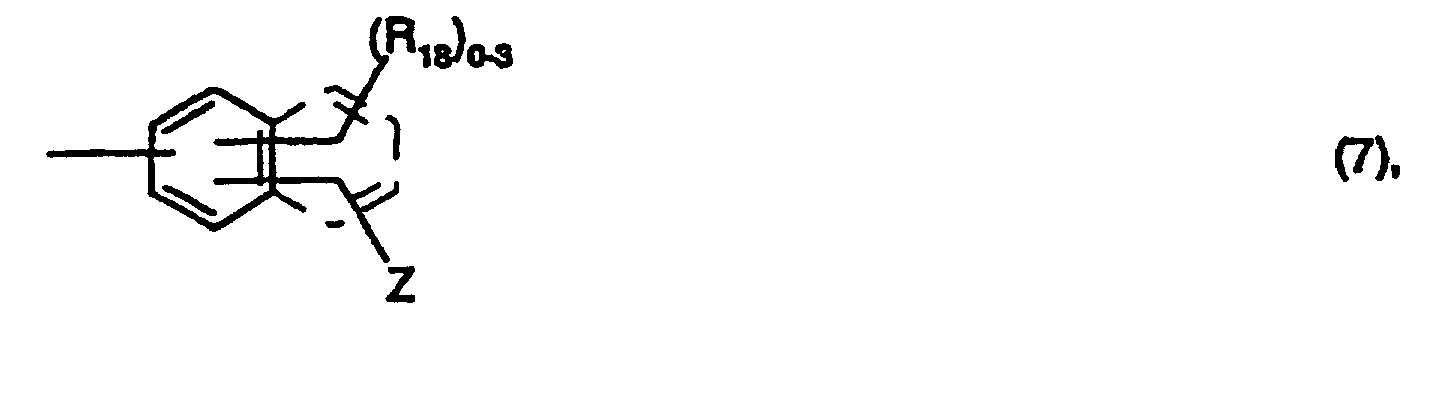
(R18)0-3 représente 0 à 3 substituants identiques ou différents pris dans le groupe comprenant halogène, alkyle en C1-C4, alkoxy en C1-C4, carboxy, nitro et sulfo et
Z représente un reste de formules (2a), (2c), (2d), (2e) ou (2f)où
R8 et R9 représentent un atome d'hydrogène,
Hal représente un atome de brome,
Y représente un groupe vinyle, β-chloréthyle ou β-sulfatoéthyle,
T1 représente un groupe alkoxy en C1-C4, (alkyl en C1-C4)thio éventuellement substitué par des substituants hydroxy, carboxy ou sulfo, hydroxy, amino, N-mono- ou N,N-di-(alkyl en C1-C4)amino éventuellement substitué dans le fragment alkyle par des substituants hydroxy, sulfato ou sulfo, morpholino, N-(alkyl en C1-C4)-N-phénylamino ou phénylamino éventuellement substitué dans le cycle phényle par des substituants sulfo, carboxy, chloro, acétylamino, méthyle ou méthoxy, où le fragment alkyle est éventuellement substitué par des substituants hydroxy, sulfo ou sulfato, naphtylamino éventuellement substitué par 1 à 3 groupes sulfo, ou représente un reste réactif sur la fibre de formule (3c') ou (3d')ou et Y possède la signification donnée ci-dessus,
X2 représente un atome de chlore ou de fluor, et
m vaut 2 ou 3 ; ouoù
B2 représente un groupe alkylène en C2-C6 éventuellement substitué par des substituants hydroxy, sulfo, carboxy ou sulfato,
D2 représente un reste de formule (7), où (R18)0-3 possède les significations données ci-dessus et Z représente un reste de formule (2a), (2c), (2d) ou (2e), où R8, Hal, Y et m possèdent les significations données ci-dessus,
R16 représente un atome d'hydrogène, un groupe alkyle en C1-C4 ou phényle,
R17 représente un atome d'hydrogène, un groupe cyano, carbamoyle ou sulfométhyle,
R19 représente un atome d'hydrogène, un groupe méthyle ou éthyle, et
R9 et X2 possèdent les significations données ci-dessus. - Colorants réactifs selon l'une des revendications 1 à 5, caractérisés en ce que D1 représente un reste de formule (7a), (7b), (7c), (7d) ou (6j")


 où
où
(R18)0-2 représente 0 à 2 substituants identiques ou différents pris dans le groupe comprenant halogène, alkyle en C1-C4, alkoxy en C1-C4 et sulfo,
Y représente un groupe vinyle, β-chloroéthyle ou β-sulfatoéthyle,
Y1 représente un groupe -CH(Br)-CH2Br ou -C(Br)=CH2 et
m vaut 2 ou 3 ; ouoù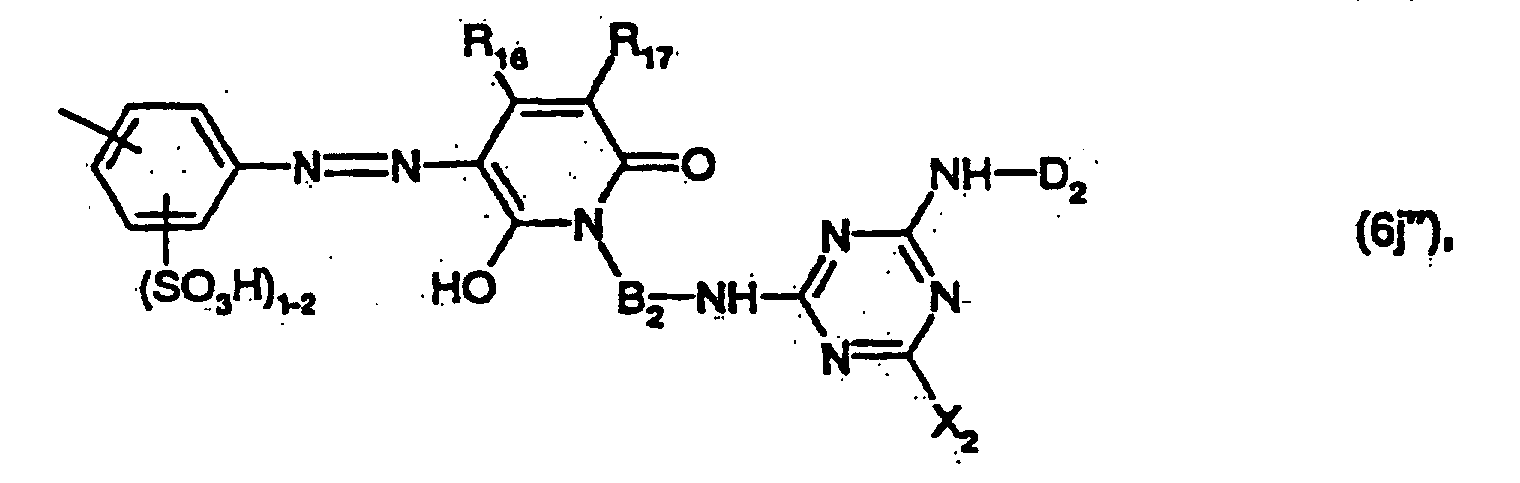
B2 représente un groupe alkylène en C2-C4,
D2 représente un reste de formules (7a), (7b), (7c) ou (7d), où
(R18)0-2, Y, Y1 et m possèdent les significations données ci-dessus,
R16 représente un groupe méthyle ou éthyle,
R17 représente un groupe carbamoyle ou sulfométhyle, et
X2 représente un atome de fluor ou de chlore. - Colorants réactifs selon l'une des revendications 1 à 6, caractérisés en ce que X1 représente un atome de fluor ou de chlore.
- Colorants réactifs selon l'une des revendications 1 à 7, caractérisés en ce qu'ils répondent à la formule (1a)où A, B1, D1 et X1 possèdent les significations et les préférences données ci-dessus.

- Colorants réactifs selon la revendication 8, caractérisés en ce que
A représente un groupe alkyle en C1-C4 éventuellement substitué par des substituants hydroxy, sulfo, carboxy ou sulfato, phényle éventuellement substitué par des substituants alkyle en C1-C4, alkoxy en C1-C4, (alcanoyl en C2-C4)amino, hydroxy, carboxy, carbamoyle, sulfo ou halogène, phénylalkylène en C1-C4 éventuellement substitué dans le cycle phényle par des substituants alkyle en C1-C4, alkoxy en C1-C4, (alcanoyl en C2-C4)-amino, hydroxy, carboxy, sulfo, carbamoyle, uréido ou halogène, ou cycloalkyle en C5-C7 éventuellement substitué par un substituant alkyle en C1-C4 ;
B1 représente un reste alkylène en C2-C12, qui peut être interrompu par 1, 2 ou 3 membres -O- et est non substitué ou substitué par des substituants hydroxy, sulfo, sulfato, cyano ou carboxy, ou représente un groupe phénylène éventuellement substitué par des substituants alkyle en C1-C4, alkoxy en C1-C4, (alcanoyl en C2-C4)amino, sulfo, halogène ou carboxy ;
X1 représente un atome de fluor ou de chlore.
D1 représente un reste de formules (7) ou (6j")où
(R18)0-3 représente 0 à 3 substituants identiques ou différents pris dans le groupe comprenant halogène, alkyle en C1-C4, alkoxy en C1-C4, carboxy, nitro et sulfo et
Z représente un reste de formules (2a), (2c), (2d), (2e) ou (2f) oùoù
R8 et R9 représentent un atome d'hydrogène,
Hal représente un atome de brome,
Y représente un groupe vinyle, β-chloréthyle ou β-sulfatoéthyle,
T1 représente un groupe alkoxy en C1-C4, (alkyl en C1-C4)thio éventuellement substitué par des substituants hydroxy, carboxy ou sulfo, hydroxy, amino, N-mono- ou N,N-di-(alkyl en C1-C4)amino éventuellement substitué dans le fragment alkyle par des substituants hydroxy, sulfato ou sulfo, morpholino, N-(alkyl en C1-C4)-N-phénylamino ou phénylamino éventuellement substitué dans le cycle phényle par des substituants sulfo, carboxy, chloro, acétylamino, méthyle ou méthoxy, où le fragment alkyle est éventuellement substitué par des substituants hydroxy, sulfo ou sulfato, naphtylamino éventuellement substitué par 1 à 3 groupes sulfo, ou représente un reste réactif sur la fibre de formule (3c') ou (3d')ou et Y possède la signification donnée ci-dessus,
X2 représente un atome de chlore ou de fluor, et
m vaut 2 ou 3 ; ouoù
B2 représente un groupe alkylène en C2-C6 éventuellement substitué par des substituants hydroxy, sulfo, carboxy ou sulfato,
D2 représente un reste de formule (7), où (R18)0-3 possède les significations données ci-dessus et Z représente un reste de formule (2a), (2c), (2d) ou (2e), où R8, Hal, Y et m possèdent les significations données ci-dessus,
R16 représente un atome d'hydrogène, un groupe alkyle en C1-C4 ou phényle,
R17 représente un atome d'hydrogène, un groupe cyano, carbamoyle ou sulfométhyle,
R19 représente un atome d'hydrogène, un groupe méthyle ou éthyle, et
R9 et X2 possèdent les significations données ci-dessus. - Colorants réactifs selon l'une dés revendications 8 ou 9, caractérisés en ce que
A représente un groupe alkyle en C1-C4 substitué par un substituant hydroxy ou sulfato,
B1 représente un reste de formule -CH2-CH(CH3)- ou - (CH3)CH-CH2-,
X1 représente un atome de fluor ou de chlore,
D1 représente un reste de formule (7a), (7b), (7c) ou (6j")
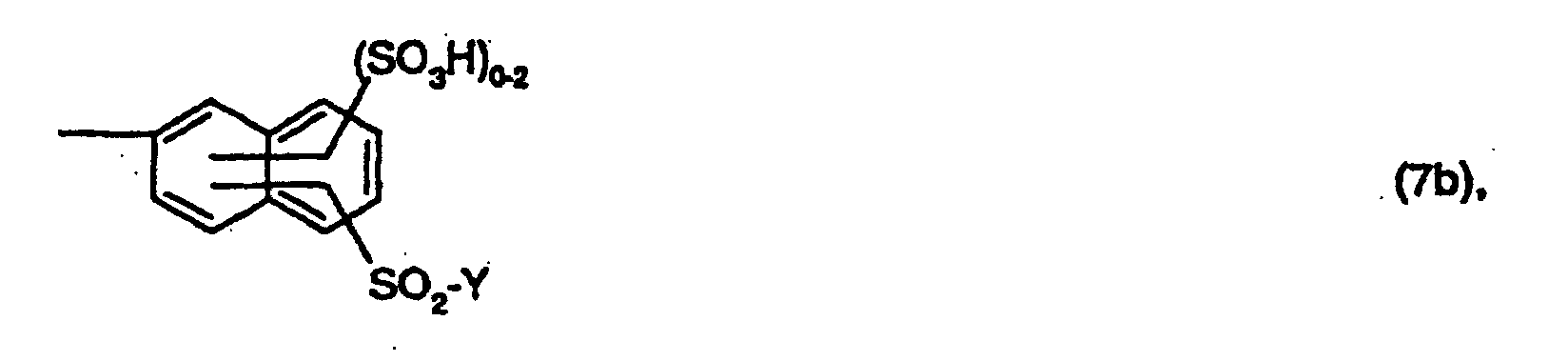 où
où
(R18)0-2 représente 0 à 2 substituants identiques ou différents pris dans le groupe comprenant méthyle, méthoxy et sulfo,
Y représente un groupe vinyle ou β-sulfatoéthyle,
m vaut 2 ou 3 ; ouoù
B2 représente un groupe éthylène,
D2 représente un reste de formule (7a), où (R18)0-2 et Y possèdent les significations données ci-dessus,
R16 représente un groupe méthyle,
R17 représente un groupe carbamoyle ou sulfométhyle, et
X2 représente un atome de fluor ou de chlore. - Procédé pour la préparation de colorants réactifs selon la revendication 1, caractérisé en ce qu'on fait réagir un composé de formule (8)sur un composé de formule (9)
 pour obtenir un composé de formule (10)
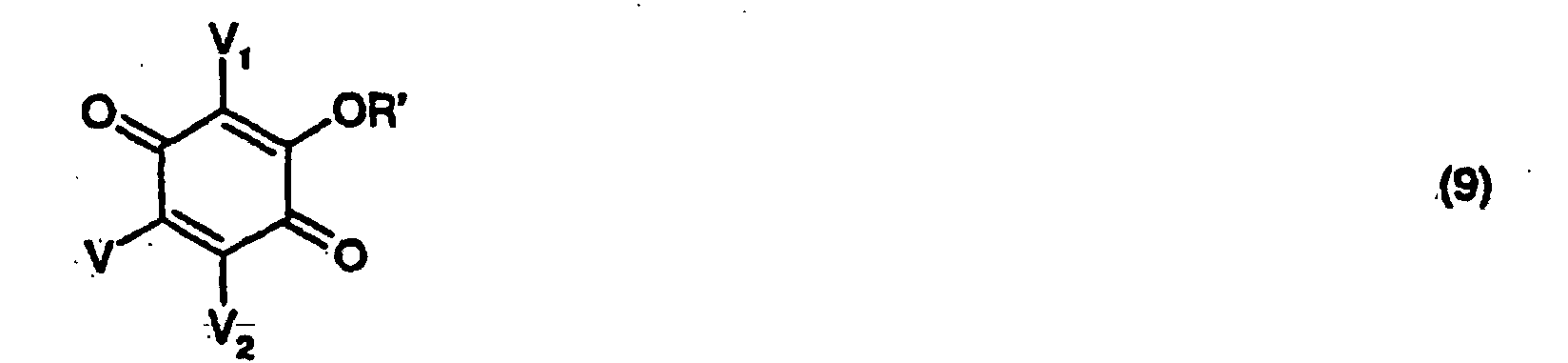 on fait réagir le composé de formule (10) sur un composé de formule (11)
 pour obtenir un composé de formule (12)
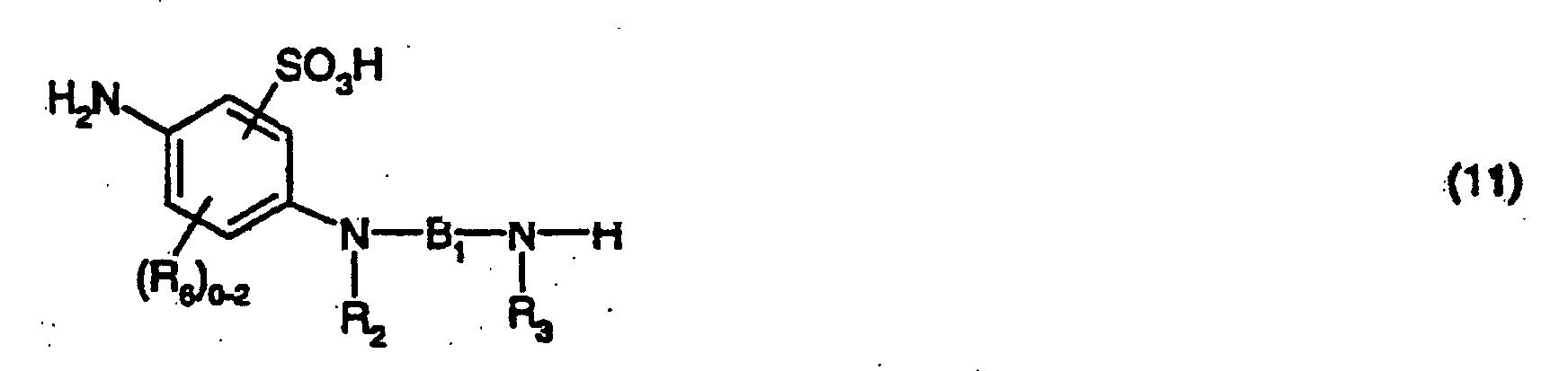 on cyclise le composé de formule (12) pour obtenir un composé de formule (13)
 et on condense le composé de formule (13), dans un ordre quelconque, sur la 2,4,6-trihalogéno-s-triazine et un composé de formule (14)
 pour obtenir un composé de formule (15)
 R1, R2, R3, R4, (R5)0-2, (R6)0-2, A, B1, D1, V1 et V2 possèdent les significations données ci-dessus, R' représente un groupe alkyle en C1-C4, V représente un atome de chlore ou de brome, et X représente un atome de fluor ou de chlore.
- Utilisation de colorants réactifs selon l'une des revendications 1 à 10 ou des colorants réactifs obtenus selon la revendication 11, pour la teinture ou l'impression de matières fibreuses azotées ou présentant des groupes hydroxyle.
- Utilisation selon la revendication 12, caractérisée en ce qu'on teint ou imprime des matières fibreuses cellulosiques, en particulier des matières fibreuses contenant du coton.
Priority Applications (1)
| Application Number | Priority Date | Filing Date | Title |
|---|---|---|---|
| EP20000810188 EP1036825B1 (fr) | 1999-03-15 | 2000-03-07 | Colorants réactifs, procédé pour leur préparation et leur utilisation |
Applications Claiming Priority (3)
| Application Number | Priority Date | Filing Date | Title |
|---|---|---|---|
| EP99810229 | 1999-03-15 | ||
| EP99810229 | 1999-03-15 | ||
| EP20000810188 EP1036825B1 (fr) | 1999-03-15 | 2000-03-07 | Colorants réactifs, procédé pour leur préparation et leur utilisation |
Publications (2)
| Publication Number | Publication Date |
|---|---|
| EP1036825A1 EP1036825A1 (fr) | 2000-09-20 |
| EP1036825B1 true EP1036825B1 (fr) | 2004-05-06 |
Family
ID=26073801
Family Applications (1)
| Application Number | Title | Priority Date | Filing Date |
|---|---|---|---|
| EP20000810188 Expired - Lifetime EP1036825B1 (fr) | 1999-03-15 | 2000-03-07 | Colorants réactifs, procédé pour leur préparation et leur utilisation |
Country Status (1)
| Country | Link |
|---|---|
| EP (1) | EP1036825B1 (fr) |
Families Citing this family (1)
| Publication number | Priority date | Publication date | Assignee | Title |
|---|---|---|---|---|
| AT505504B1 (de) * | 2007-06-21 | 2016-03-15 | Chemiefaser Lenzing Ag | Verfahren zur behandlung von cellulosischen fasern |
Family Cites Families (5)
| Publication number | Priority date | Publication date | Assignee | Title |
|---|---|---|---|---|
| DE3330547A1 (de) * | 1983-08-24 | 1985-03-21 | Bayer Ag, 5090 Leverkusen | Benzthiazinophenoxazin-farbstoffe |
| US4841049A (en) * | 1986-09-12 | 1989-06-20 | Ciba-Geigy Corporation | Reactive dyes of the dioxazine series |
| JP3074796B2 (ja) * | 1990-08-21 | 2000-08-07 | 住友化学工業株式会社 | 非対称ジオキサジン化合物及びそれを用いて繊維材料を染色又は捺染する方法 |
| DE4415780A1 (de) * | 1994-05-05 | 1995-11-09 | Bayer Ag | Triphendioxazin-Reaktivfarbstoffe |
| DE4428906A1 (de) * | 1994-08-16 | 1996-02-22 | Hoechst Ag | Triphendioxazin-Reaktivfarbstoffe |
-
2000
- 2000-03-07 EP EP20000810188 patent/EP1036825B1/fr not_active Expired - Lifetime
Also Published As
| Publication number | Publication date |
|---|---|
| EP1036825A1 (fr) | 2000-09-20 |
Similar Documents
| Publication | Publication Date | Title |
|---|---|---|
| EP0625549B1 (fr) | Colorants réactifs, procédé pour leur préparation et leur utilisation | |
| EP1035171B1 (fr) | Colorants azoiques, procédé pour leur préparation et leur utilisation | |
| EP1137716B1 (fr) | Colorants reactifs, melanges de colorants reactifs, leur preparation et leur utilisation | |
| EP0625551B1 (fr) | Mélanges de colorants, procédé pour leur préparation et leur utilisation | |
| DE60209035T2 (de) | Faserreaktive azofarbstoffe, deren herstellung und deren verwendung | |
| EP0803543B1 (fr) | Colorants réactifs sur la fibre, leur préparation et leur utilisation | |
| EP0716130A1 (fr) | Colorants réactifs, procédé pour leur préparation et leur utilisation | |
| EP0755985B1 (fr) | Mélanges de colorants, leur procédé de fabrication et leur utilisation | |
| EP0748850B1 (fr) | Des colorants, leur procédé de préparation et leur utilisation | |
| EP0764694B1 (fr) | Colorants réactifs, leur préparation et utilisation | |
| EP0776947B1 (fr) | Colorants réactifs sur la fibre, leur préparation et leur utilisation | |
| US6592634B1 (en) | Reactive dyes, processes for their preparation and their use | |
| EP0761768B1 (fr) | Colorants réactifs, procédé pour leur préparation et leur utilisation | |
| EP0712905B1 (fr) | Colorants réactifs, leur procédé de préparation et leur utilisation | |
| EP1036825B1 (fr) | Colorants réactifs, procédé pour leur préparation et leur utilisation | |
| EP0641839B1 (fr) | Colorants de fibres réactifs, leur préparation et leur utilisation | |
| EP0581731B1 (fr) | Colorants réactifs, procédé pour leur préparation et leur utilisation | |
| EP1041121B1 (fr) | Colorants, leur procédé de préparation et leur utilisation | |
| DE60010362T2 (de) | Reaktivfarbstoffe, Verfahren zu deren Herstellung und deren Verwendung | |
| EP0581729B1 (fr) | Colorants réactifs, procédé pour leur préparation et leur utilisation | |
| EP0739950A2 (fr) | Colorants réactifs dioxaziniques, leur préparation et leur utilisation | |
| EP0581732B1 (fr) | Mélanges de colorants, procédé pour leur préparation et leur utilisation | |
| EP0581733B1 (fr) | Colorants réactifs, procédé pour leur préparation et leur utilisation | |
| EP1095105B1 (fr) | Colorants reactifs, leur production et leur utilisation | |
| EP0688832A2 (fr) | Colorants réactifs, leur préparation et utilisation |
Legal Events
| Date | Code | Title | Description |
|---|---|---|---|
| PUAI | Public reference made under article 153(3) epc to a published international application that has entered the european phase |
Free format text: ORIGINAL CODE: 0009012 |
|
| AK | Designated contracting states |
Kind code of ref document: A1 Designated state(s): AT BE CH CY DE DK ES FI FR GB GR IE IT LI LU MC NL PT SE |
|
| AX | Request for extension of the european patent |
Free format text: AL;LT;LV;MK;RO;SI |
|
| 17P | Request for examination filed |
Effective date: 20010215 |
|
| AKX | Designation fees paid |
Free format text: AT BE CH CY DE DK ES FI FR GB GR IE IT LI LU MC NL PT SE |
|
| 17Q | First examination report despatched |
Effective date: 20030203 |
|
| GRAP | Despatch of communication of intention to grant a patent |
Free format text: ORIGINAL CODE: EPIDOSNIGR1 |
|
| GRAS | Grant fee paid |
Free format text: ORIGINAL CODE: EPIDOSNIGR3 |
|
| GRAA | (expected) grant |
Free format text: ORIGINAL CODE: 0009210 |
|
| AK | Designated contracting states |
Kind code of ref document: B1 Designated state(s): AT BE CH CY DE DK ES FI FR GB GR IE IT LI LU MC NL PT SE |
|
| PG25 | Lapsed in a contracting state [announced via postgrant information from national office to epo] |
Ref country code: NL Free format text: LAPSE BECAUSE OF FAILURE TO SUBMIT A TRANSLATION OF THE DESCRIPTION OR TO PAY THE FEE WITHIN THE PRESCRIBED TIME-LIMIT Effective date: 20040506 Ref country code: IE Free format text: LAPSE BECAUSE OF FAILURE TO SUBMIT A TRANSLATION OF THE DESCRIPTION OR TO PAY THE FEE WITHIN THE PRESCRIBED TIME-LIMIT Effective date: 20040506 Ref country code: FI Free format text: LAPSE BECAUSE OF FAILURE TO SUBMIT A TRANSLATION OF THE DESCRIPTION OR TO PAY THE FEE WITHIN THE PRESCRIBED TIME-LIMIT Effective date: 20040506 |
|
| REG | Reference to a national code |
Ref country code: GB Ref legal event code: FG4D Free format text: NOT ENGLISH |
|
| REG | Reference to a national code |
Ref country code: CH Ref legal event code: EP |
|
| GBT | Gb: translation of ep patent filed (gb section 77(6)(a)/1977) |
Effective date: 20040506 |
|
| REF | Corresponds to: |
Ref document number: 50006295 Country of ref document: DE Date of ref document: 20040609 Kind code of ref document: P |
|
| REG | Reference to a national code |
Ref country code: IE Ref legal event code: FG4D Free format text: GERMAN |
|
| PG25 | Lapsed in a contracting state [announced via postgrant information from national office to epo] |
Ref country code: GR Free format text: LAPSE BECAUSE OF FAILURE TO SUBMIT A TRANSLATION OF THE DESCRIPTION OR TO PAY THE FEE WITHIN THE PRESCRIBED TIME-LIMIT Effective date: 20040806 Ref country code: DK Free format text: LAPSE BECAUSE OF FAILURE TO SUBMIT A TRANSLATION OF THE DESCRIPTION OR TO PAY THE FEE WITHIN THE PRESCRIBED TIME-LIMIT Effective date: 20040806 Ref country code: SE Free format text: LAPSE BECAUSE OF FAILURE TO SUBMIT A TRANSLATION OF THE DESCRIPTION OR TO PAY THE FEE WITHIN THE PRESCRIBED TIME-LIMIT Effective date: 20040806 |
|
| NLV1 | Nl: lapsed or annulled due to failure to fulfill the requirements of art. 29p and 29m of the patents act | ||
| REG | Reference to a national code |
Ref country code: ES Ref legal event code: FG2A Ref document number: 2219289 Country of ref document: ES Kind code of ref document: T3 |
|
| REG | Reference to a national code |
Ref country code: IE Ref legal event code: FD4D |
|
| ET | Fr: translation filed | ||
| REG | Reference to a national code |
Ref country code: HK Ref legal event code: GR Ref document number: 1029133 Country of ref document: HK |
|
| PG25 | Lapsed in a contracting state [announced via postgrant information from national office to epo] |
Ref country code: LU Free format text: LAPSE BECAUSE OF NON-PAYMENT OF DUE FEES Effective date: 20050307 Ref country code: CY Free format text: LAPSE BECAUSE OF FAILURE TO SUBMIT A TRANSLATION OF THE DESCRIPTION OR TO PAY THE FEE WITHIN THE PRESCRIBED TIME-LIMIT Effective date: 20050307 Ref country code: AT Free format text: LAPSE BECAUSE OF NON-PAYMENT OF DUE FEES Effective date: 20050307 |
|
| PLBE | No opposition filed within time limit |
Free format text: ORIGINAL CODE: 0009261 |
|
| STAA | Information on the status of an ep patent application or granted ep patent |
Free format text: STATUS: NO OPPOSITION FILED WITHIN TIME LIMIT |
|
| PG25 | Lapsed in a contracting state [announced via postgrant information from national office to epo] |
Ref country code: LI Free format text: LAPSE BECAUSE OF NON-PAYMENT OF DUE FEES Effective date: 20050331 Ref country code: MC Free format text: LAPSE BECAUSE OF NON-PAYMENT OF DUE FEES Effective date: 20050331 Ref country code: CH Free format text: LAPSE BECAUSE OF NON-PAYMENT OF DUE FEES Effective date: 20050331 Ref country code: BE Free format text: LAPSE BECAUSE OF NON-PAYMENT OF DUE FEES Effective date: 20050331 |
|
| 26N | No opposition filed |
Effective date: 20050208 |
|
| BERE | Be: lapsed |
Owner name: *CIBA SPECIALTY CHEMICALS HOLDING INC. Effective date: 20050331 |
|
| REG | Reference to a national code |
Ref country code: CH Ref legal event code: PL |
|
| PGFP | Annual fee paid to national office [announced via postgrant information from national office to epo] |
Ref country code: FR Payment date: 20060214 Year of fee payment: 7 |
|
| PGFP | Annual fee paid to national office [announced via postgrant information from national office to epo] |
Ref country code: DE Payment date: 20060223 Year of fee payment: 7 |
|
| PGFP | Annual fee paid to national office [announced via postgrant information from national office to epo] |
Ref country code: ES Payment date: 20060309 Year of fee payment: 7 |
|
| GBPC | Gb: european patent ceased through non-payment of renewal fee |
Effective date: 20070307 |
|
| BERE | Be: lapsed |
Owner name: *CIBA SPECIALTY CHEMICALS HOLDING INC. Effective date: 20050331 |
|
| PG25 | Lapsed in a contracting state [announced via postgrant information from national office to epo] |
Ref country code: PT Free format text: LAPSE BECAUSE OF NON-PAYMENT OF DUE FEES Effective date: 20041006 |
|
| PGFP | Annual fee paid to national office [announced via postgrant information from national office to epo] |
Ref country code: IT Payment date: 20070611 Year of fee payment: 8 |
|
| REG | Reference to a national code |
Ref country code: FR Ref legal event code: ST Effective date: 20071130 |
|
| PG25 | Lapsed in a contracting state [announced via postgrant information from national office to epo] |
Ref country code: DE Free format text: LAPSE BECAUSE OF NON-PAYMENT OF DUE FEES Effective date: 20071002 |
|
| PG25 | Lapsed in a contracting state [announced via postgrant information from national office to epo] |
Ref country code: GB Free format text: LAPSE BECAUSE OF NON-PAYMENT OF DUE FEES Effective date: 20070307 |
|
| REG | Reference to a national code |
Ref country code: ES Ref legal event code: FD2A Effective date: 20070308 |
|
| PG25 | Lapsed in a contracting state [announced via postgrant information from national office to epo] |
Ref country code: ES Free format text: LAPSE BECAUSE OF NON-PAYMENT OF DUE FEES Effective date: 20070308 Ref country code: FR Free format text: LAPSE BECAUSE OF NON-PAYMENT OF DUE FEES Effective date: 20070402 |
|
| PGFP | Annual fee paid to national office [announced via postgrant information from national office to epo] |
Ref country code: GB Payment date: 20060224 Year of fee payment: 7 |
|
| PG25 | Lapsed in a contracting state [announced via postgrant information from national office to epo] |
Ref country code: IT Free format text: LAPSE BECAUSE OF NON-PAYMENT OF DUE FEES Effective date: 20080307 |