EP1037257A2 - Quecksilberfreie Metallhalogenidlampe - Google Patents
Quecksilberfreie Metallhalogenidlampe Download PDFInfo
- Publication number
- EP1037257A2 EP1037257A2 EP00302009A EP00302009A EP1037257A2 EP 1037257 A2 EP1037257 A2 EP 1037257A2 EP 00302009 A EP00302009 A EP 00302009A EP 00302009 A EP00302009 A EP 00302009A EP 1037257 A2 EP1037257 A2 EP 1037257A2
- Authority
- EP
- European Patent Office
- Prior art keywords
- lamp
- mercury
- enclosed
- halide
- trivalent
- Prior art date
- Legal status (The legal status is an assumption and is not a legal conclusion. Google has not performed a legal analysis and makes no representation as to the accuracy of the status listed.)
- Withdrawn
Links
Images




Classifications
-
- H—ELECTRICITY
- H01—ELECTRIC ELEMENTS
- H01J—ELECTRIC DISCHARGE TUBES OR DISCHARGE LAMPS
- H01J61/00—Gas-discharge or vapour-discharge lamps
- H01J61/02—Details
- H01J61/12—Selection of substances for gas fillings; Specified operating pressure or temperature
- H01J61/18—Selection of substances for gas fillings; Specified operating pressure or temperature having a metallic vapour as the principal constituent
-
- H—ELECTRICITY
- H01—ELECTRIC ELEMENTS
- H01J—ELECTRIC DISCHARGE TUBES OR DISCHARGE LAMPS
- H01J61/00—Gas-discharge or vapour-discharge lamps
- H01J61/02—Details
- H01J61/12—Selection of substances for gas fillings; Specified operating pressure or temperature
-
- H—ELECTRICITY
- H01—ELECTRIC ELEMENTS
- H01J—ELECTRIC DISCHARGE TUBES OR DISCHARGE LAMPS
- H01J61/00—Gas-discharge or vapour-discharge lamps
- H01J61/82—Lamps with high-pressure unconstricted discharge having a cold pressure > 400 Torr
- H01J61/827—Metal halide arc lamps
-
- H—ELECTRICITY
- H01—ELECTRIC ELEMENTS
- H01J—ELECTRIC DISCHARGE TUBES OR DISCHARGE LAMPS
- H01J61/00—Gas-discharge or vapour-discharge lamps
- H01J61/02—Details
- H01J61/30—Vessels; Containers
- H01J61/34—Double-wall vessels or containers
Definitions
- the present invention relates to a mercury-free metal-halide lamp which is usable for general luminaries, and motor vehicle headlights combined with reflectors and the like.
- rare gas, metal halide (solid matter) and, additionally, mercury are enclosed in an arc tube.
- Rare gas of these enclosures is enclosed principally in order to facilitate a starting of a lamp and to obtain a high light output immediately after the starting, metal halide is enclosed in order to obtain an appropriate light output during a stable operation, and mercury is enclosed in order to obtain a sufficiently high voltage between the electrodes damp voltage), which is required for the stable operation of the lamp.
- a high voltage between the electrodes can be obtained in the lamp in operation particularly by the enclosure of mercury, and thereby the lamp is operated at a low lamp current.
- the heat load of the electrodes (Joule loss) is reduced and the lamp can be operated for a long time up to several thousand hours.
- a lamp appropriate for motor vehicle headlights for instance, disclosed in Japanese Unexamined Patent Publication No. 59-111244, is known as a concrete example of conventional metal-halide lamps.
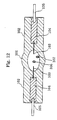
- the conventional metal-halide lamp according to the Publication will be described below showing in Fig. 12.
- 101 indicates an arc tube made of quartz, and 102 at both ends of the arc tube 101 indicates a seal portion.
- 103 indicates a pair of electrodes made of tungsten, 104 indicates a molybdenum foil, and 105 indicates a lead wire made of molybdenum.
- the electrodes 103 are connected electrically with an end of the molybdenum foil 104 sealed in the seal portion 102, and additionally, the lead wire 105 is connected electrically with the other end of the molybdenum foil 104.
- the tips of the electrodes 103 in the arc tube 101 are disposed so that a distance between the tips, namely, a distance between the electrodes is approximately 4.2 (mm).
- An internal volume of the arc tube 101 is approximately 0.03 (cc).
- the lamp voltage becomes approximately 70 to 80 V. Consequently, for instance, in the case of operating at a lamp power of approximately 35W, the lamp current becomes approximately 0.4 to 0.5 A.
- the enclosure of mercury brings the increase of the lamp voltage, and thereby a long lamp life up to several thousand hours is provided for us.
- the above-mentioned conventional metal-halide lamp has a disadvantage of causing high manufacturing costs frequently because of requiring the step of injecting liquid mercury for manufacturing.
- metal-halide lamps comprising no mercury have been desired in consideration of the global environment.
- the lamp voltage drops to approximately 25 V.
- the lamp current in operation becomes approximately 1.5 A, which is approximately three times as high as a conventional metal-halide lamp wherein mercury is enclosed. Consequently the heat load of the electrodes (Joule loss) is increased and the evaporation of the electrode becomes active. Therefore, in a mercury-free lamp having a constitution in which mercury is merely removed from a conventional metal-halide lamp, the problem is that the arc tube is blackened in no more than several tens of hours and reaches the end of its life in a very short time. Such a problem becomes conspicuous, particularly in a so-called short-arc lamp with an arc length (a distance between the electrodes) of approximately 10 mm or less.
- the purpose of the present invention is to provide a mercury-free metal-halide lamp wherein a lamp life can be made longer by raising the lamp voltage, and simultaneously a luminous flux emitted from the lamp can be increased (or a decrease in a luminous flux can be lessened).
- the present invention is characterized by a mercury-free metal halide lamp comprising in its arc tube at least a rare gas and a trivalent of indium halide InX 3 (X: halogen).
- the lamp voltage can be made higher greatly as compared with the case of comprising no InX 3 and the case of comprising a monovalent of indium halide InX. Therefore, since an electric current applied to the lamp can be decreased, the heat load of the electrodes is reduced and the blackening of an arc tube by the sputtering of the electrodes is restrained. As a result, a long lamp life can be obtained.
- the above-mentioned rare gas can comprise at least Xe (xenon), and an enclosed pressure of the above-mentioned Xe can be determined in a range of 0.1 MPa, preferably 0.7MPa, to 2.5MPa at room temperature. Furthermore, it is possible to raise the lamp voltage as well as increase the whole luminous flux by comprising a thallium halide. In particular since the ratio of a rising rate of the lamp voltage to a rising rate of the enclosed pressure of Xe is higher than the case of comprising a monovalent of indium halide InX, it is easily possible to raise the lamp voltage further by raising the enclosed pressure.
- the present invention is characterized by comprising a scandium halide or a sodium halide.
- the present invention is characterized by determining the enclosed amount of the above-mentioned rare gas, the enclosed amount of the above-mentioned trivalent of indium halide and the operating power of the above-mentioned lamp so that the lamp voltage per unit distance between the electrodes is 100 V/cm or more and the luminous efficiency is 60l m/W.
- the present invention is characterized in that the enclosed amount of the above-mentioned trivalent of indium halide is 90.0 mg/cc or less per unit internal volume of the arc tube.
- the present invention is characterized in that the operating power of the above-mentioned lamp is determined in a range of 25W to 55W.
- the present invention is characterized in that the above-mentioned trivalent of indium halide is at least one of iodide and bromide.
- a lamp life is made longer by raising the lamp voltage certainly, and simultaneously a light with a large luminous flux can be emitted. It is possible to obtain such a lamp as appropriate for motor vehicle headlights.
- Fig. 1 is a cross sectional view showing a mercury-free metal-halide lamp in Embodiments 1 and 2.
- Fig. 2 is a graph showing a relation between the enclosed amount of a trivalent of indium iodide (InI 3 ) and the lamp voltage in a mercury-free metal-halide lamp of Embodiment 1.
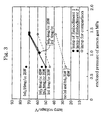
- Fig. 3 is a graph showing a relation between the enclosed pressure of xenon gas and the lamp voltage in a mercury-free metal-halide lamp of Embodiment 1.
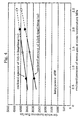
- Fig. 4 is a graph showing a relation between the enclosed pressure of xenon gas and the whole luminous flux in a mercury-free metal-halide lamp of Embodiment 1.
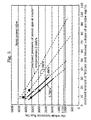
- Fig. 5 is a graph showing a relation between the enclosed amount of a trivalent of indium iodide (InI 3 ) and the whole luminous flux in a mercury-See metal-halide lamp of Embodiment 1, which is operated at a lamp power of 45W.
- Fig. 6 is a graph showing a relation between the enclosed amount of a trivalent of indium iodide (InI 3 ) and the whole luminous flux in a mercury-free metal-halide lamp of Embodiment 1, which is operated at a lamp power of 35W.
- Fig. 7 is a graph showing a relation between the enclosed amount of thallium iodide and the lamp voltage in a mercury-free metal-halide lamp of Embodiment 2.
- Fig. 8 is a graph showing a relation between the enclosed amount of thallium iodide and the whole luminous flux in a mercury-free metal-halide lamp of Embodiment 2.
- Fig. 9 is a graph showing a relation between the enclosed pressure of xenon gas and the lamp voltage in a mercury-free metal-halide lamp of Embodiment 2.
- Fig. 10 is a graph showing a relation between the enclosed pressure of xenon gas and the whole luminous flux in a mercury-free metal-halide lamp of Embodiment 2.
- Fig. 11 is a graph showing the lamp voltage per unit distance between the electrodes and the luminous efficiency in a mercury-free metal-halide lamp of Embodiments 1, 2 and a conventional metal-halide lamp.
- Fig. 12 is a cross sectional view showing a conventional metal-halide lamp.
- FIG. 1 is a cross sectional view showing a mercury-free metal-halide lamp in Embodiment 1 of the present invention.
- Fig. 1 indicates an arc tube made of quartz, and 2 at both ends of the arc tube 1 indicates a seal portion.
- 3 indicates a pair of electrodes made of tungsten, 4 indicates a molybdenum foil, and 5 indicates a lead wire made of molybdenum.
- the electrodes 3 are connected electrically with an end of the molybdenum foil 4 sealed in the seal portion 2, and additionally, the lead wire 5 is connected electrically with the other end of the molybdenum foil 4.
- the tips of the electrodes 3 in the arc tube 1 are disposed so that a distance between the tips, namely, a distance between the electrodes is approximately 4.2 (mm).
- An internal volume of the arc tube 1 is approximately 0.025 (cc).
- Halide 7 composed of approximately 0.2 mg of a trivalent of indium iodide (InI 3 ) (approximately 8.0 mg / cc per unit internal volume of the arc tube), approximately 0.19 mg of scandium iodide (approximately 8.0 mg/cc per unit internal volume of the arc tube), and approximately 0.16 mg of sodium iodide (approximately 6.4mg/cc per unit internal volume of the arc tube); and xenon gas with a pressure of approximately 0.7MPa at room temperature, not shown in Fig. 1, are enclosed inside the arc tube 1.
- InI 3 indium iodide
- scandium iodide approximately 8.0 mg/cc per unit internal volume of the arc tube
- sodium iodide approximately 6.4mg/cc per unit internal volume of the arc tube
- the noticeable characteristic of the constitution of a metal-halide lamp in Embodiment 1, as compared with the constitution of a conventional metal-halide lamp, is that the constitution comprises no mercury, and the enclosed indium iodide is a trivalent of indium iodide (InI 3 ).
- This mercury-free metal-halide lamp is driven by a voltage with a rectangular wave of, for instance, 150 to 250 Hz.
- the lamp voltage of the lamp in Embodiment 1 is approximately 55 V in the case of operating at a lamp power of 45 W, and the lamp voltage is approximately 50 V in the case of operating at a lamp power of 35W.
- the lamp voltage is no more than approximately 27 V.
- the lamp in Embodiment 1 can be operated for several hundred hours or more without the blackening of the arc tube, namely, any substantial change.
- a mercury-free metal-halide lamp wherein approximately 0.2 mg of a trivalent of indium iodide (InI 3 ) (approximately 8.0 mg/cc per unit internal volume of the arc tube) is enclosed, is described in the above-mentioned example. As shown in Fig. 2, it is found that when the enclosed amount of a trivalent of indium iodide (InI 3 ) is increased, an even higher lamp voltage is obtained, therefore the lamp voltage affects the life advantageously.
- Fig. 2 it is found that when the enclosed amount of a trivalent of indium iodide (InI 3 ) is increased, an even higher lamp voltage is obtained, therefore the lamp voltage affects the life advantageously.
- FIG. 2 is a graph showing a relation between the lamp voltage and the enclosed amount of a trivalent of indium iodide (InI 3 ) in the case of operating at a lamp power of 35W or 45W while increasing the enclosed amount of a trivalent of indium iodide (I n I 3 ) in a mercury-free metal-halide lamp of Embodiment 1. More enclosed amount of a trivalent of indium iodide (InI 3 ) brings higher lamp voltage.
- the lamp voltage can be raised further by raising the enclosed pressure.
- Fig. 4 is a graph showing a relation, under a parameter of the enclosed amount of a trivalent of indium iodide (InI 3 ), between the enclosed pressure (an equivalent at room temperature) of xenon gas and the whole luminous flux in a mercury-free metal-halide lamp of Embodiment 1, which is operated at a lamp power of 45W.
- InI 3 indium iodide
- Embodiment 1 The notable fact of a mercury-free metal-halide lamp in Embodiment 1, wherein a trivalent of indium iodide (InI 3 ) is enclosed, is that a rise in temperature at the hotspot (an area with the highest temperature: the top outside of the arc tube 1 in the case of operating the arc tube 1 while maintaining horizontally) of the arc tube 1 by an increase in the enclosed pressure of xenon gas is negligibly small, therefore there is little possibility of an expansion of the arc tube 1 by an increase in the enclosed pressure of xenon gas.
- a trivalent of indium iodide (InI 3 ) is enclosed, is negligibly small, therefore there is little possibility of an expansion of the arc tube 1 by an increase in the enclosed pressure of xenon gas.
- a mercury-free metal-halide lamp in Embodiment 1 wherein at least xenon gas and a trivalent of indium iodide (InI 3 ) are enclosed in the arc tube 1. has such a characteristic that when the enclosed pressure of xenon gas is increased, the whole luminous flux increases with little rise in temperature at the hotspot; and when the enclosed amount of a trivalent of indium iodide (InI 3 ) is increased, the lamp voltage increases.
- the enclosed pressure of xenon gas is described below.
- an upper limit of the enclosed pressure of xenon gas is approximately 2.5 M Pa (an equivalent at room temperature) in a mercury-free metal-halide lamp of Embodiment 1.
- the upper limit of the enclosed pressure of xenon gas is approximately 2.0MPa.
- its appropriate lower limit is approximately 5 to 20kPa, which facilitates a starting of the lamp.
- the lower limit is approximately 0.1MPa when a mercury-free metal-halide lamp in the present invention is used as a light source for motor vehicle headlights wherein a starting of light is required in a short time. It is more preferable to determine the lower limit at a value above 0.7MPa or 1MPa in order to lessen a decrease in a luminous flux due to the enclosure of InI 3 or supplement the luminous flux.
- the enclosed amount of a trivalent of indium iodide (InI 3 ) and the luminous flux are described.
- a mercury-free metal-halide lamp in the present invention more enclosed amount of a trivalent of indium iodide (InI 3 ) brings higher lamp voltage, and thereby the lamp voltage is to the advantage of the life.
- the whole luminous flux of approximately 1100 (1 m) is obtained at a consumption power of 55W in a halogen lamp used frequently for motor vehicle headlights nowadays.
- a lamp in the present invention as shown in Fig. 5, when the enclosed amount of a trivalent of indium iodide (InI 3 ) is determined at a value below approximately 90.0 mg/cc per unit internal volume of the arc tube, more luminous flux than a conventional halogen lamp is obtained at a consumption power of merely 45W, whereby a more economical lamp is obtained.
- Fig. 5 when the enclosed amount of a trivalent of indium iodide (InI 3 ) is determined at a value below approximately 90.0 mg/cc per unit internal volume of the arc tube, more luminous flux than a conventional halogen lamp is obtained at a consumption power of merely 45W, whereby a more economical lamp is obtained.
- FIG. 5 is a graph showing a relation, under a parameter of the enclosed pressure (an equivalent at room temperature) of xenon gas, between the whole luminous flux and the enclosed amount of a trivalent of indium iodide (InI 3 ) in a mercury-free metal-halide lamp of Embodiment 1, which is operated at a lamp power of 45W.
- a parameter of the enclosed pressure (an equivalent at room temperature) of xenon gas between the whole luminous flux and the enclosed amount of a trivalent of indium iodide (InI 3 ) in a mercury-free metal-halide lamp of Embodiment 1, which is operated at a lamp power of 45W.
- the luminous flux of approximately 1100 (1 m) or more is obtained on the condition that the enclosed amount of a trivalent of indium iodide (InI 3 ) is approximately 90.0 mg/cc or less per unit internal volume of the arc tube.
- an appropriate upper limit of the enclosed amount of a trivalent of indium iodide (InI 3 ) for obtaining the luminous flux of approximately 1100 (1 m) or more is approximately 70.0 mg/cc per unit internal volume of the arc tube in a mercury-free metal-halide lamp in the present invention.
- the enclosed pressure of xenon gas is 2.0MPa
- the luminous flux of approximately 1100 (1 m) or more is obtained on the condition that the enclosed amount is approximately 70.0 mg/cc or less per unit internal volume of the arc tube, whereby a more economical lamp than a conventional halogen lamp is obtained.
- Fig. 6 is a graph showing a relation, under a parameter of the enclosed pressure (an equivalent at room temperature) of xenon gas, between the whole luminous flux and the enclosed amount of a trivalent of indium iodide (InI 3 ) in a mercury-free metal-halide lamp of Embodiment 1, which is operated at a lamp power of 35W.
- the enclosed amount of a trivalent of indium iodide (InI 3 ) is determined at a value below approximately 50.0 mg/cc per unit internal volume of the arc tube, more luminous flux than a conventional halogen lamp is obtained at a consumption power of merely 35W, whereby a more economical lamp is obtained.
- the luminous flux of approximately 1100 (1 m) or more is obtained on the condition that the enclosed amount of a trivalent of indium iodide (InI 3 ) is approximately 50.0 mg/cc or less per unit internal volume of the arc tube.
- the enclosed pressure of xenon gas is lower, for instance, 2.0MPa (an equivalent at room temperature)
- an appropriate upper limit of the enclosed amount of a trivalent of indium iodide (InI 3 ) is approximately 40.0 mg/cc per unit internal volume of the arc tube.
- the luminous flux of approximately 1100 (1 m) or more is obtained on the condition that the enclosed amount is approximately 40.0 mg/cc or less per unit internal volume of the arc tube, whereby a more economical lamp than a conventional halogen lamp is obtained.
- a mercury-free metal-halide lamp in the present invention when xenon gas with an appropriate pressure below an upper limit of 2.5MPa is enclosed and a trivalent of indium iodide (InI 3 ) with an appropriate amount below an upper limit of approximately 90.0 mg/cc per unit internal volume of the arc tube is enclosed, it is possible to obtain a mercury-free metal-halide lamp most appropriate as a light source for motor vehicle headlights, wherein, in the case of operating at a lamp power above approximately 25W, there is no possibility of breaking the airtightness in the arc tube 1; a high lamp voltage is obtained, and thereby the lamp has a long life; and more luminous flux than a halogen lamp occurs.
- InI 3 indium iodide
- a lamp power when a mercury-free lamp in Embodiment 1 is operated at a higher lamp power, more luminous flux is obtained.
- an upper limit of a consumption power of a mercury-free lamp in Embodiment 1 is actually approximately 55W if the lamp is used for motor vehicle headlights. The reason is that an operation in a range above a consumption power of a conventional halogen lamp is uneconomical and not preferable.
- a mercury-free metal-halide lamp in Embodiment 1 when xenon gas with an appropriate pressure below an upper limit of 2.5MPa is enclosed and a trivalent of indium iodide (InI 3 ) with an appropriate amount below an upper limit of approximately 90.0 mg/cc per unit internal volume of the arc tube is enclosed, it is confirmed that the light color of a mercury-free lamp in Embodiment 1, in the case of operating at a lamp power of approximately 25 to 55 W, is in a chromaticity range of the white light source specified in HlD light sources for motor vehicle headlights (JEL 215) by the Japan Electrical Lamp Manufacturers Association.
- a chromaticity coordinate of an emitted light of the lamp can be in a chromaticity range of the following equations in a CIE1931 x,y chromaticity diagram :
- a mercury-free metal-halide lamp in Embodiment 1 is completely usable as a light source for motor vehicle headlights within the above-mentioned limited range of the enclosed pressure of xenon gas, the enclosed amount of a trivalent of indium iodide (InI 3 ), and a lamp power.
- Embodiment 2 of the present invention will be described below.
- the structural constitution of this lamp is the same as the above-mentioned lamp of Embodiment 1 shown in Fig. 1, and this lamp differs from the above-mentioned lamp of Embodiment 1 in the kind of enclosed halide 7, and approximately 1.4M Pa (an equivalent at room temperature) of the enclosed pressure of xenon gas.
- the halide 7 is composed of approximately 0.1 mg of a trivalent of indium iodide (InI 3 ) (approximately 4.0 mg/cc per unit internal volume of the arc tube), approximately 0.1 mg of thallium iodide Tll (approximately 4.0 mg/cc per unit internal volume of the arc tube), approximately 0.19 mg of scandium iodide (approximately 8.0 mg/cc per unit internal volume of the arc tube), and approximately 0.16 mg of sodium iodide (approximately 6.4 mg/cc per unit internal volume of the arc tube).
- InI 3 indium iodide
- Tll thallium iodide
- scandium iodide approximately 8.0 mg/cc per unit internal volume of the arc tube
- sodium iodide approximately 6.4 mg/cc per unit internal volume of the arc tube.
- the noticeable characteristic of the constitution of a metal-halide lamp in Embodiment 2 is that, like Embodiment 1, the constitution comprises no mercury and the enclosed indium iodide is a trivalent of indium iodide (InI 3 ), and additionally thallium iodide is enclosed.
- the constitution comprises no mercury and the enclosed indium iodide is a trivalent of indium iodide (InI 3 ), and additionally thallium iodide is enclosed.
- a mercury-free metal-halide lamp in Embodiment 2 is that the lamp is operated at a very high lamp voltage despite no mercury.
- Fig. 7 shows the changes of the lamp voltage in the case of operating at a lamp power of 35W like Embodiment 1 while changing the enclosed amount of thallium iodide (TII).
- TII thallium iodide
- Tll thallium iodide
- the lamp voltage in the case of operating at a lamp power of 35 W is approximately 70 V.
- the lamp in Embodiment 2 can be operated for several hundred hours or more without the blackening of the arc tube, namely, any substantial change.
- Embodiment 2 The notable fact of the lamp in Embodiment 2 is that greatly much luminous flux of 3250 (1 m) can be obtained in the case of operating at a lamp power of 35W.
- Fig. 8 shows the changes of the luminous flux in the case of operating at a lamp power of 35W like Embodiment 1 while changing the enclosed amount of thallium iodide (Tll) enclosed in the lamp.
- Tll thallium iodide
- large luminous flux can be obtained by adding thallium iodide (TII), and the more amount of thallium iodide is enclosed, the more the luminous flux increases.
- TII thallium iodide
- Figs. 9 and 10 show a relation between the enclosed pressure of Xe and the lamp voltage or the luminous flux in the case of operating at a lamp power of 35W. As shown in Figs. 9 and 10, it is found that the more the enclosed pressure of Xe rises, the more the lamp voltage and the luminous flux rise.
- Embodiment 1 it is desirable to determine the enclosed pressure of xenon gas at a value below 2.5MPa, more preferably, 2.0MPa, as well as above approximately 5 to 20kPa, more preferably, approximately 0.1MPa, far preferably, 0.7MPa or 1M Pa, in terms of the maintenance of airtightness and an easy starting.
- a mercury-free metal-halide lamp in Embodiment 2 wherein at least xenon gas, a trivalent of indium iodide (InI 3 ) and thallium iodide are enclosed in the arc tube 1, has such a characteristic that when the enclosed amount of thallium iodide is increased, the lamp voltage and the whole luminous flux increase as well as when the enclosed pressure of xenon gas is increased, the lamp voltage and the whole luminous flux increase.
- a mercury-free metal-halide lamp in Embodiment 2 when xenon gas with an appropriate pressure below an upper limit of 2.5MPa is enclosed and indium iodide, which is a trivalent of indium iodide, and thallium iodide are enclosed, it is possible to obtain a mercury-free metal-halide lamp most appropriate as a light source for motor vehicle headlights, wherein a high lamp voltage is obtained, and thereby the lamp has a long life; and more luminous flux than a halogen lamp occurs.
- a lamp power like Embodiment 1, when a mercury-free lamp in Embodiment 2 is operated at a higher lamp power, more luminous flux is obtained.
- an upper limit of a consumption power of a mercury-free lamp in Embodiment 2 is actually approximately 55W if the lamp is used for motor vehicle headlights. The reason is that an operation in a range above a consumption power of a conventional halogen lamp is uneconomical and not preferable.
- Embodiment 2 in a mercury-free metal-halide lamp in Embodiment 2, when xenon gas with an appropriate pressure below an upper limit of 2.5MPa is enclosed and a trivalent of indium iodide (InI 3 ) and thallium iodide with an appropriate amount below an upper limit of approximately 90.0 mg/cc per unit internal volume of the arc tube are enclosed, it is confirmed that the light color of a mercury-free lamp in Embodiment 2, in the case of operating at a lamp power of approximately 25 to 55W, is in a chromaticity range of the white light source specified in HID light sources for motor vehicle headlights (JEL 215) by the Japan Electrical Lamp Manufacturers Association.
- HID light sources for motor vehicle headlights JEL 215)
- a chromaticity coordinate of an emitted light of the lamp can be in a chromaticity range of the following equations in a CIE1931 x,y chromaticity diagram:
- the following table 1 shows a comparison in the lamp voltage and the luminous flux between a lamp (comprising InI 3 , or InI 3 and Tll) of the above-mentioned Embodiments 1 and 2, a lamp comprising InI and a lamp comprising neither InI 3 nor InI.
- Fig. 11 shows the lamp voltage per unit distance between the electrodes and the luminous efficiency (the whole luminous flux per unit lamp power) in these lamps and a conventional lamp. As shown in Fig. 11, a lamp with the lamp voltage per unit distance between the electrodes of 100 V/cm or more and the luminous efficiency of 60 l m/W or more (an area with oblique lines in Fig.
- InI 3 indium iodide
- a rise in voltage by the enclosure of InI 3 a rise (an arrow P in a solid line) in the lamp voltage of a lamp (lamp B) comprising InI 3 with a standard of a lamp (lamp A in Fig. 11) comprising neither InI 3 nor InI becomes larger than a rise (an arrow Q in a broken line) in the lamp voltage of a lamp (lamp C) comprising InI.
- a mercury-free metal-halide lamp is constituted so as to comprise in its arc tube at least a trivalent of indium halide InX 3 (X:halogen), a rare gas and a thallium halide, it is possible to obtain a high lamp voltage corresponding to a metal halide lamp comprising mercury, and accordingly to provide a mercury-free metal-halide lamp having a very long life. Since InI 3 evaporates more easily than InI, a starting is facilitated.
- the light color of a mercury-free lamp in the present invention in the case of operating at a lamp power of approximately 25 to 55W, is in a chromaticity range of the white light source specified in HID light sources for motor vehicle headlights (JEL 215) by the Japan Electrical Lamp Manufacturers Association. Then, more luminous flux occurs at less lamp power than a halogen lamp.
- a mercury-free metal-halide lamp in the present invention can be substituted completely for a halogen lamp. Consequently, the mercury-free metal-halide lamp in the present invention contributes greatly to saving resources and energy, and can provide users with a great profit for economy and global environment.
- An example of a mercury-free lamp wherein a trivalent of indium iodide (InI 3 ) is enclosed is described in each Embodiment, and instead of the bivalent of indium iodide (InI 3 ), a trivalent of indium bromide (InBr 3 ) may be enclosed, or a trivalent of indium iodide (InI 3 ) and a trivalent of indium bromide (InBr 3 ) may be enclosed.
- a trivalent of indium iodide (InI 3 ) may be enclosed in the arc tube 1 by separating into a monovalent of indium iodide (lnI) and iodine I 2 .
- a trivalent of indium bromide (InBr 3 ) may be enclosed in the arc tube 1 by separating into a monovalent of indium bromide (InBr) and bromine Br 2 .
- halides as InI (or InBr) and AgI (or AgBr), wherein halogen separates easily at a high temperature, may be enclosed. That is, it is preferred that the enclosures comprise InX y (X: iodine or bromine, y > 1) substantially.
- scandium bromide may be substituted for the scandium iodide
- sodium bromide may be substituted for the sodium iodide
- other metals such as thallium may be substituted for scandium and sodium.
- the enclosed amount of the halides of metal is not limited to the amount in the lamp of Embodiment 2.
- a distance between the electrodes may be a value except 42 (mm), and an internal volume of the arc tube 1 is not limited to 0.025 (cc).
- xenon gas with a pressure of approximately 0.7MPa or 1.4MPa at room temperature is enclosed in the arc tube 1 for the purpose of assisting the starting.
- Xenon gas is appropriate for rare gas in consideration of the utilization for motor vehicle headlights.
- rare gas except xenon gas such as argon gas may be used as the rare gas, and the enclosed pressure of rare gas is not limited to approximately 0.7MPa at room temperature.
- Embodiments of the present invention are described in the above-mentioned Embodiments, and it goes without saying that such descriptions are not limited matters, but can have different variations.
- a mercury-free metal-halide lamp in Embodiments of the present invention is a mere example, and the limits of the present invention are determined by Claims.
Landscapes
- Discharge Lamp (AREA)
Applications Claiming Priority (4)
| Application Number | Priority Date | Filing Date | Title |
|---|---|---|---|
| JP6473299 | 1999-03-11 | ||
| JP6473299 | 1999-03-11 | ||
| JP21683099 | 1999-07-30 | ||
| JP21683099 | 1999-07-30 |
Publications (2)
| Publication Number | Publication Date |
|---|---|
| EP1037257A2 true EP1037257A2 (de) | 2000-09-20 |
| EP1037257A3 EP1037257A3 (de) | 2001-02-07 |
Family
ID=26405841
Family Applications (1)
| Application Number | Title | Priority Date | Filing Date |
|---|---|---|---|
| EP00302009A Withdrawn EP1037257A3 (de) | 1999-03-11 | 2000-03-13 | Quecksilberfreie Metallhalogenidlampe |
Country Status (4)
| Country | Link |
|---|---|
| EP (1) | EP1037257A3 (de) |
| KR (1) | KR20010006751A (de) |
| CN (1) | CN1284736A (de) |
| TW (1) | TW446988B (de) |
Cited By (7)
| Publication number | Priority date | Publication date | Assignee | Title |
|---|---|---|---|---|
| EP1158567A3 (de) * | 2000-05-26 | 2002-01-16 | Matsushita Electric Industrial Co., Ltd. | Betriebsvorrichtung für eine quecksilberfreie Hochleistungsentladungslampe und quecksilberfreie Metallhalogenidlampe |
| EP1288998A1 (de) * | 2001-08-24 | 2003-03-05 | Stanley Electric Co., Ltd. | Quecksilberfreie Metallhalogenidlampe, darin enthaltene Füllung und widerstandsbedingte Leistungssteuerung |
| WO2004025691A1 (en) | 2002-09-10 | 2004-03-25 | Philips Intellectual Property & Standards Gmbh | High-pressure discharge lamp with improved color point stability and high luminous efficacy |
| DE10307067B3 (de) * | 2003-02-19 | 2004-08-19 | Sli Lichtsysteme Gmbh | Metallhalogendampflampe |
| WO2004055862A3 (en) * | 2002-12-18 | 2004-09-16 | Philips Intellectual Property | Mercury-free high-pressure gas discharge lamp |
| US7583028B2 (en) | 2003-12-22 | 2009-09-01 | Koito Manufacturing Co., Ltd. | Mercury free arc tube for a discharge lamp |
| US8030847B2 (en) | 2007-03-12 | 2011-10-04 | Koninklijke Philips Electronics N.V. | Low power discharge lamp with high efficacy |
Families Citing this family (1)
| Publication number | Priority date | Publication date | Assignee | Title |
|---|---|---|---|---|
| CN103177932A (zh) * | 2012-03-15 | 2013-06-26 | 上海劲吉节能环保科技发展有限公司 | 一种节能照明系统 |
Family Cites Families (6)
| Publication number | Priority date | Publication date | Assignee | Title |
|---|---|---|---|---|
| US3259777A (en) * | 1961-05-09 | 1966-07-05 | Gen Electric | Metal halide vapor discharge lamp with near molten tip electrodes |
| USB534443I5 (de) * | 1974-12-19 | 1976-01-27 | ||
| US5834895A (en) * | 1990-10-25 | 1998-11-10 | Fusion Lighting, Inc. | Visible lamp including selenium |
| KR20000075542A (ko) * | 1998-02-20 | 2000-12-15 | 모리시타 요이찌 | 무수은 메탈 할라이드 램프 |
| EP1032010A4 (de) * | 1998-09-16 | 2001-11-28 | Matsushita Electric Industrial Co Ltd | Wasserfreie silberhalogenidlampe |
| DE19857585A1 (de) * | 1998-12-14 | 2000-06-15 | Patent Treuhand Ges Fuer Elektrische Gluehlampen Mbh | Metallhalogenidlampe |
-
2000
- 2000-03-08 KR KR1020000011465A patent/KR20010006751A/ko not_active Withdrawn
- 2000-03-09 TW TW089104277A patent/TW446988B/zh not_active IP Right Cessation
- 2000-03-10 CN CN00108328A patent/CN1284736A/zh active Pending
- 2000-03-13 EP EP00302009A patent/EP1037257A3/de not_active Withdrawn
Cited By (12)
| Publication number | Priority date | Publication date | Assignee | Title |
|---|---|---|---|---|
| EP1158567A3 (de) * | 2000-05-26 | 2002-01-16 | Matsushita Electric Industrial Co., Ltd. | Betriebsvorrichtung für eine quecksilberfreie Hochleistungsentladungslampe und quecksilberfreie Metallhalogenidlampe |
| US6608444B2 (en) | 2000-05-26 | 2003-08-19 | Matsushita Electric Industrial Co., Ltd. | Mercury-free high-intensity discharge lamp operating apparatus and mercury-free metal halide lamp |
| EP1288998A1 (de) * | 2001-08-24 | 2003-03-05 | Stanley Electric Co., Ltd. | Quecksilberfreie Metallhalogenidlampe, darin enthaltene Füllung und widerstandsbedingte Leistungssteuerung |
| US6670765B2 (en) | 2001-08-24 | 2003-12-30 | Stanley Electric Co., Ltd. | Mercury-free metal halide lamp, with contents and electric power control depending on resistance properties |
| WO2004025691A1 (en) | 2002-09-10 | 2004-03-25 | Philips Intellectual Property & Standards Gmbh | High-pressure discharge lamp with improved color point stability and high luminous efficacy |
| US7642722B2 (en) | 2002-09-10 | 2010-01-05 | Koninklijke Philips Electronics, N.V. | High-pressure discharge lamp with improved color point stability and high luminous efficacy |
| WO2004055862A3 (en) * | 2002-12-18 | 2004-09-16 | Philips Intellectual Property | Mercury-free high-pressure gas discharge lamp |
| DE10307067B3 (de) * | 2003-02-19 | 2004-08-19 | Sli Lichtsysteme Gmbh | Metallhalogendampflampe |
| DE10307067B8 (de) * | 2003-02-19 | 2005-01-13 | Sli Lichtsysteme Gmbh | Metallhalogendampflampe |
| US7583028B2 (en) | 2003-12-22 | 2009-09-01 | Koito Manufacturing Co., Ltd. | Mercury free arc tube for a discharge lamp |
| US8030847B2 (en) | 2007-03-12 | 2011-10-04 | Koninklijke Philips Electronics N.V. | Low power discharge lamp with high efficacy |
| USRE45342E1 (en) | 2007-03-12 | 2015-01-20 | Koninklijke Philips N.V. | Low power discharge lamp with high efficacy |
Also Published As
| Publication number | Publication date |
|---|---|
| CN1284736A (zh) | 2001-02-21 |
| EP1037257A3 (de) | 2001-02-07 |
| KR20010006751A (ko) | 2001-01-26 |
| TW446988B (en) | 2001-07-21 |
Similar Documents
| Publication | Publication Date | Title |
|---|---|---|
| US6265827B1 (en) | Mercury-free metal halide lamp | |
| JP3444899B2 (ja) | メタルハライドランプ | |
| US3654506A (en) | High pressure mercury vapor discharge lamp with metal halide additive | |
| CN1322542C (zh) | 陶瓷金属卤化物灯 | |
| JP4531946B2 (ja) | 水銀を含まないメタルハライドランプ | |
| JPH10144259A (ja) | 高圧メタルハライドランプ | |
| KR20020007193A (ko) | 무수은 메탈할라이드램프 | |
| JP2003016998A (ja) | メタルハライドランプ | |
| EP1037257A2 (de) | Quecksilberfreie Metallhalogenidlampe | |
| CN100576423C (zh) | 金属卤化物灯的具有镁和铟的化学成分 | |
| EP1032010A1 (de) | Wasserfreie silberhalogenidlampe | |
| JPWO2003030210A1 (ja) | 高圧放電ランプ、高圧放電ランプ点灯装置および自動車用前照灯装置 | |
| JP2007537564A (ja) | 高圧放電ランプ | |
| CN101523552A (zh) | 陶瓷金属卤化物日光灯 | |
| JP2001068060A (ja) | 電球形蛍光ランプ | |
| JP3388539B2 (ja) | 無水銀メタルハライドランプ | |
| EP1149404B1 (de) | Hochdruckgasentladungslampe | |
| CN100452285C (zh) | 短弧型放电灯点亮装置 | |
| US6653801B1 (en) | Mercury-free metal-halide lamp | |
| US7573203B2 (en) | Mercury-free high-pressure discharge lamp and luminaire using the same | |
| JP3293499B2 (ja) | 高圧放電ランプ | |
| JP3269381B2 (ja) | メタルハライドランプ | |
| JP2001110356A (ja) | 無水銀メタルハライドランプ | |
| JP3077541B2 (ja) | ショートアークメタルハライドランプ | |
| JP4503577B2 (ja) | メタルハライドランプ |
Legal Events
| Date | Code | Title | Description |
|---|---|---|---|
| PUAI | Public reference made under article 153(3) epc to a published international application that has entered the european phase |
Free format text: ORIGINAL CODE: 0009012 |
|
| AK | Designated contracting states |
Kind code of ref document: A2 Designated state(s): DE FR GB NL |
|
| AX | Request for extension of the european patent |
Free format text: AL;LT;LV;MK;RO;SI |
|
| PUAL | Search report despatched |
Free format text: ORIGINAL CODE: 0009013 |
|
| AK | Designated contracting states |
Kind code of ref document: A3 Designated state(s): AT BE CH CY DE DK ES FI FR GB GR IE IT LI LU MC NL PT SE |
|
| AX | Request for extension of the european patent |
Free format text: AL;LT;LV;MK;RO;SI |
|
| AKX | Designation fees paid |
Free format text: DE FR GB NL |
|
| 17P | Request for examination filed |
Effective date: 20011005 |
|
| STAA | Information on the status of an ep patent application or granted ep patent |
Free format text: STATUS: THE APPLICATION HAS BEEN WITHDRAWN |
|
| 18W | Application withdrawn |
Effective date: 20040609 |