EP1037493A2 - Verfahren und Vorrichtung für Waterschlangen Segmentierung und adressierung für eine Zellen-Vermitlungstelle in einem SatellitenKommunikationssystem - Google Patents
Verfahren und Vorrichtung für Waterschlangen Segmentierung und adressierung für eine Zellen-Vermitlungstelle in einem SatellitenKommunikationssystem Download PDFInfo
- Publication number
- EP1037493A2 EP1037493A2 EP00104542A EP00104542A EP1037493A2 EP 1037493 A2 EP1037493 A2 EP 1037493A2 EP 00104542 A EP00104542 A EP 00104542A EP 00104542 A EP00104542 A EP 00104542A EP 1037493 A2 EP1037493 A2 EP 1037493A2
- Authority
- EP
- European Patent Office
- Prior art keywords
- output
- data packets
- cell
- quality
- switch
- Prior art date
- Legal status (The legal status is an assumption and is not a legal conclusion. Google has not performed a legal analysis and makes no representation as to the accuracy of the status listed.)
- Withdrawn
Links
Images


Classifications
-
- H—ELECTRICITY
- H04—ELECTRIC COMMUNICATION TECHNIQUE
- H04L—TRANSMISSION OF DIGITAL INFORMATION, e.g. TELEGRAPHIC COMMUNICATION
- H04L49/00—Packet switching elements
- H04L49/30—Peripheral units, e.g. input or output ports
- H04L49/3081—ATM peripheral units, e.g. policing, insertion or extraction
- H04L49/309—Header conversion, routing tables or routing tags
-
- H—ELECTRICITY
- H04—ELECTRIC COMMUNICATION TECHNIQUE
- H04B—TRANSMISSION
- H04B7/00—Radio transmission systems, i.e. using radiation field
- H04B7/14—Relay systems
- H04B7/15—Active relay systems
- H04B7/185—Space-based or airborne stations; Stations for satellite systems
- H04B7/18578—Satellite systems for providing broadband data service to individual earth stations
- H04B7/18589—Arrangements for controlling an end to end session, i.e. for initialising, synchronising or terminating an end to end link
-
- H—ELECTRICITY
- H04—ELECTRIC COMMUNICATION TECHNIQUE
- H04L—TRANSMISSION OF DIGITAL INFORMATION, e.g. TELEGRAPHIC COMMUNICATION
- H04L49/00—Packet switching elements
- H04L49/30—Peripheral units, e.g. input or output ports
- H04L49/3009—Header conversion, routing tables or routing tags
-
- H—ELECTRICITY
- H04—ELECTRIC COMMUNICATION TECHNIQUE
- H04L—TRANSMISSION OF DIGITAL INFORMATION, e.g. TELEGRAPHIC COMMUNICATION
- H04L49/00—Packet switching elements
- H04L49/30—Peripheral units, e.g. input or output ports
- H04L49/3027—Output queuing
-
- H—ELECTRICITY
- H04—ELECTRIC COMMUNICATION TECHNIQUE
- H04L—TRANSMISSION OF DIGITAL INFORMATION, e.g. TELEGRAPHIC COMMUNICATION
- H04L49/00—Packet switching elements
- H04L49/30—Peripheral units, e.g. input or output ports
- H04L49/3081—ATM peripheral units, e.g. policing, insertion or extraction
-
- H—ELECTRICITY
- H04—ELECTRIC COMMUNICATION TECHNIQUE
- H04Q—SELECTING
- H04Q11/00—Selecting arrangements for multiplex systems
- H04Q11/04—Selecting arrangements for multiplex systems for time-division multiplexing
- H04Q11/0428—Integrated services digital network, i.e. systems for transmission of different types of digitised signals, e.g. speech, data, telecentral, television signals
- H04Q11/0478—Provisions for broadband connections
-
- H—ELECTRICITY
- H04—ELECTRIC COMMUNICATION TECHNIQUE
- H04L—TRANSMISSION OF DIGITAL INFORMATION, e.g. TELEGRAPHIC COMMUNICATION
- H04L12/00—Data switching networks
- H04L12/54—Store-and-forward switching systems
- H04L12/56—Packet switching systems
- H04L12/5601—Transfer mode dependent, e.g. ATM
- H04L2012/5603—Access techniques
- H04L2012/5604—Medium of transmission, e.g. fibre, cable, radio
- H04L2012/5608—Satellite
-
- H—ELECTRICITY
- H04—ELECTRIC COMMUNICATION TECHNIQUE
- H04L—TRANSMISSION OF DIGITAL INFORMATION, e.g. TELEGRAPHIC COMMUNICATION
- H04L12/00—Data switching networks
- H04L12/54—Store-and-forward switching systems
- H04L12/56—Packet switching systems
- H04L12/5601—Transfer mode dependent, e.g. ATM
- H04L2012/5638—Services, e.g. multimedia, GOS, QOS
- H04L2012/5646—Cell characteristics, e.g. loss, delay, jitter, sequence integrity
- H04L2012/5651—Priority, marking, classes
-
- H—ELECTRICITY
- H04—ELECTRIC COMMUNICATION TECHNIQUE
- H04L—TRANSMISSION OF DIGITAL INFORMATION, e.g. TELEGRAPHIC COMMUNICATION
- H04L12/00—Data switching networks
- H04L12/54—Store-and-forward switching systems
- H04L12/56—Packet switching systems
- H04L12/5601—Transfer mode dependent, e.g. ATM
- H04L2012/5678—Traffic aspects, e.g. arbitration, load balancing, smoothing, buffer management
- H04L2012/5679—Arbitration or scheduling
-
- H—ELECTRICITY
- H04—ELECTRIC COMMUNICATION TECHNIQUE
- H04L—TRANSMISSION OF DIGITAL INFORMATION, e.g. TELEGRAPHIC COMMUNICATION
- H04L12/00—Data switching networks
- H04L12/54—Store-and-forward switching systems
- H04L12/56—Packet switching systems
- H04L12/5601—Transfer mode dependent, e.g. ATM
- H04L2012/5678—Traffic aspects, e.g. arbitration, load balancing, smoothing, buffer management
- H04L2012/5681—Buffer or queue management
-
- H—ELECTRICITY
- H04—ELECTRIC COMMUNICATION TECHNIQUE
- H04L—TRANSMISSION OF DIGITAL INFORMATION, e.g. TELEGRAPHIC COMMUNICATION
- H04L49/00—Packet switching elements
- H04L49/20—Support for services
- H04L49/205—Quality of Service based
Definitions
- the present invention relates to satellite communications. More specifically, the present invention relates to a method and apparatus for queuing data packets in the outbound module of a space-based cell switch using an expanded set of queuing parameters.
- Satellites have long been used to provide communications capabilities on a global scale, allowing various earth terminals to communicate with each other from anywhere on earth.
- Some satellite communications systems divide data traffic into discrete pieces of information, and each discrete piece of information may subsequently be transmitted over different selected channels in the communications network.
- the discrete pieces of information are referred to as “frames” or “data packets,” depending on the particular system.
- ATM Asynchronous Transfer Mode
- Each ATM cell is a specifically formatted data packet that is 53 bytes long and includes 48 information bytes (referred to below as an "information" field) and 5 header bytes (called a "header" field).
- the header field further includes an identifier.
- the identifier contains information about the cell including, for example, bits of information representing quality of service (QOS) parameters (discussed below), and addressing information.
- QOS quality of service
- the addressing information may be, for example, a Virtual Path Identifier/Virtual Channel Identifier (VPI/VCI) address.
- ATM standards define the components of the five-byte header field of an ATM cell.
- An ATM cell is typically associated with a set of QOS parameters.
- the QOS parameters include, for example, cell loss ratio (CLR), cell error ratio (CER), cell misinsertion rate (CMR), cell delay variation (CDV) and burstiness of traffic (BOT).
- CLR cell loss ratio
- CER cell error ratio
- CMR cell misinsertion rate
- CDV cell delay variation
- BOT burstiness of traffic
- the combination of QOS parameters associated with a particular connection may be represented by an assigned priority of cells belonging to a connection.
- CLR represents the ratio of the number of dropped cells divided by the total number of cells received.
- Cells are generally dropped in two situations. The first is overflow of the buffers used for queuing ATM cells before switching. The second is errors in the cell header, which prevent the ATM cell from being reliably identified.
- CER represents the probability that the information field of a delivered cell contains an error
- BOT represents how constant or sporadic the stream of data being transferred is.
- CMR represents the probability that an "uninvited" cell will be delivered.
- an earth terminal could not necessarily receive all of the data being sent down a particular downlink due to multiple configurations.
- the downlink can be broken into time slots whose configuration depends on several parameters including, for example, frequency, coding, antenna pointing and polarization of the downlink at the time the satellite transmits the information.
- an earth terminal may only receive information in a given downlink in time slots matching its configuration, because earth terminals may only be configured to receive a particularly configured downlink at any given moment in time.
- space-based systems unlike terrestrial systems, face unique challenges in their delivery of information to ground stations.
- past terrestrial protocols were generally not suitable for transporting data cells via processing communications satellites.
- prior proposed satellite communications systems generally advocated a very restrictive queue segmentation and addressing procedure.
- this restrictive procedure as information arrived at an output module of a cell switch, information was stored in an output queue until there was an opportunity to transmit it.
- output queues represented only information priorities, where each priority was associated with a combination of QOS parameters. For example, if a switch supported 32 different priorities, the output module of that cell switch would include only 32 different output queues. Accordingly, a single output queue stored all information having the priority associated with that queue. The queues were then serviced in a sequence which would support the QOS parameters.
- searching were very time consuming.
- searching potentially results in substantial decreases in the downlink efficiency.
- the output module may altogether miss an opportunity to transmit a cell because the downlink structure must proceed with exact regularity.
- an empty or null cell is transmitted instead. This waste of downlink bandwidth is undesirable because downlink capacity is very limited and is the principal source of revenue in a satellite communication system.
- the present invention uses an expanded set of queuing parameters to determine the appropriate output queue (i.e., a destination output queue) in which to store each data packet.
- the method includes the steps of receiving data packets at an uplink receiver, determining at least one non-quality of service (NQOS) parameter associated with said data packets, and ordering a list of packets (described in more detail below) according to the NQOS parameter.
- the NQOS parameters may include, but are not limited to, the destination beam area, the cell type, the coding rate and any other similar satellite communications parameters.
- the method in response to a signal indicating that a downlink transmitter is ready to transmit, the method locates, from a subset of queues which match the NQOS parameters, a data packet based on QOS parameters, and transfers the located data packet to the transmitter. In this fashion, the time required to locate an appropriate data packet is greatly reduced.
- the present apparatus for determining destination output queues based on an expanded set of queuing parameters may be implemented in a cell switch for a processing communications satellite.
- the cell switch includes an input module, a switch control output connected between the input module and a switch fabric, and an output module connected to the switch fabric.
- the input module includes a discriminator circuit which determines the switch control output based on a representative combination of the expanded set of queuing parameters.
- the output module includes numerous output queues assigned to combinations of the expanded set of queuing parameters.
- the output module further includes a cell selector for selecting the appropriate output queue in which to store each data packet.
- FIG. 1 shows a block diagram of a cell switch 100 for use in a processing communications satellite. It is noted that although the discussion below proceeds with reference to ATM cells, the invention is not limited to ATM cells or ATM networks. The invention may be implemented with any other suitably formatted data that includes header information as described below.
- the cell switch 100 includes a data packet input 101 for receiving data packets, several input modules 102, a switch fabric 104 and several output modules 106.
- Each of the input modules 102 further includes a discriminator circuit 108 which generally examines the header of each incoming cell.
- the discriminator circuit 108 comprises a look up table 112, a queue selection signal output 111, and a header processor 110 (which includes a switch control output 114).
- Each of the output modules 106 of the cell switch 100 includes a cell selector 118, a queue selection output signal 117, output queues 116, and an encoder 120.
- the header processor 108 examines the header field of cells received by the cell switch 100, to determine to which output module and by which QOS parameters and non-quality of service (NQOS) parameters the cell is queued.
- the NQOS parameters may include, for example, the destination beam area, the cell type, the coding rate and any other similar satellite communications parameters.
- the combined set of parameters supported by the cell switch, including the QOS and NQOS parameters, will be referred to below as the expanded set of queuing parameters.
- Each NQOS parameter is generally comprised of a plurality of parameter subclasses.
- the coding rate is a NQOS parameter
- the satellite may be able to support several different coding rates.
- Each different coding rate is a parameter subclass.
- the examining function performed by the discriminator circuit 108 may be performed by a header processor 110 and a look up table 112, both of which are part of the discriminator circuit 108. It is noted that in alternative embodiments, a hardwired identifier logic unit or a CPU/software combination may be used instead of the look up table 112. Similarly, the header processor 110 may comprise hardwired logic or a CPU/software combination that translates the queue selection signal 111 into the switch control output 114. The switch control output 114 controls the connection of inputs to outputs in the switch fabric 104.
- the output queues 116 in each output module 106 preferably include a separate output queue corresponding to every combination of queuing parameters in the expanded set of queuing parameters.
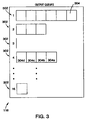
- the number of output queues 116 in a given output module 106 is generally equal to the product of the number of subclasses for each supported NQOS parameter and the number of different priorities. For example, if a particular output module 106n of the cell switch 100 supports X priorities, Y beam area subclasses and Z coding rate subclasses, the total number of output queues for that output module 106n would be X * Y * Z . This is further explained below with respect to Figure 3.
- the cell selector 118 is a logic unit that determines from which output queue to transmit a next cell (i.e., a transmission cell) on the next downlink.
- the encoder 120 may be, for example, an error correction coder such as a Reed-Solomon encoder.
- each output module 106 preferably includes a separate output queue corresponding to each combination of queuing parameters in the expanded set of queuing parameters that is supported by a particular output module 106.
- the expanded set of queuing parameters supported by a particular output module 106b includes 4 different priorities (i.e., A, B, C and D), 2 coding rate subclasses (i.e., Fast (F) and slow (S)) and 2 beam area subclasses (i.e., X and Y), 16 different queues would preferably be established in that output module 106b, corresponding to the following combinations shown below in Table 1: QUEUE NO.
- the switch control output 114 signals the switch fabric 104 to switch this cell to the proper output module 106b.
- the switch control output 114 also instructs the output module 106b to insert the cell into queue number 6.
- an input module 102a of the cell switch 100 receives a cell destined for a particular output module 106a, having priority D, intended for transmission with a slow coding rate and destined for beam area X
- the switch control output 114 would signal the output module to direct this cell to queue number 16 of the output module 106a.
- the switch fabric 104 may be replaced with hardwired logic, a bus structure, or another set of circuitry capable of routing the cells to a particular destination.
- the switch fabric 104 may perform an initial switching function based on the output module which corresponds to one or more physical beams, while the output module may actually include the logic or switching for placing the cells into an ordered list based on QOS and NQOS parameters.
- the output queues may be replaced with substitute data organization arrangements.
- the cells may be stored in a general purpose memory upon receipt.
- a table of pointers to the cells (ordered according to the expanded set of queuing parameters) in the memory may then be stored.
- both the queue structure and the pointer table may be considered ordered lists that allow much faster access to appropriate cells for a particular downlink.
- Figure 3 illustrates a more detailed diagram of the output queues 116 in accordance with the present invention.
- the 16 output queues shown in Figure 3 represent the 16 output queues in Table 1 above.
- Each output queue 302 may store several cells 304, with each cell 304 generally being stored on a first in first out ("FIFO") basis.
- FIFO first in first out
- Figure 3 shows that queue number 4 is currently storing 4 cells 304a, 304b, 304c and 304d.
- the "first-in" cell 304a will typically be transmitted in that downlink.
- the queues 302 may be dynamically created and destroyed in memory with the arrival and departure of cells or may be statically assigned to each queue if desired. Dynamic allocation, however, avoids wasting buffer space for queues with little data (i.e., queue number 16) or no data (i.e., queue number 3).
- a cell switch may support a beam which services 16 different beam areas, 2 different coding rates and 32 different priorities.
- the expanded set of queuing parameters includes two NQOS parameters (i.e., beam area and coding rate) and various QOS parameters representing the 32 different priorities.
- the beam area parameter includes 16 subclasses
- the coding rate parameter includes 2 subclasses
- the QOS parameters include 16 different priorities.
- 1024 i.e., 2 x 32 x 32
- output queues are established, and each different output queue represents a unique combination of queuing parameters.
- Figure 2 shows a flow chart of a method of processing data packets using the output queues described above with regard to Figure 3.
- the first step 202 is to select an expanded set of queuing parameters. The selection is generally based on the specific goals and requirements of the system. For example, one system may minimize the amount of time lost searching for a proper cell to transmit and therefore, provide many NQOS parameters. On the other hand, another system may minimize the complexity of the queuing system and therefore, provide relatively fewer NQOS parameters.
- step 204 several output queues are established based on combinations of queuing parameters in the expanded set of queuing parameters. As explained above with respect to Figure 3, a different output queue will generally be established for every possible combination of queuing parameters. Thus, the total number of output queues will generally equal the product of the number of subclasses of each parameter in the expanded set of queuing parameters.
- step 206 cells are received on an uplink from an earth terminal.
- the next 3 steps include indexing the look up table (208), providing a queue selection output signal (210) to a header processor, and processing the queue selection signal output (212), respectively. These three steps (208, 210 and 212) perform an examination of the identifier, and they are described below.
- a cell received at an input module 102 of the cell switch 100 may be intended to be transmitted to a particular output module 106b, destined for beam area X, with a fast coding rate and a B priority.
- the identifier of the cell forms an address, and the data at that address of the look up table 112 is sent to the header processor 110 via a queue selection signal output 111 representing queue number 5.
- the header processor 110 then processes the queue selection signal output 111 to generate a switch control output 114.
- the switch control output 114 then instructs the switch fabric 104 to switch this particular cell from the switch input to the intended output module 106b.
- the switch control output 114 instructs the intended output module 106b to store the cell in queue number 5 of that output module 106b.
- next three steps include providing a switch control output to the switch fabric (214), selecting an appropriate queue (216) in which to store each cell, and then switching the cell into that appropriate queue (218).
- the steps of providing a switch control output to the switch fabric and selecting an appropriate queue in which to store each cell perform the determination of a destination output queue.
- the header processor 110 provides a switch control output 114 to the switch fabric 104 and the destination output module 106n (step 214).
- the switch control output 114 indicates to the switch fabric 104 the destination output module 106n to which the cell is to be routed, thereby connecting switch inputs to switch outputs.
- the switch control output 114 further indicates to the destination output module 106n, the proper queue within that output module 106n in which to store each of the received cells. This generally corresponds to the step of selecting a queue for each cell (216).
- the appropriate queue in which to store each cell is based on the unique combination of queuing parameters associated with each cell. For example, if a particular cell destined for a specific output module has a priority level of X, a coding rate of Y and a destination beam area Z, the switch control output containing this information instructs the switch fabric to select the corresponding queue (i.e., the queue representing the unique combination of parameters X, Y and Z) in the specific output module, and stores this cell in that queue.
- the next three steps include choosing a cell to transmit (220) on the next downlink, encoding that cell (222) for transmission and then transmitting (224) the cell.
- the cell selector 118 of the output module 106 provides a queue selection output signal 117 indicating from which queue to select a cell for transmission. This generally corresponds to the step of choosing a cell to transmit (220).
- the cell selector 118 determines from which queue to select a cell based on both a predetermined order of priority and the configuration of the next downlink. For example, if the downlink is configured to transmit a high-coded cell to beam area X, then the cell selector will take the first cell from the highest priority queue representing high coded cells with destinations in beam area X. This cell may then be encoded and transmitted on the next downlink.
- the present invention provides several important advantages over the prior art.
- the present invention eliminates the need to search through output queues to find an appropriate cell to transmit on the next downlink. Searching is eliminated because there are preferably as many different output queues as there are possible downlink configurations.
- the satellite may transmit the first cell in the selected queue (i.e., the queue corresponding to the current satellite configuration), without having to perform the slow searching function required in the past to find an appropriate cell to transmit.
- the present cell switch will miss an opportunity to transmit a cell on the downlink.
- the downlink efficiency is correspondingly increased.
- the cell delay variation is reduced because cells near the back of a queue do not have to wait any additional time to be transmitted due to the slow searching process of the prior systems.
- Another advantage of the present invention is that the present cell switch contains substantially less hardware, thus making the apparatus much lighter and much less complex, than prior cell switches. As explained above, the additional hardware and complexity necessary to implement prior searching functions substantially increases the cost of the satellite and decreases reliability.
- the present invention thus provides an efficient, low cost, low complexity solution to space-based cell switching. While particular elements, embodiments and applications of the present invention have been shown and described, it is understood that the invention is not limited thereto since modifications may be made by those skilled in the art, particularly in light of the foregoing teaching. It is therefore contemplated by the appended claims to cover such modifications and incorporate those features which come within the spirit and scope of the invention.
Landscapes
- Engineering & Computer Science (AREA)
- Computer Networks & Wireless Communication (AREA)
- Signal Processing (AREA)
- Physics & Mathematics (AREA)
- Astronomy & Astrophysics (AREA)
- Aviation & Aerospace Engineering (AREA)
- General Physics & Mathematics (AREA)
- Data Exchanges In Wide-Area Networks (AREA)
- Radio Relay Systems (AREA)
Applications Claiming Priority (2)
| Application Number | Priority Date | Filing Date | Title |
|---|---|---|---|
| US09/270,938 US6597669B1 (en) | 1999-03-16 | 1999-03-16 | Queue segmentation and addressing method and apparatus for a cell switch in a processing communications satellite |
| US270938 | 1999-03-16 |
Publications (2)
| Publication Number | Publication Date |
|---|---|
| EP1037493A2 true EP1037493A2 (de) | 2000-09-20 |
| EP1037493A3 EP1037493A3 (de) | 2003-11-19 |
Family
ID=23033475
Family Applications (1)
| Application Number | Title | Priority Date | Filing Date |
|---|---|---|---|
| EP00104542A Withdrawn EP1037493A3 (de) | 1999-03-16 | 2000-03-13 | Verfahren und Vorrichtung für Waterschlangen Segmentierung und adressierung für eine Zellen-Vermitlungstelle in einem SatellitenKommunikationssystem |
Country Status (4)
| Country | Link |
|---|---|
| US (1) | US6597669B1 (de) |
| EP (1) | EP1037493A3 (de) |
| JP (1) | JP2000307608A (de) |
| CA (1) | CA2301473A1 (de) |
Cited By (3)
| Publication number | Priority date | Publication date | Assignee | Title |
|---|---|---|---|---|
| WO2002052803A1 (en) * | 2000-12-27 | 2002-07-04 | Electronics And Telecommunications Research Institute | Distribution/combining packet switching apparatus using brief scheduling information |
| EP1343258A1 (de) * | 2002-03-05 | 2003-09-10 | Alcatel | Satellitenschaltungsystem |
| EP1303087A3 (de) * | 2001-10-10 | 2004-01-02 | Alcatel | Zuweisung und Zurückgabe einer dynamischen Warteschlange |
Families Citing this family (14)
| Publication number | Priority date | Publication date | Assignee | Title |
|---|---|---|---|---|
| FR2806244B1 (fr) * | 2000-03-13 | 2003-05-30 | Mitsubishi Electric Inf Tech | Procede de transmission entre une station de base d'un reseau d'acces et un controleur de reseau d'acces d'un systeme de telecommunications |
| US6973089B1 (en) * | 2000-06-21 | 2005-12-06 | Northrop Grumman Corporation | Beam hopping self addressed packet switched communication system with locally intelligent scheduling |
| US9083788B1 (en) * | 2000-07-19 | 2015-07-14 | S.F. Ip Properties 21 Llc | Portable communications device |
| AU2001279130A1 (en) * | 2000-08-01 | 2002-02-13 | Qwest Communications International Inc. | Performance modeling, fault management and repair in a xdsl network |
| US6704297B1 (en) * | 2000-08-23 | 2004-03-09 | Northrop Grumman Corporation | Downlink orderwire integrator and separator for use in a satellite based communications system |
| AU2001294146A1 (en) * | 2000-09-19 | 2002-04-02 | David Nir | Integrated optical switching device |
| US7197276B2 (en) * | 2002-03-15 | 2007-03-27 | Broadcom Corporation | Downstream adaptive modulation in broadband communications systems |
| WO2003088586A1 (en) * | 2002-04-09 | 2003-10-23 | Next Generation Systems, Inc. | Systems and methods for providing qos environment ____________ |
| US7729373B2 (en) * | 2002-07-02 | 2010-06-01 | Broadcom Corporation | Modified range requests enabling bandwidth requests and state of health reporting |
| US7508785B2 (en) * | 2002-11-06 | 2009-03-24 | Broadcom Corporation | Downstream time domain based adaptive modulation for DOCSIS based applications |
| US8204051B2 (en) * | 2003-03-19 | 2012-06-19 | Samsung Electronics Co., Ltd. | Apparatus and method for queuing delay-sensitive packets for transmission on heterogenous links |
| US8565249B2 (en) * | 2009-02-10 | 2013-10-22 | Telefonaktiebolaget L M Ericsson (Publ) | Queue management system and methods |
| US9300402B2 (en) | 2010-12-14 | 2016-03-29 | Tyco Electronics Subsea Communications Llc | Dispersion management in optical networks including both coherent and direct detection receivers |
| US9225656B2 (en) | 2011-02-07 | 2015-12-29 | Brocade Communications Systems, Inc. | Quality of service in a heterogeneous network |
Family Cites Families (8)
| Publication number | Priority date | Publication date | Assignee | Title |
|---|---|---|---|---|
| US6157621A (en) | 1991-10-28 | 2000-12-05 | Teledesic Llc | Satellite communication system |
| US5736959A (en) * | 1991-10-28 | 1998-04-07 | Teledesic Corporation | Earth-fixed cell beam management for satellite communication system using dielectic lens-focused scanning beam antennas |
| JPH06318951A (ja) | 1993-01-07 | 1994-11-15 | Toshiba Corp | セル転送方法およびセル転送システム |
| US5659572A (en) * | 1993-11-22 | 1997-08-19 | Interdigital Technology Corporation | Phased array spread spectrum system and method |
| GB2300086B (en) | 1995-04-18 | 1999-08-04 | Northern Telecom Ltd | Switching arrangement |
| GB9618131D0 (en) * | 1996-08-30 | 1996-10-09 | Sgs Thomson Microelectronics | Improvements in or relating to an ATM switch |
| US6154460A (en) | 1997-05-30 | 2000-11-28 | Alcatel Usa Sourcing, L.P. | Data packet transmission system and method |
| US6115406A (en) * | 1999-09-10 | 2000-09-05 | Interdigital Technology Corporation | Transmission using an antenna array in a CDMA communication system |
-
1999
- 1999-03-16 US US09/270,938 patent/US6597669B1/en not_active Expired - Lifetime
-
2000
- 2000-03-13 EP EP00104542A patent/EP1037493A3/de not_active Withdrawn
- 2000-03-15 JP JP2000072217A patent/JP2000307608A/ja active Pending
- 2000-03-15 CA CA002301473A patent/CA2301473A1/en not_active Abandoned
Cited By (5)
| Publication number | Priority date | Publication date | Assignee | Title |
|---|---|---|---|---|
| WO2002052803A1 (en) * | 2000-12-27 | 2002-07-04 | Electronics And Telecommunications Research Institute | Distribution/combining packet switching apparatus using brief scheduling information |
| EP1303087A3 (de) * | 2001-10-10 | 2004-01-02 | Alcatel | Zuweisung und Zurückgabe einer dynamischen Warteschlange |
| EP1343258A1 (de) * | 2002-03-05 | 2003-09-10 | Alcatel | Satellitenschaltungsystem |
| FR2837043A1 (fr) * | 2002-03-05 | 2003-09-12 | Cit Alcatel | Systeme de commutation, dispositif de transmission, procede de transmission et procede de commutation pour satellite |
| US7701894B2 (en) | 2002-03-05 | 2010-04-20 | Thales | Switching system, a transmission device, a transmission method, and a switching method for satellites |
Also Published As
| Publication number | Publication date |
|---|---|
| JP2000307608A (ja) | 2000-11-02 |
| CA2301473A1 (en) | 2000-09-16 |
| US6597669B1 (en) | 2003-07-22 |
| EP1037493A3 (de) | 2003-11-19 |
Similar Documents
| Publication | Publication Date | Title |
|---|---|---|
| US6597669B1 (en) | Queue segmentation and addressing method and apparatus for a cell switch in a processing communications satellite | |
| US5870396A (en) | Output queueing in a broadband multi-media satellite and terrestrial communications network | |
| US6724761B1 (en) | Method and apparatus for serial cell replication for multicast in a cell switch | |
| US6377561B1 (en) | Data communication satellite system and method of carrying multi-media traffic | |
| US6980530B2 (en) | Spot beam hopping packet scheduler system in satellite communication | |
| US5633867A (en) | Local memory buffers management for an ATM adapter implementing credit based flow control | |
| US5930254A (en) | Non-blocking dynamic fast packet switch for satellite communication system | |
| US5687324A (en) | Method of and system for pre-fetching input cells in ATM switch | |
| US6738381B1 (en) | ATM time stamped queuing | |
| US5519700A (en) | Telecommunication system with synchronous-asynchronous interface | |
| US6483838B1 (en) | Combined header parameter table for ATM node | |
| EP0691769A1 (de) | System zur Emulation geschalteter Sprachverbindungen in einem Paketvermittlungsnetz | |
| EP0891114A1 (de) | Verfahren und System zum Durchführen eines optimierten Weiterreichens | |
| US6804246B1 (en) | Asynchronous transfer mode system handling differing AAL protocols | |
| JP3479490B2 (ja) | 処理された衛星ペイロード用の階層ダウンリンク・スケジューラ | |
| US5513174A (en) | Telecommunication system with detection and control of packet collisions | |
| KR100633379B1 (ko) | 에이티엠 큐로부터의 조정된 셀 방출 | |
| US6829248B1 (en) | Integrated switching segmentation and reassembly (SAR) device | |
| US6704315B1 (en) | Method for generating ATM cells for low bit rate applications | |
| US6567378B1 (en) | Cell discard scheme for IP traffic over a cell relay infrastructure | |
| US20020054576A1 (en) | Distributed asynchronous transfer mode (ATM) switch architecture for satellites | |
| CA2295280C (en) | Satellite communication routing arbitration techniques | |
| EP1089462B1 (de) | Verarbeitungsverfahren für Satellitenmehrfachübertragungen | |
| US7492790B2 (en) | Real-time reassembly of ATM data | |
| EP1158700A2 (de) | Algorithmus ruhend auf Tafeln zur Planung der Zuteilung der Bandbreite einer Satelliten Abwärtsverbindung |
Legal Events
| Date | Code | Title | Description |
|---|---|---|---|
| PUAI | Public reference made under article 153(3) epc to a published international application that has entered the european phase |
Free format text: ORIGINAL CODE: 0009012 |
|
| AK | Designated contracting states |
Kind code of ref document: A2 Designated state(s): AT BE CH CY DE DK ES FI FR GB GR IE IT LI LU MC NL PT SE |
|
| AX | Request for extension of the european patent |
Free format text: AL;LT;LV;MK;RO;SI |
|
| PUAL | Search report despatched |
Free format text: ORIGINAL CODE: 0009013 |
|
| AK | Designated contracting states |
Kind code of ref document: A3 Designated state(s): AT BE CH CY DE DK ES FI FR GB GR IE IT LI LU MC NL PT SE |
|
| AX | Request for extension of the european patent |
Extension state: AL LT LV MK RO SI |
|
| RAP1 | Party data changed (applicant data changed or rights of an application transferred) |
Owner name: NORTHROP GRUMMAN CORPORATION |
|
| RAP1 | Party data changed (applicant data changed or rights of an application transferred) |
Owner name: NORTHROP GRUMMAN CORPORATION |
|
| AKX | Designation fees paid | ||
| REG | Reference to a national code |
Ref country code: DE Ref legal event code: 8566 |
|
| STAA | Information on the status of an ep patent application or granted ep patent |
Free format text: STATUS: THE APPLICATION IS DEEMED TO BE WITHDRAWN |
|
| 18D | Application deemed to be withdrawn |
Effective date: 20040520 |