EP1037510A2 - Source à plasma de photons de haute énergie avec écran protecteur - Google Patents
Source à plasma de photons de haute énergie avec écran protecteur Download PDFInfo
- Publication number
- EP1037510A2 EP1037510A2 EP00105278A EP00105278A EP1037510A2 EP 1037510 A2 EP1037510 A2 EP 1037510A2 EP 00105278 A EP00105278 A EP 00105278A EP 00105278 A EP00105278 A EP 00105278A EP 1037510 A2 EP1037510 A2 EP 1037510A2
- Authority
- EP
- European Patent Office
- Prior art keywords
- high energy
- photon source
- source
- energy photon
- radiation
- Prior art date
- Legal status (The legal status is an assumption and is not a legal conclusion. Google has not performed a legal analysis and makes no representation as to the accuracy of the status listed.)
- Withdrawn
Links
Images








Classifications
-
- H—ELECTRICITY
- H05—ELECTRIC TECHNIQUES NOT OTHERWISE PROVIDED FOR
- H05G—X-RAY TECHNIQUE
- H05G2/00—Apparatus or processes specially adapted for producing X-rays, not involving X-ray tubes, e.g. involving generation of a plasma
- H05G2/001—Production of X-ray radiation generated from plasma
- H05G2/007—Production of X-ray radiation generated from plasma involving electric or magnetic fields in the process of plasma generation
-
- B—PERFORMING OPERATIONS; TRANSPORTING
- B82—NANOTECHNOLOGY
- B82Y—SPECIFIC USES OR APPLICATIONS OF NANOSTRUCTURES; MEASUREMENT OR ANALYSIS OF NANOSTRUCTURES; MANUFACTURE OR TREATMENT OF NANOSTRUCTURES
- B82Y10/00—Nanotechnology for information processing, storage or transmission, e.g. quantum computing or single electron logic
-
- G—PHYSICS
- G03—PHOTOGRAPHY; CINEMATOGRAPHY; ANALOGOUS TECHNIQUES USING WAVES OTHER THAN OPTICAL WAVES; ELECTROGRAPHY; HOLOGRAPHY
- G03F—PHOTOMECHANICAL PRODUCTION OF TEXTURED OR PATTERNED SURFACES, e.g. FOR PRINTING, FOR PROCESSING OF SEMICONDUCTOR DEVICES; MATERIALS THEREFOR; ORIGINALS THEREFOR; APPARATUS SPECIALLY ADAPTED THEREFOR
- G03F7/00—Photomechanical, e.g. photolithographic, production of textured or patterned surfaces, e.g. printing surfaces; Materials therefor, e.g. comprising photoresists; Apparatus specially adapted therefor
- G03F7/70—Microphotolithographic exposure; Apparatus therefor
- G03F7/70008—Production of exposure light, i.e. light sources
- G03F7/70033—Production of exposure light, i.e. light sources by plasma extreme ultraviolet [EUV] sources
-
- G—PHYSICS
- G03—PHOTOGRAPHY; CINEMATOGRAPHY; ANALOGOUS TECHNIQUES USING WAVES OTHER THAN OPTICAL WAVES; ELECTROGRAPHY; HOLOGRAPHY
- G03F—PHOTOMECHANICAL PRODUCTION OF TEXTURED OR PATTERNED SURFACES, e.g. FOR PRINTING, FOR PROCESSING OF SEMICONDUCTOR DEVICES; MATERIALS THEREFOR; ORIGINALS THEREFOR; APPARATUS SPECIALLY ADAPTED THEREFOR
- G03F7/00—Photomechanical, e.g. photolithographic, production of textured or patterned surfaces, e.g. printing surfaces; Materials therefor, e.g. comprising photoresists; Apparatus specially adapted therefor
- G03F7/70—Microphotolithographic exposure; Apparatus therefor
- G03F7/70058—Mask illumination systems
- G03F7/7015—Details of optical elements
- G03F7/70166—Capillary or channel elements, e.g. nested extreme ultraviolet [EUV] mirrors or shells, optical fibers or light guides
-
- G—PHYSICS
- G03—PHOTOGRAPHY; CINEMATOGRAPHY; ANALOGOUS TECHNIQUES USING WAVES OTHER THAN OPTICAL WAVES; ELECTROGRAPHY; HOLOGRAPHY
- G03F—PHOTOMECHANICAL PRODUCTION OF TEXTURED OR PATTERNED SURFACES, e.g. FOR PRINTING, FOR PROCESSING OF SEMICONDUCTOR DEVICES; MATERIALS THEREFOR; ORIGINALS THEREFOR; APPARATUS SPECIALLY ADAPTED THEREFOR
- G03F7/00—Photomechanical, e.g. photolithographic, production of textured or patterned surfaces, e.g. printing surfaces; Materials therefor, e.g. comprising photoresists; Apparatus specially adapted therefor
- G03F7/70—Microphotolithographic exposure; Apparatus therefor
- G03F7/708—Construction of apparatus, e.g. environment aspects, hygiene aspects or materials
- G03F7/70908—Hygiene, e.g. preventing apparatus pollution, mitigating effect of pollution or removing pollutants from apparatus
- G03F7/70916—Pollution mitigation, i.e. mitigating effect of contamination or debris, e.g. foil traps
-
- H—ELECTRICITY
- H05—ELECTRIC TECHNIQUES NOT OTHERWISE PROVIDED FOR
- H05G—X-RAY TECHNIQUE
- H05G2/00—Apparatus or processes specially adapted for producing X-rays, not involving X-ray tubes, e.g. involving generation of a plasma
- H05G2/001—Production of X-ray radiation generated from plasma
- H05G2/003—Production of X-ray radiation generated from plasma the plasma being generated from a material in a liquid or gas state
- H05G2/0035—Production of X-ray radiation generated from plasma the plasma being generated from a material in a liquid or gas state the material containing metals as principal radiation-generating components
-
- H—ELECTRICITY
- H05—ELECTRIC TECHNIQUES NOT OTHERWISE PROVIDED FOR
- H05G—X-RAY TECHNIQUE
- H05G2/00—Apparatus or processes specially adapted for producing X-rays, not involving X-ray tubes, e.g. involving generation of a plasma
- H05G2/001—Production of X-ray radiation generated from plasma
- H05G2/009—Auxiliary arrangements not involved in the plasma generation
-
- H—ELECTRICITY
- H05—ELECTRIC TECHNIQUES NOT OTHERWISE PROVIDED FOR
- H05G—X-RAY TECHNIQUE
- H05G2/00—Apparatus or processes specially adapted for producing X-rays, not involving X-ray tubes, e.g. involving generation of a plasma
- H05G2/001—Production of X-ray radiation generated from plasma
- H05G2/009—Auxiliary arrangements not involved in the plasma generation
- H05G2/0094—Reduction, prevention or protection from contamination; Cleaning
-
- H—ELECTRICITY
- H05—ELECTRIC TECHNIQUES NOT OTHERWISE PROVIDED FOR
- H05H—PLASMA TECHNIQUE; PRODUCTION OF ACCELERATED ELECTRICALLY-CHARGED PARTICLES OR OF NEUTRONS; PRODUCTION OR ACCELERATION OF NEUTRAL MOLECULAR OR ATOMIC BEAMS
- H05H1/00—Generating plasma; Handling plasma
- H05H1/02—Arrangements for confining plasma by electric or magnetic fields; Arrangements for heating plasma
- H05H1/04—Arrangements for confining plasma by electric or magnetic fields; Arrangements for heating plasma using magnetic fields substantially generated by the discharge in the plasma
- H05H1/06—Longitudinal pinch devices
Definitions
- the present state of the art in high energy ultraviolet and x-ray sources utilizes plasmas produced by bombarding various target materials with laser beams, electrons or other particles.
- Solid targets have been used, but the debris created by ablation of the solid target has detrimental effects on various components of a system intended for production line operation.
- a proposed solution to the debris problem is to use a frozen liquid or frozen gas target so that the debris will not plate out onto the optical equipment.
- none of these systems have proven to be practical for production line operation.
- Typical prior an plasma focus devices can generate large amounts of radiation suitable for proximity x-ray lithography, but are limited in repetition rate due to large per pulse electrical energy requirements, and short lived internal components.
- the stored electrical energy requirements for these systems range from 1kJ to 100kJ.
- the repetition rates typically did not exceed a few pulses per second.
- the present invention provides a high energy photon source.
- a pair of plasma pinch electrodes are located in a vacuum chamber.
- the chamber contains a working gas which includes a noble buffer gas and an active gas chosen to provide a desired spectral line.
- a pulse power source provides electrical pulses at voltages high enough to create electrical discharges between the electrodes to produce very high temperature, high density plasma pinches in the working gas providing radiation at the spectral line of the active gas.
- a blast shield positioned just beyond the location of the high density pinch provides a physical barrier which confines the pinch limiting its axial elongation.
- a small port is provided in the blast shield that permits the radiation but not the plasma to pass through the shield.
- a surface of the shield facing the plasma is dome-shaped.
- an external reflection radiation collector-director collects radiation produced in the plasma pinch and directs the radiation in a desired direction.
- the active gas is lithium vapor and the buffer gas is helium and the radiation-collector is made of or coated with a material possessing high grazing incidence reflectivity. Good choices for the reflector material are molybdenum, palladium, ruthenium, rhodium, gold or tungsten.
- the buffer gas is argon and lithium gas is produced by vaporization of solid or liquid lithium located in a hole along the axis of the central electrode of a coaxial electrode configuration.
- debris is collected on a conical nested debris collector having surfaces aligned with light rays extending out from the pinch site and directed toward the radiation collector-director.
- the conical nested debris collector and the radiation collector-director are maintained at a temperature in the range of about 400°C which is above the melting point of lithium and substantially below the melting point of tungsten.
- Both tungsten and lithium vapor will collect on the debris collector but the lithium will evaporate off the debris collector and the collector-director whereas the tungsten will remain permanently on the debris collector and therefore does not collect on and degrade the reflectivity of the radiation collector-director.
- the reflection radiation collector-director and the conical nested debris collector could be fabricated together as one part or they could be separate parts aligned with each other and the pinch site.
- a unique chamber window may be provided which is designed to transmit EUV light and reflect lower energy light including visible light.
- This window is preferably a small diameter window comprised of extremely thin material such as silicon, zercronium or beryllium.
- DPF Dense Plasma Focus
- the present invention provides a practical implementation of EUV lithography in a reliable, high brightness EUV light source with emission characteristics well matched to the reflection band of the Mo/Si or Mo/Be mirror systems. Since the proposed all-reflective EUV lithography tools are slit scanning based systems, the present invention provides EUV light source with high repetition rate capability.
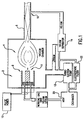
- FIG. 1 A simplified drawing of a high energy ultraviolet light source is shown in FIG. 1.
- the major components are a plasma pinch unit 2, a high energy photon collector 4 and a hollow light pipe 6.
- the plasma pinch source comprises a coaxial electrode 8 powered by a low inductance pulse power circuit 10.
- the pulse power circuit in this preferred embodiment is a high voltage, energy efficient circuit capable of providing about 5 micro seconds pulses in the range of 1 kV to 2 kV to coaxial electrode 8 at a rate of 1,000 Hz.
- a small amount of working gas such as a mixture of helium and lithium vapor, is present near the base of the electrode 8 as shown in FIG. 1.
- avalanche breakdown occurs between the inner and outer electrodes of coaxial electrode 8 either due to preionization or self breakdown.
- the avalanche process occurring in the buffer gas ionizes the gas and creates a conducting plasma between the electrodes at the base of the electrodes.
- the inner electrode is at high positive voltage and outer electrode is at ground potential. Current will flow from the inner electrode to the outer electrode and thus electrons will flow toward the center and positive ions will flow away from the center. This current flow generates a magnetic field which acts upon the moving charge carriers accelerating them away from the base of the coaxial electrode 8.
- the dimensions of the electrodes and the total electrical energy in the circuit are preferably optimized to produce the desired black body temperature in the plasma.
- a black body temperature of over 20-100 eV is required.
- temperature will increase with increasing voltage of the electrical pulse.
- the shape of the radiation spot is somewhat irregular in the axial direction and roughly gausian in the radial direction.
- the typical radial dimension of the source is 300 microns and its length is approximately 4 mm.
- the radiation spot emits radiation in all directions with a spectrum closely approximating a black body.
- the purpose of the lithium in the working gas is to narrow the spectrum of the radiation from the radiation spot.
- Doubly ionized lithium exhibits an electronic transition at 13.5 nm and serves as the radiation source atom in the buffer of helium.
- Doubly ionized lithium is an excellent choice for two reasons. The first is the low melting point and high vapor pressure of lithium. The lithium ejected from the radiation spot can be kept from plating out onto the chamber walls and collection optics by simply heating these surfaces above 180°C. The vapor phase lithium can then be pumped from the chamber along with the helium buffer gas using standard turbo-molecular pumping technology. And the lithium can be easily separated from the helium merely by cooling the two gases.
- FIG. 8 shows the lithium emission peak in relation to the published MoSi reflectivity.
- a third advantage of using lithium as the source atom is that non-ionized lithium has a low absorption cross section for 13.5 nm radiation. Furthermore, any ionized lithium ejected from the radiation spot can be easily swept away with a moderate electric field. The remaining non-ionized lithium is substantially transparent to 13.5 nm radiation.
- the currently most popular proposed source in the range of 13 nm makes use of a laser ablated frozen jet of xenon. Such a system must capture virtually all of the ejected xenon before the next pulse because the absorption cross section for xenon at 13 nm is large.
- the radiation produced at the radiation spot is emitted uniformly into a full 4 ⁇ steradians.
- Some type of collection optics is needed to capture this radiation and direct it toward the lithography tool.
- Previously proposed 13nm light sources suggested collection optics based on the use of multi-layer dielectric coated mirrors. The use of multi-layer dielectric mirrors is used to achieve high collection efficiency over a large angular range. Any radiation source which produced debris would coat these dielectric mirrors and degrade their reflectivity, and thus reduce the collected output from the source. This preferred system will suffer from electrode erosion and thus would, over time, degrade any dielectric mirror placed in proximity to the radiation spot.
- the collector may be fabricated from these materials, but preferably they are applied as a coating on a substrate structural material such as nickel. This conic section can be prepared by electroplating nickel on a removable mandrel.
- each conical section may employ more than one reflection of the radiation to redirect its section of the radiation cone in the desired direction.
- Designing the collection for operation nearest to grazing incidence will produce a collector most tolerant to deposition of eroded electrode material.
- the grazing incidence reflectivity of mirrors such as this depends strongly on the mirror's surface roughness. The dependence on surface roughness decreases as the incident angle approaches grazing incidence.
- Preferred collectors for directing radiation into light pipes are shown in FIGS. 1, 2 and 3.
- a preferred method for choosing the material for the external reflection collector is that the coating material on the collector be the same as the electrode material. Tungsten is a promising candidate since it has demonstrated performance as an electrode and the real part of its refractive index at 13nm is 0.945. Using the same material for the electrode and the mirror coating minimizes the degradation of mirror reflectivity as the eroded electrode material plates out onto the collection minors.
- Silver is also an excellent choice for the electrodes and the coatings because it also has a low refractive index at 13 nm and has high thermal conductivity allowing higher repetition rate operation.
- the collector-director is protected from surface contamination with vaporized electrode material by a debris collector which collects all of the tungsten vapor before it can reach the collector director 5.
- FIG. 9 shows a conical nested debris collector 5 for collecting debris resulting from the plasma pinch.
- Debris collector 5 is comprised of nested conical sections having surfaces aligned with light rays extending out from the center of the pinch site and directed toward the collector-director 4.
- the debris collected includes vaporized tungsten from the tungsten electrodes and vaporized lithium.
- the debris collector is attached to or is a part of radiation collector-director 4. Both collectors are comprised of nickel plated substrates.
- the radiation collector-director portion 4 is coated with molybdenum or rhodium for very high reflectivity. Preferably both collectors are heated to about 400°C which is substantially above the melting point of lithium and substantially below the melting point of tungsten.
- the vapors of both lithium and tungsten will collect on the surfaces of the debris collector 5 but lithium will vaporize off and to the extent the lithium collects on collector-director 4, it will soon thereafter also vaporize off.
- the tungsten once collected on debris collector 5 will remain there permanently.
- FIG. 7 shows the optical features of a collector designed by Applicants.
- the collector is comprised of five nested grazing incident parabolic reflectors, but only three of the five reflections are shown in the drawing. The two inner reflectors are not shown. In this design the collection angle is about 0.4 steradians.
- the collector surface is coated and is heated to prevent deposition of lithium. This design produces a parallel beam. Other preferred designs such as that shown in FIGS. 1,3 and 10 would focus the beam.
- the collector should be coated with a material possessing high glazing incidence reflectivity in the 13.5 nm wavelength range. Two such materials are palladium and ruthenium.
- the lightpipe 6 is a hollow lightpipe which also employs substantially total external reflection on its inside surfaces.
- the primary collection optic can be designed to reduce the cone angle of the collected radiation to match the acceptance angle of the hollow lightpipe. This concept is shown in FIG. 1.
- the dielectric mirrors of the lithography tool would ten be very well protected from any electrode debris since a tungsten, silver or lithium atom would have to diffuse upstream against a flow of buffer gas down the hollow lightpipe as shown in FIG. 1.
- the preferred pulse power unit 10 is a solid state high frequency, high voltage pulse power unit utilizing a solid state trigger and a magnetic switch circuit such as the pulse power units described in United States Patent 5,142,166. These units are extremely reliable and can operate continuously without substantial maintenance for many months and billions of pulses. The teachings of U.S. Patent 5,142,166 are incorporated herein by reference.
- FIG. 4 shows a simplified electrical circuit providing pulse power.
- a preferred embodiment includes DC power supply 40 which is a command resonant charging supply of the type used in excimer lasers.
- C 0 which is a bank of off the shelf capacitors having a combined capacitance of 65 ⁇ F
- a peaking capacitor C 1 which is also a bank of off the shelf capacitors having a combined capacitance of 65 ⁇ F.
- Saturable inductor 42 has a saturated drive inductance of about 1.5 nH.
- Trigger 44 is an IGBT.
- Diode 46 and inductor 48 creates an energy recovery circuit similar to that described in U.S. Patent No. 5,729,562 permitting reflected electrical energy from one pulse to be stored on C 0 prior to the next pulse.
- a working gas mixture helium and lithium vapor is discharged into coaxial electrode 8.
- Electrical pulses from pulse power unit 10 create a dense plasma focus at 11 at sufficiently high temperatures and pressures to doubly ionize the lithium atoms in the working gas generating ultraviolet radiation at about 13.5 nm wavelength.
- Discharge chamber 1 is maintained at a vacuum of about 4 Torr with turbo suction pump 12. Some of the helium in the working gas is separated in helium separator 14 and used to purge the lightpipe as shown in FIG. 1 at 16.
- the pressure of helium in the light pipe is preferably matched to the pressure requirements of the lithography tool which typically is maintained at a low pressure or vacuum.
- the temperature of the working gas is maintained at the desired temperature with heat exchanger 20 and the gas is cleaned with electrostatic filter 22. The gas is discharged into the coaxial electrode space as shown in FIG. 1.
- FIG. 5 A drawing of a prototype plasma pinch unit built and tested by Applicant and his fellow workers is shown in FIG. 5. Principal elements are C 1 capacitor decks, C 0 capacitor decks 1 GBT switches, saturable inductor 42, vacuum vessel 3, and coaxial electrode 8.
- FIG. 6 shows a typical pulse shape measured by Applicant with the unit shown in FIG. 5.
- Applicants have recorded C 1 voltage, C 1 current and intensity at 13.5 nm over an 8 microsecond period.
- the integrated energy in this typical pulse is about 0.8 J.
- the pulse width (at FWHM) is about 280 ns.
- the C 1 voltage prior to breakdown is a little less than 1 KV.
- This prototype embodiment can be operated at a pulse rate up to 200 Hz.
- the measured avenge in-band 13.5 nm radiation at 200 Hz is 152 W in 4 ⁇ steradians.
- Energy stability at 1 sigma is about 6%. Applicants estimate that 3.2 percent of the energy can be directed into a useful 13.5 nm beam with the collector 4 shown in FIG. 1.
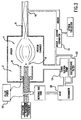
- FIG. 2 A second preferred plasma pinch unit is shown in FIG. 2.
- This unit is similar to the plasma pinch device described in United States Patent No. 4,042,848.
- This unit comprises two outer disk shaped electrodes 30 and 32 and an inner disk shaped electrode 36.
- the pinch is created from three directions as described in Patent No. 4,042,848 and as indicated in FIG. 2.
- the pinch starts near the circumference of the electrodes and proceeds toward the center and the radiation spot is developed along the axis of symmetry and at the center of the inner electrode as shown in FIG. 2 at 34.
- Radiation can be collected and directed as described with respect to the FIG. 1 embodiment However, it is possible to capture radiation in two directions coming out of both sides of the unit as shown in FIG. 2. Also, by locating a dielectric minor at 38, a substantial percentage of the radiation initially reflected to the left could be reflected back through the radiation spot. This should stimulate radiation toward the right side.
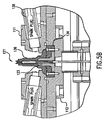
- a third preferred embodiment can be described by reference to FIG. 3.
- the buffer gas is argon.
- Helium has the desirable property that it is relatively transparent to 13 nm radiation, but it has the undesired property that it has a small atomic mass.
- the low atomic mass forces us to operate the system at a background pressure of 2-4 Torr.
- An additional drawback of the small atomic mass of He is the length of electrode required to match the acceleration distance with the timing of the electrical drive circuit. Because He is light, the electrode must be longer than desired so that the He falls off the end of the electrode simultaneous with the peak of current flow through the drive circuit.
- a heavier atom such as Ar will have a lower transmission than He for a given pressure, but because of its higher mass can produce a stable pinch at a lower pressure.
- the lower operating pressure of Ar more than offsets the increased absorption properties of Ar.
- the length of the electrode required is reduced due to the higher atomic mass.
- a shorter electrode is advantageous for two reasons. The first is a resulting reduction in circuit inductance when using a shorter electrode. A lower inductance makes the drive circuit more efficient and thus reduces the required electrical pump energy.
- the second advantage of a shorter electrode is a reduction in the thermal conduction path length from the tip of the electrode to the base. The majority of the thermal energy imparted to the electrode occurs at the tip and the conductive cooling of the electrode occurs mainly at the base (radiative cooling also occurs).
- a shorter electrode leads to a smaller temperature drop down its length from the hot tip to the cool base.
- Both the smaller pump energy per pulse and the improved cooling path allow the system to operate at a higher repetition rate.
- Increasing the repetition rate directly increases the average optical output power of the system. Scaling the output power by increasing repetition rate, as opposed to increasing the energy per pulse, is the most desired method for the average output power of lithography light sources.
- the lithium is not injected into the chamber in gaseous form as in the first and second embodiments. Instead solid lithium is placed in a hole in the center of the central electrode as shown in FIG. 3. The heat from the electrode then brings the lithium up to its evaporation temperature. By adjusting the height of the lithium relative to the hot tip of the electrode one can control the partial pressure of lithium near the tip of the electrode. One preferred method of doing this is shown in FIG. 3. A mechanism is provided for adjusting the tip of the solid lithium rod relative to the tip of the electrode.
- the system is arranged vertically so that the open side of coaxial electrodes 8 is the top so that any melted lithium will merely puddle near the top of the center electrode. The beam will exit straight up in a vertical direction as indicated in FIG.
- the hole down the center of the electrode provides another important advantage. Since the plasma pinch forms near the center of the tip of the central electrode, much of the energy is dissipated in this region. Electrode material near this point will be ablated and eventually end up of other surfaces inside the pressure vessel. Employing an electrode with a central hole greatly reduces the available erosion material. In addition, Applicant's experiments have shown that the existence of lithium vapor in this region further reduces the erosion rate of electrode material. A bellows or other appropriate sealing method should be used to maintain a good seal where the electrode equipment enters the chamber. Replacement electrodes fully loaded with the solid lithium can be easily and cheaply manufactured and easily replaced in the chamber.
- Applicants preferred window solution is to utilize an extremely thin foil which will transmit EUV and reflect visible.
- Applicants preferred window is a foil (about 0.2 to 0.5 micron) of beryllium tilted at an incident angle of about 10° with the axis of the incoming beam. With this arrangement, almost all of the visible light is reflected and about 50 to 80 percent of the EUV is transmitted.
- a thin window of course, is not very strong. Therefore, Applicants use a very small diameter window and the beam is focused through the small window.
- the diameter of the thin beryllium window is about 10 mm. Heating of the little window must be considered, and for high repetition rates special cooling of the window will be needed.
- this element can be designed merely as a beam splitter which will simplify the design since there will be no pressure differential across the thin optical element.
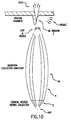
- FIG. 10 shows a preferred embodiment in which radiation collector 4 is extended by collector extension 4A to focus the beam 9 through 0.5 micron thick 1 mm diameter beryllium window 7.
- the prototype unit shown in FIG. 5 comprises DC driven spark gap preionizers to preionize the gas between the electrodes. Applicants will be able to greatly improve these energy stability values and improve other performance parameters with improved preionization techniques. Preionization is a well developed technique used by Applicants and others to improve performance in excimer lasers. Preferred preionization techniques include:
- FIG. 5B shows the location of two of a total of eight spark plugs 138 providing preionization in a preferred embodiment.
- This figure also shows the cathode 111 and the anode 123 comprised of a stainless steel outer part and a tungsten inner part. Insulator shroud encircles the lower portion of anode 123 and a 5 mill thick film insulator 125 completes the isolation of the anode from the cathode.
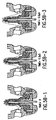
- FIGS. 5B1-6 show the progression of a typical pulse leading to a pinch which is fully developed in FIG. 5B5 at about 1.2 ⁇ s after the initiation of the discharge.
- a solution to this problem is to provide a physical barrier to motion of the plasma column in the axial direction.
- a baffler is shown as element number 143 in FIG. 5C and is called by Applicants a blast shield because it acts like a shield against the plasma exhaust of the PDF device.
- the blast shield must be made of an electrically insulating material with robust mechanical and thermal properties.
- the chemical compatibility of the blast shield material must be considered when operating with highly reactive elements such as Lithium.
- Lithium is a proposed emission element for this EUV source due to its intense emission at 13.5 nm.
- An excellent candidate is single crystal aluminum oxide, sapphire or an amorphous sapphire such as the trademarked material Lucalux manufactured by General Electric.
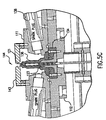
- the optimum shape of the blast shield has been found to be a dome centered on the anode with a radius equal to the diameter of the anode as shown in FIG. 5C. Such a shape closely matches the naturally occurring plasma current lines when the plasma is under maximum compression. If the blast shield is placed further from the anode tip, ten the plasma column will be too long leading to insufficient plasma heating and the risk of arc-over. If the blast shield is placed too close to the anode tip then current flow from the central axis out and down toward the cathode is restricted, again leading to insufficient plasma heating.
- the hole in the top side of blast shield 143 at 144 is required to allow EUV radiation to escape and be collected for use. This hole must be made as small as possible due to the tendency of the plasma to leak out through this hole and form a long narrow column above the blast shield. A bevel cut into this hole as shown at 144 allows for greater off-axis collection of the EUV radiation produced by the plasma pinch device.
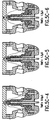
- FIGS. 5C1-6 show how the blast shield contains the plasma pinch and prevents arc-over.
- the unit may also be operated as a static-fill system without the working gas flowing through the electrodes.
- a very wide range of repetition rates are possible from single pulses to about 5 pulses per second to several hundred or thousands of pulses per second.
- the adjustment mechanism for adjusting the position of the solid lithium could be modified so that the position of the tip of the central electrode is also adjustable to account for erosion of the tip.
- the outside electrode could be cone shaped rather than cylindrical as shown with the larger diameter toward the pinch.
- performance in some embodiments could be improved by allowing the inside electrode to pertrude beyond the end of the outside electrode. This could be done with spark plugs or other preionizers well known in the art.
- Another preferred alternative is to utilize for the outer electrode an array of rods arranged to form a generally cylindrical or conical shape. This approach helps maintain a symmetrical pinch centered along the electrode axis because of the resulting inductive ballasting.
Landscapes
- Physics & Mathematics (AREA)
- Engineering & Computer Science (AREA)
- Plasma & Fusion (AREA)
- Optics & Photonics (AREA)
- General Physics & Mathematics (AREA)
- Atmospheric Sciences (AREA)
- Epidemiology (AREA)
- Public Health (AREA)
- Chemical & Material Sciences (AREA)
- Life Sciences & Earth Sciences (AREA)
- Nanotechnology (AREA)
- Health & Medical Sciences (AREA)
- Theoretical Computer Science (AREA)
- Crystallography & Structural Chemistry (AREA)
- Environmental & Geological Engineering (AREA)
- Mathematical Physics (AREA)
- Spectroscopy & Molecular Physics (AREA)
- X-Ray Techniques (AREA)
- Exposure Of Semiconductors, Excluding Electron Or Ion Beam Exposure (AREA)
- Exposure And Positioning Against Photoresist Photosensitive Materials (AREA)
Applications Claiming Priority (6)
| Application Number | Priority Date | Filing Date | Title |
|---|---|---|---|
| US268243 | 1981-05-29 | ||
| US09/268,243 US6064072A (en) | 1997-05-12 | 1999-03-15 | Plasma focus high energy photon source |
| US324526 | 1999-06-02 | ||
| US09/324,526 US6541786B1 (en) | 1997-05-12 | 1999-06-02 | Plasma pinch high energy with debris collector |
| US09/442,582 US6452199B1 (en) | 1997-05-12 | 1999-11-18 | Plasma focus high energy photon source with blast shield |
| US442582 | 2003-05-21 |
Publications (2)
| Publication Number | Publication Date |
|---|---|
| EP1037510A2 true EP1037510A2 (fr) | 2000-09-20 |
| EP1037510A3 EP1037510A3 (fr) | 2004-01-02 |
Family
ID=27402048
Family Applications (1)
| Application Number | Title | Priority Date | Filing Date |
|---|---|---|---|
| EP00105278A Withdrawn EP1037510A3 (fr) | 1999-03-15 | 2000-03-14 | Source à plasma de photons de haute énergie avec écran protecteur |
Country Status (3)
| Country | Link |
|---|---|
| US (1) | US6452199B1 (fr) |
| EP (1) | EP1037510A3 (fr) |
| KR (1) | KR100358447B1 (fr) |
Cited By (8)
| Publication number | Priority date | Publication date | Assignee | Title |
|---|---|---|---|---|
| WO2002076157A1 (fr) * | 2001-03-15 | 2002-09-26 | Safe Food Technologies, Inc. | Procede, systeme et appareil de rayons x |
| US6630799B2 (en) | 2001-03-15 | 2003-10-07 | Safe Food Technologies, Inc. | Resonant power supply and apparatus for producing vacuum arc discharges |
| EP1394612A3 (fr) * | 2002-08-27 | 2004-12-29 | ASML Netherlands B.V. | Appareil de projection lithographique et ensemble réflecteur pour l'emploi dans cet appareil |
| EP1555575A1 (fr) | 2004-01-16 | 2005-07-20 | ASML Netherlands B.V. | Appareil lithographique et méthode de fabrication d'un dispositif |
| SG129254A1 (en) * | 2002-08-27 | 2007-02-26 | Asml Netherlands Bv | Lithographic projection apparatus and reflector assembly for use in said apparatus |
| EP1305813A4 (fr) * | 2000-06-09 | 2007-10-31 | Cymer Inc | Source lumineuse a foyer a plasma a regulation de gaz utile et de gaz tampon |
| DE102011103464A1 (de) * | 2011-06-03 | 2012-12-06 | Fraunhofer-Gesellschaft zur Förderung der angewandten Forschung e.V. | Plasmaionenquelle für eine Vakuumbeschichtungsanlage |
| CN101517428B (zh) * | 2006-09-26 | 2013-05-15 | 西门子公司 | 布置在mr设备的场发生单元中的检测单元 |
Families Citing this family (57)
| Publication number | Priority date | Publication date | Assignee | Title |
|---|---|---|---|---|
| US6815700B2 (en) * | 1997-05-12 | 2004-11-09 | Cymer, Inc. | Plasma focus light source with improved pulse power system |
| US7856044B2 (en) * | 1999-05-10 | 2010-12-21 | Cymer, Inc. | Extendable electrode for gas discharge laser |
| US6826222B2 (en) * | 1999-08-27 | 2004-11-30 | Alan E. Hill | Electric oxygen iodine laser |
| US7215697B2 (en) * | 1999-08-27 | 2007-05-08 | Hill Alan E | Matched impedance controlled avalanche driver |
| US6972421B2 (en) * | 2000-06-09 | 2005-12-06 | Cymer, Inc. | Extreme ultraviolet light source |
| US7180081B2 (en) * | 2000-06-09 | 2007-02-20 | Cymer, Inc. | Discharge produced plasma EUV light source |
| US6839372B2 (en) * | 2000-11-17 | 2005-01-04 | Cymer, Inc. | Gas discharge ultraviolet laser with enclosed beam path with added oxidizer |
| US7346093B2 (en) * | 2000-11-17 | 2008-03-18 | Cymer, Inc. | DUV light source optical element improvements |
| US7598509B2 (en) | 2004-11-01 | 2009-10-06 | Cymer, Inc. | Laser produced plasma EUV light source |
| US7372056B2 (en) | 2005-06-29 | 2008-05-13 | Cymer, Inc. | LPP EUV plasma source material target delivery system |
| US7439530B2 (en) | 2005-06-29 | 2008-10-21 | Cymer, Inc. | LPP EUV light source drive laser system |
| US7378673B2 (en) | 2005-02-25 | 2008-05-27 | Cymer, Inc. | Source material dispenser for EUV light source |
| US7405416B2 (en) * | 2005-02-25 | 2008-07-29 | Cymer, Inc. | Method and apparatus for EUV plasma source target delivery |
| US7465946B2 (en) | 2004-03-10 | 2008-12-16 | Cymer, Inc. | Alternative fuels for EUV light source |
| US7088758B2 (en) | 2001-07-27 | 2006-08-08 | Cymer, Inc. | Relax gas discharge laser lithography light source |
| US6639222B2 (en) * | 2001-11-15 | 2003-10-28 | Archimedes Technology Group, Inc. | Device and method for extracting a constituent from a chemical mixture |
| US7671349B2 (en) * | 2003-04-08 | 2010-03-02 | Cymer, Inc. | Laser produced plasma EUV light source |
| SG129259A1 (en) * | 2002-10-03 | 2007-02-26 | Asml Netherlands Bv | Radiation source lithographic apparatus, and device manufacturing method |
| US7002168B2 (en) * | 2002-10-15 | 2006-02-21 | Cymer, Inc. | Dense plasma focus radiation source |
| US6809327B2 (en) * | 2002-10-29 | 2004-10-26 | Intel Corporation | EUV source box |
| US6888297B2 (en) * | 2002-12-19 | 2005-05-03 | Euv Llc | Method and apparatus for debris mitigation for an electrical discharge source |
| CN100476585C (zh) * | 2002-12-23 | 2009-04-08 | Asml荷兰有限公司 | 具有可扩展薄片的杂质屏蔽 |
| TWI275325B (en) * | 2003-03-08 | 2007-03-01 | Cymer Inc | Discharge produced plasma EUV light source |
| US7049614B2 (en) * | 2003-03-10 | 2006-05-23 | Intel Corporation | Electrode in a discharge produced plasma extreme ultraviolet source |
| US7217941B2 (en) | 2003-04-08 | 2007-05-15 | Cymer, Inc. | Systems and methods for deflecting plasma-generated ions to prevent the ions from reaching an internal component of an EUV light source |
| US7217940B2 (en) * | 2003-04-08 | 2007-05-15 | Cymer, Inc. | Collector for EUV light source |
| US7446329B2 (en) * | 2003-08-07 | 2008-11-04 | Intel Corporation | Erosion resistance of EUV source electrodes |
| US20060146906A1 (en) * | 2004-02-18 | 2006-07-06 | Cymer, Inc. | LLP EUV drive laser |
| US7193228B2 (en) | 2004-03-10 | 2007-03-20 | Cymer, Inc. | EUV light source optical elements |
| US7196342B2 (en) | 2004-03-10 | 2007-03-27 | Cymer, Inc. | Systems and methods for reducing the influence of plasma-generated debris on the internal components of an EUV light source |
| US8075732B2 (en) * | 2004-11-01 | 2011-12-13 | Cymer, Inc. | EUV collector debris management |
| US7087914B2 (en) * | 2004-03-17 | 2006-08-08 | Cymer, Inc | High repetition rate laser produced plasma EUV light source |
| US7164144B2 (en) * | 2004-03-10 | 2007-01-16 | Cymer Inc. | EUV light source |
| US7190512B2 (en) * | 2004-04-29 | 2007-03-13 | Mitsubishi Heavy Industries, Ltd. | Optical properties restoration apparatus, the restoration method, and an optical system used in the apparatus |
| DE102004021336B4 (de) * | 2004-04-30 | 2008-11-27 | Mitsubishi Heavy Industries, Ltd. | Vorrichtung und Verfahren zur Verbesserung optischer Eigenschaften und in der Vorrichtung verwendetes optisches System |
| US20050286599A1 (en) * | 2004-06-29 | 2005-12-29 | Rafac Robert J | Method and apparatus for gas discharge laser output light coherency reduction |
| US7391468B2 (en) * | 2004-07-06 | 2008-06-24 | Magnum Semiconductor, Inc. | Telecine conversion detection for progressive scan playback |
| ATE555422T1 (de) * | 2004-07-22 | 2012-05-15 | Koninkl Philips Electronics Nv | Optisches system mit einer reinigungsanordnung |
| US7109503B1 (en) * | 2005-02-25 | 2006-09-19 | Cymer, Inc. | Systems for protecting internal components of an EUV light source from plasma-generated debris |
| US7355191B2 (en) | 2004-11-01 | 2008-04-08 | Cymer, Inc. | Systems and methods for cleaning a chamber window of an EUV light source |
| US7449703B2 (en) * | 2005-02-25 | 2008-11-11 | Cymer, Inc. | Method and apparatus for EUV plasma source target delivery target material handling |
| US7482609B2 (en) | 2005-02-28 | 2009-01-27 | Cymer, Inc. | LPP EUV light source drive laser system |
| US7365349B2 (en) | 2005-06-27 | 2008-04-29 | Cymer, Inc. | EUV light source collector lifetime improvements |
| US7180083B2 (en) | 2005-06-27 | 2007-02-20 | Cymer, Inc. | EUV light source collector erosion mitigation |
| US7141806B1 (en) | 2005-06-27 | 2006-11-28 | Cymer, Inc. | EUV light source collector erosion mitigation |
| US7402825B2 (en) * | 2005-06-28 | 2008-07-22 | Cymer, Inc. | LPP EUV drive laser input system |
| US7394083B2 (en) | 2005-07-08 | 2008-07-01 | Cymer, Inc. | Systems and methods for EUV light source metrology |
| US7453077B2 (en) | 2005-11-05 | 2008-11-18 | Cymer, Inc. | EUV light source |
| US8227771B2 (en) * | 2007-07-23 | 2012-07-24 | Asml Netherlands B.V. | Debris prevention system and lithographic apparatus |
| US7872244B2 (en) * | 2007-08-08 | 2011-01-18 | Asml Netherlands B.V. | Lithographic apparatus and device manufacturing method |
| TWI402628B (zh) * | 2007-08-31 | 2013-07-21 | Cymer Inc | 控管極遠紫外線(euv)光微影裝置腔室間之氣體流動的系統 |
| US7812329B2 (en) * | 2007-12-14 | 2010-10-12 | Cymer, Inc. | System managing gas flow between chambers of an extreme ultraviolet (EUV) photolithography apparatus |
| US7655925B2 (en) * | 2007-08-31 | 2010-02-02 | Cymer, Inc. | Gas management system for a laser-produced-plasma EUV light source |
| US8519366B2 (en) * | 2008-08-06 | 2013-08-27 | Cymer, Inc. | Debris protection system having a magnetic field for an EUV light source |
| JP5687488B2 (ja) | 2010-02-22 | 2015-03-18 | ギガフォトン株式会社 | 極端紫外光生成装置 |
| US9516730B2 (en) | 2011-06-08 | 2016-12-06 | Asml Netherlands B.V. | Systems and methods for buffer gas flow stabilization in a laser produced plasma light source |
| GB2511840B (en) * | 2013-03-15 | 2017-07-05 | Thermo Electron Mfg Ltd | Method and apparatus for control of a plasma for spectrometry |
Citations (1)
| Publication number | Priority date | Publication date | Assignee | Title |
|---|---|---|---|---|
| EP0182477A2 (fr) * | 1984-10-12 | 1986-05-28 | Maxwell Laboratories, Inc. | Dispositif de filtre pour l'utilisation avec une source à rayons X |
Family Cites Families (30)
| Publication number | Priority date | Publication date | Assignee | Title |
|---|---|---|---|---|
| US3426233A (en) * | 1965-12-13 | 1969-02-04 | Vitro Corp Of America | Plasma stabilization by rotation of arc discharge tube |
| US3969628A (en) | 1974-04-04 | 1976-07-13 | The United States Of America As Represented By The Secretary Of The Army | Intense, energetic electron beam assisted X-ray generator |
| US4042848A (en) | 1974-05-17 | 1977-08-16 | Ja Hyun Lee | Hypocycloidal pinch device |
| US3961197A (en) | 1974-08-21 | 1976-06-01 | The United States Of America As Represented By The United States Energy Research And Development Administration | X-ray generator |
| US4538291A (en) | 1981-11-09 | 1985-08-27 | Kabushiki Kaisha Suwa Seikosha | X-ray source |
| US4504964A (en) | 1982-09-20 | 1985-03-12 | Eaton Corporation | Laser beam plasma pinch X-ray system |
| US4633492A (en) | 1982-09-20 | 1986-12-30 | Eaton Corporation | Plasma pinch X-ray method |
| US4618971A (en) | 1982-09-20 | 1986-10-21 | Eaton Corporation | X-ray lithography system |
| US4536884A (en) | 1982-09-20 | 1985-08-20 | Eaton Corporation | Plasma pinch X-ray apparatus |
| DE3332711A1 (de) | 1983-09-10 | 1985-03-28 | Fa. Carl Zeiss, 7920 Heidenheim | Vorrichtung zur erzeugung einer plasmaquelle mit hoher strahlungsintensitaet im roentgenbereich |
| JPS60175351A (ja) | 1984-02-14 | 1985-09-09 | Nippon Telegr & Teleph Corp <Ntt> | X線発生装置およびx線露光法 |
| US4578805A (en) * | 1984-10-10 | 1986-03-25 | Maxwell Laboratories, Inc. | Transmission line transmitting energy to load in vacuum chamber |
| CA1239487A (fr) | 1985-10-03 | 1988-07-19 | National Research Council Of Canada | Source de rayons x a plasma comprime engendre par des decharges multiples dans le vide |
| JPS62163242A (ja) * | 1985-12-05 | 1987-07-20 | Mitsubishi Electric Corp | プラズマ源 |
| JPS62143350A (ja) * | 1985-12-17 | 1987-06-26 | Hitachi Ltd | プラズマx線発生装置 |
| JPS6417361A (en) * | 1987-07-10 | 1989-01-20 | Hitachi Ltd | High energy large current particle source |
| CN1020477C (zh) * | 1987-08-10 | 1993-05-05 | 株式会社半导体能源研究所 | 含卤素的碳材料淀积方法 |
| US4889605A (en) * | 1987-12-07 | 1989-12-26 | The Regents Of The University Of California | Plasma pinch system |
| DE3927089C1 (fr) | 1989-08-17 | 1991-04-25 | Fraunhofer-Gesellschaft Zur Foerderung Der Angewandten Forschung Ev, 8000 Muenchen, De | |
| US5102776A (en) | 1989-11-09 | 1992-04-07 | Cornell Research Foundation, Inc. | Method and apparatus for microlithography using x-pinch x-ray source |
| DE4026367A1 (de) * | 1990-06-25 | 1992-03-12 | Leybold Ag | Vorrichtung zum beschichten von substraten |
| GB2260854B (en) * | 1991-10-22 | 1995-04-05 | British Aerospace | Surface discharge corona plasma cathode assembly |
| US5499282A (en) * | 1994-05-02 | 1996-03-12 | University Of Central Florida | Efficient narrow spectral width soft-X-ray discharge sources |
| US5602894A (en) * | 1994-08-04 | 1997-02-11 | Bardash; Michael J. | Three-dimensional imaging system using laser generated ultrashort x-ray pulses |
| US5504795A (en) * | 1995-02-06 | 1996-04-02 | Plex Corporation | Plasma X-ray source |
| JP3440735B2 (ja) * | 1996-12-26 | 2003-08-25 | ソニー株式会社 | ドライエッチング方法 |
| US6031241A (en) * | 1997-03-11 | 2000-02-29 | University Of Central Florida | Capillary discharge extreme ultraviolet lamp source for EUV microlithography and other related applications |
| US6172324B1 (en) * | 1997-04-28 | 2001-01-09 | Science Research Laboratory, Inc. | Plasma focus radiation source |
| US5866871A (en) * | 1997-04-28 | 1999-02-02 | Birx; Daniel | Plasma gun and methods for the use thereof |
| US5763930A (en) * | 1997-05-12 | 1998-06-09 | Cymer, Inc. | Plasma focus high energy photon source |
-
1999
- 1999-11-18 US US09/442,582 patent/US6452199B1/en not_active Expired - Fee Related
-
2000
- 2000-03-14 KR KR1020000012732A patent/KR100358447B1/ko not_active Expired - Fee Related
- 2000-03-14 EP EP00105278A patent/EP1037510A3/fr not_active Withdrawn
Patent Citations (1)
| Publication number | Priority date | Publication date | Assignee | Title |
|---|---|---|---|---|
| EP0182477A2 (fr) * | 1984-10-12 | 1986-05-28 | Maxwell Laboratories, Inc. | Dispositif de filtre pour l'utilisation avec une source à rayons X |
Cited By (12)
| Publication number | Priority date | Publication date | Assignee | Title |
|---|---|---|---|---|
| EP1305813A4 (fr) * | 2000-06-09 | 2007-10-31 | Cymer Inc | Source lumineuse a foyer a plasma a regulation de gaz utile et de gaz tampon |
| WO2002076157A1 (fr) * | 2001-03-15 | 2002-09-26 | Safe Food Technologies, Inc. | Procede, systeme et appareil de rayons x |
| US6630799B2 (en) | 2001-03-15 | 2003-10-07 | Safe Food Technologies, Inc. | Resonant power supply and apparatus for producing vacuum arc discharges |
| US6765987B2 (en) | 2001-03-15 | 2004-07-20 | Safe Food Technologies, Inc. | Resonant plasma x-ray source |
| EP1394612A3 (fr) * | 2002-08-27 | 2004-12-29 | ASML Netherlands B.V. | Appareil de projection lithographique et ensemble réflecteur pour l'emploi dans cet appareil |
| SG129254A1 (en) * | 2002-08-27 | 2007-02-26 | Asml Netherlands Bv | Lithographic projection apparatus and reflector assembly for use in said apparatus |
| CN100447671C (zh) * | 2002-08-27 | 2008-12-31 | Asml荷兰有限公司 | 光刻投射装置及用于所述装置中的反射器组件 |
| EP1555575A1 (fr) | 2004-01-16 | 2005-07-20 | ASML Netherlands B.V. | Appareil lithographique et méthode de fabrication d'un dispositif |
| US7098994B2 (en) | 2004-01-16 | 2006-08-29 | Asml Netherlands B.V. | Lithographic apparatus, device manufacturing method, and device manufactured thereby |
| CN101517428B (zh) * | 2006-09-26 | 2013-05-15 | 西门子公司 | 布置在mr设备的场发生单元中的检测单元 |
| DE102011103464A1 (de) * | 2011-06-03 | 2012-12-06 | Fraunhofer-Gesellschaft zur Förderung der angewandten Forschung e.V. | Plasmaionenquelle für eine Vakuumbeschichtungsanlage |
| DE102011103464B4 (de) * | 2011-06-03 | 2013-06-13 | Fraunhofer-Gesellschaft zur Förderung der angewandten Forschung e.V. | Plasmaionenquelle für eine Vakuumbeschichtungsanlage |
Also Published As
| Publication number | Publication date |
|---|---|
| US6452199B1 (en) | 2002-09-17 |
| KR20000062868A (ko) | 2000-10-25 |
| EP1037510A3 (fr) | 2004-01-02 |
| KR100358447B1 (ko) | 2002-10-25 |
| US20020100882A1 (en) | 2002-08-01 |
Similar Documents
| Publication | Publication Date | Title |
|---|---|---|
| US6452199B1 (en) | Plasma focus high energy photon source with blast shield | |
| EP1047288B1 (fr) | Source à plasma de photons de haute énergie | |
| US6064072A (en) | Plasma focus high energy photon source | |
| US6051841A (en) | Plasma focus high energy photon source | |
| US6566667B1 (en) | Plasma focus light source with improved pulse power system | |
| US6815700B2 (en) | Plasma focus light source with improved pulse power system | |
| KR101038479B1 (ko) | 극자외선 광원 | |
| JP4195071B2 (ja) | 平版投影装置用の照射源 | |
| KR20100057037A (ko) | 극자외선(euv) 포토리소그래피 장치의 챔버간 가스 흐름을 관리하는 시스템 | |
| JP3317957B2 (ja) | ブラストシールドを備えるプラズマフォーカス高エネルギフォトン源 | |
| EP1051727A1 (fr) | Sources pour lampe a decharge et procedes correspondants | |
| US20060011864A1 (en) | Radiation generating device, lithographic apparatus, device manufacturing method and device manufactured thereby | |
| JP4429302B2 (ja) | 電磁放射線源、リソグラフィ装置、デバイス製造方法、および該製造方法によって製造されたデバイス | |
| RU2253194C2 (ru) | Источник излучения на основе плазменного фокуса с улучшенной системой импульсного питания | |
| KR20010029769A (ko) | 블라스트 실드를 갖춘 플라즈마 포커싱된 고 에너지 포톤소스 | |
| KR20010007165A (ko) | 플라즈마 초점 고에너지 포톤 소스 |
Legal Events
| Date | Code | Title | Description |
|---|---|---|---|
| PUAI | Public reference made under article 153(3) epc to a published international application that has entered the european phase |
Free format text: ORIGINAL CODE: 0009012 |
|
| 17P | Request for examination filed |
Effective date: 20000314 |
|
| AK | Designated contracting states |
Kind code of ref document: A2 Designated state(s): AT BE CH CY DE DK ES FI FR GB GR IE IT LI LU MC NL PT SE |
|
| AX | Request for extension of the european patent |
Free format text: AL;LT;LV;MK;RO;SI |
|
| PUAL | Search report despatched |
Free format text: ORIGINAL CODE: 0009013 |
|
| AK | Designated contracting states |
Kind code of ref document: A3 Designated state(s): AT BE CH CY DE DK ES FI FR GB GR IE IT LI LU MC NL PT SE |
|
| AX | Request for extension of the european patent |
Extension state: AL LT LV MK RO SI |
|
| RAP1 | Party data changed (applicant data changed or rights of an application transferred) |
Owner name: CYMER, INC. |
|
| AKX | Designation fees paid |
Designated state(s): AT BE CH CY DE DK ES FI FR GB GR IE IT LI LU MC NL PT SE |
|
| 17Q | First examination report despatched |
Effective date: 20070306 |
|
| GRAP | Despatch of communication of intention to grant a patent |
Free format text: ORIGINAL CODE: EPIDOSNIGR1 |
|
| STAA | Information on the status of an ep patent application or granted ep patent |
Free format text: STATUS: THE APPLICATION IS DEEMED TO BE WITHDRAWN |
|
| 18D | Application deemed to be withdrawn |
Effective date: 20090213 |