EP1038432A2 - Appareil et méthode pour diviser du matériel végétal - Google Patents
Appareil et méthode pour diviser du matériel végétal Download PDFInfo
- Publication number
- EP1038432A2 EP1038432A2 EP00201047A EP00201047A EP1038432A2 EP 1038432 A2 EP1038432 A2 EP 1038432A2 EP 00201047 A EP00201047 A EP 00201047A EP 00201047 A EP00201047 A EP 00201047A EP 1038432 A2 EP1038432 A2 EP 1038432A2
- Authority
- EP
- European Patent Office
- Prior art keywords
- reeds
- worktable
- perennial plants
- reed
- feed belt
- Prior art date
- Legal status (The legal status is an assumption and is not a legal conclusion. Google has not performed a legal analysis and makes no representation as to the accuracy of the status listed.)
- Withdrawn
Links
- 238000000034 method Methods 0.000 title claims description 8
- 235000014676 Phragmites communis Nutrition 0.000 claims abstract description 83
- 241000196324 Embryophyta Species 0.000 claims abstract description 60
- 244000273256 Phragmites communis Species 0.000 claims abstract description 46
- 230000000717 retained effect Effects 0.000 claims description 2
- 230000003213 activating effect Effects 0.000 description 2
- 230000008878 coupling Effects 0.000 description 1
- 238000010168 coupling process Methods 0.000 description 1
- 238000005859 coupling reaction Methods 0.000 description 1
Images

Classifications
-
- A—HUMAN NECESSITIES
- A01—AGRICULTURE; FORESTRY; ANIMAL HUSBANDRY; HUNTING; TRAPPING; FISHING
- A01G—HORTICULTURE; CULTIVATION OF VEGETABLES, FLOWERS, RICE, FRUIT, VINES, HOPS OR SEAWEED; FORESTRY; WATERING
- A01G2/00—Vegetative propagation
-
- A—HUMAN NECESSITIES
- A01—AGRICULTURE; FORESTRY; ANIMAL HUSBANDRY; HUNTING; TRAPPING; FISHING
- A01G—HORTICULTURE; CULTIVATION OF VEGETABLES, FLOWERS, RICE, FRUIT, VINES, HOPS OR SEAWEED; FORESTRY; WATERING
- A01G9/00—Cultivation in receptacles, forcing-frames or greenhouses; Edging for beds, lawn or the like
- A01G9/02—Receptacles, e.g. flower-pots or boxes; Glasses for cultivating flowers
- A01G9/029—Receptacles for seedlings
- A01G9/0299—Handling or transporting of soil blocks or seedlings
Definitions
- the division of plants is a labour-intensive job that in accordance with the prior art, is done manually.
- the reason for this is that the division of plants is an operation requiring a kind of precision that is difficult to automize.
- the division is performed by a combination of pulling and handling a knife sensibly in order to separate entwining plant parts. This has to be done very carefully, as incompetent handling of the knife, will inexpediently damage the plants.
- the work involved with the division of plants is heavy, dirty, and arduous. There has long been a need for the mechanization of plant division in order for the process becoming automized and to avoid heavy physical work.
- a problem is, of course, that whether it is done automatically or not, the division of plants has to fulfil the criteria of usefulness and quality to ensure that the above mentioned undesirable damage to plants does not occur. These requirements have always stood in the way of mechanized plant division. Another object of the invention is to save labour costs.
- an apparatus that meets these requirements and which is characterized in that it comprises a feed belt for the perennial plants to be divided, a worktable adjoining the feed belt, a series of vertically movable reeds aligned next to each other, at least part of which are horizontally movable from above the feed belt to above the worktable, and in that the spacing between said reeds is adjustable in order to facilitate the division of the perennial plants, and a discharge conveyor for the divided perennial plants.
- the apparatus is further preferably characterized in that the reeds that move in the horizontal direction to above the worktable, are provided with an adjustment member for the lateral adjustment of the reeds whereby simultaneously their mutual spacing is increased.
- the plants to be divided are thus by means of the adjustable reed assembly pushed from the feed belt onto the worktable and are subsequently separated, as a consequence of a mutual adjustment of the adjacent reeds.
- the reeds can be adjusted to a maximal mutual distance with the reeds being positioned evenly distributed over the entire length of the worktable.
- a length of, for example, one metre of perennial plants can be pulled apart into three metres of plants, resulting in an effective division of the plants.
- a pusher attachment be provided for pushing the divided plants off the reeds, and which is equipped with fingers that can be placed between the separated reeds.
- the apparatus should be embodied such that the worktable can be folded away or can be moved from an operational to a non-operational position, and that the discharge conveyor is at least partially located under the operational position of the worktable. In the operational position the worktable adjoins the feed belt.
- the adjusting device of the reed assembly is effectively realized by an arms-and-legs-system, in which system the reeds are coupled to the system's pivoting points, and which system can be extended and folded in accordion fashion.
- this system is characterized in that substantially it comprises arms and legs which are at both ends of an arm or a leg pivotingly coupled with a first respectively a second further arm or leg and are pivotingly coupled with a first, respectively a second reed, and in that between the two ends it has a first intermediate pivoting point, at which position the respective arm or leg is pivotingly coupled with a third further arm or leg and a third further reed, and that it has a second intermediate pivoting point with which the respective arm or leg is coupled to yet a fourth further arm or leg.
- the invention is also embodied in a method of dividing perennial plants, using the apparatus described above, which method is characterized in that the perennial plants to be divided are conveyed by means of the feed belt up close to a worktable adjoining the feed belt, in that a permanent reed and a series of adjustable reeds are pushed between the perennial plants to be divided and that the permanent reed maintains its position while the adjustable reeds with the perennial plants being retained by the reeds, are being moved in horizontal direction to above the worktable, after which the adjustable reeds are moved apart until the perennial plants are spread out over the entire length of the worktable, and in that finally, the worktable is moved from the operational position occupied until now to a non-operational position, and in that a pusher attachment pushes the divided perennial plants off the reeds so that they are deposited on a conveyor belt.
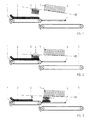
- a feed belt 1 is shown on which lies a clump of perennial plants 2 to be divided. Adjoining the feed belt 1 is, in an operational position, a worktable 6, and at the side of the worktable 6, above one end of the feed belt 1 a permanent reed 3 and an adjustable reed assembly 4, are provided with which a portion of the clump of perennial plants 2 on the feed belt 1 can be processed.
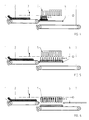
- Figures 4 and 5 then show that subsequent to separating the portion of perennial plants being processed from the clump of perennial plants that are still left on the feed belt 1, the permanent reed 3 is extracted upward to allow the latter perennial plants to be moved on by the feed belt 1 in the direction of the worktable 6, while simultaneously the adjustable reed assembly 4, after having been pushed further into the clump of perennial plants 2 that is being processed, pulls it apart in order to achieve the desired division. In doing so, the reeds are moved apart so far that, in the final position, the entire length of the worktable 6 is covered with the divided perennial plants; this position is shown in Figure 5.
- the worktable 6 is changed from the operational position depicted in Figures 1 to 5, to the non-operational position shown in Figure 6, and by means of a pusher attachment 5 that is provided with fingers that fit between the separated reeds of the reed assembly 4, the divided perennial plants are pushed off the reed assembly so that they are deposited on the discharge conveyor 7 for conveyance to a further processing device.
- FIGs 7 and 8 show a top view of the adjustable reed assembly 4 with the adjusting member 8.
- the adjacent reeds of the reed assembly 4 can be moved from the folded condition shown in Figure 7, to the extended condition shown in Figure 8, and vice versa.
- the adjusting member 8 is coupled with the reeds of the reed assembly 4 such that when activating the adjusting member, the distance between the reeds 4 is increased not only due to their adjustment in the lateral direction as indicated in the Figure by arrow A, but also due to their adjustment in longitudinal direction, as shown by arrows B and C. From the Figures 7 and 8 it can be clearly seen that the adjusting member 8 is embodied as an arm-and- leg-system with the reeds 4 being coupled thereto at pivoting points of said system, such that the system 8 can be extended and folded in accordion fashion.
- the adjusting member 8 is designed such that substantially each of the arms and legs 9 is provided at both ends of an arm or a leg 9 with a pivoting coupling to a first further arm 10 and a second further arm 11, to which pivoting point also a first reed 12 respectively a second reed 13 is pivotingly coupled.
- a first intermediate pivoting point 14 is provided, at which position the respective arm 9 is pivotingly coupled with a third further arm 16, and that there is a second intermediate pivoting point 15 with which the respective arm 9 is coupled to a fourth further arm 18.
Landscapes
- Life Sciences & Earth Sciences (AREA)
- Environmental Sciences (AREA)
- Soil Sciences (AREA)
- Botany (AREA)
- Developmental Biology & Embryology (AREA)
- Greenhouses (AREA)
- Cultivation Of Plants (AREA)
- Control And Other Processes For Unpacking Of Materials (AREA)
- Pretreatment Of Seeds And Plants (AREA)
Applications Claiming Priority (2)
| Application Number | Priority Date | Filing Date | Title |
|---|---|---|---|
| NL1011638 | 1999-03-22 | ||
| NL1011638A NL1011638C2 (nl) | 1999-03-22 | 1999-03-22 | Inrichting en werkwijze voor het splitsen van vaste planten. |
Publications (2)
| Publication Number | Publication Date |
|---|---|
| EP1038432A2 true EP1038432A2 (fr) | 2000-09-27 |
| EP1038432A3 EP1038432A3 (fr) | 2001-05-02 |
Family
ID=19768896
Family Applications (1)
| Application Number | Title | Priority Date | Filing Date |
|---|---|---|---|
| EP00201047A Withdrawn EP1038432A3 (fr) | 1999-03-22 | 2000-03-22 | Appareil et méthode pour diviser du matériel végétal |
Country Status (2)
| Country | Link |
|---|---|
| EP (1) | EP1038432A3 (fr) |
| NL (1) | NL1011638C2 (fr) |
Family Cites Families (3)
| Publication number | Priority date | Publication date | Assignee | Title |
|---|---|---|---|---|
| US4998945A (en) * | 1988-12-14 | 1991-03-12 | National Research Development Corporation | Transplanting equipment |
| FR2685852B1 (fr) * | 1992-01-07 | 1999-02-19 | Gerplant Automation | Dispositif de prehension et de transfert de plants en mottes. |
| DE69514316T2 (de) * | 1994-11-17 | 2001-01-04 | Kanzaki Kokyukoki Mfg. Co., Ltd. | Pflanzmaschine |
-
1999
- 1999-03-22 NL NL1011638A patent/NL1011638C2/nl not_active IP Right Cessation
-
2000
- 2000-03-22 EP EP00201047A patent/EP1038432A3/fr not_active Withdrawn
Non-Patent Citations (1)
| Title |
|---|
| None |
Also Published As
| Publication number | Publication date |
|---|---|
| EP1038432A3 (fr) | 2001-05-02 |
| NL1011638C2 (nl) | 2000-09-27 |
Similar Documents
| Publication | Publication Date | Title |
|---|---|---|
| CN108832457A (zh) | 连接器自动组装生产设备 | |
| KR101915019B1 (ko) | 도계의 넓적다리 발골장치 | |
| NL1025625C2 (nl) | Stelsel en werkwijze voor het kweken/verplaatsen van gewassen. | |
| EP1878351A3 (fr) | Procédé d'élimination de portions de chacune des extrémités de germe de haricot et dispositifs de traitement de germe de haricot associés | |
| EP1038432A2 (fr) | Appareil et méthode pour diviser du matériel végétal | |
| KR101915017B1 (ko) | 도계의 장각 절개 어셈블리 | |
| GB2174064A (en) | Apparatus for use in the production of pieces of sweetmeats from strips thereof | |
| EP1466523A2 (fr) | Procédé et dispositif de ramassage de coquillages | |
| US5597351A (en) | Carcass deboning | |
| WO2022128119A1 (fr) | Dispositifs et procédés pour attacher de façon automatisée des poissons étêtés et éviscérés sur des dispositifs de maintien pour un traitement ultérieur automatisé et pour obtenir de façon automatisée de la viande à partir de poissons étêtés et éviscérés | |
| EP1495971A1 (fr) | Procédé et dispositif pour emballer des bouquets de fleurs dans des manchons | |
| CN208005802U (zh) | 一种火龙果酵素生产用的火龙果切割设备 | |
| EP1190625B1 (fr) | Procédé et dispositif à lever les filets de poissons | |
| AU699211B2 (en) | An arrangement for automated handling of a carcass and parts separated therefrom at machine-assisted cutting and boning | |
| US4755096A (en) | Apparatus for moving strips using mechanical manipulator | |
| JP3822023B2 (ja) | コイルトリミング方法及びその装置 | |
| US6881138B2 (en) | Method and facility for cutting off hind feet of half carcasses | |
| GB2277245A (en) | "Carcass Deboning" | |
| BE1001797A4 (nl) | Inrichting voor het aftoppen van potplanten. | |
| EP1273220A2 (fr) | Appareil pour arracher des plantes bulbeuses, et bobine pour ceci | |
| SE515946C2 (sv) | Förfarande och anordning för hantering av bakverk | |
| EP1695929A1 (fr) | Dispositif de désempilage de plateaux | |
| EP1592305B1 (fr) | Systeme et procede pour decrocher des pieces de viande d'un dispositif de transport a crochets | |
| AU604563B2 (en) | A method and means for the processing of the head portion of an animal carcass | |
| SE464329B (sv) | Anordning foer maskinell upptagning av rotavskurna plantor innefattande en vibrerande transportoer |
Legal Events
| Date | Code | Title | Description |
|---|---|---|---|
| PUAI | Public reference made under article 153(3) epc to a published international application that has entered the european phase |
Free format text: ORIGINAL CODE: 0009012 |
|
| AK | Designated contracting states |
Kind code of ref document: A2 Designated state(s): AT BE CH CY DE DK ES FI FR GB GR IE IT LI LU MC NL PT SE |
|
| AX | Request for extension of the european patent |
Free format text: AL;LT;LV;MK;RO;SI |
|
| PUAL | Search report despatched |
Free format text: ORIGINAL CODE: 0009013 |
|
| AK | Designated contracting states |
Kind code of ref document: A3 Designated state(s): AT BE CH CY DE DK ES FI FR GB GR IE IT LI LU MC NL PT SE |
|
| AX | Request for extension of the european patent |
Free format text: AL;LT;LV;MK;RO;SI |
|
| 17P | Request for examination filed |
Effective date: 20010928 |
|
| AKX | Designation fees paid |
Free format text: AT BE CH CY DE DK ES FI FR GB GR IE IT LI LU MC NL PT SE |
|
| 17Q | First examination report despatched |
Effective date: 20040114 |
|
| STAA | Information on the status of an ep patent application or granted ep patent |
Free format text: STATUS: THE APPLICATION IS DEEMED TO BE WITHDRAWN |
|
| 18D | Application deemed to be withdrawn |
Effective date: 20040525 |