EP1041848A1 - Protection d'une zone prédéterminée contre l'utilisation pertubant des terminaux mobiles au moyen d'un message d'appel - Google Patents
Protection d'une zone prédéterminée contre l'utilisation pertubant des terminaux mobiles au moyen d'un message d'appel Download PDFInfo
- Publication number
- EP1041848A1 EP1041848A1 EP99107648A EP99107648A EP1041848A1 EP 1041848 A1 EP1041848 A1 EP 1041848A1 EP 99107648 A EP99107648 A EP 99107648A EP 99107648 A EP99107648 A EP 99107648A EP 1041848 A1 EP1041848 A1 EP 1041848A1
- Authority
- EP
- European Patent Office
- Prior art keywords
- mode change
- change information
- mobile terminal
- mode
- information
- Prior art date
- Legal status (The legal status is an assumption and is not a legal conclusion. Google has not performed a legal analysis and makes no representation as to the accuracy of the status listed.)
- Withdrawn
Links
- 230000008859 change Effects 0.000 claims abstract description 138
- 238000000034 method Methods 0.000 claims abstract description 17
- 230000001413 cellular effect Effects 0.000 claims description 22
- 238000001514 detection method Methods 0.000 claims description 4
- 230000011664 signaling Effects 0.000 description 6
- 230000005540 biological transmission Effects 0.000 description 5
- 238000004891 communication Methods 0.000 description 5
- 230000008901 benefit Effects 0.000 description 4
- 230000009849 deactivation Effects 0.000 description 4
- 238000010586 diagram Methods 0.000 description 4
- 230000000007 visual effect Effects 0.000 description 3
- 230000003213 activating effect Effects 0.000 description 1
- 238000013459 approach Methods 0.000 description 1
- 230000002452 interceptive effect Effects 0.000 description 1
- 230000008569 process Effects 0.000 description 1
- 230000004044 response Effects 0.000 description 1
- 238000012876 topography Methods 0.000 description 1
Images

Classifications
-
- H—ELECTRICITY
- H04—ELECTRIC COMMUNICATION TECHNIQUE
- H04W—WIRELESS COMMUNICATION NETWORKS
- H04W48/00—Access restriction; Network selection; Access point selection
- H04W48/02—Access restriction performed under specific conditions
- H04W48/04—Access restriction performed under specific conditions based on user or terminal location or mobility data, e.g. moving direction, speed
-
- H—ELECTRICITY
- H04—ELECTRIC COMMUNICATION TECHNIQUE
- H04W—WIRELESS COMMUNICATION NETWORKS
- H04W48/00—Access restriction; Network selection; Access point selection
- H04W48/02—Access restriction performed under specific conditions
-
- H—ELECTRICITY
- H04—ELECTRIC COMMUNICATION TECHNIQUE
- H04W—WIRELESS COMMUNICATION NETWORKS
- H04W4/00—Services specially adapted for wireless communication networks; Facilities therefor
-
- H—ELECTRICITY
- H04—ELECTRIC COMMUNICATION TECHNIQUE
- H04W—WIRELESS COMMUNICATION NETWORKS
- H04W68/00—User notification, e.g. alerting and paging, for incoming communication, change of service or the like
Definitions
- the present invention relates to a base station for protecting a predetermined area from disturbing usage of mobile terminals of a wireless cellular telecommunication system, to a method for protecting a predetermined area from disturbing usage of mobile terminals of a wireless cellular telecommunication system and to a mobile terminal for a wireless cellular telecommunication system.
- EP 0 891 110 A1 discloses a method and a system for preventing a mobile terminal from causing disturbance within a predetermined area, e. g. inside a plane or inside of hospitals. Particularly, the disclosed method comprises the steps of transmitting a deactivation signal from a base station to a mobile terminal and deactivating a use of the output of the mobile terminal in response to the deactivation signal. Thereby, the transmission output is deactivated.
- the base station can either be an ordinary base station or a base station specifically designed for mainly transmitting the deactivation signal.
- EP 0 891 110 A1 describes, that the base station could be an ordinary base station, it is not disclosed how the deactivation signals could be implemented and transmitted in an ordinary telecommunication system.
- the object of the present invention is therefore to provide a base station and a method for protecting a predetermined area from disturbing usage of mobile terminals of a wireless cellular telecommunication system, which protects a predetermined area by transmitting mode change information for changing an operation mode of the mobile terminals in a simple and effective way, whereby the mode change information is transmitted on the basis of a wireless cellular telecommunication system.
- the object of the present invention is further to provide a mobile terminal for a wireless cellular telecommunication system, which can be controlled by such mode change information so that the predetermined area is protected from disturbing use of the mobile terminal.
- a base station for protecting a predetermined area from disturbing usage of mobile terminals of a wireless cellular telecommunication system, with generating means for generating mode change information for changing an operation mode of the mobile terminals to protect the predetermined area, and transmitting means for transmitting said generated mode change information within said predetermined area by means of a paging message of a paging channel of a wireless telecommunication system.
- the above object is further achieved by a method for protecting a predetermined area from disturbing usage of mobile terminals of a wireless cellular telecommunication system, with the steps of generating mode change information for changing an operation mode of the mobile terminals to protect the predetermined area, and transmitting said generated mode change information within said predetermined area by means of a paging message of a paging channel of a wireless telecommunication system.
- the paging message from the base station comprises, consists of or relates to mode change information for changing an operation mode of the mobile terminal.
- the base station and the method for protecting a predetermined area from disturbing usage of mobile terminals of a wireless cellular telecommunication system enable a simple and effective way to change the operation mode of mobile terminals within the predetermined area automatically so that the predetermined area is protected.
- the base station of the present invention can thereby be an ordinary base station of the wireless cellular telecommunication system which additionally to its usual elements comprises the generating means and the transmitting means according to the present invention whereby the transmitting means also transmits normal signalling messages or user data information of the telecommunication system.
- the base station of the present invention is a specialised base station with a restricted functionality compared to an ordinary base station.
- the specialised base station could comprise essentially the generating means and the transmitting means according to the present invention without further elements for communicating data in the telecommunication system. This last possibility would present a very simple and cost-effective way to protect certain areas according to the present invention.
- a mobile terminal for a wireless cellular telecommunication system with transmitting and receiving means for transmitting information to and receiving information from base stations of said telecommunication system and for receiving mode change information transmitted from a base station by means of a paging message of a paging channel of the wireless telecommunication system for protecting a predetermined area from disturbing usage of the mobile terminal, and control means for detecting received mode change information and changing an operation mode of the mobile terminal depending on the received mode change information so that said predetermined area is protected.
- the wireless cellular telecommunication system can be any known or future system using paging messages in a broadcast control channel. After switching on a mobile terminal within a cell of a telecommunication system, the mobile terminal registers with the corresponding network through the base station of the cell. After a successful registration the mobile terminal listens to the paging channel of this base station in order to be able to react on incoming phone calls. According to the present invention, the paging messages of the paging channel are used for the transmission of mode change information to protect a predetermined area.
- the predetermined area is thereby the restricted area, in which the particular base station transmits the mode change information.
- a predetermined area could be a hospital or a small area around the boarding gate of an airport or inside a plane.
- the advantage of the described invention is that it does not rely on peoples responsibility to switch off their phones, but that it will perform this automatically. This will provide much higher safety to the areas to be protected. Furthermore the mode change information is not only broadcast to each phone within the cell site, which makes sure that each mobile terminal supporting the mode change functionality will be reached and prevented from disturbing usage; but it also provides the possibility to address individual phones to prevent them from disturbing usage. However, it will still be possible to exempt mobile terminals from groups of people, e.g. security personnel, from mode change, so that these can still utilise the communication tools provided by mobile telephony.
- a further advantage is that the described invention will only require a very small upgrade to existing systems and therefore additional investment in infrastructure is not necessary. All the described areas can be performed by changes to the software of the infrastructure. The impact on mobile terminals is also kept to a minimum in order to avoid any major impact on the cost of those terminals.
- the mode change information replaces at least partially paging messages in the paging channel.
- the mode change information is additional information to the paging message in the paging channel.
- the mode change information can comprise special information for changing a mode only of one or more mobile terminals, which are individually addressed, by said special information.
- the special information can be address information individually directed to particular mobile terminals, the mode of which is changed upon receiving the mode change information, whereas other mobile terminals within the predetermined area are not addressed and have their mode not changed.
- This solution might be advantageous in predetermined areas, in which the operation mode of only a part of the mobile terminals should be changed and some of the mobile terminals within the predetermined area, e. g. mobile terminals of security personal or the like, should remain usable.
- the base station according to the present invention can be built very simple and cheap, since it only needs to transmit the mode change information on a particular paging channel and does not need to perform further tasks, such as registration procedures.
- a mobile terminal switched on within the predetermined area receives the mode change information instead of or in addition to the paging message and changes its operation mode correspondingly.
- the predetermined area to be protected is usually within a cell or adjacent to one or more cells of the telecommunication system.
- a mobile terminal in one of the neighbouring cells receives information about neighbouring base stations within the system information messages from the current base station.
- the channels, on which these neighbouring base stations can be found, are monitored by the mobile terminal and when the signal of the current base station becomes weaker and the signal from a neighbouring base station becomes stronger, the mobile terminal will eventually switch to the neighbouring cell.
- the signal from a neighbouring base station is a mode change information according to the present invention
- the mobile terminal will change its mode when the signal carrying the mode change information receives a certain strength, which indicates, that the mobile terminal is entering the predetermined area to be protected.
- the transmitting means of the base station regularly transmits the mode change information.
- the generating means advantageously generates mode change information for switching off at least the high frequency portion of a mobile terminal receiving said mode change information.
- the high frequency portion of a mobile terminal which comprises e. g. upconverting and downconverting means, is the most important part of a mobile terminal to be switched off for avoiding interference with the circuitry of other electronic or electric devices in the predetermined area.
- the generating means generate mode change information for switching a mobile terminal receiving the mode change information into a silent mode, e. g. a ringer off or a vibrating device on mode.
- a silent mode audible or acoustic signals output from the mobile terminal are at least reduced to low volume to avoid a disturbance in the predetermined area.
- the audible signals are completely suppressed and replaced by visual signals, vibrating signals or other non-audible signals.
- the mobile terminal of the present invention maintains the changed mode as long as the mode change information is received and detected.
- the mobile terminal could thereby regularly check if the change mode information is still received regularly and changes its mode as soon as the mode change information is not received anymore.
- the mobile terminal could further comprise a timing means for calculating the time period since the last reception and detection of a mode change information and for comparing the time period with a predetermined time threshold, whereby the mobile terminal is reset to the original mode in case that the time period exceeds the time threshold.
- the control means maintains the changed mode until a time period received as time information with the mode change information has expired, whereby the mobile terminal is reset to the original mode thereafter.
- the mode change information may contain a minimum time indication on how long the mode change should apply.
- the transmitting and receiving means of the mobile terminal receives the special information comprised in the mode change information, whereby the special information individually addresses only one or more mobile terminals to change a mode thereof, and said control means of the mobile terminal determines on the basis of the special information if the mobile terminal is addressed and changes its mode in this case.
- the control means upon detecting mode change information, switches off at least the transmitting part of a high frequency portion of the mobile terminal.
- the mobile terminal could still receive reset messages, which reset the change mode, through its receiver. However, the receiver still would emit high frequency signals which could disturb other equipment. In case that there is no requirement for reset messages the whole high frequency part of the mobile terminal could be switched off. Further, the entire mobile terminal could be switched off.
- the control means detecting mode change information switches the mobile terminal into a silent mode, e. g. a ringer off or a vibrating device on mode.
- the silent mode is a mode in which audible or acoustic signals output from the mobile terminal are at least reduced in volume so that disturbance within the predetermined area is avoided. In case that the audible or acoustic signals are suppressed completely, visual signals, vibration signals or the like replace them.
- the transmitting and receiving means receives information on the position of the broadcast control channel of the base station according to the present invention for protecting the predetermined area, and then, the control means of the mobile terminal determines the receiving power of the broadcast control channel of the base station.
- the mobile terminal receives from the current normal base station information on the position of a broadcast control channel, on which the base station indicates the position of the paging channel in the predetermined area for protecting the predetermined area and on which the base station transmits the mode change information.
- the system will determine from information received from the mobile terminal that the mobile terminal is coming closer to the predetermined area and will therefore issue warning information, either through audible sounds (e.g. in the earpiece) or by signalling information to the mobile terminal, which will then behave according to preset behaviour.
- warning information either through audible sounds (e.g. in the earpiece) or by signalling information to the mobile terminal, which will then behave according to preset behaviour.
- the user receives an alarm signal he will be able to either terminate the conversation or step further away from the predetermined area to be able to continue his conversation.
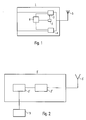
- the base station 1 shown in figure 1 is a base station for protecting a predetermined area from disturbing usage of mobile terminals of a wireless cellular telecommunication system.
- the base station 1 comprises generating means 2 for generating mode change information for changing an operation mode of the mobile terminals within the predetermined area to protect the predetermined area.
- the base station 1 further comprises transmitting means 3 for transmitting mode change information generated in the generating means 2 within the predetermined area using paging messages of a paging channel of the wireless telecommunication system.
- the mode change information is transmitted from the transmitting means 3 by means of an antenna 5.
- the base station 1 can be a normal base station for transmitting and receiving signals in the wireless cellular telecommunication system or a special base station 1' as outlined in figure 2 only transmitting said mode change information for protecting the predetermined area.
- the base station 1 further comprises receiving means 4 as shown in figure 1.
- the base station 1' essentially comprises only a generating means 2' and a transmitting means 3', so that a very simple and cost-effective solution is achieved.
- the base station 1 comprising only the transmitting means 3' and the generating means 2' only serves for transmitting the mode change information within the predetermined area without having further capabilities.
- the transmitting means 3' and the generating means 2' have the same functions as the transmitting means 3 and the generating means 2. For ease of operation an external or internal control terminal or PC 19 could be connected.
- the base station 1 in figure 1 comprises further elements which are necessary to operate the base station 1 in the respective telecommunication system, e. g. a control means 6 and so on.
- the base station 1 operates and transmits the mode change information on the basis of the wireless cellular telecommunication system, i. e. the GSM-system or the like.
- This has the advantage that mobile terminals entering the predetermined area can be addressed on the basis of the wireless cellular telecommunication system to change an operation mode thereof to protect a predetermined area without requiring a different receiving section for the mode change information transmitted from the base station 1.
- the mobile terminals as e. g. the mobile terminal 7 shown in figure 3, can be common mobile terminals for the wireless telecommunication system, which only need to be adapted to receive and process the mode change information.
- the configuration of normal mobile terminals for the wireless telecommunication system does not need to be changed essentially.
- FIG 3 a bloc diagram of a mobile terminal 7 according to the present invention is shown.
- the mobile terminal 7 comprises transmitting and receiving means 8 for transmitting information to and receiving information from base stations of the telecommunication system.
- the transmitting and receiving means 8 further receive mode change information transmitted from a base station by means of paging messages of a paging channel of the wireless telecommunication system for protecting a predetermined area from disturbing usage of the mobile terminal.
- the base station transmitting the mode change information can be the base station 1 of figure 1 or the reduced base station 1' of figure 2.
- the transmitting and receiving means 8 comprises a transmitting unit 9 and a receiving unit 10.
- the receiving unit 10 of the transmitting and receiving means 8 receives signals by means of an antenna 18.
- the received signals are then processed in the mobile terminal 7 under control of a control means 11.
- the received signals are decoded in a decoding means 15, whereby further processing steps depending on the structure of the signals might be taken.
- the signals are either transformed into audible signals and output from a loudspeaker 13 in case they are voice signals, or answered by the mobile terminal in case they are signalling information, or passed on to the data part or a data device in case they are data signals.
- the mobile terminal 7 further comprises a microphone 12 for receiving and detecting acoustic signals.
- the signals input in the microphone 12 are further processed under the control of the control means 11, e. g. coded in a coding means 14 and so on depending on the structure of the signals in the telecommunication system, and then transmitted by the transmitting unit 9 through the antenna 18.
- the mobile terminal 7 comprises further elements for processing received signals and signals to be transmitted besides the decoding means 15 and the coding means 14 as shown in figure 3.
- the additional elements depend on the structure of the signals in the wireless telecommunication system, so that a large variety of further processing units can be implemented.
- the mobile terminal 7 further comprises a generating means 16 connected between the control means 11 and the transmitting unit 9 and a timing means 17 connected with the control means 11.
- Figure 4 shows the topography of e.g. an airport terminal, where areas A and B are the coverage areas of a cell site, covering the waiting lounge X. Areas C1, C2 and C3 indicate the coverage area of cell sites covering a predetermined area, e.g. the gangway towards an airplane, Y, Z1 and Z2. As long as a user is making phone calls or is walking in areas “A" and “B” his phone will work normally and nothing will happen. Once he is approaching the area “C” the network may issue warning indications to the phone while it is in communication, warning the user that he is coming closer to a predetermined area. Once the user enters the area "C", “C2” or “C3" the telephone will receive the mode change information and change its mode accordingly. This functionality not necessarily requires separate cell sites, this could also be handled in area "C1" alone.
- the base station 1 being located in an area which has to be protected from a disturbing usage of mobile terminals, regularly broadcasts mode change information which is received by mobile terminals, as e. g. a mobile terminal 7, entering the predetermined area to change an operation mode thereof so that the area is protected.
- the mode change information is broadcasted from the base station 1 on the basis of paging messages in a paging channel of the wireless telecommunication system.
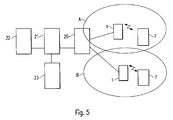
- Figure 5 shows the basic structur of a cellular system, which comprises at least two base stations 1, covering the areas A and B, a base station controller 20, a switch 21 with a gateway to a public telephone network 22, a register 23 which keeps information on the terminals of this cellular network and possibly of visiting mobile terminals and the mobile terminals 7 themselves.
- the base stations are connected with the base station controller via a communication and signalling link
- the base station controller and the switch is connected via a communication and signalling link
- the register and the switch are connected by a communication and signalling link, as well as the switch and the public telephone network.
- the mobile terminals 7 and the base stations 1 communicate by means of radio transmissions.
- a mobile terminal when it is switched on the first time, it reads system information from a broadcast control channel. Once it has the knowledge about timing, channel structure, location including the network identification of the particular base station of the respective cell of the telecommunication system, the mobile terminal will try to register itself with the network through this base station. This means, that the mobile terminal makes itself known to the network, so that the network will be able to page the mobile terminal later on. After a successful registration a mobile terminal will listen regularly to the paging channel of the respective base station in order to be able to react on incoming phone calls. Furtheron, the mobile terminal monitors base stations in neighbouring cells, the channels of which are listed in the system information of the current cell.
- a paging area can comprise several cells, in which a particular mobile terminal is paged.
- the signal of the base station of the current cell will become weaker and a signal from a neighbouring cell will become stronger.
- the mobile terminal switches to the base station of the neighbouring cell. This is true, when the mobile terminal is in the idle mode, when the mobile terminal is in the talk mode, a cell change, i. e. a hand-over, is initiated by the network.
- a cell change i. e. a hand-over
- the mobile station itself would decide on its own whether to perform a handover or not.
- the mobile terminal Once the mobile terminal has switched to the base station of the neighbouring cell, it will again read all necessary information from the system information message broadcast on the broadcast control channel from the base station of the new cell. If this new cell belongs to the same paging area as the previous cell, the mobile terminal will not perform a registration (location update). In case that the base terminal belongs to a new paging area, the mobile terminal will perform a registration (location update).
- the first scenario is that the mobile terminal 7 located within a predetermined area to be protected is switched on being within the predetermined area.
- the predetermined area which is an area to be protected from disturbing usage of mobile terminals, is usually located within a cell of the wireless telecommunication or on an intersection of two or more adjacent cells of the wireless telecommunication system.
- the mobile terminal within the predetermined area will register to a base station of one of the cells of the wireless telecommunication system.
- the mobile terminal registered to one of the base stations of a normal cell will then regularly monitor the paging channels in order to be able to receive paging messages.
- a mobile terminal being within the predetermined area receives the mode change information on the paging channel from the base station 1, the mobile terminal will change its operation mode correspondingly.
- a similar procedure takes place in case that the mobile terminal is within an adjacent cell of the telecommunication system.
- the detection of the mode change takes place in the control means 11 of the mobile terminal 7.
- the mode change information generated in the generating means 2 of the base station 1 can he additional information to the paging messages or can replace at least partially the paging messages in the paging channel.
- Normal paging messages transmitted from a normal base station of a normal cell in the telecommunication system either contain dummy bursts or paging information addressing one or more particular mobile terminals to which a call is directed.
- the mode change information transmitted by the base station 1 for protecting the predetermined area replaces e. g. a dummy burst of a paging message or a particular paging information in the paging channel or is additional information to the different types of paging messages.
- the mode change information generated in the generating means 2 of the base station 1 can additionally comprise special information for changing the operation mode only of one or more mobile terminals which are individually addressed by said special information.
- the special information can contain address information addressing particularly specified mobile terminals.
- a mobile terminal receiving the mode change information as e. g. the mobile terminal 7, receives the special information comprised in the mode change information with the transmitting and receiving means 8, whereby the control means 11 determines on the basis of the special information if the mobile terminal 7 is addressed and changes the operation mode of the mobile terminal 7 if this is the case.
- a simple and cost-effective version of the base station 1 essentially comprises the generating means 2 and the transmitting means 3 so that only mode change information is generated and transmitted by the base station 1.
- the system information messages do not need to contain additional information and it is sufficient only to transmit the mode change information instead of the paging message in the paging channel.
- the mobile terminal 7 will then receive only the mode change information and change its mode correspondingly.
- the mode change information replace only a part of the paging message in the paging channel, so that further information like the reason for the mode change, the level of the mode change or the like can be transmitted to the mobile terminal 7.
- the mobile terminal 7 does not need to register with the base station 1 for protecting the predetermined area.
- the mobile terminal 7 receives the mode change information from the base station 1 to change its mode to protect the area.
- the base station 1 of the predetermined area to he protected is thereby treated as a normal neighbouring base station of an adjacent cell.
- this normal base station comprises in its system information messages information about the channels of the neighbouring base stations. If one of the neighbouring base stations is the base station 1 for protecting the predetermined area, the mobile terminal 7 will regularly monitor the broadcast control channel of the base station 1 as it does with the other adjacent base stations. As soon as the mobile terminal switches to the base station 1 for protecting the predetermined area, the mobile terminal will read the system information and after that listen to the paging channel, carrying the change mode information which will force the mobile terminal to change a mode thereof since the predetermined area is reached.
- control means 11 of the mobile terminal 7 can cause the loudspeaker 13 to output an alarm signal to warn a user that he is approaching or within the predetermined area to be protected and that the operation mode of the mobile terminal 7 will be changed soon to protect the area.
- the user can decide to get away from the predetermined area or, in case that a call is in progress, he can terminate the conversation quickly.
- the control means 11 of the mobile terminal 7 Upon receiving a mode change information by the transmitting and receiving means 8, the control means 11 of the mobile terminal 7 detects the mode change information and changes the mode of the mobile terminal 7 depending on the received mode change information so that the predetermined area is protected. The control means 11 can thereby maintain the changed mode as long as mode change information is regularly received and detected. As soon as mode change information is no longer received, the mobile terminal 7 is reset to its original mode before the mode change.
- the timing means 17 of the mobile terminal 7 may calculate the time period since the last reception and detection of the mode change information and for comparing the time period with a predetermined time threshold, whereby the mobile terminal 7 is reset to the original mode in case that the time period exceeds the time threshold. If a time indication is present in the mode change information, the mobile terminal must not attempt a reset before the indicated time.
- control means 11 maintain the changed mode until the time period received as time information together with the mode change information has expired, whereby the mobile terminal 7 is reset to the original mode thereafter.
- the generating means 2 of the base station 1 needs to generate additional time information to the mode change information to indicate how long the changed mode in the mobile terminal 7 should be maintained.
- Another possibility is to store the time information in the mobile terminal 7 so that the time period during which the changed mode has to be maintained is provided by the mobile terminal 7 itself.
- the mobile terminals advantageously maintain their changed mode as long as the mode change information is received.
- one or more base stations 1 are located in the hospital and regularly broadcast the mode change information.
- a further possibility might be to change the mode of mobile terminals upon receiving a mode change information, e. g. at a boarding gate of an airport, to maintain the changed mode during the flight and to reset the mode of the mobile terminals upon receiving a second mode change information at the exit gate of the airport on the arrival.
- the control means 11 of the mobile terminal 7 changes the operation mode thereof. If areas like a hospital or airplane are to be protected, the control means 11 switches off at least a high frequency portion of the mobile terminal 7. The high frequency portion of the mobile terminal is the part causing interference with other electronic or electric devices and thus the operation of the high frequency part should be suppressed. In case of the mobile terminal 7 shown in figure 3, the control means 11 could switch off at least the transmitting unit 9 of the transmitting and receiving means 8 upon receiving a mode change information. The mobile terminal 7 is then still able to receive signals by means of the receiving unit 10, e. g. to receive information to reset the mobile terminal 7 to its original mode.
- control means 11 could switch off the entire transmitting and receiving means 8 so that neither the transmission nor the reception of signals is possible any longer.
- the base band functions could still be available, so that a user still can edit information, input information to the internal telephone book, store messages to be transmitted later on and the like.
- the control means 11 simply reduces the volume of the acoustic signals to be output by the loudspeaker 13. Further, the volume of signals to be output by the loudspeaker 13 could be completely suppressed. Additionally to the reduced volume signals or replacing the suppressed audible signals, the control means 11 might cause the output of the visual signals on a display of the mobile terminal 7, the activating of a vibration device of the mobile terminal 7 or the like to indicate incoming phone calls to a user.
Landscapes
- Engineering & Computer Science (AREA)
- Computer Security & Cryptography (AREA)
- Computer Networks & Wireless Communication (AREA)
- Signal Processing (AREA)
- Mobile Radio Communication Systems (AREA)
- Telephone Function (AREA)
- Telephonic Communication Services (AREA)
Priority Applications (5)
| Application Number | Priority Date | Filing Date | Title |
|---|---|---|---|
| EP99107648A EP1041848A1 (fr) | 1999-03-12 | 1999-04-16 | Protection d'une zone prédéterminée contre l'utilisation pertubant des terminaux mobiles au moyen d'un message d'appel |
| US09/523,356 US6314282B1 (en) | 1999-03-12 | 2000-03-10 | Transmitting group ID information to exclude a group of mobile terminals from changing their operation mode |
| CN00108632A CN1270484A (zh) | 1999-03-12 | 2000-03-12 | 通过寻呼消息保护预定区域不受移动终端的使用干扰 |
| JP2000074003A JP2001008272A (ja) | 1999-03-12 | 2000-03-13 | 基地局、保護方法及び移動端末装置 |
| US09/912,782 US20010041577A1 (en) | 1999-04-16 | 2001-07-25 | Protecting a predetermined area from disturbing usage of mobile terminals by means of a paging message |
Applications Claiming Priority (3)
| Application Number | Priority Date | Filing Date | Title |
|---|---|---|---|
| WOPCT/EP99/01646 | 1999-03-12 | ||
| EPPCT/EP99/01646 | 1999-03-12 | ||
| EP99107648A EP1041848A1 (fr) | 1999-03-12 | 1999-04-16 | Protection d'une zone prédéterminée contre l'utilisation pertubant des terminaux mobiles au moyen d'un message d'appel |
Publications (1)
| Publication Number | Publication Date |
|---|---|
| EP1041848A1 true EP1041848A1 (fr) | 2000-10-04 |
Family
ID=26070355
Family Applications (1)
| Application Number | Title | Priority Date | Filing Date |
|---|---|---|---|
| EP99107648A Withdrawn EP1041848A1 (fr) | 1999-03-12 | 1999-04-16 | Protection d'une zone prédéterminée contre l'utilisation pertubant des terminaux mobiles au moyen d'un message d'appel |
Country Status (4)
| Country | Link |
|---|---|
| US (1) | US6314282B1 (fr) |
| EP (1) | EP1041848A1 (fr) |
| JP (1) | JP2001008272A (fr) |
| CN (1) | CN1270484A (fr) |
Cited By (4)
| Publication number | Priority date | Publication date | Assignee | Title |
|---|---|---|---|---|
| GB2353672B (en) * | 1999-06-08 | 2001-11-07 | Nec Corp | Radio terminal and method for controlling the same |
| EP1198148A1 (fr) * | 2000-10-11 | 2002-04-17 | Lucent Technologies Inc. | Commande de la restriction de service pour transmissions mobiles |
| US6980815B1 (en) | 2002-02-12 | 2005-12-27 | Bellsouth Intellectual Property Corporation | Wireless terminal locator |
| EP2429247A1 (fr) * | 2010-09-06 | 2012-03-14 | Alcatel Lucent | Procédé de fonctionnement d'un réseau de communication sans fil, station de base d'un réseau de communication sans fil, terminal d'un réseau de communication sans fil et réseau de communication sans fil |
Families Citing this family (33)
| Publication number | Priority date | Publication date | Assignee | Title |
|---|---|---|---|---|
| US7266369B2 (en) * | 2000-04-04 | 2007-09-04 | Samsung Electronics Co., Ltd. | System and method for provisioning or updating a mobile station using over-the-air transfer of interpreted byte-code program |
| US6690940B1 (en) | 2000-09-22 | 2004-02-10 | James W. Brown | System for selective prevention of non-emergency use of an electronic device |
| GB0026052D0 (en) * | 2000-10-24 | 2000-12-13 | Pace Micro Tech Plc | Mobile telephone control |
| US20030119560A1 (en) * | 2000-12-25 | 2003-06-26 | Sunao Takatori | Radio communication control station device and radio communication device |
| KR20020065060A (ko) * | 2001-02-05 | 2002-08-13 | 삼성전자 주식회사 | 이동통신 시스템에서 매너 지역 알림 장치 및 방법 |
| US6701144B2 (en) * | 2001-03-05 | 2004-03-02 | Qualcomm Incorporated | System for automatically configuring features on a mobile telephone based on geographic location |
| US6823199B2 (en) * | 2001-06-29 | 2004-11-23 | Intel Corporation | System and method for controlling a wireless device notification alert |
| US7197124B2 (en) * | 2002-01-18 | 2007-03-27 | Qualcomm Incorporated | In-bound call directed telephone station and method of directing a telephone station based on an in-bound call |
| JP4011368B2 (ja) * | 2002-02-27 | 2007-11-21 | 京セラ株式会社 | 無線通信システム及び無線通信方法 |
| FR2842062B1 (fr) * | 2002-07-05 | 2004-12-31 | Nortel Networks Ltd | Procede de controle de la disponibilite d'un service de radiocommunication cellulaire, terminal et systeme cellulaire pour la mise en oeuvre du procede |
| US7016690B2 (en) * | 2003-02-10 | 2006-03-21 | Flarion Technologies, Inc. | Methods and apparatus for updating mobile node location information |
| US20040157626A1 (en) * | 2003-02-10 | 2004-08-12 | Vincent Park | Paging methods and apparatus |
| US7069000B1 (en) | 2003-02-10 | 2006-06-27 | Flarion Technologies, Inc. | Security methods for use in a wireless communications system |
| US20040176083A1 (en) * | 2003-02-25 | 2004-09-09 | Motorola, Inc. | Method and system for reducing distractions of mobile device users |
| US8196000B2 (en) | 2003-04-02 | 2012-06-05 | Qualcomm Incorporated | Methods and apparatus for interleaving in a block-coherent communication system |
| US7729686B2 (en) * | 2003-04-02 | 2010-06-01 | Qualcomm Incorporated | Security methods for use in a wireless communications system |
| TWI253812B (en) | 2004-01-09 | 2006-04-21 | Benq Corp | Method of changing the configuration of mobile unit by broadcasting message |
| CN1319401C (zh) * | 2004-02-16 | 2007-05-30 | 明基电通股份有限公司 | 利用广播讯息更改移动单元设定的方法 |
| JP4365287B2 (ja) * | 2004-08-30 | 2009-11-18 | 富士通株式会社 | 移動通信ネットワーク |
| CN101263724A (zh) * | 2005-07-15 | 2008-09-10 | 迈克尔·J·肯尼迪 | 进行移动电子设备的地理空间功能控制的系统 |
| US8639527B2 (en) | 2008-04-30 | 2014-01-28 | Ecolab Usa Inc. | Validated healthcare cleaning and sanitizing practices |
| US8990098B2 (en) | 2008-04-30 | 2015-03-24 | Ecolab Inc. | Validated healthcare cleaning and sanitizing practices |
| USRE48951E1 (en) | 2015-08-05 | 2022-03-01 | Ecolab Usa Inc. | Hand hygiene compliance monitoring |
| WO2010143092A2 (fr) | 2009-06-12 | 2010-12-16 | Ecolab Usa Inc. | Surveillance de l'observance de l'hygiène des mains |
| WO2011011544A1 (fr) | 2009-07-21 | 2011-01-27 | Scott Ferrill Tibbitts | Procédé et système pour commander un dispositif de communication mobile dans un véhicule en déplacement |
| US9386447B2 (en) | 2009-07-21 | 2016-07-05 | Scott Ferrill Tibbitts | Method and system for controlling a mobile communication device |
| US9615213B2 (en) | 2009-07-21 | 2017-04-04 | Katasi Llc | Method and system for controlling and modifying driving behaviors |
| US20140210620A1 (en) | 2013-01-25 | 2014-07-31 | Ultraclenz Llc | Wireless communication for dispenser beacons |
| WO2018165107A1 (fr) | 2017-03-07 | 2018-09-13 | Ecolab Usa Inc. | Modules de surveillance de distributeurs d'hygiène des mains |
| EP3589025B1 (fr) * | 2017-04-19 | 2021-06-30 | Beijing Xiaomi Mobile Software Co., Ltd. | Procédé de commande d'accès au réseau, équipement utilisateur et station de base |
| US10529219B2 (en) | 2017-11-10 | 2020-01-07 | Ecolab Usa Inc. | Hand hygiene compliance monitoring |
| JP2021119643A (ja) * | 2018-04-05 | 2021-08-12 | ソニーグループ株式会社 | 無線通信装置、通信装置および通信制御方法 |
| WO2020132525A1 (fr) | 2018-12-20 | 2020-06-25 | Ecolab Usa Inc. | Routage adaptatif, communication en réseau bidirectionnel |
Citations (5)
| Publication number | Priority date | Publication date | Assignee | Title |
|---|---|---|---|---|
| WO1997049255A1 (fr) * | 1996-06-17 | 1997-12-24 | Nokia Mobile Phones Limited | Procede et systeme de suppression des parasites imputables aux appareils de communication mobile |
| EP0873033A2 (fr) * | 1997-04-16 | 1998-10-21 | Nec Corporation | Système de communication mobile et méthode de communication mobile pour ledit système |
| EP0891110A1 (fr) * | 1997-07-10 | 1999-01-13 | Alcatel | Méthode et système pour éviter, qu'une station mobile cause des perturbations |
| US5862470A (en) * | 1995-10-25 | 1999-01-19 | Uniden America Corporation | Time shared multiple unit operation in a communication system |
| WO1999018745A1 (fr) * | 1997-10-07 | 1999-04-15 | Siemens Aktiengesellschaft | Procede et systeme pour arreter des appareils electroniques, par exemple des unites mobiles dans des zones interdites |
Family Cites Families (9)
| Publication number | Priority date | Publication date | Assignee | Title |
|---|---|---|---|---|
| US5442805A (en) * | 1988-10-05 | 1995-08-15 | Motorola, Inc. | Location-based adaptive radio control |
| US5373548A (en) * | 1991-01-04 | 1994-12-13 | Thomson Consumer Electronics, Inc. | Out-of-range warning system for cordless telephone |
| US5722068A (en) * | 1994-01-26 | 1998-02-24 | Oki Telecom, Inc. | Imminent change warning |
| US5511233A (en) * | 1994-04-05 | 1996-04-23 | Celsat America, Inc. | System and method for mobile communications in coexistence with established communications systems |
| US5548800A (en) * | 1994-06-03 | 1996-08-20 | Motorola, Inc. | Satellite telecommunication system with apparatus for protecting radio astronomy and method of using same |
| US5737707A (en) * | 1996-01-11 | 1998-04-07 | At&T Corp. | Pager-controlled wireless radiotelephone |
| JP3119173B2 (ja) * | 1996-09-13 | 2000-12-18 | 日本電気株式会社 | 移動通信システム |
| US5966655A (en) * | 1997-04-30 | 1999-10-12 | Lucent Technologies Inc. | Automatic determination of audio or vibration alerting for an incoming call in a wireless handset |
| JPH10336101A (ja) * | 1997-05-30 | 1998-12-18 | Oki Electric Ind Co Ltd | 携帯電話の使用管理システム |
-
1999
- 1999-04-16 EP EP99107648A patent/EP1041848A1/fr not_active Withdrawn
-
2000
- 2000-03-10 US US09/523,356 patent/US6314282B1/en not_active Expired - Lifetime
- 2000-03-12 CN CN00108632A patent/CN1270484A/zh active Pending
- 2000-03-13 JP JP2000074003A patent/JP2001008272A/ja not_active Withdrawn
Patent Citations (5)
| Publication number | Priority date | Publication date | Assignee | Title |
|---|---|---|---|---|
| US5862470A (en) * | 1995-10-25 | 1999-01-19 | Uniden America Corporation | Time shared multiple unit operation in a communication system |
| WO1997049255A1 (fr) * | 1996-06-17 | 1997-12-24 | Nokia Mobile Phones Limited | Procede et systeme de suppression des parasites imputables aux appareils de communication mobile |
| EP0873033A2 (fr) * | 1997-04-16 | 1998-10-21 | Nec Corporation | Système de communication mobile et méthode de communication mobile pour ledit système |
| EP0891110A1 (fr) * | 1997-07-10 | 1999-01-13 | Alcatel | Méthode et système pour éviter, qu'une station mobile cause des perturbations |
| WO1999018745A1 (fr) * | 1997-10-07 | 1999-04-15 | Siemens Aktiengesellschaft | Procede et systeme pour arreter des appareils electroniques, par exemple des unites mobiles dans des zones interdites |
Cited By (6)
| Publication number | Priority date | Publication date | Assignee | Title |
|---|---|---|---|---|
| GB2353672B (en) * | 1999-06-08 | 2001-11-07 | Nec Corp | Radio terminal and method for controlling the same |
| US6597895B1 (en) | 1999-06-08 | 2003-07-22 | Nec Corporation | Radio terminal and method for controlling the same |
| EP1198148A1 (fr) * | 2000-10-11 | 2002-04-17 | Lucent Technologies Inc. | Commande de la restriction de service pour transmissions mobiles |
| US6889040B1 (en) | 2000-10-11 | 2005-05-03 | Lucent Technologies Inc. | Service restriction control for mobile communications |
| US6980815B1 (en) | 2002-02-12 | 2005-12-27 | Bellsouth Intellectual Property Corporation | Wireless terminal locator |
| EP2429247A1 (fr) * | 2010-09-06 | 2012-03-14 | Alcatel Lucent | Procédé de fonctionnement d'un réseau de communication sans fil, station de base d'un réseau de communication sans fil, terminal d'un réseau de communication sans fil et réseau de communication sans fil |
Also Published As
| Publication number | Publication date |
|---|---|
| US6314282B1 (en) | 2001-11-06 |
| CN1270484A (zh) | 2000-10-18 |
| JP2001008272A (ja) | 2001-01-12 |
Similar Documents
| Publication | Publication Date | Title |
|---|---|---|
| US6314282B1 (en) | Transmitting group ID information to exclude a group of mobile terminals from changing their operation mode | |
| US6343212B1 (en) | Outputting a warning signal when approaching a protected area warning of an impending mode change | |
| FI102580B (fi) | Menetelmä matkaviestimen aiheuttamien häiriöiden eliminoimiseksi | |
| US8768311B2 (en) | Intelligent asymmetric service denial system for mobile cellular devices and associated methods | |
| JP2009118517A (ja) | 制限された局所領域内の移動無線システムの作動方法、無線ステーション、移動無線端末装置および移動無線システム | |
| EP1041847A1 (fr) | Protection d'une zone prédéterminée contre l'utilisation perturbant des terminaux mobiles au moyen d'une message de réponse de mise à jour l'emplacement | |
| EP1183885B1 (fr) | Procede et systeme relatifs a un dispositif de communication mobile | |
| JPH1169434A (ja) | 移動体通信装置 | |
| US20010041577A1 (en) | Protecting a predetermined area from disturbing usage of mobile terminals by means of a paging message | |
| KR100678262B1 (ko) | 비상호출시스템 및 그를 이용한 휴대폰의 비상 호출 방법 | |
| JP2000032557A (ja) | 携帯電話利用制限方法 | |
| US6212375B1 (en) | Method and apparatus providing residential base carrier inactivation after line failure or line in use | |
| CA2270324C (fr) | Terminal sans fil qui avertit l'utilisateur de l'entree d'un terminal sans fil dans un endroit physique specifie | |
| KR20010016700A (ko) | 휴대폰의 통화지역 위치 표시 제어방법 | |
| JP2868481B2 (ja) | 自動応答機能を持つ無線機 | |
| EP1035748A1 (fr) | Changement d'un terminal mobile au mode de signal de sonnerie muet | |
| KR19980037322A (ko) | 공중통신망을 이용한 주파수공용 통신시스템의 중계기고장 경보장치 | |
| EP1054570A1 (fr) | Terminal mobile sortant un signal de indication en mode de protection | |
| EP1052864A1 (fr) | Terminal mobile avec un mode de protection | |
| KR100285729B1 (ko) | 차세대디지탈무선전화시스템에서전원온/오프시자동위치등록및해제장치및방법. | |
| JPH10164659A (ja) | 無音報知および可聴報知機能を有する携帯無線機 | |
| KR100630174B1 (ko) | 전파차단기로부터 수신된 전파정보를 처리하는 방법 | |
| JPH1155717A (ja) | 移動体通信装置 | |
| JP2001095060A (ja) | 携帯電話システム | |
| JP2003163967A (ja) | 無線端末使用制限システム |
Legal Events
| Date | Code | Title | Description |
|---|---|---|---|
| PUAI | Public reference made under article 153(3) epc to a published international application that has entered the european phase |
Free format text: ORIGINAL CODE: 0009012 |
|
| AK | Designated contracting states |
Kind code of ref document: A1 Designated state(s): DE FI FR GB IT SE |
|
| AX | Request for extension of the european patent |
Free format text: AL;LT;LV;MK;RO;SI |
|
| RIN1 | Information on inventor provided before grant (corrected) |
Inventor name: WINKLER, GREGOR C/OSONY INTERNATIONAL (EUROPE)GMB Inventor name: WEBER, MATTHIAS C/O SONY INT. (EUROPE) GBMH |
|
| 17P | Request for examination filed |
Effective date: 20010205 |
|
| RIN1 | Information on inventor provided before grant (corrected) |
Inventor name: WINKLER, GREGOR C/OSONY INTERNATIONAL (EUROPE)GMB Inventor name: WEBER, MATTHIAS |
|
| AKX | Designation fees paid |
Free format text: DE FI FR GB IT SE |
|
| 17Q | First examination report despatched |
Effective date: 20031120 |
|
| STAA | Information on the status of an ep patent application or granted ep patent |
Free format text: STATUS: THE APPLICATION HAS BEEN WITHDRAWN |
|
| RAP1 | Party data changed (applicant data changed or rights of an application transferred) |
Owner name: SONY INTERNATIONAL (EUROPE) GMBH |
|
| 18W | Application withdrawn |
Effective date: 20040204 |