EP1043665A2 - Méthode et appareil pour le recouvrement d'informations audio en utilisant l'information de contenu et de personne qui parle - Google Patents
Méthode et appareil pour le recouvrement d'informations audio en utilisant l'information de contenu et de personne qui parle Download PDFInfo
- Publication number
- EP1043665A2 EP1043665A2 EP00106164A EP00106164A EP1043665A2 EP 1043665 A2 EP1043665 A2 EP 1043665A2 EP 00106164 A EP00106164 A EP 00106164A EP 00106164 A EP00106164 A EP 00106164A EP 1043665 A2 EP1043665 A2 EP 1043665A2
- Authority
- EP
- European Patent Office
- Prior art keywords
- speaker
- audio
- content
- index
- information
- Prior art date
- Legal status (The legal status is an assumption and is not a legal conclusion. Google has not performed a legal analysis and makes no representation as to the accuracy of the status listed.)
- Withdrawn
Links
Images

Classifications
-
- G—PHYSICS
- G10—MUSICAL INSTRUMENTS; ACOUSTICS
- G10L—SPEECH ANALYSIS TECHNIQUES OR SPEECH SYNTHESIS; SPEECH RECOGNITION; SPEECH OR VOICE PROCESSING TECHNIQUES; SPEECH OR AUDIO CODING OR DECODING
- G10L15/00—Speech recognition
- G10L15/26—Speech to text systems
-
- G—PHYSICS
- G06—COMPUTING OR CALCULATING; COUNTING
- G06F—ELECTRIC DIGITAL DATA PROCESSING
- G06F16/00—Information retrieval; Database structures therefor; File system structures therefor
- G06F16/60—Information retrieval; Database structures therefor; File system structures therefor of audio data
- G06F16/68—Retrieval characterised by using metadata, e.g. metadata not derived from the content or metadata generated manually
- G06F16/683—Retrieval characterised by using metadata, e.g. metadata not derived from the content or metadata generated manually using metadata automatically derived from the content
- G06F16/685—Retrieval characterised by using metadata, e.g. metadata not derived from the content or metadata generated manually using metadata automatically derived from the content using automatically derived transcript of audio data, e.g. lyrics
-
- G—PHYSICS
- G10—MUSICAL INSTRUMENTS; ACOUSTICS
- G10L—SPEECH ANALYSIS TECHNIQUES OR SPEECH SYNTHESIS; SPEECH RECOGNITION; SPEECH OR VOICE PROCESSING TECHNIQUES; SPEECH OR AUDIO CODING OR DECODING
- G10L17/00—Speaker identification or verification techniques
Definitions
- the present invention relates generally to information retrieval systems and, more particularly, to methods and apparatus for retrieving multimedia information, such as audio and video information, satisfying user-specified criteria from a database of multimedia files.
- An index is a mechanism that matches descriptions of documents with descriptions of queries.
- the indexing phase describes documents as a list of words or phrases, and the retrieval phase describes the query as a list of words or phrases.
- a document (or a portion thereof) is retrieved when the document description matches the description of the query.
- One approach for indexing an audio database is to use certain audio cues, such as applause, music or speech.
- an approach for indexing video information is to use key frames, or shot changes.
- audio and video information that is predominantly speech such as audio and video information derived from broadcast sources
- the corresponding text may be generated using a speech recognition system and the transcribed text can be used for indexing the associated audio (and video).
- audio information retrieval systems consist of two components, namely, a speech recognition system to transcribe the audio information into text for indexing, and a text-based information retrieval system.
- Speech recognition systems are typically guided by three components, namely, a vocabulary, a language model and a set of pronunciations for each word in the vocabulary.
- a vocabulary is a set of words that is used by the speech recognisor to translate speech to text.
- the recognisor matches the acoustics from the speech input to words in the vocabulary. Therefore, the vocabulary defines the words that can be transcribed. If a word that is not in the vocabulary is to be recognised, the unrecognised word must first be added to the vocabulary.
- a language model is a domain-specific database of sequences of words in the vocabulary. A set of probabilities of the words occurring in a specific order is also required. The output of the speech recognisor will be biased towards the high probability word sequences when the language model is operative. Thus, correct decoding is a function of whether the user speaks a sequence of words that has a high probability within the language model. Thus, when the user speaks an unusual sequence of words, the decoder performance will degrade. Word recognition is based entirely on its pronunciation, i.e., the phonetic representation of the word. For best accuracy, domain-specific language models must be used. The creation of such a language model requires explicit transcripts of the text along with the audio.
- Text-based information retrieval systems typically work in two phases.
- the first phase is an off-line indexing phase, where relevant statistics about the textual documents are gathered to build an index.
- the second phase is an on-line searching and retrieval phase, where the index is used to perform query-document matching followed by the return of relevant documents (and additional information) to the user.
- the indexing phase the text output from the speech recognition system is processed to derive a document description that is used in the retrieval phase for rapid searching.
- Tokenization detects sentence boundaries.
- Morphological analysis is a form of linguistic signal processing that decomposes nouns into their roots, along with a tag to indicate the plural form.
- verbs are decomposed into units designating person, tense and mood, along with the root of the verb.
- an audio retrieval system for retrieving audio information from one or more audio sources, comprising: a memory that stores a content index and a speaker index of said audio source and computer-readable code; and a processor operatively coupled to said memory, said processor configured to implement said computer-readable code, said computer-readable code configured to: receive a user query specifying one or more words and the identity of a speaker; and combine the results of a content-based and a speaker-based audio information retrieval to provide references to said audio source based on the audio content and the speaker identity.
- FIG. 1 An audio retrieval system 100 according to the present invention is shown in FIG. 1.
- the audio retrieval system 100 combines the results of two distinct methods of searching for audio material to provide references to audio information (and indirectly to video) based on the audio content as well as the identity of the speaker.
- the results of a user-specified content-based retrieval such as the results of a Web search engine, are combined in accordance with the present invention with the results of a speaker-based retrieval.
- the present invention allows a query search system to retrieve information responsive to a textual query containing an additional constraint, namely, the identity of a given speaker.
- a user query includes a text string containing one or more key words, and the identity of a given speaker.
- the present invention compares the constraints of the user-defined query to an indexed audio and/or video database and retrieves relevant audio/video segments containing the specified words spoken by the given speaker.
- the audio retrieval system 100 of the present invention consists of two primary components, namely, an indexing system 500 that transcribes and indexes the audio information, and an audio retrieval system 600.
- the indexing system 500 processes the text output from a speech recognition system during the indexing phase to perform content indexing and speaker indexing.
- the content and speaker audio retrieval system 600 uses the content and speaker indexes generated during the indexing phase to perform query-document matching based on the audio content and speaker identity and to return relevant documents (and possibly additional information) to the user.
- the speech recognition system produces transcripts with time-alignments for each word in the transcript. Unlike a conventional information retrieval scenario, there are no distinct documents in the transcripts and therefore one has to be artificially generated.
- the transcribed text corresponding to each audio or video file is automatically divided into overlapping segments of a fixed number of words, such as 100 words, and each segment is treated as a separate document.
- topic identification schemes are used to segment the files into topics.
- the audio or video file is automatically divided into individual segments associated with a given speaker. Thus, a new segment is created each time a new speaker speaks.
- the present invention establishes the best portions of the audio as determined by the content-based retrieval and the speaker-based retrieval. It is noted that the size of a segment in the content based index is about the time it takes to speak 100 words, which is approximately 30 seconds. The length of a segment in the speaker-based index, however, is variable, being a function of the speaker change detector. Thus, the segment length cannot be predicted. Thus, according to a feature of the present invention, the start and end times of the segments in both domains are compared.
- the extent of the overlap between the content and speaker domains is considered. Those documents that overlap more are weighted more heavily.
- the ranked document score ranks the content-based information retrieval, for example, using the Okapi equation, discussed below.
- the ranked document score is a function of the query terms, and is thus calculated at retrieval time.
- the speaker segment score is a distance measure indicating the proximity between the speaker segment and the enrolled speaker information and can be calculated during the indexing phase.
- Lambda is a variable that records the degree of confidence in the speaker identity process, and is a number between zero and one.
- the overlap factor penalises segments that do not overlap completely, and is a number between zero and one.
- the combined score can be used to rank-order the identified documents returned to the user, with the best-matched segments at the top of the list.
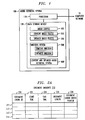
- FIG. 1 is a block diagram showing the architecture of an illustrative audio retrieval system 100 in accordance with the present invention.
- the audio retrieval system 100 may be embodied as a general purpose computing system, such as the general purpose computing system shown in FIG. 1.
- the audio retrieval system 100 includes a processor 110 and related memory, such as a data storage device 120, which may be distributed or local.
- the processor 110 may be embodied as a single processor, or a number of local or distributed processors operating in parallel.
- the data storage device 120 and/or a read only memory (ROM) are operable to store one or more instructions, which the processor 110 is operable to retrieve, interpret and execute.
- ROM read only memory
- the data storage device 120 preferably includes an audio corpus database 150 for storing one or more audio or video files (or both) that can be indexed and retrieved in accordance with the present invention.
- the data storage device 120 includes one or more content index file(s) 200 and one or more speaker index file(s) 300, discussed below in conjunction with FIGS. 2 and 3, respectively.
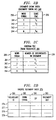
- the content index file(s) 200 includes a document database 210 (FIG. 2A), a document chunk index 240 (FIG. 2B), a unigram file (term frequency) 260 (FIG. 2C) and an inverse document index (IDF) 275 (FIG. 2D).
- the content index file(s) 200 are generated in conjunction with a speech recognition system during an indexing phase and describes the audio (or video) documents as a list of words or phrases, together with additional indexing information.
- the speaker index file(s) 300 is generated in conjunction with a speaker identification system during the indexing phase and provides a speaker label for each segment of an audio file. Thereafter, during the retrieval phase, the content index file(s) 200 and speaker index file(s) 300 are accessed and a document is retrieved if the document description in the content index file(s) 200 matches the description of the user-specified query and the speaker identity indicated by the speaker label in the speaker index file(s) 300 matches the designated speaker identity.
- the data storage device 120 includes the program code necessary to configure the processor 110 as an indexing system 500, discussed further below in conjunction with FIG. 5, and a content and speaker audio retrieval system 600, discussed further below in conjunction with FIG. 6.
- the indexing system 500 analyses one or more audio files in the audio corpus database 150 and produces the corresponding content index file(s) 200 and speaker index file(s) 300.
- the content and speaker audio retrieval system 600 accesses the content index file(s) 200 and speaker index file(s) 300 in response to a user-specified query to perform query-document matching based on the audio content and speaker identity and to return relevant documents to the user.
- the audio sample is initially transcribed, for example, using a speech recognition system, to produce a textual version of the audio information. Thereafter, the indexing system 500 analyses the textual version of the audio file(s) to produce the corresponding content index file(s) 200 and speaker index file(s) 300.
- the content index file(s) 200 includes a document database 210 (FIG. 2A), a document chunk index 240 (FIG. 2B), a unigram file (term frequency) 260 (FIG. 2C) and an inverse document index (IDF) 275 (FIG. 2D).
- the content index files 200 store information describing the audio (or video) documents as a list of words or phrases, together with additional indexing information.
- the content index file(s) 200 records, among other things, statistics required by the Okapi equation.
- the document database 210 maintains a plurality of records, such as records 211 through 214, each associated with a different 100 word document chunk in the illustrative embodiment. In one implementation, there is a 50 word overlap between documents. For each document chunk identified in field 220, the document database 210 indicates the start and end time of the chunk in fields 222 and 224, respectively, as well as the document length in field 226. Finally, for each document chunk, the document database 210 provides a pointer to a corresponding document chunk index 240, that indexes the document chunk.
- documents have a fixed length of 100 words in the illustrative embodiment, the length in bytes can vary. As discussed below, the document length (in bytes) is used to normalise the scoring of an information retrieval.
- the document chunk index 240 (FIG. 2B) maintains a plurality of records, such as records 241 through 244, each associated with a different word in the corresponding document chunk. Thus, in the illustrative implementation, there are 100 entries in each document chunk index 240. For each word string (from the document chunk) identified in field 250, the document chunk index 240 indicates the start time of the word in field 255.
- a unigram file (term frequency) 260 (FIG. 2C) is associated with each document, and indicates the number of times each word occurs in the document.
- the unigram file 260 maintains a plurality of records, such as records 261 through 264, each associated with a different word appearing in the document. For each word string identified in field 265, the unigram file 260 indicates the number of times the word appears in the document in field 270.
- the inverse document index 275 (FIG. 2D) indicates the number of times each word appears in the collection of documents (the audio corpus), and is used to rank the relevance of the current document amongst all documents in which the word occurs.
- the inverse document index 275 maintains a plurality of records, such as records 276 through 279, each associated with a different word in the vocabulary. For each word identified by the vocabulary identifier in field 280, the inverse document index 275 indicates the word string in field 285, the inverse document frequency (IDF) in field 290 and a list of the documents in which the word appears in field 295.
- the list of documents in field 295 permits a determination of whether the word appears in any documents without actually searching.
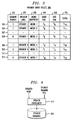
- the speaker index file(s) 300 provides a speaker label for each segment of an audio file.
- the speaker index file(s) 300 maintains a plurality of records, such as records 305 through 312, each associated with a different segment of an audio file. Each segment of speech is associated with a different speaker.
- the speaker index file(s) 300 For each segment identified in field 325, the speaker index file(s) 300 identifies the corresponding speaker in field 330, and the corresponding audio or video file containing the segment in field 335.
- the speaker index file(s) 300 also indicates the start and end time of the segment (as offsets from the start of the file) in fields 340 and 345, respectively.
- the speaker index file(s) 300 indicates a score (distance measure) in field 350 indicating the proximity between the speaker segment and the enrolled speaker information, as discussed below in conjunction with FIG. 5.
- FIG. 4 illustrates a known process used to register or enrol speakers.
- the name of the speaker is provided to a speaker enrolment process 410, together with a speaker training file, such as a pulse-code modulated (PCM) file.
- the speaker enrolment process 410 analyses the speaker training file, and creates an entry for each speaker in a speaker database 420.
- the process of adding speaker's voice samples to the speaker database 420 is called enrolment.
- the enrolment process is offline and the audio indexing system assumes such a database exists for all speakers of interest. About a minute's worth of audio is generally required from each speaker from multiple channels and microphones encompassing multiple acoustic conditions.
- the training data or database of enrolled speakers is stored using a hierarchical structure so that accessing the models is optimised for efficient recognition and retrieval.
- the indexing system 500 processes the text output from the speech recognition system to perform content indexing and speaker indexing.
- the content indexing and speaker indexing are implemented along two parallel processing branches, with content indexing being performed in steps 510 through 535, and speaker indexing being performed during steps 510 and 550 through 575. It is noted, however, that the content indexing and speaker indexing can be performed sequentially, as would be apparent to a person of ordinary skill in the art.
- step 510 changes the domain of the audio files to the frequency domain, reduces the dynamic range and performs an inverse transform to return the signal to the time domain.
- the audio information is then applied to a transcription engine, such as the ViaVoiceTM speech recognition system, commercially available from IBM Corporation of Armonk, NY, during step 515 to produce a transcribed file of time-stamped words. Thereafter, the time-stamped words are collected into document chunks of a fixed length, such as 100 words in the illustrative embodiment, during step 520.
- a transcription engine such as the ViaVoiceTM speech recognition system, commercially available from IBM Corporation of Armonk, NY
- the statistics required for the content index file(s) 200 are extracted from the audio files during step 530.
- the indexing operations includes: (i) tokenization, (ii) part-of-speech tagging, (iii) morphological analysis, and (iv) stop-word removal using a standard stop-word list.
- Tokenization detects sentence boundaries. Morphological analysis is a form of linguistic signal processing that decomposes nouns into their roots, along with a tag to indicate the plural form. Likewise, verbs are decomposed into units designating person, tense and mood, along with the root of the verb.
- the indexing system 500 obtains the statistics required by the Okapi equation. For each word identified in the audio field, the following information is obtained: the term frequency (number of times the word appears in a given document); the inverse document frequency (IDF) (indicating the number of documents in which the word occurs); the document length (for normalisation) and a set of chain linked pointers to each document containing the word (an inverted index).
- the term frequency number of times the word appears in a given document
- IDF inverse document frequency
- the document length for normalisation
- a set of chain linked pointers to each document containing the word an inverted index
- the information obtained during step 530 is stored in a content index file(s) 200 during step 535, or if a content index file(s) 200 already exists, the information is updated.
- the speaker-based information retrieval system consists of two components: (1) an acoustic-change detection system (often referred to as speaker segmentation), and (2) a speaker-independent, language-independent, text-independent speaker recognition system.
- speaker segmentation an acoustic-change detection system
- speaker-independent, language-independent, text-independent speaker recognition system To automate the speaker identification process, the boundaries (turns) between non-homogeneous speech portions must be detected during step 550. Each homogeneous segment should correspond to the speech of a single speaker. Once delineated, each segment can be classified as having been spoken by a particular speaker (assuming the segment meets the minimum segment length requirement required for speaker recognition system).
- the model-selection criterion used to segment the speech during step 550 of the illustrative embodiment is the well-known Bayesian Information Criterion (BIC).
- BIC Bayesian Information Criterion
- the input audio stream can be modelled as a Gaussian process on the cepstral space.
- BIC is a maximum likelihood approach to detect (speaker) turns of a Gaussian process.
- the problem of model identification is to choose one from among a set of candidate models to describe a given data set. It assumes the frames (10 ms) derived from the input audio signal are independent and result from a single-gaussian process. In order to detect if there is a speech change in a window of N feature vectors after the frame i, 1 ⁇ i ⁇ c N, two models are built.
- the first model represents the entire window by one Gaussian, characterised by its mean and full covariance ⁇ , ⁇ .
- the second model represents the first part of the window, up to frame i, with a first Gaussian ⁇ 1 , ⁇ 1 ⁇ , and the second part of the window with another Gaussian ( ⁇ 2 , ⁇ 2 ⁇ .
- ⁇ BIC ⁇ 0 implies, taking the penalty into account, that the model splitting the window into two Gaussians is more likely than the model representing the entire window with only a single Gaussian.
- the BIC therefore behaves like a thresholded-likelihood ratio criterion, where the threshold is not empirically tuned but has a theoretical foundation. This criterion is robust and requires no prior training.
- the BIC algorithm has been implemented to make it fast without impairing the accuracy.
- the feature vectors used are simply mel- cepstra frames using 24 dimensions. No other processing is done on these vectors.
- the algorithm works on a window-by-window basis, and in each window, a few frames are tested to check whether they are BIC-prescribed segment boundaries. If no segment boundary is found (positive ⁇ BIC), then the window size is increased. Otherwise, the old window location is recorded, which also corresponds to the start of a new window (with original size).
- N i N i-1 + ⁇ N I
- N I also increasing when no change is found:
- N i - N i-1 2(N i-1 -N I-2 ) .
- step 555 the results of step 550 are used to analyse the features produced during step 510 and to generate segment utterances, comprised of chunks of speech by a single speaker.
- the segment utterances are applied during step 560 to a speaker identification system.
- a speaker identification system see, for example, H.S.M. Beigi et al., "IBM Model-Based and Frame-By-Frame Speaker-Recognition," in Proc. of Speaker Recognition and Its Commercial and Forensic Applications, Avignon, France (1998).
- the speaker identification system compares the segment utterances to the speaker database 420 (FIG. 4) and finds the "closest" speaker.
- the speaker identification system has two different implementations, a model-based approach and a frame-based approach with concomitant merits and demerits.
- the engine is both text and language independent to facilitate live audio indexing of material such as broadcast news.
- a model M i for the I th speaker based on a sequence of M frames of speech, with the d-dimensional statistical parameters, such as, consisting of the Mean vector, the Covariance matrix, and the Counts, for the case when a Gaussian distribution is selected.
- Each speaker, i may end up with a model consisting of n I distributions.
- the distance measure devised for speaker recognition permits computation of an acceptable distance between two models with a different number of distributions n i . Comparing two speakers solely based on the parametric representation of their models obviates the need to carry the features around making the task of comparing two speakers much less computationally intensive. A short-coming of this distance measure for the recognition stage, however, is that the entire speech segment has to be used to build the model of the test individual (claimant) before computation of the comparison can begin. The frame-by-frame approach alleviates this problem.
- GMM Gaussian Mixture Model
- the following frame-based weighted likelihood distance measure, d i,n, is used in making the decision:
- the total distance, D i of model M i from the test data is then taken to be the sum of all the distances over the total number of test frames.
- the model with the smallest distance to that of the speech segment is chosen.
- a voting technique may be used for computing the total distance.
- a predetermined set of members that form the cohort of the labeled speaker is augmented with a variety of background models. Using this set as the model universe, the test data is verified by testing if the claimant's model has the smallest distance; otherwise, it is rejected.
- This distance measure is not used in training since the frames of speech would have to retained for computing the distances between the speakers.
- the training is done, therefore, using the method for the model-based technique discussed above.
- the index file for speaker-based retrieval is built by taking a second pass over the results of speaker classification and verification during step 565. If the speaker identification is verified during step 565, then the speaker label is assigned to the segment during step 570. As previously indicated, each classification result is accompanied by a score indicating the distance from the original enrolled speaker model to the audio test segment, the start and end times of the segment relative to the beginning of the audio clip concerned, and a label (name of the speaker supplied during enrolment). In addition, for any given audio clip, all the segments assigned to the same (speaker) label are gathered. They are then sorted by their scores and normalised by the segment with the best score.
- the content and speaker audio retrieval system 600 uses the content and speaker indexes generated during the indexing phase to perform query-document matching based on the audio content and speaker identity and to return relevant documents (and possibly additional information) to the user.
- retrieval can be performed using two distinct, non-overlapping modules, one for content-based and the other for speaker-based retrieval.
- the two modules can be programmed to run concurrently using threads or processes since they are completely independent. In the illustrative implementation both modules run sequentially.
- the content and speaker audio retrieval system 600 loads the same vocabularies, tag dictionaries, morphological tables and token tables that were used in indexing during steps 610 and 20.
- the appropriate content index file(s) 200 and speaker index file(s) 300 are loaded into memory during step 620.
- a test is performed during step 625 until a query is received.
- the query string is received and processed during step 630.
- the query string is compared during step 635 against the content index file(s) 200 to compute the most relevant document(s) using an objective ranking function (ranked document score).
- the ranked document score that is used in the ranking of these documents is also recorded for subsequent computing of the combined scores in accordance with the present invention (step 645) .
- Each query is matched against all the documents in the collection and the documents are ranked according to the computed score from the Okapi formula indicated above.
- the ranked document score takes into account the number of times each query term occurs in the document normalised with respect to the length of the document. This normalisation removes bias that generally favour longer documents since longer documents are more likely to have more instances of any given word. This function also favours terms that are specific to a document and rare across other documents. (If a second pass is used, the documents would be re-ranked by training another model for documents, using the top- ranked documents from the first pass as training data.)
- the identified documents are analysed during step 640 to determine if the speaker identified in the speaker index file(s) 300 matches the speaker specified by the user in the query. Specifically, the time bounds of the ranked documents satisfying the content-based query are compared with those documents satisfying the speaker-based query to identify documents with overlapping start and end times. A single segment from speaker retrieval may overlap with multiple segments from text retrieval.
- Combinedscore (rankeddocumentscore+(lambda*speakersegmentscore)) in the manner described above. All of the scored documents are then ranked and normalised with the most relevant document getting a match-score of 100.
- the top N documents alone are returned to the user.
- a list of start and end times of the N best-matched segments, together with the match-scores, and the matched words that contributed to the relevance score are returned during step 650.
- the default start time of each combined result is the same as the start time for the corresponding document from the content-based search. (The other choice is to use the start time of the speaker segment.)
- the end time is set to the end of the speaker segment (simply to let the speaker finish his statement). However, for usability reasons, the segment can be truncated at a fixed duration, such as 60 seconds, i.e., two times as long as the average document length.
- the illustrative user interface is capable of showing all the relevant information for each of the N selections returned by the retrieval engine, and on further selection uses a media handler component, implemented using the Java Media Filter, to display MPEG-1 video via a VCR-like interface.
- the Java application is responsible for locating the video files (which can be on a server if the PC is networked), and then uses information gathered during retrieval to embellish the results, such as displaying the retrieved document, associated information such as media file name, start time, end time, rank, normalised score, a graphic view of where in the media file the retrieved segment lies, highlighting the query words (and other morphs that contributed to the ranking of that document) - this is relevant only for content-based searching, or permitting highlighting of portion of the displayed retrieved document for play back.
- the top N retrieved items are presented to the user in a compact form. This lets the user visually review the retrieved item for further action. Generally, it includes all the gathered information about the retrieved document including a portion of the text of the document.
- the media handler component is called upon to locate the media file, advance to the specified start time, decompress the stream (if required), and then initialise the media player with the first frame of the audio or video.
- the VCR-like interface permits the user to "play" the retrieved video from start to finish or to stop and advance at any juncture.
- the current set of documents derived from the speech recognition output can be augmented by including the next-best guesses for each word or phrase from the recognisor. This information can be used for weighting the index terms, query expansion, and retrieval. Also, better recognition accuracy can be had by detecting segments with music or mostly noise that only pure speech is indexed for retrieval.
- One limitation with the current approach to audio-indexing is the finite coverage of the vocabulary used in the speech recognisor. Words such as proper nouns and abbreviations that are important from an information retrieval standpoint are often found missing in the vocabulary and hence in the recognised transcripts.
- One method to overcome this limitation is to complement the speech recognisor with a wordspotter for the out of vocabulary words. For this approach to be practical, however, one has to have the ability to detect spoken words in large amounts of speech at speeds many times faster than real-time.
Landscapes
- Engineering & Computer Science (AREA)
- Multimedia (AREA)
- Audiology, Speech & Language Pathology (AREA)
- Physics & Mathematics (AREA)
- Health & Medical Sciences (AREA)
- Library & Information Science (AREA)
- Human Computer Interaction (AREA)
- Acoustics & Sound (AREA)
- Theoretical Computer Science (AREA)
- Artificial Intelligence (AREA)
- General Health & Medical Sciences (AREA)
- Data Mining & Analysis (AREA)
- Databases & Information Systems (AREA)
- General Engineering & Computer Science (AREA)
- General Physics & Mathematics (AREA)
- Computational Linguistics (AREA)
- Information Retrieval, Db Structures And Fs Structures Therefor (AREA)
Applications Claiming Priority (2)
| Application Number | Priority Date | Filing Date | Title |
|---|---|---|---|
| US288724 | 1981-07-31 | ||
| US09/288,724 US6345252B1 (en) | 1999-04-09 | 1999-04-09 | Methods and apparatus for retrieving audio information using content and speaker information |
Publications (2)
| Publication Number | Publication Date |
|---|---|
| EP1043665A2 true EP1043665A2 (fr) | 2000-10-11 |
| EP1043665A3 EP1043665A3 (fr) | 2003-02-12 |
Family
ID=23108363
Family Applications (1)
| Application Number | Title | Priority Date | Filing Date |
|---|---|---|---|
| EP00106164A Withdrawn EP1043665A3 (fr) | 1999-04-09 | 2000-03-21 | Méthode et appareil pour le recouvrement d'informations audio en utilisant l'information de contenu et de personne qui parle |
Country Status (6)
| Country | Link |
|---|---|
| US (1) | US6345252B1 (fr) |
| EP (1) | EP1043665A3 (fr) |
| JP (1) | JP3488174B2 (fr) |
| KR (1) | KR100388344B1 (fr) |
| CN (1) | CN1270361A (fr) |
| TW (1) | TW469385B (fr) |
Cited By (17)
| Publication number | Priority date | Publication date | Assignee | Title |
|---|---|---|---|---|
| WO2003038665A1 (fr) * | 2001-10-31 | 2003-05-08 | Net-Release Pty Ltd | Systeme et procede destines a diffuser des informations audio enregistrees |
| EP1463258A1 (fr) * | 2003-03-28 | 2004-09-29 | Mobile Integrated Solutions Limited | Système et procédé permettant de transferer données dans un réseau de communication sans fil |
| EP1471531A3 (fr) * | 2003-04-21 | 2005-06-08 | Pioneer Corporation | Dispositif, procédé et programme d'ordinateur pour la sélection des données musicales |
| EP1764712A1 (fr) * | 2005-08-26 | 2007-03-21 | AT&T Corp. | Système et méthode pour la recherche et l'analyse du contenu multimédia |
| WO2007052988A1 (fr) * | 2005-11-07 | 2007-05-10 | Qboxdotcom Corp. | Systeme et procede pour la fourniture de contenu multimedia en ligne |
| WO2007056029A1 (fr) * | 2005-11-09 | 2007-05-18 | Microsoft Corporation | Elagage d'index vocal |
| WO2007056032A1 (fr) * | 2005-11-08 | 2007-05-18 | Microsoft Corporation | Indexation et recherche de donnees vocales avec metadonnees de texte |
| US7634407B2 (en) | 2005-05-20 | 2009-12-15 | Microsoft Corporation | Method and apparatus for indexing speech |
| US7831425B2 (en) | 2005-12-15 | 2010-11-09 | Microsoft Corporation | Time-anchored posterior indexing of speech |
| EP2395502A1 (fr) * | 2010-06-10 | 2011-12-14 | Peter F. Kocks | Systèmes et procédés de manipulation de contenu électronique basé sur la reconnaissance vocale |
| CN102314875A (zh) * | 2011-08-01 | 2012-01-11 | 北京百度网讯科技有限公司 | 一种音频文件的识别方法和装置 |
| FR2985047A1 (fr) * | 2011-12-22 | 2013-06-28 | France Telecom | Procede de navigation dans un contenu vocal |
| US8601076B2 (en) | 2010-06-10 | 2013-12-03 | Aol Inc. | Systems and methods for identifying and notifying users of electronic content based on biometric recognition |
| US8781996B2 (en) | 2007-07-12 | 2014-07-15 | At&T Intellectual Property Ii, L.P. | Systems, methods and computer program products for searching within movies (SWiM) |
| GB2549117A (en) * | 2016-04-05 | 2017-10-11 | Chase Information Tech Services Ltd | A searchable media player |
| CN107274916A (zh) * | 2012-12-05 | 2017-10-20 | 北京三星通信技术研究有限公司 | 基于声纹信息对音频/视频文件进行操作的方法及装置 |
| US10140084B2 (en) | 2000-10-12 | 2018-11-27 | Bose Corporation | Interactive sound reproducing |
Families Citing this family (124)
| Publication number | Priority date | Publication date | Assignee | Title |
|---|---|---|---|---|
| US6336116B1 (en) * | 1998-08-06 | 2002-01-01 | Ryan Brown | Search and index hosting system |
| US7739114B1 (en) * | 1999-06-30 | 2010-06-15 | International Business Machines Corporation | Methods and apparatus for tracking speakers in an audio stream |
| US6862713B1 (en) * | 1999-08-31 | 2005-03-01 | International Business Machines Corporation | Interactive process for recognition and evaluation of a partial search query and display of interactive results |
| US6651057B1 (en) * | 1999-09-03 | 2003-11-18 | Bbnt Solutions Llc | Method and apparatus for score normalization for information retrieval applications |
| JP2001093226A (ja) * | 1999-09-21 | 2001-04-06 | Sony Corp | 情報通信システムおよび方法、ならびに、情報通信装置および方法 |
| US7016835B2 (en) * | 1999-10-29 | 2006-03-21 | International Business Machines Corporation | Speech and signal digitization by using recognition metrics to select from multiple techniques |
| US6697796B2 (en) * | 2000-01-13 | 2004-02-24 | Agere Systems Inc. | Voice clip search |
| US6513003B1 (en) * | 2000-02-03 | 2003-01-28 | Fair Disclosure Financial Network, Inc. | System and method for integrated delivery of media and synchronized transcription |
| US7010485B1 (en) * | 2000-02-03 | 2006-03-07 | International Business Machines Corporation | Method and system of audio file searching |
| US7263484B1 (en) | 2000-03-04 | 2007-08-28 | Georgia Tech Research Corporation | Phonetic searching |
| US6782380B1 (en) * | 2000-04-14 | 2004-08-24 | David Victor Thede | Method and system for indexing and searching contents of extensible mark-up language (XML) documents |
| US6748356B1 (en) * | 2000-06-07 | 2004-06-08 | International Business Machines Corporation | Methods and apparatus for identifying unknown speakers using a hierarchical tree structure |
| US7318032B1 (en) * | 2000-06-13 | 2008-01-08 | International Business Machines Corporation | Speaker recognition method based on structured speaker modeling and a “Pickmax” scoring technique |
| US7162450B2 (en) * | 2000-06-30 | 2007-01-09 | Ponzio Jr Frank J | Business method for determining quality and integrity of data content |
| US7062485B1 (en) * | 2000-09-01 | 2006-06-13 | Huaichuan Hubert Jin | Method and apparatus for score normalization for information retrieval applications |
| US6895378B1 (en) * | 2000-09-22 | 2005-05-17 | Meyer Sound Laboratories, Incorporated | System and method for producing acoustic response predictions via a communications network |
| CN100421112C (zh) * | 2000-12-07 | 2008-09-24 | 索尼公司 | 用于内容检索的通信装置和通信方法 |
| US7027987B1 (en) * | 2001-02-07 | 2006-04-11 | Google Inc. | Voice interface for a search engine |
| US7039585B2 (en) | 2001-04-10 | 2006-05-02 | International Business Machines Corporation | Method and system for searching recorded speech and retrieving relevant segments |
| US7200565B2 (en) * | 2001-04-17 | 2007-04-03 | International Business Machines Corporation | System and method for promoting the use of a selected software product having an adaptation module |
| US6662176B2 (en) * | 2001-05-07 | 2003-12-09 | Hewlett-Packard Development Company, L.P. | Database indexing and rolling storage method for time-stamped normalized event data |
| US6990445B2 (en) * | 2001-12-17 | 2006-01-24 | Xl8 Systems, Inc. | System and method for speech recognition and transcription |
| US20030115169A1 (en) * | 2001-12-17 | 2003-06-19 | Hongzhuan Ye | System and method for management of transcribed documents |
| CA2473446A1 (fr) | 2002-01-14 | 2003-07-24 | Speedtrack, Inc. | Procede et systeme d'acces aux donnees de vocabulaire identificateur |
| JP4017887B2 (ja) * | 2002-02-28 | 2007-12-05 | 富士通株式会社 | 音声認識システムおよび音声ファイル記録システム |
| US7590534B2 (en) | 2002-05-09 | 2009-09-15 | Healthsense, Inc. | Method and apparatus for processing voice data |
| US6957226B2 (en) * | 2002-06-27 | 2005-10-18 | Microsoft Corporation | Searching multi-media databases using multi-media queries |
| US20040006628A1 (en) * | 2002-07-03 | 2004-01-08 | Scott Shepard | Systems and methods for providing real-time alerting |
| US20040006481A1 (en) * | 2002-07-03 | 2004-01-08 | Daniel Kiecza | Fast transcription of speech |
| US20040024599A1 (en) * | 2002-07-31 | 2004-02-05 | Intel Corporation | Audio search conducted through statistical pattern matching |
| US8509736B2 (en) | 2002-08-08 | 2013-08-13 | Global Tel*Link Corp. | Telecommunication call management and monitoring system with voiceprint verification |
| US7333798B2 (en) | 2002-08-08 | 2008-02-19 | Value Added Communications, Inc. | Telecommunication call management and monitoring system |
| JP4369708B2 (ja) * | 2002-09-27 | 2009-11-25 | パナソニック株式会社 | データ処理装置 |
| US20040083090A1 (en) * | 2002-10-17 | 2004-04-29 | Daniel Kiecza | Manager for integrating language technology components |
| US8055503B2 (en) | 2002-10-18 | 2011-11-08 | Siemens Enterprise Communications, Inc. | Methods and apparatus for audio data analysis and data mining using speech recognition |
| US20080082581A1 (en) * | 2002-12-31 | 2008-04-03 | Momindum | Process and system for the production of a multimedia edition on the basis of oral presentations |
| EP1656662B1 (fr) | 2003-08-22 | 2016-06-01 | Unify Inc. | Systeme et methode pour une surveillance de qualite automatisee |
| US8209185B2 (en) * | 2003-09-05 | 2012-06-26 | Emc Corporation | Interface for management of auditory communications |
| US8103873B2 (en) * | 2003-09-05 | 2012-01-24 | Emc Corporation | Method and system for processing auditory communications |
| US7499531B2 (en) * | 2003-09-05 | 2009-03-03 | Emc Corporation | Method and system for information lifecycle management |
| US7421391B1 (en) | 2003-09-08 | 2008-09-02 | Zamtech Llc | System and method for voice-over asset management, search and presentation |
| EP1531456B1 (fr) * | 2003-11-12 | 2008-03-12 | Sony Deutschland GmbH | Appareil et méthode pour la dissection automatique de segments de signaux audio |
| DE60320414T2 (de) * | 2003-11-12 | 2009-05-20 | Sony Deutschland Gmbh | Vorrichtung und Verfahren zur automatischen Extraktion von wichtigen Ereignissen in Audiosignalen |
| US20050209849A1 (en) * | 2004-03-22 | 2005-09-22 | Sony Corporation And Sony Electronics Inc. | System and method for automatically cataloguing data by utilizing speech recognition procedures |
| US9268780B2 (en) | 2004-07-01 | 2016-02-23 | Emc Corporation | Content-driven information lifecycle management |
| US20060004818A1 (en) * | 2004-07-01 | 2006-01-05 | Claudatos Christopher H | Efficient information management |
| US20060004579A1 (en) * | 2004-07-01 | 2006-01-05 | Claudatos Christopher H | Flexible video surveillance |
| US8244542B2 (en) | 2004-07-01 | 2012-08-14 | Emc Corporation | Video surveillance |
| US8229904B2 (en) * | 2004-07-01 | 2012-07-24 | Emc Corporation | Storage pools for information management |
| US8180743B2 (en) * | 2004-07-01 | 2012-05-15 | Emc Corporation | Information management |
| US8180742B2 (en) * | 2004-07-01 | 2012-05-15 | Emc Corporation | Policy-based information management |
| US7707037B2 (en) * | 2004-07-01 | 2010-04-27 | Emc Corporation | Archiving of surveillance data |
| CN100538695C (zh) * | 2004-07-22 | 2009-09-09 | 国际商业机器公司 | 构造、维护个性化分类树的方法及系统 |
| US7487072B2 (en) | 2004-08-04 | 2009-02-03 | International Business Machines Corporation | Method and system for querying multimedia data where adjusting the conversion of the current portion of the multimedia data signal based on the comparing at least one set of confidence values to the threshold |
| US8626514B2 (en) * | 2004-08-31 | 2014-01-07 | Emc Corporation | Interface for management of multiple auditory communications |
| US7783021B2 (en) | 2005-01-28 | 2010-08-24 | Value-Added Communications, Inc. | Digital telecommunications call management and monitoring system |
| US7984057B2 (en) * | 2005-05-10 | 2011-07-19 | Microsoft Corporation | Query composition incorporating by reference a query definition |
| US8005821B2 (en) * | 2005-10-06 | 2011-08-23 | Microsoft Corporation | Noise in secure function evaluation |
| US7769707B2 (en) * | 2005-11-30 | 2010-08-03 | Microsoft Corporation | Data diameter privacy policies |
| US7818335B2 (en) * | 2005-12-22 | 2010-10-19 | Microsoft Corporation | Selective privacy guarantees |
| US8682654B2 (en) * | 2006-04-25 | 2014-03-25 | Cyberlink Corp. | Systems and methods for classifying sports video |
| KR101071043B1 (ko) * | 2006-07-03 | 2011-10-06 | 인텔 코오퍼레이션 | 고속 오디오 검색을 위한 방법 및 장치 |
| JP5026518B2 (ja) | 2006-07-07 | 2012-09-12 | ボーグワーナー インコーポレーテッド | 可変圧縮アクチュエータシステム用制御方法 |
| US7620551B2 (en) | 2006-07-20 | 2009-11-17 | Mspot, Inc. | Method and apparatus for providing search capability and targeted advertising for audio, image, and video content over the internet |
| US8275613B2 (en) * | 2006-08-21 | 2012-09-25 | Unifiedvoice Corporation | All voice transaction data capture—dictation system |
| US20080059522A1 (en) * | 2006-08-29 | 2008-03-06 | International Business Machines Corporation | System and method for automatically creating personal profiles for video characters |
| JP2008097232A (ja) * | 2006-10-10 | 2008-04-24 | Toshibumi Okuhara | 音声情報検索プログラムとその記録媒体、音声情報検索システム、並びに音声情報検索方法 |
| CN100461179C (zh) * | 2006-10-11 | 2009-02-11 | 北京新岸线网络技术有限公司 | 基于内容的音频分析系统 |
| US20080147692A1 (en) * | 2006-12-14 | 2008-06-19 | General Motors Corporation | Method for manipulating the contents of an xml-based message |
| US8542802B2 (en) | 2007-02-15 | 2013-09-24 | Global Tel*Link Corporation | System and method for three-way call detection |
| US20080201158A1 (en) | 2007-02-15 | 2008-08-21 | Johnson Mark D | System and method for visitation management in a controlled-access environment |
| JP2008217254A (ja) * | 2007-03-01 | 2008-09-18 | Fujifilm Corp | プレイリスト作成装置、およびプレイリスト作成方法 |
| US9405823B2 (en) * | 2007-07-23 | 2016-08-02 | Nuance Communications, Inc. | Spoken document retrieval using multiple speech transcription indices |
| US8831946B2 (en) * | 2007-07-23 | 2014-09-09 | Nuance Communications, Inc. | Method and system of indexing speech data |
| US9087331B2 (en) * | 2007-08-29 | 2015-07-21 | Tveyes Inc. | Contextual advertising for video and audio media |
| US20110019805A1 (en) * | 2008-01-14 | 2011-01-27 | Algo Communication Products Ltd. | Methods and systems for searching audio records |
| US8949122B2 (en) * | 2008-02-25 | 2015-02-03 | Nuance Communications, Inc. | Stored phrase reutilization when testing speech recognition |
| JP5024154B2 (ja) * | 2008-03-27 | 2012-09-12 | 富士通株式会社 | 関連付け装置、関連付け方法及びコンピュータプログラム |
| CN101314081B (zh) * | 2008-07-11 | 2010-06-30 | 华为终端有限公司 | 一种演讲背景匹配方法和装置 |
| US9225838B2 (en) | 2009-02-12 | 2015-12-29 | Value-Added Communications, Inc. | System and method for detecting three-way call circumvention attempts |
| JP5296598B2 (ja) * | 2009-04-30 | 2013-09-25 | 日本放送協会 | 音声情報抽出装置 |
| JP5771618B2 (ja) | 2009-10-19 | 2015-09-02 | ドルビー・インターナショナル・アーベー | 音声オブジェクトの区分を示すメタデータ時間標識情報 |
| US8903812B1 (en) | 2010-01-07 | 2014-12-02 | Google Inc. | Query independent quality signals |
| JP5610197B2 (ja) | 2010-05-25 | 2014-10-22 | ソニー株式会社 | 検索装置、検索方法、及び、プログラム |
| JP2012043000A (ja) | 2010-08-12 | 2012-03-01 | Sony Corp | 検索装置、検索方法、及び、プログラム |
| US8688631B2 (en) | 2011-03-17 | 2014-04-01 | Alexander Savenok | System and method for media file synchronization |
| US8589171B2 (en) | 2011-03-17 | 2013-11-19 | Remote Media, Llc | System and method for custom marking a media file for file matching |
| US8478719B2 (en) | 2011-03-17 | 2013-07-02 | Remote Media LLC | System and method for media file synchronization |
| EP2518722A3 (fr) * | 2011-04-28 | 2013-08-28 | Samsung Electronics Co., Ltd. | Procédé de fourniture de liste de liens et dispositif dýaffichage l'appliquant |
| CN102253993B (zh) * | 2011-07-08 | 2013-08-21 | 北京航空航天大学 | 一种基于词汇树的音频片段检索算法 |
| US8819012B2 (en) * | 2011-08-30 | 2014-08-26 | International Business Machines Corporation | Accessing anchors in voice site content |
| JP5731998B2 (ja) * | 2012-03-21 | 2015-06-10 | 株式会社東芝 | 対話支援装置、対話支援方法および対話支援プログラム |
| US11023520B1 (en) | 2012-06-01 | 2021-06-01 | Google Llc | Background audio identification for query disambiguation |
| CN103631802B (zh) * | 2012-08-24 | 2015-05-20 | 腾讯科技(深圳)有限公司 | 歌曲信息检索方法、装置及相应的服务器 |
| US8880495B2 (en) * | 2012-10-16 | 2014-11-04 | Michael J. Andri | Search query expansion and group search |
| US10438591B1 (en) * | 2012-10-30 | 2019-10-08 | Google Llc | Hotword-based speaker recognition |
| US8918406B2 (en) * | 2012-12-14 | 2014-12-23 | Second Wind Consulting Llc | Intelligent analysis queue construction |
| US9741339B2 (en) * | 2013-06-28 | 2017-08-22 | Google Inc. | Data driven word pronunciation learning and scoring with crowd sourcing based on the word's phonemes pronunciation scores |
| US9542488B2 (en) * | 2013-08-02 | 2017-01-10 | Google Inc. | Associating audio tracks with video content |
| EP2887233A1 (fr) * | 2013-12-20 | 2015-06-24 | Thomson Licensing | Procédé et système d'extraction audio et de séparation de source |
| AU2015229701A1 (en) * | 2014-03-10 | 2016-09-29 | Veritone, Inc. | Engine, system and method of providing audio transcriptions for use in content resources |
| US10776419B2 (en) | 2014-05-16 | 2020-09-15 | Gracenote Digital Ventures, Llc | Audio file quality and accuracy assessment |
| US9728190B2 (en) | 2014-07-25 | 2017-08-08 | International Business Machines Corporation | Summarization of audio data |
| US10019514B2 (en) * | 2015-03-19 | 2018-07-10 | Nice Ltd. | System and method for phonetic search over speech recordings |
| US20160335493A1 (en) * | 2015-05-15 | 2016-11-17 | Jichuan Zheng | Method, apparatus, and non-transitory computer-readable storage medium for matching text to images |
| US11335080B2 (en) * | 2015-09-21 | 2022-05-17 | International Business Machines Corporation | System for suggesting search terms |
| US20170092277A1 (en) * | 2015-09-30 | 2017-03-30 | Seagate Technology Llc | Search and Access System for Media Content Files |
| JP6680008B2 (ja) * | 2016-03-15 | 2020-04-15 | カシオ計算機株式会社 | 検索インデクス生成装置、検索インデックス生成方法、音声検索装置、音声検索方法及びプログラム |
| US10572961B2 (en) | 2016-03-15 | 2020-02-25 | Global Tel*Link Corporation | Detection and prevention of inmate to inmate message relay |
| US9609121B1 (en) | 2016-04-07 | 2017-03-28 | Global Tel*Link Corporation | System and method for third party monitoring of voice and video calls |
| US10116981B2 (en) * | 2016-08-01 | 2018-10-30 | Microsoft Technology Licensing, Llc | Video management system for generating video segment playlist using enhanced segmented videos |
| CN108228658B (zh) * | 2016-12-22 | 2022-06-03 | 阿里巴巴集团控股有限公司 | 一种自动生成配音文字的方法、装置以及电子设备 |
| US10027797B1 (en) | 2017-05-10 | 2018-07-17 | Global Tel*Link Corporation | Alarm control for inmate call monitoring |
| US10225396B2 (en) | 2017-05-18 | 2019-03-05 | Global Tel*Link Corporation | Third party monitoring of a activity within a monitoring platform |
| US10860786B2 (en) | 2017-06-01 | 2020-12-08 | Global Tel*Link Corporation | System and method for analyzing and investigating communication data from a controlled environment |
| US9930088B1 (en) | 2017-06-22 | 2018-03-27 | Global Tel*Link Corporation | Utilizing VoIP codec negotiation during a controlled environment call |
| US10734024B1 (en) * | 2018-09-04 | 2020-08-04 | Adobe, Inc. | Systems and methods of appending metadata to a media file for playing time-lapsed audio |
| CN109473128A (zh) * | 2018-09-29 | 2019-03-15 | 南昌与德软件技术有限公司 | 乐曲播放方法、电子设备及计算机可读存储介质 |
| CN109635151A (zh) * | 2018-12-18 | 2019-04-16 | 深圳市沃特沃德股份有限公司 | 建立音频检索索引的方法、装置及计算机设备 |
| US20220036751A1 (en) * | 2018-12-31 | 2022-02-03 | 4S Medical Research Private Limited | A method and a device for providing a performance indication to a hearing and speech impaired person learning speaking skills |
| US11539900B2 (en) | 2020-02-21 | 2022-12-27 | Ultratec, Inc. | Caption modification and augmentation systems and methods for use by hearing assisted user |
| CN117099159A (zh) * | 2021-03-24 | 2023-11-21 | 索尼集团公司 | 信息处理装置、信息处理方法和程序 |
| US12141530B2 (en) * | 2021-06-09 | 2024-11-12 | International Business Machines Corporation | Determining unknown concepts from surrounding context |
| US11934439B1 (en) * | 2023-02-27 | 2024-03-19 | Intuit Inc. | Similar cases retrieval in real time for call center agents |
Family Cites Families (6)
| Publication number | Priority date | Publication date | Assignee | Title |
|---|---|---|---|---|
| US5550965A (en) * | 1993-12-27 | 1996-08-27 | Lucent Technologies Inc. | Method and system for operating a data processor to index primary data in real time with iconic table of contents |
| US5606643A (en) * | 1994-04-12 | 1997-02-25 | Xerox Corporation | Real-time audio recording system for automatic speaker indexing |
| US5655058A (en) * | 1994-04-12 | 1997-08-05 | Xerox Corporation | Segmentation of audio data for indexing of conversational speech for real-time or postprocessing applications |
| JP3745403B2 (ja) * | 1994-04-12 | 2006-02-15 | ゼロックス コーポレイション | オーディオデータセグメントのクラスタリング方法 |
| KR970049417A (ko) * | 1995-12-30 | 1997-07-29 | 김광호 | 오디오 파일 데이터 베이스 구축 방법, 검색 방법 및 이에 적합한 장치 |
| US6185527B1 (en) * | 1999-01-19 | 2001-02-06 | International Business Machines Corporation | System and method for automatic audio content analysis for word spotting, indexing, classification and retrieval |
-
1999
- 1999-04-09 US US09/288,724 patent/US6345252B1/en not_active Expired - Lifetime
-
2000
- 2000-03-21 EP EP00106164A patent/EP1043665A3/fr not_active Withdrawn
- 2000-03-28 CN CN00104774A patent/CN1270361A/zh active Pending
- 2000-03-31 KR KR1020000016932A patent/KR100388344B1/ko not_active Expired - Fee Related
- 2000-03-31 TW TW089106089A patent/TW469385B/zh not_active IP Right Cessation
- 2000-04-05 JP JP2000102972A patent/JP3488174B2/ja not_active Expired - Fee Related
Non-Patent Citations (6)
| Title |
|---|
| ABDEL-MOTTALEB M ET AL: "Aspects of multimedia retrieval" PHILIPS JOURNAL OF RESEARCH, ELSEVIER, AMSTERDAM, NL, vol. 50, no. 1, 1996, pages 227-251, XP004008214 ISSN: 0165-5817 * |
| DATABASE INSPEC [Online] THE INSTITUTION OF ELECTRICAL ENGINEERS, STEVENAGE, GB; October 1977 (1977-10) HOLLIEN ET AL.: "Speaker identification by long-term spectra under normal and distorted speech conditions" Database accession no. 1143932 XP002221620 * |
| FOOTE, J.: "An overview of audio information retrieval" MULTIMEDIA SYSTEMS, [Online] vol. 7, no. 1, January 1999 (1999-01), pages 2-10, XP002221393 Germany Retrieved from the Internet: <URL:http://citeseer.nj.nec.com/cache/pape rs/cs/11284/http:zSzzSzwww.cs.princeton.ed uzSzcourseszSzarchivezSzspr99zSzcs598bzSzf oote_over.pdf/foote98overview.pdf> [retrieved on 2002-11-19] * |
| GELIN P ET AL: "Keyword spotting enhancement for video soundtrack indexing" SPOKEN LANGUAGE, 1996. ICSLP 96. PROCEEDINGS., FOURTH INTERNATIONAL CONFERENCE ON PHILADELPHIA, PA, USA 3-6 OCT. 1996, NEW YORK, NY, USA,IEEE, US, 3 October 1996 (1996-10-03), pages 586-589, XP010237864 ISBN: 0-7803-3555-4 * |
| ROY D ET AL: "Speaker identification based text to audio alignment for an audio retrieval system" ACOUSTICS, SPEECH, AND SIGNAL PROCESSING, 1997. ICASSP-97., 1997 IEEE INTERNATIONAL CONFERENCE ON MUNICH, GERMANY 21-24 APRIL 1997, LOS ALAMITOS, CA, USA,IEEE COMPUT. SOC, US, 21 April 1997 (1997-04-21), pages 1099-1102, XP010225990 ISBN: 0-8186-7919-0 * |
| ROY, D.K.: "Speaker Indexing Using Neural Network Clustering of Vowel Spectra" INT. JOURNAL OF SPEECH TECHNOLOGY, [Online] vol. 1, no. 2, March 1997 (1997-03), pages 143-149, XP002221377 Netherlands Retrieved from the Internet: <URL:http://citeseer.nj.nec.com/cache/pape rs/cs/6196/http:zSzzSzvismod.www.media.mit .eduzSz~dkroyzSzpaperszSzPostscriptzSzijst 96.pdf/deb97speaker.pdf> [retrieved on 2002-11-18] * |
Cited By (34)
| Publication number | Priority date | Publication date | Assignee | Title |
|---|---|---|---|---|
| US10481855B2 (en) | 2000-10-12 | 2019-11-19 | Bose Corporation | Interactive sound reproducing |
| US10140084B2 (en) | 2000-10-12 | 2018-11-27 | Bose Corporation | Interactive sound reproducing |
| WO2003038665A1 (fr) * | 2001-10-31 | 2003-05-08 | Net-Release Pty Ltd | Systeme et procede destines a diffuser des informations audio enregistrees |
| EP1463258A1 (fr) * | 2003-03-28 | 2004-09-29 | Mobile Integrated Solutions Limited | Système et procédé permettant de transferer données dans un réseau de communication sans fil |
| EP1471531A3 (fr) * | 2003-04-21 | 2005-06-08 | Pioneer Corporation | Dispositif, procédé et programme d'ordinateur pour la sélection des données musicales |
| US7496562B2 (en) | 2003-04-21 | 2009-02-24 | Pioneer Corporation | Music data selection apparatus, music data selection method, and information recording medium on which music data selection program is computer-readably recorded |
| US7634407B2 (en) | 2005-05-20 | 2009-12-15 | Microsoft Corporation | Method and apparatus for indexing speech |
| EP1764712A1 (fr) * | 2005-08-26 | 2007-03-21 | AT&T Corp. | Système et méthode pour la recherche et l'analyse du contenu multimédia |
| US8156114B2 (en) | 2005-08-26 | 2012-04-10 | At&T Intellectual Property Ii, L.P. | System and method for searching and analyzing media content |
| WO2007052988A1 (fr) * | 2005-11-07 | 2007-05-10 | Qboxdotcom Corp. | Systeme et procede pour la fourniture de contenu multimedia en ligne |
| US7809568B2 (en) | 2005-11-08 | 2010-10-05 | Microsoft Corporation | Indexing and searching speech with text meta-data |
| WO2007056032A1 (fr) * | 2005-11-08 | 2007-05-18 | Microsoft Corporation | Indexation et recherche de donnees vocales avec metadonnees de texte |
| US7831428B2 (en) | 2005-11-09 | 2010-11-09 | Microsoft Corporation | Speech index pruning |
| WO2007056029A1 (fr) * | 2005-11-09 | 2007-05-18 | Microsoft Corporation | Elagage d'index vocal |
| US7831425B2 (en) | 2005-12-15 | 2010-11-09 | Microsoft Corporation | Time-anchored posterior indexing of speech |
| US10606889B2 (en) | 2007-07-12 | 2020-03-31 | At&T Intellectual Property Ii, L.P. | Systems, methods and computer program products for searching within movies (SWiM) |
| US9747370B2 (en) | 2007-07-12 | 2017-08-29 | At&T Intellectual Property Ii, L.P. | Systems, methods and computer program products for searching within movies (SWiM) |
| US8781996B2 (en) | 2007-07-12 | 2014-07-15 | At&T Intellectual Property Ii, L.P. | Systems, methods and computer program products for searching within movies (SWiM) |
| US9218425B2 (en) | 2007-07-12 | 2015-12-22 | At&T Intellectual Property Ii, L.P. | Systems, methods and computer program products for searching within movies (SWiM) |
| US8601076B2 (en) | 2010-06-10 | 2013-12-03 | Aol Inc. | Systems and methods for identifying and notifying users of electronic content based on biometric recognition |
| EP2395502A1 (fr) * | 2010-06-10 | 2011-12-14 | Peter F. Kocks | Systèmes et procédés de manipulation de contenu électronique basé sur la reconnaissance vocale |
| US9489626B2 (en) | 2010-06-10 | 2016-11-08 | Aol Inc. | Systems and methods for identifying and notifying users of electronic content based on biometric recognition |
| US9311395B2 (en) | 2010-06-10 | 2016-04-12 | Aol Inc. | Systems and methods for manipulating electronic content based on speech recognition |
| US11790933B2 (en) | 2010-06-10 | 2023-10-17 | Verizon Patent And Licensing Inc. | Systems and methods for manipulating electronic content based on speech recognition |
| US10657985B2 (en) | 2010-06-10 | 2020-05-19 | Oath Inc. | Systems and methods for manipulating electronic content based on speech recognition |
| US10032465B2 (en) | 2010-06-10 | 2018-07-24 | Oath Inc. | Systems and methods for manipulating electronic content based on speech recognition |
| CN102314875A (zh) * | 2011-08-01 | 2012-01-11 | 北京百度网讯科技有限公司 | 一种音频文件的识别方法和装置 |
| CN102314875B (zh) * | 2011-08-01 | 2016-04-27 | 北京音之邦文化科技有限公司 | 一种音频文件的识别方法和装置 |
| FR2985047A1 (fr) * | 2011-12-22 | 2013-06-28 | France Telecom | Procede de navigation dans un contenu vocal |
| CN107274916A (zh) * | 2012-12-05 | 2017-10-20 | 北京三星通信技术研究有限公司 | 基于声纹信息对音频/视频文件进行操作的方法及装置 |
| GB2551420A (en) * | 2016-04-05 | 2017-12-20 | Chase Information Tech Services Limited | A secure searchable media object |
| GB2549117B (en) * | 2016-04-05 | 2021-01-06 | Intelligent Voice Ltd | A searchable media player |
| GB2551420B (en) * | 2016-04-05 | 2021-04-28 | Henry Cannings Nigel | A secure searchable media object |
| GB2549117A (en) * | 2016-04-05 | 2017-10-11 | Chase Information Tech Services Ltd | A searchable media player |
Also Published As
| Publication number | Publication date |
|---|---|
| JP3488174B2 (ja) | 2004-01-19 |
| JP2000348064A (ja) | 2000-12-15 |
| KR100388344B1 (ko) | 2003-06-25 |
| TW469385B (en) | 2001-12-21 |
| KR20010006942A (ko) | 2001-01-26 |
| US6345252B1 (en) | 2002-02-05 |
| EP1043665A3 (fr) | 2003-02-12 |
| CN1270361A (zh) | 2000-10-18 |
Similar Documents
| Publication | Publication Date | Title |
|---|---|---|
| US6345252B1 (en) | Methods and apparatus for retrieving audio information using content and speaker information | |
| US6345253B1 (en) | Method and apparatus for retrieving audio information using primary and supplemental indexes | |
| Makhoul et al. | Speech and language technologies for audio indexing and retrieval | |
| Chelba et al. | Retrieval and browsing of spoken content | |
| US6434520B1 (en) | System and method for indexing and querying audio archives | |
| US7617188B2 (en) | System and method for audio hot spotting | |
| US9361879B2 (en) | Word spotting false alarm phrases | |
| US20040204939A1 (en) | Systems and methods for speaker change detection | |
| Kubala et al. | Integrated technologies for indexing spoken language | |
| Siohan et al. | Fast vocabulary-independent audio search using path-based graph indexing | |
| JP2004005600A (ja) | データベースに格納された文書をインデックス付け及び検索する方法及びシステム | |
| JP2004133880A (ja) | インデックス付き文書のデータベースとで使用される音声認識器のための動的語彙を構成する方法 | |
| Chen et al. | Discriminating capabilities of syllable-based features and approaches of utilizing them for voice retrieval of speech information in Mandarin Chinese | |
| Wang | Experiments in syllable-based retrieval of broadcast news speech in Mandarin Chinese | |
| Viswanathan et al. | Retrieval from spoken documents using content and speaker information | |
| Yu et al. | Searching the audio notebook: keyword search in recorded conversation | |
| Ramabhadran et al. | Fast decoding for open vocabulary spoken term detection | |
| Mamou et al. | Combination of multiple speech transcription methods for vocabulary independent search | |
| Wang | Mandarin spoken document retrieval based on syllable lattice matching | |
| Nouza et al. | A system for information retrieval from large records of Czech spoken data | |
| Choi et al. | Spoken content-based audio navigation (SCAN) | |
| Viswanathan et al. | Multimedia document retrieval using speech and speaker recognition | |
| Norouzian et al. | An efficient approach for two-stage open vocabulary spoken term detection | |
| Cerisara | Automatic discovery of topics and acoustic morphemes from speech | |
| Wang et al. | The SoVideo Mandarin Chinese broadcast news retrieval system |
Legal Events
| Date | Code | Title | Description |
|---|---|---|---|
| PUAI | Public reference made under article 153(3) epc to a published international application that has entered the european phase |
Free format text: ORIGINAL CODE: 0009012 |
|
| AK | Designated contracting states |
Kind code of ref document: A2 Designated state(s): AT BE CH CY DE DK ES FI FR GB GR IE IT LI LU MC NL PT SE |
|
| AX | Request for extension of the european patent |
Free format text: AL;LT;LV;MK;RO;SI |
|
| PUAL | Search report despatched |
Free format text: ORIGINAL CODE: 0009013 |
|
| AK | Designated contracting states |
Designated state(s): AT BE CH CY DE DK ES FI FR GB GR IE IT LI LU MC NL PT SE |
|
| AX | Request for extension of the european patent |
Extension state: AL LT LV MK RO SI |
|
| 17P | Request for examination filed |
Effective date: 20030714 |
|
| AKX | Designation fees paid |
Designated state(s): AT BE CH CY DE DK ES FI FR GB GR IE IT LI LU MC NL PT SE |
|
| 17Q | First examination report despatched |
Effective date: 20030919 |
|
| STAA | Information on the status of an ep patent application or granted ep patent |
Free format text: STATUS: THE APPLICATION IS DEEMED TO BE WITHDRAWN |
|
| 18D | Application deemed to be withdrawn |
Effective date: 20050608 |