EP1045314A2 - Benutzerschnittstelle einer Suchmaschine - Google Patents
Benutzerschnittstelle einer Suchmaschine Download PDFInfo
- Publication number
- EP1045314A2 EP1045314A2 EP00301911A EP00301911A EP1045314A2 EP 1045314 A2 EP1045314 A2 EP 1045314A2 EP 00301911 A EP00301911 A EP 00301911A EP 00301911 A EP00301911 A EP 00301911A EP 1045314 A2 EP1045314 A2 EP 1045314A2
- Authority
- EP
- European Patent Office
- Prior art keywords
- data
- sets
- display
- text
- query
- Prior art date
- Legal status (The legal status is an assumption and is not a legal conclusion. Google has not performed a legal analysis and makes no representation as to the accuracy of the status listed.)
- Withdrawn
Links
Images




Classifications
-
- G—PHYSICS
- G06—COMPUTING OR CALCULATING; COUNTING
- G06F—ELECTRIC DIGITAL DATA PROCESSING
- G06F16/00—Information retrieval; Database structures therefor; File system structures therefor
- G06F16/50—Information retrieval; Database structures therefor; File system structures therefor of still image data
- G06F16/58—Retrieval characterised by using metadata, e.g. metadata not derived from the content or metadata generated manually
-
- G—PHYSICS
- G06—COMPUTING OR CALCULATING; COUNTING
- G06F—ELECTRIC DIGITAL DATA PROCESSING
- G06F16/00—Information retrieval; Database structures therefor; File system structures therefor
- G06F16/90—Details of database functions independent of the retrieved data types
- G06F16/903—Querying
- G06F16/9038—Presentation of query results
-
- G—PHYSICS
- G06—COMPUTING OR CALCULATING; COUNTING
- G06F—ELECTRIC DIGITAL DATA PROCESSING
- G06F16/00—Information retrieval; Database structures therefor; File system structures therefor
- G06F16/90—Details of database functions independent of the retrieved data types
- G06F16/907—Retrieval characterised by using metadata, e.g. metadata not derived from the content or metadata generated manually
-
- Y—GENERAL TAGGING OF NEW TECHNOLOGICAL DEVELOPMENTS; GENERAL TAGGING OF CROSS-SECTIONAL TECHNOLOGIES SPANNING OVER SEVERAL SECTIONS OF THE IPC; TECHNICAL SUBJECTS COVERED BY FORMER USPC CROSS-REFERENCE ART COLLECTIONS [XRACs] AND DIGESTS
- Y10—TECHNICAL SUBJECTS COVERED BY FORMER USPC
- Y10S—TECHNICAL SUBJECTS COVERED BY FORMER USPC CROSS-REFERENCE ART COLLECTIONS [XRACs] AND DIGESTS
- Y10S707/00—Data processing: database and file management or data structures
- Y10S707/99941—Database schema or data structure
- Y10S707/99944—Object-oriented database structure
- Y10S707/99945—Object-oriented database structure processing
-
- Y—GENERAL TAGGING OF NEW TECHNOLOGICAL DEVELOPMENTS; GENERAL TAGGING OF CROSS-SECTIONAL TECHNOLOGIES SPANNING OVER SEVERAL SECTIONS OF THE IPC; TECHNICAL SUBJECTS COVERED BY FORMER USPC CROSS-REFERENCE ART COLLECTIONS [XRACs] AND DIGESTS
- Y10—TECHNICAL SUBJECTS COVERED BY FORMER USPC
- Y10S—TECHNICAL SUBJECTS COVERED BY FORMER USPC CROSS-REFERENCE ART COLLECTIONS [XRACs] AND DIGESTS
- Y10S707/00—Data processing: database and file management or data structures
- Y10S707/99941—Database schema or data structure
- Y10S707/99948—Application of database or data structure, e.g. distributed, multimedia, or image
Definitions
- the present invention generally relates to a search engine user interface which allows a user to enter a query and view representations for data which most closely match the query.
- the present invention relates to an interface which allows a user to view the data which best matches the query as a two-dimensional arrangement of representations spaced in accordance with the similarity in the data.
- Data can be stored in many different formats such as text e.g. documents, audio data e.g. music, image data e.g. pictures, and video data e.g. movies.
- audio data e.g. music
- image data e.g. pictures
- video data e.g. movies.
- web search engines have been developed. These form data bases of web pages which are searchable using key words.
- the data can be searched using text queries e.g. key word searches or natural language queries.
- text queries e.g. key word searches or natural language queries.
- search techniques have been used for many years.
- meta data can be provided for the data.
- Such meta data can include text e.g. a description of the content of the data file to which the meta data is associated.
- Such meta data is thus searchable using conventional key word searches or natural language searches. Such a technique is disclosed in US 5493677.
- search results which usually simply consist of either outputting the best match or a list of matches in order of matching. This does not help a user to understand the relationship between the query and the data returned in the search results, nor does it provide the information regarding the relationships between the data returned.
- Another method of searching non-text data is to use non-text queries.
- audio data can be searched using a particular audio signature.
- a system is disclosed which allows for the searching of image data using a colour query.
- the input colour query is used to determine the closest matches to the query and thumbnail images are then displayed on a two-dimensional map where the images are arranged in dependence upon their colour similarities.
- a user is able to navigate through the database of colour images by selecting colour images of interest. A plurality of selected colour images are averaged to form the next query and the map is redisplayed centred on the query.
- a database interface and method in which the database has a plurality of sets of non-text data. Each set of non-text data has a descriptive text caption associated with it. An input text query is received and compared with the captions to determine the similarities between the input query and the captions. A display means is controlled to display representations of a plurality of sets of non-text data which have captions which are the most similar to the input query and which are separated in accordance with similarities.
- This object of the present invention can also be achieved by database interface to a database of a plurality of sets of non-text data where each set of non-text data in the database has a descriptive text caption associated with it.
- An input textual query is received and compared with the captions for the sets of non-text data to determine the similarities between the input query and the captions.
- the most similar set of non-text data is then selected and display means is controlled to display a representation of the selected set of non-text data and representations of a plurality of sets of non-text data having the most similar captions to the caption of the selected set of non-text data.
- the representations are displayed separated in accordance with the similarities.
- the user is able to identify relationships between sets of data such as images or audio files, based on the arrangement of the representations of the sets of data.
- the arrangement is based on the textual caption and not the actual content of the sets of data.
- the textual caption is able to describe the content of the set of data to which it is associated thus facilitating a more user friendly database interface. This is particularly so when natural language is used and in an embodiment the comparison is carried out by comparing the meaning of the captions and the query.
- the representation for the set of data having the most similar caption to the query is arranged in a central region of the display.
- the other representations are then arranged around it. This focuses the user on the best match and allows a user to see that the poorer matches lie around the periphery.
- the representations of the sets of image data can comprise any form of representation.
- the representation can comprise a thumbnail image.
- the representation can comprise a reduced video frame.
- the representation can comprise an icon specifically generated to represent the data. Any form of representation can be used which will help the user understand the content of the set of data.
- This object of the present invention is achieved by providing an apparatus for accessing a database of sets of data.
- Each set of data has similarity data giving the similarity of the data to other sets of data and the identity of the other sets of data.
- a query is received and compared with the sets of data or meta data for the sets of data to determine at least the most similar set of data.
- a representation for the most similar set of data is displayed together with representations for the other sets of data arranged in accordance with their similarity.
- the user is able to select a representation and the similarity data for the set of data corresponding to the selected representation is retrieved.
- the selected representation and the other sets of data identified in the similarity data are displayed arranged in accordance with their similarities.
- this aspect of the present invention avoids the need for the recalculation of similarity values when an image is selected.
- an image When an image is selected it becomes effectively a query. Because this is a fixed parameter already known by the data base, the similarity between each set of data and the most similar sets of data can be stored as the similarity data. This avoids the need for a recalculation of similarity values every time a representation is selected as a new query. Thus the system is able to respond more rapidly to the users selection to refresh the display.
- the display means is controlled to display a representation of the most similar set of data and representations of the other sets of data identified in the similarity data.
- a plurality of the most similar sets of data to the query are determined.
- the display means is then controlled to display representations of the most similar sets of data arranged in accordance with the similarity values.
- Another aspect of the present invention provides a method and apparatus for displaying the relationships between sets of data.
- Sets of data and similarity values for the similarity between the sets of data are received.
- Display means is then controlled to display representations for the sets of data separated in accordance with said similarity values.
- Links are displayed in a first style between the representations which correspond to sets of data having a strong similarity value.
- Links are displayed in a second style between the representations which correspond to sets of data having a weak similarity.
- this aspect of the present invention provides further information to a user.
- the user is able to identify easily those sets of data which are similar and dissimilar.
- the links which are shown in the first style tend to act as links which pull the representations together on the display.
- the links which are displayed in the second style will tend to repell the representations.
- a data display apparatus and method displays the relationships between sets of data to allow the animated display of the arrangement.
- Sets of data and similarity values for the similarity between the sets of data is received.
- the optimum separations of the displayed representations of the sets of data are iteratively calculated from starting separations to target separations corresponding to the similarity values.
- Display means are then controlled to display the representations arranged in accordance with the iterative calculations at time sequential stages of the iterative calculations. In this way a user is able to see the representations moving from initial positions to optimum positions in order to try to achieve the target separations.
- a user is able to see which representations tend to move towards and away from one another thus enhancing the visual understanding of the relationship between the sets of data.
- Both of these embodiments comprise an interface for a search engine for searching for images within an image database. Searching is performed using natural language queries which can comprise simple key words or syntactically structured natural language. Each of the images has associated with it meta data in the form of captions which describe the subject matter of the image. Such captions are manually entered during the formation of the database.
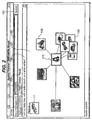
- this diagram illustrates the interface to a user.
- a user operates a computer with a web browser such as Microsoft ExplorerTM.
- a web browser such as Microsoft ExplorerTM.
- the Java applet configures the display to include a query input window 100 with a submit button 101.
- the query window 100 is of course initially empty and in Figure 1 the query "red toy car" has been entered.
- Below the query window 100 three buttons are provided.
- a refresh button 102 is provided for causing the re-rendering of the map data as will be described in more detail hereinafter.
- An options button 103 is provided to allow for the configuration of various parameters as will be described in more detail hereinafter.
- a help button 104 is provided to allow a user to access information to help them use the interface. These buttons can be selected as is conventional within a web browser by moving a pointer using for example a mouse and clicking. Next to the buttons there is provided status information in a status display region 105.
- the status information that can be provided comprises:
- buttons 102, 103, 104 and the status information display region 105 there is provided a region 106 in which is displayed a caption for an image in the image data base to be searched. Initially this is empty but once a map has been formed, it contains the caption of the best match to the query hereinafter termed a "focal image".
- map window 107 which comprises the bulk of the display. It is within this window that the search results from the search engine are mapped. Initially of course, the map window 107 is empty. As can be seen in Figure 1, once a query has been entered map data in the form of thumbnail images is formed. It can be seen in Figure 1 that as a result of the query "red toy car" an image 108 is highlighted the centre of the map window 107. This is a thumbnail image of the image data which most closely matches the input query. The closest match therefore becomes the focus of the map and the next closest matching images are used to form thumbnail images about the focal image 108. The proximity of the thumbnail images to the focal image depends on the similarity between the thumbnail images and the focal image.
- the arrangement of the thumbnail images within the map window 107 is dependent upon the similarity between them based on their captions.
- the similarity measure in this embodiment is determined off line and is contained within a database.
- the input can be matched to the captions in the database to determine the best match. Once the best match is found, predetermined similarities between the best match and other entries in the database are used. This will be described in more detail hereinafter.
- thumbnail image 111 which acts as a "back button” to allow the user to return to a previous map following a navigation around the map as will be described next.
- a user is able to navigate around the image database by selecting a thumbnail image using a pointer and clicking on the thumbnail.
- the selected thumbnail image becomes the focal image and the most similar images to the focal image are then displayed around the new focal image.
- the five thumbnail images of cars which includes the original focal image 108 remain as does image 109. The remaining images are new.
- the focal image 112 is displayed highlighted.
- the caption window 106 now displays the caption for the new focal image.
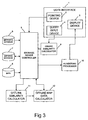
- a user interface 1 which comprises a pointing device 2 such as a mouse, an input device 4 such as a keyboard and a display device 3.
- a user inputs a query using the query input device 4, this is sent to the on-line similarity calculator 9.
- This will access meta data in the meta data database 6 via the storage device control 5 in order to identify the best match between the query and the meta data entries for the data.
- an image is identified using corresponding map data stored in the map data database 7 and corresponding data from the database 8 is retrieved and passed to the rendering processor 10 for rendering to form the map in the map window 107 on the display device 3.
- an off line process has to take place prior to the use of the system.
- An off line similarity calculator 11 accesses the meta data in the database 6 in order to determine the similarities between the meta data entries. These similarity values are then used to form map data using the map data calculator 12. The calculated map data is then stored in the map data database 7.
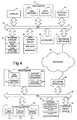
- FIG 4 is a schematic diagram of an implementation of the present invention.
- This embodiment comprises a server and client linked over a network 28.
- the network can comprise any form of network such as a local area network or the Internet.
- the client comprises a bus 20 linking the components of the client system together.
- a display 21 is provided for providing a display output of the form as shown in Figures 1 and 2.
- a processor 22 implements code stored in a program storage device 24. Web browser code within the program storage device 24 enables the processor 32 to implement a web browser 32a. HTML and Java code is stored in the program storage device 24 and enables the web browser 22a to launch a Java applet 22b.
- a pointing device 23 such as a mouse is provided to allow a user to select displayed items.
- a keyboard 26 is provided to allow the user to enter a query.
- Data storage 25 contains map data and image data to enable the map in the map window 107 of the display to be rendered.
- An interface 27 is provided for interfacing to the network 28 to enable the client to access
- the server is provided with a bus 30 linking components together.
- a network interface 29 is provided to link the server to the network 28.
- a processor 37 is provided to implement programs stored in the program storage device 34.
- Web server code stored in the program storage device 34 is loaded by the processor 31 in order to implement a web server 31a.
- a database application program is loaded by the processor 31 in order to implement a database application 31c.
- a map data calculation program stored in the program storage device 34 is loaded by the processor 31 in order to implement a map data calculation application 31b.
- a matching program is loaded by the processor 31 in order to implement a matching application 31b.
- the server is also provided with a storage device 32 comprising an image database 32a, a caption database 32b and a map data database 32c. These databases store respective image captions and map data.
- a server is also provided with an caption input device 33 which can for example comprise a keyboard to allow an operator to manually enter the captions for the images.
- this embodiment of the present invention can be implemented over the network wherein the client operates a single Java application.
- the bulk of the processing is carried out at the server.
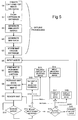
- FIG. 5 is a flow diagram illustrating the overall operation of this embodiment of the present invention.
- an operator creates captions for the image data base.
- the captions are then stored in the captions database in step S2.
- a caption can comprise a description of the subject matter of the images to enable natural language queries to be used for searching the image database.
- step S3 the similarity between the captions (and thus the images) is determined in order to generate similarity matrices.
- a similarity matrix is generated for each image and comprises similarity values for only a number of closest or best match images. Thus, similarities need not be kept for similarities between all images. The details of the generation of the similarity matrices will be described hereinafter with reference to Figure 6.
- map data is generated for each image in the image database in step S4. This is then stored in the map data database in step S5. Details of the generation of the map data will be described hereinafter in more detail with reference to Figure 7.
- Steps S1 to S5 comprise processing steps which take place before a user enters a query.
- the image database, caption database, and map data databases are formed off-line ready for a user to enter queries.
- step S6 a user inputs a query such as illustrated in Figure 1 by typing in for example "red toy car”. This is submitted by using the submit button 101.
- the on-line similarity calculator 9 the best match between the input query and the captions are determined in order to identify the corresponding map ID in step S7.
- map data is retrieved from the map data database.
- step S9 the map is rendered using the map data and by retrieving image data referenced in the map data.
- step S10 the process will then await a mouse input. When a mouse input is received in step S11 it is determined whether this input has occurred within the map window. If there was a map input within the map window, there are three possible inputs: double click, click and drag.
- step S12 the map ID of the selected thumbnail is obtained and the process returns to step S8 whereby the map ID is used to retrieve the map data.
- This process is illustrated in the transition from the displays of Figures 1 and 2.
- the user has selected the image 112 by double clicking which results in the display of Figure 2 wherein the image 112 becomes the focal image.
- step S13 the selected image is displayed at an enlarged size to enable a user to more easily view it.
- the selected image is displayed at an enlarged size to enable a user to more easily view it.
- only one image can be selected to be displayed enlarged at a time. If another image is selected whilst an image is displayed enlarged, the previously selected image is returned to its thumbnail size and the newly selected image is displayed at an enlarged size.
- the mouse input in the map window comprises a drag event
- a thumbnail image which had been selected to be dragged is moved within the map window. Any links between the thumbnail images are maintained and move as necessary during the movement of the selected image in step S14.
- This ability to allow a user to move images enables a user to manually rearrange the thumbnail images either to allow the rendering process to be repeated using the refresh button 102, or merely to pull out an image which is partially covered by other images so that it can viewed. For instance, a user may wish to move the thumbnail image 108 illustrated in Figure 2 which is partly obscured in order to be able to see the full thumbnail image. This may be the image that the user is seeking in the search.
- step S11 if the mouse input is not in the map window, in step S15 it is determined whether the mouse input comprises the selection of a button. If not, in step S16 the mouse input is ignored. If a button is selected, if the refresh button is selected the process then returns to step S9 to re-render the map.
- the re-rendering process may be desirable for several reasons. As will be described hereinafter, the rendering process includes the calculation of the separation of the images for a limited period of time. In other words, the algorithm which determines the spacing of the images iterates towards the solution but is only allowed a certain time to do it. A user may wish to allow the iterations to continue for a longer and thus the refresh button 102 can be selected for this purpose.
- step S14 if a user has manually moved a thumbnail using the process of step S14, this may help in clarifying the rendering process. Because the arrangement of the thumbnail images from the map window 107 is determined by an algorithm which has to take into consideration competing forces between images, the map displayed may not be the only "solution”. Thus because it is possible to move a selected thumbnail and re-render, a more clear map may result.
- step S17 the help menu is displayed.
- the help menu includes information to help a user to use the software.
- step S15 If in step S15 it is determined that the options button has been selected, in step S18 the options menu is displayed.
- the options menu allows various configurations of options of the system to be set.
- the linkage strategy can be set so that either:
- the number of thumbnail images rendered in the map can also be selected.
- the similarity matrices do not contain similarity values for all images.
- the number of thumbnails N is set to 10.
- each matrix is a 10 by 10 matrix wherein for an image similarity values for the 9 best matches are included.
- the options menu allows the number of thumbnails to be reduced to a number less than N. This means that images with the lowest similarity value to the focal image will not be displayed. It is not possible to show a number of thumbnail images greater than the number in the similarity matrices because the similarity values are not available.
- Another options setting which is available is to allow the web browser to preload images. Thus when this is selected, instead of the map being formed wherein the images are gradually displayed as image data is retrieved, no map data is illustrated until all the images are available. This causes a delay but ensures that all the images are available for the rendering process before the rendering process begins.
- step S15 of Figure 5 if the button selected is the submit button, this means that a new query has been input and thus the process returns to step S6.
- the embodiment of the present invention allows a user to manually input a natural language query, or effectively enter a query by a selecting an image.
- a method of entry of a query by selection of an image enables a user to navigate the image database. If during navigation the original image is not included in the closest matches surrounding the new focal image, a user is able to return to the previous map data using the back button 111 which is the image of the previous focal image.
- the generation of the similarity matrices takes place off line by determining the similarity between the entries in the database. This has the benefit of reducing the processing time required. It is only necessary simply to identify the best match between the input query and the captions in the captions database. However, this suffers from the disadvantage that the best matches illustrated in the map are the best matches to the focal image and not the best matches to the query. A benefit of this however is that the user is given an impression of the pattern of data in the database.
- step S3 in Figure 5 The method of generating the similarity matrices (step S3 in Figure 5) will now be described with reference to Figure 6.
- step S20 an initial caption is selected from the caption database.
- step S21 the best N-1 best matches are found.
- the matching process in this embodiment can comprise a simple keyword matching but preferably comprise a full natural language phrase matching technique as disclosed in UK Patent Application No. 9904662 and UK Patent Application No. 9821969 the contents of which are hereby incorporated by reference.
- the best matches are found by comparing similarity values returned from the matching process.
- the result of step S21 is a series of values which will be used to form the radial links in the map data.
- step S22 The process then goes on in step S22 to calculate the values for the similarity of each of the other captions with each other.
- the purpose of this is generate a full N x N matrix so that not only can radial links be determined in the rendering of the map, but also links between outlying images.
- step S23 the values are output of an N x N matrix indexed by the image ID for the selected caption. In the matrix the rows and columns are indexed by image IDs' for the best matches.
- step S24 the next caption is selected and the process returns to step S21.
- the process in Figure 6 thus repeats for each of the captions in the caption database to form the similarity matrices.
- Table 1 below illustrates the similarity matrix for the focal image of Figure 1. 17/71 17/72 17/73 5/62 6/35 6/36 6/37 6/38 6/39 6/40 17/71 1.00 0.51 0.67 0.00 0.67 0.36 0.42 0.34 0.65 0.40 17/72 0.51 1.00 0.49 0.00 0.64 0.36 0.38 0.32 0.62 0.38 17/73 0.67 0.49 1.00 0.00 0.55 0.31 0.33 0.27 0.53 0.32 5/62 0.00 0.00 0.00 1.00 0.02 0.28 0.03 0.03 0.00 0.09 6/35 0.67 0.64 0.55 0.02 1.00 0.59 0.63 0.52 0.93 0.61 6/36 0.36 0.36 0.31 0.28 0.59 1.00 0.36 0.64 0.53 0.38 6/37 0.42 0.38 0.33 0.03 0.63 0.36 1.00 0.34 0.56 0.40 6/38 0.34 0.32 0.27 0.03 0.52 0.64 0.34 1.00 0.47 0.36 6/39 0.65 0.62 0.53 0.00 0.93 0.53 0.56 0.47 1.00 0.56 6
- Table 2 below illustrates the similarity matrix for the focal image of Figure 2.
- the images are identified by an image ID of the format "directory/image number".
- the first column in Table 1 is for similarity values for the 10 images similar to image number 71 in directory 17.
- the diagonal window of the matrix has values of 1. Below the diagonal line the values will repeat what appears above. Thus only the upper or lower part of the matrix need be stored for the present technique wherein the similarity measure between images is symmetric i.e. it does not matter which image you take as the reference in the comparison e.g. comparing image 17/71 with image 17/72 is equivalent to comparing image 17/72 with image 17/71.
- step S30 an initial matrix is selected.
- step S31 captions for each image ID used to index the matrix is output to a map data file indexed by the map ID.
- the mean, standard deviation, maximum and minimum values in the matrix are then calculated in step S32.
- step S34 the identified values are then normalised to values which are suitable for displaying as links i.e. separations between the images.
- the normalised values are then output to the map data file and indexed by the caption sequence i.e. if a link value is output for a link between the first and fourth image in the sequence, the output format is "1-4/length", where "length" is the link length.
- step S36 the image ID for each of the images in the caption sequence is then output to the map data file.
- step S37 the caption sequence index number of the image ID for the selected matrix is output as an indication of the focal image in order to complete the data in the map data file.
- step S38 the next matrix is then selected and the process returns to step S31.
- the captions and the image IDs' are output as a sequence
- the link length data is output as lengths indexed in accordance with the sequence.
- the final piece of data from the map data file is the indication of the focal image by the use of the index to refer to the image ID in the sequence.
- the final data entry 5 indicates that the fifth position in the sequence identifies the focal image.
- the generation of the similarity matrices and the map data files have been described as two separate processes wherein once the matrices have been formed, the map data files are formed, in practice, in order to reduce storage, the map data file calculation is carried out immediately following the generation of the similarity matrix for a selected caption.
- the similarity matrices are not stored and are transient: they are merely used as an intermediary to form the map data files.
- map data files are stored in the map data database for use in the rendering of the map in the map window 107.
- Map data files contain all of the information necessary for the rendering process. The rendering process merely needs to retrieve the image data identified in the map data file.
- step S40 the map data is input having a map ID for the best matching caption or having the map ID of the selected thumbnail.
- the thumbnail of the focal image is retrieved and rendered at the centre of the map window in step S41.
- step S42 the thumbnails of the other images indexed in the map data file are rendered at predetermined positions around the focal image. These predetermined positions can be at equally spaced positions around the focal image or at random positions. The starting positions are not particularly important.
- step S43 a counter i is set to zero and in step S44 the counter is incremented.
- step S45 new thumbnail positions are calculated and the thumbnails are rendered in the new positions.
- step S46 the average thumbnail position (termed curr.ave) is determined.
- step S47 it is then determined whether the counter i has reached 10. If not, the process returns to step S44.
- steps S44 to S47 are repeated ten times.
- the new thumbnail positions are calculated and the thumbnails are rendered at those positions ten times and each time the average thumbnail position is determined.
- step S48 a ten point moving average of the average thumbnail position (termed mov.ave) is determined.
- step S49 it is determined whether the current average position is within a range of the ten point moving average and if the time taken is greater than 5 seconds. If so the rendering process has completed and the process stops in step S50. If not in step S51 it is determined whether the time T is greater than 15 seconds. If so the process terminates in step S50 and if not the process returns to step S43. Thus, in step S49 it is determined whether there is still significant movement of the images or whether they have converged towards a solution. The process is allowed at least 5 seconds to iterate but no more than 15 seconds.
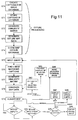
- Figure 9 illustrates in more detail the process of calculating the new thumbnail positions i.e. step S45 of Figure 8.
- a first link is selected i.e. the separation of two images corresponding to two images which have a separation value in the map data file.
- the link length is calculated by measuring the x and y distances between the nodes (images). This is the actual length of the link (ACTUAL_LEN).
- step S64 ⁇ X and ⁇ Y are added to the "from" node i.e. the node identified by the first index in the map data files and in step S65 ⁇ X and ⁇ Y are subtracted from the "to" node.
- the first link is given in the format 4-0/192. This identifies the link as being from the fourth image in the sequence to the zero image in the sequence and the link length is 192. (In the map data file, the 10 images are indexed from 0 to 9).
- step S64 requires the addition of ⁇ X and ⁇ Y to the position of the fourth image in the caption sequence i.e.
- step S64 is addition and step S65 is substraction, this does not result in the nodes moving closer together but can result in the nodes moving further apart.
- step S66 it is then determined whether there are any more links to be processed and if so, in step S68 the next link is selected and the process returns to step S61. If all the links have been processed, in step S67 the thumbnails are rendered at their new positions. Thus the process of Figure 9 comprises a single iteration in the rendering process.
- This embodiment of the present invention thus provides a simple method allowing a user to enter a query and to be presented with a map of thumbnail images in which the focal image comprises the best match to the query
- the surrounding images comprise images which are the best matches in the database to the focal image. This enables a user to navigate through the database by selecting an image as a new focal image. Such a technique is fast because there is no need to perform on-line matching. There is no query input and instead, the ID of the select image is used to retrieve the map data for the generation of the next map.
- Figure 10 is a schematic diagram of the second embodiment of the present invention.
- the interface 1 comprises the pointing device 2 the query input device 4 and the display device 3.
- the on-line similarity calculator 9 not only determines the best match between the input query and the meta data in the meta data database 6, it also calculates the N best matches between the input query and the data in the meta data database 6. This is used to calculate similarity values between the input query and the N best matches.
- the similarity data is then passed to an on-line map data calculator 13 for calculating map data on-line from the similarity values.
- the map data calculator 13 refers to the meta data database 6 and the data in the database 8 in order to form the map data. This data is then passed to the rendering processor 10 in order to render a map in the map window 107 in a similar manner to that shown in Figure 1.
- the off-line similarity calculator 11 and the off-line map data calculator 12 operates as in the first embodiment to generate map data for the map data database 7. This data is used whenever the pointing device 2 is used to select an image. In other words when an image is selected there is no need to perform any matching operation on-line and it is possible to retrieve the map data simply using the ID of the selected image.
- the map data generated is not based on similarity to an entry in the database, but instead is based on similarity to the query.
- step S70 captions for the image database are created and in step S71 they are stored in the database.
- step S72 similarity matrices are generated in accordance with the flow diagram of Figure 6 and in step S73 off-line map data is generated in accordance with the flow diagram of Figure 7 as in the previous embodiment.
- step S74 the map data is stored in the database. Steps S72 to S74 comprise off-line processing and are the same as in the first embodiment.
- step S76 When a query is input in step S75, in step S76 the N best matching captions are found and in step S77 a similarity matrix is generated on line. This comprises the determination of the similarity between the N best matches to the input query.
- step S78 map data is generated from the similarity matrix. The map data is generated on-line. This will be described in more detail with reference to Figure 12 hereinafter.
- the map data is then rendered in step S79 and the process then awaits a mouse input in step S80.
- Steps S81 to step S88 correspond to steps S11 to S18 in Figure 5 and the process operates in the same way as in the first embodiment for mouse inputs. A description of steps S81 to S88 is thus omitted for the sake of brevity.
- the second embodiment only differs from the first embodiment in that steps S7 to S9 are replaced with steps S76 to S79.
- step S90 the captions for each image ID in the similarity matrix are output as a matrix caption sequence indexed by map ID.
- the mean, standard deviation, maximum and minimum of the values in the matrix are then calculated.
- step S92 significant values in the matrix are then identified either by the fact that they are indexed by the image ID of the best match, or by the fact that they differ by more than n standard deviations from the mean. These values are then normalised suitably for display as lengths (separations) in step S93.
- the normalised values are then output indexed by caption sequence to the map data file in step S94 and in step S95 the image ID in caption sequence order is output to the map data file.
- the caption sequence index number of the image ID for the best match is output as the identification of the focal image in step S96.
- This embodiment of the present invention allows a user to enter a query and observe a map of images which most closely match the query. The process does however require the determination of a similarity matrix and map data on-line. Once the map is rendered a user is able to navigate the image database in the same manner as for the first embodiment.
- the present invention is not limited to the searching of image data.
- the present invention is applicable to any form of data such as text data, audio data, image data, and video data.
- the rendered map can include images representative of a frame with a video.
- a specific thumbnail image of a frame can be provided as meta data to the video data.
- meta data can be provided which can comprise text.
- the thumbnail images can comprise an image of a document, an abstract, or a caption.
- the present invention is applicable to any form of data wherein the rendering process generates a map having nodes which comprise representations for the data.
- the information outputting process will depend upon the form of the data. For example, in the above embodiments, for image data, when an image is selected, the size of the thumbnail is increased. This can also take place for the representation of data in other forms. Alternatively, for audio data and for video data, at least some of the audio or video can be played back.
- the searching is performed using meta data on the form of captions for images
- the present invention is applicable to searching of any form of meta data or the data itself.
- the query can be matched to the data itself, e.g. the title, the abstract or the whole text, or to meta data such as a document title, file name, abstract or caption which is extraneous to the data itself.
- natural language queries or keyword queries have been used, the present invention is not limited to such queries.
- Any form of query can be used for searching the database. For example, where colour images are being searched, colour data or signatures can be used as an input query.
- the similarity measure used for determining the similarity between each of the images is based on a natural language matching process between the natural language query and the caption or between the captions themselves.
- the present invention is not however, limited to any particular form of similarity measure.
- the similarities between images can be based on the colour content of the images.
- Similarity between videos i.e. films can be based on the content of the film e.g. the genre of the film.
- the matching process to form the similarity measure is described as using the natural language matching procedure described in UK Patent Application 9904662 and UK Patent Application No. 9821969 the content of which are hereby incorporated by reference.
- the invention can use any form of matching technique such as the cosine measure in order to determine how well things match.
- the cosine measure can be used by considering each word in the query to comprise a dimension.
- the query comprises a N-dimensional vector having values in each of the dimensions.
- the caption is mapped onto the N-dimension space and if the caption includes any of the words it is assigned a unit value in the particular dimension. Where no word is present it is assigned a zero value in a particular dimension.
- the caption and the query can be considered as N-dimensional vectors and a cosine measure can be obtained as a measure of the similarity between the query and the caption.
- the links are shown as simple links between nodes in the map.
- the links can however be considered to be two different types of links:
- Links which have values close to the mean are not mapped.
- the two different types of link can be shown in different colours to show links which are pushing and pulling nodes.
- this can be used to identify the types of links between the images e.g. for natural language queries and natural language matching, the context of the match can be used to enhance the information available for the link.
- context information can be made available from implementing the technique in UK Patent Application No. 9904662.
- the invention has many applications and can be used for searching for and browsing through information and databases.
- the present invention is not limited to the retrieval of data and can be used for browsing for information even for placing requests for information.
- the present invention can be applied to on-line shopping for searching for and ordering items, and for video-on-demand systems.
- the thumbnail images can comprise images of the items that a user wishes to order.
- the present invention is also applicable to web search engines where the images displayed in the map can comprise images of the web pages.
- the captions can either be matched to the text content of the web page, or meta data for the web pages can be provided e.g. captions.
- the embodiments of the present invention have been described with reference to implementation over a network using Java applets.
- This implementation of the present invention is particularly convenient since it allows the invention to be implemented using a browser either locally on a machine wherein the client and server effectively comprises a single machine and the searching takes place of a database stored locally on a single machine, or the technique can be applied to allow searching of databases over a network.
- the present invention is not however limited to the specific implementation and it can be implemented either using specifically designed software or hardware. Since the present invention can be implemented in software, the present invention can be embodied as a storage media carrying computer code for controlling a processor to carry out the method. Also, because the computer program can be downloaded over a network such as the internet or a local area network, the present invention can be embodied as a signal carrying instructions for controlling a processor to carry out the method.
Landscapes
- Engineering & Computer Science (AREA)
- Theoretical Computer Science (AREA)
- Databases & Information Systems (AREA)
- Data Mining & Analysis (AREA)
- Physics & Mathematics (AREA)
- General Engineering & Computer Science (AREA)
- General Physics & Mathematics (AREA)
- Library & Information Science (AREA)
- Computational Linguistics (AREA)
- Document Processing Apparatus (AREA)
- Processing Or Creating Images (AREA)
- Information Retrieval, Db Structures And Fs Structures Therefor (AREA)
Applications Claiming Priority (2)
| Application Number | Priority Date | Filing Date | Title |
|---|---|---|---|
| GB9908631 | 1999-04-15 | ||
| GBGB9908631.6A GB9908631D0 (en) | 1999-04-15 | 1999-04-15 | Search engine user interface |
Publications (2)
| Publication Number | Publication Date |
|---|---|
| EP1045314A2 true EP1045314A2 (de) | 2000-10-18 |
| EP1045314A3 EP1045314A3 (de) | 2004-06-09 |
Family
ID=10851595
Family Applications (1)
| Application Number | Title | Priority Date | Filing Date |
|---|---|---|---|
| EP00301911A Withdrawn EP1045314A3 (de) | 1999-04-15 | 2000-03-08 | Benutzerschnittstelle einer Suchmaschine |
Country Status (3)
| Country | Link |
|---|---|
| US (1) | US7028050B1 (de) |
| EP (1) | EP1045314A3 (de) |
| GB (1) | GB9908631D0 (de) |
Cited By (7)
| Publication number | Priority date | Publication date | Assignee | Title |
|---|---|---|---|---|
| US7165080B2 (en) | 2000-10-27 | 2007-01-16 | Canon Kabushiki Kaisha | Method and apparatus for facilitating refinement of a search |
| WO2006053266A3 (en) * | 2004-11-10 | 2007-02-01 | Apple Computer | Highlighting items for search results |
| EP1508863A3 (de) * | 2003-08-19 | 2007-02-14 | Pioneer Corporation | Multimedia-Inhaltswiederauffindungssystem |
| US7747621B2 (en) * | 2003-12-19 | 2010-06-29 | Canon Kabushiki Kaisha | Generating a relation diagram of data files |
| WO2014042967A1 (en) * | 2012-09-11 | 2014-03-20 | Microsoft Corporation | Gesture-based search queries |
| CN110619313A (zh) * | 2019-09-20 | 2019-12-27 | 西安电子科技大学 | 遥感图像判别性描述生成方法 |
| KR102111989B1 (ko) * | 2019-12-05 | 2020-05-18 | (주)플랜아이 | 자연어 질의에 대하여 시계열 정보를 제공하는 시스템 및 방법 |
Families Citing this family (39)
| Publication number | Priority date | Publication date | Assignee | Title |
|---|---|---|---|---|
| US6629104B1 (en) * | 2000-11-22 | 2003-09-30 | Eastman Kodak Company | Method for adding personalized metadata to a collection of digital images |
| US7620622B1 (en) * | 2001-03-08 | 2009-11-17 | Yahoo! Inc. | Method and system for indexing information and providing results for a search including objects having predetermined attributes |
| US7773800B2 (en) * | 2001-06-06 | 2010-08-10 | Ying Liu | Attrasoft image retrieval |
| US7707221B1 (en) * | 2002-04-03 | 2010-04-27 | Yahoo! Inc. | Associating and linking compact disc metadata |
| US7028036B2 (en) * | 2002-06-28 | 2006-04-11 | Microsoft Corporation | System and method for visualization of continuous attribute values |
| FR2863127A1 (fr) * | 2003-12-02 | 2005-06-03 | Canon Kk | Procedes et dispositifs pour la delivrance asynchrone de donnees numeriques |
| US20060112070A1 (en) * | 2004-11-24 | 2006-05-25 | Ramos Oscar A | Interactive graphical interface for data manipulation and presentation |
| CA2500573A1 (en) * | 2005-03-14 | 2006-09-14 | Oculus Info Inc. | Advances in nspace - system and method for information analysis |
| WO2006074266A2 (en) * | 2005-01-05 | 2006-07-13 | Hillcrest Laboratories, Inc. | Scaling and layout methods and systems for handling one-to-many objects |
| US7737995B2 (en) * | 2005-02-28 | 2010-06-15 | Microsoft Corporation | Graphical user interface system and process for navigating a set of images |
| AU2005203074A1 (en) * | 2005-07-14 | 2007-02-01 | Canon Information Systems Research Australia Pty Ltd | Image browser |
| JP4849301B2 (ja) * | 2005-07-27 | 2012-01-11 | ソニー株式会社 | 情報処理装置および方法、並びにプログラム |
| US7634474B2 (en) * | 2006-03-30 | 2009-12-15 | Microsoft Corporation | Using connectivity distance for relevance feedback in search |
| US7735010B2 (en) * | 2006-04-05 | 2010-06-08 | Lexisnexis, A Division Of Reed Elsevier Inc. | Citation network viewer and method |
| JP4747024B2 (ja) * | 2006-04-28 | 2011-08-10 | 富士フイルム株式会社 | メタ情報付加装置および画像再生装置ならびにそれらの制御方法およびそれらを制御するためのプログラム |
| JP4962009B2 (ja) * | 2007-01-09 | 2012-06-27 | ソニー株式会社 | 情報処理装置、情報処理方法、プログラム |
| US9086785B2 (en) | 2007-06-08 | 2015-07-21 | Apple Inc. | Visualization object receptacle |
| US8667418B2 (en) * | 2007-06-08 | 2014-03-04 | Apple Inc. | Object stack |
| US8745535B2 (en) | 2007-06-08 | 2014-06-03 | Apple Inc. | Multi-dimensional desktop |
| US20080307359A1 (en) * | 2007-06-08 | 2008-12-11 | Apple Inc. | Grouping Graphical Representations of Objects in a User Interface |
| US8381122B2 (en) * | 2007-06-08 | 2013-02-19 | Apple Inc. | Multi-dimensional application environment |
| US8473859B2 (en) * | 2007-06-08 | 2013-06-25 | Apple Inc. | Visualization and interaction models |
| US20080307362A1 (en) * | 2007-06-08 | 2008-12-11 | Apple Inc. | Desktop Filter |
| US8892997B2 (en) * | 2007-06-08 | 2014-11-18 | Apple Inc. | Overflow stack user interface |
| US20080307330A1 (en) * | 2007-06-08 | 2008-12-11 | Apple Inc. | Visualization object divet |
| DE102008021185A1 (de) * | 2008-04-28 | 2009-10-29 | Volkswagen Ag | Verfahren und Vorrichtung zum Darstellen von Listeneinträgen auf einer Anzeigeeinrichtung in einem Fahrzeug |
| US8832119B2 (en) * | 2008-06-12 | 2014-09-09 | Fuji Xerox Co., Ltd. | Systems and methods for organizing files in a graph-based layout |
| US8839306B2 (en) * | 2009-11-20 | 2014-09-16 | At&T Intellectual Property I, Lp | Method and apparatus for presenting media programs |
| EP2596414A4 (de) * | 2010-07-21 | 2014-12-17 | Joshua Leichtberg | Interaktive website |
| US20120272168A1 (en) * | 2011-04-20 | 2012-10-25 | Panafold | Methods, apparatus, and systems for visually representing a relative relevance of content elements to an attractor |
| US20150135048A1 (en) * | 2011-04-20 | 2015-05-14 | Panafold | Methods, apparatus, and systems for visually representing a relative relevance of content elements to an attractor |
| US20120272171A1 (en) * | 2011-04-21 | 2012-10-25 | Panasonic Corporation | Apparatus, Method and Computer-Implemented Program for Editable Categorization |
| JP5866957B2 (ja) * | 2011-10-17 | 2016-02-24 | ソニー株式会社 | 情報処理装置、表示制御方法及びプログラム |
| US9721039B2 (en) * | 2011-12-16 | 2017-08-01 | Palo Alto Research Center Incorporated | Generating a relationship visualization for nonhomogeneous entities |
| US9449028B2 (en) * | 2011-12-30 | 2016-09-20 | Microsoft Technology Licensing, Llc | Dynamic definitive image service |
| JP6274560B2 (ja) * | 2014-01-09 | 2018-02-07 | 株式会社Nttぷらら | コンテンツ提供システム、コンテンツ提供サーバ、コンテンツ提供方法、及びプログラム |
| US10713304B2 (en) * | 2016-01-26 | 2020-07-14 | International Business Machines Corporation | Entity arrangement by shape input |
| US9836183B1 (en) * | 2016-09-14 | 2017-12-05 | Quid, Inc. | Summarized network graph for semantic similarity graphs of large corpora |
| CN108075959B (zh) * | 2016-11-14 | 2021-03-12 | 腾讯科技(深圳)有限公司 | 一种会话消息处理方法和装置 |
Family Cites Families (13)
| Publication number | Priority date | Publication date | Assignee | Title |
|---|---|---|---|---|
| JPS59183458A (ja) | 1983-04-01 | 1984-10-18 | Hitachi Ltd | 画像検索方式 |
| US4965558A (en) | 1987-07-15 | 1990-10-23 | Interand Corporation | Method and apparatus for image retrieval |
| JP2690782B2 (ja) | 1989-05-30 | 1997-12-17 | 富士写真フイルム株式会社 | 画像ファイリングシステム |
| JP2903904B2 (ja) | 1992-10-09 | 1999-06-14 | 松下電器産業株式会社 | 画像検索装置 |
| JP3067966B2 (ja) | 1993-12-06 | 2000-07-24 | 松下電器産業株式会社 | 画像部品を検索する装置及びその方法 |
| US5493677A (en) | 1994-06-08 | 1996-02-20 | Systems Research & Applications Corporation | Generation, archiving, and retrieval of digital images with evoked suggestion-set captions and natural language interface |
| US5689667A (en) | 1995-06-06 | 1997-11-18 | Silicon Graphics, Inc. | Methods and system of controlling menus with radial and linear portions |
| US6405195B1 (en) * | 1996-05-06 | 2002-06-11 | Spotfire Ab | System and method for collaborative hosted analysis of data bases via a network portal |
| EP1025517A1 (de) * | 1997-10-27 | 2000-08-09 | Massachusetts Institute Of Technology | Bildsuch- und wiederauffindungssystem |
| US6211876B1 (en) * | 1998-06-22 | 2001-04-03 | Mitsubishi Electric Research Laboratories, Inc. | Method and system for displaying icons representing information items stored in a database |
| JP2000076267A (ja) * | 1998-08-31 | 2000-03-14 | Sharp Corp | 情報検索方法、情報検索装置、及び情報検索プログラムを記録したコンピュータ読み取り可能な記録媒体 |
| US6243093B1 (en) * | 1998-09-14 | 2001-06-05 | Microsoft Corporation | Methods, apparatus and data structures for providing a user interface, which exploits spatial memory in three-dimensions, to objects and which visually groups matching objects |
| US6564206B1 (en) * | 1998-10-05 | 2003-05-13 | Canon Kabushiki Kaisha | Information search apparatus and method, and storage medium |
-
1999
- 1999-04-15 GB GBGB9908631.6A patent/GB9908631D0/en not_active Ceased
-
2000
- 2000-03-08 EP EP00301911A patent/EP1045314A3/de not_active Withdrawn
- 2000-03-10 US US09/523,313 patent/US7028050B1/en not_active Expired - Fee Related
Non-Patent Citations (1)
| Title |
|---|
| None * |
Cited By (15)
| Publication number | Priority date | Publication date | Assignee | Title |
|---|---|---|---|---|
| US7165080B2 (en) | 2000-10-27 | 2007-01-16 | Canon Kabushiki Kaisha | Method and apparatus for facilitating refinement of a search |
| EP1508863A3 (de) * | 2003-08-19 | 2007-02-14 | Pioneer Corporation | Multimedia-Inhaltswiederauffindungssystem |
| US7747621B2 (en) * | 2003-12-19 | 2010-06-29 | Canon Kabushiki Kaisha | Generating a relation diagram of data files |
| US8677274B2 (en) | 2004-11-10 | 2014-03-18 | Apple Inc. | Highlighting items for search results |
| US7979796B2 (en) | 2004-11-10 | 2011-07-12 | Apple Inc. | Searching for commands and other elements of a user interface |
| US8607162B2 (en) | 2004-11-10 | 2013-12-10 | Apple Inc. | Searching for commands and other elements of a user interface |
| WO2006053266A3 (en) * | 2004-11-10 | 2007-02-01 | Apple Computer | Highlighting items for search results |
| US9659069B2 (en) | 2004-11-10 | 2017-05-23 | Apple Inc. | Highlighting items for search results |
| US10635683B2 (en) | 2004-11-10 | 2020-04-28 | Apple Inc. | Highlighting items for search results |
| US11500890B2 (en) | 2004-11-10 | 2022-11-15 | Apple Inc. | Highlighting icons for search results |
| US12182146B2 (en) | 2004-11-10 | 2024-12-31 | Apple Inc. | Highlighting icons for search results |
| WO2014042967A1 (en) * | 2012-09-11 | 2014-03-20 | Microsoft Corporation | Gesture-based search queries |
| CN110619313A (zh) * | 2019-09-20 | 2019-12-27 | 西安电子科技大学 | 遥感图像判别性描述生成方法 |
| CN110619313B (zh) * | 2019-09-20 | 2023-09-12 | 西安电子科技大学 | 遥感图像判别性描述生成方法 |
| KR102111989B1 (ko) * | 2019-12-05 | 2020-05-18 | (주)플랜아이 | 자연어 질의에 대하여 시계열 정보를 제공하는 시스템 및 방법 |
Also Published As
| Publication number | Publication date |
|---|---|
| GB9908631D0 (en) | 1999-06-09 |
| EP1045314A3 (de) | 2004-06-09 |
| US7028050B1 (en) | 2006-04-11 |
Similar Documents
| Publication | Publication Date | Title |
|---|---|---|
| US7028050B1 (en) | Data display apparatus and data display method | |
| KR101820256B1 (ko) | 시각 검색 및 삼차원 결과 제공 기법 | |
| US6993726B2 (en) | Methods and systems for document navigation using enhanced thumbnails | |
| US6883138B2 (en) | Methods and systems for generating enhanced thumbnails usable for document navigation | |
| EP1283482B1 (de) | Verfahren und Systeme zum Übergang zwischen verkleinerten Darstellungen und Dokumente basierend auf den verkleinerten Darstellungen | |
| US7428705B2 (en) | Web map tool | |
| US7603367B1 (en) | Method and system for displaying attributes of items organized in a searchable hierarchical structure | |
| US7693912B2 (en) | Methods for navigating collections of information in varying levels of detail | |
| US6473751B1 (en) | Method and apparatus for defining search queries and user profiles and viewing search results | |
| US6499029B1 (en) | User interface providing automatic organization and filtering of search criteria | |
| US20080028308A1 (en) | Visual display method for sequential data | |
| US20040205627A1 (en) | Methods and systems for generating enhanced thumbnails | |
| US20090070321A1 (en) | User search interface | |
| US20070100883A1 (en) | Methods for providing audio feedback during the navigation of collections of information | |
| US20040088291A1 (en) | Retrieval condition setting method and retrieval condition setting apparatus | |
| US7089506B2 (en) | Method for selecting products | |
| JP5010624B2 (ja) | 検索装置 | |
| Hirata et al. | Object-based navigation: An intuitive navigation style for content-oriented integration environment | |
| Lin et al. | Finding cultural heritage images through a Dual-Perspective Navigation Framework | |
| MacCuish | Applications To Image Databases", IEEE 6" International | |
| Hirose et al. | GeminiMap–geographical enhanced map interface for navigation on the Internet | |
| Wilson | Modern search user interfaces | |
| KR101886182B1 (ko) | 내용 기반 이미지 검색을 위한 질의 이미지 생성 방법 및 시스템 | |
| KR20180026011A (ko) | 내용 기반 이미지 검색을 위한 편집-예제 기반 질의 이미지 생성 방법 및 시스템 | |
| Perugini et al. | User Interface Design |
Legal Events
| Date | Code | Title | Description |
|---|---|---|---|
| PUAI | Public reference made under article 153(3) epc to a published international application that has entered the european phase |
Free format text: ORIGINAL CODE: 0009012 |
|
| AK | Designated contracting states |
Kind code of ref document: A2 Designated state(s): AT BE CH CY DE DK ES FI FR GB GR IE IT LI LU MC NL PT SE |
|
| AX | Request for extension of the european patent |
Free format text: AL;LT;LV;MK;RO;SI |
|
| PUAL | Search report despatched |
Free format text: ORIGINAL CODE: 0009013 |
|
| AK | Designated contracting states |
Kind code of ref document: A3 Designated state(s): AT BE CH CY DE DK ES FI FR GB GR IE IT LI LU MC NL PT SE |
|
| AX | Request for extension of the european patent |
Extension state: AL LT LV MK RO SI |
|
| 17P | Request for examination filed |
Effective date: 20041022 |
|
| AKX | Designation fees paid |
Designated state(s): DE FR GB IT |
|
| 17Q | First examination report despatched |
Effective date: 20070309 |
|
| STAA | Information on the status of an ep patent application or granted ep patent |
Free format text: STATUS: THE APPLICATION HAS BEEN WITHDRAWN |
|
| 18W | Application withdrawn |
Effective date: 20070803 |