EP1045546A2 - Verfahren zur Überlastreduzierung in Paketvermittlungsnetzen - Google Patents
Verfahren zur Überlastreduzierung in Paketvermittlungsnetzen Download PDFInfo
- Publication number
- EP1045546A2 EP1045546A2 EP00107082A EP00107082A EP1045546A2 EP 1045546 A2 EP1045546 A2 EP 1045546A2 EP 00107082 A EP00107082 A EP 00107082A EP 00107082 A EP00107082 A EP 00107082A EP 1045546 A2 EP1045546 A2 EP 1045546A2
- Authority
- EP
- European Patent Office
- Prior art keywords
- network
- congestion
- packet
- customer
- incentive
- Prior art date
- Legal status (The legal status is an assumption and is not a legal conclusion. Google has not performed a legal analysis and makes no representation as to the accuracy of the status listed.)
- Granted
Links
Images


Classifications
-
- H—ELECTRICITY
- H04—ELECTRIC COMMUNICATION TECHNIQUE
- H04L—TRANSMISSION OF DIGITAL INFORMATION, e.g. TELEGRAPHIC COMMUNICATION
- H04L12/00—Data switching networks
- H04L12/02—Details
- H04L12/14—Charging, metering or billing arrangements specially adapted for data communications, e.g. authentication, authorisation and accounting [AAA] framework
- H04L12/1485—Tariff-related aspects
- H04L12/1496—Tariff-related aspects involving discounts
-
- H—ELECTRICITY
- H04—ELECTRIC COMMUNICATION TECHNIQUE
- H04L—TRANSMISSION OF DIGITAL INFORMATION, e.g. TELEGRAPHIC COMMUNICATION
- H04L12/00—Data switching networks
- H04L12/02—Details
- H04L12/14—Charging, metering or billing arrangements specially adapted for data communications, e.g. authentication, authorisation and accounting [AAA] framework
-
- H—ELECTRICITY
- H04—ELECTRIC COMMUNICATION TECHNIQUE
- H04L—TRANSMISSION OF DIGITAL INFORMATION, e.g. TELEGRAPHIC COMMUNICATION
- H04L12/00—Data switching networks
- H04L12/02—Details
- H04L12/14—Charging, metering or billing arrangements specially adapted for data communications, e.g. authentication, authorisation and accounting [AAA] framework
- H04L12/1485—Tariff-related aspects
- H04L12/1489—Tariff-related aspects dependent on congestion
-
- H—ELECTRICITY
- H04—ELECTRIC COMMUNICATION TECHNIQUE
- H04L—TRANSMISSION OF DIGITAL INFORMATION, e.g. TELEGRAPHIC COMMUNICATION
- H04L47/00—Traffic control in data switching networks
- H04L47/10—Flow control; Congestion control
- H04L47/11—Identifying congestion
-
- H—ELECTRICITY
- H04—ELECTRIC COMMUNICATION TECHNIQUE
- H04L—TRANSMISSION OF DIGITAL INFORMATION, e.g. TELEGRAPHIC COMMUNICATION
- H04L47/00—Traffic control in data switching networks
- H04L47/10—Flow control; Congestion control
- H04L47/28—Flow control; Congestion control in relation to timing considerations
-
- H—ELECTRICITY
- H04—ELECTRIC COMMUNICATION TECHNIQUE
- H04L—TRANSMISSION OF DIGITAL INFORMATION, e.g. TELEGRAPHIC COMMUNICATION
- H04L65/00—Network arrangements, protocols or services for supporting real-time applications in data packet communication
- H04L65/80—Responding to QoS
Definitions
- the present invention relates to communication networks and, more particularly, to methods and systems for reducing congestion in a packet-switched or hybrid network.
- TCP/IP Transmission Control Protocol/Internet Protocol
- a TCP source begins inserting packets into the network by starting with a minimal congestion window, allowing at most one unacknowledged packet in the network.
- ACK acknowledgement
- the congestion window is enlarged exponentially until a first threshold is reached or until a packet is dropped. If the first threshold is reached, the TCP source continues to enlarge the congestion window linearly until either a second threshold is reached ⁇ or until a packet is dropped.
- the TCP source Upon the timeout of a retransmit timer (thereby indicating a dropped packet), the TCP source reduces the transmission rate and "backs off" to its minimal window, with the goal of allowing the network to reach some form of equilibrium.
- a network router with a queue nearing an overflow can transmit a signal (in the form of a special bit in the packet's header) to indicate the presence of network congestion.
- the receiver's acknowledgment packet passes the notification on to the sender, which in turn slows down its transmission rate.
- the present invention permits a network service provider to detect an operational condition ⁇ such as congestion ⁇ in a packet-switched network and to alleviate such congestion by providing customer incentives to avoid use of the network.
- the detection mechanism triggers an incentive such as the modification of the user's access charges and the customer can be immediately notified of either the occurrence of the congestion or of information regarding the incentive.
- Usage of the network during congested periods can be deterred by imposing additional access charges during such periods ⁇ similarly, customers can be given a discount to encourage usage during periods of low congestion.
- An incentive schedule can be tailored to dynamically change the usage patterns of the customers of the network to accommodate the operational conditions in the network.
- the present invention has application in the Internet, where a detection/notification mechanism, for example, can be implemented in a network node such as a router or in a network endpoint such as a client machine or a proxy or mail server.
- Fig. 1 shows a packet-switched network 100 having numerous packet-switching nodes 110 to 119 connecting endpoints 101 and 102.
- Endpoint 101 and nodes 110 to 115 are assumed to be under the control or supervision of a network service provider; the remainder of the network is assumed to be controlled or maintained by other providers or entities.
- the network service provider provides access for users to the network for an access charge.
- an Internet Service Provider such as AT&T WorldNetTM provides access to the Internet for its customers.
- 110 to 115 represent routers and endpoints
- 101 and 102 can be client machines, servers, proxy servers, mail servers, news servers, etc.
- operational conditions such as congestion in the network are detected in a network node 110 to 115 and/or at an endpoint 101 in the network under the control of the network service provider.
- the present invention Upon the detection of the condition, whether at a router or an endpoint, the present invention generates incentive information, such as billing records reflecting a reduction or an increase in the access charge paid by a particular user. This information can be relayed to a billing server or some other billing apparatus for processing.
- a notification mechanism permits the user to receive notice of the incentive, either by notifying the user of the presence of the operational condition (e.g. congestion) or of the incentive information (e.g. the modified access charge).
- each node 110-115 is customarily equipped in a packet-switched network with a large number of buffers for storing packets in anticipation of routing or awaiting availability of an output link.
- packet congestion With regard to packet congestion, such symptoms develop first in the node's buffers or queues, as the buffers become filled and unavailable to store incoming packets.
- a router knows that the Internet is getting congested because its buffer queue for some output link is too long or is getting too long.
- RED Random Early Detection
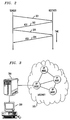
- endpoint 101 is a sender of packets across the network, see Fig. 2, it will also be aware of the congestion developing in the router's buffers. Endpoint 101, using TCP/IP, expects to receive an ACK 202 after transmitting a packet 201 through the network. Failure to receive an ACK signifies that the packet has been dropped by some router between it and the destination endpoint 102. Where, however, endpoint 101 is a receiver of packets (and endpoint 102 is, accordingly, the sender), the situation is a bit more subtle.
- the TCP process layer at endpoint 101 as it receives the packets 201, 203, etc. sent by 102, knows the order in which to reassemble the packets based on a sequence number in the received packets' headers.
- Endpoint 101 thus, expects to receive the packets in a certain order and can infer the dropping of a packet by looking for "holes" in the packets' sequence numbers.
- An out-of-sequence packet especially if there is a significant delay before the hole is filled, in general indicates that the expected packet has been dropped due to congestion.
- This method does not guarantee absolute detection of every dropped packet since, for example, packet loss will be invisible to the receiver if the trailing packet/packets in a sequence are dropped. Nevertheless, the method statistically provides good detection of dropped packets, especially for long transmissions (which is the situation a network service provider would be the most concerned about).
- the endpoint could use duplicate packets as an indicator, although the method would not be expected to be as good as a method based on detecting a hole and a timeout.
- the situation is simplified if the network has ECN capabilities.
- the router expenences congestion in its buffers (whether by a buffer overflow or by RED), it sets a "Congestion Experienced” ("CE") bit in the packet header of packets from ECN-capable transport protocols. See RFC 2481.
- CE Congestion Experienced
- the receiver of the packet detects the CE bit and sets a "ECN-Echo" flag in the header of a subsequent ACK packet sent back to the sender. Endpoints 101 and 102 are thus quickly notified of the congestion condition in a router and can react accordingly.
- the above detection mechanisms have been described with respect to the Internet protocol suite although, as noted above, the present invention works with applications and protocols other than reliable data transfer over TCP (as well as non-TCP/IP networks such as Ethernet, hybrid networks, etc.).
- the instant methods of congestion-based incentives work with multicast communication as well as unicast communication.
- a multicast audio application that runs over RTP/UDP (the Real Time Protocol over the User Datagram Protocol).
- RTP/UDP the Real Time Protocol over the User Datagram Protocol
- a sender transmits a stream of packets containing audio samples to multiple receivers.
- These applications do not require that every audio sample be reliably delivered, but they do require some reliability in order to maintain acceptable audio quality.
- RTP in particular uses sequence numbers to order packets and detect losses at each receiver.
- a lost RTP packet signals congestion just as a lost TCP packet does.
- RTP packets can also arrive at a receiver, in principle, containing an ECN (Explicit Congestion Notification) signal placed there by the network.
- ECN Exlicit Congestion Notification
- RTP receivers send periodic reports back to RTP senders. Senders use these reports to monitor communication quality and possibly adapt their behavior when there are problems.
- RTP reports include loss information, just as TCP acknowledgements do. Report packets can also carry ECN-Echo signals back to the sender. Therefore, both implicit and explicit congestion signals can be used in the context of the present invention as already described above.
- HTTP Hypertext Transfer Protocol
- proxy servers acts as an intermediary between a user terminal and the Internet to provide caching services. By caching frequently-requested pages, a proxy server can reduce the bandwidth necessary for the provider's own connection to the outside world. The present invention, then, should handle the case of both direct and proxy connections to the outside world, especially (but not exclusively) for Web traffic.
- proxy server 301 receives a request from the user 300 for an Internet service (e.g. a Web page request from server 302) which the proxy server forwards through the Internet 305 using its own IP address ⁇ assuming the request passes filtering requirements and cannot be satisfied by the internal cache.
- an Internet service e.g. a Web page request from server 302
- the proxy server forwards through the Internet 305 using its own IP address ⁇ assuming the request passes filtering requirements and cannot be satisfied by the internal cache.
- the proxy server receives the requested page, it relates it to the original request and forwards it back to the relevant user.
- a proxy server as a receiver of packets from outside Web servers, can use the present invention to detect congestion in the network and attribute it to the customer who requested the specific Web page. It is also a sender on the provider's own network; this, too, can be noted appropriately.
- the proxy server is thus perfectly positioned to detect and charge for requests over congested networks.
- the same analysis holds for operator-provided e-mail and, to a certain extent, news servers maintained by the operator.
- operational conditions internal and external to the network can be detected, noted, and billed accordingly. (It should be noted, however, that there could be philosophical problems with regard to the application of the present invention to the receipt of unsolicited mail during periods of congestion; see the discussion below on service-level congestion.)
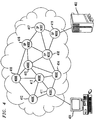
- the end systems that detect the congestion most easily are the customer's machine 401 and some endpoint 402 not under control of the network operator. While the former is ideally placed to notify the user, it clearly cannot be trusted to generate charge records for purposes of billing. Under certain circumstances, it may be possible to gather data reliably, such as when the customer utilizes a tamper-resistant modem supplied by the network operator. Otherwise, the routers 410 to 415 in Fig. 4 operated by the network service provider should be used to detect congestion and gather the data necessary to generate the appropriate billing records.
- the local operator can provide the routers for both ends of the slow link. At the upstream end, a fast link can connect to the local provider's router; this, then, reduces to the previous case.
- the upstream provider can detect and record congestion on behalf of the local operator.
- This situation can be generalized.
- Network service providers can detect congestion attributable to other customers of other network operators, and notify and bill them appropriately.
- a special-purpose "congestion indication protocol" can be utilized to pass the information between network operators. Accordingly, all users of an upstream provider can be charged for the congestion that they cause, rather than trying to attribute the problem to individual users.
- notifying the users of the incentive is important: if users do not realize there is a problem in the network (and a surcharge/reward), they will not modify their behavior at appropriate times.
- Direct notification from the network provider is straightforward where the present invention is implemented as a user process running on a direct endpoint capable of detecting congestion.
- other mechanisms for notifying the customer can be utilized. For example, when the user is in contact with only some local server, service-specific mechanisms can be utilized. When the customer is accessing Web pages through a proxy, a Java or Javascript applet can be sent to the user in the first Web page retrieved which, in turn, displays to the user the relevant notifications regarding congestion and incentive information such as the effect on access charges.
- the mail retrieval protocol could be modified to send appropriate information to the customer when accessing a mail server to check the user's e-mail (or create a new e-mail).
- the notification can be in the form of a window or screen "popup" on the user's display.
- a small window could be displayed on the user terminal indicating the level of congestion in the network in some visually intuitive and appealing form such as a speedometer. See Fig. 5.
- other forms of notification can come from preemptive detection mechanisms.
- U.S. Patent No. 5,870,557 "Method for Determining and Reporting a Level of Network Activity on a Communications Network Using a Routing Analyzer"
- a method is disclosed for periodically analyzing the congestion along routes from an access provider's entry point to the Internet to a set of desired Web sites.
- Round trip times and packet loss information collected from use of the "traceroute" command are utilized to identify congested links.
- the transit characteristics are compiled and analyzed to provide a user with useful information about congestion along routes to the Web sites of interest and in order to warn users to avoid traffic to some Web sites at congested periods of time.
- Such preemptive mechanisms can be utilized with the present invention to provide a customer with prior information on the operational condition of the network before incurring any charges for usage of a congested link. Accordingly, a customer can be prompted before deciding to access the network in a manner that will generate any incentive information such as a modification to a customer billing record.
- the notification mechanism need not be coupled to the network's detection and incentive mechanisms.
- Self-notification mechanisms can be utilized by the user. As long as users have received some notice of the general contours of the incentive, perhaps at registration, they can utilize whatever local detection/notification application scheme on their own computer terminal they choose to, such as the preemptive reporting application described above.
- the network service provider need only concern itself with detecting congestion and detecting usage.
- the present invention has been described with respect to the operational condition of the network itself. Rather than focusing on a condition such as network congestion, the idea can be generalized to encompass "service” or "application-level” congestion, i.e. congestion as an attribute of a service or application as opposed to a network.
- the incentive information can be generated as a function of some condition of a service/application provided by the network operator to the customer.
- the load on e-mail servers increases near Christmastime, as users send each other holiday greetings laden with graphics and audio. See “Graphic-Laden Holiday Greetings Clog Servers at AT&T WorldNet", Wall Street Journal, December 10, 1998.
- the present invention can be utilized to detect the increasing load on the mail server and to notify and charge customers submitting large messages during such periods of service congestion.
- receiving and storing certain high-volume newsgroups can be a considerable burden on a network operator flying to maintain a news server for its customers. Users who access such newsgroups by reading or posting to them could be notified and billed accordingly.
- Service congestion detection can be accomplished by modifying the mail protocol or the netnews protocol. Where a change in the protocol is undesirable, fake congestion indicators can be generated. While artificially dropping packets in order to signal service-level congestion would be counterproductive, an ECN congestion bit can be set to notify the user of the service-level congestion. This scheme will work for any application where most of the data is sent from the server to the user, since it will then have a minimal effect on actual transmission speeds.
Landscapes
- Engineering & Computer Science (AREA)
- Computer Networks & Wireless Communication (AREA)
- Signal Processing (AREA)
- Multimedia (AREA)
- Data Exchanges In Wide-Area Networks (AREA)
Applications Claiming Priority (2)
| Application Number | Priority Date | Filing Date | Title |
|---|---|---|---|
| US29202499A | 1999-04-16 | 1999-04-16 | |
| US292024 | 1999-04-16 |
Publications (3)
| Publication Number | Publication Date |
|---|---|
| EP1045546A2 true EP1045546A2 (de) | 2000-10-18 |
| EP1045546A3 EP1045546A3 (de) | 2003-08-20 |
| EP1045546B1 EP1045546B1 (de) | 2005-03-23 |
Family
ID=23122856
Family Applications (1)
| Application Number | Title | Priority Date | Filing Date |
|---|---|---|---|
| EP00107082A Expired - Lifetime EP1045546B1 (de) | 1999-04-16 | 2000-04-05 | Verfahren zur Überlastreduzierung in Paketvermittlungsnetzen |
Country Status (5)
| Country | Link |
|---|---|
| US (2) | US7227843B2 (de) |
| EP (1) | EP1045546B1 (de) |
| CA (1) | CA2301435C (de) |
| DE (1) | DE60018829T2 (de) |
| MX (1) | MXPA00003614A (de) |
Cited By (6)
| Publication number | Priority date | Publication date | Assignee | Title |
|---|---|---|---|---|
| WO2003065741A1 (en) * | 2002-01-25 | 2003-08-07 | Thomson Licensing S.A. | Adaptive cost of service for communication network based on level of network congestion |
| WO2004068800A1 (en) * | 2003-01-28 | 2004-08-12 | Telefonaktiebolaget Lm Ericsson (Publ) | Method and device for congestion notification in packet networks indicating several different congestion causes |
| WO2005027436A1 (en) * | 2003-09-15 | 2005-03-24 | British Telecommunications Public Limited Company | Inter-domain congestion charging |
| WO2014099552A1 (en) * | 2012-12-21 | 2014-06-26 | Alcatel Lucent | Method for offering wireless data at a discounted rate |
| WO2017006211A1 (en) * | 2015-07-06 | 2017-01-12 | Telefonaktiebolaget Lm Ericsson (Publ) | Method for non-economic incentive based user-network cooperation |
| US20230164084A1 (en) * | 2021-11-23 | 2023-05-25 | Charter Communications Operating, Llc | Adapting tcp in variable jitter environments |
Families Citing this family (35)
| Publication number | Priority date | Publication date | Assignee | Title |
|---|---|---|---|---|
| US20130343205A1 (en) * | 1999-04-01 | 2013-12-26 | Callwave Communications, Llc | Methods and apparatus for providing expanded telecommunications service |
| US7822188B1 (en) | 1999-04-01 | 2010-10-26 | Callwave, Inc. | Methods and apparatus for providing expanded telecommunications service |
| US6668051B1 (en) * | 2000-03-28 | 2003-12-23 | Sevis Systems, Inc. | Intelligent communications point platform |
| DE10019000B4 (de) * | 2000-04-17 | 2004-11-18 | Siemens Ag | Verfahren zum Erfassen von Nutzungsgebühren |
| US6778961B2 (en) * | 2000-05-17 | 2004-08-17 | Wconect, Llc | Method and system for delivering text-to-speech in a real time telephony environment |
| US6898182B1 (en) * | 2000-07-21 | 2005-05-24 | Arris International, Inc | Congestion control in a network device having a buffer circuit |
| US7562147B1 (en) * | 2000-10-02 | 2009-07-14 | Microsoft Corporation | Bi-directional HTTP-based reliable messaging protocol and system utilizing same |
| US7050393B2 (en) * | 2001-05-10 | 2006-05-23 | International Business Machines Corporation | Method, system, and product for alleviating router congestion |
| US7720951B2 (en) * | 2001-05-10 | 2010-05-18 | International Business Machines Corporation | Method, system, and product for alleviating router congestion |
| US7571317B1 (en) * | 2002-09-11 | 2009-08-04 | Cisco Technology, Inc. | Providing user notification signals in phones that use encryption |
| US7463652B2 (en) * | 2003-06-21 | 2008-12-09 | Avaya, Inc. | System and method for notification of internet users about faults detected on an IP network |
| US20050060423A1 (en) * | 2003-09-15 | 2005-03-17 | Sachin Garg | Congestion management in telecommunications networks |
| JP4415317B2 (ja) * | 2004-02-23 | 2010-02-17 | セイコーエプソン株式会社 | 情報機器及びその制御方法 |
| JP2008511205A (ja) * | 2004-08-17 | 2008-04-10 | カリフォルニア・インスティチュート・オブ・テクノロジー | キュー制御と1方向遅延測定を用いた、ネットワークの輻輳を制御する方法および装置 |
| US7564796B2 (en) * | 2004-09-30 | 2009-07-21 | Hewlett-Packard Development Company, L.P. | Method and system for managing a network slowdown |
| US7801127B2 (en) * | 2004-10-25 | 2010-09-21 | Ineoquest Technologies, Inc. | System and method for creating a sequence number field for streaming media in a packet-based networks utilizing internet protocol |
| US7733770B2 (en) * | 2004-11-15 | 2010-06-08 | Intel Corporation | Congestion control in a network |
| US7515543B2 (en) * | 2004-12-21 | 2009-04-07 | Alcatel-Lucent Usa Inc. | Packet reorder resolution in a load-balanced network architecture |
| US8670309B2 (en) * | 2005-09-30 | 2014-03-11 | Alcatel Lucent | Method and apparatus for preventing activation of a congestion control process |
| US20070230369A1 (en) * | 2006-03-31 | 2007-10-04 | Mcalpine Gary L | Route selection in a network |
| JP4280272B2 (ja) * | 2006-05-31 | 2009-06-17 | 株式会社東芝 | 情報処理装置 |
| US8018933B2 (en) | 2007-06-27 | 2011-09-13 | Microsoft Corporation | Reliable multicast with automatic session startup and client backfil support |
| US8612617B2 (en) * | 2007-06-28 | 2013-12-17 | Microsoft Corporation | Reliable multicast transport protocol |
| US8683065B2 (en) * | 2007-06-29 | 2014-03-25 | Microsoft Corporation | Multicast content provider |
| US7882240B2 (en) * | 2007-07-03 | 2011-02-01 | Microsoft Corporation | Disconnecting selected participant in multicast session |
| CN101534519B (zh) * | 2008-03-14 | 2014-03-12 | 摩托罗拉移动公司 | 显示无线通信网络的分组交换拥塞状态的方法 |
| US8565249B2 (en) * | 2009-02-10 | 2013-10-22 | Telefonaktiebolaget L M Ericsson (Publ) | Queue management system and methods |
| US8873717B2 (en) | 2010-11-23 | 2014-10-28 | Centurylink Intellectual Property Llc | Emergency alert signaling |
| KR101594942B1 (ko) * | 2012-02-06 | 2016-02-26 | 인텔 코포레이션 | 다운링크 협력 멀티포인트 통신의 구성을 위한 시그널링 |
| US9013996B2 (en) | 2012-05-16 | 2015-04-21 | Centurylink Intellectual Property Llc | Customer configuration of broadband services |
| US11469914B2 (en) * | 2012-08-10 | 2022-10-11 | Viasat, Inc. | System, method and apparatus for subscriber user interfaces |
| US9444741B2 (en) * | 2013-03-11 | 2016-09-13 | Broadcom Corporation | Facilitating network flows |
| US9647950B2 (en) | 2015-05-11 | 2017-05-09 | Ebay Inc. | System and method of site traffic control |
| US9843517B2 (en) | 2015-05-14 | 2017-12-12 | Qualcomm Incorporated | Dynamically adjusting network services stratum parameters based on access and/or connectivity stratum utilization and/or congestion information |
| CN110140334B (zh) * | 2016-11-03 | 2022-04-29 | 弗劳恩霍夫应用研究促进协会 | 基于网络的下载/流传输构思 |
Family Cites Families (37)
| Publication number | Priority date | Publication date | Assignee | Title |
|---|---|---|---|---|
| US4486626A (en) * | 1982-06-29 | 1984-12-04 | At&T Technologies, Inc. | Method of and system for limiting access to a group of telephone trunks |
| US5029164A (en) * | 1990-04-13 | 1991-07-02 | Digital Equipment Corporation | Congestion avoidance in high-speed network carrying bursty traffic |
| US5515425A (en) | 1993-01-19 | 1996-05-07 | At&T Corp. | Telecommunications system with active database |
| US5561703A (en) * | 1994-07-06 | 1996-10-01 | Rolm Company | System and method for integration of a paging server into a private branch exchange environment |
| EP0734185A2 (de) * | 1995-03-23 | 1996-09-25 | Hughes Electronics | Zweitonmehrfrequenzübertragung in einem Sprachkommunikationssystem |
| US6304574B1 (en) * | 1995-06-07 | 2001-10-16 | 3Com Corporation | Distributed processing of high level protocols, in a network access server |
| US5862203A (en) * | 1995-07-21 | 1999-01-19 | Call Manage | Telecommunications call management system |
| US6542502B1 (en) * | 1996-01-26 | 2003-04-01 | International Business Machines Corporation | Multicasting using a wormhole routing switching element |
| US5930474A (en) * | 1996-01-31 | 1999-07-27 | Z Land Llc | Internet organizer for accessing geographically and topically based information |
| US6353596B1 (en) | 1996-04-12 | 2002-03-05 | Lucent Technologies Inc. | System and method for multipoint-to-multipoint multicasting |
| US6442172B1 (en) * | 1996-07-11 | 2002-08-27 | Alcatel Internetworking, Inc. | Input buffering and queue status-based output control for a digital traffic switch |
| US5870557A (en) * | 1996-07-15 | 1999-02-09 | At&T Corp | Method for determining and reporting a level of network activity on a communications network using a routing analyzer and advisor |
| US5754786A (en) * | 1996-09-13 | 1998-05-19 | At&T Corp | System and method for integrated overload control and message distribution |
| US5974308A (en) * | 1996-11-13 | 1999-10-26 | Telefonaktiebolaget Lm Ericsson | Selective broadcasting of charge rates |
| US6188690B1 (en) * | 1996-12-12 | 2001-02-13 | Pmc-Sierra, Inc. | Method and apparatus for high speed, scalable communication system |
| US6038593A (en) * | 1996-12-30 | 2000-03-14 | Intel Corporation | Remote application control for low bandwidth application sharing |
| US6085892A (en) | 1997-02-07 | 2000-07-11 | Quantum Conveyor Systems, Inc. | High speed sorting/diverting apparatus, an apparatus controller and systems using same |
| JP2865139B2 (ja) * | 1997-04-18 | 1999-03-08 | 日本電気株式会社 | Atmセルバッファ回路及びatm交換機における優先順位任意割付方法 |
| JPH113307A (ja) * | 1997-06-13 | 1999-01-06 | Canon Inc | 情報処理装置および方法 |
| US6134589A (en) * | 1997-06-16 | 2000-10-17 | Telefonaktiebolaget Lm Ericsson | Dynamic quality control network routing |
| US6408003B1 (en) | 1997-06-17 | 2002-06-18 | Qualcomm Incorporated | Method and apparatus for resolving ambiguity in reception of multiple retransmitted frames |
| US6757268B1 (en) * | 1997-07-21 | 2004-06-29 | Winstar Corporation | Metropolitan wide area network |
| US6295294B1 (en) * | 1997-08-07 | 2001-09-25 | At&T Corp. | Technique for limiting network congestion |
| US9197599B1 (en) * | 1997-09-26 | 2015-11-24 | Verizon Patent And Licensing Inc. | Integrated business system for web based telecommunications management |
| US6389005B1 (en) * | 1997-12-01 | 2002-05-14 | Nortel Networks Limited | Automatic backup trunking for voice over the internet |
| US6438101B1 (en) * | 1997-12-23 | 2002-08-20 | At&T Corp. | Method and apparatus for managing congestion within an internetwork using window adaptation |
| US6233237B1 (en) * | 1998-02-02 | 2001-05-15 | 3Com Corporation | Method and protocol for connecting data calls using R2 signaling |
| US6170061B1 (en) * | 1998-02-04 | 2001-01-02 | 3Com Corporation | Method and system for secure cable modem registration |
| US6959318B1 (en) * | 1998-03-06 | 2005-10-25 | Intel Corporation | Method of proxy-assisted predictive pre-fetching with transcoding |
| US6275471B1 (en) | 1998-05-12 | 2001-08-14 | Panasonic Technologies, Inc. | Method for reliable real-time multimedia streaming |
| US6505253B1 (en) * | 1998-06-30 | 2003-01-07 | Sun Microsystems | Multiple ACK windows providing congestion control in reliable multicast protocol |
| US6526022B1 (en) * | 1998-06-30 | 2003-02-25 | Sun Microsystems | Detecting congestion by comparing successive loss of packets in windows to provide congestion control in reliable multicast protocol |
| US6286098B1 (en) * | 1998-08-28 | 2001-09-04 | Sap Aktiengesellschaft | System and method for encrypting audit information in network applications |
| US6160793A (en) * | 1998-10-13 | 2000-12-12 | Nokia Telecommunications, Oy | ECN-based approach for congestion management in hybrid IP-ATM networks |
| US6522875B1 (en) * | 1998-11-17 | 2003-02-18 | Eric Morgan Dowling | Geographical web browser, methods, apparatus and systems |
| US6370376B1 (en) * | 1999-03-18 | 2002-04-09 | David J. Sheath | Computer cellular communication system |
| US7120662B2 (en) * | 2000-04-17 | 2006-10-10 | Circadence Corporation | Conductor gateway prioritization parameters |
-
2000
- 2000-03-14 CA CA002301435A patent/CA2301435C/en not_active Expired - Fee Related
- 2000-04-05 EP EP00107082A patent/EP1045546B1/de not_active Expired - Lifetime
- 2000-04-05 DE DE60018829T patent/DE60018829T2/de not_active Expired - Lifetime
- 2000-04-13 MX MXPA00003614A patent/MXPA00003614A/es unknown
-
2003
- 2003-02-24 US US10/372,624 patent/US7227843B2/en not_active Expired - Fee Related
-
2007
- 2007-04-25 US US11/789,584 patent/US20070258375A1/en not_active Abandoned
Cited By (11)
| Publication number | Priority date | Publication date | Assignee | Title |
|---|---|---|---|---|
| WO2003065741A1 (en) * | 2002-01-25 | 2003-08-07 | Thomson Licensing S.A. | Adaptive cost of service for communication network based on level of network congestion |
| US7054940B2 (en) | 2002-01-25 | 2006-05-30 | Thomson Licensing | Adaptive cost of service for communication network based on level of network congestion |
| CN1311696C (zh) * | 2002-01-25 | 2007-04-18 | 汤姆森特许公司 | 基于网络拥塞层次的通信网络的自适应服务成本 |
| KR100953194B1 (ko) | 2002-01-25 | 2010-04-16 | 톰슨 라이센싱 | 통신 시스템, 및 컨텐트 제공 방법 |
| WO2004068800A1 (en) * | 2003-01-28 | 2004-08-12 | Telefonaktiebolaget Lm Ericsson (Publ) | Method and device for congestion notification in packet networks indicating several different congestion causes |
| WO2005027436A1 (en) * | 2003-09-15 | 2005-03-24 | British Telecommunications Public Limited Company | Inter-domain congestion charging |
| US8166142B2 (en) | 2003-09-15 | 2012-04-24 | British Telecommunications Plc | Inter-domain congestion charging |
| WO2014099552A1 (en) * | 2012-12-21 | 2014-06-26 | Alcatel Lucent | Method for offering wireless data at a discounted rate |
| WO2017006211A1 (en) * | 2015-07-06 | 2017-01-12 | Telefonaktiebolaget Lm Ericsson (Publ) | Method for non-economic incentive based user-network cooperation |
| US10374908B2 (en) | 2015-07-06 | 2019-08-06 | Telefonaktiebolaget Lm Ericsson (Publ) | Method for non-economic incentive based user-network cooperation |
| US20230164084A1 (en) * | 2021-11-23 | 2023-05-25 | Charter Communications Operating, Llc | Adapting tcp in variable jitter environments |
Also Published As
| Publication number | Publication date |
|---|---|
| MXPA00003614A (es) | 2002-03-08 |
| US20070258375A1 (en) | 2007-11-08 |
| US20030137938A1 (en) | 2003-07-24 |
| EP1045546A3 (de) | 2003-08-20 |
| DE60018829T2 (de) | 2006-02-09 |
| EP1045546B1 (de) | 2005-03-23 |
| DE60018829D1 (de) | 2005-04-28 |
| US7227843B2 (en) | 2007-06-05 |
| CA2301435A1 (en) | 2000-10-16 |
| CA2301435C (en) | 2006-10-10 |
Similar Documents
| Publication | Publication Date | Title |
|---|---|---|
| EP1045546B1 (de) | Verfahren zur Überlastreduzierung in Paketvermittlungsnetzen | |
| US7333431B2 (en) | Method for accelerating TCP flows in communication networks with dynamic control | |
| US8379515B1 (en) | TCP throughput control by imposing temporal delay | |
| Floyd | TCP and explicit congestion notification | |
| EP1169826B1 (de) | Schnitteinrichtung, verstärkte quittung und verfahren für tcp-verbindungen | |
| EP2772028B1 (de) | Steuersystem, netzübergang und verfahren um netzwerkdatenflüsse selektiv zu verzögern | |
| US10033653B2 (en) | Controlling a transmission control protocol congestion window size | |
| US7542419B2 (en) | Method and apparatus for managing aggregate bandwidth at a server | |
| JP4108486B2 (ja) | Ipルータ、通信システム及びそれに用いる帯域設定方法並びにそのプログラム | |
| US20020133596A1 (en) | Selective spoofer and method of performing selective spoofing | |
| US20070081543A1 (en) | Network utilization control apparatus and method of using | |
| US7177277B2 (en) | Method for optimizing performance in wireless networks | |
| CA2237264A1 (en) | Receiver based congestion control | |
| CA2237208A1 (en) | Congestion notification from router | |
| US7545743B2 (en) | P2P traffic supporting router and P2P traffic information sharing system using the router | |
| EP0955749A1 (de) | Empfängerbasierende Überlastregelung und Überlastnachricht einer Wegesucheinheit | |
| AU2003245047A1 (en) | Modifications to TCP/IP for broadcast or wireless networks | |
| US20030055881A1 (en) | Method and apparatus for transmitting data over a network | |
| EP2391068A1 (de) | Bereitstellung von Pfadkennzeichnungsinformationen in Netzwerken | |
| Sisalem et al. | The direct adjustment algorithm: A TCP-friendly adaptation scheme | |
| EP1341350B1 (de) | Verfahren zur Überlastdetektion von IP-Flows über ein drahtloses Netzwerk | |
| US20100165838A1 (en) | Method and apparatus for improving data throughput in a network | |
| Engan et al. | Selective truncating internetwork protocol: experiments with explicit framing | |
| Chi et al. | Improvements achieved by SACK employing TCP Veno equilibrium-oriented mechanism over lossy networks | |
| Lee et al. | Explicit traffic shaping scheme in content centric networking |
Legal Events
| Date | Code | Title | Description |
|---|---|---|---|
| PUAI | Public reference made under article 153(3) epc to a published international application that has entered the european phase |
Free format text: ORIGINAL CODE: 0009012 |
|
| AK | Designated contracting states |
Kind code of ref document: A2 Designated state(s): AT BE CH CY DE DK ES FI FR GB GR IE IT LI LU MC NL PT SE |
|
| AX | Request for extension of the european patent |
Free format text: AL;LT;LV;MK;RO;SI |
|
| PUAL | Search report despatched |
Free format text: ORIGINAL CODE: 0009013 |
|
| AK | Designated contracting states |
Designated state(s): AT BE CH CY DE DK ES FI FR GB GR IE IT LI LU MC NL PT SE |
|
| AX | Request for extension of the european patent |
Extension state: AL LT LV MK RO SI |
|
| 17P | Request for examination filed |
Effective date: 20031215 |
|
| 17Q | First examination report despatched |
Effective date: 20040226 |
|
| AKX | Designation fees paid |
Designated state(s): DE FR GB IT |
|
| GRAP | Despatch of communication of intention to grant a patent |
Free format text: ORIGINAL CODE: EPIDOSNIGR1 |
|
| RIN1 | Information on inventor provided before grant (corrected) |
Inventor name: CACERES, RAMON Inventor name: BELLOVIN, STEVEN MICHAEL Inventor name: BELANGER, DAVID GERALD Inventor name: NAGEL, DAVID C. |
|
| GRAS | Grant fee paid |
Free format text: ORIGINAL CODE: EPIDOSNIGR3 |
|
| GRAA | (expected) grant |
Free format text: ORIGINAL CODE: 0009210 |
|
| AK | Designated contracting states |
Kind code of ref document: B1 Designated state(s): DE FR GB IT |
|
| PG25 | Lapsed in a contracting state [announced via postgrant information from national office to epo] |
Ref country code: IT Free format text: LAPSE BECAUSE OF FAILURE TO SUBMIT A TRANSLATION OF THE DESCRIPTION OR TO PAY THE FEE WITHIN THE PRESCRIBED TIME-LIMIT;WARNING: LAPSES OF ITALIAN PATENTS WITH EFFECTIVE DATE BEFORE 2007 MAY HAVE OCCURRED AT ANY TIME BEFORE 2007. THE CORRECT EFFECTIVE DATE MAY BE DIFFERENT FROM THE ONE RECORDED. Effective date: 20050323 |
|
| REG | Reference to a national code |
Ref country code: GB Ref legal event code: FG4D |
|
| REG | Reference to a national code |
Ref country code: IE Ref legal event code: FG4D |
|
| REF | Corresponds to: |
Ref document number: 60018829 Country of ref document: DE Date of ref document: 20050428 Kind code of ref document: P |
|
| PLBE | No opposition filed within time limit |
Free format text: ORIGINAL CODE: 0009261 |
|
| STAA | Information on the status of an ep patent application or granted ep patent |
Free format text: STATUS: NO OPPOSITION FILED WITHIN TIME LIMIT |
|
| ET | Fr: translation filed | ||
| 26N | No opposition filed |
Effective date: 20051227 |
|
| PGFP | Annual fee paid to national office [announced via postgrant information from national office to epo] |
Ref country code: GB Payment date: 20100312 Year of fee payment: 11 |
|
| PGFP | Annual fee paid to national office [announced via postgrant information from national office to epo] |
Ref country code: FR Payment date: 20100420 Year of fee payment: 11 |
|
| PGFP | Annual fee paid to national office [announced via postgrant information from national office to epo] |
Ref country code: DE Payment date: 20100430 Year of fee payment: 11 |
|
| REG | Reference to a national code |
Ref country code: DE Ref legal event code: R119 Ref document number: 60018829 Country of ref document: DE |
|
| REG | Reference to a national code |
Ref country code: DE Ref legal event code: R119 Ref document number: 60018829 Country of ref document: DE |
|
| GBPC | Gb: european patent ceased through non-payment of renewal fee |
Effective date: 20110405 |
|
| REG | Reference to a national code |
Ref country code: FR Ref legal event code: ST Effective date: 20111230 |
|
| PG25 | Lapsed in a contracting state [announced via postgrant information from national office to epo] |
Ref country code: FR Free format text: LAPSE BECAUSE OF NON-PAYMENT OF DUE FEES Effective date: 20110502 |
|
| PG25 | Lapsed in a contracting state [announced via postgrant information from national office to epo] |
Ref country code: GB Free format text: LAPSE BECAUSE OF NON-PAYMENT OF DUE FEES Effective date: 20110405 |
|
| PG25 | Lapsed in a contracting state [announced via postgrant information from national office to epo] |
Ref country code: DE Free format text: LAPSE BECAUSE OF NON-PAYMENT OF DUE FEES Effective date: 20111031 |