EP1046404A2 - Zerstörer von scharfen Gegenständen - Google Patents
Zerstörer von scharfen Gegenständen Download PDFInfo
- Publication number
- EP1046404A2 EP1046404A2 EP00201394A EP00201394A EP1046404A2 EP 1046404 A2 EP1046404 A2 EP 1046404A2 EP 00201394 A EP00201394 A EP 00201394A EP 00201394 A EP00201394 A EP 00201394A EP 1046404 A2 EP1046404 A2 EP 1046404A2
- Authority
- EP
- European Patent Office
- Prior art keywords
- electrodes
- sharps
- metallic
- destroying
- electrode device
- Prior art date
- Legal status (The legal status is an assumption and is not a legal conclusion. Google has not performed a legal analysis and makes no representation as to the accuracy of the status listed.)
- Withdrawn
Links
- OKTJSMMVPCPJKN-UHFFFAOYSA-N Carbon Chemical compound [C] OKTJSMMVPCPJKN-UHFFFAOYSA-N 0.000 claims abstract description 23
- RYGMFSIKBFXOCR-UHFFFAOYSA-N Copper Chemical compound [Cu] RYGMFSIKBFXOCR-UHFFFAOYSA-N 0.000 claims abstract description 19
- 229910052802 copper Inorganic materials 0.000 claims abstract description 19
- 239000010949 copper Substances 0.000 claims abstract description 19
- 229910052799 carbon Inorganic materials 0.000 claims abstract description 14
- 230000006378 damage Effects 0.000 claims abstract description 8
- 229910002804 graphite Inorganic materials 0.000 claims description 9
- 239000010439 graphite Substances 0.000 claims description 9
- 239000000203 mixture Substances 0.000 claims description 7
- 238000012544 monitoring process Methods 0.000 claims description 7
- 239000007769 metal material Substances 0.000 claims description 6
- ATJFFYVFTNAWJD-UHFFFAOYSA-N Tin Chemical compound [Sn] ATJFFYVFTNAWJD-UHFFFAOYSA-N 0.000 claims description 3
- HCHKCACWOHOZIP-UHFFFAOYSA-N Zinc Chemical compound [Zn] HCHKCACWOHOZIP-UHFFFAOYSA-N 0.000 claims description 3
- 239000008186 active pharmaceutical agent Substances 0.000 claims description 3
- 239000011230 binding agent Substances 0.000 claims description 3
- 239000011248 coating agent Substances 0.000 claims description 3
- 238000000576 coating method Methods 0.000 claims description 3
- 239000000463 material Substances 0.000 claims description 3
- 239000011135 tin Substances 0.000 claims description 3
- 239000011701 zinc Substances 0.000 claims description 3
- 229910052725 zinc Inorganic materials 0.000 claims description 3
- 238000010438 heat treatment Methods 0.000 claims description 2
- 230000013011 mating Effects 0.000 claims description 2
- 239000012634 fragment Substances 0.000 abstract description 3
- 238000000926 separation method Methods 0.000 description 3
- 238000002844 melting Methods 0.000 description 2
- 230000008018 melting Effects 0.000 description 2
- 238000000034 method Methods 0.000 description 2
- 231100000331 toxic Toxicity 0.000 description 2
- 230000002588 toxic effect Effects 0.000 description 2
- 208000027418 Wounds and injury Diseases 0.000 description 1
- 230000002411 adverse Effects 0.000 description 1
- 239000010836 blood and blood product Substances 0.000 description 1
- 229940125691 blood product Drugs 0.000 description 1
- 230000001010 compromised effect Effects 0.000 description 1
- 239000000470 constituent Substances 0.000 description 1
- 230000000694 effects Effects 0.000 description 1
- 239000000383 hazardous chemical Substances 0.000 description 1
- 208000014674 injury Diseases 0.000 description 1
- 239000000155 melt Substances 0.000 description 1
- 238000012806 monitoring device Methods 0.000 description 1
- 238000013021 overheating Methods 0.000 description 1
- 239000002699 waste material Substances 0.000 description 1
Images

Classifications
-
- A—HUMAN NECESSITIES
- A61—MEDICAL OR VETERINARY SCIENCE; HYGIENE
- A61M—DEVICES FOR INTRODUCING MEDIA INTO, OR ONTO, THE BODY; DEVICES FOR TRANSDUCING BODY MEDIA OR FOR TAKING MEDIA FROM THE BODY; DEVICES FOR PRODUCING OR ENDING SLEEP OR STUPOR
- A61M5/00—Devices for bringing media into the body in a subcutaneous, intra-vascular or intramuscular way; Accessories therefor, e.g. filling or cleaning devices, arm-rests
- A61M5/178—Syringes
- A61M5/31—Details
- A61M5/32—Needles; Details of needles pertaining to their connection with syringe or hub; Accessories for bringing the needle into, or holding the needle on, the body; Devices for protection of needles
- A61M5/3205—Apparatus for removing or disposing of used needles or syringes, e.g. containers; Means for protection against accidental injuries from used needles
- A61M5/3278—Apparatus for destroying used needles or syringes
-
- A—HUMAN NECESSITIES
- A61—MEDICAL OR VETERINARY SCIENCE; HYGIENE
- A61M—DEVICES FOR INTRODUCING MEDIA INTO, OR ONTO, THE BODY; DEVICES FOR TRANSDUCING BODY MEDIA OR FOR TAKING MEDIA FROM THE BODY; DEVICES FOR PRODUCING OR ENDING SLEEP OR STUPOR
- A61M5/00—Devices for bringing media into the body in a subcutaneous, intra-vascular or intramuscular way; Accessories therefor, e.g. filling or cleaning devices, arm-rests
- A61M5/178—Syringes
- A61M5/31—Details
- A61M5/32—Needles; Details of needles pertaining to their connection with syringe or hub; Accessories for bringing the needle into, or holding the needle on, the body; Devices for protection of needles
- A61M5/3205—Apparatus for removing or disposing of used needles or syringes, e.g. containers; Means for protection against accidental injuries from used needles
- A61M5/3278—Apparatus for destroying used needles or syringes
- A61M2005/3283—Apparatus for destroying used needles or syringes using electric current between electrodes
Definitions
- the present invention relates to apparatus for destroying needles in particular hypodermic needles.
- the object of the present invention is to provide an improved device for destroying needles.
- an electrode device for destroying metallic sharps comprising
- the non-metallic material is included on an underside of an overhanging one of the electrodes.
- the non-metallic material will be carbon, and the electrodes will be made of or include copper.
- the electrodes may be made from heat hardened copper and coated on at least one surface with graphite having a thickness of approximately 5 microns ( ⁇ m).
- At least one electrode will have a surface at the gap which is made from a sintered mixture including copper and carbon.
- the quantity of copper in the sintered mixture is approximately 82-85% and the quantity of carbon is approximately 12%, and the other material in the sintered mixture comprises binding agents, tin and zinc.
- equipment for destroying metallic sharps characterised in that the equipment comprises a body and a disposable head, the body and the head having co-operating mating parts and contacts for mechanical and electrical connection;
- the charging circuit is adapted to charge from a car battery or any 12v source.
- the charging circuit includes a switch mode device for charging the batteries, and monitoring means for monitoring the charge level in batteries. More particularly the monitoring means is a DS 1223.
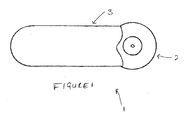
- the device 1 is divided into two parts; a head 2 and a body 3, designed in use to be connected to each other.
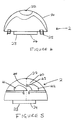
- the head 2 is domed 21 having an aperture 22 in its top.
- the head 2 has a flat underside 23 with an rectangular extension 24 along its length.
- the body 3 is rectangular in shape having extensions 31 at one end enabling the extension 24 of the head 2 to fit between them.
- the head 2 and body 3 have complimentarily shaped electrical connections 25, 32.
- the body 3 houses a charging circuit.
- the circuit is designed to charge from a car battery or any 12 v source, over a period of 4 hours. Each charge is designed to destroy 30 needles.
- the charging circuit includes an indicator to show that the battery holds enough power to destroy a needle.
- the charging circuit includes a standard switch mode device, or DC to DC switching controller for charging standard 4v batteries.
- the switch mode device allows maximum power to be fed to the batteries without high heat loss.
- the charging circuit also includes means for monitoring the charge level of the batteries.
- a DS 1223 is used to monitor the voltage level.
- This standard device is usually used in a low-voltage monitoring device, where it monitors the voltage, and if it falls below a specified level, the device will switch the monitor into re-start mode. In the present invention the device is used to monitor the charge level in the batteries. Upon depression of a test switch the device is connected across the batteries. If the charge level is above a minimum, a green led is activated, while if the charge level is on or below the minimum a red led is activated indicating that the batteries need recharging. Approximately thirty needles can be destroyed on a single charge.
- the head 2 holds a pair of electrodes 40, directly beneath the aperture 22.
- the electrodes are shaped so that a needle or the like pushed into the aperture will contact both electrodes.
- One of the electrodes, 41 is approximately domed in shape, to allow a needle a large surface area to contact.
- the other electrode 42 is shaped rather like an anvil, with the extension 43 above at least a part of the domed lower electrode 41.
- Each electrode is made from heat hardened copper and coated in a thin layer of graphite, of the order of 5 microns thick. While it has been found that it is only necessary to coat the underside 44 of the upper electrode in graphite, in practice, the whole electrode is usually graphite coated. For maximising the life of the electrodes both are graphite coated. Alternatively one or both the electrodes are made from a sintered mixture of copper and graphite. A typical mixture would contain approximately 82-85% copper and approximately 12% graphite, together with small quantities of a binding agent, tin and zinc.
- Electrodes made purely of copper become pitted as small fragments of the molten needle adheres to its surface, resulting in arcing and/or bridging to the other electrode.
- the presence of carbon in the electrodes, either as a coating or integral part of the electrode greatly reduces this. It is particularly important to ensure that the lower surface 43 of the upper electrode 42 includes carbon as this is particularly prone to damage due to adherence of debris produced by spitting as the needle comes into contact with the lower electrode. Any debris build up on this section of the electrode reduces the distance between the electrodes, and hence the likelihood of arcing or bridging.
- the use of copper in the electrodes allows a high current to be used, of the order of 400 amps. Copper also has a high heat capacity, resulting in low impedance in the electrodes when a current is passed through them.
- the use of copper insures that the heat capacity of the electrodes is higher than that of the needles preventing over heating of the electrodes. Thus the current flowing through the needle melts and burns it, but does not adversely effect the electrodes.
- the electrodes are composed of a mixture of carbon and copper, the amount of the carbon is critical to ensure that these electrical properties are not compromised, while the presence of the carbon prevents damage to the electrodes during the destruction of the needles.
- the electrodes are shaped so that a needle introduced into the aperture can contact both electrodes.
- the shape of the electrodes is also important for allowing the debris from the melting and burning to fall away into the compartment.
- the positioning of the electrodes ensures that the device operates efficiently. If the separation is too large, then a larger current would be necessary to overcome the resistance in the needle and thick needles may not be destroyed. On the other hand if the separation is too small, the debris from the melting of the needles can cause bridging between the electrodes leading to discharge from the battery.
- the separation between the needles will be between 1-5 and 2.0 mm in either direction.
Landscapes
- Health & Medical Sciences (AREA)
- Engineering & Computer Science (AREA)
- Heart & Thoracic Surgery (AREA)
- Vascular Medicine (AREA)
- Anesthesiology (AREA)
- Biomedical Technology (AREA)
- Environmental & Geological Engineering (AREA)
- Hematology (AREA)
- Life Sciences & Earth Sciences (AREA)
- Animal Behavior & Ethology (AREA)
- General Health & Medical Sciences (AREA)
- Public Health (AREA)
- Veterinary Medicine (AREA)
- Secondary Cells (AREA)
- Battery Electrode And Active Subsutance (AREA)
Applications Claiming Priority (2)
| Application Number | Priority Date | Filing Date | Title |
|---|---|---|---|
| GB9909087 | 1999-04-21 | ||
| GBGB9909087.0A GB9909087D0 (en) | 1999-04-21 | 1999-04-21 | Sharps destroyer |
Publications (2)
| Publication Number | Publication Date |
|---|---|
| EP1046404A2 true EP1046404A2 (de) | 2000-10-25 |
| EP1046404A3 EP1046404A3 (de) | 2002-06-05 |
Family
ID=10851931
Family Applications (1)
| Application Number | Title | Priority Date | Filing Date |
|---|---|---|---|
| EP00201394A Withdrawn EP1046404A3 (de) | 1999-04-21 | 2000-04-19 | Zerstörer von scharfen Gegenständen |
Country Status (3)
| Country | Link |
|---|---|
| EP (1) | EP1046404A3 (de) |
| CA (1) | CA2306316A1 (de) |
| GB (1) | GB9909087D0 (de) |
Cited By (1)
| Publication number | Priority date | Publication date | Assignee | Title |
|---|---|---|---|---|
| GB2530102A (en) * | 2014-09-15 | 2016-03-16 | Grace Sheedy | Lightweight, portable, handheld, rechargeable, needle safety incineration device and charging dock |
Family Cites Families (4)
| Publication number | Priority date | Publication date | Assignee | Title |
|---|---|---|---|---|
| DE3633587A1 (de) * | 1986-10-02 | 1988-04-07 | Bb Technik Ag | Vorrichtung zum desinfizieren oder vergluehen von injektionsnadeln |
| WO1992019291A1 (en) * | 1991-05-07 | 1992-11-12 | Malcolm Campbell Mcintyre | Apparatus and method for the destruction of sharps |
| JP2557016B2 (ja) * | 1993-07-15 | 1996-11-27 | 株式会社エス・マック | 注射針処理装置 |
| GB9425196D0 (en) * | 1994-12-12 | 1995-02-08 | Vickers Steven J | Apparatus for destroying syringe needles |
-
1999
- 1999-04-21 GB GBGB9909087.0A patent/GB9909087D0/en not_active Ceased
-
2000
- 2000-04-19 EP EP00201394A patent/EP1046404A3/de not_active Withdrawn
- 2000-04-20 CA CA 2306316 patent/CA2306316A1/en not_active Abandoned
Cited By (1)
| Publication number | Priority date | Publication date | Assignee | Title |
|---|---|---|---|---|
| GB2530102A (en) * | 2014-09-15 | 2016-03-16 | Grace Sheedy | Lightweight, portable, handheld, rechargeable, needle safety incineration device and charging dock |
Also Published As
| Publication number | Publication date |
|---|---|
| GB9909087D0 (en) | 1999-06-16 |
| EP1046404A3 (de) | 2002-06-05 |
| CA2306316A1 (en) | 2000-10-21 |
Similar Documents
| Publication | Publication Date | Title |
|---|---|---|
| EP0714336B1 (de) | Elektrische vorrichtung zum zerstören von hypodermischen spritznadeln | |
| US5076178A (en) | Syringe needle destruction method and apparatus | |
| US4628169A (en) | Mini electrical syringe needle destroyer | |
| GB2211420A (en) | Improvements relating to the destruction of hypodermic needles | |
| US5336862A (en) | Apparatus for destroying syringe-type needles by electrical current | |
| CA2469771C (en) | Syringe needle destroyer with needle cartridge | |
| US5868709A (en) | Portable modular apparatus and method for destroying medical needles | |
| AU698845B2 (en) | Apparatus for disposing of hypodermic needles | |
| EP1046404A2 (de) | Zerstörer von scharfen Gegenständen | |
| US5391849A (en) | Electrical disposal apparatus of used injection syringe | |
| AU667043B2 (en) | Incinerator, particularly for used medical needles | |
| US5540416A (en) | Injection needle melting/destroying device | |
| WO2003024501A2 (en) | Disposable sylinge needle incinerator | |
| WO1992019291A1 (en) | Apparatus and method for the destruction of sharps | |
| GB2268407A (en) | Device for the disposal of hypodermic needles | |
| US20020074315A1 (en) | Needle incinerator | |
| US20130334175A1 (en) | Needle disabling device | |
| EP0703769B1 (de) | Methode und gerät zum zerstören von spritznadeln | |
| US6376792B1 (en) | Method and apparatus for individual destruction of syringe needles by melting under the effect of electric current | |
| GB2297230A (en) | Apparatus for and method of destroying syringe needles | |
| JP2000507851A (ja) | 針等の物体を破壊する装置 | |
| JPH0258937B2 (de) | ||
| WO2001058637A1 (en) | Method and apparatus for destroying needles | |
| KR200182700Y1 (ko) | 주사침 용융 처리장치 | |
| US6580047B1 (en) | Apparatus for destroying syringe-type needles by electrical current |
Legal Events
| Date | Code | Title | Description |
|---|---|---|---|
| PUAI | Public reference made under article 153(3) epc to a published international application that has entered the european phase |
Free format text: ORIGINAL CODE: 0009012 |
|
| AK | Designated contracting states |
Kind code of ref document: A2 Designated state(s): AT BE CH CY DE DK ES FI FR GB GR IE IT LI LU MC NL PT SE |
|
| AX | Request for extension of the european patent |
Free format text: AL;LT;LV;MK;RO;SI |
|
| PUAL | Search report despatched |
Free format text: ORIGINAL CODE: 0009013 |
|
| AK | Designated contracting states |
Kind code of ref document: A3 Designated state(s): AT BE CH CY DE DK ES FI FR GB GR IE IT LI LU MC NL PT SE |
|
| AX | Request for extension of the european patent |
Free format text: AL;LT;LV;MK;RO;SI |
|
| 17P | Request for examination filed |
Effective date: 20021202 |
|
| AKX | Designation fees paid |
Designated state(s): AT BE CH CY DE DK ES FI FR GB GR IE IT LI LU MC NL PT SE |
|
| STAA | Information on the status of an ep patent application or granted ep patent |
Free format text: STATUS: THE APPLICATION IS DEEMED TO BE WITHDRAWN |
|
| 18D | Application deemed to be withdrawn |
Effective date: 20021101 |