EP1046628A1 - 1,3-butylene-glycol tres pur et son procede de production - Google Patents
1,3-butylene-glycol tres pur et son procede de production Download PDFInfo
- Publication number
- EP1046628A1 EP1046628A1 EP99935096A EP99935096A EP1046628A1 EP 1046628 A1 EP1046628 A1 EP 1046628A1 EP 99935096 A EP99935096 A EP 99935096A EP 99935096 A EP99935096 A EP 99935096A EP 1046628 A1 EP1046628 A1 EP 1046628A1
- Authority
- EP
- European Patent Office
- Prior art keywords
- butylene glycol
- boiling
- tower
- odor
- materials
- Prior art date
- Legal status (The legal status is an assumption and is not a legal conclusion. Google has not performed a legal analysis and makes no representation as to the accuracy of the status listed.)
- Granted
Links
- PUPZLCDOIYMWBV-UHFFFAOYSA-N (+/-)-1,3-Butanediol Chemical compound CC(O)CCO PUPZLCDOIYMWBV-UHFFFAOYSA-N 0.000 title claims abstract description 255
- 229940058015 1,3-butylene glycol Drugs 0.000 title claims abstract description 127
- 235000019437 butane-1,3-diol Nutrition 0.000 title claims abstract description 127
- 238000004519 manufacturing process Methods 0.000 title claims description 25
- 239000000463 material Substances 0.000 claims abstract description 92
- 238000009835 boiling Methods 0.000 claims abstract description 87
- 238000002835 absorbance Methods 0.000 claims abstract description 29
- 230000014759 maintenance of location Effects 0.000 claims abstract description 29
- 238000000034 method Methods 0.000 claims abstract description 22
- 238000004128 high performance liquid chromatography Methods 0.000 claims abstract description 19
- 239000001257 hydrogen Substances 0.000 claims abstract description 15
- 229910052739 hydrogen Inorganic materials 0.000 claims abstract description 15
- UFHFLCQGNIYNRP-UHFFFAOYSA-N Hydrogen Chemical compound [H][H] UFHFLCQGNIYNRP-UHFFFAOYSA-N 0.000 claims abstract description 14
- 239000007791 liquid phase Substances 0.000 claims abstract description 13
- 239000000203 mixture Substances 0.000 claims abstract description 9
- 238000004458 analytical method Methods 0.000 claims abstract description 8
- -1 1,3-butylene Chemical group 0.000 claims abstract description 3
- 238000004821 distillation Methods 0.000 claims description 41
- HEMHJVSKTPXQMS-UHFFFAOYSA-M Sodium hydroxide Chemical group [OH-].[Na+] HEMHJVSKTPXQMS-UHFFFAOYSA-M 0.000 claims description 39
- KWYUFKZDYYNOTN-UHFFFAOYSA-M Potassium hydroxide Chemical compound [OH-].[K+] KWYUFKZDYYNOTN-UHFFFAOYSA-M 0.000 claims description 15
- XLYOFNOQVPJJNP-UHFFFAOYSA-N water Substances O XLYOFNOQVPJJNP-UHFFFAOYSA-N 0.000 claims description 9
- 150000001298 alcohols Chemical class 0.000 claims description 5
- 150000003839 salts Chemical class 0.000 claims description 5
- 239000007795 chemical reaction product Substances 0.000 claims description 2
- 235000019645 odor Nutrition 0.000 description 36
- 239000000047 product Substances 0.000 description 28
- 239000002585 base Substances 0.000 description 20
- 239000007788 liquid Substances 0.000 description 17
- LYCAIKOWRPUZTN-UHFFFAOYSA-N Ethylene glycol Chemical compound OCCO LYCAIKOWRPUZTN-UHFFFAOYSA-N 0.000 description 16
- 238000006243 chemical reaction Methods 0.000 description 13
- 239000003513 alkali Substances 0.000 description 11
- 230000000052 comparative effect Effects 0.000 description 8
- WGCNASOHLSPBMP-UHFFFAOYSA-N hydroxyacetaldehyde Natural products OCC=O WGCNASOHLSPBMP-UHFFFAOYSA-N 0.000 description 8
- 239000010409 thin film Substances 0.000 description 8
- 230000009965 odorless effect Effects 0.000 description 7
- 230000003247 decreasing effect Effects 0.000 description 6
- 238000011156 evaluation Methods 0.000 description 6
- 239000000243 solution Substances 0.000 description 6
- 239000012535 impurity Substances 0.000 description 5
- 239000011550 stock solution Substances 0.000 description 5
- 229910052783 alkali metal Inorganic materials 0.000 description 4
- 150000001340 alkali metals Chemical class 0.000 description 4
- 238000005115 demineralization Methods 0.000 description 4
- 230000002328 demineralizing effect Effects 0.000 description 4
- 239000012071 phase Substances 0.000 description 4
- 238000000746 purification Methods 0.000 description 4
- 238000012360 testing method Methods 0.000 description 4
- CSCPPACGZOOCGX-UHFFFAOYSA-N Acetone Chemical compound CC(C)=O CSCPPACGZOOCGX-UHFFFAOYSA-N 0.000 description 3
- WEVYAHXRMPXWCK-UHFFFAOYSA-N Acetonitrile Chemical compound CC#N WEVYAHXRMPXWCK-UHFFFAOYSA-N 0.000 description 3
- 108010053481 Antifreeze Proteins Proteins 0.000 description 3
- 150000001875 compounds Chemical class 0.000 description 3
- 239000002537 cosmetic Substances 0.000 description 3
- 238000000354 decomposition reaction Methods 0.000 description 3
- 230000018044 dehydration Effects 0.000 description 3
- 238000006297 dehydration reaction Methods 0.000 description 3
- 230000007774 longterm Effects 0.000 description 3
- 239000011541 reaction mixture Substances 0.000 description 3
- ZTQSAGDEMFDKMZ-UHFFFAOYSA-N Butyraldehyde Chemical compound CCCC=O ZTQSAGDEMFDKMZ-UHFFFAOYSA-N 0.000 description 2
- NIPNSKYNPDTRPC-UHFFFAOYSA-N N-[2-oxo-2-(2,4,6,7-tetrahydrotriazolo[4,5-c]pyridin-5-yl)ethyl]-2-[[3-(trifluoromethoxy)phenyl]methylamino]pyrimidine-5-carboxamide Chemical compound O=C(CNC(=O)C=1C=NC(=NC=1)NCC1=CC(=CC=C1)OC(F)(F)F)N1CC2=C(CC1)NN=N2 NIPNSKYNPDTRPC-UHFFFAOYSA-N 0.000 description 2
- 230000002528 anti-freeze Effects 0.000 description 2
- 239000007864 aqueous solution Substances 0.000 description 2
- FUSUHKVFWTUUBE-UHFFFAOYSA-N buten-2-one Chemical compound CC(=O)C=C FUSUHKVFWTUUBE-UHFFFAOYSA-N 0.000 description 2
- 239000003054 catalyst Substances 0.000 description 2
- 238000007796 conventional method Methods 0.000 description 2
- 230000007423 decrease Effects 0.000 description 2
- 239000012153 distilled water Substances 0.000 description 2
- 238000001704 evaporation Methods 0.000 description 2
- 230000008020 evaporation Effects 0.000 description 2
- 239000007789 gas Substances 0.000 description 2
- 239000003230 hygroscopic agent Substances 0.000 description 2
- 231100000053 low toxicity Toxicity 0.000 description 2
- 238000005259 measurement Methods 0.000 description 2
- 238000010992 reflux Methods 0.000 description 2
- 239000002904 solvent Substances 0.000 description 2
- 238000003756 stirring Methods 0.000 description 2
- 239000004094 surface-active agent Substances 0.000 description 2
- 229920003002 synthetic resin Polymers 0.000 description 2
- 239000000057 synthetic resin Substances 0.000 description 2
- FZIIBDOXPQOKBP-UHFFFAOYSA-N 2-methyloxetane Chemical compound CC1CCO1 FZIIBDOXPQOKBP-UHFFFAOYSA-N 0.000 description 1
- BVKZGUZCCUSVTD-UHFFFAOYSA-L Carbonate Chemical compound [O-]C([O-])=O BVKZGUZCCUSVTD-UHFFFAOYSA-L 0.000 description 1
- DGAQECJNVWCQMB-PUAWFVPOSA-M Ilexoside XXIX Chemical compound C[C@@H]1CC[C@@]2(CC[C@@]3(C(=CC[C@H]4[C@]3(CC[C@@H]5[C@@]4(CC[C@@H](C5(C)C)OS(=O)(=O)[O-])C)C)[C@@H]2[C@]1(C)O)C)C(=O)O[C@H]6[C@@H]([C@H]([C@@H]([C@H](O6)CO)O)O)O.[Na+] DGAQECJNVWCQMB-PUAWFVPOSA-M 0.000 description 1
- NBIIXXVUZAFLBC-UHFFFAOYSA-N Phosphoric acid Chemical compound OP(O)(O)=O NBIIXXVUZAFLBC-UHFFFAOYSA-N 0.000 description 1
- ZLMJMSJWJFRBEC-UHFFFAOYSA-N Potassium Chemical compound [K] ZLMJMSJWJFRBEC-UHFFFAOYSA-N 0.000 description 1
- 239000007868 Raney catalyst Substances 0.000 description 1
- NPXOKRUENSOPAO-UHFFFAOYSA-N Raney nickel Chemical compound [Al].[Ni] NPXOKRUENSOPAO-UHFFFAOYSA-N 0.000 description 1
- 229910000564 Raney nickel Inorganic materials 0.000 description 1
- IKHGUXGNUITLKF-XPULMUKRSA-N acetaldehyde Chemical compound [14CH]([14CH3])=O IKHGUXGNUITLKF-XPULMUKRSA-N 0.000 description 1
- 230000002411 adverse Effects 0.000 description 1
- 150000001299 aldehydes Chemical class 0.000 description 1
- 150000001339 alkali metal compounds Chemical class 0.000 description 1
- 239000012295 chemical reaction liquid Substances 0.000 description 1
- MLUCVPSAIODCQM-NSCUHMNNSA-N crotonaldehyde Chemical compound C\C=C\C=O MLUCVPSAIODCQM-NSCUHMNNSA-N 0.000 description 1
- MLUCVPSAIODCQM-UHFFFAOYSA-N crotonaldehyde Natural products CC=CC=O MLUCVPSAIODCQM-UHFFFAOYSA-N 0.000 description 1
- 238000011033 desalting Methods 0.000 description 1
- 238000001514 detection method Methods 0.000 description 1
- 230000002542 deteriorative effect Effects 0.000 description 1
- 230000000694 effects Effects 0.000 description 1
- 238000010828 elution Methods 0.000 description 1
- 239000012467 final product Substances 0.000 description 1
- 239000012530 fluid Substances 0.000 description 1
- 239000013505 freshwater Substances 0.000 description 1
- 238000010438 heat treatment Methods 0.000 description 1
- 239000003906 humectant Substances 0.000 description 1
- 150000002431 hydrogen Chemical class 0.000 description 1
- 238000005984 hydrogenation reaction Methods 0.000 description 1
- 230000007062 hydrolysis Effects 0.000 description 1
- 238000006460 hydrolysis reaction Methods 0.000 description 1
- 238000002347 injection Methods 0.000 description 1
- 239000007924 injection Substances 0.000 description 1
- 238000011835 investigation Methods 0.000 description 1
- 150000002576 ketones Chemical class 0.000 description 1
- XONPDZSGENTBNJ-UHFFFAOYSA-N molecular hydrogen;sodium Chemical compound [Na].[H][H] XONPDZSGENTBNJ-UHFFFAOYSA-N 0.000 description 1
- 231100000344 non-irritating Toxicity 0.000 description 1
- 231100000252 nontoxic Toxicity 0.000 description 1
- 230000003000 nontoxic effect Effects 0.000 description 1
- VIKNJXKGJWUCNN-XGXHKTLJSA-N norethisterone Chemical compound O=C1CC[C@@H]2[C@H]3CC[C@](C)([C@](CC4)(O)C#C)[C@@H]4[C@@H]3CCC2=C1 VIKNJXKGJWUCNN-XGXHKTLJSA-N 0.000 description 1
- 238000012856 packing Methods 0.000 description 1
- 229910052700 potassium Inorganic materials 0.000 description 1
- 239000011591 potassium Substances 0.000 description 1
- 239000002244 precipitate Substances 0.000 description 1
- 230000001737 promoting effect Effects 0.000 description 1
- 239000002994 raw material Substances 0.000 description 1
- 239000011734 sodium Substances 0.000 description 1
- 229910052708 sodium Inorganic materials 0.000 description 1
- 239000007787 solid Substances 0.000 description 1
- 239000000126 substance Substances 0.000 description 1
- HGBOYTHUEUWSSQ-UHFFFAOYSA-N valeric aldehyde Natural products CCCCC=O HGBOYTHUEUWSSQ-UHFFFAOYSA-N 0.000 description 1
Images

Classifications
-
- C—CHEMISTRY; METALLURGY
- C07—ORGANIC CHEMISTRY
- C07C—ACYCLIC OR CARBOCYCLIC COMPOUNDS
- C07C31/00—Saturated compounds having hydroxy or O-metal groups bound to acyclic carbon atoms
- C07C31/18—Polyhydroxylic acyclic alcohols
- C07C31/20—Dihydroxylic alcohols
-
- C—CHEMISTRY; METALLURGY
- C07—ORGANIC CHEMISTRY
- C07C—ACYCLIC OR CARBOCYCLIC COMPOUNDS
- C07C29/00—Preparation of compounds having hydroxy or O-metal groups bound to a carbon atom not belonging to a six-membered aromatic ring
- C07C29/132—Preparation of compounds having hydroxy or O-metal groups bound to a carbon atom not belonging to a six-membered aromatic ring by reduction of an oxygen containing functional group
- C07C29/136—Preparation of compounds having hydroxy or O-metal groups bound to a carbon atom not belonging to a six-membered aromatic ring by reduction of an oxygen containing functional group of >C=O containing groups, e.g. —COOH
- C07C29/14—Preparation of compounds having hydroxy or O-metal groups bound to a carbon atom not belonging to a six-membered aromatic ring by reduction of an oxygen containing functional group of >C=O containing groups, e.g. —COOH of a —CHO group
- C07C29/141—Preparation of compounds having hydroxy or O-metal groups bound to a carbon atom not belonging to a six-membered aromatic ring by reduction of an oxygen containing functional group of >C=O containing groups, e.g. —COOH of a —CHO group with hydrogen or hydrogen-containing gases
Definitions
- the present invention relates to high purity 1,3-butylene glycol and to production method thereof. More particularly, it relates to high purity 1,3-butylene glycol which a small content of impurities eluted for a specified relative retention time range in HPLC (high performance liquid chromatography) analysis under specified conditions and hence is free of odors and has less change with time and to a method for producing high purity 1,3-butylene glycol by adding a base to crude 1,3-butylene glycol or low quality product, heat treating and distilling.
- HPLC high performance liquid chromatography
- 1,3-Butylene glycol is a viscous, colorless and transparent, odorless liquid that has a boiling point of 208°C and shows excellent solubility and produces derivatives having excellent chemical stability.
- 1,3-butylene glycol obtained by the conventional methods causes changes with time during storage in a tank to generate a slight odor so that it is difficult to store it for a long time.
- JP-A-7-258129 discloses as a method for increasing the yield of odorless product, a method in which at least one compound selected from sodium hydroxide, potassium hydroxide, sodium hydrogen borohydride and potassium borohydride upon distillation for removing high-boiling materials.
- the odorless 1,3-butylene glycol obtained by this method has the problem that it still generates a slight odor due to changes with time after a long-term storage.
- an object of the present invention is to provide high purity 1,3-butylene glycol having no odor and showing less changes with time and a production method therefor.
- the present inventors have made intensive study with view to solving the problem described in JP-A-7-258129 and as a result it has been found that when distillation is performed by adding an alkali metal to a charge stock solution into a de-high-boiling distillation tower, the charge stock solution in the de-high-boiling distillation tower contains a large amount of high-boiling materials and hence the added alkali metal base causes reaction decreasing low-boiling materials and simultaneously generation of low-boiling materials due to decomposition reaction of high-boiling materials. As a result, odor-causing materials can be decreased only to a certain level so that after a long-term storage there occurs a change with time to generate a slight odor.
- odor-causing materials can be effectively decreased by adding an alkali metal base to crude 1,3-butylene glycol from which high-boiling materials have been removed in advance, heat-treating, distilling off 1,3-butylene glycol to separate the alkali metal base and high-boiling materials as residues, and then distilling off a low-boiling material form the 1,3-butylene glycol fraction.
- the present invention has been accomplished based on this finding.
- the present invention provides the following:
- 1,3-Butylene glycol according to the present invention is preferably one produced from acetaldol by a liquid phase hydrogen reduction method. However, it may be one produced from 1,3-butylene oxide by a hydrolysis method or mixtures of these or any 1,3-glycol may be used.
- odor-causing materials In the liquid phase hydrogen reduction method for acetaldol, low-boiling compounds having unsaturated bonds such as acetaldehyde, butyraldehyde, crotonaldehyde, acetone, methyl vinyl ketone, etc., which are considered to be odor-causing materials, or condensates of these are by-produced. These are difficult to remove completely even by distillation. Therefore, in the conventional purification methods, minute amounts of such odor-causing materials tend to mix in the resulting 1,3-butylene glycol.
- the above odor-causing material means those that are source of odor themselves or become odor materials by changes with time.
- the conventional purification method is a method in which the reaction mixture of 1,3-butylene glycol produced by liquid phase hydrogen reduction of acetaldol is subjected to removal of alcohols, removal of water, removal of salts and high-boiling materials and removal of high-boiling materials, then in the low-boiling material removal distillation tower (product distillation tower) low-boiling materials are distilled off from the top of the tower and 1,3-butylene glycol is obtained as a product from the tower bottom.
- the present invention has the feature that addition of a base to crude 1,3-butylene glycol having a low content of high-boiling materials and heat-treating the mixture effectively decreases odor-causing materials and gives rise to 1,3-butylene glycol having no odor and shows less change with time.
- the crude 1,3-butylene glycol fed to the purification step is crude 1,3-butylene glycol of which high-boiling materials have been removed, for example, crude 1,3-butylene glycol (CR) after the de-high-boiling material distillation described later on, 1,3-butylene glycol obtained from the product distillation tower in the above-mentioned conventional purification process, low quality product 1,3-butylene glycol, product 1,3-butylene glycol of unknown origin, or mixtures of these and preferably crude ,3-butylene glycol (CR) after the de-high-boiling material distillation.
- crude 1,3-butylene glycol (CR) after the de-high-boiling material distillation described later on 1,3-butylene glycol obtained from the product distillation tower in the above-mentioned conventional purification process
- low quality product 1,3-butylene glycol product 1,3-butylene glycol of unknown origin
- Crude 1,3-butylene glycol as just obtained by hydrogenation of acetaldol has a high-boiling material content of usually 3 to 7%.
- the crude 1,3-butylene glycol after the removal of high-boiling materials according to the invention has a high-boiling materials content of 1.0% by weight or less, preferably 0.5% by weight or less.
- the low-boiling materials causing odor are considered to be those having unsaturated bonds such as aldehydes and ketones and hence it is considered that addition of a base to crude 1,3-butylene glycol and heat-treating converts impurities to high-boiling materials or causes them to be subject to reduction with hydrogen (hereafter, simply referred to reduction) to form alcohols, so that the absolute amount of impurities is decreased.
- Fig. 1 is a flow sheet for an apparatus for use in an embodiment obtaining high purity 1,3-butylene glycol of the present invention, illustrating the situation of charging a base from the portion indicate in broken line.
- Reference numeral 1-1 designates a dehydration tower
- 1-2 designates a desalting tower (thin film evaporator)
- 1-3 designates a de-high-boiling material distillation tower
- 1-4 designates an alkali reactor
- 1-5 designates a dealkalization tower (thin film evaporator)
- 1-6 designates a product distilling tower.1-1-1, 1-3-1, and 1-6-1 designate reboilers, respectively, and 1-1-2, 1-2-2, 1-3-2, 1-5-2, and 1-6-2 designate condensers, respectively.
- A stands for crude 1,3-butylene glycol liquid after the liquid phase hydrogen reduction treatment of acetaldol and dealcoholation
- B stands for discharged water
- C stands for salt and high-boiling materials
- D stands for high-boiling materials
- CR stands for crude 1,3-butylene glycol after the de-high-boiling material distillation
- E stands for a base
- F stands for a base and high-boiling material
- G stands for a low-boiling material
- HP stands for high purity 1,3-butylene glycol.
- Crude 1,3-butylene glycol distilled by the de-high-boiling material distillation tower 1-3 is fed to the alkali reactor (for example, a circulating tube type reactor) 1-4.
- a base is added in an amount of 0.05 to 10% by weight, preferably 0.1 to 1.0% by weight, based on the crude 1,3-butylele glycol (CR). If the addition amount of the base is above 10% by weight, the base precipitates in the distillation tower, piping, etc. to cause clogging thereof while the addition amount is too large, contrariwise, decomposition reaction of high-boiling compounds occurs to generate odor-causing materials. On the contrary, with less than 0.05% by weight, the effect to the odor-causing material is less. Thus, the both are undesirable. 1,3-butylene glycol is fed to the alkali reactor 1-4.
- the base to be added is preferably an alkali metal compound, more preferably sodium hydroxide, potassium hydroxide, sodium (bi)carbonate, most preferably sodium hydroxide, potassium hydroxide or mixtures thereof.
- the base may be added in the form of solids as it is, but it is preferred to add as an aqueous solution for ease of operation and for promoting contact with the target solution.
- Suitable reaction temperature in the alkali reactor 1-4 is 90 to 140°C, preferably 110 to 130°C. This is because, if the reaction temperature is lower, a longer reaction retention time is necessary, which requires a larger volume reactor and is uneconomical. If the reaction temperature is too high, the odor of 1,3-butylene glycol increases.
- the reaction retention time is 5 to 120 minutes, preferably 10 to 30 minutes. If the retention time is shorter, the reaction is insufficient, thus deteriorating the quality of final product. If the retention time is longer, a larger reactor is necessary, which increases appliance costs and is disadvantageous economically.
- the crude 1,3-butylene glycol to be charged in the alkali reactor may be any crude 1,3-butylene glycol so far as high-boiling materials have been removed therefrom as described above.
- it may be those distilled off from high-boiling material distillation tower or those product 1,3-butylene glycol obtained from the tower bottom of the product distillation tower of the above conventional method.
- the crude reaction mixture is treated in the step where 1,3-butylene glycol is distilled off to give the base and high-boiling materials as residues and the step where low-boiling materials are distilled off from 1,3-butylene glycol.
- the crude reaction mixture is fed first to the dealkalization tower 1-5 (thin film evaporator) where the base used in the reaction and the resulting high-boiling materials are removed from the tower bottom.
- the evaporator used as a dealkalization tower is a natural flow-down type thin film evaporator and forced stirring type thin film evaporator whose retention time is short are suitable for suppressing thermal hysteresis to the process fluid.
- evaporation is carried out at a reduced pressure of 100 torr or less, preferably 5 to 20 torr, at the top of the tower.
- a reduced pressure 100 torr or less, preferably 5 to 20 torr, at the top of the tower.
- evaporation it is preferred to lower distillation (evaporation) temperature and the lower the pressure is, the more suitable.
- Conducting distillation under the above conditions maintains the temperature of evaporator to 90 to 120°C. From the top of the tower, 1,3-butylene glycol containing low-boiling materials is distilled off and is charged to the next product distillation tower.
- the product distillation tower may be a porous plate tower, a foamed bell tower, etc.
- it is a filled tower having a low pressure loss, filled with Sulzer Packing, Melapack (both are trade names for products by Sumitomo Heavy Industries, Ltd.), etc. is more suitable.
- Sulzer Packing Sulzer Packing
- Melapack both are trade names for products by Sumitomo Heavy Industries, Ltd.
- 1,3-butylene glycol is thermally decomposed at 200°C or higher to affect adversely on odor (JP-A-63-156738) so that distillation temperature is to be lowered as low as possible.
- the reboiler to be adopted is suitably a thin film evaporator, such as a natural flow-down type thin film evaporator or a forced stirring type thin film evaporator.
- the product distillation may depend on the concentration of low-boiling material in the charge stock solution, but when the concentration of low-boiling material in the charge stock solution is 5% or less, it may be one having a theoretical number of daylights of about 10 to 20 (trays). It is preferred that the charge stock solution is fed at a position from the top of the tower to a height 20 to 70% of the height of the tower. At this time, distillation is performed under reduced pressure of 100 torr or less, preferably 5 to 20 torr, at the top of the tower. For the odor of 1,3-butylene glycol, it is preferred to lower distillation temperature. The lower the pressure is, the more suitable. It is desirable to run distillation at a reflux ratio of 0.5 to 2.0.
- the charging into the product distillation tower is carried out by feeding the liquid obtained by concentrating the top of the tower vapor of the dealkalization tower in the condenser 1-5-2.
- the top of the tower vapor from the dealkalization tower may be directly fed to the production tower.
- 1,3-Butylene glycol product can be obtained from the tower bottom of the product distillation tower.
- 1,3-butylene glycol may be obtained also as follows. That is, the treated liquid from the alkali reactor is fed first to the low-boiling material removal distillation tower where low-boiling materials are distilled off, subsequently 1,3-butlene glycol extracted from the gas phase portion in the recover trays or from the tower bottom is distilled or evaporated to remove the base and the resulting high-boiling materials as distillation residues and 1,3-butylene glycol is recovered from the top of the tower or in the midway of concentration trays.
- the distillate of the above low-boiling materials may further be fed to an additional distillation tower where 1,3-butylene glycol is distilled off to remove high-boiling materials. Also, a portion of the 1,3-butylene glycol after removal of the above low-boiling materials may be recycled to the dealkalization tower. Alternatively, low-boiling materials containing 1,3-butylene glycol may be recycled to the alkali reactor.
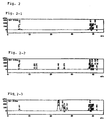
- Fig. 2 is a chart of HPLC analysis (measurement wavelength: 210 nm) of 1,3-butylene glycol under specified conditions (which will be described in detail in the column of examples).
- Fig. 2-1 is a chart which illustrates the product of Example 1
- Fig. 2-2 is a chart which illustrates the product of Example 2
- Fig. 2-3 is a chart which illustrates the product of Comparative Example 1.
- the horizontal axis represents elution time (where a peak exists, its retention time is indicated in minute), the vertical axis represents milli abosorbance (mAbs).
- 1,3-Butylene glycol has substantially no absorbance in ultraviolet regions, the peak is very small and its retention time is near 5.5 minutes in Fig. 2-1, near 5.4 minutes in Fig. 2-2, and near 5.4 minutes in Fig. 2-3.
- the impurities treated in the present invention have retention time of 20 to 30 minutes and products of low grades have large peaks appear near 23.5 minutes, 25.4 minutes, 26.4 minutes, 27.7 minutes, as shown in Fig. 2-3, that is, they have high absorbances.
- products of relatively good quality only small peaks (absorbance 0.005 or less) will appear near 23.4 minutes and 26.3 minutes as shown in Fig. 2-2.
- no peak will appear in the range of 20 to 30 minutes (absorbance 0.005 or less).
- the high purity 1,3-butylene glycol obtained by the above production method in the above HPLC analysis showed an absorbance at 210 nm of 0.02 or less for each peak eluted in a relative retention time in the range of 4.0 to 5.5, having no odor and less change with time.
- 1,3-Butylene glycol of which no odor was felt was assigned 1
- 1,3-butylene glycol substantially odorless was assigned 5
- 1,3-butylene glycol of which slight odor was felt was assigned 10
- scores were obtained by relative evaluation.
- the evaluation samples were each mixed with water in a ratio of 1:1, and charged in a jar with a ground-in stopper. This was sealed and left to stand at room temperature. Then the odor was smelled quickly in the air, and compared and scored.
- UV analysis Ultraviolet spectroscopic (UV) analysis:
- a method of the present invention is explained based on examples in accordance with a flow sheet shown in Fig 1.
- 100 parts of acetaldol and 6.5 parts of hydrogen were charged into a liquid phase hydrogen reduction reactor (not shown) as materials.
- Raney nickel was added thereto as a catalyst, and the reactor was maintained at a temperature of 125 to 135°C and a pressure of 150kg/cm 2 , and liquid phase hydrogen reduction was conducted.
- the catalyst was removed from the liquid and the liquid was neutralized with sodium hydroxide. Removal of alcohols therefrom afforded crude 1,3-butylene glycol (A).
- the crude 1,3-butylene glycol (A) was charged into dehydration tower 1-1 shown in Fig.1.
- water was released from the top of the tower, and 15 parts of fresh water per 100 parts of charged liquid volume was added as a reflux to obtain crude 1,3-butylene glycol containing 0.5% by weight or less of water at a pressure of 50 torr from the bottom of a distillation tower.
- dehydrated crude 1,3-butylene glycol was charged into a demineralization tower 1-2.
- 5 parts per 100 parts of charged liquid volume of a part of salts, high-boiling point materials, and the 1,3-butylene glycol were discharged from the bottom.
- 95 parts per 100 parts of charged liquid volume of a part of the 1,3-butylene glycol and low/high boiling point materials were distillated.
- 10 parts per 100 parts of the charged liquid of a part of sodium hydroxide, high-boiling point materials, and 1,3-butylene glycol were discharged.
- 90 parts per 100 parts of the charged liquid of 1,3-butylene glycol and low boiling point materials were distilled from the top of the tower, and charged into the next production tower.
- a production distillation tower 1-6 10% by weight per 100 parts of a charged liquid of a part of low boiling materials and 1,3-butylene glycol were distilled from the top of the tower, product 1,3-butylene glycol was extracted from the bottom of the tower.
- 1,3-butylene glycol of immediately after production had 3 of odor marks and 0.001 of an absorbance at 210 nm by an ultraviolet spectrophotometer under the prescribed conditions. And the glycol had 0.005 or less of the absorbance of each peak which eluted in the range of 4.0 to 5.5 for relative retention time in the HPLC analysis.
- 1,3-Butylene glycol was produced in the same manner as the reaction in Example 1 except that the reaction was conducted at a temperature of 100°C and a retention time of 30 minutes.
- Example 2 The process was run in the same manner as in Example 1 up to the step of the high-boiling materials removal distillation tower 1-3. 1,3-Butylene glycol and low boiling point materials were distillated from the top of the high-boiling materials removal distillation tower 1-3. The distillated liquid was charged into the production tower as it is. In the production tower 1-6, 10% by weight per 100 parts of the charged liquid of a part of low boiling materials and 1,3-butylene glycol were distillated from the top of the tower. Product 1,3-butylene glycol was extracted from the bottom of the tower.
- 1,3-Butylene glycol of immediately after production had 3 of odor marks and 1.131 of an absorbance at 210 nm by an ultraviolet spectrophotometer under the prescribed conditions.
- the glycol had 0.005 or more of the absorbance of each peak which eluted in the range of 4.0 to 5.5 for relative retention time in the HPLC analysis.
- Sodium hydroxide was added when conducting distillation of high-boiling materials in accordance with the method described in JP-A No. 7-258129. The process was run in the same manner as in Example 1 up to the step of the demineralization tower 1-2. A part of 1,3-butylene glycol and low/high boiling point materials which were distillated from the top of the demineralization tower 1-2 were charged into the distillation of high-boiling point materials tower 1-3. In this time, 10% by weight of sodium hydroxide solution was added so as to be 0.5% by weight of sodium hydroxide to the charged liquid. In the high-boiling materials removal distillation tower, 20 parts of high boiling materials, sodium hydroxide, and 1,3-butylene glycol was discharged from the bottom. 80 parts of the 1,3-butylene glycol containing low boiling materials was discharged from the top of the tower and the glycol was charged into a next production tower.
- 1,3-Butylene glycol of immediately after production had 3 of odor marks and 0.793 of an absorbance at 210 nm by an ultraviolet spectrophotometer under the prescribed conditions. And some glycol had 0.05 or more of the absorbance of each peak which eluted in the range of 4.0 to 5.5 for relative retention time in the HPLC analysis.
- a test for change with time using this 1,3-butylene glycol was conducted at 40°C.
- the odor marks was 4 and the absorbance at 210 nm by an ultraviolet spectrophotometer under prescribed condition was 0.847 after 1 month. And 3 month later, the odor marks was 7 and the absorbance at 210 nm by an ultraviolet spectrophotometer under prescribed condition was 0.928.
- Some absorbance of peak which eluted in range of 4.0 to 5.5 for relative retention time in the HPLC analysis was 0.05 or more and a slight odor occurred.
- a high quality of 1,3-butylene glycol which is non-odor and little changing with time, is provided.
- the glycol can be used for a synthetic resin, a surfactant, a hygroscopic agent, a high-boiling solvent, an anti-freeze, in particular toiletry materials making the best of hygroscopicity, low-volatility, and low-toxicity.
Landscapes
- Chemical & Material Sciences (AREA)
- Organic Chemistry (AREA)
- Organic Low-Molecular-Weight Compounds And Preparation Thereof (AREA)
Applications Claiming Priority (5)
| Application Number | Priority Date | Filing Date | Title |
|---|---|---|---|
| JP23637898 | 1998-08-07 | ||
| JP23637798 | 1998-08-07 | ||
| JP23637798 | 1998-08-07 | ||
| JP23637898 | 1998-08-07 | ||
| PCT/JP1999/004275 WO2000007969A1 (fr) | 1998-08-07 | 1999-08-06 | 1,3-butylene-glycol tres pur et son procede de production |
Publications (3)
| Publication Number | Publication Date |
|---|---|
| EP1046628A1 true EP1046628A1 (fr) | 2000-10-25 |
| EP1046628A4 EP1046628A4 (fr) | 2005-03-16 |
| EP1046628B1 EP1046628B1 (fr) | 2006-11-15 |
Family
ID=26532644
Family Applications (1)
| Application Number | Title | Priority Date | Filing Date |
|---|---|---|---|
| EP99935096A Expired - Lifetime EP1046628B1 (fr) | 1998-08-07 | 1999-08-06 | 1,3-butylene-glycol tres pur et son procede de production |
Country Status (6)
| Country | Link |
|---|---|
| US (1) | US6376725B1 (fr) |
| EP (1) | EP1046628B1 (fr) |
| JP (1) | JP4559625B2 (fr) |
| KR (1) | KR100595399B1 (fr) |
| DE (1) | DE69933987T2 (fr) |
| WO (1) | WO2000007969A1 (fr) |
Cited By (6)
| Publication number | Priority date | Publication date | Assignee | Title |
|---|---|---|---|---|
| US6900360B2 (en) | 2000-02-04 | 2005-05-31 | Daicel Chemical Industries, Ltd. | High-purity 1,3-butylen glycol, process for producing 1,3-butylene glycol, and process for producing by-product butanol and butyl acetate |
| EP1437337A4 (fr) * | 2001-09-26 | 2006-03-01 | Kyowa Yuka Kk | 1,3-butylene glycol et procede de production associe |
| WO2018183628A1 (fr) | 2017-03-31 | 2018-10-04 | Genomatica, Inc. | Procédés et systèmes pour obtenir du 1,3-butanediol à partir de bouillons de fermentation |
| US20230227389A1 (en) * | 2021-05-18 | 2023-07-20 | Kh Neochem Co., Ltd. | Product 1,3-butylene glycol |
| EP4083010A4 (fr) * | 2019-12-28 | 2024-03-13 | Daicel Corporation | Produit de 1,3-butylène glycol |
| EP4397650A4 (fr) * | 2021-09-02 | 2025-10-29 | Kh Neochem Co Ltd | Procédé de production de produit de 1,3-butylène glycol |
Families Citing this family (21)
| Publication number | Priority date | Publication date | Assignee | Title |
|---|---|---|---|---|
| JP4530461B2 (ja) * | 2000-02-04 | 2010-08-25 | ダイセル化学工業株式会社 | 1,3−ブチレングリコールの精製方法 |
| JP2004352713A (ja) * | 2003-05-08 | 2004-12-16 | Mitsubishi Chemicals Corp | 1,3−プロパンジオールの製造方法 |
| WO2004099110A1 (fr) * | 2003-05-08 | 2004-11-18 | Mitsubishi Chemical Corporation | Procede de production de 1,3-propane diol |
| US8445733B1 (en) | 2011-07-26 | 2013-05-21 | Oxea Bishop Llc | 1,3 butylene glycol with reduced odor |
| JP6890708B2 (ja) * | 2019-09-05 | 2021-06-18 | 株式会社ダイセル | 1,3−ブチレングリコール製品 |
| JP6804601B1 (ja) * | 2019-09-05 | 2020-12-23 | 株式会社ダイセル | 1,3−ブチレングリコール製品 |
| JP6890709B2 (ja) * | 2019-09-05 | 2021-06-18 | 株式会社ダイセル | 1,3−ブチレングリコール製品 |
| KR102682257B1 (ko) | 2019-09-05 | 2024-07-08 | 주식회사 다이셀 | 1,3-부틸렌 글리콜 제품 |
| JP6979473B2 (ja) * | 2020-01-07 | 2021-12-15 | 株式会社ダイセル | 1,3−ブチレングリコール製品 |
| JP6804602B1 (ja) * | 2019-09-05 | 2020-12-23 | 株式会社ダイセル | 1,3−ブチレングリコール製品 |
| US20220251011A1 (en) | 2019-12-24 | 2022-08-11 | Showa Denko K.K. | 1,3-butanediol |
| JP7086254B1 (ja) * | 2021-06-04 | 2022-06-17 | Khネオケム株式会社 | 製品1,3-ブチレングリコール |
| CN117940397A (zh) * | 2021-10-06 | 2024-04-26 | Kh新化株式会社 | 高纯度1,3-丁二醇的制造方法 |
| JP2023137968A (ja) * | 2022-03-18 | 2023-09-29 | 株式会社レゾナック | 1,3-ブタンジオールの製造方法 |
| US20250295145A1 (en) * | 2022-04-11 | 2025-09-25 | Genomatica, Inc. | Neutral taste 1,3-butylene glycol products and compositions thereof |
| WO2023228448A1 (fr) | 2022-05-23 | 2023-11-30 | Khネオケム株式会社 | Produit de 1,3-butylène glycol |
| CN115400706A (zh) * | 2022-08-29 | 2022-11-29 | 山东海科新源材料科技股份有限公司 | 一种化妆品级1,3-丁二醇提纯除味装置和方法 |
| JP2025534041A (ja) | 2022-10-17 | 2025-10-09 | オーキュー・ケミカルズ・ビショップ・リミテッド・ライアビリティ・カンパニー | 改善された1,3-ブチレングリコールプロセス |
| WO2026018555A1 (fr) * | 2024-07-17 | 2026-01-22 | 株式会社ダイセル | Produit de 1,3-butylène glycol |
| WO2026018556A1 (fr) * | 2024-07-17 | 2026-01-22 | 株式会社ダイセル | Produit de 1,3-butylène glycol |
| WO2026018557A1 (fr) * | 2024-07-17 | 2026-01-22 | 株式会社ダイセル | Produit de 1,3-butylène glycol |
Family Cites Families (7)
| Publication number | Priority date | Publication date | Assignee | Title |
|---|---|---|---|---|
| JPS6165834A (ja) * | 1984-09-07 | 1986-04-04 | Daicel Chem Ind Ltd | 1,3−ブチレングリコ−ルの精製法 |
| JPH07116081B2 (ja) * | 1986-12-22 | 1995-12-13 | ダイセル化学工業株式会社 | 1,3−ブチレングリコ−ルの精製法 |
| JP3369639B2 (ja) * | 1993-06-24 | 2003-01-20 | ダイセル化学工業株式会社 | 1,3−ブチレングリコ−ルの精製方法 |
| DE69320454T3 (de) * | 1993-03-24 | 2009-08-20 | Daicel Chemical Industries, Ltd. | Verfahren zur Herstellung von 1,3-butylenglykol |
| JP3369707B2 (ja) * | 1994-03-17 | 2003-01-20 | ダイセル化学工業株式会社 | 1,3−ブチレングリコ−ルの精製方法 |
| JP3564773B2 (ja) * | 1995-02-22 | 2004-09-15 | 三菱化学株式会社 | 水溶性有機溶剤の回収方法 |
| WO1997045390A1 (fr) * | 1996-05-30 | 1997-12-04 | Shell Internationale Research Maatschappij B.V. | Procede de preparation de 1,3-alcanediols |
-
1999
- 1999-08-06 WO PCT/JP1999/004275 patent/WO2000007969A1/fr not_active Ceased
- 1999-08-06 EP EP99935096A patent/EP1046628B1/fr not_active Expired - Lifetime
- 1999-08-06 DE DE69933987T patent/DE69933987T2/de not_active Expired - Lifetime
- 1999-08-06 KR KR1020007003714A patent/KR100595399B1/ko not_active Expired - Lifetime
- 1999-08-06 JP JP2000563604A patent/JP4559625B2/ja not_active Expired - Lifetime
- 1999-08-06 US US09/529,085 patent/US6376725B1/en not_active Expired - Lifetime
Non-Patent Citations (2)
| Title |
|---|
| No further relevant documents disclosed * |
| See also references of WO0007969A1 * |
Cited By (13)
| Publication number | Priority date | Publication date | Assignee | Title |
|---|---|---|---|---|
| US6900360B2 (en) | 2000-02-04 | 2005-05-31 | Daicel Chemical Industries, Ltd. | High-purity 1,3-butylen glycol, process for producing 1,3-butylene glycol, and process for producing by-product butanol and butyl acetate |
| EP1437337A4 (fr) * | 2001-09-26 | 2006-03-01 | Kyowa Yuka Kk | 1,3-butylene glycol et procede de production associe |
| WO2018183628A1 (fr) | 2017-03-31 | 2018-10-04 | Genomatica, Inc. | Procédés et systèmes pour obtenir du 1,3-butanediol à partir de bouillons de fermentation |
| EP4083002A4 (fr) * | 2019-12-28 | 2024-07-24 | Daicel Corporation | Procédé pour la production de 1,3-butylèneglycol et 1,3-butylèneglycol produit |
| EP4083010A4 (fr) * | 2019-12-28 | 2024-03-13 | Daicel Corporation | Produit de 1,3-butylène glycol |
| EP4083009A4 (fr) * | 2019-12-28 | 2024-03-20 | Daicel Corporation | Produit de 1,3-butylène glycol |
| EP4083008A4 (fr) * | 2019-12-28 | 2024-06-12 | Daicel Corporation | Produit de 1,3-butylène glycol et procédé de production de 1,3-butylène glycol |
| EP4083005A4 (fr) * | 2019-12-28 | 2024-06-19 | Daicel Corporation | Procédé de production de 1,3-butylène glycol et produit de 1,3-butylène glycol |
| EP4083004A4 (fr) * | 2019-12-28 | 2024-06-26 | Daicel Corporation | Procédé de production de 1,3-butylène glycol, et produit de 1,3-butylène glycol |
| EP4083006A4 (fr) * | 2019-12-28 | 2024-08-14 | Daicel Corporation | Procédé de fabrication de 1,3-butylène glycol, et produit de 1,3-butylène glycol |
| US20230227389A1 (en) * | 2021-05-18 | 2023-07-20 | Kh Neochem Co., Ltd. | Product 1,3-butylene glycol |
| US12091379B2 (en) * | 2021-05-18 | 2024-09-17 | Kh Neochem Co., Ltd. | Product 1,3-butylene glycol |
| EP4397650A4 (fr) * | 2021-09-02 | 2025-10-29 | Kh Neochem Co Ltd | Procédé de production de produit de 1,3-butylène glycol |
Also Published As
| Publication number | Publication date |
|---|---|
| DE69933987D1 (de) | 2006-12-28 |
| DE69933987T2 (de) | 2007-10-04 |
| WO2000007969A1 (fr) | 2000-02-17 |
| KR20010030964A (ko) | 2001-04-16 |
| EP1046628A4 (fr) | 2005-03-16 |
| KR100595399B1 (ko) | 2006-07-03 |
| EP1046628B1 (fr) | 2006-11-15 |
| JP4559625B2 (ja) | 2010-10-13 |
| US6376725B1 (en) | 2002-04-23 |
Similar Documents
| Publication | Publication Date | Title |
|---|---|---|
| US6376725B1 (en) | 1,3 butylene glycol of high purity and method for producing the same | |
| JP3369707B2 (ja) | 1,3−ブチレングリコ−ルの精製方法 | |
| JPWO2000007969A1 (ja) | 高純度1,3−ブチレングリコール及びその製造方法 | |
| US12472134B2 (en) | Method for manufacturing 1,3-butylene glycol, and 1,3-butylene glycol product | |
| JP6804602B1 (ja) | 1,3−ブチレングリコール製品 | |
| JP6804601B1 (ja) | 1,3−ブチレングリコール製品 | |
| JPS6165834A (ja) | 1,3−ブチレングリコ−ルの精製法 | |
| KR102682294B1 (ko) | 1,3-부틸렌 글리콜 제품 | |
| US5583270A (en) | Process for the preparation of 1,3-butylene glycol | |
| JP2001213825A (ja) | 高純度1,3−ブチレングリコール | |
| US8354561B2 (en) | Trimethylolpropane color improvement | |
| US5345004A (en) | Process for the preparation of 1,3-butylene glycol | |
| CN117940397A (zh) | 高纯度1,3-丁二醇的制造方法 | |
| JPS63156738A (ja) | 1,3−ブチレングリコ−ルの精製法 | |
| JP3369639B2 (ja) | 1,3−ブチレングリコ−ルの精製方法 | |
| JP6890709B2 (ja) | 1,3−ブチレングリコール製品 | |
| WO1992007815A1 (fr) | Procede de purification d'hydroxypivalate d'hydroxypivalyle | |
| JP6890708B2 (ja) | 1,3−ブチレングリコール製品 | |
| US20260042724A1 (en) | 1,3-butylene glycol product |
Legal Events
| Date | Code | Title | Description |
|---|---|---|---|
| PUAI | Public reference made under article 153(3) epc to a published international application that has entered the european phase |
Free format text: ORIGINAL CODE: 0009012 |
|
| 17P | Request for examination filed |
Effective date: 20000508 |
|
| AK | Designated contracting states |
Kind code of ref document: A1 Designated state(s): AT BE CH CY DE DK ES FI FR GB GR IE IT LI LU MC NL PT SE |
|
| RBV | Designated contracting states (corrected) |
Designated state(s): DE FR |
|
| A4 | Supplementary search report drawn up and despatched |
Effective date: 20050127 |
|
| GRAP | Despatch of communication of intention to grant a patent |
Free format text: ORIGINAL CODE: EPIDOSNIGR1 |
|
| GRAS | Grant fee paid |
Free format text: ORIGINAL CODE: EPIDOSNIGR3 |
|
| GRAA | (expected) grant |
Free format text: ORIGINAL CODE: 0009210 |
|
| AK | Designated contracting states |
Kind code of ref document: B1 Designated state(s): DE FR |
|
| REF | Corresponds to: |
Ref document number: 69933987 Country of ref document: DE Date of ref document: 20061228 Kind code of ref document: P |
|
| ET | Fr: translation filed | ||
| PLBE | No opposition filed within time limit |
Free format text: ORIGINAL CODE: 0009261 |
|
| STAA | Information on the status of an ep patent application or granted ep patent |
Free format text: STATUS: NO OPPOSITION FILED WITHIN TIME LIMIT |
|
| 26N | No opposition filed |
Effective date: 20070817 |
|
| REG | Reference to a national code |
Ref country code: FR Ref legal event code: PLFP Year of fee payment: 17 |
|
| PGFP | Annual fee paid to national office [announced via postgrant information from national office to epo] |
Ref country code: DE Payment date: 20150729 Year of fee payment: 17 |
|
| PGFP | Annual fee paid to national office [announced via postgrant information from national office to epo] |
Ref country code: FR Payment date: 20150629 Year of fee payment: 17 |
|
| REG | Reference to a national code |
Ref country code: DE Ref legal event code: R119 Ref document number: 69933987 Country of ref document: DE |
|
| REG | Reference to a national code |
Ref country code: FR Ref legal event code: ST Effective date: 20170428 |
|
| PG25 | Lapsed in a contracting state [announced via postgrant information from national office to epo] |
Ref country code: DE Free format text: LAPSE BECAUSE OF NON-PAYMENT OF DUE FEES Effective date: 20170301 Ref country code: FR Free format text: LAPSE BECAUSE OF NON-PAYMENT OF DUE FEES Effective date: 20160831 |