EP1047108A2 - Méthode et dispositif d' identification de peptides et de protéines par spectrometrie de masse - Google Patents
Méthode et dispositif d' identification de peptides et de protéines par spectrometrie de masse Download PDFInfo
- Publication number
- EP1047108A2 EP1047108A2 EP00302898A EP00302898A EP1047108A2 EP 1047108 A2 EP1047108 A2 EP 1047108A2 EP 00302898 A EP00302898 A EP 00302898A EP 00302898 A EP00302898 A EP 00302898A EP 1047108 A2 EP1047108 A2 EP 1047108A2
- Authority
- EP
- European Patent Office
- Prior art keywords
- sequences
- sequence
- trial
- mass
- ions
- Prior art date
- Legal status (The legal status is an assumption and is not a legal conclusion. Google has not performed a legal analysis and makes no representation as to the accuracy of the status listed.)
- Granted
Links
Images



Classifications
-
- G—PHYSICS
- G01—MEASURING; TESTING
- G01N—INVESTIGATING OR ANALYSING MATERIALS BY DETERMINING THEIR CHEMICAL OR PHYSICAL PROPERTIES
- G01N33/00—Investigating or analysing materials by specific methods not covered by groups G01N1/00 - G01N31/00
- G01N33/48—Biological material, e.g. blood, urine; Haemocytometers
- G01N33/50—Chemical analysis of biological material, e.g. blood, urine; Testing involving biospecific ligand binding methods; Immunological testing
- G01N33/68—Chemical analysis of biological material, e.g. blood, urine; Testing involving biospecific ligand binding methods; Immunological testing involving proteins, peptides or amino acids
- G01N33/6803—General methods of protein analysis not limited to specific proteins or families of proteins
- G01N33/6848—Methods of protein analysis involving mass spectrometry
-
- H—ELECTRICITY
- H01—ELECTRIC ELEMENTS
- H01J—ELECTRIC DISCHARGE TUBES OR DISCHARGE LAMPS
- H01J49/00—Particle spectrometers or separator tubes
- H01J49/0027—Methods for using particle spectrometers
- H01J49/0036—Step by step routines describing the handling of the data generated during a measurement
-
- H—ELECTRICITY
- H01—ELECTRIC ELEMENTS
- H01J—ELECTRIC DISCHARGE TUBES OR DISCHARGE LAMPS
- H01J49/00—Particle spectrometers or separator tubes
- H01J49/02—Details
- H01J49/04—Arrangements for introducing or extracting samples to be analysed, e.g. vacuum locks; Arrangements for external adjustment of electron- or ion-optical components
Definitions
- This invention relates to methods of determining the sequence of amino acids that constitute peptides, polypeptides or proteins by mass spectrometry and especially by tandem mass spectrometry or MS/MS.
- the sequence can be determined from the mass spectral data alone and which do not require the use of existing libraries of protein sequence information.
- Methods according to the invention require no information concerning the nature of the peptide other than a library of the amino acid residues that may occur in proteins weighted according to natural abundance.
- Mass spectrometric methods have been developed to the point at which they are capable of sequencing peptides in a mixture without any prior chemical purification or separation, typically using electrospray ionization and tandem mass spectrometry (MS/MS). For example, see Yates III (J. Mass Spectrom, 1998 vol. 33 pp. 1-19), Papayannopoulos (Mass Spectrom. Rev. 1995, vol. 14 pp. 49-73), and Yates III, McCormack, and Eng (Anal. Chem. 1996 vol.
- molecular ions of a particular peptide are selected by the first mass analyzer and fragmented by collisions with neutral gas molecules in a collision cell.
- the second mass analyzer is then used to record the fragment ion spectrum that generally contains enough information to allow at least a partial, and often the complete, sequence to be determined.
- the fragment spectrum of a peptide comprises peaks belonging to about half a dozen different ion series each of which correspond to different modes of fragmentation of the peptide parent ion.
- Each typically (but not invariably) comprises peaks representing the loss of successive amino acid residues from the original peptide ion. Because all but two of the 20 amino acids from which most naturally occurring proteins are comprised have different masses, it is therefore possible to establish the sequence of amino acids from the difference in mass of peaks in any given series which correspond to the successive loss of an amino acid residue from the original peptide.
- the reverse route transforming trial sequences to predicted spectra for comparison with the observed spectrum, should be easier, but has not been fully developed.
- the number of potential sequences increases very rapidly both with the size of the peptide and with the number (at least 20) of the residues being considered.
- MS/MS spectrum may be correlated with amino acid sequences derived from a protein database rather than every possible sequence.
- Such methods are taught in PCT patent application 95/25281, by Taylor and Johnson (Rapid Commun. in Mass Spectrom. 1997 vol. 11 pp 1067-1075, by Eng. McCormack, Yates in J. Am. Mass Spectrom. 1994 vol. 5 pp 976-989, by Figeys, Lock et al. (Rapid Commun. in Mass Spectrom. 1998 vol. 12 pp 1435-1444), and by Mortz, O'Connor et al (Proc. Nat. Acid Sci. USA 1996 vol.
- MS/MS experiments can be carried out on both the original peptide and a derivative of it, and the results from both experiments combined to establish at least a partial sequence without reference to a database.
- isotopic labeling method taught by Shevchenko, Chemushevich et al in Rapid Commun. in Mass Spectrom, 1997 vol. 11 pp 1015-24, or the esterification method taught by Yates III, Griffin and Hood in Techniques in Protein Chem. II, ch 46 (1991) pp 477-485
- H 2 /D 2 exchange method taught by Septov, Issakova et al in Rapid Commun. in Mass Spectrom. 1993 vol. 7 pp 58-62.
- Johnson and Walsh (Protein Science, 1992 vol. I pp 1083-1091) teach a similar method, combining Edman degradation data and MS/MS data.
- the invention provides a method of identifying the most likely amino acid sequences which would account for a mass spectrum obtained from a peptide of unknown sequence, said method comprising the steps of:
- the probability of a particular trial sequence accounting for the processable mass spectrum is estimated using Bayes' theorem.
- a prior probability is assigned to the sequence and is multiplied by a likelihood factor that reflects the degree of agreement between a spectrum predicted for that sequence and the processable mass spectrum.
- the limited number of trial amino-acid sequences chosen in step b) may comprise about 100 members chosen pseudo-randomly from the prior probability distribution.
- This distribution may comprise sequences based on a library of the 20 most common amino acid residues, but it is within the scope of the invention to include less common or presently unknown residues.
- the distribution embodies rough preliminary information about the nature of the unknown peptide sample, but its determination may require only minimal information about the sample. For example, it may be sufficient that trial sequences chosen from it are chemically plausible and not of such length that they obviously could not represent the sample.
- the amino acid composition of the sample if known, may also suffice.
- the distribution may be constrained by the approximate molecular weight of the sample, for example within ⁇ 5 daltons, or most preferably within ⁇ 0.5 daltons if it is known sufficiently accurately.
- the more constraints that can be placed on the prior probability distribution the faster will be the computation and the more tightly constrained will be the most probable sequences for the unknown peptide.
- the trial sequences may bear little resemblance to the actual sequence of the unknown peptide.
- the contribution of the likelihood factor to the probability score may be controlled by simulated annealing.
- the likelihood factor may be raised to a fractional power which is initially zero and is gradually increased as the algorithm progresses so that the experimental data is given gradually increasing significance.
- a further advantage in the use of simulated annealing is that the algorithm employed can indicate when a sufficient number of trial sequences have been tested, so that the generation of trial sequences may be terminated automatically.
- the simulated annealing algorithm may itself, on the basis of the probabilities assigned to previously tested sequences, determine the fractional power to be currently applied to the likelihood factors of the current trial sequences.
- the generation and testing of new trial sequences is continued until the simulated annealing algorithm sets to the correct value (unity) the power to which the likelihood factors are raised.
- a Markov Chain Monte Carlo algorithm generates new trial amino-acid sequences.
- Use of such an algorithm allows the most probable sequences to be identified without the need to test every possible sequence of amino acids that might, for example, account for the observed molecular weight range of the unknown peptide.
- the changes made to the trial sequences should preferably be made in a chemically meaningful manner, rather than purely randomly.
- the Markov Chain Monte Carlo algorithm may modify a trial sequence in at least some, and preferably all, of the following ways:
- a novel fragmentation model which sums probabilistically over all the ways in which a trial sequence might fragment to give rise to peaks in the processable mass spectrum.
- Such a model may be based on the production of at least two series of ions, the b series (which comprises ions representing the N-terminal residue of the trial sequence and the loss of C-terminal amino acid residues), and the y'' series (which comprises ions representing the C-terminal residue and the loss of N-terminal amino add residues).
- Each family of ions behaves as a coherent series, with neighbouring ions likely to be either both present or both absent.
- This behaviour may be described by a Markov chain, in which the probability of an ion being observed is influenced by whether or not its predecessor was observed.
- the parameters of the chain may be adjusted to take account of the proton affinities of the residues and their physical bond strengths.
- the fragmentation model may be refined by including other ion series, particularly the a series ( b ions which have lost CO), the z'' series ( y'' ions which have lost NH 3 ), and the more general loss of NH 3 or H 2 O, again taking account of the probability of the chemical processes involved.
- Immonium ions equivalent to the loss of CO and H from the various amino acid residues may also be included.
- the fragmentation model may comprise the generation of sub-sequences of amino acids, that is, sequences that begin and end at amino acid residues internal to the unknown peptide. It will be appreciated that the more realistic is the fragmentation model, the better will be the accuracy and speed of the computation of the most probable sequences. It is therefore envisaged that different fragmentation models may be employed if advances are made in understanding the chemical mechanism by which the mass spectrum of the peptide is produced.
- the processable mass spectrum may simply be the observed mass spectrum, it is generally preferable to convert the observed spectrum into a more suitable form before attempting to sequence the peptide.
- the processable spectrum is obtained by converting multiply-charged ions and isotopic clusters of ions to a single intensity value at the mass-to-charge ratio corresponding to a singly-charged ion of the lowest mass isotope, and calculating an uncertainty value for the actual mass and the probability that a peak at that mass-to-charge ratio has actually been observed.
- the uncertainty value of a peak may be based on the standard deviation of a Gaussian peak representing the processed peak and the probability that a peak is actually observed may be related to the signal-to-noise ratio of the peak in the observed spectrum.
- the program "MaxEnt3TM” available from Micromass UK Ltd. may be used to produce the processable spectrum from an observed spectrum.
- the invention comprises a method of calculating the probability that an experimentally determined mass spectrum of a peptide or a similar molecule may be accounted for by a given sequence of amino acids by the use of a fragmentation model which sums probabilistically over all the ways that said given sequence might fragment.
- the fragmentation model may model the fragmentation of the sequence by means of Markov chains in the manner described above.
- the experimentally determined mass spectrum is a processable spectrum, obtained in the manner described above.
- a fragmentation model according to the invention may be used to calculate the probability of amino acid sequences comprised in an existing protein or peptide database accounting for an experimentally observed mass spectrum of a peptide.
- the peptide, and/or the protein from which it is derived may be identified.
- sequences or partial sequences having a molecular weight in a given range are selected from the database for input to the fragmentation model.
- a sample comprising one or more unknown peptides may be introduced into a tandem mass spectrometer and ionized using electrospray ionization.
- the molecular weights of the unknown peptides may typically be determined by observing the molecular ion groups of peaks in a mass spectrum of the sample.
- the first analyzer of the tandem mass spectrometer may then be set to transmit the molecular ion group of peaks corresponding to one of the unknown peptides to a collision cell, in which the molecular ions are fragmented by collision with neutral gas molecules.
- the second mass analyzer of the tandem mass spectrometer may then be used to record an observed fragmentation mass spectrum of the peptide.
- a processable mass spectrum may then be derived from the observed spectrum using suitable computer software, as explained. If the sample comprises a mixture of peptides, for example as might be produced by a tryptic digest of a protein, further peptides may be analyzed by selecting the appropriate molecular ion group using the first mass analyzer.
- the invention provides apparatus for identifying the most likely sequences of amino acids in an unknown peptide, said apparatus comprising a mass spectrometer for generating a mass spectrum of a said unknown peptide and data processing means programmed to:
- apparatus comprises a tandem mass spectrometer, and most preferably a tandem mass spectrometer that comprises a Time-of-Flight mass analyzer at least as its final stage.
- a Time-of-Flight mass analyzer is preferred because it is generally capable of greater mass measurement accuracy than a quadrupole analyzer.
- the mass spectrometer comprises an electrospray ionization source into which an unknown peptide sample may be introduced.
- FIG. 1 the principal components of a tandem time-of-flight mass spectrometer suitable for carrying out methods according to the invention are shown in schematic form.
- An unknown peptide sample or a mixture of such samples, is introduced into a capillary 17 comprised in an electrospray ion source generally indicated by 1.
- a jet 18 comprising ions characteristic of said peptide is generated in the source 1, and at least some of these ions pass through an aperture in a sampling cone 2 into a first evacuated chamber 3. From the chamber 3 the ions pass through an aperture in a skimmer cone 4 into a second evacuated chamber 5, and are then transported by means of a hexapole ion guide 6 into a quadrupole mass analyzer 7 disposed in a third evacuated chamber 8.
- the molecular weight of the peptide may be determined by using the mass analyzer 7 in a non mass-selective mode while a mass spectrum of the sample is acquired.
- the molecular weight is determined to within ⁇ 0.5 daltons.
- the mass analyzer 7 may be set to transmit only the molecular ions of the unknown peptide (or a selected one of several peptides, if more than one is present in the sample).
- Molecular ions of the unknown peptide then pass from the mass analyzer 7 into a hexapole collision cell 9 which contains a collision gas (typically helium or argon) at a pressure between 10 -3 and 10 -2 torr and are fragmented to produce fragment ions which are indicative of the sequence of the unknown peptide.
- these fragment ions include ions formed by various losses of the amino acid residues from both the C and N termini of the peptide molecule, as discussed in more detail below.
- the fragment ions formed in the collision cell 9 pass into a time-of-flight mass analyzer generally indicated by 10 via an electrostatic lens 11.
- the ions are received by an ion-pusher 12 which causes bunches of ions to travel through a drift region 13 from the pusher to an ion-reflector 14, then back to an ion detector 15, as shown in figure 1.
- the mass of the ions is then determined by measuring the time taken for them to reach the detector 15 relative to the time they were ejected from the ion-pusher 12.
- a data acquisition system 16 controls this process and is programmed to carry out a method of the invention as discussed below.
- the mass range of the entire spectrometer should be at least 2500 daltons and it should preferably be capable of determining the masses of the fragment ions to at least ⁇ 0.5, and preferably ⁇ 0.05 daltons.
- a suitable mass spectrometer is obtainable from Micromass UK Ltd as the "Q-Tof".
- a preferred method according to the invention begins by acquiring fragmentation mass spectrum of the unknown, peptide using the tandem mass spectrometer of Figure 1.
- the fragmentation spectrum is in practice complicated by the occurrence of multiply-charged ions and isotopic clusters (that is, several peaks associated with a single ion of a particular nominal mass consequent upon the natural abundance of different carbon, hydrogen, oxygen, nitrogen, and sulphur isotopes comprised in the ion).
- the method is therefore facilitated by conversion of the raw fragmentation spectrum to a "processable" spectrum.
- the multiply-charged ions may be converted to a corresponding singly charged ion at the appropriate nominal mass and the minor peaks comprised in each isotopic cluster are subsumed into the main peak representing the parent isotopic variant (i.e. that comprising 12 C, 16 O 15 N, 1 H, 32 S).
- the program "MaxEnt3TM" available from Micromass UK Ltd. may be used for this purpose, but other software capable of these operations may be employed.
- each peak in the processable mass spectrum is also preferable to represent each peak in the processable mass spectrum as a single nominal mass value together with an uncertainty value, for example 512.30 ⁇ 0.05 daltons, rather than as a series of real data points forming an approximately Gaussian peak as it would appear in the raw spectrum.
- the program "MaxEnt3TM” also carries out this conversion, but any suitable peak recognition software could be employed.
- any suitable peak recognition software could be employed.
- the fidelity of the final most probable sequences predicted by methods according to the invention in strongly dependent on the range of the masses assigned to the constituent peaks in the processable mass spectrum. Consequently, both the calibration of the mass scale of the tandem mass spectrometer and the conversion of the raw peaks to their normal masses and their uncertainties must be carried out carefully and rigorously.
- the peak recognition software should calculate a probability that each peak actually has been detected in the fragmentation spectrum, rather than being due to noise or an interfering background.
- the program "MaxEnt3TM” is also capable of this operation.
- an initial set of approximately 100 trial sequences is first generated by building them pseudo-randomly according to the constraints imposed by the prior probability distribution.
- the sequences comprised in this initial set are based on pseudo-random combinations of the amino acid residues comprised in a library and may be assigned probabilities that reflect the natural abundance of the amino acids concerned.
- the library typically comprises the 20 most common amino acids or chemical modifications to the most common acids if desired. Table 1 lists those amino acids along with their molecular weights.
- the initial set of the trial sequences is additionally constrained by the molecular weight of the peptide that is known from the mass spectrum produced by the first mass analyzer ( Figure 1).
- a sub-library of pre-computed partial sequences having different molecular weights ⁇ 700 daltons is first prepared and indexed according to the molecular weight.
- Trial sequences are then randomly built up residue by residue until the sum of the molecular weights differs by less then 700 daltons from molecular weight of the unknown peptide.
- the trial sequence is then completed by one of the pre-computed sequences whose molecular weight is approximately equal to the difference between the partially completed sequence and that of the peptide.
- the entire trial sequence may then be pseudo-randomly permuted in order to minimize bias against a heavy residue such as tryptophan at the end of the sequence.
- Trial sequences with the lowest probabilities progressively disappear from the computations so that as the algorithm progresses the probability of particular sequences appearing in the computation evolves to mirror the probability assigned to them by the Bayesian approach outlined above.
- the most probable sequences predicted at any stage while the algorithm is running can be determined by causing the computer running the algorithm to output a list of the sequences presently undergoing changes at that time.
- MCMC algorithms incorporating a Metropolis algorithm has been found most suitable for use in methods according to the present invention.
- simulated annealing (see, for example, Kirkpatrick, Gelatt, Vecchi, Science, 1983, vol. 220, pp 671-680 and Aarts, Kost in Simulated Annealing and Boltzmann Machines, Wiley, New York, 1989) is used to ensure that the MCMC algorithm converges properly to the most probable sequences.
- the likelihood factor is raised to a power which is initially set to zero and gradually increased to unity as the MCMC algorithm progresses, thereby gradually increasing the importance of the experimental data from no significance to maximum significance.
- the schedule for increasing the fractional power ⁇ is as follows.
- one trial sequence is deleted from the less likely subset according to the probability Q and one sequence from the more likely subset is duplicated according to probability P .
- This process is equivalent to re-weighting the sequences of the original set by factors L y / i so that the parameter ⁇ is thereby increased by ⁇ to ⁇ + ⁇ , without further ad hoc device.
- the MCMC algorithm may then be terminated and the trial sequences under consideration, along with their probabilities, will represent the most probable sequences for the unknown peptide sample.
- a fragmentation model is used which sums probabilistically over all the ways in which a trial sequence might fragment and give rise to peaks in the processable mass spectrum.
- This model should incorporate as much chemical knowledge concerning the fragmentation of peptides in the tandem mass spectrometer as is available at the time it is constructed.
- a preferred model incorporates the production of the following series of ions:
- the two main series of ions ( y'' and b ) are represented in the preferred fragmentation model by Markov Chains, one for each series.
- the probability that a particular ion is observed is dependent on the probability of its predecessor. For example, principally because of charge location, the observed y'' ions in a fragmentation spectrum tend to form a coherent series starting with y 1 and usually continuing for some way with y 2 , y 3 whil , perhaps fading out for a time but likely appearing again towards y n -1 and finally the full molecule.
- P ( y r ) is the probability of y r being present and the probability of y r being absent is 1 - P ( y r ).
- the coefficients p and q are transition probabilities that determine how likely the series is to begin, to end, and to (re-)start. Their values can be set according to the charge affinity of the residues allied to physical bond strengths. For example, a y series is likely to start and be present at and after a proline residue so that p would be assigned a higher value if the residue r were proline then if it were another residue.
- a similar Markov Chain may be set up to represent the b ions, incorporating the observation that the b 1 ion is usually absent.
- Markov Chains are supplemented by introducing probabilities that the b series ions may also suffer loss of CO to form ions in the a series, and that y'' series ions can lose NH 3 to form z'' series ions and there may be more general loss of NH 3 or H 2 O.
- the possibility that any fragment ion may lose either NH 3 or H 2 O is also incorporated into the model.
- Each possible process is assigned a probability which depends on the chemistry involved, for example, the probability of water loss increases with the number of hydroxyl groups on the fragment's side chains and would be zero if there are no such hydroxyl groups that could be lost.
- Immonium ions which are equivalent to the loss of CO and H from a single residue
- the formation of Immonium ions is also incorporated in the fragmentation model. Only certain residues can generate these ions, and for those that do, appropriate probabilities are set. For example, histidine residues generally result in the formation of an immonium ion at mass 110.072 daltons, and the probability of this process is therefore set close to 100%.
- the fragmentation model allows for the formation of internal sequences starting at any residue, according to a probability appropriate for that particular residue. Internal sequences are often observed starting at proline residues, so that the probability of one starting at a proline residue is therefore set high.
- the fragmentation model is explicitly probabilistic, meaning that it produces a probability distribution over all the ways that a trial sequence might fragment (based on the fragmentation model) rather than a list of possible masses in a predicted spectrum.
- the likelihood factor is computed as the sum over all these many fragmentation possibilities, so that the fragmentation pattern for a trial sequence is automatically and individually adapted to the data comprised in the processable spectrum.
- this sum can be integrated computationally in polynomial time rather than in a time proportional to the exponentially large number of fragmentation patterns themselves, which results in practical computational times of a minute or so for the whole MCMC process while providing a mathematically rigorous approach without limiting the trial sequences being considered.
- the invention includes the use of such a probabilistic fragmentation model to calculate the probability that any given amino acid sequence could account for an experimentally observed peptide mass spectrum, irrespective of the origin of the sequence itself.
- trial sequences of appropriate molecular weight may be obtained from a database of known peptides and proteins.
- An experimental processable spectrum and molecular weight of the unknown peptide is first obtained as explained above.
- Trial sequences or, partial sequences are then pseudo-randomly selected from the database according to the criteria that they should have the molecular weight (within experimental error) of the unknown peptide.
- the fragmentation model (described above) is then used to calculate the probability that each trial sequence would account for the processable spectrum.
- the most probable trial sequences thus identified should then enable the unknown peptide to be identified, providing that its sequence is in fact comprised in the database.
- the fragmentation model is explicitly probabilistic, it requires no ad hoc scoring method to compare the processable spectrum with a spectrum predicted for a trial sequence, unlike the prior sequencing methods that are used in conjunction with existing databases. Not only is a meaningful probability figure calculated for a given trial sequence, but the probability of the assignment of each peak in the processable spectrum to a given amino acid residue loss is also inherently calculated. This leads greater confidence in the identification of the peptide and indicates the regions in a sequence about which some doubt may exist if a single match of very high probability cannot be achieved.
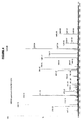
- FIG. 3 shows the electrospray mass spectrum of the digest produced by using the first stage quadrupole mass analyzer 7 in the spectrometer of Figure 1 in a non mass-selective mode.
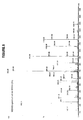
- the analyzer 7 was then tuned to transmit ions of mass-to-charge ratio 864.4 (actually a doubly charged ion) into the collision cell 9 ( Figure 1) and the resultant fragmentation spectrum is shown in Figure 4.
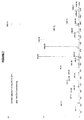
- a processable mass spectrum ( Figure 5) was then produced in accordance with the invention using the program "MaxEnt3TM", as discussed above.
- the position of the T11 fragment is shown by double underlining in the complete sequence listed in Table 5.
- the second most probable sequence in Table 6 differs only from the most probable one by the inversion of the first two residues, and it can be seen from the individual probability assignments to the various predicted residues (Table 7) that there is much less certainty about the assignment of the first two residues than there is about the assignment of the others.
- This example clearly shows the advantage of a rigorous application of probability calculus in comparison with the ad hoc methods of predicting sequences from mass spectral data described in the prior art. From the figures in table 7 it is possible to be certain about the sequence of the central part of the peptide for which very high probabilities are reported, and any doubt that may linger about the complete sequence can be shown to be limited to the first two residues.
Landscapes
- Life Sciences & Earth Sciences (AREA)
- Health & Medical Sciences (AREA)
- Engineering & Computer Science (AREA)
- Molecular Biology (AREA)
- Chemical & Material Sciences (AREA)
- Analytical Chemistry (AREA)
- Physics & Mathematics (AREA)
- Biomedical Technology (AREA)
- Immunology (AREA)
- Urology & Nephrology (AREA)
- Bioinformatics & Computational Biology (AREA)
- Hematology (AREA)
- Bioinformatics & Cheminformatics (AREA)
- Food Science & Technology (AREA)
- General Physics & Mathematics (AREA)
- Proteomics, Peptides & Aminoacids (AREA)
- Biophysics (AREA)
- Microbiology (AREA)
- Spectroscopy & Molecular Physics (AREA)
- Biochemistry (AREA)
- Medicinal Chemistry (AREA)
- Cell Biology (AREA)
- General Health & Medical Sciences (AREA)
- Biotechnology (AREA)
- Pathology (AREA)
- Other Investigation Or Analysis Of Materials By Electrical Means (AREA)
- Investigating Or Analysing Biological Materials (AREA)
Applications Claiming Priority (4)
| Application Number | Priority Date | Filing Date | Title |
|---|---|---|---|
| GB9907810 | 1999-04-06 | ||
| GBGB9907810.7A GB9907810D0 (en) | 1999-04-06 | 1999-04-06 | A method of determining peptide sequences by mass spectrometry |
| GBGB9908684.5A GB9908684D0 (en) | 1999-04-16 | 1999-04-16 | Improved methods of identifying peptides and proteins by mass spectrometry |
| GB9908684 | 1999-04-16 |
Publications (3)
| Publication Number | Publication Date |
|---|---|
| EP1047108A2 true EP1047108A2 (fr) | 2000-10-25 |
| EP1047108A3 EP1047108A3 (fr) | 2002-12-18 |
| EP1047108B1 EP1047108B1 (fr) | 2006-03-08 |
Family
ID=26315385
Family Applications (1)
| Application Number | Title | Priority Date | Filing Date |
|---|---|---|---|
| EP00302898A Expired - Lifetime EP1047108B1 (fr) | 1999-04-06 | 2000-04-06 | Méthode et dispositif d' identification de peptides et de protéines par spectrometrie de masse |
Country Status (4)
| Country | Link |
|---|---|
| US (3) | US6489121B1 (fr) |
| EP (1) | EP1047108B1 (fr) |
| CA (1) | CA2303758C (fr) |
| DE (1) | DE60031030T2 (fr) |
Cited By (7)
| Publication number | Priority date | Publication date | Assignee | Title |
|---|---|---|---|---|
| DE10323917A1 (de) * | 2003-05-23 | 2004-12-16 | Protagen Ag | Verfahren und System zur Aufklärung der Primärstruktur von Biopolymeren |
| WO2008003684A1 (fr) * | 2006-07-03 | 2008-01-10 | Physikron | Procédé et système de spectrométrie de masse en tandem dépourvue de sélection de masse primaire destinés à des ions à charges multiples |
| JP2009541764A (ja) * | 2006-07-03 | 2009-11-26 | フィジクロン | 多帯電イオンのための一次質量選択を行わないタンデム質量分光測定の方法および装置 |
| EP2565904A1 (fr) * | 2011-09-05 | 2013-03-06 | Commissariat à l'Énergie Atomique et aux Énergies Alternatives | Procédé et dispositif d'estimation d'un paramètre de masse moléculaire dans un échantillon |
| US8395113B2 (en) | 2009-05-08 | 2013-03-12 | Thermo Finnigan Llc | Methods and systems for matching product ions to precursor in tandem mass spectrometry |
| EP1376651B1 (fr) * | 2002-06-25 | 2014-06-11 | Hitachi, Ltd. | Méthode et dispositif d' analyse des données en spectrométrie de masse |
| CN116720123A (zh) * | 2023-08-10 | 2023-09-08 | 中南大学 | 一种账户识别方法、装置、终端设备及介质 |
Families Citing this family (33)
| Publication number | Priority date | Publication date | Assignee | Title |
|---|---|---|---|---|
| GB9821393D0 (en) * | 1998-10-01 | 1998-11-25 | Brax Genomics Ltd | Protein profiling 2 |
| EP1047108B1 (fr) * | 1999-04-06 | 2006-03-08 | Micromass UK Limited | Méthode et dispositif d' identification de peptides et de protéines par spectrometrie de masse |
| CA2298181C (fr) | 2000-02-02 | 2006-09-19 | Dayan Burke Goodnough | Analyse d'echantillons complexes non-cibles |
| US20020115056A1 (en) * | 2000-12-26 | 2002-08-22 | Goodlett David R. | Rapid and quantitative proteome analysis and related methods |
| US6777671B2 (en) * | 2001-04-10 | 2004-08-17 | Science & Engineering Services, Inc. | Time-of-flight/ion trap mass spectrometer, a method, and a computer program product to use the same |
| EP1504419B1 (fr) | 2002-03-22 | 2011-05-04 | Phenomenome Discoveries Inc. | Procede de visualisation de donnees metabolomiques non ciblees generees par des spectrometres de masse par resonance cyclotronique des ions a transformee de fourier |
| GB0305796D0 (en) | 2002-07-24 | 2003-04-16 | Micromass Ltd | Method of mass spectrometry and a mass spectrometer |
| US7409296B2 (en) * | 2002-07-29 | 2008-08-05 | Geneva Bioinformatics (Genebio), S.A. | System and method for scoring peptide matches |
| ATE554458T1 (de) * | 2003-04-28 | 2012-05-15 | Cerno Bioscience Llc | Rechnerisches verfahren und system für die massenspektralanalyse |
| US7529629B2 (en) * | 2003-04-28 | 2009-05-05 | Cerno Bioscience Llc | Computational methods and systems for multidimensional analysis |
| US7072772B2 (en) * | 2003-06-12 | 2006-07-04 | Predicant Bioscience, Inc. | Method and apparatus for modeling mass spectrometer lineshapes |
| US20050255606A1 (en) * | 2004-05-13 | 2005-11-17 | Biospect, Inc., A California Corporation | Methods for accurate component intensity extraction from separations-mass spectrometry data |
| WO2005057208A1 (fr) * | 2003-12-03 | 2005-06-23 | Prolexys Pharmaceuticals, Inc. | Procede d'identification de peptides et de proteines |
| JP2008514900A (ja) | 2004-07-30 | 2008-05-08 | アデザ・バイオメデイカル・コーポレイシヨン | 疾病および他の状態のマーカーとしての癌胎児性フィブロネクチンならびに癌胎児性フィブロネクチンの検出のための方法 |
| US7230235B2 (en) * | 2005-05-05 | 2007-06-12 | Palo Alto Research Center Incorporated | Automatic detection of quality spectra |
| US20060249668A1 (en) * | 2005-05-05 | 2006-11-09 | Palo Alto Research Center Incorporated | Automatic detection of quality spectra |
| SG165370A1 (en) | 2005-09-12 | 2010-10-28 | Phenomenome Discoveries Inc | Method for the diagnosis of colorectal cancer and ovarian cancer by the measurement of vitamin e-related metabolites |
| US8108153B2 (en) * | 2005-12-13 | 2012-01-31 | Palo Alto Research Center Incorporated | Method, apparatus, and program product for creating an index into a database of complex molecules |
| US7429727B2 (en) * | 2005-12-13 | 2008-09-30 | Palo Alto Research Center Incorporated | Method, apparatus, and program product for quickly selecting complex molecules from a data base of molecules |
| JP4782579B2 (ja) * | 2006-02-15 | 2011-09-28 | 株式会社日立ハイテクノロジーズ | タンデム型質量分析システム及び方法 |
| GB0609253D0 (en) * | 2006-05-10 | 2006-06-21 | Micromass Ltd | Mass spectrometer |
| US8515686B2 (en) * | 2006-12-18 | 2013-08-20 | Macquarie University | Detection and quantification of polypeptides using mass spectrometry |
| KR100805777B1 (ko) * | 2007-02-22 | 2008-02-21 | 한국기초과학지원연구원 | 질량 스펙트럼 데이터 및 1차원 젤에서의 밴드 위치분석을 포함하는 단백질 수식화 분석 시스템 및 이를이용한 단백질 수식화 분석 방법 |
| CN102138069A (zh) * | 2008-07-23 | 2011-07-27 | P设备有限公司 | 便携式基于等离子体的诊断设备和诊断方法 |
| US9671408B2 (en) * | 2008-11-18 | 2017-06-06 | Protein Metrics Inc. | Wild-card-modification search technique for peptide identification |
| JP5664667B2 (ja) * | 2011-01-11 | 2015-02-04 | 株式会社島津製作所 | 質量分析データ解析方法、質量分析データ解析装置、及び質量分析データ解析用プログラム |
| EP2798658B1 (fr) | 2011-12-30 | 2017-03-01 | DH Technologies Development Pte. Ltd. | Systèmes et procédés pour séquençage de peptides par spectrométrie de masse |
| WO2014116711A1 (fr) * | 2013-01-22 | 2014-07-31 | The University Of Chicago | Procédés et appareils impliquant une spectroscopie de masse pour identifier des protéines dans un échantillon |
| WO2014124365A2 (fr) * | 2013-02-08 | 2014-08-14 | Cornell University | Plateforme de traitement biomoléculaire et ses utilisations |
| GB201504934D0 (en) | 2015-03-24 | 2015-05-06 | Micromass Ltd | Improved method of FT-IMS |
| GB201616017D0 (en) | 2016-09-20 | 2016-11-02 | Micromass Ltd | Improved method ion mobility spectrometry |
| US12280374B2 (en) | 2018-07-13 | 2025-04-22 | University Of Kansas | Nanofluidic analytical devices and methods of using thereof |
| CN111257438B (zh) * | 2018-11-30 | 2021-11-16 | 中国科学院大连化学物理研究所 | 西洋参多肽的富集和表征方法 |
Family Cites Families (8)
| Publication number | Priority date | Publication date | Assignee | Title |
|---|---|---|---|---|
| US3982101A (en) * | 1975-05-19 | 1976-09-21 | The United States Of America As Represented By The Secretary Of The Air Force | Laser velocimeter real time digital data analyzer |
| GB2294830A (en) | 1993-08-13 | 1996-05-08 | Nec Corp | Frequency synthesizer |
| US5538897A (en) | 1994-03-14 | 1996-07-23 | University Of Washington | Use of mass spectrometry fragmentation patterns of peptides to identify amino acid sequences in databases |
| US5731983A (en) * | 1995-12-29 | 1998-03-24 | Nec Usa, Inc. | Method for synthesizing a sequential circuit |
| GB9616105D0 (en) * | 1996-07-31 | 1996-09-11 | Univ Kingston | TrkA binding site of NGF |
| AU6688598A (en) | 1997-03-07 | 1998-09-22 | University Of Florida | Method for diagnosing and staging prostate cancer |
| GB9710582D0 (en) | 1997-05-22 | 1997-07-16 | Oxford Glycosciences Uk Ltd | A method for de novo peptide sequence determination |
| EP1047108B1 (fr) * | 1999-04-06 | 2006-03-08 | Micromass UK Limited | Méthode et dispositif d' identification de peptides et de protéines par spectrometrie de masse |
-
2000
- 2000-04-06 EP EP00302898A patent/EP1047108B1/fr not_active Expired - Lifetime
- 2000-04-06 US US09/544,146 patent/US6489121B1/en not_active Expired - Lifetime
- 2000-04-06 DE DE60031030T patent/DE60031030T2/de not_active Expired - Lifetime
- 2000-04-06 CA CA002303758A patent/CA2303758C/fr not_active Expired - Lifetime
-
2002
- 2002-09-05 US US10/234,314 patent/US7069152B2/en not_active Expired - Lifetime
-
2006
- 2006-03-10 US US11/373,694 patent/US20060247865A1/en not_active Abandoned
Cited By (12)
| Publication number | Priority date | Publication date | Assignee | Title |
|---|---|---|---|---|
| EP1376651B1 (fr) * | 2002-06-25 | 2014-06-11 | Hitachi, Ltd. | Méthode et dispositif d' analyse des données en spectrométrie de masse |
| DE10323917A1 (de) * | 2003-05-23 | 2004-12-16 | Protagen Ag | Verfahren und System zur Aufklärung der Primärstruktur von Biopolymeren |
| WO2008003684A1 (fr) * | 2006-07-03 | 2008-01-10 | Physikron | Procédé et système de spectrométrie de masse en tandem dépourvue de sélection de masse primaire destinés à des ions à charges multiples |
| JP2009541764A (ja) * | 2006-07-03 | 2009-11-26 | フィジクロン | 多帯電イオンのための一次質量選択を行わないタンデム質量分光測定の方法および装置 |
| US8143572B2 (en) | 2006-07-03 | 2012-03-27 | Physikron | Method and system of tandem mass spectrometry without primary mass selection for multicharged ions |
| US8395113B2 (en) | 2009-05-08 | 2013-03-12 | Thermo Finnigan Llc | Methods and systems for matching product ions to precursor in tandem mass spectrometry |
| US8686349B2 (en) | 2009-05-08 | 2014-04-01 | Thermo Finnigan Llc | Methods and systems for matching product ions to precursor ions |
| EP2565904A1 (fr) * | 2011-09-05 | 2013-03-06 | Commissariat à l'Énergie Atomique et aux Énergies Alternatives | Procédé et dispositif d'estimation d'un paramètre de masse moléculaire dans un échantillon |
| FR2979705A1 (fr) * | 2011-09-05 | 2013-03-08 | Commissariat Energie Atomique | Procede et dispositif d'estimation d'un parametre de masse moleculaire dans un echantillon |
| US9251122B2 (en) | 2011-09-05 | 2016-02-02 | Commissariat à l'énergie atomique et aux énergies alternatives | Method and apparatus for estimating a molecular mass parameter in a sample |
| CN116720123A (zh) * | 2023-08-10 | 2023-09-08 | 中南大学 | 一种账户识别方法、装置、终端设备及介质 |
| CN116720123B (zh) * | 2023-08-10 | 2023-11-28 | 中南大学 | 一种账户识别方法、装置、终端设备及介质 |
Also Published As
| Publication number | Publication date |
|---|---|
| US20030028932A1 (en) | 2003-02-06 |
| DE60031030T2 (de) | 2007-05-10 |
| CA2303758A1 (fr) | 2000-10-06 |
| DE60031030D1 (de) | 2006-11-16 |
| EP1047108A3 (fr) | 2002-12-18 |
| US7069152B2 (en) | 2006-06-27 |
| US20060247865A1 (en) | 2006-11-02 |
| EP1047108B1 (fr) | 2006-03-08 |
| CA2303758C (fr) | 2004-01-06 |
| US6489121B1 (en) | 2002-12-03 |
Similar Documents
| Publication | Publication Date | Title |
|---|---|---|
| US6489608B1 (en) | Method of determining peptide sequences by mass spectrometry | |
| EP1047108B1 (fr) | Méthode et dispositif d' identification de peptides et de protéines par spectrometrie de masse | |
| JP3766391B2 (ja) | 質量分析スペクトルの解析システム | |
| Zhang et al. | ProbIDtree: an automated software program capable of identifying multiple peptides from a single collision‐induced dissociation spectrum collected by a tandem mass spectrometer | |
| US7781729B2 (en) | Analyzing mass spectral data | |
| CN101871945B (zh) | 一种利用质谱图库鉴定蛋白质及其修饰的方法 | |
| US20060085142A1 (en) | Determination of molecular structures using tandem mass spectrometry | |
| AU2022290368B2 (en) | Method and apparatus for identifying molecular species in a mass spectrum | |
| CN101477089B (zh) | 一种蛋白质翻译后修饰的发现方法 | |
| EP3971943B1 (fr) | Utilisation des résultats de la recherche en temps réel pour exclure dynamiquement les ions de produits qui peuvent être présents dans le balayage principal | |
| EP4078600B1 (fr) | Procédé et système pour l'identification de composés dans des échantillons biologiques ou environnementaux complexes | |
| CN104820011B (zh) | 一种蛋白质翻译后修饰定位的方法 | |
| JP2007046966A (ja) | 質量分析システム | |
| US10317412B1 (en) | Method and device for analyzing protein or peptide | |
| Xu et al. | Complexity and scoring function of MS/MS peptide de novo sequencing | |
| Hogan et al. | Charge state estimation for tandem mass spectrometry proteomics | |
| Gao et al. | A programmable fragmentation analysis of proteins by in-source decay in MALDI-TOF mass spectrometry | |
| Tschager | Algorithms for Peptide Identification via Tandem Mass Spectrometry | |
| Chen et al. | Random Forest model for quality control of high resolution mass spectra from SILAC labeling experiments | |
| Yan et al. | Separation of ion types in tandem mass spectrometry data interpretation-a graph-theoretic approach | |
| Liu et al. | PRIMA: peptide robust identification from MS/MS spectra | |
| WO2013097058A1 (fr) | Procédé d'identification du protéome | |
| Wang et al. | A new hybrid probability-based method for identifying proteins and protein modifications | |
| CN118230813A (zh) | 一种多肽质谱数据从头测序结果假阳性率评估方法及系统 | |
| Christen et al. | Sparse Signal Recovery for Peptide Analysis based on Data-Independent Tandem Mass Spectra Acquisition |
Legal Events
| Date | Code | Title | Description |
|---|---|---|---|
| PUAI | Public reference made under article 153(3) epc to a published international application that has entered the european phase |
Free format text: ORIGINAL CODE: 0009012 |
|
| AK | Designated contracting states |
Kind code of ref document: A2 Designated state(s): AT BE CH CY DE DK ES FI FR GB GR IE IT LI LU MC NL PT SE |
|
| AX | Request for extension of the european patent |
Free format text: AL;LT;LV;MK;RO;SI |
|
| PUAL | Search report despatched |
Free format text: ORIGINAL CODE: 0009013 |
|
| AK | Designated contracting states |
Kind code of ref document: A3 Designated state(s): AT BE CH CY DE DK ES FI FR GB GR IE IT LI LU MC NL PT SE |
|
| AX | Request for extension of the european patent |
Free format text: AL;LT;LV;MK;RO;SI |
|
| 17P | Request for examination filed |
Effective date: 20030214 |
|
| AKX | Designation fees paid |
Designated state(s): DE FR GB SE |
|
| RAP1 | Party data changed (applicant data changed or rights of an application transferred) |
Owner name: MICROMASS UK LIMITED |
|
| GRAP | Despatch of communication of intention to grant a patent |
Free format text: ORIGINAL CODE: EPIDOSNIGR1 |
|
| GRAS | Grant fee paid |
Free format text: ORIGINAL CODE: EPIDOSNIGR3 |
|
| GRAA | (expected) grant |
Free format text: ORIGINAL CODE: 0009210 |
|
| AK | Designated contracting states |
Kind code of ref document: B1 Designated state(s): DE FR GB SE |
|
| REG | Reference to a national code |
Ref country code: GB Ref legal event code: FG4D |
|
| REF | Corresponds to: |
Ref document number: 60026452 Country of ref document: DE Date of ref document: 20060504 Kind code of ref document: P |
|
| PG25 | Lapsed in a contracting state [announced via postgrant information from national office to epo] |
Ref country code: SE Free format text: LAPSE BECAUSE OF FAILURE TO SUBMIT A TRANSLATION OF THE DESCRIPTION OR TO PAY THE FEE WITHIN THE PRESCRIBED TIME-LIMIT Effective date: 20060608 |
|
| PLBE | No opposition filed within time limit |
Free format text: ORIGINAL CODE: 0009261 |
|
| STAA | Information on the status of an ep patent application or granted ep patent |
Free format text: STATUS: NO OPPOSITION FILED WITHIN TIME LIMIT |
|
| 26N | No opposition filed |
Effective date: 20061211 |
|
| EN | Fr: translation not filed | ||
| PG25 | Lapsed in a contracting state [announced via postgrant information from national office to epo] |
Ref country code: FR Free format text: LAPSE BECAUSE OF FAILURE TO SUBMIT A TRANSLATION OF THE DESCRIPTION OR TO PAY THE FEE WITHIN THE PRESCRIBED TIME-LIMIT Effective date: 20070309 |
|
| PG25 | Lapsed in a contracting state [announced via postgrant information from national office to epo] |
Ref country code: FR Free format text: LAPSE BECAUSE OF FAILURE TO SUBMIT A TRANSLATION OF THE DESCRIPTION OR TO PAY THE FEE WITHIN THE PRESCRIBED TIME-LIMIT Effective date: 20060430 |
|
| PG25 | Lapsed in a contracting state [announced via postgrant information from national office to epo] |
Ref country code: FR Free format text: LAPSE BECAUSE OF FAILURE TO SUBMIT A TRANSLATION OF THE DESCRIPTION OR TO PAY THE FEE WITHIN THE PRESCRIBED TIME-LIMIT Effective date: 20060308 |
|
| PGFP | Annual fee paid to national office [announced via postgrant information from national office to epo] |
Ref country code: GB Payment date: 20190325 Year of fee payment: 20 |
|
| PGFP | Annual fee paid to national office [announced via postgrant information from national office to epo] |
Ref country code: DE Payment date: 20190220 Year of fee payment: 20 |
|
| REG | Reference to a national code |
Ref country code: DE Ref legal event code: R071 Ref document number: 60026452 Country of ref document: DE |
|
| REG | Reference to a national code |
Ref country code: GB Ref legal event code: PE20 Expiry date: 20200405 |
|
| PG25 | Lapsed in a contracting state [announced via postgrant information from national office to epo] |
Ref country code: GB Free format text: LAPSE BECAUSE OF EXPIRATION OF PROTECTION Effective date: 20200405 |