EP1047207A2 - Schnelle Leistungsregelung der Vorwärtsrichtung während sanften Weiterreichens - Google Patents
Schnelle Leistungsregelung der Vorwärtsrichtung während sanften Weiterreichens Download PDFInfo
- Publication number
- EP1047207A2 EP1047207A2 EP00303346A EP00303346A EP1047207A2 EP 1047207 A2 EP1047207 A2 EP 1047207A2 EP 00303346 A EP00303346 A EP 00303346A EP 00303346 A EP00303346 A EP 00303346A EP 1047207 A2 EP1047207 A2 EP 1047207A2
- Authority
- EP
- European Patent Office
- Prior art keywords
- bts
- btss
- power control
- given
- mobile station
- Prior art date
- Legal status (The legal status is an assumption and is not a legal conclusion. Google has not performed a legal analysis and makes no representation as to the accuracy of the status listed.)
- Withdrawn
Links
- 230000002441 reversible effect Effects 0.000 claims abstract description 67
- 238000000034 method Methods 0.000 claims abstract description 41
- 230000005540 biological transmission Effects 0.000 claims abstract description 27
- 230000010267 cellular communication Effects 0.000 claims abstract description 17
- 238000004590 computer program Methods 0.000 claims abstract 4
- 238000004891 communication Methods 0.000 claims description 15
- 230000008569 process Effects 0.000 description 14
- 230000008901 benefit Effects 0.000 description 6
- 230000000694 effects Effects 0.000 description 6
- 230000001360 synchronised effect Effects 0.000 description 6
- 230000015556 catabolic process Effects 0.000 description 4
- 230000008859 change Effects 0.000 description 4
- 238000006731 degradation reaction Methods 0.000 description 4
- 238000012545 processing Methods 0.000 description 4
- 230000001413 cellular effect Effects 0.000 description 3
- 238000010586 diagram Methods 0.000 description 3
- 238000005562 fading Methods 0.000 description 3
- 230000006872 improvement Effects 0.000 description 3
- 238000012360 testing method Methods 0.000 description 3
- 230000001934 delay Effects 0.000 description 2
- 238000005259 measurement Methods 0.000 description 2
- 230000009467 reduction Effects 0.000 description 2
- 238000004088 simulation Methods 0.000 description 2
- 230000004075 alteration Effects 0.000 description 1
- 238000004458 analytical method Methods 0.000 description 1
- 238000013459 approach Methods 0.000 description 1
- 230000001010 compromised effect Effects 0.000 description 1
- 230000008878 coupling Effects 0.000 description 1
- 238000010168 coupling process Methods 0.000 description 1
- 238000005859 coupling reaction Methods 0.000 description 1
- 230000003247 decreasing effect Effects 0.000 description 1
- 230000001419 dependent effect Effects 0.000 description 1
- 238000001514 detection method Methods 0.000 description 1
- 238000005516 engineering process Methods 0.000 description 1
- 238000002474 experimental method Methods 0.000 description 1
- 230000000670 limiting effect Effects 0.000 description 1
- 230000007246 mechanism Effects 0.000 description 1
- 238000012986 modification Methods 0.000 description 1
- 230000004048 modification Effects 0.000 description 1
- 238000013442 quality metrics Methods 0.000 description 1
- 230000002829 reductive effect Effects 0.000 description 1
- 230000001960 triggered effect Effects 0.000 description 1
Images

Classifications
-
- H—ELECTRICITY
- H04—ELECTRIC COMMUNICATION TECHNIQUE
- H04W—WIRELESS COMMUNICATION NETWORKS
- H04W52/00—Power management, e.g. Transmission Power Control [TPC] or power classes
- H04W52/04—Transmission power control [TPC]
- H04W52/38—TPC being performed in particular situations
- H04W52/40—TPC being performed in particular situations during macro-diversity or soft handoff
-
- H—ELECTRICITY
- H04—ELECTRIC COMMUNICATION TECHNIQUE
- H04W—WIRELESS COMMUNICATION NETWORKS
- H04W36/00—Hand-off or reselection arrangements
- H04W36/16—Performing reselection for specific purposes
- H04W36/18—Performing reselection for specific purposes for allowing seamless reselection, e.g. soft reselection
-
- H—ELECTRICITY
- H04—ELECTRIC COMMUNICATION TECHNIQUE
- H04W—WIRELESS COMMUNICATION NETWORKS
- H04W24/00—Supervisory, monitoring or testing arrangements
- H04W24/10—Scheduling measurement reports ; Arrangements for measurement reports
-
- H—ELECTRICITY
- H04—ELECTRIC COMMUNICATION TECHNIQUE
- H04W—WIRELESS COMMUNICATION NETWORKS
- H04W28/00—Network traffic management; Network resource management
- H04W28/16—Central resource management; Negotiation of resources or communication parameters, e.g. negotiating bandwidth or QoS [Quality of Service]
- H04W28/18—Negotiating wireless communication parameters
Definitions
- the present invention relates in general to wireless communication systems and in particular to an efficient method of and apparatus for improving the implementation of fast forward power control during soft handoff.
- the repetition rate of the forward link power control signals is slow, on the order of 50Hz.
- the MS mobile station
- the SBS switch bank subsystem
- BSC base station controller
- the power control algorithm determines the new transmit power levels for all the BTSs in soft handoff with the MS.
- the SBS relays the new transmit power levels to the BTSs.
- the power level used by each BTS in soft handoff with the MS is always equal. That is, the forward link power allocated to the MS at each of the BTSs is always synchronized to the same power level.
- a forward link frame When a forward link frame is transmitted to the MS from the BTSs, it takes a finite amount of time before the MS receives it. If a communication mode designated as Rate Set 2 is employed, then the MS encodes an EIB (Erasure Indicator Bit) into the next outgoing reverse link frame, signifying the status of the forward link frame. After additional propagation delays, each BTS in soft handoff with the MS relays the demodulated reverse link frame and associated frame quality metrics to the SBS. The SBS then updates the forward transmit power levels of the forward link based on the EIB and instructs the BTSs to use the new level. Therefore, the time between the transmission of a forward link frame and the corresponding increase/decrease in transmit power is a constant delay.
- EIB Erasure Indicator Bit
- the delay is based upon the architecture (propagation/processing delays of the various interconnecting blocks) of the system.
- rate set 1 the power control is accomplished through the use of the reverse link "Power Measurement Report Message” (PMRM), which is triggered by a count of the number of bad forward link frames.
- PMRM Power Measurement Report Message
- An evolution of CDMA popularly designated as 3G (third generation), includes a fast forward link power control scheme wherein the MS determines whether or not it requires more forward link power to maintain the GOS. The decision is transmitted rapidly to the BTSs via a reverse link dedicated control channel.
- CDMA systems using fast forward link power control will be appreciated by the skilled addressee.
- the MS estimates the SNR (signal to noise ratio) per power control group after maximally ratio combining the received signal energy per multipath.
- the estimation is compared to a threshold and, based on the comparison, a power control, up or down, command is generated.
- the MS adjusts this SNR threshold every frame, or at 50Hz, based on the quality of forward link frames.
- the threshold is increased. This represents situations where the SNR may be insufficient for the current mobility conditions. If the forward link frame is good, the SNR threshold is reduced. This is based on the assumption that the SNR is sufficient for the given GOS levels.
- the increase and decrease of the threshold are related by a FER (frame error rate) requirement.
- the up/down decisions are the control mechanism that ensures that the received SNR or the forward link is equal to the threshold.
- the different BTSs of a 3G fast power control system, must now independently demodulate the MS power control decisions. Based on the demodulated decision, the BTS will increase/ decrease its transmitted power. It is quite likely that the reverse links between the MS and the different BTSs will have different instantaneous power control bit error rates. Consequently, the actual decision that each BTS makes may not be the same. In other words, some BTSs may demodulate the power control bit decision in error. With the existing prior art network architecture, the BSC cannot synchronize the BTSs to the same power level after each power control decision because of the inherent processing and queuing delay of the central processing unit and interconnecting communication links.
- each BTS to MS reverse link is likely to have a different instantaneous error rate due to the independent slow/fast fading, and different distance/antenna related path losses.
- each link has a different error rate, then the actual transmitted powers from each BTS to MS during soft handoff deviate. This may result in loss of diversity. This is further explained via a possible scenario discussed below.
- the MS is in two-way soft handoff with the network. If the BTSs could be perfectly synchronized, then they would power up/down together. Hence, the diversity gain is optimized; when one path fades, the other is used and the reverse scenario also holds.
- the BTSs start out at the same level transmitted power level, due to different power control bit error rates per reverse link, their transmit power levels and up/down decisions are no longer perfectly synchronized.
- one reverse link will have a much higher FER and BER (raw bit error rate) than the other reverse link. If the MS requires lower forward power, then one BTS will power down quickly and appropriately, while the other may well remain at the same power level (if the raw BER is 50%), or power down at a much slower rate.
- Stability is usually maintained in such cases. Stability, for the purposes of this document, means that the FER requirements are maintained and the call drop rates are not increased. Since one BTS is not powering down, the other will power down to a lower level than it would if both links were adequately controlled. This ensures that just enough signal energy is provided to maintain GOS.
- the converse is equally probable.
- the forward link is insufficient to a meet a given GOS, only the BTS with the more accurate reverse link will be able to react faster and more accurately by increasing its transmit power. Therefore, the resulting BTSs power levels are likely to be significantly different.
- the diversity gain is affected as a function of the difference between these levels.
- the forward link associated with the weaker reverse link is unable to provide diversity gain due to its inability to increase its transmit power.
- the overall requirement on power is higher in order for the adequately power controlled link to make up for the loss of diversity.
- the weaker reverse link improves, the BTSs remain out of synch by an indeterminate factor as they adjust their powers up or down. If the other reverse link corrupts, the mismatch may increase or narrow.
- the overall power control coupling between forward and reverse link needs to be considered. If the MS is in a higher order soft handoff, and there is a poor forward link quality from a number of BTSs, the MS is more likely to make wrong reverse link power control decisions, and its general trend is to power down (lower the output transmitted power). This will in turn affect the power control bit rate and forward link frame quality, which further degrades the reverse link power control process. Eventually all forward link power control bits carried on all the reverse links may thus be in error.
- the present invention comprises a method of improving the relative power level synchronization of all the BTSs communicating with an MS in a handoff mode through the use of at least one of 1) synchronizing all the handoff BTSs to the power level of the BTS having the best measured E b /N o (bit energy to noise density) of reverse link transmissions, 2) adjusting at least one of lower and upper limits of traffic channel gain of a BTS as a function of handoff mode and 3) adjusting at least one of the incremental FPC (forward power control) and RPC (reverse power control) parameters as a function of the number of BTSs in a soft handoff mode.
- E b /N o bit energy to noise density
- a cellular communication system incorporating fast forward power control and having at least 2 BTSs receiving reverse link transmissions from a MS (mobile station) comprising: measuring means, comprising a part of each BTS in the system, for measuring a parameter, at each of the BTSs receiving reverse link transmissions from said MS, of reverse link FPC (forward power control) bit stream transmissions from said MS; comparison means for periodically comparing the measured parameter to determine which BTS is receiving the most reliable FPC data wherein the BTS determined to be is receiving the most reliable FPC data is designated hereinafter as BTS(x); further comparison means for comparing the transmit power level of each BTS, other than BTS(x), with the transmit power level of BTS(x); and instructing means for instructing each BTS, other than BTS(x), whose power level differs from the transmit power level of BTS(x) by more than a predetermined value, to adjust the power level of transmissions to said MS to the level of BTS(x).
- measuring means comprising a part of each BTS in the system
- the parameter measured is E b /N o (bit energy to noise density).
- the cellular communication system further comprises: BSC checking means for determining the number of BTSs in a soft handoff mode with respect to a given MS; and means for adjusting at least one of the incremental FPC, RPC (reverse power control) parameters and the lower limit of traffic channel gain as a function of the number of BTSs in a soft handoff mode with respect to said MS.
- a method of attempting to synchronize BTS (base transceiver station) transmit powers of a cellular communication system to an MS (mobile station) when there are at least 2 BTSs receiving reverse link transmissions from said MS comprising: measuring the E b /N o (bit energy to noise density) of reverse link FPC (forward power control) bit stream transmissions from said MS; periodically comparing the measured E b /N o to determine which BTS is receiving the most reliable FPC data; and instructing active set BTSs, other than the BTS determined to be receiving the most reliable FPC data, to adjust the power level of transmissions to said MS to the level of the BTS determined to be receiving the most reliable FPC data from said MS.
- E b /N o bit energy to noise density
- FPC forward power control
- a method of adjusting power control parameters in a cellular communication system comprising: determining the number of BTSs (base transceiver stations) in a soft handoff mode with respect to a MS (mobile station); and adjusting at least one of the incremental FPC (forward power control) and RPC (reverse power control) parameters as a function of the number of BTSs in a soft handoff mode with respect to said MS.
- a method of adjusting power control parameters as part of a fast forward power control function of the BTSs (base transceiver stations)in a cellular communication system comprising the steps of: determining the number of BTSs in a soft handoff mode with respect to a given MS (mobile station); and adjusting a lower limit of traffic channel gain of a BTS (base transceiver station) as regards communications with a given MS (mobile station) as a function of whether or not said given MS is in a handoff mode.
- a cellular communication system incorporating fast forward power control and having at least 2 BTSs receiving reverse link transmissions from a MS (mobile station) comprising: checking means for determining the number of BTSs (base transceiver stations) in a soft handoff mode with respect to a MS (mobile station); and means for adjusting at least one of the incremental FPC (forward power control) and RPC (reverse power control) parameters as a function of the number of BTSs in a soft handoff mode with respect to said MS.
- FPC forward power control
- RPC reverse power control
- a cellular communication system incorporating fast forward power control and at times having at least 2 BTSs receiving reverse link transmissions from a MS (mobile station) in a handoff mode comprising: checking means for determining the number of BTSs in a soft handoff mode with respect to a given MS (mobile station); and at least one of a) circuitry for adjusting a lower limit of traffic channel gain of a BTS (base transceiver station) as regards communications with a given MS (mobile station) as a function of whether or not said given MS is in a handoff mode; b) circuitry for adjusting the range between lower and upper limits of traffic channel gain of a BTS (base transceiver station) as regards communications with a given MS (mobile station) as a function of whether or not said given MS is in a handoff mode.
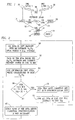
- an MTSO (mobile telephone switching office) block 10 is connected to a BSC (base station controller) block 12 as well as to a cloud labelled PSTN (public switched telephone network) 14.
- BSC base station controller
- PSTN public switched telephone network
- SBS switch bank subsystem
- First and second BTS blocks 18 and 20 are connected to BSC 12 by communication links 22 and 24 respectively.
- An antenna 26 of BTS 18 is shown transmitting forward link signals to an MS (mobile station) 28. Reverse link, part of which is the power control channel signals, are being returned from MS 28 to the antenna 26.
- a further antenna 30 for BTS 20 is also shown sending forward link signals to MS 28 and receiving reverse power control channel signals.
- a dash line CPU (central processing unit) block 32 is included as an alternative computational that may be used instead of the BSC 12.
- a BTS may be designed to use a centralized CPU when such a unit is detected but use a BSC as a default processor.
- a block 50 sets forth the requirement that all BTSs in a soft hand off mode with an MS estimate E b /N o (bit energy to noise density), over a period "N".
- E b /N o bit energy to noise density
- the BSC determines the "best BTS" which corresponds to BTS(x) having the best detected reverse link E b /N o .
- the process then proceeds to a decision block 56 where the absolute value of the incremental difference of the output power for each BTS with respect to BTS(x) is determined. If any BTS output powers incremental difference are found to exceed a predetermined threshold, these BTSs are put into a synchronization list in a block 58.
- each of the BTSs in the list are instructed to use the power output of BTS(x) (the best) and the process returns to block 50. If none of the BTSs exceed the prescribed incremental difference, the process passes to block 62 and from there returns to block 50.
- the process typically remains in a decision block 73 while checking to determine if there is a change in soft handoff state for each MS with whom the BTS is in contact. This change may be from no handoff to a handoff mode as well as from a handoff involving a plurality of BTSs to a different plurality of BTSs.
- the process proceeds to a decision block 75. If the MS is no longer in soft handoff, the process goes to block 77 where the lower limit on traffic channel power may be adjusted downward in accordance with the system configuration. In some circumstances it may be desirable to adjust the upper limit at the same time. This upper limit may be altered either up or down.
- a next block 79 causes an adjustment (normally an increase) in the setting of an "fpc" (forward power control) increment.
- fpc is the amount by which the BTS would increase/decrease its power. As an example this alteration might be 1.0, 0.5 or 0.25 db.
- a message is sent to the MS requesting an adjustment (normally an increase) in the "rpc" (reverse power control) increment.
- rpc is the amount by which the MS would increase/decrease its power in a manner similar to that mentioned above.
- the forward link is punctured every power control group with the decision in the form of bits, upon which the MS can make a hard decision.
- This invention operates similarly in 3G for "rpc" and "fpc".
- 3G CDMA also allow the use of separate channels to carry this rpc/fpc information. The process then returns to decision block 73 to await any further changes in soft handoff state.
- the process advances to a block 85.
- the lower limit on traffic channel power may be raised depending upon the present service conditions and the state of handoff.
- the upper limit may also be adjusted as mentioned above in connection with block 77.
- the incremental value of "fpc" may be increased or decreased depending upon the direction of change detected in decision block 73 and the numbers of BTSs presently involved in a soft handoff mode with the MS. In a like manner, a message is sent to the MS to either increase or decrease the "rpc" increment as a function of the state of soft handoff.
- the lack of power output level synchronization may cause loss of diversity of signals being sent from the BTS to an MS in a soft handoff mode. This is due to one or more BTSs changing transmission power levels inappropriately due to high reverse link bit errors. The end effect is a mismatch in transmitted power between the different BTSs. For instance, the strongest BTS in terms of instantaneous path loss may now be transmitting considerably less power than the other BTSs. Consequently, the other BTSs have to transmit even more power to make up for strong interference from the first BTS and loss of diversity.
- an approach to solving this problem is to ensure that the mismatch is never too large. For instance, if the lower limit on transmit power is kept at a very low value without maintaining synchronization of BTS transmit power levels, it may be determined by experiment or testing that all the forward transmit power levels are much higher than is the case in perfect synchronization cases. This is because one or more BTS transmit levels drift and remain at levels far below the other BTS transmit levels, creating the referenced loss of diversity situation. In fact, due to system set upper limit cap on the transmit power, the remaining BTSs are likely to be unable to meet the GOS, (i.e. the resulting FER is far above the typically desired 1% set point).
- the block 77 in FIGURE 3 provides the function of lowering the lower limit on traffic channel power in most situations where a BTS is not involved in a soft handoff mode with a given MS. This allows the MS get very close to the BTS without being overpowered by the BTS transmission signal and further allows the BTS to reduce its output signal to a low enough level that it will potentially increase its capacity to handle more traffic.
- the block 85 is the converse of block 77, in that normally the lower limit on the traffic channel of a BTS involved in a soft handoff mode will be raised so that it can not power down as far when the RPC messages in the reverse link are erroneously detected.
- the step size of the FPC and RPC parameters have an affect on the stability of 3G CDMA systems when fast forward power control is implemented.
- the problem of too high an RPC when in soft handoff is already something that even affects existing IS-95A systems.
- the MS may demodulate many of the reverse power control bits in error and actually start to power down. This is due to the way in which the rules have been established. As set forth in the standards, if even one power control bit is demodulated as down, the MS will power down (reduce the output transmission power level).
- the reverse link stability ties directly with forward link stability when fast forward power control is operating. If the MS erroneously powers down by large amounts frequently, then the forward power control bits that it is supplying to the various BTSs are likely to go through higher bit error rates. This will affect the forward link stability. Once forward link stability is affected, it further affects reverse link quality. The end result is cyclical leading to degradation in system capacity.
- Rapid synchronization cannot, by itself, be used to solve the drifting apart of BTS transmit levels. Rapid synchronization can solve the drifting apart of BTS transmit levels, but at substantial cost to the network to actually facilitate such a feature.
- This invention thus uses appropriate power control parameters to prevent a large drift such that slow synchronization can be applied to correct for any drift that does occur. In this manner, the benefits of fast power control are achieved through the use of appropriately chosen parameters for different handoff situations.
- FIGURES 2 and 3 An algorithm for dealing with the above parameter adjustments is shown in FIGURES 2 and 3.
- the power control parameter adjustment as function of soft handoff is presented in FIGURE 2.
- FIGURE 3 deals with slow synchronization to prevent an inadequately power controlled base station from settling to the lower or upper limits on the forward link transmit power.
- FIGURE 3 is believed apparent from the above, it may be mentioned that, whenever the state of handoff changes, the parameters "fpc,” "rpc,” and the lower limit on traffic channel power are adjusted accordingly. If for instance the handoff increases to contain three or more BTSs, then a small step value for "fpc,” and “rpc” such as 0.25dB may be used. If the soft handoff involves less than 3 BTSs, then a larger step value for "fpc,” and “rpc” such as 0.5dB may be used. Similarly, the lower limit of traffic channel gain may be lowered in situations where there is no soft handoff, and increased when the MS is in soft handoff. The only message required, is one that instructs the MS to adjust "rpc.”
- FIGURE 2 in block 50 it shows that the BTSs measure E b /N o over a period N, for instance 1 frame, and then transmit the measurement obtained along with the instantaneous traffic channel transmit power whenever it is in soft handoff as set forth in block 52 to a central location such as the BSC.
- Circuitry within the BSC may be used to determine the BTS with the most reliable reverse link, hence the BTS which is likely to be the one most reliably power controlled.
- decision block 56 the BSC compares the transmit levels of the other BTSs with this BTS(x) and based on the comparison determines if their transmit powers need to be adjusted.
- any of the BTSs need to be adjusted, for instance maybe one or more BTSs are sitting at the lower limit, or upper limit, the process continues to blocks 58 and 60 where the BSC compiles a list and sends messages instructing these BTSs to use a new transmit level.
- This transmit level is the level that was sent to it by the most reliable BTS(x). In most situations, the BTSs will not need synchronization and the process returns through block 62 to block 50. However the part of the process set forth in FIGURE 2 is used as a safety check to ensure that BTSs are not sitting at the lower/upper limits of traffic channel transmit power.
- the gain during no handoff situations is so large, that it makes up for dispersed power effects in higher handoff situations.
- the diversity gain is larger than the dispersed power impacts, and so the required power is still marginally less in the two multipath case. The end result is a reduction in the forward link average transmit power requirements.
Landscapes
- Engineering & Computer Science (AREA)
- Computer Networks & Wireless Communication (AREA)
- Signal Processing (AREA)
- Mobile Radio Communication Systems (AREA)
Applications Claiming Priority (2)
| Application Number | Priority Date | Filing Date | Title |
|---|---|---|---|
| US296974 | 1999-04-22 | ||
| US09/296,974 US6515975B1 (en) | 1999-04-22 | 1999-04-22 | Fast forward power control during soft handoff |
Publications (2)
| Publication Number | Publication Date |
|---|---|
| EP1047207A2 true EP1047207A2 (de) | 2000-10-25 |
| EP1047207A3 EP1047207A3 (de) | 2003-04-16 |
Family
ID=23144341
Family Applications (1)
| Application Number | Title | Priority Date | Filing Date |
|---|---|---|---|
| EP00303346A Withdrawn EP1047207A3 (de) | 1999-04-22 | 2000-04-20 | Schnelle Leistungsregelung der Vorwärtsrichtung während sanften Weiterreichens |
Country Status (3)
| Country | Link |
|---|---|
| US (1) | US6515975B1 (de) |
| EP (1) | EP1047207A3 (de) |
| CA (1) | CA2305020A1 (de) |
Cited By (9)
| Publication number | Priority date | Publication date | Assignee | Title |
|---|---|---|---|---|
| EP1091502A3 (de) * | 1999-10-07 | 2003-01-08 | Nec Corporation | Verfahren zur Sendeleistungsregelung in einem mobilen CDMA-Kommunikationssystem |
| WO2003032528A1 (en) | 2001-09-21 | 2003-04-17 | Ntt Docomo, Inc. | Transmission power control method and radio control apparatus in mobile packet communication system |
| WO2003034612A3 (en) * | 2001-10-15 | 2003-07-10 | Qualcomm Inc | Method and apparatus for managing imbalance in a communication system |
| KR20030077733A (ko) * | 2002-03-26 | 2003-10-04 | 삼성전자주식회사 | 고속 순방향 패킷 접속 방식을 사용하는 통신 시스템에서순방향 채널 품질을 보고하기 위한 채널 품질 보고 패턴결정 장치 및 방법 |
| WO2004051881A1 (en) * | 2002-12-02 | 2004-06-17 | Nortel Networks Limited | Enhanced forward link power control during soft hand-off |
| EP1455465A3 (de) * | 2003-03-04 | 2006-11-02 | NTT DoCoMo, Inc. | Mobilkommunikationssystem, Funknetzsteuerungseinheit, Basisstation und Verfahren zur Leistungsregelung |
| US7194281B2 (en) | 2002-11-04 | 2007-03-20 | Zte Corporation | Method and apparatus for synchronization control of forward link transmitting power during soft handoff in wireless communication systems |
| KR100993693B1 (ko) * | 2002-11-05 | 2010-11-10 | 제트티이 코포레이션 | 무선 통신 시스템에 있어서 소프트 핸드오프 동안 순방향링크 전송 파워의 동기 제어 방법 및 동기 제어 장치 |
| CN108073103A (zh) * | 2016-11-17 | 2018-05-25 | 杭州三花研究院有限公司 | 通信控制系统 |
Families Citing this family (27)
| Publication number | Priority date | Publication date | Assignee | Title |
|---|---|---|---|---|
| US6408165B1 (en) * | 1999-07-06 | 2002-06-18 | Cisco Technology, Inc. | Power regulation using multi-loop control |
| KR100641769B1 (ko) * | 1999-08-31 | 2006-11-13 | 유티스타콤코리아 유한회사 | 이동통신 시스템에서의 역방향 전력제어 부채널을 이용한 순방향 전력제어방법 |
| GB2355366B (en) * | 1999-10-11 | 2003-08-20 | Ericsson Telefon Ab L M | Radio transceiver |
| US7023822B1 (en) * | 2000-10-12 | 2006-04-04 | Via Telecom Co., Ltd. | Method and apparatus for initiating a reverse link intergenerational handoff in a CDMA communication system |
| US7206580B2 (en) * | 1999-11-04 | 2007-04-17 | Qualcomm Incorporated | Method and apparatus for performing handoff in a high speed communication system |
| US7590095B2 (en) | 2000-02-14 | 2009-09-15 | Qualcomm Incorporated | Method and apparatus for power control of multiple channels in a wireless communication system |
| US8099122B1 (en) * | 2000-06-05 | 2012-01-17 | Qualcomm Incorporated | Method and apparatus for improved forward link power control while in soft handoff |
| US6622023B2 (en) * | 2000-12-07 | 2003-09-16 | Nortel Networks Limited | Method and apparatus for improved fast forward power control in a CDMA network |
| CN101222254A (zh) | 2001-11-20 | 2008-07-16 | 高通股份有限公司 | 受反向链路功率控制的中继器 |
| US7831263B2 (en) * | 2002-11-08 | 2010-11-09 | Qualcomm Incorporated | Apparatus and method for determining the location of a repeater |
| JP4550739B2 (ja) * | 2002-12-05 | 2010-09-22 | クゥアルコム・インコーポレイテッド | 無線通信システムにおいて中継器の逆方向利得をセットするためのシステムおよび方法 |
| KR20050031551A (ko) * | 2003-09-30 | 2005-04-06 | 유티스타콤코리아 유한회사 | 시디엠에이2000-1엑스 시스템에서 순방향 데이터 서비스시데이터 레이트 조절 방법 |
| RU2355129C2 (ru) * | 2004-04-05 | 2009-05-10 | Квэлкомм Инкорпорейтед | Ретранслятор, который сообщает об обнаруженных соседях |
| CN1954232A (zh) * | 2004-04-05 | 2007-04-25 | 高通股份有限公司 | 具有定位能力的中继器 |
| US7778596B2 (en) | 2004-07-29 | 2010-08-17 | Qualcomm Incorporated | Airlink sensing watermarking repeater |
| US7729704B2 (en) * | 2005-03-31 | 2010-06-01 | Alcatel-Lucent Usa Inc. | Power load balancing in cellular networks employing shadow prices of base stations |
| US20070099576A1 (en) * | 2005-11-03 | 2007-05-03 | Vukovic Ivan N | Method and apparatus for base station management |
| DE102005060901A1 (de) * | 2005-12-20 | 2007-06-28 | Robert Bosch Gmbh | Verfahren zur Erkennung einer Versorgungsunterbrechung in einem Datenspeicher und zur Wiederherstellung des Datenspeichers |
| US8315226B2 (en) * | 2006-01-05 | 2012-11-20 | Qualcomm Incorporated | Power control and handoff with power control commands and erasure indications |
| EP2063655A4 (de) * | 2006-09-20 | 2014-06-04 | Nec Corp | Trägerzuweisungsverfahren für ein zellulares system, zellulares system, basisstation und mobilstation |
| JP4777205B2 (ja) * | 2006-09-28 | 2011-09-21 | 京セラ株式会社 | 無線通信システム、無線通信端末及び基地局 |
| JP5048831B2 (ja) * | 2007-05-23 | 2012-10-17 | テレフオンアクチーボラゲット エル エム エリクソン(パブル) | 移動体通信システムにおける出力アップリンクおよびダウンリンク電力レベルを制御するための方法およびネットワークノード |
| US8072917B2 (en) * | 2007-10-31 | 2011-12-06 | Qualcomm Incorporated | Methods and apparatus supporting adaptive decentralized traffic scheduling for wireless communications |
| US8170547B1 (en) | 2008-01-17 | 2012-05-01 | Sprint Communications Company L.P. | Dynamic adjustment of a base transceiver station in a wireless communication system |
| US8582492B2 (en) * | 2008-11-10 | 2013-11-12 | Qualcomm Incorporated | Methods and apparatus supporting adaptive decentralized traffic scheduling including a dynamic receiver yielding threshold |
| US8526461B2 (en) * | 2008-11-10 | 2013-09-03 | Qualcomm Incorporated | Methods and apparatus supporting adaptive decentralized traffic scheduling including a dynamic transmitter yielding threshold |
| US8254910B1 (en) * | 2009-06-08 | 2012-08-28 | Sprint Communications Company L.P. | Network management based on mobility agent binding tables |
Family Cites Families (22)
| Publication number | Priority date | Publication date | Assignee | Title |
|---|---|---|---|---|
| US6305210B1 (en) * | 1985-03-15 | 2001-10-23 | Weirton Steel Corporation | One-piece can bodies for pressure pack beverage cans |
| JP2911090B2 (ja) * | 1993-09-29 | 1999-06-23 | エヌ・ティ・ティ移動通信網株式会社 | 移動通信の基地局装置及び移動局装置 |
| JP3037564B2 (ja) * | 1994-08-18 | 2000-04-24 | 松下電器産業株式会社 | Cdmaシステム |
| JP2762965B2 (ja) * | 1995-09-04 | 1998-06-11 | 日本電気株式会社 | 基地局送信電力制御方式 |
| US5884187A (en) * | 1996-03-13 | 1999-03-16 | Ziv; Noam A. | Method and apparatus for providing centralized power control administration for a set of base stations |
| US5771461A (en) * | 1996-06-28 | 1998-06-23 | Motorola, Inc. | Method and apparatus for power control of a first channel based on a signal quality of a second channel |
| US6233456B1 (en) * | 1996-09-27 | 2001-05-15 | Qualcomm Inc. | Method and apparatus for adjacent coverage area handoff in communication systems |
| US6073025A (en) * | 1997-03-26 | 2000-06-06 | Nortel Networks Corporation | Base station power control during a soft hand-off |
| US5963870A (en) * | 1997-03-26 | 1999-10-05 | Nortel Networks Corporation | Process for switching between IS-95 forward power control and fast forward power control |
| US6396867B1 (en) * | 1997-04-25 | 2002-05-28 | Qualcomm Incorporated | Method and apparatus for forward link power control |
| US6104933A (en) * | 1997-06-23 | 2000-08-15 | Telefonaktiebolaget Lm Ericsson | Method and apparatus for control of base stations in macro diversity radio systems |
| US6304562B1 (en) * | 1997-06-26 | 2001-10-16 | Samsung Electronics Co., Ltd. | Asymmetric forward power control in a CDMA communication |
| US6188678B1 (en) * | 1997-08-07 | 2001-02-13 | Qualcomm Inc. | Method and apparatus for adaptive closed loop power control using open loop measurements |
| US6160999A (en) * | 1997-08-18 | 2000-12-12 | Nortel Networks Limited | Wireless communication system providing improved forward link management and method of operation |
| US6307849B1 (en) * | 1997-09-08 | 2001-10-23 | Qualcomm Incorporated | Method and system for changing forward traffic channel power allocation during soft handoff |
| US6154659A (en) * | 1997-12-24 | 2000-11-28 | Nortel Networks Limited | Fast forward link power control in a code division multiple access system |
| US6119005A (en) * | 1998-05-27 | 2000-09-12 | Lucent Technologies Inc. | System for automated determination of handoff neighbor list for cellular communication systems |
| KR100277071B1 (ko) * | 1998-09-15 | 2001-01-15 | 윤종용 | 셀룰러시스템의역방향전력제어방법 |
| US6351650B1 (en) * | 1999-01-28 | 2002-02-26 | Qualcomm Incorporated | System and method for forward link power balancing in a wireless communication system |
| US6253085B1 (en) * | 1999-05-27 | 2001-06-26 | Qualcomm Incorporated | Forward power gain adjustment during a soft handoff operation |
| FR2809252B1 (fr) * | 2000-05-17 | 2003-10-03 | Cit Alcatel | Procede d'ajustement de puissance d'emission par des stations de base transmettant en macro-diversite |
| CN1140147C (zh) * | 2000-07-01 | 2004-02-25 | 信息产业部电信传输研究所 | 一种外环功率控制的方法和系统 |
-
1999
- 1999-04-22 US US09/296,974 patent/US6515975B1/en not_active Expired - Lifetime
-
2000
- 2000-04-12 CA CA002305020A patent/CA2305020A1/en not_active Abandoned
- 2000-04-20 EP EP00303346A patent/EP1047207A3/de not_active Withdrawn
Cited By (15)
| Publication number | Priority date | Publication date | Assignee | Title |
|---|---|---|---|---|
| EP1091502A3 (de) * | 1999-10-07 | 2003-01-08 | Nec Corporation | Verfahren zur Sendeleistungsregelung in einem mobilen CDMA-Kommunikationssystem |
| US7123597B1 (en) | 1999-10-07 | 2006-10-17 | Nec Corporation | Transmit power control method in CDMA mobile communication system |
| WO2003032528A1 (en) | 2001-09-21 | 2003-04-17 | Ntt Docomo, Inc. | Transmission power control method and radio control apparatus in mobile packet communication system |
| EP1439642A4 (de) * | 2001-09-21 | 2010-10-06 | Ntt Docomo Inc | Verfahren zur regelung der sendeleistung und funksteuervorrichtung in einem mobilpaketkommunikationssystem |
| CN100345393C (zh) * | 2001-10-15 | 2007-10-24 | 高通股份有限公司 | 管理通信系统中不均衡的方法和装置 |
| WO2003034612A3 (en) * | 2001-10-15 | 2003-07-10 | Qualcomm Inc | Method and apparatus for managing imbalance in a communication system |
| EP2273830A1 (de) * | 2001-10-15 | 2011-01-12 | Qualcomm Incorporated | Verfahren und Vorrichtung zum behandeln eines unausgeglichenen Kommunikationssystems |
| US7813740B2 (en) | 2001-10-15 | 2010-10-12 | Qualcomm Incorporated | Method and apparatus for managing imbalance in a communication system |
| KR20030077733A (ko) * | 2002-03-26 | 2003-10-04 | 삼성전자주식회사 | 고속 순방향 패킷 접속 방식을 사용하는 통신 시스템에서순방향 채널 품질을 보고하기 위한 채널 품질 보고 패턴결정 장치 및 방법 |
| US7194281B2 (en) | 2002-11-04 | 2007-03-20 | Zte Corporation | Method and apparatus for synchronization control of forward link transmitting power during soft handoff in wireless communication systems |
| KR100993693B1 (ko) * | 2002-11-05 | 2010-11-10 | 제트티이 코포레이션 | 무선 통신 시스템에 있어서 소프트 핸드오프 동안 순방향링크 전송 파워의 동기 제어 방법 및 동기 제어 장치 |
| US7127267B2 (en) | 2002-12-02 | 2006-10-24 | Nortel Networks Limited | Enhanced forward link power control during soft hand-off |
| WO2004051881A1 (en) * | 2002-12-02 | 2004-06-17 | Nortel Networks Limited | Enhanced forward link power control during soft hand-off |
| EP1455465A3 (de) * | 2003-03-04 | 2006-11-02 | NTT DoCoMo, Inc. | Mobilkommunikationssystem, Funknetzsteuerungseinheit, Basisstation und Verfahren zur Leistungsregelung |
| CN108073103A (zh) * | 2016-11-17 | 2018-05-25 | 杭州三花研究院有限公司 | 通信控制系统 |
Also Published As
| Publication number | Publication date |
|---|---|
| CA2305020A1 (en) | 2000-10-22 |
| US6515975B1 (en) | 2003-02-04 |
| EP1047207A3 (de) | 2003-04-16 |
Similar Documents
| Publication | Publication Date | Title |
|---|---|---|
| US6515975B1 (en) | Fast forward power control during soft handoff | |
| US6085108A (en) | Modified downlink power control during macrodiversity | |
| US6374085B1 (en) | Method and apparatus for adjusting thresholds and measurements of received signals by anticipating power control commands yet to be executed | |
| CA2292495C (en) | Modified downlink power control during macrodiversity | |
| US6259927B1 (en) | Transmit power control in a radio communication system | |
| KR100277071B1 (ko) | 셀룰러시스템의역방향전력제어방법 | |
| US7079859B2 (en) | Best-cell amendment method for amending hysteresis margin according to the degree of congestion | |
| US5893035A (en) | Centralized forward link power control | |
| US6334047B1 (en) | Adaptive power control in a mobile radio communications system | |
| US7194281B2 (en) | Method and apparatus for synchronization control of forward link transmitting power during soft handoff in wireless communication systems | |
| US7769391B2 (en) | Method and apparatus in a telecommunication system | |
| US20080194286A1 (en) | Systems and methods for performing outer loop power control in wireless communication systems | |
| GB2389013A (en) | Closed-loop power control during handover in a CDMA mobile communication system | |
| US20050176456A1 (en) | Systems and methods for performing outer loop power control in wireless communication systems | |
| US6636746B1 (en) | Method and apparatus in a CDMA base station for controlling transmit power during soft handoff | |
| WO2006130304A1 (en) | Method of estimating a current channel condition in a wireless communications network | |
| RU2347329C2 (ru) | Системы и способы реализации внешнего контура управления мощностью в беспроводной коммуникационной системе | |
| KR100494279B1 (ko) | 매크로다이버시티 동안에 수정되는 다운링크 전력 제어 | |
| MXPA99011142A (en) | Modified downlink power control during macrodiversity | |
| MXPA99004638A (en) | Method and apparatus for adjusting thresholds and measurements of received signals by anticipating power control commands yet to be executed |
Legal Events
| Date | Code | Title | Description |
|---|---|---|---|
| PUAI | Public reference made under article 153(3) epc to a published international application that has entered the european phase |
Free format text: ORIGINAL CODE: 0009012 |
|
| AK | Designated contracting states |
Kind code of ref document: A2 Designated state(s): AT BE CH CY DE DK ES FI FR GB GR IE IT LI LU MC NL PT SE |
|
| AX | Request for extension of the european patent |
Free format text: AL;LT;LV;MK;RO;SI |
|
| RIN1 | Information on inventor provided before grant (corrected) |
Inventor name: JALALI, AHMAD Inventor name: CHHEDA, ASHVIN |
|
| PUAL | Search report despatched |
Free format text: ORIGINAL CODE: 0009013 |
|
| AK | Designated contracting states |
Designated state(s): AT BE CH CY DE DK ES FI FR GB GR IE IT LI LU MC NL PT SE |
|
| AX | Request for extension of the european patent |
Extension state: AL LT LV MK RO SI |
|
| RAP1 | Party data changed (applicant data changed or rights of an application transferred) |
Owner name: NORTEL NETWORKS LIMITED |
|
| 17P | Request for examination filed |
Effective date: 20030919 |
|
| 17Q | First examination report despatched |
Effective date: 20031028 |
|
| AKX | Designation fees paid |
Designated state(s): DE FR GB |
|
| GRAP | Despatch of communication of intention to grant a patent |
Free format text: ORIGINAL CODE: EPIDOSNIGR1 |
|
| STAA | Information on the status of an ep patent application or granted ep patent |
Free format text: STATUS: THE APPLICATION IS DEEMED TO BE WITHDRAWN |
|
| 18D | Application deemed to be withdrawn |
Effective date: 20060905 |