EP1047281A2 - Procedé et dispositif pour mettre à disposition les services Internet avec qualité superieure - Google Patents
Procedé et dispositif pour mettre à disposition les services Internet avec qualité superieure Download PDFInfo
- Publication number
- EP1047281A2 EP1047281A2 EP00440105A EP00440105A EP1047281A2 EP 1047281 A2 EP1047281 A2 EP 1047281A2 EP 00440105 A EP00440105 A EP 00440105A EP 00440105 A EP00440105 A EP 00440105A EP 1047281 A2 EP1047281 A2 EP 1047281A2
- Authority
- EP
- European Patent Office
- Prior art keywords
- time
- information
- internet
- critical
- node
- Prior art date
- Legal status (The legal status is an assumption and is not a legal conclusion. Google has not performed a legal analysis and makes no representation as to the accuracy of the status listed.)
- Withdrawn
Links
Images

Classifications
-
- H—ELECTRICITY
- H04—ELECTRIC COMMUNICATION TECHNIQUE
- H04L—TRANSMISSION OF DIGITAL INFORMATION, e.g. TELEGRAPHIC COMMUNICATION
- H04L47/00—Traffic control in data switching networks
- H04L47/10—Flow control; Congestion control
-
- H—ELECTRICITY
- H04—ELECTRIC COMMUNICATION TECHNIQUE
- H04L—TRANSMISSION OF DIGITAL INFORMATION, e.g. TELEGRAPHIC COMMUNICATION
- H04L12/00—Data switching networks
- H04L12/64—Hybrid switching systems
- H04L12/6418—Hybrid transport
-
- H—ELECTRICITY
- H04—ELECTRIC COMMUNICATION TECHNIQUE
- H04L—TRANSMISSION OF DIGITAL INFORMATION, e.g. TELEGRAPHIC COMMUNICATION
- H04L47/00—Traffic control in data switching networks
- H04L47/10—Flow control; Congestion control
- H04L47/24—Traffic characterised by specific attributes, e.g. priority or QoS
- H04L47/2416—Real-time traffic
-
- H—ELECTRICITY
- H04—ELECTRIC COMMUNICATION TECHNIQUE
- H04L—TRANSMISSION OF DIGITAL INFORMATION, e.g. TELEGRAPHIC COMMUNICATION
- H04L47/00—Traffic control in data switching networks
- H04L47/10—Flow control; Congestion control
- H04L47/24—Traffic characterised by specific attributes, e.g. priority or QoS
- H04L47/2491—Mapping quality of service [QoS] requirements between different networks
-
- H—ELECTRICITY
- H04—ELECTRIC COMMUNICATION TECHNIQUE
- H04Q—SELECTING
- H04Q11/00—Selecting arrangements for multiplex systems
- H04Q11/04—Selecting arrangements for multiplex systems for time-division multiplexing
-
- H—ELECTRICITY
- H04—ELECTRIC COMMUNICATION TECHNIQUE
- H04Q—SELECTING
- H04Q11/00—Selecting arrangements for multiplex systems
- H04Q11/04—Selecting arrangements for multiplex systems for time-division multiplexing
- H04Q11/0428—Integrated services digital network, i.e. systems for transmission of different types of digitised signals, e.g. speech, data, telecentral, television signals
- H04Q11/0478—Provisions for broadband connections
-
- H—ELECTRICITY
- H04—ELECTRIC COMMUNICATION TECHNIQUE
- H04Q—SELECTING
- H04Q3/00—Selecting arrangements
- H04Q3/64—Distributing or queueing
- H04Q3/66—Traffic distributors
-
- H—ELECTRICITY
- H04—ELECTRIC COMMUNICATION TECHNIQUE
- H04L—TRANSMISSION OF DIGITAL INFORMATION, e.g. TELEGRAPHIC COMMUNICATION
- H04L12/00—Data switching networks
- H04L12/54—Store-and-forward switching systems
- H04L12/56—Packet switching systems
- H04L12/5601—Transfer mode dependent, e.g. ATM
- H04L2012/5638—Services, e.g. multimedia, GOS, QOS
- H04L2012/5646—Cell characteristics, e.g. loss, delay, jitter, sequence integrity
- H04L2012/5651—Priority, marking, classes
-
- H—ELECTRICITY
- H04—ELECTRIC COMMUNICATION TECHNIQUE
- H04L—TRANSMISSION OF DIGITAL INFORMATION, e.g. TELEGRAPHIC COMMUNICATION
- H04L12/00—Data switching networks
- H04L12/54—Store-and-forward switching systems
- H04L12/56—Packet switching systems
- H04L12/5601—Transfer mode dependent, e.g. ATM
- H04L2012/5638—Services, e.g. multimedia, GOS, QOS
- H04L2012/5665—Interaction of ATM with other protocols
- H04L2012/5667—IP over ATM
-
- H—ELECTRICITY
- H04—ELECTRIC COMMUNICATION TECHNIQUE
- H04L—TRANSMISSION OF DIGITAL INFORMATION, e.g. TELEGRAPHIC COMMUNICATION
- H04L12/00—Data switching networks
- H04L12/54—Store-and-forward switching systems
- H04L12/56—Packet switching systems
- H04L12/5601—Transfer mode dependent, e.g. ATM
- H04L2012/5638—Services, e.g. multimedia, GOS, QOS
- H04L2012/5671—Support of voice
-
- H—ELECTRICITY
- H04—ELECTRIC COMMUNICATION TECHNIQUE
- H04L—TRANSMISSION OF DIGITAL INFORMATION, e.g. TELEGRAPHIC COMMUNICATION
- H04L12/00—Data switching networks
- H04L12/64—Hybrid switching systems
- H04L12/6418—Hybrid transport
- H04L2012/6443—Network Node Interface, e.g. Routing, Path finding
-
- H—ELECTRICITY
- H04—ELECTRIC COMMUNICATION TECHNIQUE
- H04L—TRANSMISSION OF DIGITAL INFORMATION, e.g. TELEGRAPHIC COMMUNICATION
- H04L12/00—Data switching networks
- H04L12/64—Hybrid switching systems
- H04L12/6418—Hybrid transport
- H04L2012/6464—Priority
-
- H—ELECTRICITY
- H04—ELECTRIC COMMUNICATION TECHNIQUE
- H04L—TRANSMISSION OF DIGITAL INFORMATION, e.g. TELEGRAPHIC COMMUNICATION
- H04L12/00—Data switching networks
- H04L12/64—Hybrid switching systems
- H04L12/6418—Hybrid transport
- H04L2012/6472—Internet
-
- H—ELECTRICITY
- H04—ELECTRIC COMMUNICATION TECHNIQUE
- H04L—TRANSMISSION OF DIGITAL INFORMATION, e.g. TELEGRAPHIC COMMUNICATION
- H04L12/00—Data switching networks
- H04L12/64—Hybrid switching systems
- H04L12/6418—Hybrid transport
- H04L2012/6481—Speech, voice
-
- H—ELECTRICITY
- H04—ELECTRIC COMMUNICATION TECHNIQUE
- H04Q—SELECTING
- H04Q2213/00—Indexing scheme relating to selecting arrangements in general and for multiplex systems
- H04Q2213/13039—Asymmetrical two-way transmission, e.g. ADSL, HDSL
-
- H—ELECTRICITY
- H04—ELECTRIC COMMUNICATION TECHNIQUE
- H04Q—SELECTING
- H04Q2213/00—Indexing scheme relating to selecting arrangements in general and for multiplex systems
- H04Q2213/1305—Software aspects
-
- H—ELECTRICITY
- H04—ELECTRIC COMMUNICATION TECHNIQUE
- H04Q—SELECTING
- H04Q2213/00—Indexing scheme relating to selecting arrangements in general and for multiplex systems
- H04Q2213/13097—Numbering, addressing
-
- H—ELECTRICITY
- H04—ELECTRIC COMMUNICATION TECHNIQUE
- H04Q—SELECTING
- H04Q2213/00—Indexing scheme relating to selecting arrangements in general and for multiplex systems
- H04Q2213/13103—Memory
-
- H—ELECTRICITY
- H04—ELECTRIC COMMUNICATION TECHNIQUE
- H04Q—SELECTING
- H04Q2213/00—Indexing scheme relating to selecting arrangements in general and for multiplex systems
- H04Q2213/13106—Microprocessor, CPU
-
- H—ELECTRICITY
- H04—ELECTRIC COMMUNICATION TECHNIQUE
- H04Q—SELECTING
- H04Q2213/00—Indexing scheme relating to selecting arrangements in general and for multiplex systems
- H04Q2213/13141—Hunting for free outlet, circuit or channel
-
- H—ELECTRICITY
- H04—ELECTRIC COMMUNICATION TECHNIQUE
- H04Q—SELECTING
- H04Q2213/00—Indexing scheme relating to selecting arrangements in general and for multiplex systems
- H04Q2213/13166—Fault prevention
-
- H—ELECTRICITY
- H04—ELECTRIC COMMUNICATION TECHNIQUE
- H04Q—SELECTING
- H04Q2213/00—Indexing scheme relating to selecting arrangements in general and for multiplex systems
- H04Q2213/13196—Connection circuit/link/trunk/junction, bridge, router, gateway
-
- H—ELECTRICITY
- H04—ELECTRIC COMMUNICATION TECHNIQUE
- H04Q—SELECTING
- H04Q2213/00—Indexing scheme relating to selecting arrangements in general and for multiplex systems
- H04Q2213/1329—Asynchronous transfer mode, ATM
-
- H—ELECTRICITY
- H04—ELECTRIC COMMUNICATION TECHNIQUE
- H04Q—SELECTING
- H04Q2213/00—Indexing scheme relating to selecting arrangements in general and for multiplex systems
- H04Q2213/13298—Local loop systems, access network
-
- H—ELECTRICITY
- H04—ELECTRIC COMMUNICATION TECHNIQUE
- H04Q—SELECTING
- H04Q2213/00—Indexing scheme relating to selecting arrangements in general and for multiplex systems
- H04Q2213/13339—Ciphering, encryption, security
-
- H—ELECTRICITY
- H04—ELECTRIC COMMUNICATION TECHNIQUE
- H04Q—SELECTING
- H04Q2213/00—Indexing scheme relating to selecting arrangements in general and for multiplex systems
- H04Q2213/13367—Hierarchical multiplexing, add-drop multiplexing
-
- H—ELECTRICITY
- H04—ELECTRIC COMMUNICATION TECHNIQUE
- H04Q—SELECTING
- H04Q2213/00—Indexing scheme relating to selecting arrangements in general and for multiplex systems
- H04Q2213/13389—LAN, internet
-
- H—ELECTRICITY
- H04—ELECTRIC COMMUNICATION TECHNIQUE
- H04Q—SELECTING
- H04Q2213/00—Indexing scheme relating to selecting arrangements in general and for multiplex systems
- H04Q2213/13399—Virtual channel/circuits
Definitions
- the invention relates to a method for transmitting Internet information between at least some of a plurality of physical nodes of a network.
- the data is stored and forwarded using the "Store and Foreward" procedure transfer. So the individual data packets are received in an Internet router first, then the address field is evaluated and then the packet is forwarded.
- the architecture of the Internet is a signaling in the sense of communication protocols, especially with regard to Art the message to be transmitted, not provided.
- IP data packets contain identifiers for priority and service type and recently also a flag that is inexpensive among several options Requires connections. However, only such connections between Internet nodes are available that are already set up.
- These networks also offer a number of additional features such as global availability, Transmission based on international standards and also when using ATM transmission variable bit rate.
- the invention has for its object to provide a method and an apparatus by which lowest possible effort without interfering with the Internet protocol, Internet services are provided who have the good quality required for time-critical data transmission.
- the configuration of the logical node pairs creates logical networks that match the existing one Can use Internet protocol without modification and without restriction.
- a physical or physical node is a technical physical device, e.g. the Internet user telecommunication facility.
- Several logical (different expressions: abstract) nodes are formed in the facility by its control (e.g. computer program), see above that the device behaves differently, depending on whether time-critical data or non-time-critical Data should be transferred.
- a user of the Internet who uses non-time critical traffic in the traditional way Internet can handle exactly in the usual way until then, if its technical Devices are designed according to the invention, in addition the possibility of time-critical data traffic to be routed via data paths that normally do not exist from the usual non-time-critical data traffic are used and reserved for time-critical data traffic and are well suited for this.
- Embodiments of the invention are only used without changes to the ISP network nodes (or others) Data forwarding nodes, such as routers). Choosing which data path to send In the simplest case, the message can be set manually beforehand by the user (selection of the proxy, gateway, service-dependent user profile etc.).
- Another user with whom a first user exchanges data is then at a conventional Internet address for conventional Internet traffic accessible, and under another, for time-critical data traffic intended address for time-critical traffic.
- the program that connects to another user manufactures designed such that it can choose a data path of the two described depending on the requirements different types. It is also advantageous that only one of the users separates into logical node (that is, sending the message using the appropriate logical Node) to ensure that the better connection is used.
- the technical devices recognize which of the connections the Data arrive (connection for non-time-critical data or for time-critical data) and it becomes enables the data in the local node according to the respective requirements to process further, namely conventionally with queuing at the end of the queue or preferred and quickly.
- the latter feature is also important for network nodes located between users, if one or several of the conventional Internet network nodes are also available through additional technical facilities Transmission of time-critical data are formed. These network nodes then switch data traffic on a channel intended for time-critical data arrives, with the highest priority to one in the direction of Destination outgoing channel also continues for time-critical data traffic.
- the Internet transmits messages as data packets. Each data packet has a unique address that allows this data packet to be forwarded to the destination.
- the transfer is asynchronous. I.e. the Transmission for the individual packets of a single message does not take place in a strict time cycle. Internet traffic may experience time delays (caused by the distance between senders and receivers go beyond the inevitable propagation delay anyway) that occur fluctuate strongly: The fluctuations in the transmission time are in the favorable case in the range of a few In the worst case, seconds up to several minutes.
- ATM Asynchronous Transfer mode
- ATM uses data packets (cells) of fixed length (5 byte header, 48 byte payload) and reserves the transmission capacity for individual virtual connections.
- ATM used Communication protocols for setting up and clearing the virtual connections.
- ATM was with ETSI, ITU and ATM Forum specified. ATM can guarantee end-to-end performance.
- ATM also uses data packets with address information.
- the ATM address is not one Assigned user nodes, but can be reused several times in contrast to the Internet.
- the ATM header only contains the destination address and not, as in the case of the IP header, sender and Destination address.
- the transmission mode for the time-critical data is always from ATM spoken.
- the ATM cells can e.g. via SDH or any other suitable transmission technology be transmitted.
- the description should be understood to mean that instead of ATM if necessary also another, suitable or adaptable type of transmission for the intended purpose guaranteed performance can be used without departing from the scope of the invention, e.g. a synchronous transmission of the required high quality.
- ATM is just an example if also one that is currently preferred and considered the easiest to implement becomes.
- ADSL or SDSL technology for transport of ATM cells or use IP packets directly via ADSL or SDSL to multiple logical accesses Transfer nodes.
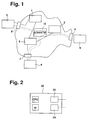
- the network has nodes 1, 2 and 3 on which are ISP nodes (Internet service provider nodes, Internet service provider nodes) acts. These are conventional internet nodes with the described delay in forwarding Data.
- the network also has user facilities (local nodes) 4, 5 and 6 for data, Voice, video, audio, etc., and these last nodes are each one in the example Network users assigned and give the user access to the Internet (more precisely: to the first ISP node of the user's Internet provider).
- IP nodes should have several logical external connections to the public network can communicate in order to use different data sources (content providers) or with to be able to communicate with other users. E.g. Downloading a file or application during a Videophone is conducted.
- Fig. 1 devices 7, 8 and 9 are shown on the edge of the network, the ADSL devices in the example but could also be SDSL devices instead. These devices stand with the local nodes 4, 5, 6 in connection. 1 shows a further node 10, which is designated as an SDH / ATM node. In the case of smaller networks, this may be a single ATM node (switching center for ATM traffic) act, for larger networks this node 10 represents an ATM network, that can contain multiple ATM nodes (multiple ATM switches).
- ADSL technology is used between nodes 4, 5 and 6 and the ATM network 10 used.
- ADSL technology allows ATM traffic to be transmitted at high bit rate and provides thus the necessary flexibility in routing is available, i.e. because of the high As long as it is not fully utilized, transmission capacity can carry out further data traffic from the individual channels.
- FIG. 1 shows dashed lines with ATM connections for time-critical traffic, with Solid lines are point-to-point connections to the ISP for non-time-critical traffic (conventional Internet traffic).
- Table 1 applies to the definition of the neighborhood of the individual nodes in FIG. 1. Neighborhood table for the case of IP connections and IP over ATM connections node Neighbors via IP connections Neighbors via ATM 1 5, 3 2, 3, 4, 5, 6 2nd 3.6 1,3,4,5,6 3rd 1,2,4 1,2,4,5,6 4th 3rd 1,2,3,5,6 5 1 1,2,3,4,6 6 2nd 1, 2, 3, 4, 5
- the nodes 1 and 2 as well as 2 and 3 are each connected in pairs with point-to-point connections (solid lines). (Node 1 is not connected to node 2 by such a connection.) This results in a routing table using only the permanent data connections drawn as a continuous line for IP data traffic on the one hand and those for ATM data traffic as dashed lines data connections shown, on the other hand, the ratios as shown in Table 2.
- This Shortening is made possible by the fact that the local node has the shortest in its own routing table Connection selects or via a proxy access the necessary information via a direct connection queries (this routing table can be configured and in the past existed exclusively for the local network, today it is replaced by a proxy access).
- This routing table will according to the invention for permanent, semi-permanent and signaled ATM connections or others Access e.g. extended via ISP for prioritized traffic or ISDN or ADSL etc.
- the computer nodes of the user devices are in accordance with the invention modified in comparison to the usual nodes for users.
- this measure is that, through appropriate planning, the expected Traffic can be considered and the least possible delay time and the smallest possible fluctuations in the transmission time can be ensured. Is also through this measure prevents that when a need arises for such a connection Traffic may be directed to a channel that is already very busy, causing again, for example due to increasing risk of collision, transmission delays or Data loss could occur.
- Synchronous transmission ensures the lowest possible delays.
- One achieves the invention But also advantages with asynchronous transmission, if transmission capacity is reserved for the connection becomes. The reservation of the transmission capacity is guaranteed by the ATM network.
- FIG. 2 schematically shows a computer 20 of a user device, which is physically different from one conventional computer for communication with the Internet differs in that it is more than contains a single network card, namely a network card 22, as before, for the Internet, but on the output only non-time-critical data under the control of the computer program or are received, and a second network card 24 on which the computer program transfers the data conducts who are time-critical.
- the network cards mentioned are ADSL or ISDN cards, which are the Connection of the computer to the public telephone network and via this to the service provider for the Internet (via the network card 22 for non-time-critical traffic) or via the network card 24 for Establish time-critical traffic to the ATM node 10.
- the computer 20 contains a processor (CPU) and mass storage and working memory (M).
- the memory M also contains data and a program for Provision of a proxy service included, the normal address translation (as in the conventional Internet known) and the implementation of Internet addresses in permanent virtual connections and in Information for dial-up connections supports what is useful for the transmission of time-critical data.
- the ATM network can have a plurality of ATM network nodes.
- the ATM network is operated by User seen as a unit. From the perspective of the Internet user, the granularity of the ATM network remains hidden, but the granularity of the Internet can be experienced (trace, ping, etc.).
- the invention also includes methods and networks in which at least one Conventional Internet nodes for the additional transmission of time-critical messages, in the example of ATM data is trained.
- the node 1 of FIG. 1 is additionally Corresponding nodes 1 'redesigned in the manner according to the invention, in such a way that a user this Internet node can send time-critical messages via an additional virtual ATM connection this Internet node receives these time-critical messages at a separate logical input (logical separately from the non-time-critical data traffic), with high priority, i.e. with the lowest possible Delay, further processed and then on an ATM channel reserved for time-critical traffic forwarded.
- this forwarding takes place to an ATM node
- said internet node sends this ATM message directly to another user; in the latter case (possibly also in the former Case) this Internet node forms the function of a at the same time as its conventional Internet function ATM node or an ATM switching center.
- One for non-time-critical internet traffic and for Time-critical traffic of suitable nodes can also be formed in such a way that an existing one ATM switching center the functionality of a conventional Internet node is added and one Integration into the Internet is done.
- Devices 7, 8 and 9 can be implemented in ADSL or SDSL technology. They can be in the form of Plug-in cards can be built into the computers of the subscriber facilities or externally to the computer are connected and direct ATM traffic to data channels provided for this. These devices allow a data rate of up to 8 MBit per second. Without such ADSL devices, the ATM data rate is around 64 kbit per second for the ISDN network set up in Germany.
Landscapes
- Engineering & Computer Science (AREA)
- Computer Networks & Wireless Communication (AREA)
- Signal Processing (AREA)
- Quality & Reliability (AREA)
- Data Exchanges In Wide-Area Networks (AREA)
Applications Claiming Priority (2)
| Application Number | Priority Date | Filing Date | Title |
|---|---|---|---|
| DE19917666 | 1999-04-19 | ||
| DE19917666A DE19917666A1 (de) | 1999-04-19 | 1999-04-19 | Verfahren und Vorrichtung zum Bereitstellen von Internet-Diensten mit hoher Qualität |
Publications (2)
| Publication Number | Publication Date |
|---|---|
| EP1047281A2 true EP1047281A2 (fr) | 2000-10-25 |
| EP1047281A3 EP1047281A3 (fr) | 2004-02-25 |
Family
ID=7905102
Family Applications (1)
| Application Number | Title | Priority Date | Filing Date |
|---|---|---|---|
| EP00440105A Withdrawn EP1047281A3 (fr) | 1999-04-19 | 2000-04-14 | Procedé et dispositif pour mettre à disposition les services Internet avec qualité superieure |
Country Status (3)
| Country | Link |
|---|---|
| EP (1) | EP1047281A3 (fr) |
| CA (1) | CA2304891A1 (fr) |
| DE (1) | DE19917666A1 (fr) |
Families Citing this family (2)
| Publication number | Priority date | Publication date | Assignee | Title |
|---|---|---|---|---|
| US7261690B2 (en) | 2000-06-16 | 2007-08-28 | Bodymedia, Inc. | Apparatus for monitoring health, wellness and fitness |
| DE10060190A1 (de) * | 2000-12-04 | 2002-06-13 | Traian Internet Products Ag | Verfahren und Vorrichtung zur Festlegung der bereitzustellenden Bandbreite für eine IP-Verbindung |
Family Cites Families (4)
| Publication number | Priority date | Publication date | Assignee | Title |
|---|---|---|---|---|
| EP0830776B1 (fr) * | 1995-05-31 | 2001-11-07 | Siemens Aktiengesellschaft | Integration de reseaux informatiques et de reseaux de communication |
| DE19542780B4 (de) * | 1995-11-16 | 2014-07-24 | Nokia Solutions And Networks Gmbh & Co. Kg | Verfahren zur Integration des Zugangs zu Breitbanddiensten in bestehende Computerneztdienste |
| CA2236285C (fr) * | 1997-05-08 | 2003-09-16 | Hitachi Ltd. | Reseau et noeud de commutation dans lesquels des ressources peuvent etre reservees |
| US5996021A (en) * | 1997-05-20 | 1999-11-30 | At&T Corp | Internet protocol relay network for directly routing datagram from ingress router to egress router |
-
1999
- 1999-04-19 DE DE19917666A patent/DE19917666A1/de not_active Withdrawn
-
2000
- 2000-04-07 CA CA002304891A patent/CA2304891A1/fr not_active Abandoned
- 2000-04-14 EP EP00440105A patent/EP1047281A3/fr not_active Withdrawn
Also Published As
| Publication number | Publication date |
|---|---|
| DE19917666A1 (de) | 2000-10-26 |
| EP1047281A3 (fr) | 2004-02-25 |
| CA2304891A1 (fr) | 2000-10-19 |
Similar Documents
| Publication | Publication Date | Title |
|---|---|---|
| DE69828112T2 (de) | Rahmenrelaisgeschalteter Datendienst | |
| DE69612302T2 (de) | Verfahren und anordnung zur verwaltung von netzwerkbetriebsmitteln | |
| DE69838126T2 (de) | Verkehrsverwaltung für geschalteten Frame Relay Datendienst | |
| DE60017622T2 (de) | Auf RSVP-basiertes Tunnelprotokoll zum Bereitstellen von integrierten Diensten | |
| DE69811622T2 (de) | Verfahren und Vorrichtung zur Bandbreitenverwaltung in einem Datenübertragungsnetz | |
| DE69601374T2 (de) | Verfahren und vorrichtung zur synchronisierung von datenubertragungen mit wahlverbindungen in einem netzwerk | |
| DE60018799T2 (de) | Netzwerkvermittlung mit paketfolgesteuerung | |
| DE69919569T2 (de) | Verwaltung von verbindungsorientierten diensten über das internet-protokoll | |
| EP0929884B1 (fr) | Procede de transmission de donnees dans un reseau de telecommunication et commutateur pour la mise en oeuvre de ce procede | |
| EP1428408A2 (fr) | Transmission d'informations dans un reseau de communication oriente paquets | |
| EP1133112B1 (fr) | Procédé pour distribuer la charge du transfert des données d'un réseau de communication et réseau de communication | |
| DE19645368A1 (de) | Verfahren zur Kommunikationseinrichtung zur Übertragung von Daten in einem Telekommunikationsnetz | |
| DE60217685T2 (de) | System und verfahren zum vermitteln von daten unter verwendung eines gemeinsamen koppelfeldes | |
| DE102012207952A1 (de) | Verfahren zur Übertragung von Daten in einem paketorientierten Kommunikationsnetzwerk und entsprechend eingerichtetes Teilnehmergerät an dem Kommunikationsnetzwerk | |
| DE60000326T2 (de) | Verkehrsformer zur Aufnahme von OAM Zellen ohne Jitter oder Verzögerung zu erreichen | |
| DE60035836T2 (de) | Dynamische Burst-Zusammenstellung basiert auf voll/teilweis gemeinsame Mehrfachübertragungsentitäten | |
| WO2004032428A2 (fr) | Procede pour conserver partiellement l'ordre des paquets dans une commutation de paquets sans connexion avec routage alternatif | |
| DE69635394T2 (de) | System und Verfahren zur Kapazitätsverwaltung in Mehrdienste-Netzen | |
| EP1249154A1 (fr) | Procede et dispositif de commande d'acces a un reseau de communication | |
| DE19919177A1 (de) | Netzwerk mit mehreren Netzwerk-Clustern zur drahtlosen Übertragung von Paketen | |
| EP1047281A2 (fr) | Procedé et dispositif pour mettre à disposition les services Internet avec qualité superieure | |
| DE3743685A1 (de) | Koppelfeld und koppelfeldsteuerung fuer ein vermittlungssystem | |
| EP1103122B1 (fr) | Procede pour devier des paquets de donnes d'un reseau emetteur de paquets sur au moins un autre reseau | |
| DE602004009397T2 (de) | Gateway zum Verbinden eines passiven und aktiven Netzes | |
| EP0998093B1 (fr) | Procédé de transmission de données d'un canal retour entre un terminal et un serveur dans un réseau de commmutation par paquets |
Legal Events
| Date | Code | Title | Description |
|---|---|---|---|
| PUAI | Public reference made under article 153(3) epc to a published international application that has entered the european phase |
Free format text: ORIGINAL CODE: 0009012 |
|
| AK | Designated contracting states |
Kind code of ref document: A2 Designated state(s): AT BE CH CY DE DK ES FI FR GB GR IE IT LI LU MC NL PT SE |
|
| AX | Request for extension of the european patent |
Free format text: AL;LT;LV;MK;RO;SI |
|
| PUAL | Search report despatched |
Free format text: ORIGINAL CODE: 0009013 |
|
| RIC1 | Information provided on ipc code assigned before grant |
Ipc: 7H 04L 12/56 B Ipc: 7H 04L 12/28 B Ipc: 7H 04L 29/06 B Ipc: 7H 04Q 3/66 B Ipc: 7H 04Q 11/04 A |
|
| AK | Designated contracting states |
Kind code of ref document: A3 Designated state(s): AT BE CH CY DE DK ES FI FR GB GR IE IT LI LU MC NL PT SE |
|
| AX | Request for extension of the european patent |
Extension state: AL LT LV MK RO SI |
|
| 17P | Request for examination filed |
Effective date: 20040128 |
|
| 17Q | First examination report despatched |
Effective date: 20040325 |
|
| AKX | Designation fees paid |
Designated state(s): AT BE CH CY DE DK ES FI FR GB GR IE IT LI LU MC NL PT SE |
|
| STAA | Information on the status of an ep patent application or granted ep patent |
Free format text: STATUS: THE APPLICATION IS DEEMED TO BE WITHDRAWN |
|
| 18D | Application deemed to be withdrawn |
Effective date: 20040806 |