EP1049018B1 - Modulare Verbindungsarchitektur für erweiterbare Mehrrechnermaschine, die eine virtuelle Bushierarchie mit verschiedenen Stufen, wobei in jeder Stufe das gleiche Grundelement enthalten ist, anwendet - Google Patents
Modulare Verbindungsarchitektur für erweiterbare Mehrrechnermaschine, die eine virtuelle Bushierarchie mit verschiedenen Stufen, wobei in jeder Stufe das gleiche Grundelement enthalten ist, anwendet Download PDFInfo
- Publication number
- EP1049018B1 EP1049018B1 EP00401036A EP00401036A EP1049018B1 EP 1049018 B1 EP1049018 B1 EP 1049018B1 EP 00401036 A EP00401036 A EP 00401036A EP 00401036 A EP00401036 A EP 00401036A EP 1049018 B1 EP1049018 B1 EP 1049018B1
- Authority
- EP
- European Patent Office
- Prior art keywords
- level
- ncs
- interconnection
- multiprocessor
- connection
- Prior art date
- Legal status (The legal status is an assumption and is not a legal conclusion. Google has not performed a legal analysis and makes no representation as to the accuracy of the status listed.)
- Expired - Lifetime
Links
Images


Classifications
-
- G—PHYSICS
- G06—COMPUTING OR CALCULATING; COUNTING
- G06F—ELECTRIC DIGITAL DATA PROCESSING
- G06F12/00—Accessing, addressing or allocating within memory systems or architectures
- G06F12/02—Addressing or allocation; Relocation
- G06F12/08—Addressing or allocation; Relocation in hierarchically structured memory systems, e.g. virtual memory systems
- G06F12/0802—Addressing of a memory level in which the access to the desired data or data block requires associative addressing means, e.g. caches
- G06F12/0806—Multiuser, multiprocessor or multiprocessing cache systems
- G06F12/0813—Multiuser, multiprocessor or multiprocessing cache systems with a network or matrix configuration
-
- G—PHYSICS
- G06—COMPUTING OR CALCULATING; COUNTING
- G06F—ELECTRIC DIGITAL DATA PROCESSING
- G06F15/00—Digital computers in general; Data processing equipment in general
- G06F15/16—Combinations of two or more digital computers each having at least an arithmetic unit, a program unit and a register, e.g. for a simultaneous processing of several programs
- G06F15/163—Interprocessor communication
- G06F15/173—Interprocessor communication using an interconnection network, e.g. matrix, shuffle, pyramid, star, snowflake
- G06F15/17337—Direct connection machines, e.g. completely connected computers, point to point communication networks
Definitions
- the present invention relates to the field of multiprocessor machines with symmetrical architecture comprising memories with uniform access time and cache coherence, better known under the terminology "CC-UMA SMP" (Cache-Coherent - Uniform Memory Symetrical Multi-Processor Access).
- CC-UMA SMP Cache-Coherent - Uniform Memory Symetrical Multi-Processor Access
- It relates more particularly to an interconnection architecture between a large number of processors organized in clusters of multiprocessor modules, also called nodes of a computer system.
- one or more cache levels of each processor stores newly acquired data that can be reused quickly, thus avoiding contentions for subsequent memory accesses.
- a processor When a processor does not find the desired data in its cache, it sends the address of the memory area which it wants to read the data via the system bus.
- M odified state E xclusive state
- S hare state S hare state
- I nvalide state
- the management of exchanges between the memories of a computer system consists in updating or invalidating copies of a memory block.
- the state " M " corresponds to the case where a specific cache is the only holder of a modified copy of a block, called reference copy, and where there are no other valid copies in the system.
- the cache holding the copy having the state “ M " is responsible for providing and updating the central memory if it wants to get rid of this copy.
- a copy having the exclusive state " E " is also the reference copy held by a cache, but in this case, the central memory has an updated copy.
- the shared state " S " refers to a copy possibly having several holders, but a copy of which is up to date in the central memory. Holders may be potential depending on the management strategy adopted.
- the invalid copy state " I " is found when the cache has a copy of the block that is not valid.
- a processor wants to access a block in state " I ", its cache sends a request on the system bus to acquire the block.
- the other caches and the central memory coupled to the system bus become aware of this request and react according to the state of the copy that the corresponding memory has.
- a cache has the block in the modified state " M ", it will provide the block to the system bus, thus allowing the processor requesting access to the data and its cache to acquire the reference copy.
- Such management is particularly suitable when several processors frequently modify the data transmitted via the system bus.
- This type of management is reliable as long as the system bus is not saturated by too many processors that issue a large number of memory access requests at the same time.
- This interconnect architecture uses a packet switching protocol to separate requests and replies and to allow transactions between multiple processors to overlap on the bus.
- the memory access requests (commands and addresses) are broadcast to all the nodes for consultation of their directories in order to locate the data that a processor of the system wants to access.
- the memory access time is independent of the node where the physical memory is located.
- interconnection in the address space there are two types of interconnection depending on the type of information processed: an interconnection in the address space and an interconnection in the data space.
- This architecture requires on the other hand an "active" backplane, that is to say having logic components, as opposed to a “passive” backplane without a logic component.
- the invention is intended to overcome these disadvantages.
- An object of the present invention is to provide a modular interconnection architecture for absorbing the traffic of all multiprocessor modules with a variable capacity in number of processors.
- the invention firstly provides a modular interconnect architecture for an extensible multiprocessor machine, based on a virtual bus hierarchy, comprising a determined number of multiprocessor modules organized in nodes and distributed over at least two interconnection levels. a first level corresponding to the interconnection of the multiprocessor modules inside a node and a second level corresponding to the interconnection of the nodes with each other; the first interconnect level comprising connection agents connecting the multiprocessor modules to each other and managing the transactions between the multiprocessor modules, the second interconnect level having external connection nodes connecting the nodes to each other and managing the transactions between the nodes .
- connection agents and the external connection nodes respectively have the same basic structure, the same external interface and implement the same cache coherence management protocol. processors.
- the subject of the invention is a method of tracking the data blocks inside an interconnection architecture defined above, characterized in that it consists, in the first level, of not duplicating in the memories associative than the modified data blocks in the caches of the multiprocessor modules and to follow only those modified blocks inside the node.
- the method consists, in the second level, of duplicating in the associative memories of connection agents of each external connection node that the modified and exported blocks, reciprocally imported, and to follow only these exported modified blocks, reciprocally imported, between each knot of the machine.
- the third object of the invention is a method for extending the capacity of a machine comprising a first determined number of first level processors organized in a first predetermined number of multiprocessor modules and able to be inserted in an interconnection architecture. as defined above, characterized in that it consists in removing one of the first-level multiprocessor modules from its connection agent and in connecting via said free connection agent a second determined number of processors organized in a second predetermined number of multiprocessor modules equally suitable to fit into an interconnection architecture as defined above.
- the fourth object of the invention is an extensible multinode multiprocessor machine, characterized in that it comprises an interconnection architecture as defined above.
- the invention has the particular advantage of being modular and extensible at will.
- NT and UNIX are registered trademarks and respectively belong to Microsoft and X / Open.
- the structure of the previously defined base brick is generally supported by the same silicon chip.
- the present invention is freed from the other hand an active "crossbar" in the backplane (active backplane).
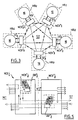
- the figure 1 schematically illustrates an interconnection architecture for a quasi-UMA machine, typically located on the backplane of a computer cabinet.
- Each multiprocessor module QPi has four processors and their respective caches, not shown, and form a quad-processor module.
- the four-processor modules QPi are connected to the interconnection module M1 respectively by means of NCSi network connection agents.
- Xli (eXternal Interface) defines the external interfaces between the QPi quad-processor modules and their respective NCSi connection agents. They are respectively symbolized by a line segment in broken lines.
- the assembly formed by the quad-processor module QPi, its connection agent NCSi and its external interface Xli, constitutes a "basic brick" of the first level of the interconnection architecture according to the invention.
- the interconnection module Ml in the illustrated example comprises five basic first level bricks QBi, delimited respectively by a discontinuous closed line.
- Each basic brick QBi is connected to the other four via respectively four point-to-point links, not referenced to avoid overloading the figure.
- These links are considered at the protocol level as virtual buses. There are thus, in the example described, four virtual buses and therefore four levels of interleaving processed by each NCSi connection agent. Each bus thus allows four accesses, or transactions, at each clock cycle.
- the protocol according to the invention makes it possible to manage the transactions transmitted on the interconnection module Ml every four clock cycles.
- each NCSi connection agent of the architecture according to the invention comprises an associative or quasi-associative memory DDi, also known in the English terminology of "duplicate directory", delimited by a discontinuous closed line.
- Each associative memory DDi contains a copy of the cache contents of the processors of a basic QBi brick to which it is dedicated.
- the contents of the caches are organized according to four levels of interleaving dd0 to dd3 corresponding respectively to the four processors of the basic brick QBi.
- Each DDi memory thus contains all directories, or "directories" in English terminology, four processors QBi modules, accessible by an address.
- the associative memories DDi are of fixed size determined according to the number of processors of the basic brick QBi and the state of the memories DDi is indicative of the presence of the last blocks of data modified in the caches of the basic brick QBi.
- Each associative memory DDi thus plays the role of a filter vis-à-vis the basic brick QBi to which it is dedicated in that a transaction is performed only when an associative memory DDi includes the last modified copy from block "a".
- the dotted lines embody the path, or "snooping" in English terminology, followed by the protocol to consult the state of associative memories DDi before starting a transaction.
- connection agent NCSi comprises, on the right of the figure, the external interface XI to connect to a quad processor module QPi.
- the protocol according to the invention is based on the principle that only modified blocks are duplicated in the associative memories DDi NCSi connection agents.
- NCS connection agents conform to the figure 2 interconnect and process the transaction flow typically exchanged between 4 to 20 processors.
- this architecture defines a first level Ml of a modular architecture according to the invention.
- the figure 3 illustrates a pattern similar to that of the figure 1 , a second level of the modular architecture defined above which integrates the first level Ml which can be considered as a base brick for the second level SI.
- the interconnection system SI behaves vis-a-vis the bricks HBj of the second level as the interconnection module Ml vis-à-vis bricks QBi the first level.
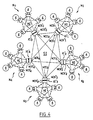
- the figure 4 schematically illustrates an architecture similar to that illustrated in figure 3 developed on both Ml and SI levels. It typically interconnects up to 80 processors for second level basic bricks HBj respectively comprising 16 processors. Each second-level basic brick HBj comprises respectively four basic first-level bricks QBi which themselves comprise respectively 4 processors.
- the extension of the capacity of a machine consists in increasing the number of its processors.
- the interconnection system SI is connected to the interconnection module M1 via a connection agent NCS "0 arranged head-to-tail with respect to the agent NCS'0, the external interface X1'0 being situated physically between the first and the second connecting agent NCS'0 and NCS "0.
- connection agents NCS'j and NCS "j, mounted head to tail, and their interface Xl'j define an external connection node NCEj through which the transactions between the different processors of the first level Ml and those of the second level IF pass through. according to the protocol according to the invention.
- the protocol according to the invention makes it possible to manage the coherence of the different cache memories distributed over the two interconnection levels M1 and S1 by consulting the respective associative memories of the agents NCS '1 and NCS 1.
- One of the peculiarities of the protocol according to the invention is its tracking capability for both a basic brick QBi of the first level Ml and for all of the basic bricks QBi and HBj of the two levels Ml and SI.
- the latency of the second level SI is chosen greater than that of the first level Ml. It is typically equal to one clock cycle for the first level M1 and equal to two clock cycles for the second level S1.
- the modified blocks are duplicated.
- tracking is only performed on the modified and exported blocks.
- the export of modified blocks means the direction from the first level Ml to the second level SI, or from the lower level to the level superior.
- the import of modified blocks means the direction from the second level SI to the first level Ml, or from the upper level to the lower level.
- the external connection node NCEj then behaves as an external agent when it is parameterized in external mode.
- the acknowledgment of an invalidation command is the aggregate, in the external agent of the requesting module, of partial acknowledgments sent by the external agents of the other nodes Nj.
- the NCS agent "has the same function, for the second level (16 processors), as the NCS agent for the first level (4 processors).
- the NCS'j agent is arranged in the same place as an NCSi agent and processes traffic from 64 processors instead of the 4 processors processed by the NCSi agent.
- NCSi NCS'j associative memory duplication of 4 processors' caches partial duplication of 64 caches (only imported and modified blocks are accurately tracked nullification filtered propagation to the caches of the 4 processors of the node propagation to the 64 processors of the second level (explicit warning) reading and invalidation the supply of the data is conditioned by the acknowledgment of the invalidation its acknowledgment waits for the acknowledgment of the nodes of the system; no data blocking
- the requested block When a requested block is identified in one of the associative memories DDi of the basic blocks QBi, the requested block is "exported" from the cache containing the last copy of the block, updated, to the requesting processor. The new valid copy is then in the cache of the requesting processor.
- the principle is symmetrical for imported blocks.
- the bandwidth can remain constant for both levels and absorb disparate traffic between the different basic bricks of first and second.
- second level QBi and HBj The principle is symmetrical for imported blocks.
- the memory coherence management protocol according to the invention is thus capable of allowing the architecture to absorb transaction traffic in the worst case where four of the five second-level bricks HBj would simultaneously search for a block in the fifth brick.
- the figure 7 illustrates the block diagram of a NCSi connection agent according to the invention in the control and addressing space.
- a first block RL realizes a logical classification of the external requests received at the entry of the agent (on the left according to the figure). Queries are ordered in the same way regardless of the base block. For each of the entries, the RL block has the capacity to take into account several received requests simultaneously to avoid the loss of requests in case of unexpected termination of the request flow.
- Logic filters RFi respectively receive the requests, in the order imposed by the block RL. They filter respectively all requests assigned to the same level of interleaving i and the same system identifier of the basic brick.
- ARBi arbitration blocks are respectively coupled at the output of the RFi filters. They select a query according to an algorithm determined, for example, a circular algorithm of the same type, "Round Robin Algorithm" in English terminology, in which the last elected query becomes the least priority.
- Associative memories DDi are respectively coupled at the output of arbitration units ARBi.
- Each associative memory DDi contains a copy ddij of the contents of the cache of each processor of a basic brick.
- the associative memory DD "j and DD" j contain respectively a copy of the exported modified blocks or a copy of the modified blocks imported according to the direction of the transaction between the two levels Ml and SI.
- DDEAMi extensions to associative memories DDi are coupled to their outputs and are intended to delay transactions intended to transit on the bus until the bus is free (idle).
- a multiplexer MUX1 on the right of the figure, receives the external requests of the four queues Fi and after validation by the memory extensions DDEAMi, the queries are issued, leaving the NCS connection agent also corresponding to the output of the multiplexer MUX1, one by one on the bus of the recipient base brick.
- UAMi blocks update the DDi associative memories. There is one block per associative memory. These UAMi blocks store the updates that must be made in the associative memories DDi and they are executed when there is no traffic or, simultaneously, by all the basic bricks.
- An IA logic block receives the responses concerning the internal requests, issued by the ARBi arbitration blocks, and indicates for each of them whether they have succeeded "hit” or failed "miss” (differ: wait its turn or try again for cause of conflict).
- An ESA block receives the responses to the DDi associative memories and distributes these results to the other basic building blocks.
- An HVB block receives information on the state of filling of certain memory blocks such as the UAMi, DDEAMi blocks and informs the other basic blocks in the event of the next overflow of one of these blocks so that they stop issuing messages. queries to these blocks.
- a partial write request (PartialWrite) is seen by a remote base brick as a read and disable request.
- a write generator block WG collects the requests sent on the bus, at the output of the connection agent, also corresponding to the output of the multiplexer MUX1, and updates the local base brick by merging the data that has been written. partially and the data that has been read.
- ORIPi blocks store all the operations requested by a given basic brick (read request waiting for data, invalidation request pending acknowledgment, ). These blocks examine the requests intended for each node Nj and emanating from a basic brick, not shown and which would be on the right in the figure, to detect a collision between the outgoing local requests (outbond) being processed and the incoming remote requests (inbond).
- the respective outputs to the ORIPi and IRIPi blocks are multiplexed by MUXi multiplexers whose outputs are respectively coupled to the inputs of the UAMi blocks.
- the updates of the memories DDi are carried out either on a transaction emanating from the external requests via the IRIPi blocks and which thus return on the connection agent NCS (at the top, to the left of the figure), for example when a processor of a node Nj determined wants to read a determined block, either on a transaction emanating from the internal requests via the ORIPi block and coming out of the NCS connection agent (bottom left of the figure), for example when a block is "expelled cache cache of a given processor.
- a CM block collects the system identifier of the base brick where the desired memory space is located (the cache of the processor hosting the request object block is there!).
- An SAH block receives on a first set of entries the responses to the consultations of the other basic building blocks. It summarizes these responses, which validates or invalidates anticipated external readings and also whether a request will be honored internally or externally.
- the inputs of the local SAH block correspond to the outputs of the ESA blocks of the other basic bricks.
- a multiplexer MUX3, bottom left of the figure receives the internal requests and the block write operations related to partial writes issued by the block WG. It allows to serialize the requests which are then diffused towards the four other basic bricks, respectively on the four links connecting the emitting base brick to the other bricks, via respectively four REGO output registers to REG3.
- a fifth register REGin is the input register of the NCS agent. It receives internal requests arriving on the basic brick. It is controlled by the information delivered by the logic block IA.
- the data processing is controlled by the address space of the NCS connection agent. This space oversees all incoming and outgoing data flows and performs translation between external and internal data tags as needed.
- the interface XI is a demultiplexed interface and therefore comprises a command / address part and a data part.
- the read response In order to prevent a read response from duplicating an invalidation command, the read response must wait until all commands, serialized before the read request, have been issued on the system bus of the quad processor module.
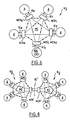
- the figure 8 illustrates an alternative embodiment of an architecture according to the invention.
- This variant corresponds to an intermediate configuration limited to the interconnection between two nodes Nj of five quad processor modules QPi each.
- the latency of the system is improved and the bandwidth XI 'makes it possible to support an equidistribution of the data between the two nodes Nj. It is thus possible to extend the number of processors from 20 to 32 on the same operating system support of a NUMA or quasi-UMA machine.
Landscapes
- Engineering & Computer Science (AREA)
- Physics & Mathematics (AREA)
- Theoretical Computer Science (AREA)
- Computer Hardware Design (AREA)
- Mathematical Physics (AREA)
- General Engineering & Computer Science (AREA)
- General Physics & Mathematics (AREA)
- Software Systems (AREA)
- Memory System Of A Hierarchy Structure (AREA)
- Multi Processors (AREA)
Claims (12)
- Modulare Verbindungsarchitektur für erweiterbare Multiprozessormaschine, die auf einer Hierarchie mit virtuellem Bus basiert, mit einer bestimmten Anzahl von Multiprozessor-Modulen (QPi), die in Knoten (Nj) organisiert sind und auf wenigstens zwei Verbindungsebenen verteilt sind: einer ersten Ebene (MI), die der Verbindung der Multiprozessor-Module (QPi) in einem Knoten (Nj) entspricht, und einer zweiten Ebene (SI), die der Verbindung der Knoten (Nj) untereinander entspricht; wobei die erste Verbindungsebene (MI) Verbindungsagenten (NCSi) enthält, die die Multiprozessor-Module (QPi) miteinander verbinden und die Transaktionen zwischen den Multiprozessor-Modulen (QPi) steuern, und wobei die zweite Verbindungsebene (SI) externe Verbindungsknoten (NCE) enthält, die die Knoten (Nj) miteinander verbinden und die Transaktionen zwischen den Knoten (Nj) steuern, dadurch gekennzeichnet, dass die Verbindungsagenten (NCSi) und die externen Verbindungsknoten (NCEj) jeweils die gleiche Basisstruktur und die gleiche externe Schnittstelle (XI) besitzen und dasselbe Protokoll für die Steuerung der Kohärenz der Cache-Speicher der Prozessoren ausführen.
- Architektur nach Anspruch 1, dadurch gekennzeichnet, dass jeder externe Verbindungsknoten (NCEj) zwei gleiche Verbindungsagenten (NCSi) enthält, die zueinander entgegengesetzt gekoppelt sind; wobei einer der zwei Agenten (NCS'j) jene Transaktionen empfängt und filtert, die von dem Knoten (Nj), mit dem er gekoppelt ist, ausgesendet werden, und der andere Agent (NCS"j) jene Transaktionen empfängt und filtert, die von den anderen Knoten (Nj), mit denen er gekoppelt ist, ausgesendet werden.
- Architektur nach Anspruch 1, dadurch gekennzeichnet, dass jeder Verbindungsagent (NCSi) einen Assoziativspeicher (DDi) mit fester Größe, die in Abhängigkeit von der Anzahl der Prozessoren des Multiprozessor-Moduls (QPi), mit dem der Verbindungsagent (NCSi) gekoppelt ist, festgelegt ist, enthält; wobei der Zustand der Speicher (DDi) das Vorhandensein der letzten modifizierten Datenblöcke in den Cache-Speichern des Multiprozessor-Moduls (QPi) angibt.
- Architektur nach Anspruch 2, dadurch gekennzeichnet, dass die Verbindungsagenten (NCS'j und NCS"j) jeweils einen Assoziativspeicher (DD'j und DD"j) mit fester Größe, die in Abhängigkeit von der Anzahl der Prozessoren der Multiprozessor-Module (HBj), mit denen sie gekoppelt sind, festgelegt ist, enthält; wobei der Zustand der Assoziativspeicher (DD'j und DD"j) das Vorhandensein der letzten exportierten bzw. importierten modifizierten Datenblöcke angibt.
- Architektur nach Anspruch 2, dadurch gekennzeichnet, dass der erste und der zweite Verbindungsagent (NCS'j und NCS"j), die zueinander entgegengesetzt gekoppelt sind, nur Transaktionen für die Blöcke akzeptieren, die in ihren jeweiligen Assoziativspeichern (DD'j und DD"j) modifiziert worden sind; wobei die modifizierten Datenblöcke im ersten Verbindungsagenten (NCS'j) zu dem oder den anfordernden Multiprozessor-Modulen exportiert werden bzw. die modifizierten Datenblöcke im zweiten Verbindungsagenten (NCS") von dem oder den Modulen, die die Blöcke enthalten, importiert werden.
- Architektur nach einem der Ansprüche 1 bis 5, dadurch gekennzeichnet, dass die Latenzzeit der zweiten Verbindungsebene (SI) gleich der doppelten Latenzzeit der ersten Verbindungsebene (MI) ist.
- Verfahren zum Verfolgen von Datenblöcken in einer Verbindungsarchitektur nach einem der Ansprüche 1 bis 6, dadurch gekennzeichnet, dass es auf der ersten Ebene darin besteht, in den Assoziativspeichern (DDi) nur die in den Cache-Speichern der Multiprozessor-Module (QPi) modifizierten Datenblöcke zu verdoppeln und nur diese modifizierten Blöcke innerhalb des Knotens (Nj) zu verfolgen.
- Verfahren zum Verfolgen von Datenblöcken in einer Verbindungsarchitektur nach einem der Ansprüche 1 bis 6, dadurch gekennzeichnet, dass es auf der zweiten Ebene (SI) darin besteht, in den Assoziativspeichern (DD'j und DD"j) der Verbindungsagenten (NCS'j und NCS"j) jedes externen Verbindungsknotens (NCEj) nur die modifizierten und exportierten bzw. importierten Blöcke zu verdoppeln und nur diese exportierten bzw. importierten modifizierten Blöcke zwischen jedem Knoten (Nj) der Maschine zu verfolgen.
- Verfahren zum Erweitern der Kapazität einer Maschine, die eine erste bestimmte Anzahl von Prozessoren einer ersten Ebene (MI), die in einer ersten bestimmten Anzahl von Multiprozessor-Modulen (QPi) organisiert sind und in eine Verbindungsarchitektur nach einem der Ansprüche 1 bis 6 eingefügt werden können, enthält, dadurch gekennzeichnet, dass es darin besteht, eines der Multiprozessor-Module (QPi) der ersten Ebene aus seinem Verbindungsagenten (NCSi) zu entnehmen und über diesen freigemachten Verbindungsagenten eine zweite bestimmte Anzahl von Prozessoren zu verbinden, die in einer zweiten bestimmten Anzahl von Multiprozessor-Modulen organisiert sind, die ebenfalls in eine Verbindungsarchitektur nach einem der Ansprüche 1 bis 6 eingefügt werden können.
- Verfahren nach Anspruch 9, dadurch gekennzeichnet, dass es dann, wenn die zweite bestimmte Anzahl von Prozessoren in einer zweiten bestimmten Anzahl von Multiprozessor-Modulen der zweiten Ebene (SI) organisiert ist, darin besteht, sie mit dem Verbindungsagenten (NCSi) der ersten bestimmten Anzahl von Prozessoren der ersten Ebene (MI) über einen der Verbindungsagenten (NCS"j) der zweiten Ebene zu verbinden.
- Verfahren nach Anspruch 10, dadurch gekennzeichnet, dass es dann, wenn die zweite bestimmte Anzahl von Prozessoren ebenfalls zur ersten ebene (MI) gehört, darin besteht, die jeweiligen Verbindungsagenten (NCS') mit der ersten und der zweiten bestimmten Anzahl von Prozessoren zu verbinden; wobei die zweite Ebene (SI) zu einer einzigen Verbindung zusammengefasst ist.
- Erweiterbare Mehrknoten-Multiprozessormaschine, dadurch gekennzeichnet, dass sie eine Verbindungsarchitektur nach einem der Ansprüche 1 bis 6 enthält.
Applications Claiming Priority (2)
| Application Number | Priority Date | Filing Date | Title |
|---|---|---|---|
| FR9905266A FR2792745B1 (fr) | 1999-04-26 | 1999-04-26 | Architecture d'interconnexion modulaire pour machine multiprocesseur extensible, mettant en oeuvre une hierarchie de bus virtuelle a plusieurs niveaux et la meme brique de base pour tous les niveaux |
| FR9905266 | 1999-04-26 |
Publications (2)
| Publication Number | Publication Date |
|---|---|
| EP1049018A1 EP1049018A1 (de) | 2000-11-02 |
| EP1049018B1 true EP1049018B1 (de) | 2008-12-03 |
Family
ID=9544865
Family Applications (1)
| Application Number | Title | Priority Date | Filing Date |
|---|---|---|---|
| EP00401036A Expired - Lifetime EP1049018B1 (de) | 1999-04-26 | 2000-04-13 | Modulare Verbindungsarchitektur für erweiterbare Mehrrechnermaschine, die eine virtuelle Bushierarchie mit verschiedenen Stufen, wobei in jeder Stufe das gleiche Grundelement enthalten ist, anwendet |
Country Status (4)
| Country | Link |
|---|---|
| US (1) | US6996681B1 (de) |
| EP (1) | EP1049018B1 (de) |
| DE (1) | DE60040944D1 (de) |
| FR (1) | FR2792745B1 (de) |
Families Citing this family (11)
| Publication number | Priority date | Publication date | Assignee | Title |
|---|---|---|---|---|
| WO2002045359A1 (en) * | 2000-11-29 | 2002-06-06 | Telefonaktiebolaget Lm Eriksson Publ | Method and apparatus for forwarding of telecommunications traffic |
| US8185602B2 (en) | 2002-11-05 | 2012-05-22 | Newisys, Inc. | Transaction processing using multiple protocol engines in systems having multiple multi-processor clusters |
| JP2007115223A (ja) * | 2005-09-20 | 2007-05-10 | Sharp Corp | プロセッサおよびマルチプロセッサ構成方法 |
| US7941499B2 (en) * | 2007-03-06 | 2011-05-10 | Freescale Semiconductor, Inc. | Interprocessor message transmission via coherency-based interconnect |
| US8140719B2 (en) * | 2007-06-21 | 2012-03-20 | Sea Micro, Inc. | Dis-aggregated and distributed data-center architecture using a direct interconnect fabric |
| US20110145837A1 (en) * | 2009-12-14 | 2011-06-16 | Bower Kenneth S | Filtering Broadcast Recipients In A Multiprocessing Environment |
| CN103473031B (zh) * | 2013-01-18 | 2015-11-18 | 龙建 | 协同并发式消息总线、主动构件组装模型及构件拆分方法 |
| US9728526B2 (en) | 2013-05-29 | 2017-08-08 | Sandisk Technologies Llc | Packaging of high performance system topology for NAND memory systems |
| US9703702B2 (en) * | 2013-12-23 | 2017-07-11 | Sandisk Technologies Llc | Addressing auto address assignment and auto-routing in NAND memory network |
| US10831658B2 (en) * | 2019-01-03 | 2020-11-10 | Intel Corporation | Read-with-invalidate modified data in a cache line in a cache memory |
| US11757612B2 (en) | 2021-10-29 | 2023-09-12 | Hewlett Packard Enterprise Development Lp | Communicating management traffic between baseboard management controllers and network interface controllers |
Family Cites Families (9)
| Publication number | Priority date | Publication date | Assignee | Title |
|---|---|---|---|---|
| US4491945A (en) * | 1982-06-25 | 1985-01-01 | At&T Bell Laboratories | Fast packet switch |
| US5105424A (en) * | 1988-06-02 | 1992-04-14 | California Institute Of Technology | Inter-computer message routing system with each computer having separate routinng automata for each dimension of the network |
| US4952930A (en) * | 1988-11-18 | 1990-08-28 | International Business Machines Corp. | Multipath hierarchical network |
| US5337414A (en) * | 1992-09-22 | 1994-08-09 | Unisys Corporation | Mass data storage and retrieval system |
| US5394555A (en) * | 1992-12-23 | 1995-02-28 | Bull Hn Information Systems Inc. | Multi-node cluster computer system incorporating an external coherency unit at each node to insure integrity of information stored in a shared, distributed memory |
| US5983326A (en) * | 1996-07-01 | 1999-11-09 | Sun Microsystems, Inc. | Multiprocessing system including an enhanced blocking mechanism for read-to-share-transactions in a NUMA mode |
| US5887138A (en) * | 1996-07-01 | 1999-03-23 | Sun Microsystems, Inc. | Multiprocessing computer system employing local and global address spaces and COMA and NUMA access modes |
| US5734922A (en) * | 1996-07-01 | 1998-03-31 | Sun Microsystems, Inc. | Multiprocessing system configured to detect and efficiently provide for migratory data access patterns |
| US6041376A (en) * | 1997-04-24 | 2000-03-21 | Sequent Computer Systems, Inc. | Distributed shared memory system having a first node that prevents other nodes from accessing requested data until a processor on the first node controls the requested data |
-
1999
- 1999-04-26 FR FR9905266A patent/FR2792745B1/fr not_active Expired - Fee Related
-
2000
- 2000-04-13 EP EP00401036A patent/EP1049018B1/de not_active Expired - Lifetime
- 2000-04-13 DE DE60040944T patent/DE60040944D1/de not_active Expired - Lifetime
- 2000-04-26 US US09/558,377 patent/US6996681B1/en not_active Expired - Lifetime
Also Published As
| Publication number | Publication date |
|---|---|
| EP1049018A1 (de) | 2000-11-02 |
| FR2792745A1 (fr) | 2000-10-27 |
| DE60040944D1 (de) | 2009-01-15 |
| US6996681B1 (en) | 2006-02-07 |
| FR2792745B1 (fr) | 2001-06-15 |
Similar Documents
| Publication | Publication Date | Title |
|---|---|---|
| US11908546B2 (en) | In-memory lightweight memory coherence protocol | |
| US6295598B1 (en) | Split directory-based cache coherency technique for a multi-processor computer system | |
| US7814279B2 (en) | Low-cost cache coherency for accelerators | |
| JP3722415B2 (ja) | 効率的なバス機構及びコヒーレンス制御を有する繰り返しチップ構造を有するスケーラブル共用メモリ・マルチプロセッサ・コンピュータ・システム | |
| US7334089B2 (en) | Methods and apparatus for providing cache state information | |
| US6128677A (en) | System and method for improved transfer of data between multiple processors and I/O bridges | |
| US6631448B2 (en) | Cache coherence unit for interconnecting multiprocessor nodes having pipelined snoopy protocol | |
| US7395379B2 (en) | Methods and apparatus for responding to a request cluster | |
| US5900015A (en) | System and method for maintaining cache coherency using path directories | |
| EP0817071B1 (de) | Multiprozessorsystem ausgestaltet zur Erkennung und zum effizienten Handhabung von Migrationsdatenzugriffsmustern | |
| US7003633B2 (en) | Methods and apparatus for managing probe requests | |
| FR2792745A1 (fr) | Architecture d'interconnexion modulaire pour machine multiprocesseur extensible, mettant en oeuvre une hierarchie de bus virtuelle a plusieurs niveaux et la meme brique de base pour tous les niveaux | |
| US7249224B2 (en) | Methods and apparatus for providing early responses from a remote data cache | |
| US7653790B2 (en) | Methods and apparatus for responding to a request cluster | |
| US7337279B2 (en) | Methods and apparatus for sending targeted probes | |
| US7103726B2 (en) | Methods and apparatus for managing probe requests | |
| CA2505016A1 (en) | Methods and apparatus for managing probe requests | |
| JP2001222517A (ja) | 方向分離二重リング構造を有する分散共有メモリ多重プロセッサシステム | |
| JP2002197047A (ja) | 入力/出力読出しデータがプロセッサローカルキャッシュに直接配置されるコンピュータシステム | |
| KR19990023119A (ko) | 분산된 공유 메모리 구조의 다중 프로세서 장치 | |
| Xiao et al. | Memory organization in multi-channel optical networks: NUMA and COMA revisited | |
| KR19980030039A (ko) | Pci버스를 이용한 분산공유메모리 컴퓨터 구조와 제어용 인터페이스카드 |
Legal Events
| Date | Code | Title | Description |
|---|---|---|---|
| PUAI | Public reference made under article 153(3) epc to a published international application that has entered the european phase |
Free format text: ORIGINAL CODE: 0009012 |
|
| AK | Designated contracting states |
Kind code of ref document: A1 Designated state(s): DE FR GB |
|
| AX | Request for extension of the european patent |
Free format text: AL;LT;LV;MK;RO;SI |
|
| RIN1 | Information on inventor provided before grant (corrected) |
Inventor name: AUTECHAUD, JEAN-FRANCOIS |
|
| 17P | Request for examination filed |
Effective date: 20010502 |
|
| AKX | Designation fees paid |
Free format text: DE FR GB |
|
| RTI1 | Title (correction) |
Free format text: MODULAR INTERCONNECTION ARCHITECTURE FOR EXPANDABLE MULTIPROCESSOR ENGINE, IMPLEMENTING A VIRTUAL BUS HIERARCHY COMPRISING A PLURALITY OF LEVELS, EACH LEVEL COMPRISING THE SAME B |
|
| GRAP | Despatch of communication of intention to grant a patent |
Free format text: ORIGINAL CODE: EPIDOSNIGR1 |
|
| RAP1 | Party data changed (applicant data changed or rights of an application transferred) |
Owner name: BULL SAS |
|
| GRAS | Grant fee paid |
Free format text: ORIGINAL CODE: EPIDOSNIGR3 |
|
| GRAA | (expected) grant |
Free format text: ORIGINAL CODE: 0009210 |
|
| AK | Designated contracting states |
Kind code of ref document: B1 Designated state(s): DE FR GB |
|
| REG | Reference to a national code |
Ref country code: GB Ref legal event code: FG4D Free format text: NOT ENGLISH |
|
| REF | Corresponds to: |
Ref document number: 60040944 Country of ref document: DE Date of ref document: 20090115 Kind code of ref document: P |
|
| PLBE | No opposition filed within time limit |
Free format text: ORIGINAL CODE: 0009261 |
|
| STAA | Information on the status of an ep patent application or granted ep patent |
Free format text: STATUS: NO OPPOSITION FILED WITHIN TIME LIMIT |
|
| 26N | No opposition filed |
Effective date: 20090904 |
|
| REG | Reference to a national code |
Ref country code: FR Ref legal event code: PLFP Year of fee payment: 17 |
|
| REG | Reference to a national code |
Ref country code: FR Ref legal event code: PLFP Year of fee payment: 18 |
|
| REG | Reference to a national code |
Ref country code: FR Ref legal event code: PLFP Year of fee payment: 19 |
|
| PGFP | Annual fee paid to national office [announced via postgrant information from national office to epo] |
Ref country code: DE Payment date: 20190621 Year of fee payment: 20 |
|
| PGFP | Annual fee paid to national office [announced via postgrant information from national office to epo] |
Ref country code: FR Payment date: 20190424 Year of fee payment: 20 |
|
| PGFP | Annual fee paid to national office [announced via postgrant information from national office to epo] |
Ref country code: GB Payment date: 20190429 Year of fee payment: 20 |
|
| REG | Reference to a national code |
Ref country code: DE Ref legal event code: R071 Ref document number: 60040944 Country of ref document: DE |
|
| REG | Reference to a national code |
Ref country code: GB Ref legal event code: PE20 Expiry date: 20200412 |
|
| PG25 | Lapsed in a contracting state [announced via postgrant information from national office to epo] |
Ref country code: GB Free format text: LAPSE BECAUSE OF EXPIRATION OF PROTECTION Effective date: 20200412 |