EP1049281A1 - TDMA-Mehrpunkt-zu-Punkt-System unter Verwendung einer besonderen Burststruktur und dazugehöriger Sender - Google Patents
TDMA-Mehrpunkt-zu-Punkt-System unter Verwendung einer besonderen Burststruktur und dazugehöriger Sender Download PDFInfo
- Publication number
- EP1049281A1 EP1049281A1 EP99440078A EP99440078A EP1049281A1 EP 1049281 A1 EP1049281 A1 EP 1049281A1 EP 99440078 A EP99440078 A EP 99440078A EP 99440078 A EP99440078 A EP 99440078A EP 1049281 A1 EP1049281 A1 EP 1049281A1
- Authority
- EP
- European Patent Office
- Prior art keywords
- burst
- bursts
- transmitters
- guard time
- transmitter
- Prior art date
- Legal status (The legal status is an assumption and is not a legal conclusion. Google has not performed a legal analysis and makes no representation as to the accuracy of the status listed.)
- Granted
Links
- 230000005540 biological transmission Effects 0.000 claims abstract description 24
- 238000000034 method Methods 0.000 claims abstract description 5
- 230000001360 synchronised effect Effects 0.000 claims abstract description 4
- 230000006870 function Effects 0.000 claims 1
- 230000009931 harmful effect Effects 0.000 abstract description 4
- 238000004891 communication Methods 0.000 description 5
- 230000003111 delayed effect Effects 0.000 description 3
- 238000012549 training Methods 0.000 description 3
- 238000012986 modification Methods 0.000 description 2
- 230000004048 modification Effects 0.000 description 2
- 230000002123 temporal effect Effects 0.000 description 2
- 230000007704 transition Effects 0.000 description 2
- 230000006978 adaptation Effects 0.000 description 1
- 230000003321 amplification Effects 0.000 description 1
- 239000000969 carrier Substances 0.000 description 1
- 238000010586 diagram Methods 0.000 description 1
- 238000003780 insertion Methods 0.000 description 1
- 230000037431 insertion Effects 0.000 description 1
- 238000003199 nucleic acid amplification method Methods 0.000 description 1
Images

Classifications
-
- H—ELECTRICITY
- H04—ELECTRIC COMMUNICATION TECHNIQUE
- H04J—MULTIPLEX COMMUNICATION
- H04J3/00—Time-division multiplex systems
- H04J3/02—Details
- H04J3/06—Synchronising arrangements
- H04J3/07—Synchronising arrangements using pulse stuffing for systems with different or fluctuating information rates or bit rates
-
- H—ELECTRICITY
- H04—ELECTRIC COMMUNICATION TECHNIQUE
- H04B—TRANSMISSION
- H04B7/00—Radio transmission systems, i.e. using radiation field
- H04B7/24—Radio transmission systems, i.e. using radiation field for communication between two or more posts
- H04B7/26—Radio transmission systems, i.e. using radiation field for communication between two or more posts at least one of which is mobile
- H04B7/2643—Radio transmission systems, i.e. using radiation field for communication between two or more posts at least one of which is mobile using time-division multiple access [TDMA]
Definitions
- the field of the invention is that of radiocommunication. More precisely the present invention relates to a TDMA transmission system multipoint to point using a specific burst structure allowing to transmit within the same transmission system information from different types, for example speech and data.
- each user uses a given frequency during a time interval given, the other time intervals being reserved for other users.
- the signal transmitted by a user in the allocated time interval is referred to as burst.
- each user is allocated, on a regular basis, a unit time interval.
- the duration of the time interval is a constant of the transmission system adapted to the characteristics of the service in terms of speed, delay or even requirement with respect to the error rate.
- adaptations are necessary.
- the transmission of information of different types such as voice and data is conventionally carried out by allocating to each user a number of unit time intervals depending on his needs.
- the communication chain contains an entity performing a amplification of the received signal before re-transmitting it, for example a satellite
- the inherent characteristics of the amplifier of this entity lead to disturbances during sudden transitions of the signal amplitude. These transitions are observed each time that a guard time, devoid of signal and therefore having negligible signal amplitude, intersects the flow information with a significant signal amplitude.
- the disturbances come from the fact that the amplifier introduces a modification of the phase of the signal output depending on the amplitude of the input signal. During a variation abrupt amplitude of the signal at the input of the amplifier, the signal amplified in amplifier output will exhibit significant phase variation.
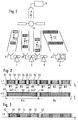
- transmitters 1, 2, 3 and 4 each connected to an antenna respectively transmitter 11, 21, 31 and 41 communicate through communication channels with a base station 6 via a satellite 5.
- Transmitters 1, 2 and 3 are of the same type and allow the transmission of information of the speech type. These three transmitters transmit on the same carrier frequency F1, in turn, during unit time intervals. In each triplet of time intervals consecutive, transmitter 1 is assigned the first time slot, transmitter 2 the second time interval and the transmitter 3 the third time interval.
- the transmitter 4 allows the transmission of data type information. It broadcasts on a carrier frequency F2, different from F1.
- the transmitter 4 is the only one to transmit on the frequency F2, it emits a series of consecutive superbursts extending over a time interval three times longer than the unit time interval. It thus offers a transmission rate three times higher than the information transmitters of speech type 1, 2 and 3.
- the amplifier located directly after the satellite receiving antenna 5 simultaneously amplifies the signal contained in the bursts emitted by different transmitters on different carriers, these bursts arriving synchronously at the amplifier.
- the guard times exactly coincide, disturbances have no influence harmful.
- coexist bursts and superbursts as in the example shown in Figure 1, it appears times when the guard time of a burst received on a given frequency corresponds to one or more symbols information in a superburst received on another frequency.
- Figure 2 shows the spread in time and frequency of the information received at satellite 5 in the case of the transmission system described in the figure 1. More precisely figure 2 represents a succession of bursts received in parallel on frequencies F1 and F2 and carried over to two axes having the same temporal origin.
- the bursts B1, B2 and B3 received on the carrier frequency F1 are juxtaposed unit bursts originating from transmitters 1, 2 and 3 respectively.
- bursts B4 received on carrier frequency F2 are triple length superbursts the length of the unit burst from the transmitter 4.
- a guard time is provided at the start and at the end of each burst sent, whether be a unit burst or a superburst.
- On-call times 12, 22, 32 and 42 are the burst start guard times transmitted respectively by the transmitters 1, 2, 3 and 4.
- the guard times 13, 23, 33 and 43 are the end guard times of burst emitted by transmitters 1, 2, 3 and 4 respectively.
- a training sequence is provided in each burst directly after the start time and immediately before the end time. These learning sequences are shown but not referenced in Figure 2.
- Bursts B1, B2, B3 and B4 also each have symbols 14, 24, 34 and 44 respectively corresponding to useful information transmitted by the user to whom the burst is allocated.
- the guard time for the start of burst 12 sent by transmitter 1 is received in same time as the start of burst 42 guard time sent by the transmitter 4.
- burst guard time 13 emitted by the transmitter 1 and the burst start guard 22 sent by the transmitter 2 are adjacent and received at the same time as information symbols 441 of the burst sent by the transmitter 4.
- the end-of-burst guard time 23 emitted by the transmitter 2 and the burst start guard 32 sent by the transmitter 3 are adjacent and received at the same time as information symbols 442 of the burst sent by the transmitter 4.
- the end of burst guard time 33 sent by the transmitter 3 is received in same time as the end of burst guard time 43 sent by the transmitter 4.
- Disturbances during reception of on-call time at satellite 5 amplifier cause signal phase changes transported in the superburst to the corresponding locations 42, 441, 442 and 43.
- the locations 42 and 43 being on-call times, the disturbances remain at these places without harmful effect.
- the locations referenced 441 and 442 containing information symbols are sensitive to disturbances which cause a problem with signal demodulation. Indeed, like the phase of the information symbols contained in each burst is estimated and used for signal demodulation, such a phase modification is a source of numerous demodulation errors in the information symbols located at locations 441 and 442.
- the objective of the present invention is to define a structure for superburst such that the information symbols of the superburst of the harmful influence of the non-linearities of the amplifier, while optimizing the quantity of information carried in the superburst.
- Non-linearities induced by a guard time present on a certain carrier frequency will therefore not disturb information symbols since the information symbols never coincide with guard times received at the same instant on another carrier. We therefore limit the error rate caused by interference due to non-linearities of the amplifier.
- each filling sequence inserted in a superburst is chosen longer than the guard time it is called to cover. It is preferable to choose it of length equal to the length of on-call time to be increased increased by twice the uncertainty of absolute synchronization, the sequence being centered with respect to the middle of time corresponding guard.
- the filling sequence can be a sequence learning allowing, in addition to solving the problem mentioned above, allow the receiver to have regular training sequences. Introducing additional learning sequences in a superburst has the advantage of being able to follow more precisely the frequency drift of the signal received at the receiver to ensure good quality demodulation.
- FIG. 1 representing a communication system comprising four transmitters sending information bursts towards a satellite according to a TDMA type medium access technique described above.
- the structure of superburst arising from the invention is illustrated in Figure 3.
- Figures 2 and 3 are correlative, the axes represented have the same temporal origin.
- training sequences 45 and 46 respectively are introduced covering exactly the corresponding location on the carrier frequency F1 at the times of guard 13, 22, 23 and 32. These guard times have the particularity of corresponding to different locations of the ends of the superburst.
- the inserted learning sequences can be of any form, taking the form of the start and end of burst learning sequences or no.
- the learning sequences In a unit burst, the learning sequences must allow the receiver to recover the transmission phase in order to allow demodulation of quality taking into account any frequency drifts caused by instabilities of the physical elements of transmission and reception notably due at very high carrier frequencies.
- having more learning sequences we can avoid certain demodulation errors and thus work towards a low error rate in superbursts, the need for which has been explained above.
- the invention can be extended by taking into account timing uncertainties. Indeed, although the transmitters are synchronized, there may remain uncertainty about the precise time of arrival of information sent by a transmitter at the receiver. This uncertainty can result in the overlap of two bursts emitted by separate transmitters on the same carrier and supposed to arrive in time intervals adjacent to the level of the receiver, assuming that the first burst arrives for example later than planned and the next one earlier. This is avoided thanks to the dimensioned guard times so that they guarantee that the bursts do not overlap taking into account synchronization uncertainty.
- We define the absolute uncertainty of synchronization by the duration of the period during which the start of the signal contained in a burst subject to timing uncertainty is likely to be received by the receiver. The absolute uncertainty of synchronization also extends on both sides and other than when the start of the burst should be received in the ideal case of absence timing uncertainty.
- the maximum duration corresponding to the presence guard time on different frequencies is twice the duration nominal of a guard time increased by one time the absolute uncertainty of synchronization.
- the invention can also be advantageously applied when the transmitters are base stations each transmitting in parallel streams of adjacent bursts, called frames, on different frequencies. These bursts being of the same type as those described above, there appears the same problem of superposition of on-call time and information symbols at a level common receiver, a satellite for example, which can be solved by as described by the invention.
Landscapes
- Engineering & Computer Science (AREA)
- Computer Networks & Wireless Communication (AREA)
- Signal Processing (AREA)
- Radio Relay Systems (AREA)
- Time-Division Multiplex Systems (AREA)
- Mobile Radio Communication Systems (AREA)
Priority Applications (4)
| Application Number | Priority Date | Filing Date | Title |
|---|---|---|---|
| EP99440078A EP1049281B1 (de) | 1999-04-19 | 1999-04-19 | TDMA-Mehrpunkt-zu-Punkt-System unter Verwendung einer besonderen Burststruktur und dazugehöriger Sender |
| DE69922342T DE69922342T2 (de) | 1999-04-19 | 1999-04-19 | TDMA-Mehrpunkt-zu-Punkt-System unter Verwendung einer besonderen Burststruktur und dazugehöriger Sender |
| CA002304884A CA2304884A1 (en) | 1999-04-19 | 2000-04-07 | A multipoint-to-point tdma transmission system using a particular burst structure, and a corresponding transmitter |
| US09/551,493 US6731615B1 (en) | 1999-04-19 | 2000-04-18 | Multipoint-to-point tdma transmission system using a particular burst structure, and a corresponding transmitter |
Applications Claiming Priority (1)
| Application Number | Priority Date | Filing Date | Title |
|---|---|---|---|
| EP99440078A EP1049281B1 (de) | 1999-04-19 | 1999-04-19 | TDMA-Mehrpunkt-zu-Punkt-System unter Verwendung einer besonderen Burststruktur und dazugehöriger Sender |
Publications (2)
| Publication Number | Publication Date |
|---|---|
| EP1049281A1 true EP1049281A1 (de) | 2000-11-02 |
| EP1049281B1 EP1049281B1 (de) | 2004-12-01 |
Family
ID=8242319
Family Applications (1)
| Application Number | Title | Priority Date | Filing Date |
|---|---|---|---|
| EP99440078A Expired - Lifetime EP1049281B1 (de) | 1999-04-19 | 1999-04-19 | TDMA-Mehrpunkt-zu-Punkt-System unter Verwendung einer besonderen Burststruktur und dazugehöriger Sender |
Country Status (4)
| Country | Link |
|---|---|
| US (1) | US6731615B1 (de) |
| EP (1) | EP1049281B1 (de) |
| CA (1) | CA2304884A1 (de) |
| DE (1) | DE69922342T2 (de) |
Cited By (2)
| Publication number | Priority date | Publication date | Assignee | Title |
|---|---|---|---|---|
| US6788917B1 (en) | 2000-01-19 | 2004-09-07 | Ericsson Inc. | Timing systems and methods for forward link diversity in satellite radiotelephone systems |
| US7089005B2 (en) | 2002-07-31 | 2006-08-08 | Interdigital Technology Corporation | Handover between a cellular system and a wireless local area network |
Families Citing this family (6)
| Publication number | Priority date | Publication date | Assignee | Title |
|---|---|---|---|---|
| US7088734B2 (en) * | 2001-03-27 | 2006-08-08 | Motorola, Inc. | Slot format and method for increasing random access opportunities in a wireless communication system |
| GB2401759A (en) * | 2003-05-13 | 2004-11-17 | Nokia Corp | Method of signalling in a mobile communications network |
| EP1608100A1 (de) * | 2004-06-17 | 2005-12-21 | Mitsubishi Electric Information Technology Centre Europe B.V. | Verfahren zur Übertragung von TDD-Rahmen mit erhöhten Nutzdaten |
| GB0420540D0 (en) * | 2004-09-15 | 2004-10-20 | Nokia Corp | Burst transmission in a digital broadcasting network |
| US20090190570A1 (en) * | 2005-11-07 | 2009-07-30 | Agency For Science, Technology And Research | Methods and Device for Transmitting Data from a First Communication Device to a Second Communication Device |
| US10945274B2 (en) * | 2016-05-13 | 2021-03-09 | Huawei Technologies Co., Ltd. | System and method for bandwidth utilization |
Citations (3)
| Publication number | Priority date | Publication date | Assignee | Title |
|---|---|---|---|---|
| FR2700086A1 (fr) * | 1992-12-30 | 1994-07-01 | Alcatel Radiotelephone | Procédé de transmission d'informations à débit élevé par allocation multiple de blocs, procédé de réception associé et dispositif de réception pour sa mise en Óoeuvre. |
| WO1996027959A1 (en) * | 1995-03-06 | 1996-09-12 | Nokia Telecommunications Oy | High-speed data transmission in mobile communication networks |
| EP0903872A1 (de) * | 1997-09-17 | 1999-03-24 | Motorola, Inc. | Funkkommunikationssystem mit einem Übertragungsrahmensformat und Verfahren zu seiner Realization |
Family Cites Families (3)
| Publication number | Priority date | Publication date | Assignee | Title |
|---|---|---|---|---|
| FR2710805B1 (fr) * | 1993-09-29 | 1995-11-10 | Alcatel Mobile Comm France | Structure de burst de remplissage dans un système cellulaire de radiocommunications numériques utilisant le principe de l'AMRT, et station de base pour l'élaboration d'une telle structure. |
| US6337855B1 (en) * | 1996-11-13 | 2002-01-08 | Nokia Telecommunications Oy | Method, transmitter and receiver for transmitting training signals in a TDMA transmission system |
| US6256486B1 (en) * | 1999-09-09 | 2001-07-03 | Nortel Networks Limited | Method and apparatus for measuring co-channel interference |
-
1999
- 1999-04-19 DE DE69922342T patent/DE69922342T2/de not_active Expired - Lifetime
- 1999-04-19 EP EP99440078A patent/EP1049281B1/de not_active Expired - Lifetime
-
2000
- 2000-04-07 CA CA002304884A patent/CA2304884A1/en not_active Abandoned
- 2000-04-18 US US09/551,493 patent/US6731615B1/en not_active Expired - Lifetime
Patent Citations (3)
| Publication number | Priority date | Publication date | Assignee | Title |
|---|---|---|---|---|
| FR2700086A1 (fr) * | 1992-12-30 | 1994-07-01 | Alcatel Radiotelephone | Procédé de transmission d'informations à débit élevé par allocation multiple de blocs, procédé de réception associé et dispositif de réception pour sa mise en Óoeuvre. |
| WO1996027959A1 (en) * | 1995-03-06 | 1996-09-12 | Nokia Telecommunications Oy | High-speed data transmission in mobile communication networks |
| EP0903872A1 (de) * | 1997-09-17 | 1999-03-24 | Motorola, Inc. | Funkkommunikationssystem mit einem Übertragungsrahmensformat und Verfahren zu seiner Realization |
Cited By (2)
| Publication number | Priority date | Publication date | Assignee | Title |
|---|---|---|---|---|
| US6788917B1 (en) | 2000-01-19 | 2004-09-07 | Ericsson Inc. | Timing systems and methods for forward link diversity in satellite radiotelephone systems |
| US7089005B2 (en) | 2002-07-31 | 2006-08-08 | Interdigital Technology Corporation | Handover between a cellular system and a wireless local area network |
Also Published As
| Publication number | Publication date |
|---|---|
| US6731615B1 (en) | 2004-05-04 |
| DE69922342D1 (de) | 2005-01-05 |
| EP1049281B1 (de) | 2004-12-01 |
| DE69922342T2 (de) | 2005-05-12 |
| CA2304884A1 (en) | 2000-10-19 |
Similar Documents
| Publication | Publication Date | Title |
|---|---|---|
| EP0645903B2 (de) | Burstfüllstruktur in einer digitalen TDMA zellularen Funkanordnung, und Basisstation, die diese Struktur aufbaut | |
| EP1302016B1 (de) | Synchronisation der von mehreren einheiten ausgesendeten signale in einer basisstation, für fdma-kommunikationssysteme | |
| FR2718306A1 (fr) | Procédé d'adaptation de l'interface air, dans un système de radiocommunication vers des mobiles. | |
| FR2527871A1 (fr) | Systeme de radiocommunications, a sauts de frequence | |
| FR2778517A1 (fr) | Activation de porteuse pour transmission de donnees | |
| EP0200275A1 (de) | Multiplex-Nachrichtenübertragungssystem | |
| WO1998044688A1 (fr) | Procede de transmission sur une pluralite de supports de transmission, a repartition dynamique des donnees, et emetteur et terminal correspondants | |
| FR2508742A1 (fr) | Circuit pour synchroniser le fonctionnement d'un emetteur et d'un ou plusieurs recepteurs radioelectriques | |
| EP0480505A1 (de) | Funkübertragungssystem mit einer Anzahl von Teilnehmerendgeräten | |
| EP1049281B1 (de) | TDMA-Mehrpunkt-zu-Punkt-System unter Verwendung einer besonderen Burststruktur und dazugehöriger Sender | |
| EP0009096B1 (de) | Verfahren und System zur Synchronisierung eines Übertragungsnetzwerkes mit Vielfachzugriff im Zeitmultiplex unter Verwendung eines mit mehreren bündelnden Antennen ausgerüsteten Satelliten mit verschiedenen Frequenzen | |
| EP0641096B1 (de) | Verfahren mit mehrfachem Zugang durch Einteilung in orthogonale Frequenzen, entsprechende zentrale Station, entfernte Station, System und deren Verwendung | |
| FR2593342A1 (fr) | Sous-systeme de communication par paquets d'ondes pour la determination des impulsions de synchronisation et la correlation des impulsions de donnees d'un paquet d'ondes, et procede de synchronisation et de detection de paquets d'ondes pour un tel systeme | |
| WO2007090968A2 (fr) | Procede de synchronisation des transmissions de signaux d'utilisateurs dans un reseau de communication hybride | |
| EP0037770B1 (de) | System zur paketweisen Übertragung digitaler Daten unter Verwendung eines besonderen Typs von Synchronisationsworten | |
| EP0717575A2 (de) | Funk-Kommunikationssystem mit verteilten Feststationen | |
| FR2752120A1 (fr) | Systeme de communication a canal unique et emetteur pour un tel systeme | |
| EP0994580B1 (de) | Übertragungsverfahren in einem Funkkommunikationssystem mit Vielfachzugriff | |
| EP1721486B1 (de) | Zellulares Funktelefonsignal, das Synchronisation eines Ergänzungskanals mittels eines Hauptkanals ermöglicht, und entsprechendes Verfahren, Endgerät und Basisstation | |
| EP1879419B1 (de) | Erfassung einer asynchronen Kollision in einem System für direkten Mobilfunk | |
| FR2724076A1 (fr) | Procede de conservation de la synchronisation temporelle d'une station mobile dans un systeme de radiocommunication numerique cellulaire | |
| EP0588396B1 (de) | TDMA Mobilfunkübertragungsanordnung mit Sendeverstärker mit verzögertem Sendezustand | |
| FR2593984A1 (fr) | Procede et dispositif de transmission de donnees alphanumeriques par voie radio | |
| WO1998000931A1 (fr) | Terminal, systeme et procede pour communication radio avec decalage d'intervalle temporel | |
| WO2008009401A1 (fr) | Système de téléphonie cellulaire dans lequel un terminal esclave est adapté à émettre des données à destination d'un terminal maître selon un canal de trafic de type simplex montant |
Legal Events
| Date | Code | Title | Description |
|---|---|---|---|
| PUAI | Public reference made under article 153(3) epc to a published international application that has entered the european phase |
Free format text: ORIGINAL CODE: 0009012 |
|
| 17P | Request for examination filed |
Effective date: 19991124 |
|
| AK | Designated contracting states |
Kind code of ref document: A1 Designated state(s): DE ES FR GB IT SE |
|
| AX | Request for extension of the european patent |
Free format text: AL;LT;LV;MK;RO;SI |
|
| AKX | Designation fees paid |
Free format text: DE ES FR GB IT SE |
|
| GRAP | Despatch of communication of intention to grant a patent |
Free format text: ORIGINAL CODE: EPIDOSNIGR1 |
|
| GRAS | Grant fee paid |
Free format text: ORIGINAL CODE: EPIDOSNIGR3 |
|
| GRAA | (expected) grant |
Free format text: ORIGINAL CODE: 0009210 |
|
| AK | Designated contracting states |
Kind code of ref document: B1 Designated state(s): DE ES FR GB IT SE |
|
| REG | Reference to a national code |
Ref country code: GB Ref legal event code: FG4D Free format text: NOT ENGLISH |
|
| REF | Corresponds to: |
Ref document number: 69922342 Country of ref document: DE Date of ref document: 20050105 Kind code of ref document: P |
|
| GBT | Gb: translation of ep patent filed (gb section 77(6)(a)/1977) |
Effective date: 20050110 |
|
| PG25 | Lapsed in a contracting state [announced via postgrant information from national office to epo] |
Ref country code: SE Free format text: LAPSE BECAUSE OF FAILURE TO SUBMIT A TRANSLATION OF THE DESCRIPTION OR TO PAY THE FEE WITHIN THE PRESCRIBED TIME-LIMIT Effective date: 20050301 |
|
| PG25 | Lapsed in a contracting state [announced via postgrant information from national office to epo] |
Ref country code: ES Free format text: LAPSE BECAUSE OF FAILURE TO SUBMIT A TRANSLATION OF THE DESCRIPTION OR TO PAY THE FEE WITHIN THE PRESCRIBED TIME-LIMIT Effective date: 20050312 |
|
| PLBE | No opposition filed within time limit |
Free format text: ORIGINAL CODE: 0009261 |
|
| STAA | Information on the status of an ep patent application or granted ep patent |
Free format text: STATUS: NO OPPOSITION FILED WITHIN TIME LIMIT |
|
| 26N | No opposition filed |
Effective date: 20050902 |
|
| REG | Reference to a national code |
Ref country code: GB Ref legal event code: 732E Free format text: REGISTERED BETWEEN 20131114 AND 20131120 |
|
| REG | Reference to a national code |
Ref country code: FR Ref legal event code: GC Effective date: 20140717 |
|
| REG | Reference to a national code |
Ref country code: FR Ref legal event code: RG Effective date: 20141016 |
|
| REG | Reference to a national code |
Ref country code: FR Ref legal event code: PLFP Year of fee payment: 17 |
|
| REG | Reference to a national code |
Ref country code: FR Ref legal event code: PLFP Year of fee payment: 18 |
|
| PGFP | Annual fee paid to national office [announced via postgrant information from national office to epo] |
Ref country code: GB Payment date: 20160421 Year of fee payment: 18 Ref country code: DE Payment date: 20160421 Year of fee payment: 18 |
|
| PGFP | Annual fee paid to national office [announced via postgrant information from national office to epo] |
Ref country code: FR Payment date: 20160421 Year of fee payment: 18 Ref country code: IT Payment date: 20160427 Year of fee payment: 18 |
|
| REG | Reference to a national code |
Ref country code: DE Ref legal event code: R119 Ref document number: 69922342 Country of ref document: DE |
|
| GBPC | Gb: european patent ceased through non-payment of renewal fee |
Effective date: 20170419 |
|
| REG | Reference to a national code |
Ref country code: FR Ref legal event code: ST Effective date: 20171229 |
|
| PG25 | Lapsed in a contracting state [announced via postgrant information from national office to epo] |
Ref country code: FR Free format text: LAPSE BECAUSE OF NON-PAYMENT OF DUE FEES Effective date: 20170502 Ref country code: DE Free format text: LAPSE BECAUSE OF NON-PAYMENT OF DUE FEES Effective date: 20171103 |
|
| PG25 | Lapsed in a contracting state [announced via postgrant information from national office to epo] |
Ref country code: GB Free format text: LAPSE BECAUSE OF NON-PAYMENT OF DUE FEES Effective date: 20170419 |
|
| PG25 | Lapsed in a contracting state [announced via postgrant information from national office to epo] |
Ref country code: IT Free format text: LAPSE BECAUSE OF NON-PAYMENT OF DUE FEES Effective date: 20170419 |