EP1049336A2 - Etablisssement d'un canal de données dans un flux de vidéo - Google Patents
Etablisssement d'un canal de données dans un flux de vidéo Download PDFInfo
- Publication number
- EP1049336A2 EP1049336A2 EP00303501A EP00303501A EP1049336A2 EP 1049336 A2 EP1049336 A2 EP 1049336A2 EP 00303501 A EP00303501 A EP 00303501A EP 00303501 A EP00303501 A EP 00303501A EP 1049336 A2 EP1049336 A2 EP 1049336A2
- Authority
- EP
- European Patent Office
- Prior art keywords
- stream
- data
- opportunistic data
- opportunistic
- transport
- Prior art date
- Legal status (The legal status is an assumption and is not a legal conclusion. Google has not performed a legal analysis and makes no representation as to the accuracy of the status listed.)
- Withdrawn
Links
- 238000000034 method Methods 0.000 claims abstract description 26
- 238000001824 photoionisation detection Methods 0.000 claims 2
- 230000005540 biological transmission Effects 0.000 description 10
- 238000010586 diagram Methods 0.000 description 10
- 238000004891 communication Methods 0.000 description 4
- 230000006870 function Effects 0.000 description 4
- 238000012545 processing Methods 0.000 description 4
- 230000008901 benefit Effects 0.000 description 3
- 230000000295 complement effect Effects 0.000 description 2
- 238000003384 imaging method Methods 0.000 description 2
- 230000006855 networking Effects 0.000 description 2
- 230000003287 optical effect Effects 0.000 description 2
- 230000005236 sound signal Effects 0.000 description 2
- 238000012546 transfer Methods 0.000 description 2
- 230000006978 adaptation Effects 0.000 description 1
- 238000013459 approach Methods 0.000 description 1
- 239000000470 constituent Substances 0.000 description 1
- 238000013500 data storage Methods 0.000 description 1
- 230000001419 dependent effect Effects 0.000 description 1
- 230000004069 differentiation Effects 0.000 description 1
- 238000005538 encapsulation Methods 0.000 description 1
- 238000009432 framing Methods 0.000 description 1
- 230000007246 mechanism Effects 0.000 description 1
- 230000010363 phase shift Effects 0.000 description 1
- 230000035755 proliferation Effects 0.000 description 1
- 230000009467 reduction Effects 0.000 description 1
- 230000009466 transformation Effects 0.000 description 1
Images




Classifications
-
- H—ELECTRICITY
- H04—ELECTRIC COMMUNICATION TECHNIQUE
- H04N—PICTORIAL COMMUNICATION, e.g. TELEVISION
- H04N21/00—Selective content distribution, e.g. interactive television or video on demand [VOD]
- H04N21/20—Servers specifically adapted for the distribution of content, e.g. VOD servers; Operations thereof
- H04N21/23—Processing of content or additional data; Elementary server operations; Server middleware
- H04N21/236—Assembling of a multiplex stream, e.g. transport stream, by combining a video stream with other content or additional data, e.g. inserting a URL [Uniform Resource Locator] into a video stream, multiplexing software data into a video stream; Remultiplexing of multiplex streams; Insertion of stuffing bits into the multiplex stream, e.g. to obtain a constant bit-rate; Assembling of a packetised elementary stream
- H04N21/23614—Multiplexing of additional data and video streams
-
- H—ELECTRICITY
- H04—ELECTRIC COMMUNICATION TECHNIQUE
- H04N—PICTORIAL COMMUNICATION, e.g. TELEVISION
- H04N21/00—Selective content distribution, e.g. interactive television or video on demand [VOD]
- H04N21/20—Servers specifically adapted for the distribution of content, e.g. VOD servers; Operations thereof
- H04N21/23—Processing of content or additional data; Elementary server operations; Server middleware
- H04N21/236—Assembling of a multiplex stream, e.g. transport stream, by combining a video stream with other content or additional data, e.g. inserting a URL [Uniform Resource Locator] into a video stream, multiplexing software data into a video stream; Remultiplexing of multiplex streams; Insertion of stuffing bits into the multiplex stream, e.g. to obtain a constant bit-rate; Assembling of a packetised elementary stream
- H04N21/2362—Generation or processing of Service Information [SI]
-
- H—ELECTRICITY
- H04—ELECTRIC COMMUNICATION TECHNIQUE
- H04N—PICTORIAL COMMUNICATION, e.g. TELEVISION
- H04N21/00—Selective content distribution, e.g. interactive television or video on demand [VOD]
- H04N21/40—Client devices specifically adapted for the reception of or interaction with content, e.g. set-top-box [STB]; Operations thereof
- H04N21/43—Processing of content or additional data, e.g. demultiplexing additional data from a digital video stream; Elementary client operations, e.g. monitoring of home network or synchronising decoder's clock; Client middleware
- H04N21/434—Disassembling of a multiplex stream, e.g. demultiplexing audio and video streams, extraction of additional data from a video stream; Remultiplexing of multiplex streams; Extraction or processing of SI; Disassembling of packetised elementary stream
- H04N21/4345—Extraction or processing of SI, e.g. extracting service information from an MPEG stream
Definitions
- the invention relates to a method and apparatus for establishing a datapipe in a digital transport stream. Specifically, the present invention describes a method for inserting data, especially opportunistic data, into a multiple program per channel digital television transport stream.
- MPEG transport bitstreams or streams carry associated programs, usually comprised of Packetized Elementary Streams (PES) of video, audio and data associated with the video and audio signals. It would be advantageous to operate within this protocol to insert data, especially opportunistic data into the MPEG transport bitstream, for other purposes.
- PES Packetized Elementary Streams
- An embodiment of the present invention is a method and apparatus for establishing a "datapipe" in a digital transport stream.
- opportunistic data are packetized into packets that are compliant with a particular transport protocol, e.g., as part of an MPEG transport stream. Namely, the opportunistic data are inserted into a multiple program per channel digital television transport stream.
- the opportunistic data are uniquely identified using at least one unique packet identification (PID) label that will allow a receiver to quickly determine whether a packet is carrying opportunistic data or television data.
- PID packet identification
- the unique use of at least one PID to identify all opportunistic data gives rise to the term, "datapipe”.
- a "datacast guide" is also inserted into the transport stream, which will allow the receiver to further differentiate different types or subchannels of opportunistic data.
- the present invention provides a dynamic method of inserting opportunistic data onto a television transport stream. This approach will allow a broadcaster to dynamically lease or share a portion of its available bandwidth for transmitting opportunistic data.
- the opportunistic data may include but is not limited to, internet data.
- a computer user or a data provider e.g., an internet service provider (ISP) will be able to exploit the speed and bandwidth of infrastructures that were originally established for the transmission of digital television signals.
- ISP internet service provider
- FIG. 1 depicts a block diagram of a simplified structure of a packet stream system 100 of the present invention.
- the packet stream system 100 is broadly illustrated as comprising an encoding system 110 (or broadly defined as a digital data transmitting system), a first decoding system 120 (or broadly defined as a receiver system) and a second decoding system 130.
- the first decoding system 120 is illustrated as a set-top box configuration
- the second decoding system 130 is illustrated as an add-on board or an external module to a personal computer (PC).
- PC personal computer
- Transport stream as defined in accordance with the MPEG standards is used in the packet stream system illustrated in FIG. 1.
- the present invention is described below using the MPEG transport stream as an example, those skilled in the art will realize that the present invention can be applied to any other packet streams in accordance with other formats.
- the present invention is described below using the term "stream” it should be understood that the various operations described below may be performed on the entire stream or portion thereof.
- Encoding system 110 includes a video encoder 113, an audio encoder 114, a transport encoder 116, e.g., an MPEG transport encoder, a modulator 117 and a transmitter 118.
- video sources 111 are encoded into video elementary streams
- audio sources 112 are encoded into audio elementary streams.
- data sources 115 opportunistic data
- the video and audio can be combined to produce a transport stream via encoder 116, and then re-multiplexed with opportunistic data that are processed in an optional transport encoder 116a to form a combined transport stream.
- opportunistic data is defined as data that is not related to data encompassed in the video and audio elementary streams of a primary service of the transport stream. Additionally, although opportunistic data is described as data that is transmitted as the opportunity exists for their transmission given the available bandwidth, it should be understood that for a particular application, a transmission system may reserve a minimum or a fixed bandwidth for their transmission. Namely, the opportunistic data may have a minimum throughput, but can achieve higher throughput as the conditions allow.
- the modulator 117 will modulated the transport stream for transmission by the transmitter 118, e.g., vestigial side band (VSB) (broadcast), quadrature amplitude modulation (QAM) (cablecast), or quadrature phase-shift key (QPSK) (satellite) modulation.
- VSB vestigial side band
- QAM quadrature amplitude modulation
- QPSK quadrature phase-shift key
- Decoding system 120 includes a video decoder 121, an audio decoder 122, a transport decoder 124, a data sink or storage 123, a demodulator 125 and a tuner 126.
- the tuner 126 will select the desired channel for receiving the transmitted signal that is then demodulated by the demodulator 125 to produce a transport stream.
- the transport decoder 124 e.g., an MPEG transport decoder, will decode the transport stream into video, audio and data (opportunistic data) streams which are then forwarded to video decoder 121, audio decoder 122 and data storage 123, respectively.
- the decoded video and audio signals are then forwarded to a display and speakers, respectively.
- the stored opportunistic data can be selectively recalled and displayed by the user The method for extracting the opportunistic data from the transport stream will be further described below.
- Decoding system 130 includes, a PC interface module 131, a transport decoder 132, a demodulator 133 and a tuner 134.
- the tuner 134 will select the desired channel for receiving the transmitted signal that is then demodulated by the demodulator 133 to produce a transport stream.
- the transport decoder 132 e.g., an MPEG transport decoder
- the PC interface will format the decoded data streams for transfer to a PC 140. Since the decoded video and audio streams may not be relevant to the PC application, these video and audio streams can be discarded if the PC has no capability to exploit the information carried on these streams.
- FIG. 2 illustrates a block diagram of an encoding system 200 of the present invention.
- FIG. 2 shows more details of the encoder system 110 of FIG. 1. Since the modules in FIG. 2 are the same as those in FIG. 1, same reference numerals have been used and the general description of the operation of each module is provided above.
- the video, audio, and data PES components are each assigned a separate 13 bit Packet Identification (PID) label by the transport stream encoder, denoted by OxHHHH. Namely, each opportunistic data source will be assigned a different PID.
- PID Packet Identification
- an electronic program guide is also sent in packets with a reserved PID 0x1FFD.
- the entries in the program guide are channel and event descriptors that point to entries in a Program Association Table (PAT, also a reserved PID 0x0000), which entries then indirectly point to entries in a Program Map Table (PMT) where the PID's for the selected video, and associated audio and data are listed.
- the program guide can also make use of the ATSC Program and System Information Protocol (PSIP) tables with the ATSC established "base PID" of 0x1FFB. Namely, the electronic program guide will allow the decoding system to quickly identify a packet as a video, audio or data packet.
- PSIP Program and System Information Protocol
- FIG. 4 illustrates a block diagram of a decoding system 400 of the present invention in operation with a PC 410.
- the decoding system 400 comprises a physical layer interface module 402, a tuner 404, a demodulator 406, a transport stream decoder 408 and a PC interface module 409.
- the decoding system 400 has a physical layer interface module 402 that can interface with a variety of physical links (PHY), such as terrestrial, cable, external server (e.g., CD ROM), or satellite.
- PHY physical links
- the physical layer interface module 402 allows the user to select the physical link in which the transmitted signal is being received.
- These physical connections can be selected from application software residing in the computer 410.
- the selected physical layer from terrestrial or cable will be sent to a tuner 404 for appropriate channel selection.
- the tuner 404 can also be controlled by the application software.
- the tuner IF output is sent to a data demodulator 406.
- a data demodulator 406 Depending on the transmission method that is being employed, different demodulation methods will be required. For example, in the case of ATSC, a VSB demodulator is used. Cable systems may use other forms of data demodulation, such as QAM or QPSK. The selection of data demodulation method can also be selected by the application software.
- the output of the demodulator 406 is a transport stream that is sent to the transport stream decoder (TSD) 408.
- TSD transport stream decoder
- the TSD demultiplexes the data packets from the aggregate bitstream by decoding the Program Identification (PID) in the transport stream headers. Namely, the recovered payloads of the opportunistic data are sent to the host 410 (or personal computer) via a system Bus Interface, shown as a PCI Host Interface 409 in FIG. 4.
- the host 410 can store the opportunistic data in RAM 414, CD ROM 412, hard disk 418 or other storage media. Once the data is stored, the user may access and view the data at his or her leisure via a display 419. The operation of the data transfer is performed with the cooperation of the central processor unit (CPU) 416 of the host. It should be noted that all of the functions, up to and including the PCI Interface of the decoding system 400 can be implemented on a card, that is compatible with expansion slots of the host.
- PSI program specific information
- the MPEG standards already support PSI which contains information about the program and its constituent elementary streams.
- EPG Electronic Program Guide
- PMT Program Map Tables
- PAT Program Association Tables
- VGA video graphics adapter
- PSIP Program and System Information Protocol
- ATSC Advanced Television Systems Committee
- A/65 which defines the standard protocol for transmission of the relevant table data contained within packets in a Transport Stream multiplex with the "base PID" of 0x1FFB.
- the relevant base PID (BPID) tables are:
- external transport stream data from external servers, or satellite modems can be routed directly to the TSD 408 via path 407.
- the opportunistic data may be in such a format that the functions performed by the physical layer interface 402, tuner 404 and demodulator 406 can be omitted.
- the configuration of the decoding system 400 of FIG. 4 provides several advantages.
- the decoding system will use the local bus 405 in performing many of its functions in obtaining the opportunistic data, thereby minimizing traffic on the PCI bus 411. Namely, the decoding system will minimize the computation burden on the host 410.
- the present invention provides the ability to display the available data services (i.e., various opportunistic data) from a combination of the EPG, PAT, and PMT entries in the transport stream. Namely, the existing structure of the transport stream can be exploited to provide the ability to display the available data services.
- FIG. 3 illustrates a block diagram of a preferred encoding system 300 of the present invention.
- FIG. 3 shows more details of the encoder system 110 of FIG. 1. Since various modules in FIG. 3 are the same as those in FIGs. 1 and 2, same reference numerals have been used and the general description of the operation of each module is provided above.
- all opportunistic data sources 115 are assigned a single (or unique) PID, thereby establishing a "datapipe".
- the single opportunistic data stream is assigned one PID in the TSE 116, either uniquely (0x1FFC, for example), or assigned in the User Private PID (UP PID) descriptor in the EPG.
- UP PID User Private PID
- the data is assembled in a "push server" 310, where a datacast guide 340 is inserted with the various opportunistic data sources 115.
- the term "push server” indicates that the data stream is formed without any input from the receiver, i.e., the data stream is simply formed and is ready for transmission (whether it is transmitted now or later).
- the opportunistic data is assembled by the push server 310 where each data service has its own, separate data address, e.g., User Datagram Protocol (UDP)/IP address. Namely, the push server 310 is tasked with applying a unique data address to each opportunistic data source.
- UDP User Datagram Protocol
- the opportunistic data sources 115 may comprise a plurality of distinct data sources, e.g., information from a web site providing sports data, information from a web site providing news data, information from a web site providing financial data, and so on. Although all these different opportunistic data sources will be packetized into the transport stream using only a single PID, separate data (or UDP/IP) address will be assigned to each opportunistic data source. This mechanism will allow a decoding system to differentiate different opportunistic data sources and to present them in a menu to a user.
- encapsulation means that UDP prepends a header to the data that the user sends, thereby forming the user datagram, and passes it to the IP.
- the IP layer prepends a header to what it receives from the UDP, thereby forming an IP datagram.
- the network interface layer embeds the IP datagram in a frame, dependent upon the physical layer i.e., Ethernet, ATM etc., before sending it from one machine (server) to another.
- the framing of the IP datagram is accomplished in the MPEG transport encoder by sending the IP datagram as 184 byte of payloads in Transport Packets with the unique PID 0x1FFc, in one example.
- This forms a unique datapipe within a transport stream and allows the present invention to use UDP and IP differently than the typical network scheme.
- the datacast guide 340 serves as a map or a look-up table of data addresses or IP addresses, thereby linking or pointing an address to a particular opportunistic content.
- the data program guide (DPG) is inserted within the transport stream with a unique IP address. Therefore, the broadcaster's video programming in the EPG and the DPG can be administered separately.
- the PC simply has to handle only a single PID, and can separate the various data sources in an IP address basis by using the data program guide (DPG).
- the UDP layer module 320 applies an UDP formatting on the data sources to provide consistency and compatibility with existing software that generates and uses UDP/IP layering and the IP address module 330 generates a data or IP address for each data source or service.
- the push server 310, UDP layer module 320 and IP address module 330 are shown as separate modules, those skilled in the art will realize that the functions performed by these modules can be implemented in a single module.
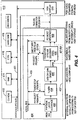
- FIG. 5 illustrates a block diagram of a preferred decoding system 500 of the present invention.
- FIG. 5 shows more details of the decoder system of FIG. 1. Since various modules in FIG. 5 are the same as those in FIGs. 1 and 4, same reference numerals have been used and the general description of the operation of each module is provided above.
- the decoding system 500 comprises an additional data address (UDP or IP address) filter 505.
- UDP additional data address
- the output from transport stream decoder 408 can be fed into a data address filter 505 that is defaulted to the data address of the datacast guide.
- the unique IP address for the DPG is extracted.
- the data address filter 505 can quickly obtain the datacast guide and then efficiently distinguishes the various data sources. This has the additional advantage of relieving the host from having to search through the EPG, PAT, and PMT entries. User selection of a particular opportunistic data service is accomplished on an IP address basis, and only that IP address is filtered through to the PCI bus, thereby increasing efficiency.
- FIG. 6 illustrates a flowchart of a method 600 for establishing a datapipe of the present invention. Specifically, FIG. 6 summarizes the present invention in a flowchart format.
- Method 600 starts in step 605 and proceeds to step 610, where method 600 generates a regular elementary stream. Namely, elementary video and/or audio streams associated with a program, e.g., a television program, are generated to be carried in a transport stream.
- a program e.g., a television program
- step 620 method 600 generates an opportunistic data stream. Namely, opportunistic data streams associated with one or more data sources 115 are generated to be carried in a transport stream.
- step 630 method 600 generates a datacast guide or data program guide (DPG)for the opportunistic data streams.
- the datacast guide serves as a look-up table of data or IP addresses to differentiate different opportunistic data sources or data services that are being forwarded in the transport stream.
- the datacast guide itself, is assigned a unique IP address so that the decoding system can rapidly obtain the datacast guide from the transport stream. It should be noted that if the application of the present invention is for a dedicated opportunistic data source, then it is possible to omit the datacast guide since the data carried in the datapipe comprises only a single source of opportunistic data. Thus, no differentiation is necessary. Similarly, if a unique PID is assigned to each opportunistic data source, then the datacast guide can also be omitted, since the unique PID can be used to identify an opportunistic data source.
- DPG data program guide
- the regular elementary stream, the opportunistic data stream and optionally the datacast guide are inserted into a transport stream.
- the transport stream encoder will assign a unique PID to each opportunistic data source.
- a unique PID is assigned to a plurality of opportunistic data sources.
- Method 600 then ends in step 645. It should be noted that steps 610, 620 and 630 can be implemented in parallel since there are no dependencies between these steps.
- FIG. 7 illustrates an encoding system 700 and a decoding system 705 of the present invention.
- the encoding system 700 comprises a general purpose computer 710 and various input/output devices 720.
- the general purpose computer comprises a central processing unit (CPU) 712, a memory 1714, an encoder 716 for receiving and encoding a sequence of images and a transport encoder 718.
- CPU central processing unit
- the encoder 716 and transport encoder 718 are simply the video encoder 113 and transport encoder 116, respectively, as discussed above.
- the encoder 716 and transport encoder 718 can be physical devices which are coupled to the CPU 712 through communication channels.
- the encoder 716 and transport encoder 718 can be represented by a software application (or a combination of software and hardware, e.g., application specific integrated circuit (ASIC))which is loaded from a storage device, e.g., a magnetic or optical disk, and resides in the memory 714 of the computer.
- ASIC application specific integrated circuit
- other modules for processing opportunistic data of FIG. 3 can be implemented as part of the encoding system 700.
- the encoder 716, the transport encoder 718 and other modules for processing opportunistic data of the present invention can be stored on a computer readable medium, including the bitstreams generated by these encoders.
- the computer 710 can be coupled to a plurality of input and output devices 720, such as a keyboard, a mouse, a camera, a camcorder, a video monitor, any number of imaging devices or storage devices, including but not limited to, a tape drive, a floppy drive, a hard disk drive or a compact disk drive.
- the input devices serve to provide inputs to the computer for producing the encoded video bitstreams or to receive the sequence of video images from a storage device or an imaging device.
- the encoding system is coupled to the decoding system via a communication channel 750.
- the present invention is not limited to any particular type of communication channel.
- the decoding system 705 comprises a general purpose computer 730 and various input/output devices 740.
- the general purpose computer comprises a central processing unit (CPU) 732, a memory 734, an decoder 736 for receiving and decoding a sequence of encoded images and a transport decoder 738.
- the decoder 736 and transport decoder 738 are simply the video decoder 121 and transport decoder 124, 132 respectively, as discussed above. It should be noted that although the decoder 121 is not specifically described, those skilled in the art will realize that decoder 121 can be any decoder that is complementary to the encoder 113 as discussed above for decoding the bitstreams generated by the encoder 114.
- the decoder 736 and transport decoder 738 can be physical devices which are coupled to the CPU 732 through communication channels.
- the decoder 736 and transport decoder 738 can be represented by a software application which is loaded from a storage device, e.g., a magnetic or optical disk, and resides in the memory 734 of the computer.
- a storage device e.g., a magnetic or optical disk
- any complementary decoder of the encoder 114 and the transport decoder 738 of the present invention can be stored on a computer readable medium.
- the computer 730 can be coupled to a plurality of input and output devices 740, such as a keyboard, a mouse, a video monitor, or any number of devices for storing or distributing images, including but not limited to, a tape drive, a floppy drive, a hard disk drive or a compact disk drive.
- the input devices serve to allow the computer for storing and distributing the sequence of decoded video images.
Landscapes
- Engineering & Computer Science (AREA)
- Multimedia (AREA)
- Signal Processing (AREA)
- Compression Or Coding Systems Of Tv Signals (AREA)
- Time-Division Multiplex Systems (AREA)
- Data Exchanges In Wide-Area Networks (AREA)
Applications Claiming Priority (4)
| Application Number | Priority Date | Filing Date | Title |
|---|---|---|---|
| US13098699P | 1999-04-26 | 1999-04-26 | |
| US130986P | 1999-04-26 | ||
| US55981600A | 2000-04-25 | 2000-04-25 | |
| US559816 | 2000-04-25 |
Publications (2)
| Publication Number | Publication Date |
|---|---|
| EP1049336A2 true EP1049336A2 (fr) | 2000-11-02 |
| EP1049336A3 EP1049336A3 (fr) | 2001-03-07 |
Family
ID=26829029
Family Applications (1)
| Application Number | Title | Priority Date | Filing Date |
|---|---|---|---|
| EP00303501A Withdrawn EP1049336A3 (fr) | 1999-04-26 | 2000-04-26 | Etablisssement d'un canal de données dans un flux de vidéo |
Country Status (1)
| Country | Link |
|---|---|
| EP (1) | EP1049336A3 (fr) |
Cited By (5)
| Publication number | Priority date | Publication date | Assignee | Title |
|---|---|---|---|---|
| DE10057997A1 (de) * | 2000-11-23 | 2002-05-29 | Rohde & Schwarz Ftk Gmbh | System zur Datenübertragung zwischen lokalen Datennetzen |
| EP1605702A1 (fr) * | 2004-06-10 | 2005-12-14 | Mediasyscom SAS | Procédé de commutation de programmes vidéo numériques et émetteur pour sa mise en oeuvre |
| WO2007135500A3 (fr) * | 2006-05-16 | 2008-02-07 | Nokia Corp | Procédé et système assurant un accès rapide à un service |
| CN101420622B (zh) * | 2007-10-22 | 2010-07-14 | 北京永新同方数字电视技术有限公司 | 一种描述数字电视事件状态的标签电视系统及描述方法 |
| EP3270596A1 (fr) * | 2012-08-22 | 2018-01-17 | Huawei Technologies Co., Ltd. | Transport de boxes d'événements selon iso-bmff dans un flux de transport mpeg-2 |
Family Cites Families (6)
| Publication number | Priority date | Publication date | Assignee | Title |
|---|---|---|---|---|
| US5666487A (en) * | 1995-06-28 | 1997-09-09 | Bell Atlantic Network Services, Inc. | Network providing signals of different formats to a user by multplexing compressed broadband data with data of a different format into MPEG encoded data stream |
| US6172988B1 (en) * | 1996-01-31 | 2001-01-09 | Tiernan Communications, Inc. | Method for universal messaging and multiplexing of video, audio, and data streams |
| US5864557A (en) * | 1996-09-25 | 1999-01-26 | Thomson Multimedia S.A. | Method and apparatus for opportunistically transferring data in a packet stream encoder |
| US5987518A (en) * | 1996-10-28 | 1999-11-16 | General Instrument Corporation | Method and apparatus for communicating internet protocol data over a broadband MPEG channel |
| EP0893913A1 (fr) * | 1997-07-24 | 1999-01-27 | CANAL+ Société Anonyme | Traitement d'un train numérique de transport |
| EP0901261B1 (fr) * | 1997-09-05 | 2013-01-09 | Hitachi, Ltd. | Procédé et équipement de conversion de protocole de transport |
-
2000
- 2000-04-26 EP EP00303501A patent/EP1049336A3/fr not_active Withdrawn
Cited By (11)
| Publication number | Priority date | Publication date | Assignee | Title |
|---|---|---|---|---|
| DE10057997A1 (de) * | 2000-11-23 | 2002-05-29 | Rohde & Schwarz Ftk Gmbh | System zur Datenübertragung zwischen lokalen Datennetzen |
| EP1217837A3 (fr) * | 2000-11-23 | 2004-12-29 | Rohde & Schwarz FTK GmbH | Système de transmission de données entre des réseaux locaux de données |
| EP1605702A1 (fr) * | 2004-06-10 | 2005-12-14 | Mediasyscom SAS | Procédé de commutation de programmes vidéo numériques et émetteur pour sa mise en oeuvre |
| WO2007135500A3 (fr) * | 2006-05-16 | 2008-02-07 | Nokia Corp | Procédé et système assurant un accès rapide à un service |
| US7702337B2 (en) | 2006-05-16 | 2010-04-20 | Nokia Corporation | Method and system for providing quick service access |
| US7957747B2 (en) | 2006-05-16 | 2011-06-07 | Nokia Corporation | Method and system for providing quick service access |
| EP2033436A4 (fr) * | 2006-05-16 | 2012-09-19 | Nokia Corp | Procede et systeme assurant un acces rapide e un service |
| CN101420622B (zh) * | 2007-10-22 | 2010-07-14 | 北京永新同方数字电视技术有限公司 | 一种描述数字电视事件状态的标签电视系统及描述方法 |
| EP3270596A1 (fr) * | 2012-08-22 | 2018-01-17 | Huawei Technologies Co., Ltd. | Transport de boxes d'événements selon iso-bmff dans un flux de transport mpeg-2 |
| US9992250B2 (en) | 2012-08-22 | 2018-06-05 | Futurewei Technologies, Inc. | Carriage of ISO-BMFF event boxes in an MPEG-2 transport stream |
| US10911511B2 (en) | 2012-08-22 | 2021-02-02 | Futurewei Technologies, Inc. | Carriage of ISO-BMFF event boxes in an MPEG-2 transport stream |
Also Published As
| Publication number | Publication date |
|---|---|
| EP1049336A3 (fr) | 2001-03-07 |
Similar Documents
| Publication | Publication Date | Title |
|---|---|---|
| RU2370907C2 (ru) | Способ и устройство для преобразования транспортного потока mpeg в ip-пакеты для широковещания в wlan | |
| US7150029B1 (en) | System for formatting and processing multimedia program data and program guide information | |
| EP1023807B1 (fr) | Systeme et procede permettant de formater et de traiter des donnees de programme multimedia et des informations de programme | |
| US8056110B2 (en) | Service system of thumbnail image and transmitting/receiving method thereof | |
| KR101759958B1 (ko) | 비실시간 서비스 처리 방법 및 방송 수신기 | |
| KR100665653B1 (ko) | 프로그램 입력 스트림 재처리 장치 | |
| JP6261741B2 (ja) | デジタル放送システムにおける高画質uhd放送コンテンツの送受信方法及び装置 | |
| US20170078765A1 (en) | Apparatus for transmitting broadcast signal, apparatus for receiving broadcast signal, method for transmitting broadcast signal and method for receiving broadcast signal | |
| US9602883B2 (en) | Method for transmitting/receiving media and device for transmitting/receiving using same | |
| JP2004266334A (ja) | データ処理装置及び方法 | |
| US20030097663A1 (en) | Method and apparatus for dynamic provisioning of IP-based services in a DVB network | |
| KR20030020380A (ko) | 정보 전송 장치 및 방법, 정보 처리 장치 및 방법, 및정보 처리 시스템 | |
| US10237591B2 (en) | Broadcast signal transmission device, broadcast signal reception device, broadcast signal transmission method, and broadcast signal reception method | |
| KR101341519B1 (ko) | 방송 수신기 및 데이터 처리 방법 | |
| EP1049336A2 (fr) | Etablisssement d'un canal de données dans un flux de vidéo | |
| US10616618B2 (en) | Broadcast signal transmitting device, broadcast signal receiving device, broadcast signal transmitting method and broadcast signal receiving method | |
| CN1143542C (zh) | 接收装置和接收方法 | |
| CN1416627A (zh) | 在数字广播网中提供内容描述和连接信息 | |
| EP3668101B1 (fr) | Dispositif d'émission, procédé d'émission, dispositif de réception et procédé de réception | |
| EP3435679A1 (fr) | Procédé et dispositif d'émission et de réception d'un signal de radiodiffusion | |
| KR20080073435A (ko) | 디지털 방송 송신기 및 디지털 방송 수신기와 그를 이용한디지털 방송 시스템 및 그 서비스 방법 | |
| JP2000165438A (ja) | ディジタル信号の通信方法及び装置、並びに通信システム | |
| JPH11275546A (ja) | 信号処理装置及び信号処理方法、並びに提供媒体 | |
| KR101366278B1 (ko) | 방송 수신기 및 방송 데이터 처리 방법 | |
| KR20050055535A (ko) | 셋탑박스와 pod 모듈의 인터페이스 방법 |
Legal Events
| Date | Code | Title | Description |
|---|---|---|---|
| PUAI | Public reference made under article 153(3) epc to a published international application that has entered the european phase |
Free format text: ORIGINAL CODE: 0009012 |
|
| AK | Designated contracting states |
Kind code of ref document: A2 Designated state(s): DE FR GB IT NL |
|
| AX | Request for extension of the european patent |
Free format text: AL;LT;LV;MK;RO;SI |
|
| PUAL | Search report despatched |
Free format text: ORIGINAL CODE: 0009013 |
|
| AK | Designated contracting states |
Kind code of ref document: A3 Designated state(s): AT BE CH CY DE DK ES FI FR GB GR IE IT LI LU MC NL PT SE |
|
| AX | Request for extension of the european patent |
Free format text: AL;LT;LV;MK;RO;SI |
|
| RIC1 | Information provided on ipc code assigned before grant |
Free format text: 7H 04N 7/52 A, 7H 04N 7/24 B, 7H 04N 7/58 B |
|
| 17P | Request for examination filed |
Effective date: 20010822 |
|
| AKX | Designation fees paid |
Free format text: DE FR GB IT NL |
|
| 17Q | First examination report despatched |
Effective date: 20040326 |
|
| STAA | Information on the status of an ep patent application or granted ep patent |
Free format text: STATUS: THE APPLICATION IS DEEMED TO BE WITHDRAWN |
|
| 18D | Application deemed to be withdrawn |
Effective date: 20040907 |