EP1051799B1 - Wandlervorrichtung - Google Patents
Wandlervorrichtung Download PDFInfo
- Publication number
- EP1051799B1 EP1051799B1 EP98963698A EP98963698A EP1051799B1 EP 1051799 B1 EP1051799 B1 EP 1051799B1 EP 98963698 A EP98963698 A EP 98963698A EP 98963698 A EP98963698 A EP 98963698A EP 1051799 B1 EP1051799 B1 EP 1051799B1
- Authority
- EP
- European Patent Office
- Prior art keywords
- mid point
- voltage
- semiconductor elements
- poles
- units
- Prior art date
- Legal status (The legal status is an assumption and is not a legal conclusion. Google has not performed a legal analysis and makes no representation as to the accuracy of the status listed.)
- Expired - Lifetime
Links
Images

Classifications
-
- H—ELECTRICITY
- H02—GENERATION; CONVERSION OR DISTRIBUTION OF ELECTRIC POWER
- H02M—APPARATUS FOR CONVERSION BETWEEN AC AND AC, BETWEEN AC AND DC, OR BETWEEN DC AND DC, AND FOR USE WITH MAINS OR SIMILAR POWER SUPPLY SYSTEMS; CONVERSION OF DC OR AC INPUT POWER INTO SURGE OUTPUT POWER; CONTROL OR REGULATION THEREOF
- H02M7/00—Conversion of AC power input into DC power output; Conversion of DC power input into AC power output
- H02M7/42—Conversion of DC power input into AC power output without possibility of reversal
- H02M7/44—Conversion of DC power input into AC power output without possibility of reversal by static converters
- H02M7/48—Conversion of DC power input into AC power output without possibility of reversal by static converters using discharge tubes with control electrode or semiconductor devices with control electrode
- H02M7/483—Converters with outputs that each can have more than two voltages levels
- H02M7/487—Neutral point clamped inverters
-
- H—ELECTRICITY
- H02—GENERATION; CONVERSION OR DISTRIBUTION OF ELECTRIC POWER
- H02M—APPARATUS FOR CONVERSION BETWEEN AC AND AC, BETWEEN AC AND DC, OR BETWEEN DC AND DC, AND FOR USE WITH MAINS OR SIMILAR POWER SUPPLY SYSTEMS; CONVERSION OF DC OR AC INPUT POWER INTO SURGE OUTPUT POWER; CONTROL OR REGULATION THEREOF
- H02M7/00—Conversion of AC power input into DC power output; Conversion of DC power input into AC power output
- H02M7/42—Conversion of DC power input into AC power output without possibility of reversal
- H02M7/44—Conversion of DC power input into AC power output without possibility of reversal by static converters
- H02M7/48—Conversion of DC power input into AC power output without possibility of reversal by static converters using discharge tubes with control electrode or semiconductor devices with control electrode
- H02M7/483—Converters with outputs that each can have more than two voltages levels
- H02M7/4837—Flying capacitor converters
-
- H—ELECTRICITY
- H02—GENERATION; CONVERSION OR DISTRIBUTION OF ELECTRIC POWER
- H02M—APPARATUS FOR CONVERSION BETWEEN AC AND AC, BETWEEN AC AND DC, OR BETWEEN DC AND DC, AND FOR USE WITH MAINS OR SIMILAR POWER SUPPLY SYSTEMS; CONVERSION OF DC OR AC INPUT POWER INTO SURGE OUTPUT POWER; CONTROL OR REGULATION THEREOF
- H02M1/00—Details of apparatus for conversion
- H02M1/0095—Hybrid converter topologies, e.g. NPC mixed with flying capacitor, thyristor converter mixed with MMC or charge pump mixed with buck
Definitions
- the present invention relates to a device for converting alternating voltage into direct voltage and conversely, which comprises a series connection of at least four units each consisting of a semiconductor element of turn-off type and a first diode connected in anti-parallel therewith, said series connection being arranged between two poles, a positive one and a negative one, of a direct voltage side of the device, an alternating voltage phase line connected to a first mid point, which is called phase output, of the series connection between two units while dividing the series connection into two parts, means adapted to provide a mid point between the two poles on said direct voltage side and put these poles on the same voltage but with opposite signs with respect to the mid point of the direct voltage side, a second mid point of each said part of the series connection being through a second diode with the conducting direction with respect to the phase output opposite to the conducting direction of the first diode in the unit arranged between this second mid point and the phase output connected to the mid point of the direct voltage side and an apparatus for controlling the semiconductor elements of the units to
- Such devices may be used in all kinds of situations, in which direct voltage is to be converted into alternating voltage or conversely, in which examples of such uses are in stations of HVDC-plants (high voltage direct current), in which direct voltage normally is converted into a three-phase alternating voltage or conversely or in so called back-to-back-stations in which alternating voltage is firstly converted into direct voltage and this is then converted into alternating voltage, as well as in SVCs (Static Var Compensator), in which the direct voltage side consists of one or more capacitors hanging freely.
- HVDC-plants high voltage direct current
- SVCs Static Var Compensator
- Such converter devices already known have a number of drawbacks, when these are used for transmitting high powers, and the present invention aims at a converter device being well suited to transmit high powers, although the invention is not restricted to this field of use, since a converter device of this type may very well find other field of uses.
- the case of transmitting high powers will for this reason hereinafter be discussed for eliminating but not in any way restricting the invention.
- the device defined in the introduction is a so called multi-level converter, since it may deliver at least three different phase potentials on said phase output.
- Different types of such multi-level converters of this voltage stiff so called VSC-type (Voltage Source Converter) for high power applications have been described in the IEEE-article IEEE Trans on Ind. Appln. Vol 32, no 3, 1996, pages 509-517 .
- Three different types of multi-level converters are described therein, namely multi-level converters with clamping diodes, multi-level converters based upon flying capacitors and multi-level converters based upon cascaded converters. Only the two first ones are suitable for transmitting active power, such as for example in HVDC- and back-to-back-applications.
- the greatest problem of multi-level converters having clamping diodes is that the diode cost will be very high when the number of levels increases, so that for example in the case of five levels the number of clamping diodes increases so that there is a need of more clamping diodes then said semiconductor elements of turn-off type.
- the converter devices with flying capacitors require for sure no clamping diodes, but they require instead a large number of capacitors, and the capacitor size increases with a comparatively large factor when the number of levels is increased, in which this factor is for example five to six when it is changed from three to five levels. Accordingly, this solution is also very costly.
- the object of the present invention is to provide a converter device of the type defined in the introduction, which is well suited for high voltage and high power applications and in which the drawbacks mentioned above of such devices already known are reduced to a large extend, primarily at an increased number of levels of the converter.
- This object is according the invention obtained by connecting a semiconductor element of turn-off type in anti-parallel with each of said second diodes in a device of the type mentioned in the introduction, and that the apparatus is adapted to control the semiconductor elements of the units between the two second mid points to be turned on and turned off with a pulse width modulation frequency of at least one order of magnitude higher than the fundamental frequency of the alternating voltage of said alternating voltage phase line and to control the semiconductor elements connected in anti-parallel with said second diodes and in the units between the respective second mid point and the respective pole to be turned on and turned off with a frequency being substantially lower than said pulse width modulation frequency and within or close to the frequency range one or a couple of times said fundamental frequency.
- the frequency through which the semiconductor elements first mentioned are switched may for example be 50 or 60 Hz, while the pulse width modulation frequency is typically 1-2 kHz. This means that totally different, more exactly lower, demands are made upon the semiconductor elements first mentioned, which have not to be turned on and turned off with any high frequency, which means that for this semiconductor elements having a considerable better ability to hold high voltages may be used, since such high voltage semiconductor elements cannot take high frequencies without unacceptably high switching losses. Voltages in the order of 10-400 kV are normally handled in devices of this type, and this requires then a series connection of a higher number of semiconductor elements within each said unit for a series connection of a higher number of said units so as to distribute the voltage these have to hold in the blocking state among a high number of such semiconductor elements.
- the apparatus is adapted to control the semiconductor elements connected in anti-parallel with said second diodes and in the units between the respective second mid point and the respective pole with a frequency coinciding with said fundamental frequency in absence of voltage harmonics in the alternating voltage phase line.
- the apparatus is advantageously adapted, when said voltage harmonics occur to optionally carry out one or several additional switchings of the semiconductor elements connected in anti-parallel with said second diodes and those in the units between the respective second mid point and the respective pole within a fundamental frequency period, in which a switching is defined as comprising a turn-off and turn-on. It may in this way be compensated for such instabilities, in which the frequency in question may during a very short period of time become for example three times said fundamental frequency, but it is still considerably lower than the pulse width modulation frequency.
- the apparatus is adapted to control the semiconductor elements of the units and the semiconductor elements connected in anti-parallel with said second diodes to alternatingly connect the alternating voltage phase line to an odd number of different levels, in which one of them is the mid point of the direct voltage side and just as many are positive as negative, in which said number is n, which is at least five, that at least (n-1)/2 of said units are connected in series between the second and the first mid point, that it comprises (n-3)/2 so called flying capacitors and that each said flying capacitor is connected with one pole thereof to a mid point of said series connection, which is located between the phase output and the second mid point on the opposite side of the phase output with respect to the connection mid point belonging to the opposite pole thereof and has at least one unit between itself and the second mid point and another unit between itself and another capacitor connection or the phase output.
- Such a multi-level converter device with a higher number of levels than another converter device, which has for example three levels, results in a better adaptation of the pulse width modulation pattern to the sinus wave desired to be obtained downstream of an inductor or transformer arranged in said alternating voltage phase line, so that the harmonics generated during the conversion are reduced or the size of these inductors and/or filters for extinguishing such harmonics may be reduced, lower voltage differentials may be obtained for said inductors or transformers, so that stresses thereon may be reduced and these may be made less costly, and lower switching losses may be obtained.
- Such converter devices with a higher number of levels and the advantages associated therewith may according to this advantageous embodiment of the invention be obtained in a simple way and to a low cost.
- a large advantage of a converter device according to this embodiment of the invention is accordingly that it is possible to get a five-level-converter to a comparatively low additional cost with respect to a three-level-converter, and it will be easy to modify a three-level-converter.
- n is 5 and said units are adapted to give the flying capacitor a voltage across the poles thereof substantially equal to U/4, in which U is the voltage between the two poles of the direct voltage side.
- the voltage of the flying capacitor may in this way be kept low and the size and the cost thereof may be kept at a low level.
- the apparatus is adapted to control said units, when one pole of said flying capacitors is connected to said phase output so that the phase current passes said capacitor, to make this connection in one of two ways, which gives substantially the same phase potential on the phase outlet depending upon the instantaneous real level of the voltage between the poles of the capacitor, so that the capacitor is upon said connection charged for a voltage level thereof lower than desired and discharged for a voltage level thereof higher than desired.
- This process is possible thanks to the fact that there are two possible states giving almost the same potential on the phase output, in which one state may be used for charging the capacitor and the other for discharging the capacitor for a given direction of the phase current.
- This process means that the capacitance value of the capacitor may be kept at a minimum, with a time constant for the charging and the discharging, respectively, which is a suitable factor higher than the period of time during which the capacitor is normally switched in each of the positions for a given switching frequency.
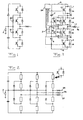
- the converter device shown in Fig 1 is a so called NPC (Neutral Point Clamped)-converter device with clamping diodes of a type well known, and this figure is shown here only for comparing the design of this converter device with a three-level-converter device according to a first preferred embodiment of the invention, which is shown in Fig 2 and 3 and now will be described with reference to these two figures. Only a part of the converter device connected to a phase of an alternating voltage phase line is shown in Fig 3 , but it is also possible that this constitutes the entire converter device, when this is connected to a one-phase alternating voltage network.
- NPC Neutral Point Clamped
- the converter device is a so called VSC-converter, which has four units 1-4, usually called transistor valves or alternatively thyristor valves, connected in series between the two poles 5, 6 of a direct voltage side of the device.
- the units 1-4 are each made of a semiconductor element 10-13 of turn-off type, such as an IGBT or a GTO, and a first diode 14, a so called free-wheeling diode, connected in anti-parallel therewith.
- a semiconductor element 10-13 of turn-off type such as an IGBT or a GTO
- a first diode 14 a so called free-wheeling diode, connected in anti-parallel therewith.
- a first mid point 15 of the series connection between the two units 2 and 3, which constitutes the phase output of the converter, is connected to an alternating voltage phase line 16 through an inductor 17.
- Said series connection is in this way divided into two equal parts with two units 1, 2 and 3, 4, respectively, of each such part.
- a second mid point 18, 19 of each said part of the series connection is through a second diode 20, 21 with a conduction direction with respect to the phase output opposite to the conducting direction of the first diode in the unit arranged between this second mid point and the phase output connected to the mid point 9 of the direct voltage side.
- a semiconductor element 22, 23 of turn-off type, such as an IGBT, is connected in anti-parallel with each second diode. It is also here valid that a great number of semiconductor elements may in practice be connected in series so as to distribute the voltage they have to hold in the blocking state among each of them, although one single semiconductor element has been shown in anti-parallel with each diode.
- the device has an apparatus 24 adapted to control the different semiconductor elements and by that ensure that the phase output 15 is connected to and receive the same potential as the pole 5, the pole 6 or the mid point 9 of the direct voltage side.
- This apparatus 24 and the arrangement thereof is here very simplified illustrated, and a separate such apparatus could in practice be arranged on high potential at each individual unit and these receive control signals from a control apparatus arranged on ground level. The function of the apparatus will be explained further below.
- the converter device shown in Fig 3 differs with respect to the construction thereof from the NPC-converter device already known shown in Fig 1 by the replacement of the two clamping diodes 20', 21' by a unit consisting of a semiconductor element of turn-off type and a second diode connected in anti-parallel therewith.
- the semiconductor elements 10, 13 of the units located between the respective pole and the respective second mid point have not to be turned on and turned off with a higher frequency than a frequency in the order of said fundamental frequency any longer, in which the frequency in question preferably is identical to said fundamental frequency, but this may also be a multiple thereof, such as for example three times the fundamental frequency, especially when voltage harmonics occur on the alternating voltage phase line 16, in which the phase voltage may pass zero at more occasions than two times per period.
- the semiconductor elements 22 and 23 are also controlled with the same frequency as the semiconductor elements 10 and 13. The advantages of not being forced to control the semiconductor elements 10 and 13 with the same high frequency as the semiconductor elements 11 and 12 appear clearly from the disclosure above. +U/2 is obtained on the phase output 15 by turning the semiconductor elements 10 and 11 on, -U/2 is obtained by turning the semiconductor elements 12 and 13 on, while the mid point potential may be obtained either through turning the semiconductor elements 23 and 12 or the semiconductor elements 22 and 11 on.
- a converter device according to Fig 3 is designed for converting direct voltage into alternating voltage and conversely between a direct voltage side and an alternating voltage network with three phases 25, 26, 27. A control for each phase is taking place in accordance with the description made with reference to Fig 3 .
- a converter device with respect to one phase according to a second preferred embodiment of the invention is illustrated in Fig 4 in a view corresponding to Fig 3 , and this differs from the embodiment according to Fig 3 by the series connection of eight units 28-35 between the two poles 5 and 6, in which four are arranged on each side of the phase output 15. Furthermore, two units are arranged between the respective second mid point 18, 19 and the respective pole. Moreover, two units 36-39 are arranged instead of one such unit between each mid point 18 and 19, respectively, and the mid point 9 of the direct voltage side.
- a so called flying capacitor 40 is connected with one pole thereof to a mid point 41, 42 of the series connection of units, which is located between said phase output 15 and the second 18, 19 mid point on the opposite side of the phase output with respect to the connection mid point belonging to the opposite pole thereof and has a unit between itself and the second mid point and a unit between itself and the phase output.
- the following switch state table indicates the voltage levels obtainable at the first mid point 15 and which switch states preferably should be used so as to obtain these voltage levels.
- 28 and 29 30 31 34 and 35 33 32 36 and 37 38 and 39
- This may be obtained in two different ways, which charges or discharges the flying capacitor 40. Which one of these two ways is the one to be used is determined by the voltage of the flying capacitor 40, so that an apparatus corresponding to the apparatus 24 in Fig 3 controls the different semiconductor elements to choose the way resulting in a charging of the capacitor when the voltage across the poles thereof is too low and a discharging thereof when the voltage thereacross is too high with the aim to keep the voltage across the poles of the capacitor at U/4.
- the voltage across the capacitor is by that kept almost constant, which means a low energy content and the capacitor may by that be made small, i.e. with a low capacitance.
- the frequency of the alternating voltage on the phase line 16 is for example 50 or 60 Hz and the converter only has to deliver active or reactive power at this fundamental frequency.
- the inner units 30-33 will then have a mean switching frequency of half the PWM-frequency, i.e. 0,5-1 kHz.
- the other units 28, 29, 34, 35, 36, 37 and 38, 39 will only switch with the fundamental frequency (50 or 60 Hz), and they will do so either at 0-current (28, 29 and 34, 35) or at 0-voltage (36, 37 and 38, 39).
- the switching losses will be kept at a low level. This is valid especially for the semiconductor elements 28, 29, 34, 35, 36, 37, 38, 39. But also the semiconductor elements 30-33 will have a lower mean switching frequency than the corresponding 3-level-converter, so that high voltage semiconductor elements may be chosen, or alternatively semiconductor elements with a smaller area and a higher thermal resistance.
- a seven-level-converter device constructed in the same way as the converter device according to Fig 4 is illustrated in Fig 5 , and the function thereof appear from the description of the device according to Fig 4 .
- two flying capacitors 43 are arranged for obtaining different voltage levels, in which the voltage across the outer capacitor 40 will be U/3 and across the inner capacitor 43 U/6. It is possible to continue in this way and by adding further flying capacitors obtain converter devices with more levels, i.e. 9, 11, ...
- the distribution of the units arranged on both sides of the different mid points of said series connection and between said second mid points and the respective pole may for example be different should that be desired, so that the voltage levels obtained on the first mid point 15 have another mutual relation than shown above.
Landscapes
- Engineering & Computer Science (AREA)
- Power Engineering (AREA)
- Inverter Devices (AREA)
- Ac-Ac Conversion (AREA)
Claims (19)
- Vorrichtung zum Umwandeln von Wechselspannung in Gleichspannung und umgekehrt, welche eine serielle Verbindung von mindestens vier Einheiten (1-4, 28-35), von denen jede aus einem Halbleiter-Element einer Abschaltart (10-13) und einer ersten, antiparallel dazu verbundenen Diode (14) besteht, wobei die serielle Verbindung zwischen zwei Polen (5, 6), einem positiven und einem negativen, einer Gleichspannungsseite der Vorrichtung angeordnet ist, eine Wechselspannungs-Phasenleitung (16), die mit einem ersten Mittelpunkt (15), welcher Phasenausgang genannt wird, der seriellen Verbindung zwischen zwei Einheiten verbunden ist, während die serielle Verbindung in zwei Teile geteilt wird, Mittel (9), welche angepasst sind, einen Mittelpunkt zwischen den zwei Polen auf der Gleichspannungsseite bereitzustellen und diese Pole auf die gleiche Spannung aber mit unterschiedlichen Vorzeichen in Bezug auf den Mittelpunkt der Gleichspannungsseite zu legen, einen zweiten Mittelpunkt (18, 19) von jedem Teil der seriellen Verbindung, welche durch eine zweite Diode (20, 21) mit der Durchlassrichtung in Bezug auf den Phaseausgang entgegengesetzt zu der Durchlassrichtung der ersten Diode (14) in der Einheit besteht, welche zwischen diesem zweiten Mittelpunkt und dem Phasenausgang angeordnet ist, welcher mit dem Mittelpunkt der Gleichspannungsseite verbunden ist und einen Einrichtung (24) zum Steuern der Halbleiter-Elemente der Einheiten umfasst, um einen Pulszug mit vorbestimmten Amplituden gemäß einem Pulsbreiten-Modulationsmuster auf dem Phasenausgang (15) der Vorrichtung, durch alternierendes Verbinden der Wechselspannungs-Phasenleitung mit mindestens dem Mittelpunkt, dem Plus-Pol und dem Minus-Pol der Gleichspannungsseite zu erzeugen, dadurch gekennzeichnet, dass ein Halbleiter-Element (22, 23) eines Abschalttyps anti-parallel mit jeder der zweiten Dioden verbunden ist, und dass die Einrichtung angepasst ist, die Halbleiter-Elemente der Einheiten (2, 3, 30-33) zwischen den zwei Mittelpunkten (18, 19) zu steuern, um mit einer Pulsbreiten-Modulationsfrequenz von mindestens einer Größenordnung höher als die Grundfrequenz der Wechselspannung der Wechselspannungs-Phasenleitung angeschaltet und ausgeschaltet zu werden und um die Halbleiterelemente (22, 23), welche antiparallel mit den zweiten Dioden (20, 21) verbunden sind, und in den Einheiten (1, 4, 28, 29, 34, 35) zwischen dem entsprechenden zweiten Mittelpunkt und dem entsprechenden Pol zu steuern, welche mit einer Frequenz eingeschaltet und ausgeschaltet werden, die wesentlich niedriger als die Pulsbreiten-Modulationsfrequenz und innerhalb oder nahe des Frequenzbereichs des Ein- oder Mehrfachen der Grundfrequenz ist.
- Vorrichtung nach Anspruch 1, dadurch gekennzeichnet, dass die Einrichtung (24) angepasst ist, die Halbleiterelemente (22, 23), welche antiparallel mit den zweiten Dioden (20, 21) verbunden sind, und in den Einheiten (1, 4, 28, 29, 34, 35) zwischen dem entsprechenden zweiten Mittelpunkt und dem entsprechenden Pol mit einer Frequenz zu steuern, die ein Vielfaches der Grundfrequenz beträgt.
- Vorrichtung nach Anspruch 1 oder 2, dadurch gekennzeichnet, dass die Einrichtung (24) angepasst ist, die Halbleiterelemente, welche antiparallel mit den zweiten Dioden verbunden sind, und in den Einheiten zwischen dem entsprechenden zweiten Mittelpunkt und dem entsprechenden Pol mit einer Frequenz zu steuern, die mit der Grundfrequenz in Abwesenheit der Spannungs-Oberschwingungen in der Wechselspannungs-Phasenleitung übereinstimmt.
- Vorrichtung nach Anspruch 3, dadurch gekennzeichnet, dass die Einrichtung (24) angepasst ist, optional einen oder mehrere zusätzliche Schaltungen der Halbleiterelemente, welche antiparallel mit den zweiten Dioden verbunden sind, und diesen in den Einheiten zwischen dem entsprechenden zweiten Mittelpunkt und dem entsprechenden Pol innerhalb einer Grundfrequenzperiode auszuführen.
- Vorrichtung nach einem der Ansprüche 1 - 4, dadurch gekennzeichnet, dass sie vier Ventile (1-4) mit einem oder mehreren der seriell verbundenen Einheiten aufweist, welche angepasst sind, gleichzeitig durch die Einrichtung (24) gesteuert zu werden, wobei jedes der Ventile derart gestaltet ist, um im Wesentlichen den gleichen Anteil einer Spannung aufzunehmen, welche an eine oder mehrere derartige Ventile angelegt ist, welche seriell verbunden ist, wie andere derartige Ventile, wenn die darin enthaltenen Halbleiterelemente ausgeschaltet werden, dass zwei Ventile (1, 2 bzw. 3, 4) zwischen dem Phasenausgang (15) und dem entsprechenden Pol (5, 6) entsprechend angeordnet sind, dass ein Ventil (1, 4) zwischen dem entsprechenden Mittelpunkt (18, 19) und dem entsprechenden Pol angeordnet ist, dass ein Ventil zwischen dem Mittelpunkt (9) der Gleichspannungsseite und dem zweiten Mittelpunkt (18, 19) angeordnet ist und dass die Einrichtung (24) angepasst ist, eine alternierende Verbindung von drei verschiedenen Potenzialpegeln mit dem Phasenausgang (15) auszuführen.
- Vorrichtung nach einem der Ansprüche 1-4, dadurch gekennzeichnet, dass die Einrichtung (24) angepasst ist, die Halbleiterelemente (10-13) der Einheiten und die Halbleiterelemente (22, 23) zu steuern, welche antiparallel mit den zweiten Dioden verbunden sind, um alternierend die Wechselspannungs-Phasenleitung mit einer ungeraden Anzahl von verschiedenen Pegeln zu verbinden, wobei einer von ihnen der Mittelpunkt der Gleichspannungsseite ist und genau so viele positiv wie negativ sind, von denen die Anzahl n ist, welche zumindest 5 ist, dass mindestens (n-1)/2 der Einheiten seriell zwischen dem zweiten (18, 19) und dem ersten Mittelpunkt (15) verbunden sind, dass sie (n-3)/2 sogenannte schwebende Kondensatoren (flying capacitors) (40, 43) umfasst, und dass jeder der fliegenden Kondensatoren mit einem seiner Pole mit einem Mittelpunkt (41, 42) der seriellen Verbindung verbunden ist, welche zwischen dem Phasenausgang und dem zweiten Mittelpunkt auf der entgegen gesetzten Seite des Phasenausgangs in Bezug auf den Verbindungs-Mittelpunkt (41, 42) angeordnet ist, welcher zu seinem entgegen gesetzten Pol gehört und mindestens eine Einheit zwischen sich und dem zweiten Mittelpunkt und einer weiteren Einheit zwischen sich und einer weiteren Kondensatorverbindung oder dem Phasenausgang aufweist.
- Vorrichtung nach Anspruch 6, dadurch gekennzeichnet, dass n 5 ist und dass sie einen der fliegenden Kondensatoren aufweist.
- Vorrichtung nach Anspruch 7, dadurch gekennzeichnet, dass die Einheiten angepasst sind dem fliegenden Kondensator (40) eine Spannung zwischen seinen Polen zu liefern, welche im Wesentlichen gleich U/4 ist, wobei U die Spannung zwischen den zwei Polen der Gleichspannungsseite ist.
- Vorrichtung nach Anspruch 7 oder 8, dadurch gekennzeichnet, dass die serielle Schaltung acht Ventile (28-35) aufweist, wobei jedes Ventil angepasst ist, um im Wesentlichen den selben Anteil einer Spannung aufzunehmen, welche an einem oder mehreren derartigen seriell verbundenen Ventilen anliegt, wie andere derartige Ventile, wenn die darin enthaltenen Halbleiterelemente ausgeschaltet werden, dass vier Ventile (28-35) zwischen dem Phasenausgang und dem entsprechenden Gleichspannungspol angeordnet sind, dass zwei Ventile (28, 29, 34, 35) zwischen dem entsprechenden zweiten Mittelpunkt und dem entsprechenden Gleichspannungspol angeordnet sind, dass ein Ventil (31, 32) zwischen der entsprechenden Verbindung (41, 42) des fliegenden Kondensators (40) mit der seriellen Verbindung und dem Phasenausgang (15) angeordnet ist und dass die zwei Ventile (36-39) seriell zwischen dem Mittelpunkt der Gleichspannungsseite und dem zweiten Mittelpunkt verbunden sind.
- Vorrichtung nach Anspruch 6, dadurch gekennzeichnet, dass n 7 ist.
- Vorrichtung nach Anspruch 9, dadurch gekennzeichnet dass sie zwei fliegende Kondensatoren (40, 43) aufweist, und dass der innere Kondensator (43), welcher durch seine Pole mit der seriellen Verbindung, welche am nächsten an dem Phasenausgang (15) ist, verbunden ist, angepasst ist, eine Spannung von U/6 zwischen seinen Polen aufzuweisen und der zweite, äußere Kondensator (40) eingerichtet ist, ein Spannung von U/3 zwischen seinen Polen aufzuweisen, wobei U die Spannung zwischen den beiden Polen der Gleichspannungsseite darstellt.
- Vorrichtung nach Anspruch 6, dadurch gekennzeichnet, dass die Ventile angepasst sind den fliegenden Kondensatoren (40, 43) eine Spannung Ux zwischen seinen zwei Polen von


- Vorrichtung nach einem der Ansprüche 6-12, dadurch gekennzeichnet, dass die Einrichtung (24) angepasst ist, die Einheit zu steuern, wenn einer der Pole des fliegenden Kondensators (40, 43) mit dem Phasenausgang verbunden ist, so dass der Phasenstrom den Kondensator durchfließt, um diese Verbindung in einem der beiden Richtungen zu ergeben, was im Wesentlichen das selbe Phasenpotential auf dem Phasenausgang ergibt, abhängig von dem unverzögerten realen Pegel der Spannung zwischen den Polen des Kondensators, so dass der Kondensator über die Verbindung auf einen Spannungspegel, welches niedriger als erwünscht ist, geladen wird und auf ein Spannungspegel welcher höher als erwünscht ist, entladen wird.
- Vorrichtung nach Ansprüche 1-13, dadurch gekennzeichnet, dass die Halbleiterelemente IGBTs (Insulated Gate Bipolar Transistor) sind.
- Vorrichtung nach einem der Ansprüche 1-13, dadurch gekennzeichnet, dass die Halbleiterelemente GTOs (Gate Turn-Off thyristor) sind.
- Vorrichtung nach einem der Ansprüche 1-15, dadurch gekennzeichnet, dass die Gleichspannungsseite durch ein Gleichspannungs-Netzwerk gebildet wird, um Hochspannungs-Gleichstrom (HVDC) zu übertragen und die Wechselspannungs-Phasenleitung zu einem Wechselspannungs-Netzwerk gehört.
- Vorrichtung nach einem der Ansprüche 1-15, dadurch gekennzeichnet, dass sie ein Teil einer SVC (Static Var Compensator) mit einer Gleichspannungsseite ist, welche durch Kondensatoren gebildet wird, welche frei betrieben werden und die Wechselspannungs-Phasenleitung zu einem Wechselspannungs-Netzwerk gehört.
- Vorrichtung nach einem der Ansprüche 1-17, dadurch gekennzeichnet, dass sie mindestens zwei Wechselspannungs-Phasenleitungen (16, 25-27) aufweist, welche in einem Multi-Phasen-Wechselspannungsnetzwerk eingeschlossen sind und dass sie eine der seriellen Verbindungen und zweite Dioden, welche damit verknüpft sind und Halbleiterelemente eines Abschalttyps umfasst, welche damit anti-parallel für jede Phasenleitung, welche miteinander parallel verbunden sind, zwischen den Polen der Gleichspannungsseite verbunden sind.
- Vorrichtung nach Anspruch 18, dadurch gekennzeichnet, dass die Anzahl der Phasen des Wechselspannungsnetzwerks drei ist.
Applications Claiming Priority (3)
| Application Number | Priority Date | Filing Date | Title |
|---|---|---|---|
| SE9800205 | 1998-01-27 | ||
| SE9800205A SE511219C2 (sv) | 1998-01-27 | 1998-01-27 | Omriktare där klampningsdioderna ersatts av en aktiv klampningskrets |
| PCT/SE1998/002273 WO1999040676A1 (en) | 1998-01-27 | 1998-12-10 | A converter device |
Publications (2)
| Publication Number | Publication Date |
|---|---|
| EP1051799A1 EP1051799A1 (de) | 2000-11-15 |
| EP1051799B1 true EP1051799B1 (de) | 2008-07-30 |
Family
ID=20409975
Family Applications (1)
| Application Number | Title | Priority Date | Filing Date |
|---|---|---|---|
| EP98963698A Expired - Lifetime EP1051799B1 (de) | 1998-01-27 | 1998-12-10 | Wandlervorrichtung |
Country Status (5)
| Country | Link |
|---|---|
| US (1) | US6480403B1 (de) |
| EP (1) | EP1051799B1 (de) |
| DE (1) | DE69839818D1 (de) |
| SE (1) | SE511219C2 (de) |
| WO (1) | WO1999040676A1 (de) |
Cited By (6)
| Publication number | Priority date | Publication date | Assignee | Title |
|---|---|---|---|---|
| WO2011154576A1 (es) | 2010-06-09 | 2011-12-15 | Consejo Superior De Investigaciones Científicas (Csic) | Pila de combustible de placas bipolares con lámina metálica corrugada |
| WO2012146792A2 (es) | 2011-04-29 | 2012-11-01 | Ingeteam Energy, S.A. | Convertidor electrónico multinivel de potencia |
| CN103250340A (zh) * | 2010-10-15 | 2013-08-14 | Abb技术有限公司 | 用于在dc电力线与ac电力线之间传输电力的装置 |
| WO2014083214A1 (es) | 2012-11-30 | 2014-06-05 | Ingeteam Power Technology, S.A. | Etapa de conmutación, circuito de conversión de energía, y etapa de conversión para turbinas eólicas que comprende el circuito de conversión de energía |
| US10153685B2 (en) | 2014-03-26 | 2018-12-11 | Solaredge Technologies Ltd. | Power ripple compensation |
| US11545912B2 (en) | 2013-03-14 | 2023-01-03 | Solaredge Technologies Ltd. | High frequency multi-level inverter |
Families Citing this family (56)
| Publication number | Priority date | Publication date | Assignee | Title |
|---|---|---|---|---|
| WO2001010007A1 (de) * | 1999-07-31 | 2001-02-08 | Alstom Power Conversion Gmbh | Elektrische schaltung, insbesondere für einen mittelspannungsstromrichter |
| DE19961382A1 (de) | 1999-07-31 | 2001-02-01 | Alstom Anlagen Und Antriebssys | Elektrische Schaltung, insbesondere für einen Mittelspannungsstromrichter |
| FR2814006B1 (fr) * | 2000-09-12 | 2002-11-08 | Centre Nat Rech Scient | Dispositif de conversion d'energie electrique a decoupage |
| DE50110556D1 (de) * | 2000-09-13 | 2006-09-07 | Abb Research Ltd | Steuer- und regelverfahren für einen dreipunkt-stromrichter mit aktiven klemmschaltern sowie vorrichtung hierzu |
| SE517427C2 (sv) * | 2000-10-11 | 2002-06-04 | Abb Ab | Förfarande, apparat, datorprogram och datorprogramprodukt för styrning av VSC-omriktare, samt en VSC-omriktare |
| SE522427C2 (sv) * | 2001-05-30 | 2004-02-10 | Abb Ab | Omriktaranordning samt förfarande för styrning av en sådan |
| DE10131961A1 (de) * | 2001-07-02 | 2003-01-23 | Siemens Ag | N-Punkt-Stromrichterschaltung |
| US6838925B1 (en) * | 2003-10-07 | 2005-01-04 | American Power Conversion Corporation | Three level inverter |
| US6954366B2 (en) * | 2003-11-25 | 2005-10-11 | Electric Power Research Institute | Multifunction hybrid intelligent universal transformer |
| US20070230226A1 (en) * | 2003-11-25 | 2007-10-04 | Jih-Sheng Lai | Multilevel intelligent universal auto-transformer |
| US7050311B2 (en) * | 2003-11-25 | 2006-05-23 | Electric Power Research Institute, Inc. | Multilevel converter based intelligent universal transformer |
| US20070223258A1 (en) * | 2003-11-25 | 2007-09-27 | Jih-Sheng Lai | Multilevel converters for intelligent high-voltage transformers |
| DE102005041087A1 (de) * | 2005-08-30 | 2007-03-01 | Siemens Ag | Stromrichterschaltung mit verteilten Energiespeichern |
| CA2640688C (en) * | 2006-02-01 | 2014-02-11 | Abb Research Ltd | Switchgear cell and converter circuit for switching a large number of voltage levels |
| EP1976107B1 (de) * | 2007-03-30 | 2010-06-09 | Abb Research Ltd. | Schaltzelle sowie Umrichterschaltung zur Schaltung einer Vielzahl von Spannungsniveaus mit einer solchen Schaltzelle |
| DE102008007659A1 (de) * | 2008-02-06 | 2009-02-19 | Siemens Aktiengesellschaft | Umrichter |
| CA2743085C (en) * | 2008-11-10 | 2018-02-13 | Socovar S.E.C. | Multilevel electric power converter |
| US8144491B2 (en) | 2008-12-31 | 2012-03-27 | Drs Power & Control Technologies, Inc. | Cascaded flying capacitor modular high voltage inverters |
| JP5457449B2 (ja) * | 2009-06-19 | 2014-04-02 | 三菱電機株式会社 | 電力変換装置 |
| WO2011073466A1 (es) * | 2009-12-18 | 2011-06-23 | Ingeteam Technology, S.A. | Convertidor modular basado en circuitos distribuidos multinivel de punto medio capacitivo |
| WO2012040257A1 (en) * | 2010-09-21 | 2012-03-29 | Curtiss-Wright Electro-Mechanical Corporation | Two terminal multilevel converter |
| CN103119821B (zh) | 2010-09-30 | 2016-01-13 | Abb研究有限公司 | 多端hvdc系统的协调控制 |
| DE202010012993U1 (de) * | 2010-11-25 | 2012-02-27 | Sma Solar Technology Ag | Mehrpunktwechselrichter-Schaltung |
| US20120243136A1 (en) * | 2011-03-23 | 2012-09-27 | Satcon Technology Corporation | Surge protection arrangement for electrical circuits |
| CN103620941B (zh) * | 2011-07-05 | 2016-03-16 | 富士电机株式会社 | 多电平转换电路 |
| EP2590312A1 (de) * | 2011-11-04 | 2013-05-08 | Alstom Technology Ltd | Spannungszwischenkreisumrichter in erweiterter NPC Topologie und Verfahren zu dessen Betrieb |
| JP5803683B2 (ja) * | 2012-01-13 | 2015-11-04 | 富士電機株式会社 | マルチレベル電力変換回路 |
| JP2013158093A (ja) * | 2012-01-27 | 2013-08-15 | Fuji Electric Co Ltd | 3レベル電力変換装置 |
| AT512409B1 (de) | 2012-02-06 | 2013-08-15 | Fronius Int Gmbh | Ac/dc-spannungswandler und betriebsverfahren hierfür |
| DE102012005974A1 (de) * | 2012-03-23 | 2013-09-26 | Tq-Systems Gmbh | Elektrische Schaltung und Verfahren zu deren Betrieb |
| US8885374B2 (en) | 2012-03-26 | 2014-11-11 | General Electric Company | Multilevel converter and topology method thereof |
| JP2013223274A (ja) * | 2012-04-13 | 2013-10-28 | Fuji Electric Co Ltd | マルチレベル電力変換装置 |
| JP6111541B2 (ja) * | 2012-07-09 | 2017-04-12 | 富士電機株式会社 | マルチレベル電力変換回路の制御方式 |
| US9559611B2 (en) | 2012-09-28 | 2017-01-31 | General Electric Company | Multilevel power converter system and method |
| US9431918B2 (en) * | 2012-09-28 | 2016-08-30 | General Electric Company | Grounding scheme for modular embedded multilevel converter |
| EP2733837A1 (de) * | 2012-11-16 | 2014-05-21 | ABB Technology AG | Umrichter |
| US9252670B2 (en) * | 2012-12-19 | 2016-02-02 | General Electric Company | Multilevel converter |
| JP2015012621A (ja) * | 2013-06-26 | 2015-01-19 | 富士電機株式会社 | マルチレベル電力変換回路 |
| US9537425B2 (en) * | 2013-07-09 | 2017-01-03 | Transphorm Inc. | Multilevel inverters and their components |
| EP2840699A3 (de) * | 2013-07-29 | 2015-07-15 | GE Energy Power Conversion Technology Ltd | Mehrstufiges Wandlersystem |
| US9479075B2 (en) * | 2013-07-31 | 2016-10-25 | General Electric Company | Multilevel converter system |
| CN104682736A (zh) * | 2013-12-02 | 2015-06-03 | 台达电子企业管理(上海)有限公司 | 五电平整流器 |
| US9667167B2 (en) * | 2014-07-15 | 2017-05-30 | General Electric Company | Systems and methods for power conversion with direct current fault ride-through capability |
| US9537421B2 (en) * | 2014-08-22 | 2017-01-03 | General Electric Company | Multilevel converter |
| CN104638619B (zh) * | 2014-12-29 | 2018-11-27 | 国家电网公司 | 一种级联全桥直流断路器控制系统的控制方法 |
| US9800132B2 (en) | 2015-12-29 | 2017-10-24 | General Electric Company | Systems and methods for controlling a plurality of power semiconductor devices |
| US9960708B2 (en) * | 2016-04-22 | 2018-05-01 | Futurewei Technologies, Inc. | Apparatus and method for an active-switched inverter using multiple frequencies |
| CN107707139B (zh) * | 2016-08-08 | 2020-05-01 | 维谛技术有限公司 | 一种具有开关桥臂的电路的控制方法及装置 |
| CN109104098B (zh) | 2017-06-21 | 2020-02-21 | 华为技术有限公司 | 变流器及其驱动方法 |
| US10075080B1 (en) * | 2017-07-18 | 2018-09-11 | Texas Instruments Incorporated | Three-level converter using an auxiliary switched capacitor circuit |
| US10103633B1 (en) * | 2017-08-31 | 2018-10-16 | Dialog Semiconductor (Uk) Limited | Switching converter with power level selection |
| US20200350833A1 (en) * | 2019-05-03 | 2020-11-05 | The Regents Of The University Of California | Pyramid-type multilevel converter topology |
| CN113261190A (zh) * | 2019-09-11 | 2021-08-13 | 华为技术有限公司 | 开关电容器功率转换系统和控制方法 |
| CN112260304B (zh) * | 2020-10-21 | 2022-04-08 | 大连理工大学 | 一种针对于背靠背换流站的三段式控制策略 |
| CN113258804A (zh) * | 2021-05-19 | 2021-08-13 | 山东大学 | 一种减少开关管数量的五电平光伏逆变器及其调制方法 |
| JP7028359B1 (ja) * | 2021-10-01 | 2022-03-02 | 富士電機株式会社 | 電力変換装置 |
Family Cites Families (5)
| Publication number | Priority date | Publication date | Assignee | Title |
|---|---|---|---|---|
| US3757140A (en) * | 1969-02-04 | 1973-09-04 | Ransomes Sims & Jefferies Ltd | Commutation circuits |
| JPS56115182A (en) * | 1980-02-15 | 1981-09-10 | Toshiba Corp | Inverter |
| EP0838855B1 (de) * | 1991-09-20 | 2004-11-24 | Hitachi, Ltd. | Halbleitermodul |
| US5617308A (en) | 1994-11-10 | 1997-04-01 | Otis Elevator Company | Noise-immune, clamped, resonant link inverter |
| US5910892A (en) * | 1997-10-23 | 1999-06-08 | General Electric Company | High power motor drive converter system and modulation control |
-
1998
- 1998-01-27 SE SE9800205A patent/SE511219C2/sv not_active IP Right Cessation
- 1998-12-10 EP EP98963698A patent/EP1051799B1/de not_active Expired - Lifetime
- 1998-12-10 DE DE69839818T patent/DE69839818D1/de not_active Expired - Lifetime
- 1998-12-10 WO PCT/SE1998/002273 patent/WO1999040676A1/en not_active Ceased
- 1998-12-10 US US09/601,114 patent/US6480403B1/en not_active Expired - Lifetime
Non-Patent Citations (1)
| Title |
|---|
| JIH-SHENG LAI; FANG ZHENG PENG: "Multilevel converters-a new breed of power converters", IEEE TRANSACTIONS ON INDUSTRY APPLICATIONS, vol. 32, 8 October 1995 (1995-10-08), pages 509 - 517, XP010193247, ISBN: 0-7803-3008-0 * |
Cited By (21)
| Publication number | Priority date | Publication date | Assignee | Title |
|---|---|---|---|---|
| WO2011154576A1 (es) | 2010-06-09 | 2011-12-15 | Consejo Superior De Investigaciones Científicas (Csic) | Pila de combustible de placas bipolares con lámina metálica corrugada |
| CN103250340A (zh) * | 2010-10-15 | 2013-08-14 | Abb技术有限公司 | 用于在dc电力线与ac电力线之间传输电力的装置 |
| CN103250340B (zh) * | 2010-10-15 | 2016-09-14 | Abb技术有限公司 | 用于在dc电力线与ac电力线之间传输电力的装置 |
| WO2012146792A2 (es) | 2011-04-29 | 2012-11-01 | Ingeteam Energy, S.A. | Convertidor electrónico multinivel de potencia |
| US9559523B2 (en) | 2011-04-29 | 2017-01-31 | Ingeteam Power Technology, S.A. | Multilevel electronic power converter |
| WO2014083214A1 (es) | 2012-11-30 | 2014-06-05 | Ingeteam Power Technology, S.A. | Etapa de conmutación, circuito de conversión de energía, y etapa de conversión para turbinas eólicas que comprende el circuito de conversión de energía |
| US9660553B2 (en) | 2012-11-30 | 2017-05-23 | Ingeteam Power Technology, S.A. | Switching stage, energy conversion circuit, and conversion stage for wind turbines comprising the energy conversion circuit |
| US11545912B2 (en) | 2013-03-14 | 2023-01-03 | Solaredge Technologies Ltd. | High frequency multi-level inverter |
| US11742777B2 (en) | 2013-03-14 | 2023-08-29 | Solaredge Technologies Ltd. | High frequency multi-level inverter |
| US12119758B2 (en) | 2013-03-14 | 2024-10-15 | Solaredge Technologies Ltd. | High frequency multi-level inverter |
| US10700588B2 (en) | 2014-03-26 | 2020-06-30 | Solaredge Technologies Ltd. | Multi-level inverter |
| US10404154B2 (en) | 2014-03-26 | 2019-09-03 | Solaredge Technologies Ltd | Multi-level inverter with flying capacitor topology |
| US10886832B2 (en) | 2014-03-26 | 2021-01-05 | Solaredge Technologies Ltd. | Multi-level inverter |
| US10886831B2 (en) | 2014-03-26 | 2021-01-05 | Solaredge Technologies Ltd. | Multi-level inverter |
| US11296590B2 (en) | 2014-03-26 | 2022-04-05 | Solaredge Technologies Ltd. | Multi-level inverter |
| US10153685B2 (en) | 2014-03-26 | 2018-12-11 | Solaredge Technologies Ltd. | Power ripple compensation |
| US11632058B2 (en) | 2014-03-26 | 2023-04-18 | Solaredge Technologies Ltd. | Multi-level inverter |
| US10680505B2 (en) | 2014-03-26 | 2020-06-09 | Solaredge Technologies Ltd. | Multi-level inverter |
| US11855552B2 (en) | 2014-03-26 | 2023-12-26 | Solaredge Technologies Ltd. | Multi-level inverter |
| US10680506B2 (en) | 2014-03-26 | 2020-06-09 | Solaredge Technologies Ltd. | Multi-level inverter |
| US12136890B2 (en) | 2014-03-26 | 2024-11-05 | Solaredge Technologies Ltd. | Multi-level inverter |
Also Published As
| Publication number | Publication date |
|---|---|
| SE9800205D0 (sv) | 1998-01-27 |
| EP1051799A1 (de) | 2000-11-15 |
| US6480403B1 (en) | 2002-11-12 |
| SE511219C2 (sv) | 1999-08-23 |
| DE69839818D1 (de) | 2008-09-11 |
| WO1999040676A9 (en) | 2002-01-03 |
| SE9800205L (sv) | 1999-07-28 |
| WO1999040676A1 (en) | 1999-08-12 |
Similar Documents
| Publication | Publication Date | Title |
|---|---|---|
| EP1051799B1 (de) | Wandlervorrichtung | |
| EP1196983B1 (de) | Selbstgeführter umrichter | |
| Menzies et al. | Advanced static compensation using a multilevel GTO thyristor inverter | |
| US6898095B2 (en) | Bidirectional VSC converter with a resonant circuit | |
| US5673189A (en) | Device for increasing the power yield of the fundamental component of a self-commutated power inverter | |
| Menzies et al. | Five-level GTO inverters for large induction motor drives | |
| US7046531B2 (en) | Transformerless static voltage inverter for battery systems | |
| US6411067B1 (en) | Voltage source converters operating either as back-to-back stations or as parallel static var compensators | |
| US5644482A (en) | HVDC transmission system with multiple converter stations | |
| EP2289163B1 (de) | Spannungsquellenumsetzer | |
| CN1720655B (zh) | 转换器和用于控制转换器的方法 | |
| WO2010115471A1 (en) | An arrangement for exchanging power | |
| US8437113B2 (en) | Cooling and shielding of a high voltage converter | |
| WO1998007225A1 (en) | Reducing switching losses in series connected bridge inverters and amplifiers | |
| US10873254B2 (en) | Electrical circuit for zero-voltage soft-switching in DC-DC converter under all load conditions | |
| EP3649729B1 (de) | Hybrider leistungswandler | |
| EP1325550B1 (de) | Verfahren zur steuerung eines spannungsgespeisten umrichters und spannungsgespeister umrichter | |
| JP2004524795A (ja) | Vscコンバータ | |
| WO2004082115A1 (en) | A vsc converter and a method | |
| JPH11127540A (ja) | 交流グリッドシステムへの無効電力の供給方法およびこの方法に用いるインバータ | |
| WO2004017505A1 (en) | An installation for transmission of electric power and a method for operation of such an installation | |
| WO2002097960A1 (en) | A converter apparatus and a method for control thereof | |
| EP1338083A1 (de) | Vorrichtung zum umsetzen einer wechselspannung in gleichspannung | |
| Shakweh | Evaluation of MV power stack topologies | |
| CN114826000A (zh) | 三桥臂多电平变换器 |
Legal Events
| Date | Code | Title | Description |
|---|---|---|---|
| PUAI | Public reference made under article 153(3) epc to a published international application that has entered the european phase |
Free format text: ORIGINAL CODE: 0009012 |
|
| 17P | Request for examination filed |
Effective date: 20000614 |
|
| AK | Designated contracting states |
Kind code of ref document: A1 Designated state(s): DE FR GB SE |
|
| GRAP | Despatch of communication of intention to grant a patent |
Free format text: ORIGINAL CODE: EPIDOSNIGR1 |
|
| RIN1 | Information on inventor provided before grant (corrected) |
Inventor name: BIJLENGA, BO |
|
| GRAS | Grant fee paid |
Free format text: ORIGINAL CODE: EPIDOSNIGR3 |
|
| GRAA | (expected) grant |
Free format text: ORIGINAL CODE: 0009210 |
|
| AK | Designated contracting states |
Kind code of ref document: B1 Designated state(s): DE FR GB SE |
|
| REG | Reference to a national code |
Ref country code: GB Ref legal event code: FG4D |
|
| REF | Corresponds to: |
Ref document number: 69839818 Country of ref document: DE Date of ref document: 20080911 Kind code of ref document: P |
|
| PLBE | No opposition filed within time limit |
Free format text: ORIGINAL CODE: 0009261 |
|
| STAA | Information on the status of an ep patent application or granted ep patent |
Free format text: STATUS: NO OPPOSITION FILED WITHIN TIME LIMIT |
|
| 26N | No opposition filed |
Effective date: 20090506 |
|
| PG25 | Lapsed in a contracting state [announced via postgrant information from national office to epo] |
Ref country code: SE Free format text: LAPSE BECAUSE OF FAILURE TO SUBMIT A TRANSLATION OF THE DESCRIPTION OR TO PAY THE FEE WITHIN THE PRESCRIBED TIME-LIMIT Effective date: 20081030 |
|
| PGFP | Annual fee paid to national office [announced via postgrant information from national office to epo] |
Ref country code: DE Payment date: 20141211 Year of fee payment: 17 Ref country code: GB Payment date: 20141219 Year of fee payment: 17 |
|
| PGFP | Annual fee paid to national office [announced via postgrant information from national office to epo] |
Ref country code: FR Payment date: 20141219 Year of fee payment: 17 |
|
| REG | Reference to a national code |
Ref country code: DE Ref legal event code: R119 Ref document number: 69839818 Country of ref document: DE |
|
| GBPC | Gb: european patent ceased through non-payment of renewal fee |
Effective date: 20151210 |
|
| REG | Reference to a national code |
Ref country code: FR Ref legal event code: ST Effective date: 20160831 |
|
| PG25 | Lapsed in a contracting state [announced via postgrant information from national office to epo] |
Ref country code: DE Free format text: LAPSE BECAUSE OF NON-PAYMENT OF DUE FEES Effective date: 20160701 Ref country code: GB Free format text: LAPSE BECAUSE OF NON-PAYMENT OF DUE FEES Effective date: 20151210 |
|
| PG25 | Lapsed in a contracting state [announced via postgrant information from national office to epo] |
Ref country code: FR Free format text: LAPSE BECAUSE OF NON-PAYMENT OF DUE FEES Effective date: 20151231 |