EP1051992A2 - Stimulateur cardiaque avec fréquence adaptative avec changement de fréquence amélioré - Google Patents
Stimulateur cardiaque avec fréquence adaptative avec changement de fréquence amélioré Download PDFInfo
- Publication number
- EP1051992A2 EP1051992A2 EP00116324A EP00116324A EP1051992A2 EP 1051992 A2 EP1051992 A2 EP 1051992A2 EP 00116324 A EP00116324 A EP 00116324A EP 00116324 A EP00116324 A EP 00116324A EP 1051992 A2 EP1051992 A2 EP 1051992A2
- Authority
- EP
- European Patent Office
- Prior art keywords
- rate
- sensor
- pacing
- pacemaker
- pacing rate
- Prior art date
- Legal status (The legal status is an assumption and is not a legal conclusion. Google has not performed a legal analysis and makes no representation as to the accuracy of the status listed.)
- Granted
Links
- 230000008859 change Effects 0.000 title claims abstract description 25
- 230000000747 cardiac effect Effects 0.000 claims description 9
- 230000004044 response Effects 0.000 abstract description 11
- 230000006870 function Effects 0.000 description 21
- 230000000694 effects Effects 0.000 description 7
- 230000007423 decrease Effects 0.000 description 5
- 238000010586 diagram Methods 0.000 description 5
- 238000000034 method Methods 0.000 description 5
- 230000006461 physiological response Effects 0.000 description 4
- 230000003247 decreasing effect Effects 0.000 description 3
- 230000004043 responsiveness Effects 0.000 description 3
- 102100026827 Protein associated with UVRAG as autophagy enhancer Human genes 0.000 description 2
- 101710102978 Protein associated with UVRAG as autophagy enhancer Proteins 0.000 description 2
- 239000008280 blood Substances 0.000 description 2
- 210000004369 blood Anatomy 0.000 description 2
- 230000036772 blood pressure Effects 0.000 description 2
- 230000037081 physical activity Effects 0.000 description 2
- 230000002861 ventricular Effects 0.000 description 2
- 230000009118 appropriate response Effects 0.000 description 1
- QVGXLLKOCUKJST-UHFFFAOYSA-N atomic oxygen Chemical compound [O] QVGXLLKOCUKJST-UHFFFAOYSA-N 0.000 description 1
- 230000001746 atrial effect Effects 0.000 description 1
- 230000008901 benefit Effects 0.000 description 1
- 238000004364 calculation method Methods 0.000 description 1
- 238000004891 communication Methods 0.000 description 1
- 238000005314 correlation function Methods 0.000 description 1
- 230000009977 dual effect Effects 0.000 description 1
- 210000002837 heart atrium Anatomy 0.000 description 1
- 230000006872 improvement Effects 0.000 description 1
- 230000002503 metabolic effect Effects 0.000 description 1
- 229910052760 oxygen Inorganic materials 0.000 description 1
- 239000001301 oxygen Substances 0.000 description 1
- 230000009894 physiological stress Effects 0.000 description 1
- 230000029058 respiratory gaseous exchange Effects 0.000 description 1
- 230000007704 transition Effects 0.000 description 1
- 238000009423 ventilation Methods 0.000 description 1
Images



Classifications
-
- A—HUMAN NECESSITIES
- A61—MEDICAL OR VETERINARY SCIENCE; HYGIENE
- A61N—ELECTROTHERAPY; MAGNETOTHERAPY; RADIATION THERAPY; ULTRASOUND THERAPY
- A61N1/00—Electrotherapy; Circuits therefor
- A61N1/18—Applying electric currents by contact electrodes
- A61N1/32—Applying electric currents by contact electrodes alternating or intermittent currents
- A61N1/36—Applying electric currents by contact electrodes alternating or intermittent currents for stimulation
- A61N1/362—Heart stimulators
- A61N1/365—Heart stimulators controlled by a physiological parameter, e.g. heart potential
-
- A—HUMAN NECESSITIES
- A61—MEDICAL OR VETERINARY SCIENCE; HYGIENE
- A61N—ELECTROTHERAPY; MAGNETOTHERAPY; RADIATION THERAPY; ULTRASOUND THERAPY
- A61N1/00—Electrotherapy; Circuits therefor
- A61N1/18—Applying electric currents by contact electrodes
- A61N1/32—Applying electric currents by contact electrodes alternating or intermittent currents
- A61N1/36—Applying electric currents by contact electrodes alternating or intermittent currents for stimulation
- A61N1/362—Heart stimulators
- A61N1/365—Heart stimulators controlled by a physiological parameter, e.g. heart potential
- A61N1/36585—Heart stimulators controlled by a physiological parameter, e.g. heart potential controlled by two or more physical parameters
Definitions
- the present invention relates to cardiac pacers, and more particularly, to a rate responsive cardiac pacer which automatically controls the speed with which pacing rate can be changed so as to provide a more physiological response to changing cardiac demand.
- rate responsive cardiac pacemaker is now acknowledged to provide a significant improvement over prior fixed-rate cardiac pacemakers.
- rate response techniques have been applied to both single and dual chamber pacemakers, and are able to control pacing rate as a function of one or more measured parameters which are directly or indirectly related to cardiac demand.
- measured parameters include, for example, the physical activity or movement of the patient, right ventricular blood pressure and change of such blood pressure over time, venous blood temperature, venous blood oxygen saturation, respiration, minute ventilation and Q-T interval.
- a more recent advent is the employment of two or more sensors and the use of algorithms for obtaining an optimized sensor-heart rate correlation function. See, for example, U.S. Patent No. 5,065,759, entitled "Pacemaker With Optimized Rate Responsiveness and Method of Rate Control,” assigned to the same assignee as this application.
- An advantage of the combined sensor approach is to provide a sensor response which accurately tracks cardiac demand both during fast time period episodes and during more stable steady state patient conditions.
- the Q-T parameter is very reliable as a steady state indicator of metabolic demand, but does not respond quickly to fast changes, such as at the onset of exercise.
- the activity-type sensor such as described in U.S. Patent No. 4,485,813, issued to Anderson et al., and assigned to Medtronic, Inc., provides a faster response to changing patient conditions, even though it may not be as accurate an indicator of quiescent demand.
- a problem that pacemaker designers have encountered, but not yet resolved fully satisfactorily, is that of translating sensor indications of desired pacing rate into actual changes in pacing rate.
- the body's physiological response is known to be different from what accurate sensor signals would otherwise indicate.
- the heart does not increase rate as a step function, but increases over a period of time and as a function of the degree of exercise.
- the physiological heart rate decays in accordance with a certain decay function. Accordingly, there have been efforts to resolve the discrepancy between normal heart deceleration function at the end of physiological stresses such as physical activity, and the normal physiological decay function. See, for example, U.S. Application S.N.
- the inventor of this invention has also observed that the appropriate response of a pacemaker to changed sensor indication of heart rate is generally a function of patient history, and specifically recent heart rate (paced or natural). This is a general rule, and is the case not just at transitions from rest to exercise or exercise to rest. Thus, if a patient has already had a relatively high heart rate, e.g., 85 bpm, and the sensor indication calls for a still increased heart rate, the correct physiological response may be different from the situation where the patient starts with a lower heart rate, e.g., around 70 bpm.
- a relatively high heart rate e.g. 85 bpm
- the sensor indication calls for a still increased heart rate
- the correct physiological response may be different from the situation where the patient starts with a lower heart rate, e.g., around 70 bpm.
- a pacemaker wherein the sensor rate information is analyzed continuously and wherein the rise time for increasing rates and the decay time for decreasing rates are adjusted as a function of patient history such as initial rate, the difference between the sensor indicated rate and present natural rate, and the rate of change of the sensor indicated rate.
- the pacemaker determines an indicated sensor rate (R), the difference between the sensor rate and the then current pacing rate (R-r), and calculates a measure of the time rate of change of R.
- the pacemaker determines whether rate should be incremented or decremented (or left unchanged).
- a first value or change in r ( ⁇ r) is obtained as a function of current pacing rate.
- the measure of time rate of change in R is then compared to a rise threshold figure or a decay threshold figure, depending upon whether a rise or decay in pacing rate is indicated. If the time rate of change in R exceeds the corresponding threshold, a further adjustment to ⁇ r is made, following which pacing rate is increased or decreased by the adjusted ⁇ r.
- control of the per cycle change in pacing rate as set forth above is suitably carried out with the aid of a programmed microprocessor and associated memory.
- the algorithm for carrying out the novel functions of this invention may be supplemented to modify decay time as a function of total patient work during exercise, in accordance with the aforementioned U.S. application S.N. 880,877, which is incorporated herein by reference.
- FIG. 1A there are shown curves which illustrate the problems to be solved by this invention.
- FIG. 1A there are shown two curves correlating pacing rate (r) with a sensed parameter.
- a first curve 30 correlates Q-T interval with pacing rate
- a second curve correlates activity (ACT) with pacing rate.
- each sensor calls for a higher R, and thus a shorter pacing interval.
- the activity sensor is a relatively fast response time sensor, indicating an elevated target pacing rate as shown at R ACT , corresponding to "ACTUAL ACT.”
- the Q-T interval indicates a pacing rate as shown at R QT , corresponding to "ACTUAL QT.” For either sensor, the change from r to R could constitute a large (and unacceptable) jump.
- the pacemaker does not jump directly to the target pacing rate, i.e., immediately switch to a pacing rate R. Rather, the pacemaker may suitably increase rate by an increment ⁇ r which establishes a limit on the rise time of the pacing rate. Likewise, at the cessation of exercise, where R may call for a sharp drop in pacing rate, the pacemaker imposes a decay time which limits the speed with which pacing rate is decreased down toward a normal base rate. See, for example, the discussion in above-referenced S.N. 880,877.
- the rise time or decay time for use in a pacemaker is properly a function of the pacing rate, and should not be a constant value.
- the permitted rise time may vary from a maximum at a relatively low rate to a minimum level at a relatively high rate.
- the initial incremental rise ( ⁇ r) can correspond to an incremental decrease in time interval of, e.g., 20 ms. The value of ⁇ r decreases as the pacing rate is driven upward toward the target rate of 150 bpm.
- the rise time corresponds to a smaller incremental increase in rate, to permit a more physiological step up of pacing rate toward the target rate.
- the initial decay rate can be set to decrement pacing rate at a larger interval (e.g., 20 ms), whereas the decay rate is less for a starting point where the pacing rate was closer to 70 bpm.
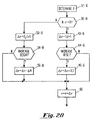
- FIG. 2A there is shown a flow diagram for logic steps to be taken in a pacemaker of this invention.
- the steps may be embodied in software such a contained in microprocessor circuitry 70 as illustrated in Figure 3.
- any equivalent hardware or combination of hardware and software may be utilized for carrying out the steps of determining how to vary the rise time or decay time for a pacemaker of this invention.
- the indicated pacing rate R is determined from the sensor information.
- the absolute difference ⁇ R between R and the present pacing rate (R-r) is determined. If this absolute difference is less than a predetermined minimum amount, ⁇ R is set to zero.
- a measure of the time rate of change of the sensor indicated pacing rate is obtained.
- a calculation of ⁇ R AVG is made, which is an average of ⁇ R over the last n cycles. Thus, if n is a small number, e.g., 2-4, ⁇ R AVG will give an indication of any substantial change in R. Note that also that the change in R-r from the last cycle can also be calculated, and used as a measure of time rate of change of the sensor rate.
- step 38 it is determined whether R-r is greater than zero. If yes, meaning that the pacemaker wants to increase rate, the program branches to block 40.
- pacing rate is set equal to r (the prior pacing rate) + ⁇ r. Going back to block 38, if the answer is no, this means that the pacemaker wants to decrease pacing rate, and select a decay time.
- ⁇ r is set equal to f 2 (r). The program then goes to block 54 and compares ⁇ R AVG to a second stored threshold ⁇ R TH2 . If this comparison is positive, then ⁇ r is further decremented by ⁇ 2 at 56, to decrease pacing rate at a greater decay rate.
- Figure 2A is reflective simply of logic steps taken to adjust the rise time or the decay time of the pacer response as a function of pacing rate and time rate of change of the sensor indicated rate. These steps may be combined with other logic decisions, such as consideration of total work done during exercise, as set forth in the above-mentioned application entitled "Work-Modulated Pacing Rate Deceleration.” Further, rise time and/or decay time may be modulated as a function of a second sensor. Thus, if sensor rate r is determined primarily or solely from a first parameter such as Q-T interval, a second faster response sensor such as a typical activity sensor may be used to control rise time or decay time. For this embodiment, as seen in Fig.
- R is obtained from a first sensor, at 32-B.
- rate should be incremented or decremented. If incremented, at 40-B ⁇ r is made equal to f 1 (r). Then, at 44B, the second sensor is monitored, to see if a faster response is indicated. If yes, ⁇ r is set equal to ⁇ r + ⁇ 3 at 46-B. If it is determined that rate should be decremented, at 50-B, ⁇ r is made equal to f 2 (r). Then, at 54-B, the second sensor signal is examined to determine whether a faster decay is indicated. If yes, at 56-B, ⁇ r is set equal to ⁇ r - ⁇ 4.
- Microprocessor circuitry 70 is illustrated, being comprised of microprocessor unit 70 and associated memory 72.
- the microprocessor itself may have built-in memory, in which case memory 72 is additional memory.
- the microprocessor circuitry is connected by data communication bus 73 to hardware block 75, and specifically to digital logic and control circuitry 76.
- This control circuitry is used for a number of conventional pacemaker operations, including controlling the timing, shape and size of output stimulus pulses.
- the digital logic and control circuitry 76 provides control signals to circuitry 81, which may generate atrial pace and/or ventricular pace pulses, which pulses are coupled on lead 83 to the atrium and/or the ventricle of the patient.
- sensor 77 is shown, illustrated as an external sensor, which generates signals which are coupled through to amplifier and processing circuitry 78, and in turn coupled to circuitry 76 for developing of the R signal.
- Sensor 77 may be one or more external sensors, including a fast time-response sensor as discussed below, and may be utilized along with the Q-T signal, which latter signal is developed from the V sense circuitry in a known manner.
- an external programmer 86 may be used which communicates with the pacemaker through transmit receive circuitry 87 in a standard fashion.
- rate increments can be determined to include either ⁇ 1 and/or ⁇ 3, and rate decrements can be determined to include either ⁇ 2 and/or ⁇ 4.
- changes can be determined as a function of pacing rate; time rate of change of the sensor-indicated pacing rate, and/or an extra sensor chosen to provide a fast time response. The contribution of the extra sensor in this arrangement is to accelerate the change of r so as to more quickly decrease the R-r difference.
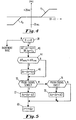
- ⁇ r may be determined from a function f3, as illustrated in Figure 4.
- ⁇ r is zero until the magnitude of R-r exceeds a predetermined limit; ⁇ r then increases linearly to a maximum value, such as 20 ms, and remains at such maximum value for even greater magnitudes (positive or negative values) of R-r.
- the increment in pacing rate ( ⁇ r) can be modified depending upon whether the prior cycles were terminated with sensed natural beats, or paced beats. For example, the prior n cycles can be examined to determine if all resulted in sensed beats, or all resulted in paced beats. If sensed beats, the increase in ⁇ r is limited, so that the sensor is not allowed to overtake the natural rate too quickly. If the prior n beats were paced, then the ⁇ r increment can be made greater. This variation is illustrated in Figure 5, which is a variation of Figure 2A. As there illustrated, at 40, ⁇ r is determined following a finding that R-r is positive, by using either the f1 or f3 function.
Landscapes
- Health & Medical Sciences (AREA)
- Heart & Thoracic Surgery (AREA)
- Life Sciences & Earth Sciences (AREA)
- Cardiology (AREA)
- Engineering & Computer Science (AREA)
- Physiology (AREA)
- Biophysics (AREA)
- Biomedical Technology (AREA)
- Nuclear Medicine, Radiotherapy & Molecular Imaging (AREA)
- Radiology & Medical Imaging (AREA)
- Animal Behavior & Ethology (AREA)
- General Health & Medical Sciences (AREA)
- Public Health (AREA)
- Veterinary Medicine (AREA)
- Electrotherapy Devices (AREA)
Applications Claiming Priority (3)
| Application Number | Priority Date | Filing Date | Title |
|---|---|---|---|
| US08/132,758 US5470344A (en) | 1993-10-06 | 1993-10-06 | Rate responsive pacemake with improved rate change dynamics and pacing method |
| US132758 | 1993-10-06 | ||
| EP94115769A EP0647454B1 (fr) | 1993-10-06 | 1994-10-06 | Stimulateur cardiaque avec fréquence adaptative avec changement de fréquence amélioré |
Related Parent Applications (1)
| Application Number | Title | Priority Date | Filing Date |
|---|---|---|---|
| EP94115769A Division EP0647454B1 (fr) | 1993-10-06 | 1994-10-06 | Stimulateur cardiaque avec fréquence adaptative avec changement de fréquence amélioré |
Publications (3)
| Publication Number | Publication Date |
|---|---|
| EP1051992A2 true EP1051992A2 (fr) | 2000-11-15 |
| EP1051992A3 EP1051992A3 (fr) | 2000-11-22 |
| EP1051992B1 EP1051992B1 (fr) | 2005-04-20 |
Family
ID=22455467
Family Applications (2)
| Application Number | Title | Priority Date | Filing Date |
|---|---|---|---|
| EP94115769A Expired - Lifetime EP0647454B1 (fr) | 1993-10-06 | 1994-10-06 | Stimulateur cardiaque avec fréquence adaptative avec changement de fréquence amélioré |
| EP00116324A Expired - Lifetime EP1051992B1 (fr) | 1993-10-06 | 1994-10-06 | Stimulateur cardiaque avec fréquence adaptative avec changement de fréquence amélioré |
Family Applications Before (1)
| Application Number | Title | Priority Date | Filing Date |
|---|---|---|---|
| EP94115769A Expired - Lifetime EP0647454B1 (fr) | 1993-10-06 | 1994-10-06 | Stimulateur cardiaque avec fréquence adaptative avec changement de fréquence amélioré |
Country Status (3)
| Country | Link |
|---|---|
| US (1) | US5470344A (fr) |
| EP (2) | EP0647454B1 (fr) |
| DE (2) | DE69430892T2 (fr) |
Families Citing this family (7)
| Publication number | Priority date | Publication date | Assignee | Title |
|---|---|---|---|---|
| FR2713094B1 (fr) * | 1993-12-06 | 1996-01-19 | Ela Medical Sa | Simulateur cardiaque implantable à fréquence asservie, et son procédé de commande. |
| FR2734730B1 (fr) * | 1995-05-31 | 1997-08-22 | Ela Medical Sa | Dispositif medical implantable actif, notamment stimulateur cardiaque ou defribrillateur |
| SE9603635D0 (sv) | 1996-10-04 | 1996-10-04 | Pacesetter Ab | Implantable stimulator |
| DE19900690C1 (de) | 1999-01-05 | 2000-05-18 | Pacesetter Ab Jaerfaella | Herzschrittmacher |
| US6836682B2 (en) | 2001-11-16 | 2004-12-28 | Medtronic, Inc. | Rate responsive pacing system with QT sensor based on intrinsic QT data |
| US20040215277A1 (en) * | 2003-04-25 | 2004-10-28 | Peter Oosterhoff | Dynamic pacing interval extension for detection of intrinsic ventricular activity |
| US7957801B2 (en) * | 2003-04-25 | 2011-06-07 | Medtronic, Inc. | Dynamic pacing interval extension for detection of intrinsic ventricular activity |
Citations (4)
| Publication number | Priority date | Publication date | Assignee | Title |
|---|---|---|---|---|
| US4485813A (en) | 1981-11-19 | 1984-12-04 | Medtronic, Inc. | Implantable dynamic pressure transducer system |
| US5065759A (en) | 1990-08-30 | 1991-11-19 | Vitatron Medical B.V. | Pacemaker with optimized rate responsiveness and method of rate control |
| US5134997A (en) | 1990-08-14 | 1992-08-04 | Medtronic, Inc. | Rate responsive pacemaker and pacing method |
| US5312453A (en) | 1992-05-11 | 1994-05-17 | Medtronic, Inc. | Rate responsive cardiac pacemaker and method for work-modulating pacing rate deceleration |
Family Cites Families (11)
| Publication number | Priority date | Publication date | Assignee | Title |
|---|---|---|---|---|
| US4091726A (en) * | 1976-11-02 | 1978-05-30 | Joseph E. Podgor, Inc. | Magnetic registration apparatus for silk screen printer |
| DE3419439C1 (de) * | 1984-05-24 | 1985-11-21 | Eckhard Dr. 8000 München Alt | Belastungsabhaengig frequenzvariabler Herzschrittmacher |
| US4782836A (en) * | 1984-05-24 | 1988-11-08 | Intermedics, Inc. | Rate adaptive cardiac pacemaker responsive to patient activity and temperature |
| US4708143A (en) * | 1984-07-19 | 1987-11-24 | Cordis Leads Inc. | Method for controlling pacing of a heart in response to changes in stroke volume |
| US4566456A (en) * | 1984-10-18 | 1986-01-28 | Cordis Corporation | Apparatus and method for adjusting heart/pacer rate relative to right ventricular systolic pressure to obtain a required cardiac output |
| DE3787186T2 (de) * | 1986-03-19 | 1994-05-05 | Telectronics Nv | Taktempfindliche Stimulierung mit Benutzung des ventrikulären Gradienten. |
| DE68927447T2 (de) * | 1988-02-17 | 1997-04-03 | Lewis | Frequenz-empfindlicher Herzschrittmacher |
| US5052388A (en) * | 1989-12-22 | 1991-10-01 | Medtronic, Inc. | Method and apparatus for implementing activity sensing in a pulse generator |
| US5158078A (en) * | 1990-08-14 | 1992-10-27 | Medtronic, Inc. | Rate responsive pacemaker and methods for optimizing its operation |
| US5144949A (en) * | 1991-03-15 | 1992-09-08 | Medtronic, Inc. | Dual chamber rate responsive pacemaker with automatic mode switching |
| IT1245814B (it) * | 1991-05-21 | 1994-10-18 | Sorin Biomedica Spa | Dispositivo cardiostimolatore del tipo rate responsive |
-
1993
- 1993-10-06 US US08/132,758 patent/US5470344A/en not_active Expired - Lifetime
-
1994
- 1994-10-06 EP EP94115769A patent/EP0647454B1/fr not_active Expired - Lifetime
- 1994-10-06 DE DE69430892T patent/DE69430892T2/de not_active Expired - Lifetime
- 1994-10-06 EP EP00116324A patent/EP1051992B1/fr not_active Expired - Lifetime
- 1994-10-06 DE DE69434346T patent/DE69434346T2/de not_active Expired - Lifetime
Patent Citations (4)
| Publication number | Priority date | Publication date | Assignee | Title |
|---|---|---|---|---|
| US4485813A (en) | 1981-11-19 | 1984-12-04 | Medtronic, Inc. | Implantable dynamic pressure transducer system |
| US5134997A (en) | 1990-08-14 | 1992-08-04 | Medtronic, Inc. | Rate responsive pacemaker and pacing method |
| US5065759A (en) | 1990-08-30 | 1991-11-19 | Vitatron Medical B.V. | Pacemaker with optimized rate responsiveness and method of rate control |
| US5312453A (en) | 1992-05-11 | 1994-05-17 | Medtronic, Inc. | Rate responsive cardiac pacemaker and method for work-modulating pacing rate deceleration |
Also Published As
| Publication number | Publication date |
|---|---|
| EP0647454B1 (fr) | 2002-07-03 |
| DE69430892D1 (de) | 2002-08-08 |
| US5470344A (en) | 1995-11-28 |
| EP0647454A2 (fr) | 1995-04-12 |
| DE69434346T2 (de) | 2006-03-09 |
| EP1051992B1 (fr) | 2005-04-20 |
| EP0647454A3 (fr) | 1997-02-05 |
| EP1051992A3 (fr) | 2000-11-22 |
| DE69430892T2 (de) | 2003-02-06 |
| DE69434346D1 (de) | 2005-05-25 |
Similar Documents
| Publication | Publication Date | Title |
|---|---|---|
| US5312453A (en) | Rate responsive cardiac pacemaker and method for work-modulating pacing rate deceleration | |
| US5065759A (en) | Pacemaker with optimized rate responsiveness and method of rate control | |
| US5158078A (en) | Rate responsive pacemaker and methods for optimizing its operation | |
| US4972834A (en) | Pacemaker with improved dynamic rate responsiveness | |
| US5350409A (en) | Rate adaptive pacemaker with adjustment of sensor rate as a function of sensed sinus rate | |
| US6477418B2 (en) | Implantable heart stimulation system with automatic mode switching controlled by sympatho-vagal balance | |
| JP3340819B2 (ja) | 心臓ペースメーカー | |
| US5282839A (en) | Rate responsive cardiac pacemaker and method for providing an optimized pacing rate which varies with a patient's physiologic demand | |
| EP0363015A1 (fr) | Stimulateur cardiaque à stabilisation du rythme | |
| EP0543939A1 (fr) | Procede d'optimisation pour stimulateur cardiaque sensible au rythme du c ur. | |
| EP0545967A1 (fr) | Systeme de stimulateur cardiaque a frequence commandee utilisant l'intervalle ar pour la commande de la frequence. | |
| US5134997A (en) | Rate responsive pacemaker and pacing method | |
| EP1051992B1 (fr) | Stimulateur cardiaque avec fréquence adaptative avec changement de fréquence amélioré | |
| EP0543925B1 (fr) | Stimulateur cardiaque sensible au rythme | |
| US5271396A (en) | Activity controlled pacer with automatic sensor response amplification adjustment |
Legal Events
| Date | Code | Title | Description |
|---|---|---|---|
| PUAI | Public reference made under article 153(3) epc to a published international application that has entered the european phase |
Free format text: ORIGINAL CODE: 0009012 |
|
| PUAL | Search report despatched |
Free format text: ORIGINAL CODE: 0009013 |
|
| 17P | Request for examination filed |
Effective date: 20000727 |
|
| AC | Divisional application: reference to earlier application |
Ref document number: 647454 Country of ref document: EP |
|
| AK | Designated contracting states |
Kind code of ref document: A2 Designated state(s): DE FR GB IT NL SE |
|
| AK | Designated contracting states |
Kind code of ref document: A3 Designated state(s): DE FR GB IT NL SE |
|
| AKX | Designation fees paid |
Free format text: DE FR GB IT NL SE |
|
| 17Q | First examination report despatched |
Effective date: 20030915 |
|
| GRAP | Despatch of communication of intention to grant a patent |
Free format text: ORIGINAL CODE: EPIDOSNIGR1 |
|
| GRAS | Grant fee paid |
Free format text: ORIGINAL CODE: EPIDOSNIGR3 |
|
| GRAA | (expected) grant |
Free format text: ORIGINAL CODE: 0009210 |
|
| AC | Divisional application: reference to earlier application |
Ref document number: 0647454 Country of ref document: EP Kind code of ref document: P |
|
| AK | Designated contracting states |
Kind code of ref document: B1 Designated state(s): DE FR GB IT NL SE |
|
| REG | Reference to a national code |
Ref country code: GB Ref legal event code: FG4D |
|
| REG | Reference to a national code |
Ref country code: SE Ref legal event code: TRGR |
|
| REF | Corresponds to: |
Ref document number: 69434346 Country of ref document: DE Date of ref document: 20050525 Kind code of ref document: P |
|
| PG25 | Lapsed in a contracting state [announced via postgrant information from national office to epo] |
Ref country code: GB Free format text: LAPSE BECAUSE OF NON-PAYMENT OF DUE FEES Effective date: 20051006 |
|
| ET | Fr: translation filed | ||
| PLBE | No opposition filed within time limit |
Free format text: ORIGINAL CODE: 0009261 |
|
| STAA | Information on the status of an ep patent application or granted ep patent |
Free format text: STATUS: NO OPPOSITION FILED WITHIN TIME LIMIT |
|
| 26N | No opposition filed |
Effective date: 20060123 |
|
| GBPC | Gb: european patent ceased through non-payment of renewal fee |
Effective date: 20051006 |
|
| PGFP | Annual fee paid to national office [announced via postgrant information from national office to epo] |
Ref country code: NL Payment date: 20070920 Year of fee payment: 14 |
|
| PGFP | Annual fee paid to national office [announced via postgrant information from national office to epo] |
Ref country code: IT Payment date: 20071018 Year of fee payment: 14 |
|
| PGFP | Annual fee paid to national office [announced via postgrant information from national office to epo] |
Ref country code: SE Payment date: 20071005 Year of fee payment: 14 |
|
| EUG | Se: european patent has lapsed | ||
| NLV4 | Nl: lapsed or anulled due to non-payment of the annual fee |
Effective date: 20090501 |
|
| PG25 | Lapsed in a contracting state [announced via postgrant information from national office to epo] |
Ref country code: NL Free format text: LAPSE BECAUSE OF NON-PAYMENT OF DUE FEES Effective date: 20090501 |
|
| PG25 | Lapsed in a contracting state [announced via postgrant information from national office to epo] |
Ref country code: IT Free format text: LAPSE BECAUSE OF NON-PAYMENT OF DUE FEES Effective date: 20081006 |
|
| PG25 | Lapsed in a contracting state [announced via postgrant information from national office to epo] |
Ref country code: SE Free format text: LAPSE BECAUSE OF NON-PAYMENT OF DUE FEES Effective date: 20081007 |
|
| PGFP | Annual fee paid to national office [announced via postgrant information from national office to epo] |
Ref country code: DE Payment date: 20101029 Year of fee payment: 17 |
|
| PGFP | Annual fee paid to national office [announced via postgrant information from national office to epo] |
Ref country code: FR Payment date: 20111028 Year of fee payment: 18 |
|
| REG | Reference to a national code |
Ref country code: FR Ref legal event code: ST Effective date: 20130628 |
|
| PG25 | Lapsed in a contracting state [announced via postgrant information from national office to epo] |
Ref country code: DE Free format text: LAPSE BECAUSE OF NON-PAYMENT OF DUE FEES Effective date: 20130501 |
|
| REG | Reference to a national code |
Ref country code: DE Ref legal event code: R119 Ref document number: 69434346 Country of ref document: DE Effective date: 20130501 |
|
| PG25 | Lapsed in a contracting state [announced via postgrant information from national office to epo] |
Ref country code: FR Free format text: LAPSE BECAUSE OF NON-PAYMENT OF DUE FEES Effective date: 20121031 |