EP1052276A1 - Rosafarbiger angeregter Niedrigspannungsphosphor - Google Patents
Rosafarbiger angeregter Niedrigspannungsphosphor Download PDFInfo
- Publication number
- EP1052276A1 EP1052276A1 EP99119123A EP99119123A EP1052276A1 EP 1052276 A1 EP1052276 A1 EP 1052276A1 EP 99119123 A EP99119123 A EP 99119123A EP 99119123 A EP99119123 A EP 99119123A EP 1052276 A1 EP1052276 A1 EP 1052276A1
- Authority
- EP
- European Patent Office
- Prior art keywords
- phosphor
- pink
- color
- zns
- low
- Prior art date
- Legal status (The legal status is an assumption and is not a legal conclusion. Google has not performed a legal analysis and makes no representation as to the accuracy of the status listed.)
- Withdrawn
Links
Images

Classifications
-
- C—CHEMISTRY; METALLURGY
- C09—DYES; PAINTS; POLISHES; NATURAL RESINS; ADHESIVES; COMPOSITIONS NOT OTHERWISE PROVIDED FOR; APPLICATIONS OF MATERIALS NOT OTHERWISE PROVIDED FOR
- C09K—MATERIALS FOR MISCELLANEOUS APPLICATIONS, NOT PROVIDED FOR ELSEWHERE
- C09K11/00—Luminescent materials, e.g. electroluminescent or chemiluminescent
- C09K11/08—Luminescent materials, e.g. electroluminescent or chemiluminescent containing inorganic luminescent materials
- C09K11/54—Luminescent materials, e.g. electroluminescent or chemiluminescent containing inorganic luminescent materials containing zinc or cadmium
-
- C—CHEMISTRY; METALLURGY
- C09—DYES; PAINTS; POLISHES; NATURAL RESINS; ADHESIVES; COMPOSITIONS NOT OTHERWISE PROVIDED FOR; APPLICATIONS OF MATERIALS NOT OTHERWISE PROVIDED FOR
- C09K—MATERIALS FOR MISCELLANEOUS APPLICATIONS, NOT PROVIDED FOR ELSEWHERE
- C09K11/00—Luminescent materials, e.g. electroluminescent or chemiluminescent
- C09K11/08—Luminescent materials, e.g. electroluminescent or chemiluminescent containing inorganic luminescent materials
- C09K11/61—Luminescent materials, e.g. electroluminescent or chemiluminescent containing inorganic luminescent materials containing fluorine, chlorine, bromine, iodine or unspecified halogen elements
- C09K11/611—Chalcogenides
- C09K11/612—Chalcogenides with zinc or cadmium
-
- C—CHEMISTRY; METALLURGY
- C09—DYES; PAINTS; POLISHES; NATURAL RESINS; ADHESIVES; COMPOSITIONS NOT OTHERWISE PROVIDED FOR; APPLICATIONS OF MATERIALS NOT OTHERWISE PROVIDED FOR
- C09K—MATERIALS FOR MISCELLANEOUS APPLICATIONS, NOT PROVIDED FOR ELSEWHERE
- C09K11/00—Luminescent materials, e.g. electroluminescent or chemiluminescent
- C09K11/08—Luminescent materials, e.g. electroluminescent or chemiluminescent containing inorganic luminescent materials
- C09K11/56—Luminescent materials, e.g. electroluminescent or chemiluminescent containing inorganic luminescent materials containing sulfur
- C09K11/562—Chalcogenides
- C09K11/565—Chalcogenides with zinc cadmium
-
- C—CHEMISTRY; METALLURGY
- C09—DYES; PAINTS; POLISHES; NATURAL RESINS; ADHESIVES; COMPOSITIONS NOT OTHERWISE PROVIDED FOR; APPLICATIONS OF MATERIALS NOT OTHERWISE PROVIDED FOR
- C09K—MATERIALS FOR MISCELLANEOUS APPLICATIONS, NOT PROVIDED FOR ELSEWHERE
- C09K11/00—Luminescent materials, e.g. electroluminescent or chemiluminescent
- C09K11/08—Luminescent materials, e.g. electroluminescent or chemiluminescent containing inorganic luminescent materials
- C09K11/58—Luminescent materials, e.g. electroluminescent or chemiluminescent containing inorganic luminescent materials containing copper, silver or gold
- C09K11/582—Chalcogenides
- C09K11/584—Chalcogenides with zinc or cadmium
Definitions
- the present invention relates to a low-voltage excited pink phosphor, and more particularly, to a low-voltage excited pink phosphor of high brightness and excellent color maintaining property.
- Low-voltage driving display devices utilizing a voltage of 1kV or less to excite phosphor material include a field emission display (FED), a vacuum fluorescent display (VFD) etc.
- FEDs utilize the well-established cathode-anode-phosphor technology in combination with the dot matrix cellular construction of each pixel.
- VFDs also utilize the cathode-anode-phosphor technology, and electrons are emitted from a filament, and controlled by a grid electrode and an anode elecotrode to collide with phosphor material on the anode to excite the phosphor material.
- a CRT produces various color images by mixing red, green and blue lights emitted from red, green and blue phosphors, respectively.
- VFDs or FEDs it is difficult for VFDs or FEDs to radiate various colors by mixing the red, green and blue lights because the VFDs or FEDs generally use only one color phosphor. Therefore, there are ever-increasing demands for the various color phosphors fullfiling various physical properties as the phosphor for low-voltage driving display devices. Especially, a phosphor emitting a pink ray is required for display devices alarming emergency situation.
- the pink phosphor is produced by mixing a blue phosphor with a reddish orange or red phosphor, and uses a ZnS:Zn or ZnS:Ag phosphor as the blue phosphor and a (ZnCd)S:Ag,CI phosphor as the red phosphor.
- the color of the (ZnCd)S:Ag,Cl phosphor depends on the composition of Zn and Cd.
- the (ZnCd)S:Ag,CI having 10-50 mol% of Zn and 90-50 mol% of Cd is preferably used.
- the phosphor is expressed by the formula (Zn x Cd 1-x )S:Ag,Cl, where x is in the range of 0.1 to 0.5. If x is not within this range, the resulting phosphor emits a different color from the intended pink color.
- the wavelength spectrum of the resulting phosphor actually shows two peaks of a blue and a red wavelength, but the users can not differentiate the separate colors but rather see only the mixed pink color.
- the ZnS:Zn or ZnS:Ag phosphors have good light emitting efficiency and the brightness thereof is high.
- the (ZnCd)S:Ag,Cl phosphor has good conductivity and low threshold voltage, but has a drawback that the brightness saturation phenomena is frequently occurred on the phosphor. Therefore, the pink phosphor, produced by properly mixing the two phosphors, has high brightness and good light emitting efficiency, and emits visible ray with relatively low driving voltage and without brightness saturation.
- the pink phosphor of the present invention may further include metal additives to increase liminous efficiency, brightness and the color maintaining property thereof.
- the preferable metal additive includes Zn, and Zn is added to the phosphor in the form of minuscule particles having diameter of 0.1 to 100 micrometers.
- Zn particle has a diameter of 0.1 ⁇ 10 ⁇ m and at least 95% purity.
- the added Zn increases the luminous efficiency of the (ZnCd)S:Ag,Cl phosphor, thereby a peak intensity corresponding to a red wavelength increases, and the color of the phosphor changes from blue to red, and the brightness of the phosphor increases.
- the preferable amount of Zn is from 0.1 to 5.0 wt % based on the pink phosphor. If the amount of Zn is less than 0.1 wt %, the brightness of the pink phosphor does not increase, whereas if the amount of Zn is above 5.0 wt %, no additional advantage is realized.
- the Zn particles in the phosphor react with oxygen during a baking step when producing the VFD, thereby oxidization of a host material in the phosphor can be prevented. Furthermore, Zn is diffused on a surface of the phosphor, lowering a surface charge of the phosphor such that an incidence efficiency of hot electrons is enhanced. Accordingly, the brightness of the phosphor increases by 20 to 100% according to the amount of metal added to the phosphor compared with the brightness of pink phosphor having no metal additives.
- the brightness of a conventional phosphor decreases as surface temperature thereof is raised.
- the pink phosphor including metal additives has excellent heat resistance characteristics, and the brightness thereof is minimally decreased with increase of the temperature.
- the other advantage of the pink phosphor is its color maintaining property. Because the lifetime of each phosphor material is generally different from each other, the color of a phosphor having two or more phosphor compositions gradually changes with use. In contrast, in the pink phosphor of the present invention, each phosphor component has similar lifetime; thereby the pink phosphor maintains its color during its full lifetime.
- the pink phosphor including metal additives has more preferable color maintaining property.
- VFDs Six VFDs were manufactured with the pink phosphors of Examples 1-6. While driving each VFD with a grid and anode voltage Ebc of 21Vp-p and a duty ratio of 1/7, the brightness, luminous efficiency, color coordinates, and heat resistance property were measured. The results are shown in Table 1.
- ft-L is a unit of brightness and indicates foot-lambert.
- the luminous efficiency indicates brightness per watt.
- the brightness decreases as the temperature increase, and the heat resistance in Table 1 represents the brightnesses of the phosphors at high temperature (85°C) compared with the brightness of the phosphor at room temperature (25°C).
- Example 1 20.2 0.99 0.320 ⁇ 0.297 6.3 47.0
- Example 2 31.1 1.48 0.398 ⁇ 0.320 9.7 68.4
- Example 3 16.6 0.89 0.380 ⁇ 0.314 5.2 47.2
- Example 4 31.0 1.52 0.466 ⁇ 0.341 9.6 74.1
- Example 5 17.8 0.92 0.429 ⁇ 0.330 5.5 49.7
- Example 6 31.7 1.58 0.504 ⁇ 0.343 9.9 73.4
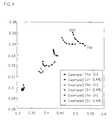
- phosphors of Examples 1-6 emit a pink color in a CIE chromaticity diagram, and the colors of the phosphors of Examples 1-6 shift to red color as the amount of the red phosphor increases.
- A indicates the CIE chromaticity coordinate of the phosphor of Example 1
- C, B, D, E and F indicate the CIE chromaticity coordinates of the phosphors of Example 2, 3, 4, 5 and 6, respectively.
- C has a color coordinate which is most close to the pink color
- A has a color coordinate of white color, but the user generally perceive the color as pink.
- the pink phosphors including Zn have improved brightness and heat resistance compared with the pink phosphors without Zn (Examples 1, 3 and 5). Therefore, the reduction of the brightness of the phosphors at high temperature is minimized by adding Zn to the phosphors.
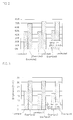
- FIGs. 2 and 3 are graphs showing the heat resistances and brightnesses of the phosphors of Examples 1-6. As shown in FIGs. 2 and 3, the heat resistance and the brightness are greatly improved by adding Zn.
- Fig. 4 shows shifts in the CIE chromaticity coordinates of the pink phosphors of Examples 1-6 when changing Ebc from 15V to 50V. As shown in Fig. 4, when Zn is added to the phosphors, the brightnesses of the red phosphors increase, and the CIE chromaticity coordinates of the phosphors shift to a red color compared with the phosphors without Zn.
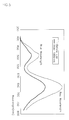
- a VFD was manufactured with the pink phosphor of Example 2, and wavelength spectrums of its pink color rays before and after driving 1000 hours were measured. The results are shown in FIG. 5.
- the pink phosphor of the present invention has two peaks of a blue and a red wavelength, and the color quality of the resulting pink color ray depends on the difference between heights (intensities) of the blue and the red peaks. If he blue peak is higher than the red peak, a light pink color results, while if the red peak is higher than the blue peak, a dark pink color results.
- the quality of pink color ray changes since the difference between the heights of the two peaks changes with driving the VFD.
- the height difference between the blue and the red peaks for the pink phosphor of the present invention remains constant before and after use. This indicates that the quality of the pink color is maintained during the entire lifetime of the pink phosphor, because the blue and the red phosphors have the same lifetimes.
Landscapes
- Chemical & Material Sciences (AREA)
- Inorganic Chemistry (AREA)
- Engineering & Computer Science (AREA)
- Materials Engineering (AREA)
- Organic Chemistry (AREA)
- Luminescent Compositions (AREA)
- Cathode-Ray Tubes And Fluorescent Screens For Display (AREA)
Applications Claiming Priority (2)
| Application Number | Priority Date | Filing Date | Title |
|---|---|---|---|
| KR9916814 | 1999-05-11 | ||
| KR1019990016814A KR100315225B1 (ko) | 1999-05-11 | 1999-05-11 | 저전압용 분홍색 형광체 |
Publications (1)
| Publication Number | Publication Date |
|---|---|
| EP1052276A1 true EP1052276A1 (de) | 2000-11-15 |
Family
ID=19584813
Family Applications (1)
| Application Number | Title | Priority Date | Filing Date |
|---|---|---|---|
| EP99119123A Withdrawn EP1052276A1 (de) | 1999-05-11 | 1999-10-04 | Rosafarbiger angeregter Niedrigspannungsphosphor |
Country Status (6)
| Country | Link |
|---|---|
| US (1) | US6200497B1 (de) |
| EP (1) | EP1052276A1 (de) |
| JP (1) | JP2000319652A (de) |
| KR (1) | KR100315225B1 (de) |
| CN (1) | CN100336883C (de) |
| TW (1) | TW495543B (de) |
Cited By (1)
| Publication number | Priority date | Publication date | Assignee | Title |
|---|---|---|---|---|
| EP1052277A1 (de) * | 1999-05-11 | 2000-11-15 | Samsung Display Devices Co., Ltd. | Weissstrahlender Niedrigspannungsphosphor |
Families Citing this family (6)
| Publication number | Priority date | Publication date | Assignee | Title |
|---|---|---|---|---|
| US7220390B2 (en) * | 2003-05-16 | 2007-05-22 | Velocys, Inc. | Microchannel with internal fin support for catalyst or sorption medium |
| US20070215195A1 (en) | 2006-03-18 | 2007-09-20 | Benyamin Buller | Elongated photovoltaic cells in tubular casings |
| US7235736B1 (en) | 2006-03-18 | 2007-06-26 | Solyndra, Inc. | Monolithic integration of cylindrical solar cells |
| US20100132765A1 (en) | 2006-05-19 | 2010-06-03 | Cumpston Brian H | Hermetically sealed solar cells |
| US8093493B2 (en) | 2007-04-30 | 2012-01-10 | Solyndra Llc | Volume compensation within a photovoltaic device |
| US9024526B1 (en) | 2012-06-11 | 2015-05-05 | Imaging Systems Technology, Inc. | Detector element with antenna |
Citations (2)
| Publication number | Priority date | Publication date | Assignee | Title |
|---|---|---|---|---|
| JPH07305057A (ja) * | 1994-05-13 | 1995-11-21 | Kasei Optonix Co Ltd | 硫化物蛍光体 |
| EP1052277A1 (de) * | 1999-05-11 | 2000-11-15 | Samsung Display Devices Co., Ltd. | Weissstrahlender Niedrigspannungsphosphor |
Family Cites Families (4)
| Publication number | Priority date | Publication date | Assignee | Title |
|---|---|---|---|---|
| US3031416A (en) * | 1959-11-16 | 1962-04-24 | Sylvania Electric Prod | White emitting electroluminescent phosphor mixture |
| JPS5230158B2 (de) * | 1973-10-13 | 1977-08-05 | ||
| JPS61145277A (ja) * | 1984-12-18 | 1986-07-02 | Kasei Optonix Co Ltd | 発光組成物および低速電子線励起螢光表示管 |
| JPH105057A (ja) * | 1996-06-18 | 1998-01-13 | Koji Tanaka | 収納庫 |
-
1999
- 1999-05-11 KR KR1019990016814A patent/KR100315225B1/ko not_active Expired - Fee Related
- 1999-09-16 JP JP11261986A patent/JP2000319652A/ja active Pending
- 1999-09-28 TW TW088116661A patent/TW495543B/zh not_active IP Right Cessation
- 1999-10-04 EP EP99119123A patent/EP1052276A1/de not_active Withdrawn
- 1999-10-07 US US09/414,022 patent/US6200497B1/en not_active Expired - Fee Related
- 1999-10-08 CN CNB991221427A patent/CN100336883C/zh not_active Expired - Fee Related
Patent Citations (2)
| Publication number | Priority date | Publication date | Assignee | Title |
|---|---|---|---|---|
| JPH07305057A (ja) * | 1994-05-13 | 1995-11-21 | Kasei Optonix Co Ltd | 硫化物蛍光体 |
| EP1052277A1 (de) * | 1999-05-11 | 2000-11-15 | Samsung Display Devices Co., Ltd. | Weissstrahlender Niedrigspannungsphosphor |
Non-Patent Citations (1)
| Title |
|---|
| DATABASE WPI Section Ch Week 199604, Derwent World Patents Index; Class L03, AN 1996-036080, XP002143732 * |
Cited By (1)
| Publication number | Priority date | Publication date | Assignee | Title |
|---|---|---|---|---|
| EP1052277A1 (de) * | 1999-05-11 | 2000-11-15 | Samsung Display Devices Co., Ltd. | Weissstrahlender Niedrigspannungsphosphor |
Also Published As
| Publication number | Publication date |
|---|---|
| CN100336883C (zh) | 2007-09-12 |
| KR100315225B1 (ko) | 2001-11-26 |
| US6200497B1 (en) | 2001-03-13 |
| TW495543B (en) | 2002-07-21 |
| CN1273262A (zh) | 2000-11-15 |
| JP2000319652A (ja) | 2000-11-21 |
| KR20000073497A (ko) | 2000-12-05 |
Similar Documents
| Publication | Publication Date | Title |
|---|---|---|
| JPH0885788A (ja) | 蛍光体 | |
| JPS6241990B2 (de) | ||
| US6200497B1 (en) | Low-voltage excited pink phosphor | |
| EP1052277A1 (de) | Weissstrahlender Niedrigspannungsphosphor | |
| EP0976142B1 (de) | Niederdruck-gasentladungslampe mit verschiedenen leuchtstoffe | |
| EP0120453B1 (de) | Kathodenstrahlrohr für einfarbige Anzeigevorrichtung | |
| KR900006169B1 (ko) | 음극선관 | |
| KR930003972B1 (ko) | 백색 발광혼합 형광체 조성물 | |
| JPH0428758B2 (de) | ||
| KR920000938B1 (ko) | 붕산알루미늄계 형광체와 이를 사용한 음극선관 | |
| TW464902B (en) | Phosphor and fluorescent display device | |
| JPH0715096B2 (ja) | 残光性螢光体 | |
| KR100241604B1 (ko) | 저전압용 고휘도 형광체 및 그 제조 방법 | |
| JPS63251491A (ja) | 長残光性青色発光混合物螢光体 | |
| JPH0115556B2 (de) | ||
| KR930003976B1 (ko) | 등색발광 형광체 | |
| JP2001303047A (ja) | 真空紫外線励起蛍光体およびそれを用いた発光装置 | |
| JP2011074268A (ja) | Tb付活希土類アルミン酸マグネシウム蛍光体、及びその製造方法、並びに該蛍光体を用いたバックライト用蛍光ランプおよび液晶表示装置 | |
| JPH0111712Y2 (de) | ||
| JPH0524192B2 (de) | ||
| JPS60170686A (ja) | カラ−投写型映像装置用青色発光ブラウン管 | |
| JPH0613045A (ja) | 蛍光ランプ | |
| JP2008285517A (ja) | 真空紫外線励起用アルミニウム・ガリウム酸塩蛍光体、希ガス放電ランプ用蛍光体混合物、希ガス放電ランプ及び液晶表示装置 | |
| JPH08153491A (ja) | 蛍光ランプおよび照明器具 | |
| JPS60229983A (ja) | 投写型カラ−テレビの投写管 |
Legal Events
| Date | Code | Title | Description |
|---|---|---|---|
| PUAI | Public reference made under article 153(3) epc to a published international application that has entered the european phase |
Free format text: ORIGINAL CODE: 0009012 |
|
| AK | Designated contracting states |
Kind code of ref document: A1 Designated state(s): DE FR GB |
|
| AX | Request for extension of the european patent |
Free format text: AL;LT;LV;MK;RO;SI |
|
| 17P | Request for examination filed |
Effective date: 20010511 |
|
| AKX | Designation fees paid |
Free format text: DE FR GB |
|
| GRAH | Despatch of communication of intention to grant a patent |
Free format text: ORIGINAL CODE: EPIDOS IGRA |
|
| STAA | Information on the status of an ep patent application or granted ep patent |
Free format text: STATUS: THE APPLICATION IS DEEMED TO BE WITHDRAWN |
|
| 18D | Application deemed to be withdrawn |
Effective date: 20030207 |