EP1052815A2 - Gestion multidestinataire programmable pour un dispositif réseau - Google Patents
Gestion multidestinataire programmable pour un dispositif réseau Download PDFInfo
- Publication number
- EP1052815A2 EP1052815A2 EP00304077A EP00304077A EP1052815A2 EP 1052815 A2 EP1052815 A2 EP 1052815A2 EP 00304077 A EP00304077 A EP 00304077A EP 00304077 A EP00304077 A EP 00304077A EP 1052815 A2 EP1052815 A2 EP 1052815A2
- Authority
- EP
- European Patent Office
- Prior art keywords
- scheduling
- multicast
- unicast
- scheduler
- cell
- Prior art date
- Legal status (The legal status is an assumption and is not a legal conclusion. Google has not performed a legal analysis and makes no representation as to the accuracy of the status listed.)
- Withdrawn
Links
- 238000000034 method Methods 0.000 claims abstract description 33
- 239000004744 fabric Substances 0.000 claims description 103
- 238000012546 transfer Methods 0.000 claims description 15
- 230000005540 biological transmission Effects 0.000 claims description 13
- 238000004590 computer program Methods 0.000 claims description 5
- 241001522296 Erithacus rubecula Species 0.000 claims description 4
- 230000003247 decreasing effect Effects 0.000 claims description 2
- 230000003213 activating effect Effects 0.000 claims 1
- 230000001960 triggered effect Effects 0.000 abstract description 5
- 239000013598 vector Substances 0.000 description 70
- 238000012545 processing Methods 0.000 description 45
- 238000010586 diagram Methods 0.000 description 22
- 238000013459 approach Methods 0.000 description 16
- 230000007246 mechanism Effects 0.000 description 7
- 230000000903 blocking effect Effects 0.000 description 5
- 230000022131 cell cycle Effects 0.000 description 5
- 238000004891 communication Methods 0.000 description 5
- 238000011156 evaluation Methods 0.000 description 5
- 230000006855 networking Effects 0.000 description 4
- 230000003287 optical effect Effects 0.000 description 2
- 238000000926 separation method Methods 0.000 description 2
- 230000002411 adverse Effects 0.000 description 1
- 230000008901 benefit Effects 0.000 description 1
- 230000003139 buffering effect Effects 0.000 description 1
- 230000001934 delay Effects 0.000 description 1
- 230000003111 delayed effect Effects 0.000 description 1
- 230000001419 dependent effect Effects 0.000 description 1
- 238000013461 design Methods 0.000 description 1
- 238000012986 modification Methods 0.000 description 1
- 230000004048 modification Effects 0.000 description 1
- 238000012544 monitoring process Methods 0.000 description 1
- 230000010355 oscillation Effects 0.000 description 1
- 230000008569 process Effects 0.000 description 1
- 230000010076 replication Effects 0.000 description 1
- 230000003362 replicative effect Effects 0.000 description 1
- 230000007727 signaling mechanism Effects 0.000 description 1
- 230000001360 synchronised effect Effects 0.000 description 1
- 230000009466 transformation Effects 0.000 description 1
Images





Classifications
-
- H—ELECTRICITY
- H04—ELECTRIC COMMUNICATION TECHNIQUE
- H04L—TRANSMISSION OF DIGITAL INFORMATION, e.g. TELEGRAPHIC COMMUNICATION
- H04L49/00—Packet switching elements
- H04L49/30—Peripheral units, e.g. input or output ports
- H04L49/3018—Input queuing
-
- H—ELECTRICITY
- H04—ELECTRIC COMMUNICATION TECHNIQUE
- H04L—TRANSMISSION OF DIGITAL INFORMATION, e.g. TELEGRAPHIC COMMUNICATION
- H04L49/00—Packet switching elements
- H04L49/20—Support for services
- H04L49/201—Multicast operation; Broadcast operation
-
- H—ELECTRICITY
- H04—ELECTRIC COMMUNICATION TECHNIQUE
- H04L—TRANSMISSION OF DIGITAL INFORMATION, e.g. TELEGRAPHIC COMMUNICATION
- H04L49/00—Packet switching elements
- H04L49/20—Support for services
- H04L49/201—Multicast operation; Broadcast operation
- H04L49/203—ATM switching fabrics with multicast or broadcast capabilities
-
- H—ELECTRICITY
- H04—ELECTRIC COMMUNICATION TECHNIQUE
- H04L—TRANSMISSION OF DIGITAL INFORMATION, e.g. TELEGRAPHIC COMMUNICATION
- H04L49/00—Packet switching elements
- H04L49/25—Routing or path finding in a switch fabric
- H04L49/253—Routing or path finding in a switch fabric using establishment or release of connections between ports
- H04L49/254—Centralised controller, i.e. arbitration or scheduling
-
- H—ELECTRICITY
- H04—ELECTRIC COMMUNICATION TECHNIQUE
- H04L—TRANSMISSION OF DIGITAL INFORMATION, e.g. TELEGRAPHIC COMMUNICATION
- H04L49/00—Packet switching elements
- H04L49/25—Routing or path finding in a switch fabric
- H04L49/253—Routing or path finding in a switch fabric using establishment or release of connections between ports
- H04L49/255—Control mechanisms for ATM switching fabrics
-
- H—ELECTRICITY
- H04—ELECTRIC COMMUNICATION TECHNIQUE
- H04L—TRANSMISSION OF DIGITAL INFORMATION, e.g. TELEGRAPHIC COMMUNICATION
- H04L49/00—Packet switching elements
- H04L49/30—Peripheral units, e.g. input or output ports
- H04L49/3027—Output queuing
-
- H—ELECTRICITY
- H04—ELECTRIC COMMUNICATION TECHNIQUE
- H04Q—SELECTING
- H04Q11/00—Selecting arrangements for multiplex systems
- H04Q11/04—Selecting arrangements for multiplex systems for time-division multiplexing
- H04Q11/0428—Integrated services digital network, i.e. systems for transmission of different types of digitised signals, e.g. speech, data, telecentral, television signals
- H04Q11/0478—Provisions for broadband connections
-
- H—ELECTRICITY
- H04—ELECTRIC COMMUNICATION TECHNIQUE
- H04L—TRANSMISSION OF DIGITAL INFORMATION, e.g. TELEGRAPHIC COMMUNICATION
- H04L12/00—Data switching networks
- H04L12/54—Store-and-forward switching systems
- H04L12/56—Packet switching systems
- H04L12/5601—Transfer mode dependent, e.g. ATM
- H04L2012/5629—Admission control
- H04L2012/5631—Resource management and allocation
- H04L2012/5632—Bandwidth allocation
-
- H—ELECTRICITY
- H04—ELECTRIC COMMUNICATION TECHNIQUE
- H04L—TRANSMISSION OF DIGITAL INFORMATION, e.g. TELEGRAPHIC COMMUNICATION
- H04L12/00—Data switching networks
- H04L12/54—Store-and-forward switching systems
- H04L12/56—Packet switching systems
- H04L12/5601—Transfer mode dependent, e.g. ATM
- H04L2012/5629—Admission control
- H04L2012/5631—Resource management and allocation
- H04L2012/5632—Bandwidth allocation
- H04L2012/5635—Backpressure, e.g. for ABR
-
- H—ELECTRICITY
- H04—ELECTRIC COMMUNICATION TECHNIQUE
- H04L—TRANSMISSION OF DIGITAL INFORMATION, e.g. TELEGRAPHIC COMMUNICATION
- H04L12/00—Data switching networks
- H04L12/54—Store-and-forward switching systems
- H04L12/56—Packet switching systems
- H04L12/5601—Transfer mode dependent, e.g. ATM
- H04L2012/5638—Services, e.g. multimedia, GOS, QOS
- H04L2012/5646—Cell characteristics, e.g. loss, delay, jitter, sequence integrity
- H04L2012/5651—Priority, marking, classes
-
- H—ELECTRICITY
- H04—ELECTRIC COMMUNICATION TECHNIQUE
- H04L—TRANSMISSION OF DIGITAL INFORMATION, e.g. TELEGRAPHIC COMMUNICATION
- H04L12/00—Data switching networks
- H04L12/54—Store-and-forward switching systems
- H04L12/56—Packet switching systems
- H04L12/5601—Transfer mode dependent, e.g. ATM
- H04L2012/5678—Traffic aspects, e.g. arbitration, load balancing, smoothing, buffer management
- H04L2012/5679—Arbitration or scheduling
-
- H—ELECTRICITY
- H04—ELECTRIC COMMUNICATION TECHNIQUE
- H04L—TRANSMISSION OF DIGITAL INFORMATION, e.g. TELEGRAPHIC COMMUNICATION
- H04L49/00—Packet switching elements
- H04L49/10—Packet switching elements characterised by the switching fabric construction
- H04L49/101—Packet switching elements characterised by the switching fabric construction using crossbar or matrix
-
- H—ELECTRICITY
- H04—ELECTRIC COMMUNICATION TECHNIQUE
- H04L—TRANSMISSION OF DIGITAL INFORMATION, e.g. TELEGRAPHIC COMMUNICATION
- H04L49/00—Packet switching elements
- H04L49/30—Peripheral units, e.g. input or output ports
- H04L49/3063—Pipelined operation
-
- H—ELECTRICITY
- H04—ELECTRIC COMMUNICATION TECHNIQUE
- H04L—TRANSMISSION OF DIGITAL INFORMATION, e.g. TELEGRAPHIC COMMUNICATION
- H04L49/00—Packet switching elements
- H04L49/50—Overload detection or protection within a single switching element
- H04L49/505—Corrective measures
- H04L49/506—Backpressure
Definitions
- a network device such as a router, or a Layer 2 or Layer 3 switch operable within a TCP/IP network
- ATM Asynchronous Transfer Mode
- the method and apparatus described herein are equally applicable to Asynchronous Transfer Mode (ATM) networks and networking devices, and other devices such as multiprocessing computers, for example.
- ATM Asynchronous Transfer Mode
- various embodiments of the present invention are described in connection with a networking device that recognizes four different classes of service, the method and apparatus described herein are not limited to such a configuration.
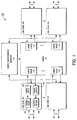
- the forwarding logic 106 determines the output port(s) to which received packets need to be forwarded and performs other Internet Protocol (IP) header processing, such as appending the next hop Media Access Control (MAC) address retrieved from a forwarding database (not shown), updating the time-to-live (TTL) field, and calculating a new header checksum.
- IP Internet Protocol
- the fabric input 107 may include a set of virtual output queues (VOQs) (not shown) for each class of service supported.
- VOQs virtual output queues
- the fabric input 107 may also include a dedicated multicast queue (not shown) for multicast traffic for each class of service.
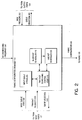
- both multicast and unicast scheduling may be performed independently and in parallel.
- the results of the multicast scheduling cycle that were performed in advance are fed into the unicast scheduler 220 and the unicast scheduler 220 then schedules unicast cells whose ports are not being used by the previously scheduled multicast cells.
- the mechanism for producing a combined schedule is not limited to these particular approaches.
- the novel separation and pipelined staging of multicast and unicast scheduling and the parallel operation of the multicast and unicast scheduling that will be described further below are equally applicable to other current and future scheduling approaches.
- the fabric configuration manager 110 also receives control information from the output ports 109.
- a back pressure signal 250 may identify output ports 109 having one or more output queues that have exceeded a predetermined threshold of pending cells.
- a back pressure signaling mechanism is important to protect the output ports from excess traffic from the fabric.
- a back pressure signal is typically coupled directly from each of the output ports 109 to each of the input ports 107.
- output ports assert their back pressure signal upon exceeding a predetermined threshold of pending cells. Subsequently, when the number of pending cells falls below another predetermined threshold, the output port deasserts the back pressure signal.
- VOQs are employed at the input ports 107, back pressure does not cause difficulties for unicast traffic since a head-of-line unicast cell destined for a back pressuring output only blocks other cells destined for the same output.
- a complication occurs for multicast traffic.
- a head-of-line multicast cell blocks the rest of the cells in the multicast queue, which may or may not be destined for the back pressuring port.
- the novel back pressure mechanism described below provides for centralized back pressure handling and solves this head-of-line blocking problem for multicast traffic.
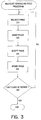
- the grant phase is performed.
- the multicast scheduler 215 evaluates the request vectors for the current class of service corresponding to those of the output ports that remain available for matching. The purpose of this evaluation is to determine a conflict-free matching of input ports 107 and output ports 109.
- a single global indicator that identifies which of the input ports is to receive priority for the current scheduling cycle is maintained for each class of service.
- this priority indicator comprises a modulo N counter, referred to as the global multicast round robin counter (GRRC), where N represents the number of ports.
- GRRC global multicast round robin counter
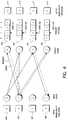
- Communication of transmit request information is depicted as a solid line from an input port to an output port and grants are depicted as dotted lines from output ports to input ports.
- the input ports each have a corresponding unavailability indicator 405-408.
- each output port has a corresponding unavailability indicator 415-418.
- the global priority indicator comprises a GRRC 450 which currently points to input port 1. Therefore, input port 1 will receive priority over the other input ports during this scheduling cycle.
- input port 0 has a multicast cell ready for delivery to output ports 1 and 2
- the head-of-line multicast cell at input port 1 is destined for output ports 0, 1 and 3
- no multicast cells are pending at input port 2
- input port 3 has a multicast cell that is ready to be transferred to output port 2.
- this control information is communicated from the input ports 107 to the fabric configuration manager 110, for purposes of this example, the communication is conceptually represented as being communicated between input ports 0-3 and output ports 0-3.
- the input ports each communicate their transmit request information to the output ports.
- the transmit request information accumulated at output port 0 forms request vector 425.
- request vectors 426-428 are formed at output ports 1-3, respectively.
- each output port that is available searches its corresponding request vector 425-428, respectively, in a circular fashion beginning with the input port identified by GRRC 450 to select the first available input port 0-3 that has a request for that output port.
- the first available input port that has a request for output port 0 is input port 1.
- Input port 1 is also the first available input port that has a request for output port 1.
- Output port 2 selects input port 3 and output port 3 selects input port 1.
- grants are issued to those of the input ports that have been selected and those of the output ports that gave a grant to an input port set their corresponding unavailability indicators. In this example, therefore, all of the output ports would set their output unavailability indicators 415-418.
- step 340 the GRRC update criteria are evaluated and the GRRC 450 is incremented to point to input port 2. Therefore, in the next scheduling cycle, input port 2 will receive priority over input ports 0, 1 and 3.
- iteration control logic 530 causes an arbitration iteration to be performed for each class of service.
- the priority request vector registers 510-513 are coupled to the input of MUX 520.
- Iteration control logic 530 is coupled to MUX 520 to select the set of priority request vectors for the current iteration.
- the output of MUX 520 is coupled to the set of active request vector registers 540.
- the priority request vectors selected for the current iteration are passed to the active request vector registers 540.
- Iteration control logic 530 is also coupled to MUX 560 to select the GRRC appropriate for the current iteration.
- the GRRCs 580-583 are coupled to the input of MUX 560 and the output of MUX 560 is coupled to each of the output grant arbiters 55, thereby programming each output grant arbiter 550 with the selected GRRC.
- the active request vector registers 540 are coupled to the output grant arbiters 550.
- Each of the output grant arbiters 550 are presented with priorities and a request vector from the active request vector registers 540.
- output grant arbiter 0 receives request vector 541 which indicates which of the input ports have a request for output port 0 and identifies the priorities associated with each of the requests.
- output grant arbiters 1 and N receive request vectors 542 and 543, respectively and the associated priorities.
- Each output grant arbiter 550 looks at the inputs associated with the class of service selected for the current iteration and selects one request on behalf of the corresponding output port. According to one embodiment, the output grant arbiters 550 select the request closest in priority to the GRRC in a circular fashion. A vector identifying the selected and non-selected input ports is then stored in the grant vector registers 570. Once an output grant arbiter 550 has matched an input port to its corresponding output port, it is disabled in all further iterations of the multicast scheduling cycle in order to prevent the output grant arbiter 550 from making additional matches.
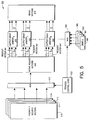
- the unicast scheduling cycle processing is conceptually divided into four phases: a request phase, a grant phase, an accept phase, and an update phase.
- the four phases may be repeated for multiple iterations until no further port matchings can be established or until the time allocated to unicast scheduling has expired.
- Each iteration seeks to identify one or more port matchings that were not made in earlier iterations.
- the unicast algorithm is similar to the multicast algorithm, but it is more complicated due to the fact that there can be contention among two or more queues on the input side.
- an input may receive grants from multiple outputs.
- an input can be paired with only one output and can therefore accept only one of the grants received.
- the unicast scheduling cycle begins at step 610 by performing the request phase.
- each of the input ports 107 communicates a transmit request 235 to the fabric configuration manager 110 indicating the output ports 109 to which cells at the head of its VOQs are destined.
- request vectors are formed for each output pod 109 that identify those of the input ports 107 with requests for the output port 109.
- the evaluation begins with the input port pointed to by the corresponding ORRC and proceeds in a circular fashion until an available input port is found that has a request for the output port.
- each class of service is independent, the operations for each class of service may be performed in parallel.
- the input port selected from the request vector corresponding to the higher priority class of service receives the grant over the input port selected from the request vector corresponding to the lower priority class of service.
- grants are made to the selected inputs forming a grant vector for each input port indicating the output ports 109 that have granted a request from the input port 107.
- the accept phase is performed. Since two or more VOQs may have a head of line cell pending for different output ports 109, input ports 107 may receive grants from multiple output ports 109.
- the unicast scheduler 220 evaluates the grant vectors for each input port that is available for matching with an output port (in parallel) and accepts only one grant per available input port.
- a per input port priority indicator is maintained for each class of service. The priority indicator identifies which of the output ports that is given top priority by the input port for the current scheduling iteration.
- the priority indicators are modulo N counters, referred to as input round robin counters (IRRCs), where N represents the number of ports.
- the unicast scheduler 220 begins with the output port pointed to by the corresponding IRRC and proceeds in a circular fashion until an available output port is found that has issued a grant to the input port.
- the operations for each class of service may be performed in parallel.
- the output port selected from the grant vector corresponding to the higher priority class of service is accepted.
- accepts are made to the selected outputs.
- those of the input ports 107 and output ports 109 that were matched during the current iteration (as determined by the accepts) should be marked as unavailable. In this manner, the matched ports are removed from further consideration in subsequent iterations of the scheduling cycle.
- the update phase includes updating the request vectors for use in the next iteration and updating the priority indicators, e.g., the ORRC values and the IRRC values.
- the request vectors may be modified based upon the accepts such that no requests will be presented in subsequent iterations from an input port that has accepted an output port and/or such that no requests will be presented to an output port that has been accepted by an input port.
- an ORRC is incremented if either the input port to which it points has been serviced by the corresponding output port (e.g., the output port has issued a grant to the input port which has been accepted for the corresponding class of service) or the input port requires no service from the output port (e.g., the input port has no unicast cells pending for the corresponding output port at the corresponding class of service).
- an IRRC is incremented if either the output port to which it points has been serviced by the corresponding input port (e.g., the input port has accepted a grant to the output port for the corresponding class of service) or the output port requires no service from the input port (e.g., the output port has issued no grant to the corresponding input port for the corresponding class of service).
- the priority indicators are updated only after the first iteration of a scheduling cycle.
- the IRRC for a particular input port steps through the corresponding grant vector until it encounters a grant (e.g., the bit it is pointing to is set indicating the corresponding output port has given a grant to the input port).
- the IRRC remains at this value until this grant is accepted. This behavior ensures that the input port will always accept the grant from this output port at every opportunity. Without such a gating mechanism, there is no guarantee that a cell will be transmitted. For example, if an ORRC was allowed to move ahead of a request without servicing it or if an IRRC was allowed to move ahead of a grant without servicing it, then the possibility exists that the corresponding cell might never be transmitted.
- the priority indicators may be updated differently depending upon the circumstances. For example, when a port to which a priority indicator points does not need service, the priority indicator is simply incremented by one (modulo N). However, when a port to which a priority indicator points needs service, the priority indicator is only updated after that port has been serviced; otherwise the priority indicator is not updated. The ORRC and IRRC values are incremented beyond a port that has just been serviced.
- the IRRC For each IRRC, if the corresponding input port has accepted an output port for the corresponding class of service, then the IRRC is incremented to point to the output port after the one accepted. That is, the IRRC is set to one plus the value of the output port accepted (modulo N). Similarly, for each ORRC, if the corresponding output port has been accepted by an input port for the corresponding class of service, then the ORRC is set to one plus the value of the input port that has accepted the output port (module N). In this manner, connections made in the first iteration are the lowest priority during the next scheduling cycle and no connections are starved.
- step 650 it is determined if this is the last iteration of the scheduling cycle. For example, a predetermined number of iterations may be performed or the iterations may continue so long as at least one port matching was made during the previous iteration. In any event, the number of iterations need not exceed the number of input ports, N, since only one connection can be made for each input port. If this is not the last iteration of the scheduling cycle, processing continues with step 610. Otherwise, the unicast scheduling cycle is complete and fabric configuration may commence at step 660.
- fabric configuration is performed.
- the fabric 120 is configured one time for each unicast scheduling cycle after the current schedule, e.g., the port matchings, has been established.
- the unicast scheduler 220 presents a fabric configuration 260 to the fabric 120.
- the fabric configuration 260 activates the fabric 120 and directs the fabric 120 to form connections among the fabric interfaces 115 that will accommodate the transfer of cells across the fabric 120 according to the current schedule.
- FIG. 7A communication of transmit request information is depicted as a solid line from an input port to an output port and grants are depicted as dotted lines from output ports to input ports.
- the input ports each have a corresponding unavailability indicator 705-708.
- each output port has a corresponding unavailability indicator 715-718.
- the output ports each have a corresponding priority indicator, ORRC 0-3, shown pointing to input ports 1, 3, 2, and 0, respectively.
- input port 1 receives priority over any other input ports contending for output port 0
- input port 3 receives priority over any other input ports contending for output port 1
- input port 2 receives priority over any other input ports contending for output port 2
- input port 0 receives priority over any other input ports contending for output port 3.
- input port 0 has two unicast cells ready for transfer across the fabric 120. One is destined for output port 1 and the other is destined for output port 2. Three head-of-line unicast cells at input port 1 are destined for output ports 0, 1 and 3. No unicast cells are pending at input port 2. Finally, input port 3 has one unicast cell that is ready to be transferred to output port 2. While control information is typically communicated from the input ports 107 to the fabric configuration manager 110, for purposes of this example, the communication is conceptually represented as being communicated between input ports 0-3 and output ports 0-3. At any rate, during the request phase (step 610) the input ports each communicate their transmit request information to the output ports. The transmit request information accumulated at output port 0 forms request vector 725.
- request vectors 726-728 are formed at output ports 1-3, respectively.
- the request vectors 725-728 have a bit position corresponding to each of the input ports 0-3. Again, a bit is set in the request vectors 735-728 when the corresponding input port has a unicast cell ready for delivery to the output port. The bit remains clear if the corresponding input port has no unicast cells destined for the output port.
- each output port that is available searches its corresponding request vector 725-728, respectively, in a circular fashion beginning with the input port identified by the associated ORRC 0-3 to select the first available input port that has a request for that output port.
- the first available input port that has a request for output port 0 is input port 1.
- Input port 0 is the first available input port that has a request for output port 1.
- Output port 2 selects input port 3 and output port 3 selects input port 1.
- grants are issued to those of the input ports that have been selected. In this example, therefore, grants are issued from output port 0 to input port 1, from output port 1 to input port 0, from output port 2 to input port 3, and from output port 3 to input port 1.
- a grant is depicted as a dotted line from an output port to an input port and accepts are depicted as solid lines from input ports to output ports.
- each input port has a corresponding priority indicator, IRRC 0-3, shown pointing to output ports 1, 3, 2, and 0, respectively. Therefore, during this scheduling cycle, output port 1 receives priority over any other output ports contending for input port 0, output port 3 receives priority over any other output ports contending for input port 1, output port 2 receives priority over any other output ports contending for input port 2, and output port 0 receives priority over any other output ports contending for input port 3.
- each input port that is available searches its corresponding grant vector 735-738, respectively, in a circular fashion beginning with the output port identified by the associated IRRC 0-3 to select the first available output port that has a grant for that input port.
- the first available output port that has a grant for input port 0 is output port 1.
- Output port 3 is the first available output pod that has a request for input port 1.
- Input pod 2 has received no grants and input port 3 selects output port 2.
- accepts are issued to those of the output ports that have been selected. In this example, therefore, accepts are issued from input port 0 to output port 1, from input port 1 to output port 3, and from input port 3 to input port 2.
- those of the input ports and output ports that were matched are marked as unavailable.
- input ports 0, 1, and 3 and output ports 1-3 are marked as unavailable by setting input unavailability indicators 705, 706, and 708 and output unavailability indicators 716-718, respectively, thereby removing these ports from consideration in subsequent iterations of the scheduling cycle.
- the IRRCs and the ORRCs are updated in accordance with the update mechanism described above.
- the value of ORRC 0 will remain unchanged since a request from the input port to which it points remains unserviced.
- the value of ORRC 1 will be updated to one since the request from input port 0 was serviced.
- the value of ORRC 2 will be updated to zero since the request from input port 3 was serviced.
- the value of ORRC 3 will be updated to two since the request from input port 1 was serviced.
- the value of IRRC 0 will be updated to two
- the value of IRRC 1 will be updated to zero
- the values of both IRRC 2 and IRRC 3 will be updated to three.
- the fabric configuration would cause a unicast cell to be transferred from input ports 0, 1, and 3 to output ports 1, 3, and 2, respectively.
- Figure 8 is a high level block diagram of a hardware implementation of a unicast scheduler according to one embodiment of the present invention.
- this example addresses the case of a unicast scheduler 800 that supports a single class of service.
- the unicast scheduler 800 consists of a set of active request vector registers 810, a set of output grant arbiters 850, a set of input accept arbiters 860, and a set of accept vector registers 870.
- the active request vector registers 810 are coupled to the output grant arbiters 850.
- the output grant arbiters 850 choose among contenting requests on behalf of the corresponding output port 109.
- transmit requests 235 from the input ports 107 are loaded into the active request vector registers 810.
- N-bit request vectors 811 are presented to each of the N corresponding output grant arbiters 850.
- Each of the output grant arbiters 850 are coupled to each of the input accept arbiters 860.
- the output grant arbiters 850 each select one of the competing requests that is closest in priority to its ORRC and issue a grant signal to the input accept arbiter 860 corresponding to the selected request.
- the input accept arbiters 860 are coupled to the set of accept vector registers 870 to identify the output port that has been matched with the corresponding input port.
- the input grant arbiters 860 each select one of the competing grants received from the output grant arbiters 850 that is closest in priority to its IRRC and issue an accept signal corresponding to the selected output port.
- the input accept arbiters 860 present accept signals in the form of an accept vector 871 to the set of accept vector registers 870. Each iteration, feedback from the accept vector registers 870 may be used to mask oft requests corresponding to ports that have already been matched during the scheduling cycle.
- the corresponding arbiter 850 or 860 may be disabled in all further iterations of the scheduling cycle in order to prevent the arbiter from making additional matches.
- the accept signals are accumulated in the set of accept vector registers 870 during each iteration of the unicast scheduling cycle and, as discussed above, are used at the end of the unicast scheduling cycle to configure the fabric 120.
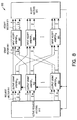
- Figures 9A and 9B depict exemplary round-robin arbiters that may be used in accordance with one embodiment of the present invention.
- the output grant arbiter 950 includes a grant priority filter 905 and a programmable priority encoder 920.
- a plurality of request vectors 904 associated with one or more priority levels are received by the grant priority filter 905.
- the grant priority filter 905 selects the request vector associated with the highest priority class of service and allows those requests 915 to be presented to the programmable priority encoder 920.
- programmable priority encoders select as an output one of its inputs as determined by a supplied priority indication.
- the programmable priority encoder 920 grants one of the requests 915 based upon the highest priority 910, e.g., an ORRC, supplied by the grant priority filter 905.
- the priority levels and the grants produced by N output grant arbiters 950 are presented to an input accept arbiter 990 such as that illustrated in Figure 9B.
- the input accept arbiter 990 includes an accept priority filter 945 and a programmable priority encoder 960.
- the accept priority filter 945 outputs the grants 955 associated with the highest priority class of service level.
- the programmable priority encoder 960 accepts one of the grants 955 based upon the highest priority 951, e.g., an IRRC, supplied by the accept priority filter 945.
- the unicast scheduler 220 may include N output grant arbiters 950 and N input accept arbiters 990.
- the present invention is not limited to any particular round-robin arbiter, the multicast scheduler 215 and unicast scheduler 220 may employ various other types of round-robin arbiters.
- one of the fast programmable priority encoders described in P. Gupta and N. McKeown, "Design and Implementation of a Fast Crossbar Scheduler," Hot Interconnects VI, Stanford University, August 1998, which is hereby incorporated by reference, may be used.
- a novel scheduling approach permits unicast scheduling processing and multicast scheduling processing to operate in parallel and independently resulting in a combined schedule comprising both unicast and multicast cells.
- Parallelism may be achieved, for example, by pipeline staging of unicast and multicast scheduling.
- Pipelining unicast and multicast scheduling is advantageous, for example, if the duration of the cell scheduling cycle is insufficient to accommodate both unicast and multicast scheduling in serial.
- Prior scheduling approaches produce uniform schedules that are limited to either all unicast cells or all multicast cells.
- the novel combined scheduling approach permits a combined schedule to be produced comprising both unicast and multicast cells. In this manner, both multicast and unicast cells may be transferred across the fabric 120 during the same time slot. Additionally, the separation of unicast and multicast scheduling results in increased flexibility and programmability of the rate at which unicast and/or multicast traffic is serviced.
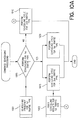
- FIG. 10A a general flow diagram is described illustrating combined scheduling processing for two different types of traffic according to one embodiment of the present invention.
- This example assumes cell scheduling processing is performed once each time slot, cell scheduling for one of the types of traffic, i.e., the first traffic type, is performed less than every time slot, cell scheduling for the other type of traffic, i.e., the second traffic type is performed every time slot, cells of the first traffic type are scheduled at least one time slot in advance of their transfer across the fabric 120, cells of the second traffic type are scheduled and transferred in the same time slot, and when both cells of the first and second traffic type.
- the scheduling frequency 1001 may be a hardcoded value or a programmable parameter as will be discussed further below.
- steps 1015 and 1020 are preferably performed by separate and independent cell scheduling units, as discussed above, thereby providing the ability to perform the cell scheduling for the two types of traffic in parallel.
- a cell scheduling cycle for the first type of traffic is performed and the results are stored for a subsequent time slot.
- a cell scheduling cycle for the second type of traffic is performed for the current time slot.
- the prior scheduling results for the first type of traffic 1002 are fed into the scheduling processing for the second type of traffic (step 1015) and the scheduler schedules cells of the second type of traffic whose ports are not being used by the previously scheduled cells of the first type of traffic.
- step 1010 a cell scheduling cycle for the second type of traffic is performed for the current time slot.
- the prior scheduling results for the first type of traffic 1002 are fed into the scheduling processing for the second type of traffic (step 1010) and the scheduler schedules cells of the second type of traffic whose ports are not being used by the previously scheduled cells of the first type of traffic.
- the scheduling cycle has been finalized, the combined scheduling processing is complete.
- the cell scheduling cycles may be performed serially. Additionally, in alternative embodiments, scheduling frequencies may be supplied for both the first type and the second type of traffic.
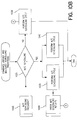
- Figure 10B is a flow diagram illustrating an embodiment of Figure 10A in which unicast and multicast scheduling may be combined.
- multicast and unicast cell scheduling operate separately and independently, however during selected time slots when both multicast traffic and unicast traffic are scheduled for transfer across the fabric 120, unicast cells are scheduled based upon the results of an earlier multicast scheduling cycle. For example, unicast cells may be scheduled at a lower priority than the multicast cells by limiting the ports available to the unicast scheduler 220 to those ports that are left unmatched by the earlier multicast scheduling cycle.
- a multicast scheduling cycle is performed and the results are stored for a subsequent time slot. Concurrently, in step 1035 a unicast scheduling cycle is performed for the current time slot.
- the prior multicast scheduling results 1004 are input into the unicast scheduling processing (step 1035) and the unicast scheduler 220 schedules unicast cells whose ports are not being used by the previously scheduled multicast cells.
- the combined scheduling processing is complete.
- step 1030 a unicast scheduling cycle is performed for the current time slot. Again, if both unicast and multicast cells are to be transferred during the current time slot, then the prior multicast scheduling results 1004 are input into the unicast scheduling processing (step 1030) and the unicast scheduler 220 schedules unicast cells whose ports are not being used by the previously scheduled multicast cells. When the scheduling cycle has been finalized, the combined scheduling processing is complete.
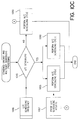
- Figure 10C is a flow diagram illustrating another embodiment of Figure 10A in which unicast and multicast scheduling may be combined.
- multicast and unicast cell scheduling operate separately and independently as above, however when both multicast traffic and unicast traffic are scheduled for transfer across the fabric 120, multicast cells are scheduled based upon the results of an earlier unicast scheduling cycle. For example, multicast cells may be scheduled at a lower priority than the unicast cells by limiting the ports available to the multicast scheduler 215 to those ports left unmatched by the earlier multicast schedule.
- a unicast scheduling cycle is performed and the results are stored for a subsequent time slot. Concurrently, in step 1055 a multicast scheduling cycle is performed for the current time slot.
- the prior unicast scheduling results 1007 are input into the multicast scheduling processing (step 1055) and the multicast scheduler 215 schedules multicast cells whose ports are not being used by the previously scheduled unicast cells.
- the combined scheduling processing is complete.
- step 1050 a multicast scheduling cycle is performed for the current time slot. Again, if both unicast and multicast cells are to be transferred during the current time slot, then the prior unicast scheduling results 1007 are input into the multicast scheduling processing (step 1050) and the multicast scheduler 215 schedules multicast cells whose ports are not being used by the previously scheduled unicast cells. When the scheduling cycle has been finalized, the combined scheduling processing is complete.
- FIG 11A conceptually illustrates a pipelined approach for scheduling multicast and unicast traffic according to one embodiment of the present invention.
- Multicast scheduling 1100 is shown along the top row.
- Unicast scheduling 1110 is shown along the middle row.
- the bottom row indicates the resulting combined schedule 1120.
- the hollow arrows point in the direction of the time slot during which the resulting schedule is used.
- multicast schedule M 0 is generated during time slot t 0 , but is used during time slot t 1 .
- a multicast scheduling frequency register 1003 identifies those of the time slots, e.g., t 0 - t 7 , during which multicast scheduling 1100 is to be performed. Many possible implementations of the multicast scheduling frequency register 1003 have been contemplated.
- a circular register is implemented, where the bits of the register are set to '1' or '0' in accordance with whether the current time slot is a multicast time slot. Each time slot, the bits of the register are rotated and the LSB or the MSB can be evaluated.
- the multicast scheduling frequency register 1003 may be implemented as an up or a down circular counter. Each time slot, the counter is incremented or decremented and the value in the counter is compared to a predetermined value that indicates when multicast scheduling is to be performed.
- the multicast scheduling frequency register 1003 contains a hardcoded value.
- the multicast scheduling frequency register 1003 is a programmable parameter thereby allowing the provision of variable rate multicast servicing and putting a cap on the total bandwidth available to multicast traffic. Responsive to historical network usage or scheduled network usage, the multicast scheduling frequency register 1003 may be adjusted upward or downward automatically by a traffic monitoring process, for example. Alternatively, bandwidth may be allocated between unicast and multicast traffic by the network administrator by tuning the multicast scheduling frequency.
- multicast scheduling 1100 is performed during the corresponding time slot; otherwise no multicast scheduling is performed during the time slot.
- unicast scheduling 1110 is performed every time slot.
- multicast scheduling time slots occur as a subset of unicast scheduling time slots.
- Unicast scheduling 1110 occurs every time slot and multicast scheduling 1100 occurs every other time slot.
- both multicast scheduling and unicast scheduling are performed in parallel.
- the multicast scheduling cycle produces a first multicast schedule, M 0 , for the next time slot, t 1
- the unicast scheduling cycle produces a first unicast schedule, U 0 , for the current time slot, t 0 . Since no multicast cells are scheduled for t 0 , the resulting combined schedule is U 0 .
- multicast scheduling may be triggered differently than as described above. Bit positions in the multicast scheduling frequency register 1003 containing a '0' may cause multicast scheduling to be performed in the corresponding time slot while a '1' may inhibit multicast scheduling.
- multicast scheduling may be triggered by a circular counter. For example, when the counter is incremented or decremented to a predetermined value this event may cause a multicast scheduling cycle to be performed.
- multicast scheduling may be performed more than one time slot in advance of its use.
- an eight bit register is depicted for purposes of illustration, registers of more or fewer bits may be used depending upon the needs of a particular implementation.
- the examples only show control of multicast traffic, it is contemplated that the scheduling of unicast traffic may be similarly triggered (in addition to or instead of multicast traffic triggering) by employing a unicast scheduling frequency register (not shown).
- unicast scheduling 1110 is performed during every time slot and if a bit position in the multicast scheduling frequency register 1003 contains a '1,' then multicast scheduling 1100 is also performed during the corresponding time slot; otherwise no multicast scheduling is performed during the time slot.
- multicast scheduling time slots occur as a subset of unicast scheduling time slots. This example illustrates that multicast scheduling 1110 may be performed more than one time slot in advance of the use of the resulting schedule. Additionally, multicast scheduling 1110 need not be symmetric or uniformly distributed.
- multicast scheduling 1110 is not limited to being performed every other time slot as shown in Figure 11A. Rather, if desired, multicast scheduling 1110 may be performed during two or more consecutive time slots, so long as during at least one time slot unicast traffic is given priority to ensure unicast traffic has adequate access to the fabric 120.
- both multicast scheduling and unicast scheduling are performed in parallel.
- the multicast scheduling cycle produces a first multicast schedule, M 0 , for use in time slot, t 2
- the unicast scheduling cycle produces a first unicast schedule, U 0 , for the current time slot, t 0 . Since no multicast cells are scheduled for t 0 , the resulting combined schedule is U 0 .
- Multicast scheduling is performed for time slot t3 during time slot, t1. Again, since no multicast cells are scheduled for t1, the resulting combined schedule is U 1 .
- the unicast scheduling cycle performed during time slot t2 is dependent upon the results of the previous multicast scheduling cycle, M 0 thereby giving the previously scheduled multicast cells priority over the unicast cells for the current time slot.
- Cell scheduling proceeds in a similar manner for the remaining time slots.
- each time slot the output ports 109 communicate an N-bit backpressure signal to the fabric arbiter 110 indicating whether or not one or more of the corresponding output queues has filled up. Then, the fabric arbiter 110 makes multicast scheduling decisions based upon the backpressure signal and the status of the multicast queues.
- the fabric arbiter 110 is configured to operate in one of two modes of operation with respect to a backpressuring output port. In the first mode of operation, the fabric arbiter obeys the backpressure signal and does not include the backpressuring output port in the fabric configuration.
- the fabric arbiter solves the head-of-line blocking problem by ignoring the backpressure signal and causing the head-of-line multicast cells destined for the backpressuring output port to be transferred to the backpressuring output port regardless of the backpressure signal.
- the head-of-line multicast cell When received by the backpressuring output port, the head-of-line multicast cell may be accepted if the output port has room or dropped. In this manner, multicast performance is protected by allowing the remainder of the multicast cells the opportunity to be transferred.
- in order to reduce oscillation of the backpressure signals from time slot to time slot once a backpressure signal is asserted it is not de-asserted until a certain amount of time has passed or until a the output queue size has fallen below a predetermined threshold. For example, de-assertion of the backpressure signal may be delayed until the backpressuring output queue is half-empty.
- FIG. 12 is a flow diagram illustrating backpressure processing according to one embodiment of the present invention.
- the fabric arbiter 110 receives back pressure signals from the output ports 109.
- a determination is made whether or not to obey the backpressure signals based upon the size (length) of the multicast queues. If a multicast queue reaches a certain high watermark threshold, processing continues with step 1230. Otherwise, processing proceeds to step 1240.
- step 1230 requests associated with backpressuring output ports are not masked and are therefore considered eligible for multicast scheduling. In this manner, the head-of-line cell is sent to the destined output port(s) 109 regardless of the backpressure signal thereby removing the blockage and allowing the remaining multicast cells an opportunity to be scheduled for transfer across the fabric 120.
- step 1240 no multicast build up has occurred, therefore, requests associated with backpressuring output ports are masked and are not considered by the multicast scheduler 215.
- step 1250 multicast scheduling is performed based upon the requests that remain after step 1230 or 1240.
- one overloaded output port is prevented from adversely affecting other unrelated output ports.
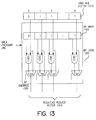
- FIG. 13 a block diagram of an exemplary hardware implementation of a portion of backpressure logic 1300 will now briefly be described, according to one embodiment of the present invention.
- An original request vector 130 is masked or not based upon a backpressure override signal 1330 and a resulting request vector 1340 is output from the backpressure logic 1300.
- the backpressure logic 1300 comprises a backpressure mask 1305, N AND gates 1320, and N multiplexors 1325.
- a bit position of the backpressure mask 1305 contains a '0' if the corresponding output port / queue is backpressuring or a '1, is the output port /queue is not backpressuring.
- the requests associated with backpressured output ports / queues can be masked off.
- the backpressure override signals 1330 allow one or more of the original request vector positions to be passed through unchanged in the case of multicast queue buildup at an input port, for example.
Landscapes
- Engineering & Computer Science (AREA)
- Computer Networks & Wireless Communication (AREA)
- Signal Processing (AREA)
- Data Exchanges In Wide-Area Networks (AREA)
Applications Claiming Priority (2)
| Application Number | Priority Date | Filing Date | Title |
|---|---|---|---|
| US311833 | 1999-05-14 | ||
| US09/311,833 US6628646B1 (en) | 1999-05-14 | 1999-05-14 | Programmable multicast scheduling for a network device |
Publications (1)
| Publication Number | Publication Date |
|---|---|
| EP1052815A2 true EP1052815A2 (fr) | 2000-11-15 |
Family
ID=23208701
Family Applications (2)
| Application Number | Title | Priority Date | Filing Date |
|---|---|---|---|
| EP00304077A Withdrawn EP1052815A2 (fr) | 1999-05-14 | 2000-05-15 | Gestion multidestinataire programmable pour un dispositif réseau |
| EP00304076A Withdrawn EP1052814A2 (fr) | 1999-05-14 | 2000-05-15 | Gestion multidestinataire pour un dispositif réseau |
Family Applications After (1)
| Application Number | Title | Priority Date | Filing Date |
|---|---|---|---|
| EP00304076A Withdrawn EP1052814A2 (fr) | 1999-05-14 | 2000-05-15 | Gestion multidestinataire pour un dispositif réseau |
Country Status (3)
| Country | Link |
|---|---|
| US (1) | US6628646B1 (fr) |
| EP (2) | EP1052815A2 (fr) |
| CA (1) | CA2308243A1 (fr) |
Cited By (3)
| Publication number | Priority date | Publication date | Assignee | Title |
|---|---|---|---|---|
| WO2007123870A3 (fr) * | 2006-04-20 | 2008-03-06 | Enigma Semiconductor Inc | Commutation multidiffusion dans une architecture de commutation à multidiffusion et unidiffusion |
| GB2482149A (en) * | 2010-07-21 | 2012-01-25 | Gnodal Ltd | A network switch adaptive routing mechanism wherein each input port includes an input arbiter and each output port includes and output arbiter |
| CN101902390B (zh) * | 2009-05-27 | 2013-04-17 | 华为技术有限公司 | 一种单播和多播集成调度装置、交换系统及方法 |
Families Citing this family (17)
| Publication number | Priority date | Publication date | Assignee | Title |
|---|---|---|---|---|
| US6813274B1 (en) * | 2000-03-21 | 2004-11-02 | Cisco Technology, Inc. | Network switch and method for data switching using a crossbar switch fabric with output port groups operating concurrently and independently |
| US6907035B1 (en) * | 2000-06-13 | 2005-06-14 | Lucent Technologies Inc. | Master controller for a flexible switching system |
| US6813267B1 (en) * | 2000-09-11 | 2004-11-02 | Sun Microsystems, Inc. | Tunable broadcast/point-to-point packet arbitration |
| DE60116401T2 (de) * | 2000-09-20 | 2006-09-07 | Broadcom Corp., Irvine | Netzwerkvermittlung mit der Möglichkeit Anschlüsse zu blockieren |
| DE60031284T2 (de) * | 2000-12-14 | 2007-10-11 | Lucent Technologies Inc. | Ablauffolgesteuerung für Paketvermittlungen und passive optischen Netzwerke |
| CN1122390C (zh) * | 2001-03-22 | 2003-09-24 | 顾红波 | 数据网络中利用多目传送循环传输数据的方法及其系统 |
| US7079485B1 (en) * | 2001-05-01 | 2006-07-18 | Integrated Device Technology, Inc. | Multiservice switching system with distributed switch fabric |
| FR2831367B1 (fr) * | 2001-10-18 | 2004-01-30 | Cit Alcatel | Procede et dispositif de commande des temps de services de cellules multidestination copiees dans les modules d'entree d'un noeud de commutation asynchrone |
| US7453898B1 (en) * | 2002-03-30 | 2008-11-18 | Cisco Technology, Inc. | Methods and apparatus for simultaneously scheduling multiple priorities of packets |
| US7184443B2 (en) | 2002-03-30 | 2007-02-27 | Cisco Technology, Inc. | Packet scheduling particularly applicable to systems including a non-blocking switching fabric and homogeneous or heterogeneous line card interfaces |
| GB2405299B (en) * | 2002-11-22 | 2005-05-04 | Sun Microsystems Inc | Arbitration unit and method |
| US6990541B2 (en) | 2002-11-22 | 2006-01-24 | Sun Microsystems, Inc. | Arbitration unit for prioritizing requests based on multiple request groups |
| US7061927B2 (en) | 2004-04-12 | 2006-06-13 | Cisco Technology, Inc. | Weighted random scheduling particularly applicable to packet switching systems |
| US20060140191A1 (en) * | 2004-12-29 | 2006-06-29 | Naik Uday R | Multi-level scheduling using single bit vector |
| US8705557B2 (en) | 2011-07-07 | 2014-04-22 | Qualcomm Incorporated | Methods and apparatus for supporting multicast communications |
| US8768737B1 (en) * | 2012-12-21 | 2014-07-01 | PagerDuty, Inc. | Schedule management interface |
| US20230318865A1 (en) * | 2022-03-14 | 2023-10-05 | Nvidia Corporation | Multicast communication arbitration |
Family Cites Families (17)
| Publication number | Priority date | Publication date | Assignee | Title |
|---|---|---|---|---|
| US5267235A (en) | 1992-05-21 | 1993-11-30 | Digital Equipment Corporation | Method and apparatus for resource arbitration |
| MX9306994A (es) | 1992-12-15 | 1994-06-30 | Ericsson Telefon Ab L M | Sistema de control de flujo para interruptores de paquete. |
| US6157967A (en) * | 1992-12-17 | 2000-12-05 | Tandem Computer Incorporated | Method of data communication flow control in a data processing system using busy/ready commands |
| DE69328380T2 (de) | 1993-12-31 | 2000-10-12 | International Business Machines Corp., Armonk | Verfahren und vorrichtung zur vermittlung von mehreren verkehrsklassen |
| GB2288096B (en) | 1994-03-23 | 1999-04-28 | Roke Manor Research | Apparatus and method of processing bandwidth requirements in an ATM switch |
| US5500858A (en) * | 1994-12-20 | 1996-03-19 | The Regents Of The University Of California | Method and apparatus for scheduling cells in an input-queued switch |
| KR100262682B1 (ko) | 1995-04-15 | 2000-08-01 | 최병석 | 멀티캐스트 atm교환기 및 그멀티캐스트 경합조정방법 |
| US5909427A (en) | 1995-07-19 | 1999-06-01 | Fujitsu Network Communications, Inc. | Redundant switch system and method of operation |
| SE9504231L (sv) | 1995-11-27 | 1997-05-28 | Ericsson Telefon Ab L M | Kösystem för överföring av informatonspaket |
| US6212182B1 (en) * | 1996-06-27 | 2001-04-03 | Cisco Technology, Inc. | Combined unicast and multicast scheduling |
| US5875190A (en) | 1996-09-27 | 1999-02-23 | Law; Ka Lun | Asynchronous transfer mode switching system |
| US5835491A (en) | 1996-11-21 | 1998-11-10 | Xerox Corporation | Method for supporting multicast capabilities in switching networks with a reservation ring |
| US6188690B1 (en) | 1996-12-12 | 2001-02-13 | Pmc-Sierra, Inc. | Method and apparatus for high speed, scalable communication system |
| US6201789B1 (en) | 1996-12-30 | 2001-03-13 | Compaq Computer Corporation | Network switch with dynamic backpressure per port |
| KR100216368B1 (ko) | 1997-06-11 | 1999-08-16 | 윤종용 | Atm 스위치에서 셀 손실율 개선을 위한 역방향압력 신호를 이용한 입력 버퍼 제어기 장치 및 논리버퍼 크기 결정알고리즘 |
| US6324165B1 (en) | 1997-09-05 | 2001-11-27 | Nec Usa, Inc. | Large capacity, multiclass core ATM switch architecture |
| US6201792B1 (en) | 1998-05-14 | 2001-03-13 | 3Com Corporation | Backpressure responsive multicast queue |
-
1999
- 1999-05-14 US US09/311,833 patent/US6628646B1/en not_active Expired - Fee Related
-
2000
- 2000-05-12 CA CA002308243A patent/CA2308243A1/fr not_active Abandoned
- 2000-05-15 EP EP00304077A patent/EP1052815A2/fr not_active Withdrawn
- 2000-05-15 EP EP00304076A patent/EP1052814A2/fr not_active Withdrawn
Cited By (6)
| Publication number | Priority date | Publication date | Assignee | Title |
|---|---|---|---|---|
| WO2007123870A3 (fr) * | 2006-04-20 | 2008-03-06 | Enigma Semiconductor Inc | Commutation multidiffusion dans une architecture de commutation à multidiffusion et unidiffusion |
| US7738473B2 (en) | 2006-04-20 | 2010-06-15 | Forestay Research, Llc | Multicast switching in a credit based unicast and multicast switching architecture |
| CN101902390B (zh) * | 2009-05-27 | 2013-04-17 | 华为技术有限公司 | 一种单播和多播集成调度装置、交换系统及方法 |
| GB2482149A (en) * | 2010-07-21 | 2012-01-25 | Gnodal Ltd | A network switch adaptive routing mechanism wherein each input port includes an input arbiter and each output port includes and output arbiter |
| US9203739B2 (en) | 2010-07-21 | 2015-12-01 | Cray Uk Limited | Adaptive routing apparatus and method |
| GB2482149B (en) * | 2010-07-21 | 2017-09-06 | Cray Uk Ltd | Network switch adaptive routing |
Also Published As
| Publication number | Publication date |
|---|---|
| EP1052814A2 (fr) | 2000-11-15 |
| US6628646B1 (en) | 2003-09-30 |
| CA2308243A1 (fr) | 2000-11-14 |
Similar Documents
| Publication | Publication Date | Title |
|---|---|---|
| US6477169B1 (en) | Multicast and unicast scheduling for a network device | |
| US6519225B1 (en) | Backpressure mechanism for a network device | |
| US6661788B2 (en) | Multicast scheduling for a network device | |
| US6628646B1 (en) | Programmable multicast scheduling for a network device | |
| US6963576B1 (en) | Scheduling and arbitration scheme for network processing device | |
| US12137055B2 (en) | Virtual channel starvation-free arbitration for switches | |
| US7224671B2 (en) | Method and apparatus for load balancing in network processing device | |
| US6160812A (en) | Method and apparatus for supplying requests to a scheduler in an input buffered multiport switch | |
| EP0981878B1 (fr) | Ordonnancement equilibre et efficace de paquets de donnees de dimension variable dans un commutateur multipoint a tampon d'entree | |
| US5500858A (en) | Method and apparatus for scheduling cells in an input-queued switch | |
| US11159455B1 (en) | Reducing power consumption in an electronic device | |
| US8121122B2 (en) | Method and device for scheduling unicast and multicast traffic in an interconnecting fabric | |
| JPH10164096A (ja) | マルチキャスト・パケット・アクセス調停方法 | |
| JPH10190710A (ja) | アクセス調停方法 | |
| US20040083326A1 (en) | Switch scheduling algorithm | |
| JP2002217962A (ja) | 複数の入力ポートから出力ポートにデータパケットをスケジューリングする方法 | |
| US8145823B2 (en) | Parallel wrapped wave-front arbiter | |
| US7408947B2 (en) | Method and apparatus for scheduling packets and/or cells | |
| JP4568364B2 (ja) | 相互接続ファブリックにおいてユニキャスト・トラフィック及びマルチキャスト・トラフィックをスケジューリングする方法、装置、及びコンピュータ・プログラム(相互接続ファブリックにおいてユニキャスト・トラフィック及びマルチキャスト・トラフィックをスケジューリングする方法及び装置) | |
| CN112491748A (zh) | 一种基于信用的支持数据包交换的比例公平调度方法 |
Legal Events
| Date | Code | Title | Description |
|---|---|---|---|
| PUAI | Public reference made under article 153(3) epc to a published international application that has entered the european phase |
Free format text: ORIGINAL CODE: 0009012 |
|
| AK | Designated contracting states |
Kind code of ref document: A2 Designated state(s): AT BE CH CY DE DK ES FI FR GB GR IE IT LI LU MC NL PT SE |
|
| AX | Request for extension of the european patent |
Free format text: AL;LT;LV;MK;RO;SI |
|
| RIN1 | Information on inventor provided before grant (corrected) |
Inventor name: ANGLE, RICHARD L. Inventor name: YIN, NANYING Inventor name: LADWIG, GEOFFREY B. Inventor name: JAGANNATH, SHANTIGRAM V. |
|
| RAP1 | Party data changed (applicant data changed or rights of an application transferred) |
Owner name: NORTEL NETWORKS LIMITED |
|
| STAA | Information on the status of an ep patent application or granted ep patent |
Free format text: STATUS: THE APPLICATION HAS BEEN WITHDRAWN |
|
| 18W | Application withdrawn |
Effective date: 20040405 |