EP1052845A2 - Bildverarbeitungsvorrichtung - Google Patents
Bildverarbeitungsvorrichtung Download PDFInfo
- Publication number
- EP1052845A2 EP1052845A2 EP00109721A EP00109721A EP1052845A2 EP 1052845 A2 EP1052845 A2 EP 1052845A2 EP 00109721 A EP00109721 A EP 00109721A EP 00109721 A EP00109721 A EP 00109721A EP 1052845 A2 EP1052845 A2 EP 1052845A2
- Authority
- EP
- European Patent Office
- Prior art keywords
- coefficient
- central
- filter
- pixels
- characteristic
- Prior art date
- Legal status (The legal status is an assumption and is not a legal conclusion. Google has not performed a legal analysis and makes no representation as to the accuracy of the status listed.)
- Withdrawn
Links
Images





Classifications
-
- H—ELECTRICITY
- H04—ELECTRIC COMMUNICATION TECHNIQUE
- H04N—PICTORIAL COMMUNICATION, e.g. TELEVISION
- H04N19/00—Methods or arrangements for coding, decoding, compressing or decompressing digital video signals
- H04N19/85—Methods or arrangements for coding, decoding, compressing or decompressing digital video signals using pre-processing or post-processing specially adapted for video compression
- H04N19/86—Methods or arrangements for coding, decoding, compressing or decompressing digital video signals using pre-processing or post-processing specially adapted for video compression involving reduction of coding artifacts, e.g. of blockiness
-
- H—ELECTRICITY
- H04—ELECTRIC COMMUNICATION TECHNIQUE
- H04N—PICTORIAL COMMUNICATION, e.g. TELEVISION
- H04N19/00—Methods or arrangements for coding, decoding, compressing or decompressing digital video signals
- H04N19/50—Methods or arrangements for coding, decoding, compressing or decompressing digital video signals using predictive coding
- H04N19/503—Methods or arrangements for coding, decoding, compressing or decompressing digital video signals using predictive coding involving temporal prediction
- H04N19/51—Motion estimation or motion compensation
- H04N19/527—Global motion vector estimation
-
- H—ELECTRICITY
- H04—ELECTRIC COMMUNICATION TECHNIQUE
- H04N—PICTORIAL COMMUNICATION, e.g. TELEVISION
- H04N19/00—Methods or arrangements for coding, decoding, compressing or decompressing digital video signals
- H04N19/80—Details of filtering operations specially adapted for video compression, e.g. for pixel interpolation
Definitions
- the present invention relates to an image processing apparatus and, more particularly, to an image processing apparatus for adjusting, at a high speed, the spatial frequency characteristic of a two-dimensional image sensed by an electronic camera apparatus when the image is to be compressed and recorded at a high speed.
- An electronic camera apparatus for sensing an image using an image sensing section such as a CCD adjusts the spatial frequency characteristic of an obtained two-dimensional image and compresses the image.
- an image obtained by a CCD using a color filter is constructed by a number of pixels having luminance values of different color components such as R, G, and B components. For this reason, pixels of the same color component are arranged in a checkerboard pattern, and actual resolution with respect to the number of pixels is low.
- a general electronic camera apparatus executes processing of adjusting the spatial frequency characteristic of an input image whereby edge enhance or other image processing is performed for the input image to compensate for such deterioration in resolution.
- image compression processing is performed to reduce the data capacity using two-dimensional orthogonal transform without largely damaging the quality of an input image.
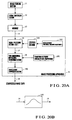
- Fig. 20A shows the arrangement of a conventional electronic camera apparatus.
- An image (RGB) photoelectrically converted by an image sensing section 11 constituted by a CCD is digitized by a signal conversion section 12. After various conversion processes including luminance/color difference signal conversion, color temperature correction, and gamma correction are executed, the image is temporarily stored in a memory 13.
- An image processing apparatus 15 has a signal processing section 16 for adjusting the spatial frequency characteristic of the sensed image, a two-dimensional orthogonal transform section 18 for performing two-dimensional orthogonal transform for the image with the adjusted spatial frequency characteristic, and a quantization/compression section 18B for quantizing and compressing the transformed image data.
- the signal processing section 16 is constructed by a general-purpose circuit section such as a DSP (Digital Signal Processor).
- DSP Digital Signal Processor
- image data 14 is sequentially read out from the memory 13, and predetermined floating-point operation is repeatedly executed using a filter coefficient 16A having a desired filter characteristic for spatial frequency characteristic adjustment to generate an intermediate image 17 having an adjusted spatial frequency characteristic.
- the two-dimensional orthogonal transform section 18 is constructed by a general circuit section for performing two-dimensional orthogonal transform processing such as DCT (Discrete Cosine Transform).
- DCT Discrete Cosine Transform
- two-dimensional orthogonal transform processing for the intermediate image 17 is performed using a transform coefficient 18A for image data compression.
- the quantization/compression section 18B quantizes and compresses the image data that has undergone two-dimensional orthogonal transform to obtain compressed image data 19.
- the spatial frequency characteristic cannot be arbitrarily adjusted on the basis of a desired characteristic because of limitations on the time required for calculation and power consumption.
- the spatial frequency characteristic in units of matrix spaces each constructed by M ⁇ M pixels (M is an odd number; M ⁇ 3) of an input image, the spatial frequency characteristic can be arbitrarily adjusted in a wide frequency band by increasing the space size M.
- the degree of freedom of a characteristic in adjusting the spatial frequency characteristic is considerably limited, and no satisfactory image processing can be realized.
- the present invention has been made to solve the above problem, and has as its object to provide an image processing apparatus capable of adjusting the spatial frequency characteristic of an input image and compressing the image using a desired filter characteristic.
- an image processing apparatus which, for an input two-dimensional image constructed by arraying, in a matrix, a number of pixels each representing a luminance value at a corresponding position, adjusts a spatial frequency characteristic on the basis of a desired spatial frequency adjustment filter characteristic, and compresses the image, comprising a spatial filter for obtaining a new luminance value of each pixel of an input image on the basis of a first coefficient having a first filter characteristic which forms the desired spatial frequency adjustment filter characteristic in cooperation with a second filter characteristic, thereby generating a two-dimensional intermediate image which has the adjusted spatial frequency characteristic of the input image, and an orthogonal transform section for performing two-dimensional orthogonal transform for the intermediate image on the basis of a second coefficient which has the second filter characteristic, which forms the desired spatial frequency adjustment filter characteristic in cooperation with the first filter characteristic, and is used for two-dimensional orthogonal transform for compressing the intermediate image generated by the spatial filter, thereby generating image data which has the adjusted spatial frequency characteristic of the intermediate
- Fig. 1A shows an electronic camera apparatus to which an image processing apparatus according to the first embodiment of the present invention is applied.
- Fig. 1B shows adjustment processing of a spatial frequency characteristic.
- An image (RGB) photoelectrically converted by an image sensing section 11 constructed by an image sensing element such as a CCD is digitized by a signal conversion section 12. After various conversion processes including luminance/color difference signal conversion, color temperature correction, and gamma correction are executed, the image is temporarily stored in a memory 13.
- This image is constructed by a number of pixels arrayed in a matrix. Each pixel has a luminance signal Y and luminance values of two color difference signals.
- An image processing apparatus 1 has a spatial filter 2 which adjusts the spatial frequency characteristic of an input image 14 (luminance signal Y) read out from the memory 13 on the basis of a filter coefficient 2A (first coefficient) having a filter characteristic (first filter characteristic) for spatial frequency adjustment to obtain an intermediate image 6.
- a spatial filter 2 which adjusts the spatial frequency characteristic of an input image 14 (luminance signal Y) read out from the memory 13 on the basis of a filter coefficient 2A (first coefficient) having a filter characteristic (first filter characteristic) for spatial frequency adjustment to obtain an intermediate image 6.
- the image processing apparatus also has a two-dimensional orthogonal transform section 4 for performing two-dimensional orthogonal transform for spatial frequency characteristic adjustment and compression processing for the intermediate image 6 obtained by the spatial filter 2, on the basis of a coefficient 4A (second coefficient) having two characteristics, i.e., a filter characteristic (second filter characteristic) for spatial frequency adjustment and a transform coefficient for two-dimensional orthogonal transform.
- a coefficient 4A second coefficient
- a filter characteristic second filter characteristic
- a quantization/compression section 18B quantizes and compresses the image data which has undergone two-dimensional orthogonal transform, thereby obtaining compressed image data 19.
- a DSP may be used, as in the prior art, or an optimized circuit section may be used, as in the embodiment to be described later.
- the two-dimensional orthogonal transform section 4 is constructed by a general-purpose circuit section for performing two-dimensional orthogonal transform such as DCT.
- a desired filter characteristic 7 for spatial frequency adjustment in the entire image processing apparatus 1 is separated into a filter characteristic 7A (first filter characteristic) and filter characteristic 7B (second filter characteristic).
- the spatial filter 2 and two-dimensional orthogonal transform section 4 adjust the spatial frequency using filter coefficients 2A and 4A representing the filter characteristics, respectively.
- the filter characteristics 7A and 7B cooperatively synthesize the desired filter characteristic 7 for spatial frequency adjustment.
- the desired filter characteristic 7 for spatial frequency adjustment is separated into the filter characteristics 7A and 7B respectively matching the processing performances of the spatial filter 2 and two-dimensional orthogonal transform section 4, and the spatial frequency characteristic is adjusted by both the spatial filter 2 and two-dimensional orthogonal transform section 4, two-dimensional orthogonal transform for spatial frequency characteristic adjustment and compression processing can be performed for the input image 14 using the desired filter characteristic without adding any new circuit arrangement, unlike the prior art using a single filter characteristic.
- the spatial frequency characteristic is adjusted in units of matrix spaces each constructed by an arbitrary central pixel on the input image and M ⁇ M pixels (M is an odd number; M ⁇ 3) in the periphery.
- the desired filter characteristic 7 for spatial frequency adjustment is separated into the two filter characteristics 7A and 7B.
- the filter characteristic of the filter coefficient 2A used by the spatial filter 2 generally having desired characteristic 7 with mainly adjusting the characteristic of the intermediate- to high-frequency ranges.
- the filter characteristic of the transform coefficient 4A used by the two-dimensional orthogonal transform section 4 a characteristic with mostly adjusting characteristic of the high-frequency range of the desired filter characteristic 7 is prepared.
- the change in luminance value tends to be relatively large at the peripheral portion of the matrix space, so the spatial frequency cannot be largely adjusted.
- the two-dimensional orthogonal transform section 4 adjusts the characteristic in the highest-frequency range, the characteristic in the low- to intermediate-frequency ranges need not be adjusted, and the block noise can be suppressed.
- the filter characteristic 7A a characteristic with a peak from the intermediate- to high-frequency portions is used, as shown in Fig. 12 or 17.
- the filter characteristic 7B of the two-dimensional orthogonal transform section 4 a characteristic that cannot be realized by the spatial filter 2, i.e., that attenuates in the high-frequency range, as shown in Fig. 2 (to be described later), is used.
- the spatial frequency characteristic of a color difference signal is adjusted using a characteristic different from that for a luminance signal, for example, the high-frequency portion can be greatly attenuated as compared to the luminance signal, so processing equivalent to chromakeying can be performed.
- the transform coefficient 4A has both the filter characteristic 7B for spatial frequency adjustment and a transform coefficient for two-dimensional orthogonal transform.
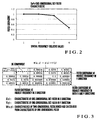
- Fig. 2 shows an example of a one-dimensional DCT filter characteristic for spatial frequency adjustment which is performed by the two-dimensional orthogonal transform section.
- this one-dimensional DCT filter characteristic is arranged in the X and Y directions, as shown in Fig. 3, and coefficients X(x) and Y(y) are multiplied, a two-dimensional DCT filter characteristic, i.e., a coefficient W(x,y) of the filter characteristic 7B is obtained.
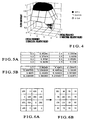
- Fig. 4 shows a 3D model representing the two-dimensional DCT filter characteristics.
- Fig. 5A shows transform coefficients used for DCT transform by the two-dimensional orthogonal transform section 4.
- the transform coefficients 4A having the filter characteristic 7B are obtained, as shown in Fig. 5B.
- Figs. 6A and 6B show DCT transform results using DCT transform coefficients having a high-frequency attenuation characteristic.
- Fig. 6A shows pixels (luminance values) before DCT processing.
- Fig. 6B shows pixels (luminance values) which have undergone DCT processing (compression) and then inverse DCT processing (expansion).
- two-dimensional orthogonal transform section 4 When the two-dimensional orthogonal transform section 4 performs two-dimensional orthogonal transform using the transform coefficient 4A, two-dimensional orthogonal transform for spatial frequency characteristic adjustment and image compression is executed at once. For this reason, transform processing for spatial frequency characteristic adjustment using the filter characteristic 7B need not be separately performed, and the processing time and power consumption can be suppressed.
- the sum of power values of 2 may be used as a central coefficient corresponding to the central pixel of a matrix space, and a peripheral coefficient corresponding to a peripheral pixel of the matrix space except the central pixel may be selected such that the sum of the central coefficient and the total sum of the peripheral coefficients has a power value of 2.
- the calculation process for spatial frequency characteristic adjustment by a DSP can be realized by addition of integers or multiplication and division (i.e., bit shift) of a power value of 2 with respect to an integer without using floating-point operation, unlike the prior art.
- the processing time can be shortened, and power consumption can be reduced as compared to a case wherein another filter coefficient is used.
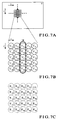
- Figs. 7A to 7C show a matrix space used by a spatial filter.
- Figs. 7A and 7B show a pixel arrangement, and
- Fig. 7C shows filter coefficients.
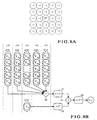
- Figs. 8A and 8B show a spatial filter according to the second embodiment.
- Fig. 8A shows filter coefficients
- Fig. 8B shows a block diagram
- a general-purpose DSP is used as the spatial filter 2.
- a spatial filter 2 is constructed by a circuit section for performing pipeline processing.
- pipeline processing means processing of sequentially reading input data, processing them, and sequentially outputting new data.
- pipeline processing by the spatial filter 2 means an operation of sequentially reading a plurality of pixels from an input image 14 and sequentially calculating and outputting new luminance values.
- a new luminance value V P ' of a central pixel P located at the center of the matrix space can be expressed as the following general equation using the luminance values of the peripheral pixels.
- the central coefficient R P and peripheral coefficients R ij are selected such that the sum of the central coefficient R P and all peripheral coefficients R ij becomes 1.
- the luminance value gain by spatial frequency characteristic adjustment is 1, and only the spatial frequency characteristic is adjusted without changing the brightness of the entire image before and after adjustment.
- the input image 14 is constructed by a number of pixels arrayed in a matrix in a horizontal direction i and vertical direction j, as shown in Fig. 7A.
- the new luminance value V P ' of the central pixel P is calculated using the above-described equations (1).
- a totalizer 20 calculates the total sum of luminance values V 11 to V 55 of the peripheral pixels.
- a multiplier peripheral multiplier 21
- the total sum of products of the luminance values V 11 to V 55 of the peripheral pixels and corresponding peripheral coefficients R 11 to R 55 is obtained.
- the luminance value V P of the central pixel is multiplied by the central coefficient R P by a multiplier (central multiplier) 22, and the multiplied value is added to the output from the multiplier 21 by an adder 23.
- the luminance values of the peripheral pixels can be divided into pixel groups A(1), A(2), B(3), A(4), and A(5) in the vertical direction j.
- Figs. 9 and 10 show the detailed arrangement of the spatial filter.
- an adder (block adder) 20A calculates a sum A(i) of the luminance values V i1 to V i5 of five pixels consecutive in the vertical direction j, which are parallelly input at the timing i, and an adder (block adder) 20B calculates a sum B(i) of the luminance values V i1 ,V i2 , V i4 , and V i5 .
- Each of shift registers 200, 210, and 220 is formed from a plurality of 1-pixel clock delays connected in series, and shifts, holds, and outputs the value A(i) at each timing i on the basis of a clock signal in the horizontal direction i.
- the totalizer 20 calculates a total sum G of the output A(i) from the adder 20A and outputs A(i-1), B(i-2), A(i-3), and A(i-4) from predetermined 1-pixel clock delays of the shift registers 200, 210, and 220.
- the shift register 210 outputs the luminance value V P of the central pixel P, i.e., E(i-2) as a value F.
- the multiplier (central multiplier) 22 multiplies the value F by the central coefficient R P
- the multiplier (peripheral multiplier) 21 multiplies the total sum G by the inverse peripheral coefficients R 11 to R 55
- the adder 23 adds the outputs from the multipliers 21 and 22
- the spatial filter shown in Fig. 8B is constructed, and the new luminance value V P ' of the central pixel P is output.
- the sum of power values of 2 is selected as the central coefficient R P
- the peripheral coefficient R 11 to R 55 are selected such that the sum of the central coefficient R P and the total sum of the peripheral coefficients R 11 to R 55 equals the sum of power values of 2.
- a value obtained by adding the central coefficient R P to the sum of the peripheral coefficients R 11 to R 55 is set as the gain adjustment coefficient K which equals a power value of 2.
- the adders 20A, 20B, and 23 required to realize equations (1) can be implemented by addition of integers, and the multipliers 21 and 22 and divider 24 can be implemented by bit shift, so the circuit arrangement of the spatial filter can be greatly simplified.
- the processing time necessary for adjusting the spatial frequency characteristic can be shortened, and power consumption can be reduced.
- a single power value of 2, i.e., 2 5 is selected as the central coefficient R P .
- a plurality of multipliers 22 are used in correspondence with the power values of 2.
- the output from an adder 27 is divided by the gain adjustment coefficient K by a divider 28, and the new luminance value V P ' of the central pixel P is obtained, with which the brightness of the entire image equals that of the input image 14.
- Fig. 12 shows the filter characteristic of the spatial filter.
- a characteristic 29A is obtained when the filter coefficients shown in Fig. 8A are used, i.e., when the combination of the filter coefficients shown in Figs. 9 and 10 is used.
- a characteristic 29B is obtained when the combination of the filter coefficients shown in Figs. 9 and 11 is used. Unlike the characteristic 29A, the characteristic 29B has a high gain in the intermediate- and high-frequency ranges of the spatial frequency because of the larger central coefficient R P .
- the optimum filter characteristic changes depending on a pixel contained in a matrix space to be processed.
- a plurality of filter characteristics are prepared. On the basis of a predetermined statistic amount calculated from the luminance values of pixels contained in a matrix space, one of the filter coefficients is selected to adjust the spatial frequency characteristic of an input image.
- filter coefficient sections 30A to 30C have different filter characteristics.
- a selection control section 31 selects an optimum filter characteristic on the basis of a predetermined statistic amount calculated from the luminance values of pixels contained in a matrix space.
- a selector 36 selects one of the outputs from the filter coefficient sections 30A to 30C on the basis of an instruction from the selection control section 31.
- the filter coefficients shown in Figs. 10 and 11 are used by the filter coefficient sections 30A and 30C.
- the filter coefficient section 30B uses a flat filter characteristic and therefore directly outputs an input value F.
- the selection control section 31 selects one of the filter characteristics on the basis of a predetermined statistic amount calculated from the luminance values of pixels contained in a matrix space, such as the average luminance of pixels in the matrix space, the difference between the luminance value of the central pixel and the average luminance in the matrix space, or the difference between the luminance value of the central pixel and the luminance value of the farthest pixel in the matrix space.
- the selection control section 31 uses the same circuit arrangement as that of the filter coefficient section 30A or 30C and comprises multipliers 33A and 33B for multiplying the value F by predetermined coefficients, a multiplier 32 for multiplying a total sum G by a predetermined coefficient, an adder 34 for adding the outputs from the multipliers 33A, 33B, and 32 and a determination section 35 for determining an optimum filter coefficient on the basis of the output level of the adder 34.
- circuit arrangement shown in Fig. 9 or 15 (to be described later) is connected to the input side of the circuit section shown in Fig. 13.
- one of the filter coefficients is selected to adjust the spatial frequency characteristic of an input image. Even when the luminance values of pixels contained in the matrix space are unevenly distributed, the spatial frequency characteristic can be adjusted using a filter characteristic (optimum filter characteristic) corresponding to the region.
- a filter coefficient having no large gain for a high-frequency range is selected to prevent emphasis small noise.
- an image concealed in a dark (or bright) portion can be made clear.
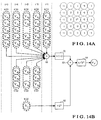
- Figs. 14A and 14B show a spatial filter according to the fourth embodiment.
- Fig. 14A shows filter coefficients
- Fig. 14B shows the arrangement of the spatial filter.
- the spatial filter uses filter coefficients including peripheral coefficients all having the same value and a central coefficient having a different value.
- filter coefficients having different values as peripheral coefficients will be described.
- filter characteristics having different values are realized as peripheral coefficients by overlapping the pixel groups used in the above-described second embodiment by the coefficient value.
- the coefficients of peripheral pixels around the central pixel i.e., pixels separated one pixel distance from the central pixel are -2, and the coefficients of pixels around these pixels are -1, will be examined.
- this case can be regarded that pixel groups A(1), A(2), B(3), A(4), and A(5) with the coefficient of -1 in the case of Fig. 8B overlap new pixel groups C(2), D(3), and C(4) with the coefficients of -1.
- the sums of luminance values of these pixel groups are totalized by a totalizer 50.
- the output is multiplied by the polarity of the peripheral coefficients of -1 by a multiplier (peripheral multiplier) 51, so the total sum of products of luminance values V 11 to V 55 of the peripheral pixels and corresponding peripheral coefficients R 11 to R 55 is obtained.
- a luminance value V P of the central pixel is multiplied by a central coefficient R P by a multiplier (central multiplier) 52, and the multiplied value is added to the output from the multiplier 51 by an adder 53.
- a new luminance value V P ' of a central pixel P is obtained, with which the luminance value gain by spatial frequency characteristic adjustment is 1, and the brightness of the entire image equals that of an input image 14.
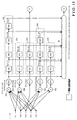
- adders (block adders) 50A and 50B are provided in correspondence with the adders 20A and 20B shown in Fig. 8A, as shown in Fig. 15.
- shift registers 500, 510, and 520 are provided in correspondence with the shift registers 200, 210, and 220.
- An adder (block adder) 50C for obtaining the total sum of luminance values V i2 to V i4 of a new pixel group C, and an adder (block adder) 50D for obtaining the total sum of the luminance values V i2 and V i4 of a pixel group D are provided.
- shift registers 530 and 540 for shifting, holding, and outputting the outputs C(i) and D(i) from the adders 50C and 50D at each timing i on the basis of a clock signal in a horizontal direction i are provided.
- the totalizer 50 calculates a total sum G of outputs A(i), A(i-1), C(i-1), B(i-2), D(i-2), A(i-3), C(i-3), and A(i-4) from predetermined 1-pixel block delays of the shift registers 500 to 540.
- the shift register 510 outputs the luminance value V P of the central pixel P, i.e., E(i-2) as a value F.
- a multiplier (central multiplier) 52 multiplies the value F by the central coefficient R P .
- a multiplier (peripheral multiplier) 51 multiplies the total sum G by the polarity of the peripheral coefficients R 11 to R 55 .
- An adder 53 adds the outputs from the multipliers 51 and 52.
- a filter characteristic representing that the gain peak is present in the intermediate-frequency range of the spatial frequency, and the gain gradually attenuates from the intermediate-frequency portion to the high-frequency portion is obtained, as shown in Fig. 12.
- the filter characteristic in the high-frequency range of the spatial frequency can be controlled.
- the circuit arrangement shown in Fig. 14B includes the circuit arrangement shown in Fig. 8B.
- a plurality of filter coefficients can be easily switched.
- Fig. 18 shows a 3D model representing filter characteristics of the spatial filter using the filter coefficients shown in Fig. 14A.
- a section along the X or Y direction corresponds to the characteristic shown in Fig. 17.
- Fig. 19 shows a 3D model representing the synthesized characteristics of the spatial filter and two-dimensional DCT filter.
- the spatial filter characteristic shown in Fig. 18, and the two-dimensional DCT filter characteristic shown in Fig. 4, i.e., filter characteristics 7A and 7B in Fig. 1B. are synthesized.
- a complex filter characteristic 7 for spatial frequency adjustment can be obtained.
- a spatial filter using a first coefficient having a first filter characteristic which forms a desired spatial frequency adjustment filter characteristic in cooperation with a second filter characteristic, and an orthogonal transform section for performing two-dimensional orthogonal transform for compressing an intermediate image generated by the spatial filter, using a second coefficient having the second filter characteristic which forms the desired spatial frequency adjustment filter characteristic in cooperation with the first filter characteristic are provided to adjust the spatial frequency characteristic by both the spatial filter and the orthogonal transform section.
- the desired filter characteristic for spatial frequency adjustment can be separated into the first and second filter characteristics suitable for processing by the spatial filter and orthogonal transform section, and the spatial frequency characteristic can be adjusted by both the spatial filter and the orthogonal transform section.
- the spatial frequency characteristic can be adjusted, and an input image can be compressed using a desired filter characteristic for the image without adding any new circuit arrangement.
Landscapes
- Engineering & Computer Science (AREA)
- Multimedia (AREA)
- Signal Processing (AREA)
- Image Processing (AREA)
- Compression Or Coding Systems Of Tv Signals (AREA)
- Compression Of Band Width Or Redundancy In Fax (AREA)
Applications Claiming Priority (2)
| Application Number | Priority Date | Filing Date | Title |
|---|---|---|---|
| JP13197699 | 1999-05-12 | ||
| JP13197699A JP2000333171A (ja) | 1999-05-12 | 1999-05-12 | 画像処理装置 |
Publications (2)
| Publication Number | Publication Date |
|---|---|
| EP1052845A2 true EP1052845A2 (de) | 2000-11-15 |
| EP1052845A3 EP1052845A3 (de) | 2002-08-07 |
Family
ID=15070640
Family Applications (1)
| Application Number | Title | Priority Date | Filing Date |
|---|---|---|---|
| EP20000109721 Withdrawn EP1052845A3 (de) | 1999-05-12 | 2000-05-08 | Bildverarbeitungsvorrichtung |
Country Status (3)
| Country | Link |
|---|---|
| US (1) | US6819717B1 (de) |
| EP (1) | EP1052845A3 (de) |
| JP (1) | JP2000333171A (de) |
Cited By (5)
| Publication number | Priority date | Publication date | Assignee | Title |
|---|---|---|---|---|
| EP1394741A3 (de) * | 2002-08-30 | 2005-07-20 | Konica Corporation | Transformation eines Bildfrequenzcharakteristikums abhängig von einem Charakteristikum des Bildaufnahmegeräts |
| WO2006001533A3 (en) * | 2004-06-29 | 2006-02-23 | Olympus Corp | Methods and apparatus for image encoding/decoding, and extended image compression expansion |
| DE10203359B4 (de) * | 2001-02-02 | 2007-04-19 | Hewlett-Packard Development Co., L.P., Houston | System und Verfahren zur Linsenfilteremulation bei der Digitalphotographie |
| CN100571389C (zh) * | 2004-06-29 | 2009-12-16 | 奥林巴斯株式会社 | 用于图像编码/解码和扩展图像压缩解压缩的方法和设备 |
| TWI476731B (zh) * | 2009-11-27 | 2015-03-11 | Sony Corp | 影像處理裝置、影像處理方法、及程式 |
Families Citing this family (5)
| Publication number | Priority date | Publication date | Assignee | Title |
|---|---|---|---|---|
| US8391630B2 (en) * | 2005-12-22 | 2013-03-05 | Qualcomm Mems Technologies, Inc. | System and method for power reduction when decompressing video streams for interferometric modulator displays |
| JP4293225B2 (ja) | 2006-10-31 | 2009-07-08 | セイコーエプソン株式会社 | 画像処理回路 |
| US8532428B2 (en) * | 2007-02-27 | 2013-09-10 | Nec Corporation | Noise reducing apparatus, noise reducing method, and noise reducing program for improving image quality |
| JP5215165B2 (ja) * | 2008-12-24 | 2013-06-19 | 株式会社情報システム総合研究所 | 画像圧縮装置、および画像圧縮方法 |
| US9177204B1 (en) * | 2011-09-28 | 2015-11-03 | Rockwell Collins, Inc. | Spectrally enhanced vision system for low visibility operations |
Family Cites Families (15)
| Publication number | Priority date | Publication date | Assignee | Title |
|---|---|---|---|---|
| DE3788779T2 (de) | 1986-10-27 | 1994-06-30 | Philips Nv | Digitales, nicht-rekursives Filter mit Multiplizierkoeffizienten der Basis zwei. |
| JPH03256454A (ja) | 1990-03-07 | 1991-11-15 | Ricoh Co Ltd | 画像データ処理方式 |
| US5287299A (en) | 1992-05-26 | 1994-02-15 | Monolith Technologies Corporation | Method and apparatus for implementing a digital filter employing coefficients expressed as sums of 2 to an integer power |
| US6434266B1 (en) * | 1993-12-17 | 2002-08-13 | Canon Kabushiki Kaisha | Image processing method and apparatus for converting colors in a color image |
| JPH08237669A (ja) * | 1995-02-28 | 1996-09-13 | Sony Corp | 画像信号処理装置、画像信号処理方法および画像信号復号化装置 |
| US5706216A (en) | 1995-07-28 | 1998-01-06 | Reisch; Michael L. | System for data compression of an image using a JPEG compression circuit modified for filtering in the frequency domain |
| JPH0970044A (ja) | 1995-08-31 | 1997-03-11 | Sony Corp | 画像信号処理装置および方法 |
| US5862266A (en) | 1996-06-07 | 1999-01-19 | Hewlett-Packard Company | Circuit for sharpening of edges of a pixel image in a color copier |
| JP4034380B2 (ja) * | 1996-10-31 | 2008-01-16 | 株式会社東芝 | 画像符号化/復号化方法及び装置 |
| US6539120B1 (en) * | 1997-03-12 | 2003-03-25 | Matsushita Electric Industrial Co., Ltd. | MPEG decoder providing multiple standard output signals |
| US6028965A (en) * | 1997-05-13 | 2000-02-22 | Lg Electronics, Inc | Method and apparatus for intelligent codec system |
| US6173085B1 (en) * | 1998-09-18 | 2001-01-09 | Eastman Kodak Company | Edge enhancement using modified edge boost function |
| US6487249B2 (en) * | 1998-10-09 | 2002-11-26 | Matsushita Electric Industrial Co., Ltd. | Efficient down conversion system for 2:1 decimation |
| US6320987B1 (en) * | 1998-10-16 | 2001-11-20 | Neo Paradigm Labs, Inc. | Pre-DCT residue filter |
| US6215908B1 (en) * | 1999-02-24 | 2001-04-10 | Intel Corporation | Symmetric filtering based VLSI architecture for image compression |
-
1999
- 1999-05-12 JP JP13197699A patent/JP2000333171A/ja active Pending
-
2000
- 2000-05-03 US US09/564,598 patent/US6819717B1/en not_active Expired - Lifetime
- 2000-05-08 EP EP20000109721 patent/EP1052845A3/de not_active Withdrawn
Cited By (7)
| Publication number | Priority date | Publication date | Assignee | Title |
|---|---|---|---|---|
| DE10203359B4 (de) * | 2001-02-02 | 2007-04-19 | Hewlett-Packard Development Co., L.P., Houston | System und Verfahren zur Linsenfilteremulation bei der Digitalphotographie |
| EP1394741A3 (de) * | 2002-08-30 | 2005-07-20 | Konica Corporation | Transformation eines Bildfrequenzcharakteristikums abhängig von einem Charakteristikum des Bildaufnahmegeräts |
| US7324702B2 (en) | 2002-08-30 | 2008-01-29 | Konica Corporation | Image processing method, image processing apparatus, image recording apparatus, program, and recording medium |
| WO2006001533A3 (en) * | 2004-06-29 | 2006-02-23 | Olympus Corp | Methods and apparatus for image encoding/decoding, and extended image compression expansion |
| CN100571389C (zh) * | 2004-06-29 | 2009-12-16 | 奥林巴斯株式会社 | 用于图像编码/解码和扩展图像压缩解压缩的方法和设备 |
| US7848580B2 (en) | 2004-06-29 | 2010-12-07 | Olympus Corporation | Image encoding method, image decoding method, moving-image compression method, moving-image expansion method, image encoding program, image decoding device, image encoding device, image encoding/decoding system, and extended image compression/expansion system |
| TWI476731B (zh) * | 2009-11-27 | 2015-03-11 | Sony Corp | 影像處理裝置、影像處理方法、及程式 |
Also Published As
| Publication number | Publication date |
|---|---|
| JP2000333171A (ja) | 2000-11-30 |
| US6819717B1 (en) | 2004-11-16 |
| EP1052845A3 (de) | 2002-08-07 |
Similar Documents
| Publication | Publication Date | Title |
|---|---|---|
| EP0641508B1 (de) | Methode und Vorrichtung zur Verbesserung der Schärfe einer einem kontinuierlichem Zoom unterworfenen Bildfolge | |
| US4674125A (en) | Real-time hierarchal pyramid signal processing apparatus | |
| US8172755B2 (en) | Fractional delay filter-based beamformer apparatus using post filtering | |
| US5857033A (en) | Method for image enhancing using quantized mean-separate histogram equalization and a circuit therefor | |
| EP0126148B1 (de) | Bildverarbeitungsverfahren mit blocküberlappungstransformation | |
| US7116819B2 (en) | Image processing apparatus | |
| US8248492B2 (en) | Edge preserving and tone correcting image processing apparatus and method | |
| EP1494462A1 (de) | Bildverarbeitungseinrichtung und -verfahren | |
| US20110222767A1 (en) | Image processing apparatus and method, and program | |
| US6636629B1 (en) | Image processing apparatus | |
| EP1052845A2 (de) | Bildverarbeitungsvorrichtung | |
| US20110134291A1 (en) | Image-processing device for color image data and method for the image processing of color image data | |
| KR20030023294A (ko) | 이미지센서 출력데이터 처리장치 및 처리방법 | |
| US6701024B1 (en) | Image processing apparatus | |
| US8238685B2 (en) | Image noise reduction method and image processing apparatus using the same | |
| US6654492B1 (en) | Image processing apparatus | |
| US6545715B1 (en) | Apparatus and method for controlling focus using adaptive filter | |
| EP1067774B1 (de) | Verfahren und Schaltung zur Pixelinterpolation | |
| US6643412B1 (en) | Method and apparatus for high speed convolution | |
| EP1173029A2 (de) | Farbbildaufnahmegerät | |
| WO2006059365A1 (ja) | 画像処理装置、非撮像色信号算出装置及び画像処理方法 | |
| KR890003685B1 (ko) | 실시간 계층 피라밋 신호처리장치 | |
| JP2006211610A (ja) | 撮像システム | |
| JPH0715734A (ja) | 固体撮像素子の信号処理回路 | |
| Kekre et al. | Restoration of Color Halftone image by using Fast Inverse Half toning Algorithm |
Legal Events
| Date | Code | Title | Description |
|---|---|---|---|
| PUAI | Public reference made under article 153(3) epc to a published international application that has entered the european phase |
Free format text: ORIGINAL CODE: 0009012 |
|
| AK | Designated contracting states |
Kind code of ref document: A2 Designated state(s): AT BE CH CY DE DK ES FI FR GB GR IE IT LI LU MC NL PT SE |
|
| AX | Request for extension of the european patent |
Free format text: AL;LT;LV;MK;RO;SI |
|
| PUAL | Search report despatched |
Free format text: ORIGINAL CODE: 0009013 |
|
| AK | Designated contracting states |
Kind code of ref document: A3 Designated state(s): AT BE CH CY DE DK ES FI FR GB GR IE IT LI LU MC NL PT SE |
|
| AX | Request for extension of the european patent |
Free format text: AL;LT;LV;MK;RO;SI |
|
| RIC1 | Information provided on ipc code assigned before grant |
Free format text: 7H 04N 1/40 A, 7H 04N 7/30 B, 7H 04N 7/26 B |
|
| 17P | Request for examination filed |
Effective date: 20020820 |
|
| AKX | Designation fees paid |
Designated state(s): DE FR GB IT NL |
|
| 17Q | First examination report despatched |
Effective date: 20030618 |
|
| STAA | Information on the status of an ep patent application or granted ep patent |
Free format text: STATUS: THE APPLICATION HAS BEEN WITHDRAWN |
|
| 18W | Application withdrawn |
Effective date: 20051112 |