EP1053608B1 - Dispositif et procede de communication de donnees vocales en paquets, dans un systeme de communication mobile - Google Patents
Dispositif et procede de communication de donnees vocales en paquets, dans un systeme de communication mobile Download PDFInfo
- Publication number
- EP1053608B1 EP1053608B1 EP99941819A EP99941819A EP1053608B1 EP 1053608 B1 EP1053608 B1 EP 1053608B1 EP 99941819 A EP99941819 A EP 99941819A EP 99941819 A EP99941819 A EP 99941819A EP 1053608 B1 EP1053608 B1 EP 1053608B1
- Authority
- EP
- European Patent Office
- Prior art keywords
- voice
- packet
- layer
- channel
- pvcp
- Prior art date
- Legal status (The legal status is an assumption and is not a legal conclusion. Google has not performed a legal analysis and makes no representation as to the accuracy of the status listed.)
- Expired - Lifetime
Links
Images






Classifications
-
- H—ELECTRICITY
- H04—ELECTRIC COMMUNICATION TECHNIQUE
- H04W—WIRELESS COMMUNICATION NETWORKS
- H04W60/00—Affiliation to network, e.g. registration; Terminating affiliation with the network, e.g. de-registration
-
- H—ELECTRICITY
- H04—ELECTRIC COMMUNICATION TECHNIQUE
- H04W—WIRELESS COMMUNICATION NETWORKS
- H04W76/00—Connection management
- H04W76/10—Connection setup
-
- H—ELECTRICITY
- H04—ELECTRIC COMMUNICATION TECHNIQUE
- H04L—TRANSMISSION OF DIGITAL INFORMATION, e.g. TELEGRAPHIC COMMUNICATION
- H04L1/00—Arrangements for detecting or preventing errors in the information received
- H04L1/004—Arrangements for detecting or preventing errors in the information received by using forward error control
-
- H—ELECTRICITY
- H04—ELECTRIC COMMUNICATION TECHNIQUE
- H04L—TRANSMISSION OF DIGITAL INFORMATION, e.g. TELEGRAPHIC COMMUNICATION
- H04L47/00—Traffic control in data switching networks
- H04L47/10—Flow control; Congestion control
- H04L47/34—Flow control; Congestion control ensuring sequence integrity, e.g. using sequence numbers
-
- H—ELECTRICITY
- H04—ELECTRIC COMMUNICATION TECHNIQUE
- H04W—WIRELESS COMMUNICATION NETWORKS
- H04W72/00—Local resource management
- H04W72/04—Wireless resource allocation
-
- H—ELECTRICITY
- H04—ELECTRIC COMMUNICATION TECHNIQUE
- H04W—WIRELESS COMMUNICATION NETWORKS
- H04W76/00—Connection management
- H04W76/20—Manipulation of established connections
- H04W76/27—Transitions between radio resource control [RRC] states
-
- H—ELECTRICITY
- H04—ELECTRIC COMMUNICATION TECHNIQUE
- H04W—WIRELESS COMMUNICATION NETWORKS
- H04W76/00—Connection management
- H04W76/30—Connection release
-
- H—ELECTRICITY
- H04—ELECTRIC COMMUNICATION TECHNIQUE
- H04W—WIRELESS COMMUNICATION NETWORKS
- H04W28/00—Network traffic management; Network resource management
- H04W28/02—Traffic management, e.g. flow control or congestion control
- H04W28/06—Optimizing the usage of the radio link, e.g. header compression, information sizing, discarding information
-
- H—ELECTRICITY
- H04—ELECTRIC COMMUNICATION TECHNIQUE
- H04W—WIRELESS COMMUNICATION NETWORKS
- H04W4/00—Services specially adapted for wireless communication networks; Facilities therefor
- H04W4/18—Information format or content conversion, e.g. adaptation by the network of the transmitted or received information for the purpose of wireless delivery to users or terminals
-
- H—ELECTRICITY
- H04—ELECTRIC COMMUNICATION TECHNIQUE
- H04W—WIRELESS COMMUNICATION NETWORKS
- H04W80/00—Wireless network protocols or protocol adaptations to wireless operation
- H04W80/04—Network layer protocols, e.g. mobile IP [Internet Protocol]
Definitions
- the present invention relates generally to a device and method for supporting voice service in a mobile communication system, and in particular, to a device and method for communicating packet voice data, which can support more voice users.
- a fixed bandwidth is assigned from a voice call set-up to a voice call release in a line-type voice protocol.
- This corresponds to voice service over a mobile communication network such as IS-95, GSM (Global System for Mobile communication), and the like.
- GSM Global System for Mobile communication
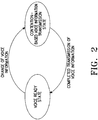
- the line-type voice protocol assigns fixed resources from call set-up to call release as shown in FIG. 1 .
- a fixed assigned channel is assigned to a user even though the user does not continuously generate voice traffic, thereby preventing another user from using the channel.
- voice traffic consists of an utterance period where sounds are produced and a mute period where no sounds are produced. While the ratio of utterance period to mute period varies with nation or individual user, research and analysis of user characteristics suggests that the ratio is 300ms:700ms, or 1sec:1.35sec.
- a line-type voice service can be considered the best way to support voice quality because a fixed bandwidth is assigned all the time. From a user's perspective, however, the service is billed even for the mute period and thus the user pays for unused periods. From a service provider's perspective, bandwidth efficiency is decreased by assigning a fixed radio resource, the fixed radio resource being a very small bandwidth, as compared to a wire service.
- line-type service structure needs to change to a packet type so that other activated users can use the bandwidth.
- utterance period:mute period 300ms:700ms, three times more subscribers can be supported, and thus performance can be increased drastically.
- IS-95 a control method which uses a 20ms-control message.
- An IS-95 system performs control processes on a common channel and then multiplexes signal traffic and voice traffic on one channel by inband signaling in providing a service. Therefore, in order to support a mechanism of releasing a traffic channel during a mute period and assigning it during an utterance period, the traffic channel should be acquired through the common channel when the utterance period is entered. In this case, a time delay occurs due to contention-based channel acquisition.
- the current packet voice service is based on ITU-T (International Telecommunication Union) G.764 "Packetized Voice Protocol". This is a LAN technology designed for widely used common channel access schemes but utilizable over a wire communication network.
- An Internet phone which is a very popular packet voice service on the Internet, is designed based on the above technology.
- the difference between the Internet phone and the ITU-T G.764 is that the former is a layer-2 protocol while the latter uses RTP/RTCP (Realtime Transmission Protocol/Realtime Transmission Control Protocol) of the IETF (Internet Engineering Task Force) and is designed as a layer-4 protocol.
- the Internet phone is intended for use as part of a TCP/IP (Transmission Control Protocol/Internet Protocol) network since the RTP/RTCP is designed based on the IETF, and to efficiently use an existing IP network.
- TCP/IP Transmission Control Protocol/Internet Protocol
- the Internet phone and the ITU-T G.764 are almost the same in operation.
- a problem with extension of the ITU-T G.764 to a radio network is that conventional wire network-based packet voice protocols such as the ITU-T G.764 are characterized by contention-based use of common channels. That is, over the Internet or a LAN, common channels are used and traffic transmission is implemented on the basis of contention between users. Therefore, no separate channel reservation technique for acquisition of a common channel and no channel release technique are necessary. In addition, the ability of the transmission end to detect the presence or absence of a contention is a feature of communication in non-connection service over a wire network.
- the contention-caused time delay may have a great influence. It is impossible to detect a contention in the radio environment and a contention-based scheme shows a poor performance. Therefore, it is very difficult to design a radio packet voice protocol using a contention-based scheme. In particular, considering CDMA technology, power control and synchronization make it impossible to support a contention-based packet voice protocol using common channels.
- the radio mobile communication network requires transmission/reception signals and control information to transmit voice traffic, maintain a call, and exchange control information.
- the common channel-based contention scheme is difficult to support.
- handoff of a mobile station makes it more difficult to support because time delay and inconvenience are involved in transmission/reception of handoff-related information and process messages.
- the packet voice protocols like ITU-T G.764 or the IETF RTP/RTCP, which were designed based on the conventional wire network, are difficult to use and inefficient in a radio channel environment using CDMA technology.
- EP 0801513 A1 discloses a cellular system architecture supporting data services.
- a separate ATM-based infrastructure is introduced that supports data services.
- a data call control is also introduced on industry standard hardware platforms using object oriented and modular programming.
- ATM is introduced at radio ports and call control functions are migrated to the new ATM-based call control platforms.
- Vocoders are introduced at the DCS and cellular functions of the legacy cellular switch are phased out and replaced by the ATM-based target architecture.
- MAC Medium Access Control
- the following description of the present invention is based on TIA CDMA 2000. Yet, the present invention is also applicable to all systems supporting high-speed packet data.
- a logical dsch (dedicated signaling channel) is assigned only in an control-hold state and dedicated to a mobile station. The dsch is used to transmit/receive a control message and operates based on a 20ms-message.
- a logical dmch (dedicated MAC channel) is a dedicated channel, assigned to a mobile station only in the control-hold state. The dmch is used to transmit/receive a control message of a MAC layer and control a dtch (dedicated traffic channel), and operates based on a 5ms-message.
- a cmch (common MAC channel) is shared by a plurality of mobile stations and assigned only in a suspended/dormant state.
- the cmch is used to transmit/receive a control message of a MAC layer and operates based on a 20ms-message.
- a dtch is a dedicated channel assigned to a mobile station only in an active state and used to transmit/receive traffic.
- a ctch (common traffic channel) is assigned as common to a mobile station only in a dormant state and used for traffic transmission/reception.
- a physical channel DCCH (dedicated control channel) is mapping to the logical channel dsch and dmch and the DCCH is operating as 20 ms-message and 5ms message transmission.
- a DCCH (Dedicated Control Channel) is assigned as dedicated to each mobile station. The DCCH results from using a channel bandwidth only when there is traffic in a DTX (Discontinuous Transmission) mode.
- a DCCH is mapped with the dsch/dmch.
- a CCCH Common Control Channel
- a FCH (Fundamental Channel) is a channel with which reverse compatibility with IS-95 is obtained and transmits/receives traffic and control information.
- An SCH (Supplemental Channel) corresponds to a supplemental channel of IS-95B, is based on an outband scheme in which traffic is mainly transmitted, and is dynamically assigned and released by the dmch.
- FIG. 3 is a state transition diagram of a CDMA 2000 MAC protocol. As shown in FIG. 3 , the state transition is determined by whether a channel is reserved or not. Each transition is performed with a timer or an artificial primitive.
- a null state 311 is the state before a call set-up where there is no connection and information.
- an initialization state 312 a negotiation for call processing and other actions is carried out upon request for initialization of a packet service on common channels. Shortly after the channel negotiation is completed, a dsch/dmch is connected and a traffic channel is assigned directly via the dmch in a control hold state 313.
- a dtch is assigned via the dmch through activation of traffic and traffic data is transmitted/received on the dtch.
- a DCCH such as the dsch/dmch is released and control information is transmitted/received on a common channel in a suspended state 315.
- a dormant state 316 If there is no traffic transmission/reception for a period of time, all channels at or below layer-2 are released and related information is removed in a dormant state 316. Only PPP (Point-to-Point Protocol) information is managed in the dormant state 316. When traffic to be transmitted is generated in the dormant state 316, a reconnect state 317 is entered where the PPP information is maintained and an initial call set-up procedure is performed.
- PPP Point-to-Point Protocol
- the state transition is based on a timer. For example, after the control hold state 313 transitions to the active state 314 by acquiring a dtch, the suspended state 315 is entered if there is no traffic transmission/reception within T_active (the waiting threshold time period for the active stage). If traffic is not transmitted/received within T_hold (the waiting threshold time period control for the hold state) in the control hold state 313, the suspended state 315 is entered. If there is no data transmission/reception within T_suspended (the waiting threshold time period for the suspended state) in the suspended state 315, the dormant state 316 is entered.
- FIG. 4 illustrates the state transitions of a physical layer supporting high-speed packet data service in conventional technology.
- a voice channel active state 412 is entered. If there is no traffic transmission/reception within T_sleep (the waiting threshold time period before entering sleep state) in the voice channel active state 412, the voice channel active state 412 transitions to a voice channel sleep state 413. Here, the gain of the traffic channel assigned on the DCCH can be obtained through power control. If traffic to be transmitted/received is generated in the voice channel sleep state 413, the voice channel active state 412 is re-entered through a wakeup procedure.
- the voice channel active state 412 transitions to the voice channel release state 411. If the voice traffic channel is released in the voice channel sleep state 413, the voice channel sleep state 413 transitions to the voice channel release state 411. That is, in the absence of traffic transmission/reception within T_sleep, the gain of the traffic channel assigned in the voice channel active state 412 is obtained through power control in the sleep state 413.
- the present invention is independent of direct voice coding, like ITU-T G.764.
- call set-up and release is performed in a CDMA 2000 call process. Therefore, the present invention uses voice coding for a conventional wire/wireless voice communication.
- an overhead including coding information is removed in each packet like the ITU-T G.764 by a negotiating codec or vocoder used for a call set-up.
- the present invention includes various error compensation functions and facilitates interconnection with existing wire network-based packet voice protocols.
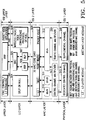
- FIG. 5 illustrates a main protocol layer structure in a CDMA 2000 communication network according to an embodiment of the present invention.
- the upper layer is at or above layer-3 in the OSI (Open Systems Interconnection) 7 layer model and the LCC layer and MAC layer correspond to layer-2.
- the MAC layer corresponds to a MAC sublayer.
- the physical layer corresponds to layer-1.
- a Call Control/L3 Signaling Protocol 501 generates signaling messages for initiating and releasing a service.
- the signaling messages are mapped on a logical channel dsch 510 in the MAC layer through or not through an SRLP (Signaling Radio Link Protocol) and transmitted on a DCCH, which is the physical layer.
- a PPP (Point-to-Point Protocol) 502 is a layer-3 protocol for use in transmitting/receiving data over the Internet.
- a data unit 1 generated by the PPP 502 is mapped in an RBP (Radio Burst Protocol) 506 or an RLP (Radio Link Protocol) 507 through a PRC (PLP-RBP Conversation Layer) 505 and transmitted to a supplemental channel, 516 which is a physical layer channel, via a dtch 512, which is a logical channel.
- the PPP 502 transmits voice data to a W-PVCP (Wireless Packet Voice Convergence Protocol) 508.
- a packet voice application 503 converts voice data to packet data of a predetermined length and transmits the packet data to a lower layer.
- the packet data is called a W-PVCP frame and the W-PVCP frame is divided into a header area and voice information area of a variable length.
- the SRLP 504 is a protocol processor for processing an L3 signaling message.
- a PRC 505 is an entity which determines whether to provide a service through the RBP 506 or the RLP 507 according to the features of data received from the upper layer.
- the RBP 506 transmits data without establishing a link between nodes if the amount of data is small.
- the RLP 507 transmits a large amount of data by establishing a link between nodes for data transmission/reception.
- the W-PVCP 508 provides synchronization with respect to transmission delay and loss compensation in transmitting voice packets. If a voice packet received from the upper layer is larger than a frame size in the lower MAC layer, the voice packet is divided into MAC layer frames of a predetermined length, and frames received from the lower MAC layer are assembled in sequence and transmitted to the upper application layer.
- a MAC layer 509 maps frames received from the upper layer on corresponding logical channel For example, an L3 signaling message is mapped on a dsch 510, a signaling message of the MAC sublayer is mapped on a dmch, and a voice packet is mapped on the dtch.
- the dsch 510 is a logical channel set for transmitting/receiving the L3 signaling message between a mobile station and a base station.
- a dmch 511 is a logical channel set for transmitting/receiving a MAC sublayer signaling message between a base station and a mobile station.
- the dtch 512 is a logical channel set for transmitting/receiving user data between a base station and a mobile station.
- a control channel multiplexer 515 multiplexes the dsch and the dmch into a physical channel DCCH.
- a traffic channel multiplexer 516 multiplexes the dtch into a physical channel SCH.
- DCCH 515 is the channel set for transmitting a control message between a mobile station and a base station.
- the SCH 516 is the physical-layer channel set for transmitting/receiving user traffic between a mobile station and a base station.
- the W-PVCP 508 belongs to the LCC layer, it performs the same function as that of a DLC (Data Link Control) layer in terms of a protocol layer structures.
- a packet voice application dedicated to the W-PVCP 508 is configured above the W-PVCP 508. Therefore, a terminal dedicated to packet voice can be achieved.
- An IP-based packet voice protocol like an Internet phone can be interconnected to the W-PVCP through the PPP 502. That is, an Internet phone service designed without consideration of a radio environment can be provided on a radio channel. The following description is conducted mainly on a packet voice service provided through the W-PVCP 508.
- the W-PVCP 508 performs the following functions.
- the W-PVCP 508 defines items related with transmission/reception of packet voice traffic and thus follows a call set-up and release procedure based on the CDMA 2000 radio connection standard. Service options and codec/vocoder parameters for supporting the packet voice service are negotiated by control messages in a call set-up.
- the W-PVCP 508 assembles and disassembles frames to map a W-PVCP frame of a variable length or longer than a MAC layer frame to a MAC layer frame of a fixed length.
- a W-PVCP frame is comprised of a header area and a packet voice data area and has a variable length.
- the W-PVCP frame is divided into a plurality of MAC layer frames.
- a MAC layer frame includes a subframe number recording area, an information bit area where a packet voice segment is stored, a CRC (Cyclic Redundancy Code) area, and a tail area.
- the CRC area and the tail area are used by the physical layer. They are virtually generated and processed by the physical area. While a voice frame periodically sampled has a variable length, any W-PVCP frame longer than 20ms is divided and a sequence number is assigned to each divided subframe since the CDMA 2000 uses a 20ms MAC layer frame. In IS-95, error detection and recovery are performed without support of a subframe sequence after assembly of frames, but a partially damaged variable voice frame is recovered in a subframe-unit recovery procedure.
- the W-PVCP 508 assigns a voice channel by a 5ms control message of the CDMA 2000 MAC layer. Therefore, a control scheme related with the CDMA 2000 MAC layer is performed with parameters adjusted for voice service. That is, a channel control scheme based on a MAC layer T_active/T_hold timer is executed with careful consideration of the utterance and mute periods of voice. If parameters are set without consideration of voice, the delay in MAC layer state transitions will increase. Since a traffic channel is very rapidly assigned and released to support the packet voice service, the W-PVCP according to an embodiment of the present invention operates with the sleep mode of the CDMA 2000 physical layer as a fundamental structure.
- the W-PVCP 508 generates traffic only in a voice active period since it supports the packet voice service. Therefore, it does not generate traffic in a mute period. To do so, the W-PVCP 508 removes the mute period from information received in a CODEC (Coder and Decoder) on a predetermined basis, or the CODEC itself removes it. Noise generation in the mute period should be supported at the CODEC level. For this purpose, a noise parameter is involved in a W-PVCP frame and a receiving end generates noise with the noise parameter.
- CODEC Coder and Decoder
- the frame structure in each layer should be defined to support packet voice service using the CDMA 2000 MAC layer. That is, a variable-length frame in the W-PVCP layer and a 20ms packet frame in the CDMA 2000 MAC layer are modified suitably for voice service.
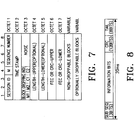
- FIG. 7 illustrates the structure of a W-PVCP frame according to an embodiment of the present invention.
- the W-PVCP frame is of variable length and provides compatibility with the ITU-T G.764.
- the W-PVCP frame includes a 3-byte fixed header area, an area indicating the variable length of voice information, FEC (Forward Error Correction) or CRC area for enabling the header area to be reliably transmitted in a radio error environment, a voice information area (optionally droppable blocks) for selective blocking of voice information in a congestion period or when errors are generated, and a voice information area (non-droppable blocks) which should be transmitted without fail.
- FEC Forward Error Correction
- CRC Control Channel Control
- a session ID field represents the number of a logical channel used to distinguish a plurality of channels together with a subsequence field of a MAC layer.
- An M (More bits) field is set to 1 for a first message in W-PVCP voice activation and to 0 for other messages.
- a sequence number field occupies 4 bits and a larger sequence number (e.g., 7 or 8 bits) can be used in an environment of serious errors.
- a time stamp field represents a voice packet generation time (or an accumulated packet queueing delay from the ITU-T perspective) for use in voice recovery.
- a noise field represents the noise level in generating the voice packet and is used to generate noise in a mute period at a receiving end.
- a block dropping indicator field indicates a droppable block of a lower priority in the current voice packet. Dropping a block with a lower priority is performed to voice recovery in a congestion period or at an error generation. The length of the compressed voice information for voice packet is included in the length field.
- a CRC/FEC field for a header is used to correct errors in the header.
- An optional CRC/FEC field for a data area supports only CRC or is not used. This is a structure in which no error control field is supported, since retransmission of packet voice data is meaningless.
- FIG. 8 illustrates the structure of the MAC layer frame supporting a packet voice service according to the present invention.
- the MAC layer frame is basically a CDMA 2000 MAC layer traffic frame and has a fixed length of 20ms.
- a subframe sequence field is added to the MAC layer frame.
- the subframe number, an information bit area, a CRC area, and a tail bit area are arranged in this order in the MAC layer frame.
- the CRC and tail bits are shared between the physical layer and the MAC layer, and are virtually generated and processed by the physical layer.
- the state of packet voice service can vary depending on the states of the W-PVCP and the MAC layer. This is because the MAC layer releases a channel in the absence of voice traffic to be transmitted and thus the service transitions among the control-hold state, the active state, the suspended state, and the dormant state. Further, since the physical layer transitions between the normal state and the sleep state in order to save power, various situations can be considered according to the states of the W-PVCP, the MAC layer, and the physical layer. The reason for contemplating various situations is to consider an environment where an end-to-end delay can be accommodated.
- the most significant consideration in achieving a packet voice protocol is that a traffic channel is assigned when necessary and released between voice traffic transmissions so that the traffic channel does not remain assigned until the call is released. Therefore, the delay involved in assigning a traffic channel according to the MAC layer and the normal/sleep/disconnect state of the DCCH physical layer should be considered when achieving a packet voice protocol using the CDMA 2000 MAC layer.
- a packet voice service can be supported when using a high-speed packet data MAC layer, only if the MAC layer is placed in an active state/control hold state and the DCCH physical layer is in a normal state/sleep state.
- the dtch since the dtch is connected in the active state, there is no time delay in voice service if the packet voice protocol favors the active state. However, if the voice service is in the active state longer, the dtch is maintained longer. This results in the channel reuse rate being too low to accommodate multiple subscribers.
- the dtch is absent and only a DCCH is assigned in the control hold state. This results in the reuse rate of a traffic channel being high enough to accommodate multiple subscribers. Since the DCCH operates in a discontinuous transmission (DTX) mode and is identified by a long code, there is little bandwidth loss caused by maintenance of the DCCH. In the case where the MAC layer is in the control hold state and the physical layer of the DCCH is in sleep mode, power is saved in the base station and the mobile station, resulting in efficient bandwidth use. However, if the DCCH is in normal/sleep mode, a delay of 20-30ms occurs in assigning a traffic channel. Thus, an end-to-end delay in voice service must be accommodated.
- DTX discontinuous transmission
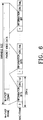
- FIG. 9 illustrates a procedure of assigning a dtch for transmitting voice traffic according to the present invention when the MAC layer is in control hold state and the physical layer of a DCCH is in sleep mode.
- a mobile station requests a traffic channel, which is similar to the situation where a base station requests a traffic channel.
- the W-PVCP 508 requests assignment of a dtch (PVCH: packet voice channel) for transmitting the packetized voice traffic to the MAC layer in step 913.
- the MAC layer passes the request for assigning the dtch to the physical layer in step 915.
- a sleep mode (or gating mode) is set and the DCCH is in a sleep state
- a wakeup procedure is required and thus channels whose power was reduced are increased to normal levels.
- the physical layer of the mobile station requests a wakeup from the base station in step 917.
- the physical layer of the base station transmits a response to the wakeup request on an f-dmch to the base station in step 919.
- the physical layer of the mobile station requests assignment of an r-dtch from the base station on an r-dmch.
- the physical layer of the base station passes the request for a dtch to the MAC layer in step 923 and the MAC layer notifies the physical layer of assignment of a dedicated channel in step 925.
- the base station physical layer informs the mobile station of the traffic channel assignment on the f-dmch.
- the physical layer of the mobile station informs the MAC layer of assignment of a dtch in step 929 and the MAC layer informs the W-PVCP of assignment of a PVCH in step 931.
- the mobile station acquires a dtch for transmitting activated packet voice traffic and transmits the packet voice traffic on the dtch.
- a 5ms control message is used in transmitting/receiving a message on the dmch. This causes a small delay in the channel assignment. Since each dmch is identified by a long code in the case of the DCCH, use of the DCCH result in little bandwidth reduction. In addition, since the physical channel uses a sleep mode, the base station and the mobile station save power.
- FIG. 10 illustrates the state transitions of the W-PVCP according to an embodiment the present invention.
- null state 1011 If a radio packet voice service is initiated in a base station or a mobile station, the null state 1011 transitions to an initialization state 1012. A call procedure for supporting the corresponding service is performed in the initialization state 1012 and if a service negotiation is made through the call process, the initialization state 1012 transitions to an inactive state 1013. In the inactive state 1013, the packet voice service is connected but voice is not activated. Thus, no traffic is generated.
- the ready state 1014 is entered where the packet voice service is activated and a traffic channel is assigned upon request for a PVCH.
- the active state 1015 is entered. The activated voice traffic is transmitted in the active state 1015. If no traffic is transmitted/received within a predetermined time period in the active state 1015, the inactive state 1013 is entered, waiting for the next traffic activation.
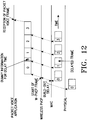
- FIGs. 11 to 13C illustrate operations of the W-PVCP with respect to voice packet delay and errors according to an embodiment of the present invention.
- FIG. 11 illustrates the operation of processing a voice packet received in a normal environment.
- the W-PVCP stores voice packets received from the lower MAC layer for a predetermined time period, assembles successively received voice packets, and transmits the assembled voice packets to an upper packet voice application. That is, in order to compensate for RTT delay, the W-PVCP supports a build-out delay based on the delay of a first received voice packet, and the build-out delay is calculated in the 10ms order.
- RTT round trip time
- an RTT is calculated based on time-stamp information in the first voice packet and the following voice packets are transmitted after a build-out delay after it is arrived at receiver.
- time-interval between voice packets at voice reconstruction module could be uniformed.
- FIG. 12 illustrates an operation of processing a voice packet when successive frames are delayed.
- the delay can occur due to a delay at the radio terminal or a processing delay in the physical layer or the MAC layer. Dummy information is inserted for the delay time without discarding the entire frame and the frame having dummy information is transmitted to the packet voice application.
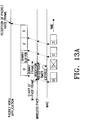
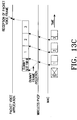
- FIGs. 13A , 13B , and 13C illustrate the process when errors occur.
- the W-PVCP detects errors based on the subframe sequence number recorded in the MAC layer frame.
- the W-PVCP performs compensation for the frame, recovers the voice traffic, and transmits the recovered voice traffic to the packet voice application. That is, a dummy slot is inserted into the damaged portion of the frame and the recovered frame is transmitted to the packet voice application.
- FIG. 13A illustrates a frame whose center is partially is lost
- FIG. 13B illustrates a frame whose end is lost
- FIG. 13C illustrates a frame whose sequence number portion is lost.
- the W-PVCP does no retransmission of voice traffic in relation to error detection and correction. Error control is basically not performed on voice data. Therefore, only CRC is used in a W-PVCP level and errors are corrected in only the header by supporting FEC. This method is used to reuse an partial correct information of error-containing packet by error compensation method without retransmission of the packet. The errors of the header are compensated by FEC since it transmits W-PVCP-related control information. Consequently, the W-PVCP supports error detection based on the subframe sequence number. It appropriately compensates for a partially damaged variable-length frame and sends corresponding traffic to the packet voice application. Errors in the voice traffic are not detected.
- the present invention teaches a W-PVCP protocol which can support a radio packet voice service in a high-speed packet data system.
- the suggested W-PVCP protocol supports a voice service structure in a mobile communication system focusing on a line-type service in the concept of a packet-type service, to thereby make the best use of limited radio resources. That is, bandwidth abuse caused by mute periods in the conventional line type scheme is overcome and more subscribers can be accommodated by application of statistical multiplexing of the bandwidth. Therefore, the number of subscribers which can be accommodated is increased from the conventional mobile phone system by about 250% to 280%.
Landscapes
- Engineering & Computer Science (AREA)
- Computer Networks & Wireless Communication (AREA)
- Signal Processing (AREA)
- Computer Security & Cryptography (AREA)
- Mobile Radio Communication Systems (AREA)
- Telephonic Communication Services (AREA)
- Time-Division Multiplex Systems (AREA)
- Small-Scale Networks (AREA)
- Synchronisation In Digital Transmission Systems (AREA)
- Data Exchanges In Wide-Area Networks (AREA)
Claims (19)
- Dispositif de communication vocale sur base de paquets dans un système de communication mobile ayant une architecture à protocole par couches, comprenant :une couche (508) à protocole de convergence vocale par paquets sans fil, soit Wireless Packet Voice Convergence Protocol ou W-PVCP, adaptée pour demander d'assigner un canal vocal par paquets lors de la génération d'un trafic vocal, pour entrer dans un état d'activité (1015), et pour mapper un paquet vocal de longueur variable généré par l'activation de trafic vocal sur une trame de paquets de longueur fixée ; etune couche (509) de contrôle d'accès au support, soit Medium Access Control ou MAC, adaptée pour notifier concernant l'attribution du canal vocal par paquets et une couche physique adaptée pour transmettre la trame de paquets à une station sur le canal vocal par paquets.
- Dispositif selon la revendication 1, dans lequel ladite couche W-PVCP (508) est interconnectée avec un protocole vocal par paquets via une couche supérieure (502) à protocole point à point, soit Point-to-Point Protocol ou PPP.
- Dispositif selon la revendication 1, dans lequel ladite couche MAC (509) est adaptée pour fonctionner dans un état d'activité et dans un état de maintien de contrôle.
- Dispositif selon la revendication 1, dans lequel ladite couche physique est adaptée pour fonctionner dans un état normal et dans un état de veille.
- Dispositif selon la revendication 1, dans lequel ledit paquet vocal de longueur variable comprend :une zone d'en-tête qui comporte un champ d'identifiant de section indiquant un numéro de canal logique, un champ indiquant un premier message, un champ de numéro de séquence de trame, un champ d'horodatage indiquant un temps de génération de paquet vocal, un champ indiquantdes blocks de faible priorité, et un champ de bruit pour générer du bruit durant une période de sourdine d'un côté récepteur ;une zone de longueur représentant la longueur d'information vocale ;une zone de contrôle de redondance cyclique, soit Cyclic Redundancy Code ou CRC, ou de correction d'erreurs de retransmission, soit Forward Error Control ou FEC, pour la correction d'erreurs dans la zone d'entête ;une zone d'information vocale pour des blocs de faible priorité qui sont éliminés lorsqu'une erreur se produit ; etune zone d'information vocale non éliminable.
- Dispositif selon la revendication 1, dans lequel ladite trame de paquets comprend :une zone de séquence de sous-trame représentant la séquence de la trame de paquets ;une zone d'information pour stocker un paquet vocal divisé ;une zone CRC de correction d'erreurs dans la trame de paquets ; etune zone de queue indiquant la fin de la trame de paquets.
- Dispositif selon la revendication 6, dans lequel la couche physique est adaptée pour utiliser lesdites zones CRC et de queue.
- Dispositif selon la revendication 1, comprenant en outre des minuteries dans la couche MAC (509) pour des seuils de changement d'état, dans lequel le dispositif est adapté pour régler lesdites minuteries en fonction d'une période d'énonciation et d'une période de sourdine du trafic vocal.
- Dispositif de communication vocale sur base de paquets dans un système de communication mobile ayant une architecture à protocole, comprenant :une couche physique et une couche de contrôle d'accès au support MAC (509) pour transmettre un paquet vocal reçu sur un canal à une couche à protocole de convergence vocale par paquets sans fil W-PVCP (508) ;dans lequel ladite couche W-PVCP (508) est adaptée pour calculer un délai de synchronisation en utilisant un horodatage compris dans un premier paquet vocal reçu de ladite couche MAC (509), pour tamponner les paquets vocaux suivants durant une période prédéterminée en fonction du délai de synchronisation, et pour transmettre les paquets vocaux tamponnés à une application vocale par paquets.
- Dispositif selon la revendication 9, dans lequel ladite couche W-PVCP (508) est adaptée pour détecter un paquet perdu parmi des numéros de séquence des paquets vocaux reçus de la couche MAC (509) et pour transmettre un créneau factice au lieu du paquet perdu à ladite application vocale par paquets.
- Dispositif selon la revendication 9, dans lequel ladite couche W-PVCP (508) est adaptée pour détecter un délai d'arrivée d'un paquet vocal causé par un délai de traitement dans la couche physique ou la couche MAC (509) et pour transmettre une information factice pour le délai temporel à une application vocale par paquets.
- Procédé de communication vocale sur base de paquets dans un système de communication mobile ayant une architecture à protocole par couches, comprenant les étapes consistant à :convertir des données vocales générées par une application vocale par paquets en des données de paquet de longueur variable lors de l'activation d'un trafic vocal ;demander (913) d'assigner un canal vocal par paquets lors de la génération d'un trafic vocal, passer dans un état d'activité (1015), et mapper lesdites données de paquet de longueur variable en fonction d'au moins une trame de paquets de longueur fixée via une couche à protocole de conversion vocale par paquets sans fil W-PVCP (508) ;passer ladite trame de paquets à une couche de contrôle d'accès au support MAC (509),et notifier concernant l'attribution du canal vocal par paquets par la couche MAC (509) et la transmission de la trame de paquets sur ledit canal vocal par paquets via une couche physique.
- Procédé selon la revendication 12, comprenant les étapes additionnelles consistant à
attribuer ledit canal vocal par paquets en réponse à la demande d'attribution dudit canal vocal par paquets, puis à passer en état de disponibilité (1014) ;
libérer le canal vocal par paquets attribué lorsqu'il n'y a pas de données vocales à transmettre durant une période prédéterminée, et passer en état d'inactivité (103), et
faire passer de nouveau le canal vocal par paquets de l'état d'inactivité (1013) à l'état d'activité lorsqu'un canal vocal par paquets est attribué pour transmettre des données vocales nouvellement générées, dans lequel ledit canal vocal par paquets est attribué par un message de contrôle de ladite couche MAC (509). - Procédé selon la revendication 12 ou 13, dans lequel ladite couche W-PVCP (508) mappe les données vocales par paquets reçues via une couche supérieure à protocole point à point PPP (502) par rapport à ladite trame de paquets de longueur fixée.
- Procédé selon la revendication 12, dans lequel ladite couche MAC (509) fonctionne dans un état d'activité (314) et un état de maintien de contrôle (313).
- Procédé selon la revendication 12, dans lequel ladite couche physique fonctionne dans un état normal et dans un état de veille.
- Procédé de communication vocale sur base de paquets dans un système de communication mobile ayant une architecture à protocole par couches, comprenant les étapes consistant à :transmettre un paquet vocal reçu sur un canal à une couche à protocole de convergence vocale par paquets sans fil W-PVCP (508) via une couche de contrôle d'accès au support MAC (509) ;calculer un délai de synchronisation en se référant à un horodatage compris dans un premier paquet vocal reçu de ladite couche MAC (509), tamponner les paquets vocaux suivants durant une période prédéterminée en fonction du délai de synchronisation, et transmettre les paquets vocaux tamponnés à une application vocale par paquets via la couche W-PVCP (508).
- Procédé selon la revendication 17, dans lequel ladite couche W-PVCP (508) détecte un paquet perdu parmi les numéros de séquence des paquets vocaux reçus de ladite couche MAC (509) et transmet une information factice au lieu du paquet perdu à l'application vocale par paquets.
- Procédé selon la revendication 17, dans lequel ladite couche W-PVCP (508) détecte un délai d'arrivée d'un paquet vocal causé par un délai de traitement dans une couche physique ou dans ladite couche MAC (509) et transmet une information factice pour le délai temporel à une application vocale par paquets.
Applications Claiming Priority (3)
| Application Number | Priority Date | Filing Date | Title |
|---|---|---|---|
| KR1019980035311A KR100330241B1 (ko) | 1998-08-26 | 1998-08-26 | 무선패킷음성데이터통신장치및방법 |
| KR9835311 | 1998-08-26 | ||
| PCT/KR1999/000487 WO2000013427A2 (fr) | 1998-08-26 | 1999-08-26 | Dispositif et procede de communication de donnees vocales en paquets, dans un systeme de communication mobile |
Publications (2)
| Publication Number | Publication Date |
|---|---|
| EP1053608A2 EP1053608A2 (fr) | 2000-11-22 |
| EP1053608B1 true EP1053608B1 (fr) | 2012-04-25 |
Family
ID=19548798
Family Applications (1)
| Application Number | Title | Priority Date | Filing Date |
|---|---|---|---|
| EP99941819A Expired - Lifetime EP1053608B1 (fr) | 1998-08-26 | 1999-08-26 | Dispositif et procede de communication de donnees vocales en paquets, dans un systeme de communication mobile |
Country Status (12)
| Country | Link |
|---|---|
| US (1) | US6928289B1 (fr) |
| EP (1) | EP1053608B1 (fr) |
| JP (2) | JP3865585B2 (fr) |
| KR (1) | KR100330241B1 (fr) |
| CN (1) | CN1145280C (fr) |
| AT (1) | ATE555624T1 (fr) |
| AU (1) | AU732850B2 (fr) |
| BR (1) | BR9906773A (fr) |
| CA (1) | CA2306813C (fr) |
| ES (1) | ES2386768T3 (fr) |
| RU (1) | RU2187205C2 (fr) |
| WO (1) | WO2000013427A2 (fr) |
Families Citing this family (70)
| Publication number | Priority date | Publication date | Assignee | Title |
|---|---|---|---|---|
| FI110563B (fi) * | 2000-06-20 | 2003-02-14 | Nokia Corp | Resurssien varaus pakettimuotoisessa tiedonsiirrossa |
| US9100457B2 (en) | 2001-03-28 | 2015-08-04 | Qualcomm Incorporated | Method and apparatus for transmission framing in a wireless communication system |
| US8077679B2 (en) | 2001-03-28 | 2011-12-13 | Qualcomm Incorporated | Method and apparatus for providing protocol options in a wireless communication system |
| US8121296B2 (en) | 2001-03-28 | 2012-02-21 | Qualcomm Incorporated | Method and apparatus for security in a data processing system |
| US7342901B1 (en) * | 2001-05-01 | 2008-03-11 | Nortel Networks Limited | Medium access control (MAC) protocol for a wireless communication system |
| US7111787B2 (en) | 2001-05-15 | 2006-09-26 | Hand Held Products, Inc. | Multimode image capturing and decoding optical reader |
| US7920554B2 (en) * | 2001-07-30 | 2011-04-05 | Intel Corporation | Supporting both packet and circuit-based wireless networks |
| US7352868B2 (en) | 2001-10-09 | 2008-04-01 | Philip Hawkes | Method and apparatus for security in a data processing system |
| US7649829B2 (en) | 2001-10-12 | 2010-01-19 | Qualcomm Incorporated | Method and system for reduction of decoding complexity in a communication system |
| KR100747464B1 (ko) | 2002-01-05 | 2007-08-09 | 엘지전자 주식회사 | 고속하향링크패킷접속(hsdpa)시스템을 위한타이머를 이용한 교착상황 회피방법 |
| US8077681B2 (en) | 2002-10-08 | 2011-12-13 | Nokia Corporation | Method and system for establishing a connection via an access network |
| KR100518446B1 (ko) * | 2002-12-11 | 2005-09-29 | 엘지전자 주식회사 | 이동 통신 시스템에서 호 승인 제어 방법 |
| ATE408318T1 (de) * | 2002-12-16 | 2008-09-15 | Research In Motion Ltd | Verfahren und vorrichtung zur senkung des energieverbrauches in einem cdma- kommunikationsgerät |
| US7599655B2 (en) | 2003-01-02 | 2009-10-06 | Qualcomm Incorporated | Method and apparatus for broadcast services in a communication system |
| RU2314650C2 (ru) * | 2003-02-25 | 2008-01-10 | Сименс Акциенгезелльшафт | Способ для разделения ip-пакетов, присваиваемых к специфическим группам, и ip-пакет |
| KR100498347B1 (ko) * | 2003-04-01 | 2005-07-01 | 엘지전자 주식회사 | Amr 코덱을 지원하기 위한 데이터 처리방법 |
| US8098818B2 (en) | 2003-07-07 | 2012-01-17 | Qualcomm Incorporated | Secure registration for a multicast-broadcast-multimedia system (MBMS) |
| US8718279B2 (en) | 2003-07-08 | 2014-05-06 | Qualcomm Incorporated | Apparatus and method for a secure broadcast system |
| JP4295320B2 (ja) * | 2003-07-14 | 2009-07-15 | サムスン エレクトロニクス カンパニー リミテッド | 無線パケットデータ通信システムにおける多重サービスを支援するためのプロトコルデータを生成する方法及び装置 |
| US7817663B2 (en) * | 2003-07-14 | 2010-10-19 | Samsung Electronics Co., Ltd. | Method and apparatus for generating packet data to support multiple services in a wireless packet data communication system |
| US8724803B2 (en) | 2003-09-02 | 2014-05-13 | Qualcomm Incorporated | Method and apparatus for providing authenticated challenges for broadcast-multicast communications in a communication system |
| KR100686775B1 (ko) * | 2003-11-07 | 2007-02-23 | 삼성전자주식회사 | 광대역 무선 접속 통신 시스템에서 트래픽 지시 메시지 전송 방법 |
| US7773502B2 (en) * | 2003-11-19 | 2010-08-10 | Telefonaktiebolaget Lm Ericsson (Publ) | Dynamic voice over data prioritization for wireless communication networks |
| KR100574960B1 (ko) * | 2003-11-25 | 2006-05-02 | 삼성전자주식회사 | 패이로드 안에서의 프레임 분할방법 |
| FI20031886A0 (fi) * | 2003-12-22 | 2003-12-22 | Nokia Corp | Pakettipohjaisten palvelujen aloittaminen julkisessa mobiiliviestintäjärjestelmässä |
| US7586948B2 (en) * | 2003-12-24 | 2009-09-08 | Agere Systems Inc. | Packet sub-frame structure for selective acknowledgment |
| US7489688B2 (en) * | 2003-12-23 | 2009-02-10 | Agere Systems Inc. | Frame aggregation |
| US7590118B2 (en) * | 2003-12-23 | 2009-09-15 | Agere Systems Inc. | Frame aggregation format |
| US7558250B2 (en) * | 2004-03-12 | 2009-07-07 | Aeromobile, Ltd. | Systems and methods for wireless communications via satellite |
| FI117313B (fi) * | 2004-04-05 | 2006-08-31 | Nokia Corp | Viestinkäsittely |
| US7633970B2 (en) * | 2004-05-07 | 2009-12-15 | Agere Systems Inc. | MAC header compression for use with frame aggregation |
| US8503340B1 (en) * | 2004-07-11 | 2013-08-06 | Yongyong Xu | WiFi phone system |
| KR101141649B1 (ko) | 2004-11-09 | 2012-05-17 | 엘지전자 주식회사 | 고속의 상향 데이터 전송을 위한 데이터 채널의 제어정보송수신 방법 |
| EP1855494A4 (fr) * | 2005-03-04 | 2012-03-07 | Fujitsu Ltd | Appareil de communication sans fil |
| JP2007221178A (ja) | 2005-04-01 | 2007-08-30 | Ntt Docomo Inc | 送信装置及び送信方法 |
| RU2408987C2 (ru) * | 2005-04-01 | 2011-01-10 | Нтт Досомо, Инк. | Передающее устройство и способ передачи сигнала |
| EP3197206B2 (fr) * | 2005-04-26 | 2022-08-17 | Conversant Wireless Licensing S.A.R.L. | Attribution fixe hs-dsch ou attribution e-dch pour voip (ou hs-dsch sans hs-scch/e-dch sans e-dpcch) |
| CN100399744C (zh) * | 2005-04-30 | 2008-07-02 | 腾讯科技(深圳)有限公司 | 一种实现群组聊天的方法 |
| WO2007016641A2 (fr) * | 2005-08-02 | 2007-02-08 | Comhouse Wireless, Lp | Procedes d'identification, de suppression et/ou d'inactivation a distance de dispositifs sans fil particuliers |
| US8767595B2 (en) * | 2005-08-02 | 2014-07-01 | L-3 Communications Corporation | Enhanced methods of cellular environment detection when interoperating with timed interfers |
| US8045542B2 (en) * | 2005-11-02 | 2011-10-25 | Nokia Corporation | Traffic generation during inactive user plane |
| CN101421954A (zh) * | 2006-04-11 | 2009-04-29 | 汤姆逊许可公司 | 通过有线电视接入网传输数据的媒体接入控制方法 |
| US8755770B2 (en) * | 2006-08-01 | 2014-06-17 | L-3 Communications Corporation | Methods for identifying wireless devices connected to potentially threatening devices |
| WO2008022175A2 (fr) * | 2006-08-15 | 2008-02-21 | Comhouse Wireless Lp | Protocole de commande d'accès au support à arbitrage entre de nœuds pour des réseaux de diffusion ad hoc transportant une information éphémère |
| TW200830900A (en) | 2006-09-28 | 2008-07-16 | Qualcomm Inc | Processing of a mobile terminated data over signaling message |
| US8433357B2 (en) | 2007-01-04 | 2013-04-30 | Qualcomm Incorporated | Method and apparatus for utilizing other sector interference (OSI) indication |
| US8681749B2 (en) | 2007-01-04 | 2014-03-25 | Qualcomm Incorporated | Control resource mapping for a wireless communication system |
| US8320407B2 (en) | 2007-01-05 | 2012-11-27 | Qualcomm Incorporated | Mapping of subpackets to resources in a communication system |
| US8457315B2 (en) | 2007-01-05 | 2013-06-04 | Qualcomm Incorporated | Pilot transmission in a wireless communication system |
| RU2427965C2 (ru) * | 2007-01-05 | 2011-08-27 | Квэлкомм Инкорпорейтед | Отображение подпакетов в ресурсы в системе связи |
| RU2426250C2 (ru) * | 2007-01-10 | 2011-08-10 | ЗетТиИ Корпорейшн | Способ и система для речевой компенсации в сети мобильной связи |
| US8706055B2 (en) * | 2007-03-23 | 2014-04-22 | Qualcomm Incorporated | Reduction of second-order distortion caused by transmit signal leakage |
| JP4962170B2 (ja) * | 2007-06-28 | 2012-06-27 | 株式会社Jvcケンウッド | 無線中継装置、無線中継装置の制御方法 |
| US9564988B2 (en) * | 2007-07-26 | 2017-02-07 | The Directv Group, Inc. | Method and system for forming a formatted content stream and using a cyclic redundancy check |
| US8964734B2 (en) * | 2007-07-26 | 2015-02-24 | The Directv Group, Inc. | Method and system for communicating content having modified packet headers through a satellite |
| US20090067377A1 (en) * | 2007-08-15 | 2009-03-12 | Motorola, Inc. | Medium access control frame structure in wireless communication system |
| CN101657021B (zh) * | 2008-08-19 | 2011-12-28 | 上海华为技术有限公司 | 一种基于调度实现信道复用的方法、装置及系统 |
| CN102573093B (zh) * | 2008-08-19 | 2014-12-24 | 上海华为技术有限公司 | 一种基于调度实现信道复用的方法、装置及系统 |
| KR101459011B1 (ko) | 2008-12-23 | 2014-11-07 | 삼성전자주식회사 | 광대역 무선접속 시스템에서 음성 패킷 송수신 장치 및 방법 |
| US8477727B2 (en) * | 2009-07-29 | 2013-07-02 | L-3 Communications Corporation | Methods for surreptitious manipulation of CDMA 2000 wireless devices |
| US8526395B2 (en) * | 2009-09-04 | 2013-09-03 | L-3 Communications Corporation | Using code channel overrides to suppress CDMA wireless devices |
| CN102790926B (zh) * | 2011-05-19 | 2016-04-13 | 福建联拓科技有限公司 | 一种语音传输方法及系统 |
| US9226241B2 (en) * | 2011-09-02 | 2015-12-29 | Qualcomm Incorporated | Systems and methods for low power medium access |
| CN104253652B (zh) * | 2013-06-27 | 2018-01-30 | 中兴通讯股份有限公司 | 一种实现调光的方法及调光装置 |
| CN104753829B (zh) | 2013-12-30 | 2019-08-30 | 中兴通讯股份有限公司 | 调光方法及调光装置 |
| CN104486519B (zh) * | 2014-11-12 | 2017-01-18 | 徐匡一 | 一种数据化客户服务方法及系统 |
| US9998360B2 (en) * | 2014-11-17 | 2018-06-12 | Honeywell International Inc. | Minimizining message propagation times when brief datalink interruptions occur |
| US9660719B2 (en) | 2014-11-17 | 2017-05-23 | Honeywell International Inc. | Minimizing propagation times of queued-up datalink TPDUs |
| KR20170034603A (ko) * | 2015-09-21 | 2017-03-29 | 삼성전자주식회사 | 알림 이벤트를 제어하는 시스템 및 그 방법 |
| US9967306B1 (en) * | 2016-09-08 | 2018-05-08 | Sprint Spectrum L.P. | Prioritized transmission of redundancy data for packetized voice communication |
Citations (1)
| Publication number | Priority date | Publication date | Assignee | Title |
|---|---|---|---|---|
| EP0801513A1 (fr) * | 1996-04-10 | 1997-10-15 | Lucent Technologies Inc. | Architectures pour un système cellulaire supportant les services de données |
Family Cites Families (17)
| Publication number | Priority date | Publication date | Assignee | Title |
|---|---|---|---|---|
| US4907224A (en) * | 1986-10-17 | 1990-03-06 | Bydatel Corporation | Method for transmitting data in multiple access data communications networks |
| JPH0834480B2 (ja) | 1989-06-12 | 1996-03-29 | 日本電気株式会社 | パケット転送方式 |
| US4937822A (en) * | 1989-06-27 | 1990-06-26 | Rockwell International Corporation | Skywave adaptable communication apparatus |
| US6389010B1 (en) * | 1995-10-05 | 2002-05-14 | Intermec Ip Corp. | Hierarchical data collection network supporting packetized voice communications among wireless terminals and telephones |
| US5384777A (en) * | 1993-04-19 | 1995-01-24 | International Business Machines Corporation | Adaptive medium access control scheme for wireless LAN |
| US5487175A (en) * | 1993-11-15 | 1996-01-23 | Qualcomm Incorporated | Method of invoking and canceling voice or data service from a mobile unit |
| US5602836A (en) * | 1993-11-24 | 1997-02-11 | Lucent Technologies Inc. | Multiple access cellular communication with circular interleaving and reduced dropped-packet runlengths |
| DE69433872T2 (de) * | 1994-10-26 | 2005-07-14 | International Business Machines Corp. | Mediumzugriffssteuerungsschema für drahtlose lokale Netze mit verschachtelten Zeitmultiplexrahmen variabler Länge |
| US5638371A (en) * | 1995-06-27 | 1997-06-10 | Nec Usa, Inc. | Multiservices medium access control protocol for wireless ATM system |
| JPH09116954A (ja) | 1995-10-17 | 1997-05-02 | Nippon Telegr & Teleph Corp <Ntt> | 群予約型空線制御アクセス方法 |
| WO1997031492A1 (fr) | 1996-02-21 | 1997-08-28 | International Business Machines Corporation | Architecture repartie de services d'un systeme telephonique |
| US5787080A (en) * | 1996-06-03 | 1998-07-28 | Philips Electronics North America Corporation | Method and apparatus for reservation-based wireless-ATM local area network |
| US5883893A (en) * | 1996-09-10 | 1999-03-16 | Cisco Technology, Inc. | ATM voice transport protocol |
| US5940479A (en) * | 1996-10-01 | 1999-08-17 | Northern Telecom Limited | System and method for transmitting aural information between a computer and telephone equipment |
| US6198728B1 (en) * | 1996-12-19 | 2001-03-06 | Phillips Electronics North America Corp. | Medium access control (MAC) protocol for wireless ATM |
| JPH10210530A (ja) | 1997-01-17 | 1998-08-07 | Mitsubishi Electric Corp | 無線パケットアクセス方法 |
| US6130883A (en) * | 1998-07-30 | 2000-10-10 | Motorola, Inc. | Method and apparatus for voice packet communications |
-
1998
- 1998-08-26 KR KR1019980035311A patent/KR100330241B1/ko not_active Expired - Lifetime
-
1999
- 1999-08-26 RU RU2000110295A patent/RU2187205C2/ru active
- 1999-08-26 BR BR9906773A patent/BR9906773A/pt not_active IP Right Cessation
- 1999-08-26 CA CA 2306813 patent/CA2306813C/fr not_active Expired - Lifetime
- 1999-08-26 AT AT99941819T patent/ATE555624T1/de active
- 1999-08-26 US US09/383,802 patent/US6928289B1/en not_active Expired - Lifetime
- 1999-08-26 WO PCT/KR1999/000487 patent/WO2000013427A2/fr not_active Ceased
- 1999-08-26 JP JP2000568264A patent/JP3865585B2/ja not_active Expired - Lifetime
- 1999-08-26 AU AU55305/99A patent/AU732850B2/en not_active Expired
- 1999-08-26 ES ES99941819T patent/ES2386768T3/es not_active Expired - Lifetime
- 1999-08-26 EP EP99941819A patent/EP1053608B1/fr not_active Expired - Lifetime
- 1999-08-26 CN CNB99801446XA patent/CN1145280C/zh not_active Expired - Lifetime
-
2003
- 2003-05-12 JP JP2003133720A patent/JP2004007666A/ja active Pending
Patent Citations (1)
| Publication number | Priority date | Publication date | Assignee | Title |
|---|---|---|---|---|
| EP0801513A1 (fr) * | 1996-04-10 | 1997-10-15 | Lucent Technologies Inc. | Architectures pour un système cellulaire supportant les services de données |
Also Published As
| Publication number | Publication date |
|---|---|
| EP1053608A2 (fr) | 2000-11-22 |
| KR20000015423A (ko) | 2000-03-15 |
| CA2306813C (fr) | 2005-05-17 |
| RU2187205C2 (ru) | 2002-08-10 |
| AU732850B2 (en) | 2001-05-03 |
| CA2306813A1 (fr) | 2000-03-09 |
| AU5530599A (en) | 2000-03-21 |
| BR9906773A (pt) | 2000-12-05 |
| ES2386768T3 (es) | 2012-08-30 |
| WO2000013427A3 (fr) | 2000-06-22 |
| JP2002524939A (ja) | 2002-08-06 |
| CN1145280C (zh) | 2004-04-07 |
| CN1277762A (zh) | 2000-12-20 |
| JP2004007666A (ja) | 2004-01-08 |
| ATE555624T1 (de) | 2012-05-15 |
| US6928289B1 (en) | 2005-08-09 |
| WO2000013427A2 (fr) | 2000-03-09 |
| KR100330241B1 (ko) | 2002-10-04 |
| JP3865585B2 (ja) | 2007-01-10 |
Similar Documents
| Publication | Publication Date | Title |
|---|---|---|
| AU732850B2 (en) | Device and method for communicating packet voice data in mobile communication system | |
| CA2299141C (fr) | Technique d'encapsulage de protocole internet leger (lipe) pour le transport de trafic multimedia | |
| JP3722749B2 (ja) | 通信システム | |
| JP5059804B2 (ja) | ブロードキャスト通信システムにおいてハードハンドオフするための方法およびシステム | |
| JP3676977B2 (ja) | Gprsにおけるデータ送信方法 | |
| US8331269B2 (en) | Method and device for transmitting voice in wireless system | |
| US6577862B1 (en) | System and method for providing comfort noise in a mobile communication network | |
| US6879599B1 (en) | Mapping of transcoder/rate adaptor unit protocols onto user datagram protocols | |
| RU2000110295A (ru) | Устройство и способ передачи пакетных речевых данных в системе мобильной связи | |
| JP2003517800A (ja) | ディジタル移動通信システムにおけるデータの非トランスペアレント送信の方法 | |
| KR100642212B1 (ko) | 실시간 데이터 및 비 실시간 패킷 데이터를 송신하기에 적합한 원격통신 시스템, 상기 시스템에서 사용하기 위한 원격통신 지국, 및 상기 시스템을 작동하는 방법 | |
| EP2127298B1 (fr) | Suppression d'en tête dans un réseau de communication sans fil | |
| US7590070B1 (en) | System and method for discretionary multiplexing and compressing in a communications environment | |
| US6697364B1 (en) | Statistical multiplexing in a telecommunications network | |
| US6631274B1 (en) | Mechanism for better utilization of traffic channel capacity in GSM system | |
| US6041230A (en) | Transmission method and a cellular radio system | |
| KR100711245B1 (ko) | 통신 시스템 | |
| JP2002016960A (ja) | 基地局と移動体交換センター間の無線通信システムで使用される地上設備の効率を改善する装置および方法 |
Legal Events
| Date | Code | Title | Description |
|---|---|---|---|
| PUAI | Public reference made under article 153(3) epc to a published international application that has entered the european phase |
Free format text: ORIGINAL CODE: 0009012 |
|
| AK | Designated contracting states |
Kind code of ref document: A2 Designated state(s): AT BE CH CY DE DK ES FI FR GB GR IE IT LI LU MC NL PT SE |
|
| 17P | Request for examination filed |
Effective date: 20001222 |
|
| RIN1 | Information on inventor provided before grant (corrected) |
Inventor name: KIM, SUN-MI Inventor name: LEE, HYUN-SEOK Inventor name: KIM, YOUNG-KY Inventor name: LEE, SUNG-WON Inventor name: CHO, DONG-HO |
|
| 17Q | First examination report despatched |
Effective date: 20061106 |
|
| REG | Reference to a national code |
Ref country code: DE Ref legal event code: R079 Ref document number: 69944171 Country of ref document: DE Free format text: PREVIOUS MAIN CLASS: H04B0007260000 Ipc: H04W0028060000 |
|
| RIC1 | Information provided on ipc code assigned before grant |
Ipc: H04W 4/18 20090101ALN20110728BHEP Ipc: H04W 28/06 20090101AFI20110728BHEP |
|
| GRAP | Despatch of communication of intention to grant a patent |
Free format text: ORIGINAL CODE: EPIDOSNIGR1 |
|
| GRAS | Grant fee paid |
Free format text: ORIGINAL CODE: EPIDOSNIGR3 |
|
| GRAA | (expected) grant |
Free format text: ORIGINAL CODE: 0009210 |
|
| AK | Designated contracting states |
Kind code of ref document: B1 Designated state(s): AT BE CH CY DE DK ES FI FR GB GR IE IT LI LU MC NL PT SE |
|
| REG | Reference to a national code |
Ref country code: GB Ref legal event code: FG4D |
|
| REG | Reference to a national code |
Ref country code: CH Ref legal event code: EP |
|
| REG | Reference to a national code |
Ref country code: AT Ref legal event code: REF Ref document number: 555624 Country of ref document: AT Kind code of ref document: T Effective date: 20120515 |
|
| REG | Reference to a national code |
Ref country code: IE Ref legal event code: FG4D |
|
| REG | Reference to a national code |
Ref country code: DE Ref legal event code: R096 Ref document number: 69944171 Country of ref document: DE Effective date: 20120621 |
|
| REG | Reference to a national code |
Ref country code: SE Ref legal event code: TRGR |
|
| REG | Reference to a national code |
Ref country code: NL Ref legal event code: VDEP Effective date: 20120425 |
|
| REG | Reference to a national code |
Ref country code: ES Ref legal event code: FG2A Ref document number: 2386768 Country of ref document: ES Kind code of ref document: T3 Effective date: 20120830 |
|
| REG | Reference to a national code |
Ref country code: AT Ref legal event code: MK05 Ref document number: 555624 Country of ref document: AT Kind code of ref document: T Effective date: 20120425 |
|
| RAP2 | Party data changed (patent owner data changed or rights of a patent transferred) |
Owner name: SAMSUNG ELECTRONICS CO., LTD. |
|
| PG25 | Lapsed in a contracting state [announced via postgrant information from national office to epo] |
Ref country code: CY Free format text: LAPSE BECAUSE OF FAILURE TO SUBMIT A TRANSLATION OF THE DESCRIPTION OR TO PAY THE FEE WITHIN THE PRESCRIBED TIME-LIMIT Effective date: 20120425 |
|
| PG25 | Lapsed in a contracting state [announced via postgrant information from national office to epo] |
Ref country code: PT Free format text: LAPSE BECAUSE OF FAILURE TO SUBMIT A TRANSLATION OF THE DESCRIPTION OR TO PAY THE FEE WITHIN THE PRESCRIBED TIME-LIMIT Effective date: 20120827 Ref country code: GR Free format text: LAPSE BECAUSE OF FAILURE TO SUBMIT A TRANSLATION OF THE DESCRIPTION OR TO PAY THE FEE WITHIN THE PRESCRIBED TIME-LIMIT Effective date: 20120726 |
|
| PG25 | Lapsed in a contracting state [announced via postgrant information from national office to epo] |
Ref country code: BE Free format text: LAPSE BECAUSE OF FAILURE TO SUBMIT A TRANSLATION OF THE DESCRIPTION OR TO PAY THE FEE WITHIN THE PRESCRIBED TIME-LIMIT Effective date: 20120425 |
|
| PG25 | Lapsed in a contracting state [announced via postgrant information from national office to epo] |
Ref country code: AT Free format text: LAPSE BECAUSE OF FAILURE TO SUBMIT A TRANSLATION OF THE DESCRIPTION OR TO PAY THE FEE WITHIN THE PRESCRIBED TIME-LIMIT Effective date: 20120425 Ref country code: DK Free format text: LAPSE BECAUSE OF FAILURE TO SUBMIT A TRANSLATION OF THE DESCRIPTION OR TO PAY THE FEE WITHIN THE PRESCRIBED TIME-LIMIT Effective date: 20120425 Ref country code: NL Free format text: LAPSE BECAUSE OF FAILURE TO SUBMIT A TRANSLATION OF THE DESCRIPTION OR TO PAY THE FEE WITHIN THE PRESCRIBED TIME-LIMIT Effective date: 20120425 |
|
| PLBE | No opposition filed within time limit |
Free format text: ORIGINAL CODE: 0009261 |
|
| STAA | Information on the status of an ep patent application or granted ep patent |
Free format text: STATUS: NO OPPOSITION FILED WITHIN TIME LIMIT |
|
| REG | Reference to a national code |
Ref country code: CH Ref legal event code: PL |
|
| PG25 | Lapsed in a contracting state [announced via postgrant information from national office to epo] |
Ref country code: MC Free format text: LAPSE BECAUSE OF NON-PAYMENT OF DUE FEES Effective date: 20120831 |
|
| 26N | No opposition filed |
Effective date: 20130128 |
|
| PG25 | Lapsed in a contracting state [announced via postgrant information from national office to epo] |
Ref country code: LI Free format text: LAPSE BECAUSE OF NON-PAYMENT OF DUE FEES Effective date: 20120831 Ref country code: CH Free format text: LAPSE BECAUSE OF NON-PAYMENT OF DUE FEES Effective date: 20120831 |
|
| REG | Reference to a national code |
Ref country code: IE Ref legal event code: MM4A |
|
| REG | Reference to a national code |
Ref country code: DE Ref legal event code: R097 Ref document number: 69944171 Country of ref document: DE Effective date: 20130128 |
|
| PG25 | Lapsed in a contracting state [announced via postgrant information from national office to epo] |
Ref country code: IE Free format text: LAPSE BECAUSE OF NON-PAYMENT OF DUE FEES Effective date: 20120826 |
|
| PG25 | Lapsed in a contracting state [announced via postgrant information from national office to epo] |
Ref country code: LU Free format text: LAPSE BECAUSE OF NON-PAYMENT OF DUE FEES Effective date: 20120826 |
|
| REG | Reference to a national code |
Ref country code: FR Ref legal event code: PLFP Year of fee payment: 18 |
|
| REG | Reference to a national code |
Ref country code: FR Ref legal event code: PLFP Year of fee payment: 19 |
|
| REG | Reference to a national code |
Ref country code: FR Ref legal event code: PLFP Year of fee payment: 20 |
|
| PGFP | Annual fee paid to national office [announced via postgrant information from national office to epo] |
Ref country code: FR Payment date: 20180727 Year of fee payment: 20 Ref country code: DE Payment date: 20180725 Year of fee payment: 20 Ref country code: IT Payment date: 20180816 Year of fee payment: 20 Ref country code: ES Payment date: 20180912 Year of fee payment: 20 |
|
| PGFP | Annual fee paid to national office [announced via postgrant information from national office to epo] |
Ref country code: GB Payment date: 20180725 Year of fee payment: 20 Ref country code: FI Payment date: 20180725 Year of fee payment: 20 Ref country code: SE Payment date: 20180726 Year of fee payment: 20 |
|
| REG | Reference to a national code |
Ref country code: DE Ref legal event code: R071 Ref document number: 69944171 Country of ref document: DE |
|
| REG | Reference to a national code |
Ref country code: GB Ref legal event code: PE20 Expiry date: 20190825 |
|
| REG | Reference to a national code |
Ref country code: SE Ref legal event code: EUG |
|
| PG25 | Lapsed in a contracting state [announced via postgrant information from national office to epo] |
Ref country code: GB Free format text: LAPSE BECAUSE OF EXPIRATION OF PROTECTION Effective date: 20190825 |
|
| REG | Reference to a national code |
Ref country code: ES Ref legal event code: FD2A Effective date: 20200724 |
|
| PG25 | Lapsed in a contracting state [announced via postgrant information from national office to epo] |
Ref country code: ES Free format text: LAPSE BECAUSE OF EXPIRATION OF PROTECTION Effective date: 20190827 |