EP1053849A2 - Méthode et appareil pour la production d'un article plastique - Google Patents
Méthode et appareil pour la production d'un article plastique Download PDFInfo
- Publication number
- EP1053849A2 EP1053849A2 EP00109467A EP00109467A EP1053849A2 EP 1053849 A2 EP1053849 A2 EP 1053849A2 EP 00109467 A EP00109467 A EP 00109467A EP 00109467 A EP00109467 A EP 00109467A EP 1053849 A2 EP1053849 A2 EP 1053849A2
- Authority
- EP
- European Patent Office
- Prior art keywords
- electrodes
- starting material
- layer
- foamable
- energy
- Prior art date
- Legal status (The legal status is an assumption and is not a legal conclusion. Google has not performed a legal analysis and makes no representation as to the accuracy of the status listed.)
- Withdrawn
Links
- 229920003023 plastic Polymers 0.000 title claims abstract description 26
- 239000004033 plastic Substances 0.000 title claims abstract description 26
- 238000000034 method Methods 0.000 title claims description 43
- 239000000463 material Substances 0.000 claims abstract description 65
- 239000007858 starting material Substances 0.000 claims abstract description 30
- 239000002131 composite material Substances 0.000 claims abstract description 17
- 230000005684 electric field Effects 0.000 claims abstract description 11
- 238000004519 manufacturing process Methods 0.000 claims abstract description 11
- 239000010410 layer Substances 0.000 claims description 32
- 229920000642 polymer Polymers 0.000 claims description 12
- 238000010438 heat treatment Methods 0.000 claims description 10
- 239000006260 foam Substances 0.000 claims description 9
- 238000005187 foaming Methods 0.000 claims description 7
- 230000008859 change Effects 0.000 claims description 6
- 238000010521 absorption reaction Methods 0.000 claims description 5
- 230000005672 electromagnetic field Effects 0.000 claims description 5
- 239000002245 particle Substances 0.000 claims description 4
- 239000002994 raw material Substances 0.000 claims description 3
- 239000000126 substance Substances 0.000 claims description 3
- OKTJSMMVPCPJKN-UHFFFAOYSA-N Carbon Chemical compound [C] OKTJSMMVPCPJKN-UHFFFAOYSA-N 0.000 claims description 2
- 239000004809 Teflon Substances 0.000 claims description 2
- 229920006362 Teflon® Polymers 0.000 claims description 2
- 230000001105 regulatory effect Effects 0.000 claims description 2
- 239000007788 liquid Substances 0.000 claims 2
- 239000000203 mixture Substances 0.000 claims 2
- 239000007787 solid Substances 0.000 claims 2
- 239000000654 additive Substances 0.000 claims 1
- 230000000295 complement effect Effects 0.000 claims 1
- 238000001816 cooling Methods 0.000 claims 1
- 229910002804 graphite Inorganic materials 0.000 claims 1
- 239000010439 graphite Substances 0.000 claims 1
- 238000006116 polymerization reaction Methods 0.000 claims 1
- 239000002356 single layer Substances 0.000 claims 1
- 238000000465 moulding Methods 0.000 abstract description 2
- 230000008569 process Effects 0.000 description 6
- 238000005516 engineering process Methods 0.000 description 4
- 239000004604 Blowing Agent Substances 0.000 description 3
- 239000003990 capacitor Substances 0.000 description 3
- 230000008901 benefit Effects 0.000 description 2
- 239000012876 carrier material Substances 0.000 description 2
- 238000006243 chemical reaction Methods 0.000 description 2
- 230000008878 coupling Effects 0.000 description 2
- 238000010168 coupling process Methods 0.000 description 2
- 238000005859 coupling reaction Methods 0.000 description 2
- 230000006698 induction Effects 0.000 description 2
- 230000004913 activation Effects 0.000 description 1
- 238000007792 addition Methods 0.000 description 1
- 230000015556 catabolic process Effects 0.000 description 1
- 239000004020 conductor Substances 0.000 description 1
- 238000010276 construction Methods 0.000 description 1
- 238000011161 development Methods 0.000 description 1
- 230000018109 developmental process Effects 0.000 description 1
- 239000003989 dielectric material Substances 0.000 description 1
- 238000001035 drying Methods 0.000 description 1
- 230000000694 effects Effects 0.000 description 1
- 238000010891 electric arc Methods 0.000 description 1
- 230000005284 excitation Effects 0.000 description 1
- 230000020169 heat generation Effects 0.000 description 1
- 238000003780 insertion Methods 0.000 description 1
- 230000037431 insertion Effects 0.000 description 1
- 230000001788 irregular Effects 0.000 description 1
- 238000005259 measurement Methods 0.000 description 1
- 239000007769 metal material Substances 0.000 description 1
- 238000010327 methods by industry Methods 0.000 description 1
- 238000012544 monitoring process Methods 0.000 description 1
- 230000003287 optical effect Effects 0.000 description 1
- 238000013021 overheating Methods 0.000 description 1
- 238000004321 preservation Methods 0.000 description 1
- 230000009467 reduction Effects 0.000 description 1
- 238000007493 shaping process Methods 0.000 description 1
- 239000002344 surface layer Substances 0.000 description 1
- 238000012546 transfer Methods 0.000 description 1
- 230000007704 transition Effects 0.000 description 1
Images
Classifications
-
- B—PERFORMING OPERATIONS; TRANSPORTING
- B29—WORKING OF PLASTICS; WORKING OF SUBSTANCES IN A PLASTIC STATE IN GENERAL
- B29C—SHAPING OR JOINING OF PLASTICS; SHAPING OF MATERIAL IN A PLASTIC STATE, NOT OTHERWISE PROVIDED FOR; AFTER-TREATMENT OF THE SHAPED PRODUCTS, e.g. REPAIRING
- B29C44/00—Shaping by internal pressure generated in the material, e.g. swelling or foaming ; Producing porous or cellular expanded plastics articles
- B29C44/34—Auxiliary operations
- B29C44/3415—Heating or cooling
-
- B—PERFORMING OPERATIONS; TRANSPORTING
- B29—WORKING OF PLASTICS; WORKING OF SUBSTANCES IN A PLASTIC STATE IN GENERAL
- B29C—SHAPING OR JOINING OF PLASTICS; SHAPING OF MATERIAL IN A PLASTIC STATE, NOT OTHERWISE PROVIDED FOR; AFTER-TREATMENT OF THE SHAPED PRODUCTS, e.g. REPAIRING
- B29C44/00—Shaping by internal pressure generated in the material, e.g. swelling or foaming ; Producing porous or cellular expanded plastics articles
- B29C44/02—Shaping by internal pressure generated in the material, e.g. swelling or foaming ; Producing porous or cellular expanded plastics articles for articles of definite length, i.e. discrete articles
- B29C44/04—Shaping by internal pressure generated in the material, e.g. swelling or foaming ; Producing porous or cellular expanded plastics articles for articles of definite length, i.e. discrete articles consisting of at least two parts of chemically or physically different materials, e.g. having different densities
- B29C44/0407—Shaping by internal pressure generated in the material, e.g. swelling or foaming ; Producing porous or cellular expanded plastics articles for articles of definite length, i.e. discrete articles consisting of at least two parts of chemically or physically different materials, e.g. having different densities by regulating the temperature of the mould or parts thereof, e.g. cold mould walls inhibiting foaming of an outer layer
-
- B—PERFORMING OPERATIONS; TRANSPORTING
- B29—WORKING OF PLASTICS; WORKING OF SUBSTANCES IN A PLASTIC STATE IN GENERAL
- B29C—SHAPING OR JOINING OF PLASTICS; SHAPING OF MATERIAL IN A PLASTIC STATE, NOT OTHERWISE PROVIDED FOR; AFTER-TREATMENT OF THE SHAPED PRODUCTS, e.g. REPAIRING
- B29C35/00—Heating, cooling or curing, e.g. crosslinking or vulcanising; Apparatus therefor
- B29C35/02—Heating or curing, e.g. crosslinking or vulcanizing during moulding, e.g. in a mould
- B29C35/08—Heating or curing, e.g. crosslinking or vulcanizing during moulding, e.g. in a mould by wave energy or particle radiation
- B29C35/0805—Heating or curing, e.g. crosslinking or vulcanizing during moulding, e.g. in a mould by wave energy or particle radiation using electromagnetic radiation
- B29C2035/0855—Heating or curing, e.g. crosslinking or vulcanizing during moulding, e.g. in a mould by wave energy or particle radiation using electromagnetic radiation using microwave
-
- B—PERFORMING OPERATIONS; TRANSPORTING
- B29—WORKING OF PLASTICS; WORKING OF SUBSTANCES IN A PLASTIC STATE IN GENERAL
- B29C—SHAPING OR JOINING OF PLASTICS; SHAPING OF MATERIAL IN A PLASTIC STATE, NOT OTHERWISE PROVIDED FOR; AFTER-TREATMENT OF THE SHAPED PRODUCTS, e.g. REPAIRING
- B29C35/00—Heating, cooling or curing, e.g. crosslinking or vulcanising; Apparatus therefor
- B29C35/02—Heating or curing, e.g. crosslinking or vulcanizing during moulding, e.g. in a mould
- B29C35/12—Dielectric heating
-
- B—PERFORMING OPERATIONS; TRANSPORTING
- B29—WORKING OF PLASTICS; WORKING OF SUBSTANCES IN A PLASTIC STATE IN GENERAL
- B29C—SHAPING OR JOINING OF PLASTICS; SHAPING OF MATERIAL IN A PLASTIC STATE, NOT OTHERWISE PROVIDED FOR; AFTER-TREATMENT OF THE SHAPED PRODUCTS, e.g. REPAIRING
- B29C35/00—Heating, cooling or curing, e.g. crosslinking or vulcanising; Apparatus therefor
- B29C35/16—Cooling
-
- B—PERFORMING OPERATIONS; TRANSPORTING
- B29—WORKING OF PLASTICS; WORKING OF SUBSTANCES IN A PLASTIC STATE IN GENERAL
- B29K—INDEXING SCHEME ASSOCIATED WITH SUBCLASSES B29B, B29C OR B29D, RELATING TO MOULDING MATERIALS OR TO MATERIALS FOR MOULDS, REINFORCEMENTS, FILLERS OR PREFORMED PARTS, e.g. INSERTS
- B29K2105/00—Condition, form or state of moulded material or of the material to be shaped
- B29K2105/04—Condition, form or state of moulded material or of the material to be shaped cellular or porous
-
- B—PERFORMING OPERATIONS; TRANSPORTING
- B29—WORKING OF PLASTICS; WORKING OF SUBSTANCES IN A PLASTIC STATE IN GENERAL
- B29K—INDEXING SCHEME ASSOCIATED WITH SUBCLASSES B29B, B29C OR B29D, RELATING TO MOULDING MATERIALS OR TO MATERIALS FOR MOULDS, REINFORCEMENTS, FILLERS OR PREFORMED PARTS, e.g. INSERTS
- B29K2707/00—Use of elements other than metals for preformed parts, e.g. for inserts
- B29K2707/04—Carbon
-
- B—PERFORMING OPERATIONS; TRANSPORTING
- B29—WORKING OF PLASTICS; WORKING OF SUBSTANCES IN A PLASTIC STATE IN GENERAL
- B29L—INDEXING SCHEME ASSOCIATED WITH SUBCLASS B29C, RELATING TO PARTICULAR ARTICLES
- B29L2009/00—Layered products
Definitions
- the invention relates to a method for producing a plastic part or Plastic composite part, with the steps a) arranging at least one layer of a material that can be foamed by high-frequency electrical energy Starting material in a space between two or more, each other opposite, electrically conductive electrodes, and b) applying a high-frequency alternating electrical field to the electrodes to introduce energy into the Starting material and in particular to couple into the foamable material.
- the invention further relates to a device that is particularly suitable for carrying out of such a method is suitable.
- CH 417055 describes a process for the production of moldings by means of heating known by a high-frequency electric field. From DE 3724316 a process for the production of foamed plastics by means of dielectric heating known. DE 1236174 describes a method and a device for continuous manufacture of panels known as having layered materials Foam core can be produced on roller beds.
- the invention is based on the known possibility of materials such as. foamable plastics by introducing them into a high-frequency electromagnetic Alternating field to heat, where due to the energy coupling, for example, polymers heated or melted and other physical processes or chemical Reactions are activated and accelerated.
- the absorption of energy from the alternating field is due to vibration excitation of the polar structures in the molecular composite of the plastic or polymer.
- the choice of frequency range affects, among other things on the techniques for generating, forwarding, measuring and applying the associated electromagnetic fields.
- the most important process technologies are, on the one hand, high-frequency technology Frequencies in the range of approximately 100 kHz to 1 GHz (somewhat conservative 300 kHz to 300 MHz) and on the other hand the microwave technology with frequencies in Range from 300 MHz to 300 GHz.
- the alternating electromagnetic fields are replaced by conventional ones Oscillating circuits (combination of coil and capacitor) are generated and on suitable conductor cables or (essentially) on the surface of metallic Transported bodies.
- Oscillating circuits combination of coil and capacitor
- suitable conductor cables or (essentially) on the surface of metallic Transported bodies.
- microwave range the alternating fields from special sources (klystron, Magnetron, Gyrotron) generated and by means of an antenna in free space (radar monitoring, Speed and distance measurement) are emitted.
- Special sources klystron, Magnetron, Gyrotron
- radar monitoring, Speed and distance measurement are emitted.
- metallic hollow bodies of suitable dimensions are enclosed in microwaves and can be transported in a controlled manner (waveguide).
- the thermal energy is generated by the flow of heat from the Surface fed from the outside due to a temperature gradient.
- a fast Heating is only possible if the surface temperature is significantly above the desired temperature.
- the capacitance of a plate capacitor is inversely proportional to the distance between the To plan. Accordingly, the energy content of the field increases for a given voltage inversely proportional to the reduction in the plate spacing.
- the energy density as a decisive parameter for the local energy input, it even increases quadratically with falling plate spacing.
- the invention has for its object the known methods and devices to further develop for heating by means of electromagnetic fields, that the best possible haptic and optical properties are foamed Plastic parts can be manufactured with the least possible manufacturing effort.
- this object is achieved from a procedural point of view by means of a method solved for producing a plastic part or plastic composite part, with the steps a) arranging an at least one layer by high frequency starting material comprising electrical energy of foamable material in one Gap between two or more, opposing, electrically conductive electrodes, and b) applying an alternating electrical field the electrodes to energy in the introduced raw material and in particular to couple into the foamable material, the method being characterized in that that a surface of the starting material formed by foamable material at least in some areas during and / or after application of the alternating field by contact with a heat-dissipating molded element at a temperature is kept (usually cooled), with essentially no foaming takes place so that an unfoamed or little foamed surface zone is produced.
- the object of the invention is further achieved by a method for manufacturing a plastic part or plastic composite part, with the steps a) arranging one at least one layer by high frequency electrical energy foamable material comprising starting material in a space between two or more, opposite, electrically conductive Electrodes, the starting material being a single or multi-layer cover layer, in particular decorative layer, which is made entirely or partially of a polar material exists and / or has leading shares or additions and b) creating one alternating electrical field to the electrodes to energy in the introduced starting material and especially in the foamable material and in the top layer to couple, so that due to the dielectric heating of the cover layer foamable material, in particular also in one of the top layers Area is completely foamed.
- the object of the invention is achieved by a device solved, in particular for carrying out the method according to the invention, with two or more electrically conductive electrodes facing each other with a space in between that is used to generate a high frequency electrical Alternating field in the space with a high frequency generator are connected to generate a high-frequency voltage, at least an electrode is movably held in order to change the size of the space, the device being characterized in that at least one electrode is divided and the individual parts can be moved individually or together are, wherein at least one electrically conductive, with a (respective) electrode connected cover is present to the between movable electrode parts to close the resulting gaps mechanically and electrically.
- the invention is suitable for the production of single- or multi-layer plastic parts, in particular multilayer foam composite parts resulting from the following Individual components can consist of: (1) a rigid single or multi-layer Carrier part, (2) a foamable polymer by foaming generating, soft or hard, single or multi-layer foam layer, and if necessary (3) a single or multi-layer top or surface layer, which serves as a decorative layer can consist of a decorative material.
- the foam layer between the decorative material and the carrier can haptic ( Improve the soft touch ") of the workpiece and also serve to absorb energy or sound, for example when using parts or composite parts produced according to the invention in vehicle construction.
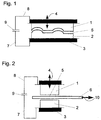
- the device shown in Fig. 1 has two flat, plate-shaped electrodes 1, 2, one (lower) electrode 2 is fixedly arranged on a base 3, while the (upper) electrode 1 by means of the height of a drive device (not shown) can be changed (arrow 4), so that the mutual distance between the electrodes 1 and 2 and thus the size of the Intermediate space 5 is changeable.
- the two electrodes 1, 2 are connected via lines 7, 8 to the outputs of a high-frequency generator 9 connected, with which a high-frequency AC voltage is variable Size (amplitude) and / or frequency are applied to the electrodes can.
- the facing surfaces of the electrodes are shaped so that the between Intermediate space 5 formed for them of the desired (irregular) shape of the one to be produced Plastic part corresponds.
- the local distance between the electrodes is suitably essentially constant and as low as possible, i.e. so low as the shape of the output part allows, to achieve the best possible efficiency to achieve.
- the electrodes enclose the output part or composite material close-fitting.
- the electrode When performing a method of manufacturing a Impression grain ", a desired surface structure being transferred directly from a correspondingly structured surface of one of the electrodes to an unfoamed or little foamed surface zone of the foamed material without the use of a separate decorative layer, it can be provided that the electrode is provided with a cover element, the The electrode itself has a smooth surface and the electrically non-conductive cover element has the desired surface structure on the side facing the foamable material. This measure avoids the problem that local field strength peaks and resulting breakdowns can occur on a structured surface A suitable choice of material for the cover element, for example Teflon, prevents the foamable material from sticking.
- Teflon Teflon
- the corresponding electrode must be cooled or be heat-dissipating in some other way.
- An exit composite part consisting of a carrier material, an unfoamed one foamable polymer and possibly a cover layer made of decorative material, is introduced into the intermediate space 5, with the electrodes 1, 2 possibly for this purpose Ease of insertion or removal temporarily moved apart can be.
- the RF generator 9 is first used in accordance with the purpose is suitably dimensioned, generates an alternating electric field and applied to the electrodes.
- the material between the electrodes becomes exposed to an alternating electrical field from which it absorbs energy and into Converts heat.
- the energy drawn is continuously generated by the generator replaced.
- the temperature rises the composite material.
- An essential requirement here is that the non-foamed, foamable polymer has the highest possible degree of absorption, because ideally only in this material (and possibly the top layer, if available) Heat is to be generated.
- the electrode gap must be increased become.
- the electrode 1 is removed by a suitable device Fixed electrode 2 moved away.
- the movable electrode can be divided into curves in the composite material, the individual parts can then move apart radially to a suitable To create cavity.
- the electrodes move apart continuously, their speed of the Foaming rate of the foamable polymer is adjusted so that at any time a minimum distance is guaranteed.
- the capacity will increase of the electrode gap is reduced, so that a corresponding increase in the voltage between the electrodes is necessary if a constant energy density should be achieved.
- the absorption properties of the composite material and especially the foamable one Polymers are usually not constant but change with temperature.
- the thermal energy generated also depends on the temperature already reached from.
- the heat capacity is a function of Temperature is.
- the temperature change per time is already different from that depend on the temperature reached.
- With softening of the foamable polymer and the activation of the blowing agent also has an effect on the energy balance of the blowing agent reaction the temperature change.
- the tension between the electrodes (and / or the frequency) and thus the power of the generator accordingly regulated possibly in addition to compensate for the change in capacity as a result moving the electrodes apart.
- foamable material such as supports and decorative materials are expediently restricted Material selection so that the carrier material as possible should be temperature stable and the decorative material, if available, should be electromagnetic Field should warm up as much as possible, so that the underlying foamable material is foamed as completely as possible.
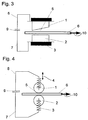
- FIG. 2 shows, the electrodes 1, 2 are like this formed that the starting material 6 in the direction of arrow 10 continuously therebetween can be moved through, the smallest possible distance or Gap 5 between the starting material and electrodes is observed.
- the upper electrode 1 is designed or arranged in such a way that that the gap 5 between that passed through the electrodes Starting material 6 and the electrode 1 in the direction of movement 10 deliberately changed (enlarged in this example) so that a certain spatial Intensity distribution of the radio frequency energy within the space 5 is achieved becomes.
- the intensity of the exposure thus increases of the material gradually in the feed direction 10, so that an abrupt Transition is avoided.
- the electrodes 1, 2 are rotating and drivable rollers formed, the starting material 6 in the feed direction 10 move forward, apply radio frequency energy within the space 5 and also deform through shaping contact and / or a Surface structure in the manner of an impression on the surface of the foamable Transfer material.
- the method can be used in continuous operation or in batch operation become.
- the process is quick and leads to a homogeneous foaming of the Materials and is very easy to control and regulate.
Landscapes
- Engineering & Computer Science (AREA)
- Mechanical Engineering (AREA)
- Casting Or Compression Moulding Of Plastics Or The Like (AREA)
- Molding Of Porous Articles (AREA)
- Heating, Cooling, Or Curing Plastics Or The Like In General (AREA)
- Processing And Handling Of Plastics And Other Materials For Molding In General (AREA)
- Laminated Bodies (AREA)
Applications Claiming Priority (2)
| Application Number | Priority Date | Filing Date | Title |
|---|---|---|---|
| DE19921742 | 1999-05-11 | ||
| DE1999121742 DE19921742C2 (de) | 1999-05-11 | 1999-05-11 | Verfahren zum Herstellen eines Kunststoffteils oder Kunststoffverbundteils |
Publications (2)
| Publication Number | Publication Date |
|---|---|
| EP1053849A2 true EP1053849A2 (fr) | 2000-11-22 |
| EP1053849A3 EP1053849A3 (fr) | 2001-10-17 |
Family
ID=7907740
Family Applications (1)
| Application Number | Title | Priority Date | Filing Date |
|---|---|---|---|
| EP00109467A Withdrawn EP1053849A3 (fr) | 1999-05-11 | 2000-05-04 | Méthode et appareil pour la production d'un article plastique |
Country Status (2)
| Country | Link |
|---|---|
| EP (1) | EP1053849A3 (fr) |
| DE (1) | DE19921742C2 (fr) |
Cited By (4)
| Publication number | Priority date | Publication date | Assignee | Title |
|---|---|---|---|---|
| EP1765562A4 (fr) * | 2004-07-14 | 2008-11-05 | Vertex Llc | Procede pour former une peau durcie sur une surface d'un article moule |
| US20100096780A1 (en) * | 2004-07-14 | 2010-04-22 | Michel Marc | Method of Forming a Hardened Skin on a Surface of a Molded Article |
| US8298470B2 (en) | 2004-07-14 | 2012-10-30 | Vertex L.L.C. | Method of making a molded article from two or more different formable materials in a single heating cycle |
| CN108372621A (zh) * | 2018-03-07 | 2018-08-07 | 泉州师范学院 | 一种聚合物发泡成型装置 |
Families Citing this family (4)
| Publication number | Priority date | Publication date | Assignee | Title |
|---|---|---|---|---|
| DE102005048553A1 (de) * | 2005-10-11 | 2007-04-12 | Bayerische Motoren Werke Ag | Verfahren zur Herstellung eines Schichtkörpers |
| DE102016100690A1 (de) | 2016-01-18 | 2017-07-20 | Kurtz Gmbh | Verfahren und Vorrichtung zur Herstellung eines Partikelschaumstoffteils |
| DE102016123214A1 (de) | 2016-12-01 | 2018-06-07 | Kurtz Gmbh | Vorrichtung zur Herstellung eines Partikelschaumstoffteils |
| DE202017107149U1 (de) | 2016-12-01 | 2018-03-05 | Kurtz Gmbh | Crackspalt-Formwerkzeug zum Herstellen eines Partikelschaumstoffteils sowie Vorrichtung zum Herstellen eines Partikelschaumstoffteils |
Family Cites Families (4)
| Publication number | Priority date | Publication date | Assignee | Title |
|---|---|---|---|---|
| NL113706C (fr) * | 1957-12-27 | |||
| NL256156A (fr) * | 1960-09-23 | |||
| FR2129967A1 (en) * | 1971-03-24 | 1972-11-03 | Giraud Augustin | Foam cored mouldings - mfred by induction heated core expansion after chilling the moulding shot surface |
| JPH078505B2 (ja) * | 1986-07-30 | 1995-02-01 | 株式会社イノアックコ−ポレ−ション | プラスチツク発泡体の製造方法 |
-
1999
- 1999-05-11 DE DE1999121742 patent/DE19921742C2/de not_active Expired - Fee Related
-
2000
- 2000-05-04 EP EP00109467A patent/EP1053849A3/fr not_active Withdrawn
Cited By (7)
| Publication number | Priority date | Publication date | Assignee | Title |
|---|---|---|---|---|
| EP1765562A4 (fr) * | 2004-07-14 | 2008-11-05 | Vertex Llc | Procede pour former une peau durcie sur une surface d'un article moule |
| US20100096780A1 (en) * | 2004-07-14 | 2010-04-22 | Michel Marc | Method of Forming a Hardened Skin on a Surface of a Molded Article |
| US7837910B2 (en) | 2004-07-14 | 2010-11-23 | Vertex L.L.C. | Method of forming a hardened skin on a surface of a molded article |
| US8236212B2 (en) * | 2004-07-14 | 2012-08-07 | Vertex L.L.C. | Method of forming a hardened skin on a surface of a molded article |
| US8298470B2 (en) | 2004-07-14 | 2012-10-30 | Vertex L.L.C. | Method of making a molded article from two or more different formable materials in a single heating cycle |
| CN108372621A (zh) * | 2018-03-07 | 2018-08-07 | 泉州师范学院 | 一种聚合物发泡成型装置 |
| CN108372621B (zh) * | 2018-03-07 | 2023-11-28 | 泉州师范学院 | 一种聚合物发泡成型装置 |
Also Published As
| Publication number | Publication date |
|---|---|
| EP1053849A3 (fr) | 2001-10-17 |
| DE19921742C2 (de) | 2002-01-24 |
| DE19921742A1 (de) | 2000-11-23 |
Similar Documents
| Publication | Publication Date | Title |
|---|---|---|
| EP3405322B1 (fr) | Procédé et dispositif pour produire une pièce en mousse particulaire | |
| DE3610295C2 (de) | Verfahren und Vorrichtung zur Umsetzung von Rohmaterialien | |
| EP3548246B1 (fr) | Dispositif de fabrication d'un élément en mousse de particules expansées | |
| EP1412101B1 (fr) | Procede et dispositif permettant simultanement de mouler un corps et de former un revetement sur ce corps | |
| EP2210728B1 (fr) | Procédé et dispositif pour chauffer des ébauches en plastique | |
| DE69503114T2 (de) | Verfahren und vorrichtung zur herstellung von fleischaehnlichen produkten | |
| DE2837628A1 (de) | Vorrichtung und verfahren zum formen expandierter kunststoffe durch ultrahochfrequenzstrahlung | |
| EP0085318B1 (fr) | Dispositif pour le chauffage d'une coulée en matériau conducteur électrique ainsi que son application | |
| DE102016223980A1 (de) | Verfahren zur Herstellung eines Kunststoffformteils, Kunststoffformteil und Schuh | |
| EP2200797A1 (fr) | Procédé de fabrication d'une pièce en matériau composite renforcé par des fibres | |
| EP1053849A2 (fr) | Méthode et appareil pour la production d'un article plastique | |
| DE102004049060A1 (de) | Verfahren zur Herstellung von Formkörpern aus Polymerschaumpartikeln | |
| EP3943277A1 (fr) | Procédé et dispositif de fabrication additive de composants | |
| EP4041476A1 (fr) | Procédé et dispositif permettant la fabrication d'objets tridimensionnels | |
| EP0658416B1 (fr) | Procédé pour la formation d'un motif sur des feuilles plastiques | |
| DE102017128895B4 (de) | Vorrichtung und Verfahren zur Herstellung eines Partikelschaumstoffteils | |
| EP4330004A1 (fr) | Dispositif, procédé et ensemble plaque-condensateur pour produire une pièce en mousse de particules | |
| DE102020126017A1 (de) | Formeinsatz zur Verwendung in einer Form zur Herstellung eines Partikelschaumteils | |
| DE102020107041A1 (de) | Vorrichtung und Verfahren zur Herstellung von kohlenstofffaserverstärkten Kunststoffhalbzeugen | |
| EP4219047A1 (fr) | Dispositif de fabrication permettant de fabriquer des objets par couches | |
| DE2243087A1 (de) | Verfahren und vorrichtung zum formen von faserverstaerkten harzformen | |
| DE102018123261A1 (de) | Verfahren zum Aufbringen von Leitermaterial auf Substraten | |
| EP0486472B1 (fr) | Installation de chauffage d'un produit long en matériau électriquement conducteur | |
| DE102004049865A1 (de) | Vorrichtung und Verfahren zum Drucken, insbesondere zum Drucken von Mikrostrukturen | |
| DE102020125375A1 (de) | Verfahren zum Heizen von Objekten mit Mikrowellen |
Legal Events
| Date | Code | Title | Description |
|---|---|---|---|
| PUAI | Public reference made under article 153(3) epc to a published international application that has entered the european phase |
Free format text: ORIGINAL CODE: 0009012 |
|
| AK | Designated contracting states |
Kind code of ref document: A2 Designated state(s): AT BE CH CY DE DK ES FI FR GB GR IE IT LI LU MC NL PT SE Kind code of ref document: A2 Designated state(s): DE ES FR GB IT |
|
| AX | Request for extension of the european patent |
Free format text: AL;LT;LV;MK;RO;SI |
|
| PUAL | Search report despatched |
Free format text: ORIGINAL CODE: 0009013 |
|
| AK | Designated contracting states |
Kind code of ref document: A3 Designated state(s): AT BE CH CY DE DK ES FI FR GB GR IE IT LI LU MC NL PT SE |
|
| AX | Request for extension of the european patent |
Free format text: AL;LT;LV;MK;RO;SI |
|
| 17P | Request for examination filed |
Effective date: 20020325 |
|
| AKX | Designation fees paid |
Free format text: DE ES FR GB IT |
|
| 17Q | First examination report despatched |
Effective date: 20020902 |
|
| STAA | Information on the status of an ep patent application or granted ep patent |
Free format text: STATUS: THE APPLICATION HAS BEEN WITHDRAWN |
|
| 18W | Application withdrawn |
Effective date: 20031025 |