EP1054031A2 - Molekulargewichtsaufbau und Modifizierung von Polykondensaten - Google Patents
Molekulargewichtsaufbau und Modifizierung von Polykondensaten Download PDFInfo
- Publication number
- EP1054031A2 EP1054031A2 EP00810408A EP00810408A EP1054031A2 EP 1054031 A2 EP1054031 A2 EP 1054031A2 EP 00810408 A EP00810408 A EP 00810408A EP 00810408 A EP00810408 A EP 00810408A EP 1054031 A2 EP1054031 A2 EP 1054031A2
- Authority
- EP
- European Patent Office
- Prior art keywords
- bis
- tert
- butyl
- alkyl
- dianhydride
- Prior art date
- Legal status (The legal status is an assumption and is not a legal conclusion. Google has not performed a legal analysis and makes no representation as to the accuracy of the status listed.)
- Granted
Links
- 0 Cc1cc(*)cc(N)c1O Chemical compound Cc1cc(*)cc(N)c1O 0.000 description 1
Classifications
-
- C—CHEMISTRY; METALLURGY
- C08—ORGANIC MACROMOLECULAR COMPOUNDS; THEIR PREPARATION OR CHEMICAL WORKING-UP; COMPOSITIONS BASED THEREON
- C08G—MACROMOLECULAR COMPOUNDS OBTAINED OTHERWISE THAN BY REACTIONS ONLY INVOLVING UNSATURATED CARBON-TO-CARBON BONDS
- C08G69/00—Macromolecular compounds obtained by reactions forming a carboxylic amide link in the main chain of the macromolecule
- C08G69/48—Polymers modified by chemical after-treatment
-
- C—CHEMISTRY; METALLURGY
- C08—ORGANIC MACROMOLECULAR COMPOUNDS; THEIR PREPARATION OR CHEMICAL WORKING-UP; COMPOSITIONS BASED THEREON
- C08G—MACROMOLECULAR COMPOUNDS OBTAINED OTHERWISE THAN BY REACTIONS ONLY INVOLVING UNSATURATED CARBON-TO-CARBON BONDS
- C08G63/00—Macromolecular compounds obtained by reactions forming a carboxylic ester link in the main chain of the macromolecule
- C08G63/91—Polymers modified by chemical after-treatment
- C08G63/914—Polymers modified by chemical after-treatment derived from polycarboxylic acids and polyhydroxy compounds
-
- C—CHEMISTRY; METALLURGY
- C08—ORGANIC MACROMOLECULAR COMPOUNDS; THEIR PREPARATION OR CHEMICAL WORKING-UP; COMPOSITIONS BASED THEREON
- C08G—MACROMOLECULAR COMPOUNDS OBTAINED OTHERWISE THAN BY REACTIONS ONLY INVOLVING UNSATURATED CARBON-TO-CARBON BONDS
- C08G64/00—Macromolecular compounds obtained by reactions forming a carbonic ester link in the main chain of the macromolecule
- C08G64/42—Chemical after-treatment
-
- C—CHEMISTRY; METALLURGY
- C08—ORGANIC MACROMOLECULAR COMPOUNDS; THEIR PREPARATION OR CHEMICAL WORKING-UP; COMPOSITIONS BASED THEREON
- C08K—Use of inorganic or non-macromolecular organic substances as compounding ingredients
- C08K5/00—Use of organic ingredients
- C08K5/49—Phosphorus-containing compounds
- C08K5/51—Phosphorus bound to oxygen
- C08K5/53—Phosphorus bound to oxygen bound to oxygen and to carbon only
- C08K5/5317—Phosphonic compounds, e.g. R—P(:O)(OR')2
Definitions
- the invention relates to a method for increasing molecular weight and for modification of polycondensates, the use of which brings about the molecular weight build-up Additive mixture and the polycondensates obtainable by the process and their Use especially as foam products.
- Polycondensates such as polyamides, polycarbonates or polyesters in particular Polyethylene terephthalate (PET) and polybutylene terephthalate (PBT) as well as polyester copolymers and polyester blends e.g. with polycarbonate (PBT / PC) are important thermoplastic Materials from the group of engineering plastics.
- Partially crystalline polyester are used for injection molding compounds and are characterized by high strength and Stiffness, high dimensional stability and favorable wear behavior.
- Amorphous Polyesters have a high transparency, high toughness and very good resistance to Stress crack formation and are processed, for example, into hollow bodies. Another area of application for PET is the production of fibers and foils.
- the mechanical and physical properties depend crucially on the molecular weight of the polymer.
- Polycondensates are formed by condensation in the melt manufactured. Average molecular weights are accessible. For some applications like Beverage bottles and technical fibers require higher molecular weights.
- the prepolymer is a thermal treatment above the glass transition temperature and below the melting temperature of the polymer in the Subjected to inert gas or in vacuo.
- this method is lengthy and energy intensive.
- To increase the intrinsic viscosity there is a residence time of up to 12 hours under vacuum or inert gas at temperatures from 180 to 240 ° C necessary.
- pentaerythritol can also be used during the solid phase condensation can be added advantageously.
- WO 98/33837 discloses that only pentaerythritol is added in reactive extrusion adversely affects the intrinsic viscosity of PET.
- polycondensate recyclates from the collection of used items such as used packaging (Films and bottles) as well as textile waste achieve a molecular weight increase.
- used items such as used packaging (Films and bottles)
- textile waste In order to recyclates can be recycled, e.g. as High performance fiber, injection molded parts, in extrusion applications or as foams.
- Recyclates for example, also come from industrial or industrial waste collections Household, from production waste such as from fiber production and from Marginal sections, or from take-back obligations, such as Bottle collections from PET beverage bottles.
- Foamed polymers have, among others, compared to non-foamed polymers. the advantages of Material saving, better thermal insulation, lower density combined with better mechanical properties. Polymer foams are therefore used in many applications e.g. Packaging, thermal insulation, buffers used to absorb mechanical forces. Foams from polycondensation products are becoming increasingly interesting due to the interesting mechanical properties, long-term use temperature resistance and malleability superior to other foams.
- the present invention also the corresponding copolymers and blends, e.g. PBT / PS, PBT / ASA, PBT / ABS, PBT / PC, PET / ABS, PET / PC, PBT / PET / PC, PBT / PET, PA / PP, PA / PE and PA / ABS.
- PBT / PS polyethylene glycol
- PBT / ASA polybisulfite
- PBT / PC PET / ABS
- PET / PC PET / PC
- PBT / PET / PC PET
- PA / PP PA / PE
- PA / PE PA / PE
- the polycondensation product is an aliphatic or aromatic polyester, an aliphatic or aromatic polyamide or Polycarbonate or a mixture (blend) or copolymer thereof.
- PET polyethylene terephthalate
- PBT Polybutylene terephthalate
- PEN polyethylene naphthalate
- PTT polytrimethylene terephthalate
- PA 6 PA 6.6, polycarbonate containing over carbonate groups linked bisphenol A, bisphenol Z or bisphenol F.
- the polycondensate is very particularly preferably PET or a Copolymer with PET.
- the polycondensate is preferably a recyclate.
- polyamides i.e. Both new polyamides and polyamide recyclates are aliphatic and aromatic polyamides or copolyamides derived from diamines and dicarboxylic acids and / or derived from aminocarboxylic acids or the corresponding lactams.
- Suitable polyamides are, for example: PA 6, PA 11, PA 12, PA 46, PA 66, PA 69, PA 610, PA 612, PA 10.12, PA 12.12 as well as amorphous polyamides and thermoplastic Polyamide elastomers such as Polyamide amides of the type Vestamid, Grilamid ELY60, Pebax, Nyim and Grilon ELX. . Polyamides of the type mentioned are generally known and in Available commercially.
- Preferred polyamides are crystalline or partially crystalline polyamides and in particular PA6 and PA6.6 or their mixtures, as well as recyclates on this basis, or copolymers of it, used.
- polyester i.e. Both new polyester and recycled polyester, it can be Trade homo- or mixed polyesters that are made from aliphatic, cycloaliphatic or aromatic Dicarboxylic acids and diols or hydroxycarboxylic acids are built up.
- the polyesters can either by direct esterification (PTA process) or by Transesterification (DMT process). Any can in the manufacture known catalyst systems are used.
- the aliphatic dicarboxylic acids can have 2 to 40 carbon atoms, the cycloaliphatic dicarboxylic acids 6 to 10 carbon atoms, the aromatic dicarboxylic acids 8 to 14 carbon atoms, the aliphatic Hydroxycarboxylic acids 2 to 12 carbon atoms and the aromatic and cycloaliphatic Hydroxycarboxylic acids contain 7 to 14 carbon atoms.
- the aliphatic diols can have 2 to 12 C atoms, the cycloaliphatic diols can have 5 to 8 C atoms and the aromatic diols contain 6 to 16 carbon atoms.
- It can also be polyoxyalkylene glycols with molecular weights between 150 and Trade 40,000.
- Aromatic diols are those in which two hydroxyl groups are attached to one or various aromatic hydrocarbon radicals are bound.
- polyesters are used in small amounts, e.g. 0.1 to 3 mol%, based on the existing dicarboxylic acids, by more than difunctional monomers (e.g. Pentaerythritol, trimellitic acid, 1,3,5-tri (hydroxyphenyl) benzene, 2,4-dihydroxybenzoic acid or 2- (4-hydroxyphenyl) -2- (2,4-dihydroxyphenyl) propane) are branched.
- difunctional monomers e.g. Pentaerythritol, trimellitic acid, 1,3,5-tri (hydroxyphenyl) benzene, 2,4-dihydroxybenzoic acid or 2- (4-hydroxyphenyl) -2- (2,4-dihydroxyphenyl) propane
- Suitable dicarboxylic acids are linear and branched saturated aliphatic dicarboxylic acids, aromatic dicarboxylic acids and cycloaliphatic dicarboxylic acids.
- Suitable aliphatic dicarboxylic acids are those with 2 to 40 carbon atoms, e.g. Oxalic acid, Malonic acid, dimethylmalonic acid, succinic acid, pimelic acid, adipic acid, trimethyladipic acid, Sebacic acid, azelaic acid and dimer acids (dimerization products from unsaturated aliphatic carboxylic acids such as oleic acid), alkylated malonic and succinic acids like octadecylsuccinic acid.
- Possible cycloaliphatic dicarboxylic acids are: 1,3-cyclobutanedicarboxylic acid, 1,3-cyclopentanedicarboxylic acid, 1,3- and 1,4-cyclohexanedicarboxylic acid, 1,3- and 1,4- (dicarboxylmethyl) cyclohexane, 4,4'-dicyclohexyldicarboxylic acid.
- Suitable aromatic dicarboxylic acids are: in particular terephthalic acid, Isophthalic acid, o-phthalic acid, and 1,3-, 1,4-, 2,6- or 2,7-naphthalenedicarboxylic acid, 4,4'-diphenyldicarboxylic acid, 4,4'-diphenylsulfone dicarboxylic acid, 4,4'-benzophenone dicarboxylic acid, 1,1,3-trimethyl-5-carboxyl-3- (p-carboxylphenyl) indane, 4,4'-diphenyl ether dicarboxylic acid, Bis-p- (carboxylphenyl) methane or bis-p- (carboxylphenyl) ethane.
- Aromatic dicarboxylic acids are preferred, among them especially terephthalic acid. Isophthalic acid and 2,6-naphthalenedicarboxylic acid.
- dicarboxylic acids are those containing -CO-NH groups; they are in the DE-A2414349.
- dicarboxylic acids containing N-heterocyclic rings are suitable, e.g. those that differ from carboxylalkylated, carboxylphenylated or carboxybenzylated monoamine-s-triazinedicarboxylic acids (cf. DE-A2121184 and 2533675), Mono- or bishydantoins, optionally halogenated benzimidazoles or Derive parabanic acid.
- the carboxyalkyl groups can contain 3 to 20 carbon atoms.
- Suitable aliphatic diols are the linear and branched aliphatic glycols, especially those with 2 to 12, in particular 2 to 6, carbon atoms in the molecule, for example: ethylene glycol, 1,2- and 1,3-propylene glycol, 1,2-, 1,3-, 2,3- or 1,4-butanediol, pentyl glycol, neopentyl glycol, 1,6-hexanediol, 1,12-dodecanediol.
- a suitable cycloaliphatic diol is e.g. 1,4-dihydroxycyclohexane.
- Other suitable aliphatic diols are e.g.
- 1,4-bis (hydroxymethyl) cyclohexane aromatic-aliphatic diols such as p-xylylene glycol or 2,5-dichloro-p-xylylene glycol, 2,2- ( ⁇ -hydroxyethoxyphenyl) propane and polyoxyalkylene glycols such as diethylene glycol, triethylene glycol, polyethylene glycol or polypropylene glycol.
- aromatic-aliphatic diols such as p-xylylene glycol or 2,5-dichloro-p-xylylene glycol, 2,2- ( ⁇ -hydroxyethoxyphenyl) propane and polyoxyalkylene glycols such as diethylene glycol, triethylene glycol, polyethylene glycol or polypropylene glycol.
- the Alkylene diols are preferably linear and contain in particular 2 to 4 carbon atoms.
- Preferred diols are the alkylene diols, 1,4-dihydroxycyclohexane and 1,4-bis (hydroxymethyl) cyclohexane. Particularly preferred are ethylene glycol, 1,4-butanediol, and 1,2- and 1,3-propylene glycol.
- Suitable aliphatic diols are the ⁇ -hydroxyalkylated, especially ⁇ -hydroxyethylated Bisphenols such as 2,2-bis [4 '- ( ⁇ -hydroxyethoxy) phenyl] propane. Other bisphenols are mentioned later.
- Suitable aliphatic diols are those in the German published documents 1812003, 2342432, 2342372 and 2453326 heterocyclic described Diols. Examples are: N, N'-bis ( ⁇ -hydroxyethyl) -5,5-dimethyl-hydantoin, N, N'-bis ( ⁇ -hydroxypropyl) -5,5-dimethyl-hydantoin, Methylene-bis- [N- ( ⁇ -hydroxyethyl) -5-methyl-5-ethylhydantoin], Methylene-bis- [N- ( ⁇ -hydroxyethyl) -5,5-dimethylhydantoin], N, N'-bis ( ⁇ -hydroxyethyl) benzimidazolone, N, N'-bis ( ⁇ -hydroxyethyl) - (tetrachlor) benzimidazolone or N, N'-bis ( ⁇ -hydroxyethyl) - (tetrabromo) benzimid
- Aromatic is preferably understood to mean hydrocarbon-aromatic radicals such as, for example, phenylene or naphthylene.
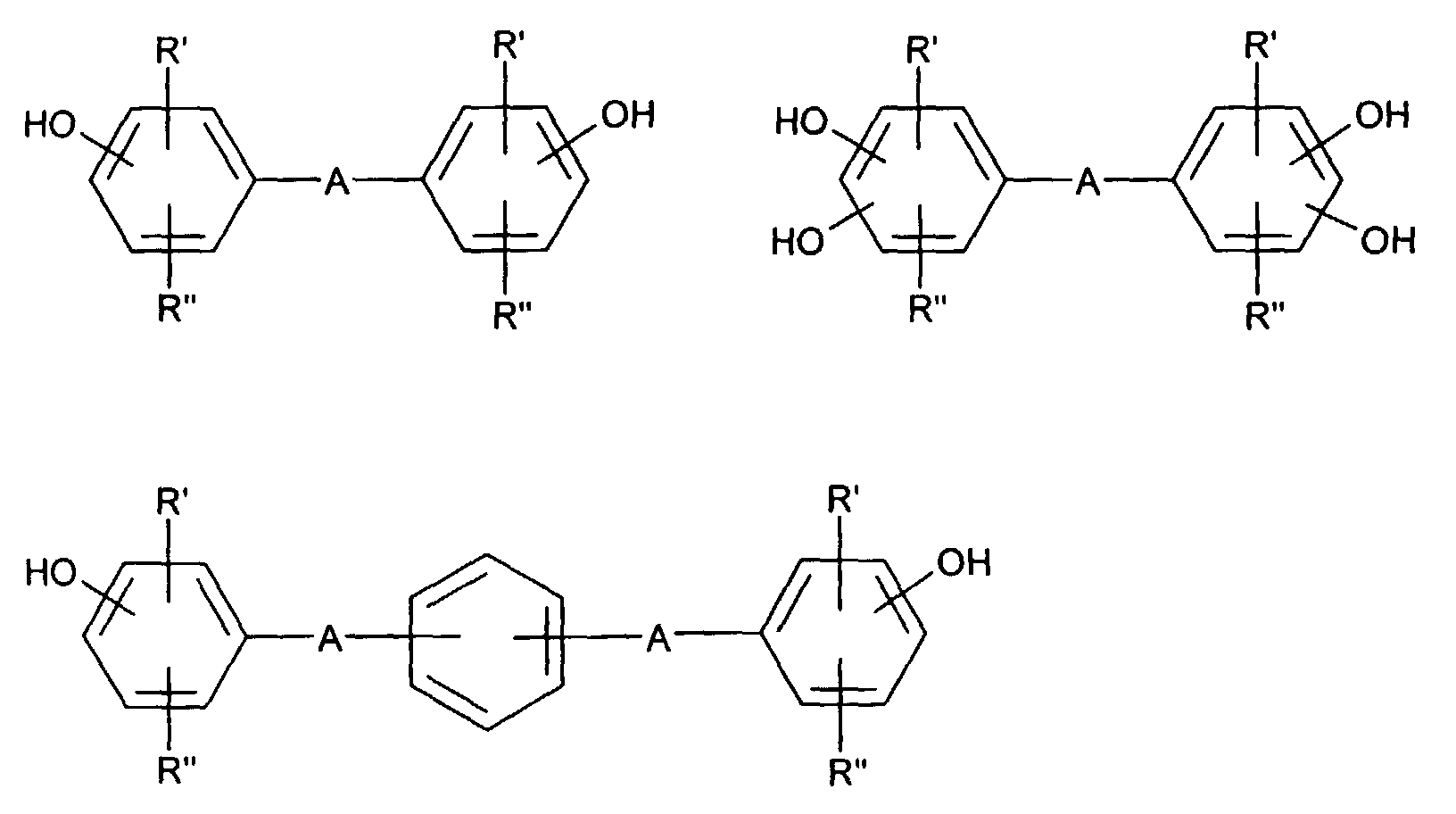
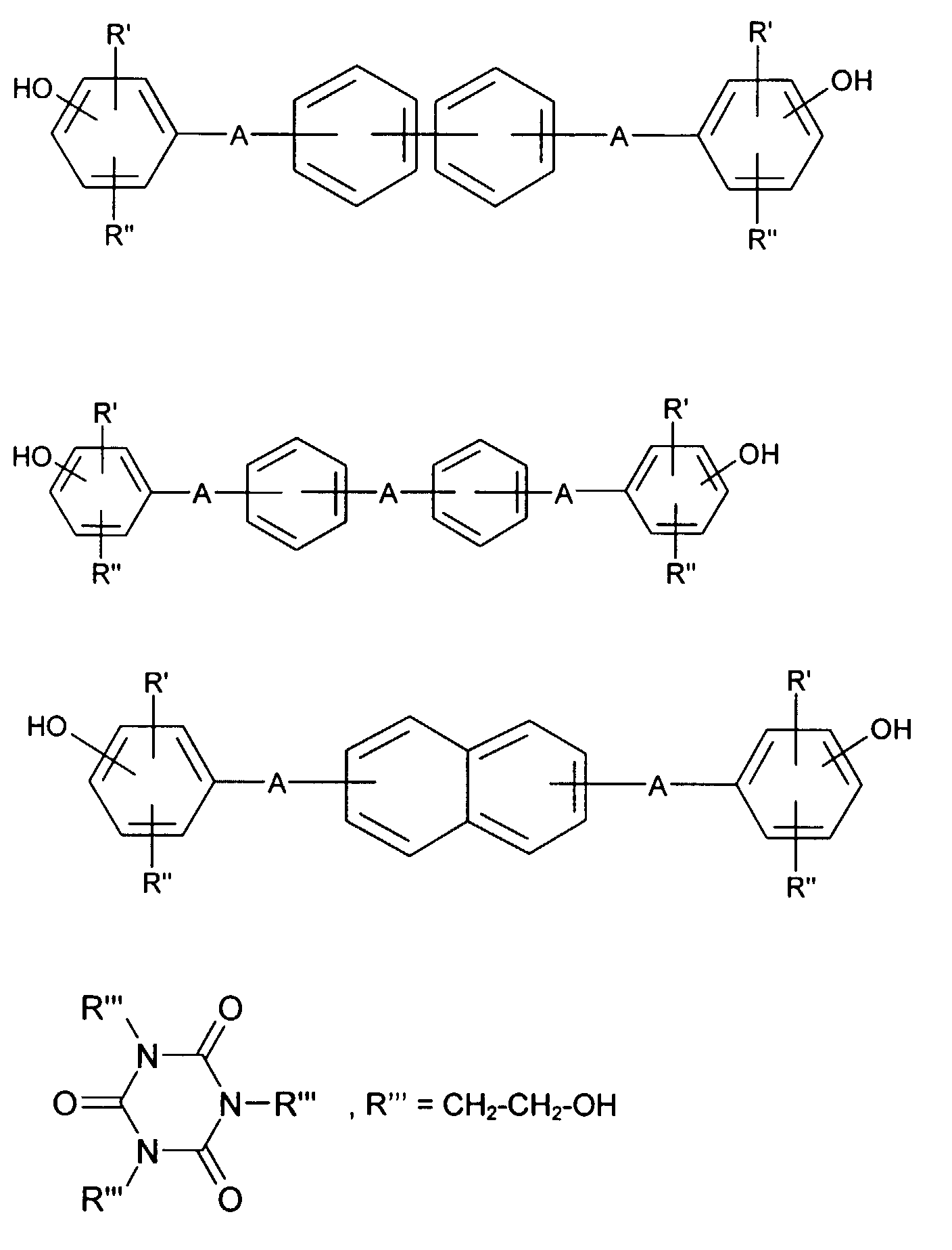
- hydroquinone, resorcinol or 1,5-, 2,6- and 2,7-dihydroxynaphthalene particular mention should be made of the bisphenols, which can be represented by the following formulas:
- the hydroxyl groups can be in the m-position, but especially in the p-position, R 'and R''in these formulas can denote alkyl with 1 to 6 carbon atoms, halogen such as chlorine or bromine and in particular hydrogen atoms.
- A can stand for a direct bond, or -O-, -S-, - (O) S (O) -, -C (O) -, -P (O) (C 1 -C 20 alkyl) -, optionally substituted alkylidene, cycloalkylidene or alkylene.
- optionally substituted alkylidene examples include: ethylidene, 1,1- or 2,2-propylidene, 2,2-butylidene, 1,1-isobutylidene, pentylidene, hexylidene, heptylidene, octylidene, dichloroethylidene, Trichloroethylidene.
- optionally substituted alkylene examples include methylene, ethylene, phenylmethylene, Diphenylmethylene, methylphenylmethylene.
- cycloalkylidene examples include cyclopentylidene, Cyclohexylidene, cycloheptylidene and cyclooctylidene.
- bisphenols are: bis (p-hydroxyphenyl) ether or thioether, bis (p-hydroxyphenyl) sulfone, Bis (p-hydroxyphenyl) methane, bis (4-hydroxyphenyl) -2,2'-biphenyl, phenylhydroquinone, 1,2-bis (p-hydroxyphenyl) ethane, 1-phenyl-bis (p-hydroxyphenyl) methane, Diphenyl-bis (p-hydroxyphenyl) methane, diphenyl-bis (p-hydroxyphenyl) -ethane, bis (3,5-dimethyl-4-hydroxyphenyl) sulfone, Bis (3,5-dimethyl-4-hydroxyphenyl) -p-diisopropylbenzene, Bis (3,5-dimethyl-4-hydroxyphenyl) -m-diisopropylbenzene 2,2-bis (3 ', 5'-dimethyl-4'-hydroxyphenyl)
- Suitable polyesters of hydroxycarboxylic acids are e.g. Polycaprolactone, polypivalolactone or the polyesters of 4-hydroxycyclohexane carboxylic acid, 2-hydroxy-6-naphthalene carboxylic acid or 4-hydroxybenzoic acid.
- polymers which are predominantly ester bonds, but also other bonds suitable, such as Polyester amides or polyester imides.
- Polyesters with aromatic dicarboxylic acids have gained the greatest importance, especially the polyalkylene terephthalates. Molding compositions according to the invention are therefore preferred, in which the polyester consists of at least 30 mol%, preferably at least 40 mol%, aromatic dicarboxylic acids and at least 30 mol%, preferably at least 40 Mol%, composed of alkylene diols with preferably 2 to 12 C atoms, based on the Polyester.
- the alkylene diol is linear and contains 2 to 6 C atoms, e.g. Ethylene, tri, tetra or hexamethylene glycol and the aromatic dicarboxylic acid, terephthalic and / or isophthalic acid.
- PET particularly suitable polyesters
- PBT polystyrene
- PEN polystyrene
- PTT polystyrene
- PET and its copolymers being especially preferred.
- PET recyclates which, for example, consist of Bottle collections such as from collections in the beverage industry.
- Bottle collections such as from collections in the beverage industry.
- These materials preferably consist of terephthalic acid, 2,6-naphthalenedicarboxylic acid and / or isophthalic acid in combination with ethylene glycol and / or 1,4-bis (hydroxymethyl) cyclohexane.
- Polyester blends include those with polycarbonate.
- PC polycarbonate
- phosgene or a phosgene analogue such as trichloromethyl chloroformate, triphosgene or diphenyl carbonate by condensation in the latter case usually with the addition of a suitable transesterification catalyst such as. a borohydride, an amine such as 2-methylimidazole or a quaternary Receive ammonium salt;
- a suitable transesterification catalyst such as. a borohydride, an amine such as 2-methylimidazole or a quaternary Receive ammonium salt
- bisphenol A other bisphenol components can also be used
- Halogenated monomers can also be used in the benzene nucleus be used.
- bisphenol components 2,2-bis (4'-hydroxyphenyl) propane (bisphenol A), 2,4'-dihydroxydiphenylmethane, bis (2-hydroxyphenyl) methane, Bis (4-hydroxyphenyl) methane, bis (4-hydroxy-5-propylphenyl) methane, 1,1-bis (4'-hydroxyphenyl) ethane, bis (4-hydroxyphenyl) cyclohexylmethane, 2,2-bis (4'-hydroxyphenyl) -1-phenylpropane, 2,2-bis (3 ', 5'-dimethyl-4'-hydroxyphenyl) propane, 2,2-bis (3', 5'-dibromo-4'-hydroxyphenyl) propane, 2,2-bis (3 ', 5'-dichloro-4'-hydroxyphenyl) propane, 1,1-bis (4'-hydroxyphenyl) cyclododecane, 1,1-bis (3 ', 5'-dimethyl-4'-hydroxyphenyl) cycl
- polyester copolymers or blends which can be used in the process according to the invention are made in the usual way from the starting polymers.
- polyester component PET PBT
- PC component a PC based on bisphenol-A.
- the ratio of polyester to PC is preferably 95: 5 to 5:95, with a ratio at which a component makes up at least 75%, is particularly preferred.
- the invention attains particular importance in the case of polyester recyclates, as is the case with production waste, Collection of recyclables or through so-called take-back obligations e.g. in the automotive industry or in the electrical sector.
- the polycondensate recyclates are thermally and / or hydrolytically damaged in a variety of ways.
- these recyclates can also be added in minor amounts of plastics of other structures such as polyolefins, polyurethanes, ABS or PVC included.
- these recyclates can also be admixed with conventional ones Impurities such as Residues of dyes, adhesives, contact media or paints, Traces of metal, traces of water, traces of equipment or inorganic salts exhibit.
- the polyanhydride a) used is a polyanhydride which is 2-8 Has anhydride functions, with free carboxylic acid groups in addition to the anhydride functions or carboxylic acid esters may be present.
- Tetracarboxylic dianhydrides are preferably used.
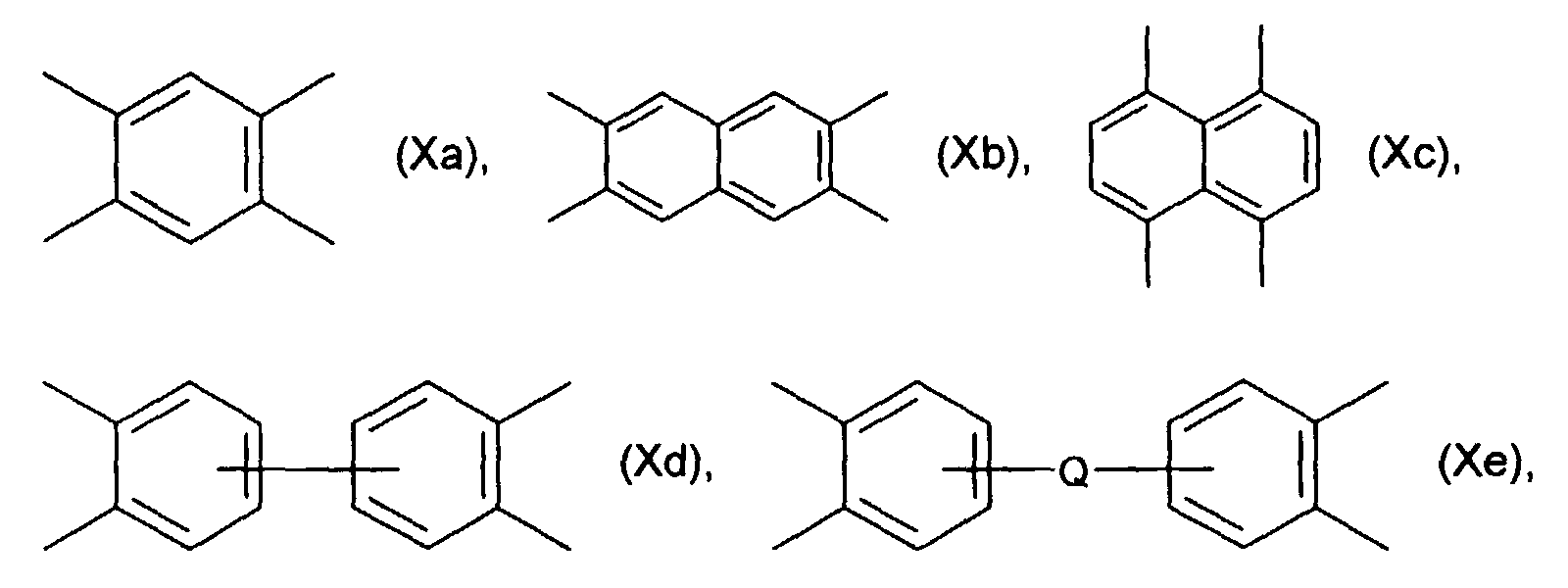
- Tetracarboxylic dianhydrides which can be used in the context of the invention are those of the formula wherein RC 4 -C 20 alkanetrayl or a radical of the formulas (Xa) - (Xj) wherein Q represents -CH 2 -, -CH (CH 3 ) -, -C (CH 3 ) 2 -, -C (CF 3 ) 2 -, -S-, -O-, -SO 2 -, -NHCO- , -CO- or> P (O) (C 1 -C 20 alkyl) and in which the aromatic rings in the formulas and (Va) - (Ve) are unsubstituted or by one or more C 1 -C 6 alkyl groups, C 1 -C 6 alkoxy groups or halogen atoms are substituted.
- the tetracarboxylic acid dianhydride can be, for example Butane-1,2,3,4-tetra-carboxylic acid dianhydride.
- Tetracarboxylic acid dianhydrides which contain aromatic rings are preferred.
- Pyromellitic dianhydride 3,3 ', 4,4'-benzophenonetetracarboxylic dianhydride are particularly preferred.
- a mixture of tetracarboxylic acid dianhydrides can also be used different structure can be used.
- tetracarboxylic acid dianhydrides are: pyromellitic acid dianhydride, benzophenone tetracarboxylic acid dianhydride, 1,1,2,2-ethane tetracarboxylic acid dianhydride, 1,2,3,4-cyclopentane tetracarboxylic acid dianhydride, diphenylsulfone tetracarboxylic acid dianhydride, 5- (2,5-3-dioxotetanyl) methyl-3 cyclohexane-1,2-dicarboxylic acid dianhydride, bis (3,4-dicarboxylic acid phenyl) ether dianhydride, bis (3,4-dicarboxylic acid phenyl) thioether dianhydride, bisphenol-A bisether dianhydride, 2.2 - bis (3,4-dicarboxylic acid phenyl) hexafluoropropane dianhydride, 2,3,6,7-
- the polyfunctional compound b) is a polyfunctional one Hydroxyl compound (polyol), a polyfunctional epoxy compound, a polyfunctional Amine compound (polyamine), a polyfunctional aziridine compound (polyaziridine), polyfunctional isocyanate compound (polyisocyanate), a polyfunctional Oxazoline compound (polyoxazoline), a polyfunctional thio alcohol or combinations of these connections.
- a polyol of phenols and / or alcohols with 3-10 free ones Hydroxyl groups a polythiol from thiophenols and / or thio alcohols with 3-10 free Thiol groups, an aromatic and / or aliphatic polyamine with 3-10 free With amino groups, a polyoxazoline, a polyaziridine or an epoxy compound at least two epoxy groups.
- an aliphatic, aromatic, cycloaliphatic, araliphatic or have heterocyclic structure they contain epoxy groups as side groups or these groups form part of an alicyclic or heterocyclic ring system.
- the epoxy groups are preferably as glycidyl groups via ether or ester linkages connected to the rest of the molecule, or it is N-glycidyl derivatives of heterocyclic amines, amides or imides. Epoxides of these types are common known and commercially available.
- difunctional epoxides can, for example, due to the Manufacturing process containing small amounts of monofunctional or trifunctional components.
- epoxides are, for example, a) liquid Bisphenol A diglycidyl ether such as Araldit®GY 240, Araldit®GY 250, Araldit®GY 260, Araldit®GY 266, Araldit®GY 2600, Araldit®MY 790; b) solid bisphenol A diglycidyl ether such as Araldit®GT 6071, Araldit®GT 7071, Araldit®GT 7072, Araldit®GT 6063, Araldit®GT 7203, Araldit®GT 6064, Araldit®GT 7304, Araldit®GT 7004, Araldit®GT 6084, Araldit®GT 1999, Araldit®GT 7077, Araldit®GT 6097, Araldit®GT 7097, Araldit®GT 7008,
- Araldit®PT 910 i) solid heterocyclic Epoxy resins (triglycidyl isocyanurate) such as Araldit®PT 810; j) liquid cycloaliphatic Epoxy resins such as Araldit®CY 179; k) liquid N, N, O-triglycidyl ether of p-aminophenol such as Araldit®MY 0510; l) tetraglycidyl-4-4'-methylenebenzamine or N, N, N ', N'-tetraglycidyldiaminophenylmethane like Araldit®MY 720, Araldit®MY 721.
- solid heterocyclic Epoxy resins such as Araldit®PT 810
- liquid cycloaliphatic Epoxy resins such as Araldit®CY 179
- k) liquid N, N, O-triglycidyl ether of p-aminophenol such as Araldit®
- difunctional epoxides are diglycidyl ethers based on bisphenols, such as 2,2-bis (4-hydroxyphenyl) propane (bisphenol A), bis (4-hydroxyphenyl) sulfone (Bisphenol S), mixtures of bis (ortho / para-hydroxyphenyl) methane (Bisphenol F) or Araldit® MT 0163.
- bisphenols such as 2,2-bis (4-hydroxyphenyl) propane (bisphenol A), bis (4-hydroxyphenyl) sulfone (Bisphenol S), mixtures of bis (ortho / para-hydroxyphenyl) methane (Bisphenol F) or Araldit® MT 0163.
- Solid epoxides of the bisphenol A diglycidyl ether type are very particularly preferred, e.g .: Araldit® GT 6071, GT 7071, GT 7072, GT 6097 and GT 6099 or liquid epoxides of the bisphenol F type like Araldit® GY 281 or PY 306.
- 0.01-5 parts are preferred, particularly preferred 0.02 to 2 parts, in particular 0.05 to 1 part, of a diepoxide are used.
- Halogen means, for example, fluorine, chlorine, bromine or iodine. Chlorine is particularly preferred.
- Alkyl with up to 20 carbon atoms means a branched or unbranched radical such as, for example, methyl, ethyl, propyl, isopropyl, n-butyl, sec-butyl, isobutyl, tert-butyl, 2-ethylbutyl, n-pentyl, isopentyl, 1-methylpentyl, 1,3-dimethylbutyl, n-hexyl, 1-methylhexyl, n-heptyl, isoheptyl, 1,1,3,3-tetramethylbutyl, 1-methylheptyl, 3-methylheptyl, n-octyl, 2-ethylhexyl, 1,1, 3-trimethylhexyl, 1,1,3,3-tetramethylpentyl, nonyl, decyl, undecyl, 1-methylundecyl, dodecyl, 1,1,3,3,5,5-hexamethylhe
- C 4 -C 15 cycloalkyl in particular C 5 -C 12 cycloalkyl, means for example cyclobutyl, cyclopentyl, cyclohexyl, cycloheptyl, cyclooctyl or cyclododecyl.
- Phenyl substituted by C 1 -C 4 alkyl, which preferably contains 1 to 3, in particular 1 or 2, alkyl groups means, for example, o-, m- or p-methylphenyl, 2,3-dimethylphenyl, 2,4-dimethylphenyl, 2, 5-dimethylphenyl, 2,6-dimethylphenyl, 3,4-dimethylphenyl, 3,5-dimethylphenyl, 2-methyl-6-ethylphenyl, 4-tert-butylphenyl, 2-ethylphenyl or 2,6-diethylphenyl.
- Alkoxy with up to 20 carbon atoms means a branched or unbranched radical such as methoxy, ethoxy, propoxy, isopropoxy, n-butoxy, isobutoxy, pentoxy, isopentoxy, hexoxy, heptoxy, octoxy, decyloxy, tetradecyloxy, hexadecyloxy or octadecyloxy.
- a preferred meaning of R 8 , R 9 , R 10 and R 11 is alkoxy having 1 to 12, in particular 1 to 8, for example 1 to 4 carbon atoms.
- Carboxyalkyl having 2 to 20 carbon atoms means a branched or unbranched radical such as, for example, carboxymethyl, carboxyethyl, carboxypropyl, carboxybutyl, carboxypentyl, carboxyhexyl, carboxyheptyl, carboxyoctyl, carboxynonyl, carboxydecyl, carboxyundecyl, carboxydodecyl, 2-carboxy-1-propyl -1-butyl or 2-carboxy-1-pentyl.
- a preferred meaning of R 8 , R 9 , R 10 and R 11 is C 2 -C 12 carboxyalkyl, in particular C 2 -C 8 carboxyalkyl, e.g. B- C 2 -C 4 carboxyalkyl.
- these are methanetriyl, 1,1,1-ethanetriyl, 1,1,1-propanetriyl, 1,1,1-butanetriyl, 1,1,1-pentanetriyl, 1,1,1-hexanetriyl, 1,1,1 -Heptanetriyl, 1,1,1-octanetriyl, 1,1,1-nonantriyl, 1,1,1-decanetriyl, 1,1,1-undecanetriyl, 1,1,1-dodecanetriyl, 1,2,3-propanetriyl , 1,2,3-butanetriyl, 1,2,3-pentanetriyl, 1,2,3-hexanetriyl, 1,1,3-cyclopent
- C 1 -C 4 alkyl which preferably contains 1 to 3, in particular 1 or 2, alkyl groups means, for example, 1,2,4-benzenetriyl, 1,3,5-benzenetriyl, 3-methyl-1, 2,4-benzenetriyl or 2-methyl-1,3,5-benzenetriyl. 1,2,4-Benzenetriyl and 1,3,5-benzenetriyl are particularly preferred.
- R 8 , R 9 , R 10 and R 11 independently of one another are hydrogen or C 1 -C 4 alkyl, and R 12 is 1,2,4-benzenetriyl or 1,3,5 -Benzoltriyl represents.
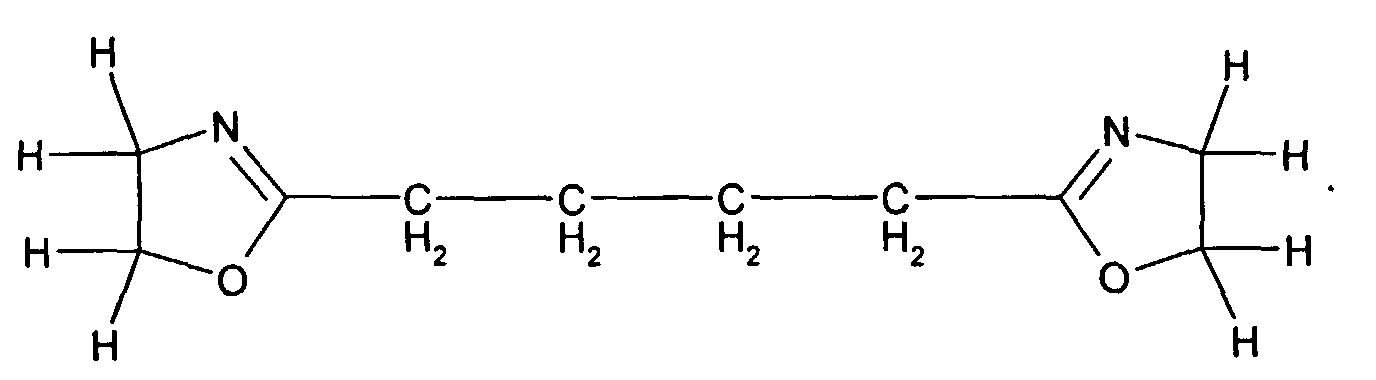
- Preferred difunctional compounds from the class of bisoxazolines for the purposes of this invention are from T. Loontjens et al., Makromol. Chem., Macromol. Symp. 75 , 211-216 (1993) and mean, for example, compounds of the formula
- Preferred diisocyanates are tetramethylene diisocyanate, hexamethylene diisocyanate, dodecamethylene diisocyanate, eikosan-1,20-diisocyanate, 4-butylhexamethylene diisocyanate, 2,2,4- or 2,4,4-trimethylhexamethylene diisocyanate, OCN (CH 2 ) 2 O (CH 2 ) 2 NCO, Toluene-2,4-diisocyanate, p-phenylene diisocyanate, xylylene diisocyanates, 3-isocyanatomethyl-3,5,5-trimethylcyclohexyl isocyanate, naphthalene diisocyanates, sulfonyl diisocyanates, 3,3'-, 4,4'- and 3,4'-diisocyanates of diphenylmethane , 2,2-diphenylpropane and diphenyl ether, 3,3'-dimethyl-4
- the diisocyanates listed are commercially available or can be obtained from commercially available Amines are made.
- diisocyanate generators can also be used, such as polymeric urethanes, Uretdione dimers and higher oligomers, cyanurate polymers, urethanes and polymeric urethanes of cyanurate polymers and thermally dissociable adducts of Schiff bases.
- Polyfunctional compounds from the class of alcohols for the purposes of this invention are known and mean, for example, pentaerythritol, dipentaerythritol, tripentaerythritol, bistrimethylolpropane, Bistrimethylolethane, trismethylolpropane, sorbitol, maltitol, isomaltitol, lactitol, Lycasin, mannitol, lactose, leucrose, tris (hydroxyethyl) isocyanurate, palatinite, tetramethylolcyclohexanol, Tetramethylolcyclopentanol, tetramethylolcyclopyranol, glycerin, diglycerin, Polyglycerol or 1-0- ⁇ -D-glycopyranosyl-D-mannitol dihydrate, 1,1,1-tris (4-hydroxyphenyl) ethane, 4,6-dimethyl-2,4,
- Glycerol or pentaerythritol is preferably used as the polyol, as the epoxy compound Aminophenol triglycidyl ether, trimellic acid triglycidyl ester or Araldit MT 0163, as oxazoline 2,2'-bis (4H-3,1-benzoxazin-4-one), as polyamine 2-amino-malonamine, 1,2,3-triamino-propane, Triaminobenzene, triaminotoluene, triaminoanisole, triaminonaphthalene, triaminopyridine, Triaminopyrimidine, tetraaminopyrimidine, tetraaminobenzene, tetraamino-diphenyl, Tetraamino diphenyl sulfone, hexaaminodiphenyl, triamine cyclopropane, as polyaziridine tris [1- (2-methyl) aziridiny
- Sterically hindered hydroxyphenyl-alkyl-phosphonic acid esters or half-esters are preferred as are known for example from US-A-4778840.
- Halogen means fluorine, chlorine, bromine or iodine.
- substituents are alkyl with up to 18 carbon atoms
- the radicals such as methyl, ethyl, propyl, butyl, pentyl, hexyl and octyl, stearyl and corresponding branched isomers are suitable, preference is given to C 2 -C 4 -alkyl and iso-octyl .
- Phenyl or naphthyl which is substituted by C 1 -C 4 alkyl and preferably contains 1 to 3, in particular 1 or 2, alkyl groups means, for example, o-, m- or p-methylphenyl, 2,3-dimethylphenyl, 2,4-dimethylphenyl, 2,5-dimethylphenyl, 2,6-dimethylphenyl, 3,4-dimethylphenyl, 3,5-dimethylphenyl, 2-methyl-6-ethylphenyl, 4-tert-butylphenyl, 2-ethylphenyl, 2,6-diethylphenyl, 1- Methylnaphthyl, 2-methylnaphthyl, 4-methylnaphthyl, 1,6-dimethylnaphthyl or 4-tert-butylnaphthyl.
- Cyclohexyl which is substituted by C 1 -C 4 alkyl and preferably contains 1 to 3, in particular 1 or 2, branched or unbranched alkyl group radicals means, for example, cyclopentyl, methylcyclopentyl, dimethylcyclopentyl, cyclohexyl, methylcyclohexyl, dimethylcyclohexyl, trimethylcyclohexyl or tert-butylcyclohexyl.
- a one-, two-, three- or four-valent metal cation is preferably an alkali metal, alkaline earth metal, heavy metal or aluminum cation, for example Na + , K + , Mg ++ , Ca ++ , Ba ++ , Zn ++ , Al +++ , or Ti ++++ .
- Ca ++ is particularly preferred.
- Preferred compounds of the formula I are those which have at least one tert-butyl group as radical R 1 or R 2 . Compounds in which R 1 and R 2 simultaneously mean tert-butyl are very particularly preferred.
- N is preferably 1 or 2 and very particularly preferably 1.
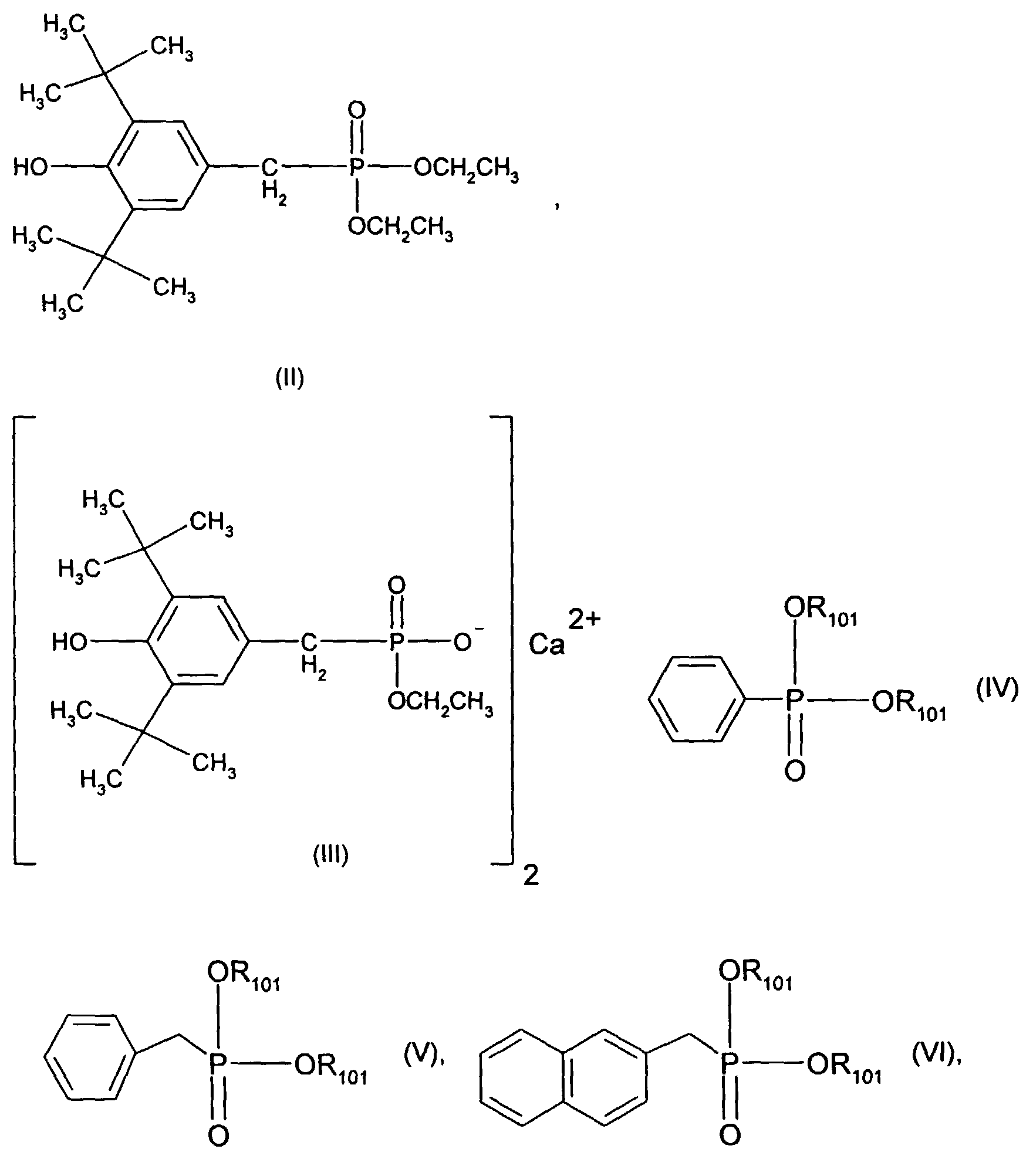
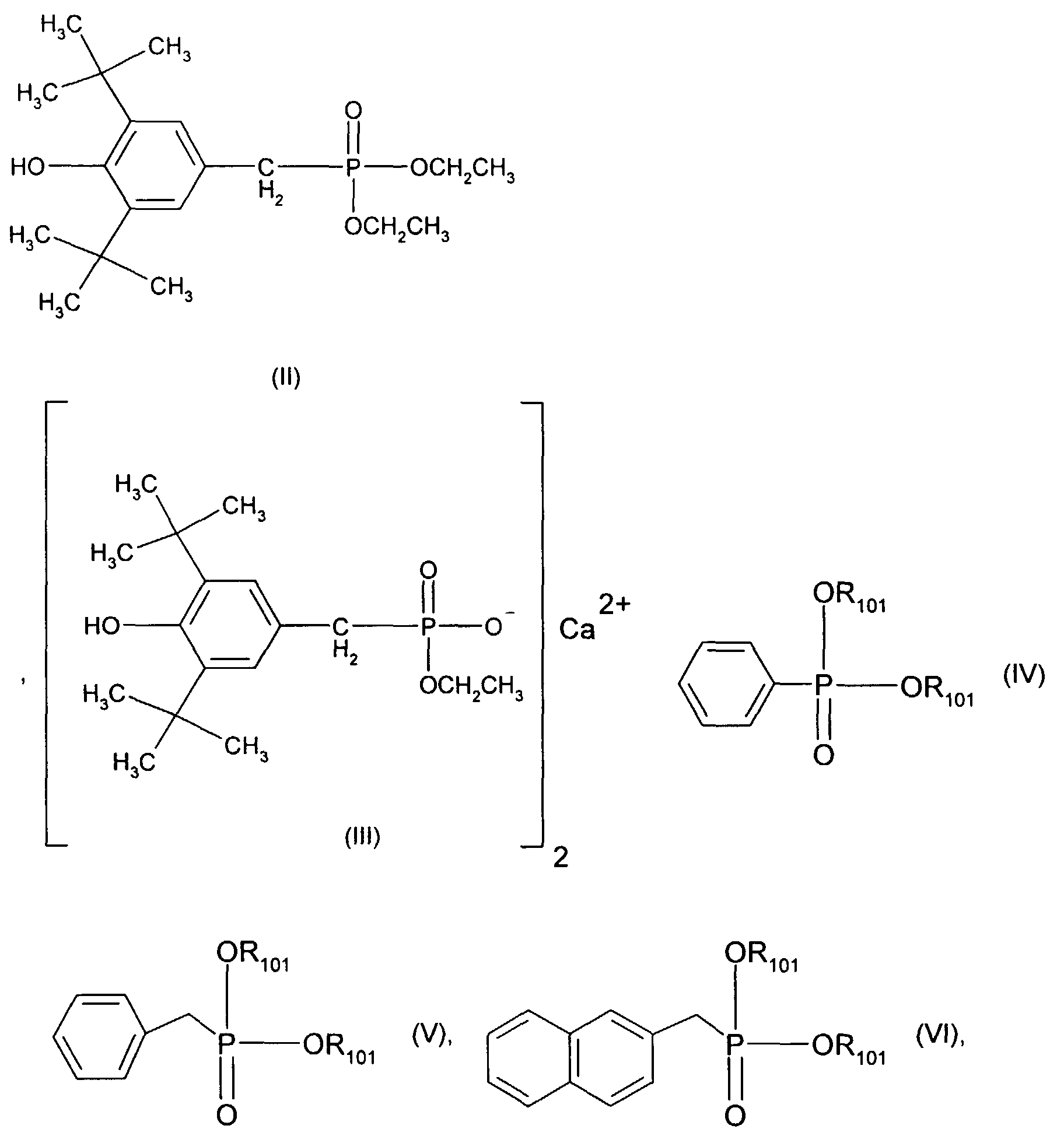
- Very particularly preferred sterically hindered aryl-alkyl-phosphonic acid esters or half-esters are the compounds of the formulas II, III, IV, V and VI wherein the R 101 independently of one another are hydrogen, ethyl, phenyl or M r + / r. Meanings for M r + / r have already been given above.
- the method can be carried out in any heatable vessel equipped with a stirring device. Heating is preferably carried out in closed apparatus with the exclusion of atmospheric oxygen, for example under an inert gas atmosphere (N 2 ) or under vacuum, in a kneader, mixer or stirred kettle. However, it is also possible to carry out the process in an extruder and also in the presence of air.
- the polycondensate to be heated and the mixture of dianhydride, polyfunctional Compound b) and phosphonic acid ester or half-ester are usually at the beginning the heating is filled into the apparatus, a subsequent dosing of the mixture to the
- polycondensate is also possible, but the mixture as such also Individual components can be added in any order.
- the components can be added independently of each other as a liquid, powder, granulate or in compacted form or on a carrier material such as silica gel or together with a polymer powder or wax such as a polyethylene wax.
- n-functional compound b) to m-functional is preferred Polyanhydride a) between 2m / n and m / (4n).
- the method is preferably carried out such that the maximum mass temperature of the Melt is from 180 ° to 320 ° C.
- the heating above the melting or glass point is generally up to one homogeneous distribution of the mixture carried out with stirring.
- the temperature changes according to the polycondensate used.
- One works with crystalline polyesters preferably in the range between melting temperature and a temperature of about 50 ° C above the melting temperature. In the case of amorphous polyesters, the process takes place approximately in the Range between 50 ° C and 150 ° C above the respective glass transition temperature.
- the processing device is preferably a single-screw extruder, twin-screw extruder, Planetary roller extruder, ring extruder or co-kneader with at least one degassing zone, to which a vacuum is applied.
- a method is preferred which is characterized in that a negative pressure of less than 250 mbar, particularly preferably less than 100 mbar and very particularly preferably less than 50 mbar is applied to the degassing zone.
- the processing device is a tightly intermeshing, intermeshing twin-screw extruder or ring extruder with co-rotating screws and with a feed zone, a melting zone, at least one degassing zone and a discharge zone, the degassing zone being from the melting zone or from another degassing zone is separated by a melting plug.
- This separation by means of a melt plug can be brought about, for example, by a combination of a kneading element and a returning screw element.
- the processing device preferably has 1-4 degassing zones, particularly preferably 1-3.
- Another object of the invention is the use of an additive mixture, containing a) at least one polyfunctional anhydride (polyanhydride); b) at least one polyfunctional compound, the functional groups of which with the anhydride groups Component a) can react; and c) at least one phosphonate to increase the Molecular weight and for the modification of polycondensation products during the Processing in the melt.
- polyanhydride polyfunctional anhydride
- Component a) can react
- at least one phosphonate to increase the Molecular weight and for the modification of polycondensation products during the Processing in the melt.
- the mixture particularly preferably contains 0.05% -0.5% pentaerythritol, 0.1-3% Pyromellitic dianhydride and 0.03-1% of a compound of formula II, III, IV, V or VI.
- the mixture very particularly preferably contains 0.09% -0.2% pentaerythritol, 0.18-1.2% Pyromellitic dianhydride and 0.05-0.5% of a compound of formula II, III, IV, V or VI.
- polycondensates producible according to the above described process with the addition of blowing agent, and foamed products, can be produced from the modified polycondensate and article made by extrusion blow molding a modified polycondensate.
- a carbodiimide is additionally added.
- the molecular weight increase is evident Effect of the mixture according to the invention through a higher I.V. value and at the same time due to a lower MFR value.
Landscapes
- Chemical & Material Sciences (AREA)
- Organic Chemistry (AREA)
- Health & Medical Sciences (AREA)
- Chemical Kinetics & Catalysis (AREA)
- Medicinal Chemistry (AREA)
- Polymers & Plastics (AREA)
- General Chemical & Material Sciences (AREA)
- Polyesters Or Polycarbonates (AREA)
- Compositions Of Macromolecular Compounds (AREA)
- Manufacture Of Porous Articles, And Recovery And Treatment Of Waste Products (AREA)
- Polymers With Sulfur, Phosphorus Or Metals In The Main Chain (AREA)
- Polyamides (AREA)
- Manufacture Of Macromolecular Shaped Articles (AREA)
- Addition Polymer Or Copolymer, Post-Treatments, Or Chemical Modifications (AREA)
Abstract
Description




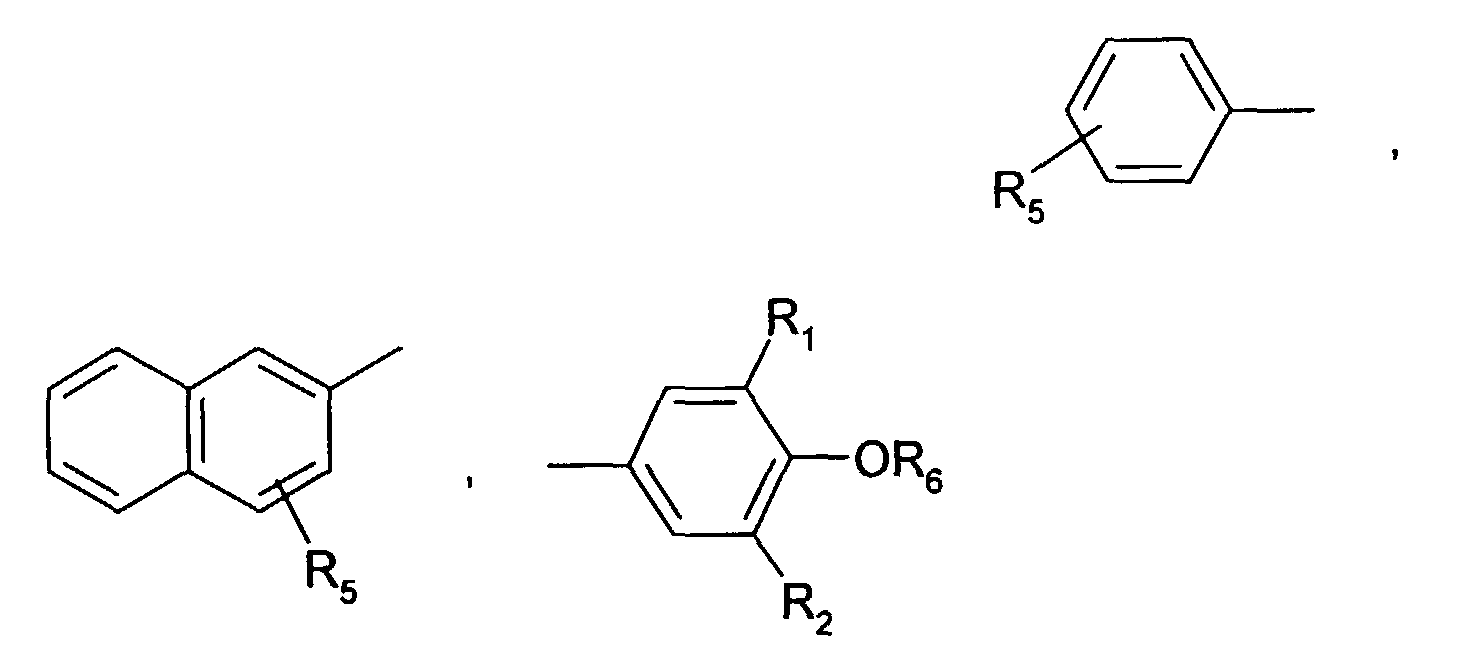
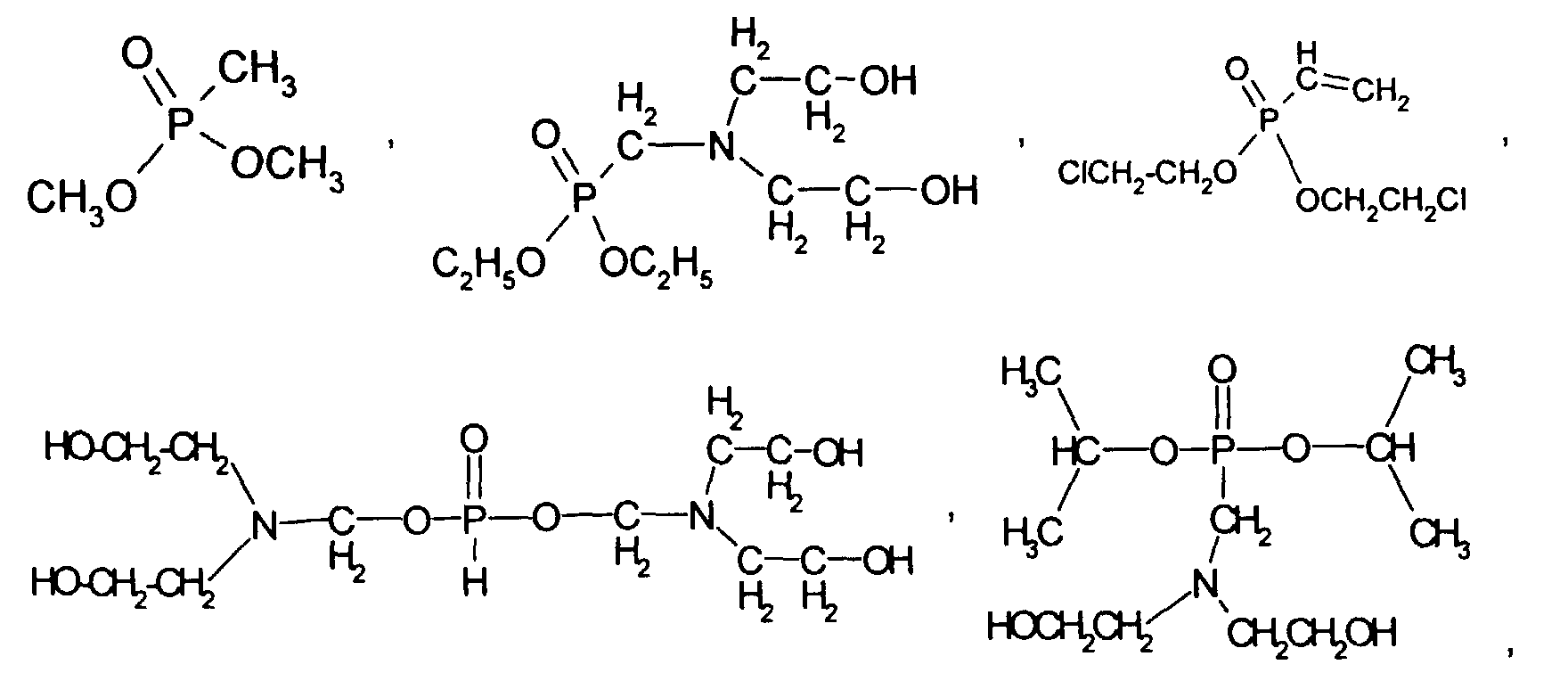


Bevorzugte Verbindungen der Formel I sind diejenigen, welche mindestens eine tert-Butylgruppe als Rest R1 oder R2 aufweisen. Ganz besonders bevorzugt sind Verbindungen worin R1 und R2 gleichzeitig tert-Butyl bedeutet.
Diese Trennung durch einen Schmelzpfropf kann beispielsweise durch eine Kombination von einem Knet- und einem rückfördernden Schneckenelement bewirkt werden.
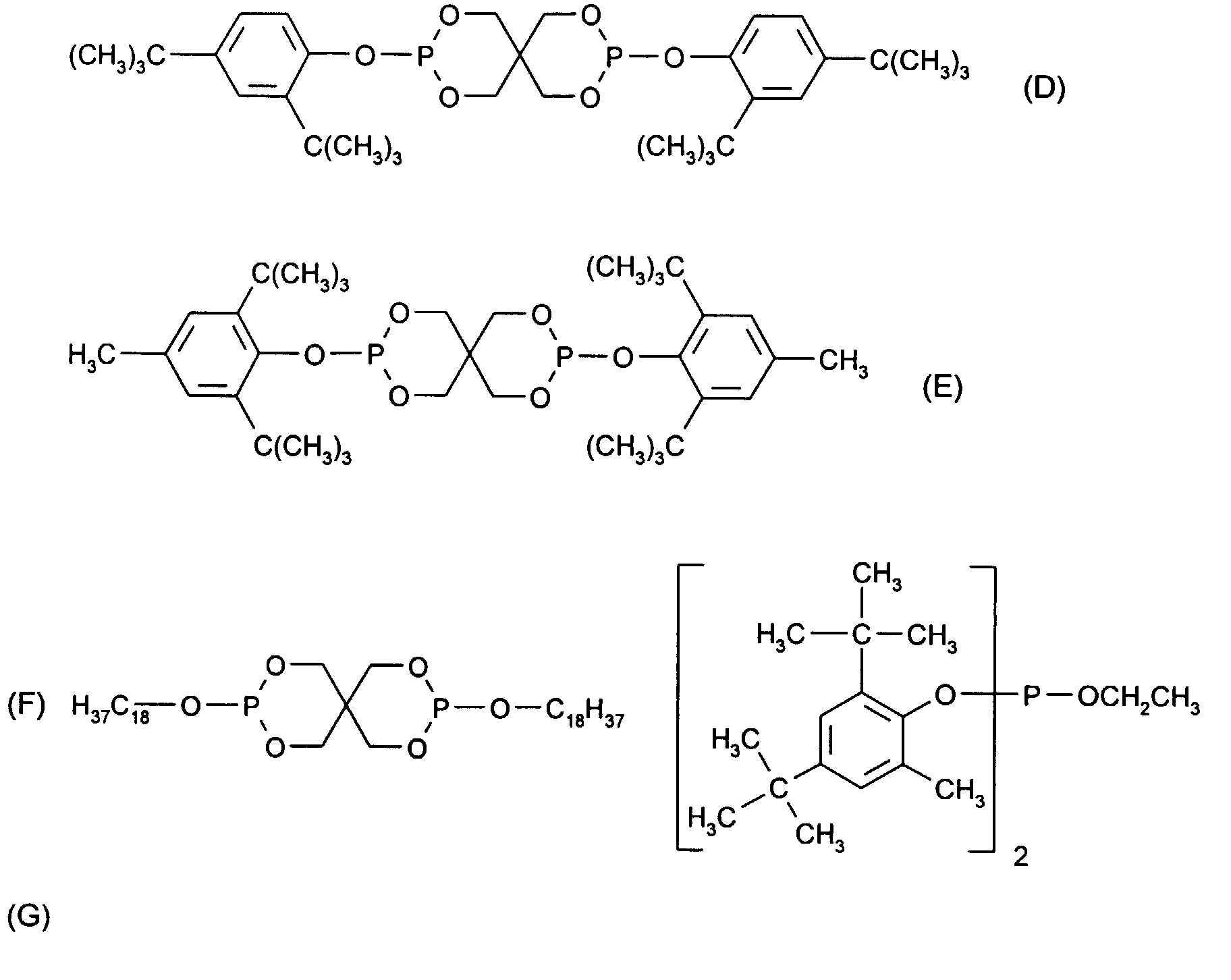
[R―CH2CH2―COO―CH2CH2]2 mit R = 3'-tert-Butyl-4'-hydroxy-5'-2H-benzotriazol-2-yl-phenyl; 2-[2'-Hydroxy-3'-(α,α-dimethylbenzyl)-5'-(1,1,3,3-tetramethylbutyl)-phenyl]-benzotriazol; 2-[2'-Hydroxy-3'-(1,1,3,3-tetramethylbutyl)-5'-(α,α-dimethylbenzyl)-phenyl]-benzotriazol.
| Vergleichsbeispiele und Beispiel 1 (Gewichtsteile) | ||||
| Vergleichsbeispiel 1 | Vergleichsbeispiel 2 | Vergleichsbeispiel 3 | Beispiel 1 erfindungsgemäß | |
| Polyclear RT43 (Hoechst Trevira) | 100 | 100 | 100 | 100 |
| Pentaerythrit | 0 | 0,1 | 0,1 | 0,1 |
| PMDA | 0 | 0 | 0,5 | 0,5 |
| 0 | 0,25 | 0 | 0,25 |
| Beispiel | I.V. [dl/g] | MFR [g/10min] | |
| Vergleichsbeispiel 1 | 0,61 | 25 | 15 |
| Vergleichsbeispiel 2 | 0,59 | 31 | 18 |
| Vergleichsbeispiel 3 | 0,57 | 17 | 10 |
| Beispiel 1 | 0,65 | 9 | 6 |
| Polyclear RT43 | 0,63 | 20 | 13 |
Claims (23)
- Verfahren zur Erhöhung des Molekulargewichtes und/oder zur Modifizierung von Polykondensationsprodukten in der Schmelze, dadurch gekennzeichnet, daß man dem Polykondensationsprodukt ein Gemisch enthaltendzusetzt.a) mindestens ein polyfunktionelles Anhydrid (Polyanhydrid);b) mindestens eine polyfunktionelle Verbindung, deren funktionelle Gruppen mit den Anhydridgruppen der Komponente a) reagieren können; undc) mindestens ein Phosphonat
- Verfahren nach Anspruch 1, dadurch gekennzeichnet, dass das Polykondensationsprodukt ein aliphatischer oder aromatischer Polyester, ein aliphatisches oder aromatisches Polyamid oder Polycarbonat oder ein Gemisch (blend) oder Copolymeres davon ist.
- Verfahren nach Anspruch 1, dadurch gekennzeichnet, dass das Polykondensationsprodukt Polyethylentherephthalat (PET), Polybutylentherephthalat (PBT), Polyethylennaphthalat (PEN), ein Copolyester, PA 6, PA 6,6, Polycarbonat enthaltend über Carbonatgruppen verknüpftes Bisphenol A, Bisphenol Z oder Bisphenol F ist.
- Verfahren nach Anspruch 1, dadurch gekennzeichnet, dass das Polykondensat ein Recyclat ist.
- Verfahren nach Anspruch 1, dadurch gekennzeichnet, dass das Polykondensat PET oder ein Copolymeres mit PET ist.
- Verfahren nach Anspruch 1, dadurch gekennzeichnet, dass das Polyanhydrid a) 2-8 Anhydridfunktionen aufweist und neben den Anhydridfunktionen noch freie Carbonsäuregruppen oder Carbonsäureester vorhanden sein können.
- Verfahren nach Anspruch 6, dadurch gekennzeichnet, dass man Tetracarbonsäuredianhydride einsetzt.
- Verfahren nach Anspruch 7, dadurch gekennzeichnet, dass man Pyromellitsäuredianhydrid, Benzophenontetracarbonsäuredianhydrid, 1,1,2,2-Ethantetracarbonsäuredianhydrid, 1,2,3,4-Cyclopentantetracarbonsäuredianhydrid, Diphenylsulfon-tetracarbonsäuredianhydrid, 5-(2,5-Dioxotetrahydro-3-furanyl)-3-methyl-3 cyclohexan-1,2-dicarbonsäuredianhydrid, Bis-(3,4-dicarbonsäurephenyl)-ether-dianhydrid, Bis-(3,4-Dicarbonsäurephenyl)-thioether-dianhydrid, Bisphenol-A-bisether-dianhydrid, 2,2-Bis-(3,4-Dicarbonsäurephenyl)-hexafluorpropan-dianhydrid, 2,3,6,7-Naphthalin-tetracarbonsäure-dianhydrid, Bis-(3,4-dicarbonsäurephenyl)-sulfon-dianhydrid, 1,2,5,6-Naphthalin-tetracarbonsäure-dianhydrid, 2,2',3,3'-Biphenyltetracarbonsäure-dianhydrid, Hydrochinonbisether-dianhydrid, 3,4,9,10-Perylentetracarbonsäure-dianhydrid, 1,2,3,4-Cyclobutantetracarbonsäure-dianhydrid, 3,4-Dicarboxy-1,2,3,4-tetrahydro-1-naphthalin-bernsteinsäure-dianhydrid, Bicyclo(2,2)oct-7-en-2,3,5,6-tetracarbonsäure-dianhydrid, Tetrahydrofuran-2,3,4,5-tetracarbonsäure-dianhydrid, 2,2-bis(3,4-Dicarboxyphenyl)propan-dianhydrid, 3,3',4,4'-Biphenyltetracarbonsäure-dianhydrid, 4,4'-Oxydiphthalsäure-dianhydrid (ODPA), Ethylendiamin-tetracarbonsäure-dianhydrid (DDTAh), oder Kombinationen dieser Dianhydride einsetzt.
- Verfahren nach Anspruch 1, dadurch gekennzeichnet, dass die polyfunktionelle Verbindung b) eine polyfunktionelle Hydroxylverbindung (Polyol), eine polyfunktionelle Epoxyverbindung, eine polyfunktionelle Aminverbindung (Polyamin), eine polyfunktionelle Aziridinverbindung (Polyaziridin), polyfunktionelle Isocyanatverbindung (Polyisocyanat), eine polyfunktionelle Oxazolinverbindung (Polyoxazolin), ein polyfunktioneller Thioalkohol oder eine Kombinationen dieser Verbindungen ist.
- Verfahren nach Anspruch 9, dadurch gekennzeichnet, dass man ein Polyol aus Phenolen und/oder Alkoholen mit 3-10 freien Hydroxylgrupen, ein Polythiol aus Thiophenolen und/oder Thioalkoholen mit 3-10 freien Thiolgruppen, ein aromatisches und/oder aliphatisches Polyamin mit 3-10 freien Aminogruppen, ein Polyoxazolin, ein Polyaziridin oder eine Epoxyverbindungen mit mindestens zwei Epoxygruppen einsetzt.
- Verfahren nach Anspruch 9, dadurch gekennzeichnet, dass manals Polyol Glycerin oder Pentaerythritol,als Epoxyverbindung Aminophenoltriglycidylether, Trimellisäuretriglycidylester oder Tetragylycidylether des Tetraphenylethan, Araldit® MT 0163als Oxazolin 2,2'-Bis(4H-3,1-benzoxazin-4-on),als Polyamin 2-Amino-malonamin, 1,2,3-Triamino-propan, Triaminobenzol, Triaminotoluol, Triaminoanisol, Triaminonaphthalin, Triaminopyridin, Triaminopyrimidin, Tetraaminopyrimidin, Tetraaminobenzol, Tetraamino-diphenyl, Tetraamino-diphenylsulfon, Hexaaminodiphenyl, Triamincyclopropan,als Polyaziridin Tris-[1-(2-Methyl)-aziridinyl]-phosphinoxidund als Polythiol 1,2,3-Trimercapto-propan, Trimercapto-benzol oder Trimercapto-anilin einsetzt
- Verfahren nach Anspruch 1, dadurch gekennzeichnet, dass man ein Phosphonat der Formel Iworin
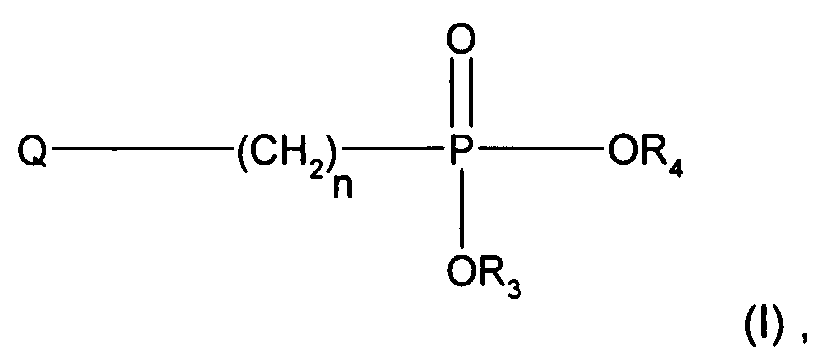 R3 H, C1-C20-Alkyl, unsubstituiertes oder durch C1-C4-Alkyl substituiertes Phenyl oder Naphthyl bedeutet,R4 Wasserstoff, C1-C20-Alkyl, unsubstituiertes oder durch C1-C4-Alkyl substituiertes Phenyl oder Naphthyl; oder Mr+ / r darstellt,Mr+ ein r-wertiges Metallkation oder das Ammoniumion ist,n 0, 1, 2, 3, 4, 5 oder 6 bedeutet, undr 1, 2, 3 oder 4 darstellt;Q Wasserstoff, -X-C(O)-OR7, oder einen Restbedeutet,
 R1 iso-Propyl, tert-Butyl, Cyclohexyl oder mit 1-3 C1-C4-Alkylgruppen substituiertes Cyclohexyl bedeutet,R2 Wasserstoff, C1-C4-Alkyl, Cyclohexyl oder mit 1-3 C1-C4-Alkylgruppen substituiertes Cyclohexyl darstellt,R5, H, C1-C18-Alkyl, OH, Halogen oder C3-C7-Cycloalkyl ist;R6 H, Methyl, Trimethylsilyl, Benzyl, Phenyl, Sulfonyl oder C1-C18-Alkyl ist;R7 H, C1-C10-Alkyl oder C3-C7-Cycloalkyl ist;undX Phenylen, mit C1-C4-Alkylgruppen substituiertes Phenylen oder Cyclohexylen bedeutet;
einsetzt. - Verfahren nach Anspruch 12, dadurch gekennzeichnet, dass man eine Verbindung der Formel Iaworin
 einsetzt.R1 H, iso-Propyl, tert-Butyl, Cyclohexyl oder mit 1-3 C1-C4-Alkylgruppen substituiertes Cyclohexyl bedeutet,R2 Wasserstoff, C1-C4-Alkyl, Cyclohexyl oder mit 1-3 C1-C4-Alkylgruppen substituiertes Cyclohexyl darstelltR3 C1-C20-Alkyl, unsubstituiertes oder durch C1-C4-Alkyl substituiertes Phenyl oder Naphthyl bedeutet,R4 Wasserstoff, C1-C20-Alkyl, unsubstituiertes oder durch C1-C4-Alkyl substituiertes Phenyl oder Naphthyl; oder Mr+ / r darstellt,Mr+ ein r-wertiges Metallkation ist,n 1, 2, 3, 4, 5 oder 6 bedeutet, undr 1, 2, 3 oder 4 darstellt;
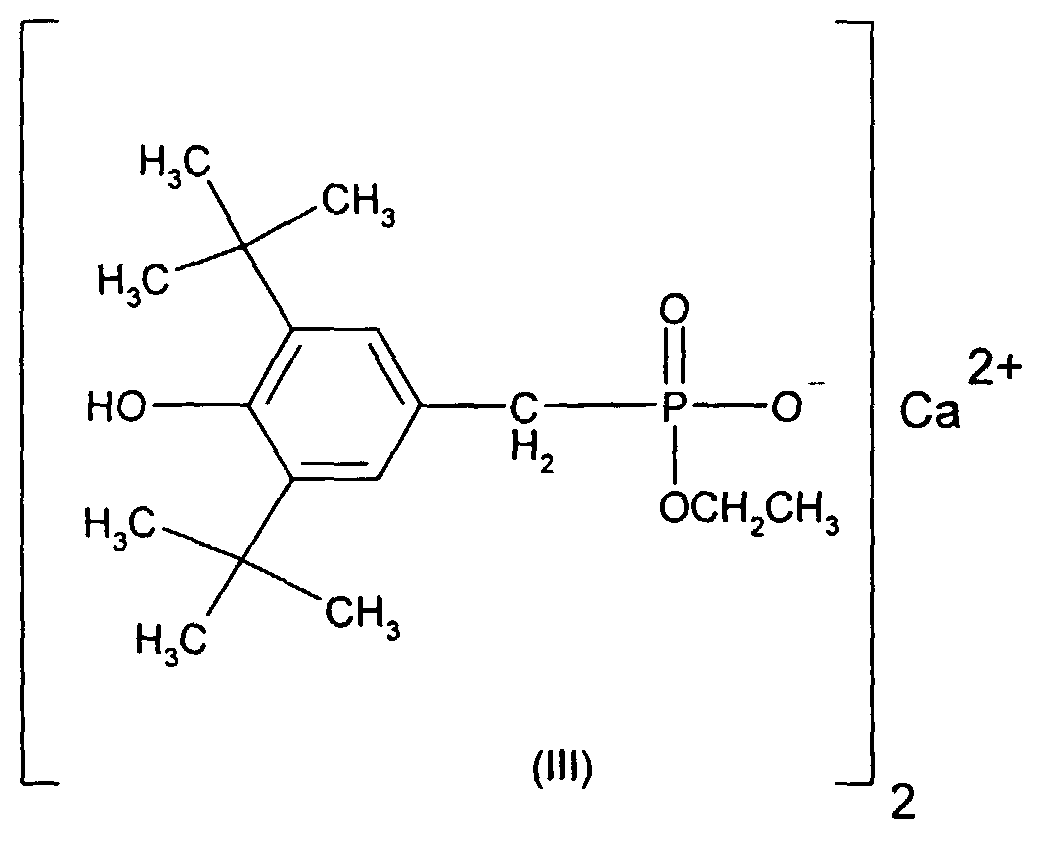
 - Verfahren nach Anspruch 1, dadurch gekennzeichnet, dass man eine Verbindung der Formel II, III, IV, V oder VI einsetztworin R101 unabhängig voneinander Wasserstoff oder Mr+ / r bedeutet.
- Verfahren nach Anspruch 1, dadurch gekennzeichnet, dass pro 100 Teile Polykondensat 0,01 bis 5 Teile Phosphonat eingesetzt werden.
- Verfahren nach Anspruch 1, dadurch gekennzeichnet, dass man pro 100 Teile Polykondensat 0,01 bis 2,5 Teile polyfunktionelle Verbindung b) und 0,02 bis 15 Teile Polyanhydrid a) einsetzt.
- Verfahren nach Anspruch 1, dadurch gekennzeichnet, dass das Verhältnis n-funktionelle Verbindung b) zu m-funktionellem Polyanhydrid a) zwischen 2m/n und m/(4n) beträgt.
- Verfahren nach Anspruch 1, dadurch gekennzeichnet, dass die maximale Massentemperatur der Schmelze von 180° bis 320° C beträgt.
- Verfahren nach Anspruch 1, dadurch gekennzeichnet, dass man zusätzlich ein Carbodiimid einsetzt.
- Verwendung einer Additivmischung enthaltendzur Erhöhung des Molekulargewichtes und zur Modifizierung von Polykondensationsprodukten während der Verarbeitung in der Schmelzea) mindestens ein polyfunktionelles Anhydrid (Polyanhydrid);b) mindestens eine polyfunktionelle Verbindung, deren funktionelle Gruppen mit den Anhydridgruppen der Komponente a) reagieren können; undc) mindestens ein Phosphonat
- Polykondensate, herstellbar nach einem Verfahren gemäss Anspruch 1.
- Geschäumte Polykondensate, herstellbar nach Anspruch 1, indem zusätzlich Treibmittel zugesetzt wird.
- Artikel, hergestellt durch Extrusionsblasformen eines Polykondensates nach Anspruch 21.
Applications Claiming Priority (2)
| Application Number | Priority Date | Filing Date | Title |
|---|---|---|---|
| CH94799 | 1999-05-21 | ||
| CH94799 | 1999-05-21 |
Publications (3)
| Publication Number | Publication Date |
|---|---|
| EP1054031A2 true EP1054031A2 (de) | 2000-11-22 |
| EP1054031A3 EP1054031A3 (de) | 2002-10-23 |
| EP1054031B1 EP1054031B1 (de) | 2005-08-24 |
Family
ID=4198876
Family Applications (1)
| Application Number | Title | Priority Date | Filing Date |
|---|---|---|---|
| EP00810408A Expired - Lifetime EP1054031B1 (de) | 1999-05-21 | 2000-05-12 | Molekulargewichtsaufbau und Modifizierung von Polykondensaten |
Country Status (7)
| Country | Link |
|---|---|
| US (1) | US6469078B1 (de) |
| EP (1) | EP1054031B1 (de) |
| JP (1) | JP2001002775A (de) |
| AT (1) | ATE302808T1 (de) |
| CA (1) | CA2308888C (de) |
| DE (1) | DE50011006D1 (de) |
| ES (1) | ES2246821T3 (de) |
Cited By (7)
| Publication number | Priority date | Publication date | Assignee | Title |
|---|---|---|---|---|
| WO2005030857A1 (en) * | 2003-09-26 | 2005-04-07 | Ciba Specialty Chemicals Holding Inc. | Process for improving color of polycondensates |
| EP1366103A4 (de) * | 2000-12-06 | 2006-04-26 | Invista Tech Sarl | Copolyester mit hohem carboxylendgruppengehalt und herstellungsverfahren |
| EP1541611A4 (de) * | 2002-08-07 | 2006-05-31 | Goo Chemical Co Ltd | Wasserlösliches flammfestes polyesterharz, das harz enthaltende harzzusammensetzung und mit der harzzusammensetzung behandeltes textilprodukt |
| WO2007038373A1 (en) * | 2005-09-22 | 2007-04-05 | E. I. Du Pont De Nemours And Company | Manufacture of aromatic polyesters |
| EP2184311A1 (de) | 2008-11-11 | 2010-05-12 | Mitsubishi Polyester Film GmbH | Biaxial orientierte hydrolysebeständige Polyesterfolie enthaltend epoxidierte Fettsäurederivate und einen Kettenverlängerer sowie Verfahren zu ihrer Herstellung und ihre Verwendung |
| DE102008056694A1 (de) | 2008-11-11 | 2010-05-12 | Mitsubishi Polyester Film Gmbh | Biaxial gestreckte Polyesterfolie die einen Kettenverlängerer enthält, sowie Verfahren zu ihrer Herstellung und ihre Verwendung |
| WO2021185757A1 (de) | 2020-03-16 | 2021-09-23 | Alpla Werke Alwin Lehner Gmbh & Co. Kg | Verfahren zur herstellung eines zur verwendung in einem extrusionsblasverfahren geeigneten pet-ausgangsmaterials und im extrusionsblasverfahren hergestellter hohlkörper |
Families Citing this family (19)
| Publication number | Priority date | Publication date | Assignee | Title |
|---|---|---|---|---|
| US20030034616A1 (en) * | 2000-07-31 | 2003-02-20 | Deforest Stanley F. | Motor cover with integral seal |
| JP4522000B2 (ja) * | 2001-02-01 | 2010-08-11 | 旭化成せんい株式会社 | 発泡体 |
| US7214742B2 (en) * | 2001-11-30 | 2007-05-08 | Ciba Specialty Chemicals Corp. | 2-hydroxyphenyl-s-triazine crosslinkers for polymer networks |
| US8129450B2 (en) | 2002-12-10 | 2012-03-06 | Cellresin Technologies, Llc | Articles having a polymer grafted cyclodextrin |
| US7166671B2 (en) | 2002-12-10 | 2007-01-23 | Cellresin Technologies, Llc | Grafted cyclodextrin |
| US7385004B2 (en) | 2002-12-10 | 2008-06-10 | Cellresin Technologies, Llc | Enhanced lubrication in polyolefin closure with polyolefin grafted cyclodextrin |
| WO2004101666A2 (en) * | 2003-05-19 | 2004-11-25 | Polymers Australia Pty. Limited | Polyester masterbatch composition |
| CN100471893C (zh) * | 2003-09-25 | 2009-03-25 | 西巴特殊化学品控股有限公司 | 缩聚物分子量的提高和改性 |
| CN101691430B (zh) | 2004-05-24 | 2012-10-10 | 细胞树脂技术有限责任公司 | 两性接枝阻隔材料 |
| EP1882009A1 (de) * | 2005-05-20 | 2008-01-30 | Ciba Specialty Chemicals Holding Inc. | Verfahren zur verbesserung der wärme- und lichtstabilität von polyestern |
| US8080191B2 (en) * | 2006-10-20 | 2011-12-20 | Pepsico, Inc. | Extrudable polyethylene terephthalate blend |
| TR201904238T4 (tr) * | 2008-04-18 | 2019-04-22 | Pepsico Inc | Ekstrüzyon üflemeli kalıplama ile ürünlerin hazırlanmasına yönelik polyester bileşimleri ve yöntem. |
| US20120016090A1 (en) * | 2010-07-19 | 2012-01-19 | Basf Se | Process for increasing the molecular weight of polyesters |
| JP5843439B2 (ja) * | 2010-11-29 | 2016-01-13 | ウィンテックポリマー株式会社 | ポリブチレンテレフタレート系樹脂組成物の製造方法及び成形用ポリブチレンテレフタレート系樹脂組成物 |
| JP2014507543A (ja) * | 2011-03-10 | 2014-03-27 | ネクサム ケミカル エイビー | ポリエステルを改善するための組成物 |
| EP3019557B1 (de) * | 2013-07-12 | 2018-09-05 | PolyOne Corporation | Polyesterverbindungen mit verbesserten hydrophoben oberflächen |
| EP3635028A1 (de) * | 2017-06-07 | 2020-04-15 | SABIC Global Technologies B.V. | Schaumfähiges thermoplastisches polyestercopolymer |
| KR102360000B1 (ko) | 2018-06-29 | 2022-02-09 | 롯데첨단소재(주) | 열가소성 수지 조성물 및 이를 이용한 성형품 |
| DE102018213101A1 (de) * | 2018-08-06 | 2020-02-06 | Gargiulo Gmbh | Gedämmtes Bauteil mit Profilstrang zur Wärmedämmung aus geschäumtem Polyethylenterephthalat sowie Verfahren zur Herstellung eines solchen Bauteils |
Family Cites Families (31)
| Publication number | Priority date | Publication date | Assignee | Title |
|---|---|---|---|---|
| NL301601A (de) * | 1962-12-11 | |||
| US3553137A (en) * | 1967-09-29 | 1971-01-05 | Dow Chemical Co | Corrosion inhibitor for methoxypropanol |
| US3875145A (en) * | 1974-01-14 | 1975-04-01 | Thiokol Corp | Purification of tris{8 1-(2-methyl) aziridinyl{9 phosphine oxide |
| DE2615343C2 (de) * | 1976-04-08 | 1984-09-27 | Bayer Ag, 5090 Leverkusen | Polymerkombinationen |
| DE3023918A1 (de) * | 1980-06-26 | 1982-01-14 | Bayer Ag, 5090 Leverkusen | Leitfliessende, schlagzaehe polyamide |
| DE3237401A1 (de) * | 1982-10-08 | 1984-04-12 | Bayer Ag, 5090 Leverkusen | Schlagzaehe polyamide |
| US4762883A (en) * | 1985-05-06 | 1988-08-09 | Ashland Oil, Inc. | Solutions of polymers in oxazolines and polymerizates thereof |
| US4933429A (en) * | 1989-03-13 | 1990-06-12 | General Electric Company | Method for preparing polyester-polyepoxide compositions of high melt viscosity |
| EP0410230A3 (en) * | 1989-07-26 | 1992-02-26 | Bayer Ag | Process for preparing high molecular weight polyamides |
| DE4034459A1 (de) | 1990-10-30 | 1992-05-07 | Hoechst Ag | Verfahren zur aufbereitung thermisch beanspruchter polyester-abfaelle |
| JP3228977B2 (ja) * | 1991-03-14 | 2001-11-12 | ジョーンズ・マンヴィル・インターナショナル・インコーポレーテッド | カルボジイミド変性ポリエステル繊維およびその製造方法 |
| DE4125167A1 (de) | 1991-07-30 | 1993-02-04 | Zimmer Ag | Modifiziertes co-polyethylenterephthalat |
| IT1251953B (it) * | 1991-10-18 | 1995-05-27 | M & G Ricerche Spa | Procedimento per la produzione di resine poliestere ad elevato peso molecolare. |
| US5436056A (en) * | 1991-12-20 | 1995-07-25 | Showa Highpolymer Co., Ltd. | Method of producing a high molecular weight aliphatic polyester and film thereof |
| DE4214193A1 (de) * | 1992-04-30 | 1993-11-04 | Rhein Chemie Rheinau Gmbh | Hydrolysestabile polyamide |
| TW254955B (de) | 1992-09-25 | 1995-08-21 | Ciba Geigy | |
| US5288764A (en) * | 1993-01-29 | 1994-02-22 | Amoco Corporation | Increased throughput in foaming and other melt fabrication of polyester |
| US5536793A (en) * | 1993-01-29 | 1996-07-16 | Amoco Corporation | Concentrate for use in the melt fabrication of polyester |
| US5747606A (en) * | 1993-04-21 | 1998-05-05 | Ciba Specialty Chemicals Corporation | Increasing the molecular weight of polyesters and premix useful for this process |
| TW332824B (en) * | 1993-04-21 | 1998-06-01 | Ciba Sc Holding Ag | Polyester |
| US5496920A (en) * | 1993-06-07 | 1996-03-05 | Ciba-Geigy Corporation | Increasing the molecular weight of polyamides |
| AU689781B2 (en) | 1993-06-09 | 1998-04-09 | Ciba Specialty Chemicals Holding Inc. | Stabilization of damaged thermoplastics |
| IL110514A0 (en) * | 1993-10-04 | 1994-10-21 | Eastman Chem Co | Concentrates for improving polyester compositions and a method for preparing such compositions |
| US5756596A (en) * | 1993-12-16 | 1998-05-26 | Ciba Specialty Chemicals Corporation | Increasing the molecular weight of polyamides |
| TW460525B (en) * | 1994-02-28 | 2001-10-21 | Ciba Sc Holding Ag | A process for increasing the molecular weight of polyesters with a tetracarboxylic acid dianhydride and a sterically hindered hydroxy-phenylalkylphonic acid ester or half-ester |
| DE69524966T2 (de) * | 1994-10-14 | 2002-08-29 | Ciba Speciality Chemicals Holding Inc., Basel | Molekulargewichtserhöhung von polykondensaten |
| DE69533745T2 (de) * | 1994-12-21 | 2005-10-27 | Showa Denko K.K. | Aliphatisches polyesterharz und verfahren zu seiner herstellung |
| JP3510398B2 (ja) * | 1995-09-29 | 2004-03-29 | 大日本インキ化学工業株式会社 | ヒドロキシカルボン酸系ポリエステル組成物の製造方法 |
| AU1721597A (en) * | 1996-02-15 | 1997-09-02 | Ciba Specialty Chemicals Holding Inc. | Increasing the molecular weight of polycondensates |
| ATE269370T1 (de) * | 1997-01-31 | 2004-07-15 | Polymers Australia Pty Ltd | Modifizierte polyester |
| DE59900888D1 (de) * | 1998-01-26 | 2002-04-04 | Ciba Sc Holding Ag | Molekulargewichtserhöhung und Stabilisierung von Polykondensaten mit Diepoxiden von sterisch gehinderten Aminen |
-
2000
- 2000-05-12 ES ES00810408T patent/ES2246821T3/es not_active Expired - Lifetime
- 2000-05-12 AT AT00810408T patent/ATE302808T1/de active
- 2000-05-12 EP EP00810408A patent/EP1054031B1/de not_active Expired - Lifetime
- 2000-05-12 DE DE50011006T patent/DE50011006D1/de not_active Expired - Lifetime
- 2000-05-15 US US09/571,622 patent/US6469078B1/en not_active Expired - Fee Related
- 2000-05-19 CA CA002308888A patent/CA2308888C/en not_active Expired - Fee Related
- 2000-05-22 JP JP2000149782A patent/JP2001002775A/ja active Pending
Cited By (12)
| Publication number | Priority date | Publication date | Assignee | Title |
|---|---|---|---|---|
| EP1366103A4 (de) * | 2000-12-06 | 2006-04-26 | Invista Tech Sarl | Copolyester mit hohem carboxylendgruppengehalt und herstellungsverfahren |
| EP1541611A4 (de) * | 2002-08-07 | 2006-05-31 | Goo Chemical Co Ltd | Wasserlösliches flammfestes polyesterharz, das harz enthaltende harzzusammensetzung und mit der harzzusammensetzung behandeltes textilprodukt |
| US7358323B2 (en) | 2002-08-07 | 2008-04-15 | Goo Chemical Co., Ltd. | Water-soluble flame-retardant polyester resin, resin composition containing the resin, and fiber product treated with the resin composition |
| WO2005030857A1 (en) * | 2003-09-26 | 2005-04-07 | Ciba Specialty Chemicals Holding Inc. | Process for improving color of polycondensates |
| CN1856536B (zh) * | 2003-09-26 | 2010-06-16 | 西巴特殊化学品控股有限公司 | 改进缩聚物颜色的方法 |
| WO2007038373A1 (en) * | 2005-09-22 | 2007-04-05 | E. I. Du Pont De Nemours And Company | Manufacture of aromatic polyesters |
| EP2184311A1 (de) | 2008-11-11 | 2010-05-12 | Mitsubishi Polyester Film GmbH | Biaxial orientierte hydrolysebeständige Polyesterfolie enthaltend epoxidierte Fettsäurederivate und einen Kettenverlängerer sowie Verfahren zu ihrer Herstellung und ihre Verwendung |
| DE102008056692A1 (de) | 2008-11-11 | 2010-05-12 | Mitsubishi Polyester Film Gmbh | Biaxial orientierte hydrolysebeständige Polyesterfolie, enthaltend epoxidierte Fettsäurederivate und einen Kettenverlängerer sowie Verfahren zu ihrer Herstellung und ihre Verwendung |
| DE102008056694A1 (de) | 2008-11-11 | 2010-05-12 | Mitsubishi Polyester Film Gmbh | Biaxial gestreckte Polyesterfolie die einen Kettenverlängerer enthält, sowie Verfahren zu ihrer Herstellung und ihre Verwendung |
| EP2184313A1 (de) | 2008-11-11 | 2010-05-12 | Mitsubishi Polyester Film GmbH | Biaxial gestreckte Polyesterfolie die einen Kettenverlängerer enthält, sowie Verfahren zu ihrer Herstellung und ihre Verwendung |
| US8710121B2 (en) | 2008-11-11 | 2014-04-29 | Mitsubishi Polyester Film Gmbh | Biaxially oriented hydrolysis-stable polyester film comprising epoxidized fatty acid derivatives and a chain extender, and process for production thereof and use thereof |
| WO2021185757A1 (de) | 2020-03-16 | 2021-09-23 | Alpla Werke Alwin Lehner Gmbh & Co. Kg | Verfahren zur herstellung eines zur verwendung in einem extrusionsblasverfahren geeigneten pet-ausgangsmaterials und im extrusionsblasverfahren hergestellter hohlkörper |
Also Published As
| Publication number | Publication date |
|---|---|
| US6469078B1 (en) | 2002-10-22 |
| DE50011006D1 (de) | 2005-09-29 |
| ES2246821T3 (es) | 2006-03-01 |
| ATE302808T1 (de) | 2005-09-15 |
| EP1054031B1 (de) | 2005-08-24 |
| EP1054031A3 (de) | 2002-10-23 |
| CA2308888A1 (en) | 2000-11-21 |
| JP2001002775A (ja) | 2001-01-09 |
| CA2308888C (en) | 2008-07-08 |
Similar Documents
| Publication | Publication Date | Title |
|---|---|---|
| EP1054031B1 (de) | Molekulargewichtsaufbau und Modifizierung von Polykondensaten | |
| DE69912782T2 (de) | Molekulargewichtserhöhung von polyestern | |
| DE69524966T2 (de) | Molekulargewichtserhöhung von polykondensaten | |
| DE69534961T2 (de) | Vergrösserung des molekulargewichts von polykondensaten | |
| US20060293416A1 (en) | Polyester masterbatch composition | |
| KR100346065B1 (ko) | 폴리에스테르분자량의증가방법 | |
| EP0931810B1 (de) | Molekulargewichtserhöhung und Stabilisierung von Polykondensaten mit Diepoxiden von sterisch gehinderten Aminen | |
| DE60306206T2 (de) | Antistatische zusammensetzung | |
| JP3413523B2 (ja) | 高められた特性を有するポリエステル/ポリカーボネートブレンド | |
| DE69702498T2 (de) | Vergrösserung des molekulargewichts von polykondensaten | |
| EP1095978B1 (de) | Additivgemisch zur Verbesserung der mechanischen Eigenschaften von Polymeren | |
| US20090163621A1 (en) | Process for improving color of polycondensates | |
| KR19990062799A (ko) | 폴리아미드, 폴리에스테르 및 폴리아세탈의 안정화 | |
| JP2008540786A (ja) | ポリエステルの熱及び光安定性を改良する方法 | |
| KR20080040640A (ko) | 포스포네이트의 존재 하에서 폴리아미드의 제조방법 | |
| US20040192877A1 (en) | Property enhancement of polyamides by co-condensation with lightstabilizers |
Legal Events
| Date | Code | Title | Description |
|---|---|---|---|
| PUAI | Public reference made under article 153(3) epc to a published international application that has entered the european phase |
Free format text: ORIGINAL CODE: 0009012 |
|
| AK | Designated contracting states |
Kind code of ref document: A2 Designated state(s): AT BE CH CY DE DK ES FI FR GB GR IE IT LI LU MC NL PT SE |
|
| AX | Request for extension of the european patent |
Free format text: AL;LT;LV;MK;RO;SI |
|
| 17P | Request for examination filed |
Effective date: 20010424 |
|
| PUAL | Search report despatched |
Free format text: ORIGINAL CODE: 0009013 |
|
| RIC1 | Information provided on ipc code assigned before grant |
Free format text: 7C 08G 63/91 A, 7C 08G 64/00 B, 7C 08G 69/00 B, 7C 08F 8/00 B, 7C 08K 5/5317 B, 7C 08K 5/5333 B, 7C 08K 5/1539 B, 7C 08G 63/20 B |
|
| AK | Designated contracting states |
Kind code of ref document: A3 Designated state(s): AT BE CH CY DE DK ES FI FR GB GR IE IT LI LU MC NL PT SE |
|
| AX | Request for extension of the european patent |
Free format text: AL;LT;LV;MK;RO;SI |
|
| AKX | Designation fees paid |
Designated state(s): AT BE CH CY DE DK ES FI FR GB GR IE IT LI LU MC NL PT SE |
|
| 17Q | First examination report despatched |
Effective date: 20040204 |
|
| GRAP | Despatch of communication of intention to grant a patent |
Free format text: ORIGINAL CODE: EPIDOSNIGR1 |
|
| GRAS | Grant fee paid |
Free format text: ORIGINAL CODE: EPIDOSNIGR3 |
|
| GRAA | (expected) grant |
Free format text: ORIGINAL CODE: 0009210 |
|
| AK | Designated contracting states |
Kind code of ref document: B1 Designated state(s): AT BE CH CY DE DK ES FI FR GB GR IE IT LI LU MC NL PT SE |
|
| PG25 | Lapsed in a contracting state [announced via postgrant information from national office to epo] |
Ref country code: FI Free format text: LAPSE BECAUSE OF FAILURE TO SUBMIT A TRANSLATION OF THE DESCRIPTION OR TO PAY THE FEE WITHIN THE PRESCRIBED TIME-LIMIT Effective date: 20050824 Ref country code: IE Free format text: LAPSE BECAUSE OF FAILURE TO SUBMIT A TRANSLATION OF THE DESCRIPTION OR TO PAY THE FEE WITHIN THE PRESCRIBED TIME-LIMIT Effective date: 20050824 |
|
| REG | Reference to a national code |
Ref country code: GB Ref legal event code: FG4D Free format text: NOT ENGLISH |
|
| REG | Reference to a national code |
Ref country code: CH Ref legal event code: EP |
|
| REG | Reference to a national code |
Ref country code: IE Ref legal event code: FG4D Free format text: LANGUAGE OF EP DOCUMENT: GERMAN |
|
| REF | Corresponds to: |
Ref document number: 50011006 Country of ref document: DE Date of ref document: 20050929 Kind code of ref document: P |
|
| GBT | Gb: translation of ep patent filed (gb section 77(6)(a)/1977) |
Effective date: 20050917 |
|
| PG25 | Lapsed in a contracting state [announced via postgrant information from national office to epo] |
Ref country code: GR Free format text: LAPSE BECAUSE OF FAILURE TO SUBMIT A TRANSLATION OF THE DESCRIPTION OR TO PAY THE FEE WITHIN THE PRESCRIBED TIME-LIMIT Effective date: 20051124 Ref country code: DK Free format text: LAPSE BECAUSE OF FAILURE TO SUBMIT A TRANSLATION OF THE DESCRIPTION OR TO PAY THE FEE WITHIN THE PRESCRIBED TIME-LIMIT Effective date: 20051124 |
|
| REG | Reference to a national code |
Ref country code: SE Ref legal event code: TRGR |
|
| PG25 | Lapsed in a contracting state [announced via postgrant information from national office to epo] |
Ref country code: PT Free format text: LAPSE BECAUSE OF FAILURE TO SUBMIT A TRANSLATION OF THE DESCRIPTION OR TO PAY THE FEE WITHIN THE PRESCRIBED TIME-LIMIT Effective date: 20060124 |
|
| REG | Reference to a national code |
Ref country code: ES Ref legal event code: FG2A Ref document number: 2246821 Country of ref document: ES Kind code of ref document: T3 |
|
| REG | Reference to a national code |
Ref country code: IE Ref legal event code: FD4D |
|
| ET | Fr: translation filed | ||
| PG25 | Lapsed in a contracting state [announced via postgrant information from national office to epo] |
Ref country code: MC Free format text: LAPSE BECAUSE OF NON-PAYMENT OF DUE FEES Effective date: 20060531 |
|
| PLBE | No opposition filed within time limit |
Free format text: ORIGINAL CODE: 0009261 |
|
| STAA | Information on the status of an ep patent application or granted ep patent |
Free format text: STATUS: NO OPPOSITION FILED WITHIN TIME LIMIT |
|
| 26N | No opposition filed |
Effective date: 20060526 |
|
| REG | Reference to a national code |
Ref country code: CH Ref legal event code: PFA Owner name: CIBA HOLDING INC. Free format text: CIBA SPECIALTY CHEMICALS HOLDING INC.#KLYBECKSTRASSE 141#4057 BASEL (CH) -TRANSFER TO- CIBA HOLDING INC.#KLYBECKSTRASSE 141#4057 BASEL (CH) |
|
| PG25 | Lapsed in a contracting state [announced via postgrant information from national office to epo] |
Ref country code: LU Free format text: LAPSE BECAUSE OF NON-PAYMENT OF DUE FEES Effective date: 20060512 |
|
| PG25 | Lapsed in a contracting state [announced via postgrant information from national office to epo] |
Ref country code: CY Free format text: LAPSE BECAUSE OF FAILURE TO SUBMIT A TRANSLATION OF THE DESCRIPTION OR TO PAY THE FEE WITHIN THE PRESCRIBED TIME-LIMIT Effective date: 20050824 |
|
| PGFP | Annual fee paid to national office [announced via postgrant information from national office to epo] |
Ref country code: NL Payment date: 20120530 Year of fee payment: 13 Ref country code: CH Payment date: 20120531 Year of fee payment: 13 |
|
| PGFP | Annual fee paid to national office [announced via postgrant information from national office to epo] |
Ref country code: GB Payment date: 20120531 Year of fee payment: 13 Ref country code: FR Payment date: 20120618 Year of fee payment: 13 Ref country code: SE Payment date: 20120530 Year of fee payment: 13 |
|
| PGFP | Annual fee paid to national office [announced via postgrant information from national office to epo] |
Ref country code: IT Payment date: 20120522 Year of fee payment: 13 |
|
| PGFP | Annual fee paid to national office [announced via postgrant information from national office to epo] |
Ref country code: BE Payment date: 20120628 Year of fee payment: 13 |
|
| PGFP | Annual fee paid to national office [announced via postgrant information from national office to epo] |
Ref country code: DE Payment date: 20120730 Year of fee payment: 13 Ref country code: ES Payment date: 20120629 Year of fee payment: 13 |
|
| PGFP | Annual fee paid to national office [announced via postgrant information from national office to epo] |
Ref country code: AT Payment date: 20120525 Year of fee payment: 13 |
|
| BERE | Be: lapsed |
Owner name: *CIBA SPECIALTY CHEMICALS HOLDING INC. Effective date: 20130531 |
|
| REG | Reference to a national code |
Ref country code: NL Ref legal event code: V1 Effective date: 20131201 |
|
| REG | Reference to a national code |
Ref country code: CH Ref legal event code: PL |
|
| REG | Reference to a national code |
Ref country code: SE Ref legal event code: EUG |
|
| REG | Reference to a national code |
Ref country code: AT Ref legal event code: MM01 Ref document number: 302808 Country of ref document: AT Kind code of ref document: T Effective date: 20130531 |
|
| GBPC | Gb: european patent ceased through non-payment of renewal fee |
Effective date: 20130512 |
|
| PG25 | Lapsed in a contracting state [announced via postgrant information from national office to epo] |
Ref country code: LI Free format text: LAPSE BECAUSE OF NON-PAYMENT OF DUE FEES Effective date: 20130531 Ref country code: AT Free format text: LAPSE BECAUSE OF NON-PAYMENT OF DUE FEES Effective date: 20130531 Ref country code: DE Free format text: LAPSE BECAUSE OF NON-PAYMENT OF DUE FEES Effective date: 20131203 Ref country code: CH Free format text: LAPSE BECAUSE OF NON-PAYMENT OF DUE FEES Effective date: 20130531 Ref country code: SE Free format text: LAPSE BECAUSE OF NON-PAYMENT OF DUE FEES Effective date: 20130513 |
|
| PG25 | Lapsed in a contracting state [announced via postgrant information from national office to epo] |
Ref country code: NL Free format text: LAPSE BECAUSE OF NON-PAYMENT OF DUE FEES Effective date: 20131201 Ref country code: IT Free format text: LAPSE BECAUSE OF NON-PAYMENT OF DUE FEES Effective date: 20130512 Ref country code: BE Free format text: LAPSE BECAUSE OF NON-PAYMENT OF DUE FEES Effective date: 20130531 |
|
| REG | Reference to a national code |
Ref country code: DE Ref legal event code: R119 Ref document number: 50011006 Country of ref document: DE Effective date: 20131203 |
|
| REG | Reference to a national code |
Ref country code: FR Ref legal event code: ST Effective date: 20140131 |
|
| PG25 | Lapsed in a contracting state [announced via postgrant information from national office to epo] |
Ref country code: GB Free format text: LAPSE BECAUSE OF NON-PAYMENT OF DUE FEES Effective date: 20130512 |
|
| PG25 | Lapsed in a contracting state [announced via postgrant information from national office to epo] |
Ref country code: FR Free format text: LAPSE BECAUSE OF NON-PAYMENT OF DUE FEES Effective date: 20130531 |
|
| REG | Reference to a national code |
Ref country code: ES Ref legal event code: FD2A Effective date: 20140610 |
|
| PG25 | Lapsed in a contracting state [announced via postgrant information from national office to epo] |
Ref country code: ES Free format text: LAPSE BECAUSE OF NON-PAYMENT OF DUE FEES Effective date: 20130513 |