EP1054343B1 - Substrat, das eine magnetische Markierung enthält, Verfahren zu dessen Herstellung und Vorrichtung, die es verwendet - Google Patents
Substrat, das eine magnetische Markierung enthält, Verfahren zu dessen Herstellung und Vorrichtung, die es verwendet Download PDFInfo
- Publication number
- EP1054343B1 EP1054343B1 EP00401353A EP00401353A EP1054343B1 EP 1054343 B1 EP1054343 B1 EP 1054343B1 EP 00401353 A EP00401353 A EP 00401353A EP 00401353 A EP00401353 A EP 00401353A EP 1054343 B1 EP1054343 B1 EP 1054343B1
- Authority
- EP
- European Patent Office
- Prior art keywords
- substrate
- magnetic
- grid
- marking
- magnetic particles
- Prior art date
- Legal status (The legal status is an assumption and is not a legal conclusion. Google has not performed a legal analysis and makes no representation as to the accuracy of the status listed.)
- Expired - Lifetime
Links
Images


Classifications
-
- D—TEXTILES; PAPER
- D21—PAPER-MAKING; PRODUCTION OF CELLULOSE
- D21H—PULP COMPOSITIONS; PREPARATION THEREOF NOT COVERED BY SUBCLASSES D21C OR D21D; IMPREGNATING OR COATING OF PAPER; TREATMENT OF FINISHED PAPER NOT COVERED BY CLASS B31 OR SUBCLASS D21G; PAPER NOT OTHERWISE PROVIDED FOR
- D21H21/00—Non-fibrous material added to the pulp, characterised by its function, form or properties; Paper-impregnating or coating material, characterised by its function, form or properties
- D21H21/14—Non-fibrous material added to the pulp, characterised by its function, form or properties; Paper-impregnating or coating material, characterised by its function, form or properties characterised by function or properties in or on the paper
- D21H21/40—Agents facilitating proof of genuineness or preventing fraudulent alteration, e.g. for security paper
- D21H21/44—Latent security elements, i.e. detectable or becoming apparent only by use of special verification or tampering devices or methods
- D21H21/48—Elements suited for physical verification, e.g. by irradiation
-
- G—PHYSICS
- G06—COMPUTING OR CALCULATING; COUNTING
- G06K—GRAPHICAL DATA READING; PRESENTATION OF DATA; RECORD CARRIERS; HANDLING RECORD CARRIERS
- G06K19/00—Record carriers for use with machines and with at least a part designed to carry digital markings
- G06K19/06—Record carriers for use with machines and with at least a part designed to carry digital markings characterised by the kind of the digital marking, e.g. shape, nature, code
- G06K19/06187—Record carriers for use with machines and with at least a part designed to carry digital markings characterised by the kind of the digital marking, e.g. shape, nature, code with magnetically detectable marking
- G06K19/06196—Constructional details
-
- G—PHYSICS
- G07—CHECKING-DEVICES
- G07D—HANDLING OF COINS OR VALUABLE PAPERS, e.g. TESTING, SORTING BY DENOMINATIONS, COUNTING, DISPENSING, CHANGING OR DEPOSITING
- G07D7/00—Testing specially adapted to determine the identity or genuineness of valuable papers or for segregating those which are unacceptable, e.g. banknotes that are alien to a currency
- G07D7/004—Testing specially adapted to determine the identity or genuineness of valuable papers or for segregating those which are unacceptable, e.g. banknotes that are alien to a currency using digital security elements, e.g. information coded on a magnetic thread or strip
-
- G—PHYSICS
- G11—INFORMATION STORAGE
- G11B—INFORMATION STORAGE BASED ON RELATIVE MOVEMENT BETWEEN RECORD CARRIER AND TRANSDUCER
- G11B5/00—Recording by magnetisation or demagnetisation of a record carrier; Reproducing by magnetic means; Record carriers therefor
- G11B5/62—Record carriers characterised by the selection of the material
- G11B5/68—Record carriers characterised by the selection of the material comprising one or more layers of magnetisable material homogeneously mixed with a bonding agent
-
- G—PHYSICS
- G07—CHECKING-DEVICES
- G07D—HANDLING OF COINS OR VALUABLE PAPERS, e.g. TESTING, SORTING BY DENOMINATIONS, COUNTING, DISPENSING, CHANGING OR DEPOSITING
- G07D7/00—Testing specially adapted to determine the identity or genuineness of valuable papers or for segregating those which are unacceptable, e.g. banknotes that are alien to a currency
- G07D7/04—Testing magnetic properties of the materials thereof, e.g. by detection of magnetic imprint
Definitions
- the present invention relates to a substrate having a magnetic marking.
- the present invention also relates to a method of manufacturing and using said substrate and a device using it.
- bar codes require direct printing tolerances difficult to obtain with any media. For example, if the print media is porous, it will absorb too much printing ink and will not produce well defined, small sized prints, otherwise the code will be difficult to read.
- Another disadvantage is their lack of aesthetics, which can be particularly troublesome when worn on luxury packaging or on containers (bottles, bottles, etc.), particularly with shapes and / or patterns.
- Another way of marking a substrate is the magnetic marking by magnetization of magnetic particles deposited on or included in the substrate. Nevertheless, this means suffers from disadvantages, in particular related to the visibility of the magnetic particles in the substrates. By “visibility” is meant here that it has been impossible to include them as such in the mass or over the entire surface of the substrates, in particular in paper, without considerably affecting the appearance characteristics of the latter.
- the magnetic particles must be applied in a sufficiently concentrated layer of particles and thick to generate enough flux and allow a good reading.
- the thickness of the magnetic layers is of the order of 10 to 15 microns.
- the magnetic layers given their high concentration of magnetic particles, appear very dark, even black and should be deposited in the form of strips if possible narrow to form a track on the back of the substrates. This track being visible, it is easy to read, to imitate or to falsify by counterfeiters.
- the presence in a narrow and well-localized zone of the magnetic particles implies that it is necessary to carry out markings according to this zone which hinders the legibility of the prints and which must not be removed during cutting.
- a white or metallic masking layer composed of reflective particles such as silver or aluminum, which hides the black of the magnetic pigments but increases the manufacturing costs and furthermore, leads at an extra thickness, which causes particular difficulties of stacking substrates.
- US-A-5,288,981 discloses that the map is marked in that the marking points are defined in a grid in columns and rows. The information is recorded in that these marking points are selectively magnetized.
- This document also discloses a method of magnetic decoding of a substrate with the steps in which the presence or absence of magnetism is detected at the centers of the surfaces of the gate which is then converted into the form of an electrical signal, the the state of the signal detected for each of the respective centers of coordinates of the grid surfaces, the combination of the centers of the surfaces having magnetism is determined, and this combination is analyzed and decoded in connection with the file relating to the pre-established coding system to provide information.
- a problem to be solved is therefore to provide a substrate with a marking to control a product, which is invisible and difficult to locate without knowing its location in advance, and offers extensive data coding capabilities and whose decoding would be easy .
- An object of the present invention is to provide a substrate comprising a marking for controlling the identity of a product bound to the substrate, this marking being neither detectable to the naked eye nor detectable with the aid of a magnifying glass, and without it being necessary to hide the area where this marking is present to make it invisible.
- Another property sought in addition to marking is its inviolability that is to say that it can not be tampered with or that the alteration can be highlighted.
- An object related to the objects of the present invention stated above is to introduce magnetic particles homogeneously and without aggregates over an area extended to the surface or in the mass of a substrate, particularly paper.
- this substrate is compatible at least with one of the anti-theft systems known as electromagnetic devices (magnetic tongue or thin alloy), the electronic circuits detectable remotely by a radio-frequency or magnetoacoustic devices (vibrate and emit a frequency of 58kHz), that is, it must not interfere with the detection, activation and deactivation of these various devices.
- electromagnetic devices electromagnetic tongue or thin alloy
- the electronic circuits detectable remotely by a radio-frequency or magnetoacoustic devices (vibrate and emit a frequency of 58kHz), that is, it must not interfere with the detection, activation and deactivation of these various devices.
- Another secondary property sought in addition to the marking is its compatibility with known authentication means (so-called security elements) in the field of security documents, such as in particular optically variable devices (holograms, iridescence, diffraction gratings, moire, thermochromic effect ).
- security elements such as in particular optically variable devices (holograms, iridescence, diffraction gratings, moire, thermochromic effect ).
- An object of the present invention is therefore to provide a substrate with a marking for the control of a product that solves the problems of the means of the prior art and may furthermore have the desired secondary properties set out above.
- the present invention provides a substrate according to claim 1.
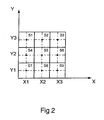
- an area of the substrate is partitioned into a grid (2) so as to determine the centers of the surfaces to be magnetized and to establish the coding system, but preferably this grid is not visually represented on the substrate. so as not to be easily spotted by falsifiers.
- This grid can be in the form of columns and lines whose intersections constitute the surfaces (S 1 , S 2 , S 3 ). Size The minimum of these surfaces is determined according to the dimensions of the writing heads which will make it possible to magnetize the magnetic particles participating in the marking. This grid will also serve to guide the movement of the writing heads and also magnetism presence detection heads.
- This grid is provided with an abscissa axis and an ordinate axis in order to be able to assign geometric coordinates to the centers of the surfaces (S 1 , S 2 , S 3, etc.) and to be able to constitute data files and to do software treatments.
- Substrate means any substrate comprising a magnetic marking by virtue of the magnetic particles according to the invention and possibly other identification, authentication or additional control elements. It may be in particular substrates for the production of labels or product packaging whose data relating to their authenticity and their distribution circuit must be controlled. It may still be official documents, such as passports, identity cards or fiduciary documents, tickets or payment vouchers, but also any document, particularly paper that one wishes to be able to control, such as banknotes. entrance to sports or cultural events, transport tickets.
- state of the detected signal is meant a given amplitude value of the current inside the magnetoresistance of the detection head. This amplitude value varies according to the magnetic field encountered.
- Paper means any sheet of paper or cardboard obtained by wet process using a suspension of natural cellulose fibers and / or synthetic fibers and which may contain various mineral fillers and various additives, such as binders commonly used in stationery.
- said substrate has a thickness of between 1 and 2000 ⁇ m, preferably between 1 and 800 ⁇ m and more preferably between 10 and 600 ⁇ m.
- the magnetic particles can be included directly in the substrate, ie as they are in the mass or in a coating on the surface of the substrate, or indirectly in the substrate, ie via an element of security. In the latter case, said magnetic particles may be included in the mass of said security element or in a coating applied on the surface of said security element, said security element being itself totally or partially comprised in the mass of the substrate or applied on the surface of it.
- security element any element associated with the substrate, especially paper, and contributing to the authentication of the substrate or making it counterfeit difficult. It may be, in particular, a particular coating on the surface of the substrate, or an element included in the mass or applied to the surface of the substrate, such as a plastic strip included, in whole or in part in the mass of the substrate, a hologram applied to the surface of the substrate, or to another security element.
- Coating on the surface of the substrate or the security element means that it is a coating which is not, at least in part, covered by a masking layer, said coating may be present on the outer surface of the substrate or be located below or between other layers which themselves do not directly mask said coating, at least in part.
- the characteristic that "the magnetic particles do not affect the appearance characteristics of said area” is meant that it is not necessary to hide said area to make them invisible.
- the characteristic that "magnetic particles do not affect the appearance characteristics of the zone” means that when they are included in the mass of the substrate, or included within a security element , itself included, in whole or in part, in the mass of the substrate, or when included in a coating on the surface of the substrate, or said security element, the particles as such are not discernible. and the appearance, in particular the brightness (L *) and / or colorimetric coordinates (L *, a *, b *) in the CIELAB system, and / or the opacity of the substrate, and / or the element of security are not or very little changed.
- the Delta E * color difference in the CIELAB formula between a control substrate without magnetic particles and the same substrate distinguished only by the presence of magnetic particles according to the present invention is less than 10. More generally, the Delta E * color deviation in the CIELAB formula between a said zone comprising said magnetic particles and an area distinguished by the absence of magnetic particles, is less than 10.
- the brightness L * is greater than 70 and preferably 80.
- ISO whiteness according to ISO 2471 is greater than or equal to 60% and / or CIE whiteness according to CIELAB is greater than or equal to 20% under illuminant D65 without UV and at an observation angle of 10 °.
- Whiteness-giving fillers known in the paper industry such as, for example, titanium dioxide or calcium carbonate, can be added to improve whiteness, particularly at levels of between 2 and 10%.
- the substrate, security element or coating on the surface of the substrate or security element is transparent or translucent, their opacity is not substantially modified so that the transparency is retained.
- the invention makes it possible to associate in the same zone a magnetic marking with a security or identification element such as, in particular, a visual effect identification element, in particular an element comprising inscriptions intended to be seen, without the presence of the magnetic particles involved in the marking does not obscure the desired visual effect with said security element, in particular said visual effect identification element.
- a security or identification element such as, in particular, a visual effect identification element, in particular an element comprising inscriptions intended to be seen
- the magnetic marking can therefore be associated with known security or identification elements, and / or over large areas of said substrates.
- These substrates comprise a magnetic marking which can be made according to a large number of combinations of magnetized surfaces because the entire extent of the substrate can be used and moreover this marking is invisible to the naked eye and invisible to the magnifying glass.
- the detection of the magnetic presence of the marking is done using heads equipped with magneto-resistive sensors which have a much higher sensitivity to the inductive heads used previously; it is therefore possible to characterize the saturation or remanent magnetization of the magnetic particles with very low particle concentrations.
- magneto-resistive heads it is necessary that the magnetic particles do not form agglomerates or inhomogeneous aggregates. It is therefore necessary that magnetic particles are well individualized and uniformly dispersed and distributed in their substrate.
- uniform distribution of the magnetic particles it is therefore meant that the volume density of particles in said zone, ie in the mass of the substrate or of said security element or in the coating on the surface of said substrate or said security element in said area, and thus the saturation or non-volatile magnetic magnetization in said area are substantially constant so that there is little or no background noise. This characteristic is necessary to detect the marking recorded in said zone and to subsequently decode it reliably.
- a substrate suitable for the present invention is advantageously made using a dispersion of the magnetic particles in which a good individualization of the particles is obtained, which makes it possible to prevent a reagglomeration of said particles.
- the particles are in the form of particles capable of being coated with a layer, even a discrete (ie non-continuous) layer originating from the dispersion medium.
- the dispersion comprises a wetting and dispersing surfactant to allow the individualization of the particles and the redispersion of this dispersion in the final incorporation medium.
- the particles are stabilized against sedimentation by advantageously incorporating a rheology control agent if necessary. This way of incorporating the dispersion is particularly advantageous when the dispersion is incorporated in a liquid medium and at very high dilution rates and in addition under heavy stirring because one might fear a reagglomeration by a "leaching" of the particles. that is, by destroying the protective and stabilizing layer that has formed around the individualized particles.
- a method of manufacturing said substrate suitable for the invention relates to a method of incorporating said magnetic particles into the mass of the substrate or said security element or into a said coating on the surface of said substrate or said security element in said zone.
- Said particles have a dimension and a concentration such that they do not affect the appearance characteristics of said area and allow a uniform distribution of particles in said area as mentioned above.
- a dispersion of magnetic particles is mixed with the base material of the substrate or a coating applied to the surface of the substrate.
- the magnetic particles can therefore advantageously be incorporated into the mass of a paper by mixing an aqueous dispersion of said particles with the mixture of fibers, in particular cellulose or cotton fibers, and conventional paper-making auxiliaries for producing the paper sheet.
- a dispersion of magnetic particles in an organic medium is mixed with the base mixture for use in the manufacture of said plastic sheet substrate.
- the plastic sheets may in particular be based on a polyolefin such as polyethylene or polypropylene or their copolymers, and comprise pigment fillers, anti-static agents. They can be obtained by extrusion or injection. The leaves can be stretched.
- Said zone comprising said particles may concern all or only part of the substrate. Preferably, it concerns the entire extent of the substrate so that the number combinations of the marking is high and that this zone is the most difficult to locate by unsuspecting people.
- the direct incorporation of the magnetic particles into the mass of the substrate, or into a coating on the surface of the substrate in an area covering the entire substrate makes it possible to considerably extend the marking possibilities of the substrate of the present invention.
- the magnetic particles when included directly in the mass of the substrate, or in a coating on the surface of the substrate, they may be included in a localized zone, especially in the form of a strip, in particular a width of 1 at 10 cm and a height of the same dimensions by methods known to those skilled in the art, said area not necessarily covering the entire substrate.
- the present invention is particularly advantageous when the substrate comprising said magnetic particles is a substrate, especially of paper, light in color, in particular white, cream or pale yellow.
- the brightness L * of the CIELAB system is greater than 70 and preferably 80.
- the ISO whiteness according to ISO 2471 is preferably greater than or equal to 60% and the CIE whiteness according to the CIELAB formula is preferably greater than or equal to 20%, measured under D65 illuminant without UV at an observation angle of 10 °.
- this coating may consist of an ink or a varnish or a coating or sizing composition, which may to be applied respectively by printing or coating paper.
- the coating composition may comprise in particular, besides said magnetic particles, a binder of the polyvinyl alcohol (PVA) type, starch or polymer in aqueous dispersion (latex), coating fillers, water and additives.
- the varnish may comprise in particular, besides said magnetic particles, a polymeric binder, a solvent and additives.
- the coating composition can be applied by means known to those skilled in the art with coating facilities, such as press-gluing machine, metal-blade coater, air-knife coater, CHAMPION rotary-bar coater, predosed film transfer coater.
- coating facilities such as press-gluing machine, metal-blade coater, air-knife coater, CHAMPION rotary-bar coater, predosed film transfer coater.
- inks or varnishes mention is made more particularly of printing inks or varnishes which can be applied by gravure printing, intaglio printing, offset printing or screen printing on a thickness of 1 to 5 ⁇ m.
- printing varnishes mention may be made of soluble varnishes in aqueous medium or in organic solvent medium which are dried by evaporation, and varnishes fixed by UV radiation or electron ("electron beam").
- the surface coating comprising magnetic particles may also consist of an adhesive composition applied to the surface of the substrate, in particular paper or a security element, in particular, a heat-sealing varnish facilitating the holding of said security element in the mass of the substrate, especially of paper.
- the coating on the surface of the substrate may also consist of a plastic film in the mass of which are incorporated the magnetic particles, including a film thickness of 10 to 500 microns.
- said coating can be advantageously transparent or translucent.
- the particles When the particles are included in the mass of a security element, they are considered to be included in the mass of said substrate and the concentrations of magnetic particles are those indicated above when the particles are included in the mass of said substrate.
- the present invention it is possible to apply transparent magnetic layers having a thickness of 1 to 5 ⁇ m on a strip, enabling magnetic marking and its detection.
- the particles may be incorporated into the substrate by deposition of a specific magnetic layer or simply by mixing with layers involved in the production of the substrate, such as the layer of a protective varnish, the layer of a heat-sealing varnish, or incorporated in the mass for example of a security element which will be introduced or affixed to the substrate.
- holograms are sometimes transparent holograms, ie non-metallized holograms or partially demetallized holograms.
- dark magnetic layer is on the one hand incompatible with the transparency properties of the hologram and on the other hand, resists the partial demetallization treatment of the hologram, making it impossible to perform an inscription with recesses of the type called " Cleartext Colour
- the present invention makes it possible to associate a magnetic marking with holograms advantageously. To do this, it is sufficient to mix the magnetic particles with the layers composing the hologram, such as an adhesive layer, an embossing lacquer, a protective varnish or in a "primer” of adhesion and to carry out the marking as described. This "primer” adhesion is applied to the surface of the support on which the hologram will be glued to promote its adhesion.
- a holographic strip it is also possible to incorporate said magnetic particles in the mass of a polyester substrate forming said strip or in the heat-sealing varnish, allowing adhesion of said strip in the mass of the substrate, in particular paper.
- the present invention provides transparent or partially demetallized holograms comprising magnetic marking.
- An additional advantage of the holographic strips is to obtain a magnetic property hologram without affecting traditional manufacturing processes and without unduly increasing its thickness.
- the magnetic particles participating in the magnetic marking are included in a film.
- This variant makes it possible to produce plastic films, in particular packaging films, labels or protective films with a magnetic marking in the mass of the film.
- the protective film is a complex of a transparent plastic film, security inks (fluorescent, iridescent, etc.) and an adhesive.
- the present invention it is possible to make a magnetic marking which corresponds for example to the country giving the nationality of the holder of the passport or of the identity card, this in the mass of the protective film, without this marking being visible or does not interfere with a standard layout, the entire page can be used to support the marking.
- the magnetic particles involved in the marking are included in the adhesive of the protective film.
- the adhesive constitutes a malleable and ductile heat-sensitive recording medium that is relatively more fragile than a film.
- the present invention also makes it possible to produce substrates consisting of a packaging sheet or a sheet of paper intended for the manufacture of a packaging sheet, said magnetic particles being incorporated into the mass of the substrate constituting said sheet or in a coating applied to the surface of said substrate.
- the present invention also makes it possible to produce labels, particularly of paper, which are particularly advantageous.
- the magnetic particles may be incorporated into the mass of the substrate or in a coating applied to the surface of the substrate on the front of the label, in particular in a transparent varnish-type coating, or on the back, in particular in an adhesive applied to the substrate. surface of said substrate on its back. In all cases, the magnetic marking is never visible, even on the back side through a transparent support on which the label is applied like a bottle, in particular, when it is a label of a bottle of wine or a bottle of perfume.
- the marking is carried out using magnetic particles obtained from so-called high coercivity materials, that is to say which have a coercitivity greater than or equal to 135 ⁇ 10 3 A / m (about 1700 Oe) and preferably greater than or equal to 218.10 3 A / m (approximately 2700 Oe).
- This coercivity is generally less than 800.10 3 A / m (about 10,000 Oe).
- the present invention is particularly advantageous when said carrier is a label or a packaging sheet or a packaging film.
- the invention makes it possible to associate in the same area an invisible magnetic marking and an authentication element such as those known in the field of security documents, in particular with visual effect, such as certain security threads, the effect devices variable optics such as diffraction gratings, holograms, moire patterns, iridescent prints or tapes, ink-based prints thermochromic or other. Visual effect or readability is not obscured by the presence of magnetic particles.
- the magnetic particles can therefore be associated with authentication or security elements.
- the anti-theft devices can coexist with the presence of the marking obtained with the magnetic particles.
- Such a support is therefore inviolable because the zones containing the marking can not be easily identified.
- the mixing of the magnetic particles in the bulk of the substrate or a transparent to translucent coating allows to distribute them uniformly over the entire surface of the support and superimpose them on inscriptions or patterns, in negative or in positive , without altering their visibility and appearance.
- the present invention provides in particular a substrate characterized in that the magnetic particles have a coercitivity greater than or equal to 135 ⁇ 10 3 A / m, preferably greater than or equal to 218 ⁇ 10 3 A / m.
- the present invention provides in particular a substrate characterized in that the magnetic particles have an average size of less than 2 ⁇ m, preferably of between 0.1 and 1 ⁇ m, and more preferably of between 0.1 and 0.5 ⁇ m.
- the present invention provides in particular a substrate characterized by the fact that said substrate is a sheet comprising cellulose fibers.
- the present invention provides in particular a substrate characterized in that it is a sheet having a thickness of between 1 and 2000 ⁇ m.
- the present invention provides in particular a substrate characterized in that it is a sheet having a thickness of between 1 and 800 ⁇ m, preferably between 10 and 600 ⁇ m.
- the present invention provides in particular a substrate characterized in that said magnetic particles are included in said coating on the surface of the substrate, said coating consisting of an adhesive.
- the present invention provides in particular a substrate characterized in that said particles are included in said coating on the surface of the substrate, said coating consisting of a coating composition.
- the present invention provides a substrate characterized in that the magnetic particles are included in a coating applied to a hologram or a constituent layer of a hologram.
- the present invention provides in particular a substrate characterized in that said hologram is a transparent hologram or partially demetallized hologram.
- the present invention provides in particular a substrate characterized in that said substrate has a light color, in particular white, cream or pale yellow.
- the present invention provides in particular a substrate characterized in that the area of said substrate or a said coating comprising said particles has a brightness L * according to the CIELAB system greater than 70 and preferably 80.
- the present invention provides in particular a substrate characterized in that the zone of said substrate or of said coating comprising said particles, has an ISO whiteness according to ISO 2471 greater than or equal to 60% under D65 illuminant without UV at an angle observation of 10 °.
- the present invention provides in particular a substrate characterized in that the area of the substrate comprising said particles has a CIE whiteness according to the CIELAB formula of the substrate is greater than or equal to 20% under D65 illuminant without UV at an observation angle of 10. °.
- the present invention provides in particular a substrate characterized in that said substrate or said coating on the surface of the substrate is transparent or translucent.
- the present invention provides in particular a substrate characterized in that it has a basis weight greater than or equal to 200 g / m 2 .
- the present invention provides in particular a substrate characterized in that said substrate is a package.
- the present invention provides in particular a substrate characterized in that said substrate is a label.
- the present invention provides in particular a substrate characterized in that the zone comprising said magnetic particles represents the entire extent of the substrate.
- the present invention also relates to a method of producing a substrate according to claim 27.
- the present invention provides in particular a method characterized by the fact that the marking is carried out using at least one inductive writing head and that the detection of the presence or absence of magnetism is carried out with the aid of at least one magnetoresistive head.
- the present invention provides in particular a method characterized by the fact that the head (s) of writing and the head (s) of detection are controlled by system with software to navigate the entire grid (2).
- the present invention provides in particular a method characterized in that said information to be marked is analyzed according to the same grid as the grid (2) by an image analysis software.
- the present invention provides in particular a method characterized in that the decoded information is reconstructed visually using an image reconstruction software.
- the present invention also relates to a device for the magnetic marking of information, such as alphanumeric or graphic information relating to a product, on a substrate (1) and the decoding of said marking of said substrate according to claim 35 or 36.
- the present invention provides in particular a device characterized by the fact that it comprises means that translate said reconstituted information into voice form.
- the present invention provides in particular a device characterized in that the magnetic write head (s) is / are of the inductive type.
- the present invention provides in particular a device characterized by the fact that the detection head (s) of the magnetic detection means is / are of the magnetoresistive type.
- the present invention provides in particular a device characterized in that the writing means is selected from the means comprising one or more moving heads, the means comprising fixed heads in a number equal to that of the number of surfaces (S1, S2 , S3, ...) constituting the grid.
- the present invention provides in particular a device characterized in that the detection means is chosen from the means comprising one or more moving heads, the means comprising fixed heads in a number equal to that of the number of surfaces (S1, S2, S3, ...) constituting the grid.
- the present invention provides in particular a device characterized in that the writing means is connected to a control system provided with a software generating the respective coordinates (X n , Y p ) of the centers of the surfaces to be magnetized in connection with the pre-established coding system.
- paper is made with 0.06% by dry weight of magnetic particles of high coercivity uniformly distributed in the mass of the paper as follows. In 300 liters of water, 2 kg of cellulose fibers are suspended containing 60% long fibers and 40% short fibers. This suspension is refined to about 40 degrees Schoepper-Riegler. Then 10% by weight (based on the weight of the fibers) of kaolin as mineral fillers and dyes based on ferric oxides giving the substrate a specific cream color are added. Then an aqueous dispersion of magnetic particles is added to the mixing chamber.
- a cationic bonding agent (0.8% dry weight of a rosin) and a cationic retention agent [0.6% by dry weight of a cationic starch]; the percentages being expressed with respect to the cellulose fibers.
- the magnetic particles are barium ferrites and have a coercivity of 218.84 x 10 3 A / m (2750 Oe); the largest dimension of the particles is less than about 1 ⁇ m.
- the aqueous dispersion of magnetic particles was obtained in the following manner.
- a powder of barium ferrites is added with stirring to an aqueous solution of a surfactant, both wetting and dispersing, such as an ammonium salt of polyacrylic acid and optionally a grinding resin such as PVA which has good compatibility with the medium to which it will be incorporated later, namely the fibrous suspension.
- a pulp with a high particle content is obtained, called grinding pulp, which is then ground in a horizontal type ball mill to destroy the agglomerates and individualize the particles so as to obtain particles less than 1 ⁇ m in size.
- the individualized magnetizable particle concentrate is then rediluted and stabilized against sedimentation by adding a rheology modifier, such as an aqueous gel of bentonites or pyrogenic silicas.
- a rheology modifier such as an aqueous gel of bentonites or pyrogenic silicas.
- the dispersion obtained contains 10% of magnetic particles in dry weight.
- the CIE whiteness is also determined according to the formula CIELAB; it is 22.3.
- ISO whiteness is also determined according to ISO 2471 (reflectance at 457 nm). It is 57.5 because the paper was made to be cream in color.
- the paper has a basis weight of 320 g / m 2 ; this basis weight is measured according to ISO 536 after conditioning according to ISO 187. 2 / From this substrate, a case is manufactured to pack for example a perfume bottle. 3 / It prints on this case, a visible bar code and / or fluorescent unit, that is to say characteristic of the case.
- This barcode contains as information a reference number related to the contents of the case. This number and the description of the corresponding content are stored in the file of a database on a computer.
- the country of destination given, for example Japan is marked on the case by magnetizing only certain centers of these new surfaces.
- the three surfaces (S 1 , S 3 , S 7 ) of respective coordinates (X1, Y3), (X3, Y3) and (X1, Y1) which will have magnetism correspond to the code of Japan.
- Correspondence between coordinates of the surfaces (S 1 , S 3 , S 7 ) and the name of the country Japan is stored in the file (F) of a database on a computer.
- the three respective centers of the surfaces are magnetized by means of a multi-head writing system, in this case nine heads, controlled by an automation software that positions the system correctly. above the accessible portion of the case (2) at the grid which is marked by an optical system with respect to the right front corner of the case.
- the coordinates of the centers of the surfaces to be magnetized are generated from the file (F) and determine which magnetic write heads must be activated.
- a current is then applied in the heads positioned on the centers of the surfaces to be magnetized (S 1 , S 3 , S 7 ) so as to magnetize the magnetic particles contained in the paper to carry out the marking.
- the write heads are inductive heads that have a gap length of 100 ⁇ m and a width of 6 mm, the magnetism is generated by the heads with a saturation induction of about 2 Tesla.
- the truly magnetized surfaces (S ' 1 , S' 3 , S ' 7 ) are centered on the centers of the surfaces (S 1 , S 3 , S 7 ) and have the shape of a rectangle having the size of the writing heads that is to say, 6 mm high and 100 microns wide and are actually present on a depth of 75 microns in the paper along the lines of the magnetic write field.
- the figure 3 shows a diagram of the grid (2) magnified twice with the indication of the magnetized surfaces (S '1, S' 3, S '7) around the respective centers of the surfaces (S 1, S 3, S 7). 7 /
- such a magnetic marking can be made on the carton containing the cases and on a label applied to the pallet, if this carton and this label contain magnetic particles and are made as the paper cases.
- the reading operation can be practiced during packaging of the bottles in order to verify that the marking is correct and also during a control of the products, for example to fight against the parallel markets.
- the marking of the magnetic marking zone is established with respect to a given impression itself identified by optical recognition.
- the detection of the presence or absence of magnetism is also done by grid of the magnetic marking zone, after identification, using a magnetoresistive head.
- the position of the head is recorded in a file each time a magnetization is detected and thus we find the coordinates relative to the centers of the magnetized surfaces. Thanks to a software that will map the magnetized centers, and if necessary using an image reconstruction software, we will establish the image of the logo that can be shown on the screen of the computer that processes the scanned data or a printer attached to it.
- a plastic case is made in the following manner.
- a dispersion of magnetic particles is produced in the following manner.
- Magnetic particles are dispersed with stirring using a dispersing agent, such as a polyacrylate, and optionally a grinding resin, having good compatibility with the medium to which it will be incorporated later.
- the paste obtained is then treated in a ball mill to destroy the agglomerates and individualize the particles.
- the dispersion obtained comprises 10% of magnetic particles in dry weight.
- the magnetic particles are barium ferrites which have a coercivity of 278.84 x 10 3 A / m (2750 Oe).
- the largest particle size is less than about 1 ⁇ m.
- the dispersion of magnetic particles and granules of a random copolymer of ethylene and propylene are mixed to form a masterbatch.
- This mixture is heated to 210 ° C.
- the resulting masterbatch is cooled and dried. The passage through a granulator makes it possible to obtain rods (granules) of constant size.
- this masterbatch is introduced with another masterbatch comprising an ethylene-propylene copolymer and an antistatic agent and this mixture is heated to 210.degree. After extrusion and calendering, a sheet 70 ⁇ 100 cm is obtained. The sheets obtained are translucent and have a thickness of 300 ⁇ m. For 100 parts by weight of the copolymer, there is 0.15 parts of antistatic agent and 0.05 parts of magnetic particles in dry weight.
- a transparent plastic magnetic label is produced in the following way:
- An acrylic adhesive in a solvent medium (mixture of ethyl acetate and heptane) containing the magnetic particles is applied to a transparent film of polyethylene terephthalate by means of a scribing coating. 0.19 parts of the magnetic particles in the form of the magnetic dispersion of Example 1 were introduced per 100 parts of the adhesive by dry weight. The amount of magnetic adhesive deposited is 23 g / m 2 dry. The support film has a thickness of 23 ⁇ m before depositing the adhesive. A transparent magnetic and adhesive label is obtained. This label is applied to a clear plastic bottle. We do not alter the aesthetic appearance of the bottle.
- the magnetic marking of the case and its use can be made as in Example 2.
- the vial thus labeled can be packaged in the case of Example 1 or Example 4, and thus make the magnetic marking both in the package and in the label. So we have a link between the product and its packaging.
- packaging is made as follows.
- an aqueous dispersion of magnetic particles is produced as follows:
- the barium ferrite powder is added with stirring to an aqueous solution of a surfactant, both wetting and dispersing, such as an ammonium salt of the poly (acrylic acid) and optionally a grinding resin having good compatibility with the environment to which it will be incorporated later.
- a surfactant such as an ammonium salt of the poly (acrylic acid) and optionally a grinding resin having good compatibility with the environment to which it will be incorporated later.
- the paste obtained is then treated in a ball mill to destroy the agglomerates and individualize the particles.
- the concentrate of individualized magnetic particles is then rediluted and stabilized against the sedimentation of the particles by adding a rheology modifying agent, such as for example an aqueous gel of bentonites or pyrogenic silicas.
- the dispersion comprises, by dry weight, 10 percent of magnetic particles.
- the amount deposited is 10 g / m 2 by dry weight.
- a case is formed as in Example 4 and the labeling and decoding of the marking is carried out as in Example 4.
- the observation of the hologram is not affected by the presence of the magnetic layer.
- Marking is carried out as in Example 4 at the level of the holographic strip. The marking is detected without being impeded by the presence of the holographic strip.
Landscapes
- Physics & Mathematics (AREA)
- General Physics & Mathematics (AREA)
- Engineering & Computer Science (AREA)
- Theoretical Computer Science (AREA)
- Computer Security & Cryptography (AREA)
- Credit Cards Or The Like (AREA)
- Magnetic Record Carriers (AREA)
- Manufacturing Of Magnetic Record Carriers (AREA)
- Soft Magnetic Materials (AREA)
- Dental Preparations (AREA)
- Hard Magnetic Materials (AREA)
Claims (43)
- Substrat (1) mit einer magnetischen Markierung, die sich auf eine Information, wie zum Beispiel eine alphanumerische oder grafische Information, bezieht, wobei das Substrat so beschaffen ist, dass es wenigstens eine Zone mit magnetischen Teilchen aufweist, die die Markierung für das bloße Auge unsichtbar macht, und dass- die magnetischen Teilchen in der Substratmasse und/oder in einer Beschichtung auf der Oberflächen des Substrats enthalten sind,- die magnetischen Teilchen gleichmäßig in der Zone verteilt sind,- die magnetischen Teilchen, um die Maskierung unsichtbar zu machen, nicht die Erscheinungcharakteristika der Zone bei komplett fehlender Maskierung der Teilchen beeinflüssen, und
die Teilchen wenigstens eine oder mehrere der folgenden Konzentratiönscharakteristika aufweisen:(a) die magnetischen Teilchen sind in der Substratmasse oder in der auf einer Oberfläche des Substrats aufgebrachten Beschichtung mit zwischen 0,02 und 0,07 Gew.-% in der Zone enthalten,(b) die Teilchen sind in der auf der Oberfläche des Substrats aufgebrachten Beschichtung in einer Menge zwischen 5 und 50 mg/m2 in der Zone enthalten, und- eine Fläche der Zone mit den magnetischen Teilchen in Oberflächen (S1, S2, S3) gemäß einem visuell nicht vorhandenen Gitter (2) unterteilt ist, wobei jede Oberfläche ein Koordinatenzentrum (Xn, Yp) gemäß der Abszissenachse X und der Ordinatenachse Y des Gitters (2) aufweist,- bestimmte Oberflächen (S 1, S2, S3...) des Gitters in ihren jeweiligen Zentren gemäß einem vorbestimmten Kodiersystem magnetisiert sind, das eine Entsprechungsbeziehung der magnetisierten Oberflächen der magnetischen Markierung mit der genannten Information herstellt,- das Vorhandensein oder Fehlen von Magnetismus im Zentrum jeder Oberfläche (S1, S2, S3...) des Gitters (2) dazu ausgelegt ist, durch einen oder mehrere Magnetköpfe detektiert und in ein elektrisches Signal konvertiert zu werden, wobei der Zustand des detektierten Signals für jedes der Koordinatenzentren (Xn, Yp) bezüglich jeder Oberfläche (S1, S2, S3...) des Gitters bestimmt werden kann. - Substrat nach Anspruch 1, dadurch gekennzeichnet, dass es einen Markierungsaufdruck zur optischen Erkennung aufweist, mittels dem bestimmte Oberflächen (S1, S2, S3...) des Gitters (2) magnetisiert sind oder Jedes Zentrum jeder Oberfläche des Gitters detektiert wird.
- Substrat nach einem der vorstehenden Ansprüche, dadurch gekennzeichnet, dass die magnetischen Teilchen eine Koerzitivität von mindestens 135,103 A/m, vorzugsweise mindestens 218.103 A/m aufweisen.
- Substrat nach einem der vorstehenden Ansprüche, dadurch gekennzeichnet, dass die magnetischen Teilchen eine mittlere Größe von weniger als 2 µm, vorzugsweise zwischen 0,1 und 1 µm, besonders vorzugsweise zwischen 0,1 und 0,5 µm aufweisen.
- Substrat nach einem der vorstehenden Ansprüche, dadurch gekennzeichnet, dass das Substrat ein Cellulosefasern enthaltendes Blatt ist.
- Substrat nach einem der vorstehenden Ansprüche, dadurch gekennzeichnet, dass es in einem Blatt mit einer Dicke zwischen 1 und 2000 µm besteht.
- Substrat nach einem der vorstehenden Ansprüche, dadurch gekennzeichnet, dass es in einem Blatt mit einer Dicke zwischen 1 und 800 µm, vorzugsweise zwischen 10 und 600 µm besteht.
- Substrat nach einem der vorstehenden Ansprüche, dadurch gekennzeichnet, dass die magnetischen Teilchen in der Beschichtung auf der Oberfläche des Substrats enthalten sind, und die Beschichtung aus einem Klebstoff besteht.
- Substrat nach einem der Ansprüche 1 bis 7, dadurch gekennzeichnet, dass die magnetischen Teilchen in der Beschichtung auf der Oberfläche des Substrats enthalten sind und die Beschichtung aus einem Lack besteht.
- Substrat nach einem der Ansprüche 1 bis 7, dadurch gekennzeichnet, dass die magnetischen Teilchen in der Beschichtung auf der Oberfläche des Substrats enthalten sind und die Beschichtung aus einer Tinte besteht.
- Substrat nach einem der Ansprüche 1 bis 7, dadurch gekennzeichnet, dass die Teilchen in der Beschichtung auf der Oberfläche des Substrats enthalten sind und die Beschichtung aus einer Einbettungs- oder Aufklebezusammensetzung besteht.
- Substrat nach eine der Ansprüche 1 bis 7, dadurch gekennzeichnet, dass die Teilchen in der Beschichtung auf der Oberfläche des Substrats enthalten sind und die Beschichtung aus einem Film, insbesondere einem Kunststofffilim besteht.
- Substrat nach einem der Ansprüche 1 bis 7, dadurch gekennzeichnet, dass die Teilchen in der Beschichtung, insbesondere einem Thermosiegellack, auf der Oberfläche eines Sicherheitselements enthalten sind.
- Substrat nach einem der Ansprüche 1 bis 7, dadurch gekennzeichnet, dass die Teilchen in einer Sicherheitselement-Masse enthalten sind.
- Substrat nach einem der vorstehenden Ansprüche, dadurch gekennzeichnet, dass die Teilchen in einem Film, insbesondere einem Plastikfilm und ferner insbesondere einem Verpackungsfilm oder einem Schutzfilm, enthalten sind.
- Substrat nach einem der vorstehenden Ansprüche, dadurch gekennzeichnet, dass die magnetischen Teilchen in einer Beschichtung enthalten sind, die auf einem Hologramm oder einer das Hologramm bildenden Schicht aufgebracht ist.
- Substrat nach Anspruch 16, dadurch gekennzeichnet, dass das Hologramm ein transparentes oder teilweises entmetallisiertes Hologramm ist.
- Substrat nach einem der vorstehenden Ansprüche, dadurch gekennzeichnet, dass das Substrat eine helle Farbe, insbesondere weiß, cremefarben oder blassgelb hat.
- Substrat nach einem der vorstehenden Ansprüche, dadurch gekennzeichnet, dass die Zone des Substrats oder der die Teilchen enthaltenden Beschichtung eine Leuchtkraft L* gemäß dem System CIELAB von mehr als 70, vorzugsweise mehr als 80, aufweist.
- Substrat nach einem der vorstehenden Ansprüche, dadurch gekennzeichnet, dass die Zone des Substrats oder der die Teilchen enthaltenden Beschichtung eine ISO-Weiße gemäß der ISO-Norm 2471 von mindestens 60% bei Bestrahlung mit D65 ohne UV unter einem Beobachtungswinkel von 10° aufweist.
- Substrat nach einem der vorstehenden Ansprüche, dadurch gekennzeichnet, dass die die Teilchen enthaltende Zone des Substrats, eine CIE-Weiße gemäß der CIELAB-Formel des Substrats von mindestens 20% bei Bestrahlung mit D65 ohne UV unter einem Beobachtungswinkel von 10 aufweist.
- Substrat nach einem der vorstehenden Ansprüche, dadurch gekennzeichnet, dass das Substrat oder die Beschichtung auf der Oberfläche des Substrats transparent oder transluzent ist.
- Substrat nach einem der vorstehenden Ansprüche, dadurch gekennzeichnet, dass es ein Flächengewicht von mindestens 200 g/m2 aufweist.
- Substrat nach einem der vorstehenden Ansprüche, dadurch gekennzeichnet, dass das Substrat eine Verpackung ist.
- Substrat nach einem der Ansprüche 1 bis 11, dadurch gekennzeichnet, dass das Substrat ein Etikett ist.
- Substrat nach einem der vorstehenden Ansprüche, dadurch gekennzeichnet, dass die die magnetischen Teilchen enthaltende Zone die gesamte Flächenausdehnung des Substrats darstellt.
- Verfahren zur Herstellung eines Substrats (1) nach einem der vorstehenden Ansprüche, das eine magnetische Markierung bezüglich einer Information, wie zum Beispiel einer alphanumerischen oder grafischen Information, aufweist, sowie zur Dekodierung der Markierung, wobei in dem Verfahren:- ein Substrat durch Mischen einer Dispersion der magnetischen Teilchen mit dem Herstellungsmedium des Substrats oder der Beschichtung auf der Oberfläche des Substrats gemäß den genannten Konzentrationen hergestellt wird,- ein Flächenbereich der die magnetischen Teilchen enthaltenden Zone gemäß einem Gitter (2) in Oberflächen (S1, S2, S3,...) unterteilt wird, wobei jede Oberfläche ein Koordinatenzentrum (Xn, Yp) gemäß der Abszissenachse X und der Ordinatenachse Y des Gitters (2) aufweist, und das Zentrum von bestimmten Oberflächen (S1, S2, S3...) des Gitters (2) gemäß einem vorbestimmten Kodiersystem magnetisiert wird, das eine Entsprechungsbeziehung der magnetisierten Oberflächen oder der magnetischen Markierung mit der genannten Information herstellt, wobei die Entsprechung in einer datenbasierten Datei (F) niedergelegt ist, das Vorhandensein oder Fehlen von Magnetismus im Zentrum jeder Fläche (S1, S2, S3...) des Gitters (2) dazu geeignet ist, von einem oder mehreren Magnetköpfen detektiert und in ein elektrisches Signal konvertiert zu werden, und der Zustand des detektierten Signals für jedes der Koordinatenzentren (Xn, Yp) der jeweiligen Oberflächen (S1, S2, S3...) des Gitters (2) bestimmt werden kann.
- Verfahren nach Anspruch 27, in dem die Dispersion ein benetzendes und dispergierendes Tensid enthält.
- Verfahren nach Anspruch 27 oder 28, dadurch gekennzeichnet, dass:- das Vorhandensein oder Fehlen von Magnetismus an den Zentren der Oberflächen (S1, S2; S3...) des Gitters (2) detektiert und anschließend in ein elektrisches Signal konvertiert wird,- der Zustand des detektierten Signals für jedes Koordinatenzentrum (Xn, Yp) der jeweiligen Oberflächen (S1, S2, S3...) des Gitters bestimmt wird,- die Kombination der Oberflächenzentren, die Magnetismus zeigen, bestimmt wird,- diese Kombination im Zusammenhang mit der Datei (F) bezüglich eines vorbestimmten Kodiersystems analysiert und dekodiert wird, um die gesuchte Information zu liefern.
- Verfahren nach einem der vorstehenden Ansprüche 27 oder 29, dadurch gekennzeichnet, dass die Markierung mittels wenigstens eines Induktionsschreibkopfs hergestellt wird und die Detektion des Vorhandenseins oder Fehlens von Magnetismus mittels wenigstens eines Magnetwiderstandskopfs erfolgt.
- Verfahren nach einem der vorstehenden Ansprüche 27 oder 29, dadurch gekennzeichnet, dass die Markierung mittels wenigstens eines Induktionsschreibkopfs hergestellt wird und die Detektion des Vorhandenseins oder Fehlens von Magnetismus mittels mehrerer Magnetwiderstandsköpfe erfolgt, die über den Zentren der Oberflächen des Gitters (2) positioniert werden.
- Verfahren nach dem vorstehenden Anspruch, dadurch gekennzeichnet, dass der/die Schreibkopf/Schreibköpfe und der/die Detektionskopf/Detektionsköpfe durch ein softwaregesteuertes System gelenkt werden, das ein Durchlaufen des gesamten Gitters (2) gestattet.
- Verfahren nach einem der Ansprüche 27 bis 29, dadurch gekennzeichnet, dass die zu markierende Information mittels einer Bildanalysesoftware gemäß dem gleichen Gitter analysiert wird wie das Gitter (2).
- Verfahren nach einem der Ansprüche 27 bis 33, dadurch gekennzeichnet, dass die dekodierte Information mittels einer Bildrekonstruktionssoftware visuell rekonstruiert wird.
- Gegenstand, der die magnetische Markierung einer Information bezüglich eines Produkts und das Dekodieren der Markierung eines Substrats gestattet, mit:- einem Substrat (1) gemäß einem der Ansprüche 1 bis 18, das hinsichtlich der Information in Verbindung mit dem Produkt steht,- einer magnetischen Schreibeinrichtung, die die magnetische Markierung des Substrats (1) herstellt,- einer Einrichtung zur Detektion des Vorhandenseins oder Fehlens von Magnetismus gemäß einer visuellen Markierung auf dem Substrat,- einer Einrichtung zum Konvertieren des Magnetismus jedes Zentrums der jeweiligen Oberflächen (S1, S2, S3...) in ein elektrisches Signal,- einer Einrichtung zum Bestimmen der Koordinatenzentren der Magnetismus zeigenden Oberflächen, um eine Verbindung zur magnetischen Markierung zu ermitteln,- einer Einrichtung zum Übersetzen dieser Koordinatenverbindung in die genannte Information gemäß dem vorbestimmten Kodiersystem.
- Gegenstand, der die magnetische Markierung einer Information bezüglich eines Produkts und das Dekodieren der Markierung eines Substrats gestattet, mit:- einem Substrat (1) gemäß einem der Ansprüche 1 bis 18, das mit dem Produkt verbunden ist,- einer magnetischen Schreibeinrichtung, die die magnetische Markierung einer Information bezüglich des Produkts auf dem Substrat (1) herstellt,- einer Einrichtung zur Detektion des Vorhandenseins oder Fehlens von Magnetismus gemäß einem Winkel des Produkts oder einem Winkel des Substrats,- einer Einrichtung zum Konvertieren des Magnetismus jedes Zentrums der jeweiligen Oberflächen (S1, S2, S3...) in ein elektrisches Signal,- einer Einrichtung zum Bestimmen der Koordinatenzentren der Magnetismus zeigenden Oberflächen, um eine Verbindung zur magnetischen Markierung zu ermitteln,- einer Einrichtung zum Übersetzen dieser Koordinatenverbindung in die genannte Information gemäß dem vorbestimmten Kodiersystem.
- Gegenstand nach einem der Ansprüche 35 und 36, dadurch gekennzeichnet, dass er eine Einrichtung (9) aufweist, die die wiederhergestellte alphanumerisehe oder grafische Information in Sprachform übersetzt.
- Gegenstand nach einem der Ansprüche 35 bis 37, dadurch gekennzeichnet, dass der/die magnetischen Schreibköpfe vom Induktionstyp ist/sind.
- Gegenstand nach einem der Ansprüche 35 bis 38, dadurch gekennzeichnet, dass der/die Magnetdetektionsköpfe vom Magnetwiderstandstyp ist/sind.
- Gegenstand nach einem der Ansprüche 35 bis 39, dadurch gekennzeichnet, dass die Einrichtung zum Schreiben oder Lesen ausgewählt ist aus Einrichtungen mit einem oder mehreren beweglichen Köpfen und Einrichtungen mit festen Köpfen einer Anzahl, die der Anzahl der Oberflächen (S1, S2, S3,...), die das Gitter bilden, gleich ist und über den Oberflächenzentren des Gitters positioniert sind.
- Gegenstand nach einem der Ansprüche 35 bis 40, dadurch gekennzeichnet, dass die Detektionseinrichtung ausgewählt ist aus Einrichtungen mit einem oder mehreren beweglichen Köpfen und Einrichtungen mit festen Köpfen, deren Anzahl der Anzahl von Oberflächen (S1, S2, S3, ...), die das Gitter bilden, gleich ist.
- Gegenstand nach einem der Ansprüche 35 bis 41, dadurch gekennzeichnet, dass die Schreibeinrichtung mit einem sofwaregesteuerten Lenkungssystem verbunden ist, das die Koordinaten (Xn, Yp) der jeweiligen zu magnetisierenden. Oberflächenzentren in Verbindung mit dem vorbestimmten Kodiersystem erzeugt.
- Gegenstand nach einem der Ansprüche 35 bis 42, dadurch gekennzeichnet, dass die Detektionseinrichtung verbunden ist mit:- einem sofwaregesteuerten Lenkungssystem, das dem/den Detektionsköpfen ein Durchlaufen des gesamten Gitters (2) ennöglicht,- einem System zur Analyse des durch die Detektionsköpfe gelesenen Signals,- einer Software, die eine Bestimmung der Koordinatcnzentren der magnetisierten Oberflächen erlaubt, um eine Verknüpfung zur magnetischen Markierung herzustellen,- einer Software, die ein Übersetzen dieser Verknüpfung in die genannten Information in Verbindung mit der Datei (F) bezüglich des vorbestimmten Kodicrsystems ermöglicht.
Applications Claiming Priority (2)
| Application Number | Priority Date | Filing Date | Title |
|---|---|---|---|
| FR9906349 | 1999-05-19 | ||
| FR9906349A FR2793886B1 (fr) | 1999-05-19 | 1999-05-19 | Substrat comportant un marquage magnetique, procede de fabrication dudit substrat et dispositif l'utilisant |
Publications (2)
| Publication Number | Publication Date |
|---|---|
| EP1054343A1 EP1054343A1 (de) | 2000-11-22 |
| EP1054343B1 true EP1054343B1 (de) | 2011-04-06 |
Family
ID=9545759
Family Applications (1)
| Application Number | Title | Priority Date | Filing Date |
|---|---|---|---|
| EP00401353A Expired - Lifetime EP1054343B1 (de) | 1999-05-19 | 2000-05-17 | Substrat, das eine magnetische Markierung enthält, Verfahren zu dessen Herstellung und Vorrichtung, die es verwendet |
Country Status (5)
| Country | Link |
|---|---|
| EP (1) | EP1054343B1 (de) |
| AT (1) | ATE504890T1 (de) |
| DE (1) | DE60045807D1 (de) |
| ES (1) | ES2364394T3 (de) |
| FR (1) | FR2793886B1 (de) |
Families Citing this family (6)
| Publication number | Priority date | Publication date | Assignee | Title |
|---|---|---|---|---|
| AU2008341036B2 (en) * | 2007-12-21 | 2012-08-16 | Electro Life Pty Ltd | Magnetic wrap |
| CN102448830B (zh) * | 2009-05-29 | 2014-06-25 | 利乐拉瓦尔集团及财务有限公司 | 包括可磁化部分的包装材料 |
| US20170100862A1 (en) | 2015-10-09 | 2017-04-13 | Lexmark International, Inc. | Injection-Molded Physical Unclonable Function |
| US9665748B1 (en) | 2016-08-03 | 2017-05-30 | Lexmark International, Inc. | Magnetic helical physical unclonable function measured adjacent to flight |
| US9542576B1 (en) * | 2016-08-03 | 2017-01-10 | Lexmark International, Inc. | Magnetic helical physical unclonable function measured above flight |
| CN113239930B (zh) * | 2021-05-14 | 2024-04-05 | 广州广电运通金融电子股份有限公司 | 一种玻璃纸缺陷识别方法、系统、装置及存储介质 |
Family Cites Families (7)
| Publication number | Priority date | Publication date | Assignee | Title |
|---|---|---|---|---|
| US528898A (en) | 1894-11-06 | Railway electric switch | ||
| DE805811C (de) | 1948-10-02 | 1951-05-31 | Basf Ag | Verfahren zur Herstellung von Magnetogrammtraegern |
| GB8817855D0 (en) * | 1988-07-27 | 1988-09-01 | Emi Plc Thorn | Electromagnetic identification system |
| US5143583A (en) * | 1991-04-02 | 1992-09-01 | Marchessault Robert H | Preparation and synthesis of magnetic fibers |
| US5288981A (en) * | 1991-10-25 | 1994-02-22 | Allsafe Company, Inc. | Method and apparatus for encoding machine readable serial encryptedmagnetic data |
| EP0736840A3 (de) * | 1995-04-07 | 2000-03-15 | Eastman Kodak Company | Magnetisch kodierbare Karte mit magnetischem Pigment gleichmässig verteilt in Plastik und Herstellungsverfahren |
| US5714747A (en) * | 1996-07-17 | 1998-02-03 | Eastman Kodak Company | Magnetic card and reader system |
-
1999
- 1999-05-19 FR FR9906349A patent/FR2793886B1/fr not_active Expired - Fee Related
-
2000
- 2000-05-17 AT AT00401353T patent/ATE504890T1/de not_active IP Right Cessation
- 2000-05-17 EP EP00401353A patent/EP1054343B1/de not_active Expired - Lifetime
- 2000-05-17 DE DE60045807T patent/DE60045807D1/de not_active Expired - Lifetime
- 2000-05-17 ES ES00401353T patent/ES2364394T3/es not_active Expired - Lifetime
Also Published As
| Publication number | Publication date |
|---|---|
| FR2793886B1 (fr) | 2001-06-22 |
| EP1054343A1 (de) | 2000-11-22 |
| ES2364394T3 (es) | 2011-09-01 |
| DE60045807D1 (de) | 2011-05-19 |
| FR2793886A1 (fr) | 2000-11-24 |
| ATE504890T1 (de) | 2011-04-15 |
Similar Documents
| Publication | Publication Date | Title |
|---|---|---|
| EP1034536B1 (de) | Sicherheitsinformationsträger | |
| US6138913A (en) | Security document and method using invisible coded markings | |
| DE69718826T2 (de) | Sicherheitsdokument und methode welche unsichtbare kodierte markierungen verwendet | |
| EP0500726B1 (de) | Kunststoffträger mit wasserzeichen | |
| CN110662655B (zh) | 产生水不溶性量子点图案的方法 | |
| US20100108874A1 (en) | Film element for detecting authenticity | |
| US6813011B2 (en) | Process for blending of ink used in counterfeit detection systems | |
| US6483576B1 (en) | Counterfeit detection system | |
| EP2406084A1 (de) | Lasermarkierbares substrat und zugehöriges herstellungsverfahren | |
| US20050116465A1 (en) | Packaging with embedded security measures | |
| FR2907136A1 (fr) | Ruban de securite, feuille et document de securite le comportant et procede d'incorporation | |
| EP2914440A1 (de) | Durch wärmetransferdruck personalisierbare sichere karte | |
| EP1054343A1 (de) | Substrat, das eine magnetische Markierung enthält, Verfahren zu dessen Herstellung und Vorrichtung, die es verwendet | |
| JP2008173862A (ja) | 真偽判定体 | |
| KR200400312Y1 (ko) | 복제가 불가능한 라벨 | |
| JPH04303678A (ja) | 感熱情報記録媒体 | |
| US20050269819A1 (en) | Packaging with embedded security measures | |
| CN1044860A (zh) | 防伪材料及其制作方法 | |
| JP2003293287A (ja) | 塗工シート | |
| FR2868093A1 (fr) | Papier de securite couche |
Legal Events
| Date | Code | Title | Description |
|---|---|---|---|
| PUAI | Public reference made under article 153(3) epc to a published international application that has entered the european phase |
Free format text: ORIGINAL CODE: 0009012 |
|
| AK | Designated contracting states |
Kind code of ref document: A1 Designated state(s): AT BE CH CY DE DK ES FI FR GB GR IE IT LI LU MC NL PT SE |
|
| AX | Request for extension of the european patent |
Free format text: AL;LT;LV;MK;RO;SI |
|
| 17P | Request for examination filed |
Effective date: 20010522 |
|
| AKX | Designation fees paid |
Free format text: AT BE CH CY DE DK ES FI FR GB GR IE IT LI LU MC NL PT SE |
|
| RAP1 | Party data changed (applicant data changed or rights of an application transferred) |
Owner name: ARJO WIGGINS |
|
| RAP1 | Party data changed (applicant data changed or rights of an application transferred) |
Owner name: ARJO WIGGINS SECURITY SAS |
|
| 17Q | First examination report despatched |
Effective date: 20070504 |
|
| GRAP | Despatch of communication of intention to grant a patent |
Free format text: ORIGINAL CODE: EPIDOSNIGR1 |
|
| RIN1 | Information on inventor provided before grant (corrected) |
Inventor name: RANCIEN, SANDRINE |
|
| GRAS | Grant fee paid |
Free format text: ORIGINAL CODE: EPIDOSNIGR3 |
|
| GRAA | (expected) grant |
Free format text: ORIGINAL CODE: 0009210 |
|
| AK | Designated contracting states |
Kind code of ref document: B1 Designated state(s): AT BE CH CY DE DK ES FI FR GB GR IE IT LI LU MC NL PT SE |
|
| REG | Reference to a national code |
Ref country code: GB Ref legal event code: FG4D Free format text: NOT ENGLISH |
|
| REG | Reference to a national code |
Ref country code: CH Ref legal event code: EP |
|
| REG | Reference to a national code |
Ref country code: IE Ref legal event code: FG4D |
|
| REF | Corresponds to: |
Ref document number: 60045807 Country of ref document: DE Date of ref document: 20110519 Kind code of ref document: P |
|
| REG | Reference to a national code |
Ref country code: DE Ref legal event code: R096 Ref document number: 60045807 Country of ref document: DE Effective date: 20110519 |
|
| REG | Reference to a national code |
Ref country code: CH Ref legal event code: NV Representative=s name: KIRKER & CIE S.A. |
|
| REG | Reference to a national code |
Ref country code: NL Ref legal event code: T3 |
|
| PGFP | Annual fee paid to national office [announced via postgrant information from national office to epo] |
Ref country code: ES Payment date: 20110525 Year of fee payment: 12 Ref country code: FR Payment date: 20110607 Year of fee payment: 12 Ref country code: CH Payment date: 20110524 Year of fee payment: 12 |
|
| PGFP | Annual fee paid to national office [announced via postgrant information from national office to epo] |
Ref country code: GB Payment date: 20110520 Year of fee payment: 12 Ref country code: NL Payment date: 20110520 Year of fee payment: 12 |
|
| REG | Reference to a national code |
Ref country code: ES Ref legal event code: FG2A Ref document number: 2364394 Country of ref document: ES Kind code of ref document: T3 Effective date: 20110901 |
|
| PGFP | Annual fee paid to national office [announced via postgrant information from national office to epo] |
Ref country code: DE Payment date: 20110520 Year of fee payment: 12 |
|
| REG | Reference to a national code |
Ref country code: IE Ref legal event code: FD4D |
|
| PG25 | Lapsed in a contracting state [announced via postgrant information from national office to epo] |
Ref country code: PT Free format text: LAPSE BECAUSE OF FAILURE TO SUBMIT A TRANSLATION OF THE DESCRIPTION OR TO PAY THE FEE WITHIN THE PRESCRIBED TIME-LIMIT Effective date: 20110808 Ref country code: SE Free format text: LAPSE BECAUSE OF FAILURE TO SUBMIT A TRANSLATION OF THE DESCRIPTION OR TO PAY THE FEE WITHIN THE PRESCRIBED TIME-LIMIT Effective date: 20110406 |
|
| BERE | Be: lapsed |
Owner name: ARJO WIGGINS SECURITY SAS Effective date: 20110531 |
|
| PG25 | Lapsed in a contracting state [announced via postgrant information from national office to epo] |
Ref country code: FI Free format text: LAPSE BECAUSE OF FAILURE TO SUBMIT A TRANSLATION OF THE DESCRIPTION OR TO PAY THE FEE WITHIN THE PRESCRIBED TIME-LIMIT Effective date: 20110406 Ref country code: AT Free format text: LAPSE BECAUSE OF FAILURE TO SUBMIT A TRANSLATION OF THE DESCRIPTION OR TO PAY THE FEE WITHIN THE PRESCRIBED TIME-LIMIT Effective date: 20110406 Ref country code: CY Free format text: LAPSE BECAUSE OF FAILURE TO SUBMIT A TRANSLATION OF THE DESCRIPTION OR TO PAY THE FEE WITHIN THE PRESCRIBED TIME-LIMIT Effective date: 20110406 Ref country code: GR Free format text: LAPSE BECAUSE OF FAILURE TO SUBMIT A TRANSLATION OF THE DESCRIPTION OR TO PAY THE FEE WITHIN THE PRESCRIBED TIME-LIMIT Effective date: 20110707 |
|
| PG25 | Lapsed in a contracting state [announced via postgrant information from national office to epo] |
Ref country code: MC Free format text: LAPSE BECAUSE OF NON-PAYMENT OF DUE FEES Effective date: 20110531 |
|
| PG25 | Lapsed in a contracting state [announced via postgrant information from national office to epo] |
Ref country code: IE Free format text: LAPSE BECAUSE OF FAILURE TO SUBMIT A TRANSLATION OF THE DESCRIPTION OR TO PAY THE FEE WITHIN THE PRESCRIBED TIME-LIMIT Effective date: 20110406 |
|
| PLBE | No opposition filed within time limit |
Free format text: ORIGINAL CODE: 0009261 |
|
| STAA | Information on the status of an ep patent application or granted ep patent |
Free format text: STATUS: NO OPPOSITION FILED WITHIN TIME LIMIT |
|
| PG25 | Lapsed in a contracting state [announced via postgrant information from national office to epo] |
Ref country code: DK Free format text: LAPSE BECAUSE OF FAILURE TO SUBMIT A TRANSLATION OF THE DESCRIPTION OR TO PAY THE FEE WITHIN THE PRESCRIBED TIME-LIMIT Effective date: 20110406 |
|
| 26N | No opposition filed |
Effective date: 20120110 |
|
| PG25 | Lapsed in a contracting state [announced via postgrant information from national office to epo] |
Ref country code: BE Free format text: LAPSE BECAUSE OF NON-PAYMENT OF DUE FEES Effective date: 20110531 |
|
| REG | Reference to a national code |
Ref country code: DE Ref legal event code: R097 Ref document number: 60045807 Country of ref document: DE Effective date: 20120110 |
|
| REG | Reference to a national code |
Ref country code: NL Ref legal event code: V1 Effective date: 20121201 |
|
| REG | Reference to a national code |
Ref country code: CH Ref legal event code: PL |
|
| GBPC | Gb: european patent ceased through non-payment of renewal fee |
Effective date: 20120517 |
|
| PG25 | Lapsed in a contracting state [announced via postgrant information from national office to epo] |
Ref country code: CH Free format text: LAPSE BECAUSE OF NON-PAYMENT OF DUE FEES Effective date: 20120531 Ref country code: LI Free format text: LAPSE BECAUSE OF NON-PAYMENT OF DUE FEES Effective date: 20120531 |
|
| PG25 | Lapsed in a contracting state [announced via postgrant information from national office to epo] |
Ref country code: IT Free format text: LAPSE BECAUSE OF NON-PAYMENT OF DUE FEES Effective date: 20120517 |
|
| REG | Reference to a national code |
Ref country code: FR Ref legal event code: ST Effective date: 20130131 |
|
| REG | Reference to a national code |
Ref country code: DE Ref legal event code: R119 Ref document number: 60045807 Country of ref document: DE Effective date: 20121201 |
|
| PG25 | Lapsed in a contracting state [announced via postgrant information from national office to epo] |
Ref country code: NL Free format text: LAPSE BECAUSE OF NON-PAYMENT OF DUE FEES Effective date: 20121201 |
|
| PG25 | Lapsed in a contracting state [announced via postgrant information from national office to epo] |
Ref country code: FR Free format text: LAPSE BECAUSE OF NON-PAYMENT OF DUE FEES Effective date: 20120531 Ref country code: GB Free format text: LAPSE BECAUSE OF NON-PAYMENT OF DUE FEES Effective date: 20120517 |
|
| PG25 | Lapsed in a contracting state [announced via postgrant information from national office to epo] |
Ref country code: LU Free format text: LAPSE BECAUSE OF NON-PAYMENT OF DUE FEES Effective date: 20110517 |
|
| PG25 | Lapsed in a contracting state [announced via postgrant information from national office to epo] |
Ref country code: DE Free format text: LAPSE BECAUSE OF NON-PAYMENT OF DUE FEES Effective date: 20121201 |
|
| REG | Reference to a national code |
Ref country code: ES Ref legal event code: FD2A Effective date: 20130820 |
|
| PG25 | Lapsed in a contracting state [announced via postgrant information from national office to epo] |
Ref country code: ES Free format text: LAPSE BECAUSE OF NON-PAYMENT OF DUE FEES Effective date: 20120518 |