EP1054401B1 - Detektorschaltung und Verfahren zur Fehlerunterdrückung - Google Patents
Detektorschaltung und Verfahren zur Fehlerunterdrückung Download PDFInfo
- Publication number
- EP1054401B1 EP1054401B1 EP00303986A EP00303986A EP1054401B1 EP 1054401 B1 EP1054401 B1 EP 1054401B1 EP 00303986 A EP00303986 A EP 00303986A EP 00303986 A EP00303986 A EP 00303986A EP 1054401 B1 EP1054401 B1 EP 1054401B1
- Authority
- EP
- European Patent Office
- Prior art keywords
- error
- encoding method
- bit
- epr4
- samples
- Prior art date
- Legal status (The legal status is an assumption and is not a legal conclusion. Google has not performed a legal analysis and makes no representation as to the accuracy of the status listed.)
- Expired - Lifetime
Links
- 238000000034 method Methods 0.000 title claims abstract description 17
- 238000001914 filtration Methods 0.000 claims description 15
- 238000004590 computer program Methods 0.000 claims description 8
- 238000012545 processing Methods 0.000 claims description 5
- 238000001514 detection method Methods 0.000 abstract description 11
- 238000012805 post-processing Methods 0.000 abstract description 10
- 230000007704 transition Effects 0.000 description 10
- 230000004044 response Effects 0.000 description 7
- 230000004083 survival effect Effects 0.000 description 7
- 238000012546 transfer Methods 0.000 description 6
- 238000007476 Maximum Likelihood Methods 0.000 description 5
- 238000012937 correction Methods 0.000 description 5
- 238000005070 sampling Methods 0.000 description 5
- 230000006870 function Effects 0.000 description 4
- 230000005415 magnetization Effects 0.000 description 3
- 230000015654 memory Effects 0.000 description 3
- 238000013459 approach Methods 0.000 description 2
- 238000004891 communication Methods 0.000 description 2
- 230000000295 complement effect Effects 0.000 description 2
- 230000003111 delayed effect Effects 0.000 description 2
- 238000010586 diagram Methods 0.000 description 2
- 238000009987 spinning Methods 0.000 description 2
- 230000001629 suppression Effects 0.000 description 2
- 238000010200 validation analysis Methods 0.000 description 2
- 230000008859 change Effects 0.000 description 1
- 230000007423 decrease Effects 0.000 description 1
- 230000005381 magnetic domain Effects 0.000 description 1
- 238000012986 modification Methods 0.000 description 1
- 230000004048 modification Effects 0.000 description 1
- 230000003287 optical effect Effects 0.000 description 1
- 238000013139 quantization Methods 0.000 description 1
- 230000008707 rearrangement Effects 0.000 description 1
- 238000011084 recovery Methods 0.000 description 1
- 230000011664 signaling Effects 0.000 description 1
- 238000012360 testing method Methods 0.000 description 1
Images


Classifications
-
- G—PHYSICS
- G11—INFORMATION STORAGE
- G11B—INFORMATION STORAGE BASED ON RELATIVE MOVEMENT BETWEEN RECORD CARRIER AND TRANSDUCER
- G11B20/00—Signal processing not specific to the method of recording or reproducing; Circuits therefor
- G11B20/10—Digital recording or reproducing
- G11B20/10009—Improvement or modification of read or write signals
- G11B20/10046—Improvement or modification of read or write signals filtering or equalising, e.g. setting the tap weights of an FIR filter
- G11B20/10055—Improvement or modification of read or write signals filtering or equalising, e.g. setting the tap weights of an FIR filter using partial response filtering when writing the signal to the medium or reading it therefrom
- G11B20/10064—EEPR4 or E2PR4, i.e. extended partial response class 4, polynomial (1-D)*(1+D)3
-
- G—PHYSICS
- G11—INFORMATION STORAGE
- G11B—INFORMATION STORAGE BASED ON RELATIVE MOVEMENT BETWEEN RECORD CARRIER AND TRANSDUCER
- G11B20/00—Signal processing not specific to the method of recording or reproducing; Circuits therefor
- G11B20/10—Digital recording or reproducing
- G11B20/10009—Improvement or modification of read or write signals
-
- G—PHYSICS
- G11—INFORMATION STORAGE
- G11B—INFORMATION STORAGE BASED ON RELATIVE MOVEMENT BETWEEN RECORD CARRIER AND TRANSDUCER
- G11B20/00—Signal processing not specific to the method of recording or reproducing; Circuits therefor
- G11B20/10—Digital recording or reproducing
- G11B20/10009—Improvement or modification of read or write signals
- G11B20/10046—Improvement or modification of read or write signals filtering or equalising, e.g. setting the tap weights of an FIR filter
- G11B20/10055—Improvement or modification of read or write signals filtering or equalising, e.g. setting the tap weights of an FIR filter using partial response filtering when writing the signal to the medium or reading it therefrom
- G11B20/10074—EPR4, i.e. extended partial response class 4, polynomial (1-D) *(1+D)2
-
- G—PHYSICS
- G11—INFORMATION STORAGE
- G11B—INFORMATION STORAGE BASED ON RELATIVE MOVEMENT BETWEEN RECORD CARRIER AND TRANSDUCER
- G11B20/00—Signal processing not specific to the method of recording or reproducing; Circuits therefor
- G11B20/10—Digital recording or reproducing
- G11B20/18—Error detection or correction; Testing, e.g. of drop-outs
- G11B20/1833—Error detection or correction; Testing, e.g. of drop-outs by adding special lists or symbols to the coded information
Definitions
- the invention relates to electronic devices, and, more particularly, but not exclusively, to digital communications and storage with partial response sequential detectors.
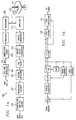
- Figure 1a schematically illustrates a magnetic storage and retrieval system.
- Error correction coder 101 encodes data bits into error corrected bits by an error correction encoding method such as Reed-Solomon. Further, the error correction coding may include interleaving of blocks of bits.
- modulation coder (channel coder) 103 codes blocks of bits output by error corrected coder 101 into blocks of bits using a runlength-limited code or other channel code which may include a parity bit for post processing removal of dominant errors. This modulation coding helps read timing recovery. These blocks may then be precoded. Then the (precoded) modulation coded bits drive the read/write head to set the magnetization orientation of domains on spinning magnetic disk 111; this stores the data bits.
- the reading of the stored data bits first amplifies (and filters) with amplifier 121 voltages induced in the read/write head 113 due to the transitions of magnetization orientation of domains on spinning disk 111.
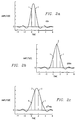
- These voltages have the ideal form of a sequence of overlapping pulses, such as illustrated (after shape filtering) in Figures 2a-2c, with positive, negative, or zero amplitudes.
- the pulse overlaps imply intersymbol interference if the subsequent digital sampling includes contributions from more than one pulse; indeed, Figures 2a-2c indicate the ideal sampling times.
- Clocked analog-to-digital converter 123 samples and quantizes the sequence of pulses to form a digital output stream; there may be 64 or 128 quantization levels (a 6-bit or 7-bit converter with one sign bit and 5 or 6 magnitude bits).
- the Viterbi detector 125 performs a maximum likelihood data detection on the digital output stream.
- an (E)PR4 sensed voltage consists of a sequence of overlapping (E)PR4 pulses spaced one period apart and with positive, negative, or zero amplitudes depending upon the corresponding transitions of magnetization domain orientations.
- the sampling of the (E)PR4 sensed voltage yields the digital stream input to the detector, typically a sequence detector such as a maximum likelihood Viterbi decoder.
- a sequence detector such as a maximum likelihood Viterbi decoder.
- Higher storage densities on a magnetic disk require more samples per induced pulse and consequent more overlap, and thus the higher order polynomial transfer functions are used.
- storage densities of about 3 bits per PW50 (pulse width at half maximum amplitude) would use EEPR4 which has four nonzero samples per pulse; see Figure 2c.
- the demand for high density originates with small, portable devices such as notebook computers.
- Modulation decoder 127 is the inverse of modulation coder 103.
- error correction decoder 129 deinterleaves and further corrects errors and recovers the data bits, hopefully with only minimal errors.
- Maximum likelihood detection of a digital stream with intersymbol interference can be described in terms of maximizing probabilities of paths through a trellis of state transitions (branches); each state corresponds to a possible pattern of recently received data bits and each stage of the trellis corresponds to a receipt of the next (noisy) input.
- Figure 3 illustrates one stage (one step in time) in the trellis for an EPR4 detector; the states are labeled with three previous data bits (reflecting the three non-zero sampled values in the isolated pulse) and the branches are labeled 'with the bit for the branch transition plus the corresponding noiseless input sample target values: 2, 1, 0, -1, or -2.
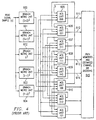
- FIG. 4 shows a prior art Viterbi detector which includes one add-compare-select (ACS) unit for each trellis state and a branch metric unit for each of the target levels t ij ; the survival register for each state is in the path memories block.
- Each branch metric unit computes the square of the difference between its target value and the noisy input sample value.
- Each ACS stores a metric for its state and has inputs for the appropriate branch metric computations and the related state metrics from other ACS units.
- each ACS adds its (two) input branch metric computations to the corresponding state metrics of the states emitting the branches; and then it compares these (two) sums and selects the smaller as the updated state metric for its state.
- Each state's survival register updates its contents to maintain a survival path for the state; that is, the sequence of selected bits (transitions) that have led to the updated state metric.
- the detected bits will correspond to the path with the smallest metric.
- the maximum likelihood path through the trellis up to that time is the path traced backwards through the trellis starting from the state with the smallest state metric at that time and recursively using the branch previously selected as the branch into the traced-to state. That is, the survival register contents for the state with the smallest state metric.
- the length of the survival registers depends on the modulation code used. As the decision goes deeper into the survival registers, more of the contesting survival paths (versus the correct path) will be eliminated, the detected data will become more accurate.
- An error event metric may be defined as the difference between the path metric for the correct path and path metric for the contender error path through the trellis that diverges from the correct path and later remerges.
- the minimum squared Euclidean distance (metric) between paths equals 4.
- the first four errors have a common characteristic in that the error occurs when three or more consecutive transitions exist.
- a modulation code which prevents three consecutive transitions (NRZI tribits) will preclude the foregoing errors except for the single bit error.
- removing all tribits yields a low code rate. Consequently, various codes such as W.Bliss, An 8/9 Rate Time-Varying Trellis code for High Density Magnetic Recording, Proc. 1997 IEEE Int. Mag. Conf. (April 1997) remove quadbits and limit tribits to certain positions within the codeword to regain code rate.
- aspects of the present invention provide a device and method of single bit error suppression by post processing after Viterbi detection using a filtering of the difference of the ideal samples from the detected bit stream and the detector input sample stream.
- the first preferred embodiments suppress single bit errors in an EPR4 channel by post processing after the initial EPR4 Viterbi detection.
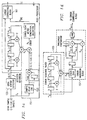
- Post processor 151 (details in Figures 1c-1d) filters the detected bit sequence, filters the sample sequence prior to detection, and then filters the difference of the two filtered sequences to assess the likelihood of a single bit error.
- the particular filterings provide single bit error detection with low-complexity by using EEPR4-type filters. If the comparison indicates a likely single bit error, then the output is corrected.
- Figure 1b is an overall preferred embodiment detector system block diagram showing an EEPR4-type filtering post processor 151 added onto an EPR4 system.
- This architecture allows post processor 151 to be added to a standard EPR4 system to improve the bit error rate (BER) performance without altering the EPR4 system.
- BER bit error rate
- Figure 1c is a block diagram of the first preferred embodiment post processor 151.
- the data path of the post processor can be broken down into two parts: the ideal data path and the sample data path.
- the ideal data path consists of four flip-flops, two multipliers (multiply by 2), and a four-input adder.
- Ideal EEPR4 samples have seven possible levels as compared to the five of ideal EPR4 samples.
- the EEPR4 transfer polynomial is (1-D)(1+D) 3 which can be expressed as (1-D)(1+D) 2 (1+D). And this is just the EPR4 transfer polynomial multiplied by (1+D).
- the samples input to the EPR4 Viterbi detector 125 can be converted into corresponding EEPR4 samples by filtering them with a 1+D filter.
- the samples input to the EPR4 Viterbi detector 125 are denoted as z[k]
- Figure 1c illustrates the ideal data path in the upper center and the sample data path in the lower left.
- the sample data path includes delay 153 to compensate for the delay through Viterbi detector 125 and thus synchronize with the ideal data path.
- the error event metric is then passed through error validation block 157 to identify the position of possible single bit errors. If the error event metric E[k] satisfies the following conditions, a flag will be sent to the error correction block 161 to invert the polarity of the k-5 output bit:
- a heuristic analysis will help clarify the operation of the foregoing preferred embodiment post processing.
- a common single bit error arises from pulse jitter in which the pulse induced in a read head is offset in time; this offset may be due to raggedness of the boundary of the magnetic domains of opposite polarities.
- the pulse offset combined with state metric variation within the Viterbi detector can lead to the single bit detection error.
- Figure 5 also shows the corresponding ideal correct samples and the ideal erroneous samples. That is, Figure 5 shows two ideal pulses and a delayed-by-jitter pulse in between the two ideal pulses.
- EEPR4 transfer function of -1, -2, 0, 2, 1 has such a shape and is convenient to use because EEPR4 hardware and software already exist.
- -1, -2, 0, 2, 1 filter to generate the E[k] sequence as 0, -1.2 ⁇ , -3.6 ⁇ - ⁇ 2 , -1.2 ⁇ -3 ⁇ 2 , 7.2 ⁇ -2 ⁇ 2 , 9.6 ⁇ +2 ⁇ 2 , 1.2 ⁇ +3 ⁇ 2 , -6 ⁇ + ⁇ 2 , -4.8 ⁇ , -1.2 ⁇ .
- the threshold of condition (2) being set equal to 5, and an error would be properly flagged by this E[k].
- the other terms of E[k] never exceed 4 in magnitude.
- the overall filtering from error bit to E[k] is (1-D)(1+D) 3 (1-D)(1+D) 3 which has coefficients 1,4,4,-4,-10,-4,4,4,1.
- the -10 coefficient has magnitude just twice the threshold, aligns with the dominate 9.6 ⁇ +2 ⁇ 2 + ⁇ term, and locates the error bit. Indeed, the magnitude of the -10 coefficient is more than twice that of the next largest magnitude coefficient.
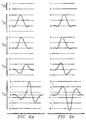
- Figures 6a-6b numerically illustrate the foregoing with z[k] taken as roughly equal to 0, 0.5, 1.8, 1.5, 0.5, 0, as in Figure 5. Indeed, with the correct bit sequence detected by Viterbi detector 125, the post processing would be as follows.
- the X C [k] sequence would be 0, 1, 1, 1, ...; the EEPR4 Y C [k] sequence 0, 1, 3, 3, 1, 0, 0; the error e C [k] sequence 0, -0.5, -0.7, 0.3, 1.0, 0.5, 0; and the error metric E C [k] sequence 0, -0.5, -1.7, -1.1, 0.6, 4.4, 1.1, 2.3, -2.0, -0.5 where (1+D)z[k] equal to 0, 0.5, 2.3, 3.3, 2.0, 0.5, 0, ... was used.
- Figure 6a illustrates these sequences and includes the ideal 0, 1, 2, 1, 0 EPR4 pulse for comparison.
- the post processing would be as follows. Using an E subscript for error, the X E [k] sequence would be 0, 0, 1, 1, 1, ...; the Y E [k] sequence 0, 0, 1, 3, 3, 1, 0; the e E [k] sequence 0, 0.5, 1.3, 0.3, -1.0, -0.5, 0; and the E E [k] sequence 0, 0.5, 2.3, 2.9, -0.4, -5.6, -2.9, 1.7, 2.0, 0.5.
- Figure 6b shows these sequences.
- Criteria (1) and (3) are met for E C [k] values -1.7, 4.4, and -2.3, and for E E [k] values 2.9, -5.6, and 2.0 (allowing 0 to be either sign).
- Setting the threshold at about 5 would correct the single bit error in that the error metric E C [k] for the correctly detected bit sequence does not set the error flag, but the error metric E E [k] for the incorrectly detected bit sequence does set the error flag.
- the samples z[k] could be compared to the ideal EPR4 samples and filtered by EPR4 to generate E[k].
- Figure 7 shows experimental results for the first preferred embodiment.
- the preferred embodiment post processor system shows a 1 dBN gain over a 16/17 code EPR4 system.
- the preferred embodiments can be modified in various ways while retaining the feature of a single bit error detection by comparison of the filtered difference between actual samples and ideal samples from the detected bit stream.
- the user bit density could be varied, the filtering to detect changed with corresponding changes in thresholds, and so forth.
- the computer program is stored on a carrier medium in machine or device readable form, for example in solid-state memory or magnetic memory such as disc or tape and the processing device utilises the program or a part thereof to configure it for operation.
- the computer program may be supplied from a remote source embodied in a communications medium such as an electronic signal, radio frequency carrier wave or optical carrier wave.
- a communications medium such as an electronic signal, radio frequency carrier wave or optical carrier wave.
- carrier media are also envisaged as aspects of the present invention.
Landscapes
- Engineering & Computer Science (AREA)
- Signal Processing (AREA)
- Physics & Mathematics (AREA)
- Algebra (AREA)
- Pure & Applied Mathematics (AREA)
- Signal Processing For Digital Recording And Reproducing (AREA)
- Error Detection And Correction (AREA)
- Detection And Correction Of Errors (AREA)
- Techniques For Improving Reliability Of Storages (AREA)
- Radar Systems Or Details Thereof (AREA)
- Detection And Prevention Of Errors In Transmission (AREA)
Claims (6)
- Verfahren zum Korrigieren von Fehlern, das umfasst:(a) Schätzen von Informationen aus einem ersten Abtastdatenstrom, in dem Informationen mit einem ersten Codierungsverfahren codiert sind;(b) Vergleichen der Differenz zwischen (i) dem Abtastdatenstrom nach einer ersten Filterung und (ii) einem idealen Abtastdatenstrom, der aus den geschätzten Informationen mit einem zweiten Codierungsverfahren erzeugt wird, wobei das zweite Codierungsverfahren das erste Codierungsverfahren plus die erste Filterung emuliert; und(c) Korrigieren der geschätzten Informationen aus (a), wenn der Vergleich von (b) einen Fehler angibt.
- Verfahren nach Anspruch 1, bei dem:(a) das erste Codierungsverfahren EPR4 ist; und(b) das zweite Codierungsverfahren EEPR4 ist.
- Computerprogramm, das Computerprogrammmittel zum Konfigurieren einer Verarbeitungsvorrichtung nach Anspruch 1 oder 2 umfasst.
- Computerprogramm-Trägermedium, das ein Computerprogramm nach Anspruch 3 trägt.
- Verarbeitungsvorrichtung, die gemäß einem Computerprogramm nach Anspruch 3 konfiguriert ist.
- Schaltung zum Korrigieren von Fehlern, die umfasst:Mittel (125), die Informationen aus einem ersten Abtastdatenstrom schätzen, in dem Informationen mit einem ersten Codierungsverfahren codiert sind;Mittel (155, 157), die die Differenz zwischen (i) dem Abtastdatenstrom nach einer ersten Filterung und (ii) einem idealen Abtastdatenstrom, der aus den geschätzten Informationen mit einem zweiten Codierungsverfahren erzeugt wird, vergleichen, wobei das zweite Codierungsverfahren das erste Codierungsverfahren plus der ersten Filterung emuliert; undMittel (161), die die geschätzten Informationen korrigieren, wenn die Vergleichsmittel einen Fehler angeben.
Applications Claiming Priority (2)
| Application Number | Priority Date | Filing Date | Title |
|---|---|---|---|
| US13490999P | 1999-05-19 | 1999-05-19 | |
| US134909P | 1999-05-19 |
Publications (3)
| Publication Number | Publication Date |
|---|---|
| EP1054401A2 EP1054401A2 (de) | 2000-11-22 |
| EP1054401A3 EP1054401A3 (de) | 2001-09-05 |
| EP1054401B1 true EP1054401B1 (de) | 2004-03-03 |
Family
ID=22465562
Family Applications (1)
| Application Number | Title | Priority Date | Filing Date |
|---|---|---|---|
| EP00303986A Expired - Lifetime EP1054401B1 (de) | 1999-05-19 | 2000-05-11 | Detektorschaltung und Verfahren zur Fehlerunterdrückung |
Country Status (6)
| Country | Link |
|---|---|
| US (1) | US6546518B1 (de) |
| EP (1) | EP1054401B1 (de) |
| JP (1) | JP2001024519A (de) |
| AT (1) | ATE261175T1 (de) |
| DE (1) | DE60008624T2 (de) |
| TW (1) | TW493165B (de) |
Families Citing this family (12)
| Publication number | Priority date | Publication date | Assignee | Title |
|---|---|---|---|---|
| JP2001266499A (ja) * | 2000-03-23 | 2001-09-28 | Sony Corp | データ記録装置及びデータ記録方法、データ再生装置及びデータ再生方法、並びに、データ記録再生装置及びデータ記録再生方法 |
| JP4555454B2 (ja) * | 2000-11-21 | 2010-09-29 | 富士通株式会社 | データ再生装置 |
| EP1271509A1 (de) * | 2001-06-22 | 2003-01-02 | STMicroelectronics S.r.l. | Verfahren und Vorrichtung zum Erkennen und Korrigieren von Fehlern in einem magnetischen Aufzeichnungskanal eines Massenspeichersystems |
| WO2003012789A1 (en) | 2001-07-27 | 2003-02-13 | Fujitsu Limited | Signal processing method, signal processing circuit and information recorder/reproducer |
| US7184237B2 (en) * | 2001-08-21 | 2007-02-27 | Seagate Technology Llc | Method and apparatus for selecting equalization targets |
| EP1508813B1 (de) * | 2003-08-20 | 2007-01-31 | Agilent Technologies, Inc. | Spektrale Jitter-Analyse mit Jitter-Modulation-Wellenform-Analyse |
| US7173784B2 (en) * | 2003-10-10 | 2007-02-06 | Hitachi Global Storage Technologies Netherlands B.V. | Apparatus for providing data dependent detection in a data read channel |
| JP4622632B2 (ja) * | 2005-03-31 | 2011-02-02 | ソニー株式会社 | 最尤復号装置、信号評価方法、再生装置 |
| US8145983B1 (en) * | 2006-11-08 | 2012-03-27 | Marvell International Ltd. | Methods and apparatus for identification of likely errors in data blocks |
| JP2009110572A (ja) * | 2007-10-29 | 2009-05-21 | Funai Electric Co Ltd | 光ディスク記録再生装置 |
| US7755521B1 (en) | 2008-12-23 | 2010-07-13 | Advantest Corporation | A-D convert apparatus, D-A convert apparatus and adjustment method |
| JP2020135391A (ja) | 2019-02-19 | 2020-08-31 | キオクシア株式会社 | メモリシステム |
Family Cites Families (9)
| Publication number | Priority date | Publication date | Assignee | Title |
|---|---|---|---|---|
| JPH0877726A (ja) * | 1994-09-06 | 1996-03-22 | Hitachi Ltd | ディジタル信号処理装置、誤り検出方法および記録媒体再生装置 |
| JPH08329619A (ja) * | 1994-10-27 | 1996-12-13 | Hitachi Ltd | データ再生方法、データ再生装置、およびデータ再生用回路 |
| US5521945A (en) | 1995-06-30 | 1996-05-28 | Quantum Corporation | Reduced complexity EPR4 post-processor for sampled data detection |
| US5938790A (en) * | 1997-03-04 | 1999-08-17 | Silicon Systems Research Ltd. | Sequence error event detection and correction using fixed block digital sum codes |
| US5949831A (en) * | 1997-05-21 | 1999-09-07 | International Business Machines Corporation | Method and apparatus for data detection for PRML data channels |
| US5961658A (en) * | 1997-05-23 | 1999-10-05 | Cirrus Logic, Inc. | PR4 equalization and an EPR4 remod/demod sequence detector in a sampled amplitude read channel |
| US6052248A (en) * | 1998-01-30 | 2000-04-18 | Cirrus Logic, Inc. | Parity channel code for enhancing the operation of a remod/demod sequence detector in a d=1 sampled amplitude read channel |
| US6185173B1 (en) | 1998-07-31 | 2001-02-06 | Cirrus Logic, Inc. | Sampled amplitude read channel employing a trellis sequence detector matched to a channel code constraint and a post processor for correcting errors in the detected binary sequence using the signal samples and an error syndrome |
| US6185175B1 (en) * | 1998-12-02 | 2001-02-06 | Cirrus Logic, Inc. | Sampled amplitude read channel employing noise whitening in a remod/demod sequence detector |
-
2000
- 2000-04-14 US US09/549,458 patent/US6546518B1/en not_active Expired - Lifetime
- 2000-05-11 AT AT00303986T patent/ATE261175T1/de not_active IP Right Cessation
- 2000-05-11 EP EP00303986A patent/EP1054401B1/de not_active Expired - Lifetime
- 2000-05-11 DE DE60008624T patent/DE60008624T2/de not_active Expired - Lifetime
- 2000-05-18 JP JP2000146722A patent/JP2001024519A/ja not_active Abandoned
- 2000-05-19 TW TW089109682A patent/TW493165B/zh not_active IP Right Cessation
Also Published As
| Publication number | Publication date |
|---|---|
| TW493165B (en) | 2002-07-01 |
| DE60008624D1 (de) | 2004-04-08 |
| EP1054401A2 (de) | 2000-11-22 |
| US6546518B1 (en) | 2003-04-08 |
| ATE261175T1 (de) | 2004-03-15 |
| EP1054401A3 (de) | 2001-09-05 |
| DE60008624T2 (de) | 2005-02-03 |
| JP2001024519A (ja) | 2001-01-26 |
Similar Documents
| Publication | Publication Date | Title |
|---|---|---|
| EP0369962B1 (de) | Verfahren zur Signalverarbeitung in einem Kanal | |
| US5689532A (en) | Reduced complexity EPR4 post-processor for sampled data detection | |
| US6023386A (en) | Fault tolerant sync mark detector for synchronizing a time varying sequence detector in a sampled amplitude read channel | |
| US6246723B1 (en) | Sampled amplitude read channel employing early-decisions from a trellis sequence detector for sampling value estimation | |
| US7089483B2 (en) | Two stage detector having viterbi detector matched to a channel and post processor matched to a channel code | |
| US6185173B1 (en) | Sampled amplitude read channel employing a trellis sequence detector matched to a channel code constraint and a post processor for correcting errors in the detected binary sequence using the signal samples and an error syndrome | |
| US6460150B1 (en) | Noise-predictive post-processing for PRML data channel | |
| GB2286952A (en) | Maximum-likelihood data detection in a partial-response data channel for a direct access storage device | |
| US6154870A (en) | Signal error-correction system and method | |
| EP1054401B1 (de) | Detektorschaltung und Verfahren zur Fehlerunterdrückung | |
| US6307884B1 (en) | Dual decision feedback equalizer with selective attenuation to improve channel performance | |
| US5844507A (en) | Rate 16/17 ENDEC with independent high/low byte decoding | |
| US6366418B1 (en) | Method for reducing data overhead in PRML data channel | |
| US6735724B1 (en) | Detection error estimation and method | |
| US6282690B1 (en) | Parity insertion with precoder feedback in a read channel | |
| US5949357A (en) | Time-varying maximum-transition-run codes for data channels | |
| US5838738A (en) | Coding to improve timing recovery in a sampled amplitude read channel | |
| WO1999017456A9 (en) | Method and apparatus for encoding a binary signal | |
| EP1046165B1 (de) | Erzeugung von amplitudenstufen für einen bitdetektor mit partiellen wiedergabe und höchster wahrscheinlichkeit (prml) | |
| JP3950579B2 (ja) | 符号化方法およびこれを用いた記録再生装置 | |
| US5786950A (en) | PR4 sampled amplitude read channel employing an NRZI write modulator and a PR4/NRZI converter | |
| JPWO1999039334A1 (ja) | 判定帰還等化における誤り伝搬抑制方法及び、これを用いた磁気再生回路 | |
| US6393598B1 (en) | Branch metric compensation for digital sequence detection | |
| US6882604B2 (en) | Method and apparatus for utilizing modulation codes that produce maximized sample timing information | |
| US6201779B1 (en) | MEEPR4 sampled amplitude read channel for disk storage systems |
Legal Events
| Date | Code | Title | Description |
|---|---|---|---|
| PUAI | Public reference made under article 153(3) epc to a published international application that has entered the european phase |
Free format text: ORIGINAL CODE: 0009012 |
|
| AK | Designated contracting states |
Kind code of ref document: A2 Designated state(s): AT BE CH CY DE DK ES FI FR GB GR IE IT LI LU MC NL PT SE |
|
| AX | Request for extension of the european patent |
Free format text: AL;LT;LV;MK;RO;SI |
|
| PUAL | Search report despatched |
Free format text: ORIGINAL CODE: 0009013 |
|
| AK | Designated contracting states |
Kind code of ref document: A3 Designated state(s): AT BE CH CY DE DK ES FI FR GB GR IE IT LI LU MC NL PT SE |
|
| AX | Request for extension of the european patent |
Free format text: AL;LT;LV;MK;RO;SI |
|
| 17P | Request for examination filed |
Effective date: 20020226 |
|
| AKX | Designation fees paid |
Free format text: AT BE CH CY DE DK ES FI FR GB GR IE IT LI LU MC NL PT SE |
|
| 17Q | First examination report despatched |
Effective date: 20020510 |
|
| GRAP | Despatch of communication of intention to grant a patent |
Free format text: ORIGINAL CODE: EPIDOSNIGR1 |
|
| RBV | Designated contracting states (corrected) |
Designated state(s): DE FR GB IT NL |
|
| GRAS | Grant fee paid |
Free format text: ORIGINAL CODE: EPIDOSNIGR3 |
|
| GRAA | (expected) grant |
Free format text: ORIGINAL CODE: 0009210 |
|
| RBV | Designated contracting states (corrected) |
Designated state(s): AT BE CH CY DE DK ES FI FR GB GR IE IT LI LU MC NL PT SE |
|
| AK | Designated contracting states |
Kind code of ref document: B1 Designated state(s): AT BE CH CY DE DK ES FI FR GB GR IE IT LI LU MC NL PT SE |
|
| PG25 | Lapsed in a contracting state [announced via postgrant information from national office to epo] |
Ref country code: IT Free format text: LAPSE BECAUSE OF FAILURE TO SUBMIT A TRANSLATION OF THE DESCRIPTION OR TO PAY THE FEE WITHIN THE PRESCRIBED TIME-LIMIT;WARNING: LAPSES OF ITALIAN PATENTS WITH EFFECTIVE DATE BEFORE 2007 MAY HAVE OCCURRED AT ANY TIME BEFORE 2007. THE CORRECT EFFECTIVE DATE MAY BE DIFFERENT FROM THE ONE RECORDED. Effective date: 20040303 Ref country code: CY Free format text: LAPSE BECAUSE OF FAILURE TO SUBMIT A TRANSLATION OF THE DESCRIPTION OR TO PAY THE FEE WITHIN THE PRESCRIBED TIME-LIMIT Effective date: 20040303 Ref country code: NL Free format text: LAPSE BECAUSE OF FAILURE TO SUBMIT A TRANSLATION OF THE DESCRIPTION OR TO PAY THE FEE WITHIN THE PRESCRIBED TIME-LIMIT Effective date: 20040303 Ref country code: AT Free format text: LAPSE BECAUSE OF FAILURE TO SUBMIT A TRANSLATION OF THE DESCRIPTION OR TO PAY THE FEE WITHIN THE PRESCRIBED TIME-LIMIT Effective date: 20040303 Ref country code: BE Free format text: LAPSE BECAUSE OF FAILURE TO SUBMIT A TRANSLATION OF THE DESCRIPTION OR TO PAY THE FEE WITHIN THE PRESCRIBED TIME-LIMIT Effective date: 20040303 Ref country code: CH Free format text: LAPSE BECAUSE OF FAILURE TO SUBMIT A TRANSLATION OF THE DESCRIPTION OR TO PAY THE FEE WITHIN THE PRESCRIBED TIME-LIMIT Effective date: 20040303 Ref country code: LI Free format text: LAPSE BECAUSE OF FAILURE TO SUBMIT A TRANSLATION OF THE DESCRIPTION OR TO PAY THE FEE WITHIN THE PRESCRIBED TIME-LIMIT Effective date: 20040303 |
|
| REG | Reference to a national code |
Ref country code: GB Ref legal event code: FG4D |
|
| REG | Reference to a national code |
Ref country code: CH Ref legal event code: EP |
|
| REG | Reference to a national code |
Ref country code: IE Ref legal event code: FG4D |
|
| REF | Corresponds to: |
Ref document number: 60008624 Country of ref document: DE Date of ref document: 20040408 Kind code of ref document: P |
|
| PG25 | Lapsed in a contracting state [announced via postgrant information from national office to epo] |
Ref country code: LU Free format text: LAPSE BECAUSE OF NON-PAYMENT OF DUE FEES Effective date: 20040511 Ref country code: IE Free format text: LAPSE BECAUSE OF NON-PAYMENT OF DUE FEES Effective date: 20040511 |
|
| PG25 | Lapsed in a contracting state [announced via postgrant information from national office to epo] |
Ref country code: FI Free format text: LAPSE BECAUSE OF NON-PAYMENT OF DUE FEES Effective date: 20040531 Ref country code: MC Free format text: LAPSE BECAUSE OF NON-PAYMENT OF DUE FEES Effective date: 20040531 |
|
| PG25 | Lapsed in a contracting state [announced via postgrant information from national office to epo] |
Ref country code: SE Free format text: LAPSE BECAUSE OF FAILURE TO SUBMIT A TRANSLATION OF THE DESCRIPTION OR TO PAY THE FEE WITHIN THE PRESCRIBED TIME-LIMIT Effective date: 20040603 Ref country code: DK Free format text: LAPSE BECAUSE OF FAILURE TO SUBMIT A TRANSLATION OF THE DESCRIPTION OR TO PAY THE FEE WITHIN THE PRESCRIBED TIME-LIMIT Effective date: 20040603 Ref country code: GR Free format text: LAPSE BECAUSE OF FAILURE TO SUBMIT A TRANSLATION OF THE DESCRIPTION OR TO PAY THE FEE WITHIN THE PRESCRIBED TIME-LIMIT Effective date: 20040603 |
|
| PG25 | Lapsed in a contracting state [announced via postgrant information from national office to epo] |
Ref country code: ES Free format text: LAPSE BECAUSE OF FAILURE TO SUBMIT A TRANSLATION OF THE DESCRIPTION OR TO PAY THE FEE WITHIN THE PRESCRIBED TIME-LIMIT Effective date: 20040614 |
|
| NLV1 | Nl: lapsed or annulled due to failure to fulfill the requirements of art. 29p and 29m of the patents act | ||
| REG | Reference to a national code |
Ref country code: CH Ref legal event code: PL |
|
| ET | Fr: translation filed | ||
| PLBE | No opposition filed within time limit |
Free format text: ORIGINAL CODE: 0009261 |
|
| STAA | Information on the status of an ep patent application or granted ep patent |
Free format text: STATUS: NO OPPOSITION FILED WITHIN TIME LIMIT |
|
| REG | Reference to a national code |
Ref country code: IE Ref legal event code: MM4A |
|
| 26N | No opposition filed |
Effective date: 20041206 |
|
| PG25 | Lapsed in a contracting state [announced via postgrant information from national office to epo] |
Ref country code: PT Free format text: LAPSE BECAUSE OF NON-PAYMENT OF DUE FEES Effective date: 20040803 |
|
| REG | Reference to a national code |
Ref country code: FR Ref legal event code: PLFP Year of fee payment: 16 |
|
| PGFP | Annual fee paid to national office [announced via postgrant information from national office to epo] |
Ref country code: DE Payment date: 20150601 Year of fee payment: 16 Ref country code: GB Payment date: 20150424 Year of fee payment: 16 |
|
| PGFP | Annual fee paid to national office [announced via postgrant information from national office to epo] |
Ref country code: FR Payment date: 20150424 Year of fee payment: 16 |
|
| REG | Reference to a national code |
Ref country code: DE Ref legal event code: R119 Ref document number: 60008624 Country of ref document: DE |
|
| GBPC | Gb: european patent ceased through non-payment of renewal fee |
Effective date: 20160511 |
|
| REG | Reference to a national code |
Ref country code: FR Ref legal event code: ST Effective date: 20170131 |
|
| PG25 | Lapsed in a contracting state [announced via postgrant information from national office to epo] |
Ref country code: FR Free format text: LAPSE BECAUSE OF NON-PAYMENT OF DUE FEES Effective date: 20160531 Ref country code: DE Free format text: LAPSE BECAUSE OF NON-PAYMENT OF DUE FEES Effective date: 20161201 |
|
| PG25 | Lapsed in a contracting state [announced via postgrant information from national office to epo] |
Ref country code: GB Free format text: LAPSE BECAUSE OF NON-PAYMENT OF DUE FEES Effective date: 20160511 |