EP1054575A2 - Décodeur directionnel - Google Patents
Décodeur directionnel Download PDFInfo
- Publication number
- EP1054575A2 EP1054575A2 EP00304128A EP00304128A EP1054575A2 EP 1054575 A2 EP1054575 A2 EP 1054575A2 EP 00304128 A EP00304128 A EP 00304128A EP 00304128 A EP00304128 A EP 00304128A EP 1054575 A2 EP1054575 A2 EP 1054575A2
- Authority
- EP
- European Patent Office
- Prior art keywords
- channel
- signal
- channels
- signals
- input
- Prior art date
- Legal status (The legal status is an assumption and is not a legal conclusion. Google has not performed a legal analysis and makes no representation as to the accuracy of the status listed.)
- Withdrawn
Links
- 238000010606 normalization Methods 0.000 claims abstract description 55
- 230000005236 sound signal Effects 0.000 claims abstract description 20
- 238000000034 method Methods 0.000 claims description 30
- 230000002596 correlated effect Effects 0.000 claims description 27
- 239000011159 matrix material Substances 0.000 description 8
- 238000012935 Averaging Methods 0.000 description 7
- 238000010586 diagram Methods 0.000 description 6
- 238000005259 measurement Methods 0.000 description 5
- 230000000295 complement effect Effects 0.000 description 4
- 230000000875 corresponding effect Effects 0.000 description 2
- 230000000694 effects Effects 0.000 description 2
- 238000007781 pre-processing Methods 0.000 description 2
- 230000003044 adaptive effect Effects 0.000 description 1
- 239000002131 composite material Substances 0.000 description 1
- 230000007423 decrease Effects 0.000 description 1
- 230000001419 dependent effect Effects 0.000 description 1
- 239000000203 mixture Substances 0.000 description 1
- 230000010363 phase shift Effects 0.000 description 1
- 238000009877 rendering Methods 0.000 description 1
- 230000000717 retained effect Effects 0.000 description 1
- 230000008054 signal transmission Effects 0.000 description 1
- 238000006467 substitution reaction Methods 0.000 description 1
Images




Classifications
-
- H—ELECTRICITY
- H04—ELECTRIC COMMUNICATION TECHNIQUE
- H04S—STEREOPHONIC SYSTEMS
- H04S5/00—Pseudo-stereo systems, e.g. in which additional channel signals are derived from monophonic signals by means of phase shifting, time delay or reverberation
- H04S5/005—Pseudo-stereo systems, e.g. in which additional channel signals are derived from monophonic signals by means of phase shifting, time delay or reverberation of the pseudo five- or more-channel type, e.g. virtual surround
-
- H—ELECTRICITY
- H04—ELECTRIC COMMUNICATION TECHNIQUE
- H04S—STEREOPHONIC SYSTEMS
- H04S2400/00—Details of stereophonic systems covered by H04S but not provided for in its groups
- H04S2400/05—Generation or adaptation of centre channel in multi-channel audio systems
Definitions
- the invention relates to the decoding of audio signals into directional channels, and more particularly to novel apparatus and methods for decoding input channels into cardinal output channels.
- novel apparatus and methods for decoding input channels into cardinal output channels For background reference is made to that application and its background.
- a method for processing multichannel audio signals includes determining the degree of correlation of two of the channels, and normalizing the channels according to first and second normalization modes; in response to determining that the two channels are correlated and uncorrelated, respectively.
- a method for processing multichannel audio signals includes determining the degree of correlation of two of the channels and responsive to a determining that the two channels are partially correlated and partially uncorrelated, processing the channels according to a combination of a first normalization mode and a second normalization mode.
- a method for decoding an encoded multichannel audio signal includes determining the correlation of a first channel and a second channel and processing the first channel and the second channel to produce a third channel and a fourth channel.
- an apparatus for processing multichannel audio signals includes an input characteristics determiner for determining a degree of correlation of two of the channels; a first normalizing multiplier, coupled to the input characteristics determiner, for applying a first normalizing coefficient to a first of the two channels, the normalizing coefficient being responsive to the degree of correlation; and
- Input channel characteristics determiner 10 is adapted to receive an audio signal from input channels 12, 13 (identified as left input channel Lt 12 and right input channel Rt 13) from a signal source such as a receiver, VCR, or DVD player. Input channel characteristics determiner 10 is adapted to transmit inputs on channels 12, 13 (by signal lines 17, 19), and to transmit other signals as will be described in the discussion of Fig. 3, to output channel synthesizer 14. Output channel synthesizer 14 is adapted to synthesize output signals on output channels 50, 56, 62, 66, 68, 70, 72, 74.
- a “channel” as used herein, refers to audio information that is encoded in such a manner that it can be decoded or processed or both and reproduced at a location relative to a listener, so that the listener perceives the sound as originating from a direction in space.
- Input channels may be encoded in such a way that they can be decoded into more than one output channel, or so that the total number of output channels is greater than the total number of input channels.
- Output channels are typically designated by a directional designator, such as "left,” “right,” “center,” “surround,” “left surround” and “right surround,” depending on the direction from which it is intended the sound is perceived to come.
- input channels 12, 13, and output channels 50, 56, 62, 66, 68, 70, 72, 74 are shown as separate elements.
- the number of input channels is not necessarily the same as the number of physical signal lines that transmit the information in the channels.
- Digital signal transmission systems typically have one signal line for transmitting several input channels.
- Input channels are typically encoded as analog electrical signals or as digital bitstreams.
- Presentation channels refer to channels that are available for decoding or reproduction
- production channels refer to the channels which have been decoded and which are intended for reproduction by a device such as a loudspeaker.
- the information in the output channels may be in a "cardinal" state if information in the output channel is exclusively and uniquely associated with that output channel associated direction. Stated differently, if the information in the output channel contains only information for that output channel associated direction and no other output channel contains information for that output channel associated direction, that output channel is in a cardinal state and the associated direction is a cardinal direction. So, for example, if the left surround channel contains only left surround signal content and if no other channels contains left surround signal content, the left surround channel is said to be in a cardinal state, the left surround direction is said to be a cardinal direction, and a location in the cardinal direction relative to a listener is said to be a cardinal location.
- input channel information is encoded as a signal level, typically measured in volts v with respect to time t .
- signal level in a channel for example input channel Lt
- Lt the signal level in a channel
- the time-avenged values of the signal level in a channel (for example input channel Rt) will be referred to as
- the difference of the signal level in channels Lt and Rt will be referred to as Lt - Rt
- the time avenged values of the sum of the signal levels will be referred to as Lt + Rt
- the absolute value of the time-averaged difference of the signal levels in channels Lt and Rt will be represented as
- a typical time avenging interval is about 5 ms to about 1000 ms. The length of the time averaging interval is discussed below in connection with Fig. 3.
- Input channel information may also be encoded digitally as a bitstream of signal levels measured at time intervals.
- Input channels Lt 12 and Rt 13 are inputted into RMS responding level detector and correlation and phase analyzer 40 which generates the following time averaged signal quantities:
- the quantities are fed to logic 42, which derives a quantity X that is the larger of either (1) or (2), and derives a quantity Y that is the larger of (3) or (4).
- Signal quantities (1) and (2) are combined with signal quantities (3) and (4) , along with quantities Y and X to construct normalization coefficients A1, A2, A3, and A4.
- A1
- a 2
- a 3
- a 4
- normalization coefficients (A2) and (A3) evaluate to zero.
- normalization coefficients (A1) and (A4) evaluate to zero.
- normalization coefficients applied to the signals in channels Lt and Rt are different.
- the normalization coefficient is responsive to the sum or difference of the two signals and the magnitude of Lt
- the normalization coefficient is responsive to the sum or difference of the two signals and the magnitude of Rt.
- a normalization mode of this type which applies different normalization coefficients to the input signals, will be referred to as a "differential mode.”
- the time averaging interval may be adaptive to the contents of the input signals as determined by correlation and phase analyzer 40. If the input signals are uncorrelated, the avenging interval may be relatively long (for example about 1000 ms). If the input signals are correlated; that is, have similar waveforms, the time intervals may be short (for example about 5 ins). If the magnitude of the signals is relatively small, the time avenging interval may be short. The time averaging interval may be short if both of the input signals are close to zero. If the difference of the magnitude of the signals is large (for example if
- a common method of implementing time averaging intervals is to measure the signal periodically and weight each measurement exponentially less than the preceding measurement Using this measurement the averaging interval is typically expressed as the period of time it takes for the weighting of the measurement to decline to some fraction, such as 1 / 3 of the weighting of the most recent measurement.
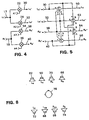
- Fig. 4 there is shown a first portion of the circuitry of output channel synthesizer 14.
- Lt input channel 12 is fed to multipliers 22 and 24, where it is multiplied by normalization coefficients A1 and A2, respectively, to form post-normalization channels Lc' 30 and Ls' 32 respectively.
- Rt input channel 13 is fed to multipliers 34 and 36, where it is multiplied by normalization coefficients A3 and A4, respectively, to form post-normalization channels Rs' 38 and Rc' 40, respectively.
- Lt to Lc' is equal (in magnitude) to the contribution from Rt to Rc' (or Rs'), independent of the relative amplitude difference (if any) imposed at the input terminals Lt and Rt. Furthermore the contribution from Lt to Lc' (or Ls') and Rt to Rc' (or Rs') is equal to the lesser of the two input signal amplitudes at Lt and Rt.
- the resulting normalized output signals at (A1) through (A4) are equal amplitude monaural contributions from Lt and Rt which are directionally identified as center channel or center surround channel components.
- the normalization function is singularly responsive to the dominant condition. Accordingly, sum dominant normalized signals appearing at the outputs of (A1) and (A4) can contain a nondominant surround channel signal. Likewise, difference dominant normalized signals appearing at the outputs of (A2) and (A3) can contain a nondominant center channel signal.
- the surround channel signal which is present at the outputs of (A1) and (A4) during a sum signal dominant condition, is retrieved by subtracting the output of (A4) from (A1).
- the surround channel signal is identified as containing a 180 degree relative phase difference at input terminals Lt and Rt.
- the center channel signal appearing at the outputs of (A2) and (A3) during a difference dominant condition is retrieved by summing the output of (A3) with (A2).
- the center channel signal is identified as being the in-phase signal appearing at input terminals Lt and Rt.
- the normalization function illustrated in Fig. 4 has an important characteristic. If the input signals at Lt and Rt contain a dominant center channel signal and simultaneously contain uncorrelated unequal amplitude signals, (such that Lt or Rt is in a condition of dominance) the normalized Lt and Rt signal contributions at the outputs of (A1) and (A4) will not contain equal amplitude contributions of the Lt and Rt input signals, but rather, equal magnitude contributions of the normalized Lt and Rt input signals. Subtracting the output of (A4) from (A1) to retrieve a surround channel signal in the presence of a sum signal dominant condition and an Lt or Rt dominant condition will introduce a portion of the center channel signal into the surround channel.
- the invention includes a method for providing an improved normalization mode for instances in which contents of Lt and lit are other than panned mono.
- logic 42 outputs the following values for A1, A2, A3, and A4:
- a 1
- a 2
- a 3
- a 4
- These normalization coefficients are formed by taking the signal quantities (1) and (2) in combination with the Y variable and do not include the signal quantities
- normalization coefficients are formed by taking the signal quantities (1) and (2) in combination with the Y variable, which is common to the normalization coefficients applied to both Lt and Rt, and which do not include the signal quantities
- a normalization mode of this type, which applies a common normalization coefficient to the input signals will be referred to as a "common mode.”
- the time averaging intervals may vary, as in the discussion above.
- a 2 A 8 ⁇
- a 3 A 8 ⁇ [ Lt-Rt ]- A 7 Rt -(1- A 7) Y Y + ⁇ - u (
- equations A1, A2, A3, and A4 are applicable to all degrees of correlation and phase. In the case of highly correlated signals, these generalized equations reduce to the differential mode normalization coefficients. In the case of the highly uncorrelated signals, these generalized equations reduce to the common mode normalization coefficients. In the case signals that are partially correlated, the generalized equations yield a result that has some differential content and some common content A normalization of this type will be referred to a "complex mode.”
- Fig. 5 there is shown a second portion of the circuitry of output channel synthesizer 14.
- Rc Rc' + .5(1s' + Rs')
- Ls'' Ls' + .5(Lc' - Rc')
- Rs''' Rs' + .5(Rc' - Lc')
- the normalization coefficients are singularly (and therefore exclusively) responsive to the dominant input signal condition at Lt and Rt. If the input signals at Lt and Rt are sum signal dominant, the input signals at Lt and Rt are correlated in-phase, and only normalization multipliers (A1) and (A4) are active. If the input signals at Lt and Rt are difference signal dominant the input signals at Lt and Rt are correlated wit a relative 180 degree phase shift, and only normalization multipliers (A2) and (A3) are active. If the input signals at Lt and Rt are uncorrelated (or in phase quadrature), the sum signal magnitude and the difference signal magnitude are equal, and all normalization multipliers (A1) through (A4) are active with the same numerical value.
- the Lt and Rt input signals are respectively reduced by subtracting the normalized amplitude of Lt from Lt, and the normalized amplitude of Rt from Rt. This produces a corresponding reduction in the amplitudes of Lo' and Ro'.
- Lc Lc' + .5 (Ls' + Rs')
- Rc Rc' + .5 (Rs' + Ls')
- Ls'' Ls' + .5 (Lc' - Rc)
- Rs'' Rs' + .5 (Rc'- Lc')
- Lc' and Ls' are components of the normalized Lt input
- the Lc' signal cumulatively combines with the Ls' signal
- the Rc' signal cumulatively combines with the Rs' signal.
- the normalization coefficient variables at (A1) through (A4) are numerically identical when the input signal conditions at Lt and Rt are uncorrelated in nature. For this condition, the Lt contribution to Lc and Ls'' is dominant over the Rt contribution to Lc and Ls'' by a factor of three, or approximately 10 dB. The Rt contribution to Rc' and Rs'' is dominant over the Lt contribution to Rc' and Rs'' by the same factor of three, or approximately 10 dB. As such, the Lc' and Ls'' signals are substantially components of the normalized Lt input, and the Rc' and Rs'' signals are substantially components of the normalized Rt input.
- a signal processing system reproduces the contributions from Lt to center and Rt to center as separate Lc and Rc signals, whenever separate center channel loudspeakers can be practically utilized in a reproduction system. This is advantageous over audio signal processing systems that derive a center channel signal from matrix encoded Lt and Rt stereophonic signals by summing a portion (or all) of the component signals at Lt and Rt. Recall that the normalization coefficient values of input normalization multipliers (A1) and (A4) are approximately zero whenever the input signals at Lt and Rt are difference signal dominant.
- Lc and Rc are identical.
- Summing the component signals of Lt and Rt at Ls' and Rs' to produce Lc and Rc ensures that the Lc and Rc signals do not contain the dominant surround channel signal .
- Lc and Rc are largely stereophonic when the input conditions at Lt and Rt are uncorrelated or stereophonic, in nature, and that the content of Lc and Rc are monaural whenever the nature of the input signals at Lt and Rt are difference signal (or surround channel) dominant.
- Channels Lc and Rc are largely monaural in nature whenever the input signal conditions at Lt and Rt are substantially correlated.
- the normalization coefficient values at input normalization multipliers (A2) and (A3) are approximately zero whenever the input signal conditions at Lt and Rt are sum signal (or center channel) dominant.
- the surround channel signal which may be present at Lt and Rt during a sum signal dominant condition is derived by subtracting the signal components of Rc' from Lc' to produce Ls'' and similarly subtracting the signal components at Lc' from Rc' to produce Rs''.
- Subtracting Rc' from Lc' to produce Ls'' and Lc' from Re' to produce Rs'' ensures that Ls'' and Rs'' do not contain any center channel signal components whenever Lt and Rt are substantially sum signal (or center channel) dominant.
- the content of the interim signals Ls'' and Rs'' are largely stereophonic in nature whenever the input signal conditions at Lt and Rt are uncorrelated or substantially stereophonic in nature.
- the interim signals at Ls'' and Rs'' are substantially monaural in nature whenever the input signal conditions at Lt and Rt are substantially sum signal (or center channel) dominant.
- the stereophonic nature of the interim signals, Ls'' and Rs'' for uncorrelated input signals at Lt and Rt is advantageous over audio signal processing sytems that derive a monaural surround channel signal from matrix encoded stereophonic Lt and Rt signals by subtracting a portion (or all) of the Rt input signal from the Lt input signal.
- the interim signals at Ls'' and Rs'' although largely stereophonic in nature when the input signal conditions at Lt and Rt are uncorrelated, do not exhibit exclusive cardinal states.
- the encoded Lt and Rt signals are such that an exclusive left surround channel signal or an exclusive right surround channel signal will respectively appear at Lt and Rt as:
- the Lt or Rt encoded signals are such that a difference signal dominant condition is encoded with an attending Lt or Rt dominant condition.
- the encoded Lt and Rt signals are panned mono.
- An audio signal processing system according to the invention is advantageous because it can decode the given encoded Lt and Rt signal conditions as exclusive left only or right only surround channel signals.
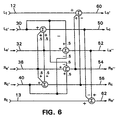
- FIG. 7 there is shown another portion of channels synthesizer 14.
- Interim channels La'' 52 and Rs'' 54 signals are combined to form left front channel Lo 64, right front channel Ro 66, left center surround channel Lcs 68, right center surround channel Rcs 70, left surround channel Ls 72, and right surround channel Rs 74 according to:
- Lo Lo' - .5(A5(.75 Ls'' - .25Rs''))
- Ro Ro' - .5(A6(.75Rs'' - .25 Rs'))
- the effect of the circuit of Fig. 7 is to re-matrix interim channels Ls'' and Rs'' with the normalization coefficients A5 and A6.
- the out-of-phase (or surround channel) signals cumulatively combine, whereas the in-phase (or center channel) signals differentially combine.
- Re-matrixing the Ls'' and Rs'' signals causes a corresponding reduction in amplitude of any center channel signal component which may be present in Ls'' or Rs'' during a difference dominant, uncorrelated input signal condition at Lt and Rt
- the process of re-matrixing the Ls'' and Rs'' signals further reduces the stereophonic content of Ls'' and Rs''
- the contribution of Lt to Ls'' is still dominant over the contribution of Rt to Ls''.
- the contribution of Rt to Rs'' is still dominant over the contribution of Lt to Rs'.
- the rematrixed Ls'' and Rs'' signals still retain a stereophonic characteristic when the signal conditions at Lt and Rt are substantially uncorrelated.
- the Lo' interim signal contains the differential surround channel signal that was dominant in Lt.
- the outputs of multipliers (A5) or (A6) are equal in amplitude to the contribution of Lt or Rt at Ls'' or Rs'' which is a component of the originating encoded Ls or Rs input signal conditions.
- all Lt dominant and difference signal dominant input signal conditions are defined as Ls dominant output signal conditions.
- all Rt dominant and difference signal dominant input signal conditions are defined to be Rs dominant output signal conditions.
- the directionally cardinal Ls or Rs encoded signal conditions are decoded as cardinal Ls or Rs output signal conditions.
- the decoder is the complement of the encoded signal conditions. It is also instructive to consider that the output signals at Ls and Rs are approximately zero whenever the encoded signals at Lt and Rt are equal amplitude signals. For this condition, the encoded signals are decoded to the Lcs and Rcs output terminals. In this regard, the decoded output signal conditions are the directional complement of the encoded signal conditions.
- a signal can be cardinally decoded to the following output terminals: Lo 62, Lc 50 Rc 70, Ro 66, Ls 72, Lcs 68, Rcs 56, Rs 74 placed relative to a listener 78 as indicated.
- Lt and Rt signals it is possible to decode matrix encoded Lt and Rt signals to six directionally cardinal locations in a 360-degree space. Interim directional locations are "phantom" sources based upon the presence of the decoded signal in multiple channels. For example, a signal can be encoded and subsequently decoded in a complementary manner; to appear at any point between the left channel output and left surround channel output. Likewise, a signal can be encoded and subsequently decoded in a complementary manner, to appear anywhere between the right output channel and right surround output channel. Thus a signal can be encoded and subsequently decoded to appear at any point within a 360-degree spatial angle.
- Down-mixing the decoded output channels does not reduce the number of cardinal directional states, but rather, the way in which the cardinal directions are reproduced.
- the cardinal Ls and Rs directional states are still retained.
- the stereophonic nature of the signals at Ls and Rs is likewise preserved.
- the exclusive Lcs/Rcs output condition is now reproduced as equal amplitude signals at Ls and Rs.
- the Lc and Rc output signals appear at the single center channel output, thus retaining the cardinal center only direction.
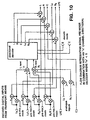
- Fig. 9 there is shown the combined circuits of Figs. 3, 4, 5, 6, and 8.
- the composite block diagram of Fig. 9 is constructed from the individual block diagrams of Figs. 4,5,6, and 7.
- Boolean switches 80 and 82 have been incorporated into Fig. 9 to enable or disable center channel decoding or surround channel decoding or both.
- the input signals at Lt and Rt are presented at the Lo and Ro output terminals.
- Setting the surround channel mode switches to the off state presents the surround channel signals at Lt and Rt to the Lo and Ro output terminals.
- setting the center channel mode switches to the off state presents the center channel signals at Lt and Rt to the Lo and Ro output terminals.
- the number of provided reproduction channels are fewer than the number of available presentation channels. In these instances, it is advantageous to process the lesser number of reproduction channels such that the derived number of reproduction channels are equal to the number of available presentation channels.
- contemporary signal transport formats convey as few as one channel or as many as five channels with an attending (spectrally limited) low frequency effects channel.
- information identifying the intended reproduction channel format are included as supplementary data within the transport format. It is possible to utilize the supplementary data as a means of re-formatting the number of intended reproduction channels for further processing into the number of available presentation channels.
- the provided reproduction channel information is defined in terms of the number of front and rear (surround) reproduction channels. The most widespread formats are:
- the channels are processed discretely.
- format (2) only the provided left and right reproduction channels are processed as Rt and Lt to obtain a new left, right, and (the derived) center presentation channel signal(s).
- the originating surround channel signals of format (2) are not processed, and the surround channel mode switches 80 in the block diagram of Fig. 9 are set to the off state.
- the given channel format is first converted to a matrix format for processing. This is accomplished by first down-mixing the given monaural surround channel into the given left channel to form Lnew and further down-mixing (out-of-phase) the given monaural surround channel into the given right channel to form Rnew. Lnew and Rnew are subsequently input into the decoder to obtain new left, right, left surround and right surround presentation channels.
- the center channel mode switches 80 are set to the off state, since the originating center channel signal is not processed and is reproduced as given.
Landscapes
- Physics & Mathematics (AREA)
- Engineering & Computer Science (AREA)
- Acoustics & Sound (AREA)
- Signal Processing (AREA)
- Stereophonic System (AREA)
- Compression, Expansion, Code Conversion, And Decoders (AREA)
Applications Claiming Priority (2)
| Application Number | Priority Date | Filing Date | Title |
|---|---|---|---|
| US313058 | 1981-10-19 | ||
| US09/313,058 US7016501B1 (en) | 1997-02-07 | 1999-05-17 | Directional decoding |
Publications (2)
| Publication Number | Publication Date |
|---|---|
| EP1054575A2 true EP1054575A2 (fr) | 2000-11-22 |
| EP1054575A3 EP1054575A3 (fr) | 2002-09-18 |
Family
ID=23214203
Family Applications (1)
| Application Number | Title | Priority Date | Filing Date |
|---|---|---|---|
| EP00304128A Withdrawn EP1054575A3 (fr) | 1999-05-17 | 2000-05-16 | Décodeur directionnel |
Country Status (3)
| Country | Link |
|---|---|
| EP (1) | EP1054575A3 (fr) |
| JP (1) | JP2000350300A (fr) |
| CN (1) | CN100349497C (fr) |
Cited By (8)
| Publication number | Priority date | Publication date | Assignee | Title |
|---|---|---|---|---|
| WO2002063925A3 (fr) * | 2001-02-07 | 2004-02-19 | Dolby Lab Licensing Corp | Modulation de canal audio |
| WO2004019656A3 (fr) * | 2001-02-07 | 2004-10-14 | Dolby Lab Licensing Corp | Modulation spatiale de canal audio |
| WO2007008004A3 (fr) * | 2005-07-11 | 2007-03-15 | Lg Electronics Inc | Appareil et procede de codage et decodage de signal audio |
| AU2003278704B2 (en) * | 2002-08-07 | 2009-04-23 | Dolby Laboratories Licensing Corporation | Audio channel spatial translation |
| US7660424B2 (en) | 2001-02-07 | 2010-02-09 | Dolby Laboratories Licensing Corporation | Audio channel spatial translation |
| US8793125B2 (en) | 2004-07-14 | 2014-07-29 | Koninklijke Philips Electronics N.V. | Method and device for decorrelation and upmixing of audio channels |
| WO2017049397A1 (fr) * | 2015-09-25 | 2017-03-30 | Voiceage Corporation | Procédé et système utilisant une différence de corrélation à long terme entre les canaux gauche et droit pour le sous-mixage temporel d'un signal sonore stéréo en canaux primaire et secondaire |
| US12125492B2 (en) | 2015-09-25 | 2024-10-22 | Voiceage Coproration | Method and system for decoding left and right channels of a stereo sound signal |
Families Citing this family (6)
| Publication number | Priority date | Publication date | Assignee | Title |
|---|---|---|---|---|
| ATE390683T1 (de) * | 2004-03-01 | 2008-04-15 | Dolby Lab Licensing Corp | Mehrkanalige audiocodierung |
| US7283634B2 (en) * | 2004-08-31 | 2007-10-16 | Dts, Inc. | Method of mixing audio channels using correlated outputs |
| US7787631B2 (en) * | 2004-11-30 | 2010-08-31 | Agere Systems Inc. | Parametric coding of spatial audio with cues based on transmitted channels |
| KR100857105B1 (ko) | 2005-09-14 | 2008-09-05 | 엘지전자 주식회사 | 오디오 신호의 디코딩 방법 및 장치 |
| CN101341533B (zh) * | 2005-09-14 | 2012-04-18 | Lg电子株式会社 | 解码音频信号的方法和装置 |
| CN101411214B (zh) * | 2006-03-28 | 2011-08-10 | 艾利森电话股份有限公司 | 用于多信道环绕声音的解码器的方法和装置 |
Citations (2)
| Publication number | Priority date | Publication date | Assignee | Title |
|---|---|---|---|---|
| EP0615399A1 (fr) | 1993-03-09 | 1994-09-14 | Matsushita Electric Industrial Co., Ltd. | Système de commande de champ sonore |
| US5727068A (en) | 1996-03-01 | 1998-03-10 | Cinema Group, Ltd. | Matrix decoding method and apparatus |
Family Cites Families (6)
| Publication number | Priority date | Publication date | Assignee | Title |
|---|---|---|---|---|
| US5046098A (en) * | 1985-03-07 | 1991-09-03 | Dolby Laboratories Licensing Corporation | Variable matrix decoder with three output channels |
| JP2512038B2 (ja) * | 1987-12-01 | 1996-07-03 | 松下電器産業株式会社 | 音場再生装置 |
| JPH03110999A (ja) * | 1989-09-25 | 1991-05-10 | Sharp Corp | 4チャンネル・ステレオ強調回路 |
| JPH05236599A (ja) * | 1992-02-21 | 1993-09-10 | Clarion Co Ltd | 3スピーカの音響再生装置 |
| EP0593128B1 (fr) * | 1992-10-15 | 1999-01-07 | Koninklijke Philips Electronics N.V. | Système de dérivation pour obtenir un signal de canal central à partir d'un signal audio stéréophonique |
| US6711266B1 (en) * | 1997-02-07 | 2004-03-23 | Bose Corporation | Surround sound channel encoding and decoding |
-
2000
- 2000-05-16 EP EP00304128A patent/EP1054575A3/fr not_active Withdrawn
- 2000-05-17 CN CNB00108691XA patent/CN100349497C/zh not_active Expired - Fee Related
- 2000-05-17 JP JP2000145596A patent/JP2000350300A/ja active Pending
Patent Citations (2)
| Publication number | Priority date | Publication date | Assignee | Title |
|---|---|---|---|---|
| EP0615399A1 (fr) | 1993-03-09 | 1994-09-14 | Matsushita Electric Industrial Co., Ltd. | Système de commande de champ sonore |
| US5727068A (en) | 1996-03-01 | 1998-03-10 | Cinema Group, Ltd. | Matrix decoding method and apparatus |
Cited By (57)
| Publication number | Priority date | Publication date | Assignee | Title |
|---|---|---|---|---|
| WO2002063925A3 (fr) * | 2001-02-07 | 2004-02-19 | Dolby Lab Licensing Corp | Modulation de canal audio |
| WO2004019656A3 (fr) * | 2001-02-07 | 2004-10-14 | Dolby Lab Licensing Corp | Modulation spatiale de canal audio |
| KR100904985B1 (ko) * | 2001-02-07 | 2009-06-26 | 돌비 레버러토리즈 라이쎈싱 코오포레이션 | 오디오 채널 변환 |
| US7660424B2 (en) | 2001-02-07 | 2010-02-09 | Dolby Laboratories Licensing Corporation | Audio channel spatial translation |
| AU2003278704B2 (en) * | 2002-08-07 | 2009-04-23 | Dolby Laboratories Licensing Corporation | Audio channel spatial translation |
| KR100988293B1 (ko) * | 2002-08-07 | 2010-10-18 | 돌비 레버러토리즈 라이쎈싱 코오포레이션 | 오디오 채널 공간 트랜스레이션 |
| US8793125B2 (en) | 2004-07-14 | 2014-07-29 | Koninklijke Philips Electronics N.V. | Method and device for decorrelation and upmixing of audio channels |
| WO2007008004A3 (fr) * | 2005-07-11 | 2007-03-15 | Lg Electronics Inc | Appareil et procede de codage et decodage de signal audio |
| US7411528B2 (en) | 2005-07-11 | 2008-08-12 | Lg Electronics Co., Ltd. | Apparatus and method of processing an audio signal |
| US7830921B2 (en) | 2005-07-11 | 2010-11-09 | Lg Electronics Inc. | Apparatus and method of encoding and decoding audio signal |
| US7835917B2 (en) | 2005-07-11 | 2010-11-16 | Lg Electronics Inc. | Apparatus and method of processing an audio signal |
| US7930177B2 (en) | 2005-07-11 | 2011-04-19 | Lg Electronics Inc. | Apparatus and method of encoding and decoding audio signals using hierarchical block switching and linear prediction coding |
| US7949014B2 (en) | 2005-07-11 | 2011-05-24 | Lg Electronics Inc. | Apparatus and method of encoding and decoding audio signal |
| US7962332B2 (en) | 2005-07-11 | 2011-06-14 | Lg Electronics Inc. | Apparatus and method of encoding and decoding audio signal |
| US7966190B2 (en) | 2005-07-11 | 2011-06-21 | Lg Electronics Inc. | Apparatus and method for processing an audio signal using linear prediction |
| US7987008B2 (en) | 2005-07-11 | 2011-07-26 | Lg Electronics Inc. | Apparatus and method of processing an audio signal |
| US7987009B2 (en) | 2005-07-11 | 2011-07-26 | Lg Electronics Inc. | Apparatus and method of encoding and decoding audio signals |
| US7991012B2 (en) | 2005-07-11 | 2011-08-02 | Lg Electronics Inc. | Apparatus and method of encoding and decoding audio signal |
| US7991272B2 (en) | 2005-07-11 | 2011-08-02 | Lg Electronics Inc. | Apparatus and method of processing an audio signal |
| US7996216B2 (en) | 2005-07-11 | 2011-08-09 | Lg Electronics Inc. | Apparatus and method of encoding and decoding audio signal |
| US8010372B2 (en) | 2005-07-11 | 2011-08-30 | Lg Electronics Inc. | Apparatus and method of encoding and decoding audio signal |
| US8032368B2 (en) | 2005-07-11 | 2011-10-04 | Lg Electronics Inc. | Apparatus and method of encoding and decoding audio signals using hierarchical block swithcing and linear prediction coding |
| US8032240B2 (en) | 2005-07-11 | 2011-10-04 | Lg Electronics Inc. | Apparatus and method of processing an audio signal |
| US8032386B2 (en) | 2005-07-11 | 2011-10-04 | Lg Electronics Inc. | Apparatus and method of processing an audio signal |
| US8046092B2 (en) | 2005-07-11 | 2011-10-25 | Lg Electronics Inc. | Apparatus and method of encoding and decoding audio signal |
| US8050915B2 (en) | 2005-07-11 | 2011-11-01 | Lg Electronics Inc. | Apparatus and method of encoding and decoding audio signals using hierarchical block switching and linear prediction coding |
| US8055507B2 (en) | 2005-07-11 | 2011-11-08 | Lg Electronics Inc. | Apparatus and method for processing an audio signal using linear prediction |
| CN101218628B (zh) * | 2005-07-11 | 2011-11-09 | Lg电子株式会社 | 编码和解码音频信号的装置和方法 |
| US8065158B2 (en) | 2005-07-11 | 2011-11-22 | Lg Electronics Inc. | Apparatus and method of processing an audio signal |
| US8108219B2 (en) | 2005-07-11 | 2012-01-31 | Lg Electronics Inc. | Apparatus and method of encoding and decoding audio signal |
| US8121836B2 (en) | 2005-07-11 | 2012-02-21 | Lg Electronics Inc. | Apparatus and method of processing an audio signal |
| US8149878B2 (en) | 2005-07-11 | 2012-04-03 | Lg Electronics Inc. | Apparatus and method of encoding and decoding audio signal |
| US8149876B2 (en) | 2005-07-11 | 2012-04-03 | Lg Electronics Inc. | Apparatus and method of encoding and decoding audio signal |
| US8149877B2 (en) | 2005-07-11 | 2012-04-03 | Lg Electronics Inc. | Apparatus and method of encoding and decoding audio signal |
| US8155152B2 (en) | 2005-07-11 | 2012-04-10 | Lg Electronics Inc. | Apparatus and method of encoding and decoding audio signal |
| US8155144B2 (en) | 2005-07-11 | 2012-04-10 | Lg Electronics Inc. | Apparatus and method of encoding and decoding audio signal |
| US8155153B2 (en) | 2005-07-11 | 2012-04-10 | Lg Electronics Inc. | Apparatus and method of encoding and decoding audio signal |
| US8180631B2 (en) | 2005-07-11 | 2012-05-15 | Lg Electronics Inc. | Apparatus and method of processing an audio signal, utilizing a unique offset associated with each coded-coefficient |
| US8255227B2 (en) | 2005-07-11 | 2012-08-28 | Lg Electronics, Inc. | Scalable encoding and decoding of multichannel audio with up to five levels in subdivision hierarchy |
| US8275476B2 (en) | 2005-07-11 | 2012-09-25 | Lg Electronics Inc. | Apparatus and method of encoding and decoding audio signals |
| US8326132B2 (en) | 2005-07-11 | 2012-12-04 | Lg Electronics Inc. | Apparatus and method of encoding and decoding audio signal |
| US8417100B2 (en) | 2005-07-11 | 2013-04-09 | Lg Electronics Inc. | Apparatus and method of encoding and decoding audio signal |
| US8510120B2 (en) | 2005-07-11 | 2013-08-13 | Lg Electronics Inc. | Apparatus and method of processing an audio signal, utilizing unique offsets associated with coded-coefficients |
| US8510119B2 (en) | 2005-07-11 | 2013-08-13 | Lg Electronics Inc. | Apparatus and method of processing an audio signal, utilizing unique offsets associated with coded-coefficients |
| US8554568B2 (en) | 2005-07-11 | 2013-10-08 | Lg Electronics Inc. | Apparatus and method of processing an audio signal, utilizing unique offsets associated with each coded-coefficients |
| WO2017049397A1 (fr) * | 2015-09-25 | 2017-03-30 | Voiceage Corporation | Procédé et système utilisant une différence de corrélation à long terme entre les canaux gauche et droit pour le sous-mixage temporel d'un signal sonore stéréo en canaux primaire et secondaire |
| US10319385B2 (en) | 2015-09-25 | 2019-06-11 | Voiceage Corporation | Method and system for encoding left and right channels of a stereo sound signal selecting between two and four sub-frames models depending on the bit budget |
| US10325606B2 (en) | 2015-09-25 | 2019-06-18 | Voiceage Corporation | Method and system using a long-term correlation difference between left and right channels for time domain down mixing a stereo sound signal into primary and secondary channels |
| US10339940B2 (en) | 2015-09-25 | 2019-07-02 | Voiceage Corporation | Method and system for encoding a stereo sound signal using coding parameters of a primary channel to encode a secondary channel |
| US10522157B2 (en) | 2015-09-25 | 2019-12-31 | Voiceage Corporation | Method and system for time domain down mixing a stereo sound signal into primary and secondary channels using detecting an out-of-phase condition of the left and right channels |
| US10573327B2 (en) | 2015-09-25 | 2020-02-25 | Voiceage Corporation | Method and system using a long-term correlation difference between left and right channels for time domain down mixing a stereo sound signal into primary and secondary channels |
| RU2728535C2 (ru) * | 2015-09-25 | 2020-07-30 | Войсэйдж Корпорейшн | Способ и система с использованием разности долговременных корреляций между левым и правым каналами для понижающего микширования во временной области стереофонического звукового сигнала в первичный и вторичный каналы |
| US10839813B2 (en) | 2015-09-25 | 2020-11-17 | Voiceage Corporation | Method and system for decoding left and right channels of a stereo sound signal |
| US10984806B2 (en) | 2015-09-25 | 2021-04-20 | Voiceage Corporation | Method and system for encoding a stereo sound signal using coding parameters of a primary channel to encode a secondary channel |
| US11056121B2 (en) | 2015-09-25 | 2021-07-06 | Voiceage Corporation | Method and system for encoding left and right channels of a stereo sound signal selecting between two and four sub-frames models depending on the bit budget |
| RU2763374C2 (ru) * | 2015-09-25 | 2021-12-28 | Войсэйдж Корпорейшн | Способ и система с использованием разности долговременных корреляций между левым и правым каналами для понижающего микширования во временной области стереофонического звукового сигнала в первичный и вторичный каналы |
| US12125492B2 (en) | 2015-09-25 | 2024-10-22 | Voiceage Coproration | Method and system for decoding left and right channels of a stereo sound signal |
Also Published As
| Publication number | Publication date |
|---|---|
| CN100349497C (zh) | 2007-11-14 |
| JP2000350300A (ja) | 2000-12-15 |
| EP1054575A3 (fr) | 2002-09-18 |
| HK1032705A1 (en) | 2001-07-27 |
| CN1281329A (zh) | 2001-01-24 |
Similar Documents
| Publication | Publication Date | Title |
|---|---|---|
| EP0858243B1 (fr) | Canal audio à effet spatial, codage et décodage | |
| US7003467B1 (en) | Method of decoding two-channel matrix encoded audio to reconstruct multichannel audio | |
| US5757927A (en) | Surround sound apparatus | |
| EP0966865B1 (fr) | Decodage audio multidirectionnel | |
| EP0553832B1 (fr) | Système de commande de champ sonore | |
| KR101215872B1 (ko) | 송신되는 채널들에 기초한 큐들을 갖는 공간 오디오의파라메트릭 코딩 | |
| AU2005262025B2 (en) | Apparatus and method for generating a multi-channel output signal | |
| US7945054B2 (en) | Method and apparatus to reproduce wide mono sound | |
| EP1054575A2 (fr) | Décodeur directionnel | |
| US20120201389A1 (en) | Processing of sound data encoded in a sub-band domain | |
| EP0571455B1 (fr) | Systeme de reproduction sonore | |
| US7016501B1 (en) | Directional decoding | |
| EP1817766A1 (fr) | Codage parametrique de synchronisation d'audio spatial avec mixage reducteur fourni exterieurement | |
| EP0629335B1 (fr) | Appareil de reproduction de son d'ambiance | |
| US5844993A (en) | Surround signal processing apparatus | |
| US6882733B2 (en) | Surround headphone output signal generator | |
| US7929054B2 (en) | Up-sampling television audio signals for encoding | |
| WO2024081957A1 (fr) | Traitement d'externalisation binaurale | |
| US7502477B1 (en) | Audio reproducing apparatus | |
| CN114143699A (zh) | 一种音频信号处理方法、装置及计算机可读存储介质 | |
| HK1032705B (en) | Method and apparatus for processing multi-channel audio signals |
Legal Events
| Date | Code | Title | Description |
|---|---|---|---|
| PUAI | Public reference made under article 153(3) epc to a published international application that has entered the european phase |
Free format text: ORIGINAL CODE: 0009012 |
|
| AK | Designated contracting states |
Kind code of ref document: A2 Designated state(s): AT BE CH CY DE DK ES FI FR GB GR IE IT LI LU MC NL PT SE |
|
| AX | Request for extension of the european patent |
Free format text: AL;LT;LV;MK;RO;SI |
|
| PUAL | Search report despatched |
Free format text: ORIGINAL CODE: 0009013 |
|
| AK | Designated contracting states |
Kind code of ref document: A3 Designated state(s): AT BE CH CY DE DK ES FI FR GB GR IE IT LI LU MC NL PT SE |
|
| AX | Request for extension of the european patent |
Free format text: AL;LT;LV;MK;RO;SI |
|
| 17P | Request for examination filed |
Effective date: 20030305 |
|
| AKX | Designation fees paid |
Designated state(s): DE FR |
|
| 17Q | First examination report despatched |
Effective date: 20101013 |
|
| STAA | Information on the status of an ep patent application or granted ep patent |
Free format text: STATUS: THE APPLICATION HAS BEEN WITHDRAWN |
|
| 18W | Application withdrawn |
Effective date: 20111107 |