EP1055931A2 - Schaltungsanordnung zum Prüfen der Funktionsbereitschaft mindestens einer Antenne - Google Patents
Schaltungsanordnung zum Prüfen der Funktionsbereitschaft mindestens einer Antenne Download PDFInfo
- Publication number
- EP1055931A2 EP1055931A2 EP00110408A EP00110408A EP1055931A2 EP 1055931 A2 EP1055931 A2 EP 1055931A2 EP 00110408 A EP00110408 A EP 00110408A EP 00110408 A EP00110408 A EP 00110408A EP 1055931 A2 EP1055931 A2 EP 1055931A2
- Authority
- EP
- European Patent Office
- Prior art keywords
- antenna
- circuit arrangement
- arrangement according
- voltage
- test
- Prior art date
- Legal status (The legal status is an assumption and is not a legal conclusion. Google has not performed a legal analysis and makes no representation as to the accuracy of the status listed.)
- Withdrawn
Links
Images


Classifications
-
- H—ELECTRICITY
- H01—ELECTRIC ELEMENTS
- H01Q—ANTENNAS, i.e. RADIO AERIALS
- H01Q1/00—Details of, or arrangements associated with, antennas
- H01Q1/27—Adaptation for use in or on movable bodies
- H01Q1/32—Adaptation for use in or on road or rail vehicles
-
- H—ELECTRICITY
- H01—ELECTRIC ELEMENTS
- H01Q—ANTENNAS, i.e. RADIO AERIALS
- H01Q3/00—Arrangements for changing or varying the orientation or the shape of the directional pattern of the waves radiated from an antenna or antenna system
- H01Q3/26—Arrangements for changing or varying the orientation or the shape of the directional pattern of the waves radiated from an antenna or antenna system varying the relative phase or relative amplitude of energisation between two or more active radiating elements; varying the distribution of energy across a radiating aperture
- H01Q3/267—Phased-array testing or checking devices
Definitions
- the invention relates to a circuit arrangement for checking the operational readiness an antenna, especially in a vehicle telephone, which has several Has antennas.
- the invention enables the vehicle telephone to make errors at any time the antenna cable, unmounted, incorrectly installed, or failed vehicle antennas, for example as a result of damage in a traffic accident recognize and automatically switch to a functional antenna.
- Vehicle phones are usually equipped with an outside or window antenna equipped, their local location primarily according to the requirements of an optimal Receive and transmit quality is selected.
- mm is an example from the publication EP 0 859 237-A1 known to install an emergency or alternative antenna at another installation location. This takes over after a functional failure of the one used as the main antenna External antenna for transmission / reception. Both antennas are each separate Coaxial cable connected to the radio telephone.
- radio telephones with multiple antenna connections lead and extended equipment periodically, for example every 10th Minutes, a test procedure in which the antennas operate one after the other taken and checked for functionality. This is done, for example by comparing the strength of the received signals. Doing so will result in errors and damage recognized and reported on the antennas and lines, and in time for one functional antenna branch switched.
- the test procedure is usually too performed when an emergency call is triggered, so that only the less powerful Emergency antenna is switched if the main antenna is canceled, for example of the antenna rod has failed.
- a test procedure is carried out in accordance with the document EP 0 859 237 A1 Measurement of the antenna adaptation by determining the reflection factor on the Antenna line with a bidirectional directional coupler and a circuit for Forming the quality signal.
- the disadvantage of this solution is the high effort for both the hardware as well as for the software to implement the test procedure.
- a device is already from the document DE 196 27349-A1 known for testing vehicle antennas which are in a current loop Receiving coils from vehicle antennas constantly with a low quiescent test current supervised.
- the receiving coils take along a rail vehicle Line conductor, such as the rails or the overhead line, inductive signal currents.
- the Quiescent test current is preferably a direct current and continuously indicates that all Antennas are both present and connected to the vehicle.
- the solution according to the invention includes an antenna with an open radiator, for example a rod heater.
- This has a first end at which you can remove it or feeding the RF signal, an antenna line is connected, and a second End, which projects openly into the room, so that a capacity of the rod is distributed in the room an RF path that forms the signal circuit for message communication closes.
- the radio telephone sends one via the antenna line Test current to the antenna. This happens regardless of the signal current.
- the test current is advantageously a direct current or an alternating current with a wavelength that is around a Is many times larger than the wavelength of the signal current.
- a secondary path with an impedance is on the radiator connected, which is a rear for the test current to the antenna line Current path forms and which is parallel to the RF path.
- the Test current a voltage drop.
- the circuit arrangement has one Voltage evaluator on, which is constantly on the antenna connections of the radio telephone monitors the voltage that occurs across the impedance as a result of the test current.
- the radio telephone not only recognizes whether the rod radiator is correctly connected to the antenna connection is connected, but at least also possible short circuits of the antenna line.
- the impedance value of the secondary path lies both for the signal current and for the test current many times over the radiation resistance of the antenna.
- the Impedance at the radiator is short in relation to the transmission wavelength Connection line connected.
- the impedance of the Secondary paths from a structure with an extended body length, which for example as Individual component has a length which is in the order of magnitude of the rod radiator, or a series connection of several discrete individual elements, so that the connecting lines to the individual elements in the secondary path in relation to the operating wavelength are short and influence the RF properties of the radiator as little as possible.
- a radio telephone 10 has, as FIG. 1 shows, a transmitting / receiving part RF. This is connected via an antenna connection 12 to an antenna 14, which is preferably designed as an external antenna and is arranged, for example, on the roof of a vehicle, not shown.
- the antenna connection 12 contains a signal contact O S and a ground contact O 0 .
- the antenna 14 is a vertical known per se arranged rod radiator with a length of approximately a quarter of Transmission wavelength ⁇ of the transmit / receive signal.
- the antenna line 16 is on lower end of the radiator connected. The other end protrudes for acceptance / delivery of high frequency radiation open into the room.
- the open end of the radiator forms a capacitance C E distributed in space, which, as a capacitive RF path, closes the circuit for the high-frequency signal current I HF without a galvanic path between the open radiator end and the ground contact GND. Since the antenna 14 is attached to a vehicle body, there is a direct connection between the ground contact GND, the antenna line 16 and the conductive surface of the body.
- both a voltage source and an input of a voltage evaluator are connected to the signal contact O S.
- the voltage source provides a source voltage U S and causes a test current I C to flow to the antenna 14 via a source resistor R S.
- a current source can be used, which advantageously provides a constant current.
- the voltage evaluator is a window comparator COM, which determines whether its input voltage U IN is within a predetermined range.
- the rod radiator of the antenna 14 is connected directly to a secondary path, which contains an impedance Z.
- the secondary path closes the circuit for the test current I C from the rod radiator to the GND ground contact.
- the impedance Z forms a voltage divider with the source resistance R S.
- the impedance Z is connected to the rod radiator a connection line that is short in relation to the transmission wavelength ⁇ .
- the impedance Z is connected as firmly as possible to the antenna 14, so that the absence of the antenna 14 by the rise in the test voltage U C at the signal contact O S is recognized as reliably as an interruption in the antenna line 16
- the impedance Z can be formed both by a discrete ohmic resistor R and by a conductive structure, such as a thin high-resistance conductor track, which is mounted in the antenna body or its surface as an insulated resistor track.
- a complex arrangement, such as an inductor with a correspondingly high series resistance, can also be used advantageously.
- the impedance Z is an ohmic resistance with a resistance value approximately or equal to the source resistance R S , so that approximately half the source voltage U S is at the signal contact O S as in the present example.
- a coupling capacitor C K is arranged between the signal contact O S and the RF port of the transmitting / receiving part RF, which prevents the circuit arrangement for testing and the transmitting / receiving part RF from influencing one another.
- the decoupling resistor R K reduces the load on the high-frequency signal circuit I HF through the input of the window comparator COM.
- FIG. 2 shows a radio telephone 30 with a transmitting / receiving part RF, which is alternatively connected either to the antenna 14 or to an antenna 20 via an antenna selector switch 18, for example in the form of a relay.
- the radio telephone 30 has, in addition to the antenna connection 12, a further antenna connection 22 with a signal contact O S 2.
- the antenna selector switch 18 is switched to the signal contact O S 1 of the antenna connector 12 in its rest position. Then this connection is occupied by the main antenna, which is positioned at a favorable receiving and transmitting location, and an emergency or alternative antenna is located at the antenna connection 22.
- Each antenna 14, 20 is connected via a separate antenna line 16, 24 and contains a secondary path with its own impedance, in the present case the resistors R1 and R2.
- the source voltage U S is connected to the output of the antenna selector switch 18, so that it also switches the current paths for the test currents I C 1 and I C 2 to the antennas 14, 20.
- the antenna connection 12 has priority over the antenna connection 22 and the antenna selection switch 18 is predominantly in the corresponding position.
- the test current I C 1 flows continuously to the antenna 14 in order to monitor its operational readiness.
- the voltage evaluator VE is a window detector circuit for DC voltages, which constantly checks whether the test voltage U C at the output of the selector switch 18 is within a target range. If there is a short circuit or an open circuit at the antenna connection 12, the test voltage is outside the target range and signals that the antenna 14 is no longer ready for operation with certainty. Then the voltage evaluator VE immediately switches over to the emergency antenna, the antenna 20, with its output signal U 0 , in order to restore the operational readiness of the system.
- a control circuit switches the antenna selector switch 18 periodically for a short period each time via the control connection S while the radio telephone 30 is idle Signal contact O S 1 to signal contact O S 2 around without a signal current I HF flowing.
- the test current I C 2 flows through the resistor R2. If, when switching over to antenna 20, the test voltage U C is outside the target range due to a fault in the antenna connection 22, the radio telephone 30 signals, for example optically by means of a display in its display and / or acoustically, that the emergency antenna is not ready to be repaired . Since the communication system is still working in the event of an error on the emergency antenna, the telephone operation is carried out unchanged via the antenna 14.
- test currents I C 1, I C 2 flow independently of the signal current I HF , so that switching to the antenna 20 is possible immediately after the antenna 14 has failed.
- Another advantage of the circuit according to FIG. 2 is that the operational readiness of the antenna selector switch 18 is constantly checked.
- the resistors R1 and R2 in the secondary paths depending on the designs of the antennas 14, 20 different Resistance values.
- This allows the control circuit of the radio telephone 30 or a when mounting the antennas on the radio telephone connected external test device Automatically detect antenna types that are connected to antenna connections 12 and 22 are connected.
- This enables a corresponding display of swapped connected antennas 14 and 20 and / or a corresponding internal correction the antenna selector switch 18.
- the latter allows the antenna connections 12 and 22 at Assemble as you like.
- the antenna selector switch 18 is advantageous Impulse relay or similar executed so that after identifying the connected antennas 14, 20 a set pulse the antenna selector switch 18 in the sets that of two positions, in the outside a preferred antenna (14), that is Main antenna, is connected.
- the voltage evaluator shows VE for everyone Antenna design a separate detector window.
- the voltage evaluator VE can be contained in the digital control circuit of the radio telephone.
- the windows are represented by one or more value ranges of digital values and the digital value at the converter output is checked whether it lies in the or one of these value ranges.
- measuring circuits for alternating voltage amplitudes are also conceivable, provided an alternating current source generates the test currents I C 1 and I C 2.
- FIGS 3a to 3c show further embodiments of the invention. These have the advantage that the operational readiness of both antennas 14 and 20 is continuously monitored by the test currents I C 1 and I C 2 both during radio / transmission operation and in the standby of the radio telephone 40.
- the radio telephone 40 in contrast to the radio telephone 30, has a separate source resistor R S 1 or R S 2 for each antenna connection 12, 23, which is connected directly to the corresponding signal contact O S 1 and O S 2.
- the execution according to FIG. 3a also contains a separate voltage evaluator VE1 and VE2 for each antenna connection 12, 22, each of which is connected to the corresponding signal contact O S 1 and O S 2 via a decoupling resistor R K 1 or R K 2.
- VE1 and VE2 for each antenna connection 12, 22, each of which is connected to the corresponding signal contact O S 1 and O S 2 via a decoupling resistor R K 1 or R K 2.
- an indication signal U O 1 continuously indicates the operational readiness of antenna 14
- an indication signal U O 2 indicates the operational readiness of antenna 20.
- the designs according to FIG. 3b and FIG. 3c only the voltage evaluator VE1.
- all possible combinations of functioning and / or faulty antenna connections 12 and 22 are identified by a corresponding voltage value that only occurs with the specific combination.
- both decoupling resistors R K 1 and R K 2 are many times larger than the resistors R1 and R2 in the secondary paths and the input circuit of the voltage evaluator VE1 has an electrometer input, ie a very high input resistance R IN >> R K 2.
- each antenna 14 and 20 can have one of three possible connection states: Neutral", operational "or In addition to the possibility that both antennas are operational, there are eight further possible combinations in which at least one antenna is not operational.
- any possible combinations with at least one disturbed antenna connection 12 or 22 assume the input voltage U IN a voltage value typical for this combination. This is particularly advantageous when the antennas 14 and 20 are mounted on the radio telephone 40, because an error can also occur at both antenna connections 12, 22.
- the voltage evaluator VE1 as part of the control circuit of the radio telephone 40, has the task of comparing the digitized value of the input voltage U IN with permanently stored value ranges and of outputting a data signal DS which uniquely identifies the current state of the assignment of the antenna connections 12 or 22.
- This signal uses the control circuit of the radio telephone 40 or an analysis device connected during the assembly for error display. Each connection is uniquely assigned its current status. Even extreme error messages, such as Main antenna interrupted or not available! - Emergency antenna short-circuited! "Can thus be realized.
- FIG. 3c also shows two further features of the invention.
- the execution of FIG. 3c is based on the embodiment according to FIG. 3b and takes into account the fact that the present number of a total of nine possible combinations of error-free and faulty antenna connections 12, 22 can only be evaluated inexpensively with a microcomputer which is connected to an analog / digital converter. It is disadvantageous, however, that many analog / digital converters of microcomputers only work faultlessly due to an asymmetrical voltage supply if the input voltage U IN is above a minimum value.
- the invention are according to a further feature in series to the Qellenwiderfacen R S1 and R S2 series resistors R V 1 and R V 2 and the Entkoppelwiderinterest R K1 and R K2 are at the connecting points connected in series.
- the test voltages U C 3 and U C 4 contain the minimum value that the test current I C 1 or I C 2 causes at the series resistors R V 1 and R V 2, even if the antenna connection 12 or 22 is short-circuited, so that the analog / The digital converter of the voltage evaluator VE1 is working correctly.
- both the source resistances R S 1 and R S 2 and the resistors R1 and R2 in the secondary paths can be selected to be large enough that the test currents I C 1 and I C 2 supply the operating power of the radio telephone 10, 30 or 40 only insignificantly.
- the source resistances R S , R S 1 and R S 2 and the resistors R1 and R2 are around 10 k ⁇ and the test currents I C 1 and I C 2 are less than 1 mA.
- the coupling resistors R K , R K 1 and R K 2, the source resistors R S , R S 1 and R S 2 and the resistors R1 and R2 are dimensioned so that the influence of the entire detection circuit on the RF circuit of the Cellular phones 10, 30 and 40 is minimal.
- Another advantage of the invention is that it is also indicated if an incorrect antenna type is connected to the antenna connections 12, 22 when the vehicle is being installed. For example, a radio antenna that has no secondary path.
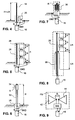
- FIGS. 4 to 6 show different forms of antennas for the circuit according to the invention.
- ⁇ denotes the transmission wavelength.
- FIG.4 shows a particularly inexpensive version for an antenna with a Resistor R directly between the HF connection Si and the ground connection GND.
- the box 26 represents a non-conductive covering for the area of the base, which connects the resistor R mechanically with the rod radiator. So that causes Breaking of the antenna 14 at a structurally planned predetermined breaking point in the area of Base bracket or disassembly also the removal of the side path with the Resistor R and thus leads to the desired detection by the circuit in Radio telephone 10, 30 or 40.
- the antenna according to the embodiment according to FIG. 4 requires a constructive measure that ensures a break at the base
- the antenna according to FIG. 5 break anywhere.
- there is an impedance with distributed components in the present case a series connection composed of at least two individual resistors Ra and Rb, between a connection point on the antenna tip 28 and the ground connection GND.
- This design enables a secondary path with discrete ohmic resistors to be attached to the outside of the antenna body.
- their lead lengths 12 to 14 can be chosen so that each is shorter than ⁇ / 10.
- the non-conductive sheathing encloses the entire radiator rod with the individual resistors Ra + Rb and their leads.
- FIG. 6 shows a rod radiator 32 which is designed as a hollow body. This points on free end of a head 34 with an enlarged diameter.
- the secondary path is housed with a resistor R.
- the location of the resistor R in Head 34 ensures the function of the circuit in this embodiment, if the Rod emitter 32 breaks off at any point. Due to the inner location of the secondary path is a Influence on the radiation characteristics of the antenna is not expected. Only that Length l1 of the rod radiator 32 must be due to the higher spatial capacity of the head 34 Earth can be shortened somewhat.
- the radiator 36 is used for the RF circuit one-sided open conductor coil used, the length of which is significantly shorter than one Rod heater.
- FIG. 8 shows that the principle of the invention also applies to ⁇ / 2 dipole antennas applicable, which are open at the ends.
- the present version shows a ⁇ / 2 vertical radiator in the form of an axially fed dipole.
- the arrangement of the Secondary path corresponds to the design according to FIG. 5.
- the secondary path can also be used ⁇ / 2 dipole antennas can also be designed in accordance with FIGS. 4 and 6.
- FIG. 9 shows the design of a planar antenna, such as that shown in FIG Vehicle interior can be installed as an emergency antenna.
- the dipole surfaces 42 and 44 are together with the resistor R and a balun BAL on a circuit board PB arranged.
- the balun BAL points between the inputs and outputs galvanic connections, for example a detour line, and is therefore advantageous included in the constant monitoring of the operational readiness of the antenna.
Landscapes
- Monitoring And Testing Of Transmission In General (AREA)
- Mobile Radio Communication Systems (AREA)
- Testing Electric Properties And Detecting Electric Faults (AREA)
Abstract
Description
- FIG. 1
- das Grundprinzip der Schaltungsanordnung gemäß der Erfindung
- FIG. 2
- eine Ausführungsform der Schaltungsanordnung gemäß der Erfindung mit mehreren Antennen
- FIG. 3a bis 3c
- weitere Ausführungsformen der Schaltungsanordnung gemäß der Erfindung mit mehreren Antennen
- FIG. 4 bis 6
- verschiedene Antennenformen für die Schaltungsanordnung entsprechend der Erfindung mit Stabstrahlern
- FIG. 7
- eine Ausführung mit einer Wendelantenne
- FIG. 8
- eine Antennenform mit einem senkrecht strahlenden Dipol und
- FIG. 9
- eine Antennenform mit einer Flächenantenne

Fehlt beispielsweise die Antenne 14 und ist die Antenne 20 funktionsfähig, so beträgt die Prüfspannung
d.h., N1 = 3 : 4 = 0,75. Somit ist die Eingangsspannung
Fehlt jedoch die Antenne 20 und ist die Antenne 14 funktionsfähig, so beträgt die Prüfspannung
Claims (18)
- Schaltungsanordnung zum Prüfen der Funktionsbereitschaft mindestens einer Antenne (14, 20) für ein Funktelefon (10, 30, 40) mit einer Steuerschaltung, einem Prüfstrom (IC, IC1, IC2), den eine Spannungsquelle (UC) unabhängig von einem Signalstrom (IHF) in einem HF-Pfad über eine Antennenleitung (16, 24) zur Antenne (14, 20) sendet, und mit einer Auswerteeinrichtung (COM, VE) mm Überwachen der Kontinuität des Prüfstroms (IC, IC1, IC2), dadurch gekennzeichnet, dass jede Antenne einen Strahler aufweist, welcher mit einem Ende offen in den Raum ragt, und dass an jedem Strahler zum Rückführen jeweils eines separaten Prüfstroms (IC, IC1, IC2) parallel zum HF-Pfad ein Nebenpfad angeschlossen ist, der eine Impedanz (Z, R, R1, R2) aufweist, wobei das Überwachen des Prüfstroms (IC, IC1, IC2) mit einem Spannungsauswerter (COM,VE, VE1, VE2) erfolgt.
- Schaltungsanordnung nach Anspruch 1, dadurch gekennzeichnet, dass der Nebenpfad mit der Impedanz (Z, R, R1, R2) unlösbar mit dem Strahler verbunden ist, so dass ein Abbrechen der Antenne (14, 20) oder eine Demontage auch das Fortfallen des Nebenpfades mit dem Widerstand R bewirkt.
- Schaltungsanordnung nach Anspruch 1, dadurch gekennzeichnet, dass die Impedanz (Z, R, R1, R2) im Nebenpfad über eine im Verhältnis zur Übertragungswellenlänge (λ) kurze Anschlussleitung am Strahler angeschlossen ist.
- Schaltungsanordnung nach Anspruch 1, dadurch gekennzeichnet, dass die Impedanz (Z, R, R1, R2) im Nebenpfad um ein Vielfaches höher ist als der Strahlungswiderstand der Antenne (14, 20).
- Schaltungsanordnung nach Anspruch 1, dadurch gekennzeichnet, dass im Nebenpfad eine Serienschaltung von separaten Widerständen (Ra, Rb) liegt mit Zuleitungen, deren Längen (l2, l3, l4) kleiner sind als ein Zehntel der Übertragungswellenlänge (λ), so dass die Zuleitungen die Hochfrequenzeigenschaft des Strahlers nicht oder nur unbedeutend beeinflussen.
- Schaltungsanordnung nach Anspruch 1, dadurch gekennzeichnet, dass der Nebenpfad mit der Impedanz (Z) im Innern des Antennenkörpers liegt.
- Schaltungsanordnung nach Anspruch 1, dadurch gekennzeichnet, dass der Prüfstrom (IC, IC1, IC2) entweder ein Gleichstrom oder ein Wechselstrom ist, mit einer Wellenlänge, die um ein Vielfaches größer ist als Übertragungswellenlänge (λ) des Signalstroms (IHF).
- Schaltungsanordnung nach Anspruch 1, gekennzeichnet durch mehrere Antennenanschlüsse (12, 22) für Antennen (14, 20), welche ein Antennenwahlschalter (18) alternativ mit einem Sende/Empfangsteil (RF) verbindet und welche von separaten Prüfströmen (IC1, IC2) durchflossene Nebenzweige aufweisen.
- Schaltungsanordnung nach Anspruch 1 oder 8, dadurch gekennzeichnet, dass jeder Nebenpfad mindestens einen ohmschen Widerstand (R, R1, R2, Ra, Rb) enthält, und dass zum Prüfen der Funktionsfähigkeit der entsprechenden Antenne (14, 20) der Spannungsauswerter (VE, VE1, VE2) am Antennenanschluss (12, 22) den Ist-Wert der vom Prüfstrom (IC, IC1, IC2) bewirkten Prüfspannung (UC, UC1, UC2) mit einem Sollwert (UREF) vergleicht.
- Schaltungsanordnung nach Anspruch 8 und 9, dadurch gekennzeichnet, dass die Nebenpfade in Abhängigkeit von der Bauform der Antennen (14, 20) Widerstände (R1, R2) mit verschiedenen Widerstandswerten aufweisen, damit die Steuerschaltung des Funktelefons (30, 40) über den entsprechenden Spannungsauswerter (VE, VE1, VE2) die an den Antennenanschlüssen (12, 22) angeschlossenen Antennen (14, 20) nach ihrer Bauform unterscheidet und deren Belegung automatisch erkennt.
- Schaltungsanordnung nach Anspruch 10, dadurch gekennzeichnet, dass die Steuerschaltung nach dem Erkennen der Belegung der Antennenanschlüsse (12, 22) den Antennenwahlschalter (18) in jene Schalterposition setzt, in der intern der Antennenanschluss mit dem Sende/Empfangsteil (RF) verbunden ist, an dem äußerlich eine bevorzugte Antenne (14) angeschlossen ist.
- Schaltungsanordnung nach Anspruch 10, dadurch gekennzeichnet, dass die Steuerschaltung nach dem Erkennen der Belegung der Antennenanschlüsse (12, 22) eine Fehlermeldung für ein Display generiert und/oder die Ausgangs/Eingangsdaten für die Antennenanschlüsse (12, 22) entsprechend konfiguriert.
- Schaltungsanordnung nach Anspruch 8 und 9, dadurch gekennzeichnet, dass während des Wartebetriebs des Funktelefons (30) eine Steuerschaltung über einen Steuereingang (S) den Antennenwahlschalter (18) periodisch jeweils für eine kurze Dauer von einer ersten Antenne (14) zu einer zweiten Antenne (20) umschaltet, um auch die Funktionsfähigkeit der zweiten Antenne (20) zu prüfen.
- Schaltungsanordnung nach Anspruch 8 und 9, dadurch gekennzeichnet, dass für die Prüfspannung (UC1, UC2) jedes Antennenanschlusses (12, 22) je ein separater Spannungsauswerter (VE1, VE2) vorhanden ist.
- Schaltungsanordnung nach Anspruch 8 und 9, dadurch gekennzeichnet, dass Entkoppelwiderstände RK1 und RK2 die Prüfspannungen (UC1, UC2 oder UC3, UC4) der Antennenanschlüsse (12, 22) zusammenführen, so dass ein Spannungsauswerter (VE1) die gemeinsame Eingangsspannung (UIN) von beiden Antennenanschlüssen (12, 22) analysiert, und dass ein Entkoppelwiderstand größer ist als der andere, um dem Spannungsauswerter (VE1) reine eindeutige Zuordnung von Fehlern an den Antennenanschlüssen (12, 22) zu ermöglichen.
- Schaltungsanordnung nach Anspruch 15, dadurch gekennzeichnet, dass der Spannungsauswerter (VE1) entsprechend der Anzahl von möglichen Kombinationen von Fehlern an den Antennenanschlüssen (12, 22) verschiedene typische Eingangsspannung (UIN) durch Vergleich mit gespeicherten Wertebereichen erkennt und diese als Datensignal (DS) ausgibt und dass eine Steuerschaltung mit einem Mikrocomputer dem ausgegebenen Datensignal (DS) entsprechende detaillierte Fehlermeldungen generiert und ausgibt.
- Schaltungsanordnung nach Anspruch 1 oder 15, dadurch gekennzeichnet, dass in Serie zu den Qellenwiderständen RS1 und RS2 Vorwiderstände RV1 und RV2 liegen und dass der Spannungsauswerter (VE1) über Entkoppelwiderstände RK1 und RK2 an den Verbindungspunkten der Serienschaltung angeschlossen ist.
- Schaltungsanordnung nach den Ansprüchen 10 und 17, dadurch gekennzeichnet, dass die Werte für die Vorwiderstände (RV1, RV2) so ausgewählt werden, dass für beide Antennenanschlüsse (12, 22) die Summe aus dem entsprechenden Widerstand (R1 bzw. R2) im Nebenzweig und dem dazu in Serie liegenden Vorwiderstand (RV1 bzw. RV2) einander gleich sind, um auch den Fall eindeutig zu identifizieren, bei dem beide Antennen 14, 20 vertauscht angeschlossen sind.
Applications Claiming Priority (2)
| Application Number | Priority Date | Filing Date | Title |
|---|---|---|---|
| DE19923729 | 1999-05-22 | ||
| DE19923729A DE19923729A1 (de) | 1999-05-22 | 1999-05-22 | Schaltungsanordnung zum Prüfen der Funktionsbereitschaft mindestens einer Antenne |
Publications (2)
| Publication Number | Publication Date |
|---|---|
| EP1055931A2 true EP1055931A2 (de) | 2000-11-29 |
| EP1055931A3 EP1055931A3 (de) | 2001-08-01 |
Family
ID=7909001
Family Applications (1)
| Application Number | Title | Priority Date | Filing Date |
|---|---|---|---|
| EP00110408A Withdrawn EP1055931A3 (de) | 1999-05-22 | 2000-05-16 | Schaltungsanordnung zum Prüfen der Funktionsbereitschaft mindestens einer Antenne |
Country Status (3)
| Country | Link |
|---|---|
| US (1) | US6437577B1 (de) |
| EP (1) | EP1055931A3 (de) |
| DE (1) | DE19923729A1 (de) |
Cited By (6)
| Publication number | Priority date | Publication date | Assignee | Title |
|---|---|---|---|---|
| EP1369323A3 (de) * | 2002-05-28 | 2004-07-14 | Delphi Technologies, Inc. | Sicherungssystem |
| EP1454807A1 (de) * | 2003-03-05 | 2004-09-08 | Delphi Technologies, Inc. | Sicherungssystem |
| DE102004017101A1 (de) * | 2003-12-17 | 2005-07-21 | Volkswagen Ag | Diagnostizierbare Befestigungsvorrichtung für Elektronikkomponenten und entsprechendes Diagnoseverfahren |
| EP1591796A1 (de) * | 2004-04-30 | 2005-11-02 | Delphi Technologies, Inc. | Antennenerkennungssystem |
| US7155267B2 (en) | 2003-02-25 | 2006-12-26 | Lg Electronics Inc. | Apparatus and method for monitoring antenna state of mobile station |
| EP1876456A1 (de) * | 2006-07-06 | 2008-01-09 | Nissan Motor Company Limited | Diagnosevorrichtung und Verfahren zur Diagnose des Verbindungszustands einer Fahrzeugantenne |
Families Citing this family (63)
| Publication number | Priority date | Publication date | Assignee | Title |
|---|---|---|---|---|
| US6466131B1 (en) | 1996-07-30 | 2002-10-15 | Micron Technology, Inc. | Radio frequency data communications device with adjustable receiver sensitivity and method |
| US6806812B1 (en) * | 2000-04-26 | 2004-10-19 | Micron Technology, Inc. | Automated antenna trim for transmitting and receiving semiconductor devices |
| FR2828286B1 (fr) * | 2001-08-02 | 2003-11-21 | Siemens Automotive Sa | Dispositif de diagnostic pour une antenne |
| FR2829622B1 (fr) * | 2001-09-11 | 2004-04-09 | Thales Sa | Systeme antennaire a rendement elevee et a forte puissance |
| DE20215442U1 (de) | 2002-10-08 | 2003-02-13 | Leopold Kostal GmbH & Co KG, 58507 Lüdenscheid | Schlüssellose Nutzungsberechtigungskontrolleinrichtung für ein Kraftfahrzeug |
| US7242917B2 (en) * | 2002-11-05 | 2007-07-10 | Motorola Inc. | Apparatus and method for antenna attachment |
| US6928281B2 (en) * | 2002-12-12 | 2005-08-09 | Visteon Global Technologies, Inc. | Active antenna system with fault detection |
| US7184414B2 (en) * | 2002-12-13 | 2007-02-27 | Bellsouth Intellectual Property Corporation | Method and system for obtaining a network map |
| US6879918B2 (en) * | 2003-05-30 | 2005-04-12 | Lucent Technologies Inc. | Method and apparatus for measuring the transmission loss of a cable |
| DE10334061B8 (de) * | 2003-07-25 | 2008-07-24 | Siemens Ag | Schaltungsanordnung und Verfahren zur Diagnose einer Antennenschaltung |
| DE10342450B4 (de) * | 2003-09-15 | 2019-05-09 | Volkswagen Ag | Antennenüberwachungssystem |
| DE10360209A1 (de) * | 2003-12-20 | 2005-07-28 | Robert Bosch Gmbh | Diagnoseverfahren zur Überwachung einer Steckverbindung |
| EP1745553A1 (de) * | 2004-05-14 | 2007-01-24 | Hirschmann Electronics GmbH | Verfahren zur überprüfung der kontaktierung einer antenne eines antennensystems eines fahrzeuges |
| US7224170B2 (en) * | 2004-12-27 | 2007-05-29 | P. G. Electronics | Fault monitoring in a distributed antenna system |
| US7064718B1 (en) * | 2005-01-27 | 2006-06-20 | Trans Electric Co., Ltd. | Indoor UHF antenna device for a digital television |
| US7583229B2 (en) | 2005-02-24 | 2009-09-01 | Bae Systems Information And Electronic Systems Integration Inc. | Method for detection of faulty antenna array elements |
| JP4412302B2 (ja) * | 2005-06-01 | 2010-02-10 | 株式会社デンソー | 統合アンテナの接続状態検出装置及びカーナビゲーション装置 |
| JP4586663B2 (ja) * | 2005-07-26 | 2010-11-24 | 船井電機株式会社 | 放送信号受信装置 |
| AU2006288410B2 (en) * | 2005-09-09 | 2009-09-10 | Olympus Corporation | Receiver apparatus |
| US20070110252A1 (en) * | 2005-11-13 | 2007-05-17 | Garcia Anthony E | Diagnostic circuit |
| DE112006000659A5 (de) * | 2006-01-09 | 2007-12-27 | Conti Temic Microelectronic Gmbh | Antennensystem, Zugangskontrollsystem für ein Kraftfahrzeug und Diagnoseverfahren |
| DE102006030638A1 (de) * | 2006-02-20 | 2007-08-23 | Conti Temic Microelectronic Gmbh | Diagnosevorrichtung |
| DE102006020094A1 (de) * | 2006-04-26 | 2007-10-31 | Siemens Ag | Anordnung und Verfahren zum Bestimmen des Wertes eines Widerstandes sowie Funkmodul |
| EP1863123A1 (de) * | 2006-05-31 | 2007-12-05 | Harman/Becker Automotive Systems GmbH | Verfahren zur Erkennung von Antennentypen |
| EP2038665A2 (de) * | 2006-06-21 | 2009-03-25 | Nxp B.V. | Verfahren zum prüfen der integrität einer antennenanordung, sender, empfänger und sender/empfänger |
| WO2008090622A1 (ja) * | 2007-01-26 | 2008-07-31 | Fujitsu Limited | 無線機、無線機制御方法、無線機制御プログラム |
| CN101135710B (zh) * | 2007-08-08 | 2010-12-08 | 中兴通讯股份有限公司 | 一种检测射频功率放大器输出端口连接状态的电路 |
| CN101119119B (zh) * | 2007-08-23 | 2010-12-22 | 华为技术有限公司 | 一种发射机开路故障的检测方法和装置 |
| GB2454236A (en) * | 2007-11-02 | 2009-05-06 | Stanelco Rf Technologies Ltd | Radio frequency cable monitor |
| DE102007055442B4 (de) * | 2007-11-20 | 2025-09-11 | Volkswagen Ag | Verfahren und Vorrichtung zur Diagnose von einer Antennenverbindung für ein Kraftfahrzeug |
| WO2010134861A1 (en) | 2009-05-20 | 2010-11-25 | Telefonaktiebolaget L M Ericsson (Publ) | Automatic detection of erroneous connections between antenna ports and radio frequency paths |
| US9590733B2 (en) | 2009-07-24 | 2017-03-07 | Corning Optical Communications LLC | Location tracking using fiber optic array cables and related systems and methods |
| FR2952723B1 (fr) * | 2009-11-13 | 2012-08-17 | Thales Sa | Circuit de test d'une antenne spirale et dispositif d'antenne comportant une antenne spirale et un circuit de test |
| WO2011123336A1 (en) | 2010-03-31 | 2011-10-06 | Corning Cable Systems Llc | Localization services in optical fiber-based distributed communications components and systems, and related methods |
| US8570914B2 (en) | 2010-08-09 | 2013-10-29 | Corning Cable Systems Llc | Apparatuses, systems, and methods for determining location of a mobile device(s) in a distributed antenna system(s) |
| DE102011003863A1 (de) * | 2011-02-09 | 2012-08-09 | Robert Bosch Gmbh | System zum Laden eines Energiespeichers und Verfahren zum Betrieb des Ladesystems |
| US8583199B2 (en) * | 2011-04-07 | 2013-11-12 | General Motors Llc | Telematics systems and methods with multiple antennas |
| WO2011137711A2 (zh) * | 2011-04-14 | 2011-11-10 | 华为技术有限公司 | 天线、检测识别终端、天线主分集连接检测系统和方法 |
| DE102011115309A1 (de) | 2011-09-29 | 2013-04-04 | Infineon Technologies Ag | Radarschaltung, Radarsystem und Verfahren zum Testen einer Verbindung zwischen einer Radarschaltung und einer Radarantenne in einem Fahrzeug |
| US9781553B2 (en) | 2012-04-24 | 2017-10-03 | Corning Optical Communications LLC | Location based services in a distributed communication system, and related components and methods |
| WO2013181247A1 (en) | 2012-05-29 | 2013-12-05 | Corning Cable Systems Llc | Ultrasound-based localization of client devices with inertial navigation supplement in distributed communication systems and related devices and methods |
| EP2690793B1 (de) * | 2012-07-27 | 2015-07-01 | Harman Becker Automotive Systems GmbH | Mehrfachantennensystem |
| US9647758B2 (en) * | 2012-11-30 | 2017-05-09 | Corning Optical Communications Wireless Ltd | Cabling connectivity monitoring and verification |
| US9158864B2 (en) | 2012-12-21 | 2015-10-13 | Corning Optical Communications Wireless Ltd | Systems, methods, and devices for documenting a location of installed equipment |
| US9385810B2 (en) | 2013-09-30 | 2016-07-05 | Corning Optical Communications Wireless Ltd | Connection mapping in distributed communication systems |
| WO2015151086A1 (en) | 2014-03-31 | 2015-10-08 | Corning Optical Communications Wireless Ltd. | Distributed antenna system continuity |
| DE102015220534B4 (de) * | 2014-10-23 | 2021-03-04 | Denso Corporation | Funkkommunikationsvorrichtung |
| US9648580B1 (en) | 2016-03-23 | 2017-05-09 | Corning Optical Communications Wireless Ltd | Identifying remote units in a wireless distribution system (WDS) based on assigned unique temporal delay patterns |
| US10560136B2 (en) | 2016-05-31 | 2020-02-11 | Corning Optical Communications LLC | Antenna continuity |
| US10067178B2 (en) * | 2016-08-16 | 2018-09-04 | Southwire Company, Llc | Two-step self-test circuit for microcontroller unit and antenna |
| FR3059437B1 (fr) * | 2016-11-30 | 2019-01-25 | Continental Automotive France | Procede de diagnostic d'un lien de communication dans un vehicule automobile |
| FR3063194B1 (fr) * | 2017-02-23 | 2019-04-26 | Valeo Comfort And Driving Assistance | Dispositif et procede de communication |
| DE102018206339A1 (de) * | 2018-04-25 | 2019-10-31 | Continental Automotive Gmbh | Vorrichtung und Verfahren zur Funktionsprüfung eines Antennensystems zur Fremdmetallerkennung |
| EP3640653B1 (de) * | 2018-10-15 | 2024-01-24 | Continental Automotive Technologies GmbH | Beobachtungsschaltung zum beobachten einer eingangsimpedanz an einem hochfrequenzverbinder eines mobilvorrichtungsendgeräts und mobilvorrichtungsendgerät mit solch einer beobachtungsschaltung und fahrzeug mit dem mobilvorrichtungsendgerät |
| DE102019200603B3 (de) | 2019-01-17 | 2020-07-09 | Vitesco Technologies GmbH | Vorrichtung und Verfahren zur Funktionsprüfung eines Antennensystems zur Fremdmetallerkennung |
| US20210132160A1 (en) * | 2019-10-30 | 2021-05-06 | Commscope Technologies Llc | Automated pim matrix test fixture and methods of operating the same |
| US11757494B2 (en) * | 2020-11-12 | 2023-09-12 | Hand Held Products, Inc. | RFID reader with configuration for either an internal antenna or external antenna |
| CN114257264B (zh) * | 2021-12-15 | 2023-08-11 | 惠州Tcl移动通信有限公司 | 射频天线线路、pcb板及移动终端 |
| CN114362848A (zh) * | 2022-01-21 | 2022-04-15 | 惠州Tcl移动通信有限公司 | 一种终端设备及天线性能测试装置 |
| CN114910710B (zh) * | 2022-04-25 | 2025-03-14 | 盛纬伦(深圳)通信技术有限公司 | 一种喇叭天线加工质量的检测方法和装置 |
| CN114665988B (zh) * | 2022-05-24 | 2022-08-05 | 龙旗电子(惠州)有限公司 | 天线电路 |
| DE102023130672A1 (de) * | 2023-11-06 | 2025-05-08 | Ifm Electronic Gmbh | Antenneneinheit zur Detektion einer Funketikette, eine Auswerteeinheit, ein Auslesegerät sowie ein Verfahren |
| WO2025194378A1 (zh) * | 2024-03-20 | 2025-09-25 | 深圳引望智能技术有限公司 | 雷达、检测方法及装置 |
Family Cites Families (8)
| Publication number | Priority date | Publication date | Assignee | Title |
|---|---|---|---|---|
| US4765179A (en) * | 1985-09-09 | 1988-08-23 | Solid State Farms, Inc. | Radio frequency spectroscopy apparatus and method using multiple frequency waveforms |
| US5153524A (en) * | 1989-03-29 | 1992-10-06 | The United States Of America As Represented By The Secretary Of The Army | Testing electromagnetic shielding effectiveness of shielded enclosures |
| US5194816A (en) * | 1990-10-19 | 1993-03-16 | Westinghouse Electric Corp. | Method and apparatus for locating electrical shorts between concealed conductive objects |
| DE4220904A1 (de) * | 1992-06-25 | 1994-01-05 | Messerschmitt Boelkow Blohm | Verfahren zur Prüfung mechanischer Schalter in Sicherheitssystemen von Kraftfahrzeugen |
| DE19538109A1 (de) * | 1995-10-13 | 1997-04-17 | Bayerische Motoren Werke Ag | Schaltanordnung zur Steuerung eines Antennendiversitys für ein zugeordnetes Rundfunkgerät |
| JPH09148958A (ja) * | 1995-11-17 | 1997-06-06 | Clarion Co Ltd | アンテナ及び無線装置 |
| DE19627349A1 (de) * | 1996-07-01 | 1998-01-08 | Siemens Ag | Einrichtung zum Prüfen von Fahrzeugantennen |
| DE19705735A1 (de) * | 1997-02-14 | 1998-08-20 | Nokia Mobile Phones Ltd | Verfahren und Vorrichtung zur Inspektion wenigstens eines Antennenzweigs, insbesondere in einem Fahrzeug |
-
1999
- 1999-05-22 DE DE19923729A patent/DE19923729A1/de not_active Withdrawn
-
2000
- 2000-05-16 EP EP00110408A patent/EP1055931A3/de not_active Withdrawn
- 2000-05-22 US US09/575,440 patent/US6437577B1/en not_active Expired - Fee Related
Cited By (8)
| Publication number | Priority date | Publication date | Assignee | Title |
|---|---|---|---|---|
| EP1369323A3 (de) * | 2002-05-28 | 2004-07-14 | Delphi Technologies, Inc. | Sicherungssystem |
| US7155267B2 (en) | 2003-02-25 | 2006-12-26 | Lg Electronics Inc. | Apparatus and method for monitoring antenna state of mobile station |
| EP1454807A1 (de) * | 2003-03-05 | 2004-09-08 | Delphi Technologies, Inc. | Sicherungssystem |
| DE102004017101A1 (de) * | 2003-12-17 | 2005-07-21 | Volkswagen Ag | Diagnostizierbare Befestigungsvorrichtung für Elektronikkomponenten und entsprechendes Diagnoseverfahren |
| EP1591796A1 (de) * | 2004-04-30 | 2005-11-02 | Delphi Technologies, Inc. | Antennenerkennungssystem |
| EP1876456A1 (de) * | 2006-07-06 | 2008-01-09 | Nissan Motor Company Limited | Diagnosevorrichtung und Verfahren zur Diagnose des Verbindungszustands einer Fahrzeugantenne |
| CN101101318B (zh) * | 2006-07-06 | 2011-03-30 | 日产自动车株式会社 | 用于诊断汽车天线连接状态的诊断设备和方法 |
| US8180524B2 (en) | 2006-07-06 | 2012-05-15 | Nissan Motor Co., Ltd. | Diagnosis apparatus and method for diagnosing connection state of vehicle antenna |
Also Published As
| Publication number | Publication date |
|---|---|
| US6437577B1 (en) | 2002-08-20 |
| DE19923729A1 (de) | 2000-11-23 |
| EP1055931A3 (de) | 2001-08-01 |
Similar Documents
| Publication | Publication Date | Title |
|---|---|---|
| EP1055931A2 (de) | Schaltungsanordnung zum Prüfen der Funktionsbereitschaft mindestens einer Antenne | |
| DE102013012615A1 (de) | Schaltungsmodul zum Trennen von Teilnetzen eines Mehrspannungsbordnetzes | |
| DE19705735A1 (de) | Verfahren und Vorrichtung zur Inspektion wenigstens eines Antennenzweigs, insbesondere in einem Fahrzeug | |
| DE102004033268A1 (de) | Hochfrequenzschaltung | |
| DE102006009040B4 (de) | Koaxialkabelanordnung und Testverfahren für eine Koaxialkabelanordnung | |
| DE102010009227A1 (de) | Breitbandrichtkoppler | |
| EP4043893A1 (de) | Schaltungsanordnung zur spannungsprüfung und teilentladungserfassung | |
| DE10051155C2 (de) | Inhärent entkoppelte MR-Empfangsspulenanordnung | |
| EP1725883B1 (de) | Diagnoseverfahren zur überwachung einer steckverbindung | |
| EP2189808B1 (de) | Vorrichtung zur Ansteuerung einer Ultraschall-Sende/Empfangseinheit | |
| DE19938431C2 (de) | System für ein Kraftfahrzeug mit einem Hochfrequenzsender und einem Hochfrequenzempfänger | |
| EP1454807B1 (de) | Sicherungssystem | |
| EP1198716B1 (de) | Schaltungsanordnung und verfahren zur prüfung eines schaltdiversity-systems | |
| DE102007055442B4 (de) | Verfahren und Vorrichtung zur Diagnose von einer Antennenverbindung für ein Kraftfahrzeug | |
| DE102010027297B4 (de) | Antennenanordnung für Magnetresonanzanwendungen | |
| DE10334061B4 (de) | Schaltungsanordnung und Verfahren zur Diagnose einer Antennenschaltung | |
| DE69028243T2 (de) | Diversity-Empfangsgerät | |
| DE102004059694B3 (de) | Verfahren und Anordnungen zum Prüfen einer Antennenanordnung, insbesondere eines Kraftfahrzeuges | |
| DE102022132636B3 (de) | Diagnose eines Anschlusses eines Ohm´schen Verbrauchers eines Kraftfahrzeugs | |
| DE10353341A1 (de) | Hochfrequenzmagnetresonanzantenne | |
| DE102004047153B4 (de) | Schaltungsanordnung zur Steuerung eines Antennen-Diversity-Systems mit einer zugehörigen Empfangseinrichtung für ein Kraftfahrzeug | |
| DE102004036489B4 (de) | Schaltung zum Verbinden von wenigstens zwei Signalquellen mit wenigstens einem Signalausgang | |
| DE10342450B4 (de) | Antennenüberwachungssystem | |
| DE102016207792B4 (de) | Vorrichtung zum Überprüfen einer Schlitzkabelantenne | |
| DE19910571A1 (de) | Rundfunkempfangsvorrichtung |
Legal Events
| Date | Code | Title | Description |
|---|---|---|---|
| PUAI | Public reference made under article 153(3) epc to a published international application that has entered the european phase |
Free format text: ORIGINAL CODE: 0009012 |
|
| AK | Designated contracting states |
Kind code of ref document: A2 Designated state(s): DE FR GB IT |
|
| AX | Request for extension of the european patent |
Free format text: AL;LT;LV;MK;RO;SI |
|
| PUAL | Search report despatched |
Free format text: ORIGINAL CODE: 0009013 |
|
| AK | Designated contracting states |
Kind code of ref document: A3 Designated state(s): AT BE CH CY DE DK ES FI FR GB GR IE IT LI LU MC NL PT SE |
|
| AX | Request for extension of the european patent |
Free format text: AL;LT;LV;MK;RO;SI |
|
| RIC1 | Information provided on ipc code assigned before grant |
Free format text: 7G 01R 27/06 A, 7G 01R 31/28 B |
|
| 17P | Request for examination filed |
Effective date: 20010817 |
|
| RAP1 | Party data changed (applicant data changed or rights of an application transferred) |
Owner name: NOKIA CORPORATION |
|
| AKX | Designation fees paid |
Free format text: DE FR GB IT |
|
| STAA | Information on the status of an ep patent application or granted ep patent |
Free format text: STATUS: THE APPLICATION IS DEEMED TO BE WITHDRAWN |
|
| 18D | Application deemed to be withdrawn |
Effective date: 20071203 |