EP1056005B1 - Algorithme de flux de données pour calcul symbolique du type ayant la plus petite borne supérieure - Google Patents
Algorithme de flux de données pour calcul symbolique du type ayant la plus petite borne supérieure Download PDFInfo
- Publication number
- EP1056005B1 EP1056005B1 EP00304321.3A EP00304321A EP1056005B1 EP 1056005 B1 EP1056005 B1 EP 1056005B1 EP 00304321 A EP00304321 A EP 00304321A EP 1056005 B1 EP1056005 B1 EP 1056005B1
- Authority
- EP
- European Patent Office
- Prior art keywords
- class
- module
- verification
- loaded
- type
- Prior art date
- Legal status (The legal status is an assumption and is not a legal conclusion. Google has not performed a legal analysis and makes no representation as to the accuracy of the status listed.)
- Expired - Lifetime
Links
Images






Classifications
-
- G—PHYSICS
- G06—COMPUTING OR CALCULATING; COUNTING
- G06F—ELECTRIC DIGITAL DATA PROCESSING
- G06F9/00—Arrangements for program control, e.g. control units
- G06F9/06—Arrangements for program control, e.g. control units using stored programs, i.e. using an internal store of processing equipment to receive or retain programs
- G06F9/44—Arrangements for executing specific programs
- G06F9/445—Program loading or initiating
- G06F9/44521—Dynamic linking or loading; Link editing at or after load time, e.g. Java class loading
-
- G—PHYSICS
- G06—COMPUTING OR CALCULATING; COUNTING
- G06F—ELECTRIC DIGITAL DATA PROCESSING
- G06F9/00—Arrangements for program control, e.g. control units
- G06F9/06—Arrangements for program control, e.g. control units using stored programs, i.e. using an internal store of processing equipment to receive or retain programs
- G06F9/44—Arrangements for executing specific programs
- G06F9/445—Program loading or initiating
- G06F9/44589—Program code verification, e.g. Java bytecode verification, proof-carrying code
-
- G—PHYSICS
- G06—COMPUTING OR CALCULATING; COUNTING
- G06F—ELECTRIC DIGITAL DATA PROCESSING
- G06F9/00—Arrangements for program control, e.g. control units
- G06F9/06—Arrangements for program control, e.g. control units using stored programs, i.e. using an internal store of processing equipment to receive or retain programs
- G06F9/44—Arrangements for executing specific programs
- G06F9/455—Emulation; Interpretation; Software simulation, e.g. virtualisation or emulation of application or operating system execution engines
- G06F9/45504—Abstract machines for program code execution, e.g. Java virtual machine [JVM], interpreters or emulators
Definitions
- machine code which consists of instructions comprised of binary signals that directly control the operation of a central processing unit (CPU).
- CPU central processing unit
- a compiler to read the source code and to convert its statements into the machine code instructions of the specific CPU.
- the machine code instructions thus produced are platform dependent, that is, different computer devices have different CPUs with different instruction sets indicated by different machine codes.
- An advantage of linking is that programs can be developed a module at a time and productivity can be enhanced as different developers work, possibly at different sites, simultaneously on separate modules.
- the actual instructions for the JVM are contained within methods of the class encoded by the class file.
- Linking in the JVM is the process of taking a binary form of a class in memory and combining it into the run time state of the JVM, so that it can be executed. A class must be loaded before it can be linked. Three different activities are involved in linking according to the JVM spec: verification, preparation and resolution of symbolic references.
- a procedure is here, and generally, conceived to be a self-consistent sequence of steps leading to a desired result. These steps are those requiring physical manipulations of physical quantities. Usually, though not necessarily, these quantities take the form of electrical or magnetic signals capable of being stored, transferred, combined, compared, and otherwise manipulated. It proves convenient at times, principally for reasons of common usage, to refer to these signals as bits, values, elements, symbols, characters, terms, numbers, or the like. It should be noted, however, that all of these and similar terms are to be associated with the appropriate physical quantities and are merely convenient labels applied to those quantities.
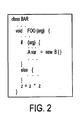
- Figure 2 shows pseudo source code written in a programming language similar to the JAVATM programming language.
- the first line names the class "BAR.”
- the first set of ellipses represents other statements that contribute to the definition of class BAR but will not be considered here.
- the next line through the end of the example defines a method named FOO in the class BAR (also denoted as BAR.FOO), the type "void" indicates that no value is returned when an invocation of the method FOO terminates.
- the next line introduces an "if else" construct that provides two branches during execution.
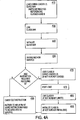
- class BAR is verified during linking in step 435; and, if class BAR passes verification and linking, the JVM goes on to initialize class BAR in step 440.
- class BAR does not pass linking and verification, then an error message is thrown (not shown) and execution is not attempted (not shown).
- the main method in class BAR is executed and eventually method FOO is invoked in step 450. If the variable arg is false, the "else" branch is taken in method FOO and neither class A nor class B is used.
- step 460 determining whether the current instruction requires resolving a reference to class B. If class B is not required, the current instruction is executed and execution continues with the next instruction looping back to 460 until no more instructions remain to be verified. If, on the other hand, variable arg is true, the "if" branch is executed. This branch contains the assignment in which the variable var of type class A is set to a new instance of class B. When the first instruction referencing B is encountered, a method of class B must be invoked (the constructor of B), and the reference to class B must be resolved. The test represented by step 460, asking whether B must be resolved for this instruction, is answered in the affirmative. Then, step 470 loads class B, if it is not already loaded, using class loader L3.
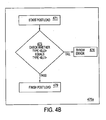
- step 475 is shown in Figure 4A , and moves directly to step 480. Since a new instance of class B is being created, it must first be linked and initialized. So, the next step is for class B to be linked in step 480 if it has not already been linked. If class B passes linkage (including verification) in step 480, then in step 490 class B is initialized and then processing continues in step 498, in which the newly-resolved class B can be used by the current instruction.
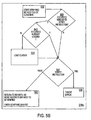
- FIG. 5A is a flowchart that shows that linking class BAR in step 435 includes starting verification of the current class BAR 510 followed eventually by a step 530 in which the method FOO of current class BAR undergoes verification. Subsequently, the verification of class BAR within step 435 is finished in step 590.
- the procedures employed during the conventional embodiment 530a of step 530 to verify method FOO of class BAR, are shown in Figure 5 B. The method starts in step 532. If the method references other classes such as A and B, and which are not yet already loaded, the verify process may need to load classes A and/or B.
- Figure 5C shows some example details of verification that may be performed during step 537; for example, as performed in the JVM and described in U.S. Patent 5,740,441 , FIG. 4B .
- a type snapshot is maintained for each instruction.
- the type snapshot is a structure which holds the types for a list of local variables and for each position on an operand stack.
- step 534 the effect of the execution of the instruction on the types in the snapshot is determined.
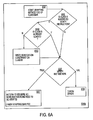
- step 640 if it is determined in step 640 that class B is not already loaded, the class loader for class B is not called to load class B at this time. Instead, verification constraints for class BAR's use of class B are written in step 650. Then it is assumed all cross-module checks on B, such as subtyping checks, are passed, and the verification of method FOO continues in step 682 as before. The circumstances that lead to writing constraints, and the form of those constraints, in step 650, are described in more detail later for the examples. According to this embodiment of the present invention, the verification step 530b during linking does not interfere with the fully lazy loading of modules, as is desired.
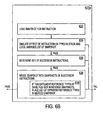
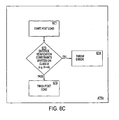
- FIG. 6C illustrates the enforcement of verification constraints on referenced class B according to an example embodiment of the present invention.
- This embodiment of the invention represents a new process 475b that may include the steps of 475a illustrated in Figure 4 B.
- the enforcement begins at step 671.
- the actual supertypes of B are used to determine whether B satisfies the subtyping verification constraints previously written. This check is made in step 673. If the referenced class B does not satisfy the constraints, then an error is thrown in step 674. The handler for this error may then terminate execution or allow execution to continue. Alternatively, execution may be terminated without throwing an error. If the referenced class B does satisfy the written constraints, then Post Load processing finishes in step 679.
- a VM can implement fully lazy loading with verification.
- the advantages of imposing fully lazy loading include:
- JIT just-in-time
- a static compiler can fail during its proprietary link phase due to an invalid class reference.
- step 716 If the module passes all the checks, then any pre-verification constraints to be recalled are written in step 716 for later use at run time. Subsequently, the process stops at step 719 when pre-verification is complete.
- Another class or module can then be pre-verified following the steps illustrated in Figure 7A . Not all the instructions in a module may need to be pre-verified, just the instructions needed for a. particular use of the module. For example, it may be necessary only to verify the instructions in method FOO, but not other methods in class BAR.
- This constraint can be written in any of the steps listed above for writing constraints (e.g. 650, 750, 889, 885 ). Later when BAR.FOO is executed, if this branch with the assignment statement is not executed, and B is not likewise referenced from any other instruction that is executed, class B is never loaded.
Landscapes
- Engineering & Computer Science (AREA)
- Software Systems (AREA)
- Theoretical Computer Science (AREA)
- Physics & Mathematics (AREA)
- General Engineering & Computer Science (AREA)
- General Physics & Mathematics (AREA)
- Stored Programmes (AREA)
- Devices For Executing Special Programs (AREA)
Claims (3)
- Procédé permettant d'éviter le chargement d'un module référencé pas encore chargé lors de la vérification d'instructions dans un premier module d'un programme d'ordinateur, lequel premier module a été chargé et est appelé à être lié dynamiquement à au moins un autre module, le procédé comprenant les étapes consistant à :fusionner (636) un premier instantané de types et un deuxième instantané de types dudit premier module, un instantané de types étant une structure qui contient les types pour une liste de variables locales et pour chaque position sur une pile d'opérandes ;établir si une position fixe dans le premier instantané contient un premier type de référence défini dans un module pas encore chargé, ledit premier type de référence étant référencé à partir du premier module ;établir si la position fixe dans le deuxième instantané contient un deuxième type de référence qui diffère du premier type de référence ; etplacer (638) une liste comportant le premier type de référence et le deuxième type de référence au niveau de la position fixe d'un instantané fusionné s'il est établi que la position fixe dans le premier instantané contient un premier type de référence défini dans un module pas encore chargé et s'il est établi que la position fixe dans le deuxième instantané contient le deuxième type de référence qui diffère du premier type de référence,de sorte que la vérification dudit premier module se poursuive sans un treillis de types complètement rempli, un treillis de types étant une structure mathématique exprimant des relations de sous-typage entre des types.
- Produit-programme d'ordinateur, comprenant un support mémoire exploitable par ordinateur comportant des codes d'exécution pour mettre en oeuvre un procédé selon la revendication 1.
- Appareil permettant d'éviter le chargement d'un module référencé pas encore chargé lors de la vérification d'instructions dans un premier module d'un programme d'ordinateur, lequel premier module a été chargé et est appelé à être lié dynamiquement à au moins un autre module, l'appareil comprenant :un moyen pour fusionner (636) un premier instantané de types et un deuxième instantané de types dudit premier module, un instantané de types étant une structure qui contient les types pour une liste de variables locales et pour chaque position sur une pile d'opérandes ;un moyen pour établir si une position fixe dans le premier instantané contient un premier type de référence défini dans un module pas encore chargé, ledit premier type de référence étant référencé à partir du premier module ;un moyen pour établir si la position fixe dans le deuxième instantané contient un deuxième type de référence qui diffère du premier type de référence ; etun moyen pour placer (638) une liste comportant le premier type de référence et le deuxième type de référence au niveau de la position fixe d'un instantané fusionné s'il est établi que la position fixe dans le premier instantané contient un premier type de référence défini dans un module pas encore chargé et s'il est établi que la position fixe dans le deuxième instantané contient le deuxième type de référence qui diffère du premier type de référence,de sorte que la vérification dudit premier module se poursuive sans un treillis de types complètement rempli, un treillis de types étant une structure mathématique exprimant des relations de sous-typage entre des types.
Applications Claiming Priority (2)
| Application Number | Priority Date | Filing Date | Title |
|---|---|---|---|
| US09/321,228 US6766521B1 (en) | 1999-05-27 | 1999-05-27 | Dataflow algorithm for symbolic computation of lowest upper bound type |
| US321228 | 2005-12-29 |
Publications (3)
| Publication Number | Publication Date |
|---|---|
| EP1056005A2 EP1056005A2 (fr) | 2000-11-29 |
| EP1056005A3 EP1056005A3 (fr) | 2001-12-12 |
| EP1056005B1 true EP1056005B1 (fr) | 2013-05-01 |
Family
ID=23249729
Family Applications (1)
| Application Number | Title | Priority Date | Filing Date |
|---|---|---|---|
| EP00304321.3A Expired - Lifetime EP1056005B1 (fr) | 1999-05-27 | 2000-05-22 | Algorithme de flux de données pour calcul symbolique du type ayant la plus petite borne supérieure |
Country Status (6)
| Country | Link |
|---|---|
| US (1) | US6766521B1 (fr) |
| EP (1) | EP1056005B1 (fr) |
| JP (1) | JP2001175487A (fr) |
| CN (1) | CN1224902C (fr) |
| AU (1) | AU770452B2 (fr) |
| CA (1) | CA2309768C (fr) |
Families Citing this family (6)
| Publication number | Priority date | Publication date | Assignee | Title |
|---|---|---|---|---|
| US20020199156A1 (en) * | 2001-05-23 | 2002-12-26 | Fuel Tech, Inc. | Hardware-adaptable data visualization tool for use in complex data analysis and engineering design |
| US7036111B2 (en) * | 2001-06-01 | 2006-04-25 | Hewlett-Packard Development Company, L.P. | Code verification system and method |
| US8356290B2 (en) * | 2009-04-27 | 2013-01-15 | National Instruments Corporation | Conversion of a class oriented data flow program with inheritance to a structure oriented data flow program |
| US8769518B1 (en) * | 2010-06-29 | 2014-07-01 | Ca, Inc. | Ensuring determinism during programmatic replay in a virtual machine |
| US10055208B2 (en) * | 2015-08-09 | 2018-08-21 | Oracle International Corporation | Extending a virtual machine instruction set architecture |
| CN107203407B (zh) * | 2016-03-18 | 2020-06-23 | 龙芯中科技术有限公司 | Java虚拟机中的数据校验方法及装置 |
Family Cites Families (31)
| Publication number | Priority date | Publication date | Assignee | Title |
|---|---|---|---|---|
| CA2102883A1 (fr) * | 1993-02-26 | 1994-08-27 | James W. Arendt | Systeme et methode de chargement differe de bibliotheques mises en commun |
| US5748964A (en) | 1994-12-20 | 1998-05-05 | Sun Microsystems, Inc. | Bytecode program interpreter apparatus and method with pre-verification of data type restrictions |
| US5668999A (en) | 1994-12-20 | 1997-09-16 | Sun Microsystems, Inc. | System and method for pre-verification of stack usage in bytecode program loops |
| US5504568A (en) | 1995-04-21 | 1996-04-02 | Xerox Corporation | Print sequence scheduling system for duplex printing apparatus |
| US5771339A (en) | 1995-06-07 | 1998-06-23 | Xerox Corporation | Method for automatically deriving print engine capabilities for incremental scheduling from compositional print engine models |
| US5668942A (en) | 1995-06-07 | 1997-09-16 | Xerox Corporation | Generic system for describing and using resources for print engine scheduling |
| US5696893A (en) | 1995-06-07 | 1997-12-09 | Xerox Corporation | System for generically describing and scheduling operation of modular printing machine |
| US5835688A (en) | 1995-06-07 | 1998-11-10 | Xerox Corporation | Generic method for automatically generating finite-state machines for schedudling from print engine capabilities |
| US5694529A (en) | 1995-06-07 | 1997-12-02 | Xerox Corporation | System for automatically configuring print engine software from print engine module capabilities |
| US5781710A (en) | 1995-06-07 | 1998-07-14 | Xerox Corporation | Generic method for scheduling print engines using print engine capabilities |
| US5617214A (en) | 1995-11-28 | 1997-04-01 | Xerox Corporation | Commitment groups to generalize the scheduling of interdependent document output terminal capabilities |
| US5631740A (en) | 1995-11-28 | 1997-05-20 | Xerox Corporation | Transducers with constraints model for print scheduling |
| US5701557A (en) | 1995-11-28 | 1997-12-23 | Xerox Corporation | Machine graphs and capabilities to represent document output terminals composed of arbitrary configurations |
| US6067575A (en) | 1995-12-08 | 2000-05-23 | Sun Microsystems, Inc. | System and method for generating trusted, architecture specific, compiled versions of architecture neutral programs |
| US5815718A (en) | 1996-05-30 | 1998-09-29 | Sun Microsystems, Inc. | Method and system for loading classes in read-only memory |
| US5812273A (en) | 1997-01-21 | 1998-09-22 | Xerox Corporation | Operation scheduling system for a digital printing apparatus, using a table of executed operations to revise a schedule in real time |
| US5729790A (en) | 1997-01-21 | 1998-03-17 | Xerox Corporation | Operation scheduling system for a digital printing apparatus using a tree of possible schedules |
| US5935249A (en) | 1997-02-26 | 1999-08-10 | Sun Microsystems, Inc. | Mechanism for embedding network based control systems in a local network interface device |
| US6092147A (en) * | 1997-04-15 | 2000-07-18 | Sun Microsystems, Inc. | Virtual machine with securely distributed bytecode verification |
| US5983348A (en) | 1997-09-10 | 1999-11-09 | Trend Micro Incorporated | Computer network malicious code scanner |
| US6061721A (en) | 1997-10-06 | 2000-05-09 | Sun Microsystems, Inc. | Bean-based management system |
| US5966702A (en) | 1997-10-31 | 1999-10-12 | Sun Microsystems, Inc. | Method and apparatus for pre-processing and packaging class files |
| US6219787B1 (en) | 1997-12-22 | 2001-04-17 | Texas Instruments Incorporated | Method and apparatus for extending security model to native code |
| US6178504B1 (en) | 1998-03-12 | 2001-01-23 | Cheyenne Property Trust C/O Data Securities International, Inc. | Host system elements for an international cryptography framework |
| US6092202A (en) | 1998-05-22 | 2000-07-18 | N*Able Technologies, Inc. | Method and system for secure transactions in a computer system |
| US6237135B1 (en) | 1998-06-18 | 2001-05-22 | Borland Software Corporation | Development system with visual design tools for creating and maintaining Java Beans components |
| US6430569B1 (en) * | 1998-08-14 | 2002-08-06 | Sun Microsystems, Inc. | Methods and apparatus for type safe, lazy, user-defined class loading |
| US6321333B1 (en) | 1998-10-14 | 2001-11-20 | Wave Systems Corporation | Efficient digital certificate processing in a data processing system |
| US6618855B1 (en) * | 1999-05-27 | 2003-09-09 | Sun Microsystems, Inc. | Caching untrusted modules for module-by-module verification |
| US6601114B1 (en) * | 1999-05-27 | 2003-07-29 | Sun Microsystems, Inc. | Fully lazy linking with module-by-module verification |
| US6618769B1 (en) * | 1999-05-27 | 2003-09-09 | Sun Microsystems, Inc. | Module-by-module verification |
-
1999
- 1999-05-27 US US09/321,228 patent/US6766521B1/en not_active Expired - Lifetime
-
2000
- 2000-05-22 EP EP00304321.3A patent/EP1056005B1/fr not_active Expired - Lifetime
- 2000-05-23 JP JP2000151833A patent/JP2001175487A/ja active Pending
- 2000-05-26 CN CN00117671.4A patent/CN1224902C/zh not_active Expired - Lifetime
- 2000-05-26 AU AU36437/00A patent/AU770452B2/en not_active Expired
- 2000-05-26 CA CA002309768A patent/CA2309768C/fr not_active Expired - Fee Related
Also Published As
| Publication number | Publication date |
|---|---|
| CN1224902C (zh) | 2005-10-26 |
| EP1056005A2 (fr) | 2000-11-29 |
| JP2001175487A (ja) | 2001-06-29 |
| EP1056005A3 (fr) | 2001-12-12 |
| AU770452B2 (en) | 2004-02-19 |
| US6766521B1 (en) | 2004-07-20 |
| CN1292526A (zh) | 2001-04-25 |
| CA2309768A1 (fr) | 2000-11-27 |
| CA2309768C (fr) | 2005-12-13 |
| AU3643700A (en) | 2000-11-30 |
Similar Documents
| Publication | Publication Date | Title |
|---|---|---|
| EP1056003B1 (fr) | Vérifier module après module | |
| US7444648B2 (en) | Fully lazy linking with module-by-module verification | |
| EP1056013B1 (fr) | Vérification sécurisée des modules de programme d'ordinateur | |
| US5999732A (en) | Techniques for reducing the cost of dynamic class initialization checks in compiled code | |
| US6560774B1 (en) | Verifier to check intermediate language | |
| US6704927B1 (en) | Static binding of dynamically-dispatched calls in the presence of dynamic linking and loading | |
| US6430569B1 (en) | Methods and apparatus for type safe, lazy, user-defined class loading | |
| US6763397B1 (en) | Fully lazy linking | |
| AU770452B2 (en) | Dataflow algorithm for symbolic computation of lowest upper bound type | |
| AU2004200283B2 (en) | Module-by-module verification | |
| Tozawa et al. | Formalization and analysis of class loading in Java | |
| Doyon et al. | On object initialization in the Java bytecode | |
| Börger¹ et al. | Modular Design for the Java Virtual Machine | |
| Buhr | Exceptions | |
| Painchaud et al. | On the implementation of a stand-alone Java/sup TM/bytecode verifier | |
| Trautweiler | Transparent runtime evolution of components: Master thesis |
Legal Events
| Date | Code | Title | Description |
|---|---|---|---|
| PUAI | Public reference made under article 153(3) epc to a published international application that has entered the european phase |
Free format text: ORIGINAL CODE: 0009012 |
|
| AK | Designated contracting states |
Kind code of ref document: A2 Designated state(s): DE FR GB IE NL SE Kind code of ref document: A2 Designated state(s): AT BE CH CY DE DK ES FI FR GB GR IE IT LI LU MC NL PT SE |
|
| AX | Request for extension of the european patent |
Free format text: AL;LT;LV;MK;RO;SI |
|
| 17P | Request for examination filed |
Effective date: 20010419 |
|
| PUAL | Search report despatched |
Free format text: ORIGINAL CODE: 0009013 |
|
| AK | Designated contracting states |
Kind code of ref document: A3 Designated state(s): AT BE CH CY DE DK ES FI FR GB GR IE IT LI LU MC NL PT SE |
|
| AX | Request for extension of the european patent |
Free format text: AL;LT;LV;MK;RO;SI |
|
| RIC1 | Information provided on ipc code assigned before grant |
Free format text: 7G 06F 9/445 A, 7G 06F 11/00 B |
|
| AKX | Designation fees paid |
Free format text: DE FR GB IE NL SE |
|
| 17Q | First examination report despatched |
Effective date: 20060714 |
|
| RAP1 | Party data changed (applicant data changed or rights of an application transferred) |
Owner name: SUN MICROSYSTEMS, INC. |
|
| RAP1 | Party data changed (applicant data changed or rights of an application transferred) |
Owner name: ORACLE AMERICA, INC. |
|
| GRAP | Despatch of communication of intention to grant a patent |
Free format text: ORIGINAL CODE: EPIDOSNIGR1 |
|
| GRAS | Grant fee paid |
Free format text: ORIGINAL CODE: EPIDOSNIGR3 |
|
| GRAA | (expected) grant |
Free format text: ORIGINAL CODE: 0009210 |
|
| AK | Designated contracting states |
Kind code of ref document: B1 Designated state(s): DE FR GB IE NL SE |
|
| REG | Reference to a national code |
Ref country code: GB Ref legal event code: FG4D |
|
| REG | Reference to a national code |
Ref country code: IE Ref legal event code: FG4D |
|
| REG | Reference to a national code |
Ref country code: DE Ref legal event code: R096 Ref document number: 60047976 Country of ref document: DE Effective date: 20130627 |
|
| REG | Reference to a national code |
Ref country code: NL Ref legal event code: VDEP Effective date: 20130501 |
|
| PG25 | Lapsed in a contracting state [announced via postgrant information from national office to epo] |
Ref country code: SE Free format text: LAPSE BECAUSE OF FAILURE TO SUBMIT A TRANSLATION OF THE DESCRIPTION OR TO PAY THE FEE WITHIN THE PRESCRIBED TIME-LIMIT Effective date: 20130501 |
|
| REG | Reference to a national code |
Ref country code: IE Ref legal event code: MM4A |
|
| PG25 | Lapsed in a contracting state [announced via postgrant information from national office to epo] |
Ref country code: NL Free format text: LAPSE BECAUSE OF FAILURE TO SUBMIT A TRANSLATION OF THE DESCRIPTION OR TO PAY THE FEE WITHIN THE PRESCRIBED TIME-LIMIT Effective date: 20130501 |
|
| PLBE | No opposition filed within time limit |
Free format text: ORIGINAL CODE: 0009261 |
|
| REG | Reference to a national code |
Ref country code: FR Ref legal event code: ST Effective date: 20140131 |
|
| STAA | Information on the status of an ep patent application or granted ep patent |
Free format text: STATUS: NO OPPOSITION FILED WITHIN TIME LIMIT |
|
| 26N | No opposition filed |
Effective date: 20140204 |
|
| PG25 | Lapsed in a contracting state [announced via postgrant information from national office to epo] |
Ref country code: IE Free format text: LAPSE BECAUSE OF NON-PAYMENT OF DUE FEES Effective date: 20130522 |
|
| REG | Reference to a national code |
Ref country code: DE Ref legal event code: R097 Ref document number: 60047976 Country of ref document: DE Effective date: 20140204 |
|
| PG25 | Lapsed in a contracting state [announced via postgrant information from national office to epo] |
Ref country code: FR Free format text: LAPSE BECAUSE OF NON-PAYMENT OF DUE FEES Effective date: 20130701 |
|
| PGFP | Annual fee paid to national office [announced via postgrant information from national office to epo] |
Ref country code: DE Payment date: 20190508 Year of fee payment: 20 |
|
| PGFP | Annual fee paid to national office [announced via postgrant information from national office to epo] |
Ref country code: GB Payment date: 20190522 Year of fee payment: 20 |
|
| REG | Reference to a national code |
Ref country code: DE Ref legal event code: R071 Ref document number: 60047976 Country of ref document: DE |
|
| REG | Reference to a national code |
Ref country code: GB Ref legal event code: PE20 Expiry date: 20200521 |
|
| PG25 | Lapsed in a contracting state [announced via postgrant information from national office to epo] |
Ref country code: GB Free format text: LAPSE BECAUSE OF EXPIRATION OF PROTECTION Effective date: 20200521 |