EP1056038A2 - Verfahren zur Aufbereitung von aus Zeichen und Zeichenfolgen generierten Bitmustern für die optische Zeichenerkennung - Google Patents
Verfahren zur Aufbereitung von aus Zeichen und Zeichenfolgen generierten Bitmustern für die optische Zeichenerkennung Download PDFInfo
- Publication number
- EP1056038A2 EP1056038A2 EP00111118A EP00111118A EP1056038A2 EP 1056038 A2 EP1056038 A2 EP 1056038A2 EP 00111118 A EP00111118 A EP 00111118A EP 00111118 A EP00111118 A EP 00111118A EP 1056038 A2 EP1056038 A2 EP 1056038A2
- Authority
- EP
- European Patent Office
- Prior art keywords
- pixels
- marginal
- character
- columns
- scanning window
- Prior art date
- Legal status (The legal status is an assumption and is not a legal conclusion. Google has not performed a legal analysis and makes no representation as to the accuracy of the status listed.)
- Ceased
Links
Images

Classifications
-
- G—PHYSICS
- G06—COMPUTING OR CALCULATING; COUNTING
- G06V—IMAGE OR VIDEO RECOGNITION OR UNDERSTANDING
- G06V30/00—Character recognition; Recognising digital ink; Document-oriented image-based pattern recognition
- G06V30/10—Character recognition
- G06V30/16—Image preprocessing
- G06V30/164—Noise filtering
-
- G—PHYSICS
- G06—COMPUTING OR CALCULATING; COUNTING
- G06V—IMAGE OR VIDEO RECOGNITION OR UNDERSTANDING
- G06V30/00—Character recognition; Recognising digital ink; Document-oriented image-based pattern recognition
- G06V30/10—Character recognition
- G06V30/20—Combination of acquisition, preprocessing or recognition functions
-
- G—PHYSICS
- G06—COMPUTING OR CALCULATING; COUNTING
- G06V—IMAGE OR VIDEO RECOGNITION OR UNDERSTANDING
- G06V30/00—Character recognition; Recognising digital ink; Document-oriented image-based pattern recognition
- G06V30/10—Character recognition
Definitions
- the invention relates to a method for processing from Characters and strings generated bit patterns for the optical Character recognition according to the characteristics of the generic term of claims 1 to 4.
- the bit information obtained using an optoelectric converter is generally binarized.
- Each pixel or pixel is either made logical by a single bit with the binary value 1 "for the character or with the binary value logical ⁇ "represents the character background. Since the most varied paper qualities or also raster printing have to be taken into account in the text templates, it is not always possible to clearly differentiate between the character background and the actual useful information of the character when binarizing the image information. The result is a binarized image, which, in addition to the useful information, also contains interference pixels that are caused by poor paper quality, extraneous particles and other stains, as well as by halftone dots in print originals.
- interference pixels or stains of different sizes and shapes inevitably impair the quality and speed of the automatic character recognition
- interference pixels or spots have a disruptive effect on the archiving of the binary images, since, for example, run-length compression, including fax data transmission, results in undesirably large amounts of data it is therefore desirable to electronically remove interfering pixels or pixels from the image prior to character recognition or archiving.
- the present invention is therefore based on the object for extracting and removing the binarized in Disturbing pixels containing character templates, as simple as possible and in particular can be implemented in a short amount of time Show solution.
- the method according to the invention is characterized in particular by this from that without knowing the exact shape and appearance concluded that there is interference pixel information can be. This brings in particular in the event of malfunctions, that are larger than a pixel in size, one Reduction of processing effort by several orders of magnitude with yourself.
- ASIC application specific integrated circuit
- FPGA field-programmable gate array
- CPLD CPLD
- the basis of the method according to the invention is the knowledge that that stains are characterized by that around the stain a continuous, closed line is drawn around it can, without covering the stain, clearly this Stain from other stains or from the actual useful information separates.
- This imaginary dividing line has the Width of an image point or pixel.
- the number of of the Line included pixels and the geometry of the included Determine the size of the stain that area can be removed.
- Figure 1 shows the bit pattern generated from a text template for two obliquely offset letters M "and a multi-pixel interfering information embedded in between.
- This interfering information is from a matrix-like search window, symbolized by a closed line L in the form of a square surrounding the interference pixels in the form of a square, each with six pixels per side edge.
- This closed line L is set out of a total of twenty, each by one Dot "marked pixels together and encloses a pixel area with a total of sixteen pixels. With the help of these twenty line pixels alone, it is now possible to use the symbol in the closed area x "to define marked interference pixels S as such, without having a precise knowledge of the arrangement of the individual interference pixels.
- a total of 2 16-1 65,535 different arrangements of interference pixels are detected by the frame-like limitation of the interference pixel area. Instead of comparing all 65,535 patterns, it is sufficient here So a comparison with only twenty line pixels in order to be able to make a clear statement about the area with interfering pixels. For practical use it makes sense that the shape of these lines is fixed. However, when defining these dividing lines there are no special ones However, all lines must have in common that they completely close an area inside. It is perfectly permissible to use several different dividing lines at the same time, but in principle it is sufficient if a single dividing line is used to determine that the There is an arbitrarily shaped stain inside This spot can then be removed or deleted from the bit pattern in a further step.
- a black pixel is logical for a binary image 1 ", a white pixel as logical ⁇ "is defined.
- a rule can now be defined, according to which the individual pixels of the closed line over a OR "element can be linked to one another. If this rule was successful, ie if an isolated spot or an interference pixel area was found, the result of the OR operation is a logical one ⁇ ", since all pixels of the line itself by definition ⁇ "must be. On the other hand, the line lies on an active pixel with the binary value 1 "is the result of the link 1 ". The results of the individual rules are then simply AND-linked. If a search rule was successful, the result of all logical links is a logical one ⁇ ".
- black pixel ⁇
- a rule defines the AND operation of the pixels lying on a line. If there is no black pixel ( ⁇ ") on the line, the result of the link is a" 1 ". The various rules are then OR-linked. If the result is a" 1 ", the end result is also a" 1 ".
- this principle is then particularly simple, if only at one point in time at a time to be decided. It should therefore only be for one pixel, which are referred to below as central pixels SZ the decision should be made as to whether it is part is a stain.
- this central pixel is in its matrix-like Environment, using a formed by the closed line L according to FIG. 1 Sampling window, column and row by pixel spacing can be moved.
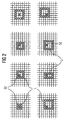
- Figure 2 shows this a set of rules defined for the central pixel SZ can be.
- the matrix-shaped environment around the central pixel realized as a large flat shift register, in this way, only one decision is made with each shift cycle hit over the new central pixel, it can but all rules are queried at the same time.
- the rules itself as a fixed OR link with the corresponding Locations within the matrix. For the implementation This measure only requires that the entire image shifted in the row and column direction every pixel becomes the central pixel.
- interference pixels or interference pixel areas form a special case or stains that are not sufficiently isolated from the Payload are so close to the payload occur that when binarizing the drawing template a Merging or gluing with the useful information takes place.
- a typical example of such effects is the description of papers with a fine screen print are a gray for the human viewer Generate background. If the interference area is small compared The stroke width of the characters can be modified by a Application of the explained in connection with Figure 2 Rules are reached that the size of the annoying bonds is reduced. To do this, follow the rules that apply so far were defined by a closed dividing line open at one or more points if necessary.
- the dividing line is open here at the frame edge facing the useful information only the pixels assigned to the two marginal columns and the pixels assigned to the upper margin line of the separating line L are linked to one another via an OR gate, if, as a result of this OR linkage, as in FIG Er Struktur "results, then the requirements for the removal of the interfering pixels occurring within the largely closed dividing line are also met here.
- the described procedure for the halftone dot and stain removal is primarily for the area of binary image information thought.
- the method according to the invention is so flexible that that an application in other color spaces, for example, Gray, RBG, HLS, CMYK, 7-8 is conceivable.
- a definition for the background in the RGB color space for example be that pixels that range from blue to Belong to violet, always belong to the background, and pixels Yellow to green always belong to the foreground.
- a colored spot in the colored area can be deleted.
- the Deleting a colored spot within a rule (line) could be included, for example, by replacing the Area by the mean of the colored pixels in the direct Environment outside of the rule.
- That would be a universal one Process defines noisy images of interference information with a defined background.
- the application of such a method is not limited to this limited the area of optical character recognition.
- the too correcting images do not necessarily have to be by means of a optoelectric photodiode matrix can be obtained.
- the procedure is also the same for synthetically produced and still noisy images applicable.
Landscapes
- Engineering & Computer Science (AREA)
- Computer Vision & Pattern Recognition (AREA)
- Physics & Mathematics (AREA)
- General Physics & Mathematics (AREA)
- Multimedia (AREA)
- Theoretical Computer Science (AREA)
- Character Input (AREA)
Abstract

Description

- Figur 1
- das Bitmuster für eine Textvorlage mit dazwischen eingelagerter Störinformation
- Figur 2
- das Prinzip zur Ermittlung von Störpixeln mit Hilfe einer Suchmatrix.
- Figur 3
- das Prinzip zur Ermittlung von mit der Nutzinformation verklebten Störpixeln
Claims (4)
- Verfahren zur Aufbereitung von aus Zeichen und Zeichenfolgen generierten Bitmustern für die optische Zeichenerkennung, bei dem die mittels einer optoelektrischen Fotodiodenmatrix abgetastete Zeichenvorlage in binarisierte Bildpunktsignale umgewandelt und in einem in Spalten und Zeilen unterteilten Bildsignalspeicher abgespeichert werden derart, dass die Nutzsignal-Bildpunkte und die im Zeichenhintergrund vorhandenen Störsignal-Bildpunke als binäre1" und die Bildpunkte des Zeichenhintergrundes als binäre

dadurch gekennzeichnet,
dass zur Herausfilterung der Störsignale aus der Nutzinformation ein matrixartig aufgebautes Abtastfenster mit einer zur Zeilengröße vergleichsweise sehr geringen Spalten- und Zeilenzahl schrittweise über einen entsprechend großen Teilbereich des gespeicherten Bitmusters gelegt und dieses Abtastfenster gegenüber dem Teilbereich taktweise sowohl in Spalten- als auch in Zeilenrichtung verschoben wird, dass bei jeder Taktstellung des Bitmusters zum Abtastfenster für die längs einer geschlossenen, durch die Randspalten und Randzeilen des Abtastfensters gebildeten Linie angeordneten Bildpunkte des Bitmusters eine ODER-Verknüpfung durchgeführt wird, und dass bei einem Verknüpfungsergebnis = ⊘ der innerhalb der Randzeilen und Randspalten liegende Bereich des Abtastfensters auf Bildpunkte mit dem Binärwert - Verfahren zur Aufbereitung von aus Zeichen und Zeichenfolgen generierten Bitmustern für die optische Zeichenerkennung, bei dem die mittels einer optoelektrischen Fotodiodenmatrix abgetastete Zeichenvorlage in binarisierte Bildpunktsignale umgewandelt und in einem in Spalten und Zeilen unterteilten Bildsignalspeicher abgespeichert werden derart, dass die Nutzsignal-Bildpunkte und die im Zeichenhintergrund vorhandenen Störsignal-Bildpunke als binäre
dadurch gekennzeichnet,
dass zur Herausfilterung der Störsignale aus der Nutzinformation ein matrixartig aufgebautes Abtastfenster mit einer zur Zeilengröße vergleichsweise sehr geringen Spalten- und Zeilenzahl schrittweise über einen entsprechend großen Teilbereich des gespeicherten Bitmusters gelegt und dieses Abtastfenster gegenüber dem Teilbereich taktweise sowohl in Spalten- als auch in Zeilenrichtung verschoben wird, dass bei jeder Taktstellung des Bitmusters zum Abtastfenster für die längs einer geschlossenen, durch die Randspalten und Randzeilen des Abtastfensters gebildeten Linie angeordneten Bildpunkte des Bitmusters eine UND-Verknüpfung durchgeführt wird, und dass bei einem Verknüpfungsergebnis = 1 der innerhalb der Randzeilen und Randspalten liegende Bereich des Abtastfensters auf Bildpunkte mit dem Binärwert - Verfahren zur Aufbereitung von aus Zeichen und Zeichenfolgen generierten Bitmustern für die optische Zeichenerkennung, bei dem die mittels einer optoelektrischen Fotodiodenmatrix abgetastete Zeichenvorlage in binarisierte Bildpunktsignale umgewandelt und in einem in Spalten und Zeilen unterteilten Bildsignalspeicher abgespeichert werden derart, dass die Nutzsignal-Bildpunkte und die im Zeichenhintergrund vorhandenen Störsignal-Bildpunke als binäre
dadurch gekennzeichnet,
dass zur Herausfilterung von in unmittelbarer Nähe zur Nutzinformation auftretenden Störsignalen aus der Nutzinformation ein matrixartig aufgebautes Abtastfenster mit einer zur Zeichengröße vergleichsweise sehr geringen Spalten- und Zeilenzahl schrittweise über einen entsprechend großen Teilbereich des gespeicherten Bitmusters gelegt und dieses Abtastfenster gegenüber dem Teilbereich taktweise sowohl in Spalten- als auch in Zeilenrichtung verschoben wird, dass bei jeder Stellung des Abtastfensters für die längs einer geschlossenen, durch die Randspalten und Randzeilen des Abtastfensters gebildeten Linie zugeordneten Bildsignale des Bitmusters mit Ausnahme der dem Nutzinformationsbereich zugewandten Randspalte oder Randzeile eine ODER-Verknüpfung durchgeführt wird, und dass bei einem Verknüpfungsergebnis gleich - Verfahren zur Aufbereitung von aus Zeichen und Zeichenfolgen generierten Bitmustern für die optische Zeichenerkennung, bei dem die mittels einer optoelektrischen Fotodiodenmatrix abgetastete Zeichenvorlage in binarisierte Bildpunktsignale umgewandelt und in einem in Spalten und Zeilen unterteilten Bildsignalspeicher abgespeichert werden derart, dass die Nutzsignal-Bildpunkte und die im Zeichenhintergrund vorhandenen Störsignal-Bildpunke als binäre
dadurch gekennzeichnet,
dass zur Herausfilterung von in unmittelbarer Nähe zur Nutzinformation auftretenden Störsignalen aus der Nutzinformation ein matrixartig aufgebautes Abtastfenster mit einer zur Zeichengröße vergleichsweise sehr geringen Spalten- und Zeilenzahl schrittweise über einen entsprechend großen Teilbereich des gespeicherten Bitmusters gelegt und dieses Abtastfenster gegenüber dem Teilbereich taktweise sowohl in Spalten- als auch in Zeilenrichtung verschoben wird, dass bei jeder Stellung des Abtastfensters für die längs einer geschlossenen, durch die Randspalten und Randzeilen des Abtastfensters gebildeten Linie zugeordneten Bildsignale des Bitmusters mit Ausnahme der dem Nutzinformationsbereich zugewandten Randspalte oder Randzeile eine UND-Verknüpfung durchgeführt wird, und dass bei einem Verknüpfungsergebnis gleich
Applications Claiming Priority (2)
| Application Number | Priority Date | Filing Date | Title |
|---|---|---|---|
| DE19924570 | 1999-05-28 | ||
| DE19924570 | 1999-05-28 |
Publications (2)
| Publication Number | Publication Date |
|---|---|
| EP1056038A2 true EP1056038A2 (de) | 2000-11-29 |
| EP1056038A3 EP1056038A3 (de) | 2002-05-08 |
Family
ID=7909529
Family Applications (1)
| Application Number | Title | Priority Date | Filing Date |
|---|---|---|---|
| EP00111118A Ceased EP1056038A3 (de) | 1999-05-28 | 2000-05-23 | Verfahren zur Aufbereitung von aus Zeichen und Zeichenfolgen generierten Bitmustern für die optische Zeichenerkennung |
Country Status (1)
| Country | Link |
|---|---|
| EP (1) | EP1056038A3 (de) |
Cited By (1)
| Publication number | Priority date | Publication date | Assignee | Title |
|---|---|---|---|---|
| DE112006003272B4 (de) | 2005-11-30 | 2022-08-18 | Adobe Inc. | Verfahren und Vorrichtung zum Entfernen von Rauschen aus einem digitalen Bild |
Family Cites Families (2)
| Publication number | Priority date | Publication date | Assignee | Title |
|---|---|---|---|---|
| US4510618A (en) * | 1982-12-27 | 1985-04-09 | Ncr Canada Ltd - Ncr Canada Ltee | Noise cleaner for binary images |
| EP0177823A1 (de) * | 1984-09-27 | 1986-04-16 | Siemens Aktiengesellschaft | Verfahren zur Selektion, insbesondere zur Selektion und Löschung horizontaler und/oder vertikaler linien in digitalsierten Faksimiles |
-
2000
- 2000-05-23 EP EP00111118A patent/EP1056038A3/de not_active Ceased
Cited By (1)
| Publication number | Priority date | Publication date | Assignee | Title |
|---|---|---|---|---|
| DE112006003272B4 (de) | 2005-11-30 | 2022-08-18 | Adobe Inc. | Verfahren und Vorrichtung zum Entfernen von Rauschen aus einem digitalen Bild |
Also Published As
| Publication number | Publication date |
|---|---|
| EP1056038A3 (de) | 2002-05-08 |
Similar Documents
| Publication | Publication Date | Title |
|---|---|---|
| DE102017220361B4 (de) | Verfahren und Testmuster zur Detektion und Kompensation ausgefallener Druckdüsen in einer Inkjet-Druckmaschine | |
| DE69526792T2 (de) | Bildverarbeitungsgerät und -verfahren | |
| DE69323180T2 (de) | Verfahren und Vorrichtung zum Justieren der Dichtung von numerischen Bildern | |
| DE3910035C3 (de) | Farbbildabtasteinrichtung | |
| DE69033484T2 (de) | Identifizierung und Segmentierung von feintexturierten und festen binären Bildern | |
| DE19842572B4 (de) | Verfahren zur automatischen Entfernung von Bildfehlern | |
| DE69027469T2 (de) | Optisches Aufzeichnungssystem | |
| DE69622491T2 (de) | Verfahren und Vorrichtung zur Verbesserung des Auflösungsvermögens von Grautonbildern mit Text und Bildern | |
| DE3041502C2 (de) | Verfahren zum Herstellen einer Reproduktion von einer Vorlage | |
| DE3838730C2 (de) | Verfahren und Vorrichtung zur Bildverarbeitung | |
| DE69925354T2 (de) | Bildverarbeitungssystem um vertikale Muster auf abgetasteten Bildern zu reduzieren | |
| DE2858688C2 (de) | ||
| DE69313551T2 (de) | Bildverarbeitungsgerät und Methode zur Änderung eingelesener Bildpunkttonwerte, beruhend auf einem veränderlichen Bildhintergrund-Bezugstonwert | |
| DE3879609T2 (de) | Verfahren und Vorrichtung zum Erkennen von kennzeichnenden Unterschieden in einem Blattmaterial. | |
| DE19719378B4 (de) | Verfahren zum Verbessern und Drucken von Text in einem Bild | |
| DE3304241C2 (de) | ||
| DE69429562T2 (de) | Ein Detektionssystem in einem Durchlauf für Bildbereiche, die von einer Markierung umschlossen sind und Verfahren für einen Photokopierer | |
| EP0059705A1 (de) | Verfahren und schaltungsanordnung zur partiellen korrektur der zeichnung bei der farbbildreproduktion. | |
| DE2435982A1 (de) | Verfahren und vorrichtung zur verarbeitung von durch abtastung eines mehrfarbigen musters erhaltenen informationen | |
| EP0132453A1 (de) | Verfahren und Einrichtung zum Minimieren von Fehlern bei der digitalen Verarbeitung von elektrischen Signalen | |
| DE102004008379A1 (de) | Verbessertes Verfahren zum Aufrechterhalten der Kantenqualität beim Tintenstrahldrucken | |
| DE69219647T2 (de) | Verfahren und Vorrichtung zum Einfärben einer Bildfläche | |
| DE69933808T2 (de) | Bildverarbeitungsvorrichtung, -verfahren und Speichermedium | |
| DE69421369T2 (de) | Automatische Schwellwertbestimmung für numerische Abtaster | |
| EP1056038A2 (de) | Verfahren zur Aufbereitung von aus Zeichen und Zeichenfolgen generierten Bitmustern für die optische Zeichenerkennung |
Legal Events
| Date | Code | Title | Description |
|---|---|---|---|
| PUAI | Public reference made under article 153(3) epc to a published international application that has entered the european phase |
Free format text: ORIGINAL CODE: 0009012 |
|
| AK | Designated contracting states |
Kind code of ref document: A2 Designated state(s): AT BE CH CY DE DK ES FI FR GB GR IE IT LI LU MC NL PT SE |
|
| AX | Request for extension of the european patent |
Free format text: AL;LT;LV;MK;RO;SI |
|
| PUAL | Search report despatched |
Free format text: ORIGINAL CODE: 0009013 |
|
| AK | Designated contracting states |
Kind code of ref document: A3 Designated state(s): AT BE CH CY DE DK ES FI FR GB GR IE IT LI LU MC NL PT SE |
|
| AX | Request for extension of the european patent |
Free format text: AL;LT;LV;MK;RO;SI |
|
| RIC1 | Information provided on ipc code assigned before grant |
Free format text: 7G 06K 9/40 A, 7G 06K 9/34 B, 7G 06K 9/56 B |
|
| 17P | Request for examination filed |
Effective date: 20020619 |
|
| AKX | Designation fees paid |
Designated state(s): DE FR GB IT |
|
| 17Q | First examination report despatched |
Effective date: 20070620 |
|
| RAP1 | Party data changed (applicant data changed or rights of an application transferred) |
Owner name: CAPTARIS DOCUMENT TECHNOLOGIES GMBH |
|
| RAP1 | Party data changed (applicant data changed or rights of an application transferred) |
Owner name: OPEN TEXT DOCUMENT TECHNOLOGIES GMBH |
|
| STAA | Information on the status of an ep patent application or granted ep patent |
Free format text: STATUS: THE APPLICATION HAS BEEN REFUSED |
|
| 18R | Application refused |
Effective date: 20091019 |