EP1056048A2 - Méthode pour comparer deux images animées et système de récupération utilisant cette méthode - Google Patents
Méthode pour comparer deux images animées et système de récupération utilisant cette méthode Download PDFInfo
- Publication number
- EP1056048A2 EP1056048A2 EP00111434A EP00111434A EP1056048A2 EP 1056048 A2 EP1056048 A2 EP 1056048A2 EP 00111434 A EP00111434 A EP 00111434A EP 00111434 A EP00111434 A EP 00111434A EP 1056048 A2 EP1056048 A2 EP 1056048A2
- Authority
- EP
- European Patent Office
- Prior art keywords
- moving
- picture
- query
- timing information
- candidate
- Prior art date
- Legal status (The legal status is an assumption and is not a legal conclusion. Google has not performed a legal analysis and makes no representation as to the accuracy of the status listed.)
- Granted
Links
Images


Classifications
-
- G—PHYSICS
- G06—COMPUTING OR CALCULATING; COUNTING
- G06F—ELECTRIC DIGITAL DATA PROCESSING
- G06F16/00—Information retrieval; Database structures therefor; File system structures therefor
- G06F16/70—Information retrieval; Database structures therefor; File system structures therefor of video data
- G06F16/73—Querying
- G06F16/732—Query formulation
- G06F16/7328—Query by example, e.g. a complete video frame or video sequence
Definitions
- the present invention relates to techniques for moving-picture retrieval, and in particular to a method for comparing two moving pictures.
- a method for comparing a first moving picture and a second moving picture includes the steps of: a) generating first moving-picture feature data from first moving-picture data according to first timing information; b) generating second moving-picture feature data from second moving-picture data according to second timing information; c) changing at least one of the first moving-picture feature data and the second moving-picture feature data based on the first and second timing information so that one of the first moving-picture feature data and the second moving-picture feature data exists at a time position of the other; and d) comparing the first moving-picture feature data and the second moving-picture feature data.
- a method for computing a degree of similarity between two moving pictures includes the steps of: a) retrievably storing moving-picture data of each of a plurality of moving pictures and moving-picture feature data generated from the moving-picture data according to feature extraction timing information of the moving-picture data; b) inputting query moving-picture data and query feature extraction timing information; c) generating query moving-picture feature data from the query moving-picture data according to the query feature extraction timing information; d) reading moving-picture feature data of a selected one of the moving pictures stored, as candidate moving-picture feature data, wherein the candidate moving-picture feature data was generated from the selected one according to candidate feature extraction timing information; e) changing at least one of the query moving-picture feature data and the candidate moving-picture feature data based on the query and candidate feature extraction timing information so that one of the query moving-picture feature data and the candidate moving-picture feature data exists at a time position of the other; and f) computing the
- the step (e) may include the steps of: e.1) generating reference timing information; e.2) comparing time positions designated by the query feature extraction timing information with those designated by the reference timing information; e.3) changing the query moving-picture feature data so that the query moving-picture feature data exists at a time position designated by the reference timing information; e.4) comparing time positions designated by the candidate feature extraction timing information with those designated by the reference timing information; and e.5) changing the candidate moving-picture feature data so that the candidate moving-picture feature data exists at a time position designated by the reference timing information.
- the step (e) may include the steps of: e.1) generating reference timing information from the query and candidate feature extraction timing information according to a predetermined rule; e.2) comparing time positions designated by the query feature extraction timing information with those designated by the reference timing information; e.3) changing the query moving-picture feature data so that the query moving-picture feature data exists at a time position designated by the reference timing information; e.4) comparing time positions designated by the candidate feature extraction timing information with those designated by the reference timing information; and e.5) changing the candidate moving-picture feature data so that the candidate moving-picture feature data exists at a time position designated by the reference timing information.
- the step (e) may include the steps of: e.1) comparing time positions designated by the query feature extraction timing information with those designated by the candidate feature extraction timing information; and e.2) interpolating one of the query moving-picture feature data and the candidate moving-picture feature data so that an interpolated one exists at a time position of the other.
- the step (e) may include the steps of: e.1) comparing time positions designated by the query feature extraction timing information with those designated by the candidate feature extraction timing information; e.2) selecting common time positions which are designated by both the query feature extraction timing information and the candidate feature extraction timing information; and e.3) changing at least one of the query moving-picture feature data and the candidate moving-picture feature data so that each of the query moving-picture feature data and the candidate moving-picture feature data exists only at the common time positions.
- the step (e) may include the steps of: e.1) comparing time positions designated by the query feature extraction timing information with those designated by the candidate feature extraction timing information; e.2) generating expanded time positions which are designated by at least one of the query feature extraction timing information and the candidate feature extraction timing information; and e.3) changing at least one of the query moving-picture feature data and the candidate moving-picture feature data so that each of the query moving-picture feature data and the candidate moving-picture feature data exists at the expanded time positions.
- a similarity-based retrieval system includes: a database for retrievably storing moving-picture data of each of a plurality of moving pictures and moving-picture feature data generated from the moving-picture data according to feature extraction timing information of the moving-picture data: a feature extractor for extracting query moving-picture feature data from query moving-picture data according to query feature extraction timing information; a feature changer for changing at least one of the query moving-picture feature data and candidate moving-picture feature data based on the query and candidate feature extraction timing information so that one of the query moving-picture feature data and the candidate moving-picture feature data exists at a time position of the other, wherein the candidate moving-picture feature data is moving-picture feature data of a selected one of the moving pictures stored in the moving-picture database, which was generated from the selected one according to the candidate feature extraction timing information; and a controller for calculating the degree of similarity between the query moving-picture feature data and the candidate moving-picture feature data, at least one
- a candidate feature exists at each of the time positions of a query feature even in the case of variable feature extraction frame interval or different frame rate, precise similarity computation can be performed. Further, it is possible to retrieve a part of moving picture similar to a query moving picture from a moving-picture database.
- the present invention can be widely applied to an examination of the number of times a specific moving picture such as a specific news report, commercial, and the opening of a program has been broadcast, a statistic examination of broadcast information, trend investigation, and the like.
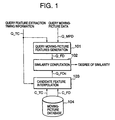
- a moving-picture similarity computing apparatus includes a query moving-picture feature generation section 101, a similarity computation section 102, a candidate feature interpolation section 103, and a moving-picture database 104.
- the query moving-picture feature generation section 101 inputs query moving-picture data Q_MPD and query feature extraction timing information Q_TC and generates query moving-picture features Q_FD from the query moving-picture data Q_MPD according to the query feature extraction timing information Q_TC.
- the query moving-picture feature generation section 101 selectively inputs frames/shots of the query moving-picture data Q_MPD at time positions designated by the query feature extraction timing information Q_TC and extracts a feature from the selected frame/shot of picture data.
- the query feature extraction timing information Q_TC is a time code indicating the time position of an Intra-frame or one representative frame of a shot.
- the query moving-picture features Q_FD is generated as a set of features of designated frames/shots.
- the moving-picture database 104 stores moving-picture data including moving-picture features that have been generated as the above-described way. More specifically, the moving-picture features are generated from the stored moving-picture data according to time positions of Intra-frame. It should be noted that a time interval between Intra-frames in the stored moving-picture data is not necessary to be equal to a time interval between Intra-frames in the query moving-picture data Q_MPD.
- the moving-picture database 104 outputs candidate moving-picture features C_FD and candidate feature extraction timing information C_TC of candidate moving picture data to the candidate feature interpolation section 103.
- the candidate feature interpolation section 103 compares the query feature extraction timing information Q_TC with the candidate feature extraction timing information C_TC and performs an interpolation operation as necessary so that a candidate feature C_FD exists at the time position of a query feature Q_FD for each designated frame. In this way, corrected or interpolated candidate feature C_FDc is output to the similarity computation section 102.
- the similarity computation section 102 receives the query features Q_FD and the interpolated candidate features C_FDc and computes the degree of similarity between them. Since a candidate feature C_FD exists at the time position of a query feature Q_FD for each designated frame, precise similarity computation can be performed. The details of the interpolation will be described hereafter.
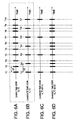
- query features Q_FD are generated at time positions T1, T2, T3, ..., and T8, respectively, and candidate features C_FD exist at time positions T1, T2', T4, T5', and T7, respectively.
- the candidate feature interpolation section 103 detects from the timing information Q_TC and C_TC that candidate features do not exist at time positions T2, T3, T5, T6, and T8. In such a case, interpolation is performed so that the candidate features C_FD are interpolated at the time positions T2, T3, T5, T6, and T8.
- the following interpolation methods may be employed.
- a first example of the interpolation method is to interpolate candidate features by using the immediately previous candidate feature at each of the time positions T2, T3, T5, T6, and T8. For example, at the time position T1, since the candidate feature exists, it is compared with the query feature at the same time position T1. At the time position T2, since no candidate feature exists, the candidate feature at the time position T1 is used as it is. At the time position T3, since no candidate feature exists, the candidate feature at the time position T2' is used as it is.
- a second example of the interpolation method is to interpolate candidate features by using the immediately following candidate feature at each of the time positions T2, T3, T5, T6, and T8.
- the candidate feature at the time position T1 since the candidate feature exists, it is compared with the query feature at the same time position T1.
- the candidate feature at the time position T2' is used as it is.
- the candidate feature at the time position T4 is used as it is.
- a third example of the interpolation method is to interpolate candidate features by using the previous and following candidate features at each of the time positions T2, T3, T5, T6, and T8.
- a candidate feature at the time position T2 is generated by averaging the candidate feature at the previous time position T1 and the candidate feature at the following time position T2'.
- a candidate feature at the time position T3 is generated by averaging the candidate feature at the previous time position T2' and the candidate feature at the following time position T4.
- a candidate feature at the time position T2 is generated by assigning weights to the candidate feature at the previous time position T1 and the candidate feature at the following time position T2' before averaging the weighed candidate features, where each weight is determined depending on a time interval between the time position T2 and a corresponding time position.
- a candidate feature at the time position T3 is generated by assigning weights to the candidate feature at the previous time position T2' and the candidate feature at the following time position T4 before averaging the weighed candidate features, where each weight is determined depending on a time interval between the time position T3 and a corresponding time position.
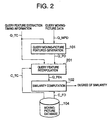
- a moving-picture similarity computing apparatus includes a query moving-picture feature generation section 101, a query feature interpolation section 201, a similarity computation section 102, and a moving-picture database 104.
- Blocks similar to those previously described with reference to Fig. 1 are denoted by the same reference numerals and the details thereof are omitted.
- the query feature interpolation section 201 compares the query feature extraction timing information Q_TC with the candidate feature extraction timing information C_TC and performs an interpolation operation as necessary so that a query feature Q_FD exists at the time position of a candidate feature C_FD for each designated frame. In this way. corrected or interpolated query feature Q_FDc is output to the similarity computation section 102.
- the similarity computation section 102 receives the interpolated query features Q_FDc and the candidate features C_FD and computes the degree of similarity between them. Since a query feature Q_FD exists at the time position of a candidate feature C_FD for each designated frame, precise similarity computation can be performed.
- a query feature Q_FD exists at each of the time positions of a candidate feature C_FD even in the case of variable time interval or different frame rate, precise similarity computation can be performed. Further, it is possible to extract features from the moving-picture data with variable feature extraction timing, resulting in a reduced scale of the moving-picture database 104.
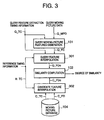
- a moving-picture similarity computing apparatus includes a query moving-picture feature generation section 101, a query feature interpolation section 301, a similarity computation section 102, a candidate feature interpolation section 302, and a moving-picture database 104.
- Blocks similar to those previously described with reference to Fig. 1 are denoted by the same reference numerals and the details thereof are omitted.
- the query feature interpolation section 301 compares the query feature extraction timing information Q_TC with a predetermined reference timing information R_TC and performs an interpolation operation as necessary so that a query feature Q_FD exists at all the time positions of the reference timing information R_TC. In this way, corrected or interpolated query feature Q_FDc is output to the similarity computation section 102.
- the candidate feature interpolation section 302 compares the reference timing information R_TC with the candidate feature extraction timing information C_TC and performs an interpolation operation as necessary so that a candidate feature C_FD exists at all the time positions of the reference timing information R_TC. In this way, corrected or interpolated candidate feature C_FDc is output to the similarity computation section 102.
- the similarity computation section 102 receives the interpolated query features Q_FDc and the interpolated candidate features C_FDc and computes the degree of similarity between them. Since both the candidate features C_FD and the query features Q_FD exist at all the time positions of the reference timing information R_TC, precise similarity computation can be performed.
- both the candidate features C_FD and the query features Q_FD are in synchronization with each other according to the reference timing information R_TC. Therefore, even in the case of variable time interval or different frame rate, precise similarity computation can be performed. Further, it is possible to extract features from the moving-picture data with variable feature extraction timing, resulting in a reduced scale of the moving-picture database 104.
- a moving-picture similarity computing apparatus includes a query moving-picture feature generation section 101, a query feature interpolation section 401, a similarity computation section 102, a candidate feature interpolation section 402, a changed timing information generator 403, and a moving-picture database 104.
- Blocks similar to those previously described with reference to Fig. 1 are denoted by the same reference numerals and the details thereof are omitted.
- the changed timing information generator 403 inputs the query feature extraction timing information Q_TC and the candidate feature extraction timing information C_TC and generates changed timing information A_TC from the timing information Q_TC and C_TC according to a predetermined scheme.
- the query feature interpolation section 401 compares the query feature extraction timing information Q_TC with the changed timing information A_TC and performs an interpolation operation as necessary so that a query feature Q_FD exists at all the time positions of the changed timing information A_TC. In this way, corrected or interpolated query feature Q_FDc is output to the similarity computation section 102.
- the candidate feature interpolation section 402 compares the changed timing information A_TC with the candidate feature extraction timing information C_TC and performs an interpolation operation as necessary so that a candidate feature C_FD exists at all the time positions of the changed timing information A_TC. In this way, corrected or interpolated candidate feature C_FDc is output to the similarity computation section 102.
- the similarity computation section 102 receives the interpolated query features Q_FDc and the interpolated candidate features C_FDc and computes the degree of similarity between them. Since both the candidate features C_FD and the query features Q_FD exist at all the time positions of the changed timing information A_TC, precise similarity computation can be performed.
- the changed timing information generator 403 calculates a query time interval between query feature extraction frames from the query feature extraction timing information Q_TC and a candidate time interval between candidate feature extraction frames from the candidate feature extraction timing information C_TC.
- the query time interval is equal to the candidate time interval, all or a part of the time positions of the frames may be used as the changed timing information A_TC. If the query time interval is not equal to the candidate time interval, all or a part of the time positions corresponding to the least common multiple or the greatest common divisor of the query and candidate time intervals can be used as the changed timing information A_TC.
- all or part of the time positions corresponding to one of them all or part of the time positions at which both (AND) of query and candidate relevant frames exist, or all or part of the time positions at which at least one (OR) of query and candidate relevant frames exists may be used as the changed timing information A_TC.
- the time position generation is adaptively switched between executed and not-executed depending on a correlation between features of each frame and another frame in proximity thereto.
- the changed timing information generator 403 calculates a query time interval QT between query feature extraction frames from the query feature extraction timing information Q_TC and a candidate time interval CT between candidate feature extraction frames from the candidate feature extraction timing information C_TC.
- the query time interval QT is shorter than the candidate time interval CT.
- the changed timing information generator 403 generates the changed timing information A_TC providing the time positions at which both (AND) of query and candidate feature extraction time positions exist.
- the timepositions T1/Tc1, T4/Tc3, T7/Tc5, T10/Tc7 are used as the changed timing information A_TC.
- the changed timing information generator 403 generates the changed timing information A_TC providing the time positions at which at least one (OR) of query and candidate feature extraction time positions exists.
- the time positions T1/Tc1, T2, Tc2, T3, T4/Tc3, ... are used as the changed timing information A_TC.
- query moving-picture feature generation section similarity computation section
- candidate feature interpolation section candidate feature interpolation section
- changed timing information generator may be implemented with a program-controlled processor.
- the database retrievably stores a plurality of moving pictures that total to 24 hours and are MPEG-1 encoded data.
- Each of the plurality of moving pictures has one of two different frame rates: 30 frames per second and 25 frames per second.
- Each of the plurality of moving pictures has one of three kinds of time interval between Intra-frames: a time interval between Intra-frames of 12 frames, a second time interval between Intra-frames of 15 frames, or a third time interval between Intra-frames adaptively varying.
- each Intra-frame is generated by extracting a direct-current component from the Intra-frame, generating a reduced image from the Intra-frame, further reducing the reduced image into an image consisting of 8 x 8 pixels, and then performing DCT (Discrete Cosine Transform) on the further reduced image of 8 x 8 pixels.
- DCT Discrete Cosine Transform
- a candidate feature of a candidate moving-picture segment is output from the moving-picture database. If there is no feature of an Intra-frame in the candidate moving-picture segment at a time position indicated by the query feature extraction timing information, then a feature is interpolated at the time position by using the previous, following, or both features. Using the interpolated candidate feature and the query feature at that time position, the degree of similarity between them is computed.
- moving-picture data which is formed by repeating the same moving picture consisting of eleven specific moving-picture segments (specific scenes) including news reports, commercials, and the openings of programs. More specifically, when any specific scene of the one moving picture is used as query moving picture data, the scene of the other moving picture corresponding to the query moving picture data can be retrieved. Even in the case of different frame rates or different time intervals between Intra-frames, therefore, one moving picture can be discriminated from the other for each moving-picture segment or scene.
- a candidate feature exists at each of the time positions of a query feature even in the case of variable feature extraction frame interval or different frame rate, precise similarity computation can be performed. Further, it is possible to retrieve a part of moving picture similar to a query moving picture from a moving-picture database.
- the present invention can be widely applied to an examination of the number of times a specific moving picture such as a specific news report, commercial, and the opening of a program has been broadcast, a statistic examination of broadcast information, trend investigation, and the like.
Landscapes
- Engineering & Computer Science (AREA)
- Theoretical Computer Science (AREA)
- Multimedia (AREA)
- Physics & Mathematics (AREA)
- Mathematical Physics (AREA)
- Data Mining & Analysis (AREA)
- Databases & Information Systems (AREA)
- General Engineering & Computer Science (AREA)
- General Physics & Mathematics (AREA)
- Computational Linguistics (AREA)
- Information Retrieval, Db Structures And Fs Structures Therefor (AREA)
- Image Analysis (AREA)
- Television Systems (AREA)
Applications Claiming Priority (2)
| Application Number | Priority Date | Filing Date | Title |
|---|---|---|---|
| JP14828699 | 1999-05-27 | ||
| JP14828699A JP3451985B2 (ja) | 1999-05-27 | 1999-05-27 | 動画像類似度算出装置および方法 |
Publications (3)
| Publication Number | Publication Date |
|---|---|
| EP1056048A2 true EP1056048A2 (fr) | 2000-11-29 |
| EP1056048A3 EP1056048A3 (fr) | 2003-04-02 |
| EP1056048B1 EP1056048B1 (fr) | 2013-07-10 |
Family
ID=15449383
Family Applications (1)
| Application Number | Title | Priority Date | Filing Date |
|---|---|---|---|
| EP00111434.7A Expired - Lifetime EP1056048B1 (fr) | 1999-05-27 | 2000-05-26 | Méthode pour comparer deux images animées et système de récupération utilisant cette méthode |
Country Status (4)
| Country | Link |
|---|---|
| US (1) | US6816551B1 (fr) |
| EP (1) | EP1056048B1 (fr) |
| JP (1) | JP3451985B2 (fr) |
| CA (1) | CA2309770C (fr) |
Cited By (2)
| Publication number | Priority date | Publication date | Assignee | Title |
|---|---|---|---|---|
| EP1193648A1 (fr) * | 2000-06-30 | 2002-04-03 | Texas Instruments Incorporated | Rangement des objets dans des images |
| EP3287946A1 (fr) * | 2016-08-24 | 2018-02-28 | Snell Advanced Media Limited | Comparaison de séquences vidéo utilisant des empreintes digitales |
Families Citing this family (20)
| Publication number | Priority date | Publication date | Assignee | Title |
|---|---|---|---|---|
| JP2002117037A (ja) * | 2000-10-06 | 2002-04-19 | Nec Corp | 画像検索装置、並びに画像検索方法及びこれが書き込まれた記録媒体 |
| KR20030067135A (ko) * | 2002-02-07 | 2003-08-14 | (주)지토 | 내용기반 동영상 자동분할 기술을 응용한 인터넷 방송기술 |
| US7236971B1 (en) * | 2002-12-20 | 2007-06-26 | Ncr Corporation | Method and system for deriving data through interpolation in a database system |
| US8249434B2 (en) | 2005-06-27 | 2012-08-21 | Nec Corporation | Contents playing method and apparatus with play starting position control |
| US9020326B2 (en) | 2005-08-23 | 2015-04-28 | At&T Intellectual Property Ii, L.P. | System and method for content-based navigation of live and recorded TV and video programs |
| US9042703B2 (en) | 2005-10-31 | 2015-05-26 | At&T Intellectual Property Ii, L.P. | System and method for content-based navigation of live and recorded TV and video programs |
| US7614018B1 (en) * | 2006-02-13 | 2009-11-03 | Google Inc. | Web based user interface for selecting options |
| US20070299812A1 (en) * | 2006-06-26 | 2007-12-27 | Datallegro, Inc. | Workload manager for relational database management systems |
| JP2009080580A (ja) * | 2007-09-25 | 2009-04-16 | Toshiba Corp | 映像表示装置及び方法 |
| JP5121367B2 (ja) * | 2007-09-25 | 2013-01-16 | 株式会社東芝 | 映像を出力する装置、方法およびシステム |
| WO2009050877A1 (fr) * | 2007-10-19 | 2009-04-23 | Nec Corporation | Procédé et appareil pour détecter un contenu inapproprié, leur programme d'ordinateur et système de publication de contenu |
| CN102067229B (zh) * | 2008-06-26 | 2013-03-20 | 日本电气株式会社 | 内容再现控制系统及其方法和程序 |
| US8879004B2 (en) | 2008-06-26 | 2014-11-04 | Nec Corporation | High-quality content generation system, method therefor, and program |
| JP5460006B2 (ja) * | 2008-09-18 | 2014-04-02 | キヤノン株式会社 | 動画検索装置及び動画検索方法 |
| JP5388631B2 (ja) * | 2009-03-03 | 2014-01-15 | 株式会社東芝 | コンテンツ提示装置、及び方法 |
| US20110218978A1 (en) * | 2010-02-22 | 2011-09-08 | Vertica Systems, Inc. | Operating on time sequences of data |
| JP5567384B2 (ja) | 2010-05-06 | 2014-08-06 | 株式会社日立製作所 | 類似映像検索装置 |
| EP2546762A1 (fr) * | 2011-07-11 | 2013-01-16 | Nederlandse Organisatie voor toegepast -natuurwetenschappelijk onderzoek TNO | Système d'accès et procédé d'accès de signaux |
| JP5677521B2 (ja) * | 2013-07-10 | 2015-02-25 | キヤノン株式会社 | 情報処理装置、情報処理方法、プログラムおよび記憶媒体 |
| US20250014342A1 (en) * | 2021-11-17 | 2025-01-09 | Nec Corporation | Search apparatus, search method, and non-transitory storage medium |
Citations (1)
| Publication number | Priority date | Publication date | Assignee | Title |
|---|---|---|---|---|
| US6088753A (en) | 1997-05-27 | 2000-07-11 | Fusion Micromedia Corporation | Bus arrangements for interconnection of discrete and/or integrated modules in a digital system and associated method |
Family Cites Families (5)
| Publication number | Priority date | Publication date | Assignee | Title |
|---|---|---|---|---|
| US6195497B1 (en) * | 1993-10-25 | 2001-02-27 | Hitachi, Ltd. | Associated image retrieving apparatus and method |
| JPH08106543A (ja) | 1994-10-05 | 1996-04-23 | Hitachi Ltd | 動画像の再生方法および動画像の再生システム |
| JPH08249348A (ja) * | 1995-03-13 | 1996-09-27 | Hitachi Ltd | 映像検索方法および装置 |
| US5870754A (en) | 1996-04-25 | 1999-02-09 | Philips Electronics North America Corporation | Video retrieval of MPEG compressed sequences using DC and motion signatures |
| JP3780623B2 (ja) | 1997-05-16 | 2006-05-31 | 株式会社日立製作所 | 動画像の記述方法 |
-
1999
- 1999-05-27 JP JP14828699A patent/JP3451985B2/ja not_active Expired - Lifetime
-
2000
- 2000-05-25 US US09/579,304 patent/US6816551B1/en not_active Expired - Lifetime
- 2000-05-26 EP EP00111434.7A patent/EP1056048B1/fr not_active Expired - Lifetime
- 2000-05-26 CA CA002309770A patent/CA2309770C/fr not_active Expired - Fee Related
Patent Citations (1)
| Publication number | Priority date | Publication date | Assignee | Title |
|---|---|---|---|---|
| US6088753A (en) | 1997-05-27 | 2000-07-11 | Fusion Micromedia Corporation | Bus arrangements for interconnection of discrete and/or integrated modules in a digital system and associated method |
Cited By (5)
| Publication number | Priority date | Publication date | Assignee | Title |
|---|---|---|---|---|
| EP1193648A1 (fr) * | 2000-06-30 | 2002-04-03 | Texas Instruments Incorporated | Rangement des objets dans des images |
| EP3287946A1 (fr) * | 2016-08-24 | 2018-02-28 | Snell Advanced Media Limited | Comparaison de séquences vidéo utilisant des empreintes digitales |
| US10395121B2 (en) | 2016-08-24 | 2019-08-27 | Snell Advanced Media Limited | Comparing video sequences using fingerprints |
| US11222209B2 (en) | 2016-08-24 | 2022-01-11 | Grass Valley Limited | Comparing video sequences using fingerprints |
| GB2553125B (en) * | 2016-08-24 | 2022-03-09 | Grass Valley Ltd | Comparing video sequences using fingerprints |
Also Published As
| Publication number | Publication date |
|---|---|
| JP2000339474A (ja) | 2000-12-08 |
| JP3451985B2 (ja) | 2003-09-29 |
| CA2309770C (fr) | 2002-10-15 |
| CA2309770A1 (fr) | 2000-11-27 |
| US6816551B1 (en) | 2004-11-09 |
| EP1056048B1 (fr) | 2013-07-10 |
| EP1056048A3 (fr) | 2003-04-02 |
Similar Documents
| Publication | Publication Date | Title |
|---|---|---|
| US6816551B1 (en) | Method for comparing two moving pictures and retrieval system using the method | |
| US5870754A (en) | Video retrieval of MPEG compressed sequences using DC and motion signatures | |
| US7376274B2 (en) | Method and apparatus for use in video searching | |
| EP1389016B1 (fr) | Procédé amelioré d'éstimation de mouvement et d'adaptation de blocs | |
| US6342904B1 (en) | Creating a slide presentation from full motion video | |
| US7177470B2 (en) | Method of and system for detecting uniform color segments | |
| US20010016007A1 (en) | Extracting key frames from a video sequence | |
| EP1195696A2 (fr) | Appareil, méthode et support d'enregistrement avec programme pour le recouvrement d'images | |
| US7469010B2 (en) | Extracting key frames from a video sequence | |
| JP2009535920A (ja) | 多重解像度、複数のフレームレートの空間及び時間域特徴に基づきデジタルビデオオブジェクトのフィンガープリンティング方法とシステム | |
| KR20060083978A (ko) | 움직임 벡터 필드 리-타이밍 | |
| WO2000045604A1 (fr) | Procede de traitement de signaux et dispositif de traitement de signaux video/vocaux | |
| US20060126942A1 (en) | Method of and apparatus for retrieving movie image | |
| EP1576539A2 (fr) | Procede et appareil pour reduire un contenu visuel | |
| US20050163355A1 (en) | Method and unit for estimating a motion vector of a group of pixels | |
| JP4021545B2 (ja) | デジタル動画像処理装置およびデジタル動画像処理方法 | |
| US6081553A (en) | Block-matching motion estimation technique for video compression of noisy source signals | |
| US7643554B2 (en) | Image retrieving apparatus performing retrieval based on coding information utilized for feature frame extraction or feature values of frames | |
| JP2006039753A (ja) | 画像処理装置、画像処理方法 | |
| KR100811835B1 (ko) | 동영상 특징량 추출방법 및 이를 이용한 내용 기반 동영상검색방법 | |
| KR100650665B1 (ko) | 동영상 검색방법 | |
| JPH10112864A (ja) | カメラワーク算出方法及び装置 | |
| AU762791B2 (en) | Extracting key frames from a video sequence | |
| Song et al. | Video sequence segmentation and keyframe description based on phase-correlation of differential images |
Legal Events
| Date | Code | Title | Description |
|---|---|---|---|
| PUAI | Public reference made under article 153(3) epc to a published international application that has entered the european phase |
Free format text: ORIGINAL CODE: 0009012 |
|
| AK | Designated contracting states |
Kind code of ref document: A2 Designated state(s): AT BE CH CY DE DK ES FI FR GB GR IE IT LI LU MC NL PT SE |
|
| AX | Request for extension of the european patent |
Free format text: AL;LT;LV;MK;RO;SI |
|
| PUAL | Search report despatched |
Free format text: ORIGINAL CODE: 0009013 |
|
| AK | Designated contracting states |
Kind code of ref document: A3 Designated state(s): AT BE CH CY DE DK ES FI FR GB GR IE IT LI LU MC NL PT SE |
|
| AX | Request for extension of the european patent |
Extension state: AL LT LV MK RO SI |
|
| 17P | Request for examination filed |
Effective date: 20030218 |
|
| 17Q | First examination report despatched |
Effective date: 20030715 |
|
| AKX | Designation fees paid |
Designated state(s): DE GB |
|
| REG | Reference to a national code |
Ref country code: DE Ref legal event code: R079 Ref document number: 60048116 Country of ref document: DE Free format text: PREVIOUS MAIN CLASS: G06T0007200000 Ipc: G06T0017300000 |
|
| GRAP | Despatch of communication of intention to grant a patent |
Free format text: ORIGINAL CODE: EPIDOSNIGR1 |
|
| RIC1 | Information provided on ipc code assigned before grant |
Ipc: G06T 17/30 20060101AFI20130115BHEP |
|
| GRAS | Grant fee paid |
Free format text: ORIGINAL CODE: EPIDOSNIGR3 |
|
| GRAA | (expected) grant |
Free format text: ORIGINAL CODE: 0009210 |
|
| AK | Designated contracting states |
Kind code of ref document: B1 Designated state(s): DE GB |
|
| REG | Reference to a national code |
Ref country code: GB Ref legal event code: FG4D |
|
| TPAB | Information related to observations by third parties deleted |
Free format text: ORIGINAL CODE: EPIDOSDTIPA |
|
| TPAC | Observations by third parties |
Free format text: ORIGINAL CODE: EPIDOSNTIPA |
|
| REG | Reference to a national code |
Ref country code: DE Ref legal event code: R096 Ref document number: 60048116 Country of ref document: DE Effective date: 20130829 |
|
| PLBE | No opposition filed within time limit |
Free format text: ORIGINAL CODE: 0009261 |
|
| STAA | Information on the status of an ep patent application or granted ep patent |
Free format text: STATUS: NO OPPOSITION FILED WITHIN TIME LIMIT |
|
| 26N | No opposition filed |
Effective date: 20140411 |
|
| REG | Reference to a national code |
Ref country code: DE Ref legal event code: R097 Ref document number: 60048116 Country of ref document: DE Effective date: 20140411 |
|
| PGFP | Annual fee paid to national office [announced via postgrant information from national office to epo] |
Ref country code: DE Payment date: 20190514 Year of fee payment: 20 |
|
| PGFP | Annual fee paid to national office [announced via postgrant information from national office to epo] |
Ref country code: GB Payment date: 20190522 Year of fee payment: 20 |
|
| REG | Reference to a national code |
Ref country code: DE Ref legal event code: R071 Ref document number: 60048116 Country of ref document: DE |
|
| REG | Reference to a national code |
Ref country code: GB Ref legal event code: PE20 Expiry date: 20200525 |
|
| PG25 | Lapsed in a contracting state [announced via postgrant information from national office to epo] |
Ref country code: GB Free format text: LAPSE BECAUSE OF EXPIRATION OF PROTECTION Effective date: 20200525 |