EP1056543B1 - Vorrichtung und verfahren zur trennung von zerkleinerten kunststoffgemischen und anmaischbehälter dafür - Google Patents
Vorrichtung und verfahren zur trennung von zerkleinerten kunststoffgemischen und anmaischbehälter dafür Download PDFInfo
- Publication number
- EP1056543B1 EP1056543B1 EP99973394A EP99973394A EP1056543B1 EP 1056543 B1 EP1056543 B1 EP 1056543B1 EP 99973394 A EP99973394 A EP 99973394A EP 99973394 A EP99973394 A EP 99973394A EP 1056543 B1 EP1056543 B1 EP 1056543B1
- Authority
- EP
- European Patent Office
- Prior art keywords
- centrifuge
- slurry container
- plastic mixture
- plastic
- mill
- Prior art date
- Legal status (The legal status is an assumption and is not a legal conclusion. Google has not performed a legal analysis and makes no representation as to the accuracy of the status listed.)
- Expired - Lifetime
Links
- 229920003023 plastic Polymers 0.000 title claims abstract description 63
- 239000004033 plastic Substances 0.000 title claims abstract description 62
- 239000000203 mixture Substances 0.000 title claims abstract description 45
- 239000002002 slurry Substances 0.000 title claims abstract description 23
- 238000000034 method Methods 0.000 title claims abstract description 18
- XLYOFNOQVPJJNP-UHFFFAOYSA-N water Substances O XLYOFNOQVPJJNP-UHFFFAOYSA-N 0.000 claims abstract description 25
- 239000000725 suspension Substances 0.000 claims abstract description 20
- 238000000926 separation method Methods 0.000 claims abstract description 19
- 238000005406 washing Methods 0.000 claims abstract description 19
- 239000000463 material Substances 0.000 claims abstract description 18
- 230000000694 effects Effects 0.000 claims abstract description 7
- 239000007788 liquid Substances 0.000 claims description 18
- 238000002156 mixing Methods 0.000 claims description 5
- 238000010079 rubber tapping Methods 0.000 claims description 5
- 238000004140 cleaning Methods 0.000 claims description 4
- 239000006260 foam Substances 0.000 claims description 4
- 230000002441 reversible effect Effects 0.000 claims description 4
- 230000015572 biosynthetic process Effects 0.000 claims description 2
- 238000005086 pumping Methods 0.000 claims description 2
- 230000002265 prevention Effects 0.000 claims 1
- 239000007787 solid Substances 0.000 claims 1
- 238000011144 upstream manufacturing Methods 0.000 claims 1
- 238000001035 drying Methods 0.000 abstract description 2
- 238000012432 intermediate storage Methods 0.000 abstract description 2
- 238000002203 pretreatment Methods 0.000 abstract 1
- 239000002245 particle Substances 0.000 description 10
- 230000008901 benefit Effects 0.000 description 7
- 239000002699 waste material Substances 0.000 description 7
- 238000003756 stirring Methods 0.000 description 5
- 230000003139 buffering effect Effects 0.000 description 4
- 238000005360 mashing Methods 0.000 description 4
- 239000012530 fluid Substances 0.000 description 3
- 238000004064 recycling Methods 0.000 description 3
- 239000003795 chemical substances by application Substances 0.000 description 2
- 238000001514 detection method Methods 0.000 description 2
- 238000005187 foaming Methods 0.000 description 2
- 230000005484 gravity Effects 0.000 description 2
- 229910052751 metal Inorganic materials 0.000 description 2
- 239000002184 metal Substances 0.000 description 2
- 239000013502 plastic waste Substances 0.000 description 2
- 238000010992 reflux Methods 0.000 description 2
- 239000002689 soil Substances 0.000 description 2
- 206010010774 Constipation Diseases 0.000 description 1
- 229920000426 Microplastic Polymers 0.000 description 1
- 239000004793 Polystyrene Substances 0.000 description 1
- 229920006328 Styrofoam Polymers 0.000 description 1
- 230000002411 adverse Effects 0.000 description 1
- 229910052782 aluminium Inorganic materials 0.000 description 1
- XAGFODPZIPBFFR-UHFFFAOYSA-N aluminium Chemical compound [Al] XAGFODPZIPBFFR-UHFFFAOYSA-N 0.000 description 1
- 239000011111 cardboard Substances 0.000 description 1
- 238000005119 centrifugation Methods 0.000 description 1
- 239000012459 cleaning agent Substances 0.000 description 1
- 239000013530 defoamer Substances 0.000 description 1
- 230000001419 dependent effect Effects 0.000 description 1
- 239000010791 domestic waste Substances 0.000 description 1
- 239000002440 industrial waste Substances 0.000 description 1
- 230000004941 influx Effects 0.000 description 1
- 238000011068 loading method Methods 0.000 description 1
- 239000010814 metallic waste Substances 0.000 description 1
- 238000012544 monitoring process Methods 0.000 description 1
- 239000011087 paperboard Substances 0.000 description 1
- 229920000098 polyolefin Polymers 0.000 description 1
- 229920002223 polystyrene Polymers 0.000 description 1
- 238000000746 purification Methods 0.000 description 1
- 150000003839 salts Chemical class 0.000 description 1
- 239000008261 styrofoam Substances 0.000 description 1
- 238000005303 weighing Methods 0.000 description 1
Images


Classifications
-
- B—PERFORMING OPERATIONS; TRANSPORTING
- B03—SEPARATION OF SOLID MATERIALS USING LIQUIDS OR USING PNEUMATIC TABLES OR JIGS; MAGNETIC OR ELECTROSTATIC SEPARATION OF SOLID MATERIALS FROM SOLID MATERIALS OR FLUIDS; SEPARATION BY HIGH-VOLTAGE ELECTRIC FIELDS
- B03B—SEPARATING SOLID MATERIALS USING LIQUIDS OR USING PNEUMATIC TABLES OR JIGS
- B03B5/00—Washing granular, powdered or lumpy materials; Wet separating
- B03B5/28—Washing granular, powdered or lumpy materials; Wet separating by sink-float separation
- B03B5/30—Washing granular, powdered or lumpy materials; Wet separating by sink-float separation using heavy liquids or suspensions
- B03B5/32—Washing granular, powdered or lumpy materials; Wet separating by sink-float separation using heavy liquids or suspensions using centrifugal force
-
- B—PERFORMING OPERATIONS; TRANSPORTING
- B29—WORKING OF PLASTICS; WORKING OF SUBSTANCES IN A PLASTIC STATE IN GENERAL
- B29B—PREPARATION OR PRETREATMENT OF THE MATERIAL TO BE SHAPED; MAKING GRANULES OR PREFORMS; RECOVERY OF PLASTICS OR OTHER CONSTITUENTS OF WASTE MATERIAL CONTAINING PLASTICS
- B29B17/00—Recovery of plastics or other constituents of waste material containing plastics
- B29B17/02—Separating plastics from other materials
-
- B—PERFORMING OPERATIONS; TRANSPORTING
- B29—WORKING OF PLASTICS; WORKING OF SUBSTANCES IN A PLASTIC STATE IN GENERAL
- B29B—PREPARATION OR PRETREATMENT OF THE MATERIAL TO BE SHAPED; MAKING GRANULES OR PREFORMS; RECOVERY OF PLASTICS OR OTHER CONSTITUENTS OF WASTE MATERIAL CONTAINING PLASTICS
- B29B17/00—Recovery of plastics or other constituents of waste material containing plastics
- B29B17/02—Separating plastics from other materials
- B29B2017/0203—Separating plastics from plastics
-
- B—PERFORMING OPERATIONS; TRANSPORTING
- B29—WORKING OF PLASTICS; WORKING OF SUBSTANCES IN A PLASTIC STATE IN GENERAL
- B29B—PREPARATION OR PRETREATMENT OF THE MATERIAL TO BE SHAPED; MAKING GRANULES OR PREFORMS; RECOVERY OF PLASTICS OR OTHER CONSTITUENTS OF WASTE MATERIAL CONTAINING PLASTICS
- B29B17/00—Recovery of plastics or other constituents of waste material containing plastics
- B29B17/02—Separating plastics from other materials
- B29B2017/0213—Specific separating techniques
- B29B2017/0217—Mechanical separating techniques; devices therefor
- B29B2017/0231—Centrifugating, cyclones
-
- B—PERFORMING OPERATIONS; TRANSPORTING
- B29—WORKING OF PLASTICS; WORKING OF SUBSTANCES IN A PLASTIC STATE IN GENERAL
- B29B—PREPARATION OR PRETREATMENT OF THE MATERIAL TO BE SHAPED; MAKING GRANULES OR PREFORMS; RECOVERY OF PLASTICS OR OTHER CONSTITUENTS OF WASTE MATERIAL CONTAINING PLASTICS
- B29B17/00—Recovery of plastics or other constituents of waste material containing plastics
- B29B17/02—Separating plastics from other materials
- B29B2017/0213—Specific separating techniques
- B29B2017/0217—Mechanical separating techniques; devices therefor
- B29B2017/0237—Mechanical separating techniques; devices therefor using density difference
- B29B2017/0244—Mechanical separating techniques; devices therefor using density difference in liquids
-
- B—PERFORMING OPERATIONS; TRANSPORTING
- B29—WORKING OF PLASTICS; WORKING OF SUBSTANCES IN A PLASTIC STATE IN GENERAL
- B29K—INDEXING SCHEME ASSOCIATED WITH SUBCLASSES B29B, B29C OR B29D, RELATING TO MOULDING MATERIALS OR TO MATERIALS FOR MOULDS, REINFORCEMENTS, FILLERS OR PREFORMED PARTS, e.g. INSERTS
- B29K2023/00—Use of polyalkenes or derivatives thereof as moulding material
-
- B—PERFORMING OPERATIONS; TRANSPORTING
- B29—WORKING OF PLASTICS; WORKING OF SUBSTANCES IN A PLASTIC STATE IN GENERAL
- B29K—INDEXING SCHEME ASSOCIATED WITH SUBCLASSES B29B, B29C OR B29D, RELATING TO MOULDING MATERIALS OR TO MATERIALS FOR MOULDS, REINFORCEMENTS, FILLERS OR PREFORMED PARTS, e.g. INSERTS
- B29K2025/00—Use of polymers of vinyl-aromatic compounds or derivatives thereof as moulding material
-
- B—PERFORMING OPERATIONS; TRANSPORTING
- B29—WORKING OF PLASTICS; WORKING OF SUBSTANCES IN A PLASTIC STATE IN GENERAL
- B29K—INDEXING SCHEME ASSOCIATED WITH SUBCLASSES B29B, B29C OR B29D, RELATING TO MOULDING MATERIALS OR TO MATERIALS FOR MOULDS, REINFORCEMENTS, FILLERS OR PREFORMED PARTS, e.g. INSERTS
- B29K2105/00—Condition, form or state of moulded material or of the material to be shaped
- B29K2105/06—Condition, form or state of moulded material or of the material to be shaped containing reinforcements, fillers or inserts
- B29K2105/065—Condition, form or state of moulded material or of the material to be shaped containing reinforcements, fillers or inserts containing impurities
-
- Y—GENERAL TAGGING OF NEW TECHNOLOGICAL DEVELOPMENTS; GENERAL TAGGING OF CROSS-SECTIONAL TECHNOLOGIES SPANNING OVER SEVERAL SECTIONS OF THE IPC; TECHNICAL SUBJECTS COVERED BY FORMER USPC CROSS-REFERENCE ART COLLECTIONS [XRACs] AND DIGESTS
- Y02—TECHNOLOGIES OR APPLICATIONS FOR MITIGATION OR ADAPTATION AGAINST CLIMATE CHANGE
- Y02W—CLIMATE CHANGE MITIGATION TECHNOLOGIES RELATED TO WASTEWATER TREATMENT OR WASTE MANAGEMENT
- Y02W30/00—Technologies for solid waste management
- Y02W30/50—Reuse, recycling or recovery technologies
- Y02W30/52—Mechanical processing of waste for the recovery of materials, e.g. crushing, shredding, separation or disassembly
-
- Y—GENERAL TAGGING OF NEW TECHNOLOGICAL DEVELOPMENTS; GENERAL TAGGING OF CROSS-SECTIONAL TECHNOLOGIES SPANNING OVER SEVERAL SECTIONS OF THE IPC; TECHNICAL SUBJECTS COVERED BY FORMER USPC CROSS-REFERENCE ART COLLECTIONS [XRACs] AND DIGESTS
- Y02—TECHNOLOGIES OR APPLICATIONS FOR MITIGATION OR ADAPTATION AGAINST CLIMATE CHANGE
- Y02W—CLIMATE CHANGE MITIGATION TECHNOLOGIES RELATED TO WASTEWATER TREATMENT OR WASTE MANAGEMENT
- Y02W30/00—Technologies for solid waste management
- Y02W30/50—Reuse, recycling or recovery technologies
- Y02W30/62—Plastics recycling; Rubber recycling
Definitions
- the present invention relates to the field of separation of plastic mixtures, in particular of plastic mixtures, as in the recycling of Domestic and industrial waste accrue. It relates to a mash tank, a device with such a mash tank and one based on density separation Centrifuge, as well as a method for feeding the centrifuge with crushed Plastic parts in the centrifuge due to their different density, especially buoyancy, to be separated.
- a first step the content of the "yellow bags" partly manual, partly with Support of automated physical processes in a metal fraction and in usually four plastic fractions separated, of which one fraction hollow body (e.g., bottles), a fraction of films, a fraction of cups, and a fourth fraction includes the rest.
- the four plastic fractions are then initially separated pressed into large bales to allow them to further separate and recycle transported to specialized companies and processed there can.
- the plastic pressed bales and the plastic components contained therein are inter alia in a process using density separation in two Fractions separated, of which at least one subsequently to a recyclable Basic product such as e.g. is processed into plastic granules.
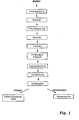
- FIG. 1 A typical prior art process for processing and separation such pressed bales is shown in a flow chart in Figure 1 and should briefly described below.
- the pressed Plastic bales fed via a conveyor belt to a shredder, in which the Bales are pre-shredded.
- the pre-shredded plastic parts are then transported with a metering screw in a first wash, in this mechanically and optionally also cleaned with the aid of cleaning agents. Falling heavy waste is separated, and the pre-cleaned, pre-shredded plastic mixture is then fed to a mill in which a fine comminution takes place.
- the finely chopped up good is in the episode depending on Need a second wash, but in any case in a turbo dryer dried and then with a conveyor blower in a buffer silo in which the now dry, purified and finely divided plastic mixture is temporarily stored.
- This intermediate storage and the associated Buffering is necessary because the discontinuous feeding of the bales too large Fluctuations in the flow of plastic mixture can cause the Beschikkung a centrifuge based on density separation but usually a very requires constant and well-dosed feed stream.
- Will be such Centrifuge e.g., a double-cone full-bowl screw centrifuge such as that described in U.S.
- the buffer silo is now taken from the plastic mixture and fed in metered and continuous manner to a small Anmaisch electrode of about 2m 3 volume, in which the mixture is stirred with stirring devices in a separating liquid (essentially water) to a suspension.
- a z. B. executed by weighing, sufficiently accurate and thus constant dosage is that the extracted from the buffer silo plastic mixture is sufficiently dry.
- a task pump conveys the suspension produced in the mash tank in a further step in the centrifuge, in which the mixture due to the different density of different types of plastic is separated. Sinkgut and floating goods are tapped separately on the centrifuge and can subsequently processed, e.g. a drying and a Regranulation of the fractions takes place.
- the circulation material (centrate), i. the of the plastic particles freed separating liquid is in a special Zentrat aser collected below the centrifuge and from there z.T. in the mash tank pumped back.
- the invention provides a device gem. Main claim available.
- the apparatus comprises a mash vessel for feeding at least one centrifuge based on density separation with a suspension of water and comminuted plastic mixture, which is characterized in that it has a size in the range from 5 to 500 m 3, in particular preferably in the range from 15 to 40 m 3 per ton centrifuge throughput of plastic mixture per hour.
- a first preferred embodiment of the invention Anmaisch placesers is characterized in that at least one agitator is provided, with which the comminuted plastic mixture can be stirred in the mixing tank, or that instead of or additionally arranged at least one washing pump is, which sucks the fluid in the mash tank in the upper area and in the lower part of the floor through an inlet pipe back into the mash tank pumps in, with particular preference at the exit port of the pumping tube a baffle is arranged, on which the pumped fluid incident.
- a second embodiment of the inventive Anmaisch concernsers draws characterized in that the tapping of the suspension to feed the centrifuge in the region of its bottom, in particular preferably the lowest point of the soil he follows.
- This has the advantage on the one hand that dirt or other heavy Particles which enter the mash tank are at the bottom of the tank accumulate not cumulatively but be continuously removed via the centrifuge with.
- the centrifuge is also used as a kind of washing unit. on the other hand it follows from this arrangement that a controlled and metered suspension can be tapped, as in the lower area by accordingly controlled circulation of the contents of the mash tank and because the plastics usually have a lower density than water, a controlled suspension in the soil area can be set.
- the mash container can also be designed in such a way that that the bottom is formed at least partially conically tapering downwards is that, and that an intake pipe is arranged for tapping the suspension, which sucks the suspension in the central, deepest part of the tip of this cone.
- the invention further relates to a device for separating plastic mixtures using an above-mentioned mash tank and a Density-based centrifuge, in particular a double-cone full-bowl centrifuge the already mentioned type.
- a Density-based centrifuge in particular a double-cone full-bowl centrifuge the already mentioned type.
- the inventive Device is the mash tank below, preferably directly below, the at least one centrifuge arranged so that expiring from the centrifuge Circulation product (centrate) and / or when starting and stopping the centrifuge at their Exits (Sinkgut- and Weggutausgang) resulting separating liquid Gravity can flow down into the mash tank. From this special arrangement of mash tank and centrifuge arise the Advantages that on lines, at least on long benefits, on active promotion, on slide and sieves etc. as well as on control elements for it are waived can.
- the centrifuge can at the erfindsgefflessen device a preferably reversible floating worm be provided and according to a Sinkgutschnecke for removal of the sinking material from their sinking material outlet.
- the invention also relates to a method for feeding at least one Density-based centrifuge using one of the above Device which is characterized in that when starting the centrifuge the contents of the Anmaisch disposers held substantially without mixing is such that the plastic mixture floats in the near-surface region, and that for feeding the centrifuge in the region of the bottom of the mash tank tapped via a suction pipe substantially free of plastic mixture water becomes.
- plastic-free water is necessary, proving the tapping in the ground area at the same time switching off the circulation and / or the stirring means as advantageous and saves one separate, intended for starting water connection.
- Another embodiment of the method is characterized in that the Start-up or shutdown of the centrifuge which in this case at their outputs by design resulting separating liquid simply returned to the mash tank and that to enable or support this return the aforesaid screws, with which the fractions at the ends of the centrifuges preferably be discharged, reversed.
- FIG 2 shows a rough schematic representation of the process for processing and Separation of pressed plastic bales, in particular from the film fraction, using the proposed components, shown generally in FIG are.
- the bales are pre-shredded and washed and the plastic mixture arrives after a fine crushing directly into a mashing tank.
- the proposed slurry container now allows a direct feed a centrifuge with the plastic mixture suspended in water in the mixing tank.
- FIG 1 greatly simplified by the proposed changes and are Savings on pipes, pumps, valves, sieves and other components possible. Such savings result in lower investment costs and less susceptible to interference.
- the proposed structure is a large mash tank 24 as a central element shown schematically in Figure 3.
- the supplied pressed bales 10 of plastic waste are conveyed by a ball conveyor 11 (e.g. Stöber, type FDS 4040 / B) and to the hopper of one or more shredders 12 (e.g., ABB, ACS601-0030-3 with DTC control).
- the pressed bales 10 are pressed by a Niederdschreiberhydraulikaggregat 13 in the shredder 12 and in this pre-crushed to a particle size in the range of some Millimeters in diameter.
- the thus pre-shredded material is from a metering screw with weight detection 14 (e.g., Stöber, FDS 4040 / B) collected in roughly metered Form a conveyor belt 15 pass and from this conveyor belt 15 in a Wash bath 16 transported.
- a metering screw with weight detection 14 e.g., Stöber, FDS 4040 / B
- the pre-shredded Plastic parts moved by paddle rollers 17, causing dirt deposits can detach from the parts.
- the density of the plastic parts is usually smaller than that of water, the plastic parts float on top, and sink Heavy material waste 20 can easily be conveyed in a heavy gully 18 (e.g. FDS 4040 / B), and from a heavy screw 19 to a container 47 are transported for heavy cargo.
- a heavy gully 18 e.g. FDS 4040 / B
- the washed coarse parts 21 are now out derived from the washing bath 16 and fed to a mill 22, in which the fine comminution takes place.
- the mill 22 may be a washing mill, which is acted upon in addition to the washed coarse parts 21 also with liquid. Conveniently, this liquid can be taken directly from the mash tank 24 become.
- the exiting the mill 22, washed fines 23 with a size of a few millimeters in diameter are now directly, in dry, moist or even slurried form the large mash tank 24 fed. It makes sense to find this mashing tank 24 (among other things) below the mill 22, so that the transport of the washed fines 23 must be effected by gravity and not by additional funding.
- the mash tank 24 has a size which can ensure buffering of discontinuities in the influx of washed fines 23.
- the necessary size is measured in particular by the throughput of the downstream centrifuge 38, or in the case of several centrifuges by the sum of the throughputs of the downstream centrifuges 38.
- Per ton of plastic mixture which is separated per hour by the centrifuge 38 is a size of 5 to 500 m 3 is displayed. Particularly preferred is a dimensioning in the range of 15 to 40m 3 per ton centrifuge throughput of plastic mixture per hour.
- the mash tank 24 is equipped with stirrers 25 and circulating pumps 36. These allow both a controlled and controlled suspension of the parts in the water, as well as the associated causes Energy input in conjunction with the by the size of the container 24 long mean residence time of the particles in the water for further purification. This Cleaning effect can go so far that on a pre-cleaning with a Washing bath u.U. even be waived.
- the agitators 25 e.g., Stöber, FDS 4085 / B
- a washing pump 36 (Nord, SK 38 S 60) may be present, which liquid or suspension in the upper region of the mash tank 24 via a suction port 59 with the pump 36 sucks and with high pressure in the floor area via a single-pump 60 pumps. It is a further advantage if in the area where the pumped suspension enters the floor area, a Baffle 62 is present, which provides for additional turbulence. A Circulation with such a washing pump 36 is indicated because the plastic particles usually have a lower density than water and thus have the tendency réelleschwimmen to the surface of the container 24.
- the mash tank 24 should also be provided with means for practical reasons which counteract foaming. This is for example by a large surface area to volume ratio of the container 24 (for example about a ratio height to diameter of about 1: 2), or by mechanical Arrangements for preventing foam such as rakes, baffles or the like possible. Likewise, foaming can be achieved by suitable design of the floor plan, For example, elliptical (ratio long to short major axis of 1.5: 1 to 2: 1, wave formation destroys foam), through a defoamer pump 49, or through suitable temperature of the water in Anmaisch studying deviser 24 or by a Combination of the mentioned means are counteracted.
- the Anmaisch constitutioner 24 also has a further intake, with which withdrawn via a pump 26 (Stöber, FDS4085 / B) 27 remindgut 27 and fed directly or indirectly to the washing bath 16 and / or the mill 22 can.
- a pump 26 Stöber, FDS4085 / B
- the mash tank 24 is preferably and as shown immediately below the centrifuge 38 is arranged. If possible, the container 24 is also larger in its layout as the overlying centrifuge 38. In this way can all fluid flows, which from the centrifuge 38 back into the mash tank 24, simply and without means of transport such as pumps flow back, this possibly even without special lines.
- the task 32 for the centrifuge is thus in the bottom outlet 51 from a pump 33 (Stöber, FDS4085 / B) with a suction pipe 64 sucked up and the centrifuge 38th fed.
- a changeover valve 34 allows an immediate recirculation 35 in the mash tank 24.
- the centrifuge 38 is, for example, the already mentioned double-cone full-shell screw centrifuge of type CENSOR® (KHD Humboldt Wedag AG, Cologne). This is fed centrally with feedstock 32, and the mixture By centrifugation in one with the Sinkgutzififugenschnecke 45th to one end of the centrifuge 38 conveyed Sinkgut-fraction and in one with the Float centrifugal screw 41 to the other end transported float fraction separated.
- the centrifuge screws 41 and 42 are of a Main drive 43 (Vectron, VC 400-090) driven, and can if necessary with a Backdrive 42 (Vectron, VC 400-045) can be reversed.
- the type of separation may optionally be via the addition of salt and the associated change in the density of the liquid become. It is also possible by the addition of flocculant another To effect cleaning effect in the centrifuge 38.
- the Weggut Group 53 is after exiting at 39 of a floating auger 46 (Stöber, FDS 4040 / B) with chute flap and the other Processing such as e.g. fed to the regranulation 54 or a further separation.
- the Sinkgut 67 68 is detected by a Sinkgutschnecke 45, and of this supplied to the heavy waste 47 in this example, but it is also conceivable that this faction is also regranulated, further divided or other processing.
Landscapes
- Engineering & Computer Science (AREA)
- Environmental & Geological Engineering (AREA)
- Mechanical Engineering (AREA)
- Separation Of Solids By Using Liquids Or Pneumatic Power (AREA)
- Processing And Handling Of Plastics And Other Materials For Molding In General (AREA)
- Separation, Recovery Or Treatment Of Waste Materials Containing Plastics (AREA)
Description
- Fig. 1
- zeigt ein Flussdiagramm des Verfahrens zur Zerkleinerung und Auf- trennung von Kunststoffgemischen nach dem Stand der Technik;
- Fig. 2
- zeigt ein Flussdiagramm des vorgeschlagenen Ablaufs zur Zerklei- nerung und Auftrennung von Kunststoffgemischen;
- Fig. 3
- zeigt eine detaillierte schematische Darstellung des Ablaufs von Zuführung und Auftrennung, der dabei verwendeten Komponenten und deren Anordnung; und
- Fig. 4
- zeigt einen Flüssigkeitsbehälter, wie er dabei eingesetzt werden kann.
- 10
- Pressballen
- 11
- Ballenförderer
- 12
- Shredder
- 13
- Niederdrückerhydraulikaggregat
- 14
- Dosierschnecke mit Gewichtserfassung
- 15
- Förderband
- 16
- Waschbad
- 17
- Paddelwalzen
- 18
- Schwergutrinne
- 19
- Schwergutschnecke
- 20
- Schwergutabfall
- 21
- gewaschene Grobteile
- 22
- Mühle
- 23
- gewaschene Feinteile
- 24
- Anmaischbehälter
- 25
- Rührwerk
- 26
- Pumpe
- 27
- Rückführungsgut
- 28-31
- Ventile
- 32
- Aufgabengut Zentrifuge
- 33
- Aufgabenpumpe
- 34
- Umschaltventil
- 35
- Zirkulationsgut
- 36
- Waschpumpe
- 37
- Zirkulationsgut bzw. Zentratflüssigkeit Zentrifuge
- 38
- Zentrifuge
- 39
- Schwimmgutausgang von 38
- 40
- Sinkgutausgang von 38
- 41
- Schwimmgutzentrifugenschnecke
- 42
- Sinkgutzentrifugenschnecke
- 43
- Hauptantrieb Zentrifuge
- 44
- Backdrive Zentrifuge
- 45
- Sinkgutschnecke
- 46
- Schwimmgutschnecke
- 47
- Abfall Schwergut/Sinkgut
- 48
- Schwingungsüberwachung
- 49
- Entschäumerpumpe
- 50
- Auslauf Zentrifuge
- 51
- Bodenauslauf von 24
- 52
- Sinkgut
- 53
- Schwimmgut
- 54
- Regranulierung
- 55
- Rührblätter
- 56
- Rührmotor
- 57
- Boden von 24
- 58
- Seitenwand von 24
- 59
- Ansaugstutzen von 36
- 60
- Einpumprohr von 36
- 61
- Ausgangsöffnung von 60
- 62
- Prallwand
- 63
- Leitung für 32
- 64
- Ansaugrohr für 32
- 65
- Trennflüssigkeit aus Sinkgutausgang
- 66
- Trennflüssigkeit aus Schwimmgutausgang
Claims (16)
- Vorrichtung, bestehend aus wenigstens einer auf Dichtetrennung beruhenden Zentrifuge (38) und einem Anmaischbehälter (24) zur Beschickung der Zentrifuge (38) mit einer Suspension (32) aus Wasser und zerkleinertem Kunststoffgemisch, dadurch gekennzeichnet, dass der Anmaischbehälter (24) eine Grösse im Bereich von 5 bis 500 m3 pro Tonne Zentrifugendurchsatz an Kunststoffgemisch pro Stunde aufweist.
- Vorrichtung nach Anspruch 1, dadurch gekennzeichnet, dass der Anmaischbehälter (24) insbesondere bevorzugt eine Grösse im Bereich von 15 bis 40 m3 pro Tonne Zentrifugendurchsatz an Kunststoffgemisch pro Stunde aufweist.
- Vorrichtung nach einem der Ansprüche 1 oder 2, dadurch gekennzeichnet, dass der Anmaischbehälter (24) zur Behinderung der Schaumbildung mit einem grossen Verhältnis Oberfläche zu Volumen, ausgedrückt bei kreisrunder Ausführung durch ein Verhältnis, Höhe zu Durchmesser von ca. 1:2, und/oder mit mechanischen Anordnungen zur Schaumverhinderung und/oder mit Mitteln zur Temperierung des Wassers versehen ist.
- Vorrichtung nach einem der Ansprüche 1 bis 3, dadurch gekennzeichnet, dass wenigstens ein Rührwerk (25) vorgesehen ist, mit welchem das zerkleinerte Kunststoffgemisch im Anmaischbehälter (24) gleichmässiger verteilt werden kann.
- Vorrichtung nach Anspruch 4, dadurch gekennzeichnet, dass der Anmaischbehälter (24) über Waschpumpe (36) zum Umpumpen der Suspension (32) aus seinem oberen Bereich in seinen Bodenbereich verfügt, sowie vorzugsweise über ein an die Waschpumpe angeschlossenes, im zentralen Bodenbereich des Behälters mündendes Einpumprohr (60), und wobei weiter vorzugsweise gegenüber der Ausgangsöffnung (61) des Einpumprohrs (60) eine Prallwand (62) angeordnet ist.
- Vorrichtung nach einem der Ansprüche 1 bis 5, dadurch gekennzeichnet, dass der Anmaischbehälter (24) über Mittel zum Abgreifen der Suspension (32) zur Beschickung der Zentrifuge (38) im Bereich seines Bodens (57), insbesondere bevorzugt am tiefsten Punkt des Bodens, verfügt.
- Vorrichtung nach Anspruch 6, dadurch gekennzeichnet, dass der Boden (57) des Anmaischbehälters (24) wenigstens teilweise konisch nach unten hin zulaufend ausgebildet ist, und dass die Mittel zum Abgreifen der Suspension (32) ein im zentralen, tiefsten Bereich der Spitze dieses Konus anschliessbares oder angeschlossenes Ansaugrohr (64) umfassen.
- Vorrichtung zur Auftrennung von Kunststoffgemischen nach einem der Ansprüche 1 bis 7, dadurch gekennzeichnet, dass der Anmaischbehälter (24) unterhalb der wenigstens einen Zentrifuge (38) angeordnet ist, und dass aus der Zentrifuge (38) auslaufendes Zirkulationsgut (37) und/oder beim An- und Abfahren der Zentrifuge (38) am Sinkgut- sowie am Schwimmgutausgang anfallende Trennflüssigkeit (64, 65) durch die Schwerkraft nach unten in den Anmaischbehälter (24) fliessen kann/können.
- Vorrichtung nach Anspruch 8, dadurch gekennzeichnet, dass eine Mühle (22) vorgesehen ist, welche mit einem wenigstens teilweise vorgereinigten und grobzerkleinertem Kunststoffgemisch (21) beschickt wird, dass Leitungen angeordnet sind, welche das aus der Mühle (22) austretende zerkleinerte Kunststoffgemisch (23) dem Anmaischbehälter (24) zuführen, und dass insbesondere bevorzugt die Mühle (22) oberhalb des Anmaischbehälters (24) angeordnet ist, so dass das zerkleinerte Kunststoffgemisch (23) infolge der Schwerkraft in den Anmaischbehälter (24) gelangt.
- Vorrichtung nach Anspruch 9, dadurch gekennzeichnet, dass es sich bei der Mühle (22) um eine Waschmühle handelt, die neben Feststoffen (21) auch mit Flüssigkeit beaufschlagt ist, und dass diese Flüssigkeit aus dem Anmaischbehälter (24) entnommen wird.
- Vorrichtung nach einem der Ansprüche 9 oder 10, dadurch gekennzeichnet, dass der Mühle (22) ein Shredder (12) sowie ggf. zusätzlich ein Waschbad (16) vorgeschaltet ist/sind.
- Vorrichtung nach einem der Ansprüche 8 bis 11, dadurch gekennzeichnet, dass der Anmaischbehälter (24) direkt unterhalb der Zentrifuge angeordnet ist und eine Oberfläche aufweist, welche im wesentlichen gleich gross oder grösser als die Grundfläche der Zentrifuge (38) ist
- Vorrichtung nach Anspruch 12, dadurch gekennzeichnet, dass die Abführung von Schwimmgut (53) aus der Zentrifuge (38) über eine vorzugsweise reversierbare Schwimmgutschnecke (46) und/oder die Abführung von Sinkgut (52) aus der Zentrifuge (38) über eine ebenfalls vorzugsweise reversierbare Sinkgutschnecke (45) erfolgt.
- Verfahren zur Beschickung wenigstens einer auf Dichtetrennung beruhenden Zentrifuge unter Verwendung einer Vorrichtung gemäss einem der Ansprüche 8 bis 13, dadurch gekennzeichnet, dass beim Anfahren der Zentrifuge (38) der Inhalt des Anmaischbehälters (24) im wesentlichen ohne Durchmischung gehalten wird, derart dass das Kunststoffgemisch im oberflächennahen Bereich schwimmt, und dass zur Beschickung der Zentrifuge (38) im Bereich des Bodens (57) des Anmaischbehälters (24) über ein Ansaugrohr (64) im wesentlichen kunststoffgemischfreies Wasser abgegriffen wird.
- Verfahren nach Anspruch 14 unter Verwendung einer Vorrichtung gemäss Anspruch 13 mit reversierbaren Schnecken (45,46), dadurch gekennzeichnet, dass beim Anfahren oder Runterfahren der Zentrifuge die Schnecken (45,46) reversiert werden.
- Verfahren nach einem der Ansprüche 14 oder 15, dadurch gekennzeichnet, dass die Zentrifuge (38) zusätzlich als Wasserreinigungsaggregat verwendet wird, indem Flockmittel eingeimpft wird.
Applications Claiming Priority (3)
| Application Number | Priority Date | Filing Date | Title |
|---|---|---|---|
| CH249198 | 1998-12-16 | ||
| CH249198 | 1998-12-16 | ||
| PCT/IB1999/001901 WO2000035587A1 (de) | 1998-12-16 | 1999-11-30 | Vorrichtung und verfahren zur trennung von zerkleinerten kunststoffgemischen und anmaischbehälter dafür |
Publications (2)
| Publication Number | Publication Date |
|---|---|
| EP1056543A1 EP1056543A1 (de) | 2000-12-06 |
| EP1056543B1 true EP1056543B1 (de) | 2005-12-14 |
Family
ID=4235003
Family Applications (1)
| Application Number | Title | Priority Date | Filing Date |
|---|---|---|---|
| EP99973394A Expired - Lifetime EP1056543B1 (de) | 1998-12-16 | 1999-11-30 | Vorrichtung und verfahren zur trennung von zerkleinerten kunststoffgemischen und anmaischbehälter dafür |
Country Status (4)
| Country | Link |
|---|---|
| EP (1) | EP1056543B1 (de) |
| AT (1) | ATE312668T1 (de) |
| DE (1) | DE59912927D1 (de) |
| WO (1) | WO2000035587A1 (de) |
Families Citing this family (2)
| Publication number | Priority date | Publication date | Assignee | Title |
|---|---|---|---|---|
| ES2262430B1 (es) * | 2005-05-04 | 2008-03-01 | Empresa De Reciclaje De Residuos De Navarra, S.A. | Instalacion para triturado, limpieza y almacenamiento de materiales plasticos/polimericos reciclables; proceso de fabricacion de madera sintetica a partir de dichos materiales plastico/polimericos reciclados y madera sintetica de material compuesto celulosico/polimerico obtenida. |
| JP7601011B2 (ja) * | 2020-01-15 | 2024-12-17 | Agc株式会社 | ヘッドアップディスプレイシステム |
Family Cites Families (3)
| Publication number | Priority date | Publication date | Assignee | Title |
|---|---|---|---|---|
| DE4405903A1 (de) * | 1994-02-24 | 1995-09-07 | Kunststoff Und Umwelttechnik G | Verfahren und Vorrichtung zur Trennung von Mischgütern mit Kunststoffbestandteilchen |
| DE19606415A1 (de) * | 1996-02-21 | 1997-08-28 | Deutz Ag | Effektive Kunststoffsortierung |
| DE19701669A1 (de) * | 1997-01-18 | 1998-07-23 | Kloeckner Humboldt Wedag | Verfahren und Anlage zur Aufbereitung von kunststoffreichen Müllgemischen |
-
1999
- 1999-11-30 DE DE59912927T patent/DE59912927D1/de not_active Expired - Lifetime
- 1999-11-30 AT AT99973394T patent/ATE312668T1/de not_active IP Right Cessation
- 1999-11-30 EP EP99973394A patent/EP1056543B1/de not_active Expired - Lifetime
- 1999-11-30 WO PCT/IB1999/001901 patent/WO2000035587A1/de not_active Ceased
Also Published As
| Publication number | Publication date |
|---|---|
| ATE312668T1 (de) | 2005-12-15 |
| DE59912927D1 (de) | 2006-01-19 |
| WO2000035587A1 (de) | 2000-06-22 |
| EP1056543A1 (de) | 2000-12-06 |
Similar Documents
| Publication | Publication Date | Title |
|---|---|---|
| Feil et al. | Mechanical recycling of packaging waste | |
| EP0936962B1 (de) | Verfahren zum aufschluss von abfällen, die wenigstens teilweise wiederverwertbare anteile enthalten | |
| US5143308A (en) | Recycling system | |
| EP4291379B1 (de) | Kunststoffrecyclingverfahren zur aufbereitung von kunststoffabfällen | |
| US10189027B2 (en) | High capacity separation of metals from auto shredder residue | |
| DE19719734A1 (de) | Verfahren zur Trennung von Mischkunststoffen | |
| US5257740A (en) | Apparatus and process for recycling scrap film | |
| KR102314555B1 (ko) | 도시 고형 폐기물의 유기물 부분의 처리 장치 및 처리 방법 | |
| EP2045003A1 (de) | Einrichtung zum Fördern und Mischen von Schüttgut | |
| EP3467214A1 (de) | Verfahren und vorrichtung zum zerkleinern von küchenabfällen und/oder speiseresten | |
| DE102019104050B4 (de) | Verfahren zur Gewinnung eines Wertstoffs aus Siedlungsabfall | |
| EP0557816A2 (de) | Verfahren und Anlage zur Trennung zerkleinerter Kunststoffe verschiedener chemischer Zusammensetzung und unterschiedlicher spezifischer Dichte | |
| DE69811007T2 (de) | Vorrichtung zur Wiederverwendung von Polyethylen , insbesondere Polyethylen-Folien | |
| JPH06339643A (ja) | 不均質プラスチック材料を均質画分に選別する方法及びその装置 | |
| EP1056543B1 (de) | Vorrichtung und verfahren zur trennung von zerkleinerten kunststoffgemischen und anmaischbehälter dafür | |
| JPS61261395A (ja) | 石炭・水燃料の生産方法および装置 | |
| DE4209277A1 (de) | Vorrichtung zur sortierung von feststoffgemischen | |
| CN103909009A (zh) | 造纸废弃物回收系统 | |
| DE4343539C2 (de) | Verfahren zum Abtrennen von an Kunststoffprodukten anhaftenden Verunreinigungen | |
| EP0422501A1 (de) | Recycling-Verfahren und -Anlage für ölverschmutzte Betriebsmittel | |
| DE2837135A1 (de) | Beschickungseinrichtung zu einem extruder | |
| EP2075107A1 (de) | Verfahren und Vorrichtung zur Aufbereitung von Kunststoffabfällen | |
| US1930709A (en) | Method of dressing barytes ore | |
| DD256049A3 (de) | Einrichtung zur kontinuierlichen und sortenreinen aufbereitung von plastmuell | |
| EP1161302B1 (de) | Anlage und verfahren zur trennung von stoffgemischen unterschiedlicher dichte |
Legal Events
| Date | Code | Title | Description |
|---|---|---|---|
| PUAI | Public reference made under article 153(3) epc to a published international application that has entered the european phase |
Free format text: ORIGINAL CODE: 0009012 |
|
| 17P | Request for examination filed |
Effective date: 20000707 |
|
| AK | Designated contracting states |
Kind code of ref document: A1 Designated state(s): AT BE CH CY DE DK ES FI FR GB GR IE IT LI LU MC NL PT SE |
|
| AX | Request for extension of the european patent |
Free format text: AL;LT;LV;MK;RO;SI |
|
| 17Q | First examination report despatched |
Effective date: 20040114 |
|
| GRAP | Despatch of communication of intention to grant a patent |
Free format text: ORIGINAL CODE: EPIDOSNIGR1 |
|
| GRAS | Grant fee paid |
Free format text: ORIGINAL CODE: EPIDOSNIGR3 |
|
| GRAA | (expected) grant |
Free format text: ORIGINAL CODE: 0009210 |
|
| AK | Designated contracting states |
Kind code of ref document: B1 Designated state(s): AT BE CH CY DE DK ES FI FR GB GR IE IT LI LU MC NL PT SE |
|
| PG25 | Lapsed in a contracting state [announced via postgrant information from national office to epo] |
Ref country code: IT Free format text: LAPSE BECAUSE OF FAILURE TO SUBMIT A TRANSLATION OF THE DESCRIPTION OR TO PAY THE FEE WITHIN THE PRESCRIBED TIME-LIMIT;WARNING: LAPSES OF ITALIAN PATENTS WITH EFFECTIVE DATE BEFORE 2007 MAY HAVE OCCURRED AT ANY TIME BEFORE 2007. THE CORRECT EFFECTIVE DATE MAY BE DIFFERENT FROM THE ONE RECORDED. Effective date: 20051214 Ref country code: IE Free format text: LAPSE BECAUSE OF FAILURE TO SUBMIT A TRANSLATION OF THE DESCRIPTION OR TO PAY THE FEE WITHIN THE PRESCRIBED TIME-LIMIT Effective date: 20051214 Ref country code: GB Free format text: LAPSE BECAUSE OF FAILURE TO SUBMIT A TRANSLATION OF THE DESCRIPTION OR TO PAY THE FEE WITHIN THE PRESCRIBED TIME-LIMIT Effective date: 20051214 Ref country code: FI Free format text: LAPSE BECAUSE OF FAILURE TO SUBMIT A TRANSLATION OF THE DESCRIPTION OR TO PAY THE FEE WITHIN THE PRESCRIBED TIME-LIMIT Effective date: 20051214 |
|
| REG | Reference to a national code |
Ref country code: GB Ref legal event code: FG4D Free format text: NOT ENGLISH |
|
| REG | Reference to a national code |
Ref country code: CH Ref legal event code: EP |
|
| REG | Reference to a national code |
Ref country code: IE Ref legal event code: FG4D Free format text: LANGUAGE OF EP DOCUMENT: GERMAN |
|
| REF | Corresponds to: |
Ref document number: 59912927 Country of ref document: DE Date of ref document: 20060119 Kind code of ref document: P |
|
| REG | Reference to a national code |
Ref country code: CH Ref legal event code: NV Representative=s name: ISLER & PEDRAZZINI AG |
|
| PG25 | Lapsed in a contracting state [announced via postgrant information from national office to epo] |
Ref country code: SE Free format text: LAPSE BECAUSE OF FAILURE TO SUBMIT A TRANSLATION OF THE DESCRIPTION OR TO PAY THE FEE WITHIN THE PRESCRIBED TIME-LIMIT Effective date: 20060314 Ref country code: GR Free format text: LAPSE BECAUSE OF FAILURE TO SUBMIT A TRANSLATION OF THE DESCRIPTION OR TO PAY THE FEE WITHIN THE PRESCRIBED TIME-LIMIT Effective date: 20060314 Ref country code: DK Free format text: LAPSE BECAUSE OF FAILURE TO SUBMIT A TRANSLATION OF THE DESCRIPTION OR TO PAY THE FEE WITHIN THE PRESCRIBED TIME-LIMIT Effective date: 20060314 |
|
| PG25 | Lapsed in a contracting state [announced via postgrant information from national office to epo] |
Ref country code: ES Free format text: LAPSE BECAUSE OF FAILURE TO SUBMIT A TRANSLATION OF THE DESCRIPTION OR TO PAY THE FEE WITHIN THE PRESCRIBED TIME-LIMIT Effective date: 20060325 |
|
| PG25 | Lapsed in a contracting state [announced via postgrant information from national office to epo] |
Ref country code: PT Free format text: LAPSE BECAUSE OF FAILURE TO SUBMIT A TRANSLATION OF THE DESCRIPTION OR TO PAY THE FEE WITHIN THE PRESCRIBED TIME-LIMIT Effective date: 20060515 |
|
| GBV | Gb: ep patent (uk) treated as always having been void in accordance with gb section 77(7)/1977 [no translation filed] |
Effective date: 20051214 |
|
| REG | Reference to a national code |
Ref country code: IE Ref legal event code: FD4D |
|
| ET | Fr: translation filed | ||
| PLBE | No opposition filed within time limit |
Free format text: ORIGINAL CODE: 0009261 |
|
| STAA | Information on the status of an ep patent application or granted ep patent |
Free format text: STATUS: NO OPPOSITION FILED WITHIN TIME LIMIT |
|
| 26N | No opposition filed |
Effective date: 20060915 |
|
| PG25 | Lapsed in a contracting state [announced via postgrant information from national office to epo] |
Ref country code: MC Free format text: LAPSE BECAUSE OF NON-PAYMENT OF DUE FEES Effective date: 20061130 |
|
| REG | Reference to a national code |
Ref country code: CH Ref legal event code: PCAR Free format text: ISLER & PEDRAZZINI AG;POSTFACH 1772;8027 ZUERICH (CH) |
|
| PG25 | Lapsed in a contracting state [announced via postgrant information from national office to epo] |
Ref country code: CY Free format text: LAPSE BECAUSE OF FAILURE TO SUBMIT A TRANSLATION OF THE DESCRIPTION OR TO PAY THE FEE WITHIN THE PRESCRIBED TIME-LIMIT Effective date: 20051214 |
|
| PGFP | Annual fee paid to national office [announced via postgrant information from national office to epo] |
Ref country code: LU Payment date: 20091120 Year of fee payment: 11 Ref country code: DE Payment date: 20091120 Year of fee payment: 11 Ref country code: CH Payment date: 20091201 Year of fee payment: 11 Ref country code: AT Payment date: 20091113 Year of fee payment: 11 |
|
| PGFP | Annual fee paid to national office [announced via postgrant information from national office to epo] |
Ref country code: NL Payment date: 20091112 Year of fee payment: 11 |
|
| PGFP | Annual fee paid to national office [announced via postgrant information from national office to epo] |
Ref country code: FR Payment date: 20091201 Year of fee payment: 11 |
|
| PGFP | Annual fee paid to national office [announced via postgrant information from national office to epo] |
Ref country code: BE Payment date: 20091224 Year of fee payment: 11 |
|
| BERE | Be: lapsed |
Owner name: *VOGT-PLASTIC G.M.B.H. Effective date: 20101130 |
|
| REG | Reference to a national code |
Ref country code: NL Ref legal event code: V1 Effective date: 20110601 |
|
| REG | Reference to a national code |
Ref country code: CH Ref legal event code: PL |
|
| PG25 | Lapsed in a contracting state [announced via postgrant information from national office to epo] |
Ref country code: LI Free format text: LAPSE BECAUSE OF NON-PAYMENT OF DUE FEES Effective date: 20101130 Ref country code: CH Free format text: LAPSE BECAUSE OF NON-PAYMENT OF DUE FEES Effective date: 20101130 |
|
| REG | Reference to a national code |
Ref country code: FR Ref legal event code: ST Effective date: 20110801 |
|
| PG25 | Lapsed in a contracting state [announced via postgrant information from national office to epo] |
Ref country code: AT Free format text: LAPSE BECAUSE OF NON-PAYMENT OF DUE FEES Effective date: 20101130 Ref country code: NL Free format text: LAPSE BECAUSE OF NON-PAYMENT OF DUE FEES Effective date: 20110601 Ref country code: BE Free format text: LAPSE BECAUSE OF NON-PAYMENT OF DUE FEES Effective date: 20101130 |
|
| REG | Reference to a national code |
Ref country code: DE Ref legal event code: R119 Ref document number: 59912927 Country of ref document: DE Effective date: 20110601 Ref country code: DE Ref legal event code: R119 Ref document number: 59912927 Country of ref document: DE Effective date: 20110531 |
|
| PG25 | Lapsed in a contracting state [announced via postgrant information from national office to epo] |
Ref country code: DE Free format text: LAPSE BECAUSE OF NON-PAYMENT OF DUE FEES Effective date: 20110531 |
|
| PG25 | Lapsed in a contracting state [announced via postgrant information from national office to epo] |
Ref country code: FR Free format text: LAPSE BECAUSE OF NON-PAYMENT OF DUE FEES Effective date: 20101130 |
|
| PG25 | Lapsed in a contracting state [announced via postgrant information from national office to epo] |
Ref country code: LU Free format text: LAPSE BECAUSE OF NON-PAYMENT OF DUE FEES Effective date: 20101130 |