EP1056560B1 - Procede de fabrication de bandes en alliage d'aluminium a grande homogeneite de surface - Google Patents
Procede de fabrication de bandes en alliage d'aluminium a grande homogeneite de surface Download PDFInfo
- Publication number
- EP1056560B1 EP1056560B1 EP99903745A EP99903745A EP1056560B1 EP 1056560 B1 EP1056560 B1 EP 1056560B1 EP 99903745 A EP99903745 A EP 99903745A EP 99903745 A EP99903745 A EP 99903745A EP 1056560 B1 EP1056560 B1 EP 1056560B1
- Authority
- EP
- European Patent Office
- Prior art keywords
- sub
- casting
- injector
- cylinders
- less
- Prior art date
- Legal status (The legal status is an assumption and is not a legal conclusion. Google has not performed a legal analysis and makes no representation as to the accuracy of the status listed.)
- Expired - Lifetime
Links
- 238000000034 method Methods 0.000 title claims abstract description 31
- 229910000838 Al alloy Inorganic materials 0.000 title claims abstract description 9
- 238000005266 casting Methods 0.000 claims abstract description 40
- 238000009749 continuous casting Methods 0.000 claims abstract description 36
- 229910001338 liquidmetal Inorganic materials 0.000 claims abstract description 18
- 230000003287 optical effect Effects 0.000 claims abstract description 17
- 230000008569 process Effects 0.000 claims abstract description 17
- 238000004519 manufacturing process Methods 0.000 claims abstract description 12
- 229910045601 alloy Inorganic materials 0.000 claims description 15
- 239000000956 alloy Substances 0.000 claims description 15
- 238000005097 cold rolling Methods 0.000 claims description 13
- 238000005482 strain hardening Methods 0.000 claims description 3
- NINIDFKCEFEMDL-UHFFFAOYSA-N Sulfur Chemical compound [S] NINIDFKCEFEMDL-UHFFFAOYSA-N 0.000 abstract 1
- 239000005864 Sulphur Substances 0.000 abstract 1
- XEEYBQQBJWHFJM-UHFFFAOYSA-N Iron Chemical compound [Fe] XEEYBQQBJWHFJM-UHFFFAOYSA-N 0.000 description 21
- 230000007547 defect Effects 0.000 description 13
- 230000010355 oscillation Effects 0.000 description 11
- 238000007743 anodising Methods 0.000 description 10
- 238000005259 measurement Methods 0.000 description 10
- 239000000047 product Substances 0.000 description 10
- 229910052751 metal Inorganic materials 0.000 description 9
- 239000002184 metal Substances 0.000 description 9
- 238000005096 rolling process Methods 0.000 description 9
- 239000000523 sample Substances 0.000 description 9
- 238000002048 anodisation reaction Methods 0.000 description 8
- 229910052742 iron Inorganic materials 0.000 description 7
- QAOWNCQODCNURD-UHFFFAOYSA-N Sulfuric acid Chemical compound OS(O)(=O)=O QAOWNCQODCNURD-UHFFFAOYSA-N 0.000 description 6
- 239000000203 mixture Substances 0.000 description 6
- 238000012512 characterization method Methods 0.000 description 5
- 238000009826 distribution Methods 0.000 description 5
- 238000005098 hot rolling Methods 0.000 description 4
- 239000011777 magnesium Substances 0.000 description 4
- 230000000007 visual effect Effects 0.000 description 4
- 229910052782 aluminium Inorganic materials 0.000 description 3
- XAGFODPZIPBFFR-UHFFFAOYSA-N aluminium Chemical compound [Al] XAGFODPZIPBFFR-UHFFFAOYSA-N 0.000 description 3
- 239000010407 anodic oxide Substances 0.000 description 3
- 238000013459 approach Methods 0.000 description 3
- 238000005282 brightening Methods 0.000 description 3
- 238000005530 etching Methods 0.000 description 3
- 230000006872 improvement Effects 0.000 description 3
- 239000006104 solid solution Substances 0.000 description 3
- XKRFYHLGVUSROY-UHFFFAOYSA-N Argon Chemical compound [Ar] XKRFYHLGVUSROY-UHFFFAOYSA-N 0.000 description 2
- 238000004458 analytical method Methods 0.000 description 2
- QDMRQDKMCNPQQH-UHFFFAOYSA-N boranylidynetitanium Chemical compound [B].[Ti] QDMRQDKMCNPQQH-UHFFFAOYSA-N 0.000 description 2
- 239000000919 ceramic Substances 0.000 description 2
- 239000007789 gas Substances 0.000 description 2
- 238000005286 illumination Methods 0.000 description 2
- 238000003475 lamination Methods 0.000 description 2
- 239000007788 liquid Substances 0.000 description 2
- 230000004048 modification Effects 0.000 description 2
- 238000012986 modification Methods 0.000 description 2
- 230000009467 reduction Effects 0.000 description 2
- 238000007670 refining Methods 0.000 description 2
- 238000004439 roughness measurement Methods 0.000 description 2
- 229910052710 silicon Inorganic materials 0.000 description 2
- 238000007711 solidification Methods 0.000 description 2
- 230000008023 solidification Effects 0.000 description 2
- 239000000243 solution Substances 0.000 description 2
- 238000001228 spectrum Methods 0.000 description 2
- 239000000126 substance Substances 0.000 description 2
- 238000004381 surface treatment Methods 0.000 description 2
- 238000012360 testing method Methods 0.000 description 2
- 229910018134 Al-Mg Inorganic materials 0.000 description 1
- 229910018467 Al—Mg Inorganic materials 0.000 description 1
- ZAMOUSCENKQFHK-UHFFFAOYSA-N Chlorine atom Chemical compound [Cl] ZAMOUSCENKQFHK-UHFFFAOYSA-N 0.000 description 1
- FYYHWMGAXLPEAU-UHFFFAOYSA-N Magnesium Chemical compound [Mg] FYYHWMGAXLPEAU-UHFFFAOYSA-N 0.000 description 1
- 241000872198 Serjania polyphylla Species 0.000 description 1
- CDBYLPFSWZWCQE-UHFFFAOYSA-L Sodium Carbonate Chemical compound [Na+].[Na+].[O-]C([O-])=O CDBYLPFSWZWCQE-UHFFFAOYSA-L 0.000 description 1
- 229910000831 Steel Inorganic materials 0.000 description 1
- 230000001594 aberrant effect Effects 0.000 description 1
- 229910052786 argon Inorganic materials 0.000 description 1
- 230000008901 benefit Effects 0.000 description 1
- 238000006243 chemical reaction Methods 0.000 description 1
- 239000000460 chlorine Substances 0.000 description 1
- 229910052801 chlorine Inorganic materials 0.000 description 1
- 238000004581 coalescence Methods 0.000 description 1
- 239000011248 coating agent Substances 0.000 description 1
- 238000000576 coating method Methods 0.000 description 1
- 239000013065 commercial product Substances 0.000 description 1
- 230000000295 complement effect Effects 0.000 description 1
- 230000001143 conditioned effect Effects 0.000 description 1
- 238000012937 correction Methods 0.000 description 1
- 238000005034 decoration Methods 0.000 description 1
- 238000001514 detection method Methods 0.000 description 1
- 238000009792 diffusion process Methods 0.000 description 1
- 238000001962 electrophoresis Methods 0.000 description 1
- 238000009713 electroplating Methods 0.000 description 1
- 230000002349 favourable effect Effects 0.000 description 1
- 238000001914 filtration Methods 0.000 description 1
- 239000012467 final product Substances 0.000 description 1
- 238000010191 image analysis Methods 0.000 description 1
- 230000004941 influx Effects 0.000 description 1
- 238000002347 injection Methods 0.000 description 1
- 239000007924 injection Substances 0.000 description 1
- 229910000765 intermetallic Inorganic materials 0.000 description 1
- 229910052749 magnesium Inorganic materials 0.000 description 1
- 238000013507 mapping Methods 0.000 description 1
- 230000005499 meniscus Effects 0.000 description 1
- 238000007645 offset printing Methods 0.000 description 1
- 230000002093 peripheral effect Effects 0.000 description 1
- 238000005554 pickling Methods 0.000 description 1
- 238000002360 preparation method Methods 0.000 description 1
- 238000003825 pressing Methods 0.000 description 1
- 230000005855 radiation Effects 0.000 description 1
- 230000004044 response Effects 0.000 description 1
- 238000007493 shaping process Methods 0.000 description 1
- 239000010703 silicon Substances 0.000 description 1
- 239000010959 steel Substances 0.000 description 1
- 230000003746 surface roughness Effects 0.000 description 1
- 238000011144 upstream manufacturing Methods 0.000 description 1
- 229910052724 xenon Inorganic materials 0.000 description 1
- FHNFHKCVQCLJFQ-UHFFFAOYSA-N xenon atom Chemical compound [Xe] FHNFHKCVQCLJFQ-UHFFFAOYSA-N 0.000 description 1
Images


Classifications
-
- B—PERFORMING OPERATIONS; TRANSPORTING
- B22—CASTING; POWDER METALLURGY
- B22D—CASTING OF METALS; CASTING OF OTHER SUBSTANCES BY THE SAME PROCESSES OR DEVICES
- B22D11/00—Continuous casting of metals, i.e. casting in indefinite lengths
- B22D11/06—Continuous casting of metals, i.e. casting in indefinite lengths into moulds with travelling walls, e.g. with rolls, plates, belts, caterpillars
- B22D11/0622—Continuous casting of metals, i.e. casting in indefinite lengths into moulds with travelling walls, e.g. with rolls, plates, belts, caterpillars formed by two casting wheels
-
- B—PERFORMING OPERATIONS; TRANSPORTING
- B22—CASTING; POWDER METALLURGY
- B22D—CASTING OF METALS; CASTING OF OTHER SUBSTANCES BY THE SAME PROCESSES OR DEVICES
- B22D11/00—Continuous casting of metals, i.e. casting in indefinite lengths
- B22D11/06—Continuous casting of metals, i.e. casting in indefinite lengths into moulds with travelling walls, e.g. with rolls, plates, belts, caterpillars
- B22D11/0637—Accessories therefor
- B22D11/064—Accessories therefor for supplying molten metal
- B22D11/0642—Nozzles
-
- C—CHEMISTRY; METALLURGY
- C25—ELECTROLYTIC OR ELECTROPHORETIC PROCESSES; APPARATUS THEREFOR
- C25D—PROCESSES FOR THE ELECTROLYTIC OR ELECTROPHORETIC PRODUCTION OF COATINGS; ELECTROFORMING; APPARATUS THEREFOR
- C25D11/00—Electrolytic coating by surface reaction, i.e. forming conversion layers
- C25D11/02—Anodisation
- C25D11/04—Anodisation of aluminium or alloys based thereon
Definitions
- the invention relates to aluminum alloy strips having a large surface homogeneity, intended for applications requiring good quality particular optical properties, such as reflectors or anodized sheets for building and decoration. It also concerns a process for producing these strips by continuous casting between rolls.
- the bands from these casting machines are very rarely used raw casting. They generally undergo a first cold rolling sequence and for some applications a second finishing cold rolling sequence, possibly with particular cylinders.
- Another surface defect that is usually observed is scratches mechanical parallel to the long direction of the band; it is a roughness defect.
- US Pat. No. 4,461,552 describes a method for the treatment of liquid metal starting with the injection into the liquid metal of a gas containing chlorine, followed by the passage of the liquid metal through a series of chambers of coalescence, and ended with filtration, thus allowing the rate to be of inclusions in the liquid metal, leading to the improvement of the surface appearance 5086 and 5182 alloy webbing for computer disks.
- industrialists are now seeking to minimize the use of chlorinated gases.
- German Patent Application DE 2443068 of 1974 discloses a machine for continuous casting between steel belts which aims to improve the surface appearance of strips of aluminum or aluminum alloy so as to be able to produce strips for decorative anodizing.
- the technical solution proposed in this application for patent can not be applied to continuous casting between cylinders, for three reasons:
- British Patent Application GB 2198976 discloses an injector device dissymmetrical to increase the casting speed and therefore the yield industrial of a machine for continuous casting between rolls; the document does not the state of improvement of the surface of the products obtained, which was not the subject of the invention he describes.
- US Pat. No. 5,350,010 seeks to optimize the surface quality of tapes for the production of offset printing plates by the end the grain size of the final product, which implies the respect of a certain composition of the metal and the control of certain process parameters, which occur downstream of the continuous casting, such as the reduction rate per cold rolling pass. knowing that the surface defects present on the raw strip of casting will not disappear usually not during the cold rolling operations that follow, this approach, according to the opinion of the plaintiff, does not seem to attack the source of the defects but seeks to minimize only their consequences on the finished product.
- patent application EP 0821074 also discloses a method of converting a strip obtained by casting continuous between cylinders, allowing the manufacture of offset plates.
- the object of the present invention is to obtain, by continuous casting between rolls, strips of aluminum alloys having, on at least one side, a large surface homogeneity and usable for applications that were not open until now. It should be noted that the vast majority of these applications require a very homogeneous surface condition only for one of the two faces. It is therefore not a problem that the present invention does not improve the surface state dramatically as for one of the two faces.
- the strips obtained by the method according to the invention also have a surface homogeneity such as the value of the asymmetry of the distribution of the 2D roughness amplitude (parameter Sk or skewness), measured by a technique based on an optical scanner. described below, is between -0.2 and +0.3, and preferably between -0.1 and +0.2.
- the 3D roughness (parameter E k ), determined by a mechanical probe parallel to the rolling direction according to a method described below, is less than 15, and preferably 8
- the subject of the invention is a process for manufacturing alloy strips of aluminum by continuous casting between two cooled rolls, from a container of casting containing the liquid metal connected to an injector, having an upper lip and a lower lip, bringing the liquid metal into the gap between the two cylinders, in which the upper lip of the injector is recessed by at least 2 mm, and preferably at least 5 mm, with respect to the lower lip.
- the height of liquid metal in the tundish is maintained less than 30 mm, preferably less than 25 mm.
- FIG. 1 represents a cross-section through a plane perpendicular to the axis of cylinders of a continuous casting machine between rolls, according to the invention.
- FIG. 2 represents an exemplary recording of the optical roughness index S N along a measurement profile for a band according to the invention of example 1.
- FIG. 3 represents an exemplary recording of the optical roughness index S N along a measurement profile for a band of the prior art of example 1.
- the surface homogeneity of the upper face of the strips is assessed under two different aspects: the presence of roughness defects (parallel mechanical scratches in the long sense), and the presence of gray level oscillations (striations perpendicular to long sense).
- the optical roughness value S N was measured using a RM 400 surface optical measuring system from RODENSTOCK. This apparatus defines and measures S N between 4 and 100, for surface roughness between 5 and 2000 nm. It is based on the principle of diffusion of radiation by a rough surface.
- the surface to be evaluated receives a beam of infrared rays, a part of which is rediffused, the angular distribution of the scattered rays depending on the morphology of the surface.
- the index S N is measured continuously over profiles of length 5 cm by scanning a beam with a diameter of 0.5 mm, and on each sample 3 profiles in the long direction and 3 profiles in the cross direction taken in the same area with a diameter of about 10 mm. For each profile, aberrant isolated peaks are eliminated due to accidental mechanical scratches visible to the naked eye, distinguishing them from wavelets to be characterized.
- the maximum value, the minimum value and the average value of S N , the difference ⁇ S N between the maximum value and the minimum value, as well as the variation, are determined from the recorded curve, as indicated in FIGS. 2 and 3. of this index, defined by the ratio: ⁇ S N / S N average.
- the 6 differences and variations corresponding to the 3 long and 3 cross measurements are averaged, giving the average difference and variation.
- the parameter L * a * b * was calculated according to ASTM D2244-89, ⁇ 6.2.
- the samples were characterized by the average value of L * parameters; and by the standard deviation on this parameter.
- twenty measurements following a generator perpendicular to the oscillations were made. This allows with a unilateral risk of 0.05 to differentiate between two sets of measures including the ratio of standard deviation is 2.17.
- the Applicant has found that this test can reproduce visual grading of samples, except for samples showing a step oscillation much lower than the diameter of the measuring area.
- a third way to characterize the gray level oscillations is the use a scanner to obtain gray level mapping, followed by the analysis rugosimetric in two dimensions by numerical methods known to man business.
- a metal sheet with a minimum size of 14 cm x 14 cm is placed, preferably size close to the DIN A4 format, to be characterized on the scanner plate.
- a calibrated grayscale grid that is used for each measurement as an internal reference. The tests were carried out with a reference grid marketed by Kodak; this grid presents twenty gray ranges of progression 0.10 included between a 0.00 white density beach and a beach practically black with a density of 1.90. It has been helpful to close the white beach of 0.00 density so as not to saturate the detection system.
- a scanner type UMAX has been used. This device provides a resolution of 150 dpi (digit per inch) x 150 dpi with 256 gray levels.
- the area to be studied was selected interactively; we eliminate the reference grid and the edges of the remaining image, typically 1 to 3 cm on each edge, and if necessary, peripherals showing sails or spots not representative of the oscillations of the gray level to characterize.
- the useful area thus obtained must have a minimum size 12 cm x 12 cm.
- the roughness profile is then analyzed in two dimensions on seven lines parallel to the rolling direction (that is, perpendicular to the gray level oscillations) at least 100 mm long, randomly selected from the usable area. If the baseline this profile shows a drift (especially due to a lack of illumination of the scanner), it is then necessary to straighten it in a way that does not affect the roughness itself.
- This correction can be performed by the box method known from the person skilled in the art, the size of the box (box size) being adjusted so as to reproduce at best the step and the amplitude of the profile.
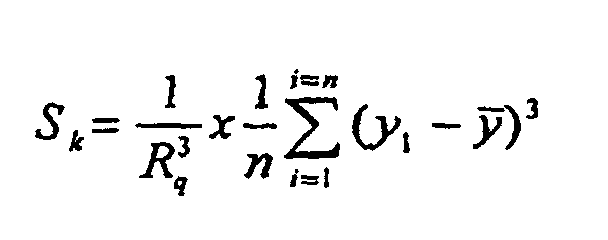
- the value Sk is between - 0.2 and + 0.3.
- a value Sk between -0.1 and +0.2 is preferred.
- the non-homogeneous surface samples, corresponding to the prior art, have a value Sk less than - 0.4.
- the applicant has found values between -0.45 and -1.38 for alloy samples 8011 obtained by the continuous casting process between rolls according to the prior art.
- the sample is placed on a TIXY 200 cross table.
- the probe (model FRW 750 from Mahr Mesures), with a radius of curvature of 5 ⁇ m, was conditioned by a Perthometer PRK device from the company Mahr Mesures.
- the data was recorded using an analog-to-digital conversion card in a microcomputer.
- the dimension of the measuring field was 20 mm x 20 mm, with a pitch of 40 ⁇ m in x and y.
- the theoretical resolution in depth was given by the maximum amplitude of the probe (100 ⁇ m) and the characteristics of the microprocessor (16 bit), about 0.024 ⁇ m.
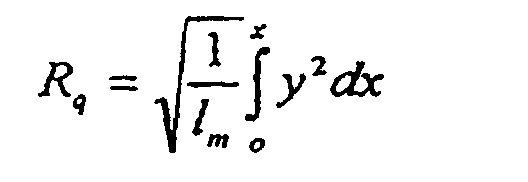
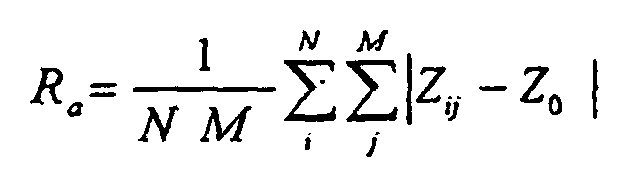
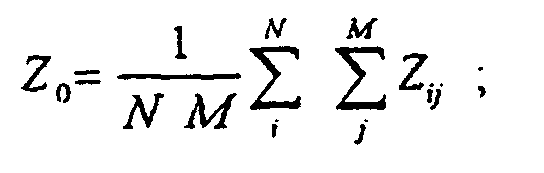
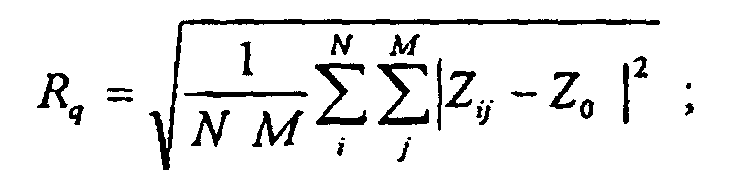
- the three-dimensional roughness was calculated with software provided by Saphir according to the following equations: where N is the number of points in x, M the number of points in y, Zo the average altitude on the observation surface according to
- the parameter Ek sometimes called kurtosis in English, characterizes the flattening of the distribution; it takes the value of 3 for an ideal Gaussian.
- the measurements can be made on the upper face, that is to say the face having have been in contact with the upper cylinder, outside areas that show accidents such as scratches due to handling or stains, for castings, simply cold-rolled strip or rolled strip cold then having undergone finishing passes with shiny cylinders (polished).
- the measurements are all performed on samples treated by sulfuric anodizing under the following conditions: concentration of sulfuric acid 200 g / l, temperature 20 ° C voltage 15 V. This treatment leads to an oxide layer thickness of 1 ⁇ m. It is eventually preceded by a preliminary basic etching (for example, at a temperature of 60 ° C and during 7 minutes in a 50 g / l bath of ALUMINUX 138, commercial product at soda base).
- the average variation of S N is greater than 50%, both for the raw tapes and for the cold-rolled tapes.
- the average variation is less than 20% in all cases.
- the difference ⁇ S N is less than 20 for the raw tapes, and less than 12 for the cold-rolled tapes to a thickness between 4 and 0.1 mm, and underwent anodizing before basic etching. It is less than 3.5, and even often 0.5 for bands which have undergone a final cold rolling called "brilliant", that is to say leading to a roughness R a less than 0.2 microns, then electrolytically brightened before anodization of 1 ⁇ m.
- the machine comprises a pouring pan (1) fed with liquid aluminum alloy and connected to an injector (2), consisting of a lower lip (3) and an upper lip (4), bringing the liquid metal into the gap between the two cylinders (5) and (6) turning in the opposite direction.
- the strip (7) is solidified on the other side of the gap between cylinders.
- the modification according to the invention consists in using an injector having an upper lip (4) set back a distance (d) from the lower lip (3). This shrinkage (d) is at least 2 mm and preferably at least 5 mm.
- the pressure metallostatic that is to say the height of metal, in the tundish (1), measured at from the median casting plane, less than 30 mm, preferably less than 25 mm, and especially since the withdrawal (d) is more important.
- the removal of the lip The upper part of the injector also allows a finer positioning of the injector. which avoids accidental friction on the surface of the cylinders, and thus improves indirectly the surface condition of the underside of the cast strip.
- the invention is applicable to all aluminum alloys capable of being cast in continuous between cylinders.
- the plaintiff obtained good results with certain alloys from the 3000 series and with some low Al-Mg alloys magnesium content such as the 5005.
- the invention is particularly interesting for AlFeSi alloys of the 1000 series and 8000, containing from 0.01 to 2% by weight of iron, and from 0.1 to 2% of silicon. Indeed, these alloys, when they are continuously cast between cylinders, have mechanical characteristics significantly higher than those obtained by casting traditional and hot rolling, which facilitates their rolling "brilliant".
- One of the reasons for the higher mechanical strength of the strips obtained by casting continuous for this type of alloy is that the amount of iron in solid solution in aluminum is higher. For an alloy containing more than 0.01% (100 ppm) of iron, the amount of iron in solid solution is greater than 50 ppm + 0.03 x (Fe content in ppm).
- Another advantage of having a high level of iron in solid solution is, for a given iron content, to decrease the intermetallic compounds to iron, whose surface presence is a source of optical defects.
- the invention is also particularly interesting for low-alloys Mg (Mg ⁇ 1.5%).
- a grain size is obtained on the surface, defined as the width average grain surface, measured perpendicular to the direction of rolling by image analysis, less than 20 ⁇ m, and often 15 ⁇ m, both on casting only on cold-rolled strips, which reduces some of the defects look like lineage.
- This characteristic of the bands according to the invention is also favorable for later formatting, for example by stamping.
- the metal was treated with argon in a Pechiney Rhenalu Alpur ® casting ladle and then cast continuously on a JUMBO 3 CM ® cylinder casting machine from Pechiney Rhenalu.
- the diameter of the cylinders was 1150 mm, with an air gap between the two cylinders 2.3 mm.
- the Styrite ® brand ceramic injector featured a lip 7 mm lower than the lower lip, and was powered by a casting tray with a liquid metal height of about 18 mm.
- the casting was made at a width of 1370 mm, a cast strip thickness of 3.6 mm, a speed casting speed of 1.6 m / min and an inter-roll force of 800 t / m bandwidth.
- the strip was then cold rolled to a thickness of 0.4 mm.
- strips of the same composition have been prepared by the usual method. vertical semi-continuous casting, hot rolling of trays then cold rolling up to the same thickness of 0.4 mm at two different work-hardening rates.
- the size of the grains on the surface was 7 ⁇ m for the bands according to the invention and 80 ⁇ m for the bands from vertical semi-continuous casting.
- the injector also in Styrite ® brand ceramic, had a lip upper back 10 mm from the lower lip and was powered by a casting tray with a liquid metal height of about 18 mm.
- the width of band was 1370 mm, the thickness of the casting band 3 mm, the casting speed of 2 m / min and the effort between cylinders of 900 t per meter of bandwidth.
- the strips thus cast were then cold-rolled to a thickness of 0.8 mm and then underwent two rolling passes with cylinders shining up to 0.5 mm. Samples of tapes were taken as and when tapes first castings at 3 mm, then strips after cold rolling of 0.8 mm, and finally of strips after "glossy" lamination at 0.5 mm.
- Samples of 3 mm cast tapes were treated by anodizing sulfuric acid with a thickness of 1 ⁇ m.
- Strip samples after cold rolling at 0.8 mm have undergone a basic etching on 10 ⁇ m then a sulfuric anodization with a thickness of 1 ⁇ m.
- the strip samples after glossy lamination to 0.5 mm have successively undergone electrolytic brightening and sulfuric anodizing of thickness 1 ⁇ m.
- bands of the same composition having undergone the same cold rolling ranges but from the conventional process (semi-continuous casting vertical then hot rolling trays) have grain sizes in surface of the order of 70 microns.
- the casting R5 corresponds to that of Example 1, carried out with the casting process continuous between cylinders according to the invention.
- the casting R7 corresponds to that of Example 1, carried out according to the prior art with a traditional injector.
- the surface also has a standard deviation on the average L * value less than 0.5 and preferably less than 0.3.
Landscapes
- Engineering & Computer Science (AREA)
- Mechanical Engineering (AREA)
- Continuous Casting (AREA)
- Metal Rolling (AREA)
- Coating With Molten Metal (AREA)
- Superconductors And Manufacturing Methods Therefor (AREA)
- Diaphragms For Electromechanical Transducers (AREA)
Description


avec addition de 3 kg/t d'affinant au titane-bore. Le métal a été traité à l'argon dans une poche de coulée Alpur ® de Pechiney Rhenalu, puis coulé en continu sur une machine de coulée entre cylindres JUMBO 3 CM ® de Pechiney Rhenalu.
| Provenance | Rm (MPa) | R0,2 (MPa) | A (%) | n (%) |
| coulée continue JUMBO 3CM | 173 | 167 | 7,7 | 80 |
| coulée semi-continue. | 155 | 148 | 7 | 93 |
| coulée semi-continue. | 165 | 158 | 6,2 | 96 |
| SN max | SN min | SN max - SN min | SN max -SNmin/SN moyen | |
| Bandes suivant l'invention | 7,4 | 6,4 | 1 | 14% |
| Bandes suivant l'art antérieur | 11 | 7 | 4 | 50% |
| Epaisseur en mm | SN max | Sn min | Sn max - Sn min | Sn max- Sn min / Sn moyen | |
| Bandes brutes de coulée, anodisées, suivant l'invention | 3 | 53 | 44 | 9 | 19% |
| Bandes laminées décapées, anodisées, suivant l'invention | 0,8 | 36 | 32 | 4 | 11% |
| Bandes laminées " brillant ", anodisées, suivant l'invention | 0,5 | 10 | 8,5 | 1,5 | 17% |
| Bandes laminées " brillant ", anodisées, Suivant l'art antérieur | 0,5 | 19 | 13 | 6 | 37% |
| référence | Alliage | teneur en Fe et Si | vitesse de coulée | épaisseur de coulée |
| R1 | 8011 | Fe 0,60 ; Si 0,75 | 0,96 m/mn | 7,0 mm |
| R3 | 1050 | Fe 0,20 ; Si 0,14 | 3,0 mm | |
| R4 | 1235 | Fe 0,37 ; Si 0,14 | 2,5 m/mn | 2,7 mm |
| R5 | 1085 | voir exemple 1 | ||
| R6 | 8011 | Fe 0,70 , Si 0,73 | 1,6 m/mn | 3,1 mm |
| R7 | 1085 | voir exemple 1 |
| Caractérisation des oscillations de niveau de gris | |||
| Référence | Mesure L*a*b* | ||
| L* moyen | Ecart-type Sur L*moyen | classement visuel (1: le meilleur 7: le moins bon) | |
| R1 | 74,74 | 0,26 | 7 |
| R2 | 75,47 | 0,31 | 3 |
| R3 | 77,98 | 0,45 | 4 |
| R4 | 79,42 | 0,20 | 2 |
| R5 | 82,50 | 0,23 | 1 |
| R6 | 74,54 | 0,46 | 5 |
| R7 | 74,99 | 0,77 | 6 |
| Caractérisation des défauts de rugosité par rugosimétrie 3D | ||||
| réf. | Ra µm | Rq µm | Sk | Ek |
| R1 | 2,622 | 4,401 | -4,124 | 35,830 |
| R3 | 2,111 | 2,745 | - 0, 784 | 4,640 |
| R4 | 3,158 | 4,060 | - 0,643 | 4,364 |
| R5 | 2,905 | 3,661 | - 0,614 | 3,542 |
| R6 | 1,759 | 2,316 | - 0,856 | 6,168 |
| R7 | 2,681 | 4,033 | - 2,678 | 27,002 |
- la valeur de Sk en rugosimétrie 3D selon la procédure décrite soit supérieure à -2,0 et préférentiellement supérieure à -1,0 ;
- la valeur Ek en rugosimétrie 3D doit être inférieure à 15 et préférentiellement inférieure à 8.
Claims (8)
- Procédé de fabrication d'une bande en alliage d'aluminium présentant sur sa face supérieure une homogénéité de surface améliorée par rapport à sa face inférieure, par coulée continue entre deux cylindres (5) et (6) refroidis, à partir d'un bac de coulée (1) contenant le métal liquide relié à un injecteur (2) constitué d'une lèvre inférieure (3) et d'une lèvre supérieure (4), amenant le métal liquide dans l'intervalle entre les deux cylindres, caractérisé en ce que la lèvre supérieure (3) de l'injecteur (2) est en retrait d'au moins 2 mm par rapport à la lèvre inférieure (4).
- Procédé-selon la revendication 2, caractérisé en ce que la lèvre supérieure (3) de l'injecteur (2) est en retrait d'au moins 5 mm par rapport à la lèvre inférieure (4).
- Procédé selon l'une quelconque des revendications 1 ou 2, caractérisé en ce que la hauteur de métal liquide dans le bac de coulée (1), mesurée à partir du plan médian de coulée, est inférieure à 30 mm.
- Procédé selon la revendication 8, caractérisé en ce que la hauteur de métal liquide dans le bac de coulée (1), mesurée à partir du plan médian dé coulée, est inférieure à 25 mm.
- Utilisation d'une bande obtenue par un procédé selon l'une quelconque des revendications 1 à 4 pour la fabrication de tôles anodisées et éventuellement laquées pour le bâtiment.
- Utilisation d'une bande obtenue par un procédé selon l'une quelconque des revendications 1 à 4 pour la fabrication de pièces embouties.
- Utilisation d'une bande obtenue par un procédé selon l'une quelconque des revendications 1 à 4 pour la fabrication de reflecteurs optiques.
- Bande en alliage 1085, élaborée par coulée continue entre cylindres selon l'une des revendications 1 à 4, caractérisée en ce que après une ou plusieurs passes de laminage à froid avec un taux d'écrouissage total inférieur à 85%, elle présente au moins un des groupes de propriétés suivantes:(a) Rm > 165 MPa et A > 6%,(b) R0.2 > 160 MPa et A > 6%.
Applications Claiming Priority (3)
| Application Number | Priority Date | Filing Date | Title |
|---|---|---|---|
| FR9801987A FR2774930B1 (fr) | 1998-02-13 | 1998-02-13 | Bandes en alliage d'aluminium a grande homogeneite de surface et procede de fabrication de ces bandes |
| FR9801987 | 1998-02-13 | ||
| PCT/FR1999/000319 WO1999041031A1 (fr) | 1998-02-13 | 1999-02-12 | Bandes en alliage d'aluminium a grande homogeneite de surface et procede de fabrication de ces bandes |
Publications (2)
| Publication Number | Publication Date |
|---|---|
| EP1056560A1 EP1056560A1 (fr) | 2000-12-06 |
| EP1056560B1 true EP1056560B1 (fr) | 2005-04-27 |
Family
ID=9523123
Family Applications (1)
| Application Number | Title | Priority Date | Filing Date |
|---|---|---|---|
| EP99903745A Expired - Lifetime EP1056560B1 (fr) | 1998-02-13 | 1999-02-12 | Procede de fabrication de bandes en alliage d'aluminium a grande homogeneite de surface |
Country Status (11)
| Country | Link |
|---|---|
| US (2) | US6834708B1 (fr) |
| EP (1) | EP1056560B1 (fr) |
| JP (1) | JP2002502708A (fr) |
| CN (1) | CN1222381C (fr) |
| AT (1) | ATE294038T1 (fr) |
| AU (1) | AU2429499A (fr) |
| BR (1) | BR9907880A (fr) |
| DE (1) | DE69924981D1 (fr) |
| FR (1) | FR2774930B1 (fr) |
| NO (1) | NO20004061L (fr) |
| WO (1) | WO1999041031A1 (fr) |
Cited By (5)
| Publication number | Priority date | Publication date | Assignee | Title |
|---|---|---|---|---|
| DE102009012984A1 (de) * | 2009-03-12 | 2010-09-23 | Salzgitter Flachstahl Gmbh | Gießdüse für eine horizontale Bandgießanlage |
| DE102015114725B3 (de) * | 2015-09-03 | 2016-12-08 | Salzgitter Flachstahl Gmbh | Schmelzenaufgabesystem für eine horizontale Bandgießanlage |
| WO2017032371A2 (fr) | 2015-08-21 | 2017-03-02 | Schaeffler Technologies AG & Co. KG | Dispositif de simulation d'effort sur un élément d'actionnement d'un véhicule, de préférence simulateur d'effort sur la pédale |
| US10957942B2 (en) | 2016-09-14 | 2021-03-23 | Wirtz Manufacturing Co., Inc. | Continuous lead strip casting line, caster, and nozzle |
| US10960461B2 (en) | 2016-09-14 | 2021-03-30 | Wirtz Manufacturing Co., Inc. | Continuous lead strip casting line, caster, and nozzle |
Families Citing this family (7)
| Publication number | Priority date | Publication date | Assignee | Title |
|---|---|---|---|---|
| JP4203508B2 (ja) * | 2006-03-08 | 2009-01-07 | 株式会社神戸製鋼所 | アルミニウム合金鋳造板の製造方法 |
| EP3444719B1 (fr) | 2017-08-14 | 2021-07-21 | Unify Patente GmbH & Co. KG | Procédé et système pour un déploiement de client à un serveur par le intermédiaire d'une plate-forme de distribution en ligne |
| CN111761036B (zh) * | 2020-07-08 | 2022-03-01 | 甘肃东兴铝业有限公司 | 一种汽车用6×××系铝合金板的铸轧方法 |
| TWI733592B (zh) * | 2020-09-24 | 2021-07-11 | 中國鋼鐵股份有限公司 | 鋁合金片及其製造方法 |
| CN113560515B (zh) * | 2021-06-21 | 2023-01-03 | 杭州电子科技大学 | 一种稀土磁性材料速凝铸带用中间包及浇注方法 |
| CN113857445B (zh) * | 2021-09-26 | 2023-10-03 | 云南浩鑫铝箔有限公司 | 一种铸嘴结构及利用该铸嘴结构的滑边生产工艺 |
| CN114309505B (zh) * | 2021-12-17 | 2023-01-10 | 北京科技大学 | 一种采用动量布流的金属薄带连铸方法 |
Family Cites Families (14)
| Publication number | Priority date | Publication date | Assignee | Title |
|---|---|---|---|---|
| NL235564A (fr) | 1958-01-31 | |||
| FR1198006A (fr) * | 1958-01-31 | 1959-12-04 | Pechiney Prod Chimiques Sa | Coulée continue des métaux |
| DE2443068A1 (de) * | 1974-09-09 | 1976-03-25 | Leichtmetall Gmbh | Verfahren und vorrichtung zum eingiessen der schmelze in den erstarrungsraum einer bandgiessmaschine |
| AU507351B2 (en) * | 1974-12-23 | 1980-02-14 | Hunter Engineering Co. Inc. | Roll casting |
| US4054173A (en) | 1974-12-23 | 1977-10-18 | Hunter Engineering Co., Inc. | Apparatus for producing completely recrystallized metal sheet |
| FR2398565A1 (fr) * | 1977-07-27 | 1979-02-23 | Scal Gp Condit Aluminium | Busette d'alimentation en metal liquide pour machine de coulee continue de bande |
| CH657546A5 (de) * | 1982-12-16 | 1986-09-15 | Alusuisse | Verfahren zum herstellen eines zur fertigung von dosendeckeln geeigneten bandes. |
| US4681152A (en) * | 1985-10-04 | 1987-07-21 | Hunter Engineering Company, Inc. | Continuous casting aluminum alloy |
| GB2198976B (en) * | 1986-12-19 | 1990-10-17 | Davy Mckeen | Roll caster |
| US5350010A (en) * | 1992-07-31 | 1994-09-27 | Fuji Photo Film Co., Ltd. | Method of producing planographic printing plate support |
| WO1995008408A1 (fr) * | 1993-09-21 | 1995-03-30 | Alcan International Limited | Feuille d'aluminium a surface rugueuse |
| TW374096B (en) * | 1995-01-10 | 1999-11-11 | Nihon Parkerizing | Process for hot dip-coating a steel material with a molten aluminum alloy according to an one-stage metal alloy coating method using a flux |
| FR2737430B1 (fr) * | 1995-08-03 | 1997-09-05 | Pechiney Rhenalu | Procede et dispositif de demarrage d'une machine de coulee continue entre cylindres |
| EP0821074A1 (fr) * | 1996-07-25 | 1998-01-28 | Alusuisse Technology & Management AG | Procédé pour la production d'une bande en alliage d'aluminium pour plaques d'impression lithographique |
-
1998
- 1998-02-13 FR FR9801987A patent/FR2774930B1/fr not_active Expired - Fee Related
-
1999
- 1999-02-12 CN CNB998026727A patent/CN1222381C/zh not_active Expired - Fee Related
- 1999-02-12 AT AT99903745T patent/ATE294038T1/de not_active IP Right Cessation
- 1999-02-12 BR BR9907880-5A patent/BR9907880A/pt not_active Application Discontinuation
- 1999-02-12 DE DE69924981T patent/DE69924981D1/de not_active Expired - Lifetime
- 1999-02-12 US US09/582,625 patent/US6834708B1/en not_active Expired - Fee Related
- 1999-02-12 AU AU24294/99A patent/AU2429499A/en not_active Abandoned
- 1999-02-12 JP JP2000531266A patent/JP2002502708A/ja not_active Abandoned
- 1999-02-12 EP EP99903745A patent/EP1056560B1/fr not_active Expired - Lifetime
- 1999-02-12 WO PCT/FR1999/000319 patent/WO1999041031A1/fr not_active Ceased
-
2000
- 2000-08-11 NO NO20004061A patent/NO20004061L/no not_active Application Discontinuation
-
2001
- 2001-12-13 US US10/013,681 patent/US6948550B2/en not_active Expired - Fee Related
Non-Patent Citations (1)
| Title |
|---|
| BRODMANN R.; GAST T.; THURN G.: "An optical instrument for measuring the surface roughness in production control", CIRP ANNALS, vol. 33, no. 1, 1984, pages 403 - 406 * |
Cited By (7)
| Publication number | Priority date | Publication date | Assignee | Title |
|---|---|---|---|---|
| DE102009012984A1 (de) * | 2009-03-12 | 2010-09-23 | Salzgitter Flachstahl Gmbh | Gießdüse für eine horizontale Bandgießanlage |
| DE102009012984B4 (de) * | 2009-03-12 | 2013-05-02 | Salzgitter Flachstahl Gmbh | Gießdüse für eine horizontale Bandgießanlage |
| WO2017032371A2 (fr) | 2015-08-21 | 2017-03-02 | Schaeffler Technologies AG & Co. KG | Dispositif de simulation d'effort sur un élément d'actionnement d'un véhicule, de préférence simulateur d'effort sur la pédale |
| DE102015114725B3 (de) * | 2015-09-03 | 2016-12-08 | Salzgitter Flachstahl Gmbh | Schmelzenaufgabesystem für eine horizontale Bandgießanlage |
| WO2017036456A1 (fr) | 2015-09-03 | 2017-03-09 | Sms Group Gmbh | Système d'alimentation en métal liquide pour une installation horizontale de coulée continue de bande minces |
| US10957942B2 (en) | 2016-09-14 | 2021-03-23 | Wirtz Manufacturing Co., Inc. | Continuous lead strip casting line, caster, and nozzle |
| US10960461B2 (en) | 2016-09-14 | 2021-03-30 | Wirtz Manufacturing Co., Inc. | Continuous lead strip casting line, caster, and nozzle |
Also Published As
| Publication number | Publication date |
|---|---|
| US20020084056A1 (en) | 2002-07-04 |
| AU2429499A (en) | 1999-08-30 |
| CN1222381C (zh) | 2005-10-12 |
| JP2002502708A (ja) | 2002-01-29 |
| US6948550B2 (en) | 2005-09-27 |
| ATE294038T1 (de) | 2005-05-15 |
| FR2774930B1 (fr) | 2000-05-19 |
| US6834708B1 (en) | 2004-12-28 |
| FR2774930A1 (fr) | 1999-08-20 |
| NO20004061D0 (no) | 2000-08-11 |
| BR9907880A (pt) | 2000-10-17 |
| CN1289275A (zh) | 2001-03-28 |
| NO20004061L (no) | 2000-10-13 |
| DE69924981D1 (de) | 2005-06-02 |
| WO1999041031A1 (fr) | 1999-08-19 |
| EP1056560A1 (fr) | 2000-12-06 |
Similar Documents
| Publication | Publication Date | Title |
|---|---|---|
| EP1056560B1 (fr) | Procede de fabrication de bandes en alliage d'aluminium a grande homogeneite de surface | |
| EP2263811A1 (fr) | Tôle d'alliage d'aluminium et son procédé de production | |
| US20100215926A1 (en) | Aluminum alloy substrates having a multi-color effect and methods for producing the same | |
| CA1308337C (fr) | Methode de fabrication de plaques offset | |
| CH629410A5 (fr) | Procede de fabrication d'une bande composite par placage. | |
| RU2537835C2 (ru) | Литографическая лента для электрохимического зернения, а также способ ее изготовления | |
| CA2861064C (fr) | Dispositif de refroidissement a double jet pour moule de coulee semi-continue verticale | |
| WO2001064965A1 (fr) | Procede de fabrication de bandes en alliage d'aluminium aptes a la fabrication de corps de boites | |
| US5779824A (en) | Aluminum alloy support for planographic printing plate and method for producing the same | |
| EP1187691A1 (fr) | Procede de coulee continue entre cylindres de bandes d'acier inoxydable ferritique exemptes de microcriques | |
| CN1144889C (zh) | 制造标准薄箔材用的铝合金带材制品 | |
| US12522894B2 (en) | Aluminum foil with improved barrier property | |
| JP4134517B2 (ja) | アルミニウム箔およびその製造方法 | |
| HK1035877A (en) | Aluminium alloy strips with high surface homogeneity and method for making same | |
| EP0665448A1 (fr) | Bandes ou toles d'aluminium à propriétés optiques réproductibles et améliorées | |
| EP4496670A1 (fr) | Tôle metallique à relief performante en présence de givre | |
| US11807027B2 (en) | Litho strip having flat topography and printing plate produced therefrom | |
| FR3163384A1 (fr) | Méthode de traitement thermique de mise en solution-trempe pour des profilés en alliage d’aluminium | |
| JP2005008915A (ja) | 光輝性ホイールリム用アルミニウム合金板およびその製造方法 | |
| CA1195821A (fr) | Tole d'aluminium pour boites de conserves, et methode de fabrication | |
| JPS63180331A (ja) | 深絞り成形用アルミニウムおよびアルミニウム合金板 | |
| FR2628348A1 (fr) | Procede pour accroitre le frottement entre l'outil et le produit a laminer, et cylindre approprie pour la mise en oeuvre de ce procede | |
| JP2003341696A (ja) | 光沢度に優れた缶蓋用アルミニウム合金 | |
| EP0666333A1 (fr) | Tôles fortes en alliages d'aluminium résistant à la fatigue et procédé d'obtention | |
| JPH08269649A (ja) | 陽極酸化処理用アルミニウム合金材の製造方法 |
Legal Events
| Date | Code | Title | Description |
|---|---|---|---|
| PUAI | Public reference made under article 153(3) epc to a published international application that has entered the european phase |
Free format text: ORIGINAL CODE: 0009012 |
|
| 17P | Request for examination filed |
Effective date: 20000620 |
|
| AK | Designated contracting states |
Kind code of ref document: A1 Designated state(s): AT DE FR GB IT |
|
| 17Q | First examination report despatched |
Effective date: 20010521 |
|
| GRAP | Despatch of communication of intention to grant a patent |
Free format text: ORIGINAL CODE: EPIDOSNIGR1 |
|
| RTI1 | Title (correction) |
Free format text: METHOD FOR MAKING ALUMINIUM ALLOY STRIPS WITH HIGH SURFACE HOMOGENEITY |
|
| GRAS | Grant fee paid |
Free format text: ORIGINAL CODE: EPIDOSNIGR3 |
|
| GRAA | (expected) grant |
Free format text: ORIGINAL CODE: 0009210 |
|
| AK | Designated contracting states |
Kind code of ref document: B1 Designated state(s): AT DE FR GB IT |
|
| PG25 | Lapsed in a contracting state [announced via postgrant information from national office to epo] |
Ref country code: GB Free format text: LAPSE BECAUSE OF FAILURE TO SUBMIT A TRANSLATION OF THE DESCRIPTION OR TO PAY THE FEE WITHIN THE PRESCRIBED TIME-LIMIT Effective date: 20050427 Ref country code: AT Free format text: LAPSE BECAUSE OF FAILURE TO SUBMIT A TRANSLATION OF THE DESCRIPTION OR TO PAY THE FEE WITHIN THE PRESCRIBED TIME-LIMIT Effective date: 20050427 |
|
| REG | Reference to a national code |
Ref country code: GB Ref legal event code: FG4D Free format text: NOT ENGLISH |
|
| REF | Corresponds to: |
Ref document number: 69924981 Country of ref document: DE Date of ref document: 20050602 Kind code of ref document: P |
|
| PG25 | Lapsed in a contracting state [announced via postgrant information from national office to epo] |
Ref country code: DE Free format text: LAPSE BECAUSE OF FAILURE TO SUBMIT A TRANSLATION OF THE DESCRIPTION OR TO PAY THE FEE WITHIN THE PRESCRIBED TIME-LIMIT Effective date: 20050728 |
|
| GBV | Gb: ep patent (uk) treated as always having been void in accordance with gb section 77(7)/1977 [no translation filed] |
Effective date: 20050427 |
|
| RAP2 | Party data changed (patent owner data changed or rights of a patent transferred) |
Owner name: NOVELIS, INC. |
|
| PLBE | No opposition filed within time limit |
Free format text: ORIGINAL CODE: 0009261 |
|
| STAA | Information on the status of an ep patent application or granted ep patent |
Free format text: STATUS: NO OPPOSITION FILED WITHIN TIME LIMIT |
|
| 26N | No opposition filed |
Effective date: 20060130 |
|
| REG | Reference to a national code |
Ref country code: FR Ref legal event code: TP |
|
| REG | Reference to a national code |
Ref country code: FR Ref legal event code: CL |
|
| REG | Reference to a national code |
Ref country code: FR Ref legal event code: AU |
|
| REG | Reference to a national code |
Ref country code: FR Ref legal event code: PLFP Year of fee payment: 18 |
|
| REG | Reference to a national code |
Ref country code: FR Ref legal event code: PLFP Year of fee payment: 19 |
|
| REG | Reference to a national code |
Ref country code: FR Ref legal event code: PLFP Year of fee payment: 20 |
|
| PGFP | Annual fee paid to national office [announced via postgrant information from national office to epo] |
Ref country code: IT Payment date: 20180222 Year of fee payment: 20 Ref country code: FR Payment date: 20180227 Year of fee payment: 20 |