EP1056579B1 - Fabrication d'articles a base d'une matiere moulable de pmma thermoplastique en utilisant des outils en metaux non ferreux - Google Patents
Fabrication d'articles a base d'une matiere moulable de pmma thermoplastique en utilisant des outils en metaux non ferreux Download PDFInfo
- Publication number
- EP1056579B1 EP1056579B1 EP99913160A EP99913160A EP1056579B1 EP 1056579 B1 EP1056579 B1 EP 1056579B1 EP 99913160 A EP99913160 A EP 99913160A EP 99913160 A EP99913160 A EP 99913160A EP 1056579 B1 EP1056579 B1 EP 1056579B1
- Authority
- EP
- European Patent Office
- Prior art keywords
- process according
- moulding
- pmma
- molding
- weight
- Prior art date
- Legal status (The legal status is an assumption and is not a legal conclusion. Google has not performed a legal analysis and makes no representation as to the accuracy of the status listed.)
- Expired - Lifetime
Links
Images




Classifications
-
- B—PERFORMING OPERATIONS; TRANSPORTING
- B29—WORKING OF PLASTICS; WORKING OF SUBSTANCES IN A PLASTIC STATE IN GENERAL
- B29C—SHAPING OR JOINING OF PLASTICS; SHAPING OF MATERIAL IN A PLASTIC STATE, NOT OTHERWISE PROVIDED FOR; AFTER-TREATMENT OF THE SHAPED PRODUCTS, e.g. REPAIRING
- B29C43/00—Compression moulding, i.e. applying external pressure to flow the moulding material; Apparatus therefor
- B29C43/003—Compression moulding, i.e. applying external pressure to flow the moulding material; Apparatus therefor characterised by the choice of material
-
- B—PERFORMING OPERATIONS; TRANSPORTING
- B29—WORKING OF PLASTICS; WORKING OF SUBSTANCES IN A PLASTIC STATE IN GENERAL
- B29C—SHAPING OR JOINING OF PLASTICS; SHAPING OF MATERIAL IN A PLASTIC STATE, NOT OTHERWISE PROVIDED FOR; AFTER-TREATMENT OF THE SHAPED PRODUCTS, e.g. REPAIRING
- B29C45/00—Injection moulding, i.e. forcing the required volume of moulding material through a nozzle into a closed mould; Apparatus therefor
- B29C45/0001—Injection moulding, i.e. forcing the required volume of moulding material through a nozzle into a closed mould; Apparatus therefor characterised by the choice of material
-
- C—CHEMISTRY; METALLURGY
- C08—ORGANIC MACROMOLECULAR COMPOUNDS; THEIR PREPARATION OR CHEMICAL WORKING-UP; COMPOSITIONS BASED THEREON
- C08F—MACROMOLECULAR COMPOUNDS OBTAINED BY REACTIONS ONLY INVOLVING CARBON-TO-CARBON UNSATURATED BONDS
- C08F20/00—Homopolymers and copolymers of compounds having one or more unsaturated aliphatic radicals, each having only one carbon-to-carbon double bond, and only one being terminated by only one carboxyl radical or a salt, anhydride, ester, amide, imide or nitrile thereof
- C08F20/02—Monocarboxylic acids having less than ten carbon atoms, Derivatives thereof
- C08F20/10—Esters
- C08F20/12—Esters of monohydric alcohols or phenols
- C08F20/14—Methyl esters, e.g. methyl (meth)acrylate
-
- B—PERFORMING OPERATIONS; TRANSPORTING
- B29—WORKING OF PLASTICS; WORKING OF SUBSTANCES IN A PLASTIC STATE IN GENERAL
- B29K—INDEXING SCHEME ASSOCIATED WITH SUBCLASSES B29B, B29C OR B29D, RELATING TO MOULDING MATERIALS OR TO MATERIALS FOR MOULDS, REINFORCEMENTS, FILLERS OR PREFORMED PARTS, e.g. INSERTS
- B29K2033/00—Use of polymers of unsaturated acids or derivatives thereof as moulding material
- B29K2033/04—Polymers of esters
- B29K2033/12—Polymers of methacrylic acid esters, e.g. PMMA, i.e. polymethylmethacrylate
Definitions
- the present invention relates to a method for production of Moldings made of thermoplastic PMMA molding compound, in particular by compression molding or Injection molding.
- Another object of the invention is the quality of PMMA molded parts to improve, especially with regard to their purity and surface quality.
- Thermoplastic PMMA molding compound for the production of Shaped bodies used with tools containing non-ferrous metals, the wear is effectively reduced tools and machine parts containing non-ferrous metals.
- the sulfur content of the commercially available Molding compounds is only 500 to 800 ppm.
- so-called Molecular weight regulators are mostly built into the polymer via covalent bonds.
- essentially sulfur free means that no sulfur-containing regulators are used and that the Sulfur content of the PMMA molding compounds less than 50 ppm, preferably less than 30 ppm, particularly preferably less than 10 ppm and very particularly preferably less than 5 ppm is.
- Thermoplastic PMMA molding compounds are homo- or Copolymers made by polymerizing methyl methacrylate alone or in combination with one or more ethylenically unsaturated monomers are available and the can be processed thermoplastic.
- Tools containing nonferrous metals are tools, in particular Inserts, nozzles and channels that contain non-ferrous metals.
- Non-ferrous metals are understood to mean: form poorly soluble sulfides. These include a., without that this should result in a limitation, nickel, Copper and alloys of these two metals together or with other metals such. B. beryllium, zinc or Tin.
- the production of moldings from the above PMMA masses can be in any way known to those skilled in the art respectively. This includes in particular extrusion, the Injection molding and compression molding, this is preferred Injection molding and compression molding.
- Component (i) is commercially available. you The proportion by weight is 5 to 100% by weight, preferably 50 up to 100% by weight and particularly preferably 80 to 100% by weight. If the proportion by weight is less than 5% by weight, the Properties of the methyl methacrylate components not in Appearance.
- Methyl methacrylate may be included, u. a.
- ⁇ -methylstyrene and ⁇ -ethylstyrene substituted styrenes with an alkyl substituent on the ring, such as for example vinyl toluene and p-methyl styrene, halogenated Styrenes, such as monochlorostyrenes, Dichlorostyrenes, tribromostyrenes and tetrabromostyrenes, vinyl and Isopropenyl ether, maleic acid derivatives, such as for example maleic anhydride, Methyl maleic anhydride, maleimide, methyl maleimide, Phenyl maleimide and cyclohexyl maleimide, and dienes, such as for example 1,3-butadiene and divinylbenzene, are preferred are acrylic esters, methacrylic acid esters, which are derived from (i) are different, vinyl acetate, vinyl chloride, Vinylidene chloride, styrene, ⁇ -methylstyren
- All of the above monomers are commercially available. They are in an amount from 0 to 95% by weight, preferably 0 to 50% by weight and particularly preferably 0 to 20 wt .-% based on the total amount of monomers Components copolymerized with methyl methacrylate. Is the Weight proportion greater than 95%, so the properties occur the methacrylic acid component (i) does not appear.
- Sulfur-free molecular weight regulators are for example, without any restriction dimeric ⁇ -methylstyrene (2,4 diphenyl-4-methyl-1-pentene), Aliphatic enol ether and / or cycloaliphatic aldehydes, terpenes, ⁇ -terpinene, Terpinolene, 1,4-cyclohexadiene, 1,4-dihydronaphthalene, 1,4,5,8-tetrahydronaphthalene, 2,5-dihydrofuran, 2,5-dimethylfuran and / or 3,6-dihydro-2H-pyran, is preferred dimeric ⁇ -methylstyrene.
- the sulfur-free molecular weight regulators are in one Amount in the range of 0.05 to 5 wt .-%, preferably 0.1 to 2 wt .-%, based on 100 wt .-% of the monomeric components used. Is the weight fraction of the Molecular weight regulator greater than 5 wt .-%, so that Weight average molecular weight of the polymer small. Is the weight fraction of the molecular weight regulator less than 0.05 wt .-%, the weight average of Molecular weight of the polymer too large.
- the PMMA molding compositions for thermoplastic molding compositions obtained customary additives.
- additives are mentioned as examples: Antistatic agents, antioxidants, bio-stabilizers, chemical blowing agents, mold release agents, flame retardants, lubricants, colorants, flow improvers, fillers, lubricants, light stabilizers, optical brighteners, organic phosphites, pigments, impact modifiers, crosslinking agents, reinforcing agents, reinforcing fibers, weathering protection agents and plasticizers.
- suitable additives care must be taken that they are essentially sulfur-free.
- the additives are in the usual amount, i. H. up to 100% by weight, preferably up to 10% by weight relative to that Sum of (i) and (ii) used. If the amount is greater than 100 wt .-% relative to the sum of (i) and (ii), so Properties of the molding compound, such as Processability and / or mechanical properties, be adversely affected.
- the molding compositions which can be used according to the invention can be used for Modification of properties containing other polymers.
- These polymer mixtures are known to the person skilled in the art as "blends" known.
- These polymers include, for example, without that this should result in a limitation, all of the by radical polymerization of the above Monomers or mixtures of these monomers arise, as well Polycarbonates, polyesters, polyamides, polyimides, Polyurethanes and polyethers.
- the weight average molecular weight M w of the homopolymers and / or copolymers to be used according to the invention is in general in the range between 20,000 and 300,000, preferably 50,000 to 250,000 and particularly preferably 80,000 to 200,000. If the weight average molecular weight is less than 20,000, then it is lost the molding compound has its mechanical properties. If, on the other hand, the weight average molecular weight is greater than 300,000, the molding composition can only be processed thermoplastically with difficulty.
- the manufacture of the above mentioned according to the invention using PMMA homopolymers and / or copolymers according to various processes of radical polymerization is known per se. So the polymers can be Solution, suspension or emulsion polymerization getting produced. Bulk polymerization is exemplary in Houben-Weyl, volume E20, part 2 (1987), P. 1145ff. described. Valuable information regarding the Solution polymerization can be found there on p. 1156ff. Find explanations of the suspension polymerization technique there on p. 1149ff., while the Emulsion polymerization there on p. 1150ff. accomplished and is explained.
- Polymers to be used according to the invention can be favorably to plastic molding compounds in granular form to process. These molding compound granules are then for the further processing by compression molding, extrusion or Injection molding particularly suitable.
- the manufacture of the Molding compound granules are made by extrusion and granulation the plastics obtained in sheets or pearls, taking low molecular weight accompanying substances from the polymers separated by degassing in the extruder and the above additives mentioned during the extrusion process can be added. Such a procedure will e.g. in the manual of plastic extrusion technology, vol. I and II (ed .: F. Heusen, W. Kap, H. Potente; Hauser Verlag 1986 and 1989).
- MMA methyl methacrylate
- n-butyl acrylate 60 parts of n-butyl acrylate
- 8 parts of dimeric ⁇ -methylstyrene and 9 parts of dilauroyl peroxide were suspended in 2000 parts of water in which 1.1 parts of the ammonium salt of a water-soluble copolymer of MMA and methacrylic acid had been dissolved and after 2 hours at 78 ° by the suspension process C and polymerized at 49 ° C for 1 hour.
- the polymerization beads obtained were filtered off, Washed out thoroughly with deionized water and at 80 ° C dried. 970 parts became clearer Polymer beads with a melt index according to DIN 7745 of Obtained 2.8 g / 10 min.
- the approach was at 78 ° C for 2 hours and at 98 ° C for 1 hour polymerized and then cooled to room temperature.
- the Polymer beads were filtered off, thoroughly with fully deionized water and washed in a fluid bed dryer dried at 80 ° C.
- the compression molding takes place with the following processing parameters: mold temperatures approx. 160-200 ° C pressing pressure 100 to 500 bar press time 5 to 60 minutes.
- Figures 1 and 2 show that the Tool approaches in this process of sulphurous Molding compounds corrode very quickly and are therefore unusable become.
- the tool parts shown have five To form.
- the shaping areas are on the edge of the individual forms. This is where the troublesome corrosion occurs.
- the nickel surface of the tool inserts in those sulfur-containing molding compounds have been processed black, with sulfur in the affected areas is detectable.
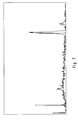
- Figure 7 (34 impressions, sulfur content 725 ppm), 8 (100 impressions sulfur content 630 ppm) and 9 (360 Impressions, no sulfur content) represent SEM spectra, from which the sulfur content of the surface of the Tool inserts emerges.
- Sulfur is detected under the SEM microscope through energy-dispersive X-ray microanalysis.
- the sample is excited with an electron beam (20,000 V).
- the elements in the sample with a Ordinal number greater than 12 emit through the excitation X-rays.
- Each element emits characteristic Energy, being the amount (frequency) of the emitted Radiation is a measure of the content of the element in the sample is.
- a multi-channel analyzer (1024 Channels of 20 eV).
- Injection molding takes place with the following processing parameters: melt temperatures 220-260 ° C mold temperatures 60-80 ° C injection pressure 500-1000 bar cycle time approx. 30 sec.
- the black coating was identified as copper sulfide by SEM analysis identified.
Landscapes
- Chemical & Material Sciences (AREA)
- Engineering & Computer Science (AREA)
- Mechanical Engineering (AREA)
- Health & Medical Sciences (AREA)
- Chemical Kinetics & Catalysis (AREA)
- Medicinal Chemistry (AREA)
- Polymers & Plastics (AREA)
- Organic Chemistry (AREA)
- Manufacturing & Machinery (AREA)
- Injection Moulding Of Plastics Or The Like (AREA)
- Compositions Of Macromolecular Compounds (AREA)
- Moulds For Moulding Plastics Or The Like (AREA)
Claims (9)
- Procédé de production d'articles moulés à partir d'une masse à mouler de PMMA thermoplastique avec utilisation d'outils contenant des métaux non ferreux,
caractérisé en ce que
la masse à mouler de PMMA thermoplastique est essentiellement dépourvue de soufre. - Procédé selon la revendication 1,
caractérisé en ce qu'
on produit l'article moulé au moyen d'un moulage par injection. - Procédé selon la revendication 1,
caractérisé en ce qu'
on produit l'article moulé par un moulage par pression. - Procédé selon une ou plusieurs des revendications 1 à 3,
caractérisé en ce que
la masse à mouler en PMMA repose sur les homo- et/ou copolymères de PMMA que l'on obtient par polymérisation deet qui présentent une moyenne pondérale du poids moléculaire Mw allant de 5 x 10⁴ à 2,5 x 10⁵.(i) 80 à 100 % en poids de méthacrylate de méthyle (MMA).(ii) O à 20 % en poids d'un ou plusieurs monomères éthyléniquement Insaturés copolymérisables avec (i),
où (i) et (ii) donnent ensemble 100 % en poids,(iii) de 0,05 à 5 % en poids, par rapport à 100 % en poids de la somme de (i) et de (ii). au moins un régulateur de poids moléculaire essentiellement dépourvu de soufre et(iv) jusqu'à 100 % en poids, relativement à la somme de (i) et de (ii), d'additifs habituels pour les masses à mouler thermoplastiques, - Procédé selon la revendication 4,
caractérisé en ce que(ii) est choisi dans le groupe constitué par les esters d'acryliques d'acide méthacrylique qui diffèrent de (i), l'acétate de vinyle, le chlorure de vinyle, le chlorure de vinylidène, le styrène, l'alpha-méthylstyrène. l'alpha-méthylstyrène, le styrène halogéno-substitué, l'éther vinylique, l'éther isopropylique et les diènes. - Procédé selon la revendication 4 ou 5,
caractérisé en ce que(iii) représente l'alpha-méthyl styrène dimère, l'énol éther d'aldéhyde aliphatique et/ou cycloaliphatique, les terpènes. les bêta-terpinènes. les terpénols. le 1,4-cyclohexadiène, le 1,4-dihydronaphtalène, le 1,4,5,8-tétrahydronaphtalène, le 2,5-dihydrofuranne, le 2,5-diméthylfuranne et/ou le 3,6-dihydro-2H-pyrane. - Procédé selon l'une des revendications 4 à 6,
caractérisé en ce que(iii) est présent en une quantité allant de 0.1 à 2,0 % en poids, par rapport à 100 % en poids des composants (i) et (ii). - Procédé selon une ou plusieurs des revendications précédentes,
caractérisé en ce que
le régulateur (iii) est l'alpha-méthyl styrène dimère. - Procédé selon une ou plusieurs des revendications précédentes,
caractérisé en ce que
la moyenne pondérale du poids moléculaire Mw est dans un intervalle allant de 8 x 10⁴ à 2 x 10⁵.
Applications Claiming Priority (3)
| Application Number | Priority Date | Filing Date | Title |
|---|---|---|---|
| DE19806749 | 1998-02-18 | ||
| DE19806749 | 1998-02-18 | ||
| PCT/EP1999/000934 WO1999042271A1 (fr) | 1998-02-18 | 1999-02-12 | Utilisation d'une matiere moulable de pmma thermoplastique |
Publications (2)
| Publication Number | Publication Date |
|---|---|
| EP1056579A1 EP1056579A1 (fr) | 2000-12-06 |
| EP1056579B1 true EP1056579B1 (fr) | 2002-04-24 |
Family
ID=7858151
Family Applications (1)
| Application Number | Title | Priority Date | Filing Date |
|---|---|---|---|
| EP99913160A Expired - Lifetime EP1056579B1 (fr) | 1998-02-18 | 1999-02-12 | Fabrication d'articles a base d'une matiere moulable de pmma thermoplastique en utilisant des outils en metaux non ferreux |
Country Status (4)
| Country | Link |
|---|---|
| US (1) | US6231799B1 (fr) |
| EP (1) | EP1056579B1 (fr) |
| DE (2) | DE59901295D1 (fr) |
| WO (1) | WO1999042271A1 (fr) |
Families Citing this family (6)
| Publication number | Priority date | Publication date | Assignee | Title |
|---|---|---|---|---|
| KR100509571B1 (ko) * | 2002-10-10 | 2005-08-22 | 전미령 | 프로파일 가스켓 및 그 조성물 |
| US8551622B2 (en) | 2007-07-20 | 2013-10-08 | Ivoclar Vivadent Ag | Addressable matrices/cluster blanks for dental CAD/CAM systems and optimization thereof |
| US8568897B2 (en) | 2007-07-20 | 2013-10-29 | Ivoclar Vivadent Ag | Addressable matrices/cluster blanks for dental CAD/CAM systems and optimization thereof |
| US10465027B2 (en) | 2014-12-18 | 2019-11-05 | Evonik Oil Additives Gmbh | Method for the preparation of copolymers of alkyl methacrylates and maleic anhydride |
| WO2021149967A1 (fr) * | 2020-01-22 | 2021-07-29 | Samsung Electronics Co., Ltd. | Joint d'étanchéité pour porte de réfrigérateur |
| DE102022111613A1 (de) | 2022-05-10 | 2023-11-16 | HELLA GmbH & Co. KGaA | Verfahren zur Herstellung eines Optikbauteils im Spritzgussverfahren |
Family Cites Families (10)
| Publication number | Priority date | Publication date | Assignee | Title |
|---|---|---|---|---|
| JPS53121890A (en) * | 1977-04-01 | 1978-10-24 | Mitsubishi Chem Ind Ltd | Preparation of methyl methacrylate polymer |
| JPS53121892A (en) * | 1977-04-01 | 1978-10-24 | Mitsubishi Chem Ind Ltd | Preparation of methyl methacrylate polymer |
| JPS53121891A (en) * | 1977-04-01 | 1978-10-24 | Mitsubishi Chem Ind Ltd | Preparation of methyl methacrylate polymer |
| DE3010373A1 (de) * | 1980-03-18 | 1981-10-01 | Bayer Ag, 5090 Leverkusen | Verfahren zur herstellung von methacrylsaeuremethylester-homo- oder -copolymerisaten |
| DE3612791C2 (de) | 1986-04-16 | 1997-01-16 | Roehm Gmbh | Polymethacrylatformmasse mit hoher Wärmeformbeständigkeit und hoher thermischer Stabilität, Verfahren zu ihrer Herstellung und ihre Verwendung zur Herstellung von Formkörpern |
| US5087510A (en) * | 1990-03-22 | 1992-02-11 | Monsanto Company | Electrolessly deposited metal holograms |
| DE4024371C2 (de) * | 1990-08-01 | 1994-10-13 | Degussa | Verfahren zur Herstellung von Suspensionspolymerisaten unter Verwendung von Phosphonsäuren bzw. deren Ammonium- oder Alkalimetallsalzen als Dispergierhilfsmittel-Additive |
| US5296959A (en) * | 1991-01-30 | 1994-03-22 | Minolta Camera Kabushiki Kaisha | Polygonal mirror, and manufacturing process and mold thereof |
| US5376317A (en) * | 1992-12-08 | 1994-12-27 | Galic Maus Ventures | Precision surface-replicating thermoplastic injection molding method and apparatus, using a heating phase and a cooling phase in each molding cycle |
| US5294686A (en) | 1993-03-29 | 1994-03-15 | Rohm And Haas Company | Process for efficient utilization of chain transfer agent |
-
1999
- 1999-02-12 EP EP99913160A patent/EP1056579B1/fr not_active Expired - Lifetime
- 1999-02-12 WO PCT/EP1999/000934 patent/WO1999042271A1/fr not_active Ceased
- 1999-02-12 DE DE59901295T patent/DE59901295D1/de not_active Expired - Lifetime
- 1999-02-17 US US09/251,618 patent/US6231799B1/en not_active Expired - Fee Related
- 1999-02-18 DE DE19906713A patent/DE19906713B4/de not_active Expired - Fee Related
Also Published As
| Publication number | Publication date |
|---|---|
| DE19906713A1 (de) | 1999-08-19 |
| US6231799B1 (en) | 2001-05-15 |
| EP1056579A1 (fr) | 2000-12-06 |
| WO1999042271A1 (fr) | 1999-08-26 |
| DE19906713B4 (de) | 2010-08-26 |
| DE59901295D1 (de) | 2002-05-29 |
Similar Documents
| Publication | Publication Date | Title |
|---|---|---|
| DE3037520C2 (fr) | ||
| DE69311223T2 (de) | Formbare kristalline Polyesterzusammensetzung | |
| EP1844102B1 (fr) | Matiere moulable poly(meth)acrylate resistante aux chocs a thermostabilite elevee | |
| EP0111260B1 (fr) | Masses à mouler thermoplastiques | |
| DE69628383T2 (de) | Polyacrylfilm und damit geformte gegenstände | |
| EP0134937B1 (fr) | Compositions thermoplastiques de polyamide à haute résistance | |
| DE2830232B2 (de) | Thermoplastische Formmasse mit hoher Schlag- und Biegerißfestigkeit | |
| EP0776931A1 (fr) | Masses à mouler résistantes aux chocs à base de polyméthylméthacrylate stables aux intempéries et aux couleurs et procédé de leur préparation | |
| DE4025219A1 (de) | Thermoplastische polyoxymethylen-formmasse mit hoher zaehigkeit und ihre verwendung | |
| DE60007596T2 (de) | Mehrphasig strukturierte Polymerteilchen, Verfahren zu deren Herstellung und ihre Anwendungen | |
| EP1056579B1 (fr) | Fabrication d'articles a base d'une matiere moulable de pmma thermoplastique en utilisant des outils en metaux non ferreux | |
| DE69123341T2 (de) | Kern-Schale-Polymer | |
| EP0796287A1 (fr) | Polymeres greffes caoutchouteux | |
| DE3313385C2 (fr) | ||
| DE69031606T2 (de) | Kern-Schale-Polymer, Herstellung und dessen Verwendung | |
| DE4431732A1 (de) | Transparente, schlagzähe Formmassen mit hoher Spannungsrißbeständigkeit und matter Oberfläche | |
| DE2747334C2 (de) | Anode für die kathodische Elektrotauchlackierung und ihre Anwendung | |
| DE2363564B2 (de) | Thermoplastische Formmasse auf der Basis von Vinylchlorid-Homo- oder Mischpolymerisaten | |
| DE68925406T2 (de) | Schlagzähmodifikator, Harzzusammensetzung damit und geformte Gegenstände aus dieser Zusammensetzung | |
| DE69529815T2 (de) | Thermoplastische harzzusammensetzung und kraftfahrzeuginnenverkleidung | |
| EP1606092B1 (fr) | Granulats thermoplastiques | |
| DE10318606A1 (de) | Glasfaser-verstärktes Polypropylenharz-Pellet und daraus erhaltenes Fahrzeugfront-Bauteil | |
| DE60131461T2 (de) | Verfahren zur herstellung eines schlagzähigkeitsverbesserers auf acrylbasis | |
| EP0599067B1 (fr) | Matière à mouler transparente | |
| EP0295517B1 (fr) | Masses à mouler ABS, mates, élastiques, thermoplastiques |
Legal Events
| Date | Code | Title | Description |
|---|---|---|---|
| PUAI | Public reference made under article 153(3) epc to a published international application that has entered the european phase |
Free format text: ORIGINAL CODE: 0009012 |
|
| 17P | Request for examination filed |
Effective date: 20000805 |
|
| AK | Designated contracting states |
Kind code of ref document: A1 Designated state(s): DE FR GB IT NL |
|
| GRAG | Despatch of communication of intention to grant |
Free format text: ORIGINAL CODE: EPIDOS AGRA |
|
| 17Q | First examination report despatched |
Effective date: 20010329 |
|
| GRAG | Despatch of communication of intention to grant |
Free format text: ORIGINAL CODE: EPIDOS AGRA |
|
| GRAH | Despatch of communication of intention to grant a patent |
Free format text: ORIGINAL CODE: EPIDOS IGRA |
|
| RAP1 | Party data changed (applicant data changed or rights of an application transferred) |
Owner name: ROEHM GMBH & CO. KG |
|
| GRAH | Despatch of communication of intention to grant a patent |
Free format text: ORIGINAL CODE: EPIDOS IGRA |
|
| REG | Reference to a national code |
Ref country code: GB Ref legal event code: IF02 |
|
| GRAA | (expected) grant |
Free format text: ORIGINAL CODE: 0009210 |
|
| AK | Designated contracting states |
Kind code of ref document: B1 Designated state(s): DE FR GB IT NL |
|
| REG | Reference to a national code |
Ref country code: GB Ref legal event code: FG4D Free format text: NOT ENGLISH |
|
| REF | Corresponds to: |
Ref document number: 59901295 Country of ref document: DE Date of ref document: 20020529 |
|
| GBT | Gb: translation of ep patent filed (gb section 77(6)(a)/1977) |
Effective date: 20020726 |
|
| ET | Fr: translation filed | ||
| ET | Fr: translation filed | ||
| PLBE | No opposition filed within time limit |
Free format text: ORIGINAL CODE: 0009261 |
|
| STAA | Information on the status of an ep patent application or granted ep patent |
Free format text: STATUS: NO OPPOSITION FILED WITHIN TIME LIMIT |
|
| 26N | No opposition filed |
Effective date: 20030127 |
|
| REG | Reference to a national code |
Ref country code: FR Ref legal event code: CJ Ref country code: FR Ref legal event code: CD |
|
| REG | Reference to a national code |
Ref country code: NL Ref legal event code: TD Effective date: 20100223 Ref country code: NL Ref legal event code: SD Effective date: 20100223 |
|
| PGFP | Annual fee paid to national office [announced via postgrant information from national office to epo] |
Ref country code: IT Payment date: 20110221 Year of fee payment: 13 Ref country code: NL Payment date: 20110216 Year of fee payment: 13 Ref country code: FR Payment date: 20110302 Year of fee payment: 13 Ref country code: DE Payment date: 20110218 Year of fee payment: 13 |
|
| PGFP | Annual fee paid to national office [announced via postgrant information from national office to epo] |
Ref country code: GB Payment date: 20110217 Year of fee payment: 13 |
|
| REG | Reference to a national code |
Ref country code: NL Ref legal event code: V1 Effective date: 20120901 |
|
| GBPC | Gb: european patent ceased through non-payment of renewal fee |
Effective date: 20120212 |
|
| REG | Reference to a national code |
Ref country code: FR Ref legal event code: ST Effective date: 20121031 |
|
| PG25 | Lapsed in a contracting state [announced via postgrant information from national office to epo] |
Ref country code: IT Free format text: LAPSE BECAUSE OF NON-PAYMENT OF DUE FEES Effective date: 20120212 |
|
| REG | Reference to a national code |
Ref country code: DE Ref legal event code: R119 Ref document number: 59901295 Country of ref document: DE Effective date: 20120901 |
|
| PG25 | Lapsed in a contracting state [announced via postgrant information from national office to epo] |
Ref country code: NL Free format text: LAPSE BECAUSE OF NON-PAYMENT OF DUE FEES Effective date: 20120901 Ref country code: FR Free format text: LAPSE BECAUSE OF NON-PAYMENT OF DUE FEES Effective date: 20120229 Ref country code: GB Free format text: LAPSE BECAUSE OF NON-PAYMENT OF DUE FEES Effective date: 20120212 |
|
| PG25 | Lapsed in a contracting state [announced via postgrant information from national office to epo] |
Ref country code: DE Free format text: LAPSE BECAUSE OF NON-PAYMENT OF DUE FEES Effective date: 20120901 |