EP1056873B1 - Procede de production d'un polypeptide dans une cellule de bacille - Google Patents
Procede de production d'un polypeptide dans une cellule de bacille Download PDFInfo
- Publication number
- EP1056873B1 EP1056873B1 EP99911012A EP99911012A EP1056873B1 EP 1056873 B1 EP1056873 B1 EP 1056873B1 EP 99911012 A EP99911012 A EP 99911012A EP 99911012 A EP99911012 A EP 99911012A EP 1056873 B1 EP1056873 B1 EP 1056873B1
- Authority
- EP
- European Patent Office
- Prior art keywords
- promoter
- bacillus
- gene
- cell
- nucleic acid
- Prior art date
- Legal status (The legal status is an assumption and is not a legal conclusion. Google has not performed a legal analysis and makes no representation as to the accuracy of the status listed.)
- Expired - Lifetime
Links
- 108090000765 processed proteins & peptides Proteins 0.000 title abstract description 143
- 102000004196 processed proteins & peptides Human genes 0.000 title abstract description 143
- 229920001184 polypeptide Polymers 0.000 title abstract description 142
- 241000193830 Bacillus <bacterium> Species 0.000 title abstract description 103
- 238000000034 method Methods 0.000 title abstract description 41
- 150000007523 nucleic acids Chemical class 0.000 abstract description 95
- 108020004999 messenger RNA Proteins 0.000 abstract description 80
- 108091028043 Nucleic acid sequence Proteins 0.000 abstract description 64
- 230000000087 stabilizing effect Effects 0.000 abstract description 55
- 238000012545 processing Methods 0.000 abstract description 46
- 108020004707 nucleic acids Proteins 0.000 abstract description 24
- 102000039446 nucleic acids Human genes 0.000 abstract description 24
- 238000004519 manufacturing process Methods 0.000 abstract description 20
- 238000011144 upstream manufacturing Methods 0.000 abstract description 17
- 210000004027 cell Anatomy 0.000 description 128
- 239000012634 fragment Substances 0.000 description 98
- 239000013612 plasmid Substances 0.000 description 97
- 229960000723 ampicillin Drugs 0.000 description 95
- AVKUERGKIZMTKX-NJBDSQKTSA-N ampicillin Chemical compound C1([C@@H](N)C(=O)N[C@H]2[C@H]3SC([C@@H](N3C2=O)C(O)=O)(C)C)=CC=CC=C1 AVKUERGKIZMTKX-NJBDSQKTSA-N 0.000 description 95
- 230000014509 gene expression Effects 0.000 description 69
- 239000013598 vector Substances 0.000 description 63
- -1 amyL Chemical class 0.000 description 52
- 108020004414 DNA Proteins 0.000 description 49
- 238000001502 gel electrophoresis Methods 0.000 description 48
- 108090000623 proteins and genes Proteins 0.000 description 44
- 239000013615 primer Substances 0.000 description 38
- 108091026890 Coding region Proteins 0.000 description 37
- 241000620209 Escherichia coli DH5[alpha] Species 0.000 description 36
- 244000063299 Bacillus subtilis Species 0.000 description 32
- 235000014469 Bacillus subtilis Nutrition 0.000 description 32
- 238000010276 construction Methods 0.000 description 29
- 239000000203 mixture Substances 0.000 description 26
- 238000003752 polymerase chain reaction Methods 0.000 description 25
- 230000003321 amplification Effects 0.000 description 23
- 238000003199 nucleic acid amplification method Methods 0.000 description 23
- 239000003381 stabilizer Substances 0.000 description 23
- 101100055551 Bacillus licheniformis amyS gene Proteins 0.000 description 20
- 101100216056 Lactobacillus amylovorus amyL gene Proteins 0.000 description 20
- 239000000539 dimer Substances 0.000 description 20
- 108010006785 Taq Polymerase Proteins 0.000 description 19
- 239000003550 marker Substances 0.000 description 19
- 238000001712 DNA sequencing Methods 0.000 description 18
- 108091005658 Basic proteases Proteins 0.000 description 16
- 230000001580 bacterial effect Effects 0.000 description 16
- 108010076504 Protein Sorting Signals Proteins 0.000 description 15
- 239000000872 buffer Substances 0.000 description 15
- 238000006243 chemical reaction Methods 0.000 description 15
- 239000000047 product Substances 0.000 description 15
- 230000000694 effects Effects 0.000 description 13
- 241000194108 Bacillus licheniformis Species 0.000 description 12
- 241000588724 Escherichia coli Species 0.000 description 12
- 238000013518 transcription Methods 0.000 description 12
- 230000035897 transcription Effects 0.000 description 12
- 101000775727 Bacillus amyloliquefaciens Alpha-amylase Proteins 0.000 description 11
- 241000193385 Geobacillus stearothermophilus Species 0.000 description 11
- 229960005091 chloramphenicol Drugs 0.000 description 11
- WIIZWVCIJKGZOK-RKDXNWHRSA-N chloramphenicol Chemical compound ClC(Cl)C(=O)N[C@H](CO)[C@H](O)C1=CC=C([N+]([O-])=O)C=C1 WIIZWVCIJKGZOK-RKDXNWHRSA-N 0.000 description 11
- SUYVUBYJARFZHO-RRKCRQDMSA-N dATP Chemical compound C1=NC=2C(N)=NC=NC=2N1[C@H]1C[C@H](O)[C@@H](COP(O)(=O)OP(O)(=O)OP(O)(O)=O)O1 SUYVUBYJARFZHO-RRKCRQDMSA-N 0.000 description 11
- SUYVUBYJARFZHO-UHFFFAOYSA-N dATP Natural products C1=NC=2C(N)=NC=NC=2N1C1CC(O)C(COP(O)(=O)OP(O)(=O)OP(O)(O)=O)O1 SUYVUBYJARFZHO-UHFFFAOYSA-N 0.000 description 11
- RGWHQCVHVJXOKC-SHYZEUOFSA-J dCTP(4-) Chemical compound O=C1N=C(N)C=CN1[C@@H]1O[C@H](COP([O-])(=O)OP([O-])(=O)OP([O-])([O-])=O)[C@@H](O)C1 RGWHQCVHVJXOKC-SHYZEUOFSA-J 0.000 description 11
- HAAZLUGHYHWQIW-KVQBGUIXSA-N dGTP Chemical compound C1=NC=2C(=O)NC(N)=NC=2N1[C@H]1C[C@H](O)[C@@H](COP(O)(=O)OP(O)(=O)OP(O)(O)=O)O1 HAAZLUGHYHWQIW-KVQBGUIXSA-N 0.000 description 11
- NHVNXKFIZYSCEB-XLPZGREQSA-N dTTP Chemical compound O=C1NC(=O)C(C)=CN1[C@@H]1O[C@H](COP(O)(=O)OP(O)(=O)OP(O)(O)=O)[C@@H](O)C1 NHVNXKFIZYSCEB-XLPZGREQSA-N 0.000 description 11
- 241000193422 Bacillus lentus Species 0.000 description 10
- 108010029675 Bacillus licheniformis alpha-amylase Proteins 0.000 description 10
- 210000000349 chromosome Anatomy 0.000 description 10
- 108010061330 glucan 1,4-alpha-maltohydrolase Proteins 0.000 description 10
- 239000002609 medium Substances 0.000 description 10
- 230000010076 replication Effects 0.000 description 10
- 101000695691 Bacillus licheniformis Beta-lactamase Proteins 0.000 description 9
- 238000010367 cloning Methods 0.000 description 9
- 230000029087 digestion Effects 0.000 description 9
- RZVAJINKPMORJF-UHFFFAOYSA-N Acetaminophen Chemical compound CC(=O)NC1=CC=C(O)C=C1 RZVAJINKPMORJF-UHFFFAOYSA-N 0.000 description 8
- 241000534414 Anotopterus nikparini Species 0.000 description 8
- 101900315840 Bacillus subtilis Alpha-amylase Proteins 0.000 description 8
- 101900040182 Bacillus subtilis Levansucrase Proteins 0.000 description 8
- 108010014303 DNA-directed DNA polymerase Proteins 0.000 description 8
- 102000016928 DNA-directed DNA polymerase Human genes 0.000 description 8
- 101100342470 Dictyostelium discoideum pkbA gene Proteins 0.000 description 8
- 108090000204 Dipeptidase 1 Proteins 0.000 description 8
- 102000004190 Enzymes Human genes 0.000 description 8
- 108090000790 Enzymes Proteins 0.000 description 8
- 101100385973 Escherichia coli (strain K12) cycA gene Proteins 0.000 description 8
- 101100001650 Geobacillus stearothermophilus amyM gene Proteins 0.000 description 8
- 229930193140 Neomycin Natural products 0.000 description 8
- 101100309436 Streptococcus mutans serotype c (strain ATCC 700610 / UA159) ftf gene Proteins 0.000 description 8
- 241000187432 Streptomyces coelicolor Species 0.000 description 8
- 108010056079 Subtilisins Proteins 0.000 description 8
- 108010045649 agarase Proteins 0.000 description 8
- 238000000246 agarose gel electrophoresis Methods 0.000 description 8
- 101150005799 dagA gene Proteins 0.000 description 8
- 229940088598 enzyme Drugs 0.000 description 8
- 230000010354 integration Effects 0.000 description 8
- 229960004927 neomycin Drugs 0.000 description 8
- 239000002773 nucleotide Substances 0.000 description 8
- 125000003729 nucleotide group Chemical group 0.000 description 8
- 101150019841 penP gene Proteins 0.000 description 8
- 101150025220 sacB gene Proteins 0.000 description 8
- 101150052264 xylA gene Proteins 0.000 description 8
- 101150110790 xylB gene Proteins 0.000 description 8
- 239000000499 gel Substances 0.000 description 7
- 238000002744 homologous recombination Methods 0.000 description 7
- 230000006801 homologous recombination Effects 0.000 description 7
- 239000013638 trimer Substances 0.000 description 7
- 108010017826 DNA Polymerase I Proteins 0.000 description 6
- 102000004594 DNA Polymerase I Human genes 0.000 description 6
- 230000008859 change Effects 0.000 description 6
- 239000013604 expression vector Substances 0.000 description 6
- 101150105742 spoIIE gene Proteins 0.000 description 6
- 108090000637 alpha-Amylases Proteins 0.000 description 5
- 244000309466 calf Species 0.000 description 5
- 239000000523 sample Substances 0.000 description 5
- 238000012163 sequencing technique Methods 0.000 description 5
- 108020004774 Alkaline Phosphatase Proteins 0.000 description 4
- 102000002260 Alkaline Phosphatase Human genes 0.000 description 4
- 239000003155 DNA primer Substances 0.000 description 4
- ULGZDMOVFRHVEP-RWJQBGPGSA-N Erythromycin Chemical compound O([C@@H]1[C@@H](C)C(=O)O[C@@H]([C@@]([C@H](O)[C@@H](C)C(=O)[C@H](C)C[C@@](C)(O)[C@H](O[C@H]2[C@@H]([C@H](C[C@@H](C)O2)N(C)C)O)[C@H]1C)(C)O)CC)[C@H]1C[C@@](C)(OC)[C@@H](O)[C@H](C)O1 ULGZDMOVFRHVEP-RWJQBGPGSA-N 0.000 description 4
- 108091005804 Peptidases Proteins 0.000 description 4
- 238000004458 analytical method Methods 0.000 description 4
- 230000003115 biocidal effect Effects 0.000 description 4
- 210000000936 intestine Anatomy 0.000 description 4
- 230000035772 mutation Effects 0.000 description 4
- 125000002467 phosphate group Chemical group [H]OP(=O)(O[H])O[*] 0.000 description 4
- 238000003259 recombinant expression Methods 0.000 description 4
- JRMUNVKIHCOMHV-UHFFFAOYSA-M tetrabutylammonium bromide Chemical compound [Br-].CCCC[N+](CCCC)(CCCC)CCCC JRMUNVKIHCOMHV-UHFFFAOYSA-M 0.000 description 4
- 241000193388 Bacillus thuringiensis Species 0.000 description 3
- 241000894006 Bacteria Species 0.000 description 3
- BTBUEUYNUDRHOZ-UHFFFAOYSA-N Borate Chemical compound [O-]B([O-])[O-] BTBUEUYNUDRHOZ-UHFFFAOYSA-N 0.000 description 3
- 241000193764 Brevibacillus brevis Species 0.000 description 3
- KCXVZYZYPLLWCC-UHFFFAOYSA-N EDTA Chemical compound OC(=O)CN(CC(O)=O)CCN(CC(O)=O)CC(O)=O KCXVZYZYPLLWCC-UHFFFAOYSA-N 0.000 description 3
- 108700007698 Genetic Terminator Regions Proteins 0.000 description 3
- 108091034117 Oligonucleotide Proteins 0.000 description 3
- 108010022999 Serine Proteases Proteins 0.000 description 3
- 108700009124 Transcription Initiation Site Proteins 0.000 description 3
- 238000013459 approach Methods 0.000 description 3
- 238000003556 assay Methods 0.000 description 3
- 229940097012 bacillus thuringiensis Drugs 0.000 description 3
- 230000015572 biosynthetic process Effects 0.000 description 3
- 239000005018 casein Substances 0.000 description 3
- BECPQYXYKAMYBN-UHFFFAOYSA-N casein, tech. Chemical compound NCCCCC(C(O)=O)N=C(O)C(CC(O)=O)N=C(O)C(CCC(O)=N)N=C(O)C(CC(C)C)N=C(O)C(CCC(O)=O)N=C(O)C(CC(O)=O)N=C(O)C(CCC(O)=O)N=C(O)C(C(C)O)N=C(O)C(CCC(O)=N)N=C(O)C(CCC(O)=N)N=C(O)C(CCC(O)=N)N=C(O)C(CCC(O)=O)N=C(O)C(CCC(O)=O)N=C(O)C(COP(O)(O)=O)N=C(O)C(CCC(O)=N)N=C(O)C(N)CC1=CC=CC=C1 BECPQYXYKAMYBN-UHFFFAOYSA-N 0.000 description 3
- 235000021240 caseins Nutrition 0.000 description 3
- 239000013611 chromosomal DNA Substances 0.000 description 3
- 239000002299 complementary DNA Substances 0.000 description 3
- MHMNJMPURVTYEJ-UHFFFAOYSA-N fluorescein-5-isothiocyanate Chemical compound O1C(=O)C2=CC(N=C=S)=CC=C2C21C1=CC=C(O)C=C1OC1=CC(O)=CC=C21 MHMNJMPURVTYEJ-UHFFFAOYSA-N 0.000 description 3
- 238000003780 insertion Methods 0.000 description 3
- 230000037431 insertion Effects 0.000 description 3
- 238000002955 isolation Methods 0.000 description 3
- 235000015097 nutrients Nutrition 0.000 description 3
- 102000004169 proteins and genes Human genes 0.000 description 3
- 230000028327 secretion Effects 0.000 description 3
- 238000013519 translation Methods 0.000 description 3
- 108091032973 (ribonucleotides)n+m Proteins 0.000 description 2
- 239000004382 Amylase Substances 0.000 description 2
- 102000013142 Amylases Human genes 0.000 description 2
- 108010065511 Amylases Proteins 0.000 description 2
- IJGRMHOSHXDMSA-UHFFFAOYSA-N Atomic nitrogen Chemical compound N#N IJGRMHOSHXDMSA-UHFFFAOYSA-N 0.000 description 2
- 241000193744 Bacillus amyloliquefaciens Species 0.000 description 2
- 241000193752 Bacillus circulans Species 0.000 description 2
- 241001328122 Bacillus clausii Species 0.000 description 2
- 241000193749 Bacillus coagulans Species 0.000 description 2
- 241000193747 Bacillus firmus Species 0.000 description 2
- 241000194107 Bacillus megaterium Species 0.000 description 2
- 241000194103 Bacillus pumilus Species 0.000 description 2
- 241000193369 Bacillus thuringiensis serovar tenebrionis Species 0.000 description 2
- 101100114758 Bacillus thuringiensis subsp. tenebrionis cry3Aa gene Proteins 0.000 description 2
- 108020000946 Bacterial DNA Proteins 0.000 description 2
- VTYYLEPIZMXCLO-UHFFFAOYSA-L Calcium carbonate Chemical compound [Ca+2].[O-]C([O-])=O VTYYLEPIZMXCLO-UHFFFAOYSA-L 0.000 description 2
- 102000009016 Cholera Toxin Human genes 0.000 description 2
- 108010049048 Cholera Toxin Proteins 0.000 description 2
- 108091035707 Consensus sequence Proteins 0.000 description 2
- 238000007399 DNA isolation Methods 0.000 description 2
- 101100369308 Geobacillus stearothermophilus nprS gene Proteins 0.000 description 2
- 108700026244 Open Reading Frames Proteins 0.000 description 2
- 102000004316 Oxidoreductases Human genes 0.000 description 2
- 108090000854 Oxidoreductases Proteins 0.000 description 2
- 241000194109 Paenibacillus lautus Species 0.000 description 2
- 102000035195 Peptidases Human genes 0.000 description 2
- 108010002747 Pfu DNA polymerase Proteins 0.000 description 2
- 102000012479 Serine Proteases Human genes 0.000 description 2
- FAPWRFPIFSIZLT-UHFFFAOYSA-M Sodium chloride Chemical compound [Na+].[Cl-] FAPWRFPIFSIZLT-UHFFFAOYSA-M 0.000 description 2
- 108090000787 Subtilisin Proteins 0.000 description 2
- 101100157012 Thermoanaerobacterium saccharolyticum (strain DSM 8691 / JW/SL-YS485) xynB gene Proteins 0.000 description 2
- 239000011543 agarose gel Substances 0.000 description 2
- 235000019418 amylase Nutrition 0.000 description 2
- 239000003242 anti bacterial agent Substances 0.000 description 2
- 229940054340 bacillus coagulans Drugs 0.000 description 2
- 229940005348 bacillus firmus Drugs 0.000 description 2
- 230000008901 benefit Effects 0.000 description 2
- 230000027455 binding Effects 0.000 description 2
- 230000002759 chromosomal effect Effects 0.000 description 2
- 238000001514 detection method Methods 0.000 description 2
- 230000001627 detrimental effect Effects 0.000 description 2
- 229960003276 erythromycin Drugs 0.000 description 2
- 238000000605 extraction Methods 0.000 description 2
- 238000007834 ligase chain reaction Methods 0.000 description 2
- 239000012528 membrane Substances 0.000 description 2
- 230000002906 microbiologic effect Effects 0.000 description 2
- 101150105920 npr gene Proteins 0.000 description 2
- 230000037361 pathway Effects 0.000 description 2
- 230000001124 posttranscriptional effect Effects 0.000 description 2
- 235000018102 proteins Nutrition 0.000 description 2
- 238000000746 purification Methods 0.000 description 2
- 230000003362 replicative effect Effects 0.000 description 2
- 238000009738 saturating Methods 0.000 description 2
- 238000012216 screening Methods 0.000 description 2
- 230000003248 secreting effect Effects 0.000 description 2
- 239000011550 stock solution Substances 0.000 description 2
- 239000000758 substrate Substances 0.000 description 2
- 239000006228 supernatant Substances 0.000 description 2
- 230000002103 transcriptional effect Effects 0.000 description 2
- 101150011516 xlnD gene Proteins 0.000 description 2
- 108020004465 16S ribosomal RNA Proteins 0.000 description 1
- 108010011619 6-Phytase Proteins 0.000 description 1
- 229920001817 Agar Polymers 0.000 description 1
- 102000004400 Aminopeptidases Human genes 0.000 description 1
- 108090000915 Aminopeptidases Proteins 0.000 description 1
- 241000203069 Archaea Species 0.000 description 1
- 241000304886 Bacilli Species 0.000 description 1
- 108700003918 Bacillus Thuringiensis insecticidal crystal Proteins 0.000 description 1
- 108010045681 Bacillus stearothermophilus neutral protease Proteins 0.000 description 1
- OKTJSMMVPCPJKN-UHFFFAOYSA-N Carbon Chemical compound [C] OKTJSMMVPCPJKN-UHFFFAOYSA-N 0.000 description 1
- 102000005367 Carboxypeptidases Human genes 0.000 description 1
- 108010006303 Carboxypeptidases Proteins 0.000 description 1
- 102000016938 Catalase Human genes 0.000 description 1
- 108010053835 Catalase Proteins 0.000 description 1
- 108010031396 Catechol oxidase Proteins 0.000 description 1
- 102000030523 Catechol oxidase Human genes 0.000 description 1
- 108010059892 Cellulase Proteins 0.000 description 1
- 108010022172 Chitinases Proteins 0.000 description 1
- 102000012286 Chitinases Human genes 0.000 description 1
- 102100038445 Claudin-2 Human genes 0.000 description 1
- 101710151559 Crystal protein Proteins 0.000 description 1
- 108010025880 Cyclomaltodextrin glucanotransferase Proteins 0.000 description 1
- 102000053602 DNA Human genes 0.000 description 1
- 108020003215 DNA Probes Proteins 0.000 description 1
- 239000003298 DNA probe Substances 0.000 description 1
- 102000004163 DNA-directed RNA polymerases Human genes 0.000 description 1
- 108090000626 DNA-directed RNA polymerases Proteins 0.000 description 1
- 108010053770 Deoxyribonucleases Proteins 0.000 description 1
- 102000016911 Deoxyribonucleases Human genes 0.000 description 1
- 101100364969 Dictyostelium discoideum scai gene Proteins 0.000 description 1
- 206010059866 Drug resistance Diseases 0.000 description 1
- 101710121765 Endo-1,4-beta-xylanase Proteins 0.000 description 1
- 108090000371 Esterases Proteins 0.000 description 1
- 241000192125 Firmicutes Species 0.000 description 1
- 108700039691 Genetic Promoter Regions Proteins 0.000 description 1
- 101100080316 Geobacillus stearothermophilus nprT gene Proteins 0.000 description 1
- 108010073178 Glucan 1,4-alpha-Glucosidase Proteins 0.000 description 1
- 102100022624 Glucoamylase Human genes 0.000 description 1
- 244000068988 Glycine max Species 0.000 description 1
- 235000010469 Glycine max Nutrition 0.000 description 1
- 101000882901 Homo sapiens Claudin-2 Proteins 0.000 description 1
- 102000004157 Hydrolases Human genes 0.000 description 1
- 108090000604 Hydrolases Proteins 0.000 description 1
- 102100024319 Intestinal-type alkaline phosphatase Human genes 0.000 description 1
- 101710184243 Intestinal-type alkaline phosphatase Proteins 0.000 description 1
- 102000004195 Isomerases Human genes 0.000 description 1
- 108090000769 Isomerases Proteins 0.000 description 1
- 108010029541 Laccase Proteins 0.000 description 1
- 102000003960 Ligases Human genes 0.000 description 1
- 108090000364 Ligases Proteins 0.000 description 1
- 108090001060 Lipase Proteins 0.000 description 1
- 102000004882 Lipase Human genes 0.000 description 1
- 239000004367 Lipase Substances 0.000 description 1
- 239000006137 Luria-Bertani broth Substances 0.000 description 1
- 102000004317 Lyases Human genes 0.000 description 1
- 108090000856 Lyases Proteins 0.000 description 1
- 102100024295 Maltase-glucoamylase Human genes 0.000 description 1
- 108010054377 Mannosidases Proteins 0.000 description 1
- 102000001696 Mannosidases Human genes 0.000 description 1
- 101100364971 Mus musculus Scai gene Proteins 0.000 description 1
- 239000004677 Nylon Substances 0.000 description 1
- 108010038807 Oligopeptides Proteins 0.000 description 1
- 102000015636 Oligopeptides Human genes 0.000 description 1
- 238000009004 PCR Kit Methods 0.000 description 1
- 238000010222 PCR analysis Methods 0.000 description 1
- 229910019142 PO4 Inorganic materials 0.000 description 1
- 102000003992 Peroxidases Human genes 0.000 description 1
- 241000276498 Pollachius virens Species 0.000 description 1
- 239000004365 Protease Substances 0.000 description 1
- 241000589774 Pseudomonas sp. Species 0.000 description 1
- 230000004570 RNA-binding Effects 0.000 description 1
- 108020004511 Recombinant DNA Proteins 0.000 description 1
- 102000007056 Recombinant Fusion Proteins Human genes 0.000 description 1
- 108010008281 Recombinant Fusion Proteins Proteins 0.000 description 1
- 108010083644 Ribonucleases Proteins 0.000 description 1
- 102000006382 Ribonucleases Human genes 0.000 description 1
- 241000187747 Streptomyces Species 0.000 description 1
- 241000187398 Streptomyces lividans Species 0.000 description 1
- 241001468239 Streptomyces murinus Species 0.000 description 1
- 229930006000 Sucrose Natural products 0.000 description 1
- CZMRCDWAGMRECN-UGDNZRGBSA-N Sucrose Chemical compound O[C@H]1[C@H](O)[C@@H](CO)O[C@@]1(CO)O[C@@H]1[C@H](O)[C@@H](O)[C@H](O)[C@@H](CO)O1 CZMRCDWAGMRECN-UGDNZRGBSA-N 0.000 description 1
- 239000004098 Tetracycline Substances 0.000 description 1
- 102000004357 Transferases Human genes 0.000 description 1
- 108090000992 Transferases Proteins 0.000 description 1
- 108060008539 Transglutaminase Proteins 0.000 description 1
- 239000007983 Tris buffer Substances 0.000 description 1
- BTKMJKKKZATLBU-UHFFFAOYSA-N [2-(1,3-benzothiazol-2-yl)-1,3-benzothiazol-6-yl] dihydrogen phosphate Chemical compound C1=CC=C2SC(C3=NC4=CC=C(C=C4S3)OP(O)(=O)O)=NC2=C1 BTKMJKKKZATLBU-UHFFFAOYSA-N 0.000 description 1
- JLCPHMBAVCMARE-UHFFFAOYSA-N [3-[[3-[[3-[[3-[[3-[[3-[[3-[[3-[[3-[[3-[[3-[[5-(2-amino-6-oxo-1H-purin-9-yl)-3-[[3-[[3-[[3-[[3-[[3-[[5-(2-amino-6-oxo-1H-purin-9-yl)-3-[[5-(2-amino-6-oxo-1H-purin-9-yl)-3-hydroxyoxolan-2-yl]methoxy-hydroxyphosphoryl]oxyoxolan-2-yl]methoxy-hydroxyphosphoryl]oxy-5-(5-methyl-2,4-dioxopyrimidin-1-yl)oxolan-2-yl]methoxy-hydroxyphosphoryl]oxy-5-(6-aminopurin-9-yl)oxolan-2-yl]methoxy-hydroxyphosphoryl]oxy-5-(6-aminopurin-9-yl)oxolan-2-yl]methoxy-hydroxyphosphoryl]oxy-5-(6-aminopurin-9-yl)oxolan-2-yl]methoxy-hydroxyphosphoryl]oxy-5-(6-aminopurin-9-yl)oxolan-2-yl]methoxy-hydroxyphosphoryl]oxyoxolan-2-yl]methoxy-hydroxyphosphoryl]oxy-5-(5-methyl-2,4-dioxopyrimidin-1-yl)oxolan-2-yl]methoxy-hydroxyphosphoryl]oxy-5-(4-amino-2-oxopyrimidin-1-yl)oxolan-2-yl]methoxy-hydroxyphosphoryl]oxy-5-(5-methyl-2,4-dioxopyrimidin-1-yl)oxolan-2-yl]methoxy-hydroxyphosphoryl]oxy-5-(5-methyl-2,4-dioxopyrimidin-1-yl)oxolan-2-yl]methoxy-hydroxyphosphoryl]oxy-5-(6-aminopurin-9-yl)oxolan-2-yl]methoxy-hydroxyphosphoryl]oxy-5-(6-aminopurin-9-yl)oxolan-2-yl]methoxy-hydroxyphosphoryl]oxy-5-(4-amino-2-oxopyrimidin-1-yl)oxolan-2-yl]methoxy-hydroxyphosphoryl]oxy-5-(4-amino-2-oxopyrimidin-1-yl)oxolan-2-yl]methoxy-hydroxyphosphoryl]oxy-5-(4-amino-2-oxopyrimidin-1-yl)oxolan-2-yl]methoxy-hydroxyphosphoryl]oxy-5-(6-aminopurin-9-yl)oxolan-2-yl]methoxy-hydroxyphosphoryl]oxy-5-(4-amino-2-oxopyrimidin-1-yl)oxolan-2-yl]methyl [5-(6-aminopurin-9-yl)-2-(hydroxymethyl)oxolan-3-yl] hydrogen phosphate Polymers Cc1cn(C2CC(OP(O)(=O)OCC3OC(CC3OP(O)(=O)OCC3OC(CC3O)n3cnc4c3nc(N)[nH]c4=O)n3cnc4c3nc(N)[nH]c4=O)C(COP(O)(=O)OC3CC(OC3COP(O)(=O)OC3CC(OC3COP(O)(=O)OC3CC(OC3COP(O)(=O)OC3CC(OC3COP(O)(=O)OC3CC(OC3COP(O)(=O)OC3CC(OC3COP(O)(=O)OC3CC(OC3COP(O)(=O)OC3CC(OC3COP(O)(=O)OC3CC(OC3COP(O)(=O)OC3CC(OC3COP(O)(=O)OC3CC(OC3COP(O)(=O)OC3CC(OC3COP(O)(=O)OC3CC(OC3COP(O)(=O)OC3CC(OC3COP(O)(=O)OC3CC(OC3COP(O)(=O)OC3CC(OC3COP(O)(=O)OC3CC(OC3CO)n3cnc4c(N)ncnc34)n3ccc(N)nc3=O)n3cnc4c(N)ncnc34)n3ccc(N)nc3=O)n3ccc(N)nc3=O)n3ccc(N)nc3=O)n3cnc4c(N)ncnc34)n3cnc4c(N)ncnc34)n3cc(C)c(=O)[nH]c3=O)n3cc(C)c(=O)[nH]c3=O)n3ccc(N)nc3=O)n3cc(C)c(=O)[nH]c3=O)n3cnc4c3nc(N)[nH]c4=O)n3cnc4c(N)ncnc34)n3cnc4c(N)ncnc34)n3cnc4c(N)ncnc34)n3cnc4c(N)ncnc34)O2)c(=O)[nH]c1=O JLCPHMBAVCMARE-UHFFFAOYSA-N 0.000 description 1
- 239000002253 acid Substances 0.000 description 1
- 239000008272 agar Substances 0.000 description 1
- 102000005840 alpha-Galactosidase Human genes 0.000 description 1
- 108010030291 alpha-Galactosidase Proteins 0.000 description 1
- 108010028144 alpha-Glucosidases Proteins 0.000 description 1
- 150000001413 amino acids Chemical group 0.000 description 1
- 238000012870 ammonium sulfate precipitation Methods 0.000 description 1
- 101150039703 amyL gene Proteins 0.000 description 1
- 238000000137 annealing Methods 0.000 description 1
- 210000004507 artificial chromosome Anatomy 0.000 description 1
- 108010051210 beta-Fructofuranosidase Proteins 0.000 description 1
- 102000005936 beta-Galactosidase Human genes 0.000 description 1
- 108010005774 beta-Galactosidase Proteins 0.000 description 1
- 108010047754 beta-Glucosidase Proteins 0.000 description 1
- 102000006995 beta-Glucosidase Human genes 0.000 description 1
- 239000003139 biocide Substances 0.000 description 1
- 101150049515 bla gene Proteins 0.000 description 1
- 238000009835 boiling Methods 0.000 description 1
- 229910000019 calcium carbonate Inorganic materials 0.000 description 1
- 108010089934 carbohydrase Proteins 0.000 description 1
- 229910052799 carbon Inorganic materials 0.000 description 1
- 229940106157 cellulase Drugs 0.000 description 1
- 238000005119 centrifugation Methods 0.000 description 1
- 239000003153 chemical reaction reagent Substances 0.000 description 1
- 238000011098 chromatofocusing Methods 0.000 description 1
- 238000004587 chromatography analysis Methods 0.000 description 1
- 230000000295 complement effect Effects 0.000 description 1
- 230000021615 conjugation Effects 0.000 description 1
- 238000001816 cooling Methods 0.000 description 1
- 238000004132 cross linking Methods 0.000 description 1
- 108010005400 cutinase Proteins 0.000 description 1
- 238000012217 deletion Methods 0.000 description 1
- 230000037430 deletion Effects 0.000 description 1
- 239000005547 deoxyribonucleotide Substances 0.000 description 1
- 125000002637 deoxyribonucleotide group Chemical group 0.000 description 1
- 230000008034 disappearance Effects 0.000 description 1
- 238000001962 electrophoresis Methods 0.000 description 1
- 238000004520 electroporation Methods 0.000 description 1
- 230000002708 enhancing effect Effects 0.000 description 1
- 230000007613 environmental effect Effects 0.000 description 1
- 238000001952 enzyme assay Methods 0.000 description 1
- 238000001704 evaporation Methods 0.000 description 1
- 230000008020 evaporation Effects 0.000 description 1
- 230000007717 exclusion Effects 0.000 description 1
- 108010000165 exo-1,3-alpha-glucanase Proteins 0.000 description 1
- 238000000855 fermentation Methods 0.000 description 1
- 230000004151 fermentation Effects 0.000 description 1
- 238000001914 filtration Methods 0.000 description 1
- 235000013312 flour Nutrition 0.000 description 1
- 239000012520 frozen sample Substances 0.000 description 1
- 238000010230 functional analysis Methods 0.000 description 1
- 230000004927 fusion Effects 0.000 description 1
- 238000012224 gene deletion Methods 0.000 description 1
- 230000002068 genetic effect Effects 0.000 description 1
- 125000001475 halogen functional group Chemical group 0.000 description 1
- 229910001385 heavy metal Inorganic materials 0.000 description 1
- 229940088597 hormone Drugs 0.000 description 1
- 239000005556 hormone Substances 0.000 description 1
- 230000002209 hydrophobic effect Effects 0.000 description 1
- 238000001727 in vivo Methods 0.000 description 1
- 238000010348 incorporation Methods 0.000 description 1
- 230000003834 intracellular effect Effects 0.000 description 1
- 239000001573 invertase Substances 0.000 description 1
- 235000011073 invertase Nutrition 0.000 description 1
- 238000005342 ion exchange Methods 0.000 description 1
- 238000001155 isoelectric focusing Methods 0.000 description 1
- 229960000318 kanamycin Drugs 0.000 description 1
- 229930027917 kanamycin Natural products 0.000 description 1
- SBUJHOSQTJFQJX-NOAMYHISSA-N kanamycin Chemical compound O[C@@H]1[C@@H](O)[C@H](O)[C@@H](CN)O[C@@H]1O[C@H]1[C@H](O)[C@@H](O[C@@H]2[C@@H]([C@@H](N)[C@H](O)[C@@H](CO)O2)O)[C@H](N)C[C@@H]1N SBUJHOSQTJFQJX-NOAMYHISSA-N 0.000 description 1
- 229930182823 kanamycin A Natural products 0.000 description 1
- 238000002372 labelling Methods 0.000 description 1
- 101150066555 lacZ gene Proteins 0.000 description 1
- 235000019421 lipase Nutrition 0.000 description 1
- 108010020132 microbial serine proteinases Proteins 0.000 description 1
- 238000012986 modification Methods 0.000 description 1
- 230000004048 modification Effects 0.000 description 1
- 238000010369 molecular cloning Methods 0.000 description 1
- 238000000329 molecular dynamics simulation Methods 0.000 description 1
- 239000000178 monomer Substances 0.000 description 1
- 229910052757 nitrogen Inorganic materials 0.000 description 1
- 101150017837 nprM gene Proteins 0.000 description 1
- 229920001778 nylon Polymers 0.000 description 1
- 230000003287 optical effect Effects 0.000 description 1
- 230000002351 pectolytic effect Effects 0.000 description 1
- 108040007629 peroxidase activity proteins Proteins 0.000 description 1
- 229940085127 phytase Drugs 0.000 description 1
- 229920001983 poloxamer Polymers 0.000 description 1
- 230000004481 post-translational protein modification Effects 0.000 description 1
- 235000008476 powdered milk Nutrition 0.000 description 1
- 238000001556 precipitation Methods 0.000 description 1
- 238000002360 preparation method Methods 0.000 description 1
- 125000002924 primary amino group Chemical group [H]N([H])* 0.000 description 1
- 238000001742 protein purification Methods 0.000 description 1
- 210000001938 protoplast Anatomy 0.000 description 1
- 101150070305 prsA gene Proteins 0.000 description 1
- 230000006798 recombination Effects 0.000 description 1
- 238000005215 recombination Methods 0.000 description 1
- 230000001105 regulatory effect Effects 0.000 description 1
- 238000011160 research Methods 0.000 description 1
- 238000012552 review Methods 0.000 description 1
- 150000003839 salts Chemical class 0.000 description 1
- 239000013606 secretion vector Substances 0.000 description 1
- 230000035945 sensitivity Effects 0.000 description 1
- 238000002741 site-directed mutagenesis Methods 0.000 description 1
- 239000011780 sodium chloride Substances 0.000 description 1
- 238000002415 sodium dodecyl sulfate polyacrylamide gel electrophoresis Methods 0.000 description 1
- 238000010563 solid-state fermentation Methods 0.000 description 1
- 239000000243 solution Substances 0.000 description 1
- 238000001694 spray drying Methods 0.000 description 1
- 238000012916 structural analysis Methods 0.000 description 1
- 238000006467 substitution reaction Methods 0.000 description 1
- 239000005720 sucrose Substances 0.000 description 1
- 238000003786 synthesis reaction Methods 0.000 description 1
- 238000012360 testing method Methods 0.000 description 1
- 229960002180 tetracycline Drugs 0.000 description 1
- 229930101283 tetracycline Natural products 0.000 description 1
- 235000019364 tetracycline Nutrition 0.000 description 1
- 150000003522 tetracyclines Chemical class 0.000 description 1
- 108700012359 toxins Proteins 0.000 description 1
- 230000009466 transformation Effects 0.000 description 1
- 102000003601 transglutaminase Human genes 0.000 description 1
- 230000014616 translation Effects 0.000 description 1
- 230000017105 transposition Effects 0.000 description 1
- YNJBWRMUSHSURL-UHFFFAOYSA-N trichloroacetic acid Chemical compound OC(=O)C(Cl)(Cl)Cl YNJBWRMUSHSURL-UHFFFAOYSA-N 0.000 description 1
- LENZDBCJOHFCAS-UHFFFAOYSA-N tris Chemical compound OCC(N)(CO)CO LENZDBCJOHFCAS-UHFFFAOYSA-N 0.000 description 1
Images













Classifications
-
- C—CHEMISTRY; METALLURGY
- C12—BIOCHEMISTRY; BEER; SPIRITS; WINE; VINEGAR; MICROBIOLOGY; ENZYMOLOGY; MUTATION OR GENETIC ENGINEERING
- C12N—MICROORGANISMS OR ENZYMES; COMPOSITIONS THEREOF; PROPAGATING, PRESERVING, OR MAINTAINING MICROORGANISMS; MUTATION OR GENETIC ENGINEERING; CULTURE MEDIA
- C12N15/00—Mutation or genetic engineering; DNA or RNA concerning genetic engineering, vectors, e.g. plasmids, or their isolation, preparation or purification; Use of hosts therefor
- C12N15/09—Recombinant DNA-technology
- C12N15/63—Introduction of foreign genetic material using vectors; Vectors; Use of hosts therefor; Regulation of expression
- C12N15/74—Vectors or expression systems specially adapted for prokaryotic hosts other than E. coli, e.g. Lactobacillus, Micromonospora
- C12N15/75—Vectors or expression systems specially adapted for prokaryotic hosts other than E. coli, e.g. Lactobacillus, Micromonospora for Bacillus
Definitions
- the present invention relates to methods for producing a polypeptide in a bacterial cell.
- Bacilli are well established as host cell systems for the production of native and recombinant proteins. However, Bacillus host cells with the desirable traits of increased protein expression may not necessarily have the most desirable characteristics for commercial use.
- maximal expression of a gene contained in a Bacillus cell is achieved by amplifying in the chromosome an expression cassette containing a single promoter operably linked to a gene of interest and an amplifiable selectable marker gene, e . g ., an antibiotic resistance marker.
- the amplification leads to the production of multiple copies of the expression cassette and the selectable marker gene in the chromosome.
- WO 94/25612 discloses an mRNA stabilizer region downstream of the promoter and upstream of the coding sequence of the cryIIIA gene which increases expression of the gene.
- RBS ribosome binding site
- GB 2182664A discloses tandem promoters driving expression of an alpha-amylase gene and also extra RBS's located at the 5' end of the mRNA for this gene in a Bacillus host cell (see constructs pTA1, pTA2, pTA4).
- the promoter P3 by itself and without the extra RBS's (in construct pTA7) yields the highest expression of the alpha-amylase gene when compared to tandem promoters which do include the extra RBS's (constructs pTA1, pTA2, and pTA4; see Table 4).
- the P2 promoter by itself and without the extra RBS's (in construct pTA6) gives higher expression of the alpha-amylase gene when compared to a tandem promoter that contains the P2 + P3 + P4 promoters and the extra RBS's (in construct pTA4).
- the P2 and P3 promoters are both quite strong, but a tandem promoter containing both of them is not stronger.
- WO 94/25612 discloses an expression system comprising a crylll A gene, under the control of a cryIII A promoter as well as a cryIII A sequence called the "downstream region" or a "mRNA processing/stabilizing sequence", situated between the promoter and the coding sequence to be expressed and susceptible of acting at the post-transcriptional level during gene expression.
- the present invention relates to methods for producing a polypeptide, comprising:
- the present invention also relates to a Bacillus cell comprising a nucleic acid construct which comprises:
- the present invention also relates to methods for obtaining a Bacillus host cell, comprising introducing into a Bacillus cell a nucleic acid construct comprising:
- the present invention relates to methods for producing a polypeptide, comprising:
- the present invention relates to a Bacillus cell comprising a nucleic acid construct which comprises:
- the present invention relates to methods for obtaining a Bacillus host cell, comprising introducing into a Bacillus cell a nucleic acid construct comprising:
- Promoter is defined herein as a nucleic acid sequence involved in the binding of RNA polymerase to initiate transcription of a gene
- Tumor is defined herein as two or more promoter sequences each of which is operably linked to a coding sequence and mediates the transcription of the coding sequence into mRNA.
- “Operably linked” is defined herein as a configuration in which a control sequence, e . g ., a promoter sequence, is appropriately placed at a position relative to a coding sequence such that the control sequence directs the production of a polypeptide encoded by the coding sequence.
- Coding sequence is defined herein as a nucleic acid sequence which is transcribed into mRNA and translated into a polypeptide when placed under the control of the appropriate control sequences.
- the boundaries of the coding sequence are generally determined by a ribosome binding site located just upstream of the open reading frame at the 5' end of the mRNA and a transcription terminator sequence located just downstream of the open reading frame at' the 3' end of the mRNA.
- a coding sequence can include, but is not limited to, genomic DNA, cDNA, semisynthetic, synthetic, and recombinant nucleic acid sequences.
- nucleic acid construct is defined herein as a nucleic acid molecule, either single- or double-stranded, which is isolated from a naturally occurring gene or which has been modified to contain segments of nucleic acid which are combined and juxtaposed in a manner which would not otherwise exist in nature.
- nucleic acid construct is synonymous with the term expression cassette when the nucleic acid construct contains all the control sequences required for expression of a coding sequence.
- Each promoter sequence of the tandem promoter may be any nucleic acid sequence which shows transcriptional activity in the Bacillus cell of choice including a mutant, truncated, and hybrid promoter, and may be obtained from genes encoding extracellular or intracellular polypeptides either homologous or heterologous to the Bacillus cell.
- Each promoter sequence may be native or foreign to the nucleic acid sequence encoding the polypeptide and native or foreign to the Bacillus cell.
- the promoter sequences may be the same promoter sequence or different promoter sequences.
- the promoter sequences may be obtained from a bacterial source.
- the promoter sequences may be obtained from a gram positive bacterium such as a Bacillus strain, e.g., Bacillus alkalophilus, Bacillus amyloliquefaciens, Bacillus brevis, Bacillus circulans, Bacillus clausii, Bacillus coagulans, Bacillus firmus, Bacillus lautus, Bacillus lentus, Bacillus licheniformis, Bacillus megaterium, Bacillus pumilus, Bacillus stearothermophilus, Bacillus subtilis, or Bacillus thuringiensis ; or a Streptomyces strain, e.g., Streptomyces lividans or Streptomyces murinus ; or from a gram negative bacterium, e.g., E. coli or Pseudomonas sp.
- Bacillus strain e.g., Bac
- a suitable promoter for directing the transcription of a nucleic acid sequence in the methods of the present invention is the promoter obtained from the E. coli lac operon.
- Another example is the promoter of the Streptomyces coelicolor agarase gene ( dagA ) .
- Another example is the promoter of the Bacillus lentus alkaline protease gene ( aprH ) .
- Another example is the promoter of the Bacillus licheniformis alkaline protease gene (subtilisin Carlsberg gene).
- Another example is the promoter of the Bacillus subtilis levansucrase gene ( sacB ) .
- Another example is the promoter of the Bacillus subtilis alpha-amylase gene ( amyE ) .
- Another example is the promoter of the Bacillus licheniformis alpha-amylase gene ( amyL ) .
- Another example is the promoter of the Bacillus stearothermophilus maltogenic amylase gene ( amyM ) .
- Another example is the promoter of the Bacillus amyloliquefaciens alpha-amylase gene ( amyQ ) .
- Another example is a "consensus" promoter having the sequence TTGACA for the "-35" region and TATAAT for the "-10" region.
- Another example is the promoter of the Bacillus licheniformis penicillinase gene ( penP ) .
- Another example are the promoters of the Bacillus subtilis xylA and xylB genes.
- Another example is the promoter of the Bacillus thuringiensis subsp. tenebrionis CryIIIA gene ( cryIIIA, SEQ ID NO. 1) or portions thereof.
- Another example is the promoter of the prokaryotic beta-lactamase gene ( Villa-Kamaroff et al., 1978, Proceedings of the National Academy of Sciences USA 75:3727-3731 ).
- Another example is the promoter of the spol bacterial phage promoter.
- tac promoter DeBoer et al., 1983, Proceedings of the National Academy of Sciences USA 80:21-25 . Further promoters are described in " Useful proteins from recombinant bacteria" in Scientific American, 1980, 242:74-94 ; and in Sambrook, Fritsch, and Maniatus, 1989, Molecular Cloning, A Laboratory Manual, 2d edition, Cold Spring Harbor, New York .
- the two or more promoter sequences of the tandem promoter may simultaneously promote the transcription of the nucleic acid sequence.
- one or more of the promoter sequences of the tandem promoter may promote the transcription of the nucleic acid sequence at different stages of growth of the Bacillus cell.
- the tandem promoter contains at least the amyQ promoter of the Bacillus amyloliquefaciens alpha-amylase gene. In another preferred embodiment, the tandem promoter contains at least a "consensus” promoter having the sequence TTGACA for the "-35" region and TATAAT for the "-10" region. In another preferred embodiment, the tandem promoter contains at least the amyL promoter of the Bacillus licheniformis alpha-amylase gene. In another preferred embodiment, the tandem promoter contains at least the cryIIIA promoter or portions thereof (Agaisse and Lereclus, 1994, supra ).
- the tandem promoter contains at least the amyL promoter and the cryIIIA promoter. In another more preferred embodiment, the tandem promoter contains at least the amyQ promoter and the cryIIIA promoter. In another more preferred embodiment, the tandem promoter contains at least a "consensus" promoter having the sequence TTGACA for the "-35" region and TATAAT for the "-10" region and the cryIIIA promoter. In another more preferred embodiment, the tandem promoter contains at least two copies of the amyL promoter. In another more preferred embodiment, the tandem promoter contains at least two copies of the amyQ promoter.
- tandem promoter contains at least two copies of a "consensus" promoter having the sequence TTGACA for the "-35" region and TATAAT for the "-10" region. In another more preferred embodiment, the tandem promoter contains at least two copies of the cryIIIA promoter.
- the construction of a "consensus” promoter may be accomplished by site-directed mutagenesis to create a promoter which conforms more perfectly to the established consensus sequences for the "-10" and "-35" regions of the vegetative "sigma A-type” promoters for Bacillus subtilis ( Voskuil et al. , 1995, Molecular Microbiology 17: 271-279 ).
- the consensus sequence for the "-35" region is TTGACA and for the "-10" region is TATAAT.
- the consensus promoter may be obtained from any promoter which can function in a Bacillus host cell.
- the "consensus" promoter is obtained from a promoter obtained from the E. coli lac operon, Streptomyces coelicolor agarase gene ( dagA ), Bacillus lentus alkaline protease gene ( aprH ) , Bacillus licheniformis alkaline protease gene (subtilisin Carlsberg gene), Bacillus subtilis levansucrase gene ( sacB ), Bacillus subtilis alpha-amylase gene ( amyE ), Bacillus licheniformis alpha-amylase gene ( amyL ), Bacillus stearothermophilus maltogenic amylase gene ( amyM ), Bacillus amyloliquefaciens alpha-amylase gene ( amyQ ), Bacillus licheniformis penicillinase gene ( penP ), Bacillus subtilis xylA and xylB genes, Bacillus thuringiensis sub
- the "consensus” promoter is obtained from Bacillus amyloliquefaciens alpha-amylase gene ( amyQ ) .
- the consensus promoter is the "consensus” amyQ promoter contained in nucleotides 1 to 185 of SEQ ID NO. 3 or SEQ ID NO. 4.
- the consensus promoter is the short “consensus” amyQ promoter contained in nucleotides 86 to 185 of SEQ ID NO. 3 or SEQ ID NO. 4. The "consensus” amyQ promoter of SEQ ID NO.
- SEQ ID NO. 3 contains the following mutations of the nucleic acid sequence containing the wild-type amyQ promoter (SEQ ID NO. 2): T to A and T to C in the -35 region (with respect to the transcription start site) at positions 135 and 136, respectively, and an A to T change in the -10 region at position 156 of SEQ ID NO. 2.
- the "consensus" amyQ promoter (SEQ ID NO. 2) further contains a T to A change at position 116 approximately 20 base pairs upstream of the -35 region as shown in Figure 21 (SEQ ID NO. 4). This change apparently had no detrimental effect on promoter function since it is well removed from the critical -10 and -35 regions.
- An mRNA processing/stabilizing sequence is defined herein as a sequence located downstream of one or more promoter sequences and upstream of a coding sequence to which each of the one or more promoter sequences are operably linked such that all mRNAs synthesized from each promoter sequence may be processed to generate mRNA transcripts with a stabilizer sequence at the 5' end of the transcripts.
- the presence of such a stabilizer sequence at the 5' end of the mRNA transcripts increases their half-life (Agaisse and Lereclus, 1994, supra , Hue et al. , 1995, supra ).
- the mRNA processing/stabilizing sequence is complementary to the 3' extremity of a bacterial 16S ribosomal RNA.
- the mRNA processing/stabilizing sequence generates essentially single-size transcripts with a stabilizing sequence at the 5' end of the transcripts.
- the mRNA processing/stabilizing sequence is the Bacillus thuringiensis cryIIIA mRNA processing/stabilizing sequence disclosed in WO 94/25612 and Agaisse and Lereclus, 1994, supra, or portions thereof which retain the mRNA processing/stabilizing function.
- the mRNA processing/stabilizing sequence is the Bacillus subtilis SP82 mRNA processing/stabilizing sequence disclosed in Hue et al . , 1995, supra, or portions thereof which retain the mRNA processing/stabilizing function.
- cryIIIA promoter and its mRNA processing/stabilizing sequence are employed in the methods of the present invention
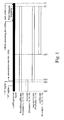
- a DNA fragment containing the sequence disclosed in WO 94/25612 and Agaisse and Lereclus, 1994, supra, delineated by nucleotides -635 to -22 ( Figure 1 ) (SEQ ID NO. 1), or portions thereof which retain the promoter and mRNA processing/stabilizing functions, may be used.
- the cryIIIA promoter is delineated by nucleotides -635 to -552 while the cryIIIA mRNA processing/stabilizing sequence is contained within nucleotides -551 to -22.
- cryIIIA mRNA processing/stabilizing sequence is contained in a fragment comprising nucleotides -568 to -22. In another preferred embodiment, the cryIIIA mRNA processing/stabilizing sequence is contained in a fragment comprising nucleotides -367 to -21.
- DNA fragments containing only the cryIIIA promoter or only the cryIIIA mRNA processing/stabilizing sequence may be prepared using methods well known in the art to construct various tandem promoter and mRNA processing/stabilizing sequence combinations.
- the cryIIIA promoter and its mRNA processing/stabilizing sequence are preferably placed downstream of the other promoter sequence(s) constituting the tandem promoter and upstream of the coding sequence of the gene of interest.
- FIG. 2 Various constructions containing a tandem promoter and the cryIIIA mRNA processing/stabilizing sequence are shown in Figure 2 .
- the Bacillus cell may contain one or more copies of the nucleic acid construct. In a preferred embodiment, the Bacillus cell contains a single copy of the nucleic acid construct.
- the nucleic acid construct may further contain one or more selectable markers which permit easy selection of transformed cells.
- a selectable marker is a gene the product of which provides for biocide resistance, resistance to heavy metals, prototrophy to auxotrophs, and the like.
- Examples of bacterial selectable markers are the dal genes from Bacillus subtilis or Bacillus licheniformis , or markers which confer antibiotic resistance such as ampicillin, kanamycin, erythromycin, chloramphenicol or tetracycline resistance.
- selection may be accomplished by co-transformation, e . g ., as described in WO 91/09129 , where the selectable marker is on a separate vector.
- a particular advantage of the present invention is that a Bacillus cell can be produced free of a selectable marker gene, i . e ., after the introduction of the nucleic acid construct into the Bacillus cell, the selectable marker gene can be deleted from the Bacillus cell making the cell marker-free.
- the nucleic acid construct containing a single copy of the nucleic acid sequence encoding the polypeptide allows for the removal of the selectable marker gene to produce a Bacillus cell free of such a marker which may be preferable for regulatory and environmental reasons.
- Gene deletion or replacement techniques may be used for the complete removal of the selectable marker gene.
- the deletion of the selectable marker gene may be accomplished by homologous recombination using a plasmid which has been constructed to contiguously contain the 5' and 3' regions flanking the selectable marker gene.
- the contiguous 5' and 3' regions may be introduced into a Bacillus cell on a temperature-sensitive plasmid, e . g ., pE194, in association with a second selectable marker at a permissive temperature to allow the plasmid to become established in the cell.
- the cell is then shifted to a non-permissive temperature to select for cells which have the plasmid integrated into the chromosome at one of the homologous flanking regions. Selection for integration of the plasmid is effected by selection for the second selectable marker. After integration, a recombination event at the second homologous flanking region is stimulated by shifting the cells to the permissive temperature for several generations without selection. The cells are plated to obtain single colonies and the colonies are examined for loss of both selectable markers (see, for example, Perego, 1993, In A.L. Sonneshein, J.A. Hoch, and R. Losick, editors, Bacillus subtilis and Other Gram-Positive Bacteria, Chapter 42, American Society of Microbiology, Washington, D.C., 1993 ).
- polypeptide may be native or heterologous to the Bacillus cell.
- polypeptide is not meant herein to refer to a specific length of the encoded product and, therefore, encompasses peptides, oligopeptides, and proteins.
- the polypeptide may also be a naturally occurring allelic or engineered variant of a polypeptide.
- the polypeptide is a hormone or variant thereof, enzyme, receptor or portion thereof, antibody or portion thereof, or reporter.
- the polypeptide is an oxidoreductase.
- the polypeptide is a transferase.
- the polypeptide is a hydrolase.
- the polypeptide is a lyase.
- the polypeptide is an isomerase.
- the polypeptide is a ligase.
- the polypeptide is an aminopeptidase. In another even more preferred embodiment, the polypeptide is an amylase. In another even more preferred embodiment, the polypeptide is a carbohydrase. In another even more preferred embodiment, the polypeptide is a carboxypeptidase. In another even more preferred embodiment, the polypeptide is a catalase. In another even more preferred embodiment, the polypeptide is a cellulase. In another even more preferred embodiment, the polypeptide is a chitinase. In another even more preferred embodiment, the polypeptide is a cutinase. In another even more preferred embodiment, the polypeptide is a cyclodextrin glycosyltransferase.
- the polypeptide is a deoxyribonuclease. In another even more preferred embodiment, the polypeptide is an esterase. In another even more preferred embodiment, the polypeptide is an alpha-galactosidase. In another even more preferred embodiment, the polypeptide is a beta-galactosidase. In another even more preferred embodiment, the polypeptide is a glucoamylase. In another even more preferred embodiment, the polypeptide is an alpha-glucosidase. In another even more preferred embodiment, the polypeptide is a beta-glucosidase. In another even more preferred embodiment, the polypeptide is an invertase. In another even more preferred embodiment, the polypeptide is a laccase.
- the polypeptide is a lipase. In another even more preferred embodiment, the polypeptide is a mannosidase. In another even more preferred embodiment, the polypeptide is a mutanase. In another even more preferred embodiment, the polypeptide is an oxidase. In another even more preferred embodiment, the polypeptide is a pectinolytic enzyme. In another even more preferred embodiment, the polypeptide is a peroxidase. In another even more preferred embodiment, the polypeptide is a phytase. In another even more preferred embodiment, the polypeptide is a polyphenoloxidase. In another even more preferred embodiment, the polypeptide is a proteolytic enzyme.
- the polypeptide is a ribonuclease. In another even more preferred embodiment, the polypeptide is a transglutaminase. In another even more preferred embodiment, the polypeptide is a xylanase.
- the polypeptide is a serine protease, for example, a subtilisin.
- the polypeptide is a maltogenic amylase.
- the polypeptide is a pullulanase.
- the methods of the present invention may also be used for the recombinant production of polypeptides which are native to the Bacillus cell.
- the present invention also encompasses, within the scope of the term "heterologous polypeptide", such recombinant production of native polypeptides, to the extent that such expression involves the use of genetic elements not native to the Bacillus cell, or use of native elements which have been manipulated to function in a manner not normally occurring in the host cell.
- heterologous polypeptides may also include fused or hybrid polypeptides in which another polypeptide is fused at the N-terminus or the C-terminus of the polypeptide or fragment thereof.
- a fused polypeptide is produced by fusing a nucleic acid sequence (or a portion thereof) encoding one polypeptide to a nucleic acid sequence (or a portion thereof) encoding another polypeptide.
- Techniques for producing fusion polypeptides are known in the art, and include ligating the coding sequences encoding the polypeptides so that they are in frame and expression of the fused polypeptide is under control of the same promoter(s) and terminator.
- the hybrid polypeptides may comprise a combination of partial or complete polypeptide sequences obtained from at least two different polypeptides wherein one or more may be heterologous to the Bacillus cell.
- a Bacillus cell comprising a tandem or "consensus" promoter and alternatively also an mRNA processing/stabilizing sequence, operably linked to a nucleic acid sequence encoding a polypeptide of interest may be accomplished by modifying an isolated nucleic acid sequence encoding the polypeptide using methods well known in the art to operably link the promoter and alternatively also the mRNA processing/stabilizing sequence to the nucleic acid sequence, inserting the modified sequence into a vector, and introducing the vector into the Bacillus cell's chromosome by homologous recombination or into the Bacillus cell as an extrachromosomal autonomously replicating element, e . g . , plasmid.
- the nucleic acid sequence may also be manipulated in vivo in the Bacillus cell using methods well known in the art.
- a nucleic acid sequence encoding a polypeptide of interest may be native or foreign to the Bacillus cell.
- a foreign nucleic acid sequence encoding a heterologous polypeptide may be obtained from any prokaryotic, eukaryotic, or other source, e . g ., archaebacteria.
- the nucleic acid sequence is obtained from a bacterial strain, such as a gram-negative or a gram-positive bacterial cell.
- the nucleic acid sequence encoding the polypeptide is obtained from a Bacillus cell.
- the term "obtained from” as used herein in connection with a given source shall mean that the polypeptide is produced by the source or by a cell in which a gene from the source has been inserted.
- the techniques used to isolate or clone a nucleic acid sequence encoding a polypeptide are well known in the art and include, for example, isolation from genomic DNA, preparation from cDNA, or a combination thereof.
- the cloning of the nucleic acid sequences from such genomic DNA can be effected, e . g ., by using antibody screening of expression libraries to detect cloned DNA fragments with shared structural features or the well known polymerase chain reaction (PCR). See, for example, Innis et al. , 1990, PCR Protocols: A Guide to Methods and Application, Academic Press, New York .
- nucleic acid amplification procedures such as ligase chain reaction (LCR), ligated activated transcription (LAT), and nucleic acid sequence-based amplification (NASBA) may be used.
- LCR ligase chain reaction
- LAT ligated activated transcription
- NASBA nucleic acid sequence-based amplification
- the cloning procedures may involve excision and isolation of a desired nucleic acid fragment comprising the nucleic acid sequence encoding the polypeptide, insertion of the fragment into a vector molecule, and incorporation of the recombinant vector into a Bacillus cell where clones of the nucleic acid sequence will be replicated.
- the nucleic acid sequence may be of genomic, cDNA, RNA, semisynthetic, synthetic origin, or any combinations thereof.
- An isolated nucleic acid sequence encoding a polypeptide of interest may then be manipulated to produce a nucleic acid construct by operably linking the nucleic acid sequence to a tandem or "consensus" promoter and alternatively also to an mRNA processing/stabilizing sequence, as well as one or more additional control sequences which direct the expression of the coding sequence in a Bacillus cell under conditions compatible with the control sequences.
- Expression will be understood to include any step involved in the production of the polypeptide including, but not limited to, transcription, post-transcriptional modification, translation, post-translational modification, and secretion.
- the techniques for modifying nucleic acid sequences utilizing cloning methods are well known in the art.
- control sequences is defined herein to include all components which are necessary or advantageous for expression of the coding sequence of the nucleic acid sequence.
- Each control sequence may be native or foreign to the nucleic acid sequence encoding the polypeptide.
- control sequences include, but are not limited to, a leader, a signal sequence, and a transcription terminator.
- the control sequences may be provided with linkers for the purpose of introducing specific restriction sites facilitating ligation of the control sequences with the coding region of the nucleic acid sequence encoding a polypeptide.
- the control sequence may also be a suitable transcription terminator sequence, a sequence recognized by a Bacillus cell to terminate transcription.
- the terminator sequence is operably linked to the 3' terminus of the nucleic acid sequence encoding the polypeptide. Any terminator which is functional in the Bacillus cell of choice may be used in the present invention.
- the control sequence may also be a suitable leader sequence, a nontranslated region of an mRNA which is important for translation by the Bacillus cell.
- the leader sequence is operably linked to the 5' terminus of the nucleic acid sequence encoding the polypeptide. Any leader sequence which is functional in the Bacillus cell of choice may be used in the present invention.
- the control sequence may also be a signal peptide coding region that codes for an amino acid sequence linked to the amino terminus of the polypeptide which directs the expressed polypeptide into the cell's secretory pathway.
- the signal peptide coding region may be native to the polypeptide or may be obtained from foreign sources.
- the 5' end of the coding sequence of the nucleic acid sequence may inherently contain a signal peptide coding region naturally linked in translation reading frame with the segment of the coding region which encodes the secreted polypeptide.
- the 5' end of the coding sequence may contain a signal peptide coding region which is foreign to that portion of the coding sequence which encodes the secreted polypeptide.
- the foreign signal peptide coding region may be required where the coding sequence does not normally contain a signal peptide coding region. Alternatively, the foreign signal peptide coding region may simply replace the natural signal peptide coding region in order to obtain enhanced secretion of the polypeptide relative to the natural signal peptide coding region normally associated with the coding sequence.
- the signal peptide coding region may be obtained from an amylase or a protease gene from a Bacillus species. However, any signal peptide coding region capable of directing the expressed polypeptide into the secretory pathway of a Bacillus cell of choice may be used in the present invention.
- An effective signal peptide coding region for Bacillus cells is the signal peptide coding region obtained from the Bacillus NCIB 11837 maltogenic amylase gene, Bacillus stearothermophilus alpha-amylase gene, Bacillus licheniformis subtilisin gene, Bacillus licheniformis beta-lactamase gene, Bacillus stearothermophilus neutral protease genes ( nprT, nprS, nprM ), and Bacillus subtilis prsA gene. Further signal peptides are described by Simonen and Palva, 1993, Microbiological Reviews 57: 109-137 .
- a recombinant expression vector comprising a nucleic acid sequence encoding a polypeptide of interest, a tandem or “consensus" promoter and alternatively also an mRNA processing/stabilizing sequence, and transcriptional and translational stop signals may be used for the recombinant production of a polypeptide.
- the various nucleic acid and control sequences described above may be joined together to produce a recombinant expression vector which may include one or more convenient restriction sites to allow for insertion or substitution of the nucleic acid sequence encoding the polypeptide at such sites.
- the nucleic acid sequence may be expressed by inserting the nucleic acid sequence or a nucleic acid construct comprising the sequence into an appropriate vector for expression.
- the coding sequence is located in the vector so that the coding sequence is operably linked with a tandem or "consensus" promoter and alternatively also an mRNA processing/stabilizing sequence, and any other appropriate control sequences for expression, and possibly secretion.
- the recombinant expression vector may be any vector which can be conveniently subjected to recombinant DNA procedures and can bring about the expression of the nucleic acid sequence on introduction into a Bacillus cell.
- the choice of the vector will typically depend on the compatibility of the vector with the Bacillus cell into which the vector is to be introduced.
- the vectors may be linear or closed circular plasmids.
- the vector may be an autonomously replicating vector, i . e ., a vector which exists as an extrachromosomal entity, the replication of which is independent of chromosomal replication, e . g ., a plasmid, an extrachromosomal element, a minichromosome, or an artificial chromosome.
- the vector may contain any means for assuring self-replication.
- the vector may be one which, when introduced into the Bacillus cell, is integrated into the genome and replicated together with the chromosome(s) into which it has been integrated.
- the vector system may be a single vector or plasmid or two or more vectors or plasmids, or a transposon.
- “Introduction” means introducing a vector comprising the nucleic acid sequence into a Bacillus cell so that the vector is maintained as a chromosomal integrant or as a self-replicating extrachromosomal vector. Integration is generally considered to be an advantage as the nucleic acid sequence is more likely to be stably maintained in the cell. Integration of the vector into the chromosome occurs by homologous recombination, non-homologous recombination, or transposition.
- an expression vector into a Bacillus cell may, for instance, be effected by protoplast transformation (see, e . g ., Chang and Cohen, 1979, Molecular General Genetics 168: 111-115 ), using competent cells (see, e . g ., Young and Spizizin, 1961, Journal of Bacteriology 81: 823-829 , or Dubnau and Davidoff-Abelson, 1971, Journal of Molecular Biology 56: 209-221 ), electroporation (see, e . g ., Shigekawa and Dower, 1988, Biotechniques 6: 742-751 ), or conjugation (see, e . g ., Koehler and Thorne, 1987, Journal of Bacteriology 169: 5271-5278 ).
- the vector may rely on the nucleic acid sequence encoding the polypeptide or any other element of the vector for stable integration of the vector into the genome by homologous recombination.
- the vector may contain additional nucleic acid sequences for directing integration by homologous recombination into the genome of the Bacillus cell.
- the additional nucleic acid sequences enable the vector to be integrated into the Bacillus cell genome at a precise location in the chromosome.
- the integrational elements should preferably contain a sufficient number of nucleic acids, such as 100 to 1,500 base pairs, preferably 400 to 1,500 base pairs, and most preferably 800 to 1,500 base pairs, which are highly homologous with the corresponding target sequence to enhance the probability of homologous recombination.
- the integrational elements may be any sequence that is homologous with the target sequence in the genome of the Bacillus cell.
- the integrational elements may be non-encoding or encoding nucleic acid sequences.
- the vector may further comprise an origin of replication enabling the vector to replicate autonomously in the Bacillus cell in question.
- origins of replication are the origins of replication of plasmids pBR322, pUC19, pACYC177, and pACYC184 permitting replication in E. coli, and pUB110, pE194, pTA1060, and pAMB1 permitting replication in Bacillus.
- the origin of replication may be one having a mutation to make its function temperature-sensitive in the Bacillus cell (see, e . g ., Ehrlich, 1978, Proceedings of the National Academy of Sciences USA 75:1433 ).
- the Bacillus cell may be a wild-type Bacillus cell or a mutant thereof. Furthermore, the Bacillus cell may be an alkalophilic or a thermophilic Bacillus. In a preferred embodiment, the Bacillus cell is a Bacillus alkalophilus cell. In another preferred embodiment, the Bacillus cell is a Bacillus amyloliquefaciens cell. In another preferred embodiment, the Bacillus cell is a Bacillus brevis cell. In another preferred embodiment, the Bacillus cell is a Bacillus circulans cell. In another preferred embodiment, the Bacillus cell is a Bacillus clausii cell. In another preferred embodiment, the Bacillus cell is a Bacillus coagulans cell.
- the Bacillus cell is a Bacillus firmus cell. In another preferred embodiment, the Bacillus cell is a Bacillus lautus cell. In another preferred embodiment, the Bacillus cell is a Bacillus lentus cell. In another preferred embodiment, the Bacillus cell is a Bacillus licheniformis cell. In another preferred embodiment, the Bacillus cell is a Bacillus megaterium cell. In another preferred embodiment, the Bacillus cell is a Bacillus pumilus cell. In another preferred embodiment, the Bacillus cell is a Bacillus stearothermophilus cell. In another preferred embodiment, the Bacillus cell is a Bacillus subtilis cell. In another preferred embodiment, the Bacillus cell is a Bacillus thuringiensis cell.
- the Bacillus cell may be a recombinant cell comprising, for example, a nucleic acid sequence encoding a heterologous polypeptide.
- the cells are cultivated in a nutrient medium suitable for production of the polypeptide using methods known in the art.
- the cell may be cultivated by shake flask cultivation, small-scale or large-scale fermentation (including continuous, batch, fed-batch, or solid state fermentations) in laboratory or industrial fermentors performed in a suitable medium and under conditions allowing the polypeptide to be expressed and/or isolated.
- the cultivation takes place in a suitable nutrient medium comprising carbon and nitrogen sources and inorganic salts, using procedures known in the art.
- Suitable media are available from commercial suppliers or may be prepared according to published compositions ( e . g ., in catalogues of the American Type Culture Collection).
- the secreted polypeptide can be recovered directly from the medium.
- the polypeptides may be detected using methods known in the art that are specific for the polypeptides. These detection methods may include use of specific antibodies, formation of an enzyme product, disappearance of an enzyme substrate, or SDS-PAGE. For example, an enzyme assay may be used to determine the activity of the polypeptide. Procedures for determining enzyme activity are known in the art for many enzymes.
- the Bacillus cell preferably produces at least about 25% more, more preferably at least about 50% more, more preferably at least about 75 % more, more preferably at least about 100% more, even more preferably at least about 200% more, most preferably at least about 300% more, and even most preferably at least about 400% more polypeptide relative to a Bacillus cell containing only one of the promoter sequences of the tandem or "consensus" promoter operably linked to a nucleic acid sequence encoding the polypeptide when cultured under identical production conditions.
- the resulting polypeptide may be isolated by methods known in the art.
- the polypeptide may be isolated from the nutrient medium by conventional procedures including, but not limited to, centrifugation, filtration, extraction, spray-drying, evaporation, or precipitation.
- the isolated polypeptide may then be further purified by a variety of procedures known in the art including, but not limited to, chromatography (e . g ., ion exchange, affinity, hydrophobic, chromatofocusing, and size exclusion), electrophoretic procedures ( e . g ., preparative isoelectric focusing), differential solubility ( e . g ., ammonium sulfate precipitation), or extraction (see, e.g., Protein Purification, J.-C. Janson and Lars Ryden, editors, VCH Publishers, New York, 1989 ).
- E. coli DH5 ⁇ E. coli JM101
- Bacillus subtilis PL1801 spollE::Tn917 amyE, apr, npr ).
- pDG268 Antoniewski, et al., 1990, Journal of Bacteriology 172: 86-93
- Tth 111I and Eco RI Tris-borate-1 mM EDTA
- TBE Tris-borate-1 mM EDTA
- the largest plasmid fragment of approximately 6020 bp was excised from the gel and the DNA was recovered using the Qiaquick DNA purification kit (QIAGEN, Inc., Chatsworth, CA) according to the manufacturer's instructions.
- the recovered DNA was then ligated with the following synthetic polylinker shown below to introduce unique Sfi I and Bam HI sites into the plasmid.
- E. coli DH5 ⁇ was transformed with the ligation mixture and ampicillin resistant transformants were selected on LB plates supplemented with 100 ⁇ g of ampicillin per ml.
- Plasmid DNA was purified according to Sambrook et al. , 1989, supra, and digested with Sfi I and Not I to identify plasmids which contained these sites and by implication, the polylinker shown above (pDG268 does not contain these two restriction sites).
- pDG268MCS MCS refers to multiple cloning site
- pDG268MCS ⁇ -Pr cryIIIA /cryIIIAstab/SAV was constructed to delete the Sac I site in pDG268MCS of Example 1 to facilitate the swapping of promoter fragments engineered to contain a Sac I site at their 3' end.
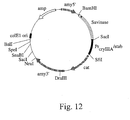
- pDG268MCS-Pr cryIIIA /cryIIIAstab/SAV (see Example 9 and Figure 12 ) was digested with SnaBI and Nru I (both restriction sites flank the Sac I site of the vector), ligated, and transformed into E. coli DH5 ⁇ . Ampicillin resistant transformants were selected on LB plates supplemented with 100 ⁇ g of ampicillin per ml. Plasmid DNA was purified from several transformants and recovered as described in Example 1.
- the plasmid DNA was digested with Sac I to identify plasmids which were deleted for the Sac I site located in the vector sequence and thus cleaved only once due to the Sac I site downstream of the cryIIIA promoter.
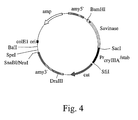
- Such a plasmid was identified and designated pDG268MCS ⁇ -Pr cryIIIA /cryIIIAstab/SAV ( Figure 4 ).
- pDG268MCS ⁇ neo-Pr CryIIIA /cryIIIAstab/SAV was constructed first by digesting pDG268MCS ⁇ -Pr CryIIIA /cryIIIAstab/SAV of Example 2 with Bal I and treating with calf intestinal alkaline phosphatase.
- Plasmid pBEST501 ( Itaya et al., 1989, Nucleic Acids Research 17: 4410 ) was digested with Pst I and Not I, treated with T4 DNA polymerase I to generate blunt ends, and agarose gel purified as described in Example 1 to isolate a fragment harboring the neomycin resistance marker.
- the gel-purified fragment and Bal I-digested plasmid were ligated together and transformed into E. coli DH5 ⁇ .
- Ampicillin resistant transformants were selected on LB plates supplemented with 100 ⁇ g of ampicillin per ml.
- the selected transformants were patched onto LB plates supplemented with 50 ⁇ g of neomycin per ml to identify neomycin resistant transformants.
- Plasmid DNA was purified from a few of the neomycin resistant transformants as described in Example 1 and digested with Bgl II (cuts twice due to the additional Bgl II site introduced with the neomycin resistance marker) yielding two fragments in the 4 kb range and with BamHI (which is predicted to cut once downstream of the SAVINASETM protease gene) yielding a fragment of approximately 8 kb.
- Bgl II cuts twice due to the additional Bgl II site introduced with the neomycin resistance marker
- BamHI which is predicted to cut once downstream of the SAVINASETM protease gene
- pHP13-amp a variant of pHP13 ( Haima et al., 1987, Molecular and General Genetics 209: 335-342 ), was constructed by digesting pUC9 with Aat II, blunting with Klenow fragment and deoxyribonucleotides, and then digesting with Hind III. The larger 2.2 kb fragment was gel-purified with a Qiaex kit (QIAGEN, Thousand Oaks, CA). pHP13 was digested with Hpa I (which cuts within the erythromycin resistance gene), blunted, and then digested with HindIII.
- the larger 3.0 kb fragment released from pHP13 was then ligated to the 2.1 kb pUC9 fragment containing the pUC9 origin of replication and ampicillin resistance gene.
- the ligation mixture was transformed into E. coli DH5 ⁇ . Ampicillin resistant transformants were selected on LB plates supplemented with 100 ⁇ g of ampicillin per ml. Plasmid DNA was purified from several transformants as described in Example 1. A plasmid designated pHP13amp was recovered from one of the transformants.
- Plasmid pHP13amp was digested with Eco RI and Hind III and the pUC9 MCS was replaced with a new MCS created by annealing 100 pmol of the following polylinker in 50 mM NaCl, 10 mM Tris pH 7.5, and 1 mM EDTA, boiling for 5 minutes, and cooling slowly to room temperature over a 2 hour time period:
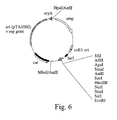
- E. coli DH5 ⁇ was transformed with the ligation mix and ampicillin resistant transformants were selected on LB plates supplemented with 100 ⁇ g of ampicillin per ml. Plasmid DNA was purified from several transformants as described in Example 1 and digested with Not I and Sac I. Plasmids which were cleaved with these enzymes contained the synthetic polylinker. One such plasmid was identified and designated pHP13amp-MCS ( Figure 6 ). This plasmid was further verified by DNA sequencing through the polylinker region. DNA sequencing was performed with an Applied Biosystems Model 373A Automated DNA Sequencer (Applied Biosystems, Inc., Foster City, CA) according to the manufacturer's instructions.
- the gene which encodes a Bacillus serine protease (SAVINASETM, Novo Nordisk A/S, Bagsv ⁇ rd, Denmark), hereinafter referred to as the SAVINASETM gene, was PCR-amplified using plasmid pSX222 ( Figure 7 , U.S. Patent No. 5,621,089 ) as template DNA and the following two primers (restriction sites are underlined):
- the amplification reaction (100 ⁇ l) consisted of the following components: 50 ng of pSX222, 50 pmole of each primer, 1X Taq DNA polymerase Buffer (Boehringer Mannheim, Indianapolis, IN), 200 ⁇ M each of dATP, dTTP, dGTP, and dCTP, and 2.5 units of Taq DNA polymerase (Perkin-Elmer Corp., Branchburg, NJ).
- the amplification conditions were one cycle at 95 °C for 3 minutes, 30 cycles each at 95 °C for 1 minute, 55°C for 1 minute, and 72°C for 1.5 minutes, and a final cycle at 72°C for 5 minutes.
- the approximately 1230 bp PCR product was subcloned directly into the pCRII vector (Invitrogen, Carlsbad, CA) according to the manufacturer's instructions. The sequence of the gene was verified by DNA sequencing as described in Example 4 using gene-specific primers. Once verified, the plasmid was digested with BamHI, filled in with Klenow fragment, digested with Apa I , and the fragment harboring the SAVINASETM gene was then ligated into the Apa I, Eci 136II site of pHP13ampMCS. E. coli DH5 ⁇ was transformed with this ligation mixture and ampicillin resistant transformants were selected on LB plates supplemented with 100 ⁇ g of ampicillin per ml. A plasmid designated pHP13amp-SAV ( Figure 8 ) was isolated from one of the transformants and verified by DNA sequencing as described in Example 4 using construct-specific primers. The Bam HI site was regenerated as a result of this ligation.
- the promoter of the amyL gene which encodes a Bacillus licheniformis alpha-amylase (TERMAMYLTM, Novo Nordisk A/S, Bagsv ⁇ rd, Denmark), described in U.S. Patent No. 5,698,415 was PCR-amplified using plasmid pPL1759 ( U.S. Patent No. 5,698,415 ) as template DNA, the following two primers (restriction sites are underlined), and GENEAMP® XL PCR Kit (Perkin-Elmer Corp., Branchburg, NJ) according to the manufacturer's instructions:
- the amplification reaction (100 ⁇ l) consisted of the following components: 50 ng of pPL1759, 50 pmole of each primer, 1X Taq polymerase buffer, 2.5 ⁇ M each of dATP, dTTP, dGTP, and dCTP, and 1.0 unit of Taq polymerase.
- the amplification conditions were one cycle at 95°C for 3 minutes; 30 cycles each at 95°C for 1 minute, 55°C for 1 minute, and 72°C for 1.5 minutes; and a final cycle at 72°C for 5 minutes.
- the approximately 620 bp PCR product containing the amyL promoter was ligated with Ecl I36II-digested pUC118.
- E. coli DH5 ⁇ was transformed with this ligation mixture and ampicillin resistant transformants were selected on LB plates supplemented with 100 ⁇ g of ampicillin per ml.
- a plasmid designated pUC118-Pr amyL was purified from an ampicillin resistant transformant that appeared white in the presence of 5-bromo-4-chloro-3-inodlyl-â-D-galactopyranoside (Sigma, St. Louis, MO) and verified by DNA sequencing as described in Example 4, using M13/pUC sequencing primers and amyL -specific primers.
- pHP13amp-SAV of Example 5 was digested with Sfi I and Sac I and purified by gel electrophoresis, as described in Example 1.
- the approximately 620 bp Sfi I- Sac I fragment of pUC118-Pr amyL bearing the amyL promoter was isolated by gel electrophoresis, as described in Example 1, and ligated to Sfi I/ Sac I-digested pHP13amp-SAV.
- E. coli DH5 ⁇ was transformed with this ligation mixture and ampicillin resistant transformants were selected on LB plates supplemented with 100 ⁇ g of ampicillin per ml.
- a plasmid designated pHP13amp-Pr amyL /SAV was purified from one of the ampicillin resistant transformants.
- pHP13amp-Pr amyL /SAV was digested with Sfi I and Bam HI and the approximately 1840 bp fragment bearing the Pr amyL /SAV cassette was purified as described in Example 1.
- pDG268MCS was digested with Sfi I and Bam HI, purified as described in Example 1, and ligated with the Pr amyL /SAV Sfi I/ Bam HI fragment.
- E. coli DH5 ⁇ was transformed with this ligation mixture and ampicillin resistant transformants were selected on LB plates supplemented with 100 ⁇ g of ampicillin per ml.
- a plasmid designated pDG268MCS-Pr amyL /SAV ( Figure 9 ) was purified from one of the ampicillin resistant transformants.
- the promoter of the amyQ gene which encodes a Bacillus amyloliquefaciens alpha-amylase (BANTM, Novo Nordisk A/S, Bagsv ⁇ rd, Denmark) was PCR-amplified using plasmid pSX222 as template DNA and the following primers (restriction sites are underlined):
- the amplification reaction (100 ⁇ l) consisted of the following components: 50 ng of pSX222, 50 pmole of each primer, 1X Taq DNA polymerase buffer, 200 ⁇ M each of dATP, dTTP, dGTP, and dCTP, and 2.5 units of Taq DNA polymerase.
- the amplification conditions were one cycle at 95°C for 3 minutes; 30 cycles each at 95°C for 1 minute, 55°C for 1 minute, and 72°C for 1.5 minutes; and a final cycle at 72°C for 5 minutes.
- the approximately 185 bp PCR product was subcloned directly into the pCRII vector according to the manufacturer's instructions and verified by DNA sequencing as described in Example 4 yielding pCRII-Pr amyQ .
- the approximately 185 bp Sfi I- Sac I fragment of pCRII-Pr amyQ bearing the amyQ promoter was isolated by gel electrophoresis, as described in Example 1, and ligated to Sfi I/ Sac I-digested pHP13amp-SAV (Example 5).
- E. coli DH5 ⁇ was transformed with this ligation mixture and ampicillin resistant transformants were selected on LB plates supplemented with 100 ⁇ g of ampicillin per ml.
- a plasmid designated pHP13amp-Pr amyQ /SAV was purified from one of the ampicillin resistant transformants.
- pHP13amp-Pr amyQ /SAV was digested with Sfi I and Bam HI, and the approximately 1400 bp fragment bearing the Pr amyQ /SAV expression cassette was purified as described in Example 1.
- the SfiI-Bam HI fragment was then ligated into Sfi I-Bam HI digested pDG268MCS (Example 6).
- E. coli DH5 ⁇ was transformed with this ligation mixture and ampicillin resistant transformants were selected on LB plates supplemented with 100 ⁇ g of ampicillin per ml.
- a plasmid designated pDG268MCS-Pr amyQ /SAV ( Figure 10 ) was purified from one of the ampicillin resistant transformants.
- Example 8 Construction of pUC18-Pr cryIIIA /cryIIIAstab/cryIIIA
- cryIIIA gene which encodes a Bacillus thuringiensis subsp. tenebrionis coleopteran crystal protein CryIIIA was PCR amplified from chromosomal DNA isolated according to Pitcher et al. , 1989, Letters in Applied Microbiology 8: 151-156 from the Bacillus thuringiensis subsp. tenebrionis strain NB125 described in WO 95/02695 using the following primers:
- the amplification reaction (100 ⁇ l) consisted of the following components: 50 ng of NB125 chromosomal DNA, 50 pmole of each primer, 1X Pfu polymerase buffer (Stratagene Cloning Systems, La Jolla, CA), 200 ⁇ M each of dATP, dTTP, dGTP, and dCTP, and 1.0 unit of Pfu polymerase (Stratagene Cloning Systems, La Jolla, CA).
- the amplification conditions were one cycle at 95 °C for 3 minutes; 30 cycles each at 95 °C for 1 minute, 50°C for 1 minute, and 72°C for 1.5 minutes; and a final cycle at 72°C for 5 minutes.
- the approximately 1000 bp PCR product was digested with Sma I and Hind III and ligated into the Sma I/ Hind III site of pUC18.
- E. coli DH5 ⁇ was transformed with this ligation mixture and ampicillin resistant transformants were selected on LB plates supplemented with 100 ⁇ g of ampicillin per ml.
- a plasmid designated pUC18-Pr cryIIIA was isolated from one of the ampicillin resistant transformants.
- Plasmid pUC118-cryIIIA ( WO 95/02695 ) was digested with Hind III and the approximately 3000 bp Hind III fragment harboring the cryIIIA gene and mRNA stabilizing sequence was gel-purified as described in Example 1. This fragment was ligated into the Hind III site of pUC18-Pr cyIIIA . E. coli DH5 ⁇ was transformed with this ligation mixture and ampicillin resistant transformants were selected on LB plates supplemented with 100 ⁇ g of ampicillin per ml. A plasmid designated pUC18-Pr cryIIIA /cryIIIAstab/cryIIIA ( Figure 11 ) was isolated from one of the ampicillin resistant transformants. The correct orientation of the fragment was confirmed by digesting the plasmid with Eco RI.
- Example 9 Construction of a cryIIIA promoter- cryIIIA mRNA stabilizer-SAVINASETM gene expression cassette
- the promoter and cryIIIA mRNA stabilizing sequence of the cryIIIA gene were PCR amplified using plasmid pUC18-Pr cryIIIA /cryIIIAstab/cryIIIA of Example 8 as DNA template and the two primers (restriction sites are underlined) described below:
- the amplification reaction (100 ⁇ l) consisted of the following components: 50 ng of pUC18-Pr cryIIIA /cryIIIAstab, 50 pmole of each primer, 1X Taq polymerase buffer, 200 ⁇ M each of dATP, dTTP, dGTP, and dCTP, and 1.0 unit of Taq polymerase.
- the amplification conditions were one cycle at 95 °C for 3 minutes; 30 cycles each at 95 °C for 1 minute, 55°C for 1 minute, and 72°C for 1.5 minutes; and a final cycle at 72°C for 5 minutes.
- the approximately 630 bp PCR product was cloned in the pCRII vector according to the manufacturer's instructions, yielding plasmid pCRII-Pr cryIIIA /cryIIIAstab, which was verified by DNA sequencing as described in Example 4, using M13 sequencing primers and cryIIIA -specific primers.
- Example 10 Construction of a cryIIIA promoter-SAVINASETM gene expression cassette
- pDG268 ⁇ neo-Pr cryIIIA /SAV was constructed as follows. A fragment of approximately 1640 bp of pDG268MCS ⁇ neo-Prc ryIIIA /cryIIIAstab/SAV of Example 3 ranging from the Dra III site to 6 nucleotides downstream of the cryIIIA transcription start site was PCR-amplified using plasmid pDG268MCS ⁇ neo-Pr cryIIIA /cryIIIAstab/SAV as DNA template and the following two primers (restriction sites are underlined):
- the amplification reaction (50 ⁇ l) consisted of the following components: 50 ng of pDG268MCS ⁇ neo-Pr cryIIIA /cryIIIAstab/SAV, 50 pmole of each primers, 1X Taq polymerase Buffer, 200 ⁇ M each of dATP, dTTP, dGTP, and dCTP, and 1.25 unit of Amplitaq ® Gold DNA polymerase (Perkin-Elmer Corporation, Branchburg, NJ).
- the amplification conditions were one cycle at 95°C for 9 minutes; 30 cycles of 95°C for 1 minute, 55°C for 1 minute, and 72°C for 1.5 minutes; and a final cycle at 72°C for 3 minutes.
- PCR product was cloned directly into pCR2.1 using the TOPO-TA Cloning Kit (Invitrogen, Carlsbad, CA) according to the manufacturer's instructions yielding pCR2.1-DraIII/Pr cryIIIA , which was verified by DNA sequencing as described in Example 4.
- pDG268MCS ⁇ neo- Pr amyL /Pr cryIIIA /cryIIIAstab/SAV of Example 12 was digested with Dra III and Sac I to remove the Pr amyL /Pr cryIIIA /cryIIIAstab tandem promoter and part of the vector, and the approximately 6440 bp vector fragment was isolated by gel electrophoresis, as described in Example 1.
- the approximately 1640 bp Dra III/ Sac I fragment of pCR2.1-DraIII/P cryIIIA was isolated and ligated with the Dra III/ Sac I-cut vector.
- E. coli DH5 ⁇ was transformed with this ligation mixture and ampicillin resistant transformants were selected on LB plates supplemented with 100 ⁇ g of ampicillin per ml.
- a plasmid designated pDG268MCS ⁇ neo-Pr cryIIIA /SAV ( Figure 13 ) was purified from one of the ampicillin resistant transformants.
- Example 11 Construction of an amyL promoter-cryIIIA mRNA stabilizer-SAVINASETM gene expression cassette
- cryIIIA mRNA stabilizer sequence was PCR-amplified using plasmid pUC18-Pr cryIIIA /cryIIIAstab/cryIIIA of Example 8 as DNA template and the following two primers ( Sac I restriction sites are underlined):
- the amplification reaction (100 ⁇ l) consisted of the following components: 50 ng of pUC18-Pr cryIIIA /cryIIIAstab/cryIIIA, 50 pmole of each primer, 1X Taq DNA polymerase Buffer, 200 ⁇ M each of dATP, dTTP, dGTP, and dCTP, and 2.5 units of Taq DNA polymerase.
- the amplification conditions were one cycle at 95°C for 3 minutes, 30 cycles each at 95°C for 1 minute, 55°C for 1 minute, and 72°C for 1.5 minutes, and a final cycle at 72°C for 5 minutes.
- the approximately 360 bp PCR product was subcloned directly into the pCRII vector according to the manufacturer's instructions and confirmed by DNA sequencing, as described in Example 4, using construct specific primers.
- the resulting plasmid designated pCRII-cryIIIAstab was digested with Sac I and the fragment harboring the cryIIIA mRNA stabilizer sequence was purified by agarose gel electrophoresis as described in Example 1. Plasmid pHP13amp-Pr amyL /SAV of Example 6 was digested with Sac I and treated with calf intestine alkaline phosphatase (CIP) to remove the 5' phosphate groups. The purified fragment containing the stabilizer sequence and the CIP-treated plasmid were then ligated together. E. coli DH5 ⁇ cells were transformed with this ligation mixture and ampicillin resistant transformants were selected on LB plates supplemented with 100 ⁇ g of ampicillin per ml.
- CIP calf intestine alkaline phosphatase
- Plasmid DNA was isolated from several transformants and digested with Sac I to identify those which contained the mRNA stabilizer sequence. Once these were identified, the orientation of the fragment was determined by digesting the plasmid DNA with Xmn I . A plasmid containing the cryIIIA stabilizing sequence in the correct orientation was identified and designated pHP13amp-Pr amyL /cryIIIAstab/SAV.
- pHP13amp-Pr amyL /cryIIIAstab/SAV was digested with Sfi I and Bam HI and the fragment harboring the expression cassette was ligated into the Sfi I -Bam HI site of pDG268-MCS to produce pDG268MCS-Pr amyL /cryIIIAstab/SAV ( Figure 14 ).
- Example 12 Construction of a tandem amyL-cryIIIA promoter- cryIIIA mRNA stabilizer-SAVINASETM gene expression cassette
- Plasmid pDG268MCS ⁇ neo-Pr cryIIIA /cryIIIAstab/SAV of Example 3 was digested with SfiI, blunt-ended with T4 polymerase I, and then digested with Dra III. The digest was separated by agarose gel electrophoresis and the vector fragment of approximately 7010 bp was excised from the gel and the DNA extracted as described in Example 1.
- pDG268MCS-Pr amyL /SAV of Example 6 was digested with Ecl 136II and Dra III. The digest was separated by agarose gel electrophoresis, the promoter fragment of approximately 2150 bp was excised from the gel, and the DNA was extracted as described in Example 1.
- the purified DNAs were ligated together and transformed into E. coli DH5 ⁇ . Ampicillin resistant transformants were selected on LB plates supplemented with 100 ⁇ g of ampicillin per ml.
- a plasmid designated pDG268MCS ⁇ neo-Pr amyL /Pr cryIIIA /cryIIIAstab/SAV ( Figure 15 ) was isolated from one of the transformants and verified by digesting with Nco I followed by agarose gel electrophoresis.
- Example 13 Construction of a tandem amyL-cryIIIA promoter-SAVINASETM gene expression cassette
- pDG268MCS ⁇ neo-Pr cryIIIA /SAV of Example 10 was digested with Pac I and Dra III, and the approximately 6450 bp vector fragment was isolated by gel electrophoresis, as described in Example 1.
- the approximately 2230 bp Pac I -Dra III fragment of pDG268MCS ⁇ neo-Pr amyL /Pr cryIIIA /cryIIIAstab/SAV of Example 12 bearing Pr amyL and Pr cryIIIA was isolated by gel electrophoresis, as described in Example 1, and ligated with the vector fragment.
- E. coli DH5 ⁇ was transformed with this ligation mixture and ampicillin resistant transformants were selected on LB plates supplemented with 100 ⁇ g of ampicillin per ml.
- a plasmid designated pDG268MCS ⁇ neo-Pr amyL /Pr cryIIIA /SAV ( Figure 16 ) was purified from one of the ampicillin resistant transformants.
- pDG268MCS-Pr amyQ /SAV of Example 7 was digested with Sfi I and Bam HI and the approximately 1400 bp bearing the Pr amyQ /SAV cassette was isolated by gel electrophoresis, as described in Example 1.
- pDG268MCS ⁇ neo-Pr cryIIIA /cryIIIAstab/SAV of Example 3 was digested with Sfi I and Bam HI and the approximately 6780 bp vector fragment was isolated by gel electrophoresis, as described in Example 1. The purified fragments were ligated together, E.
- coli DH5 ⁇ was transformed with the ligation mixture, and ampicillin resistant transformants were selected on LB plates supplemented with 100 ⁇ g of ampicillin per ml.
- a plasmid designated pDG268MCS ⁇ neo-Pr amyQ /SAV was purified from one of the ampicillin resistant transformants and verified by digestion with Nco I followed by gel electrophoresis.
- pDG268MCS ⁇ neo-Pr amyQ /cryIIIAstab/SAV was constructed first by digesting pDG268MCSOneo-Pr amyQ /SAV with Sac I and treating with calf intestine alkaline phosphatase to remove the 5' phosphate groups.
- Sac I The approximately 360 bp Sac I fragment of pDG268MCS-Pr amyL /cryIIIAstab/SAV of Example 11 bearing the cryIIIA leader was gel-purified as described in Example 1 and ligated with Sac I-cut, dephosphorylated pDG268MCSAneo-Pr amyQ /SAV.
- E. coli DH5 ⁇ was transformed with this ligation mixture and ampicillin resistant transformants were selected on LB plates supplemented with 100 ⁇ g of ampicillin per ml. Plasmid DNA was isolated from several transformants and digested with Sac I to identify those which contained the stabilizer sequence. Once these were identified, the orientation of the fragment was determined by digesting the plasmid DNA with Xmn I. A plasmid containing the cryIIIA mRNA stabilizing sequence in the correct orientation was identified and designated pDG268MCS ⁇ neO-Pr amyQ /cryIIIAstab/SAV ( Figure 17 ).
- Example 15 Construction of a tandem amyQ-cryIIIA promoter- cryIIIA mRNA stabilizer-SAVINASETM gene expression cassette
- Plasmid pDG268MCS-Pr cryIIIA /cryIIIAstab/SAV of Example 9 was digested with Sfi I, blunt-ended with T4 polymerase I, and then digested with Dra III. The digest was subjected to agarose gel electrophoresis and the vector fragment of approximately 6360 bp was excised from the gel and the DNA extracted as described in Example 1.
- Plasmid pDG268MCS-Pr amyQ /SAV of Example 7 was digested with Sac I , blunt-ended with T4 DNA polymerase I, digested with Dra III. The digest was subjected to agarose gel electrophoresis and the promoter fragment of approximately 1710 bp was excised from the gel and the DNA extracted as described in Example 1.
- Purified DNAs were ligated together and transformed in E. coli DH5 ⁇ cells. Ampicillin resistant transformants were selected on LB plates supplemented with 100 ⁇ g of ampicillin per ml. A plasmid designated pDG268MCS-Pr amyQ /Pr cryIIIA /cryIIIAstab/SAV ( Figure 18 ) was isolated from one of the ampicillin resistant transformants. The plasmid structure was verified by digesting with Sac I followed by gel-electrophoresis.
- Example 16 Construction of a tandem amyQ-cryIIIA promoter-SAVINASETM gene expression cassette
- pDG268MCS ⁇ neo-Pr cryIIIA /SAV of Example 10 was digested with Pac I and Dra III, and the approximately 6450 bp vector fragment was isolated by gel electrophoresis, as described in Example 1.
- the approximately 1790 bp Pac I -Dra III fragment of pDG268MCS-Pr amyQ /Pr cryIIIA /cryIIIAstab/SAV (Example 15) bearing Pr amyQ and Pr cryIIIA was isolated by gel electrophoresis, as described in Example 1, and ligated with the vector fragment.
- E. coli DH5 ⁇ was transformed with this ligation mixture and ampicillin resistant transformants were selected on LB plates supplemented with 100 ⁇ g of ampicillin per ml.
- a plasmid designated pDG268MCSOneo-Pr amyQ /Pr cryIIIA /SAV ( Figure 19 ) was purified from one of the ampicillin resistant transformants.
- Example 17 Construction of a cryIIIA stabilizer-SAVINASETM gene expression cassette
- pDG268MCS ⁇ neo-cryIIIAstab/SAV was constructed as follows: pDG268MCS ⁇ neo-Pr cryIIIA /cryIIIAstab/SAV of Example 3 was digested with Sfi I and treated with T4 DNA polymerase to remove the 3' overhangs. The plasmid was then digested with Asp 718. The digest was subjected to agarose gel electrophoresis and the Asp 718/blunted Sfi I vector fragment of approximately 7540 bp was excised from the gel and the DNA extracted as described in Example 1.
- pDG268MCS ⁇ neo-Pr cryIIIA /cryIIIAstab/SAV was digested with Hind III and treated with T4 DNA polymerase and dNTPs to fill in the recessed 3' ends.
- the plasmid was then digested with Asp 718.
- the digest was separated by agarose gel electrophoresis and the fragment of approximately 920 bp containing the truncated cryIIIA promoter (only the "-10" region) and the downstream cryIIIA stabilizing sequence was excised from the gel and the DNA extracted as described in Example 1.
- a second double-stranded fragment comprising 137 bp of the upstream region of the amyQ promoter was generated by PCR using the following to primers:
- Both double-stranded DNA fragments were then fused together by traditional SOE methods (SOE overlaps are underlined and labeled) to generate a mutated version of the amyQ promoter designated "consensus" amyQ.
- the primers used in the SOE reaction to obtain the full-length fragment were 5'- GGCCTTAAGGGCC TGCA-3' and 5'- GAGCTC CATTTTCTTATACAAATTATAT-3'.
- the SOE reaction (50 ⁇ l) consisted of the following components: 50 ng of the 68 bp SOE fragment and 50 ng of the 137 bp SOE fragment, 1X Taq polymerase buffer, 200 ⁇ M each of dATP, dTTP, dGTP, and dCTP, and 2.5 units of Taq DNA polymerase.
- the conditions were one cycle at 95 °C for 3 minutes; 30 cycles each at 95 °C for 1 minute, 55°C for 1 minute, and 72°C for 1.5 minutes; after the third cycle 50 pmole of each of the two primers described above were added during the remaining 27 cycles to amplify the 185 bp promoter fragment.
- a final cycle was performed at 72°C for 5 minutes.
- the approximately 185 bp PCR product was subcloned directly into the pCRII vector according to the manufacturer's instructions and verified by DNA sequencing as described in Example 4 yielding pCRII-Pr "consensus" amyQ , using forward and reverse M13 sequencing primers.
- the sequence of the entire amyQ promoter including flanking restriction sites is shown in Figure 21 (SEQ ID NO. 2).
- the following mutations were introduced into the nucleic acid sequence containing the wild-type amyQ promoter (SEQ ID NO. 2) to generate the "consensus" amyQ promoter (SEQ ID NO. 3): T to A and T to C in the -35 region (with respect to the transcription start site) at positions 135 and 136, respectively, and an A to T change in the -10 region at position 156 of SEQ ID NO. 2.
- a T to A change was inadvertently made at position 116 approximately 20 base pairs upstream of the -35 region as shown in Figure 21 (SEQ ID NO. 4). This change apparently had no detrimental effect on promoter function since it is well removed from the critical -10 and -35 regions.
- Example 19 Construction of a short "consensus” amyQ promoter-SAVINASETM gene expression cassette
- the short "consensus” amyQ promoter was PCR amplified from pCRII-Pr “consensus” amyQ (Example 18) using the following oligonucleotide primers:
- the amplification reaction (100 ⁇ l) consisted of the following components: 50 ng of pCRII-Pr "consensus" amyQ , 50 pmole of each primer, 1X Taq polymerase buffer, 200 ⁇ M each of dATP, dTTP, dGTP, and dCTP, and 1.0 unit of Taq polymerase.
- the amplification conditions were one cycle at 95°C for 3 minutes; 30 cycles each at 95°C for 1 minute, 50°C for 1 minute, and 72°C for 1.5 minutes; and a final cycle at 72°C for 5 minutes.
- the approximately 100 bp PCR product was cloned in the pCRII vector according to the manufacturer's instructions, yielding plasmid pCRII-Pr shon "consensus" amyQ , which was verified by DNA sequencing as described in Example 4, using forward and reverse M13 sequencing primers.
- pCRII-Pr short "consensus” amyQ was digested with Sfi I and Sac I, and the approximately 100 bp fragment bearing the promoter was isolated by gel electrophoresis, as described in Example 1.
- pHP13amp-SAV of Example 5 was digested with Sfi I and Sac I, and the approximately 6430 bp vector fragment was isolated by gel electrophoresis, as described in Example 1.
- the purified were ligated together, Bacillus subtilis PL1801 spoIIE ::Tn 917 was transformed with this ligation mixture, and chloramphenicol resistant transformants were selected on TBAB plates supplemented with 5 ⁇ g of chloramphenicol per ml.
- a plasmid designated pHP13amp-Pr short "consensus” amyQ /SAV was purified from one of the chloramphenicol resistant transformants.
- pHP13amp-Pr short "consensus” amyQ /SAV was digested with SfiI and Bam HI, and the approximately 1330 bp fragment bearing the Pr snort "consensus” amyQ /SAV cassette was isolated by gel electrophoresis, as described in Example 1.
- pDG268MCS of Example 1 was digested with Sfi I and Bam HI, and the approximately 6040 bp vector fragment was isolated by gel electrophoresis, as described in Example 1. The purified fragments were ligated together, E. coli DH5 ⁇ was transformed with the ligation, and ampicillin resistant transformants were selected on LB plates supplemented with 100 ⁇ g of ampicillin per ml.
- a plasmid designated pDG268MCS-Pr short "consensus” amyQ /SAV ( Figure 22 ) was purified from one of the ampicillin-resistant transformants and verified by digestion with Sfi I and Bam HI followed by gel electrophoresis.
- pDG268MCS-Pr short "consensus” amyQ /SAV of Example 19 was digested with Sfi I, treated with T4 DNA polymerase to generate blunt ends, and digested with Dra III.
- the approximately 5830 bp vector fragment was isolated by gel electrophoresis, as described in Example 1.
- pDG268MCS-Pr short "consensus” amyQ /SAV was also digested with Ecl 136II and Dra III, and the approximately 1640 bp fragment bearing the Pr short "consensus” amyQ /SAV was isolated by gel electrophoresis, as described in Example 1.
- the purified fragments were ligated together and transformed into E . coli DH5 ⁇ cells.
- Ampicillin resistant transformants were selected on LB plates supplemented with 100 ⁇ g of ampicillin per ml.
- a plasmid designated pDG268MCS-Pr short "consensus” amyQ dimer /SAV ( Figure 23 ) was purified from one of the ampicillin-resistant transformants and verified by DNA sequencing as described in Example 4 using construct-specific primers.
- Example 21 Construction of a short "consensus” amyQ promoter- cryIIIA stabilizer-SAVINASETM gene expression cassette
- pDG268MCS ⁇ -Pr cryIIIA /cryIIIAstab/SAV of Example 2 was digested with SfiI and BamHI, and the approximately 5390 bp vector fragment was isolated by gel electrophoresis, as described in Example 1.
- pHP13amp-Pr snort "consensus” amyQ /SAV was digested with Sfi I and Bam HI, and the approximately 1330 bp fragment bearing the Pr short "consensus” amyQ /SAV cassette was isolated by gel electrophoresis, as described in Example 1.
- the purified fragments were ligated together, E .
- coli DH5 ⁇ was transformed with the ligation mixture, and ampicillin resistant transformants were selected on LB plates supplemented with 100 ⁇ g of ampicillin per ml.
- a plasmid designated pDG268MCS ⁇ -Pr short "consensus” amyQ /SAV was purified from one of the ampicillin resistant transformants and verified by digestion with Nco I followed by gel electrophoresis.
- pDG268MCS ⁇ -Pr short "consensus” amyQ /SAV was digested with Sac I and treated with calf intestine alkaline phosphatase to remove the 5' phosphate groups.
- pDG268MCS-Pr amyL /cryIIIAstab/SAV of Example 11 was digested with Sac I and the approximately 350 bp fragment bearing the cryIIIA stabilizer was isolated by gel electrophoresis, as described in Example 1.
- pDG268MCS ⁇ -Pr short "consensus” amyQ /SAV and the stabilizer fragment were ligated, E .
- coli DH5 ⁇ was transformed with the ligation mixture, and ampicillin resistant transformants were selected on LB plates supplemented with 100 ⁇ g of ampicillin per ml.
- a plasmid designated pDG268MCSA-Pr short "consensus” amyQ /cryIIIAstab/SAV ( Figure 24 ) was purified from one of the ampicillin resistant transformants and verified by DNA sequencing as described in Example 4 using construct-specific primers.
- Example 22 Construction of a tandem short "consensus” amyQ-cryIIIA promoter- cryIIIA mRNA stabilizer- SAVINASETM gene expression cassette
- pDG268MCS ⁇ neo-Pr cryIIIA /cryIIIAstab/SAV of Example 3 was digested with Sfi I and Bam HI.
- the approximately 6780 bp vector fragment was isolated by gel electrophoresis, as described in Example 1.
- pDG268MCS- Pr short "consensus” amyQ /SAV was digested with Sfi I and Bam HI.
- the approximately 1300 bp expression cassette fragment was isolated by gel electrophoresis, as described in Example 1.
- the purified fragments were ligated together and transformed into E. coli DH5 ⁇ cells. Ampicillin resistant transformants were selected on LB plates supplemented with 100 ⁇ g of ampicilllin per ml.
- a plasmid designated pDG268MCS ⁇ neo- Pr short "consensus” amyQ /SAV was purified from one of the ampicillin resistant transformants and verified by digestion with Nco I followed by gel electro
- pDG268MCSOneo-Pr cryIIIA /cryIIIAstab/SAV of Example 3 was digested with Sfi I, treated with Klenow fragment to generate blunt ends, and digested with Dra III.
- the approximately 7060 bp vector fragment was isolated by gel electrophoresis, as described in Example 1.
- pDG268MCSAneo-Pr short "consensus” amyQ /SAV was digested with Ecl 136II and Dra III, and the approximately 1540 bp fragment bearing the short "consensus” amyQ promoter was isolated by gel electrophoresis, as described in Example 1.
- the purified fragments were ligated together and transformed into E. coli DH5 ⁇ cells.
- Ampicillin resistant transformants were selected on LB plates supplemented with 100 ⁇ g of ampicillin per ml.
- Example 23 Construction of a short "consensus” amyQ trimer promoter-SAVINASETM gene expression cassette
- pDG268MCS-Pr short "consensus” amyQ dimer /SAV of Example 20 was digested with Sfi I and Bam HI, and the approximately 1230 bp fragment bearing the Pr short "consensus” amyQ dimer /SAV cassette was isolated by gel electrophoresis, as described in Example 1.
- pDG268MCS ⁇ neo-Pr cryIIIA /cryIIIAstab/SAV of Example 3 was digested with Sfi I and Bam HI, and the approximately 6750 bp vector fragment was isolated by gel electrophoresis, as described in Example 1. The purified fragments were ligated together, E.
- coli DH5 ⁇ was transformed with the ligation mixture, and ampicillin resistant transformants were selected on LB plates supplemented with 100 ⁇ g of ampicillin per ml.
- a plasmid designated pDG268MCS ⁇ neo-Pr short "consensus” amyQ dimer /SAV was purified from one of the ampicillin resistant transformants and verified by digestion with Nco I followed by gel electrophoresis.
- pDG268MCS ⁇ neo-Pr short "consensus” amyQ /SAV of Example 23 was digested with Ecl 136II and Bam HI, and the approximately 6840 bp vector fragment was isolated by gel electrophoresis, as described in Example 1.
- pDG268MCS ⁇ neo-Pr "short consensus amyQ" dimer /SAV was digested with Sfi I, treated with T4 DNA polymerase to generate blunt ends, and digested with Bam HI.
- the approximately 1230 bp fragment bearing the Pr "short consensus amyQ" dimer /SAV cassette was isolated by gel electrophoresis, as described in Example 1.
- the purified fragments were ligated together, Bacillus subtilis PL1801 spoIIE ::Tn 917 was transformed with the ligation, and chloramphenicol resistant transformants were selected on TBAB plates supplemented with 5 ⁇ g of chloramphenicol per ml.
- a chloramphenicol resistant, neomycin sensitive integrant containing the Pr short "consensus” amyQ trimer /SAV cassette was isolated.
- Genomic DNA was isolated from this integrant using the QIAGEN bacterial DNA isolation protocol (QIAGEN, Inc., Santa Clarita, CA, and a fragment bearing the short "consensus” amyQ trimer promoter was amplified from the genomic DNA by PCR using the following oligonucleotide primers:
- the amplification reaction (100 ⁇ l) consisted of the following components: 50 ng of genomic DNA, 50 pmole of each primer, 1X Taq polymerase buffer, 200 ⁇ M each of dATP, dTTP, dGTP, and dCTP, and 1.0 unit of Taq polymerase.
- the amplification conditions were one cycle at 95°C for 3 minutes; 30 cycles each at 95°C for 1 minute, 55°C for 1 minute, and 72°C for 1.5 minutes; and a final cycle at 72°C for 5 minutes.
- the approximately 1078 bp PCR product was purified using the QIAquick PCR Purification Kit (QIAGEN Inc., Santa Clarita, CA), and the sequence of the short "consensus” amyQ trimer promoter was verified by DNA sequencing of the PCR product as described in Example 4 using construct-specific primers.
- Example 24 Construction of a short "consensus” amyQ promoter-long cryIIIA mRNA stabilizer-SAVINASETM gene expression cassette
- pDG268MCS-Pr cryIIIA /cryIIIAstab/SAV of Example 9 was digested with Hind III, treated with T4 DNA polymerase and dNTPs to generate blunt ends, and digested with Asp 718.
- the approximately 913 bp fragment bearing the long cryIIIA stabilizer and part of the SAVINASETM gene coding region was isolated by gel electrophoresis, as described in Example 1.
- pDG268MCSOneo-Pr short "consensus" amyQ /SAV of Example 23 was digested with Ecl 136II and Asp718, and the approximately 7700 bp vector fragment was isolated by gel electrophoresis, as described in Example 1.
- the purified fragments were ligated and transformed into E . coli DH5 ⁇ cells. Ampicillin resistant transformants were selected on LB plates supplemented with 100 ⁇ g of ampicillin per ml. A plasmid designated pDG268MCSOneo-Pr short "consensus” amyQ /long cryIIIAstab/SAV ( Figure 26 ) was purified from one of the ampicillin resistant transformants and verified by DNA sequencing as described in Example 4 using construct-specific primers.
- Example 25 Construction of a "short” amyQ dimer promoter-SAVINASETM gene expression cassette
- the "short" amyQ promoter was PCR amplified from pCRII-Pr amyQ (Example 7) using the following oligonucleotide primers:
- the amplification reaction (100 ⁇ l) consisted of the following components: 50 ng of pCRII-Pr amyQ , 50 pmole of each primer, 1X Taq polymerase buffer, 200 ⁇ M each of dATP, dTTP, dGTP, and dCTP, and 1.0 unit of Taq polymerase.
- the amplification conditions were one cycle at 95 °C for 3 minutes; 30 cycles each at 95 °C for 1 minute, 55 °C for 1 minute, and 72°C for 1.5 minutes; and a final cycle at 72°C for 5 minutes.
- the approximately 100 bp PCR product was cloned in the pCRII vector according to the manufacturer's instructions, yielding plasmid pCRII-Pr "short" amyQ , which was verified by DNA sequencing as described in Example 4, using forward and reverse M13 sequencing primers.
- this plasmid was digested with Sfi I and Sac I and the approximately 100 bp promoter fragment was isolated by gel electrophoresis, as described in Example 1.
- pHP13amp-Pr amyL /SAV from Example 6 was digested with Sfi I and Sac I and the approximately 6400 bp vector fragment was isolated by gel electrophoresis, as described in Example 1.
- Chloramphenicol resistant transformants were selected on TBAB plates supplemented with 5 ⁇ g of chloramphenicol per ml and overlayed with 2 % dried milk in TBAB agar in order to identify SAVINASE expressing clones by halo formation around transformant colonies.
- a plasmid designated pHP13amp- Pr "short" amyQ /SAV was purified from one of the chloramphenicol resistant, halo-forming transformants and verified by digestion with Pvu II followed by gel electrophoresis.
- this plasmid was digested with Sfi I and Bam HI and the approximately 1300 bp expression cassette fragment was isolated by gel electrophoresis, as described in Example 1.
- pDG268MCS from Example 4 was digested with Sfi I and Bam HI. The two fragments were then ligated together and transformed into E. coli DH5 ⁇ cells. Ampicillin resistant transformants were selected on LB plates supplemented with 100 ⁇ g of ampicilllin per ml.
- a plasmid designated pDG268MCS-Pr "short" amyQ /SAV ( Figure 27 ) was purified from one of the ampicillin resistant transformants and verified by digestion with Nco I followed by gel electrophoresis.
- pDG268MCS-Pr "short” amyQ /SAV was digested with Sfi I and Bam HI, and the approximately 1330 bp fragment bearing the Pr "short” amyQ /SAV expression cassette was isolated by gel electrophoresis, as described in Example 1.
- pDG268MCS ⁇ neo-Pr cryIIIA /cryIIIAstab/SAV of Example 3 was digested with Sfi I and Bam HI, and the approximately 6750 bp vector fragment was isolated by gel electrophoresis, as described in Example 1. The purified fragments were ligated together and transformed into E. coli DH5 ⁇ cells.
- Ampicillin resistant transformants were selected on LB plates supplemented with 100 ⁇ g of ampicillin per ml.
- a plasmid designated pDG268 ⁇ neo-Pr "short" amyQ /SAV was purified from one of the ampicillin resistant transformants and verified by digestion with Nco I followed by gel electrophoresis.
- pDG268 ⁇ neo-Pr "short” amyQ /SAV was digested with Sfi I, treated with T4 DNA polymerase to generate blunt ends, and digested with Dra III.
- the approximately 6530 bp vector fragment was isolated by gel electrophoresis, as described in Example 1.
- pDG268 ⁇ neo-Pr "short” amyQ /SAV was also digested with Dra III and Ecl 136II, and the approximately 1640 bp fragment bearing the "short” amyQ promoter was isolated by gel electrophoresis, as described in Example 1.
- the purified fragments were ligated, E.
- coli DH5 ⁇ was transformed with the ligation mixture, and ampicillin resistant transformants were selected on LB plates supplemented with 100 ⁇ g of ampicillin per ml.
- a plasmid designated pDG268 ⁇ neo-Pr "short" amyQ dimer /SAV ( Figure 28 ) was purified from one of the ampicillin resistant transformants and verified by DNA sequencing as described in Example 4 using construct-specific primers.
- Example 26 Construction of a "short" amyQ dimer promoter- cryIIIA mRNA stabilizer-SAVINASETM gene expression cassette
- pDG268 ⁇ neo-Pr "short” amyQ dimer /SAV of Example 25 was digested with Sac I and treated with calf intestine alkaline phosphatase to remove the 5' phosphate groups.
- pDG268MCS-Pr amyL /cryIIIAstab/SAV of Example 11 was digested with Sac I and the approximately 350 bp fragment bearing the cryIIIA stabilizer was isolated by gel electrophoresis, as described in Example 1. The cryIIIA stabilizer fragment was ligated to Sac I-cut pDG268 ⁇ neo-Pr "short” amyQ dimer /SAV. E.
- coli DH5 ⁇ was transformed with the ligation mixture and ampicillin resistant transformants were selected on LB plates supplemented with 100 ⁇ g of ampicillin per ml.
- a plasmid designated pDG268 ⁇ neo-Pr "short" amyQ dimer /cryIIIAstab/SAV ( Figure 29 ) was purified from one of the ampicillin resistant transformants and verified by DNA sequencing as described in Example 4 using construct-specific primers.
- Example 27 Copy number of SAVINASETM gene expression cassettes in Bacillus subtilis PL1801 spoIIE ::Tn 917 integrants
- the SAVINASETM gene expression cassettes were each integrated into the amyE locus of Bacillus subtilis strain PL1801 spoIIE ::Tn 917 .
- pDG268MCS derivatives containing the expression cassettes were digested with Sca I to linearize the plasmids.
- One microgram of linearized plasmid DNA was used to transform competent Bacillus subtilis PL1801 spoIIE ::Tn 917 to chloramphenicol resistance.
- All transformants should contain a single copy of the expression cassette in the amyE locus as a result of a double cross-over event. This was confirmed by DNA dot blot analyses on chromosomal DNA to show the absence of the ampicillin-resistance gene (in integrants derived from pDG268MCS-or pDG268MCS ⁇ -based plasmids) or by neomycin sensitivity (in integrants derived from pDG268MCS ⁇ neo-based plasmids).
- Genomic DNA was isolated from Bacillus subtilis integrants using the QIAGEN bacterial DNA isolation protocol. For dot blot analysis, approximately 3 ⁇ g of genomic DNA were denatured with 400 mM NaOH-10 mM EDTA in a total volume of 10 ⁇ l, incubating at room temperature for 10 minutes. One ⁇ l of denatured DNA was spotted on a Boehringer-Mannheim positively-charged nylon membrane (Boehringer-Mannheim Corporation, Indianapolis, IN) and fixed by UV-crosslinking with a UV STRATALINKERTM 2400 (Stratagene Cloning Systems, La Jolla, CA).
- the membrane was probed with a DNA probe specific to the ampicillin-resistance gene bla , using the GENIUSTM System, Version 2.0 (Boehringer-Mannheim Corporation, Indianapolis, IN). The blot was developed according to the GENIUS protocol using ATTOPHOS® detection reagent (Amersham International, Little Chalfont, UK). The probe was detected using the STORMTM 860 optical scanner and ImageQuant software (Molecular Dynamics, Sunnyvale, CA). Inability of the probe to bind to genomic DNA indicated absence of the bla gene, confirming insertion of the plasmid by double cross-over.
- the bla probe was created by labeling a PCR fragment with digoxigenin-11-dUTP using the Boehringer-Mannheim PCR DIG Probe Synthesis Kit (Boehringer-Mannheim Corporation, Indianapolis, IN).
- the PCR was performed using Amplitaq® Gold DNA polymerase and a RobocyclerTM 40 thermal cycler (Stratagene Cloning Systems, La Jolla, CA) with the following temperature profile: 9 minutes at 95°C; 30 cycles of 1 minute each at 95°C, 55°C, and 72°C; and 3 minutes at 72°C.
- the probe was amplified from pUC118 using the following oligonucleotide primers:
- Example 28 SAVINASETM expression in Bacillus subtilis PL1801 spoIIE ::Tn 917
- the single-copy integrants of each expression cassette described in Example 19 were grown to mid-log phase in 1 ml of LB broth at 37°C. Then 100 ⁇ l of each mid-log phase culture was inoculated into 50 ml of PS-1 medium composed of 10% sucrose, 4% soybean flour, 1% Na 2 PO 4 ⁇ 12H 2 O, 0.5% CaCO 3 , and 0.01% pluronic acid. The cultures were shaken vigorously at 37°C for 5 days. One ml aliquots were removed on days 3, 4, and 5, centrifuged at 12,000 X g for 2 minutes, and 0.5 ml of each supernatant was frozen at -20°C until all samples were taken. The frozen samples were then thawed and assayed for SAVINASETM activity using the following protocol to determine relative yields.
- the assay for SAVINASETM activity was performed with casein fluorescein isothiocyanate as substrate.
- the casein fluorescein isothiocyanate stock solution was prepared according to Twining, 1984, Analytical Biochemistry 143: 30-34 and contained 0.5 mg of casein fluorescein isothiocyanate per 100 ml of 50 mM Tris-Cl pH 7.2 buffer.
- the assay reaction was initiated by the addition of 40 ⁇ l of the stock solution mixed 1:1 v/v with 0.25 M borate pH 9.0 buffer to 10 ⁇ l of the enzyme sample diluted in 0.25 M borate pH 9.0 buffer as appropriate.
- the reaction was incubated for 10 minutes at 37°C and then quenched by adding 150 ⁇ l of 5% trichloroacetic acid. The quenched reaction was placed in the cold room for 10 minutes and then centrifuged at top speed for 2 minutes. A 10 ⁇ l aliquot of the supernatant was transferred to a test tube containing 2 ml of 0.5 M borate pH 9.0 buffer and mixed well.
- the results are shown in Table 1.
- the amyQ , amyL , and cryIIIA promoters were all about equal in strength based on the SAVINASETM assay results.
- the cryIIIA mRNA stabilizer sequence was placed downstream of these promoters their activities increased substantially (at least a 1.7-fold increase in expression levels).
- the cryIIIA mRNA stabilizer sequence was included downstream of the tandem promoters, the activities were more than four-fold higher than the single promoters by themselves and more than 2-fold higher than the single promoters with the cryIIIA mRNA stabilizer sequence included.
- cryIIIA mRNA stabilizer sequence When the cryIIIA mRNA stabilizer sequence was used without a promoter, SAVINASETM expression was very low, indicating that the enhancing effect of the stabilizer sequence was not due to promoter activity within the stabilizer sequence. Therefore, by placing a promoter such as the amyQ or amyL promoter upstream of the cryIIIA promoter and its mRNA stabilizing sequence, a tandem promoter can be created which is far superior activity to any single promoter by itself.
Landscapes
- Genetics & Genomics (AREA)
- Health & Medical Sciences (AREA)
- Engineering & Computer Science (AREA)
- Life Sciences & Earth Sciences (AREA)
- Chemical & Material Sciences (AREA)
- Wood Science & Technology (AREA)
- Organic Chemistry (AREA)
- Biotechnology (AREA)
- General Engineering & Computer Science (AREA)
- Biomedical Technology (AREA)
- Zoology (AREA)
- Bioinformatics & Cheminformatics (AREA)
- Molecular Biology (AREA)
- Microbiology (AREA)
- Plant Pathology (AREA)
- Physics & Mathematics (AREA)
- Biochemistry (AREA)
- General Health & Medical Sciences (AREA)
- Biophysics (AREA)
- Micro-Organisms Or Cultivation Processes Thereof (AREA)
- Preparation Of Compounds By Using Micro-Organisms (AREA)
- Enzymes And Modification Thereof (AREA)
- Peptides Or Proteins (AREA)
Claims (42)
- Procédé de production d'un polypeptide, comprenant les étapes consistant à :(a) cultiver une cellule de Bacillus dans un milieu propice à la production du polypeptide, où la cellule de Bacillus comprend un hybride d'acide nucléique comprenant :(i) un promoteur en tandem comprenant deux séquences de promoteur ou plus, où chaque séquence de promoteur du promoteur en tandem est liée de manière fonctionnelle à une séquence d'acide nucléique codant le polypeptide, et(ii) une séquence de transformation/ stabilisation de l'ARNm située en aval du promoteur en tandem et en amont de la séquence d'acide nucléique codant le polypeptide, où la séquence de transformation/stabilisation de l'ARNm est la séquence de transformation/ stabilisation de l'ARNm cryIIIA et au moins un des promoteurs du promoteur en tandem est choisi dans le groupe constitué par un promoteur de l'opéron lac de E. coli, un promoteur du gène de l'agarase (dagA) de Streptomyces coelicolor, un promoteur du gène de l'alcaline protéase (aprH) de Bacillus lentus, un promoteur du gène de l'alcaline protéase (gène de la subtilisine de Carlsberg) de Bacillus licheniformis, un promoteur du gène de la lévane-sucrase (sacB) de Bacillus subtilis, un promoteur du gène de l'alpha-amylase (amyE) de Bacillus subtilis, un promoteur du gène de l'alpha-amylase (amyL) de Bacillus licheniformis, un promoteur du gène de l'amylase maltogénique (amyM) de Bacillus stearothermophilus, un promoteur du gène de l'alpha-amylase (amyQ) de Bacillus amyloliquefaciens, un promoteur du gène de la pénicillinase (penP) de Bacillus licheniformis, un promoteur du gène xylA de Bacillus subtilis, un promoteur du gène xylB de Bacillus subtilis, un promoteur du gène de la bêta-lactamase procaryote, un promoteur du phage bactérien spo1, un promoteur tac et un promoteur « consensus » ayant la séquence TTGACA pour la région -35 et TATAAT pour la région -10 ; et(b) isoler le polypeptide du milieu de culture ;dans lequel la cellule de Bacillus produit au moins environ 25 % de polypeptide en plus par rapport à une cellule de Bacillus contenant seulement une des séquences de promoteur du promoteur en tandem lié de manière fonctionnelle à une séquence d'acide nucléique codant le polypeptide quand elle est cultivée dans des conditions de production identiques.
- Procédé selon la revendication 1, dans lequel les deux séquences de promoteur ou plus sont obtenues à partir d'un ou de plusieurs gènes de Bacillus.
- Procédé selon l'une quelconque des revendications 1 à 2, dans lequel le promoteur en tandem comprend un ou plusieurs des promoteurs suivants : le promoteur amyQ; le promoteur amyL ; le promoteur cryIIIA ; et un promoteur consensus ayant la séquence TTGACA pour la région -35 et TATAAT pour la région -10.
- Procédé selon l'une quelconque des revendications 1 à 3, dans lequel les deux séquences de promoteur ou plus du promoteur en tandem initient simultanément la transcription de la séquence d'acide nucléique.
- Procédé selon l'une quelconque des revendications 1 à 4, dans lequel une ou plusieurs des deux séquences de promoteur ou plus du promoteur en tandem initient la transcription de la séquence d'acide nucléique à différents stades de croissance de la cellule de Bacillus.
- Procédé selon l'une quelconque des revendications 1 à 5, dans lequel la séquence de transformation/ stabilisation de l'ARNm génère des produits de transcription de l'ARNm essentiellement de même taille.
- Procédé selon l'une quelconque des revendications 1 à 6, dans lequel la cellule de Bacillus comprend une ou plusieurs copies de l'hybride d'acide nucléique, de préférence, la cellule de Bacillus comprend seulement une copie de l'hybride d'acide nucléique.
- Procédé selon l'une quelconque des revendications 1 à 7, dans lequel l'hybride d'acide nucléique comprend en outre un gène marqueur sélectionnable.
- Procédé selon l'une quelconque des revendications 1 à 8, dans lequel la cellule de Bacillus ne contient pas de gène marqueur sélectionnable.
- Procédé selon l'une quelconque des revendications 1 à 9, dans lequel la séquence d'acide nucléique code un polypeptide hétérologue à la cellule de Bacillus, de préférence, le polypeptide est une hormone ou un variant de celle-ci, une enzyme, un récepteur ou une fraction de celui-ci, un anticorps ou une fraction de celui-ci, ou un rapporteur.
- Procédé selon la revendication 10, dans lequel le polypeptide est une enzyme, de préférence une oxydoréductase, une transférase, une hydrolase, une lyase, une isomérase, ou une ligase.
- Procédé selon la revendication 11, dans lequel l'enzyme est une aminopeptidase, une amylase, une carbohydrase, une carboxypeptidase, une catalase, une cellulase, une chitinase, une cutinase, une cyclodextrine, une glycosyltransférase, une désoxyribonucléase, une estérase, une alpha-galactosidase, une bêta-galactosidase, une glucoamylase, une alpha-glucosidase, une bêta-glucosidase, une invertase, une laccase, une lipase, une mannosidase, une mutanase, une oxydase, une enzyme pectinolytique, une peroxydase, une phytase, une polyphénoloxydase, une enzyme protéolytique, une ribonucléase, une transglutaminase ou une xylanase.
- Procédé selon l'une quelconque des revendications 1 à 12, dans lequel l'hybride d'acide nucléique est présent dans le chromosome ou sur un élément extrachromosomique de la cellule de Bacillus.
- Procédé selon l'une quelconque des revendications 1 à 13, dans lequel la cellule hôte de Bacillus est une cellule de Bacillus alkalophilus, Bacillus amyloliquefaciens, Bacillus brevis, Bacillus circulans, Bacillus clausii, Bacillus coagulans, Bacillus firmus, Bacillus lautus, Bacillus lentus, Bacillus licheniformis, Bacillus megaterium, Bacillus pumilus, Bacillus stearothermophilus, Bacillus subtilis ou Bacillus thurigiensis ; de préférence, la cellule de Bacillus est une cellule de Bacillus subtilis.
- Cellule de Bacillus, comprenant un hybride d'acide nucléique comprenant :(a) un promoteur en tandem comprenant deux séquences de promoteur ou plus, où chaque séquence de promoteur du promoteur en tandem est liée de manière fonctionnelle à une unique copie d'une séquence d'acide nucléique codant un polypeptide, et(b) une séquence de transformation/ stabilisation de l'ARNm située en aval du promoteur en tandem et en amont de la séquence d'acide nucléique codant le polypeptide, où la séquence de transformation/ stabilisation de l'ARNm est la séquence de transformation/ stabilisation de l'ARNm cryIIIA et au moins un des promoteurs du promoteur en tandem est choisi dans le groupe constitué par un promoteur de l'opéron lac de E. coli, un promoteur du gène de l'agarase (dagA) de Streptomyces coelicolor, un promoteur du gène de l'alcaline protéase (aprH) de Bacillus lentus, un promoteur du gène de l'alcaline protéase (gène de la subtilisine de Carlsberg) de Bacillus licheniformis, un promoteur du gène de la lévane sucrase (sacB) de Bacillus subtilis, un promoteur du gène de l'alpha-amylase (amyE) de Bacillus subtilis, un promoteur du gène de l'alpha-amylase (amyL) de Bacillus licheniformis, un promoteur du gène de l'amylase maltogénique (amyM) de Bacillus stearothermophilus, un promoteur du gène de l'alpha-amylase (amyQ) de Bacillus amyloliquefaciens, un promoteur du gène de la pénicillinase (penP) de Bacillus licheniformis, un promoteur du gène xylA de Bacillus subtilis, un promoteur du gène xylB de Bacillus subtilis, un promoteur du gène de la bêta-lactamase procaryote, un promoteur du phage bactérien spo1, un promoteur tac et un promoteur « consensus » ayant la séquence TTGACA pour la région -35 et TATAAT pour la région -10 ; etdans laquelle la cellule de Bacillus produit au moins environ 25 % de polypeptide en plus par rapport à une cellule de Bacillus contenant seulement une des séquences de promoteur du promoteur en tandem lié de manière fonctionnelle à une séquence d'acide nucléique codant le polypeptide quand elle est cultivée dans des conditions de production identiques.
- Cellule selon la revendication 15, dans laquelle l'hybride d'acide nucléique comprend en outre un gène marqueur sélectionnable.
- Cellule selon la revendication 15, qui ne contient pas de gène marqueur sélectionnable.
- Cellule selon l'une quelconque des revendications 15 à 17, dans laquelle les deux séquences de promoteur ou plus sont obtenues à partir d'un ou de plusieurs gènes de Bacillus.
- Cellule selon l'une quelconque des revendications 15 à 18, dans laquelle le promoteur en tandem comprend un ou plusieurs des promoteurs suivants : le promoteur amyQ ; le promoteur amyL ; le promoteur cryIIIA ; et un promoteur consensus ayant la séquence TTGACA pour la région -35 et TATAAT pour la région -10.
- Cellule selon l'une quelconque des revendications 15 à 19, dans laquelle les deux séquences de promoteur ou plus du promoteur en tandem initient simultanément la transcription de la séquence d'acide nucléique.
- Cellule selon l'une quelconque des revendications 15 à 20, dans laquelle une ou plusieurs des deux séquences de promoteur ou plus du promoteur en tandem initient la transcription de la séquence d'acide nucléique à différents stades de croissance de la cellule.
- Cellule selon l'une quelconque des revendications 15 à 21, dans laquelle la séquence de transformation/ stabilisation de l'ARNm génère des produits de transcription de l'ARNm essentiellement de même taille.
- Cellule selon l'une quelconque des revendications 15 à 22, dans laquelle la cellule de Bacillus comprend une ou plusieurs copies de l'hybride d'acide nucléique, de préférence, la cellule de Bacillus comprend seulement une copie de l'hybride d'acide nucléique.
- Cellule selon l'une quelconque des revendications 15 à 23, dans laquelle la séquence d'acide nucléique code un polypeptide hétérologue à la cellule de Bacillus, de préférence, le polypeptide est une hormone ou un variant de celle-ci, une enzyme, un récepteur ou une fraction de celui-ci, un anticorps ou une fraction de celui-ci, ou un rapporteur.
- Cellule selon la revendication 24, dans laquelle le polypeptide est une enzyme, de préférence une oxydoréductase, une transférase, une hydrolase, une lyase, une isomérase, ou une ligase.
- Cellule selon la revendication 25, dans laquelle l'enzyme est une aminopeptidase, une amylase, une carbohydrase, une carboxypeptidase, une catalase, une cellulase, une chitinase, une cutinase, une cyclodextrine, une glycosyltransférase, une désoxyribonucléase, une estérase, une alpha-galactosidase, une bêta-galactosidase, une glucoamylase, une alpha-glucosidase, une bêta-glucosidase, une invertase, une laccase, une lipase, une mannosidase, une mutanase, une oxydase, une enzyme pectinolytique, une peroxydase, une phytase, une polyphénoloxydase, une enzyme protéolytique, une ribonucléase, une transglutaminase ou une xylanase.
- Cellule selon l'une quelconque des revendications 15 à 26, dans laquelle l'hybride d'acide nucléique est présent dans le chromosome ou sur un élément extrachromosomique de la cellule de Bacillus.
- Cellule selon l'une quelconque des revendications 15 à 27, dans laquelle la cellule hôte de Bacillus est une cellule de Bacillus alkalophilus, Bacillus amyloliquefaciens, Bacillus brevis, Bacillus circulans, Bacillus clausii, Bacillus coagulans, Bacillus firmus, Bacillus lautus, Bacillus lentus, Bacillus licheniformis, Bacillus megaterium, Bacillus pumilus, Bacillus stearothermophilus, Bacillus subtilis ou Bacillus thurigiensis ; de préférence, la cellule de Bacillus est une cellule de Bacillus subtilis.
- Procédé d'obtention d'une cellule hôte de Bacillus, consistant à introduire dans une cellule de Bacillus un hybride d'acide nucléique comprenant :(i) un promoteur en tandem comprenant deux séquences de promoteur ou plus, où chaque séquence de promoteur du promoteur en tandem est liée de manière fonctionnelle à une unique copie d'une séquence d'acide nucléique codant un polypeptide, et(ii) une séquence de transformation/ stabilisation de l'ARNm située en aval du promoteur en tandem et en amont de la séquence d'acide nucléique codant le polypeptide, où la séquence de transformation/ stabilisation de l'ARNm est la séquence de transformation/ stabilisation de l'ARNm cryIIIA et au moins un des promoteurs du promoteur en tandem est choisi dans le groupe constitué par un promoteur de l'opéron lac de E. coli, un promoteur du gène de l'agarase (dagA) de Streptomyces coelicolor, un promoteur du gène de l'alcaline protéase (aprH) de Bacillus lentus, un promoteur du gène de l'alcaline protéase (gène de la subtilisine de Carlsberg) de Bacillus licheniformis, un promoteur du gène de la lévane sucrase (sacB) de Bacillus subtilis, un promoteur du gène de l'alpha-amylase (amyE) de Bacillus subtilis, un promoteur du gène de l'alpha-amylase (amyL) de Bacillus licheniformis, un promoteur du gène de l'amylase maltogénique (amyM) de Bacillus stearothermophilus, un promoteur du gène de l'alpha-amylase (amyQ) de Bacillus amyloliquefaciens, un promoteur du gène de la pénicillinase (penP) de Bacillus licheniformis, un promoteur du gène xylA de Bacillus subtilis, un promoteur du gène xylB de Bacillus subtilis, un promoteur du gène de la bêta-lactamase procaryote, un promoteur du phage bactérien spo1, un promoteur tac et un promoteur « consensus » ayant la séquence TTGACA pour la région -35 et TATAAT pour la région -10.
- Procédé selon la revendication 29, dans lequel l'hybride d'acide nucléique comprend en outre un gène marqueur sélectionnable.
- Procédé selon la revendication 29, dans lequel la cellule de Bacillus ne contient pas de gène marqueur sélectionnable.
- Procédé selon l'une quelconque des revendications 29 à 31, dans lequel les deux séquences de promoteur ou plus sont obtenues à partir d'un ou de plusieurs gènes de Bacillus.
- Procédé selon l'une quelconque des revendications 29 à 32, dans lequel le promoteur en tandem comprend un ou plusieurs des promoteurs suivants : le promoteur amyQ ; le promoteur amyL ; le promoteur cryIIIA ; et un promoteur consensus ayant la séquence TTGACA pour la région -35 et TATAAT pour la région -10.
- Procédé selon l'une quelconque des revendications 29 à 33, dans lequel les deux séquences de promoteur ou plus du promoteur en tandem initient simultanément la transcription de la séquence d'acide nucléique.
- Procédé selon l'une quelconque des revendications 29 à 34, dans lequel une ou plusieurs des deux séquences de promoteur ou plus du promoteur en tandem initient la transcription de la séquence d'acide nucléique à différents stades de croissance de la cellule.
- Procédé selon l'une quelconque des revendications 29 à 35, dans lequel la séquence de transformation/ stabilisation de l'ARNm génère des produits de transcription de l'ARNm essentiellement de même taille.
- Procédé selon l'une quelconque des revendications 29 à 36, dans lequel la cellule de Bacillus comprend une ou plusieurs copies de l'hybride d'acide nucléique, de préférence, la cellule de Bacillus comprend seulement une copie de l'hybride d'acide nucléique.
- Procédé selon l'une quelconque des revendications 29 à 37, dans lequel la séquence d'acide nucléique code un polypeptide hétérologue à la cellule de Bacillus, de préférence, le polypeptide est une hormone ou un variant de celle-ci, une enzyme, un récepteur ou une fraction de celui-ci, un anticorps ou une fraction de celui-ci, ou un rapporteur.
- Procédé selon la revendication 38, dans lequel le polypeptide est une enzyme, de préférence une oxydoréductase, une transférase, une hydrolase, une lyase, une isomérase, ou une ligase.
- Procédé selon la revendication 39, dans lequel l'enzyme est une aminopeptidase, une amylase, une carbohydrase, une carboxypeptidase, une catalase, une cellulase, une chitinase, une cutinase, une cyclodextrine, une glycosyltransférase, une désoxyribonucléase, une estérase, une alpha-galactosidase, une bêta-galactosidase, une glucoamylase, une alpha-glucosidase, une bêta-glucosidase, une invertase, une laccase, une lipase, une mannosidase, une mutanase, une oxydase, une enzyme pectinolytique, une peroxydase, une phytase, une polyphénoloxydase, une enzyme protéolytique, une ribonucléase, une transglutaminase ou une xylanase.
- Procédé selon l'une quelconque des revendications 29 à 40, dans lequel l'hybride d'acide nucléique est présent dans le chromosome ou sur un élément extrachromosomique de la cellule de Bacillus.
- Procédé selon l'une quelconque des revendications 29 à 41, dans lequel la cellule hôte de Bacillus est une cellule de Bacillus alkalophilus, Bacillus amyloliquefaciens, Bacillus brevis, Bacillus circulans, Bacillus clausii, Bacillus coagulans, Bacillus firmus, Bacillus lautus, Bacillus lentus, Bacillus licheniformis, Bacillus megaterium, Bacillus pumilus, Bacillus stearothermophilus, Bacillus subtilis ou Bacillus thurigiensis ; de préférence, la cellule de Bacillus est une cellule de Bacillus subtilis.
Applications Claiming Priority (3)
| Application Number | Priority Date | Filing Date | Title |
|---|---|---|---|
| US31442 | 1998-02-26 | ||
| US09/031,442 US5955310A (en) | 1998-02-26 | 1998-02-26 | Methods for producing a polypeptide in a bacillus cell |
| PCT/US1999/004360 WO1999043835A2 (fr) | 1998-02-26 | 1999-02-26 | Procede de production d'un polypeptide dans une cellule de bacille |
Publications (2)
| Publication Number | Publication Date |
|---|---|
| EP1056873A2 EP1056873A2 (fr) | 2000-12-06 |
| EP1056873B1 true EP1056873B1 (fr) | 2010-03-31 |
Family
ID=21859485
Family Applications (1)
| Application Number | Title | Priority Date | Filing Date |
|---|---|---|---|
| EP99911012A Expired - Lifetime EP1056873B1 (fr) | 1998-02-26 | 1999-02-26 | Procede de production d'un polypeptide dans une cellule de bacille |
Country Status (9)
| Country | Link |
|---|---|
| US (3) | US5955310A (fr) |
| EP (1) | EP1056873B1 (fr) |
| JP (3) | JP4571304B2 (fr) |
| CN (2) | CN100510095C (fr) |
| AT (1) | ATE462794T1 (fr) |
| AU (1) | AU2975699A (fr) |
| DE (1) | DE69942199D1 (fr) |
| DK (1) | DK1056873T3 (fr) |
| WO (1) | WO1999043835A2 (fr) |
Cited By (13)
| Publication number | Priority date | Publication date | Assignee | Title |
|---|---|---|---|---|
| US8664194B2 (en) | 2011-12-16 | 2014-03-04 | Moderna Therapeutics, Inc. | Method for producing a protein of interest in a primate |
| US8710200B2 (en) | 2011-03-31 | 2014-04-29 | Moderna Therapeutics, Inc. | Engineered nucleic acids encoding a modified erythropoietin and their expression |
| US8822663B2 (en) | 2010-08-06 | 2014-09-02 | Moderna Therapeutics, Inc. | Engineered nucleic acids and methods of use thereof |
| US8980864B2 (en) | 2013-03-15 | 2015-03-17 | Moderna Therapeutics, Inc. | Compositions and methods of altering cholesterol levels |
| US8999380B2 (en) | 2012-04-02 | 2015-04-07 | Moderna Therapeutics, Inc. | Modified polynucleotides for the production of biologics and proteins associated with human disease |
| US9107886B2 (en) | 2012-04-02 | 2015-08-18 | Moderna Therapeutics, Inc. | Modified polynucleotides encoding basic helix-loop-helix family member E41 |
| US9283287B2 (en) | 2012-04-02 | 2016-03-15 | Moderna Therapeutics, Inc. | Modified polynucleotides for the production of nuclear proteins |
| US9334328B2 (en) | 2010-10-01 | 2016-05-10 | Moderna Therapeutics, Inc. | Modified nucleosides, nucleotides, and nucleic acids, and uses thereof |
| US9428535B2 (en) | 2011-10-03 | 2016-08-30 | Moderna Therapeutics, Inc. | Modified nucleosides, nucleotides, and nucleic acids, and uses thereof |
| US9464124B2 (en) | 2011-09-12 | 2016-10-11 | Moderna Therapeutics, Inc. | Engineered nucleic acids and methods of use thereof |
| US9572897B2 (en) | 2012-04-02 | 2017-02-21 | Modernatx, Inc. | Modified polynucleotides for the production of cytoplasmic and cytoskeletal proteins |
| US9597380B2 (en) | 2012-11-26 | 2017-03-21 | Modernatx, Inc. | Terminally modified RNA |
| US10323076B2 (en) | 2013-10-03 | 2019-06-18 | Modernatx, Inc. | Polynucleotides encoding low density lipoprotein receptor |
Families Citing this family (444)
| Publication number | Priority date | Publication date | Assignee | Title |
|---|---|---|---|---|
| KR100351620B1 (ko) * | 1999-07-09 | 2002-09-10 | 주식회사대성미생물연구소 | 3차 결정구조의 내열성 효소 |
| WO2005012515A2 (fr) | 2003-04-29 | 2005-02-10 | Pioneer Hi-Bred International, Inc. | Genes de la glyphosate-n-acetyltransferase (gat) |
| KR100405991B1 (ko) * | 2000-12-15 | 2003-11-15 | 한국생명공학연구원 | 포자형성 의존성 프로모터를 이용한 목적 단백질의 생산방법 |
| US7063962B2 (en) * | 2001-07-20 | 2006-06-20 | Novozymes A/S | DNA sequences for regulating transcription |
| AU2002366711C1 (en) * | 2001-12-21 | 2009-01-22 | Novozymes A/S | Methods for producing hyaluronan in a recombinant host cell |
| CA2480178A1 (fr) * | 2002-04-01 | 2003-10-09 | Novozymes Biotech, Inc. | Procedes de production de polypeptides secretes a activite l-asparaginase |
| EP1696035A3 (fr) | 2002-04-10 | 2008-04-02 | Novozymes A/S | Cellule hôte de bacille améliorée |
| EP1995319B1 (fr) | 2002-04-10 | 2011-08-31 | Novozymes A/S | Cellule hôte de Bacillus licheniformis mutée |
| AU2003223928A1 (en) * | 2002-05-07 | 2003-11-11 | Novozymes A/S | Homologous recombination into bacterium for the generation of polynucleotide libraries |
| EP1539794B1 (fr) | 2002-07-03 | 2008-12-31 | Dow Global Technologies Inc. | Promoteurs a induction de benzoate- et d'anthranilate |
| CN1809634A (zh) | 2003-06-19 | 2006-07-26 | 诺维信公司 | 蛋白酶 |
| EP1639107B1 (fr) | 2003-06-19 | 2013-08-14 | Novozymes A/S | Proteases ameliorees et procedes de production de ces dernieres |
| WO2008090395A1 (fr) | 2007-01-25 | 2008-07-31 | Danisco A/S | Production d'une lipide acyltransférase à partir de cellules transformées de bacillus licheniformis |
| JP5059412B2 (ja) | 2004-01-06 | 2012-10-24 | ノボザイムス アクティーゼルスカブ | アリシクロバシラスsp.のポリペプチド |
| WO2005085437A1 (fr) * | 2004-03-05 | 2005-09-15 | Kao Corporation | Bactérie mutante appartenant au genre bacillus |
| US20050221446A1 (en) * | 2004-03-31 | 2005-10-06 | Novozymes Biopolymer A/S. | Methods for producing hyaluronic acid in a Bacillus cell |
| ES2380105T3 (es) | 2004-06-21 | 2012-05-08 | Novozymes A/S | Proteasas de Nocardiopsis |
| WO2005123915A1 (fr) | 2004-06-21 | 2005-12-29 | Novozymes A/S | Copies multiples d'au moins deux cadres de lecture ouverte maintenus stables dans la meme orientation |
| WO2006032279A1 (fr) | 2004-09-21 | 2006-03-30 | Novozymes A/S | Subtilases |
| EP2261329A3 (fr) | 2004-09-21 | 2011-01-19 | Novozymes A/S | Subtilases |
| ATE533843T1 (de) | 2004-09-21 | 2011-12-15 | Novozymes As | Subtilasen |
| DE602005016707D1 (de) * | 2004-10-22 | 2009-10-29 | Novozymes As | Stabile genomische integration mehrerer polynukleotidkopien |
| US7820422B2 (en) * | 2005-06-16 | 2010-10-26 | Centre National De La Recherche Scientifique (Cnrs) | Efficient production of oligosaccharides using metabolically engineered microorganisms |
| EP1920053B1 (fr) | 2005-08-16 | 2011-10-26 | Novozymes A/S | Subtilases |
| EP1967584B1 (fr) | 2005-08-16 | 2011-03-23 | Novozymes A/S | Polypeptides de la souche bacillus SP. P203 |
| CN101336295B (zh) * | 2005-12-05 | 2013-07-17 | 帝斯曼知识产权资产管理有限公司 | 用于mRNA稳定的方法 |
| EP1998793A1 (fr) | 2006-03-22 | 2008-12-10 | Novozymes A/S | Utilisation de polypeptides a activite antimicrobienne |
| MX2008012632A (es) | 2006-04-04 | 2008-10-13 | Novozymes As | Variantes de fitasa. |
| US7820408B2 (en) | 2006-11-29 | 2010-10-26 | Novozymes, Inc. | Methods of improving the introduction of DNA into bacterial cells |
| WO2008140615A2 (fr) | 2006-12-21 | 2008-11-20 | Novozymes, Inc. | Séquences stabilisatrices d'arn messager modifié permettant l'expression de gènes dans des cellules bactériennes |
| EA018840B1 (ru) * | 2007-02-15 | 2013-11-29 | ДСМ АйПи АССЕТС Б.В. | Рекомбинантная клетка-хозяин для получения соединения, представляющего интерес |
| PL2129781T3 (pl) | 2007-03-26 | 2014-07-31 | Novozymes As | Fitaza z Hafnia |
| BRPI0811492B8 (pt) | 2007-05-11 | 2018-05-08 | Chr Hansen As | método para produzir uma bebida láctea acidificada, bebida láctea acidificada, e, polipeptídeo isolado com atividade desamidase |
| US7618801B2 (en) | 2007-10-30 | 2009-11-17 | Danison US Inc. | Streptomyces protease |
| NZ587540A (en) | 2008-03-28 | 2012-06-29 | Danisco Us Inc | Method for amplifying locus in bacterial cell |
| RU2545721C2 (ru) | 2008-06-06 | 2015-04-10 | Новозимс А/С | Варианты семейства, состоящего из 44 ксилоглюканаз |
| DE102008052529A1 (de) | 2008-10-21 | 2010-04-22 | Henkel Ag & Co. Kgaa | Expressionsverstärkte Nukleinsäuren |
| EP2379729A2 (fr) | 2008-12-19 | 2011-10-26 | Novozymes A/S | Utilisation d'enzymes possédant une activité silicase |
| TW201030146A (en) | 2009-01-16 | 2010-08-16 | Otsuka Chemical Co Ltd | High-expression promoter and method for producing gene product using the same |
| CN102414317B (zh) | 2009-02-27 | 2014-11-05 | 诺维信公司 | 具有减少的金属肽酶表达、适于重组多肽产生的突变细胞 |
| AR076941A1 (es) | 2009-06-11 | 2011-07-20 | Danisco Us Inc | Cepa de bacillus para una mayor produccion de proteina |
| CN102712919B (zh) | 2009-06-26 | 2017-06-23 | 诺维信北美公司 | 热稳定性碳酸酐酶及其用途 |
| MX2012002095A (es) | 2009-08-21 | 2012-04-10 | Novozymes As | Polipeptidos que tienen actividad de isoamilasa y polinucleotidos que codifican los mismos. |
| EP2496694B1 (fr) | 2009-11-06 | 2017-04-19 | Novozymes, Inc. | Compositions pour la saccharification des matières cellulosiques |
| CN102762723A (zh) | 2009-12-21 | 2012-10-31 | 诺维信股份有限公司 | 用于在巯基-二硫键氧还酶缺陷的细菌突变体细胞中产生异源多肽的方法 |
| CN102933227A (zh) | 2009-12-22 | 2013-02-13 | 诺维信公司 | 包含增强性多肽和淀粉降解酶的组合物及其用途 |
| WO2011104339A1 (fr) | 2010-02-25 | 2011-09-01 | Novozymes A/S | Variants d'un lysozyme et polynucléotides pour les coder |
| EP2588604B1 (fr) | 2010-06-30 | 2016-06-29 | Novozymes, Inc. | Polypeptides présentant une activité de beta-glucosidase et polynucléotides codant pour ceux-ci |
| CN103180438A (zh) | 2010-08-24 | 2013-06-26 | 诺维信公司 | 热稳定性Persephonella碳酸酐酶及其用途 |
| US20130212746A1 (en) | 2010-08-30 | 2013-08-15 | Novoyzmes A/S | Polypeptides Having Hemicellulolytic Activity And Polynucleotides Encoding Same |
| US9187742B2 (en) | 2010-08-30 | 2015-11-17 | Novozymes, Inc. | Polypeptides having cellobiohydrolase activity and polynucleotides encoding same |
| WO2012030845A2 (fr) | 2010-08-30 | 2012-03-08 | Novozymes A/S | Polypeptides présentant une activité bêta-glucosidase, une activité bêta-xylosidase, ou une activité bêta-glucosidase et bêta-glucosidase, et polynucléotides codant pour ceux-ci |
| DK2735611T3 (en) | 2010-08-30 | 2019-01-28 | Novozymes As | POLYPEPTIDES WITH CELLULOLYSE INCREASING ACTIVITY AND POLYNUCLEOTIDES CODING THEM |
| US9267126B2 (en) | 2010-08-30 | 2016-02-23 | Novozymes, Inc. | Polypeptides having endoglucanase activity and polynucleotides encoding same |
| US8624082B2 (en) | 2010-08-30 | 2014-01-07 | Novozymes A/S | Polypeptides having xylanase activity and polynucleotides encoding same |
| IT1402384B1 (it) * | 2010-09-09 | 2013-09-04 | Fidia Farmaceutici | Processo per la produzione di acido ialuronico in escherichia coli o bacillus megaterium |
| WO2012035103A1 (fr) | 2010-09-16 | 2012-03-22 | Novozymes A/S | Lysozymes |
| US10246691B2 (en) | 2010-09-30 | 2019-04-02 | Novozymes, Inc. | Variants of polypeptides having cellulolytic enhancing activity and polynucleotides encoding same |
| US9816082B2 (en) | 2010-09-30 | 2017-11-14 | Novozymes, Inc. | Variants of polypeptides having cellulolytic enhancing activity and polynucleotides encoding same |
| ES2563209T3 (es) | 2010-10-01 | 2016-03-11 | Novozymes, Inc. | Variantes de beta-glucosidasa y polinucleótidos que codifican las mismas |
| JP5944908B2 (ja) | 2010-10-01 | 2016-07-05 | ノボザイムス アクティーゼルスカブ | エンドペプチダーゼ活性を有するポリペプチド及びそれをコードするポリヌクレオチド |
| BR112013009817B1 (pt) | 2010-10-26 | 2020-02-04 | Novozymes As | métodos de degradar ou converter refugo de cana de açúcar, de produzir um produto de fermentação, e, de fermentar refugo de cana de açúcar |
| WO2012061517A1 (fr) | 2010-11-02 | 2012-05-10 | Novozymes, Inc. | Procédés de prétraitement de matériau cellulosique avec un polypeptide gh61 |
| EP2635594B1 (fr) | 2010-11-04 | 2017-01-11 | Novozymes Inc. | Polypeptides présentant une activité de cellobiohydrolase et polynucléotides codant pour ceux-ci |
| BR112013009026A2 (pt) | 2010-11-12 | 2016-07-12 | Novozymes Inc | polipeptídeo isolado, célula hospedeira recombinante, métodos para produzir um polipeptídeo, um mutante de uma célula precursora, uma proteína, e um produto de fermentação, para inibir a expressão de um polipeptídeo, para degradar ou converter um material celulósico, e método para fermentar um material celulósico, planta transgênica, parte de planta ou célula de planta, molécula de rna inibidora de filamento duplo, polinucleotídeo isolado, e, formulação de caldo integral ou composição de cultura de célula |
| WO2012068509A1 (fr) | 2010-11-18 | 2012-05-24 | Novozymes, Inc. | Polypeptides chimères possédant une activité renforçant l'activité cellulolytique et polynucléotides les codant |
| US8759023B2 (en) | 2011-01-26 | 2014-06-24 | Novozymes Inc. | Polypeptides having cellobiohydrolase activity and polynucleotides encoding same |
| WO2012103322A1 (fr) | 2011-01-26 | 2012-08-02 | Novozymes A/S | Polypeptides ayant une activité d'endoglucanase et polynucléotides les codant |
| EP2668269B1 (fr) | 2011-01-26 | 2018-01-03 | Novozymes A/S | Polypeptides ayant une activité d'endoglucanase et polynucléotides les codant |
| MX2013007720A (es) | 2011-01-26 | 2013-08-09 | Novozymes As | Polipeptidos que tienen actividad celobiohidrolasa y polinucleotidos que codifican para los mismos. |
| EP2668270B1 (fr) | 2011-01-26 | 2018-11-21 | Novozymes A/S | Polypeptides possédant une activité de cellobiohydrolase et polynucléotides les codant |
| CN103384678B (zh) | 2011-02-23 | 2017-01-18 | 诺维信股份有限公司 | 具有纤维素水解增强活性的多肽及其编码多核苷酸 |
| CN103608461B (zh) | 2011-03-09 | 2016-08-03 | 诺维信公司 | 增加多肽的纤维素分解增强活性的方法 |
| WO2012122477A1 (fr) | 2011-03-10 | 2012-09-13 | Novozymes A/S | Polypeptides ayant une activité améliorant l'activité cellulolytique et polynucléotides codant pour ceux-ci |
| CN103443278B (zh) | 2011-03-23 | 2017-07-04 | 诺维信公司 | 生产分泌型多肽的方法 |
| WO2012127002A1 (fr) | 2011-03-23 | 2012-09-27 | Novozymes A/S | Polypeptide au goût sucré provenant d'une bactérie à gram positif |
| US9879294B2 (en) | 2011-03-25 | 2018-01-30 | Novozymes A/S | Methods for degrading or converting cellulosic material |
| WO2012135659A2 (fr) | 2011-03-31 | 2012-10-04 | Novozymes A/S | Procédés d'augmentation de dégradation ou de conversion de matière cellulosique |
| US20140080182A1 (en) | 2011-03-31 | 2014-03-20 | Novozymes, Inc. | Cellulose Binding Domain Variants and Polynucleotides Encoding Same |
| EP2702153B1 (fr) | 2011-04-28 | 2018-12-12 | Novozymes, Inc. | Polypeptides à activité endoglucanase et polynucléotides codant pour les polypeptides |
| DK2702162T3 (da) | 2011-04-29 | 2020-05-18 | Novozymes Inc | Fremgangsmåder til forbedring af nedbrydningen eller omdannelsen af celluloseholdigt materiale |
| US8993286B2 (en) | 2011-05-19 | 2015-03-31 | Novozymes, Inc. | Methods for enhancing the degradation of cellulosic material with chitin binding proteins |
| WO2012159007A1 (fr) | 2011-05-19 | 2012-11-22 | Novozymes, Inc. | Procédés d'accélération de la dégradation de la matière cellulosique avec des protéines de liaison à la chitine |
| MX349517B (es) | 2011-06-24 | 2017-08-02 | Novozymes As | Polipeptidos que tienen actividad de proteasa y polinucleotidos que codifican los mismos. |
| CN103827298A (zh) | 2011-07-15 | 2014-05-28 | 诺维信公司 | 脂肪酶变体及其编码多核苷酸 |
| EP2734633B1 (fr) | 2011-07-22 | 2019-05-01 | Novozymes North America, Inc. | Procédés de pretraitement matériel cellulosique et amélioration de son hydrolyse |
| EP3091073B2 (fr) | 2011-08-04 | 2023-03-08 | Novozymes Inc. | Polypeptides ayant une activité xylanase et polynucléotides codant pour ceux-ci |
| CA2838758A1 (fr) | 2011-08-04 | 2013-02-07 | Novozymes A/S | Polypeptides ayant une activite endoglucanase et polynucleotides codant pour ceux-ci |
| WO2013021064A1 (fr) | 2011-08-10 | 2013-02-14 | Novozymes A/S | Polypeptides ayant une activité peroxygénase et polynucléotides codant pour ceux-ci |
| CN103732740B (zh) | 2011-08-10 | 2018-07-31 | 诺维信公司 | 具有过氧化酶活性的多肽及编码该多肽的多核苷酸 |
| WO2013021060A1 (fr) | 2011-08-10 | 2013-02-14 | Novozymes A/S | Polypeptides ayant une activité peroxygénase et polynucléotides codant les polypeptides |
| WO2013021061A1 (fr) | 2011-08-10 | 2013-02-14 | Novozymes A/S | Polypeptides ayant une activité peroxygénase et polynucléotides codant pour ceux-ci |
| WO2013021059A1 (fr) | 2011-08-10 | 2013-02-14 | Novozymes A/S | Polypeptides ayant une activité peroxygénase et polynucléotides codant les polypeptides |
| WO2013021062A1 (fr) | 2011-08-10 | 2013-02-14 | Novozymes A/S | Polypeptides ayant une activité peroxygénase et polynucléotides codant les polypeptides |
| WO2013021065A1 (fr) | 2011-08-10 | 2013-02-14 | Novozymes A/S | Polypeptides ayant une activité peroxygénase et polynucléotides codant pour ceux-ci |
| WO2013026796A1 (fr) | 2011-08-19 | 2013-02-28 | Novozymes A/S | Polypeptides à activité protéase |
| CN103930543B (zh) | 2011-09-06 | 2020-11-27 | 诺维信公司 | 葡糖淀粉酶变体和编码它们的多核苷酸 |
| CA2847236A1 (fr) | 2011-09-09 | 2013-03-14 | Novozymes A/S | Polypeptides ayant une activite alpha-amylase et polynucleotides codant pour ceux-ci |
| US20140308705A1 (en) | 2011-09-20 | 2014-10-16 | Novozymes A/S | Polypeptides Having Cellulolytic Enhancing Activity And Polynucleotides Encoding Same |
| US20140227738A1 (en) | 2011-09-22 | 2014-08-14 | Novozymes A/S | Polypeptides Having Protease Activity and Polynucleotides Encoding Same |
| DK2760885T3 (en) | 2011-09-30 | 2017-10-30 | Novozymes Inc | CHEMICAL POLYPEPTIDES WITH BETA-GLUCOSIDASE ACTIVITY AND POLYNUCLEOTIDES CODING THEM |
| CA2850070A1 (fr) | 2011-09-30 | 2013-04-04 | Novozymes A/S | Polypeptides a activite alpha-amylase et polynucleotides codant pour ceux-ci |
| CA2849303C (fr) | 2011-09-30 | 2019-09-17 | Novozymes, Inc. | Variants de deshydrogenase et polynucleotides codant pour ceux-ci |
| CA2853000C (fr) | 2011-10-11 | 2022-03-15 | Novozymes A/S | Variants de glucoamylase et polynucleotides les encodant |
| CN103857794B (zh) | 2011-10-17 | 2018-03-20 | 诺维信公司 | α‑淀粉酶变体以及编码它们的多核苷酸 |
| EP3495479B1 (fr) | 2011-10-17 | 2025-08-06 | Novozymes A/S | Variants d'alpha-amylase et polynucléotides les codant |
| WO2013064075A1 (fr) | 2011-10-31 | 2013-05-10 | Novozymes, Inc. | Polypeptides présentant une activité cellulolytique augmentée et polynucléotides codant pour ceux-ci |
| EP2780449B1 (fr) | 2011-11-18 | 2018-04-11 | Novozymes, Inc. | Polypeptides ayant une activité bêta-glucosidase, une activité bêta-xylosidase ou une activité bêta-glucosidase et bêta-xylosidase, et polynucléotides codant pour ceux-ci |
| US10351834B2 (en) | 2011-11-21 | 2019-07-16 | Novozymes, Inc. | GH61 polypeptide variants and polynucleotides encoding same |
| WO2013075644A1 (fr) | 2011-11-22 | 2013-05-30 | Novozymes, Inc. | Polypeptides ayant une activité bêta-xylosidase et polynucléotides codant pour ceux-ci |
| WO2013076269A1 (fr) | 2011-11-25 | 2013-05-30 | Novozymes A/S | Variants de subtilase et polynucléotides codants pour ceux-ci |
| CN103957929B (zh) | 2011-11-25 | 2017-06-30 | 诺维信公司 | 具有溶菌酶活性的多肽和编码所述多肽的多核苷酸 |
| US9624481B2 (en) | 2011-12-01 | 2017-04-18 | Novozymes, Inc. | Polypeptides having beta-xylosidase activity and polynucleotides encoding same |
| WO2013079533A1 (fr) | 2011-12-02 | 2013-06-06 | Novozymes A/S | Polypeptides présentant une activité peroxygénase et polynucléotides codant pour ceux-ci |
| WO2013079531A2 (fr) | 2011-12-02 | 2013-06-06 | Novozymes A/S | Polypeptides ayant une activité peroxygénase et polynucléotides codant pour ces polypeptides |
| EP3272862A1 (fr) | 2011-12-16 | 2018-01-24 | Novozymes, Inc. | Polypeptides ayant une activité laccase et polynecleotides les codant |
| BR112014014697A2 (pt) | 2011-12-19 | 2020-10-27 | Novozymes, Inc. | polipeptídeo isolado, composição, polinucleotídeo isolado, construto de ácido nucleico ou vetor de expressão, célula hospedeira recombinante, métodos para produzir um polipeptídeo e uma proteína, para gerar oxigênio molecular, e para remover peróxido de hidrogênio do tecido, processos para degradar ou converter um material celulósico, e para produzir um produto de fermentação, e, formulação de caldo integral ou composição de cultura de células |
| JP2015504660A (ja) | 2011-12-20 | 2015-02-16 | ノボザイムス アクティーゼルスカブ | サブチラーゼ変異体およびそれをコードするポリヌクレオチド |
| CA2878019A1 (fr) | 2011-12-20 | 2013-06-27 | Novozymes, Inc. | Variants de cellobiohydrolase et polynucleotides codant pour ceux-ci |
| AU2012360992B2 (en) | 2011-12-28 | 2018-08-09 | Novozymes A/S | Polypeptides having protease activity |
| DE102012201297A1 (de) * | 2012-01-31 | 2013-08-01 | Basf Se | Expressionsverfahren |
| BR112014019142A2 (pt) | 2012-02-03 | 2017-06-27 | Procter & Gamble | composições e métodos para tratamento de superfícies com lipases |
| CN104080908B (zh) | 2012-02-03 | 2018-02-06 | 诺维信公司 | 脂肪酶变体以及编码它们的多核苷酸 |
| WO2013120948A1 (fr) | 2012-02-17 | 2013-08-22 | Novozymes A/S | Variants de subtilisine et polynucléotides codant ces derniers |
| EP2817325B1 (fr) | 2012-02-20 | 2019-06-26 | Novozymes A/S | Polypeptides ayant une activité endoglucanasique et polynucléotides codant pour ceux-ci |
| CN107988181A (zh) | 2012-04-02 | 2018-05-04 | 诺维信公司 | 脂肪酶变体以及编码其的多核苷酸 |
| US10227579B2 (en) | 2012-04-27 | 2019-03-12 | Novozymes A/S | GH61 polypeptide variants and polynucleotides encoding same |
| AR090971A1 (es) | 2012-05-07 | 2014-12-17 | Novozymes As | Polipeptidos que tienen actividad de degradacion de xantano y polinucleotidos que los codifican |
| US9512413B2 (en) | 2012-05-31 | 2016-12-06 | Novozymes A/S | Polypeptides having organophosphorous hydrolase activity |
| BR112014031882A2 (pt) | 2012-06-20 | 2017-08-01 | Novozymes As | uso de um polipeptídeo isolado, polipeptídeo, composição, polinucleotídeo isolado, construto de ácido nucleico ou vetor de expressão, célula hospedeira de expressão recombinante, métodos para produção de um polipeptídeo, para melhoria do valor nutricional de uma ração animal, e para o tratamento de proteínas, uso de pelo menos um polipeptídeo, aditivo de ração animal, ração animal, e, composição detergente |
| CN104471048B (zh) | 2012-07-12 | 2018-11-16 | 诺维信公司 | 具有脂肪酶活性的多肽及编码它的多核苷酸 |
| MX2015001969A (es) | 2012-08-17 | 2015-05-15 | Novozymes As | Variantes de asparaginasa termoestables y polinucleotidos que las codifican. |
| US20160145540A1 (en) | 2012-08-22 | 2016-05-26 | Novozymes A/S | Detergent Compositions Comprising Metalloproteases |
| MX357022B (es) | 2012-08-22 | 2018-06-25 | Novozymes As | Metaloproteasas de alicyclobacillus sp. |
| US20150203793A1 (en) | 2012-08-22 | 2015-07-23 | Novozymes A/S | Metalloprotease from Exiguobacterium |
| AU2013311668B2 (en) | 2012-09-05 | 2019-02-28 | Novozymes A/S | Polypeptides having protease activity |
| WO2014092832A2 (fr) | 2012-09-19 | 2014-06-19 | Novozymes, Inc. | Procédés pour améliorer la dégradation ou la conversion de matériau cellulosique |
| EP3586610B1 (fr) | 2012-10-08 | 2024-09-25 | Novozymes A/S | Polypeptides ayant une activité améliorant la cellulolyse et polynucléotides codant pour ceux-ci |
| US9458435B2 (en) | 2012-10-12 | 2016-10-04 | Novozymes A/S | Polypeptides having peroxygenase activity |
| US9453207B2 (en) | 2012-10-12 | 2016-09-27 | Novozymes A/S | Polypeptides having peroxygenase activity |
| CN104704116B (zh) | 2012-10-12 | 2018-09-28 | 诺维信公司 | 具有过氧合酶活性的多肽 |
| CN104718288B (zh) | 2012-10-12 | 2018-11-16 | 诺维信公司 | 具有过氧合酶活性的多肽 |
| US9534208B2 (en) | 2012-10-12 | 2017-01-03 | Novozymes A/S | Polypeptides having peroxygenase activity |
| WO2014056927A2 (fr) | 2012-10-12 | 2014-04-17 | Novozymes A/S | Polypeptides à activité peroxygénase |
| EP2906688B1 (fr) | 2012-10-12 | 2018-08-29 | Novozymes A/S | Polypeptides à activité peroxygénase |
| WO2014066141A2 (fr) | 2012-10-24 | 2014-05-01 | Novozymes A/S | Polypeptides ayant une activité d'amélioration cellulolytique et polynucléotides codant pour ceux-ci |
| CN112852777A (zh) | 2012-12-11 | 2021-05-28 | 诺维信公司 | 具有磷脂酶c活性的多肽以及对其进行编码的多核苷酸 |
| BR112015013421A2 (pt) | 2012-12-14 | 2017-11-14 | Novozymes As E Novozymes Inc | célula hospedeira microbiana transgênica, polipeptídeo isolado, métodos de produção de um polipeptídeo e de uma proteína, processos de degradação de um material celulósico, de produção de um produto de fermentação e de fermentação de um material celulósico, construção de ácido nucleico ou vetor de expressão, polipeptídeo isolado, e polinucleotídeo isolado |
| DK2935574T3 (da) | 2012-12-17 | 2020-02-03 | Novozymes As | Alfaamylaser og polynukleotider, som koder for dem |
| US20150337280A1 (en) | 2012-12-19 | 2015-11-26 | Novozymes A/S | Polypeptides Having Cellulolytic Enhancing Activity And Polynucleotides Encoding Same |
| EP2934177B1 (fr) | 2012-12-21 | 2017-10-25 | Novozymes A/S | Polypeptides possédant une activité protéasique et polynucléotides codant pour ceux-ci |
| BR112015014624A2 (pt) | 2012-12-24 | 2017-10-10 | Novozymes As | polipeptídeo isolado, composição, polinucleotídeo isolado, construto de ácido nucleico ou vetor de expressão, célula hospedeira recombinante, e, método para tratamento de têxtil |
| EP2941485B1 (fr) | 2013-01-03 | 2018-02-21 | Novozymes A/S | Variants d'alpha-amylase et polynucléotides les codant |
| US9441215B2 (en) | 2013-02-06 | 2016-09-13 | Novozymes A/S | Polypeptides having protease activity |
| CN105164254B (zh) | 2013-03-08 | 2019-06-28 | 诺维信公司 | 纤维二糖水解酶变体和编码它们的多核苷酸 |
| EP2971165A4 (fr) | 2013-03-15 | 2016-11-23 | Moderna Therapeutics Inc | Elimination de fragments d'adn dans des procédés de production d'arnm |
| WO2014152027A1 (fr) | 2013-03-15 | 2014-09-25 | Moderna Therapeutics, Inc. | Procédés de fabrication pour la production de transcrits d'arn |
| WO2014152031A1 (fr) | 2013-03-15 | 2014-09-25 | Moderna Therapeutics, Inc. | Purification d'acide ribonucléique |
| US10590161B2 (en) | 2013-03-15 | 2020-03-17 | Modernatx, Inc. | Ion exchange purification of mRNA |
| WO2014147127A1 (fr) | 2013-03-21 | 2014-09-25 | Novozymes A/S | Polypeptides ayant une activité lipase et polynucléotides les codant |
| TR201819061T4 (tr) | 2013-04-18 | 2019-01-21 | Novozymes As | Proteaz Aktivitesine Sahip Polipeptitler Ve Bunları Kodlayan Polinükleotitler |
| ES2674701T3 (es) | 2013-04-30 | 2018-07-03 | Novozymes A/S | Variantes de glucoamilasa y polinucleótidos que las codifican |
| US9963690B2 (en) | 2013-04-30 | 2018-05-08 | Novozymes A/S | Glucoamylase variants and polynucleotides encoding same |
| EP4717756A2 (fr) | 2013-05-14 | 2026-04-01 | Novozymes A/S | Variantes de lipase et compositions détergentes |
| CN105209613A (zh) | 2013-05-17 | 2015-12-30 | 诺维信公司 | 具有α淀粉酶活性的多肽 |
| EP3004315A2 (fr) | 2013-06-06 | 2016-04-13 | Novozymes A/S | Variants d'alpha-amylase et polynucléotides les codant |
| JP2016521579A (ja) | 2013-06-21 | 2016-07-25 | ノボザイムス アクティーゼルスカブ | バチルス属(Bacillus)における分泌シグナルを含まないポリペプチドの生成 |
| US20160135486A1 (en) | 2013-06-24 | 2016-05-19 | Novozymes A/S | Method for Producing a Food Product |
| EP3013952A1 (fr) | 2013-06-24 | 2016-05-04 | Novozymes A/S | Procédé de production d'un produit alimentaire |
| EP3013951A1 (fr) | 2013-06-24 | 2016-05-04 | Novozymes A/S | Procédé de production d'un produit alimentaire |
| US20160145596A1 (en) | 2013-06-27 | 2016-05-26 | Novozymes A/S | Subtilase Variants and Polynucleotides Encoding Same |
| US10378001B2 (en) | 2013-06-27 | 2019-08-13 | Novozymes A/S | Subtilase variants and compositions comprising same |
| RU2015156280A (ru) | 2013-07-04 | 2017-08-09 | Новозимс А/С | Полипептиды, обладающие эффектом против переосаждения, и полинуклеотиды, кодирующие их |
| WO2015004102A1 (fr) | 2013-07-09 | 2015-01-15 | Novozymes A/S | Polypeptides à activité lipase et polynucléotides codant pour ceux-ci |
| CA2917348A1 (fr) | 2013-07-11 | 2015-01-15 | Moderna Therapeutics, Inc. | Compositions comprenant des polynucleotides synthetiques codant pour des proteines liees a crispr et des arnsg synthetiques et methodes d'utilisation |
| EP3022300B1 (fr) | 2013-07-17 | 2018-07-11 | Novozymes A/S | Chimere des pullanases des sequences des nucleotidiques codantes |
| US9637728B2 (en) | 2013-07-26 | 2017-05-02 | Biomethodes | Variant Trichoderma reesei endoglucanases |
| CN105358686A (zh) | 2013-07-29 | 2016-02-24 | 诺维信公司 | 蛋白酶变体以及对其进行编码的多核苷酸 |
| WO2015014803A1 (fr) | 2013-07-29 | 2015-02-05 | Novozymes A/S | Variants de protéases et polynucléotides les codant |
| WO2015048744A2 (fr) | 2013-09-30 | 2015-04-02 | Moderna Therapeutics, Inc. | Polynucléotides codant des polypeptides de modulation immunitaire |
| EP3052511A4 (fr) | 2013-10-02 | 2017-05-31 | Moderna Therapeutics, Inc. | Molécules de polynucléotides et leurs utilisations |
| WO2015059133A1 (fr) | 2013-10-22 | 2015-04-30 | Novozymes A/S | Variants de deshydrogénase de cellobiose et polynucléotides codant pour ceux-ci |
| US9926548B2 (en) | 2013-10-25 | 2018-03-27 | Novozymes A/S | Nucleic acid constructs and host cells for producing neurospora endoglucanases |
| EP2876156A1 (fr) | 2013-11-26 | 2015-05-27 | Commissariat A L'energie Atomique Et Aux Energies Alternatives | Nouvelles enzymes et procédé de préparation de L-lysine ou L-ornithine hydroxylé et leurs analogues |
| WO2015079064A2 (fr) | 2013-11-29 | 2015-06-04 | Novozymes A/S | Variants de peroxygénase |
| PT3080254T (pt) | 2013-12-11 | 2024-07-30 | Novozymes As | Variantes cutinase e polinucleótidos que codificam o mesmo |
| EP2886656A1 (fr) | 2013-12-18 | 2015-06-24 | Commissariat A L'energie Atomique Et Aux Energies Alternatives | Nouvelle enzyme et procédé de préparation de l'alcool benzylique 4-hydroxyle et leurs dérivés |
| EP3453757B1 (fr) | 2013-12-20 | 2020-06-17 | Novozymes A/S | Polypeptides a activite de protease et polynucleotides les codant |
| US10208297B2 (en) | 2014-01-22 | 2019-02-19 | Novozymes A/S | Polypeptides with lipase activity and polynucleotides encoding same for cleaning |
| EP3097192B1 (fr) | 2014-01-22 | 2018-07-25 | Novozymes A/S | Variants de pullulanase et polynucléotides les codant |
| US20170027167A1 (en) | 2014-03-05 | 2017-02-02 | Novozymes Bioag A/S | Formulations comprising polymeric xyloglucan as a carrier for agriculturally beneficial agents |
| CN106068077B (zh) | 2014-03-05 | 2019-06-07 | 诺维信公司 | 用于改进农作物的收获后特性的组合物和方法 |
| CN106062271A (zh) | 2014-03-05 | 2016-10-26 | 诺维信公司 | 用于改进具有木葡聚糖内糖基转移酶的纤维素纺织材料的性质的组合物和方法 |
| WO2015134729A1 (fr) | 2014-03-05 | 2015-09-11 | Novozymes A/S | Compositions et procédés destinés à améliorer les propriétés de matériaux textiles non-cellulosiques par l'utilisation d'endo-xyloglucane transférase |
| WO2015134773A1 (fr) | 2014-03-05 | 2015-09-11 | Novozymes A/S | Compositions et méthodes de fonctionnalisation et de liaison de matériaux |
| EP3521434A1 (fr) | 2014-03-12 | 2019-08-07 | Novozymes A/S | Polypeptides à activité lipase et polynucléotides codant pour ceux-ci |
| EP4696776A3 (fr) | 2014-03-19 | 2026-04-22 | Novozymes A/S | Polypeptides présentant une activité phospholipase c et polynucléotides codant pur ceux-ci |
| GB201405834D0 (en) * | 2014-04-01 | 2014-05-14 | Univ London Queen Mary | Oncolytic virus |
| US20170015950A1 (en) | 2014-04-01 | 2017-01-19 | Novozymes A/S | Polypeptides having alpha amylase activity |
| EP3129478B1 (fr) | 2014-04-10 | 2019-03-27 | Novozymes A/S | Variants d'alpha-amylase et polynucléotides codant pour ces derniers |
| MX376770B (es) | 2014-04-11 | 2025-03-07 | Novozymes As | Composición detergente. |
| WO2015158237A1 (fr) | 2014-04-15 | 2015-10-22 | Novozymes A/S | Polypeptides à activité lipase et polynucléotides codant pour ceux-ci |
| WO2017186943A1 (fr) | 2016-04-29 | 2017-11-02 | Novozymes A/S | Compositions détergentes et leurs utilisations |
| AR100606A1 (es) | 2014-05-27 | 2016-10-19 | Novozymes As | Variantes de lipasas y polinucleótidos que las codifican |
| WO2015181118A1 (fr) | 2014-05-27 | 2015-12-03 | Novozymes A/S | Procédés de production de lipases |
| CA2950273C (fr) | 2014-05-30 | 2022-06-21 | Novozymes A/S | Variants de xylanases de la famille gh11 et polynucleotides codant ces variants |
| WO2015189371A1 (fr) | 2014-06-12 | 2015-12-17 | Novozymes A/S | Variants d'alpha-amylase et polynucléotides codant pour ces derniers |
| WO2015196128A2 (fr) | 2014-06-19 | 2015-12-23 | Moderna Therapeutics, Inc. | Molécules d'acide nucléique alternatives et leurs utilisations |
| WO2015200659A1 (fr) | 2014-06-25 | 2015-12-30 | Novozymes A/S | Variants de xylanase et polynucléotides les codant |
| EP3739029A1 (fr) | 2014-07-04 | 2020-11-18 | Novozymes A/S | Variants de subtilase et polynucléotides codant pour ceux-ci |
| US10550381B2 (en) | 2014-07-04 | 2020-02-04 | Novozymes A/S | Variant proteases and amylases having enhanced storage stability |
| US10407683B2 (en) | 2014-07-16 | 2019-09-10 | Modernatx, Inc. | Circular polynucleotides |
| EP3594335B1 (fr) | 2014-09-05 | 2024-05-01 | Novozymes A/S | Module de liaison d'hydrate de carbone et polynucléotides codant pour celui-ci |
| WO2016050680A1 (fr) | 2014-09-29 | 2016-04-07 | Novozymes A/S | Inactivation de yoqm dans bacillus |
| BR112017009320A2 (pt) | 2014-11-04 | 2017-12-19 | Novozymes As | ração animal ou aditivo de ração animal, uso de ração animal ou aditivo de ração animal, e, métodos para preparação de uma ração animal, para melhoria do valor nutricional de uma ração animal, para tratamento de proteínas aumento da digestibilidade e/ou solubilidade da proteína, para melhoria de um ou mais parâmetros de desempenho em um animal e para produção de um polipeptídeo. |
| WO2016079305A1 (fr) | 2014-11-20 | 2016-05-26 | Novozymes A/S | Variants de alicyclobacillus et polynucléotides codant pour ceux-ci |
| WO2016087327A1 (fr) | 2014-12-01 | 2016-06-09 | Novozymes A/S | Polypeptides ayant une activité pullulanase comprenant les domaines x25, x45 et cbm41 |
| CA2963331C (fr) | 2014-12-04 | 2024-09-10 | Novozymes A/S | Variants de subtilase et polynucleotides codant pour ceux-ci |
| WO2016087401A1 (fr) | 2014-12-05 | 2016-06-09 | Novozymes A/S | Variantes de lipase et polynucléotides codant pour ces dernières |
| CN105779444B (zh) * | 2014-12-16 | 2018-11-30 | 青岛蔚蓝生物集团有限公司 | 一种提高芽孢杆菌蛋白表达量的串联启动子 |
| MX383142B (es) | 2014-12-19 | 2025-03-13 | Novozymes As | Composiciones que comprenden polipéptidos que tienen actividad xilanasa y polipéptidos que tienen actividad arabinofuranosidasa. |
| US11518987B2 (en) | 2014-12-19 | 2022-12-06 | Novozymes A/S | Protease variants and polynucleotides encoding same |
| WO2016100910A1 (fr) | 2014-12-19 | 2016-06-23 | Novozymes A/S | Cellules hôtes de recombinaison pour la production d'acide 3-hydroxypropionique |
| US10400230B2 (en) | 2014-12-19 | 2019-09-03 | Novozymes A/S | Protease variants and polynucleotides encoding same |
| CN104513830B (zh) * | 2015-01-27 | 2017-08-11 | 华东理工大学 | 一种适用于氧化葡萄糖酸杆菌的基因表达载体及其应用 |
| US10557127B2 (en) | 2015-02-24 | 2020-02-11 | Novozymes A/S | Cellobiohydrolase variants and polynucleotides encoding same |
| CN107406821B (zh) | 2015-02-27 | 2021-10-15 | 诺维信公司 | 用于生产3-羟基丙酸的突变宿主细胞 |
| EP3271477B1 (fr) | 2015-03-20 | 2020-06-24 | Novozymes A/S | Sélection à base de gouttelettes par injection |
| WO2016164596A2 (fr) | 2015-04-07 | 2016-10-13 | Novozymes A/S | Procédés de sélection d'enzymes présentant une activité de lipase |
| CN107667177A (zh) | 2015-04-07 | 2018-02-06 | 诺维信公司 | 用于选择具有增强活性的酶的方法 |
| US20200181595A1 (en) | 2015-05-12 | 2020-06-11 | Novozymes A/S | Bacillus Licheniformis Host Cell |
| WO2016196202A1 (fr) | 2015-05-29 | 2016-12-08 | Novozymes A/S | Polypeptides ayant une activité protéase et polynucléotides codant pour ceux-ci |
| US10450539B2 (en) | 2015-06-04 | 2019-10-22 | Novozymes A/S | Use of M4 metalloprotease in wort production |
| US10858637B2 (en) | 2015-06-16 | 2020-12-08 | Novozymes A/S | Polypeptides with lipase activity and polynucleotides encoding same |
| EP4071244A1 (fr) | 2015-06-18 | 2022-10-12 | Novozymes A/S | Variants de subtilase et polynucléotides codant pour ceux-ci |
| CA2981342A1 (fr) | 2015-06-18 | 2016-12-22 | Novozymes A/S | Polypeptides ayant une activite trehalase et leur utilisation dans un procede de production de produits de fermentation |
| BR112017028063B1 (pt) | 2015-06-26 | 2022-05-17 | Novozymes A/S | Método para produção de um extrato de café |
| US10392742B2 (en) | 2015-06-26 | 2019-08-27 | Novozymes A/S | Biofinishing system |
| WO2016207373A1 (fr) | 2015-06-26 | 2016-12-29 | Novozymes A/S | Polypeptides à activité peroxygénase |
| MX394221B (es) | 2015-07-01 | 2025-03-24 | Novozymes As | Metodos de reduccion de olor. |
| MX387681B (es) | 2015-07-02 | 2025-03-18 | Novozymes As | Composiciones de pienso para animales y uso de las mismas. |
| EP3950939A3 (fr) | 2015-07-06 | 2022-06-08 | Novozymes A/S | Variantes de la lipase et polynucleotides les codant |
| WO2017015329A1 (fr) | 2015-07-23 | 2017-01-26 | Novozymes A/S | Variants d'alpha-amylase et polynucléotides codant pour ces derniers |
| US10577594B2 (en) | 2015-07-24 | 2020-03-03 | Novozymes, Inc. | Polypeptides having arabinofuranosidase activity and polynucleotides encoding same |
| US20180216089A1 (en) | 2015-07-24 | 2018-08-02 | Novozymes, Inc. | Polypeptides Having Beta-Xylosidase Activity And Polynucleotides Encoding Same |
| US20180230446A1 (en) | 2015-07-29 | 2018-08-16 | Abengoa Bioenergía Nuevas Tecnologías, S.A. | Expression of recombinant beta-xylosidase enzymes |
| EP3341475A1 (fr) | 2015-08-24 | 2018-07-04 | Novozymes A/S | Bêta-alanine aminotransférases pour la production d'acide 3-hydroxypropionique |
| US11053486B2 (en) | 2015-09-17 | 2021-07-06 | Henkel Ag & Co. Kgaa | Detergent compositions comprising polypeptides having xanthan degrading activity |
| EP3350333B2 (fr) * | 2015-09-17 | 2025-08-06 | ModernaTX, Inc. | Polynucléotides contenant une région de queue de stabilisation |
| WO2017049286A1 (fr) | 2015-09-17 | 2017-03-23 | Moderna Therapeutics, Inc. | Polynucléotides contenant un lieur morpholino |
| CA2991114A1 (fr) | 2015-09-17 | 2017-03-23 | Novozymes A/S | Polypeptides presentant une activite de degradation de xylanase et polynucleotides codant pour ceux-ci |
| EP3359657B1 (fr) | 2015-10-07 | 2020-04-01 | Novozymes A/S | Polypeptides |
| EP4324919A3 (fr) | 2015-10-14 | 2024-05-29 | Novozymes A/S | Variants polypeptidiques |
| EP3362558A1 (fr) | 2015-10-14 | 2018-08-22 | Novozymes A/S | Polypeptides ayant une activité de protéase et polynucléotides codant pour ceux-ci |
| US20190078097A1 (en) | 2015-10-30 | 2019-03-14 | Novozymes A/S | Polynucleotide Constructs For In Vitro and In Vivo Expression |
| WO2017089366A1 (fr) | 2015-11-24 | 2017-06-01 | Novozymes A/S | Polypeptides ayant une activité de protéase et polynucléotides codant pour ceux-ci |
| CN108251447B (zh) * | 2015-11-25 | 2020-06-12 | 天津大学 | 一种能高效表达脂肪酶的质粒、其构建方法及其应用 |
| WO2017093318A1 (fr) | 2015-12-01 | 2017-06-08 | Novozymes A/S | Procédés de production de lipases |
| US10981957B2 (en) | 2015-12-02 | 2021-04-20 | Institut National De Recherche Pour L'agriculture, L'alimentation Et L'environnement | Peptides having antimicrobial activity and new enzyme capable of converting L-configured residue in D-configured amino acid in a peptide |
| US11407986B2 (en) | 2015-12-30 | 2022-08-09 | Novozymes A/S | Enzyme variants and polynucleotides encoding same |
| MX2018008051A (es) | 2016-01-29 | 2018-08-23 | Novozymes As | Variantes de beta-glucanasa y polinucleotidos que las codifican. |
| US20190048413A1 (en) | 2016-02-23 | 2019-02-14 | Novozymes A/S | Improved next-generation sequencing |
| BR112018067371A2 (pt) | 2016-03-02 | 2019-01-15 | Novozymes As | variante de celobio-hidrolase, composição de enzimas, formulação de caldo inteiro ou composição de cultura de células, polinucleotídeo, célula hospedeira recombinante, planta, parte de planta ou célula de planta transgênica, métodos para produção e para obtenção de uma variante de celobio-hidrolase, planta trangênica, e, processos para degradação de um material celulósico, para produção de um produto de fermentação e para fermentação de um material celulósico |
| US11965189B2 (en) | 2016-03-24 | 2024-04-23 | Novozymes A/S | Cellobiohydrolase variants and polynucleotides encoding same |
| CN109312333A (zh) | 2016-04-07 | 2019-02-05 | 诺维信公司 | 选择具有蛋白酶活性的酶的方法 |
| CN109415421B (zh) | 2016-05-03 | 2023-02-28 | 诺维信公司 | α-淀粉酶变体以及编码它们的多核苷酸 |
| CN109312319B (zh) | 2016-05-09 | 2023-05-16 | 诺维信公司 | 具有改善的性能的变体多肽及其用途 |
| CN105779489B (zh) * | 2016-05-16 | 2019-11-08 | 齐鲁工业大学 | 利用Pcry3Aa启动子构建高表达海藻糖合成酶工程菌的方法 |
| EP3246401A1 (fr) | 2016-05-20 | 2017-11-22 | Commissariat À L'Énergie Atomique Et Aux Énergies Alternatives | Nouvelle décarboxylase d'acide gras et ses utilisations |
| US10808268B2 (en) | 2016-05-24 | 2020-10-20 | Novozymes A/S | Polypeptides having alpha-galactosidase activity and polynucleotides encoding same |
| CN109196098A (zh) | 2016-05-24 | 2019-01-11 | 诺维信公司 | 包含具有半乳聚糖酶活性的多肽和具有β-半乳糖苷酶活性的多肽的组合物 |
| WO2017202979A1 (fr) | 2016-05-24 | 2017-11-30 | Novozymes A/S | Polypeptides à activité d'alpha-galactosidase et polynucléotides codant pour ceux-ci |
| BR112018073890A2 (pt) | 2016-05-24 | 2019-02-26 | Novozymes As | composição, grânulo, aditivo de ração para animal, ração para animal, formulação líquida, uso da composição, do grânulo, do aditivo de ração para animal ou da formulação líquida, polipeptídeo isolado, métodos para liberar galactose de material à base de planta, para melhorar um ou mais parâmetros de desempenho de um animal e para produzir o polipeptídeo, polinucleotídeo, construto de ácido nucleico ou vetor de expressão, e, célula hospedeira recombinante. |
| WO2017205535A1 (fr) | 2016-05-27 | 2017-11-30 | Novozymes, Inc. | Polypeptides présentant une activité endoglucanase et polynucléotides codant pour ceux-ci |
| CN109715792A (zh) | 2016-06-03 | 2019-05-03 | 诺维信公司 | 枯草杆菌酶变体和对其进行编码的多核苷酸 |
| WO2017223176A1 (fr) | 2016-06-24 | 2017-12-28 | Modernatx, Inc. | Procédés et appareil de filtration |
| WO2018002261A1 (fr) | 2016-07-01 | 2018-01-04 | Novozymes A/S | Compositions détergentes |
| US10662417B2 (en) | 2016-07-05 | 2020-05-26 | Novozymes A/S | Pectate lyase variants and polynucleotides encoding same |
| EP3481959A1 (fr) | 2016-07-06 | 2019-05-15 | Novozymes A/S | Amélioration d'un micro-organisme par inhibition de crispr |
| CA3029113A1 (fr) | 2016-07-08 | 2018-01-11 | Novozymes A/S | Variants de xylanase et polynucleotides les codant |
| WO2018007573A1 (fr) | 2016-07-08 | 2018-01-11 | Novozymes A/S | Compositions détergentes contenant de la galactanase |
| WO2018007153A1 (fr) | 2016-07-08 | 2018-01-11 | Novozymes A/S | Polypeptides dotés d'une activité xylanase et polynucléotides codant pour ces polypeptides |
| CA3027272C (fr) | 2016-07-13 | 2022-06-21 | The Procter & Gamble Company | Variants dnase de bacillus cibi et leurs utilisations |
| EP3485008B1 (fr) | 2016-07-18 | 2024-01-31 | Novozymes A/S | Variantes de lipase, polynucléotides les codant et leur utilisation |
| CN109477083B (zh) | 2016-07-20 | 2023-06-06 | 诺维信公司 | 热稳定性宏基因组碳酸酐酶及其用途 |
| CN106148381B (zh) * | 2016-07-22 | 2019-10-18 | 成都大学 | 一种利用枯草芽孢杆菌高效表达猪防御素的方法 |
| WO2018026868A1 (fr) | 2016-08-01 | 2018-02-08 | Novozymes, Inc. | Polypeptides présentant une activité endoglucanase et polynucléotides codant pour ceux-ci |
| CN109563498A (zh) | 2016-08-24 | 2019-04-02 | 汉高股份有限及两合公司 | 包含黄原胶裂解酶变体i的洗涤剂组合物 |
| US11512300B2 (en) | 2016-08-24 | 2022-11-29 | Novozymes A/S | Xanthan lyase variants and polynucleotides encoding same |
| WO2018037065A1 (fr) | 2016-08-24 | 2018-03-01 | Henkel Ag & Co. Kgaa | Composition détergente comprenant des variants i d'endoglucanase gh9 |
| CA3031609A1 (fr) | 2016-08-24 | 2018-03-01 | Novozymes A/S | Variants d'endoglucanase gh9 et polynucleotides codant pour de tels variants |
| US20210284933A1 (en) | 2016-10-25 | 2021-09-16 | Novozymes A/S | Detergent compositions |
| WO2018077796A1 (fr) | 2016-10-25 | 2018-05-03 | Novozymes A/S | Intégration génomique médiée par flp dans bacillus licheniformis |
| WO2018094181A1 (fr) | 2016-11-21 | 2018-05-24 | Novozymes A/S | Construction de molécules d'adn assistée par un extrait de cellules de levure |
| CN110072997A (zh) | 2016-11-23 | 2019-07-30 | 诺维信公司 | 具有蛋白酶活性的多肽和编码其的多核苷酸 |
| EP3548615A1 (fr) | 2016-11-29 | 2019-10-09 | Novozymes A/S | Variants d'alpha-amylase et polynucléotides codant pour ces derniers |
| US10986850B2 (en) | 2016-12-21 | 2021-04-27 | Novozymes A/S | Polypeptides having lysozyme activity, polynucleotides encoding same and uses and compositions thereof |
| DK3558026T3 (da) | 2016-12-21 | 2026-01-12 | Int N&H Denmark Aps | Fremgangsmåder til anvendelse af termostabile serinproteaser |
| CN106754833B (zh) * | 2017-01-16 | 2020-06-09 | 广东溢多利生物科技股份有限公司 | 在枯草芽孢杆菌中高效表达普鲁兰酶的方法及重组枯草芽孢杆菌 |
| US20190367932A1 (en) | 2017-01-23 | 2019-12-05 | Danisco Us Inc. | Methods and compositions for obtaining natural comptence in bacillus host cells |
| WO2018134386A1 (fr) | 2017-01-23 | 2018-07-26 | Novozymes A/S | Cellules hôtes et méthode de production d'arn double brin |
| CN106811416B (zh) * | 2017-02-24 | 2020-06-12 | 中国农业科学院植物保护研究所 | 水解酶CwlC在芽胞杆菌母细胞裂解中的应用 |
| BR112019018969A2 (pt) | 2017-03-15 | 2020-04-22 | Dupont Nutrition Biosci Aps | serina proteases similar à tripsina e usos das mesmas |
| EP3596211B1 (fr) | 2017-03-15 | 2021-06-02 | DuPont Nutrition Biosciences ApS | Procédés d'utilisation d'une sérine protéase archaeal |
| US11453871B2 (en) | 2017-03-15 | 2022-09-27 | Danisco Us Inc. | Trypsin-like serine proteases and uses thereof |
| US11149233B2 (en) | 2017-03-31 | 2021-10-19 | Novozymes A/S | Polypeptides having RNase activity |
| WO2018177936A1 (fr) | 2017-03-31 | 2018-10-04 | Novozymes A/S | Polypeptides ayant une activité dnase |
| CN110651040A (zh) | 2017-03-31 | 2020-01-03 | 诺维信公司 | 具有dna酶活性的多肽 |
| US11208639B2 (en) | 2017-03-31 | 2021-12-28 | Novozymes A/S | Polypeptides having DNase activity |
| CN114480034A (zh) | 2017-04-04 | 2022-05-13 | 诺维信公司 | 糖基水解酶 |
| EP3607040A1 (fr) | 2017-04-04 | 2020-02-12 | Novozymes A/S | Compositions de poypeptides et utilisations associées |
| EP3607039A1 (fr) | 2017-04-04 | 2020-02-12 | Novozymes A/S | Polypeptides |
| WO2018202846A1 (fr) | 2017-05-05 | 2018-11-08 | Novozymes A/S | Compositions comprenant une lipase et un sulfite |
| EP3401385A1 (fr) | 2017-05-08 | 2018-11-14 | Henkel AG & Co. KGaA | Composition détergente comprenant un polypeptide comprenant un domaine de liaison aux glucides |
| WO2018206302A1 (fr) | 2017-05-08 | 2018-11-15 | Novozymes A/S | Variants de mannanase et polynucléotides codant pour ces derniers |
| WO2018206535A1 (fr) | 2017-05-08 | 2018-11-15 | Novozymes A/S | Domaine de liaison aux glucides et polynucléotides codant pour celui-ci |
| CA3058092A1 (fr) | 2017-05-08 | 2018-11-15 | Novozymes A/S | Variants de mannanase et polynucleotides codant pour ces derniers |
| WO2018224035A1 (fr) | 2017-06-09 | 2018-12-13 | Novozymes A/S | Polypeptide, utilisation et procédé d'hydrolyse de protéine |
| US11499144B2 (en) | 2017-06-22 | 2022-11-15 | Novozymes A/S | Xylanase variants and polynucleotides encoding same |
| US11584783B2 (en) | 2017-06-28 | 2023-02-21 | Novozymes A/S | Processes for producing a fermentation product |
| US11624059B2 (en) | 2017-08-24 | 2023-04-11 | Henkel Ag & Co. Kgaa | Detergent compositions comprising GH9 endoglucanase variants II |
| CA3070749A1 (fr) | 2017-08-24 | 2019-02-28 | Novozymes A/S | Variants d'endoglucanase gh9 et polynucleotides codant pour de tels variants |
| US11359188B2 (en) | 2017-08-24 | 2022-06-14 | Novozymes A/S | Xanthan lyase variants and polynucleotides encoding same |
| US20210130744A1 (en) | 2017-08-24 | 2021-05-06 | Henkel Ag & Co. Kgaa | Detergent composition comprising xanthan lyase variants ii |
| EP4603591A3 (fr) | 2017-08-31 | 2025-10-22 | Novozymes A/S | Polypeptides présentant une activité de d-psicose 3-épimérase et polynucléotides codant pour ceux-ci |
| AU2018322865B2 (en) | 2017-09-01 | 2023-11-09 | Novozymes A/S | Animal feed additives comprising polypeptide having protease activity and uses thereof |
| EP4501130A3 (fr) | 2017-09-01 | 2025-04-23 | Novozymes A/S | Additifs d'aliments pour animaux comprenant des polypeptides avant une activite de protease et leurs utilisations |
| EP3684899A1 (fr) | 2017-09-22 | 2020-07-29 | Novozymes A/S | Nouveaux polypeptides |
| JP7114697B2 (ja) | 2017-09-27 | 2022-08-08 | ザ プロクター アンド ギャンブル カンパニー | リパーゼを含む洗剤組成物 |
| EP4567094A3 (fr) | 2017-09-27 | 2026-01-07 | Novozymes A/S | Variants de lipase et compositions de microcapsules comprenant de tels variants de lipase |
| CN111373036A (zh) | 2017-10-02 | 2020-07-03 | 诺维信公司 | 具有甘露聚糖酶活性的多肽和编码它们的多核苷酸 |
| US11746310B2 (en) | 2017-10-02 | 2023-09-05 | Novozymes A/S | Polypeptides having mannanase activity and polynucleotides encoding same |
| CN111148830A (zh) | 2017-10-04 | 2020-05-12 | 诺维信公司 | 具有蛋白酶活性的多肽和编码其的多核苷酸 |
| CN111417726A (zh) | 2017-10-23 | 2020-07-14 | 诺维信公司 | 通过与前肽共表达改善蛋白酶的表达 |
| WO2019081515A1 (fr) | 2017-10-24 | 2019-05-02 | Novozymes A/S | Compositions comprenant des polypeptides présentant une activité mannanase |
| HUE057832T2 (hu) | 2017-10-27 | 2022-06-28 | Procter & Gamble | Polipeptid-variánsokat tartalmazó mosószerkészítmények |
| EP3701017A1 (fr) | 2017-10-27 | 2020-09-02 | Novozymes A/S | Variants de dnase |
| DE102017125559A1 (de) | 2017-11-01 | 2019-05-02 | Henkel Ag & Co. Kgaa | Reinigungszusammensetzungen, die dispersine ii enthalten |
| WO2019086530A1 (fr) | 2017-11-01 | 2019-05-09 | Novozymes A/S | Polypeptides et compositions comprenant de tels polypeptides |
| EP3704240A1 (fr) | 2017-11-01 | 2020-09-09 | Novozymes A/S | Polypeptides et compositions comprenant de tels polypeptides |
| DE102017125558A1 (de) | 2017-11-01 | 2019-05-02 | Henkel Ag & Co. Kgaa | Reinigungszusammensetzungen, die dispersine i enthalten |
| DE102017125560A1 (de) | 2017-11-01 | 2019-05-02 | Henkel Ag & Co. Kgaa | Reinigungszusammensetzungen, die dispersine iii enthalten |
| EP3707252A1 (fr) | 2017-11-10 | 2020-09-16 | Novozymes A/S | Protéine cas9 sensible à la température |
| WO2019096903A1 (fr) | 2017-11-20 | 2019-05-23 | Novozymes A/S | Nouvelles galactanases (ec 3.2.1.89) destinées à être utilisées dans la transformation du soja |
| CN111670248A (zh) | 2017-12-04 | 2020-09-15 | 诺维信公司 | 脂肪酶变体以及编码其的多核苷酸 |
| BR112020011173A2 (pt) | 2017-12-08 | 2020-11-17 | Novozymes A/S | variante de alfa-amilase, polinucleotídeo, composição, construto de ácido nucleico, vetor de expressão, célula hospedeira, método de produção de uma variante de alfa-amilase, uso da variante, e, processo para produção de um xarope a partir de material contendo amido. |
| DK3720955T5 (da) | 2017-12-08 | 2024-08-26 | Novozymes As | Alfa-amylasevarianter og polynukleotider, der koder for dem |
| CA3083854A1 (fr) | 2017-12-22 | 2019-06-27 | Novozymes A/S | Procede de broyage de ble et xylanases gh8 |
| US20210017544A1 (en) | 2017-12-22 | 2021-01-21 | Novozymes A/S | Counter-Selection by Inhibition of Conditionally Essential Genes |
| WO2019152380A1 (fr) * | 2018-01-30 | 2019-08-08 | Children's Medical Center Corporation | Production de neurotoxines de botulinum à l'aide de systèmes bacillus |
| EP3749759A1 (fr) | 2018-02-08 | 2020-12-16 | Novozymes A/S | Variants de lipase et compositions en comprenant |
| WO2019154951A1 (fr) | 2018-02-08 | 2019-08-15 | Novozymes A/S | Lipases, variants de lipase et compositions associées |
| US20210102184A1 (en) | 2018-02-23 | 2021-04-08 | Henkel Ag & Co. Kgaa | Detergent composition comprising xanthan lyase and endoglucanase variants |
| EP3775190A1 (fr) | 2018-03-29 | 2021-02-17 | Novozymes A/S | Variants de mannanase et polynucléotides codant pour ceux-ci |
| EP3781680A1 (fr) | 2018-04-19 | 2021-02-24 | Novozymes A/S | Variants améliorés de cellulase |
| CN118460512A (zh) | 2018-04-19 | 2024-08-09 | 诺维信公司 | 稳定化的纤维素酶变体 |
| US20210277374A1 (en) | 2018-07-06 | 2021-09-09 | Dupont Nutrition Biosciences Aps | Xylanase-containing feed additives for cereal-based animal feed |
| US11473076B2 (en) | 2018-08-31 | 2022-10-18 | Novozymes A/S | Animal feed additives and compositions comprising an S8 serine protease |
| CN112969788A (zh) | 2018-10-02 | 2021-06-15 | 诺维信公司 | 用于清洁的核酸内切酶1核糖核酸酶 |
| WO2020070199A1 (fr) | 2018-10-03 | 2020-04-09 | Novozymes A/S | Polypeptides ayant une activité de dégradation de l'alpha-mannane et polynucléotides codant pour ceux-ci |
| CN109182313B (zh) * | 2018-10-08 | 2022-09-06 | 南京福斯弗瑞生物科技有限公司 | 一种纳豆激酶、其表达载体的构建及生产方法 |
| GB201816547D0 (en) | 2018-10-10 | 2018-11-28 | Univ London Queen Mary | Oncolytic virus for the treatment of cancer |
| EP3874051A1 (fr) | 2018-10-31 | 2021-09-08 | Novozymes A/S | Édition de génome par endonucléase guidée et oligonucléotide simple brin |
| EP3647397A1 (fr) | 2018-10-31 | 2020-05-06 | Henkel AG & Co. KGaA | Compositions de nettoyage contenant des dispersions iv |
| EP3647398B1 (fr) | 2018-10-31 | 2024-05-15 | Henkel AG & Co. KGaA | Compositions de nettoyage contenant des dispersines v |
| WO2020112609A1 (fr) * | 2018-11-28 | 2020-06-04 | Danisco Us Inc | Nouvelles séquences de promoteur et leurs procédés d'amélioration de la production de protéines dans des cellules de bacillus |
| BR112021011384A2 (pt) | 2018-12-12 | 2022-05-17 | Novozymes As | Polipeptídeo isolado, composição de enzimas, formulação de caldo inteiro ou composição de cultura de células, polinucleotídeo isolado, célula hospedeira recombinante, método de produção de um polipeptídeo, planta, parte da planta ou célula da planta transgênica, e, processos para degradação de um material celulósico ou hemicelulósico, para produção de um produto de fermentação e de fermentação de um material celulósico ou hemicelulósico |
| CN109486847B (zh) * | 2018-12-17 | 2021-03-02 | 江南大学 | 基于人工串联启动子的枯草芽孢杆菌高效诱导表达系统 |
| CN113366103A (zh) | 2018-12-21 | 2021-09-07 | 诺维信公司 | 具有肽聚糖降解活性的多肽以及编码其的多核苷酸 |
| US12492391B2 (en) | 2019-01-30 | 2025-12-09 | Novozymes A/S | Cognate foldase co-expression |
| BR112021014873A2 (pt) | 2019-01-31 | 2021-10-05 | Novozymes A/S | Polipeptídeo, combinação de enzimas, polinucleotídeo, construto de ácido nucleico ou vetor de expressão recombinante, célula hospedeira recombinante, método de produção de um polipeptídeo, e, processo de produção de um produto de fermentação |
| CN114096676A (zh) | 2019-02-20 | 2022-02-25 | 巴斯夫欧洲公司 | 用确定成分培养基和镁补料的芽孢杆菌工业发酵工艺 |
| WO2020169564A1 (fr) | 2019-02-20 | 2020-08-27 | Basf Se | Procédé de fermentation industrielle pour bacillus utilisant un milieu défini et une alimentation en élément trace |
| WO2020173817A1 (fr) | 2019-02-28 | 2020-09-03 | Novozymes A/S | Protéines de liaison à la calcite |
| EP3935160A1 (fr) | 2019-03-08 | 2022-01-12 | Novozymes A/S | Moyens et procédés pour améliorer l'expression de protéases |
| EP3942033A1 (fr) | 2019-03-18 | 2022-01-26 | Novozymes A/S | Polypeptides présentant une activité de pullulanase appropriée pour une utilisation dans la liquéfaction |
| WO2020201403A1 (fr) | 2019-04-03 | 2020-10-08 | Novozymes A/S | Polypeptides ayant une activité bêta-glucanase, polynucléotides codant pour celles-ci et leur utilisation dans des compositions nettoyantes et détergentes |
| US12247237B2 (en) | 2019-04-10 | 2025-03-11 | Novozymes A/S | Polypeptide variants |
| WO2020208056A1 (fr) | 2019-04-12 | 2020-10-15 | Novozymes A/S | Variants stabilisés d'un glycoside hydrolase |
| CN113939588A (zh) | 2019-05-15 | 2022-01-14 | 诺维信公司 | 温度敏感性的rna指导的内切核酸酶 |
| CN114207125B (zh) | 2019-06-25 | 2025-01-28 | 诺维信公司 | 通过抑制条件性必需基因进行反向选择 |
| EP3994255A1 (fr) | 2019-07-02 | 2022-05-11 | Novozymes A/S | Variants de lipase et compositions de ceux-ci |
| RU2723722C1 (ru) | 2019-07-26 | 2020-06-17 | Общество с ограниченной ответственностью "ЦЕНТР ТРАНСФЕРА БИОТЕХНОЛОГИЙ ОКА-Биотех" | ТАНДЕМНЫЙ ПРОМОТОР, ФУНКЦИОНИРУЮЩИЙ В БАКТЕРИИ РОДА Bacillus, ТРАНСФОРМИРОВАННАЯ БАКТЕРИЯ РОДА Bacillus - ПРОДУЦЕНТ ЦЕЛЕВОГО ПРОДУКТА, СОДЕРЖАЩАЯ УКАЗАННЫЙ ПРОМОТОР, И СПОСОБ ПОЛУЧЕНИЯ ЦЕЛЕВОГО ПРОДУКТА С ИСПОЛЬЗОВАНИЕМ УКАЗАННОЙ БАКТЕРИИ |
| EP4031661A1 (fr) | 2019-09-16 | 2022-07-27 | Novozymes A/S | Polypeptides dotés d'une activité bêta-glucanase et polynucléotides codant pour ces polypeptides |
| WO2021064068A1 (fr) | 2019-10-03 | 2021-04-08 | Novozymes A/S | Polypeptides comprenant au moins deux domaines de liaison aux hydrates de carbone |
| US12612649B2 (en) | 2019-11-19 | 2026-04-28 | Danisco Us Inc. | Selection marker free methods for modifying the genome of bacillus and compositions thereof |
| JP2023506305A (ja) | 2019-12-19 | 2023-02-15 | ノボザイムス アクティーゼルスカブ | キシラナーゼバリアント及びそれをコードするポリヌクレオチド |
| US20220411773A1 (en) | 2019-12-20 | 2022-12-29 | Novozymes A/S | Polypeptides having proteolytic activity and use thereof |
| WO2021146492A1 (fr) * | 2020-01-16 | 2021-07-22 | Novozymes Bioag A/S | Plasmide pour bacillus exprimant des gènes rapporteurs fluorescents |
| WO2021152120A1 (fr) | 2020-01-31 | 2021-08-05 | Novozymes A/S | Variants de mannanase et polynucléotides codant pour ceux-ci |
| EP4097227A1 (fr) | 2020-01-31 | 2022-12-07 | Novozymes A/S | Variants de mannanase et polynucléotides codant pour ceux-ci |
| US20230235367A1 (en) | 2020-02-10 | 2023-07-27 | Novozymes A/S | Process for producing ethanol from raw starch using alpha-amylase variants |
| EP4103709A2 (fr) | 2020-02-10 | 2022-12-21 | Novozymes A/S | Polypeptides ayant une activité alpha-amylase et polynucléotides codant pour ces derniers |
| US20230142991A1 (en) | 2020-02-10 | 2023-05-11 | Novozymes A/S | Alpha-amylase variants and polynucleotides encoding same |
| EP4110909A1 (fr) | 2020-02-26 | 2023-01-04 | Novozymes A/S | Variants polypeptidiques |
| US20250179528A1 (en) | 2020-03-12 | 2025-06-05 | Novozymes A/S | Crispr-aid using catalytically inactive rna-guided endonuclease |
| EP3892708A1 (fr) | 2020-04-06 | 2021-10-13 | Henkel AG & Co. KGaA | Compositions de nettoyage comprenant des variantes de dispersine |
| WO2021204838A1 (fr) | 2020-04-08 | 2021-10-14 | Novozymes A/S | Variants de module de liaison d'hydrate de carbone |
| US20230167384A1 (en) | 2020-04-21 | 2023-06-01 | Novozymes A/S | Cleaning compositions comprising polypeptides having fructan degrading activity |
| US20230174997A1 (en) * | 2020-05-26 | 2023-06-08 | Spiber Inc. | Method for Preparing Plasmid Containing Type I Polyketide Synthase Gene |
| BR112023001392A2 (pt) | 2020-07-28 | 2023-02-14 | Basf Se | Método para produzir uma proteína de interesse a partir de uma célula hospedeira de bacillus |
| BR112023001386A2 (pt) | 2020-07-28 | 2023-02-14 | Basf Se | Método para cultivar uma célula hospedeira de bacillus, e, cultura de células hospedeiras de bacillus |
| MX2023001272A (es) | 2020-07-28 | 2023-03-03 | Basf Se | Proceso de fermentacion industrial para bacillus mediante el uso de cambio de temperatura. |
| US20230313209A1 (en) | 2020-08-18 | 2023-10-05 | Novozymes A/S | Dispersins expressed with amylase signal peptides |
| US20230332124A1 (en) | 2020-08-24 | 2023-10-19 | Novozymes A/S | Oral care composition comprising a fructanase |
| EP4204551B1 (fr) | 2020-08-25 | 2025-09-17 | Novozymes A/S | Variants de xyloglucanase de la famille 44 |
| WO2022043563A1 (fr) | 2020-08-28 | 2022-03-03 | Novozymes A/S | Variants de protéase dégradant le polyester |
| MX2023003276A (es) | 2020-09-22 | 2023-05-03 | Basf Se | Método para recuperar una proteína de un caldo de fermentación que comprende un alto grado de células lisadas. |
| US12421504B2 (en) | 2020-10-07 | 2025-09-23 | Novozymes A/S | Bacterial superoxide dismutases |
| JP2023547450A (ja) | 2020-10-29 | 2023-11-10 | ノボザイムス アクティーゼルスカブ | リパーゼ変異体及びそのようなリパーゼ変異体を含む組成物 |
| CN116438309A (zh) | 2020-11-02 | 2023-07-14 | 诺维信公司 | 葡糖淀粉酶变体和编码它们的多核苷酸 |
| WO2022090555A1 (fr) | 2020-11-02 | 2022-05-05 | Novozymes A/S | Peptides-leaders et polynucléotides codant pour ceux-ci |
| CN116710471A (zh) | 2020-12-15 | 2023-09-05 | 诺维信公司 | 具有减少的细胞运动的突变的宿主细胞 |
| WO2022175440A1 (fr) | 2021-02-18 | 2022-08-25 | Novozymes A/S | Polypeptides d'hème inactifs |
| EP4305146A1 (fr) | 2021-03-12 | 2024-01-17 | Novozymes A/S | Variants polypeptidiques |
| WO2022194673A1 (fr) | 2021-03-15 | 2022-09-22 | Novozymes A/S | Variants de la dnase |
| EP4060010A3 (fr) | 2021-03-15 | 2022-12-07 | The Procter & Gamble Company | Compositions de nettoyage contenant des variants polypeptidiques |
| EP4060036A1 (fr) | 2021-03-15 | 2022-09-21 | Novozymes A/S | Variantes de polypeptides |
| EP4359518A1 (fr) | 2021-06-23 | 2024-05-01 | Novozymes A/S | Polypeptides d'alpha-amylase |
| CN117693587A (zh) | 2021-06-24 | 2024-03-12 | 巴斯夫欧洲公司 | 具有改变的RemA/RemB蛋白的改良芽孢杆菌宿主细胞 |
| CN113930403A (zh) * | 2021-09-22 | 2022-01-14 | 天津科技大学 | 一种地衣芽孢杆菌中胞外蛋白高表达的元件γ-谷氨酰转肽酶、方法及应用 |
| AU2022384583A1 (en) | 2021-11-09 | 2024-05-02 | Ab Enzymes Gmbh | Improved xylanases |
| EP4451889A1 (fr) | 2021-12-22 | 2024-10-30 | Novozymes A/S | Procédé de production d'un produit à base de lait |
| EP4476240A1 (fr) | 2022-02-10 | 2024-12-18 | Novozymes A/S | Expression améliorée de protéines recombinantes |
| LU501894B1 (en) | 2022-04-21 | 2023-10-23 | Acies Bio D O O | Novel polypeptides having lactate dehydrogenase activity |
| WO2023247514A1 (fr) | 2022-06-22 | 2023-12-28 | Novozymes A/S | Expression de mannanase recombinée |
| WO2024003143A1 (fr) | 2022-06-30 | 2024-01-04 | Novozymes A/S | Mutanases et compositions d'hygiène buccale les comprenant |
| US20260062690A1 (en) | 2022-08-02 | 2026-03-05 | Basf Se | Stabilized protein production process using bacillus host cells |
| CN115717151A (zh) * | 2022-09-01 | 2023-02-28 | 南京农业大学 | 一种高效分泌有机磷农药水解酶mph的基因工程枯草芽孢杆菌 |
| WO2024121357A1 (fr) | 2022-12-08 | 2024-06-13 | Novozymes A/S | Enzymes de dégradation de fibres pour aliments pour animaux comprenant des graines oléagineuses |
| EP4639551A1 (fr) | 2022-12-20 | 2025-10-29 | Novozymes A/S | Procédé de fourniture d'une séquence biologique candidate et dispositif électronique associé |
| CN120476196A (zh) | 2022-12-21 | 2025-08-12 | 诺维信公司 | 用于细胞分离的微生物蛋白酶 |
| EP4389886A1 (fr) | 2022-12-22 | 2024-06-26 | Novozymes A/S | Enzymes lactase et procédé de production d'un produit à base de lait |
| CN118496306A (zh) * | 2023-02-14 | 2024-08-16 | 南京农业大学 | 一种利用重组枯草芽孢杆菌制备抗应激肽lgspdvivir的方法及应用 |
| WO2024213513A1 (fr) | 2023-04-12 | 2024-10-17 | Novozymes A/S | Compositions comprenant des polypeptides ayant une activité de phosphatase alcaline |
| EP4273249A3 (fr) | 2023-07-07 | 2024-05-22 | Novozymes A/S | Expression améliorée de protéines recombinantes |
| CN121464215A (zh) | 2023-07-10 | 2026-02-03 | 诺维信公司 | 人工信号肽 |
| AU2024325961A1 (en) | 2023-08-15 | 2026-01-29 | Novozymes A/S | Polypeptides having alkaline phosphatase activity for animal feed |
| WO2025196175A1 (fr) | 2024-03-22 | 2025-09-25 | Novozymes A/S | Compositions de soins bucco-dentaires comprenant des dnases |
| WO2026017381A1 (fr) | 2024-07-17 | 2026-01-22 | Novozymes A/S | Cellules hôtes de bacillus optimisées |
| WO2026073574A1 (fr) | 2024-10-01 | 2026-04-09 | Novozymes A/S | Expression de désamidase optimisée par codons |
| WO2026082817A1 (fr) | 2024-10-16 | 2026-04-23 | Novozymes A/S | Polypeptides ayant une activité phosphatase alcaline destinés à être utilisés dans le traitement de maladies inflammatoires et métaboliques |
| WO2026082822A1 (fr) | 2024-10-16 | 2026-04-23 | Novozymes A/S | Polypeptides présentant une activité phosphatase alcaline pour animaux de compagnie |
| WO2026082819A1 (fr) | 2024-10-16 | 2026-04-23 | Novozymes A/S | Polypeptides ayant une activité de phosphatase alcaline pour aliment fonctionnel |
Family Cites Families (6)
| Publication number | Priority date | Publication date | Assignee | Title |
|---|---|---|---|---|
| JPH07108224B2 (ja) * | 1985-11-07 | 1995-11-22 | 重三 鵜高 | バチルス・ブレビスを用いる遺伝子の発現方法 |
| US5698415A (en) * | 1991-11-13 | 1997-12-16 | Novo Nordisk Als | Bacillus promoter derived from a variant of a bacillus licheniformis X-amylase promoter |
| FR2704860B1 (fr) * | 1993-05-05 | 1995-07-13 | Pasteur Institut | Sequences de nucleotides du locus cryiiia pour le controle de l'expression de sequences d'adn dans un hote cellulaire. |
| CN1177380A (zh) * | 1995-01-23 | 1998-03-25 | 诺沃挪第克公司 | 通过转座的dna整合 |
| WO1998022598A1 (fr) * | 1996-11-18 | 1998-05-28 | Novo Nordisk Biotech, Inc. | Procedes de production de polypeptides dans des mutants de cellules de bacilles induisant la surfactine |
| EP1002109A1 (fr) * | 1997-07-03 | 2000-05-24 | Novo Nordisk A/S | Cellule de production de proteine contenant de multiples copies d'un gene desire et un marqueur depistable mais aucun marqueur de selection |
-
1998
- 1998-02-26 US US09/031,442 patent/US5955310A/en not_active Expired - Lifetime
-
1999
- 1999-02-26 WO PCT/US1999/004360 patent/WO1999043835A2/fr not_active Ceased
- 1999-02-26 AT AT99911012T patent/ATE462794T1/de not_active IP Right Cessation
- 1999-02-26 DE DE69942199T patent/DE69942199D1/de not_active Expired - Lifetime
- 1999-02-26 EP EP99911012A patent/EP1056873B1/fr not_active Expired - Lifetime
- 1999-02-26 DK DK99911012.5T patent/DK1056873T3/da active
- 1999-02-26 CN CNB031581218A patent/CN100510095C/zh not_active Expired - Lifetime
- 1999-02-26 US US09/258,377 patent/US6255076B1/en not_active Expired - Lifetime
- 1999-02-26 CN CNB998033316A patent/CN1174101C/zh not_active Expired - Lifetime
- 1999-02-26 AU AU29756/99A patent/AU2975699A/en not_active Abandoned
- 1999-02-26 JP JP2000533574A patent/JP4571304B2/ja not_active Expired - Lifetime
-
2001
- 2001-04-12 US US09/834,271 patent/US7179634B2/en not_active Expired - Fee Related
-
2009
- 2009-03-12 JP JP2009059814A patent/JP4629783B2/ja not_active Expired - Lifetime
- 2009-09-04 JP JP2009204651A patent/JP5270498B2/ja not_active Expired - Lifetime
Cited By (43)
| Publication number | Priority date | Publication date | Assignee | Title |
|---|---|---|---|---|
| US9181319B2 (en) | 2010-08-06 | 2015-11-10 | Moderna Therapeutics, Inc. | Engineered nucleic acids and methods of use thereof |
| US9447164B2 (en) | 2010-08-06 | 2016-09-20 | Moderna Therapeutics, Inc. | Engineered nucleic acids and methods of use thereof |
| US8822663B2 (en) | 2010-08-06 | 2014-09-02 | Moderna Therapeutics, Inc. | Engineered nucleic acids and methods of use thereof |
| US10064959B2 (en) | 2010-10-01 | 2018-09-04 | Modernatx, Inc. | Modified nucleosides, nucleotides, and nucleic acids, and uses thereof |
| US9334328B2 (en) | 2010-10-01 | 2016-05-10 | Moderna Therapeutics, Inc. | Modified nucleosides, nucleotides, and nucleic acids, and uses thereof |
| US9533047B2 (en) | 2011-03-31 | 2017-01-03 | Modernatx, Inc. | Delivery and formulation of engineered nucleic acids |
| US9950068B2 (en) | 2011-03-31 | 2018-04-24 | Modernatx, Inc. | Delivery and formulation of engineered nucleic acids |
| US8710200B2 (en) | 2011-03-31 | 2014-04-29 | Moderna Therapeutics, Inc. | Engineered nucleic acids encoding a modified erythropoietin and their expression |
| US10022425B2 (en) | 2011-09-12 | 2018-07-17 | Modernatx, Inc. | Engineered nucleic acids and methods of use thereof |
| US9464124B2 (en) | 2011-09-12 | 2016-10-11 | Moderna Therapeutics, Inc. | Engineered nucleic acids and methods of use thereof |
| US9428535B2 (en) | 2011-10-03 | 2016-08-30 | Moderna Therapeutics, Inc. | Modified nucleosides, nucleotides, and nucleic acids, and uses thereof |
| US9271996B2 (en) | 2011-12-16 | 2016-03-01 | Moderna Therapeutics, Inc. | Formulation and delivery of PLGA microspheres |
| US8664194B2 (en) | 2011-12-16 | 2014-03-04 | Moderna Therapeutics, Inc. | Method for producing a protein of interest in a primate |
| US8754062B2 (en) | 2011-12-16 | 2014-06-17 | Moderna Therapeutics, Inc. | DLIN-KC2-DMA lipid nanoparticle delivery of modified polynucleotides |
| US8680069B2 (en) | 2011-12-16 | 2014-03-25 | Moderna Therapeutics, Inc. | Modified polynucleotides for the production of G-CSF |
| US9186372B2 (en) | 2011-12-16 | 2015-11-17 | Moderna Therapeutics, Inc. | Split dose administration |
| US9295689B2 (en) | 2011-12-16 | 2016-03-29 | Moderna Therapeutics, Inc. | Formulation and delivery of PLGA microspheres |
| US9095552B2 (en) | 2012-04-02 | 2015-08-04 | Moderna Therapeutics, Inc. | Modified polynucleotides encoding copper metabolism (MURR1) domain containing 1 |
| US9114113B2 (en) | 2012-04-02 | 2015-08-25 | Moderna Therapeutics, Inc. | Modified polynucleotides encoding citeD4 |
| US9220792B2 (en) | 2012-04-02 | 2015-12-29 | Moderna Therapeutics, Inc. | Modified polynucleotides encoding aquaporin-5 |
| US9220755B2 (en) | 2012-04-02 | 2015-12-29 | Moderna Therapeutics, Inc. | Modified polynucleotides for the production of proteins associated with blood and lymphatic disorders |
| US9233141B2 (en) | 2012-04-02 | 2016-01-12 | Moderna Therapeutics, Inc. | Modified polynucleotides for the production of proteins associated with blood and lymphatic disorders |
| US9254311B2 (en) | 2012-04-02 | 2016-02-09 | Moderna Therapeutics, Inc. | Modified polynucleotides for the production of proteins |
| US9255129B2 (en) | 2012-04-02 | 2016-02-09 | Moderna Therapeutics, Inc. | Modified polynucleotides encoding SIAH E3 ubiquitin protein ligase 1 |
| US9216205B2 (en) | 2012-04-02 | 2015-12-22 | Moderna Therapeutics, Inc. | Modified polynucleotides encoding granulysin |
| US9283287B2 (en) | 2012-04-02 | 2016-03-15 | Moderna Therapeutics, Inc. | Modified polynucleotides for the production of nuclear proteins |
| US9192651B2 (en) | 2012-04-02 | 2015-11-24 | Moderna Therapeutics, Inc. | Modified polynucleotides for the production of secreted proteins |
| US9301993B2 (en) | 2012-04-02 | 2016-04-05 | Moderna Therapeutics, Inc. | Modified polynucleotides encoding apoptosis inducing factor 1 |
| US9303079B2 (en) | 2012-04-02 | 2016-04-05 | Moderna Therapeutics, Inc. | Modified polynucleotides for the production of cytoplasmic and cytoskeletal proteins |
| US9149506B2 (en) | 2012-04-02 | 2015-10-06 | Moderna Therapeutics, Inc. | Modified polynucleotides encoding septin-4 |
| US9221891B2 (en) | 2012-04-02 | 2015-12-29 | Moderna Therapeutics, Inc. | In vivo production of proteins |
| US9107886B2 (en) | 2012-04-02 | 2015-08-18 | Moderna Therapeutics, Inc. | Modified polynucleotides encoding basic helix-loop-helix family member E41 |
| US9089604B2 (en) | 2012-04-02 | 2015-07-28 | Moderna Therapeutics, Inc. | Modified polynucleotides for treating galactosylceramidase protein deficiency |
| US9061059B2 (en) | 2012-04-02 | 2015-06-23 | Moderna Therapeutics, Inc. | Modified polynucleotides for treating protein deficiency |
| US9572897B2 (en) | 2012-04-02 | 2017-02-21 | Modernatx, Inc. | Modified polynucleotides for the production of cytoplasmic and cytoskeletal proteins |
| US9587003B2 (en) | 2012-04-02 | 2017-03-07 | Modernatx, Inc. | Modified polynucleotides for the production of oncology-related proteins and peptides |
| US8999380B2 (en) | 2012-04-02 | 2015-04-07 | Moderna Therapeutics, Inc. | Modified polynucleotides for the production of biologics and proteins associated with human disease |
| US9675668B2 (en) | 2012-04-02 | 2017-06-13 | Moderna Therapeutics, Inc. | Modified polynucleotides encoding hepatitis A virus cellular receptor 2 |
| US9782462B2 (en) | 2012-04-02 | 2017-10-10 | Modernatx, Inc. | Modified polynucleotides for the production of proteins associated with human disease |
| US9050297B2 (en) | 2012-04-02 | 2015-06-09 | Moderna Therapeutics, Inc. | Modified polynucleotides encoding aryl hydrocarbon receptor nuclear translocator |
| US9597380B2 (en) | 2012-11-26 | 2017-03-21 | Modernatx, Inc. | Terminally modified RNA |
| US8980864B2 (en) | 2013-03-15 | 2015-03-17 | Moderna Therapeutics, Inc. | Compositions and methods of altering cholesterol levels |
| US10323076B2 (en) | 2013-10-03 | 2019-06-18 | Modernatx, Inc. | Polynucleotides encoding low density lipoprotein receptor |
Also Published As
| Publication number | Publication date |
|---|---|
| JP4629783B2 (ja) | 2011-02-09 |
| DK1056873T3 (da) | 2010-07-26 |
| US7179634B2 (en) | 2007-02-20 |
| CN100510095C (zh) | 2009-07-08 |
| JP5270498B2 (ja) | 2013-08-21 |
| AU2975699A (en) | 1999-09-15 |
| US5955310A (en) | 1999-09-21 |
| CN1292031A (zh) | 2001-04-18 |
| JP2002504379A (ja) | 2002-02-12 |
| JP4571304B2 (ja) | 2010-10-27 |
| WO1999043835A3 (fr) | 1999-11-25 |
| JP2009279014A (ja) | 2009-12-03 |
| DE69942199D1 (de) | 2010-05-12 |
| CN1510145A (zh) | 2004-07-07 |
| ATE462794T1 (de) | 2010-04-15 |
| US20030170876A1 (en) | 2003-09-11 |
| CN1174101C (zh) | 2004-11-03 |
| JP2009131277A (ja) | 2009-06-18 |
| EP1056873A2 (fr) | 2000-12-06 |
| WO1999043835A2 (fr) | 1999-09-02 |
| US6255076B1 (en) | 2001-07-03 |
Similar Documents
| Publication | Publication Date | Title |
|---|---|---|
| EP1056873B1 (fr) | Procede de production d'un polypeptide dans une cellule de bacille | |
| US6808896B2 (en) | Method for stable chromosomal multi-copy integration of genes | |
| EP2104739B1 (fr) | Séquences stabilisatrices d'arn messager modifié permettant l'expression de gènes dans des cellules bactériennes | |
| US8911969B2 (en) | Bacillus host cell | |
| US8431382B2 (en) | Chloramphenicol resistance selection in Bacillus licheniformis | |
| EP0941349B1 (fr) | Procedes de production de polypeptides dans des mutants de cellules de bacilles induisant la surfactine | |
| US5958728A (en) | Methods for producing polypeptides in mutants of bacillus cells | |
| US20190276855A1 (en) | Flp-mediated genomic integration in bacillus licheniformis | |
| US20050176097A1 (en) | Bacillus host cell |
Legal Events
| Date | Code | Title | Description |
|---|---|---|---|
| PUAI | Public reference made under article 153(3) epc to a published international application that has entered the european phase |
Free format text: ORIGINAL CODE: 0009012 |
|
| 17P | Request for examination filed |
Effective date: 20000926 |
|
| AK | Designated contracting states |
Kind code of ref document: A2 Designated state(s): AT BE CH DE DK ES FI FR GB GR IE IT LI NL PT SE |
|
| RAP1 | Party data changed (applicant data changed or rights of an application transferred) |
Owner name: NOVOZYMES BIOTECH, INC. |
|
| 17Q | First examination report despatched |
Effective date: 20030411 |
|
| RAP1 | Party data changed (applicant data changed or rights of an application transferred) |
Owner name: NOVOZYMES, INC. |
|
| 17Q | First examination report despatched |
Effective date: 20030411 |
|
| GRAP | Despatch of communication of intention to grant a patent |
Free format text: ORIGINAL CODE: EPIDOSNIGR1 |
|
| RIC1 | Information provided on ipc code assigned before grant |
Ipc: C12N 1/21 20060101ALI20090910BHEP Ipc: C12N 9/54 20060101ALI20090910BHEP Ipc: C12N 15/57 20060101ALI20090910BHEP Ipc: C12N 15/52 20060101ALI20090910BHEP Ipc: C12N 15/75 20060101AFI20090910BHEP |
|
| GRAS | Grant fee paid |
Free format text: ORIGINAL CODE: EPIDOSNIGR3 |
|
| GRAA | (expected) grant |
Free format text: ORIGINAL CODE: 0009210 |
|
| AK | Designated contracting states |
Kind code of ref document: B1 Designated state(s): AT BE CH DE DK ES FI FR GB GR IE IT LI NL PT SE |
|
| REG | Reference to a national code |
Ref country code: GB Ref legal event code: FG4D Ref country code: CH Ref legal event code: EP |
|
| REG | Reference to a national code |
Ref country code: IE Ref legal event code: FG4D |
|
| REF | Corresponds to: |
Ref document number: 69942199 Country of ref document: DE Date of ref document: 20100512 Kind code of ref document: P |
|
| REG | Reference to a national code |
Ref country code: NL Ref legal event code: T3 |
|
| REG | Reference to a national code |
Ref country code: DK Ref legal event code: T3 |
|
| PG25 | Lapsed in a contracting state [announced via postgrant information from national office to epo] |
Ref country code: AT Free format text: LAPSE BECAUSE OF FAILURE TO SUBMIT A TRANSLATION OF THE DESCRIPTION OR TO PAY THE FEE WITHIN THE PRESCRIBED TIME-LIMIT Effective date: 20100331 |
|
| PG25 | Lapsed in a contracting state [announced via postgrant information from national office to epo] |
Ref country code: SE Free format text: LAPSE BECAUSE OF FAILURE TO SUBMIT A TRANSLATION OF THE DESCRIPTION OR TO PAY THE FEE WITHIN THE PRESCRIBED TIME-LIMIT Effective date: 20100331 Ref country code: ES Free format text: LAPSE BECAUSE OF FAILURE TO SUBMIT A TRANSLATION OF THE DESCRIPTION OR TO PAY THE FEE WITHIN THE PRESCRIBED TIME-LIMIT Effective date: 20100712 |
|
| PG25 | Lapsed in a contracting state [announced via postgrant information from national office to epo] |
Ref country code: PT Free format text: LAPSE BECAUSE OF FAILURE TO SUBMIT A TRANSLATION OF THE DESCRIPTION OR TO PAY THE FEE WITHIN THE PRESCRIBED TIME-LIMIT Effective date: 20100802 |
|
| PLBE | No opposition filed within time limit |
Free format text: ORIGINAL CODE: 0009261 |
|
| STAA | Information on the status of an ep patent application or granted ep patent |
Free format text: STATUS: NO OPPOSITION FILED WITHIN TIME LIMIT |
|
| 26N | No opposition filed |
Effective date: 20110104 |
|
| PG25 | Lapsed in a contracting state [announced via postgrant information from national office to epo] |
Ref country code: IT Free format text: LAPSE BECAUSE OF FAILURE TO SUBMIT A TRANSLATION OF THE DESCRIPTION OR TO PAY THE FEE WITHIN THE PRESCRIBED TIME-LIMIT Effective date: 20100331 |
|
| REG | Reference to a national code |
Ref country code: CH Ref legal event code: PL |
|
| PG25 | Lapsed in a contracting state [announced via postgrant information from national office to epo] |
Ref country code: LI Free format text: LAPSE BECAUSE OF NON-PAYMENT OF DUE FEES Effective date: 20110228 Ref country code: CH Free format text: LAPSE BECAUSE OF NON-PAYMENT OF DUE FEES Effective date: 20110228 |
|
| REG | Reference to a national code |
Ref country code: IE Ref legal event code: MM4A |
|
| PG25 | Lapsed in a contracting state [announced via postgrant information from national office to epo] |
Ref country code: IE Free format text: LAPSE BECAUSE OF NON-PAYMENT OF DUE FEES Effective date: 20110226 |
|
| PG25 | Lapsed in a contracting state [announced via postgrant information from national office to epo] |
Ref country code: GR Free format text: LAPSE BECAUSE OF FAILURE TO SUBMIT A TRANSLATION OF THE DESCRIPTION OR TO PAY THE FEE WITHIN THE PRESCRIBED TIME-LIMIT Effective date: 20100331 |
|
| REG | Reference to a national code |
Ref country code: FR Ref legal event code: PLFP Year of fee payment: 18 |
|
| REG | Reference to a national code |
Ref country code: FR Ref legal event code: PLFP Year of fee payment: 19 |
|
| REG | Reference to a national code |
Ref country code: FR Ref legal event code: PLFP Year of fee payment: 20 |
|
| PGFP | Annual fee paid to national office [announced via postgrant information from national office to epo] |
Ref country code: BE Payment date: 20171228 Year of fee payment: 20 |
|
| PGFP | Annual fee paid to national office [announced via postgrant information from national office to epo] |
Ref country code: NL Payment date: 20180214 Year of fee payment: 20 |
|
| PGFP | Annual fee paid to national office [announced via postgrant information from national office to epo] |
Ref country code: DE Payment date: 20180214 Year of fee payment: 20 Ref country code: DK Payment date: 20180221 Year of fee payment: 20 Ref country code: FI Payment date: 20180209 Year of fee payment: 20 Ref country code: GB Payment date: 20180221 Year of fee payment: 20 |
|
| PGFP | Annual fee paid to national office [announced via postgrant information from national office to epo] |
Ref country code: FR Payment date: 20180111 Year of fee payment: 20 |
|
| REG | Reference to a national code |
Ref country code: DE Ref legal event code: R071 Ref document number: 69942199 Country of ref document: DE |
|
| REG | Reference to a national code |
Ref country code: NL Ref legal event code: MK Effective date: 20190225 |
|
| REG | Reference to a national code |
Ref country code: DK Ref legal event code: EUP Effective date: 20190226 |
|
| REG | Reference to a national code |
Ref country code: GB Ref legal event code: PE20 Expiry date: 20190225 |
|
| REG | Reference to a national code |
Ref country code: BE Ref legal event code: MK Effective date: 20190226 |
|
| PG25 | Lapsed in a contracting state [announced via postgrant information from national office to epo] |
Ref country code: GB Free format text: LAPSE BECAUSE OF EXPIRATION OF PROTECTION Effective date: 20190225 |