EP1057788A2 - Dispositif de transformation biologique de déchets organiques dans un produit final similaire à la terre - Google Patents
Dispositif de transformation biologique de déchets organiques dans un produit final similaire à la terre Download PDFInfo
- Publication number
- EP1057788A2 EP1057788A2 EP00112098A EP00112098A EP1057788A2 EP 1057788 A2 EP1057788 A2 EP 1057788A2 EP 00112098 A EP00112098 A EP 00112098A EP 00112098 A EP00112098 A EP 00112098A EP 1057788 A2 EP1057788 A2 EP 1057788A2
- Authority
- EP
- European Patent Office
- Prior art keywords
- chamber
- rotting
- rotting chamber
- post
- waste
- Prior art date
- Legal status (The legal status is an assumption and is not a legal conclusion. Google has not performed a legal analysis and makes no representation as to the accuracy of the status listed.)
- Withdrawn
Links
Images

Classifications
-
- A—HUMAN NECESSITIES
- A47—FURNITURE; DOMESTIC ARTICLES OR APPLIANCES; COFFEE MILLS; SPICE MILLS; SUCTION CLEANERS IN GENERAL
- A47K—SANITARY EQUIPMENT; ACCESSORIES THEREFOR, e.g. TOILET ACCESSORIES
- A47K11/00—Closets without flushing; Urinals without flushing; Chamber pots; Chairs with toilet conveniences or specially adapted for use with toilets
- A47K11/02—Dry closets, e.g. incinerator closets
-
- C—CHEMISTRY; METALLURGY
- C05—FERTILISERS; MANUFACTURE THEREOF
- C05F—ORGANIC FERTILISERS NOT COVERED BY SUBCLASSES C05B, C05C, e.g. FERTILISERS FROM WASTE OR REFUSE
- C05F17/00—Preparation of fertilisers characterised by biological or biochemical treatment steps, e.g. composting or fermentation
- C05F17/10—Addition or removal of substances other than water or air to or from the material during the treatment
-
- C—CHEMISTRY; METALLURGY
- C05—FERTILISERS; MANUFACTURE THEREOF
- C05F—ORGANIC FERTILISERS NOT COVERED BY SUBCLASSES C05B, C05C, e.g. FERTILISERS FROM WASTE OR REFUSE
- C05F17/00—Preparation of fertilisers characterised by biological or biochemical treatment steps, e.g. composting or fermentation
- C05F17/50—Treatments combining two or more different biological or biochemical treatments, e.g. anaerobic and aerobic treatment or vermicomposting and aerobic treatment
-
- C—CHEMISTRY; METALLURGY
- C05—FERTILISERS; MANUFACTURE THEREOF
- C05F—ORGANIC FERTILISERS NOT COVERED BY SUBCLASSES C05B, C05C, e.g. FERTILISERS FROM WASTE OR REFUSE
- C05F17/00—Preparation of fertilisers characterised by biological or biochemical treatment steps, e.g. composting or fermentation
- C05F17/90—Apparatus therefor
- C05F17/95—Devices in which the material is conveyed essentially vertically between inlet and discharge means
- C05F17/955—Devices in which the material is conveyed essentially vertically between inlet and discharge means the material going from platform to platform
-
- C—CHEMISTRY; METALLURGY
- C05—FERTILISERS; MANUFACTURE THEREOF
- C05F—ORGANIC FERTILISERS NOT COVERED BY SUBCLASSES C05B, C05C, e.g. FERTILISERS FROM WASTE OR REFUSE
- C05F17/00—Preparation of fertilisers characterised by biological or biochemical treatment steps, e.g. composting or fermentation
- C05F17/90—Apparatus therefor
- C05F17/964—Constructional parts, e.g. floors, covers or doors
- C05F17/971—Constructional parts, e.g. floors, covers or doors for feeding or discharging materials to be treated; for feeding or discharging other material
- C05F17/979—Constructional parts, e.g. floors, covers or doors for feeding or discharging materials to be treated; for feeding or discharging other material the other material being gaseous
-
- C—CHEMISTRY; METALLURGY
- C05—FERTILISERS; MANUFACTURE THEREOF
- C05F—ORGANIC FERTILISERS NOT COVERED BY SUBCLASSES C05B, C05C, e.g. FERTILISERS FROM WASTE OR REFUSE
- C05F3/00—Fertilisers from human or animal excrements, e.g. manure
- C05F3/04—Fertilisers from human or animal excrements, e.g. manure from human faecal masses
-
- Y—GENERAL TAGGING OF NEW TECHNOLOGICAL DEVELOPMENTS; GENERAL TAGGING OF CROSS-SECTIONAL TECHNOLOGIES SPANNING OVER SEVERAL SECTIONS OF THE IPC; TECHNICAL SUBJECTS COVERED BY FORMER USPC CROSS-REFERENCE ART COLLECTIONS [XRACs] AND DIGESTS
- Y02—TECHNOLOGIES OR APPLICATIONS FOR MITIGATION OR ADAPTATION AGAINST CLIMATE CHANGE
- Y02A—TECHNOLOGIES FOR ADAPTATION TO CLIMATE CHANGE
- Y02A40/00—Adaptation technologies in agriculture, forestry, livestock or agroalimentary production
- Y02A40/10—Adaptation technologies in agriculture, forestry, livestock or agroalimentary production in agriculture
- Y02A40/20—Fertilizers of biological origin, e.g. guano or fertilizers made from animal corpses
-
- Y—GENERAL TAGGING OF NEW TECHNOLOGICAL DEVELOPMENTS; GENERAL TAGGING OF CROSS-SECTIONAL TECHNOLOGIES SPANNING OVER SEVERAL SECTIONS OF THE IPC; TECHNICAL SUBJECTS COVERED BY FORMER USPC CROSS-REFERENCE ART COLLECTIONS [XRACs] AND DIGESTS
- Y02—TECHNOLOGIES OR APPLICATIONS FOR MITIGATION OR ADAPTATION AGAINST CLIMATE CHANGE
- Y02A—TECHNOLOGIES FOR ADAPTATION TO CLIMATE CHANGE
- Y02A50/00—TECHNOLOGIES FOR ADAPTATION TO CLIMATE CHANGE in human health protection, e.g. against extreme weather
- Y02A50/30—Against vector-borne diseases, e.g. mosquito-borne, fly-borne, tick-borne or waterborne diseases whose impact is exacerbated by climate change
-
- Y—GENERAL TAGGING OF NEW TECHNOLOGICAL DEVELOPMENTS; GENERAL TAGGING OF CROSS-SECTIONAL TECHNOLOGIES SPANNING OVER SEVERAL SECTIONS OF THE IPC; TECHNICAL SUBJECTS COVERED BY FORMER USPC CROSS-REFERENCE ART COLLECTIONS [XRACs] AND DIGESTS
- Y02—TECHNOLOGIES OR APPLICATIONS FOR MITIGATION OR ADAPTATION AGAINST CLIMATE CHANGE
- Y02P—CLIMATE CHANGE MITIGATION TECHNOLOGIES IN THE PRODUCTION OR PROCESSING OF GOODS
- Y02P20/00—Technologies relating to chemical industry
- Y02P20/141—Feedstock
- Y02P20/145—Feedstock the feedstock being materials of biological origin
-
- Y—GENERAL TAGGING OF NEW TECHNOLOGICAL DEVELOPMENTS; GENERAL TAGGING OF CROSS-SECTIONAL TECHNOLOGIES SPANNING OVER SEVERAL SECTIONS OF THE IPC; TECHNICAL SUBJECTS COVERED BY FORMER USPC CROSS-REFERENCE ART COLLECTIONS [XRACs] AND DIGESTS
- Y02—TECHNOLOGIES OR APPLICATIONS FOR MITIGATION OR ADAPTATION AGAINST CLIMATE CHANGE
- Y02W—CLIMATE CHANGE MITIGATION TECHNOLOGIES RELATED TO WASTEWATER TREATMENT OR WASTE MANAGEMENT
- Y02W10/00—Technologies for wastewater treatment
- Y02W10/30—Wastewater or sewage treatment systems using renewable energies
- Y02W10/37—Wastewater or sewage treatment systems using renewable energies using solar energy
-
- Y—GENERAL TAGGING OF NEW TECHNOLOGICAL DEVELOPMENTS; GENERAL TAGGING OF CROSS-SECTIONAL TECHNOLOGIES SPANNING OVER SEVERAL SECTIONS OF THE IPC; TECHNICAL SUBJECTS COVERED BY FORMER USPC CROSS-REFERENCE ART COLLECTIONS [XRACs] AND DIGESTS
- Y02—TECHNOLOGIES OR APPLICATIONS FOR MITIGATION OR ADAPTATION AGAINST CLIMATE CHANGE
- Y02W—CLIMATE CHANGE MITIGATION TECHNOLOGIES RELATED TO WASTEWATER TREATMENT OR WASTE MANAGEMENT
- Y02W30/00—Technologies for solid waste management
- Y02W30/40—Bio-organic fraction processing; Production of fertilisers from the organic fraction of waste or refuse
Definitions
- the invention relates to a device for the biological implementation of organic waste to an earth-like end product (compost). This can be fed to the soil for soil improvement and fertilization.
- the main area of application the device is the collection and processing of human Toilet waste.
- There is also a partial or exclusive loading with other organic waste e.g. from the household, garden or similar) possible.
- Multi-chamber systems are available as rotatable containers or in the version with one behind the other Known drawers.
- Interchangeable (e.g. mobile) Containers can be used as a multi-chamber system. After filling a chamber the container is turned to the next chamber or the drawer or the The container was replaced and put back to rotting. The following result Problems:
- the degree of filling of the individual chamber is lower than with single-chamber systems, so that an increased control effort is required.
- rotatable Containers are precisely adjusted and are also difficult to move.
- Drawers and interchangeable containers are also difficult to transport.
- the disadvantage is also that the divided compost volume a common composting process is lost, so that an exchange of organisms and nutrients does not can take place.
- the volume required for self-heating processes is in the Normal trap not reached.
- the invention is based on the object of a device to create the more favorable conditions for the biological Degradation process, as well as extensive sanitation of the waste materials achieved and which advantageously has installation, maintenance and drainage properties.
- the device basically has three chambers, namely a rotting chamber and a post-rotting chamber for collecting and processing organic solids and a filter chamber for collecting and filtering organic liquids (e.g. urine, compost leachate or similar)
- three chambers namely a rotting chamber and a post-rotting chamber for collecting and processing organic solids and a filter chamber for collecting and filtering organic liquids (e.g. urine, compost leachate or similar)
- the pre-rotting chamber serves to collect and pre-compost the waste materials.
- she can be a top wall with a particularly horizontal installation surface for at least one toilet seat and / or for at least one pipe connection for one Toilet chair and / or for at least one dump for organic waste and / or Have aggregates and at least one pipe connection for exhaust air.
- On The discharge can simply be designed as a closable opening. But he can also a device for introducing and / or distributing the material to be discarded in the pre-rotting chamber.
- the pre-rotting chamber is preferably provided with a filter bed before start-up from earth.
- Waste can, in particular, from a rotting chamber Dry toilet, from a urine separating toilet, from the solids outlet of a connected to a water flush toilet or from the discharge for organic waste (from the kitchen or garden).
- the rotting chamber can, for example be equipped with an inspection hatch on the front. The surface of the Waste mass can periodically through the inspection hatch or through the toilet or the dropping is sprinkled with aggregates.
- the post-rotting chamber is arranged next to and through the pre-rotting chamber separated a partition, which can be designed for example as a slide.
- Pre-rotted material becomes post-rotting from the pre-rotting chamber into the post-rotting chamber promoted.
- This can be done, for example, with the help of a calculation or with the help a ventilation rod (e.g. with barb effect), for example can be inserted through the slide.
- a screw conveyor or similar Mixing and / or conveying devices possible.
- the screw conveyor can substantially horizontally on the rotting chamber through or into an opening the partition wall to the post-rotting chamber.
- the material from the post-rotting chamber Taken for recovery to make room for the overpassed overpass To create materials in the post-rotting chamber.
- the post-rotting chamber have at least one removal flap on the front and / or on the Top of the same can be arranged.
- the device can also be designed with a detachable rotting chamber his. This is particularly important for the removal of that located in the post-rotting chamber Material and / or usable for revision purposes. There is also an exchange of post-rotting chambers (e.g. in a multi-way system) possible without being in contact with the Compost to come.
- the at least one intermediate floor can in particular be aligned horizontally. But it can also - especially in the rotting chamber - an inclination to the horizontal have to move the waste forward - especially to the post-rotting chamber - to support.
- At least one mixing and / or conveying device in the pre-rotting chamber and / or in the post-rotting chamber at least one mixing and / or conveyor device.
- This mixing and / or conveying device can in particular prevent that fresh waste material slips into the post-rotting chamber and is immediately fed to the post-rotting chamber.
- the mixed and / or conveying device a revision of the filter chamber and located therein Filter layer, which is in the space below the mixing and / or conveying device are located.
- at least one intermediate shelf can be made removable, whereby the system is basically usable.
- Actuation of the mixing and / or conveying device bulk cones are compensated, that form when the waste is abandoned.
- the mixing and / or conveying device is preferably one or more Agitators or screw conveyors or the like with horizontal or vertical Axis formed.
- Agitators can be arranged so that they can be combined with agitators (e.g. Paddle) intertwine to largely increase the cross-section of the post-rotting chamber block.
- the agitator elements can be designed so that they the waste material promote in a desired direction.
- the filter chamber is located below the pre-rotting chamber and the post-rotting chamber, which can be a relatively flat chamber.
- the filter chamber is through a perforated intermediate floor from the pre-rotting chamber and the post-rotting chamber Cut. This can be designed as a removable cover.
- the filter chamber is partially filled with a filter layer made from tree bark or from a mineral filter material (e.g. pebble) or from a mixture of both or similar can exist.
- the filter chamber itself can pass through vertical walls with through holes or assigned overflow devices (e.g. overflow weirs or overflow pipes) in Sections be divided so that gradual cleaning is possible.
- the filter chamber has an overflow connected to a liquid outlet is to maintain a constant liquid level in the filter chamber.
- the Liquid leakage can occur at a collection chamber located behind the overflow are located. It can be equipped with a storage tank, a sewage system or a Sterilizer connected to direct discharge into the ground or into a body of water.
- connection of a float-controlled pump or a bilge pump is also on the filter chamber possible to empty and if necessary compliance to maintain a constant liquid level.
- Ventilation ducts can supply and extract air from light passages in the Upper area of post-rotting chamber and pre-rotting chamber to and from the air layer lead away.
- the ventilation ducts can be arranged in the corners of the three chambers Air ducts. These can have triangular cross sections, wherein the two legs of the triangular cross section of chamber walls and the Base of the triangular cross section can be formed by an additional wall can.
- the liquid is preferably removed from a urine-separating toilet and / or Wastewater of other origin through at least one sewage pipe without contact to come with the waste in the rotting chamber fed to the filter chamber, thereby wetting of the waste is avoided.
- the line can be used as a hose or pipe or duct. In particular, it can enter the ventilation ducts be integrated.
- the supply air volume can be adjustable via an adjustable poppet valve.
- the exhaust air can be discharged through an air passage on the installation surface over a roof his.
- the exhaust air guide can be designed so that extensive use of the chimney effect takes place.
- a fan can be installed in the exhaust air duct to secure an odor trap be installed.
- This can, in particular, be solar and / or wind powered become.
- the air can pass through heat exchangers heated to the process, the heat exchanger for example can be installed in the filter chamber.
- the heat exchangers can too Heaters, solar hot air collectors or similar belong.
- the device can also at least partially absorbent and / or heat-conducting by heat radiation and / or convection and / or heat conduction heat to record. This can be, for example, radiant or convection heat from the environment (solar radiation) or geothermal energy, if the device is at least partially installed in the ground. about Manholes can then be inspected for the device.
- the system can at least partially heat-insulated (e.g. using pressure-resistant thermal insulation).
- the thermal insulation can be protected from the outside by panels.
- the device can be designed as a module, its width and height within of a grid can be selected differently in order to meet the capacity requirements or the to meet structural requirements.
- the installation area can be dimensioned in this way be that in addition to the connection of downpipes from e.g. Toilets on several floors (e.g. in residential construction) also direct seating on the installation area is given to simple solutions for communal toilet facilities too enable.
- One or more toilet seats can be placed directly on the Installation area to be attached.
- This insert can also have a urine separation that passes the urine Pipe or ducts (e.g. the ventilation ducts) through the pre-rotting chamber in the filter chamber conducts. This prevents the compost mass from becoming wet.
- the arrangement and design of the chambers and device parts the necessary conditions for the biodegradation process as well as for one as far as possible hygienization of waste materials achieved.
- the facility can be underground, be installed in the basement or at ground level. An installation is also halfway through House, possible half outside. This gives the opportunity to Install connections on the inside and carry out maintenance and removal from the outside.
- the filter chamber is a storage volume for liquids in which the leachate are pre-cleaned and filtered so that putrefactive processes are absorbed.
- the overlying air layer ensures a constant oxygen supply, to promote air-breathing organisms in the biological implementation and moisture to be absorbed as water vapor and discharged via the ventilation system.
- Known systems also have direct contact with the leachate the air flow, but have no filter and storage effect.
- Mixing in the pre-rotting chamber, as well as the transport of the waste from the pre-rotting chamber into the post-rotting chamber, can with a ventilation rod or Rakes are done manually. This is done by a mixing and / or conveying device (Agitator and screw conveyor or screw and conveyor screw) relieved, so that the possibility of contact with the waste materials during maintenance work is also considerable is reduced.
- the mixing and / or conveying device can be manual or motorized are driven.
- Known systems use vertical or agitators horizontal axis, which are primarily used for mixing (single-chamber systems, see above), but thereby pose the risk that inadequate removal composted material is removed.
- the device can be made directly by installing toilet seats on an installation surface to be used. This is particularly advantageous for buildings without a basement with rocky ground. Furthermore, the system is designed so that the removal can be done outside the building while the toilet seat is in the building located.
- the pre-rot room in the building and the post-rot room are none higher temperatures required, located outside the building. So you can also individual toilet facilities in separate buildings (toilet houses in hiking and leisure areas, construction sites, etc.).
- Known systems at least half of the vault room outside the building, so that different Conditions for the rotting process arise.
- the dimensioning of the installation area can be such that several connections, also from neighboring rooms. Depending on the size of the installation area two or up to four toilet seats in back-to-back position be connected (required e.g. if the male and female users). Different widths of the device allow e.g. in the Multi-storey apartment building makes it easier to assign separate devices to those to be connected Housing units, so that the unfavorable connection of several housing units to a plant can be avoided.
- Known systems have A maximum of two connection options, whereby different container sizes are not are modularly coordinated.
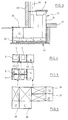
- the device has a box-shaped rotting chamber 1, the bottom is bounded by a perforated, horizontal intermediate floor 2.
- a perforated, horizontal intermediate floor 2 In a top wall 3 are entrances 4, 5 for waste.
- the entrance 4 is via a shaft 6 connected to a higher toilet seat 7.
- a directly Placed toilet seat 8 In the input 5 is a directly Placed toilet seat 8, which is installed on the top wall 3.
- the toilet seats 7, 8 have a downwardly tapering shell 7 ', 8' with an opening 7 ", 8" at the lower end.
- the inclined wall of the bowl 8 ' has at the lower end a retaining plate 8 "' for urine separation, which is preceded by a urine drain 8 IV .
- top wall 3 has an air passage 9 through which one to the environment leading exhaust pipe 10 is connected to an integrated exhaust fan 11.
- a mixing and conveying element 12 sits in the upper region of the rotting chamber 1 has a stirring shaft extending in the longitudinal direction of the rotting chamber 1 with a plurality of stirring blades, which are arranged axially distributed on it ("paddle stirrer").
- This Mixing and conveying member 12 is connected to a hand crank 13 which on the Front of the rotting chamber 1 protrudes and can be operated from the outside.
- crank handle 13 is in the front side of the rotting chamber 1 Inspection hatch 14 available.
- Fig. 1 the same mixing and conveying member 12 'is in a lower position within the rotting chamber 1 shown. At this position, the mixing and conveying body 12 'in particular prevent waste from slipping when it is not actuated becomes. When the mixing and conveying element 12 'is actuated, there is thorough mixing of the waste, its ventilation and its downward movement.
- Screw conveyor 15 which is arranged directly above the intermediate floor 2. This also extends in the longitudinal direction of the rotting chamber 1 over its entire depth. It has a drive device 16 at one end. If this - like drawn - is present at the front end, it can be an upward leading traction mechanism act, which in turn from the outside by means of a crank can be actuated. However, this can also be a rear from the rotting chamber 1 lead out, directly connected to the screw 15 crank handle.
- Ventilation ducts 17 to 20 In the four corners of the rotting chamber 1 are by additional plate-shaped walls separate ventilation ducts 17 to 20, each with a triangular cross-section, each with an upper and a lower opening.
- the top opening of all Ventilation ducts 17 to 20 are located in the upper area of the rotting chamber 1 and lower opening of the channels 17, 18 slightly above the screw conveyor 15 and Channels 19, 20 slightly below the intermediate floor 2.
- a box-shaped rotting chamber 21 In front of the rotting chamber 1 there is also a box-shaped rotting chamber 21 arranged, which is also limited below by the sieve plate 2, which extends over the Pre-rotting chamber 1 and the post-rotting chamber 21 extends.
- the post-rotting chamber 21 has a significantly lower height than the rotting chamber 1, but the same width.
- the depth of the rotting chamber 21 is also less than that of the rotting chamber 1.
- the post-rotting chamber 21 is separated from the rotting chamber 1 by an intermediate wall 23 separated, which is designed as a pusher to remove pre-rotted waste from the pre-rotting chamber 1 to transfer into the post-rotting chamber 21.
- the post-rotting chamber 21 has a removal flap 24 for post-rotting material.
- a top wall 25 of the post-rotting chamber 21 can be folded up as a whole Maintenance and revision purposes and for operating the slide 23 and possibly the Screw conveyor 15.
- Air channels 28, 29 are provided in the front corners of the post-rotting chamber 21, which also have a circular cross-section. These extend from the upper area the post-rotting chamber 21 to the intermediate floor 2.
- filter chamber 30 Below the continuous intermediate floor 2 is also a rectangular one, however relatively flat filter chamber 30 is present. This is about half of them Height filled with a filter layer 31. At the front it has an outlet 32 for liquid. A bilge pump 33, a level sensor 34, sits in the interior of the filter chamber 30 and an associated alarm device 35.
- the filter chamber 30 is located between the filter layer 31 and the intermediate floor 2 an air layer 36. This is at the front via the air channels 28, 29 with the air passage 26 connected and at least at the rear via the air channels 19, 20 to the upper area the rotting chamber 1 and thus with the air passage 9. It goes without saying that the air channels 28, 29, 19, 20 end in the area of holes in the intermediate floor 2 or even protrude through recesses in the sieve bottom 2 into the air layer 36.
- a negative pressure is thus formed in the pre-rotting chamber when the exhaust air valve 11 is in operation 1, which is for an air flow from the air passage 26 through the air layer 36 ensures up to the air passage 9 and causes an odor trap. Understands itself that the toilet seats 7, 8 essentially airtight cover exhibit.
- the filter chamber 30 is filled with a filter layer 31 which only needs to be changed every few years. Besides, will a filter bed 37 made of organic material is first introduced into the rotting chamber 1, and this or waste entered through the toilet seats 7, 8 also inoculated with compost organisms and / or soil animals. From time to time aggregates are also added to the waste in the rotting chamber 1.
- the mixing device 12 is actuated from time to time in order to support the precomposting.
- Urine passes through the urine separation 8 IV and the ventilation duct 19 directly into the filter chamber 30.
- Liquid seeps down from the pre-rotting chamber 1 and also passes through the intermediate floor 2 into the filter chamber 30.
- There the liquid is prepared and filtered and with the filter layer 31 an earth-like material. This is supported by the oxygen supplied through the air layer 36.
- the liquid overflow is prevented by the bilge pump 33.
- the slide 23 is opened from time to time and by means of the screw conveyor 15 pre-rotted material is filled into the post-rotting chamber 21, where residual liquid passes through the intermediate floor 2 can seep.
- the rotting material is through the removal flap 24 taken.
- such a device 38 can be installed directly in a building 39 be installed next to an outer wall 40.
- the rotting chamber 1 and one on it arranged toilet seat 8 are then almost completely within the Building.
- the connection area to the post-rotting chamber 21 or the post-rotting chamber themselves are located outside the building, below the Corridor level 41. In this respect, soil excavation at 42 may be required.
- the rotting material is removed from the rotting chamber 21 Opened the hinged top wall 25 removed.
- the outlet 32 for liquid is connected to the sewage system.
- the exhaust pipe 10 is guided over the roof.
- two toilet seats can run on the top wall 3 of the rotting chamber 1 8 can be placed, and a partition can be provided on both sides.
- toilet seats 8 are arranged on the pre-rotting chamber, specifically in two pairs in back-to-back arrangement. In between are building side Partitions 43 available.
- Figure 6 shows a larger installation of four devices 38, 38 ', three devices narrower width and a device of greater width are available.
Landscapes
- Chemical & Material Sciences (AREA)
- Health & Medical Sciences (AREA)
- Organic Chemistry (AREA)
- Molecular Biology (AREA)
- Life Sciences & Earth Sciences (AREA)
- General Chemical & Material Sciences (AREA)
- Biochemistry (AREA)
- Biotechnology (AREA)
- Chemical Kinetics & Catalysis (AREA)
- Engineering & Computer Science (AREA)
- Microbiology (AREA)
- Public Health (AREA)
- Fertilizers (AREA)
Applications Claiming Priority (2)
| Application Number | Priority Date | Filing Date | Title |
|---|---|---|---|
| DE29909785U DE29909785U1 (de) | 1999-06-04 | 1999-06-04 | Vorrichtung zur biologischen Umsetzung von organischen Abfällen zu einem erdähnlichen Endprodukt |
| DE29909785U | 1999-06-04 |
Publications (2)
| Publication Number | Publication Date |
|---|---|
| EP1057788A2 true EP1057788A2 (fr) | 2000-12-06 |
| EP1057788A3 EP1057788A3 (fr) | 2002-01-30 |
Family
ID=8074377
Family Applications (1)
| Application Number | Title | Priority Date | Filing Date |
|---|---|---|---|
| EP00112098A Withdrawn EP1057788A3 (fr) | 1999-06-04 | 2000-06-05 | Dispositif de transformation biologique de déchets organiques dans un produit final similaire à la terre |
Country Status (2)
| Country | Link |
|---|---|
| EP (1) | EP1057788A3 (fr) |
| DE (1) | DE29909785U1 (fr) |
Cited By (2)
| Publication number | Priority date | Publication date | Assignee | Title |
|---|---|---|---|---|
| WO2004107946A1 (fr) * | 2003-06-10 | 2004-12-16 | Hermanus Johannes Redelinghuys | Evacuation des dejections humaines |
| FR2968919A1 (fr) * | 2010-12-21 | 2012-06-22 | Petit Coin Nature | Toilettes seches avec trappe d'acces |
Families Citing this family (2)
| Publication number | Priority date | Publication date | Assignee | Title |
|---|---|---|---|---|
| DE102006006226B4 (de) * | 2006-02-09 | 2008-12-18 | Karsten Holzapfel | Kombinierter Fäkalien-Urin-Behälter |
| DE102019125178B4 (de) * | 2019-09-18 | 2025-09-18 | Theo Pauly | Einrichtung zum Sammeln von Exkrementen einer Trockentoilette |
Family Cites Families (5)
| Publication number | Priority date | Publication date | Assignee | Title |
|---|---|---|---|---|
| SE402450B (sv) * | 1976-07-23 | 1978-07-03 | Sundberg Hardy Mikael | Sett for behandling av avfallsmaterial i formultningsanordningar samt anordning for genomforande av settet |
| FI78897C (fi) * | 1988-09-01 | 1989-10-10 | Matti Juhani Yloesjoki | Komposter foer wc- och koeksavfall. |
| DE69314286T2 (de) * | 1992-11-26 | 1998-03-05 | Otsuka Science Co Ltd | Fermentationsvorrichtung für organische Abfälle zur Verhinderung von Geruchtsabgabe |
| DE4324142A1 (de) * | 1993-07-19 | 1995-02-09 | Ika Ind Kunststoff Anwendungen | Plattensystem |
| CA2286979A1 (fr) * | 1997-04-24 | 1998-11-05 | James Wright | Composteur automatise de petite taille |
-
1999
- 1999-06-04 DE DE29909785U patent/DE29909785U1/de not_active Expired - Lifetime
-
2000
- 2000-06-05 EP EP00112098A patent/EP1057788A3/fr not_active Withdrawn
Cited By (2)
| Publication number | Priority date | Publication date | Assignee | Title |
|---|---|---|---|---|
| WO2004107946A1 (fr) * | 2003-06-10 | 2004-12-16 | Hermanus Johannes Redelinghuys | Evacuation des dejections humaines |
| FR2968919A1 (fr) * | 2010-12-21 | 2012-06-22 | Petit Coin Nature | Toilettes seches avec trappe d'acces |
Also Published As
| Publication number | Publication date |
|---|---|
| DE29909785U1 (de) | 2000-10-19 |
| EP1057788A3 (fr) | 2002-01-30 |
Similar Documents
| Publication | Publication Date | Title |
|---|---|---|
| DE3991055C2 (de) | Vorrichtung zur Kompostierung von menschlichem Kot und Harn sowie von Lebensmittelabfällen | |
| DE112020000013T5 (de) | Mehrstufige hocheffiziente Kompostierungsvorrichtung und deren Verwendungsverfahren | |
| DE19530471C2 (de) | Vorrichtung zur Verarbeitung organischen Feststoffabfalls | |
| EP0873286A1 (fr) | Procede et dispositif de traitement aerobie de substances organiques | |
| DE3204471C2 (fr) | ||
| DE69434054T2 (de) | Kompostierungsanlage für organische abfälle und verfahren zur kompostierung dieser abfälle | |
| DE20107576U1 (de) | Vorrichtung zur Trocknung von Feuchtgut und Klarwasserabzugrohr für eine Kläranlage | |
| DE69807351T2 (de) | Kompostierungsanlage | |
| DE3630637C2 (de) | Vorrichtung zur Durchführung einer biologischen Umwandlung von organischen Stoffen | |
| DE2438039C2 (de) | Vorrichtung für die Kompostierung von organischem Müll | |
| DE2711803A1 (de) | Verfahren und vorrichtung zur waermegewinnung | |
| EP1057788A2 (fr) | Dispositif de transformation biologique de déchets organiques dans un produit final similaire à la terre | |
| DE69801502T2 (de) | Verfahren und anlage zur kompostierung von abbaubaren materialien | |
| EP0699255B1 (fr) | Construction prefabriquee en beton arme ou dans un materiau equivalent | |
| AT507246B1 (de) | Komposter | |
| DE2439251B2 (de) | Rundstall | |
| AT510133B1 (de) | Komposter | |
| DE102006006226B4 (de) | Kombinierter Fäkalien-Urin-Behälter | |
| DE2547134C3 (de) | Verfahren und Vorrichtung zur Kompostierung von Müll bzw. Müll-Klärschlammgemischen | |
| DE2057413B2 (de) | Hausmuellkompostierungszelle | |
| DE655901C (de) | Einrichtung zur Herstellung von Duengemitteln aus Haus- und Stadtmuell | |
| DE102010050354A1 (de) | Belüftungssystem | |
| DE4314786A1 (de) | Komposter | |
| DE1256233B (de) | Vorrichtung zur Herstellung von organischen Duengemitteln oder Komposten | |
| DE3100324A1 (de) | Vorrichtung zur umsetzung von biomasse in energie |
Legal Events
| Date | Code | Title | Description |
|---|---|---|---|
| PUAI | Public reference made under article 153(3) epc to a published international application that has entered the european phase |
Free format text: ORIGINAL CODE: 0009012 |
|
| AK | Designated contracting states |
Kind code of ref document: A2 Designated state(s): AT BE CH CY DE DK ES FI FR GB GR IE IT LI LU MC NL PT SE |
|
| AX | Request for extension of the european patent |
Free format text: AL;LT;LV;MK;RO;SI |
|
| PUAL | Search report despatched |
Free format text: ORIGINAL CODE: 0009013 |
|
| RIC1 | Information provided on ipc code assigned before grant |
Free format text: 7C 02F 11/00 A, 7A 47K 11/02 B, 7C 05F 3/04 B, 7C 05F 17/00 B, 7C 05F 17/02 B |
|
| AK | Designated contracting states |
Kind code of ref document: A3 Designated state(s): AT BE CH CY DE DK ES FI FR GB GR IE IT LI LU MC NL PT SE |
|
| AX | Request for extension of the european patent |
Free format text: AL;LT;LV;MK;RO;SI |
|
| 17P | Request for examination filed |
Effective date: 20020730 |
|
| AKX | Designation fees paid |
Free format text: AT BE CH CY DE DK ES FI FR GB GR IE IT LI LU MC NL PT SE |
|
| STAA | Information on the status of an ep patent application or granted ep patent |
Free format text: STATUS: THE APPLICATION IS DEEMED TO BE WITHDRAWN |
|
| 18D | Application deemed to be withdrawn |
Effective date: 20060812 |