EP1058111A2 - Optische Prüfvorrichtung und Verfahren - Google Patents
Optische Prüfvorrichtung und Verfahren Download PDFInfo
- Publication number
- EP1058111A2 EP1058111A2 EP00401435A EP00401435A EP1058111A2 EP 1058111 A2 EP1058111 A2 EP 1058111A2 EP 00401435 A EP00401435 A EP 00401435A EP 00401435 A EP00401435 A EP 00401435A EP 1058111 A2 EP1058111 A2 EP 1058111A2
- Authority
- EP
- European Patent Office
- Prior art keywords
- workpiece
- axis
- symmetry
- inspection
- optical assemblies
- Prior art date
- Legal status (The legal status is an assumption and is not a legal conclusion. Google has not performed a legal analysis and makes no representation as to the accuracy of the status listed.)
- Withdrawn
Links
- 238000007689 inspection Methods 0.000 title claims abstract description 100
- 230000003287 optical effect Effects 0.000 title claims abstract description 100
- 238000000034 method Methods 0.000 title claims description 36
- 238000005286 illumination Methods 0.000 claims abstract description 70
- 238000000429 assembly Methods 0.000 claims abstract description 67
- 230000000712 assembly Effects 0.000 claims abstract description 67
- 230000005855 radiation Effects 0.000 claims abstract description 24
- 230000007547 defect Effects 0.000 claims abstract description 17
- 238000000206 photolithography Methods 0.000 claims description 19
- 238000004519 manufacturing process Methods 0.000 claims description 16
- 239000013307 optical fiber Substances 0.000 claims description 14
- 230000007246 mechanism Effects 0.000 claims description 11
- 230000002250 progressing effect Effects 0.000 claims description 6
- 238000012545 processing Methods 0.000 claims description 3
- 239000011159 matrix material Substances 0.000 claims 1
- 235000012431 wafers Nutrition 0.000 description 108
- 230000008569 process Effects 0.000 description 13
- 229920002120 photoresistant polymer Polymers 0.000 description 8
- 239000004065 semiconductor Substances 0.000 description 7
- 238000010276 construction Methods 0.000 description 6
- 239000000463 material Substances 0.000 description 6
- 239000011248 coating agent Substances 0.000 description 4
- 238000000576 coating method Methods 0.000 description 4
- 239000000835 fiber Substances 0.000 description 4
- 238000013461 design Methods 0.000 description 3
- 238000010586 diagram Methods 0.000 description 3
- 238000003384 imaging method Methods 0.000 description 3
- 230000001902 propagating effect Effects 0.000 description 3
- 238000000151 deposition Methods 0.000 description 2
- 238000001514 detection method Methods 0.000 description 2
- 230000000694 effects Effects 0.000 description 2
- 238000005530 etching Methods 0.000 description 2
- 238000012986 modification Methods 0.000 description 2
- 230000004048 modification Effects 0.000 description 2
- XLYOFNOQVPJJNP-UHFFFAOYSA-N water Substances O XLYOFNOQVPJJNP-UHFFFAOYSA-N 0.000 description 2
- XUIMIQQOPSSXEZ-UHFFFAOYSA-N Silicon Chemical compound [Si] XUIMIQQOPSSXEZ-UHFFFAOYSA-N 0.000 description 1
- 238000011109 contamination Methods 0.000 description 1
- 230000008021 deposition Effects 0.000 description 1
- 238000011161 development Methods 0.000 description 1
- 238000007599 discharging Methods 0.000 description 1
- 239000000428 dust Substances 0.000 description 1
- 230000006870 function Effects 0.000 description 1
- 239000011521 glass Substances 0.000 description 1
- 238000001459 lithography Methods 0.000 description 1
- 238000005259 measurement Methods 0.000 description 1
- 238000012544 monitoring process Methods 0.000 description 1
- 239000002245 particle Substances 0.000 description 1
- 238000000059 patterning Methods 0.000 description 1
- 230000003252 repetitive effect Effects 0.000 description 1
- 229910052710 silicon Inorganic materials 0.000 description 1
- 239000010703 silicon Substances 0.000 description 1
- 239000007787 solid Substances 0.000 description 1
- YDLQKLWVKKFPII-UHFFFAOYSA-N timiperone Chemical compound C1=CC(F)=CC=C1C(=O)CCCN1CCC(N2C(NC3=CC=CC=C32)=S)CC1 YDLQKLWVKKFPII-UHFFFAOYSA-N 0.000 description 1
- 229950000809 timiperone Drugs 0.000 description 1
- 238000013519 translation Methods 0.000 description 1
- 230000000007 visual effect Effects 0.000 description 1
Images





Classifications
-
- G—PHYSICS
- G01—MEASURING; TESTING
- G01N—INVESTIGATING OR ANALYSING MATERIALS BY DETERMINING THEIR CHEMICAL OR PHYSICAL PROPERTIES
- G01N21/00—Investigating or analysing materials by the use of optical means, i.e. using sub-millimetre waves, infrared, visible or ultraviolet light
- G01N21/84—Systems specially adapted for particular applications
- G01N21/88—Investigating the presence of flaws or contamination
- G01N21/95—Investigating the presence of flaws or contamination characterised by the material or shape of the object to be examined
- G01N21/9501—Semiconductor wafers
-
- G—PHYSICS
- G01—MEASURING; TESTING
- G01N—INVESTIGATING OR ANALYSING MATERIALS BY DETERMINING THEIR CHEMICAL OR PHYSICAL PROPERTIES
- G01N21/00—Investigating or analysing materials by the use of optical means, i.e. using sub-millimetre waves, infrared, visible or ultraviolet light
- G01N21/84—Systems specially adapted for particular applications
- G01N21/88—Investigating the presence of flaws or contamination
- G01N21/95—Investigating the presence of flaws or contamination characterised by the material or shape of the object to be examined
- G01N21/956—Inspecting patterns on the surface of objects
-
- G—PHYSICS
- G01—MEASURING; TESTING
- G01N—INVESTIGATING OR ANALYSING MATERIALS BY DETERMINING THEIR CHEMICAL OR PHYSICAL PROPERTIES
- G01N21/00—Investigating or analysing materials by the use of optical means, i.e. using sub-millimetre waves, infrared, visible or ultraviolet light
- G01N21/84—Systems specially adapted for particular applications
- G01N21/88—Investigating the presence of flaws or contamination
- G01N21/8806—Specially adapted optical and illumination features
- G01N2021/8822—Dark field detection
- G01N2021/8825—Separate detection of dark field and bright field
-
- G—PHYSICS
- G01—MEASURING; TESTING
- G01N—INVESTIGATING OR ANALYSING MATERIALS BY DETERMINING THEIR CHEMICAL OR PHYSICAL PROPERTIES
- G01N21/00—Investigating or analysing materials by the use of optical means, i.e. using sub-millimetre waves, infrared, visible or ultraviolet light
- G01N21/84—Systems specially adapted for particular applications
- G01N21/88—Investigating the presence of flaws or contamination
- G01N21/94—Investigating contamination, e.g. dust
-
- G—PHYSICS
- G01—MEASURING; TESTING
- G01N—INVESTIGATING OR ANALYSING MATERIALS BY DETERMINING THEIR CHEMICAL OR PHYSICAL PROPERTIES
- G01N2201/00—Features of devices classified in G01N21/00
- G01N2201/06—Illumination; Optics
- G01N2201/063—Illuminating optical parts
- G01N2201/0635—Structured illumination, e.g. with grating
Definitions
- the present invention is in the field of automatic inspection techniques, and relates to an optical inspection method and system, particularly useful for inspecting semiconductor wafers progressing on a production line.
- the manufacture of semiconductor devices consists of a multi-staged process requiring wafers progressing on a production line to be inspected between sequential manufacturing steps.
- One of the principle processes in the manufacture of semiconductor devices is the photolithography process. It consists of patterning the wafer's surface in accordance with the active elements of semiconductor devices to be manufactured.
- the photolithography process includes the following main operational steps:
- the wafer prior to the photolithography process, the wafer is prepared for the deposition of one or more layers. After the completion of the photolithography process, the uppermost layer of the wafer is etched. Then a new layer is deposited, in order to start the photolithography and etching operations again. In this repetitive manner, a multi-layer semiconductor wafer is produced.
- Fig. 1 illustrates a block diagram of a typical photocluster 1 used for performing the photolithography process in semiconductor fabrication plants (FABs).
- the photocluster 1 (or link) is composed of two main parts: a phototrack 2 and an exposure tool 4.
- the phototrack 2 includes a coater track 6 associated with a cassette load station 6a , and a developer track 8 associated with a cassette unload station 8a .
- a load/unload robot R is mounted for movement within the photocluster 1 for conveying wafers W to and from the photocluster tools.
- the coater track 6 , the exposure tool 4 and the development track 8 are tightly joined together in order to minimize process variability and any potential risk of contamination during photolithography, which is a super sensitive process.
- a manual inspection technique is conventionally used for inspecting the wafers for so-called macro lithography defects, such as scratches or foreign particles of dust and dirt.
- macro defects are considered as defects having tenths of micrometers in size.
- the manual inspection technique utilizes the visual examination of the wafer's surface by an operator using intense light and magnification. This inspection is inconsistent and unreliable, since the results vary significantly amongst operators, due to the wafer's complexity and depending on the operators' experience. About 80% of the photo-related defects remain undetected. Manual inspection has low throughput, and could not be performed within the FAB tools. Manual inspection is not cost effective.
- the area sensor based technique utilizes a so-called step-and-repeat mode of operation, wherein the camera and the wafer are mounted for movement relative to each other to cover the entire surface of the wafer. More specifically, the camera and the wafer are moved step-by-step, and images are acquired upon the camera or the wafer stops.
- This technique requires a quite complicated mechanical stage providing movement along two mutually perpendicular axes. Additionally, it results in low throughput due to a great number of movement steps, and requires an additional footprint for performing such a two-dimensional movement.
- Machine vision systems having multiple cameras have been developed, being disclosed, for example, in U.S. Patent No. 5,768,443.
- images are acquired simultaneously by a plurality of cameras.
- the fields of view of the cameras cover a relatively large area of the wafer under inspection, thereby increasing the throughput of the system, as compared to the techniques utilizing a single line or area sensor.
- this patent does not present any example of the cameras' arrangement, which would be useful in an integrated inspection.
- An inspection machine should be inexpensive, simple to erect and maintain, and should have a small footprint (like a wafer cassette) to meet the requirements of the integrated inspection.
- Laser inspection systems have been developed which utilize various types of scanners and collectors for scanning the wafer's surface during the translational movement and for collecting light reflective and scattered from the surface. Such systems are disclosed, for example, in U.S. Patent Nos. 4,630,276; 5,108,176; 5,127,726 and 5,712,701. Unfortunately, these systems are complicated and expensive. Since they use monochromatic laser illumination, they are non-effective and insufficient for the inspection of developed photoresist for macro defects.
- the optical inspection system may be integrated into the production line. It is simple, inexpensive and compact, and provides for inspection with a high throughput of workpieces.
- a semiconductor wafer is typically a substantially flat workpiece, having an axis of symmetry (i.e. is round). Consequentially, one half of the wafer can be inspected by appropriately moving respective parts of a scanning apparatus above it, and, upon rotating the wafer about its axis of symmetry by 180°, inspecting the other half of the wafer.
- suitable mechanics should be provided for moving the respective components of the scanning apparatus solely within an inspection area equal to the half of the wafer, rather than moving them above the entire wafer, or moving both the respective components and the wafer relative to each other.
- a plurality of optical assemblies is mounted for movement above the wafer within the inspection area, the optical assemblies being aligned in a line parallel to the axis of symmetry of the wafer between the opposite sides thereof.
- a plurality of sensors is provided, each sensor being associated with a corresponding one of the plurality of optical assemblies.
- an optical inspection system for detecting defects on a substantially flat workpiece having an axis of symmetry, the system comprising a stage supporting said workpiece in an inspection plane, and a scanning apparatus accommodated above said workpiece, wherein:
- the illumination assembly may operate in bright-field illumination mode.
- it comprises a plurality of stationary mounted light sources aligned corresponding to the alignment of the optical assemblies, each incident radiation component being directed on the corresponding optical assembly, which, in turn, directs it onto the corresponding region of the workpiece.
- the illumination assembly may operate in a dark-filed illumination mode.
- it includes either a plurality of light sources, each accommodated in the vicinity of the corresponding optical assembly, or an elongated light source, extending along the optical assemblies in the proximity thereof.
- This "dark-field" illumination assembly is mounted for movement together with the optical assemblies. If the dark-field light illumination is used in addition to the bright-field illumination, the operation of the stationary mounted light sources and the operation of the movable light sources are time separated.
- the stationary mounted light sources may be continuously operated, while the movable light sources are selectively actuated to inspect only those locations on the workpiece where either a potential defect has been detected during the bright-field mode, or a real defect is expected.
- the area sensors may be arranged in a line parallel to the axis of symmetry and associated with the optical assemblies, so as to move together with the optical assemblies.
- the area sensors may be arranged in two parallel lines, parallel to the axis of symmetry, wherein each two adjacent sensors are displaced from each other along two mutually perpendicular axes.
- an additional light directing assembly is provided for receiving the components of the returned radiation ensuing from the optical assemblies, and directing them onto to the area sensors.
- a photolithography tools arrangement for processing a stream of substantial flat workpieces progressing on a production line, which tools arrangement comprises an optical inspection system constructed as described above.
- a method for inspecting a substantial flat workpiece having an axis of symmetry comprising the steps of:
- the present invention is used for inspecting wafers progressing within a photolithography tools set-up, and is therefore described below with respect to this application.
- Fig. 1 illustrates the configuration of the conventional photocluster 1 , which comprises the phototrack 2 and the exposure tool 4 , wherein the photo track is composed of the water track 6 and the developer track 8 .
- the water and developer tracks have their associated cassette load and unload stations 6a and 8a , respectively.
- the cassettes containing wafers are supplied to the phototrack 2 , being loaded from the station 6a onto the coater track 6 .
- a photoresist material is deposited onto the wafer's surface, and then the robot R transmits the coated wafer to the exposure tool 4 .
- the photoresist coating is exposed to light through a mask having a predetermined pattern to produce a latent image of the mask on the photoresist coating. Thereafter, the robot R transmits the wafer to the developer track 8 for developing the latent image.
- a photocluster 10 (constituting a photolithography tools arrangement) constructed according to one example of the invention.
- the same reference numbers are used for identifying those components which are common in the photoclusters 1 and 10 , to facilitate understanding.
- the photocluster 10 is constructed generally similar to the conventional photocluster 1 , but comprises an optical inspection system 12 , constructed and operated according to the invention, as will be described further below.
- the optical inspection system 12 is compact so as to be easily installed within the conventionally designed photocluster, enabling the use of the same robot R for feeding and discharging the wafers to and from the inspection system 12 .
- the system 12 may be dimensioned and shaped similar to that of the conventional cassette.
- the exact location of the inspection system 12 within the photocluster is selected in accordance with the considerations and circumstances of a specific manufacturer, an available foot-print inside the phototrack and the FAB considerations. Since the inspection system 12 is extremely compact, it can be positioned at a cassette location in the unloading area, or any other location accessible for the load/unload robot R .
- Fig. 2b illustrates a photolithography tools arrangement 14 , constructed according to another example of the invention.
- the arrangement 14 utilizes the photocluster 1 and the optical inspection system 12 , which is installed as a stand-alone unit within the photolithography tools arrangement 14 similar to the wafers' load/unload cassette station 15 .
- the robot R conveys wafers from the cassette 15 to the inspection system 12 and returns the inspected wafers back to the cassette station 15 , and supplies and discharges wafers to and from the photocluster 1 .
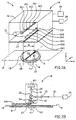
- Fig. 3a illustrates the main constructional parts of the optical inspection system 12 , constructed according to one embodiment of the invention.
- the inspection system 12 comprises a scanning apparatus 16 for inspecting a wafer W located on a support stage 18 , which supports the wafer W in an inspection plane IP .
- the wafer W has an axis of its symmetry OP defining half-parts P 1 and P 2 of the wafer W at opposite sides of the axis OP .
- Coupled to the stage 18 is a first drive mechanism D 1 for driving the rotational movement of the stage 18 within a plane parallel to the inspection plane IP .
- the scanning apparatus 16 inspects the wafer W within an inspection area IA defined by the half P 1 of the wafer, as will be described more specifically further below. Then, the drive mechanism D 1 operates to rotate the stage 18 by 180°, thereby locating the other half P 2 of the wafer within the inspection area IA .
- the scanning apparatus 16 comprises a sealed housing 22 containing a plurality of optical assemblies, for example five optical assemblies OA 1 -OA 5 , and a corresponding plurality of area sensors AS 1 -AS 5 .
- An illumination assembly 24 and a control unit 26 are accommodated outside the housing 22 .
- the housing 22 is formed with an optically transparent bottom portion 22a (i.e., window) substantially covering the inspection area IA (one half of the wafer).
- a second drive mechanism D 2 is accommodated inside the housing so as to be outside the inspection area IA .
- the drive mechanism D 2 is associated with the optical assemblies OA 1 -OA 5 and with the area sensors AS 1 -AS 5 for driving a reciprocation movement thereof along the X -axis within the inspection area IA .
- a suitable guiding assembly is provided for slidingly supporting the moving parts (i.e., optical assemblies and area sensors) inside the housing 22 .
- the optical assemblies OA 1 -OA 5 are accommodated above the window 22a being aligned along the Y -axis parallel to the axis of symmetry OP in a spaced-apart parallel relationship between the opposite sides of the wafer.
- the sensors AS 1 -AS 5 are arranged like a "rule" extending along the Y -axis and spaced from the optical assemblies along the Z -axis.
- the construction and operation of the control unit 26 do not form part of the present invention and may be of any known suitable kind, and therefore need not be specifically described, except to note the following.
- the control unit 26 includes several suitable utilities. Some of them are associated with the sensors AS 1 -AS 5 for receiving and analyzing data representative of radiation returned from the wafer W , and the other are associated with the driver assemblies D 1 and D 2 for synchronizing the movements of the stage 16 and moving components of the scanning apparatus.
- the control unit 26 is typically a computer device comprising a suitable pattern recognition software and a translation means so as to be responsive to data representative of the radiation returned from the wafer W and locate defects, if any.
- This software generates a gray level bit map of the acquired images, which may, for example, be stored in a memory.
- the analyzing of the obtained data is performed in a die-to-die, die-to-many dies or die-to-database manner.
- the control unit 26 and the illumination assembly 24 are located outside the area occupied by the photocluster
- the control unit 26 may operate the driver assemble D 1 to rotate the wafer W , and operate the periphery sensors, e.g. AS 1 and AS 5 , along with the corresponding illuminating assemblies, to acquire images of the wafer's edge and analyze them, so as to detect a registration mark, i.e., "notch" or "flat". After the notch or flat is detected, the wafer could be turned so as to provide desired orientation of the main wafer direction. Preferably, the main wafer direction coincides with the X -axis, i.e., with the direction of movement of the optical assemblies OA 1 -OA 5 .
- Fig. 3b schematically illustrates the main operational principles of the system 12 .
- the beam propagation is shown here schematically to facilitate the illustration.
- the illumination assembly 24 comprises a suitable number of light sources or a single light source equipped with suitable light splitting means, capable of producing a plurality of incident light components.
- a corresponding number of lenses 30 are stationary mounted inside the housing 22 being aligned according to that of the optical assemblies.
- Each incident light component impinges onto a corresponding one of the optical assemblies (five in the present example), the component B 1 associated with the optical assembly OA 1 being seen in Fig. 3b.
- the optical assembly OA 1 comprises a beam splitter 32 and an objective lens assembly including inter alia a field lens 34 .
- the area sensor AS 1 is associated with an imaging tube lens 38 .
- the beam splitter 32 directs the incident light component B 1 onto the objective lens assembly (only the field lens 34 thereof being shown here), which, in turn, focuses the light component B 1 onto a region S 1 on the wafer.
- a light component B 1 ' returned from the illuminated region S 1 is directed onto the lens 38 by the beam splitter 32 . It is understood, although not specifically shown, that regions illuminated by all the incident light components via the optical assemblies OA 1 -OA 5 form together the illuminated strip S extending parallel to the diameter of the wafer W .
- each of the sensors AS 1 -AS 5 acquires an image of the illuminated region S 1 and generates data representative thereof.
- the respective utilities of the control unit 26 receive and analyze these data to locate defects, if any, within the entire illuminated strip S composed of the regions S 1 -S 5 .
- the illumination assembly 24 operates in a so-called "bright-field illumination" mode.
- the scanning apparatus 18 comprises an additional illumination assembly 40 mounted inside the housing 22 for the purpose to move together with the optical assemblies OA 1 -OA 5 and sensors AS 1 -AS 5 within the inspection area IA .
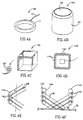
- Figs. 4a and 4b illustrate one possible design for the illumination assembly 40 .
- the illumination assembly 40 is composed of a corresponding number of light sources, each associated with a corresponding one of the optical assemblies (not shown here).
- a light source is designed like a ring 41 formed by a plurality of LEDs or optical fibers (not shown).
- an external light source (not shown) associated with a fiber bundle 42 may be used.
- the ring 41 would enclose the corresponding field lens (not shown).
- the light source is designed like a cylinder 43 , which also may be formed by a plurality of LEDs.
- the illumination assembly 40 may include either a single elongated light source mounted in the proximity of the field lenses 34 of the optical assemblies so as to extend along the Y -axis, or a pair of such elongated light sources mounted at opposite sides of the optical assemblies.
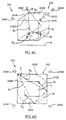
- Figs. 4c-4f there is illustrated another possible design of a dark-field illumination assembly 140 , aimed at providing the illumination of each region on the wafer at substantially 45°-angle between the vertical plane defined by the average direction of the incident beam propagation and those of the pattern (as seen from the top).
- a pattern on the wafer is typically arranged in the so-called “streets-and-avenues” manner, and the illumination at 45°-azimuth angle, ⁇ , enables to eliminate or at least significantly reduce the undesirable diffraction effects caused by the pattern.
- the illumination assembly 140 is in the form of a corresponding number of light sources, each in the form of a rectangular frame carrying a plurality of light emitting elements 142 (e.g., LEDs) and a plurality of identical transparent ball-like lenses 144 for directing emitting light towards the inspection plane.
- the lens 144 may be of another suitable shape, being shaped like a ball in the present example.
- the balls 144 are arranged in rows and columns so as to form four sides of the rectangular frame, such that contact is provided between each two adjacent balls.
- Each of the light emitting elements is located in the corresponding one of the spaces formed between the balls.
- the ball 144 has the diameter of about 3mm, and is made either from glass or optical-quality plastic.
- the light source 142 is about 0.3mm in size.
- the projection of a field of view F i of the corresponding sensor AS 1 is located in the center of the horizontal plane defined by the rectangular frame 140 enclosing the field of view F i .
- the length of the frame's wall is about 1.5-2 times larger than that of the field of view F i of the area sensor.
- Figs. 4e and 4f partly show top and side views, respectively, of the balls-LEDs assembly 140 .
- Each ball 144 serves as a lens accommodated in the optical path of a light beam B emitted by the corresponding LED 142 .
- the light beams B propagate through the corresponding balls 144 and, whilst ensuing therefrom, become directed onto the wafer W at 45°-azimuth angle.
- the emitting surface of the LED is appropriately oriented with respect to the corresponding balls, and is located in the focus plane thereof.
- the 45°-angle provided by the LED-balls assembly is the azimuth angle, while an elevation angle, ⁇ , may be different.
- Eletitude angle used herein is the angle between the incident beam and the wafer's plane as seen from the side.
- a dark-field illumination assembly generally designated 240 , aimed at providing the illumination with the substantially 45°-angle.
- the illumination assembly 240 comprises a plurality of light sources each in the form of a rectangular frame 242 carrying four light emitting elements (e.g., LEDs) 244a , 244b , 244c and 244d which are accommodated at the upper corners of the frame 242 , respectively, aimed at providing the propagation of their central beams at the opposite corners.
- the inner surfaces 242a-242d of the frame 242 are mirrors.
- the frame 242 is vertically aligned with the corresponding field lens 34 .
- the construction is such that the projection of the field of view F of the corresponding sensor (not shown) occupies the central region of the frame.
- the light emitting elements 244a-244d are accommodated in the focal plane of the field lens 34 .
- Each light emitting element emits a beam B , which slightly diverges, e.g., within the angle of 14°, and, while propagating towards the lens 34 through the frame 242 , is sequentially reflected from two adjacent mirrors located opposite (along the diagonal axis) to the corresponding light emitting element.
- light beams emitted by all the emitting elements end propagating as described above impinge onto the field lens 34 at the substantially near 45°-angle, which lens produces collimated beams of 45°-azimuth angle of incidence.
- This construction provides the dark-field illumination of an area within the entire field of view F of the area sensor, with the desired uniformity of illumination.
- the illumination assembly operating in the dark-filed illumination mode is optional. Should this assembly be used, its operation is timely separated from the operation of the bright-field illumination assembly 24 , and it may be operated selectively. In other words, whilst continuously inspecting the wafer using the illumination assembly 24 , at selective locations on the wafer (strips), the operation of the assembly 24 is halted and the dark-field illumination assembly is switched-on. These selective locations may be those, where a potential defect has been detected during the bright-field illumination mode of the system 12 , or a real defect is expected, which is usually the case when dealing with such patterned workpieces as wafers.
- a scanning technique suitable to be used in the present invention aimed at inspecting a strip-like scanning field SF on the wafer by all the sensors AS 1 -AS 5 .
- the fields of view F 1 -F 5 of the sensors AS 1 -AS 5 are aligned along the Y -axis and define together a continuous scanning field SF that extends along the wafer's diameter.
- the movement of the housing 22 along the X -axis is such so as to provide a small overlap region 44 between the scanning fields of each two locally adjacent positions of the sensors AS 1 -AS 5 .
- the entire scanning field is formed by the fields of view F 1 -F 5 of all the sensors AS 1 -AS 5 .
- These fields of view cover a corresponding number (five in the present example) spaced-apart areas aligned along the Y -axis, rather than the overlapping areas as in the previously described example
- a scanning field is "discontinuous". This is associated with the fact that the specular reflection from a patterned article, such as wafer, will unavoidably require the field lens to be at least slightly larger than the field of view of the area sensor, which creates the spaces between the fields of views of the adjacent sensors.
- Fig. 5a When dealing with the detection of non-specular reflected light (Lambertian), the example of Fig. 5a provides sufficient results.
- additional step-like movement of the optics (and, optionally, the corresponding sensors) is provided along the Y -axis, with a pitch not less than the space between the areas (preferably, slightly exceeding this space).
- a so-called “calibration target” is formed along a strip 23 on the window 22a .
- the calibration target 23 serves for calibrating the sensors prior to inspection, for example, correcting the non-uniformity of illumination, etc.
- FIG. 6 illustrating an optical inspection system 112 constructed according to another embodiment of the invention, suitable to be used in the photolithography tools arrangement of either of Figs. 2a or 2b.
- the same reference numbers are used for identifying common components of the systems 12 and 112 , and the beam propagation is shown schematically.
- a scanning apparatus 116 of the system 112 has a somewhat different construction as compared to that of the system 12 .
- the following elements are accommodated inside the housing 22 : optical assemblies OA 1 -OA 5 , illumination assembly 40 , sensors AS 1 -AS 5 , a plurality of mirrors 46 (or a single elongated mirror) aligned along the Y -axis above the optical assemblies, imaging tube lenses 38 and an additional light directing assembly 48 .
- the drive mechanism D 2 is also mounted inside the housing 22 and is coupled to the optical assemblies OA 1 -OA 5 and to the mirror(s) 46 for driving the reciprocation movement thereof.
- the sensors AS 1 -AS 5 are stationary mounted inside the housing 22 , rather than being mounted for movement together with the optical assemblies OA 1 -OA 5 .
- the additional light directing assembly 48 serves for dividing the returned light components B i ' reflected from the mirror 46 into two groups 49a and 49b propagating, respectively, along the Z - and X -axes.
- the sensors AS 1 -AS 5 are aligned in two parallel lines L 1 and L 2 which extend along the Y -axis and are spaced from each along the X -and Z -axes. Each two adjacent sensors are spaced from each other along the X -and Z -axes.
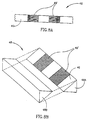
- the light directing assembly 48 is in the form of a parallelepiped, which is substantially optically transparent, except for spaced-apart reflective regions 49b formed on its inner diagonal surface 49 .
- the light directing assembly 48 may be constructed by attaching a pair of parallel sides of a pair of symmetrically identical triangular prisms 48a and 48b to each other. One of these parallel sides has the patterned surface 49 .
- the pattern may, for example, be made by depositing a reflective material onto the regions 49a through a mask. It should be noted, although not specifically shown, that beam-splitter cubes may replace the prisms 48a and 48b .
- the operation of the system 112 is generally similar to that of the system 12 .
- the moving elements i.e., the optical elements OA 1 -OA 5 , mirror(s) 46 , and, optionally, the illumination assembly 40 ) step-by-step move along the X -axis between the center region and the periphery region of the wafer (i.e., within the inspection area IA ).
- One half of the wafer is strip-by-strip inspected.
- the stage 16 rotates by 180° parallel to the inspection plane IP , resulting in that the other half of the wafer is positioned within the inspection area IA , and the inspection is repeated by step-by-step moving the respective elements from the periphery region of the wafer towards its center region.
- the moving elements may be returned to their initial position above the center region of the wafer prior to starting the inspection of the second half of the wafer.
- the inspection proceeds from the center region to the periphery region of the wafer.
- Fig. 5b it should be understood that various operational modes are possible. For example, after completing the scanning of the half of the wafer by step-by-step movements along the X -axis, the fields of view of the sensors are shifted along the Y -axis and the inspection area IA is passed with this shifted position of the fields of view. In this case, the sensors may and may not be returned into their initial position relative to the wafer prior to the shifting procedure.
- An alternative operational mode consists of step-by-step performing the Y -axis shift of the fields of view for each sensors' position along the X -axis.
- the number of area sensors, and, accordingly, of the optical assemblies, suitable to be used in the system 12 , 112 is dictated by the dimensions of the wafer to be inspected and the desired image resolution. For example, if a standard 200mm wafer should be inspected with the resolution of 50 ⁇ m, eight commercially available TV cameras (i.e., each having approximately 500x600 pixels) may be used as the area sensors.
- the scanning time at each relative location of the moving components relative to the wafer is approximately 170msec
- the time for moving these elements from strip to strip is about 0.5sec
- the inspection area one half of the wafer
- the total inspection time for the entire wafer is about 5.4sec.
- total inspection time per wafer would be about 10sec. It is understood that such brief inspection time would not affect the throughput of the photolithography tools arrangement, nor would it impede the regular operation of the robot.
- a large area of the wafer i.e., a strip extending along the entire diameter of the wafer
- the illumination assembly may comprise a suitable number of light sources.
- a single light source equipped with suitable light splitting means capable of producing a plurality of incident light components may be provided.
- Figs. 9a and 9b illustrate two possible constructions of such an illumination assembly having a single light source.
- an illumination assembly 124 comprises a lamp 50 associated with a plurality of condensers C 1 - C 8 and optical fibers OF 1 -OF 8 (constituting a light guiding means), eight in the present example, considering eight cameras and eight optical assemblies.
- Eight shutters, generally at 52 are provided, each associated with a corresponding one of the optical fibers.
- the shutters may be of either mechanical or electrooptical type.
- the provision of the shutters 52 is aimed at the following. Whilst illuminating the plurality of regions within the illuminated strip S through separate field lenses 34 , a certain overlap of two locally adjacent illuminated regions occurs, unavoidably resulting in the non-uniform illumination within such an overlapping area. To avoid this effect, the array of the regions within the strip S may be illuminated sequentially, by sequentially opening the shutters 52 . Alternatively, the shutters may be operated in such a manner that the regions illuminated at each time unit are disposed in a so-called "chess-board" order, thereby enabling the interlaced illumination. It should be noted that such shutters enabling the sequential illumination of the array of regions within the strip or the interlaced illumination of these regions may also be used with a plurality of separate light sources.
- Fig. 9b illustrates a section view of an illumination assembly 224 having a somewhat different construction as compared to the assembly 124 .
- the assembly 224 similarly to the assembly 124 , includes the lamp 50 , a condenser 51 and a plurality of optical fibers (fibers OF 1 and OF 5 are shown in the figure), but is also provided with a mirror 54 .
- the mirror 54 is mounted in the optical path of a primary beam B , and is rotatable, preferably step-by-step, about an axis AP of propagation of the beam B towards the mirror 54 , by a suitable driver (not shown).
- the mirror 54 is oriented at 45° to the vertical axis AP , and rotates in the horizontal plane, the input faces of the optical fibers being arranged in a spaced-apart relationship in the horizontal plane.
- the rotation of the mirror 54 will result in the sequential illumination of the input faces of the optical fibers and, consequently, the regions within the strip S .
- the frequency of the rotation of the mirror 54 is about 7Hz.
- Fig. 10 partly illustrates the scanning apparatus 18 .
- the wafer W under inspection is located in a focal plane FP of the objective lens assemblies (shown here as field lenses 34 ).
- the calibration pattern 23 is provided serving for calibrating the sensors prior to inspection, and should therefore be also located in the focal plane FP .
- the calibration pattern 23 extends parallel to the inspection plane IP but is located in a plane IP' perpendicular thereto, and a mirror 56 is accommodated in the optical path of the incident beam ensuing from the field lens 34 .
- the location of the mirror is selected such as to ensure that the optical distance d 1 between the optical window 22A and the wafer (i.e., the focal plane FP ) is equal to the distance d 2 between the plane IP' and a point 56A of incidence of the beam B 1 onto the mirror 56 .
- the mirror 56 is mounted stationary, and therefore does not impede the inspection of the half of the wafer through the moving optical assemblies.
- a glass-piece 58 is preferably accommodated in the optical path of the incident beam B 1 on its way towards the calibration pattern 23 . This enables to obtain substantially identical conditions for light propagation during the inspection and calibration procedures.
- the advantages of the present invention are self-evident.
- the optical inspection system constructed and operated according to the invention is compact, provides for maintaining the wafer stationary during the inspection and utilizes a rigid and very stable scanning apparatus capable of fast scanning of the wafer.
- the scanning apparatus is fully separated from the photolithography environment owing to the fact that all moving components of the scanning apparatus are located within the sealed housing 22 , while the control unit 26 and illumination assembly 24 are located outside the track clean area.
- the optical inspection system according to the invention has the option to be bypassed by the production process and to be simultaneously operated in off-line or integrated modes.
Landscapes
- Physics & Mathematics (AREA)
- Health & Medical Sciences (AREA)
- Life Sciences & Earth Sciences (AREA)
- Chemical & Material Sciences (AREA)
- Analytical Chemistry (AREA)
- Biochemistry (AREA)
- General Health & Medical Sciences (AREA)
- General Physics & Mathematics (AREA)
- Immunology (AREA)
- Pathology (AREA)
- Investigating Materials By The Use Of Optical Means Adapted For Particular Applications (AREA)
- Exposure Of Semiconductors, Excluding Electron Or Ion Beam Exposure (AREA)
- Length Measuring Devices By Optical Means (AREA)
- Testing Or Measuring Of Semiconductors Or The Like (AREA)
Applications Claiming Priority (4)
| Application Number | Priority Date | Filing Date | Title |
|---|---|---|---|
| IL13008799 | 1999-05-24 | ||
| IL13008799A IL130087A0 (en) | 1999-05-24 | 1999-05-24 | Optical inspection method and system |
| US501230 | 2000-02-10 | ||
| US09/501,230 US6407809B1 (en) | 1999-05-24 | 2000-02-10 | Optical inspection system and method |
Publications (2)
| Publication Number | Publication Date |
|---|---|
| EP1058111A2 true EP1058111A2 (de) | 2000-12-06 |
| EP1058111A3 EP1058111A3 (de) | 2001-05-02 |
Family
ID=26323842
Family Applications (1)
| Application Number | Title | Priority Date | Filing Date |
|---|---|---|---|
| EP00401435A Withdrawn EP1058111A3 (de) | 1999-05-24 | 2000-05-23 | Optische Prüfvorrichtung und Verfahren |
Country Status (2)
| Country | Link |
|---|---|
| EP (1) | EP1058111A3 (de) |
| JP (1) | JP2001133416A (de) |
Cited By (5)
| Publication number | Priority date | Publication date | Assignee | Title |
|---|---|---|---|---|
| WO2003023718A1 (en) * | 2001-09-07 | 2003-03-20 | Nline Corporation | System and method for registering images |
| WO2003040709A3 (en) * | 2001-11-07 | 2004-01-08 | Applied Materials Inc | Spot grid array imaging system |
| US6841787B2 (en) | 2001-11-07 | 2005-01-11 | Applied Materials, Inc. | Maskless photon-electron spot-grid array printer |
| US6946655B2 (en) | 2001-11-07 | 2005-09-20 | Applied Materials, Inc. | Spot grid array electron imaging system |
| CN109975311A (zh) * | 2019-04-08 | 2019-07-05 | 清华大学深圳研究生院 | 一种轮转式多环境aoi检测装置和方法 |
Families Citing this family (2)
| Publication number | Priority date | Publication date | Assignee | Title |
|---|---|---|---|---|
| JP6015100B2 (ja) * | 2012-04-26 | 2016-10-26 | Jfeスチール株式会社 | H形鋼の曲がり状態判定方法および曲がり状態判定装置 |
| US9689804B2 (en) * | 2013-12-23 | 2017-06-27 | Kla-Tencor Corporation | Multi-channel backside wafer inspection |
Family Cites Families (4)
| Publication number | Priority date | Publication date | Assignee | Title |
|---|---|---|---|---|
| US5298989A (en) * | 1990-03-12 | 1994-03-29 | Fujitsu Limited | Method of and apparatus for multi-image inspection of bonding wire |
| US5274434A (en) * | 1990-04-02 | 1993-12-28 | Hitachi, Ltd. | Method and apparatus for inspecting foreign particles on real time basis in semiconductor mass production line |
| US5644393A (en) * | 1995-10-19 | 1997-07-01 | Hitachi Electronics Engineering Co., Ltd. | Extraneous substance inspection method and apparatus |
| US6020957A (en) * | 1998-04-30 | 2000-02-01 | Kla-Tencor Corporation | System and method for inspecting semiconductor wafers |
-
2000
- 2000-05-23 EP EP00401435A patent/EP1058111A3/de not_active Withdrawn
- 2000-05-24 JP JP2000153777A patent/JP2001133416A/ja active Pending
Cited By (7)
| Publication number | Priority date | Publication date | Assignee | Title |
|---|---|---|---|---|
| WO2003023718A1 (en) * | 2001-09-07 | 2003-03-20 | Nline Corporation | System and method for registering images |
| US6873354B2 (en) | 2001-09-07 | 2005-03-29 | Nline Corporation | System and method for registering complex images |
| WO2003040709A3 (en) * | 2001-11-07 | 2004-01-08 | Applied Materials Inc | Spot grid array imaging system |
| US6841787B2 (en) | 2001-11-07 | 2005-01-11 | Applied Materials, Inc. | Maskless photon-electron spot-grid array printer |
| US6946655B2 (en) | 2001-11-07 | 2005-09-20 | Applied Materials, Inc. | Spot grid array electron imaging system |
| CN1602421B (zh) * | 2001-11-07 | 2010-05-26 | 应用材料有限公司 | 点格栅阵列成像系统 |
| CN109975311A (zh) * | 2019-04-08 | 2019-07-05 | 清华大学深圳研究生院 | 一种轮转式多环境aoi检测装置和方法 |
Also Published As
| Publication number | Publication date |
|---|---|
| JP2001133416A (ja) | 2001-05-18 |
| EP1058111A3 (de) | 2001-05-02 |
Similar Documents
| Publication | Publication Date | Title |
|---|---|---|
| US6407809B1 (en) | Optical inspection system and method | |
| US5917588A (en) | Automated specimen inspection system for and method of distinguishing features or anomalies under either bright field or dark field illumination | |
| TWI449900B (zh) | 檢測系統、微影系統、器件製造方法及原位污染物檢測系統 | |
| US7072034B2 (en) | Systems and methods for inspection of specimen surfaces | |
| US6166801A (en) | Monitoring apparatus and method particularly useful in photolithographically processing substrates | |
| US6603529B1 (en) | Monitoring apparatus and method particularly useful in photolithographically processing substrates | |
| JP5924267B2 (ja) | 検査方法、検査装置、露光管理方法、露光システムおよび半導体デバイスの製造方法 | |
| US20040032581A1 (en) | Systems and methods for inspection of specimen surfaces | |
| US20110141272A1 (en) | Apparatus and method for inspecting an object surface defect | |
| US7355690B2 (en) | Double inspection of reticle or wafer | |
| US20070076195A1 (en) | Defect inspection apparatus and defect inspection method | |
| US20030085335A1 (en) | Spot grid array imaging system | |
| US8514388B2 (en) | Flaw inspecting method and device therefor | |
| JPH0961365A (ja) | 表面欠陥検査装置 | |
| JP5111721B2 (ja) | 複数検出器顕微鏡検査システム | |
| KR20230044214A (ko) | 입자 검사 시스템의 처리량 개선을 위한 이중 스캐닝 광학 기계식 구성체 | |
| JP2005517217A6 (ja) | 複数検出器顕微鏡検査システム | |
| EP0894262B1 (de) | Optische prüfvorrichtung und mit einer solchen versehene lithographische vorrichtung | |
| JP3048168B2 (ja) | 表面状態検査装置及びこれを備える露光装置 | |
| JP2001133416A (ja) | 光学検査システムおよび方法 | |
| IL136325A (en) | Optical inspection system and method | |
| WO2002073173A2 (en) | Systems and methods for inspection of specimen surfaces | |
| JP2006276756A (ja) | 異物検査装置及び方法 | |
| JP2024076154A (ja) | マスクストッカー、リソグラフィ装置、検査方法、及び物品の製造方法 | |
| JPH07115050A (ja) | 検査方法及び該検査方法を用いる走査型露光装置と該検査方法を用いるデバイス製造方法 |
Legal Events
| Date | Code | Title | Description |
|---|---|---|---|
| PUAI | Public reference made under article 153(3) epc to a published international application that has entered the european phase |
Free format text: ORIGINAL CODE: 0009012 |
|
| AK | Designated contracting states |
Kind code of ref document: A2 Designated state(s): DE FR GB |
|
| AX | Request for extension of the european patent |
Free format text: AL;LT;LV;MK;RO;SI |
|
| PUAL | Search report despatched |
Free format text: ORIGINAL CODE: 0009013 |
|
| AK | Designated contracting states |
Kind code of ref document: A3 Designated state(s): AT BE CH CY DE DK ES FI FR GB GR IE IT LI LU MC NL PT SE |
|
| AX | Request for extension of the european patent |
Free format text: AL;LT;LV;MK;RO;SI |
|
| RIC1 | Information provided on ipc code assigned before grant |
Free format text: 7G 01N 21/89 A, 7G 01N 21/95 B, 7G 01N 21/956 B, 7G 01N 21/88 B |
|
| AKX | Designation fees paid | ||
| REG | Reference to a national code |
Ref country code: DE Ref legal event code: 8566 |
|
| 17P | Request for examination filed |
Effective date: 20020130 |
|
| RBV | Designated contracting states (corrected) |
Designated state(s): DE FR GB |
|
| 17Q | First examination report despatched |
Effective date: 20040310 |
|
| STAA | Information on the status of an ep patent application or granted ep patent |
Free format text: STATUS: THE APPLICATION IS DEEMED TO BE WITHDRAWN |
|
| 18D | Application deemed to be withdrawn |
Effective date: 20040721 |