EP1058727B1 - Materialien und verfahren zur identifizierung und analyse von dns-markern mit intermediären 'tandem repeats'. - Google Patents
Materialien und verfahren zur identifizierung und analyse von dns-markern mit intermediären 'tandem repeats'. Download PDFInfo
- Publication number
- EP1058727B1 EP1058727B1 EP99906720A EP99906720A EP1058727B1 EP 1058727 B1 EP1058727 B1 EP 1058727B1 EP 99906720 A EP99906720 A EP 99906720A EP 99906720 A EP99906720 A EP 99906720A EP 1058727 B1 EP1058727 B1 EP 1058727B1
- Authority
- EP
- European Patent Office
- Prior art keywords
- sequence
- dna
- seq
- tandem repeat
- itr
- Prior art date
- Legal status (The legal status is an assumption and is not a legal conclusion. Google has not performed a legal analysis and makes no representation as to the accuracy of the status listed.)
- Expired - Lifetime
Links
- 238000000034 method Methods 0.000 title claims abstract description 59
- 239000000463 material Substances 0.000 title abstract description 18
- 108020004414 DNA Proteins 0.000 claims abstract description 256
- 108091028043 Nucleic acid sequence Proteins 0.000 claims abstract description 10
- 239000013615 primer Substances 0.000 claims description 54
- 108091034117 Oligonucleotide Proteins 0.000 claims description 38
- 208000003028 Stuttering Diseases 0.000 claims description 34
- 239000003550 marker Substances 0.000 claims description 29
- 230000000295 complement effect Effects 0.000 claims description 21
- 102000053602 DNA Human genes 0.000 claims description 17
- 102000054765 polymorphisms of proteins Human genes 0.000 claims description 11
- 238000001514 detection method Methods 0.000 claims description 10
- 239000003155 DNA primer Substances 0.000 claims description 9
- 239000007850 fluorescent dye Substances 0.000 claims 1
- 238000004458 analytical method Methods 0.000 abstract description 14
- 108091081062 Repeated sequence (DNA) Proteins 0.000 abstract description 10
- 239000012634 fragment Substances 0.000 description 77
- 102100021244 Integral membrane protein GPR180 Human genes 0.000 description 63
- 150000007523 nucleic acids Chemical class 0.000 description 51
- 102000039446 nucleic acids Human genes 0.000 description 49
- 108020004707 nucleic acids Proteins 0.000 description 49
- 210000000349 chromosome Anatomy 0.000 description 39
- 238000003752 polymerase chain reaction Methods 0.000 description 37
- 239000000523 sample Substances 0.000 description 33
- 239000013612 plasmid Substances 0.000 description 30
- 239000002585 base Substances 0.000 description 29
- 108700028369 Alleles Proteins 0.000 description 27
- 238000009396 hybridization Methods 0.000 description 26
- 108091092878 Microsatellite Proteins 0.000 description 18
- 239000000499 gel Substances 0.000 description 17
- 239000000047 product Substances 0.000 description 16
- 239000000243 solution Substances 0.000 description 16
- 230000003321 amplification Effects 0.000 description 15
- 238000003199 nucleic acid amplification method Methods 0.000 description 15
- 238000006243 chemical reaction Methods 0.000 description 14
- 238000001962 electrophoresis Methods 0.000 description 11
- 239000012528 membrane Substances 0.000 description 11
- 239000002773 nucleotide Substances 0.000 description 11
- 125000003729 nucleotide group Chemical group 0.000 description 11
- 239000000872 buffer Substances 0.000 description 10
- 108091008146 restriction endonucleases Proteins 0.000 description 10
- XLYOFNOQVPJJNP-UHFFFAOYSA-N water Substances O XLYOFNOQVPJJNP-UHFFFAOYSA-N 0.000 description 10
- PEDCQBHIVMGVHV-UHFFFAOYSA-N Glycerine Chemical compound OCC(O)CO PEDCQBHIVMGVHV-UHFFFAOYSA-N 0.000 description 9
- VYPSYNLAJGMNEJ-UHFFFAOYSA-N Silicium dioxide Chemical compound O=[Si]=O VYPSYNLAJGMNEJ-UHFFFAOYSA-N 0.000 description 9
- HEMHJVSKTPXQMS-UHFFFAOYSA-M Sodium hydroxide Chemical compound [OH-].[Na+] HEMHJVSKTPXQMS-UHFFFAOYSA-M 0.000 description 9
- 239000013598 vector Substances 0.000 description 9
- JLCPHMBAVCMARE-UHFFFAOYSA-N [3-[[3-[[3-[[3-[[3-[[3-[[3-[[3-[[3-[[3-[[3-[[5-(2-amino-6-oxo-1H-purin-9-yl)-3-[[3-[[3-[[3-[[3-[[3-[[5-(2-amino-6-oxo-1H-purin-9-yl)-3-[[5-(2-amino-6-oxo-1H-purin-9-yl)-3-hydroxyoxolan-2-yl]methoxy-hydroxyphosphoryl]oxyoxolan-2-yl]methoxy-hydroxyphosphoryl]oxy-5-(5-methyl-2,4-dioxopyrimidin-1-yl)oxolan-2-yl]methoxy-hydroxyphosphoryl]oxy-5-(6-aminopurin-9-yl)oxolan-2-yl]methoxy-hydroxyphosphoryl]oxy-5-(6-aminopurin-9-yl)oxolan-2-yl]methoxy-hydroxyphosphoryl]oxy-5-(6-aminopurin-9-yl)oxolan-2-yl]methoxy-hydroxyphosphoryl]oxy-5-(6-aminopurin-9-yl)oxolan-2-yl]methoxy-hydroxyphosphoryl]oxyoxolan-2-yl]methoxy-hydroxyphosphoryl]oxy-5-(5-methyl-2,4-dioxopyrimidin-1-yl)oxolan-2-yl]methoxy-hydroxyphosphoryl]oxy-5-(4-amino-2-oxopyrimidin-1-yl)oxolan-2-yl]methoxy-hydroxyphosphoryl]oxy-5-(5-methyl-2,4-dioxopyrimidin-1-yl)oxolan-2-yl]methoxy-hydroxyphosphoryl]oxy-5-(5-methyl-2,4-dioxopyrimidin-1-yl)oxolan-2-yl]methoxy-hydroxyphosphoryl]oxy-5-(6-aminopurin-9-yl)oxolan-2-yl]methoxy-hydroxyphosphoryl]oxy-5-(6-aminopurin-9-yl)oxolan-2-yl]methoxy-hydroxyphosphoryl]oxy-5-(4-amino-2-oxopyrimidin-1-yl)oxolan-2-yl]methoxy-hydroxyphosphoryl]oxy-5-(4-amino-2-oxopyrimidin-1-yl)oxolan-2-yl]methoxy-hydroxyphosphoryl]oxy-5-(4-amino-2-oxopyrimidin-1-yl)oxolan-2-yl]methoxy-hydroxyphosphoryl]oxy-5-(6-aminopurin-9-yl)oxolan-2-yl]methoxy-hydroxyphosphoryl]oxy-5-(4-amino-2-oxopyrimidin-1-yl)oxolan-2-yl]methyl [5-(6-aminopurin-9-yl)-2-(hydroxymethyl)oxolan-3-yl] hydrogen phosphate Polymers Cc1cn(C2CC(OP(O)(=O)OCC3OC(CC3OP(O)(=O)OCC3OC(CC3O)n3cnc4c3nc(N)[nH]c4=O)n3cnc4c3nc(N)[nH]c4=O)C(COP(O)(=O)OC3CC(OC3COP(O)(=O)OC3CC(OC3COP(O)(=O)OC3CC(OC3COP(O)(=O)OC3CC(OC3COP(O)(=O)OC3CC(OC3COP(O)(=O)OC3CC(OC3COP(O)(=O)OC3CC(OC3COP(O)(=O)OC3CC(OC3COP(O)(=O)OC3CC(OC3COP(O)(=O)OC3CC(OC3COP(O)(=O)OC3CC(OC3COP(O)(=O)OC3CC(OC3COP(O)(=O)OC3CC(OC3COP(O)(=O)OC3CC(OC3COP(O)(=O)OC3CC(OC3COP(O)(=O)OC3CC(OC3COP(O)(=O)OC3CC(OC3CO)n3cnc4c(N)ncnc34)n3ccc(N)nc3=O)n3cnc4c(N)ncnc34)n3ccc(N)nc3=O)n3ccc(N)nc3=O)n3ccc(N)nc3=O)n3cnc4c(N)ncnc34)n3cnc4c(N)ncnc34)n3cc(C)c(=O)[nH]c3=O)n3cc(C)c(=O)[nH]c3=O)n3ccc(N)nc3=O)n3cc(C)c(=O)[nH]c3=O)n3cnc4c3nc(N)[nH]c4=O)n3cnc4c(N)ncnc34)n3cnc4c(N)ncnc34)n3cnc4c(N)ncnc34)n3cnc4c(N)ncnc34)O2)c(=O)[nH]c1=O JLCPHMBAVCMARE-UHFFFAOYSA-N 0.000 description 8
- 238000011161 development Methods 0.000 description 8
- QKNYBSVHEMOAJP-UHFFFAOYSA-N 2-amino-2-(hydroxymethyl)propane-1,3-diol;hydron;chloride Chemical compound Cl.OCC(N)(CO)CO QKNYBSVHEMOAJP-UHFFFAOYSA-N 0.000 description 7
- 230000002068 genetic effect Effects 0.000 description 7
- 239000000203 mixture Substances 0.000 description 7
- 238000012163 sequencing technique Methods 0.000 description 7
- LFQSCWFLJHTTHZ-UHFFFAOYSA-N Ethanol Chemical compound CCO LFQSCWFLJHTTHZ-UHFFFAOYSA-N 0.000 description 6
- TWRXJAOTZQYOKJ-UHFFFAOYSA-L Magnesium chloride Chemical compound [Mg+2].[Cl-].[Cl-] TWRXJAOTZQYOKJ-UHFFFAOYSA-L 0.000 description 6
- WGZDBVOTUVNQFP-UHFFFAOYSA-N N-(1-phthalazinylamino)carbamic acid ethyl ester Chemical compound C1=CC=C2C(NNC(=O)OCC)=NN=CC2=C1 WGZDBVOTUVNQFP-UHFFFAOYSA-N 0.000 description 6
- 239000004677 Nylon Substances 0.000 description 6
- KWYUFKZDYYNOTN-UHFFFAOYSA-M Potassium hydroxide Chemical compound [OH-].[K+] KWYUFKZDYYNOTN-UHFFFAOYSA-M 0.000 description 6
- 210000004027 cell Anatomy 0.000 description 6
- 238000013507 mapping Methods 0.000 description 6
- 229920001778 nylon Polymers 0.000 description 6
- 238000000926 separation method Methods 0.000 description 6
- 238000001502 gel electrophoresis Methods 0.000 description 5
- 210000001519 tissue Anatomy 0.000 description 5
- HEDRZPFGACZZDS-UHFFFAOYSA-N Chloroform Chemical compound ClC(Cl)Cl HEDRZPFGACZZDS-UHFFFAOYSA-N 0.000 description 4
- 102000012410 DNA Ligases Human genes 0.000 description 4
- 108010061982 DNA Ligases Proteins 0.000 description 4
- KCXVZYZYPLLWCC-UHFFFAOYSA-N EDTA Chemical compound OC(=O)CN(CC(O)=O)CCN(CC(O)=O)CC(O)=O KCXVZYZYPLLWCC-UHFFFAOYSA-N 0.000 description 4
- 238000012408 PCR amplification Methods 0.000 description 4
- FAPWRFPIFSIZLT-UHFFFAOYSA-M Sodium chloride Chemical compound [Na+].[Cl-] FAPWRFPIFSIZLT-UHFFFAOYSA-M 0.000 description 4
- 238000003556 assay Methods 0.000 description 4
- 239000003795 chemical substances by application Substances 0.000 description 4
- 230000002759 chromosomal effect Effects 0.000 description 4
- 230000001351 cycling effect Effects 0.000 description 4
- 229920002401 polyacrylamide Polymers 0.000 description 4
- 230000037452 priming Effects 0.000 description 4
- 238000012216 screening Methods 0.000 description 4
- 239000000377 silicon dioxide Substances 0.000 description 4
- 229920000936 Agarose Polymers 0.000 description 3
- 108010014303 DNA-directed DNA polymerase Proteins 0.000 description 3
- 102000016928 DNA-directed DNA polymerase Human genes 0.000 description 3
- 108091092919 Minisatellite Proteins 0.000 description 3
- ISWSIDIOOBJBQZ-UHFFFAOYSA-N Phenol Chemical compound OC1=CC=CC=C1 ISWSIDIOOBJBQZ-UHFFFAOYSA-N 0.000 description 3
- 108010006785 Taq Polymerase Proteins 0.000 description 3
- 239000011543 agarose gel Substances 0.000 description 3
- 230000037429 base substitution Effects 0.000 description 3
- 230000015572 biosynthetic process Effects 0.000 description 3
- 239000008280 blood Substances 0.000 description 3
- 210000004369 blood Anatomy 0.000 description 3
- 239000013592 cell lysate Substances 0.000 description 3
- 230000008878 coupling Effects 0.000 description 3
- 238000010168 coupling process Methods 0.000 description 3
- 238000005859 coupling reaction Methods 0.000 description 3
- 238000004374 forensic analysis Methods 0.000 description 3
- 238000010438 heat treatment Methods 0.000 description 3
- 229910001629 magnesium chloride Inorganic materials 0.000 description 3
- 239000002987 primer (paints) Substances 0.000 description 3
- 230000008569 process Effects 0.000 description 3
- 238000000746 purification Methods 0.000 description 3
- 238000003786 synthesis reaction Methods 0.000 description 3
- 241000894006 Bacteria Species 0.000 description 2
- 102100029058 Coagulation factor XIII B chain Human genes 0.000 description 2
- 238000001712 DNA sequencing Methods 0.000 description 2
- 101000918350 Homo sapiens Coagulation factor XIII B chain Proteins 0.000 description 2
- 108091028664 Ribonucleotide Proteins 0.000 description 2
- 108020004682 Single-Stranded DNA Proteins 0.000 description 2
- 238000002105 Southern blotting Methods 0.000 description 2
- 239000007984 Tris EDTA buffer Substances 0.000 description 2
- 238000002835 absorbance Methods 0.000 description 2
- 238000013019 agitation Methods 0.000 description 2
- 238000000137 annealing Methods 0.000 description 2
- 238000003491 array Methods 0.000 description 2
- 230000001580 bacterial effect Effects 0.000 description 2
- 230000000903 blocking effect Effects 0.000 description 2
- 238000010322 bone marrow transplantation Methods 0.000 description 2
- 239000007795 chemical reaction product Substances 0.000 description 2
- 238000010367 cloning Methods 0.000 description 2
- 238000010276 construction Methods 0.000 description 2
- 239000007822 coupling agent Substances 0.000 description 2
- 230000007812 deficiency Effects 0.000 description 2
- 238000012217 deletion Methods 0.000 description 2
- 230000037430 deletion Effects 0.000 description 2
- 239000005547 deoxyribonucleotide Substances 0.000 description 2
- 125000002637 deoxyribonucleotide group Chemical group 0.000 description 2
- 229910000397 disodium phosphate Inorganic materials 0.000 description 2
- 238000005516 engineering process Methods 0.000 description 2
- 238000000605 extraction Methods 0.000 description 2
- 239000011521 glass Substances 0.000 description 2
- 210000004754 hybrid cell Anatomy 0.000 description 2
- 238000000338 in vitro Methods 0.000 description 2
- 230000001939 inductive effect Effects 0.000 description 2
- 238000003780 insertion Methods 0.000 description 2
- 230000037431 insertion Effects 0.000 description 2
- 239000012160 loading buffer Substances 0.000 description 2
- 239000006166 lysate Substances 0.000 description 2
- 238000001471 micro-filtration Methods 0.000 description 2
- 239000008188 pellet Substances 0.000 description 2
- 239000013600 plasmid vector Substances 0.000 description 2
- 238000006862 quantum yield reaction Methods 0.000 description 2
- 239000011541 reaction mixture Substances 0.000 description 2
- 239000002336 ribonucleotide Substances 0.000 description 2
- 125000002652 ribonucleotide group Chemical group 0.000 description 2
- 210000003296 saliva Anatomy 0.000 description 2
- 239000011780 sodium chloride Substances 0.000 description 2
- 239000007787 solid Substances 0.000 description 2
- 239000008223 sterile water Substances 0.000 description 2
- 238000012360 testing method Methods 0.000 description 2
- 239000011534 wash buffer Substances 0.000 description 2
- 108091032973 (ribonucleotides)n+m Proteins 0.000 description 1
- 102000002260 Alkaline Phosphatase Human genes 0.000 description 1
- 108020004774 Alkaline Phosphatase Proteins 0.000 description 1
- 108090001008 Avidin Proteins 0.000 description 1
- 108091011896 CSF1 Proteins 0.000 description 1
- 241000282472 Canis lupus familiaris Species 0.000 description 1
- 208000026350 Inborn Genetic disease Diseases 0.000 description 1
- 102000003960 Ligases Human genes 0.000 description 1
- 108090000364 Ligases Proteins 0.000 description 1
- 102100028123 Macrophage colony-stimulating factor 1 Human genes 0.000 description 1
- 241001465754 Metazoa Species 0.000 description 1
- 206010028980 Neoplasm Diseases 0.000 description 1
- 239000000020 Nitrocellulose Substances 0.000 description 1
- 108020005187 Oligonucleotide Probes Proteins 0.000 description 1
- 229910019142 PO4 Inorganic materials 0.000 description 1
- 208000033147 Parenteral nutrition-associated cholestasis Diseases 0.000 description 1
- 239000004793 Polystyrene Substances 0.000 description 1
- 241000288906 Primates Species 0.000 description 1
- BQCADISMDOOEFD-UHFFFAOYSA-N Silver Chemical compound [Ag] BQCADISMDOOEFD-UHFFFAOYSA-N 0.000 description 1
- VMHLLURERBWHNL-UHFFFAOYSA-M Sodium acetate Chemical compound [Na+].CC([O-])=O VMHLLURERBWHNL-UHFFFAOYSA-M 0.000 description 1
- 108010090804 Streptavidin Proteins 0.000 description 1
- 239000007983 Tris buffer Substances 0.000 description 1
- 229920004890 Triton X-100 Polymers 0.000 description 1
- 239000013504 Triton X-100 Substances 0.000 description 1
- 230000001154 acute effect Effects 0.000 description 1
- 239000003513 alkali Substances 0.000 description 1
- 239000000427 antigen Substances 0.000 description 1
- 108091007433 antigens Proteins 0.000 description 1
- 102000036639 antigens Human genes 0.000 description 1
- 239000011324 bead Substances 0.000 description 1
- 210000001124 body fluid Anatomy 0.000 description 1
- UDSAIICHUKSCKT-UHFFFAOYSA-N bromophenol blue Chemical compound C1=C(Br)C(O)=C(Br)C=C1C1(C=2C=C(Br)C(O)=C(Br)C=2)C2=CC=CC=C2S(=O)(=O)O1 UDSAIICHUKSCKT-UHFFFAOYSA-N 0.000 description 1
- 244000309466 calf Species 0.000 description 1
- 238000012512 characterization method Methods 0.000 description 1
- 239000003153 chemical reaction reagent Substances 0.000 description 1
- 239000013611 chromosomal DNA Substances 0.000 description 1
- 230000006835 compression Effects 0.000 description 1
- 238000007906 compression Methods 0.000 description 1
- 238000004132 cross linking Methods 0.000 description 1
- 125000004122 cyclic group Chemical group 0.000 description 1
- 238000013461 design Methods 0.000 description 1
- 238000010586 diagram Methods 0.000 description 1
- ZBCBWPMODOFKDW-UHFFFAOYSA-N diethanolamine Chemical compound OCCNCCO ZBCBWPMODOFKDW-UHFFFAOYSA-N 0.000 description 1
- 239000000539 dimer Substances 0.000 description 1
- 238000007598 dipping method Methods 0.000 description 1
- BNIILDVGGAEEIG-UHFFFAOYSA-L disodium hydrogen phosphate Chemical compound [Na+].[Na+].OP([O-])([O-])=O BNIILDVGGAEEIG-UHFFFAOYSA-L 0.000 description 1
- UKWLRLAKGMZXJC-QIECWBMSSA-L disodium;[4-chloro-3-[(3r,5s)-1-chloro-3'-methoxyspiro[adamantane-4,4'-dioxetane]-3'-yl]phenyl] phosphate Chemical compound [Na+].[Na+].O1OC2([C@@H]3CC4C[C@H]2CC(Cl)(C4)C3)C1(OC)C1=CC(OP([O-])([O-])=O)=CC=C1Cl UKWLRLAKGMZXJC-QIECWBMSSA-L 0.000 description 1
- 238000006073 displacement reaction Methods 0.000 description 1
- 238000001976 enzyme digestion Methods 0.000 description 1
- 238000012869 ethanol precipitation Methods 0.000 description 1
- ZMMJGEGLRURXTF-UHFFFAOYSA-N ethidium bromide Chemical compound [Br-].C12=CC(N)=CC=C2C2=CC=C(N)C=C2[N+](CC)=C1C1=CC=CC=C1 ZMMJGEGLRURXTF-UHFFFAOYSA-N 0.000 description 1
- 229960005542 ethidium bromide Drugs 0.000 description 1
- 238000011156 evaluation Methods 0.000 description 1
- 238000002474 experimental method Methods 0.000 description 1
- GNBHRKFJIUUOQI-UHFFFAOYSA-N fluorescein Chemical compound O1C(=O)C2=CC=CC=C2C21C1=CC=C(O)C=C1OC1=CC(O)=CC=C21 GNBHRKFJIUUOQI-UHFFFAOYSA-N 0.000 description 1
- 238000013467 fragmentation Methods 0.000 description 1
- 238000006062 fragmentation reaction Methods 0.000 description 1
- 208000016361 genetic disease Diseases 0.000 description 1
- 210000004209 hair Anatomy 0.000 description 1
- 210000003917 human chromosome Anatomy 0.000 description 1
- 230000006872 improvement Effects 0.000 description 1
- 238000001727 in vivo Methods 0.000 description 1
- 230000000415 inactivating effect Effects 0.000 description 1
- 238000010348 incorporation Methods 0.000 description 1
- 238000011534 incubation Methods 0.000 description 1
- 230000000977 initiatory effect Effects 0.000 description 1
- 230000000968 intestinal effect Effects 0.000 description 1
- 238000011835 investigation Methods 0.000 description 1
- 239000004816 latex Substances 0.000 description 1
- 229920000126 latex Polymers 0.000 description 1
- 238000007834 ligase chain reaction Methods 0.000 description 1
- 239000007788 liquid Substances 0.000 description 1
- 238000011068 loading method Methods 0.000 description 1
- 230000007774 longterm Effects 0.000 description 1
- 239000006249 magnetic particle Substances 0.000 description 1
- 238000005259 measurement Methods 0.000 description 1
- 230000001404 mediated effect Effects 0.000 description 1
- 238000013508 migration Methods 0.000 description 1
- 230000005012 migration Effects 0.000 description 1
- 238000002156 mixing Methods 0.000 description 1
- 238000012544 monitoring process Methods 0.000 description 1
- 230000007935 neutral effect Effects 0.000 description 1
- 230000003472 neutralizing effect Effects 0.000 description 1
- 229920001220 nitrocellulos Polymers 0.000 description 1
- LRMQCJCMKQSEJD-UHFFFAOYSA-N oligo b Chemical class O1C(N2C3=NC=NC(N)=C3N=C2)C(OC)C(OC(=O)C=2C=C3C4(OC(=O)C3=CC=2)C2=CC=C(O)C=C2OC2=CC(O)=CC=C24)C1COP(O)(=O)OC1C(C(O2)N3C(N=C(N)C(C)=C3)=O)OCC12COP(O)(=O)OC(C1OC)C(COP(O)(=O)OC2C3(COP(O)(=O)OC4C(C(OC4COP(O)(=O)OC4C(C(OC4COP(O)(=O)OC4C(C(OC4COP(O)(=O)OC4C5(COP(O)(=O)OC6C(C(OC6COP(O)(=O)OC6C7(COP(O)(=O)OC8C(C(OC8COP(O)(=O)OC8C9(CO)COC8C(O9)N8C(N=C(N)C(C)=C8)=O)N8C(NC(=O)C=C8)=O)OC)COC6C(O7)N6C(N=C(N)C(C)=C6)=O)N6C(N=C(N)C=C6)=O)OC)COC4C(O5)N4C(N=C(N)C(C)=C4)=O)N4C5=NC=NC(N)=C5N=C4)OC)N4C5=C(C(NC(N)=N5)=O)N=C4)OC)N4C5=C(C(NC(N)=N5)=O)N=C4)OC)COC2C(O3)N2C(N=C(N)C(C)=C2)=O)OC1N1C=CC(=O)NC1=O LRMQCJCMKQSEJD-UHFFFAOYSA-N 0.000 description 1
- 239000002751 oligonucleotide probe Substances 0.000 description 1
- NBIIXXVUZAFLBC-UHFFFAOYSA-K phosphate Chemical compound [O-]P([O-])([O-])=O NBIIXXVUZAFLBC-UHFFFAOYSA-K 0.000 description 1
- 239000010452 phosphate Substances 0.000 description 1
- 239000002985 plastic film Substances 0.000 description 1
- 238000006116 polymerization reaction Methods 0.000 description 1
- 229920002223 polystyrene Polymers 0.000 description 1
- 238000012545 processing Methods 0.000 description 1
- 230000001012 protector Effects 0.000 description 1
- 108090000623 proteins and genes Proteins 0.000 description 1
- 230000005855 radiation Effects 0.000 description 1
- 230000002285 radioactive effect Effects 0.000 description 1
- 230000010076 replication Effects 0.000 description 1
- 238000011160 research Methods 0.000 description 1
- 239000011347 resin Substances 0.000 description 1
- 229920005989 resin Polymers 0.000 description 1
- 230000002441 reversible effect Effects 0.000 description 1
- 239000012266 salt solution Substances 0.000 description 1
- 229920006395 saturated elastomer Polymers 0.000 description 1
- 238000010187 selection method Methods 0.000 description 1
- 210000000582 semen Anatomy 0.000 description 1
- 230000035945 sensitivity Effects 0.000 description 1
- 229910052709 silver Inorganic materials 0.000 description 1
- 239000004332 silver Substances 0.000 description 1
- 239000001632 sodium acetate Substances 0.000 description 1
- 235000017281 sodium acetate Nutrition 0.000 description 1
- 238000000527 sonication Methods 0.000 description 1
- 241000894007 species Species 0.000 description 1
- 238000010186 staining Methods 0.000 description 1
- 230000001954 sterilising effect Effects 0.000 description 1
- 238000006467 substitution reaction Methods 0.000 description 1
- 239000000758 substrate Substances 0.000 description 1
- 239000000725 suspension Substances 0.000 description 1
- 238000012546 transfer Methods 0.000 description 1
- 230000009466 transformation Effects 0.000 description 1
- 230000001131 transforming effect Effects 0.000 description 1
- LENZDBCJOHFCAS-UHFFFAOYSA-N tris Chemical compound OCC(N)(CO)CO LENZDBCJOHFCAS-UHFFFAOYSA-N 0.000 description 1
- 241001515965 unidentified phage Species 0.000 description 1
- 210000002700 urine Anatomy 0.000 description 1
- 230000003442 weekly effect Effects 0.000 description 1
Images



Classifications
-
- C—CHEMISTRY; METALLURGY
- C12—BIOCHEMISTRY; BEER; SPIRITS; WINE; VINEGAR; MICROBIOLOGY; ENZYMOLOGY; MUTATION OR GENETIC ENGINEERING
- C12N—MICROORGANISMS OR ENZYMES; COMPOSITIONS THEREOF; PROPAGATING, PRESERVING, OR MAINTAINING MICROORGANISMS; MUTATION OR GENETIC ENGINEERING; CULTURE MEDIA
- C12N15/00—Mutation or genetic engineering; DNA or RNA concerning genetic engineering, vectors, e.g. plasmids, or their isolation, preparation or purification; Use of hosts therefor
- C12N15/09—Recombinant DNA-technology
- C12N15/11—DNA or RNA fragments; Modified forms thereof; Non-coding nucleic acids having a biological activity
-
- C—CHEMISTRY; METALLURGY
- C12—BIOCHEMISTRY; BEER; SPIRITS; WINE; VINEGAR; MICROBIOLOGY; ENZYMOLOGY; MUTATION OR GENETIC ENGINEERING
- C12N—MICROORGANISMS OR ENZYMES; COMPOSITIONS THEREOF; PROPAGATING, PRESERVING, OR MAINTAINING MICROORGANISMS; MUTATION OR GENETIC ENGINEERING; CULTURE MEDIA
- C12N15/00—Mutation or genetic engineering; DNA or RNA concerning genetic engineering, vectors, e.g. plasmids, or their isolation, preparation or purification; Use of hosts therefor
- C12N15/09—Recombinant DNA-technology
- C12N15/10—Processes for the isolation, preparation or purification of DNA or RNA
- C12N15/1034—Isolating an individual clone by screening libraries
- C12N15/1093—General methods of preparing gene libraries, not provided for in other subgroups
-
- C—CHEMISTRY; METALLURGY
- C12—BIOCHEMISTRY; BEER; SPIRITS; WINE; VINEGAR; MICROBIOLOGY; ENZYMOLOGY; MUTATION OR GENETIC ENGINEERING
- C12Q—MEASURING OR TESTING PROCESSES INVOLVING ENZYMES, NUCLEIC ACIDS OR MICROORGANISMS; COMPOSITIONS OR TEST PAPERS THEREFOR; PROCESSES OF PREPARING SUCH COMPOSITIONS; CONDITION-RESPONSIVE CONTROL IN MICROBIOLOGICAL OR ENZYMOLOGICAL PROCESSES
- C12Q1/00—Measuring or testing processes involving enzymes, nucleic acids or microorganisms; Compositions therefor; Processes of preparing such compositions
- C12Q1/68—Measuring or testing processes involving enzymes, nucleic acids or microorganisms; Compositions therefor; Processes of preparing such compositions involving nucleic acids
- C12Q1/6813—Hybridisation assays
- C12Q1/6834—Enzymatic or biochemical coupling of nucleic acids to a solid phase
- C12Q1/6837—Enzymatic or biochemical coupling of nucleic acids to a solid phase using probe arrays or probe chips
-
- C—CHEMISTRY; METALLURGY
- C12—BIOCHEMISTRY; BEER; SPIRITS; WINE; VINEGAR; MICROBIOLOGY; ENZYMOLOGY; MUTATION OR GENETIC ENGINEERING
- C12Q—MEASURING OR TESTING PROCESSES INVOLVING ENZYMES, NUCLEIC ACIDS OR MICROORGANISMS; COMPOSITIONS OR TEST PAPERS THEREFOR; PROCESSES OF PREPARING SUCH COMPOSITIONS; CONDITION-RESPONSIVE CONTROL IN MICROBIOLOGICAL OR ENZYMOLOGICAL PROCESSES
- C12Q1/00—Measuring or testing processes involving enzymes, nucleic acids or microorganisms; Compositions therefor; Processes of preparing such compositions
- C12Q1/68—Measuring or testing processes involving enzymes, nucleic acids or microorganisms; Compositions therefor; Processes of preparing such compositions involving nucleic acids
- C12Q1/6844—Nucleic acid amplification reactions
- C12Q1/6853—Nucleic acid amplification reactions using modified primers or templates
Definitions
- the present invention is generally based on the identification and analysis of genetic markers in a genomic system.
- the present invention is more specifically directed to the identification of loci in DNA, particularly in genomic DNA, containing length polymorphisms due to variations in the number of intermediate (5 to 7 base) sequence repeats.
- the present invention is also directed to the detection of such polymorphic loci. Also described herein are methods of identifying and distinguishing individuals based primarily on differences in size of the products of amplifying genomic DNA at such a locus, wherein the number of intermediate tandem repeat sequences vary from one individual to another.
- DNA typing is commonly used to identify the parentage of human children, and to confirm the lineage of horses, dogs, and other prize animals. DNA typing is also commonly employed to identify the source of blood, saliva, semen, and other tissue found at a crime scene. DNA typing methods in use today are designed to detect and analyze differences in the length and/or sequence of one or more regions of DNA known to appear in at least two different forms in a population. DNA typing is also employed in clinical settings to determine success or failure of bone marrow transplantation and presence of particular cancerous tissues. Such length and/or sequence variation is referred to as "polymorphism.” Any region (i.e.
- locus of DNA in which such a variation occurs is referred to as a "polymorphic locus.”
- Most DNA typing techniques employ at least one "marker” containing the at least one such polymorphic locus.
- Each individual marker contains a single allele of genomic DNA ultimately derived from a single individual in a population.
- the methods and materials of the present invention are all designed for use in the detection of a particular class of polymorphisms in DNA characterized primarily by variation in length.
- STRs polymorphic short tandem repeats
- the term "short tandem repeat” or "STR” as used herein refers to all sequences between two and seven nucleotides long which are repeated perfectly, or nearly perfectly in tandem within the genomic DNA of any organism. See, for example, the definition of "short tandem repeat” applied to human genomic DNA in U.S. Pat. No. 5,364,759 , column 4, line 58 et seq.
- the first identified DNA variant markers were simple base substitutions, i.e. simple sequence polymorphisms, which were most often detected by Southern hybridization assays.
- DNA variant markers designed to be used to analyze restriction endonuclease-digested DNA with radioactive probes, see: Southern, E. M. (1975), J. Mol. Biol. 98(3):503-507 ; Schumm, et al. (1988), American Journal of Human Genetics 42:143-159 ; and Wyman, A. and White, R. (1980) Proc. Natl. Acad. Sci, U.S.A. 77:6754-6758 .
- markers size variants, i.e. length polymorphisms, specifically "variable number of tandem repeat” (VNTR) markers ( Nakamura Y., et al. (1987), Science 235: 1616-1622 ; and U.S. Pat. No. 4,963,663 issued to White et al. (1990 ); U.S. Pat. No. 5,411,859 continuation of 4,963,663 issued to White et al. (1995 )) and "minisatellite” markers ( Jeffreys et al. (1985a), Nature 314:67-73 ; Jeffreys et al. (1985b) Nature 316:76-79 ., U.S. Pat. No.
- VNTR and minisatellite markers contain regions of nearly identical sequences repeated in tandem fashion.
- the core repeat sequence is 10 to 70 bases in length, with shorter core repeat sequences referred to as "minisatellite" repeats and longer repeats referred to as VNTRs.
- minisatellite repeats
- Different individuals in a human population contain different numbers of these repeats.
- These markers are more highly polymorphic than base substitution polymorphisms, sometimes displaying up to forty or more alleles at a single genetic locus.
- the tedious process of restriction enzyme digestion and subsequent Southern hybridization analysis are still required to detect and analyze most such markers.
- PCR polymerase chain reaction
- the microsatellite loci are similar to amplifiable VNTRs, in that their alleles may be differentiated based on length variation. However, unlike VNTRs, these loci contain perfect or imperfect repeat sequences two, three, four, or rarely, five bases long. They display from just a few alleles to more than forty at a single locus. Amplification protocols can be designed to produce small products, generally from 60 to 400 base pairs long, and alleles from each locus are often contained within a range of less than 50 bp. This allows simultaneous electrophoretic analysis of several systems on the same gel by careful design of PCR primers such that all potential amplification products from an individual system do not overlap the range of alleles of other systems in the same gel.
- a second drawback to current STR and microsatellite marker systems relates to the difficulty in separating multiple loci in a single gel. This occurs because there is spacial compression of fragments of different size in the upper regions of the gels most commonly used for separation of DNA fragments by those skilled in the art. Development of the markers described in this work, based on larger repeat units, extends the useful range within these gels, allowing simultaneous analysis of more loci.
- a third drawback is that, prior to the invention disclosed herein, only a few DNA loci of human genomic DNA had been described in the literature, with length polymorphisms based on variations in a number of five to seven base repeats at each such locus. See, e.g. Edwards et al. (1991) Nucleic Acids Res. 19:4791 ; Chen et al. (1993) Genomics 15(3): 621-5 ; Harada et al. (1994) Am. J. Hum. Genet. 55: 175-189 ; Comings et al. (1995), Genomics 29(2):390-6 ; and Utah Marker Development Group (1995), Am. J. Genet. 57:619-628 .
- the materials and methods of the present method are designed for use in identifying and analyzing particular polymorphic loci of DNA of various types, including single-stranded and double-stranded DNA from a variety of different sources.
- the present invention represents a significant improvement over existing technology, bringing increased power and precision to DNA profiling for linkage analysis, criminal justice, paternity testing, and other forensic and medical uses.
- an object of the present invention to provide materials and methods for the identification and analysis of DNA loci with intermediate tandem repeat sequences, wherein an "intermediate tandem repeat sequence" Is a region of DNA which contains at least one repeat unit consisting of a sequence of five (5), six (6), or seven (7) bases repeated in tandem at least two (2) times.
- the methods and materials are preferably used to identify and analyze loci of genomic DNA, each of which contains a polymorphic Intermediate tandem repeat sequence.
- the materials include oligonucleotide primers and DNA markers to such loci of human genomic DNA.
- intermediate tandem repeat loci detected using methods of the present invention exhibit fewer artifacts than do many known loci detected, using similar methods, including short STR's (i.e. tandem repeats of a two, three or four base DNA sequence).
- a particular object of the present invention is to provide a method and materials for the analysis of individual polymorphic genetic loci based primarily on length variation due primarily to differences in the number of nucleic acid repeat units in a region of Intermediate nucleic acid tandem repeats. It is also a specific object of the present invention to provide a method, a kit, and primers for the detection and analysis of a polymorphic loci of genomic DNA, containing intermediate tandem repeat polymorphisms, including pentanucleotide tandem repeat polymorphisms.
- One embodiment of the present invention consists of a method of detecting a target intermediate tandem repeat DNA sequence having a low incidence of stutter artifacts, comprising the steps of: (a) providing a sample of DNA having at least one target intermediate tandem repeat sequence; (b) amplifying said target intermediate tandem repeat sequence using at least one oligonucleotide primer, comprising a sequence which is complementary to and flanks a region of a double-stranded DNA marker containing a template intermediate tandem repeat sequence, wherein the template intermediate tandem repeat sequence is a region of the DNA marker which contains the repeat unit sequence: (GAAAA) repeated in tandem at least two (2) times, provided that the DNA marker has the sequence SEQ ID NO: 34; and (c) detecting the target intermediate tandem repeat sequence in the sample of DNA.
- the invention is a kit for the detection of at least one target intermediate tandem repeat sequence in a sample of DNA, the kit comprising a container which has a pair of oligonucleotide primers for amplifying the at least one target intermediate tandem repeat sequence, wherein each oligonucleotide primer comprises a sequence of greater than 15 bases, which sequences are complementary to opposite strands of a double-stranded DNA marker flanking the template intermediate tandem repeat sequence, wherein the template intermediate tandem repeat sequence is a region of the DNA marker which contains the repeat unit sequence: (GAAAA) repeated in tandem at least two (2) times, provided that the DNA marker has the sequence SEQ ID NO: 34.
- Each of the various embodiments of the present invention have specific use in the fields of human and other organism identification, forensic analysis, paternity determination, monitoring of bone marrow transplantation, linkage mapping, and detection of genetic diseases and cancers.
- the need to distinguish accurately between small amounts of tissue of different individuals is particularly acute in forensics applications, where many convictions (and acquittals) depend on DNA typing analysis, including the analysis of STR loci.
- intermediate tandem repeat refers to a region of a DNA sequence comprising a five to seven base sequence repeated in tandem at least two times.
- the term ITR also encompasses a region of DNA wherein more than a single five to seven base sequence is repeated in tandem or with intervening bases, provided that at least one of the sequences is repeated at least two times in tandem.
- Each sequence repeated at least once within an ITR is referred to herein as a "repeat unit.”
- ITR polymorphism refers an ITR in genomic DNA which varies in length from one chromosome to another in a population of individuals, due primarily to differences in the number of repeat units in the same region of each chromosome.
- the intermediate tandem repeat sequences identified and analyzed according to the present invention can be divided into two general categories, perfect and imperfect.
- the term "perfect” ITR refers to a region of double-stranded DNA containing a single five to seven base repeat unit repeated in tandem at least two times, e.g. (AAAAT) 12 .
- the term "imperfect” ITR refers to a region of DNA containing at least two tandem repeats of a perfect repeat unit and at least one repeat of an imperfect repeat unit, wherein the imperfect repeat unit consists of a DNA sequence which could result from one, two, or three base insertions, deletions, or substitutions in the sequence of the perfect repeat unit, e.g.
- Every imperfect ITR sequence contains at least one perfect ITR sequence.
- every ITR sequence, whether perfect or imperfect includes at least one repeat unit sequence appearing at least two times in tandem, a repeat unit sequence which can be represented by formula (I): (A w G x T y C z ) n (I) wherein A, G, T, and C represent the nucleotides which can be in any order; w, x, y and z represent the number of each nucleotide in the sequence and range from 0 to 7 with the sum of w+x+y+z ranging between 5 and 7; and n represents the number of times the sequence is tandemly repeated and is at least 2.
- Pentanucleotide tandem repeat refers to a subclass of the “intermediate tandem repeat” polymorphisms defined above. Unless specified otherwise, the term “pentanucleotide tandem repeat” encompasses perfect ITRs wherein the repeat unit is a five base sequence, and imperfect ITRs wherein at least one repeat unit is a five base repeat.
- DNA Marker refers to a fragment of DNA which contains an ITR sequence such as a fragment of DNA containing an ITR sequence produced by amplifying a region of genomic DNA. Each individual marker contains a single allele of genomic DNA ultimately derived from a single individual in a population.
- locus refers to a specific region of DNA. When used to describe a region of genomic DNA, "locus” refers to a particular position on a chromosome. The same genomic locus appears at identical sites on each pair of homologous chromosomes for any individual in a population. The sequence of DNA at the same locus on each such chromosome, or at the same locus of DNA originating from the same such chromosome, is referred to as an "allele.”
- polymorphism refers to variations in the alleles at a locus seen in at least two chromosomes found in the genomic DNA of a population of individual organisms of the same species.
- polymorphism includes variations in the sequence of DNA obtained from the same locus of fragments of chromosomes cloned into other vehicles, such as DNA vectors or the chromosomal DNA of another organism.
- ITR flanking sequence refers to the nucleotide sequence adjacent to an ITR on a strand of DNA sequence containing an ITR. Sequences which include the ITR flanking sequence as a portion of their entire sequence are themselves flanking sequences.
- oligonucleotide primer defines a molecule comprised of more than three deoxyribonucleotides or ribonucleotides. Although each primer sequence need not reflect the exact sequence of the template, the more closely the sequence reflects the complementarity to a template, the better the binding to the template. Its exact length and sequence will depend on many factors relating to the ultimate function and use of the oligonucleotide primer, including temperature, sequence of the primer, and use of the method. Each oligonucleotide primer of the present invention comprises a sequence of nucleic acids which is complementary to the sequence of a DNA marker flanking an ITR sequence.
- the oligonucleotide primers of the present invention are capable of acting as an initiation point for synthesis when placed under conditions which induce synthesis of a primer extension product complementary to a nucleic acid strand.
- the conditions can include the presence of nucleotides and an inducing agent, such as a DNA polymerase at a suitable temperature and pH.
- the primer is a single-stranded oligodeoxyribonuclotide of sufficient length to prime the synthesis of an extension product from a specific sequence in the presence of an inducing agent.
- Sensitivity and specificity of the oligonucleotide primers are determined by the primer length and uniqueness of sequence within a given sample of template DNA.
- the oligonucleotide primers are greater than 15 bases and preferably about 20 to 40 bases in length.
- oligonucleotide primer pair refers to a pair of primers, each comprising a sequence of deoxyribonucleotide or ribonucleotide bases complementary to opposite strands of double-stranded DNA flanking the same ITR.
- Each pair of oligonucleotide primers of the present invention is preferably selected to detect a single ITR.
- each primer sequence need not reflect the exact sequence of the template, the more closely the sequence reflects the complementarity to a template, the better the binding to the template.
- extension product refers to the nucleotide sequence which is synthesized from the 3' end of the oligonucleotide primer and which is complementary to the strand to which the oligonucleotide is bound.
- oligonucleotide probe refers to a single-stranded molecule of DNA or RNA comprising a sequence which is complementary to a portion of a target sequence, such as the intermediate tandem repeat sequence of a DNA sample, wherein the portion of complementarity is of sufficient length to enable the probe to hybridize to the target sequence.
- sample artifact refers to a particular type of artifact observed when detecting one or more molecules of target DNA, wherein the target DNA contains tandem repeats of the same repeat unit sequence, including the target intermediate tandem repeat sequences detected and analyzed according to the present invention.
- target DNA contains tandem repeats of the same repeat unit sequence, including the target intermediate tandem repeat sequences detected and analyzed according to the present invention.
- each molecule of target DNA produces a major signal (e.g. a major band on a gel); but, a minor signal can be detected proximate to each major signal.
- the minor signal is generally produced from the detection of DNA fragments which differ from the target DNA in length due to the addition or deletion of one or more repeat units from the target DNA sequence.
- Stutter artifacts have been attributed to slipped-strand mispairing during replication of DNA, both in vivo and in vitro. See, e.g. Levinson and Gutman (1987), Mol. Biol. Evol, 4(3):203-221 ; and Schlötterer and Tautz (1992), Nucleic Acids Research 20(2):211-215 . Such artifacts are particularly apparent when DNA containing any such repeat sequence is amplified in vitro, using a method of amplification such as the polymerase chain reaction (PCR), as any minor fragment present in a sample or produced during polymerization is amplified along with the major fragments.
- PCR polymerase chain reaction
- % stutter artifact refers to a comparison of the amplitude of a minor (i.e. artifact) signal to the amplitude of a major (i.e. target) signal observed in a sample of DNA obtained from a single source, such as a single colony of bacteria or a single chromosome of genomic DNA. % stutter artifact can be determined on DNA which has not been amplified; but, is preferably determined after amplification of at least one target intermediate tandem repeat sequence.
- average % stutter artifact refers to an average of % stutter artifacts obtained from the measurements of % stutter artifact detected from a representative sample of at least twenty alleles in a population.
- genomic DNA refers to any DNA ultimately derived from the DNA of a genome.
- the term includes, for example, cloned DNA in a heterologous organism, whole genomic DNA, and partial genomic DNA (e.g. the DNA of a single isolated chromosome).
- the DNA detected or isolated according to the present invention can be single-stranded or double-stranded.
- single-stranded DNA suitable for use in the present invention cen be obtained from bacteriophage, bacteria, or fragments of genomic DNA.
- Double-stranded DNA suitable for use in the present invention can be obtained from any one of a number of different sources containing DNA with intermediate tandem repeat sequences, including phage libraries, cosmid libraries, and bacterial genomic or plasmid DNA, and DNA isolated from any eukaryotic organism, including human genomic DNA.
- the DNA is preferably obtained from human genomic DNA.
- any one of a number of different sources of human genomic DNA can be used, including medical or forensic samples, such as blood, samen, vaginal swabs, tissue, hair, saliva, urine, and mixtures of bodily fluids. Such samples can be fresh, old, dried, and/or partially degraded. The samples can be collected from evidence at the scene of a crime.
- Described herein is a method for isolating a fragment of DNA containing an ITR, using hybridization selection.
- the method comprises the steps of: (a) providing a plurality of fragments of DNA, wherein at least one DNA fragment contains an ITR; (b) providing a support means having at least one oligonucleotide associated therewith, wherein the oligonucleotide includes a sequence of nucleotides which is complementary to a portion of the intermediate tandem repeat sequence; and (c) combining the plurality of fragments of DNA with the support means under conditions wherein DNA fragments, including any DNA fragments containing the ITR sequence, hybridize to the support means.
- the plurality of fragments of DNA provided in step (a) of the method can be obtained by fragmenting any sample of DNA containing an ITR, but are preferably obtained by fragmenting genomic DNA. See, e.g. Current Protocols in Human Genetics (1994), Chapter 2: Development of Genetic Markers, Construction of Small-insert Libraries from Genomic DNA, p. 2.2.1 et seq ., which is incorporated herein by reference.
- the most preferred method for preparing a plurality of fragments of DNA for use in step (a) is according to the steps comprising: fragmenting a sample of DNA, thereby producing a population DNA fragments wherein at least one DNA fragment contains the ITR; ligating a linker containing a priming sequence to at least one end of each DNA fragment in the population DNA fragments; and amplifying each linker ligated fragment using an oligonucleotide primer comprising a sequence which is complementary to the priming sequence.
- a different linker can be ligated to each end of each fragment.
- a single linker is preferably ligated to each end to enable amplification using a single oligonucleotide primer having a sequence which is complementary to the priming sequence of the linker.
- Linker ligation is preferably conducted in the presence of a ligase enzyme, such as T4 DNA ligase.
- any one of a number of different means can be used to produce the plurality of DNA fragments provided in step (a) of the method, including sonication or fragmentation with at least one restriction enzyme, although only double-stranded DNA can be fragmented with a restriction enzyme.
- a restriction enzyme is used to fragment a sample of double-stranded DNA, it is preferably a restriction enzyme with a four base pair recognition sequence, which leaves single-stranded overhangs, and which does not cut the DNA sample within the ITR region of interest.
- Preferred restriction enzymes for use in fragmenting a double-stranded DNA sample include Mbo I, Aci I, Bfa I, Dpn II, Hha I, Hin P1I, Hpa II, Mse I, Msp I, Nla III, Sau 3AI, Taq I, Csp 61, and Tai I.
- Linker-ligated DNA fragments produced as described above are subsequently amplified, using an amplification reaction, such as a polymerase chain reaction, ( U.S. Pat. No. 4,683,202 by Mullis, K.B ), nucleic acid sequence based amplification (NASBA) Kievits et al. (1991) J Virol Methods 35(3):273-286 , ligation-mediated amplification ( Volloch et al. (1994) Nucleic Acids Res 22(13):2507-2511 , strand displacement amplification (SDA) ( Walker et al.
- an amplification reaction such as a polymerase chain reaction, ( U.S. Pat. No. 4,683,202 by Mullis, K.B ), nucleic acid sequence based amplification (NASBA) Kievits et al. (1991) J Virol Methods 35(3):273-286 , ligation-mediated amplification ( Volloch et al. (1994) Nucleic Acids Res 22(13):
- the support means provided in step (b) of the present method comprises a stationary support with at least one target oligonucleotide associated therewith.
- the stationary support preferably comprises a material capable of coupling with the oligonucleotide directly or indirectly.
- Suitable material capable of coupling directly with the oligonucleotide includes nitrocellulose, nylon, glass, silica, and latex.
- suitable stationary supports for use in this preferred embodiment of the present method include a nylon membrane, a filter embedded with silica particles, glass beads, silica magnetic particles, or a resin containing silica.
- Suitable material capable of coupling indirectly to the oligonucleotide through a first coupling agent bound to the oligonucleotide and a second coupling agent bound to the surface of the stationary support include avidin and streptavidin, or an antigen and antibody thereto.
- the at least one target oligonucleotide associated with the stationary support includes a sequence of nucleotides which is complementary to a portion of the intermediate tandem repeat sequence of the DNA fragment.
- portion refers to a sequence of nucleotides within the ITR region of the DNA fragment of sufficient length that an oligonucleotide having a sequence complementary to the sequence would hybridize thereto when it comes into contact therewith.
- the "portion” is preferably a sequence of at least 20 bases in length, and more preferably a sequence of at least 40 bases.
- the target oligonucleotide more preferably has a sequence characterized by the formula (A w G x T y C z ) n , wherein A, G, T, and C represent the nucleotides which can be in any order; w, x, y and z represent the number of each nucleotide in the sequence and range from 0 to 7 with the sum of w+x+y+z ranging between 5 and 7; and n represents the number of times the sequence is tandemly repeated and is at least about 4 times, more preferably at least about 8 times, and most preferably at least about 1 5 times.
- the plurality of fragments of DNA is combined with the support means under conditions wherein the DNA fragment containing the ITR hybridizes to the support means.
- the DNA is denatured prior to hybridization to the support means.
- Suitable means for denaturing double-stranded DNA fragments prior to hybridization to the support means include exposing the DNA to a temperature which is sufficiently high to denature double-stranded DNA, or suspension of the DNA in a denaturing solution.
- the DNA is preferably denatured using a denaturing solution containing a denaturing agent, such as a base (e.g. sodium hydroxide or potassium hydroxide).
- a base e.g. sodium hydroxide or potassium hydroxide
- the pH of the resulting mixture is preferably adjusted to about a neutral pH, preferably by adding a buffer at a pH of about 4.8 to the mixture.
- the support means is preferably washed to remove DNA fragments and any other material present in any solution in which the support means is contained or on the surface of the support means which are not hybridized thereto.
- Any wash solution used is preferably configured to remove such materials without releasing the DNA fragments hybridized to the support means.
- the DNA fragments hybridized to the support means can be released, from the support means using heat or an appropriate release solution, depending upon the nature of the association between the support means and the DNA fragments.
- water or an aqueous low salt solution such as a TE buffer (e.g. 10 mM Tris-HCl, pH 7.5, 1 mM EDTA) can be used to release DNA fragments hybridized to a support means comprised of a silica material.
- a TE buffer e.g. 10 mM Tris-HCl, pH 7.5, 1 mM EDTA
- the DNA fragments can be processed to further isolate DNA containing the ITR sequence from other fragments of DNA present in the resulting mixture of released DNA fragments. Additional processing steps could include rehybridization and screening according to the method described above, or cloning into a DNA vector and screening the transformants of the clones.
- Figure 1 illustrates a preferred embodiment of the method of isolating a fragment of DNA containing an ITR, wherein a population of DNA fragments is prepared, hybridized to a support means, amplified, cloned, and screened for transformants containing the ITR.
- Each of the steps illustrated in Figure 1 is labeled with a roman numeral.
- Step I shows a molecule of double-stranded DNA (1) being digested with a restriction enzyme (2), producing a population of DNA fragments (not shown) varying in size, at least one of which includes the target ITR.
- Steps I and II illustrate a linker (3) being added to the population of DNA fragments to produce a population of linker-ligated fragments (8) with a linker (3) at the end of each of two different classes of DNA fragments, fragments with the target ITR sequence (6) and fragments without the target sequence (4).
- An oligonucleotide primer (7) having a sequence complementary to a priming sequence of each linker (3) is added to the population of DNA fragments (8) in Step III, and the population is amplified through a PCR reaction, thereby producing a population of amplified DNA fragments (9).
- Step IV the population of amplified DNA fragments (9) is placed in a container (15) with a hybridization solution (12) and a filter (10) with at least one oligonucleotide having a sequence complementary to a portion of the target ITR sequence associated therewith.
- the hybridization solution promotes the hybridization of the DNA fragments containing the ITR sequence to the filter.
- the filter (10) is removed from the container (15), and DNA fragments hybridized thereto are released therefrom.
- the resulting enriched population of released fragments are re-amplified in Step VI, using the same oligonucleotide primer (7) used in the amplification reaction in Step III.
- each fragment of the enriched amplified population of DNA fragments is cloned into a plasmid vector (18) in Step VII.
- the vectors are shown in Step VII cloned with fragments with the target ITR sequence (6) and cloned with fragments without the ITR sequence (4).
- Minimal stutter artifact is observed when a target ITR sequence of a DNA sample having such a sequence is detected according to this particular embodiment of the method of the present invention.
- the average stutter artifact observed is preferably no more than 1.1%, more preferably no more than 0.9%.
- the target ITR sequence can be either a perfect ITR or an Imperfect ITR sequence.
- the DNA sample detected is preferably genomic DNA.
- the average stutter artifact is preferably observed after amplification of the ITR sequence in the DNA sample.
- DNA markers identified in the Sequence Listing below as SEQ ID NO:'s 1-43 primers wherein each primer has a sequence which is complementary to a sequence flanking an ITR region of one of the DNA markers identified by one of those 43 sequences, and probes which have a sequence which is complementary to a sequence contained within the ITR region of one of the 43 markers.
- Specific primers identified in experiments illustrated in the Examples, below are listed in Table 1.
- Human genomic DNA was purified from whole blood pooled from 15 individuals using standard phenol:chloroform extraction procedures ( Current Protocols in Human Genetics (1994), Gilber, J. ed., Appendix ).
- genomic DNA was cut with 5 units of Mbo I restriction enzyme per ⁇ g of DNA for 16 hrs at 37°C, followed by purification with by phenol:chloroform extraction, ethanol precipitation and resuspended in 100 ⁇ l of TE Buffer (10mM Tris-HCl, 1mM EDTA, pH 8.0) for a final concentration of about 1 ⁇ g/ ⁇ l of DNA.
- TE Buffer 10mM Tris-HCl, 1mM EDTA, pH 8.0
- DNA fragments ranging in size from 250-600 bp were isolated by gel electrophoresis on a 1 % SeaKem GTG (FMC Bio Products, Rockland, Maine) preparative agarose gel (15x20 cm) for 1.25 hours at 100 volts and recovered by electroelution (reference).
- the DNA was quantified by measuring absorbance at A 260 and diluted to 500 ng/ ⁇ l in sterile nanopure water and stored at -20°C .
- Linkers were prepared by annealing equimolar amounts of oligo A (5'-GCG GTA CCC GGG AAG CTT GG-3') and 5' phosphorylated oligo B (5'-GAT CCC AAG CTT CCC GGG TAC CGC-3') for a final concentration of 1,000 pmol/ ⁇ l.
- oligo A 5'-GCG GTA CCC GGG AAG CTT GG-3'
- 5' phosphorylated oligo B 5'-GAT CCC AAG CTT CCC GGG TAC CGC-3'
- One ⁇ g of size selected insert DNA (3.5 pmols with an average size of 425bp) was ligated to 13 ⁇ g (875 pmols) of linkers (250:1 linker:insert molar ratio), using 1-3 units of T4 DNA ligase for 16 hr at 15°C.
- linkers and linker dimers were separated from the primary fragments by gel electrophoresis (1 % SeaKem GTG agarose, 1.5 hrs at 100 volts). The linker-ligated DNA fragments were recovered from the gel by electroelution, and resuspend in 50 ⁇ l sterile water.
- DNA (50ng) with ligated linkers were amplified using a PCR in 100 ⁇ l reaction volume containing 10 ⁇ l of a 10X STR buffer (500 mM KCI, 100 mM Tris-HCl, pH 9.0, 15 mM MgCl 2 , 1 % Trition X-100, and 2 mM of each dNTP), 1 ⁇ l Taq polymerase (5U/ ⁇ l), and 1 ⁇ M oligo A primer (10 ⁇ l of a 10 pmol/ ⁇ l stock).
- the "oligo A” used as a primer in this reaction is the same "oligo A" used to assemble the Mbo I linker, as described above.
- dNTPs, primers and primer dimers were removed by microfiltration with Centricon-100s (add 2 ml sterile water to sample and load Centricon-100, spin 20 min at 2,000 RPM, invert Centricon filter and spin for 2 min at 2,000 RPM to recover DNA, resuspend in 100 ⁇ l sterile dH 2 O).
- Centricon-100s add 2 ml sterile water to sample and load Centricon-100, spin 20 min at 2,000 RPM, invert Centricon filter and spin for 2 min at 2,000 RPM to recover DNA, resuspend in 100 ⁇ l sterile dH 2 O).
- a 5 ⁇ l aliquot of the resulting PCR library was checked on 1 % agarose gel (1 hr at 100 volts) to confirm that the size range was between 250 and 600 bp.
- Reference Example 2 Enrichment for pentanucleotide repeats by hybridization selection.
- DNA fragments from the whole genome PCR library produced according to Example 1 containing various different repeats were enriched by hybridization using different oligonucleotide mixtures associated with a solid support. Fragments containing (AAAAX) n pentanucleotide repeats were enriched by hybridization selection. This process was accomplished by first constructing oligonucleotides for use in hybridization selection that consisted of tandem arrays of (AAAAC) n , (AAAAG) n and (AAAAT) n around 1000 bp in length. These oligonucleotides were fixed to membranes and hybridized to the whole genome PCR library to select those fragments containing (AAAAX) n repeats.
- the array of oligonucleotides was constructed as follows: (a) 5'-phosphorylated 30 mer oligonucleotides of [AAAAC] 6 [AAAAG] 6 and [AAAAT] 6 and their complements [GTTTT] 6 , [CTTTT] 6 and [ATTTT] 6 were synthesized and suspended in nanopure waster at a concentration of 1,000 pmol/ ⁇ l, (b) equal molar concentration (used 10 ⁇ l or 10 nmol or 198 ⁇ g each) of oligonucleotides having complementary sequences were combined, heated to 65°C for 15 minutes and left at 4°C for a few hours to anneal to one another, (c) the annealed oligonucleotides were then ligated to one another using 1 Weiss Unit of T4 DNA ligase per ⁇ g DNA at 15°C overnight, (d) concantomers ⁇ 200 bp were size-selected on 1 % SeaKem GTG aga
- Hybridization selection of the whole genome PCR library to the resulting support medium of oligonucleotides associated with the nylon filter described above was accomplished as follows: (a) the filters were prehybridized in 1 ml Prehybridization Buffer [1% BSA (Sigma B-4287), 1mM EDTA, pH 8.0, 7% (w/v) SDS, 0.5M Na 2 HPO 4 ] at 40°C for filters containing oligonucleotides having sequences of (AAAAC) n and (AAAAG) n and at 37°C for those containing (AAAAT) n sequences.
- Prehybridization Buffer [1% BSA (Sigma B-4287), 1mM EDTA, pH 8.0, 7% (w/v) SDS, 0.5M Na 2 HPO 4 ] at 40°C for filters containing oligonucleotides having sequences of (AAAAC) n and (AAAAG) n and at 37°C
- the (AAAAT) 200 filters are washed 1X with 1 ml Wash Buffer #1 at 37°C and 1X at room temperature, (d) DNA bound to each filter was released by heating to 95°C for 5 minutes in 100 ⁇ l sterile nanopure water. The sample was removed while at 95°C to prevent re-annealing. Filters were stripped and reused by incubating in 0.4M NaOH for 30 minutes at 45°C, then transferring to 0.1X SSC, 0.1 % SDS, 0.2M Tris pH 7.5 and incubating another 15 minutes. The membranes were blotted dry and stored in sealed tubes at -20°C.
- the population of DNA fragments enriched for pentanucleotide repeats according to Example 2 was re-amplified by PCR.
- the reamplified fragments were then cloned into plasmid vector pGEM-3Zf(+), as described below. This process was accomplished by ligating selected inserts to the pGEM vector then transforming circularized plasmid into a JM109 E. coll host.
- the insert-vector ligations were accomplished as follows: (a) 5 ⁇ l of the hybridization selected DNA was reamplified in a 100 ⁇ l reaction volume, using a 1XSTR buffer (60 mM KCl, 10mM Tris-HCl, pH 9.0, 1.5 mM MgCl 2 , 0.1% Triton X-100, and 0.2mM each dNTP), 1 ⁇ l Taq polymerase (6U/ ⁇ l), and 1 ⁇ M oligo A primer (1 ⁇ l of 100 pmol/ ⁇ l stock). Cycling conditions were 95°C 1 min, 67°C 1 min, 70°C 2 min; for 30 cycles.
- 1XSTR buffer 60 mM KCl, 10mM Tris-HCl, pH 9.0, 1.5 mM MgCl 2 , 0.1% Triton X-100, and 0.2mM each dNTP
- 1 ⁇ l Taq polymerase 6U/ ⁇ l
- the pGEM-3Zf(+) vector (20 ⁇ g or 10.6 pmol) was prepared for fragment insertion by digesting with BamH I (5U/ ⁇ g) for 16 hours at 37°C, followed by the addition of appropriate amounts of Calf intestinal Alkaline Phosphate 10X buffer (Promega) and 1 ⁇ l CIAP (Units/ ⁇ l) and incubation for 1 hour at 37°C. This reaction was stopped by adding 0.5M EDTA to 0.02M final concentration then phenol extracted, ethanol precipitated and resuspend in TE buffer at 1 ⁇ g/ ⁇ l.
- Clones containing (AAAAX) n pentanucleotide repeats were selected by colony hybridization screening using Lightsmith II reagents and protocols (see Promega Technical Bulletin #TM227), and visualized by hybridization to alkaline phosphatase conjugated probes.
- Colony DNA was transferred to membranes by placing MagnaGraph nylon membranes (Micron Separations, Inc. Westboro, MA) on plates containing bacterial colonies, allowed to sit for 3 minutes, then blotting on dry filter paper. Next, the membranes were transferred to a series of trays containing 10% SDS for 3 minutes, then denaturing solution consisting of 5ml NaOH + 30ml 5M NaCl + 65ml dH 2 O for 5 minutes, then Neutralizing solution consisting of 30ml 5M NaCl + 25ml M Tris-HCl, pH 7.4 + 45ml dH 2 O for 5 minutes, and finally 2X SSC for 5 minutes. The membranes were then dried at room temperature for 30 minutes followed by UV crosslinking with 1 200 ⁇ joules, using a Statalinker ® (Stratagene, La Jolla, CA).
- a Statalinker ® Stratagene, La Jolla, CA.
- the detection procedure utilized Lightsmith II kit from Promega (see Promega Bulletin #TM227 for detailed description of the procedure). Briefly, the detection procedure used consisted of the steps of: (a) Incubating of the filters in a Quantum Yield ® Blocking Solution (Promega Cat NO F1021) for 45 minutes at 56°C with vigorous shaking, (b) pouring off the Blocking Solution and adding 0.05 ml of Quantum Yield ® High Stringency Hybridization Solution (Promega Cat No.
- a simplified method of preparing sequencing templates utilizing cell lysates was developed to sequence the large number of clones identified In Example 4 as possibly containing inserts with at least one (AAAAX) n sequence.
- This procedure consisted of transferring positive clones from colony hybridization assays to sterile 96 well microtiter plates (Falcon cat. # 3072) containing 200 ⁇ l of LB/Amp (100 ⁇ g/ml) and incubating overnight at 37°C at 260 rpm. Next, the overnight culture was divided and used in three different procedures involving either setting up of the call lysates, making replica filters for second hybridizations to confirm initial findings or making glycerol stocks for long term storage of clones.
- Replicate filters were made for second hybridization assays by flame sterilizing the 96-pin replicator, dipping the replicator into a 96 well plate containing overnight culture and stamping a 137 mm circular nylon membrane (MagnaGraph, MSI) on a LB / Amp (100 ⁇ g/ml) plate and incubating the membrane overnight at 37°C.
- the remaining overnight culture was converted to glycerol stocks by the addition of 46 ⁇ l 80% glycerol to each well and placing plates on in shaker - incubator set on 250 rpm for a few minutes to mix, then stored at -70°C.
- cycle profile was used on a PE 480 thermocycler: 1 cycle at 96°C / 2 min, 10 cycles at 94°C / 1 min, 56°C / 1 min, 70°C / 1.5 min; 20 cycles at 90°C / 1 min, 56°C / 1 min, 70°C / 1.5 min; 4°C hold.
- PCR reaction products were clean-up with Qiagen QIAquick 96 PCR Purification plates (Cat. #28180) following manufacturers protocol and recovered in 70 ⁇ l Tris-HCl 10mM pH 8.5 at a final concentration of about 35 ng/ ⁇ l and stored at -20°C.
- DNA sequencing was performed using ABI Dye Terminator Sequencing Chemistry and ABI 377 sequencer.
- the sequencing templates were prepared using ABI Dye Terminator Kit and manufactures protocol (Protocol P/N 402078). Two ⁇ l or approximately 30 to 90 ng of purified PCR product (described above) was used as a template DNA for sequencing reaction.
- the sequencing reaction consisted of 8 ⁇ l Dye terminator mix, 2 ⁇ l template DNA (35ng/ ⁇ l), 4 ⁇ l of M 13 -21 Forward primer at 0.8 ⁇ M, and 6 ⁇ l of sterile nanopure water.
- Cycle sequencing on the GeneAmp PCR System 9600 cycling profile was: 25 cycles at 96°C / 10 sec, 50°C / 5 sec, 60°C / 4 minutes; hold 4°C.
- the extension products were purified by adding 50 ⁇ l 95% ethanol and 2 ⁇ l 3M Sodium acetate, pH 4.6 to each tube, mixed using a vortexer, placed on ice for 10 minutes, then centrifuged for 30 minutes at maximum speed. The pellet was rinsed with 250 ⁇ l 70% ethanol, dried in vacuum centrifuge for about 3 minutes and stored dry at -20°C until ready for use. The dried pellet was resuspended in 6-9 ⁇ l loading buffer then denatured for 2 minutes at 95°C and stored on ice until loaded on gel.
- DNA sequence data generated from the ABI 377 sequencer was edited to remove any pGEM vector sequences then placed in local database created using Genetics Computer Group Wisconsin Package Software version 9.0 (Madison, WI) containing sequence information for all clones being evaluated.
- clones were examined for the presence, length and sequence patterns of pentamer repeats. Those containing 5 or more repeats were then compared with the BLAST sequence comparison program (Altschul et. al., 1990) to identify duplicated clones and those that already existed in GenBank database at the National Center for Biotechnology Information in Besthesda, Maryland, USA. Once unique clones were identified, primers were designed for PCR with the aid of OLIGO Primer Analysis Software version 5.0 (National Biosciences, Inc., Plymouth, MN).
- Example 6 Screening clones for polymorphism levels and determining chromosomal location.
- the Initial screen for polymorphisms was performed on two pooled DNA samples, one containing human genomic DNA 15 random individuals and the other containing 54 CEPH individuals from the NIGMS Human Genetic Mutant Cell Repository (CEPH Collection DNA Pool, cat. #NA13421, Coriell Cell Repositories, Camden, NJ). Fluorescently labeled PCR primers were used for PCR amplification of target locus from genomic DNA and the PCR products were separated on polyacrylamide gels and visualized on a fluorescent scanner.
- Figures 10 and 11 illustrate the wide variation in the migration of alleles amplified from two different polymorphic ITR loci in genomic DNA samples from 24 different individuals in a population (DNA samples S02 to S25). See Table 1, above, for the sequence of the primer pairs used in this analysis.
- the gel images were generated by amplifying each pentanucleotide repeat locus using fluorescein labeled primers, followed by separation on polyacrylamide gels and visualized by scanning of the FMBIO II Fluorescent Scanner (Hitachi Software Engineering America, Ltd., San Francisco, CA).
- An alleleic ladder containing most known alleles for each locus assayed was included in a lane at each end of the electrophoresis gel, in lanes S01 and S26.
- the primer pairs used to amplify each locus had sequences complementary to at least a portion of the sequence of a DNA marker isolated from clone S159 or from clone G21 0, as illustrated in the Examples above.
- the primer pair sequences were selected from the primer pairs listed for Clones S159 and G21 0 Table 1, above.
- PCR conditions for polymorphism screens were as follows: 25 ⁇ l reactions containing approximately 200ng for pooled DNA template or 25ng for individual CEPH DNAs, 1X STR Buffer, 1 unit Taq DNA Polymerase, and 1 ⁇ M corresponding primer pair.
- the sequence of each primer pair used to amplify each of the clones listed in Table 2 is provided in Table 1. Note that each primer has been assigned the SEQ ID NO listed in Table 1.
- Cycling conditions for the Perkin-Elmer GeneAmp PCR System 9600 Thermal Cycler were: 96°C for 1 minute, then 10 cycles at 94°C for 30 seconds, ramp 68 seconds to 60°C, hold 30 seconds, ramp 50 seconds to 70°C, hold for 45 seconds; followed by 20 cycles of 90°C for 30 seconds, ramp 60 seconds to 60°C, hold for 30 seconds, ramp 50 seconds to 70°C, hold 45 seconds, 60°C for 30 minutes.
- PCR Samples were prepared by mixing 2.5 ⁇ l of each sample with 2.5 ⁇ l 2X Bromophenol Blue Loading Solution, denatured by heating at 95°C for 2 minutes, iced, then 3 ⁇ l of each sample was run on a 4% polyacrylamide gel for 50 minutes at 40 watts.
- the PCR products were visualized by scanning of a Hitachi FMBIO fluorescent scanner and analyzed with accompanying software (FMBIO Analysis Version 6.0, Hitachi Software Engineering, San Francisco, CA). TABLE 2 SEQ ID NO. Clone Number GenBank Accession Number Longest ITR Sequence Observed Observed No.
- GenBank National Center for Biotechnology Information
- NCBI National Center for Biotechnology Information
- Several methods were employed, including batch searching of GenBank entries on CD-ROM with the Lasergene software package from DNASTAR (Madison, WI), batch searching GenBank with the aid of Genetics Computer Group Wisconsin Package Software version 9.0 (Madison, WI).
- each clone containing a sequence identified using primers assembled using information from the GenBank database was then screened for repeat sequence content as described in Example 7.
- the sequence of each clone found to contain an ITR sequence, i.e. an ITR marker was assigned one of the SEQ ID NO's from 28 to 43. See Table 1 for the sequence of primers comprising sequences which flank the ITR region of each such marker. See Table 2 for a summary of results of analyzing the characteristics of the sequence of each such ITR marker.
- PCR amplification products of 6 ITR loci C221, G023, G025, G210, S159 and an additional ITR not described in this patent, S117
- 17 tetranucleotide tandem repeat loci F13AO1, TH01, TPOX, F13B, FESFPS, D7S820, CSF1 PO, D13S317, D8S1179, D16S539, LPL, FGA, D5S818, D3S1358, D18S51, vWA, and D21S11
- the peak heights measured in relative fluorescence units (RFU) were determined for all major and minor peaks observed in the 25 to 40 individual samples investigated at each loci.
- the percentage of RFU observed in the minor peak (generally either 5 bp smaller than the authentic allele in the pentanucleotides or 4 bp smaller in tetranucleotide repeats) to the major authentic allele peak was calculated (see Table 3).
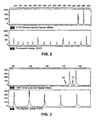
- Examples of ABI 377 electropherograms for ITR loci S159 ( Fig. 2 ) and G210 ( Fig. 3 ) and tetranucleotide repeat loci vWA ( Fig. 4 ) and D5S818 ( Fig. 5 ) show minimal or absent stutter at ITR loci and clearly observable stutter for tetranucleotide repeat loci.
- Percent stutter values for each of the 25 to 40 individuals tested are shown is scatter plots ( figures 6 , 7 , 8 and 9 ).
- the percentage of the "stutter" band to the authentic allele band was significantly lower in most of the ITR loci evaluated compared to the tetranucleotide tandem repeat loci. This was true even though the tetranucleotide loci used represent the best of this type of marker currently known. For example, 13 such tetranucleotide markers, including several of the tetranucleotide markers assayed as described reported in Table 3 below as having a high % stutter, have been selected by the U.S. Federal Bureau of Investigation for use in analyzing all DNA samples for the national Combined DNA Index System (CODIS). ( Macivee, I. (1998) Profiles in DNA 1 (3):2 ).
- CODIS national Combined DNA Index System
Landscapes
- Chemical & Material Sciences (AREA)
- Life Sciences & Earth Sciences (AREA)
- Health & Medical Sciences (AREA)
- Organic Chemistry (AREA)
- Engineering & Computer Science (AREA)
- Genetics & Genomics (AREA)
- Zoology (AREA)
- Wood Science & Technology (AREA)
- General Engineering & Computer Science (AREA)
- Bioinformatics & Cheminformatics (AREA)
- Biotechnology (AREA)
- Proteomics, Peptides & Aminoacids (AREA)
- Molecular Biology (AREA)
- Physics & Mathematics (AREA)
- Biophysics (AREA)
- Biochemistry (AREA)
- Microbiology (AREA)
- General Health & Medical Sciences (AREA)
- Biomedical Technology (AREA)
- Immunology (AREA)
- Analytical Chemistry (AREA)
- Plant Pathology (AREA)
- Chemical Kinetics & Catalysis (AREA)
- Bioinformatics & Computational Biology (AREA)
- Crystallography & Structural Chemistry (AREA)
- Measuring Or Testing Involving Enzymes Or Micro-Organisms (AREA)
Claims (8)
- Verfahren zur Detektion einer DNA-Zielsequenz mit intermediärem Tandem-Repeat, die ein geringes Vorkommen von Stotter-Artefakten aufweist, wobei das Verfahren die folgenden Schritte umfasst:(a) das Bereitstellen einer Probe von DNA, die zumindest eine Zielsequenz mit intermediärem Tandem-Repeat aufweist;(b) das Amplifizieren der Zielsequenz mit intermediärem Tandem-Repeat unter Verwendung zumindest eines Oligonucleotidprimers, der eine Sequenz umfasst, die zu einer Region eines doppelsträngigen DNA-Markers, der eine Matrizensequenz mit intermediärem Tandem-Repeat enthält, komplementär ist und diese flankiert, worin die Matrizensequenz mit intermediärem Tandem-Repeat eine Region des DNA-Markers ist, der die Repeateinheitssequenz:
(GAAAA)
enthält, die im Tandem zumindest zwei (2) Mal wiederholt wird, mit der Maßgabe, dass der DNA-Marker die Sequenz der Seq.-ID Nr. 34 aufweist; und(c) das Detektieren der Zielsequenz mit intermediärem Tandem-Repeat in der DNA-Probe. - Verfahren nach Anspruch 1, worin die in Schritt (a) bereitgestellte DNA-Probe menschliche genomische DNA ist.
- Verfahren nach Anspruch 1, worin der beim Amplifizieren der Zielsequenz mit intermediärem Tandem-Repeat verwendete Oligonucleotidprimer eine fluoreszierende Markierung aufweist, die daran kovalent gebunden ist.
- Verfahren nach Anspruch 1, weiters umfassend das Detektieren von Polymorphismen in der amplifizierten Zielsequenz mit intermediärem Tandem-Repeat.
- Verfahren nach Anspruch 3, worin der Oligonucleotidprimer eine aus Seq.-ID Nr. 128 und Seq.-ID Nr. 129 ausgewählte Sequenz umfasst.
- Set zur Detektion von zumindest einer Zielsequenz mit intermediärem Tandem-Repeat in einer Probe von DNA, wobei das Set ein Behältnis mit einem Paar Oligonucleotidprimer zum Amplifizieren der zumindest einen Zielsequenz mit intermediärem Tandem-Repeat umfasst,
worin jeder Oligonucleotidprimer eine Sequenz aus mehr als 16 Basen umfasst, wobei diese Sequenzen zu gegenüberliegenden Strängen eines doppelsträngigen DNA-Markers, die die Matrizensequenz mit intermediärem Tandem-Repeat flankieren, komplementär ist,
worin die Matrizensequenz mit intermediärem Tandem-Repeat eine Region des DNA-Markers ist, die die Repeateinheitssequenz:
(GAAAA) enthält, die im Tandem zumindest zwei (2) Mal wiederholt wird, mit der Maßgabe, dass der DNA-Marker die Sequenz der Seq.-ID Nr. 34 aufweist. - Set nach Anspruch 6, worin zumindest einer der Oligonucleotidprimer eine aus Seq.-ID Nr. 128 und Seq.-ID Nr. 129 ausgewählte Sequenz umfasst.
- Set nach Anspruch 7, worin das Paar Oligonucleotidprimer die Sequenzen Seq.-ID Nr. 128 bzw. Seq.-ID Nr. 129 aufweist.
Priority Applications (2)
| Application Number | Priority Date | Filing Date | Title |
|---|---|---|---|
| EP10011440.4A EP2287308B1 (de) | 1998-02-04 | 1999-02-04 | Materialien und Verfahren zur Identifizierung und Analyse von DNA-Markern mit intermediären Tandem-Repeats |
| EP10011439.6A EP2287307B1 (de) | 1998-02-04 | 1999-02-04 | Materialien und Verfahren zur Identifizierung und Analyse von DNA-Markern mit intermediären Tandem-Repeats |
Applications Claiming Priority (3)
| Application Number | Priority Date | Filing Date | Title |
|---|---|---|---|
| US09/018,584 US6238863B1 (en) | 1998-02-04 | 1998-02-04 | Materials and methods for indentifying and analyzing intermediate tandem repeat DNA markers |
| US18584 | 1998-02-04 | ||
| PCT/US1999/002345 WO1999040194A1 (en) | 1998-02-04 | 1999-02-04 | Materials and methods for identifying and analyzing intermediate tandem repeat dna markers |
Related Child Applications (2)
| Application Number | Title | Priority Date | Filing Date |
|---|---|---|---|
| EP10011439.6A Division EP2287307B1 (de) | 1998-02-04 | 1999-02-04 | Materialien und Verfahren zur Identifizierung und Analyse von DNA-Markern mit intermediären Tandem-Repeats |
| EP10011440.4A Division EP2287308B1 (de) | 1998-02-04 | 1999-02-04 | Materialien und Verfahren zur Identifizierung und Analyse von DNA-Markern mit intermediären Tandem-Repeats |
Publications (3)
| Publication Number | Publication Date |
|---|---|
| EP1058727A1 EP1058727A1 (de) | 2000-12-13 |
| EP1058727A4 EP1058727A4 (de) | 2003-03-26 |
| EP1058727B1 true EP1058727B1 (de) | 2010-10-27 |
Family
ID=21788699
Family Applications (3)
| Application Number | Title | Priority Date | Filing Date |
|---|---|---|---|
| EP10011439.6A Expired - Lifetime EP2287307B1 (de) | 1998-02-04 | 1999-02-04 | Materialien und Verfahren zur Identifizierung und Analyse von DNA-Markern mit intermediären Tandem-Repeats |
| EP10011440.4A Expired - Lifetime EP2287308B1 (de) | 1998-02-04 | 1999-02-04 | Materialien und Verfahren zur Identifizierung und Analyse von DNA-Markern mit intermediären Tandem-Repeats |
| EP99906720A Expired - Lifetime EP1058727B1 (de) | 1998-02-04 | 1999-02-04 | Materialien und verfahren zur identifizierung und analyse von dns-markern mit intermediären 'tandem repeats'. |
Family Applications Before (2)
| Application Number | Title | Priority Date | Filing Date |
|---|---|---|---|
| EP10011439.6A Expired - Lifetime EP2287307B1 (de) | 1998-02-04 | 1999-02-04 | Materialien und Verfahren zur Identifizierung und Analyse von DNA-Markern mit intermediären Tandem-Repeats |
| EP10011440.4A Expired - Lifetime EP2287308B1 (de) | 1998-02-04 | 1999-02-04 | Materialien und Verfahren zur Identifizierung und Analyse von DNA-Markern mit intermediären Tandem-Repeats |
Country Status (11)
| Country | Link |
|---|---|
| US (2) | US6238863B1 (de) |
| EP (3) | EP2287307B1 (de) |
| JP (3) | JP4494630B2 (de) |
| KR (1) | KR100691195B1 (de) |
| CN (2) | CN100545265C (de) |
| AT (1) | ATE486129T1 (de) |
| AU (1) | AU758639B2 (de) |
| CA (1) | CA2319111A1 (de) |
| DE (1) | DE69942891D1 (de) |
| ES (2) | ES2476266T3 (de) |
| WO (1) | WO1999040194A1 (de) |
Families Citing this family (32)
| Publication number | Priority date | Publication date | Assignee | Title |
|---|---|---|---|---|
| JP4034351B2 (ja) | 1996-04-25 | 2008-01-16 | バイオアレイ ソリューションズ エルエルシー | 粒子近接表面の光制御した動電学的アッセンブリ |
| EP1410301A4 (de) * | 2000-04-12 | 2008-01-23 | Cleveland Clinic Foundation | System zum identifizieren und analysieren der expression von are-haltigen genen |
| US6531282B1 (en) * | 2000-05-30 | 2003-03-11 | Oligotrail, Llc | Multiplex amplification and analysis of selected STR loci |
| US9709559B2 (en) | 2000-06-21 | 2017-07-18 | Bioarray Solutions, Ltd. | Multianalyte molecular analysis using application-specific random particle arrays |
| DE60117556T2 (de) | 2000-06-21 | 2006-11-02 | Bioarray Solutions Ltd. | Multianalytische molekularanalyse durch verwendung anwendungsspezifischer zufallspartikelarrays |
| DE10119468A1 (de) * | 2001-04-12 | 2002-10-24 | Epigenomics Ag | Mikroarray-Verfahren zur Anreicherung von DNA-Fragmenten aus komplexen Mischungen |
| US20020172948A1 (en) * | 2001-05-04 | 2002-11-21 | Perlin Mark W. | Method and system for nucleic acid sequencing |
| US7262063B2 (en) | 2001-06-21 | 2007-08-28 | Bio Array Solutions, Ltd. | Directed assembly of functional heterostructures |
| US20070264641A1 (en) * | 2001-10-15 | 2007-11-15 | Li Alice X | Multiplexed analysis of polymorphic loci by concurrent interrogation and enzyme-mediated detection |
| EP1463825B1 (de) | 2001-10-15 | 2017-12-06 | BioArray Solutions Ltd. | Gemultiplexte analyse polymorphischer stellen durch gleichzeitige abfrage und enzymvermittelte detektion |
| US7229764B2 (en) * | 2002-04-08 | 2007-06-12 | Pig Improvement Company (Uk) Ltd. | System for tracing animal products |
| US7157228B2 (en) * | 2002-09-09 | 2007-01-02 | Bioarray Solutions Ltd. | Genetic analysis and authentication |
| US7526114B2 (en) | 2002-11-15 | 2009-04-28 | Bioarray Solutions Ltd. | Analysis, secure access to, and transmission of array images |
| AU2003902299A0 (en) * | 2003-05-13 | 2003-05-29 | Flinders Medical Centre | A method of analysing a marker nucleic acid molecule |
| WO2005029705A2 (en) | 2003-09-18 | 2005-03-31 | Bioarray Solutions, Ltd. | Number coding for identification of subtypes of coded types of solid phase carriers |
| CA2539824C (en) | 2003-09-22 | 2015-02-03 | Xinwen Wang | Surface immobilized polyelectrolyte with multiple functional groups capable of covalently bonding to biomolecules |
| CA2899287A1 (en) | 2003-10-28 | 2005-05-12 | Bioarray Solutions Ltd. | Optimization of gene expression analysis using immobilized capture probes |
| WO2005045060A2 (en) | 2003-10-29 | 2005-05-19 | Bioarray Solutions, Ltd. | Multiplexed nucleic acid analysis by fragmentation of double-stranded dna |
| US7848889B2 (en) | 2004-08-02 | 2010-12-07 | Bioarray Solutions, Ltd. | Automated analysis of multiplexed probe-target interaction patterns: pattern matching and allele identification |
| US7867703B2 (en) * | 2004-08-26 | 2011-01-11 | Agilent Technologies, Inc. | Element defined sequence complexity reduction |
| US8486629B2 (en) | 2005-06-01 | 2013-07-16 | Bioarray Solutions, Ltd. | Creation of functionalized microparticle libraries by oligonucleotide ligation or elongation |
| US7772390B1 (en) | 2006-07-18 | 2010-08-10 | The Regents Of The University Of California | Lipid mediated nucleic acid synthesis |
| US8163480B2 (en) * | 2006-10-05 | 2012-04-24 | Quest Diagnostics Investments Incorporated | Nucleic acid size detection method |
| US20090004662A1 (en) | 2007-06-18 | 2009-01-01 | Applera Corporation | Method and compositions for nucleic acid amplification |
| WO2009012984A1 (en) | 2007-07-26 | 2009-01-29 | Roche Diagnostics Gmbh | Target preparation for parallel sequencing of complex genomes |
| EP2294225B8 (de) | 2008-06-30 | 2015-02-18 | Life Technologies Corporation | Verfahren zur direkten amplifikation aus rohen nukeinsäureproben |
| US20120183953A1 (en) * | 2011-01-14 | 2012-07-19 | Opgen, Inc. | Genome assembly |
| EP3194627B1 (de) * | 2014-09-18 | 2023-08-16 | Illumina, Inc. | Verfahren und systeme zur analyse von nukleinsäuresequenzierungsdaten |
| CN104408331A (zh) * | 2014-11-10 | 2015-03-11 | 南京工程学院 | 鉴别dna基因序列中编码区域与非编码区域的系统 |
| JP6728657B2 (ja) * | 2015-12-04 | 2020-07-22 | 東洋紡株式会社 | 核酸増幅法 |
| EP4055162A1 (de) * | 2019-11-05 | 2022-09-14 | Florida State University Research Foundation, Inc. | Auswertung von genomischer variation unter verwendung von repetitiven nukleinsäuresequenzen |
| US12601008B2 (en) | 2021-11-04 | 2026-04-14 | Florida State University Research Foundation, Inc. | Using hairpin formation to identify DNA and RNA sequences having a target nucleic acid sequence |
Family Cites Families (15)
| Publication number | Priority date | Publication date | Assignee | Title |
|---|---|---|---|---|
| IS1355B6 (is) | 1984-11-12 | 1989-04-19 | Lister Institute Of Preventive Medicine | Fjölkjarna kannar |
| US4683202A (en) | 1985-03-28 | 1987-07-28 | Cetus Corporation | Process for amplifying nucleic acid sequences |
| GB8606719D0 (en) | 1986-03-19 | 1986-04-23 | Lister Preventive Med | Genetic probes |
| AU637768B2 (en) | 1988-02-18 | 1993-06-10 | University Of Utah, The | Genetic identification employing dna probes of variable number tandem repeat loci |
| US4963663A (en) | 1988-12-23 | 1990-10-16 | University Of Utah | Genetic identification employing DNA probes of variable number tandem repeat loci |
| DE3834636A1 (de) | 1988-10-11 | 1990-04-19 | Max Planck Gesellschaft | Verfahren zur analyse von laengenpolymorphismen in dna-bereichen |
| US5582979A (en) | 1989-04-21 | 1996-12-10 | Marshfield Clinic | Length polymorphisms in (dC-dA)n.(dG-dT)n sequences and method of using the same |
| US5075217A (en) | 1989-04-21 | 1991-12-24 | Marshfield Clinic | Length polymorphisms in (dC-dA)n ·(dG-dT)n sequences |
| US5364759B2 (en) | 1991-01-31 | 1999-07-20 | Baylor College Medicine | Dna typing with short tandem repeat polymorphisms and identification of polymorphic short tandem repeats |
| IL103267A (en) * | 1991-09-24 | 2004-07-25 | Keygene Nv | Process and kit for amplification of restriction fragment obtained from starting dna |
| CA2136764A1 (en) | 1992-05-29 | 1993-12-09 | Ronald L. Marshall | Ligase chain reaction starting with rna sequences |
| GB9326052D0 (en) * | 1993-12-21 | 1994-02-23 | Zeneca Ltd | Sequences |
| US5599666A (en) | 1994-03-28 | 1997-02-04 | Promega Corporation | Allelic ladders for short tandem repeat loci |
| US6479235B1 (en) * | 1994-09-30 | 2002-11-12 | Promega Corporation | Multiplex amplification of short tandem repeat loci |
| US5843660A (en) * | 1994-09-30 | 1998-12-01 | Promega Corporation | Multiplex amplification of short tandem repeat loci |
-
1998
- 1998-02-04 US US09/018,584 patent/US6238863B1/en not_active Expired - Lifetime
-
1999
- 1999-02-04 AT AT99906720T patent/ATE486129T1/de not_active IP Right Cessation
- 1999-02-04 AU AU26565/99A patent/AU758639B2/en not_active Ceased
- 1999-02-04 ES ES10011440.4T patent/ES2476266T3/es not_active Expired - Lifetime
- 1999-02-04 JP JP2000530608A patent/JP4494630B2/ja not_active Expired - Lifetime
- 1999-02-04 CN CNB998026964A patent/CN100545265C/zh not_active Expired - Lifetime
- 1999-02-04 EP EP10011439.6A patent/EP2287307B1/de not_active Expired - Lifetime
- 1999-02-04 EP EP10011440.4A patent/EP2287308B1/de not_active Expired - Lifetime
- 1999-02-04 WO PCT/US1999/002345 patent/WO1999040194A1/en not_active Ceased
- 1999-02-04 ES ES10011439.6T patent/ES2475416T3/es not_active Expired - Lifetime
- 1999-02-04 CA CA002319111A patent/CA2319111A1/en not_active Abandoned
- 1999-02-04 KR KR20007008495A patent/KR100691195B1/ko not_active Expired - Lifetime
- 1999-02-04 DE DE69942891T patent/DE69942891D1/de not_active Expired - Lifetime
- 1999-02-04 CN CN200910164448A patent/CN101857895A/zh active Pending
- 1999-02-04 EP EP99906720A patent/EP1058727B1/de not_active Expired - Lifetime
-
2001
- 2001-02-15 US US09/784,423 patent/US6767703B2/en not_active Expired - Fee Related
-
2009
- 2009-08-10 JP JP2009185861A patent/JP5898829B2/ja not_active Expired - Lifetime
-
2013
- 2013-04-25 JP JP2013092789A patent/JP2013143965A/ja active Pending
Also Published As
| Publication number | Publication date |
|---|---|
| EP1058727A4 (de) | 2003-03-26 |
| CN100545265C (zh) | 2009-09-30 |
| DE69942891D1 (de) | 2010-12-09 |
| EP2287307A2 (de) | 2011-02-23 |
| US6238863B1 (en) | 2001-05-29 |
| ATE486129T1 (de) | 2010-11-15 |
| US20020012924A1 (en) | 2002-01-31 |
| CN101857895A (zh) | 2010-10-13 |
| EP1058727A1 (de) | 2000-12-13 |
| KR100691195B1 (ko) | 2007-03-08 |
| EP2287308B1 (de) | 2014-04-09 |
| ES2475416T3 (es) | 2014-07-10 |
| WO1999040194A1 (en) | 1999-08-12 |
| US6767703B2 (en) | 2004-07-27 |
| AU758639B2 (en) | 2003-03-27 |
| JP2013143965A (ja) | 2013-07-25 |
| KR20010040624A (ko) | 2001-05-15 |
| EP2287307B1 (de) | 2014-04-09 |
| JP2002502606A (ja) | 2002-01-29 |
| ES2476266T3 (es) | 2014-07-14 |
| CA2319111A1 (en) | 1999-08-12 |
| EP2287307A3 (de) | 2011-06-29 |
| AU2656599A (en) | 1999-08-23 |
| JP4494630B2 (ja) | 2010-06-30 |
| JP5898829B2 (ja) | 2016-04-06 |
| EP2287308A3 (de) | 2011-06-29 |
| CN1290298A (zh) | 2001-04-04 |
| EP2287308A2 (de) | 2011-02-23 |
| JP2009254388A (ja) | 2009-11-05 |
Similar Documents
| Publication | Publication Date | Title |
|---|---|---|
| EP1058727B1 (de) | Materialien und verfahren zur identifizierung und analyse von dns-markern mit intermediären 'tandem repeats'. | |
| EP0365627B1 (de) | Katalytische hybridisierungs-systeme zum nachweis von nukleinsäuresequenzen, die auf deren aktivität als kofaktoren in katalytischen reaktionen basieren in denen eine komplementäre, markierte nukleinsäureprobe gespalten wird | |
| EP0960207B1 (de) | Multiplex amplifikation kurzer tandem repeat loci | |
| US5403711A (en) | Nucleic acid hybridization and amplification method for detection of specific sequences in which a complementary labeled nucleic acid probe is cleaved | |
| EP0679190B1 (de) | Methode zum generieren von einzelsträngigen dna molekülen | |
| JP3715657B2 (ja) | 差引きハイブリダイゼーションおよび差異分析の方法 | |
| US12416003B2 (en) | Methods and compositions for enrichment of target polynucleotides | |
| CN100366753C (zh) | 短串联重复基因座的多重扩增 | |
| US7014994B1 (en) | Coupled polymerase chain reaction-restriction-endonuclease digestion-ligase detection reaction process | |
| US20120179384A1 (en) | Method for analyzing nucleic acid mutation using array comparative genomic hybridization technique | |
| EP0549107A1 (de) | Verfahren zur Herstellung eines Polynukleotids zum Gebrauch in "single-primer" Amplifizierung und Phosphorothioat-enthaltende Oligonukleotide als Primer in Nukleinsäureamplifizierung | |
| CA2195880A1 (en) | High throughput screening method for sequences or genetic alterations in nucleic acids | |
| US5952201A (en) | Method of preparing oligonucleotide probes or primers, vector therefor and use thereof | |
| US6068974A (en) | Specific, highly sensitive, nested PCR detection scheme for the pseudorabies virus | |
| US5032502A (en) | Purification of polymorphic components of complex genomes | |
| JP4601830B2 (ja) | カップル性ポリメラーゼ連鎖反応−制限エンドヌクレアーゼ消化−リガーゼ検出反応法 | |
| US10072290B2 (en) | Methods for amplifying fragmented target nucleic acids utilizing an assembler sequence | |
| WO2002034937A9 (en) | Methods for detection of differences in nucleic acids |
Legal Events
| Date | Code | Title | Description |
|---|---|---|---|
| PUAI | Public reference made under article 153(3) epc to a published international application that has entered the european phase |
Free format text: ORIGINAL CODE: 0009012 |
|
| 17P | Request for examination filed |
Effective date: 20000828 |
|
| AK | Designated contracting states |
Kind code of ref document: A1 Designated state(s): AT BE CH CY DE DK ES FI FR GB GR IE IT LI LU MC NL PT SE |
|
| RIN1 | Information on inventor provided before grant (corrected) |
Inventor name: BACHER, JEFFREY, W. Inventor name: SCHUMM, JAMES, W. |
|
| RIN1 | Information on inventor provided before grant (corrected) |
Inventor name: BACHER, JEFFREY, W. Inventor name: SCHUMM, JAMES, W. |
|
| A4 | Supplementary search report drawn up and despatched |
Effective date: 20030210 |
|
| 17Q | First examination report despatched |
Effective date: 20070518 |
|
| GRAP | Despatch of communication of intention to grant a patent |
Free format text: ORIGINAL CODE: EPIDOSNIGR1 |
|
| GRAS | Grant fee paid |
Free format text: ORIGINAL CODE: EPIDOSNIGR3 |
|
| GRAA | (expected) grant |
Free format text: ORIGINAL CODE: 0009210 |
|
| AK | Designated contracting states |
Kind code of ref document: B1 Designated state(s): AT BE CH CY DE DK ES FI FR GB GR IE IT LI LU MC NL PT SE |
|
| REG | Reference to a national code |
Ref country code: GB Ref legal event code: FG4D |
|
| REG | Reference to a national code |
Ref country code: CH Ref legal event code: EP |
|
| REG | Reference to a national code |
Ref country code: IE Ref legal event code: FG4D |
|
| REF | Corresponds to: |
Ref document number: 69942891 Country of ref document: DE Date of ref document: 20101209 Kind code of ref document: P |
|
| REG | Reference to a national code |
Ref country code: NL Ref legal event code: VDEP Effective date: 20101027 |
|
| PG25 | Lapsed in a contracting state [announced via postgrant information from national office to epo] |
Ref country code: SE Free format text: LAPSE BECAUSE OF FAILURE TO SUBMIT A TRANSLATION OF THE DESCRIPTION OR TO PAY THE FEE WITHIN THE PRESCRIBED TIME-LIMIT Effective date: 20101027 Ref country code: AT Free format text: LAPSE BECAUSE OF FAILURE TO SUBMIT A TRANSLATION OF THE DESCRIPTION OR TO PAY THE FEE WITHIN THE PRESCRIBED TIME-LIMIT Effective date: 20101027 Ref country code: NL Free format text: LAPSE BECAUSE OF FAILURE TO SUBMIT A TRANSLATION OF THE DESCRIPTION OR TO PAY THE FEE WITHIN THE PRESCRIBED TIME-LIMIT Effective date: 20101027 Ref country code: PT Free format text: LAPSE BECAUSE OF FAILURE TO SUBMIT A TRANSLATION OF THE DESCRIPTION OR TO PAY THE FEE WITHIN THE PRESCRIBED TIME-LIMIT Effective date: 20110228 Ref country code: FI Free format text: LAPSE BECAUSE OF FAILURE TO SUBMIT A TRANSLATION OF THE DESCRIPTION OR TO PAY THE FEE WITHIN THE PRESCRIBED TIME-LIMIT Effective date: 20101027 |
|
| PG25 | Lapsed in a contracting state [announced via postgrant information from national office to epo] |
Ref country code: BE Free format text: LAPSE BECAUSE OF FAILURE TO SUBMIT A TRANSLATION OF THE DESCRIPTION OR TO PAY THE FEE WITHIN THE PRESCRIBED TIME-LIMIT Effective date: 20101027 Ref country code: GR Free format text: LAPSE BECAUSE OF FAILURE TO SUBMIT A TRANSLATION OF THE DESCRIPTION OR TO PAY THE FEE WITHIN THE PRESCRIBED TIME-LIMIT Effective date: 20110128 |
|
| PG25 | Lapsed in a contracting state [announced via postgrant information from national office to epo] |
Ref country code: ES Free format text: LAPSE BECAUSE OF FAILURE TO SUBMIT A TRANSLATION OF THE DESCRIPTION OR TO PAY THE FEE WITHIN THE PRESCRIBED TIME-LIMIT Effective date: 20110207 |
|
| PG25 | Lapsed in a contracting state [announced via postgrant information from national office to epo] |
Ref country code: DK Free format text: LAPSE BECAUSE OF FAILURE TO SUBMIT A TRANSLATION OF THE DESCRIPTION OR TO PAY THE FEE WITHIN THE PRESCRIBED TIME-LIMIT Effective date: 20101027 |
|
| PLBE | No opposition filed within time limit |
Free format text: ORIGINAL CODE: 0009261 |
|
| STAA | Information on the status of an ep patent application or granted ep patent |
Free format text: STATUS: NO OPPOSITION FILED WITHIN TIME LIMIT |
|
| REG | Reference to a national code |
Ref country code: HK Ref legal event code: WD Ref document number: 1030237 Country of ref document: HK |
|
| PG25 | Lapsed in a contracting state [announced via postgrant information from national office to epo] |
Ref country code: MC Free format text: LAPSE BECAUSE OF NON-PAYMENT OF DUE FEES Effective date: 20110228 |
|
| REG | Reference to a national code |
Ref country code: CH Ref legal event code: PL |
|
| 26N | No opposition filed |
Effective date: 20110728 |
|
| PG25 | Lapsed in a contracting state [announced via postgrant information from national office to epo] |
Ref country code: CH Free format text: LAPSE BECAUSE OF NON-PAYMENT OF DUE FEES Effective date: 20110228 Ref country code: LI Free format text: LAPSE BECAUSE OF NON-PAYMENT OF DUE FEES Effective date: 20110228 |
|
| REG | Reference to a national code |
Ref country code: IE Ref legal event code: MM4A |
|
| REG | Reference to a national code |
Ref country code: DE Ref legal event code: R097 Ref document number: 69942891 Country of ref document: DE Effective date: 20110728 |
|
| PG25 | Lapsed in a contracting state [announced via postgrant information from national office to epo] |
Ref country code: IT Free format text: LAPSE BECAUSE OF FAILURE TO SUBMIT A TRANSLATION OF THE DESCRIPTION OR TO PAY THE FEE WITHIN THE PRESCRIBED TIME-LIMIT Effective date: 20101027 |
|
| PG25 | Lapsed in a contracting state [announced via postgrant information from national office to epo] |
Ref country code: IE Free format text: LAPSE BECAUSE OF NON-PAYMENT OF DUE FEES Effective date: 20110204 |
|
| PG25 | Lapsed in a contracting state [announced via postgrant information from national office to epo] |
Ref country code: LU Free format text: LAPSE BECAUSE OF NON-PAYMENT OF DUE FEES Effective date: 20110204 Ref country code: CY Free format text: LAPSE BECAUSE OF FAILURE TO SUBMIT A TRANSLATION OF THE DESCRIPTION OR TO PAY THE FEE WITHIN THE PRESCRIBED TIME-LIMIT Effective date: 20101027 |
|
| REG | Reference to a national code |
Ref country code: FR Ref legal event code: PLFP Year of fee payment: 18 |
|
| REG | Reference to a national code |
Ref country code: FR Ref legal event code: PLFP Year of fee payment: 19 |
|
| REG | Reference to a national code |
Ref country code: FR Ref legal event code: PLFP Year of fee payment: 20 |
|
| PGFP | Annual fee paid to national office [announced via postgrant information from national office to epo] |
Ref country code: DE Payment date: 20180227 Year of fee payment: 20 Ref country code: GB Payment date: 20180227 Year of fee payment: 20 |
|
| PGFP | Annual fee paid to national office [announced via postgrant information from national office to epo] |
Ref country code: FR Payment date: 20180227 Year of fee payment: 20 |
|
| REG | Reference to a national code |
Ref country code: DE Ref legal event code: R071 Ref document number: 69942891 Country of ref document: DE |
|
| REG | Reference to a national code |
Ref country code: GB Ref legal event code: PE20 Expiry date: 20190203 |
|
| PG25 | Lapsed in a contracting state [announced via postgrant information from national office to epo] |
Ref country code: GB Free format text: LAPSE BECAUSE OF EXPIRATION OF PROTECTION Effective date: 20190203 |