EP1059101A2 - Verfahren zur Zersetzung halogenierter organischer Substanzen - Google Patents
Verfahren zur Zersetzung halogenierter organischer Substanzen Download PDFInfo
- Publication number
- EP1059101A2 EP1059101A2 EP00304795A EP00304795A EP1059101A2 EP 1059101 A2 EP1059101 A2 EP 1059101A2 EP 00304795 A EP00304795 A EP 00304795A EP 00304795 A EP00304795 A EP 00304795A EP 1059101 A2 EP1059101 A2 EP 1059101A2
- Authority
- EP
- European Patent Office
- Prior art keywords
- halogenated organic
- organic compound
- decomposition
- mixing
- amino acid
- Prior art date
- Legal status (The legal status is an assumption and is not a legal conclusion. Google has not performed a legal analysis and makes no representation as to the accuracy of the status listed.)
- Withdrawn
Links
Images

Classifications
-
- A—HUMAN NECESSITIES
- A62—LIFE-SAVING; FIRE-FIGHTING
- A62D—CHEMICAL MEANS FOR EXTINGUISHING FIRES OR FOR COMBATING OR PROTECTING AGAINST HARMFUL CHEMICAL AGENTS; CHEMICAL MATERIALS FOR USE IN BREATHING APPARATUS
- A62D3/00—Processes for making harmful chemical substances harmless or less harmful, by effecting a chemical change in the substances
- A62D3/30—Processes for making harmful chemical substances harmless or less harmful, by effecting a chemical change in the substances by reacting with chemical agents
-
- B—PERFORMING OPERATIONS; TRANSPORTING
- B01—PHYSICAL OR CHEMICAL PROCESSES OR APPARATUS IN GENERAL
- B01D—SEPARATION
- B01D53/00—Separation of gases or vapours; Recovering vapours of volatile solvents from gases; Chemical or biological purification of waste gases, e.g. engine exhaust gases, smoke, fumes, flue gases, aerosols
- B01D53/34—Chemical or biological purification of waste gases
- B01D53/46—Removing components of defined structure
- B01D53/68—Halogens or halogen compounds
- B01D53/70—Organic halogen compounds
-
- B—PERFORMING OPERATIONS; TRANSPORTING
- B01—PHYSICAL OR CHEMICAL PROCESSES OR APPARATUS IN GENERAL
- B01F—MIXING, e.g. DISSOLVING, EMULSIFYING OR DISPERSING
- B01F29/00—Mixers with rotating receptacles
- B01F29/60—Mixers with rotating receptacles rotating about a horizontal or inclined axis, e.g. drum mixers
-
- B—PERFORMING OPERATIONS; TRANSPORTING
- B01—PHYSICAL OR CHEMICAL PROCESSES OR APPARATUS IN GENERAL
- B01F—MIXING, e.g. DISSOLVING, EMULSIFYING OR DISPERSING
- B01F31/00—Mixers with shaking, oscillating, or vibrating mechanisms
- B01F31/50—Mixers with shaking, oscillating, or vibrating mechanisms with a receptacle submitted to a combination of movements, i.e. at least one vibratory or oscillatory movement
-
- B—PERFORMING OPERATIONS; TRANSPORTING
- B01—PHYSICAL OR CHEMICAL PROCESSES OR APPARATUS IN GENERAL
- B01F—MIXING, e.g. DISSOLVING, EMULSIFYING OR DISPERSING
- B01F31/00—Mixers with shaking, oscillating, or vibrating mechanisms
- B01F31/80—Mixing by means of high-frequency vibrations above one kHz, e.g. ultrasonic vibrations
- B01F31/86—Mixing by means of high-frequency vibrations above one kHz, e.g. ultrasonic vibrations with vibration of the receptacle or part of it
-
- B—PERFORMING OPERATIONS; TRANSPORTING
- B09—DISPOSAL OF SOLID WASTE; RECLAMATION OF CONTAMINATED SOIL
- B09C—RECLAMATION OF CONTAMINATED SOIL
- B09C1/00—Reclamation of contaminated soil
- B09C1/06—Reclamation of contaminated soil thermally
-
- B—PERFORMING OPERATIONS; TRANSPORTING
- B09—DISPOSAL OF SOLID WASTE; RECLAMATION OF CONTAMINATED SOIL
- B09C—RECLAMATION OF CONTAMINATED SOIL
- B09C1/00—Reclamation of contaminated soil
- B09C1/08—Reclamation of contaminated soil chemically
-
- A—HUMAN NECESSITIES
- A62—LIFE-SAVING; FIRE-FIGHTING
- A62D—CHEMICAL MEANS FOR EXTINGUISHING FIRES OR FOR COMBATING OR PROTECTING AGAINST HARMFUL CHEMICAL AGENTS; CHEMICAL MATERIALS FOR USE IN BREATHING APPARATUS
- A62D2101/00—Harmful chemical substances made harmless, or less harmful, by effecting chemical change
- A62D2101/20—Organic substances
- A62D2101/22—Organic substances containing halogen
-
- A—HUMAN NECESSITIES
- A62—LIFE-SAVING; FIRE-FIGHTING
- A62D—CHEMICAL MEANS FOR EXTINGUISHING FIRES OR FOR COMBATING OR PROTECTING AGAINST HARMFUL CHEMICAL AGENTS; CHEMICAL MATERIALS FOR USE IN BREATHING APPARATUS
- A62D2101/00—Harmful chemical substances made harmless, or less harmful, by effecting chemical change
- A62D2101/20—Organic substances
- A62D2101/28—Organic substances containing oxygen, sulfur, selenium or tellurium, i.e. chalcogen
-
- B—PERFORMING OPERATIONS; TRANSPORTING
- B01—PHYSICAL OR CHEMICAL PROCESSES OR APPARATUS IN GENERAL
- B01D—SEPARATION
- B01D2257/00—Components to be removed
- B01D2257/20—Halogens or halogen compounds
- B01D2257/206—Organic halogen compounds
Definitions
- the present invention relates to a method for decomposing a halogenated organic compound, and more particularly, to a method for decomposing a halogenated organic compound contained in soil such as polychlorodibenzo-p-dioxins (PCDD), polychlorodibenzofurans (PCDF), and coplanar polychlorobiphenyl (PCB) (These materials are hereinafter generally referred to as "dioxins”.) with good operation property and high efficiency.
- PCDD polychlorodibenzo-p-dioxins
- PCDF polychlorodibenzofurans
- PCB coplanar polychlorobiphenyl
- toxins precursors including organic compounds such as phenols, benzene and acetylene, chlorinated aromatic compounds such as chlorophenols and chlorobenzenes, and chlorinated alkyl compounds are formed during incineration.
- precursors for the dioxins including organic compounds such as phenols, benzene and acetylene, chlorinated aromatic compounds such as chlorophenols and chlorobenzenes, and chlorinated alkyl compounds are formed during incineration.
- the precursors change to the dioxins under the catalytic action of the flyash, and the generated dioxins exist in incineration ash. Also, the generated dioxins sometimes contaminate the incineration plant and ambient soil therearound.
- Conventional technologies for decomposing dioxins in soil include a method using supercritical state water, a method using ozone or ultraviolet rays, a method by heating, a method utilizing special fungi such as "Maitake” or “Enokidake” or wood-rotting bacteria, and a method using a catalyst.
- a first aim of the present invention is to provide a method for decomposing a halogenated organic compound which can effectively decompose the dioxins in soil.
- a first aspect of the method for decomposing a halogenated organic compound is for achieving the first aim.
- halogenated organic compound reacts under heating with one or more amino acid compounds selected from a group of amino acids, polyamino acids, amino acid salts, and polyamino acid salts.
- dehalogenation occurs by the reaction of the amino acid compound with halogens such as chlorine in dioxins, thus achieving the decomposition of dioxins.
- the amino acid compound does not vaporize under a reaction temperature effective for decomposition of dioxins, it can be added and mixed of in liquid or solution form, with object to be treated such as soil, and can be easily heated and brought into reaction.
- a second am of the present invention is to provide a method for decomposing a halogenated organic compound, in which soil or other media containing halogenated organic compounds are treated with amino acids, salts thereof, polyamino acids, or salts thereof to effect the decomposition of the halogenated organic compounds while preventing the lumping and deposition of treated materials, thus enabling an effective decomposition of halogenated organic compounds with favorable operation properties.
- a second aspect of the method for decomposing a halogenated organic compound is for achieving the second aim.
- one or more amino acid compounds selected from a group consisting of amino acids, polyamino acids, and amino acid salts are added to and mixed with materials containing halogenated organic compounds, followed by addition and mixing of a water-absorbing agent and subsequent heating of the resultant mixture.
- the water-absorbing agent added and mixed prior to the heating step absorbs water, so that the material assumes a fine granule form with non-sticking and free flowing nature.
- the method according to the second aspect is especially effective for the treatment of soil contaminated with dioxins which is particularly easy to form lump and deposit.
- water-absorbing agent quicklime (calcium oxide) is particularly suitable.
- a third aim of the present invention is to improve a process for decomposing a halogenated organic compound in which at least one of the amino acid compounds is added to and mixed with solid material, such as soil contaminated with halogenated organic compounds, and if desired followed by adding and mixing of a water-absorbing agent, and subsequent heating of the resultant mixture to decompose the halogenated organic compounds.
- the third aim is to provide a method which enables an effective mixing of the decomposing agent with solid material, and an effective mixing of the water-absorbing agent with the mixture of solid material and the decomposing agent, thus providing a decrease of water content during the mixing of the decomposing agent, an improvement of handling properties of the mixture, and a decrease of requirements for decomposing agent or water-absorbing agent by an improvement of addition effect thereof, thus in overall enabling an effective decomposition of halogenated organic compounds.
- Third and fourth aspects of the method for decomposing a halogenated organic compound are for achieving the third aim.
- the method of the third aspect comprises a mixing step in which the amino acid compound is added to and mixed with solid material contaminated with halogenated organic compounds, and a heating step in which the mixture from the mixing step is subjected to a heating treatment to decompose halogenated organic compounds.
- the mixing step uses a mixing apparatus comprising a mixing media such as plurality of cylindrical rods contained in a drum which vibrates while rotating around a horizontal axis, achieving a homogeneous mixing as a result of mutual collision between the solid material and the rods induced by the vibration.
- the method of the fourth aspect comprises a first mixing step in which the amino acid compound is added to and mixed with solid material contaminated with halogenated organic compounds, a second mixing step in which a water-absorbing agent is added to and mixed with the mixture from said first mixing step, and a heating step in which the mixture from said second mixing step is subjected to a heating treatment to decompose halogenated organic compounds.
- the first mixing step uses a mixing apparatus comprising a mixing media such as plurality of cylindrical rods contained in a drum which vibrates while rotating around a horizontal axis, achieving a homogeneous mixing as a result of mutual collision between the solid material and the rods induced by the vibration.
- the solid material and the amino acid compound are mixed, or rather kneaded, as a result of the actions of mutual collision, shear and friction occurring between the mixing media such as rods and material being mixed, between the inner surface of the mixing apparatus and material being mixed, between the mixing media themselves, and between the mixing media and the inner surface of the mixing drum, respectively, bringing about a thorough and homogeneous mixing without generating deposit on the drum inner surface or media, without occurring of an under-mixed part, or without forming a sticky, dumpling-like mass.
- the resultant mixture has an excellent handling properties in transfer and other operations, and a good thermal conductivity in subsequent heating process, enabling an effective heat decomposition of halogenated organic compounds.
- amino acids suitable for use in the first aspect include glutamic acid, glutamine, glutathione, glycilglycine, alanine, aminobutyric acid, aminocapronic acid, arginine, asparagic acid, asparagine, citruline, tryptophan, threonine, glycine, cystine, cysteine, histidine, hidroxyproline, isoleucine, leucine, lysine, methionine, ornithine, phenylalanine, phenylglycine, proline, serine, tyrosine, and valine.
- polymers of the above-mentioned amino acids can be used without special limitation to their molecular weights.
- the amino acid salts include sodium salts, potassium salts, calcium salts, and magnesium salts of above-mentioned amino acids and polyamino acids. Especially the calcium salts give a high decomposition ratio.
- amino acids, amino acid salts, polyamino acid, and polyamino acid salts can be used alone or in combination of two or more compounds.
- An additive amount of the amino acid compound described above is preferably 0.1 to 10% by weight against air dried weight of the object to be treated such as soil, from the viewpoint of the treatment cost and the decomposition efficiency of dioxins.
- the amino acid compound is preferably added in the form of solution in water, although they can be added in solution of any solvents other than water, or they can optionally be added in powder form. When added in powder form, it can assume solution form after they are added to the material to be treated such as soil.
- reaction temperature the higher the decomposition rate and, consequently, the decomposition ratio, but generally 200 - 400 °C, especially 250 - 350 °C is preferable.
- a reaction temperature lower than 200 °C gives low reaction speed and low decomposition ratio.
- a reaction temperature higher than 400 °C gives rise to high treatment cost because of increased thermal energy, and also to disadvantages such as vaporization of halogenated organic compounds such as dioxins.
- the reaction time varies depending on the reaction temperature, the form of the object to be treated, the dioxins concentration, or other conditions, but typically, it can be appropriately set at a range of 10 - 180 minutes.
- the method of the first aspect can be carried out by adding and mixing at least one of the amino acid compounds with the object to be treated containing halogenated organic compounds, such as soil containing dioxins, and heating the resultant mixture at a predetermined temperature for a predetermined time.
- halogenated organic compounds such as soil containing dioxins
- Any kind of mixing apparatus or heating apparatus for this process can be employed. A certain mixing is preferable to be carried during heating reaction in order to equalize the temperature in the system, but this is not always necessary.
- the amino acid compound(s) Upon adding the amino acid compound(s) to the object to be treated, it is preferable to supply a certain amount of water for the purpose of the uniform dispersion of the amino acid compound in the object to be treated. It is convenient, as described above, to add the amino acid compound in the form of aqueous solution, which can be mixed uniformly with the object to be treated.
- Heating can be carried out with using a kiln including a rotary kiln.
- a kiln including a rotary kiln.
- the above described mixture is introduced at one end of a rotary kiln in which temperature is set gradually higher from one end to the other end, so that the mixture introduced at one end is first dried, then brought into reaction while passing a region at the reaction temperature or higher, and discharged after the halogenated organic compounds are sufficiently decomposed.
- the treated material discharged from the kiln can be disposed of in land reclamation or other ends.
- the exhaust gas emitted from the kiln is feared to contain volatile materials from soil or decomposition products of amino acid compounds, it can be emitted after the volatile material is burned off in oil burner or electric furnace. Otherwise, it can be washed with water.
- the method according to the first aspect can be easily carried out with a very simple equipment, as the process consists of only adding and mixing amino acid compounds with the object to be treated such as soil, followed by heating.
- Dioxin decomposition test was made on a sample of air-dried dioxin-contaminated soil having particle size under 2 mm. The determination result of dioxin concentration of this sample was as shown in Table 1.
- halogenated organic compounds contained in soil or other media can be decomposed easily and effectively without using complicated process or equipment, bringing the residual concentration to an extremely low level.
- the amino acids suitable for use in the second aspect include glutamic acid, glutamine, glutathione, glycilglycine, alanine, aminobutyric acid, aminocapronic acid, arginine, asparagic acid, asparagine, citruline, tryptophan, threonine, glycine, cystine, cysteine, bistidine, hydroxyproline, isoleucine, leucine, lysine, methionine, ornithine, phenylalanine, phenylglycine, proline, serine, tyrosine, and valine.
- polyamino acids polymers of the above-mentioned amino acids can be used without special limitation to its molecular weight.
- amino acid salts sodium salts, potassium salts, calcium salts, and magnesium salsas of above-mentioned amino acids and polyamino acids can be used. Especially, calcium salts give a high decomposition ratio.
- amino acid compounds can be used alone or in combination of two or more compounds, and the addition of which is preferably 0.1 to 10% by weight against air dried weight of the object to be treated such as soil, from the viewpoint of treatment cost and decomposition efficiency of dioxins.
- the amino acid compound is preferably added in the form of solution in water, although they can be added in solution of any solvents other than water, or it can optionally be added in powder form. When added in powder form, it can assume solution form after they are added to the object to be treated such as soil.
- the concentration of the aqueous solution of the amino acid compound is preferable to be controlled in such a manner that the total water content of the object to be treated such as soil after addition of the solution comprises 2 - 30 parts by weight against 100 parts by weight of the air dried soil.
- a water absorbing agent is added and mixed.
- quicklime As the water-absorbing agent, quicklime, water-absorbing resin, zeolite or other water-absorbing minerals, and silica gel can be used.
- Quicklime is especially preferable as it has an effect to produce finer granule, and also it gives higher decomposition ratio.
- any kind of water absorbing-resin, and starch-based or acrylic acid-based products in the market can be used.
- product form of the resin a fine powder form is preferred to the powder form from the viewpoint of absorption efficiency.
- the additive amount of the water-absorbing agent is determined depending to the nature of the object to be treated, for instance, its lumping or sticking tendencies, or amount of water supplied at the addition of the amino acid compound.
- 1 - 50 weight %, especially 3 - 20 weight % against air dried weight of the object to be treated such as soil is preferable.
- water-absorbing resin 0.1 - 5 weight %, especially 0.2 - 3 weight % against air dried weight of the object to be treated such as soil is preferable.
- silica gel or water-absorbing clay minerals such as zeolite 1 - 50 weight %, especially 3 - 20 weight % against air dried weight of the object to be treated such as soil is preferable.
- mixing operation should be carried out carefully, because an excessive kneading can cause lumping just as in the case in which water-absorbing agent is not used.
- addition of water-absorbing agent after addition and mixing of the amino acid compound prevents lumping and sticking, and considerably improves the handling property of the object to be treated as a result of water absorption of the object by the water-absorbing agent.
- the mixture After addition and mixing of the water-absorbing agent, the mixture is heated.
- the higher the heating temperature the higher the decomposition rate and, as a result, decomposition ratio, but generally 200 - 400 °C, especially 250 - 350 °C is preferable.
- a reaction temperature lower than 200 °C gives low reaction rate and low decomposition ratio.
- a reaction temperature higher than 400 °C gives rise to high treatment cost because of increased thermal energy, and also to disadvantages such as vaporization of halogenated organic compounds such as dioxins.
- the reaction time varies depending to the reaction temperature, the form of the object to be treated, the dioxins concentration, or other conditions, but typically, it can be conveniently set at a range of 10 - 180 minutes.
- the method of the second aspect can be carried out by adding and mixing the amino acid compound(s) with the object to be treated containing halogenated organic compounds, such as soil containing dioxins, and then adding and mixing water-absorbing agent, and heating the resultant mixture at a predetermined temperature for a predetermined time.
- halogenated organic compounds such as soil containing dioxins
- Any kind of mixing apparatus or heating apparatus can be employed. A certain mixing is preferable to be carried during heating reaction in order to equalize the temperature in the system, but this is not always necessary.
- Heating can be carried out using, a kiln including a rotary kiln.
- a kiln including a rotary kiln.
- the above described mixture is introduced at one end of a rotary kiln, and discharged from the other end.
- the mixture subjected to the heat treatment keeps a smooth flowing state ensuring a smooth treatment without depositing inside the rotary kiln.
- the method according to the second aspect can be easily carried out with very simple equipment, as the process consists of only adding and mixing amino compounds and water-absorbing agent, successively, with the object to be treated such as soil, followed by heating.
- Dioxin decomposition test was made on a sample of dioxin-contaminated soil (particle size under 5.0 mm). Dioxins concentration of this sample was 32,000 pg-TEQ/g as toxicity equivalent.
- lysine 4 parts by weight was added as water solution to 100 parts of soil and mixed with it.
- the water content at this step consisted of 16 parts by weight in original soil plus 20 parts by weight from water solution of lysine.
- the soil mixed with lysine solution formed lumps (dumpling-like) as large as a fist, and was fed to a rotary kiln. The soil deposited inside the kiln to form a cake.
- the targeted treatment conditions of the rotary kiln were as follows.
- the dioxins concentration (toxicity equivalent) of the obtained treated product was as shown in Table 2.
- Example 8 Same treatment as in Example 8 was carried out except that quicklime was added to the soil and mixed in ratios shown in Table 2. States of the mixtures were observed and the results are shown in Table 2.
- the mixture was fed to the kiln smoothly and flowing state of the mixture inside the kiln was good, whereby it was treated smoothly.
- the dioxins concentration (toxicity equivalent) in the exhaust gas was 37 pg-TEQ/Nm 3
- the dioxins concentrations (toxicity equivalent) and decomposition ratios of the treated products were as shown in Table 2, showing a higher decomposition ratio than in the above Example 8.
- Example 8 Same treatment as in Example 8 was carried out except that a fine powder, starch-based water absorbing resin was added to and mixed with soil in ratios shown in Table 2. States of the mixtures were observed and the results are shown in Table 2. It was obserbed that addition of 0.5 weight part of the water absorbing resin gave a fine granuled mixture with good flowing property.
- Example Lysine addition (parts) Absorbing material State of mixture Toxicity equivalent (pg-TEQ/g) Kind Addition (parts)
- Example 8 4.0 - 0 lump 4,600(85.6%)
- Example 9 4.0 quicklime 2.0 granule - 6.0 small granule - 8.0 fine granule 80(99.8%) 10 fine granule - 20 fine granule - 30 fine granule -
- Example 10 4.0 absorbing resin 0.1 granule - 0.3 small granule - 0.5 fine granule 120(98.8%) 0.7 fine granule - 0.9 fine granule -
- Example 9 using the quicklime showed higher decomposition ratio than Example 10 using the water-absorbing resin. This is probably because that the lysine formed calcium salts which has a high reactivity.
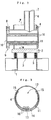
- Figs. 1-3 are illustrations showing an embodiment of a mixer (rod-containing, outer rotating and vibrating agitation mixer) of which Fig. 1 is a perspective view, Fig. 2 is a cross sectional view taken along line II-II in Fig. 1, and Fig. 3 is a cross sectional view taken along line III-III in Fig. 2.
- a mixer rod-containing, outer rotating and vibrating agitation mixer
- a mixer has a cylindrical drum 4 which is fixed on a base plate 2 arranged over a base 1 and is supported elastically by plurality of springs 3 provided between the base 1 and the base plate 2. At both sides of the drum 4, a pair of rotating weight vibrators 5A, 5B are attached which are driven synchronously by a belt drive.
- a feeding tube 6 for material to be mixed is connected to the upper periphery of one end of the drum 4.
- the inside of the feed tube 6 is divided by a partition 7 so that two kinds of materials to be mixed can be fed separately.
- a kneading tube 11 Inside the drum 4 is arranged a kneading tube 11 having an axial opening 12 at the upper periphery.
- the kneading tube 11 is arranged eccentrically relative to the axis of the drum 4 with its lower periphery supported by a block 13 provided at the inner lower periphery of the drum 4, leaving a predetermined space 14 between the kneading tube and the inner periphery of the drum 4.
- Both ends of the aforementioned opening 12 are engaged with protrusions 14 provided at the inner upper periphery of the drum 4, which engagement preventing the upward movement of the kneading tube 11.
- the kneading tube 11 holds in its inside a number of cylindrical rods 16.
- the mixer applies a vibration to the drum 4 by means of the vibrators 5A, 5B while being fed with material to be mixed by way of feeding tube 6, thus achieving a kneading effect.
- a centrifugal force generated by synchronous operation of two rotating weight vibrators 5A, 5B causes a rotating vibration of the drum 4.
- the drum 4 holds tens of cylindrical rods 16 in its inside, which violently rotate and jump due to the rotating vibration of the drum 4.
- material to be mixed is fed into the drum 4, material is kneaded by the actions of impact, shear, and friction between material and the cylindrical rods 16, between material and the kneading tube 11, between the cylindrical rods 16 themselves, and between the cylindrical rods 16 and the kneading tube 11.
- the kneading tube 11 and the rods 16 are preferably lined with rubber in order to control noise generation.
- Obtained mixture flows from the outlet 8 to the space 9 and falls out of the mixer.
- the kneading tube 11 provided inside the drum 4 is not always necessary and can be omitted.
- the methods of the third and fourth aspects comprise a mixing step in which solid material to be treated contaminated with halogenated organic compounds and the amino acid compound and, if desired, the water absorbing agent are mixed is carried out with using the mixer shown in the illustration, to effect a uniform mixing by the above described action of impact, shear, and friction.
- the solid material to be treated, the amino acid compound and the water-absorbing agent can be effectively mixed to yield an easy-to-handle mixture.
- the amino acid compound suitable for use includes amino acids, salts thereof, polyamino acids and salts thereof.
- the amino acids include glutamic acid, glutamine, glutathione, glycilglycine, alanine, aminobutyric acid, aminocapronic acid, arginine, asparagic acid, asparagine, citruline, tryptophan, threonine, glycine, cystine, cysteine, histidine, hydroxyproline, isoleucine, leucine, lysine, methionine, ornithine, phenylalanine, phenylglycine, proline, serine, tyrosine, and valine.
- polyamino acids polymers of the above-mentioned amino acids can be used without special limitation to its molecular weight.
- amino acid salts such salts as sodium salts, potassium salts, calcium salts, and magnesium salsas of above mentioned amino acids and polyamino acids can be used. Especially, calcium salts give a high decomposition ratio.
- Each of the amino acid compounds can be used alone or in combination of two or more compounds, the addition of which being preferably 0.1-10% by weight against air dried weight of material to be treated such as soil, from the viewpoint of treatment cost and decomposition efficiency of dioxins.
- the amino acid compound is preferably added in the form of solution in water, although they can be added in solution of any solvents other than water, or they can optionally be added in powder form. When added in powder form, they can assume solution form after they are added to the material to be treated such as soil.
- the concentration of the aqueous solution of the amino acid compound is preferably controlled in such a manner that the total water content of the object to be treated such as soil after addition of the solution comprises 2 - 30 parts by weight against 100 parts by weight of air dried soil.
- Quicklime, water-absorbing resin, zeolite and other water-absorbing minerals, and silica gel can be used as the water-absorbing agent.
- Quicklime is especially preferable as it has an effect to produce finer granule, and also it gives higher decomposition ratio.
- any kind of water absorbing-resin, and starch-based or acrylic acid-based products in the market can be used.
- product form of the resin a fine powder form is preferred to the powder form from the viewpoint of absorption efficiency.
- the additive amount of the water-absorbing agent is determined depending on the nature of the object to be treated, that is, its lumping or sticking tendencies, or amount of water supplied at the addition of the amino acid compound.
- 1 - 50 weight %, especially 3 - 20 weight % against air dried weight of the object to be treated such as soil is preferable.
- water-absorbing resin 0.1 - 5 weight %, especially 0.2 - 3 weight % against air dried weight of the object to be treated such as soil is preferable.
- silica gel or water-absorbing clay minerals such as zeolite 1 - 50 weight %, especially 3 - 20 weight % against air dried weight of the object to be treated such as soil is preferable.
- mixing operation should be carried out carefully, because an excessive kneading can cause lumping just as the case in which water-absorbing agent is not used.
- the addition of the water-absorbing agent after addition and mixing of the amino acid compound prevents lumping and sticking, and considerably improves the handling property of the object to be treated as a result of water absorption by the water-absorbing agent.
- the mixture After addition and mixing of the water-absorbing agent, the mixture is heated.
- the higher the heating temperature the higher the decomposition rate and, consequently, the decomposition ratio, but generally 200 - 400 °C, especially 250 - 350 °C is preferable.
- a reaction temperature lower than 200 °C gives low reaction rate and low decomposition ratio.
- a reaction temperature higher than 400 °C gives rise to high treatment cost because of increased thermal energy, and also to disadvantages such as vaporization of halogenated organic compounds such as dioxins.
- the reaction time varies depending on the reaction temperature, the form of the object to be treated, the dioxins concentration, or other conditions, but typically, it can be appropriately set at a range of 10 - 180 minutes.
- a certain mixing is preferable during heating reaction in order to equalize the temperature in the system, but this is not always necessary.
- Heating can be carried out using, for example, a rotary kiln.
- a rotary kiln For instance, the above described mixture is introduced into one end of a rotary kiln and discharged from the other end. During this process, the mixture subjected to the heat treatment keeps a smooth flowing state ensuring a smooth treatment without depositing inside the rotary kiln.
- the method according to the third and fourth aspects can be easily carried out with a very simple equipment, as the process consists of only adding and mixing the amino acid compound and, if desired, the water absorbing agent with the object to be treated such as soil, followed by heating.
- dioxins-contaminated soil particles size under 4.75 mm, water content: 15 weight %, dioxins concentration 12,000 pg-TEQ/g
- Water content was determined from the weight loss (weight %) after drying at 105 °C.
- PCDD and PCDF were determined in accordance to "The Tentative Manual for Soil Survey Related to Dioxins" (January 1998) by Water Quality Bureau, Environment Agency, Government of Japan.
- the treatment was carried out using the rod-containing, outer rotating vibration mixer shown in Figs. 1-3 as mixing apparatus.
- the first and the second mixing step and the heat treatment were carried out similarly as in Examples 11 and 12 except that mixers shown in Table 3 were used instead of the rod-containing, outer rotating vibration mixer. The obtained results are shown in Table 3.
- Comparative Examples 4 and 5 soil showed a sticky and lumpy nature after adding and mixing of lysine solution, making an uniform distribution of quicklime difficult in the second mixing step. Especially, in Comparative Examples 4 and 5, soil yielded deposit on the agitation shaft which was difficult to remove. Further, the second mixtures from Comparative Examples 4 and 5 were difficult to feed to the kiln, and the mixtures became lumpy inside the kiln, plugging the kiln and making the treatment impossible. The reason of higher dioxins concentration in Comparative Examples 4 and 5 is thought to be in the uneven distribution of lysine, and low heat transfer (because of voids) in the electric furnace.
- materials to be treated containing halogenated organic compounds are by no means limited to soil, but include such materials as active carbon, incineration ash, incineration flyash, lake and river dredging, harbor dredging, residual soil from construction, bricks, concrete, sludge, and wood.
- the methods according to the second, third and fourth aspects exhibit remarkable effects in the treatment of such materials as soil, lake and river dredging, harbor dredging, residual soil from construction, and sludge, which have tendency to form lump or dumpling in the kneading process.
Landscapes
- Chemical & Material Sciences (AREA)
- Chemical Kinetics & Catalysis (AREA)
- Engineering & Computer Science (AREA)
- Environmental & Geological Engineering (AREA)
- Life Sciences & Earth Sciences (AREA)
- Soil Sciences (AREA)
- Health & Medical Sciences (AREA)
- General Chemical & Material Sciences (AREA)
- Toxicology (AREA)
- General Health & Medical Sciences (AREA)
- Business, Economics & Management (AREA)
- Emergency Management (AREA)
- Physics & Mathematics (AREA)
- Thermal Sciences (AREA)
- Biomedical Technology (AREA)
- Analytical Chemistry (AREA)
- Oil, Petroleum & Natural Gas (AREA)
- Processing Of Solid Wastes (AREA)
- Fire-Extinguishing Compositions (AREA)
Applications Claiming Priority (6)
| Application Number | Priority Date | Filing Date | Title |
|---|---|---|---|
| JP15981699 | 1999-06-07 | ||
| JP15981699A JP3399406B2 (ja) | 1999-06-07 | 1999-06-07 | ハロゲン化有機化合物の分解方法 |
| JP29406599 | 1999-10-15 | ||
| JP29406599A JP2001112883A (ja) | 1999-10-15 | 1999-10-15 | ハロゲン化有機化合物含有物質の処理方法 |
| JP36302199A JP2001170613A (ja) | 1999-12-21 | 1999-12-21 | ハロゲン化有機化合物の分解処理方法 |
| JP36302199 | 1999-12-21 |
Publications (2)
| Publication Number | Publication Date |
|---|---|
| EP1059101A2 true EP1059101A2 (de) | 2000-12-13 |
| EP1059101A3 EP1059101A3 (de) | 2003-02-12 |
Family
ID=27321588
Family Applications (1)
| Application Number | Title | Priority Date | Filing Date |
|---|---|---|---|
| EP00304795A Withdrawn EP1059101A3 (de) | 1999-06-07 | 2000-06-06 | Verfahren zur Zersetzung halogenierter organischer Substanzen |
Country Status (2)
| Country | Link |
|---|---|
| US (1) | US6284940B1 (de) |
| EP (1) | EP1059101A3 (de) |
Cited By (3)
| Publication number | Priority date | Publication date | Assignee | Title |
|---|---|---|---|---|
| WO2004039456A1 (fr) * | 2002-11-01 | 2004-05-13 | Veckis Industries Ltd. | Procede de neutralisation d'agents toxiques, de pesticides et de leurs hydrolysats et reactif correspondant |
| WO2007011251A1 (fr) * | 2005-07-20 | 2007-01-25 | Zakrytoe Aktzionernoe Obschestvo 'elit Holding' | Procede de neutralisation de substances toxiques en produits non toxiques inoffensifs |
| RU2486951C1 (ru) * | 2011-11-08 | 2013-07-10 | Федеральное государственное бюджетное образовательное учреждение высшего профессионального образования "Кубанский государственный аграрный университет" | Роторный смеситель-диспергатор |
Families Citing this family (2)
| Publication number | Priority date | Publication date | Assignee | Title |
|---|---|---|---|---|
| WO1999051366A1 (en) * | 1998-03-31 | 1999-10-14 | Houei Syoukai Co., Ltd. | Method for producing soil, soil-treating unit, method for treating and unit for treating |
| CN1764489A (zh) * | 2003-01-22 | 2006-04-26 | 维克凯斯工业有限公司 | 中和毒剂、杀虫剂和其水解产物的方法和用于该方法的试剂 |
Family Cites Families (11)
| Publication number | Priority date | Publication date | Assignee | Title |
|---|---|---|---|---|
| IT1161215B (it) * | 1983-03-10 | 1987-03-18 | Sea Marconi Decontamin Srl | Processo per la decomposizione e decontaminazione di composti organici e agenti tossici alogenati |
| JPH0685806B2 (ja) * | 1987-08-11 | 1994-11-02 | 米澤化学工業株式会社 | 有機ハロゲン化合物の無害化処理方法 |
| JPH042350A (ja) * | 1990-04-20 | 1992-01-07 | Toyota Central Res & Dev Lab Inc | アルデヒド除去剤 |
| US5075017A (en) * | 1990-10-12 | 1991-12-24 | Kimberly-Clark Corporation | Method for removing polychlorinated dibenzodioxins and polychlorinated dibenzofurans from paper mill sludge |
| JPH04241880A (ja) | 1991-01-10 | 1992-08-28 | Hitachi Zosen Corp | 固形物中のダイオキシンの酸化分解方法 |
| DE4109639C2 (de) * | 1991-03-23 | 1994-06-01 | Metallgesellschaft Ag | Verfahren zur Zersetzung von polyhalogenierten Organoverbindungen |
| JP3154753B2 (ja) * | 1991-08-05 | 2001-04-09 | 英裕 玉置 | ペンタクロロフェノール系除草剤の回収方法 |
| JPH08155296A (ja) * | 1993-12-07 | 1996-06-18 | Teruo Takei | Pcbの化学安定剤と化学安定固化材 |
| US6197199B1 (en) * | 1995-09-05 | 2001-03-06 | Mcardle Blaise | Use of protein-polysaccharide complex in removal of contaminants |
| US5968467A (en) * | 1995-09-22 | 1999-10-19 | Kurita Water Industries, Co., Ltd. | Dioxin formation preventative in incinerators and method for preventing the formation of dioxins |
| JP3546136B2 (ja) * | 1998-03-13 | 2004-07-21 | 三菱重工業株式会社 | Pcb分解方法 |
-
2000
- 2000-06-05 US US09/586,779 patent/US6284940B1/en not_active Expired - Fee Related
- 2000-06-06 EP EP00304795A patent/EP1059101A3/de not_active Withdrawn
Cited By (3)
| Publication number | Priority date | Publication date | Assignee | Title |
|---|---|---|---|---|
| WO2004039456A1 (fr) * | 2002-11-01 | 2004-05-13 | Veckis Industries Ltd. | Procede de neutralisation d'agents toxiques, de pesticides et de leurs hydrolysats et reactif correspondant |
| WO2007011251A1 (fr) * | 2005-07-20 | 2007-01-25 | Zakrytoe Aktzionernoe Obschestvo 'elit Holding' | Procede de neutralisation de substances toxiques en produits non toxiques inoffensifs |
| RU2486951C1 (ru) * | 2011-11-08 | 2013-07-10 | Федеральное государственное бюджетное образовательное учреждение высшего профессионального образования "Кубанский государственный аграрный университет" | Роторный смеситель-диспергатор |
Also Published As
| Publication number | Publication date |
|---|---|
| EP1059101A3 (de) | 2003-02-12 |
| US6284940B1 (en) | 2001-09-04 |
Similar Documents
| Publication | Publication Date | Title |
|---|---|---|
| KR100187307B1 (ko) | 폐기물 소각방법 | |
| CZ97495A3 (en) | Disposal process of waste matters | |
| WO2007122967A1 (ja) | 廃プラスチック・有機物の分解方法、分解装置及び分解システム | |
| KR100689683B1 (ko) | 할로겐화 탄화수소의 환원 탈할로겐화 방법 | |
| US6284940B1 (en) | Method for decomposing halogenated organic compound | |
| JPH11500955A (ja) | 有機廃棄物質の処理のための方法および装置 | |
| JP5138838B2 (ja) | 液体または固体のハロゲン化炭化水素を還元的脱ハロゲン化するための方法 | |
| WO1994023802A1 (en) | Process and apparatus for destroying organic and carbonaceous waste | |
| EP1324954A1 (de) | Verfahren und vorrichtung zur schlammtrocknung mit gleichzeitiger pelletierung | |
| JP2001112883A (ja) | ハロゲン化有機化合物含有物質の処理方法 | |
| JP3399406B2 (ja) | ハロゲン化有機化合物の分解方法 | |
| JP2001170613A (ja) | ハロゲン化有機化合物の分解処理方法 | |
| JP4019558B2 (ja) | 土壌中のハロゲン化有機化合物の分解方法 | |
| JP3969372B2 (ja) | 有機塩素化合物の分解促進剤および分解方法 | |
| JP2005030608A (ja) | ガス燃焼装置を備えた加熱処理設備 | |
| JP2000288524A (ja) | ハロゲン化有機化合物の分解方法 | |
| TW434382B (en) | A method for disposing a waste | |
| JP2000246059A (ja) | 難分解性有機塩素化合物の分解用反応剤および分解方法 | |
| JP4103736B2 (ja) | 有機塩素化合物の分解促進剤及び分解方法 | |
| JP2001347159A (ja) | 有機ハロゲン化物のハロゲンおよび有機化合物を無機の物質に変換処理する方法およびそのための装置 | |
| JP7143233B2 (ja) | 焼却灰の処理方法 | |
| JP2512665B2 (ja) | 焼却灰処理方法 | |
| WO2026096525A1 (en) | Low-temperature thermal treatment of pfas-contaminated wastes | |
| JP3495552B2 (ja) | 廃棄物の脱塩処理方法 | |
| WO2005118074A2 (en) | Method of treating persistent organic pollutants |
Legal Events
| Date | Code | Title | Description |
|---|---|---|---|
| PUAI | Public reference made under article 153(3) epc to a published international application that has entered the european phase |
Free format text: ORIGINAL CODE: 0009012 |
|
| AK | Designated contracting states |
Kind code of ref document: A2 Designated state(s): AT BE CH CY DE DK ES FI FR GB GR IE IT LI LU MC NL PT SE |
|
| AX | Request for extension of the european patent |
Free format text: AL;LT;LV;MK;RO;SI |
|
| PUAL | Search report despatched |
Free format text: ORIGINAL CODE: 0009013 |
|
| AK | Designated contracting states |
Designated state(s): AT BE CH CY DE DK ES FI FR GB GR IE IT LI LU MC NL PT SE |
|
| AX | Request for extension of the european patent |
Extension state: AL LT LV MK RO SI |
|
| 17P | Request for examination filed |
Effective date: 20030408 |
|
| AKX | Designation fees paid |
Designated state(s): DE FR GB IT NL |
|
| GRAP | Despatch of communication of intention to grant a patent |
Free format text: ORIGINAL CODE: EPIDOSNIGR1 |
|
| STAA | Information on the status of an ep patent application or granted ep patent |
Free format text: STATUS: THE APPLICATION IS DEEMED TO BE WITHDRAWN |
|
| 18D | Application deemed to be withdrawn |
Effective date: 20090929 |