EP1059232A2 - Système pour transporter un satellite sur une orbite plus haute et méthode pour satellites géosynchrones - Google Patents
Système pour transporter un satellite sur une orbite plus haute et méthode pour satellites géosynchrones Download PDFInfo
- Publication number
- EP1059232A2 EP1059232A2 EP00304391A EP00304391A EP1059232A2 EP 1059232 A2 EP1059232 A2 EP 1059232A2 EP 00304391 A EP00304391 A EP 00304391A EP 00304391 A EP00304391 A EP 00304391A EP 1059232 A2 EP1059232 A2 EP 1059232A2
- Authority
- EP
- European Patent Office
- Prior art keywords
- orbit
- spacecraft
- firing
- thrusters
- solar array
- Prior art date
- Legal status (The legal status is an assumption and is not a legal conclusion. Google has not performed a legal analysis and makes no representation as to the accuracy of the status listed.)
- Withdrawn
Links
Images



Classifications
-
- B—PERFORMING OPERATIONS; TRANSPORTING
- B64—AIRCRAFT; AVIATION; COSMONAUTICS
- B64G—COSMONAUTICS; VEHICLES OR EQUIPMENT THEREFOR
- B64G1/00—Cosmonautic vehicles
- B64G1/22—Parts of, or equipment specially adapted for fitting in or to, cosmonautic vehicles
- B64G1/24—Guiding or controlling apparatus, e.g. for attitude control
- B64G1/242—Orbits and trajectories
- B64G1/2427—Transfer orbits
-
- B—PERFORMING OPERATIONS; TRANSPORTING
- B64—AIRCRAFT; AVIATION; COSMONAUTICS
- B64G—COSMONAUTICS; VEHICLES OR EQUIPMENT THEREFOR
- B64G1/00—Cosmonautic vehicles
- B64G1/22—Parts of, or equipment specially adapted for fitting in or to, cosmonautic vehicles
- B64G1/24—Guiding or controlling apparatus, e.g. for attitude control
- B64G1/244—Spacecraft control systems
-
- B—PERFORMING OPERATIONS; TRANSPORTING
- B64—AIRCRAFT; AVIATION; COSMONAUTICS
- B64G—COSMONAUTICS; VEHICLES OR EQUIPMENT THEREFOR
- B64G1/00—Cosmonautic vehicles
- B64G1/22—Parts of, or equipment specially adapted for fitting in or to, cosmonautic vehicles
- B64G1/24—Guiding or controlling apparatus, e.g. for attitude control
- B64G1/242—Orbits and trajectories
- B64G1/2425—Geosynchronous orbits
-
- B—PERFORMING OPERATIONS; TRANSPORTING
- B64—AIRCRAFT; AVIATION; COSMONAUTICS
- B64G—COSMONAUTICS; VEHICLES OR EQUIPMENT THEREFOR
- B64G1/00—Cosmonautic vehicles
- B64G1/22—Parts of, or equipment specially adapted for fitting in or to, cosmonautic vehicles
- B64G1/24—Guiding or controlling apparatus, e.g. for attitude control
- B64G1/26—Guiding or controlling apparatus, e.g. for attitude control using jets
-
- B—PERFORMING OPERATIONS; TRANSPORTING
- B64—AIRCRAFT; AVIATION; COSMONAUTICS
- B64G—COSMONAUTICS; VEHICLES OR EQUIPMENT THEREFOR
- B64G1/00—Cosmonautic vehicles
- B64G1/22—Parts of, or equipment specially adapted for fitting in or to, cosmonautic vehicles
- B64G1/40—Arrangements or adaptations of propulsion systems
- B64G1/411—Electric propulsion
-
- B—PERFORMING OPERATIONS; TRANSPORTING
- B64—AIRCRAFT; AVIATION; COSMONAUTICS
- B64G—COSMONAUTICS; VEHICLES OR EQUIPMENT THEREFOR
- B64G1/00—Cosmonautic vehicles
- B64G1/22—Parts of, or equipment specially adapted for fitting in or to, cosmonautic vehicles
- B64G1/40—Arrangements or adaptations of propulsion systems
- B64G1/411—Electric propulsion
- B64G1/415—Arcjets or resistojets
Definitions
- the present invention relates generally to satellites, and more particularly, to systems and methods that raise the orbit of a satellite to geosynchronous orbit.
- US Patent No. 5,596,360 entitled “Optimal Transfer Orbit Trajectory Using Electric Propulsion” addresses orbit raising maneuvers of satellites. Such prior art orbit raising techniques limit orbit maneuvers in terms of location and attitude to achieve and maintain the orbital semi-major axis near the geosynchronous value so that the satellite can be continuously observed from a single ground station.
- US Patent No. 5,716,029 entitled “Constant Sun Angle Transfer Orbit Sequence and Method Using Electric Propulsion” discloses a technique that adjusts the inertial attitude periodically while maintaining a fixed direction of electric propulsion thrust firing throughout each orbit. Prior art techniques also do not steer the thrust vector while also steering the satellite's attitude during the orbit to maintain the sun's illumination on the solar arrays of the satellite during orbit raising maneuvers. Steering the thrust vector maximizes efficiency of the delivered thrust thus minimizing fuel and time to achieve the desired final orbit.
- a method for raising a spacecraft launched into a transfer orbit about the earth from the transfer orbit to a geosynchronous orbit comprises the steps of:
- a system for raising a spacecraft launched into a transfer orbit about the earth from the transfer orbit to a geosynchronous orbit comprises:
- the present invention provides for a practical orbit raising method and apparatus wherein a satellite quickly escapes the Van Allen radiation belts while simultaneously maximizing payload mass and mission life.
- the satellite quickly escapes the Van Allen radiation belts by firing high thrust chemical propulsion thrusters at apogees of intermediate orbits, starting from the transfer orbit initiated by a launch vehicle, to successively raise each orbit's perigee until the perigee clears the Van Allen radiation belts.
- the payload mass and mission life of the satellite are maximized using high specific impulse electric propulsion thrusters to continue raising the satellite to near geosynchronous orbit.
- the chemical and/or electric propulsion thrusters are then used for final touch-up to achieve geosynchronous orbit
- Fig. 1 illustrates a conventional thruster orbit raising strategy
- Fig. 2 illustrates a conventional electric propulsion maneuver strategy used in a conventional satellite orbit raising method 10 that raises a satellite 11 (or spacecraft 11) from a transfer orbit 14 to geosynchronous orbit 15.
- the orbit maneuvers are limited in terms of location and attitude to achieve and maintain the semi-major axis of the orbit near the desired geosynchronous value.
- the satellite 11 may be continuously observed from a single ground station on the Earth 13.
- the prior art strategy also does not steer the thrust vector during the orbit while also steering the solar arrays to maintain the sun's illumination on solar arrays 12 of the satellite 11 during the orbit raising maneuvers.
- Fig. 3 illustrates an exemplary chemical thruster orbit raising strategy
- Fig. 4 illustrates an exemplary electric propulsion maneuver strategy that are used to implement a satellite orbit raising method 30 in accordance with the principles of the present invention.
- the present satellite orbit raising method 30 raises a satellite 11 from a transfer orbit 14 to geosynchronous orbit 15.
- the transfer orbit 14 may comprise a synchronous orbit, a subsynchronous orbit or a supersynchronous orbit.
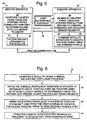
- Fig. 5 illustrates an exemplary system 20 in accordance with the principles of the present invention that may be used to implement the present method 30 to raise the orbit of the satellite 11 to geosynchronous orbit 15.
- the system 20 includes apparatus 21 and software 22 that generate thruster profiles and the satellite steering profile on the earth 13 and apparatus 23 and software 24 generate thruster profiles and the satellite steering profile onboard the satellite 11.
- the thruster firing profile generated on the Earth 13 is uplinked to the satellite 11.
- the apparatus 21 on the earth 13 includes a processor 25 that generates thruster firing timing and steering profile commands.
- the thruster firing timing and steering profile commands are derived from orbit determinations made using the software 22 that runs on the processor 25 and satellite sensor telemetry received on the ground by way of a communications link 26 and processed by the processor 25.
- the processor 25 outputs the ground-generated commands to communication apparatus 27 which uploads the commands to the satellite 11 by way of the communications link 26.
- the apparatus 23 onboard the satellite 11 includes a processor 28 that generates thruster firing timing and steering profile commands.
- the thruster firing timing and steering profile commands from the apparatus 21 on the earth 13 (or apparatus onboard the satellite 11) and satellite sensor telemetry generated onboard the satellite 11 are processed using the software 29 that runs on the processor 28 onboard the satellite 11.
- the processor 28 commands satellite actuators (not shown) to execute the thruster firing timing and steering profile generated onboard the satellite 11.
- Fig. 6 illustrates an exemplary method 30 in accordance with the principles of the present invention.
- the present invention provides for a satellite maneuvering method 30 that is used to raise a satellite 11 from a transfer orbit initiated by a launch vehicle (not shown) to geosynchronous orbit 15.
- the present method 30 comprises the following steps.
- a satellite having chemical and electric propulsion thrusters is launched 31.
- Chemical propulsion thrusters are fired 32 at apogees of intermediate orbits, starting form the transfer orbit initiated by a launch vehicle, to successively raise the perigee of the orbit until the perigee clears the Van Allen radiation belts (Fig. 3). Chemical propulsion maneuvers may also take place at perigee to raise the apogee of the transfer orbit 14 (called a perigee velocity assist) but these are not shown.
- Electric propulsion thrusters are fired 33 to raise the orbit of the satellite 11 from the orbit achieved by the chemical propulsion thruster firings 32 to near geosynchronous orbit 15 (Fig. 4).
- the chemical and/or electric propulsion thrusters are fired 34 to achieve the final geosynchronous orbit 15.
- the optimal thrust vector is the one that is normal to the axis of the solar arrays (see Fig. 4) so that maximum sun illumination on the solar arrays is obtained all the time. This can be achieved by steering the thrust vector and slewing the solar arrays to drive the sun vector to be normal to the solar arrays.
- the optimal thrust vector is the one that is canted an angle ⁇ from the axis of the solar arrays.
- This is illustrated with reference to Fig. 3 of copending US Patent Application serial No. 09/207,399, filed December 8, 1998, entitled “Practical Method and Apparatus for Satellite Stationkeeping", assigned to the assignee of the present invention. Therefore, to optimally perform both orbit raising and stationkeeping, the electric thrusters must be mounted on platforms such that the thrust vector is substantially normal to the solar array axis during orbit raising, and after orbit raising is completed, the platforms are then rotated such that the thrust vector becomes canted at an angle ⁇ to the axis of the solar arrays, as shown in Fig. 3 of the above-identified patent application.
- the orbit raising mission is designed to transfer a satellite 11 from the launch vehicle's injection orbit to the final geosynchronous orbit and place it at the desired on-station Earth longitude location.
- Each phase of the mission can be optimized for its individual propulsion system's performance parameters but the best practical solution is a tradeoff that maximizes useful satellite mass delivered to final orbit while minimizing mission risk, complexity and cost for an acceptable transfer orbit duration (TOD).
- TOD transfer orbit duration
- Transfer orbit duration (TOD) with electric propulsion thrusters may be measured in months (compared to days for chemical thrusters) but the improved useful mass in final orbit can be worth the wait and expense of this long time period.
- companies who provide satellite communications services do not want to spend unnecessary time and expense when using low thrust electric propulsion to slowly transfer the satellite 11 to its final on-orbit location. Any delay in starting commercial use of the communications payload to generate income can be significant. It is clear that any system which does not effectively use the limited electric propulsion resource and unnecessarily increases the time to reach final orbit is not desirable.
- Fig. 7 indicates a typical starting orbit for the electric propulsion orbit raising phase of a "launch vehicle injection-chemical orbit raising-electric propulsion orbit raising-chemical propulsion touchup" mission, optimized to minimize TOD for the electric orbit raising phase of a mission to geosynchronous equatorial orbit.
- the three main parameters defining the starting orbit will change: apogee radius and inclination increase while perigee radius decreases.
- the starting apogee is slightly supersynchronous, the perigee subsynchronous and the inclination small, but finite.
- the starting orbit inclination for electric propulsion transfer can be quite far from the desired final equatorial plane.
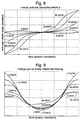
- Fig. 9 The out-of-plane thrust angle in Fig. 9 is also of interest. Clearly it is advantageous to do some inclination removal at the orbital node near apogee (true anomaly of 180 degrees) but these optimized profiles show that it is advantageous to do some inclination removal at perigee where the other orbital node is located. In fact, the attitude profiles show that in the starting orbit of the electric orbit raising phase of the mission it is often desirable to raise both perigee and apogee while removing inclination throughout the orbit (except near the anti-nodes).
- Fig. 7 summarizes the thrust attitude direction profiles in another way.
- the lines at any orbit location are projections of the thrust vector on the orbital plane, i.e., they indicate the magnitude and direction of the inplane thrust. The length of the line measures how much out-of-plane thrust is desired; shorter lines mean more out-of-plane.
- the inertial direction of thrust changes throughout the orbit. A fixed predetermined thrust attitude direction will not be optimal for TOD
- Figs. 8 and 9 show the optimal thrust angle profiles for minimizing TOD, for a continuously operating thruster, as the mission progresses. It is clear that inclination is being removed throughout the entire 85 day mission at both perigee and apogee (not possible with a fixed attitude). As perigee approaches geosynchronous radius, out-of-plane electric propulsion thrust will be effective in removing inclination.
- the attitude profile in Fig. 9 indicates approximately 17 degrees for the out-of-plane thrust angle at perigee which costs less than 5 percent of in-plane thrust magnitude (a cosine loss) but gains 29 percent of thrust in the out-of-plane direction (a sine gain).
- Clearly restricting the thrust vector to a substantially fixed attitude after attaining a near geosynchronous semi-major axis does not take advantage of an electric propulsion system's ability to take out inclination through much of the later orbits in the orbit raising mission.
- an electric propulsion system wants to operate each thruster at maximum power (maximum thrust level) for best efficiency and minimum TOD. Operation at maximum thrust means it is not possible to speed up to reach the target and that fact complicates the guidance problem.
- An electric thruster's nominal operation could be throttled back to reserve some acceleration capability or special pre-planned coast periods may be added to the mission plan (these can then be shortened to deliver more ⁇ V) but these features concede increased TOD to maintain an acceleration capability.
- the EOR mission phase can be re-planned at any time to compensate for past disturbances but if the original plan was generated to minimize TOD then changes to the plan would again increase TOD.
- a predetermined steering profile can be generated to take the satellite 11 from the EOR Initial Transfer Orbit to the Final Transfer Orbit.
- One choice for optimization could be to minimize the time to get to geosynchronous orbit (essentially zero eccentricity and zero inclination within the desired on-station longitude limits) without constraining intermediate orbital periods.
- a second choice could be to rapidly increase the semi-major axis and orbital period to near 24 hours (while still lowering inclination) so as to limit motion of the satellite 11 and allow continuous visibility to a single ground station. In the latter case, neither the inclination nor eccentricity upon reaching the 24 hour period has to be near zero to maintain single station visibility.
- Any planned mission optimal profile is a function of the specific Electric Propulsion Subsystem (EPS) performance parameters including: type of electric thruster (such as a Stationary plasma thruster-SPT or arcjets or xenon ion propulsion), nominal thrust and power levels including variation over usage lifetime, throttling characteristics, specific impulse (Isp), number of thrusters operating, location of thrusters on the satellite 11, thruster gimbaling capability and thruster pointing directions.
- EPS Electric Propulsion Subsystem
- the mission plan also depends on the ability of the solar arrays to generate enough power to run the satellite 11.
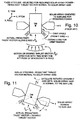
- the power generated should be sufficient to operate such things as the bus electronics equipment, provide heater power to keep the payload and batteries warm, supply power to charge the batteries in addition to providing power to operate the electric thrusters. If the resultant electric thrust is delivered nominally pointing along the z-axis of the satellite 11 (for example if both North and South side thrusters are firing simultaneously in Fig. 10) keeping the satellite 11 in a fixed attitude allows the solar arrays to be oriented to an acceptable angle from the sun but optimal steering profiles (typical values shown in Figs. 8 and 9) cannot be maintained.
- each individual thruster direction is not aligned with the z-axis of the satellite 11 because it is desirable to use the same EOR electric thrusters on-orbit to perform North/South stationkeeping (NSSK) maneuvers. Thrust effectiveness is decreased by the sine of the cant angle ⁇ , resulting in wasted fuel and a longer TOD.
- NSK North/South stationkeeping
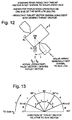
- the attitude control system may orient the satellite 11 so as to point the electric thrusters on one side of the satellite 11 in the direction of the desired thrust vector, as in Fig. 12. This orientation has essentially no thrust direction efficiency loss and TOD is minimized. Sun- ⁇ V steering may still be performed but at times the solar arrays are will be offset by the same cant angle ⁇ from normal to the sun line. If the electric thruster offset angle is very large the solar array offset angle may not provide sufficient power to run the mission plan and the electric thrusters might have to be throttled back or even shut down entirely. Again TOD would increase.
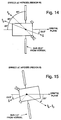
- ⁇ is the thruster cant angle from solar array axis (pitch or y-axis)
- ⁇ is the maximum allowable sun angle from normal to solar arrays
- S is the vector from satellite 11 to sun
- Td is the vector from satellite 11 in direction of desired thrust
- Ta is the vector from satellite 11 in direction of actual thrust
- ⁇ is the angle between the desired thrust vector and the sun vector (Td and S)
- ⁇ is the angle between actual resultant thrust vector and desired thrust vector (Ta and Td).
- Fig. 13 shows the definition of tree Regions in the plane containing the sun (S) and desired thrust vectors (Td).
- Fig. 14 shows that the satellite 11 is oriented to the sun at the ⁇ limit of 23.5 degrees for an acceptable effectiveness of 91.71 percent while the actual resultant thrust vector is still 25 degrees away from the desired thrust vector direction yielding a 90.6 percent effectiveness factor. Note however this thrust "loss" is not totally wasted.
- the fact that the desired out-of-plane thrust angle is already 25 degrees indicates that it is desirable to remove some inclination at perigee so increasing the total angle to 50 degrees from the orbital plane must help by removing more inclination.
- Ta may be oriented more in-plane (but still at least 25 degrees from Td) if desired and still satisfy the ⁇ limit constraint if it were desirable to do a little more orbit raising and less inclination change but the concept of using adjacent thrusters to improve the thrust effectiveness is unchanged.
Landscapes
- Engineering & Computer Science (AREA)
- Remote Sensing (AREA)
- Chemical & Material Sciences (AREA)
- Combustion & Propulsion (AREA)
- Aviation & Aerospace Engineering (AREA)
- Radar, Positioning & Navigation (AREA)
- Automation & Control Theory (AREA)
- Control Of Position, Course, Altitude, Or Attitude Of Moving Bodies (AREA)
Applications Claiming Priority (2)
| Application Number | Priority Date | Filing Date | Title |
|---|---|---|---|
| US328911 | 1999-06-09 | ||
| US09/328,911 US7113851B1 (en) | 1999-06-09 | 1999-06-09 | Practical orbit raising system and method for geosynchronous satellites |
Publications (2)
| Publication Number | Publication Date |
|---|---|
| EP1059232A2 true EP1059232A2 (fr) | 2000-12-13 |
| EP1059232A3 EP1059232A3 (fr) | 2001-08-29 |
Family
ID=23282999
Family Applications (1)
| Application Number | Title | Priority Date | Filing Date |
|---|---|---|---|
| EP00304391A Withdrawn EP1059232A3 (fr) | 1999-06-09 | 2000-05-24 | Système pour transporter un satellite sur une orbite plus haute et méthode pour satellites géosynchrones |
Country Status (3)
| Country | Link |
|---|---|
| US (1) | US7113851B1 (fr) |
| EP (1) | EP1059232A3 (fr) |
| JP (1) | JP2001001999A (fr) |
Cited By (12)
| Publication number | Priority date | Publication date | Assignee | Title |
|---|---|---|---|---|
| FR3007587A1 (fr) * | 2013-06-24 | 2014-12-26 | Astrium Sas | Procede et systeme de surveillance d'une phase de transfert d'un satellite d'une orbite initiale vers une orbite de mission |
| CN104477413A (zh) * | 2014-11-06 | 2015-04-01 | 中国空间技术研究院 | 一种基于电推力器进行位保及动量轮卸载的联合控制方法 |
| EP2977321A1 (fr) * | 2014-07-25 | 2016-01-27 | Thales | Procede de mise a poste d'un satellite et de test en orbite de sa charge utile |
| FR3030455A1 (fr) * | 2014-12-19 | 2016-06-24 | Centre Nat D'etudes Spatiales | Procede de transfert inter-orbital |
| CN106394935A (zh) * | 2016-10-31 | 2017-02-15 | 北京控制工程研究所 | 一种考虑推力器弧段损失的电推进角动量卸载方法 |
| CN106628261A (zh) * | 2016-10-20 | 2017-05-10 | 上海航天控制技术研究所 | 一种电推位保过程中的卫星高精度高稳度姿态控制方法 |
| EP3670360A1 (fr) * | 2018-12-20 | 2020-06-24 | The Boeing Company | Orbites de transfert à faible poussée équilibrée et à énergie optimisée utilisant l'exécution de propulseur partagée |
| CN111891396A (zh) * | 2020-08-12 | 2020-11-06 | 中国科学院微小卫星创新研究院 | 小型地球静止轨道卫星轨道转移方法及系统 |
| WO2021234054A1 (fr) * | 2020-05-19 | 2021-11-25 | Airbus Defence And Space Sas | Procédé d'optimisation du transfert d'orbite d'un engin spatial à propulsion électrique et satellite mettant en œuvre ledit procédé |
| US11396388B2 (en) | 2018-12-20 | 2022-07-26 | The Boeing Company | Optimized power balanced variable thrust transfer orbits to minimize an electric orbit raising duration |
| US11401053B2 (en) * | 2018-12-20 | 2022-08-02 | The Boeing Company | Autonomous control of electric power supplied to a thruster during electric orbit raising |
| CN117446210A (zh) * | 2023-12-12 | 2024-01-26 | 北京控制工程研究所 | Geo卫星化电混合推进的转移段变轨方法及装置 |
Families Citing this family (35)
| Publication number | Priority date | Publication date | Assignee | Title |
|---|---|---|---|---|
| JP4488707B2 (ja) * | 2003-09-26 | 2010-06-23 | 富士通株式会社 | 人工衛星の軌道制御計画方法、プログラム及び装置 |
| US7464898B1 (en) * | 2003-10-14 | 2008-12-16 | Lockheed Martin Corporation | Precision thrust/sun tracking attitude control system for gimbaled thruster |
| US8442751B2 (en) | 2007-11-27 | 2013-05-14 | The Boeing Company | Onboard electronic distribution system |
| US8490074B2 (en) * | 2007-11-27 | 2013-07-16 | The Boeing Company | Aircraft software part library |
| US9208308B2 (en) | 2007-11-27 | 2015-12-08 | The Boeing Company | Alternate parts signature list file |
| JP2009227019A (ja) * | 2008-03-21 | 2009-10-08 | Fujitsu Ltd | 準天頂衛星の制御計画生成プログラム、方法及び装置 |
| US20120119034A1 (en) * | 2009-07-02 | 2012-05-17 | Space Systems/Loral, Inc. | Deorbiting a Spacecraft from a Highly Inclined Elliptical Orbit |
| FR2955313B1 (fr) * | 2010-01-19 | 2012-11-16 | Thales Sa | Procede et dispositif d'optimisation de la masse d'un satellite |
| US10102687B1 (en) | 2010-08-17 | 2018-10-16 | The Boeing Company | Information management system for ground vehicles |
| US9108748B2 (en) | 2010-10-20 | 2015-08-18 | Space Systems/Loral, Llc | Satellite orbit raising using electric propulsion |
| US9108749B2 (en) | 2010-10-20 | 2015-08-18 | Space Systems/Loral, Llc | Spacecraft momentum management |
| FR2986213B1 (fr) * | 2012-02-01 | 2014-10-10 | Snecma | Engin spatial a propulsion electrique et chimique a propergol solide |
| US9180984B2 (en) | 2012-05-11 | 2015-11-10 | The Boeing Company | Methods and apparatus for performing propulsion operations using electric propulsion systems |
| US8915472B2 (en) * | 2012-05-11 | 2014-12-23 | The Boeing Company | Multiple space vehicle launch system |
| US9477795B1 (en) * | 2012-06-29 | 2016-10-25 | The United States Of America As Represented By The Administrator Of National Aeronautics And Space Administration | Modeling, simulation, and control of a solar electric propulsion vehicle in near-earth vicinity including solar array degradation |
| US8768622B2 (en) * | 2012-09-14 | 2014-07-01 | The United States Of America, As Represented By The Secretary Of The Navy | System and method for maneuver plan for satellites flying in proximity using apocentral coordinate system |
| US9284068B2 (en) * | 2014-04-08 | 2016-03-15 | The Boeing Company | Fast-low energy transfer to Earth-Moon Lagrange point L2 |
| CN104015938B (zh) * | 2014-05-07 | 2016-05-25 | 北京理工大学 | 一种电推进静止轨道卫星的位置保持方法 |
| US9764858B2 (en) * | 2015-01-07 | 2017-09-19 | Mitsubishi Electric Research Laboratories, Inc. | Model predictive control of spacecraft |
| US9919813B2 (en) | 2015-04-15 | 2018-03-20 | The United States Of America, As Represented By The Secretary Of The Navy | Control system and method for a plane change for satellite operations |
| JP6472320B2 (ja) * | 2015-05-14 | 2019-02-20 | 三菱電機株式会社 | 人工衛星 |
| JP6542581B2 (ja) * | 2015-05-19 | 2019-07-10 | 株式会社Ihiエアロスペース | 宇宙機とその軌道面変更方法 |
| RU2619486C2 (ru) * | 2015-08-07 | 2017-05-16 | Акционерное общество "Информационные спутниковые системы" имени академика М.Ф. Решетнёва" | Способ выведения космического аппарата на геостационарную орбиту с помощью электрореактивных двигателей |
| US10005568B2 (en) | 2015-11-13 | 2018-06-26 | The Boeing Company | Energy efficient satellite maneuvering |
| US10053241B2 (en) * | 2016-12-01 | 2018-08-21 | The Boeing Company | Systems and methods for multi-spacecraft distributed ascent |
| US10464694B1 (en) | 2017-03-23 | 2019-11-05 | Space Systems/Loral, Llc | Asymmetric thruster gimbal configuration |
| US10435183B1 (en) | 2017-04-14 | 2019-10-08 | Space Systems/Loral, Llc | Deployable propulsion module for spacecraft |
| CN107908597B (zh) * | 2017-11-07 | 2021-02-26 | 中国人民解放军国防科技大学 | 一种基于复用分解的卫星有效载荷功耗分析方法 |
| US11155368B1 (en) | 2018-03-13 | 2021-10-26 | Space Systems/Loral, Llc | Multiple thruster firing on a single articulable module |
| US11203447B1 (en) * | 2018-05-14 | 2021-12-21 | United States Of America As Represented By The Secretary Of The Air Force | Propulsion system for space vehicles |
| WO2020059649A1 (fr) | 2018-09-21 | 2020-03-26 | 三菱電機株式会社 | Dispositif de commande d'orientation, satellite, procédé de commande d'orientation et programme |
| US12240631B2 (en) | 2020-02-26 | 2025-03-04 | Mitsubishi Electric Corporation | Orbital attitude control device, satellite, orbital attitude control method, and recording medium |
| CN113415441B (zh) * | 2021-06-29 | 2022-12-13 | 北京控制工程研究所 | 一种静止轨道卫星气液混合变推力时应急轨道控制方法 |
| US12286243B2 (en) | 2022-05-12 | 2025-04-29 | Maxar Space Llc | Stacked spacecraft launch and orbit raising |
| CN115140319B (zh) * | 2022-09-01 | 2022-12-27 | 北京航天驭星科技有限公司 | 兼顾轨道高度调整任务的空间碎片碰撞规避方法以及装置 |
Citations (3)
| Publication number | Priority date | Publication date | Assignee | Title |
|---|---|---|---|---|
| US5596360A (en) | 1991-09-26 | 1997-01-21 | Seiko Epson Corporation | Image reading apparatus with a half mirror |
| US5716029A (en) | 1994-03-25 | 1998-02-10 | Hughes Electronics | Constant sun angle transfer orbit sequence and method using electric propulsion |
| FR2786893A1 (fr) | 1998-12-08 | 2000-06-09 | Loral Space Systems Inc | Procede et dispositif pratiques de maintien en station de satellite |
Family Cites Families (11)
| Publication number | Priority date | Publication date | Assignee | Title |
|---|---|---|---|---|
| UST100604I4 (en) * | 1979-01-29 | 1981-05-05 | Method of placing a spacecraft into final earth orbit or earth escape trajectory | |
| FR2647565B1 (fr) * | 1989-04-24 | 1991-07-26 | Alcatel Espace | Procede de mise a poste d'un satellite de telecommunications geostationnaire |
| US5349532A (en) * | 1992-04-28 | 1994-09-20 | Space Systems/Loral | Spacecraft attitude control and momentum unloading using gimballed and throttled thrusters |
| US5452869A (en) * | 1992-12-18 | 1995-09-26 | Hughes Aircraft Company | On-board three-axes attitude determination and control system |
| US5681011A (en) * | 1993-08-24 | 1997-10-28 | Orbital Sciences Corporation | Method for injecting payloads into orbit |
| US5992799A (en) * | 1996-03-08 | 1999-11-30 | Space Systems/Loral, Inc. | Earth based spacecraft orbit and attitude control using a look-ahead thruster selection logic and magnetic torquers |
| FR2747102B1 (fr) * | 1996-04-05 | 1998-06-26 | Europ Propulsion | Procede et systeme de mise en orbite d'un vehicule spatial avec des propulseurs a forte impulsion specifique |
| US5810295A (en) * | 1996-07-10 | 1998-09-22 | Hughes Electronics Corporation | Method and apparatus for a satellite station keeping |
| US6032904A (en) * | 1998-02-23 | 2000-03-07 | Space Systems/Loral, Inc. | Multiple usage thruster mounting configuration |
| US6186446B1 (en) * | 1999-06-08 | 2001-02-13 | Space Systems/Loral, Inc. | Solar array control for electric propulsion system |
| US6543723B1 (en) * | 2001-09-04 | 2003-04-08 | Space Systems/Loral, Inc. | Electric orbit raising with variable thrust |
-
1999
- 1999-06-09 US US09/328,911 patent/US7113851B1/en not_active Expired - Lifetime
-
2000
- 2000-04-14 JP JP2000113156A patent/JP2001001999A/ja active Pending
- 2000-05-24 EP EP00304391A patent/EP1059232A3/fr not_active Withdrawn
Patent Citations (3)
| Publication number | Priority date | Publication date | Assignee | Title |
|---|---|---|---|---|
| US5596360A (en) | 1991-09-26 | 1997-01-21 | Seiko Epson Corporation | Image reading apparatus with a half mirror |
| US5716029A (en) | 1994-03-25 | 1998-02-10 | Hughes Electronics | Constant sun angle transfer orbit sequence and method using electric propulsion |
| FR2786893A1 (fr) | 1998-12-08 | 2000-06-09 | Loral Space Systems Inc | Procede et dispositif pratiques de maintien en station de satellite |
Cited By (22)
| Publication number | Priority date | Publication date | Assignee | Title |
|---|---|---|---|---|
| US9709658B2 (en) | 2013-06-24 | 2017-07-18 | Airbus Defence And Space Sas | Method and system for monitoring a phase for transferring a satellite from an initial orbit to a mission orbit |
| WO2014206984A1 (fr) * | 2013-06-24 | 2014-12-31 | Astrium Sas | Procédé et système de surveillance d'une phase de transfert d'un satellite d'une orbite initiale vers une orbite de mission |
| FR3007587A1 (fr) * | 2013-06-24 | 2014-12-26 | Astrium Sas | Procede et systeme de surveillance d'une phase de transfert d'un satellite d'une orbite initiale vers une orbite de mission |
| US10005567B2 (en) | 2014-07-25 | 2018-06-26 | Thales | Method for stationing a satellite and in-orbit testing of its payload |
| EP2977321A1 (fr) * | 2014-07-25 | 2016-01-27 | Thales | Procede de mise a poste d'un satellite et de test en orbite de sa charge utile |
| FR3024128A1 (fr) * | 2014-07-25 | 2016-01-29 | Thales Sa | Procede de mise a poste d'un satellite et de test en orbite de sa charge utile |
| CN104477413B (zh) * | 2014-11-06 | 2016-06-01 | 中国空间技术研究院 | 一种基于电推力器进行位保及动量轮卸载的联合控制方法 |
| CN104477413A (zh) * | 2014-11-06 | 2015-04-01 | 中国空间技术研究院 | 一种基于电推力器进行位保及动量轮卸载的联合控制方法 |
| FR3030455A1 (fr) * | 2014-12-19 | 2016-06-24 | Centre Nat D'etudes Spatiales | Procede de transfert inter-orbital |
| CN106628261A (zh) * | 2016-10-20 | 2017-05-10 | 上海航天控制技术研究所 | 一种电推位保过程中的卫星高精度高稳度姿态控制方法 |
| CN106394935A (zh) * | 2016-10-31 | 2017-02-15 | 北京控制工程研究所 | 一种考虑推力器弧段损失的电推进角动量卸载方法 |
| CN106394935B (zh) * | 2016-10-31 | 2019-05-24 | 北京控制工程研究所 | 一种考虑推力器弧段损失的电推进角动量卸载方法 |
| US11396388B2 (en) | 2018-12-20 | 2022-07-26 | The Boeing Company | Optimized power balanced variable thrust transfer orbits to minimize an electric orbit raising duration |
| EP3670360A1 (fr) * | 2018-12-20 | 2020-06-24 | The Boeing Company | Orbites de transfert à faible poussée équilibrée et à énergie optimisée utilisant l'exécution de propulseur partagée |
| US11401053B2 (en) * | 2018-12-20 | 2022-08-02 | The Boeing Company | Autonomous control of electric power supplied to a thruster during electric orbit raising |
| US11753188B2 (en) | 2018-12-20 | 2023-09-12 | The Boeing Company | Optimized power balanced low thrust transfer orbits utilizing split thruster execution |
| EP3670359B1 (fr) * | 2018-12-20 | 2023-11-15 | The Boeing Company | Orbites de transfert de poussée variable équilibrée à puissance optimisée pour minimiser la durée de levage d'un orbite électrique |
| WO2021234054A1 (fr) * | 2020-05-19 | 2021-11-25 | Airbus Defence And Space Sas | Procédé d'optimisation du transfert d'orbite d'un engin spatial à propulsion électrique et satellite mettant en œuvre ledit procédé |
| FR3110549A1 (fr) * | 2020-05-19 | 2021-11-26 | Airbus Defence And Space Sas | Procédé d’optimisation du transfert d’orbite d’un engin spatial à propulsion électrique et satellite mettant en œuvre ledit procédé |
| US12280896B2 (en) | 2020-05-19 | 2025-04-22 | Airbus Defence And Space Sas | Method for optimising the orbital transfer of an electrically propelled spacecraft, and satellite using said method |
| CN111891396A (zh) * | 2020-08-12 | 2020-11-06 | 中国科学院微小卫星创新研究院 | 小型地球静止轨道卫星轨道转移方法及系统 |
| CN117446210A (zh) * | 2023-12-12 | 2024-01-26 | 北京控制工程研究所 | Geo卫星化电混合推进的转移段变轨方法及装置 |
Also Published As
| Publication number | Publication date |
|---|---|
| US7113851B1 (en) | 2006-09-26 |
| EP1059232A3 (fr) | 2001-08-29 |
| JP2001001999A (ja) | 2001-01-09 |
Similar Documents
| Publication | Publication Date | Title |
|---|---|---|
| US7113851B1 (en) | Practical orbit raising system and method for geosynchronous satellites | |
| US6032904A (en) | Multiple usage thruster mounting configuration | |
| US6116543A (en) | Method and a system for putting a space vehicle into orbit, using thrusters of high specific impulse | |
| US9573703B2 (en) | Propulsion system for controlling the orbit and controlling the attitude of a satellite | |
| US5961077A (en) | Method and a system for launching satellites simultaneously on non-coplanar orbits by using highly eccentric orbits and atmospheric braking | |
| JP3220142B2 (ja) | 太陽放射の圧力による衛星のピッチ姿勢の制御方法、および該方法を行うための衛星 | |
| US9957067B2 (en) | Propulsion system in two modules for satellite orbit control and attitude control | |
| US5511748A (en) | Method for extending the useful life of a space satellite | |
| EP0434861B1 (fr) | Système et méthode de correction des erreurs de pointage d'attitude pour satellites géosynchrones | |
| US6135394A (en) | Practical method and apparatus for satellite stationkeeping | |
| US6637701B1 (en) | Gimbaled ion thruster arrangement for high efficiency stationkeeping | |
| EP1654159B1 (fr) | Dispositif pour aeronef geosynchrone a prolongement de duree de vie utile | |
| US5794891A (en) | Method of controlling the attitude control for satellites on an orbit inclined relative to the equator | |
| US9108748B2 (en) | Satellite orbit raising using electric propulsion | |
| US9428285B2 (en) | System and method for managing momentum accumulation | |
| US4306692A (en) | Attitude acquisition maneuver for a bias momentum spacecraft | |
| US6378810B1 (en) | Satellite having a solar generator on a deployable arm, and method of bringing such a satellite on station | |
| EP1227037B1 (fr) | Systèmes propulsifs pour le maintien et le changement de position et la décharge du moment cinétique d'un engin spatial | |
| US6076773A (en) | Spin-stabilized spacecraft and methods | |
| EP3202670B1 (fr) | Stabilisation gyroscopique d'engin spatial pour manuvre d'orbite | |
| EP0958170A1 (fr) | Systeme de commande d'orientation d'engin spatial a propulseurs de faible poussee | |
| EP3406532B1 (fr) | Procédé d'orientation d'un engin spatial en orbite terrestre | |
| EP4107074B1 (fr) | Direction de roulis de secteur diurne uniquement | |
| Tremolizzo et al. | In-flight disturbance torque evaluation of the smart-1 plasma thruster | |
| Jeon et al. | Spacecraft operation design for an energy-balanced mission of a lunar orbiter |
Legal Events
| Date | Code | Title | Description |
|---|---|---|---|
| PUAI | Public reference made under article 153(3) epc to a published international application that has entered the european phase |
Free format text: ORIGINAL CODE: 0009012 |
|
| AK | Designated contracting states |
Kind code of ref document: A2 Designated state(s): AT BE CH CY DE DK ES FI FR GB GR IE IT LI LU MC NL PT SE |
|
| AX | Request for extension of the european patent |
Free format text: AL;LT;LV;MK;RO;SI |
|
| PUAL | Search report despatched |
Free format text: ORIGINAL CODE: 0009013 |
|
| AK | Designated contracting states |
Kind code of ref document: A3 Designated state(s): AT BE CH CY DE DK ES FI FR GB GR IE IT LI LU MC NL PT SE |
|
| AX | Request for extension of the european patent |
Free format text: AL;LT;LV;MK;RO;SI |
|
| RIC1 | Information provided on ipc code assigned before grant |
Free format text: 7B 64G 1/26 A, 7B 64G 1/40 B, 7B 64G 1/44 B, 7G 05D 1/08 B |
|
| 17P | Request for examination filed |
Effective date: 20020117 |
|
| R17P | Request for examination filed (corrected) |
Effective date: 20011121 |
|
| AKX | Designation fees paid |
Free format text: DE FR GB IT |
|
| STAA | Information on the status of an ep patent application or granted ep patent |
Free format text: STATUS: THE APPLICATION HAS BEEN WITHDRAWN |
|
| 18W | Application withdrawn |
Effective date: 20030709 |