EP1060206B1 - Polymeres polycycliques modifies - Google Patents
Polymeres polycycliques modifies Download PDFInfo
- Publication number
- EP1060206B1 EP1060206B1 EP99909541A EP99909541A EP1060206B1 EP 1060206 B1 EP1060206 B1 EP 1060206B1 EP 99909541 A EP99909541 A EP 99909541A EP 99909541 A EP99909541 A EP 99909541A EP 1060206 B1 EP1060206 B1 EP 1060206B1
- Authority
- EP
- European Patent Office
- Prior art keywords
- group
- polymer
- branched
- linear
- cyclic
- Prior art date
- Legal status (The legal status is an assumption and is not a legal conclusion. Google has not performed a legal analysis and makes no representation as to the accuracy of the status listed.)
- Expired - Lifetime
Links
- 125000003367 polycyclic group Chemical group 0.000 title claims description 25
- 229920005567 polycyclic polymer Polymers 0.000 title description 10
- 229920000642 polymer Polymers 0.000 claims abstract description 291
- 239000002253 acid Substances 0.000 claims abstract description 75
- 239000000203 mixture Substances 0.000 claims abstract description 72
- 125000002887 hydroxy group Chemical group [H]O* 0.000 claims abstract description 58
- 125000000524 functional group Chemical group 0.000 claims abstract description 31
- 229920005565 cyclic polymer Polymers 0.000 claims abstract 3
- -1 dimethylcyclopropylmethyl Chemical group 0.000 claims description 113
- 125000000999 tert-butyl group Chemical group [H]C([H])([H])C(*)(C([H])([H])[H])C([H])([H])[H] 0.000 claims description 55
- 125000000217 alkyl group Chemical group 0.000 claims description 46
- 238000000034 method Methods 0.000 claims description 37
- 229920005601 base polymer Polymers 0.000 claims description 34
- 125000004122 cyclic group Chemical group 0.000 claims description 24
- FALRKNHUBBKYCC-UHFFFAOYSA-N 2-(chloromethyl)pyridine-3-carbonitrile Chemical compound ClCC1=NC=CC=C1C#N FALRKNHUBBKYCC-UHFFFAOYSA-N 0.000 claims description 21
- 229920000570 polyether Polymers 0.000 claims description 21
- 229940014800 succinic anhydride Drugs 0.000 claims description 21
- 125000006239 protecting group Chemical group 0.000 claims description 20
- 125000003118 aryl group Chemical group 0.000 claims description 19
- 125000001424 substituent group Chemical group 0.000 claims description 19
- 125000004430 oxygen atom Chemical group O* 0.000 claims description 16
- 125000002947 alkylene group Chemical group 0.000 claims description 14
- 150000001732 carboxylic acid derivatives Chemical class 0.000 claims description 14
- 125000004435 hydrogen atom Chemical group [H]* 0.000 claims description 14
- 239000004215 Carbon black (E152) Substances 0.000 claims description 12
- 239000004721 Polyphenylene oxide Substances 0.000 claims description 12
- 150000004292 cyclic ethers Chemical class 0.000 claims description 12
- 229930195733 hydrocarbon Natural products 0.000 claims description 12
- 125000003710 aryl alkyl group Chemical group 0.000 claims description 10
- QVGXLLKOCUKJST-UHFFFAOYSA-N atomic oxygen Chemical compound [O] QVGXLLKOCUKJST-UHFFFAOYSA-N 0.000 claims description 10
- 125000004432 carbon atom Chemical group C* 0.000 claims description 10
- 239000001257 hydrogen Substances 0.000 claims description 10
- 229910052739 hydrogen Inorganic materials 0.000 claims description 10
- 239000001301 oxygen Substances 0.000 claims description 10
- 229910052760 oxygen Inorganic materials 0.000 claims description 10
- 150000008064 anhydrides Chemical group 0.000 claims description 9
- LFQSCWFLJHTTHZ-UHFFFAOYSA-N Ethanol Chemical compound CCO LFQSCWFLJHTTHZ-UHFFFAOYSA-N 0.000 claims description 8
- 150000002978 peroxides Chemical class 0.000 claims description 8
- 125000003808 silyl group Chemical group [H][Si]([H])([H])[*] 0.000 claims description 8
- 125000006850 spacer group Chemical group 0.000 claims description 8
- 238000010511 deprotection reaction Methods 0.000 claims description 6
- 239000012948 isocyanate Substances 0.000 claims description 5
- 125000002950 monocyclic group Chemical group 0.000 claims description 5
- QYKIQEUNHZKYBP-UHFFFAOYSA-N Vinyl ether Chemical class C=COC=C QYKIQEUNHZKYBP-UHFFFAOYSA-N 0.000 claims description 4
- 150000001241 acetals Chemical class 0.000 claims description 4
- 150000003997 cyclic ketones Chemical class 0.000 claims description 4
- 125000004342 dicyclopropylmethyl group Chemical group [H]C1([H])C([H])([H])C1([H])C([H])(*)C1([H])C([H])([H])C1([H])[H] 0.000 claims description 4
- KPUWHANPEXNPJT-UHFFFAOYSA-N disiloxane Chemical class [SiH3]O[SiH3] KPUWHANPEXNPJT-UHFFFAOYSA-N 0.000 claims description 4
- 239000003795 chemical substances by application Substances 0.000 claims description 3
- 150000002148 esters Chemical group 0.000 claims description 3
- 150000002513 isocyanates Chemical class 0.000 claims description 3
- 125000001273 sulfonato group Chemical class [O-]S(*)(=O)=O 0.000 claims 2
- QTBSBXVTEAMEQO-UHFFFAOYSA-M Acetate Chemical compound CC([O-])=O QTBSBXVTEAMEQO-UHFFFAOYSA-M 0.000 claims 1
- 125000004674 methylcarbonyl group Chemical group CC(=O)* 0.000 claims 1
- 229920002120 photoresistant polymer Polymers 0.000 abstract description 29
- YXFVVABEGXRONW-UHFFFAOYSA-N Toluene Chemical compound CC1=CC=CC=C1 YXFVVABEGXRONW-UHFFFAOYSA-N 0.000 description 156
- OKKJLVBELUTLKV-UHFFFAOYSA-N Methanol Chemical compound OC OKKJLVBELUTLKV-UHFFFAOYSA-N 0.000 description 144
- PXHVJJICTQNCMI-UHFFFAOYSA-N Nickel Chemical compound [Ni] PXHVJJICTQNCMI-UHFFFAOYSA-N 0.000 description 98
- JFNLZVQOOSMTJK-KNVOCYPGSA-N norbornene Chemical compound C1[C@@H]2CC[C@H]1C=C2 JFNLZVQOOSMTJK-KNVOCYPGSA-N 0.000 description 96
- 239000003054 catalyst Substances 0.000 description 78
- WYURNTSHIVDZCO-UHFFFAOYSA-N Tetrahydrofuran Chemical compound C1CCOC1 WYURNTSHIVDZCO-UHFFFAOYSA-N 0.000 description 71
- 125000000026 trimethylsilyl group Chemical group [H]C([H])([H])[Si]([*])(C([H])([H])[H])C([H])([H])[H] 0.000 description 69
- 239000000178 monomer Substances 0.000 description 66
- 238000006243 chemical reaction Methods 0.000 description 61
- 238000003756 stirring Methods 0.000 description 56
- 229920001897 terpolymer Polymers 0.000 description 50
- ZQTYQMYDIHMKQB-UHFFFAOYSA-N exo-norborneol Chemical compound C1CC2C(O)CC1C2 ZQTYQMYDIHMKQB-UHFFFAOYSA-N 0.000 description 42
- CSCPPACGZOOCGX-UHFFFAOYSA-N Acetone Chemical compound CC(C)=O CSCPPACGZOOCGX-UHFFFAOYSA-N 0.000 description 40
- 229920001429 chelating resin Polymers 0.000 description 39
- YLQBMQCUIZJEEH-UHFFFAOYSA-N tetrahydrofuran Natural products C=1C=COC=1 YLQBMQCUIZJEEH-UHFFFAOYSA-N 0.000 description 35
- 238000005481 NMR spectroscopy Methods 0.000 description 32
- VLKZOEOYAKHREP-UHFFFAOYSA-N n-Hexane Chemical compound CCCCCC VLKZOEOYAKHREP-UHFFFAOYSA-N 0.000 description 30
- 238000003786 synthesis reaction Methods 0.000 description 30
- NWUYHJFMYQTDRP-UHFFFAOYSA-N 1,2-bis(ethenyl)benzene;1-ethenyl-2-ethylbenzene;styrene Chemical compound C=CC1=CC=CC=C1.CCC1=CC=CC=C1C=C.C=CC1=CC=CC=C1C=C NWUYHJFMYQTDRP-UHFFFAOYSA-N 0.000 description 29
- 239000003456 ion exchange resin Substances 0.000 description 29
- 229920003303 ion-exchange polymer Polymers 0.000 description 29
- 238000006116 polymerization reaction Methods 0.000 description 29
- 230000015572 biosynthetic process Effects 0.000 description 28
- 229920001577 copolymer Polymers 0.000 description 27
- 239000012299 nitrogen atmosphere Substances 0.000 description 27
- 238000005160 1H NMR spectroscopy Methods 0.000 description 25
- 239000011521 glass Substances 0.000 description 25
- QTBSBXVTEAMEQO-UHFFFAOYSA-N Acetic acid Chemical group CC(O)=O QTBSBXVTEAMEQO-UHFFFAOYSA-N 0.000 description 22
- 239000000758 substrate Substances 0.000 description 21
- 239000013522 chelant Substances 0.000 description 20
- 239000000706 filtrate Substances 0.000 description 19
- 239000002904 solvent Substances 0.000 description 18
- 125000002843 carboxylic acid group Chemical group 0.000 description 17
- XLYOFNOQVPJJNP-UHFFFAOYSA-N water Chemical compound O XLYOFNOQVPJJNP-UHFFFAOYSA-N 0.000 description 17
- 230000005855 radiation Effects 0.000 description 14
- CUNNCKOPAWXYDX-KQQUZDAGSA-N (NE)-N-[(2E)-2-hydroxyiminocyclohexylidene]hydroxylamine Chemical compound O\N=C1/CCCC/C/1=N\O CUNNCKOPAWXYDX-KQQUZDAGSA-N 0.000 description 13
- YGGRTHIIVFNYDK-UHFFFAOYSA-N bicyclo[2.2.1]hept-2-ene;2-o-ethyl 1-o-methyl oxalate Chemical compound C1C2CCC1C=C2.CCOC(=O)C(=O)OC YGGRTHIIVFNYDK-UHFFFAOYSA-N 0.000 description 13
- 238000007306 functionalization reaction Methods 0.000 description 13
- 150000003254 radicals Chemical class 0.000 description 13
- GQHTUMJGOHRCHB-UHFFFAOYSA-N 2,3,4,6,7,8,9,10-octahydropyrimido[1,2-a]azepine Chemical compound C1CCCCN2CCCN=C21 GQHTUMJGOHRCHB-UHFFFAOYSA-N 0.000 description 12
- ZSWFCLXCOIISFI-UHFFFAOYSA-N cyclopentadiene Chemical compound C1C=CC=C1 ZSWFCLXCOIISFI-UHFFFAOYSA-N 0.000 description 12
- 239000008367 deionised water Substances 0.000 description 12
- 229910021641 deionized water Inorganic materials 0.000 description 12
- 230000008569 process Effects 0.000 description 12
- 0 *C1(C2C(C3)C(*)=C(*)C3C22)C2(*)C23C=CC12C3 Chemical compound *C1(C2C(C3)C(*)=C(*)C3C22)C2(*)C23C=CC12C3 0.000 description 11
- 125000004494 ethyl ester group Chemical group 0.000 description 10
- 238000010992 reflux Methods 0.000 description 10
- 229920006029 tetra-polymer Polymers 0.000 description 10
- 235000012431 wafers Nutrition 0.000 description 10
- UHOVQNZJYSORNB-UHFFFAOYSA-N Benzene Chemical compound C1=CC=CC=C1 UHOVQNZJYSORNB-UHFFFAOYSA-N 0.000 description 9
- ZMXDDKWLCZADIW-UHFFFAOYSA-N N,N-Dimethylformamide Chemical compound CN(C)C=O ZMXDDKWLCZADIW-UHFFFAOYSA-N 0.000 description 9
- 238000001878 scanning electron micrograph Methods 0.000 description 9
- RTZKZFJDLAIYFH-UHFFFAOYSA-N ether Substances CCOCC RTZKZFJDLAIYFH-UHFFFAOYSA-N 0.000 description 8
- 238000003384 imaging method Methods 0.000 description 8
- 238000001020 plasma etching Methods 0.000 description 8
- 238000004090 dissolution Methods 0.000 description 7
- 229940052303 ethers for general anesthesia Drugs 0.000 description 7
- XBFJAVXCNXDMBH-UHFFFAOYSA-N tetracyclo[6.2.1.1(3,6).0(2,7)]dodec-4-ene Chemical compound C1C(C23)C=CC1C3C1CC2CC1 XBFJAVXCNXDMBH-UHFFFAOYSA-N 0.000 description 7
- HFVMEOPYDLEHBR-UHFFFAOYSA-N (2-fluorophenyl)-phenylmethanol Chemical compound C=1C=CC=C(F)C=1C(O)C1=CC=CC=C1 HFVMEOPYDLEHBR-UHFFFAOYSA-N 0.000 description 6
- IJGRMHOSHXDMSA-UHFFFAOYSA-N Atomic nitrogen Chemical compound N#N IJGRMHOSHXDMSA-UHFFFAOYSA-N 0.000 description 6
- XEKOWRVHYACXOJ-UHFFFAOYSA-N Ethyl acetate Chemical compound CCOC(C)=O XEKOWRVHYACXOJ-UHFFFAOYSA-N 0.000 description 6
- KDYFGRWQOYBRFD-UHFFFAOYSA-N Succinic acid Natural products OC(=O)CCC(O)=O KDYFGRWQOYBRFD-UHFFFAOYSA-N 0.000 description 6
- ISWSIDIOOBJBQZ-UHFFFAOYSA-N phenol group Chemical group C1(=CC=CC=C1)O ISWSIDIOOBJBQZ-UHFFFAOYSA-N 0.000 description 6
- 125000001997 phenyl group Chemical group [H]C1=C([H])C([H])=C(*)C([H])=C1[H] 0.000 description 6
- 239000001384 succinic acid Substances 0.000 description 6
- WGTYBPLFGIVFAS-UHFFFAOYSA-M tetramethylammonium hydroxide Chemical compound [OH-].C[N+](C)(C)C WGTYBPLFGIVFAS-UHFFFAOYSA-M 0.000 description 6
- 239000011248 coating agent Substances 0.000 description 5
- 238000000576 coating method Methods 0.000 description 5
- 238000005530 etching Methods 0.000 description 5
- 239000003999 initiator Substances 0.000 description 5
- 238000004519 manufacturing process Methods 0.000 description 5
- 229910052759 nickel Inorganic materials 0.000 description 5
- 125000005062 perfluorophenyl group Chemical group FC1=C(C(=C(C(=C1F)F)F)F)* 0.000 description 5
- 150000002989 phenols Chemical class 0.000 description 5
- LLHKCFNBLRBOGN-UHFFFAOYSA-N propylene glycol methyl ether acetate Chemical compound COCC(C)OC(C)=O LLHKCFNBLRBOGN-UHFFFAOYSA-N 0.000 description 5
- MUBZPKHOEPUJKR-UHFFFAOYSA-N Oxalic acid Chemical compound OC(=O)C(O)=O MUBZPKHOEPUJKR-UHFFFAOYSA-N 0.000 description 4
- 150000001735 carboxylic acids Chemical class 0.000 description 4
- PAFZNILMFXTMIY-UHFFFAOYSA-N cyclohexylamine Chemical compound NC1CCCCC1 PAFZNILMFXTMIY-UHFFFAOYSA-N 0.000 description 4
- 238000011161 development Methods 0.000 description 4
- 238000010348 incorporation Methods 0.000 description 4
- 239000000463 material Substances 0.000 description 4
- BVJSUAQZOZWCKN-UHFFFAOYSA-N p-hydroxybenzyl alcohol Chemical compound OCC1=CC=C(O)C=C1 BVJSUAQZOZWCKN-UHFFFAOYSA-N 0.000 description 4
- 238000002360 preparation method Methods 0.000 description 4
- 238000012545 processing Methods 0.000 description 4
- 239000000047 product Substances 0.000 description 4
- WQGWDDDVZFFDIG-UHFFFAOYSA-N pyrogallol Chemical compound OC1=CC=CC(O)=C1O WQGWDDDVZFFDIG-UHFFFAOYSA-N 0.000 description 4
- 239000000376 reactant Substances 0.000 description 4
- RYHBNJHYFVUHQT-UHFFFAOYSA-N 1,4-Dioxane Chemical compound C1COCCO1 RYHBNJHYFVUHQT-UHFFFAOYSA-N 0.000 description 3
- HECLRDQVFMWTQS-RGOKHQFPSA-N 1755-01-7 Chemical compound C1[C@H]2[C@@H]3CC=C[C@@H]3[C@@H]1C=C2 HECLRDQVFMWTQS-RGOKHQFPSA-N 0.000 description 3
- WFDIJRYMOXRFFG-UHFFFAOYSA-N Acetic anhydride Chemical compound CC(=O)OC(C)=O WFDIJRYMOXRFFG-UHFFFAOYSA-N 0.000 description 3
- XDTMQSROBMDMFD-UHFFFAOYSA-N Cyclohexane Chemical compound C1CCCCC1 XDTMQSROBMDMFD-UHFFFAOYSA-N 0.000 description 3
- YMWUJEATGCHHMB-UHFFFAOYSA-N Dichloromethane Chemical compound ClCCl YMWUJEATGCHHMB-UHFFFAOYSA-N 0.000 description 3
- 238000005698 Diels-Alder reaction Methods 0.000 description 3
- XUIMIQQOPSSXEZ-UHFFFAOYSA-N Silicon Chemical compound [Si] XUIMIQQOPSSXEZ-UHFFFAOYSA-N 0.000 description 3
- 150000001298 alcohols Chemical class 0.000 description 3
- 150000001408 amides Chemical class 0.000 description 3
- 238000010894 electron beam technology Methods 0.000 description 3
- 125000001033 ether group Chemical group 0.000 description 3
- 150000002170 ethers Chemical class 0.000 description 3
- 239000007789 gas Substances 0.000 description 3
- 239000003112 inhibitor Substances 0.000 description 3
- 238000001459 lithography Methods 0.000 description 3
- 230000007935 neutral effect Effects 0.000 description 3
- 150000002825 nitriles Chemical class 0.000 description 3
- 229910052757 nitrogen Inorganic materials 0.000 description 3
- 238000000059 patterning Methods 0.000 description 3
- 229920006254 polymer film Polymers 0.000 description 3
- 229910052710 silicon Inorganic materials 0.000 description 3
- 239000010703 silicon Substances 0.000 description 3
- 125000001412 tetrahydropyranyl group Chemical group 0.000 description 3
- 125000005409 triarylsulfonium group Chemical group 0.000 description 3
- 238000009736 wetting Methods 0.000 description 3
- AFFLGGQVNFXPEV-UHFFFAOYSA-N 1-decene Chemical group CCCCCCCCC=C AFFLGGQVNFXPEV-UHFFFAOYSA-N 0.000 description 2
- JRZJOMJEPLMPRA-UHFFFAOYSA-N 1-nonene Chemical group CCCCCCCC=C JRZJOMJEPLMPRA-UHFFFAOYSA-N 0.000 description 2
- BVKZGUZCCUSVTD-UHFFFAOYSA-L Carbonate Chemical compound [O-]C([O-])=O BVKZGUZCCUSVTD-UHFFFAOYSA-L 0.000 description 2
- 206010073306 Exposure to radiation Diseases 0.000 description 2
- KRHYYFGTRYWZRS-UHFFFAOYSA-M Fluoride anion Chemical compound [F-] KRHYYFGTRYWZRS-UHFFFAOYSA-M 0.000 description 2
- JUJWROOIHBZHMG-UHFFFAOYSA-N Pyridine Chemical compound C1=CC=NC=C1 JUJWROOIHBZHMG-UHFFFAOYSA-N 0.000 description 2
- UIIMBOGNXHQVGW-UHFFFAOYSA-M Sodium bicarbonate Chemical compound [Na+].OC([O-])=O UIIMBOGNXHQVGW-UHFFFAOYSA-M 0.000 description 2
- FAPWRFPIFSIZLT-UHFFFAOYSA-M Sodium chloride Chemical compound [Na+].[Cl-] FAPWRFPIFSIZLT-UHFFFAOYSA-M 0.000 description 2
- 238000005903 acid hydrolysis reaction Methods 0.000 description 2
- 230000002378 acidificating effect Effects 0.000 description 2
- 230000004913 activation Effects 0.000 description 2
- 125000003158 alcohol group Chemical group 0.000 description 2
- 230000000903 blocking effect Effects 0.000 description 2
- 125000000484 butyl group Chemical group [H]C([*])([H])C([H])([H])C([H])([H])C([H])([H])[H] 0.000 description 2
- MVPPADPHJFYWMZ-UHFFFAOYSA-N chlorobenzene Chemical compound ClC1=CC=CC=C1 MVPPADPHJFYWMZ-UHFFFAOYSA-N 0.000 description 2
- 238000003776 cleavage reaction Methods 0.000 description 2
- 239000004020 conductor Substances 0.000 description 2
- 150000001925 cycloalkenes Chemical class 0.000 description 2
- JHIVVAPYMSGYDF-UHFFFAOYSA-N cyclohexanone Chemical compound O=C1CCCCC1 JHIVVAPYMSGYDF-UHFFFAOYSA-N 0.000 description 2
- 125000004956 cyclohexylene group Chemical group 0.000 description 2
- 125000004979 cyclopentylene group Chemical group 0.000 description 2
- 230000000694 effects Effects 0.000 description 2
- 125000004185 ester group Chemical group 0.000 description 2
- LZCLXQDLBQLTDK-UHFFFAOYSA-N ethyl 2-hydroxypropanoate Chemical compound CCOC(=O)C(C)O LZCLXQDLBQLTDK-UHFFFAOYSA-N 0.000 description 2
- 238000002474 experimental method Methods 0.000 description 2
- 238000009472 formulation Methods 0.000 description 2
- 230000006870 function Effects 0.000 description 2
- 150000002430 hydrocarbons Chemical class 0.000 description 2
- 239000003446 ligand Substances 0.000 description 2
- 238000005259 measurement Methods 0.000 description 2
- QSHDDOUJBYECFT-UHFFFAOYSA-N mercury Chemical compound [Hg] QSHDDOUJBYECFT-UHFFFAOYSA-N 0.000 description 2
- 229910052753 mercury Inorganic materials 0.000 description 2
- AUHZEENZYGFFBQ-UHFFFAOYSA-N mesitylene Substances CC1=CC(C)=CC(C)=C1 AUHZEENZYGFFBQ-UHFFFAOYSA-N 0.000 description 2
- 125000001827 mesitylenyl group Chemical group [H]C1=C(C(*)=C(C([H])=C1C([H])([H])[H])C([H])([H])[H])C([H])([H])[H] 0.000 description 2
- 229910052751 metal Inorganic materials 0.000 description 2
- 239000002184 metal Substances 0.000 description 2
- 125000002496 methyl group Chemical group [H]C([H])([H])* 0.000 description 2
- 230000004048 modification Effects 0.000 description 2
- 238000012986 modification Methods 0.000 description 2
- BBEAQIROQSPTKN-UHFFFAOYSA-N pyrene Chemical compound C1=CC=C2C=CC3=CC=CC4=CC=C1C2=C43 BBEAQIROQSPTKN-UHFFFAOYSA-N 0.000 description 2
- 229940079877 pyrogallol Drugs 0.000 description 2
- 238000000197 pyrolysis Methods 0.000 description 2
- 239000012429 reaction media Substances 0.000 description 2
- PUZPDOWCWNUUKD-UHFFFAOYSA-M sodium fluoride Chemical compound [F-].[Na+] PUZPDOWCWNUUKD-UHFFFAOYSA-M 0.000 description 2
- 150000003871 sulfonates Chemical class 0.000 description 2
- XKXIQBVKMABYQJ-UHFFFAOYSA-N tert-butyl hydrogen carbonate Chemical class CC(C)(C)OC(O)=O XKXIQBVKMABYQJ-UHFFFAOYSA-N 0.000 description 2
- VZGDMQKNWNREIO-UHFFFAOYSA-N tetrachloromethane Chemical compound ClC(Cl)(Cl)Cl VZGDMQKNWNREIO-UHFFFAOYSA-N 0.000 description 2
- 125000003718 tetrahydrofuranyl group Chemical group 0.000 description 2
- 229910052724 xenon Inorganic materials 0.000 description 2
- FHNFHKCVQCLJFQ-UHFFFAOYSA-N xenon atom Chemical compound [Xe] FHNFHKCVQCLJFQ-UHFFFAOYSA-N 0.000 description 2
- DTGKSKDOIYIVQL-WEDXCCLWSA-N (+)-borneol Chemical group C1C[C@@]2(C)[C@@H](O)C[C@@H]1C2(C)C DTGKSKDOIYIVQL-WEDXCCLWSA-N 0.000 description 1
- SCYULBFZEHDVBN-UHFFFAOYSA-N 1,1-Dichloroethane Chemical compound CC(Cl)Cl SCYULBFZEHDVBN-UHFFFAOYSA-N 0.000 description 1
- MLRCQIICAYVJHD-UHFFFAOYSA-N 1-but-1-enoxybut-1-ene Chemical compound CCC=COC=CCC MLRCQIICAYVJHD-UHFFFAOYSA-N 0.000 description 1
- CKVZUYJYEQLLRP-UHFFFAOYSA-N 1-buta-1,3-dienoxybuta-1,3-diene Chemical compound C=CC=COC=CC=C CKVZUYJYEQLLRP-UHFFFAOYSA-N 0.000 description 1
- ZKJNETINGMOHJG-UHFFFAOYSA-N 1-prop-1-enoxyprop-1-ene Chemical compound CC=COC=CC ZKJNETINGMOHJG-UHFFFAOYSA-N 0.000 description 1
- SMZOUWXMTYCWNB-UHFFFAOYSA-N 2-(2-methoxy-5-methylphenyl)ethanamine Chemical compound COC1=CC=C(C)C=C1CCN SMZOUWXMTYCWNB-UHFFFAOYSA-N 0.000 description 1
- DLFVBJFMPXGRIB-UHFFFAOYSA-N Acetamide Chemical compound CC(N)=O DLFVBJFMPXGRIB-UHFFFAOYSA-N 0.000 description 1
- NIXOWILDQLNWCW-UHFFFAOYSA-M Acrylate Chemical compound [O-]C(=O)C=C NIXOWILDQLNWCW-UHFFFAOYSA-M 0.000 description 1
- LSNNMFCWUKXFEE-UHFFFAOYSA-M Bisulfite Chemical compound OS([O-])=O LSNNMFCWUKXFEE-UHFFFAOYSA-M 0.000 description 1
- ZOXJGFHDIHLPTG-UHFFFAOYSA-N Boron Chemical compound [B] ZOXJGFHDIHLPTG-UHFFFAOYSA-N 0.000 description 1
- DKPFZGUDAPQIHT-UHFFFAOYSA-N Butyl acetate Natural products CCCCOC(C)=O DKPFZGUDAPQIHT-UHFFFAOYSA-N 0.000 description 1
- BQJLEQAXRYBKPQ-UHFFFAOYSA-N CC(C)(C(O)O)N Chemical compound CC(C)(C(O)O)N BQJLEQAXRYBKPQ-UHFFFAOYSA-N 0.000 description 1
- QVOHTKADTFCCDJ-UHFFFAOYSA-N CC1OCC(C)(C)OC1 Chemical compound CC1OCC(C)(C)OC1 QVOHTKADTFCCDJ-UHFFFAOYSA-N 0.000 description 1
- OXBZUAKGRLCZEO-UHFFFAOYSA-N CC1OCC=[O]=C1 Chemical compound CC1OCC=[O]=C1 OXBZUAKGRLCZEO-UHFFFAOYSA-N 0.000 description 1
- OKTJSMMVPCPJKN-UHFFFAOYSA-N Carbon Chemical compound [C] OKTJSMMVPCPJKN-UHFFFAOYSA-N 0.000 description 1
- BUDQDWGNQVEFAC-UHFFFAOYSA-N Dihydropyran Chemical compound C1COC=CC1 BUDQDWGNQVEFAC-UHFFFAOYSA-N 0.000 description 1
- CERQOIWHTDAKMF-UHFFFAOYSA-N Methacrylic acid Chemical compound CC(=C)C(O)=O CERQOIWHTDAKMF-UHFFFAOYSA-N 0.000 description 1
- CTQNGGLPUBDAKN-UHFFFAOYSA-N O-Xylene Chemical compound CC1=CC=CC=C1C CTQNGGLPUBDAKN-UHFFFAOYSA-N 0.000 description 1
- 229920003171 Poly (ethylene oxide) Polymers 0.000 description 1
- 239000004793 Polystyrene Substances 0.000 description 1
- 206010070834 Sensitisation Diseases 0.000 description 1
- NINIDFKCEFEMDL-UHFFFAOYSA-N Sulfur Chemical compound [S] NINIDFKCEFEMDL-UHFFFAOYSA-N 0.000 description 1
- 229920006362 Teflon® Polymers 0.000 description 1
- VZPPHXVFMVZRTE-UHFFFAOYSA-N [Kr]F Chemical compound [Kr]F VZPPHXVFMVZRTE-UHFFFAOYSA-N 0.000 description 1
- 150000007513 acids Chemical class 0.000 description 1
- 125000005073 adamantyl group Chemical group C12(CC3CC(CC(C1)C3)C2)* 0.000 description 1
- 239000000853 adhesive Substances 0.000 description 1
- 230000001070 adhesive effect Effects 0.000 description 1
- 125000003342 alkenyl group Chemical group 0.000 description 1
- 125000005250 alkyl acrylate group Chemical group 0.000 description 1
- 150000001412 amines Chemical class 0.000 description 1
- 125000002178 anthracenyl group Chemical group C1(=CC=CC2=CC3=CC=CC=C3C=C12)* 0.000 description 1
- ISQINHMJILFLAQ-UHFFFAOYSA-N argon hydrofluoride Chemical compound F.[Ar] ISQINHMJILFLAQ-UHFFFAOYSA-N 0.000 description 1
- 150000004945 aromatic hydrocarbons Chemical class 0.000 description 1
- 229910052785 arsenic Inorganic materials 0.000 description 1
- RQNWIZPPADIBDY-UHFFFAOYSA-N arsenic atom Chemical compound [As] RQNWIZPPADIBDY-UHFFFAOYSA-N 0.000 description 1
- 230000004888 barrier function Effects 0.000 description 1
- 235000019445 benzyl alcohol Nutrition 0.000 description 1
- 125000001797 benzyl group Chemical group [H]C1=C([H])C([H])=C(C([H])=C1[H])C([H])([H])* 0.000 description 1
- 239000011230 binding agent Substances 0.000 description 1
- 229910052796 boron Inorganic materials 0.000 description 1
- 229910052799 carbon Inorganic materials 0.000 description 1
- 125000005587 carbonate group Chemical group 0.000 description 1
- 238000005266 casting Methods 0.000 description 1
- 239000000919 ceramic Substances 0.000 description 1
- 230000008859 change Effects 0.000 description 1
- KXZJHVJKXJLBKO-UHFFFAOYSA-N chembl1408157 Chemical compound N=1C2=CC=CC=C2C(C(=O)O)=CC=1C1=CC=C(O)C=C1 KXZJHVJKXJLBKO-UHFFFAOYSA-N 0.000 description 1
- 239000007795 chemical reaction product Substances 0.000 description 1
- 239000003153 chemical reaction reagent Substances 0.000 description 1
- 238000005229 chemical vapour deposition Methods 0.000 description 1
- OEYIOHPDSNJKLS-UHFFFAOYSA-N choline Chemical compound C[N+](C)(C)CCO OEYIOHPDSNJKLS-UHFFFAOYSA-N 0.000 description 1
- 229960001231 choline Drugs 0.000 description 1
- 238000006482 condensation reaction Methods 0.000 description 1
- 238000007796 conventional method Methods 0.000 description 1
- 230000002596 correlated effect Effects 0.000 description 1
- 230000000875 corresponding effect Effects 0.000 description 1
- 125000001995 cyclobutyl group Chemical group [H]C1([H])C([H])([H])C([H])(*)C1([H])[H] 0.000 description 1
- 125000000113 cyclohexyl group Chemical group [H]C1([H])C([H])([H])C([H])([H])C([H])(*)C([H])([H])C1([H])[H] 0.000 description 1
- 125000001511 cyclopentyl group Chemical group [H]C1([H])C([H])([H])C([H])([H])C([H])(*)C1([H])[H] 0.000 description 1
- 125000001559 cyclopropyl group Chemical group [H]C1([H])C([H])([H])C1([H])* 0.000 description 1
- 125000002704 decyl group Chemical group [H]C([H])([H])C([H])([H])C([H])([H])C([H])([H])C([H])([H])C([H])([H])C([H])([H])C([H])([H])C([H])([H])C([H])([H])* 0.000 description 1
- 238000000151 deposition Methods 0.000 description 1
- 230000008021 deposition Effects 0.000 description 1
- 125000005520 diaryliodonium group Chemical group 0.000 description 1
- 239000003989 dielectric material Substances 0.000 description 1
- 229960004132 diethyl ether Drugs 0.000 description 1
- 238000001035 drying Methods 0.000 description 1
- 230000005670 electromagnetic radiation Effects 0.000 description 1
- 238000005516 engineering process Methods 0.000 description 1
- 239000003623 enhancer Substances 0.000 description 1
- 150000002084 enol ethers Chemical class 0.000 description 1
- 238000005886 esterification reaction Methods 0.000 description 1
- NHOGGUYTANYCGQ-UHFFFAOYSA-N ethenoxybenzene Chemical compound C=COC1=CC=CC=C1 NHOGGUYTANYCGQ-UHFFFAOYSA-N 0.000 description 1
- 125000001495 ethyl group Chemical group [H]C([H])([H])C([H])([H])* 0.000 description 1
- 229940116333 ethyl lactate Drugs 0.000 description 1
- 238000001704 evaporation Methods 0.000 description 1
- 230000008020 evaporation Effects 0.000 description 1
- 238000001914 filtration Methods 0.000 description 1
- GVEPBJHOBDJJJI-UHFFFAOYSA-N fluoranthrene Natural products C1=CC(C2=CC=CC=C22)=C3C2=CC=CC3=C1 GVEPBJHOBDJJJI-UHFFFAOYSA-N 0.000 description 1
- 150000005826 halohydrocarbons Chemical class 0.000 description 1
- FUZZWVXGSFPDMH-UHFFFAOYSA-N hexanoic acid Chemical compound CCCCCC(O)=O FUZZWVXGSFPDMH-UHFFFAOYSA-N 0.000 description 1
- BHEPBYXIRTUNPN-UHFFFAOYSA-N hydridophosphorus(.) (triplet) Chemical compound [PH] BHEPBYXIRTUNPN-UHFFFAOYSA-N 0.000 description 1
- 230000007062 hydrolysis Effects 0.000 description 1
- 238000006460 hydrolysis reaction Methods 0.000 description 1
- 150000003949 imides Chemical group 0.000 description 1
- 229910001410 inorganic ion Inorganic materials 0.000 description 1
- 238000010884 ion-beam technique Methods 0.000 description 1
- 125000000959 isobutyl group Chemical group [H]C([H])([H])C([H])(C([H])([H])[H])C([H])([H])* 0.000 description 1
- 125000001449 isopropyl group Chemical group [H]C([H])([H])C([H])(*)C([H])([H])[H] 0.000 description 1
- 150000002596 lactones Chemical class 0.000 description 1
- 239000002346 layers by function Substances 0.000 description 1
- 239000012528 membrane Substances 0.000 description 1
- 150000002734 metacrylic acid derivatives Chemical class 0.000 description 1
- 229910021645 metal ion Inorganic materials 0.000 description 1
- 150000002739 metals Chemical class 0.000 description 1
- 125000001624 naphthyl group Chemical group 0.000 description 1
- 125000001971 neopentyl group Chemical group [H]C([*])([H])C(C([H])([H])[H])(C([H])([H])[H])C([H])([H])[H] 0.000 description 1
- 125000002560 nitrile group Chemical group 0.000 description 1
- JFNLZVQOOSMTJK-UHFFFAOYSA-N norbornene Chemical compound C1C2CCC1C=C2 JFNLZVQOOSMTJK-UHFFFAOYSA-N 0.000 description 1
- 125000002868 norbornyl group Chemical group C12(CCC(CC1)C2)* 0.000 description 1
- 150000002895 organic esters Chemical group 0.000 description 1
- 125000000962 organic group Chemical group 0.000 description 1
- 125000001147 pentyl group Chemical group C(CCCC)* 0.000 description 1
- 125000002080 perylenyl group Chemical group C1(=CC=C2C=CC=C3C4=CC=CC5=CC=CC(C1=C23)=C45)* 0.000 description 1
- CSHWQDPOILHKBI-UHFFFAOYSA-N peryrene Natural products C1=CC(C2=CC=CC=3C2=C2C=CC=3)=C3C2=CC=CC3=C1 CSHWQDPOILHKBI-UHFFFAOYSA-N 0.000 description 1
- IPBVNPXQWQGGJP-UHFFFAOYSA-N phenyl acetate Chemical group CC(=O)OC1=CC=CC=C1 IPBVNPXQWQGGJP-UHFFFAOYSA-N 0.000 description 1
- 238000000206 photolithography Methods 0.000 description 1
- 238000007747 plating Methods 0.000 description 1
- 229920001451 polypropylene glycol Polymers 0.000 description 1
- 229920002223 polystyrene Polymers 0.000 description 1
- 230000001376 precipitating effect Effects 0.000 description 1
- 125000001436 propyl group Chemical group [H]C([*])([H])C([H])([H])C([H])([H])[H] 0.000 description 1
- 230000001681 protective effect Effects 0.000 description 1
- UMJSCPRVCHMLSP-UHFFFAOYSA-N pyridine Natural products COC1=CC=CN=C1 UMJSCPRVCHMLSP-UHFFFAOYSA-N 0.000 description 1
- 229920005989 resin Polymers 0.000 description 1
- 239000011347 resin Substances 0.000 description 1
- 150000003839 salts Chemical class 0.000 description 1
- 230000007017 scission Effects 0.000 description 1
- 230000035945 sensitivity Effects 0.000 description 1
- 230000008313 sensitization Effects 0.000 description 1
- 230000001235 sensitizing effect Effects 0.000 description 1
- 238000007086 side reaction Methods 0.000 description 1
- 235000017557 sodium bicarbonate Nutrition 0.000 description 1
- 229910000030 sodium bicarbonate Inorganic materials 0.000 description 1
- 239000011780 sodium chloride Substances 0.000 description 1
- 235000013024 sodium fluoride Nutrition 0.000 description 1
- 239000011775 sodium fluoride Substances 0.000 description 1
- 239000007787 solid Substances 0.000 description 1
- 238000004528 spin coating Methods 0.000 description 1
- 238000005507 spraying Methods 0.000 description 1
- 238000004544 sputter deposition Methods 0.000 description 1
- 238000000992 sputter etching Methods 0.000 description 1
- 238000003860 storage Methods 0.000 description 1
- 239000000126 substance Substances 0.000 description 1
- 239000011593 sulfur Substances 0.000 description 1
- 229910052717 sulfur Inorganic materials 0.000 description 1
- 238000010345 tape casting Methods 0.000 description 1
- ILMRJRBKQSSXGY-UHFFFAOYSA-N tert-butyl(dimethyl)silicon Chemical group C[Si](C)C(C)(C)C ILMRJRBKQSSXGY-UHFFFAOYSA-N 0.000 description 1
- 125000001973 tert-pentyl group Chemical group [H]C([H])([H])C([H])([H])C(*)(C([H])([H])[H])C([H])([H])[H] 0.000 description 1
- 238000012360 testing method Methods 0.000 description 1
- 125000005207 tetraalkylammonium group Chemical group 0.000 description 1
- 125000003944 tolyl group Chemical group 0.000 description 1
- 229910052723 transition metal Inorganic materials 0.000 description 1
- 150000003624 transition metals Chemical class 0.000 description 1
- 125000004665 trialkylsilyl group Chemical group 0.000 description 1
- 125000002827 triflate group Chemical class FC(S(=O)(=O)O*)(F)F 0.000 description 1
- 150000008648 triflates Chemical class 0.000 description 1
- 125000000025 triisopropylsilyl group Chemical group C(C)(C)[Si](C(C)C)(C(C)C)* 0.000 description 1
- LEIMLDGFXIOXMT-UHFFFAOYSA-N trimethylsilyl cyanide Chemical compound C[Si](C)(C)C#N LEIMLDGFXIOXMT-UHFFFAOYSA-N 0.000 description 1
- OTYBJBJYBGWBHB-UHFFFAOYSA-N trimethylsilyl prop-2-enoate Chemical compound C[Si](C)(C)OC(=O)C=C OTYBJBJYBGWBHB-UHFFFAOYSA-N 0.000 description 1
- FAYMLNNRGCYLSR-UHFFFAOYSA-M triphenylsulfonium triflate Chemical compound [O-]S(=O)(=O)C(F)(F)F.C1=CC=CC=C1[S+](C=1C=CC=CC=1)C1=CC=CC=C1 FAYMLNNRGCYLSR-UHFFFAOYSA-M 0.000 description 1
- 239000008096 xylene Substances 0.000 description 1
- 125000005023 xylyl group Chemical group 0.000 description 1
Images


Classifications
-
- G—PHYSICS
- G03—PHOTOGRAPHY; CINEMATOGRAPHY; ANALOGOUS TECHNIQUES USING WAVES OTHER THAN OPTICAL WAVES; ELECTROGRAPHY; HOLOGRAPHY
- G03F—PHOTOMECHANICAL PRODUCTION OF TEXTURED OR PATTERNED SURFACES, e.g. FOR PRINTING, FOR PROCESSING OF SEMICONDUCTOR DEVICES; MATERIALS THEREFOR; ORIGINALS THEREFOR; APPARATUS SPECIALLY ADAPTED THEREFOR
- G03F7/00—Photomechanical, e.g. photolithographic, production of textured or patterned surfaces, e.g. printing surfaces; Materials therefor, e.g. comprising photoresists; Apparatus specially adapted therefor
- G03F7/004—Photosensitive materials
- G03F7/039—Macromolecular compounds which are photodegradable, e.g. positive electron resists
-
- C—CHEMISTRY; METALLURGY
- C08—ORGANIC MACROMOLECULAR COMPOUNDS; THEIR PREPARATION OR CHEMICAL WORKING-UP; COMPOSITIONS BASED THEREON
- C08G—MACROMOLECULAR COMPOUNDS OBTAINED OTHERWISE THAN BY REACTIONS ONLY INVOLVING UNSATURATED CARBON-TO-CARBON BONDS
- C08G61/00—Macromolecular compounds obtained by reactions forming a carbon-to-carbon link in the main chain of the macromolecule
- C08G61/02—Macromolecular compounds containing only carbon atoms in the main chain of the macromolecule, e.g. polyxylylenes
-
- C—CHEMISTRY; METALLURGY
- C08—ORGANIC MACROMOLECULAR COMPOUNDS; THEIR PREPARATION OR CHEMICAL WORKING-UP; COMPOSITIONS BASED THEREON
- C08G—MACROMOLECULAR COMPOUNDS OBTAINED OTHERWISE THAN BY REACTIONS ONLY INVOLVING UNSATURATED CARBON-TO-CARBON BONDS
- C08G61/00—Macromolecular compounds obtained by reactions forming a carbon-to-carbon link in the main chain of the macromolecule
- C08G61/02—Macromolecular compounds containing only carbon atoms in the main chain of the macromolecule, e.g. polyxylylenes
- C08G61/04—Macromolecular compounds containing only carbon atoms in the main chain of the macromolecule, e.g. polyxylylenes only aliphatic carbon atoms
- C08G61/06—Macromolecular compounds containing only carbon atoms in the main chain of the macromolecule, e.g. polyxylylenes only aliphatic carbon atoms prepared by ring-opening of carbocyclic compounds
- C08G61/08—Macromolecular compounds containing only carbon atoms in the main chain of the macromolecule, e.g. polyxylylenes only aliphatic carbon atoms prepared by ring-opening of carbocyclic compounds of carbocyclic compounds containing one or more carbon-to-carbon double bonds in the ring
-
- G—PHYSICS
- G03—PHOTOGRAPHY; CINEMATOGRAPHY; ANALOGOUS TECHNIQUES USING WAVES OTHER THAN OPTICAL WAVES; ELECTROGRAPHY; HOLOGRAPHY
- G03F—PHOTOMECHANICAL PRODUCTION OF TEXTURED OR PATTERNED SURFACES, e.g. FOR PRINTING, FOR PROCESSING OF SEMICONDUCTOR DEVICES; MATERIALS THEREFOR; ORIGINALS THEREFOR; APPARATUS SPECIALLY ADAPTED THEREFOR
- G03F7/00—Photomechanical, e.g. photolithographic, production of textured or patterned surfaces, e.g. printing surfaces; Materials therefor, e.g. comprising photoresists; Apparatus specially adapted therefor
- G03F7/004—Photosensitive materials
- G03F7/0045—Photosensitive materials with organic non-macromolecular light-sensitive compounds not otherwise provided for, e.g. dissolution inhibitors
-
- G—PHYSICS
- G03—PHOTOGRAPHY; CINEMATOGRAPHY; ANALOGOUS TECHNIQUES USING WAVES OTHER THAN OPTICAL WAVES; ELECTROGRAPHY; HOLOGRAPHY
- G03F—PHOTOMECHANICAL PRODUCTION OF TEXTURED OR PATTERNED SURFACES, e.g. FOR PRINTING, FOR PROCESSING OF SEMICONDUCTOR DEVICES; MATERIALS THEREFOR; ORIGINALS THEREFOR; APPARATUS SPECIALLY ADAPTED THEREFOR
- G03F7/00—Photomechanical, e.g. photolithographic, production of textured or patterned surfaces, e.g. printing surfaces; Materials therefor, e.g. comprising photoresists; Apparatus specially adapted therefor
- G03F7/004—Photosensitive materials
- G03F7/038—Macromolecular compounds which are rendered insoluble or differentially wettable
-
- G—PHYSICS
- G03—PHOTOGRAPHY; CINEMATOGRAPHY; ANALOGOUS TECHNIQUES USING WAVES OTHER THAN OPTICAL WAVES; ELECTROGRAPHY; HOLOGRAPHY
- G03F—PHOTOMECHANICAL PRODUCTION OF TEXTURED OR PATTERNED SURFACES, e.g. FOR PRINTING, FOR PROCESSING OF SEMICONDUCTOR DEVICES; MATERIALS THEREFOR; ORIGINALS THEREFOR; APPARATUS SPECIALLY ADAPTED THEREFOR
- G03F7/00—Photomechanical, e.g. photolithographic, production of textured or patterned surfaces, e.g. printing surfaces; Materials therefor, e.g. comprising photoresists; Apparatus specially adapted therefor
- G03F7/004—Photosensitive materials
- G03F7/039—Macromolecular compounds which are photodegradable, e.g. positive electron resists
- G03F7/0392—Macromolecular compounds which are photodegradable, e.g. positive electron resists the macromolecular compound being present in a chemically amplified positive photoresist composition
- G03F7/0395—Macromolecular compounds which are photodegradable, e.g. positive electron resists the macromolecular compound being present in a chemically amplified positive photoresist composition the macromolecular compound having a backbone with alicyclic moieties
-
- G—PHYSICS
- G03—PHOTOGRAPHY; CINEMATOGRAPHY; ANALOGOUS TECHNIQUES USING WAVES OTHER THAN OPTICAL WAVES; ELECTROGRAPHY; HOLOGRAPHY
- G03F—PHOTOMECHANICAL PRODUCTION OF TEXTURED OR PATTERNED SURFACES, e.g. FOR PRINTING, FOR PROCESSING OF SEMICONDUCTOR DEVICES; MATERIALS THEREFOR; ORIGINALS THEREFOR; APPARATUS SPECIALLY ADAPTED THEREFOR
- G03F7/00—Photomechanical, e.g. photolithographic, production of textured or patterned surfaces, e.g. printing surfaces; Materials therefor, e.g. comprising photoresists; Apparatus specially adapted therefor
- G03F7/004—Photosensitive materials
- G03F7/039—Macromolecular compounds which are photodegradable, e.g. positive electron resists
- G03F7/0392—Macromolecular compounds which are photodegradable, e.g. positive electron resists the macromolecular compound being present in a chemically amplified positive photoresist composition
- G03F7/0397—Macromolecular compounds which are photodegradable, e.g. positive electron resists the macromolecular compound being present in a chemically amplified positive photoresist composition the macromolecular compound having an alicyclic moiety in a side chain
-
- G—PHYSICS
- G03—PHOTOGRAPHY; CINEMATOGRAPHY; ANALOGOUS TECHNIQUES USING WAVES OTHER THAN OPTICAL WAVES; ELECTROGRAPHY; HOLOGRAPHY
- G03F—PHOTOMECHANICAL PRODUCTION OF TEXTURED OR PATTERNED SURFACES, e.g. FOR PRINTING, FOR PROCESSING OF SEMICONDUCTOR DEVICES; MATERIALS THEREFOR; ORIGINALS THEREFOR; APPARATUS SPECIALLY ADAPTED THEREFOR
- G03F7/00—Photomechanical, e.g. photolithographic, production of textured or patterned surfaces, e.g. printing surfaces; Materials therefor, e.g. comprising photoresists; Apparatus specially adapted therefor
- G03F7/004—Photosensitive materials
- G03F7/075—Silicon-containing compounds
Definitions
- the present invention relates to polycyclic polymers and methods for their use in photolithographic applications. More specifically, the invention is related to the modification of polycyclic polymers containing pendant functional groups and to their uses in photoresist compositions for the manufacture of integrated circuits (IC's).
- IC integrated circuits
- the patterning of IC's is carried out according to various lithography techniques known in the an.
- Photolithography employing ultraviolet (UV) light and increasingly deep UV light or other radiation is a fundamental and important technology utilized in the production of IC devices.
- a photosensitive polymer film (photoresist) is applied over a substrate surface (e.g., wafer) and dried.
- a photomask containing the desired patterning information is then placed in close proximity to the photoresist film.
- the photoresist is irradiated through the overlying photomask by one of several types of imaging radiation including UV light. electron beams, x-rays, or ion beams.
- the photoresist undergoes a chemical change with attendant changes in solubility.
- the substrate is soaked in a solution that develops (i.e., selectively removes either the exposed or unexposed regions) the patterned images in the photosensitive polymer film.
- a solution that develops i.e., selectively removes either the exposed or unexposed regions
- either the exposed or nonexposed areas of film are removed in the developing process to expose the underlying substrate, after which the patterned exposed or unwanted substrate material is removed or changed by an etching process leaving the desired pattern in a functional layer of the wafer.
- the remaining photoresist material functions as a protective barrier against the etching process. Removal of the remaining photoresist material gives the patterned circuit. Etching is accomplished by plasma etching, sputter etching, and reactive ion etching (RIE).
- Etching generally involves passing a gas through a chamber and ionizing the gas by applying a potential across two electrodes in the presence of the gas.
- the plasma containing the ionic species generated by the potential is used to etch a substrate placed in the chamber.
- the ionic species generated in the plasma are directed to the patterned substrate where they interact with the surface material forming volatile products that are removed from the surface.
- Reactive ion etching provides well defined vertical sidewall profiles in the substrate as well as substrate to substrate etching uniformity. Because of these advantages, the reactive ion etching technique has become the standard in IC manufacture.
- the coating, exposure, and development of the photoresist film is critical. It is important to control the line width of the imaged and developed photoresist to close tolerances.
- the profiles of the patterned photoresist structures must be straight with vertical sidewalls.
- the patterned resist must be tolerant to subsequent IC processing steps such as RIE.
- These high performance polymer resists require superior tuning of several polymer properties such as hydrophilicity, adhesion, differential solubilities between the radiation exposed and unexposed regions (e.g., good resolution and contrast capabilities) and RIE resistance. Accordingly, chemically amplified resist compositions are becoming favored in the manufacture of these high density IC devices.
- U.S. Patent 4,491,628 to Ito et al. discloses a chemically amplified photoresist composition containing a photosensitive acid generator and a polymeric component having pendant acid labile groups including t-butyl esters of carboxylic acids and t-butyl carbonates of phenols.
- U.S. Patent 5,372,912 to Allen et al. discloses a chemically amplified photoresist composition comprising an acrylate based copolymer, a phenolic binder and a photosensitive acid generator.
- the copolymer component comprises the reaction product of acrylic or methacrylic acid, alkyl acrylates or methacrylates, and a monomer having a pendant acid labile group such as t-butyl esters of carboxylic and t-butyl carbonates of phenols.
- the properties of the copolymer can be tailored by varying the content of the disclosed monomers.
- the acid labile groups on the polymer are cleaved to confer polarity or solubility to the polymer, while the neutral groups function to impart hydrophilicity, solubility, promote wetting, and improve film properties.
- the pendant acid group contributes to the hydrophilicity/wetting of the polymer as well as conferring adhesive characteristics thereto.
- Pendant alkyl substituents are useful to vary the Tg of the polymer system.
- a method for preparing a polycyclic polymer suitable for use in photoresist compositions by introducing difficult to polymerize functionalities into the polymer via a post-functionalization process, said process comprising: (a) providing a polycyclic base polymer composition comprising repeating units containing pendant acid labile groups and repeating units containing pendant protected hydroxyl containing moieties said protected hydroxyl moiety containing a protecting group capable of selective removal by deprotection agents that do not attack said acid labile functional groups (b) deprotecting the hydroxyl containing moieties to give a free hydroxyl group; and (c) reacting the free hydroxyl group with a coreactive moiety to give a post-functionalized moiety.
- This invention is directed to a process for the direct incorporation of functional groups into a base polymer comprising polycyclic repeating units containing pendant acid labile groups and polycyclic repeating units containing a pendant moiety having a protected hydroxyl group.
- the post-functionalized polymers find application in chemically amplified photoresist compositions.
- the process of the present invention useful in situations where the desired functional group can not be incorporated into the polymer by the direct polymerization of monomers containing the desired functionality.
- a base polymer comprising polycyclic repeating units set forth under Formulae I and II described below is post-functionalized to give a polymer suitable for chemically amplified photoresist applications.
- the repeating units of Formula I contain a pendant acid labile group and the repeating units set forth under Formula II contain a pendant protected hydroxyl containing moiety.
- the base polymer composition can optionally contain polycyclic repeating units described under Formula III below.
- the base polymer of the invention is post-functionalized through the pendant protected hydroxyl containing moiety.
- R 1 to R 4 independently represent a substituent selected from the group - (A) n C(O)OR*, -(A) n -C(O)OR, -(A) n -OR, -(A) n -OC(O)R, -(A) n -C(O)R, - (A) n -OC(O)OR, -(A) n -OCH 2 C(O)OR*, -(A) n -C(O)O-A'-OCH 2 C(O)OR*, - (A) n -OC(O)-A'-C(O)OR*, -(A) n -C(R) 2 CH(R)(C(O)OR**), and -(A) n -C(R) 2 CH(C(O)OR**) 2 subject to the proviso that at least one of
- a and A' independently represent a divalent bridging or spacer radical selected from divalent hydrocarbon radicals, divalent cyclic hydrocarbon radicals, divalent oxygen containing radicals, and divalent cyclic ethers and cyclic diethers, m is an integer from 0 to 10, preferably, 0 or 1; and n is an integer of 0 or 1. When n is 0 it should be apparent that A represents a single covalent bond. By divalent is meant that a free valence at each terminal end of the radical are attached to two distinct groups.
- the divalent hydrocarbon radicals can be represented by the formula -(C d H 2d )- where d represents the number of carbon atoms in the alkylene chain and is an integer from 1 to 10.
- the divalent hydrocarbon radicals are preferably selected from linear and branched (C 1 to C 10 ) alkylene such as methylene, ethylene, propylene, butylene, pentylene, hexylene, heptylene, octylene, nonylene, and decylene.
- branched alkylene radicals it is to be understood that a hydrogen atom in the linear alkylene chain is replaced with a linear or branched (C 1 to C 5 ) alkyl group.
- the divalent cyclic hydrocarbon radicals include substituted and unsubstituted (C 3 to C 8 ) cycloaliphatic moieties represented by the formula: wherein a is an integer from 2 to 7 and R q when present represents linear and branched (C 1 to C 10 ) alkyl groups.
- Preferred divalent cycloalkylene radicals include cyclopentylene and cyclohexylene moieties represented by the following structures: wherein R q is defined above.
- the two bond lines projecting from the cyclic structures and/or formulae represent the divalent nature of the moiety and indicate the points at which the carbocyclic atoms are bonded to the adjacent molecular moieties defined in the respective formulae.
- the diagonal bond line projecting from the center of the cyclic structure indicates that the bond is optionally connected to any one of the carbocyclic atoms in the ring. It is also to be understood that the carbocyclic atom to which the bond line is connected will accommodate one less hydrogen atom to satisfy the valence requirement of carbon.
- Preferred divalent cyclic ethers and diethers are represented by the structures:
- the divalent oxygen containing radicals include (C 2 to C 10 ) alkylene ethers and polyethers.
- (C 2 to C 10 ) alkylene ether is meant that the total number of carbon atoms in the divalent ether moiety must at least be 2 and can not exceed 10.
- the divalent alkylene ethers are represented by the formula - alkylene-O-alkylene- wherein each of the alkylene groups that are bonded to the oxygen atom can be the same or different and are selected from methylene, ethylene, propylene, butylene, pentylene, hexylene, heptylene, octylene, and nonylene.
- the simplest divalent alkylene ether of the series is the radical - CH 2 -O-CH 2 -.
- Preferred polyether moieties include divalent radicals of the formula: wherein x is an integer from 1 to 5 and y is an integer from 2 to 50 with the proviso that the terminal oxygen atom on the polyether spacer moiety can not be directly linked to a terminal oxygen atom on an adjacent group to form a peroxide linkage.
- peroxide linkages i.e., -O-O-
- R represents linear and branched (C 1 to C 10 ) alkyl.
- R* represents moieties (i.e., acid labile, blocking or protecting groups) that are cleavable by photoacid initiators selected from -C(CH 3 ) 3 , -CH(R p )OCH 2 CH 3 , -CH(R p )OC(CH 3 ) 3 , or the following cyclic groups:
- R p represents hydrogen or a linear or branched (C 1 to C 5 ) alkyl group.
- the alkyl substituents include methyl, ethyl, propyl, i-propyl, butyl, i-butyl, t-butyl, pentyl, t-pentyl and neopentyl.
- the single bond line projecting from the cyclic groups indicates the carbon atom ring position where the protecting group is bonded to the respective substituent.
- acid labile groups include 1-methyl-1-cyclohexyl, isobornyl, 2-methyl-2-isobomyl, 2-methyl-2-adamantyl, tetrahydrofuranyl, tetrahydropyranyl, 3-oxocyclohexanonyl, mevalonic lactonyl, 1-ethoxyethyl, 1-t-butoxy ethyl, dicyclopropylmethyl (Dcpm), and dimethylcyclopropylmethyl (Dmcp) groups.
- R* independently represents R and R* as defined above.
- the Dcpm and Dmcp groups are respectively represented by the following structures:
- Polycyclic monomers of the above formula with a substituent selected from the group -(CH 2 ) n C(R) 2 CH(R)(C(O)OR**) or -(CH 2 ) n C(R) 2 CH(C(O)OR**) 2 can be represented as follows: wherein m is as defined above and n is an integer from 0 to 10.
- the preferred acid labile group is a protected organic ester group in which the protecting or blocking group undergoes a cleavage reaction in the presence of an acid.
- Tertiary butyl esters of carboxylic acids are especially preferred.
- the repeating units set forth under Formula II below contain a pendant group containing a protected hydroxyl moiety.
- hydroxyl moiety is meant any functionality that contains a hydroxyl group.
- the protected moiety can also be referred to as a protected-oxy group.
- protected-oxy refers to an oxygen atom that has been protected from undesired reactions.
- Representative hydroxyl containing functionalities include, for example, alcohols, carboxylic acids, and phenols.
- protected hydroxyl moiety means the hydrogen atom on the oxygen atom in the hydroxyl moiety is temporarily replaced by a protecting group.
- the protecting group serves to protect the functional group from undesired side reactions or to block its undesired reaction with other functional groups or with the catalysts used to polymerize the base polymer.
- Repeating units containing pendant protected hydroxyl moieties are represented as follows: wherein R 5 to R 8 independently represent hydrogen, linear and branched (C 1 to C 20 ) alkyl, -(CH 2 ) n C(O)OR, -(CH 2 ) n OR, -(CH 2 ) n OC(O)R, -(CH 2 ) n C(O)R, - (CH 2 ) n OC(O)OR, wherein R is linear or branched (C 1 to C 10 ) alkyl.
- At least one of R 5 to R 8 is selected from a protected group represented by -(CH 2 ) n OG, - (CH 2 ) n C(O)OG, and -(CH 2 ) n -(C 6 to C 14 )aryl-OG.
- Representative aryl groups are phenyl, naphthyl, and anthracenyl.
- n is an integer from 0 to 10, preferably, 0 to 5; p is an integer from 0 to 5, preferably 0 or 1; and G is a protecting group selected from a substituent of the formula -Si(R 15 ) 3 wherein R 15 independently represents linear and branched (C 1 to C 10 ) alkyl, aryl such as phenyl, aralkyl such as phenyl substituted with linear or branched (C 1 to C 5 ) alkyl groups.
- silyl groups include trimethylsilyl, triethylsilyl, triisopropylsilyl, dimethylisopropylsilyl, diethylisopropylsilyl, dimethylhexylsilyl, dimethylphenylsilyl, t-butyldimethylsilyl, t-butyldiphenylsilyl, di-t-butylmethylsilyl, tribenzylsilyl, tri- p -xylylsilyl, triphenylsilyl, and diphenylmethylsilyl.
- Preferred protecting groups include trialkylsilyl with trimethylsilyl being the most preferred.
- the base polymer of the present invention can contain a repeating unit selected from Formula III below: wherein R 9 to R 12 independently represent hydrogen, linear or branched (C 1 to C 10 ) alkyl, or a substituent selected from the group: -(A) n -C(O)OR", - (A) n -OR", -(A) n -OC(O)R", -(A) n -OC(O)OR", -(A) n -C(O)R", -(A) n -OC(O)C(O)OR", -(A) n -O-A'-C(O)OR", -(A) n -OC(O)-A'-C(O)OR", -(A) n -OC(O)-A'-C(O)OR", -(A) n -C(O)O-A'-C(O)OR", -(A) n -C(O)O-
- the moieties A and A' independently represent a divalent bridging or spacer radical selected from divalent hydrocarbon radicals, divalent cyclic hydrocarbon radicals, divalent oxygen containing radicals, and divalent cyclic ethers and cyclic diethers, and n is an integer 0 or 1.
- n is an integer 0 or 1.
- divalent is meant that a free valence at each terminal end of the radical are attached to two distinct groups.
- the divalent hydrocarbon radicals can be represented by the formula -(C d H 2d )- where d represents the number of carbon atoms in the alkylene chain and is an integer from 1 to 10.
- the divalent hydrocarbon radicals are preferably selected from linear and branched (C 1 to C 10 ) alkylene such as methylene, ethylene, propylene, butylene, pentylene, hexylene, heptylene, octylene, nonylene, and decylene.
- branched alkylene radicals it is to be understood that a hydrogen atom in the linear alkylene chain is replaced with a linear or branched (C 1 to C 5 ) alkyl group.
- the divalent cyclic hydrocarbon radicals include substituted and unsubstituted (C 3 to C 8 ) cycloaliphatic moieties represented by the formula: wherein a is an integer from 2 to 7 and R q when present represents linear and branched (C 1 to C 10 ) alkyl groups.
- Preferred divalent cycloalkylene radicals include cyclopentylene and cyclohexylene moieties represented by the following structures: wherein R q is defined above.
- Preferred divalent cyclic ethers and diethers are represented by the structures:
- the divalent oxygen containing radicals include (C 2 to C 10 ) alkylene ethers and polyethers.
- (C 2 to C 10 ) alkylene ether is meant that the total number of carbon atoms in the divalent ether moiety must at least be 2 and can not exceed 10.
- the divalent alkylene ethers are represented by the formula - alkylene-O-alkylene- wherein each of the alkylene groups that are bonded to the oxygen atom can be the same or different and are selected from methylene, ethylene, propylene, butylene, pentylene, hexylene, heptylene, octylene, and nonylene.
- the simplest divalent alkylene ether of the series is the radical - CH 2 -O-CH 2 -.
- Preferred polyether moieties include divalent radicals of the formula: wherein x is an integer from 1 to 5 and y is an integer from 2 to 50 with the proviso that the terminal oxygen atom on the polyether spacer moiety can not be directly linked to a terminal oxygen atom on an adjacent group to form a peroxide linkage.
- peroxide linkages i.e., -O-O-
- R 9 and R 12 can be taken together with the ring carbon atoms to which they are attached to represent a cyclic anhydride group as shown below: wherein q is defined as above.
- R" independently represents, linear and branched (C 1 to C 10 ) alkyl, linear and branched (C 1 to C 10 ) alkoxyalkylene, polyethers, monocyclic and polycyclic (C 4 to C 20 ) cycloaliphatic moieties, cyclic ethers, cyclic ketones, and cyclic esters (lactones).
- (C 1 to C 10 ) alkoxyalkylene is meant that a terminal alkyl group is linked through an ether oxygen atom to an alkylene moiety.
- the radical is a hydrocarbon based ether moiety that can be generically represented as -alkylene-O-alkyl wherein the alkylene and alkyl groups independently contain 1 to 10 carbon atoms each of which can be linear or branched.
- the polyether radical can be represented by the formula: wherein x is an integer from 1 to 5, y is an integer from 2 to 50 and R a represents or linear and branched (C 1 to C 10 ) alkyl.
- Preferred polyether radicals include poly(ethylene oxide) and poly(propylene oxide).
- Examples of monocyclic cycloaliphatic monocyclic moieties include cyclopropyl, cyclobutyl, cyclopentyl, cyclohexyl, and the like.
- Examples of cycloaliphatic polycyclic moieties include, norbornyl, adamantyl, tetrahydrodicyclopentadienyl (tricyclo[5.2.1.0 2,6 ] decanyl), and the like.
- Examples of cyclic ethers include tetrahydrofuranyl and tetrahydropyranyl moieties.
- An example of a cyclic ketone is a 3-oxocyclohexanonyl moiety.
- the base polymer according to the present invention comprises repeating units set forth under Formulae I and II in optional combination with repeating units set forth under Formula III .
- Base polymers comprising repeating units of Formula I and Formula III are also contemplated within the scope of this invention. Accordingly, the base polymers of the invention comprise the following repeating units: when the optional repeating units described under Formula III are included, the base polymers of the invention comprise the following repeating units: In the above described polymers R 1 to R 12 , m, p, and q are as previously defined and at least one of R 1 to R 4 must be an acid labile group and at least one of R 5 to R 8 must be a protected hydroxyl containing moiety.
- the base polymers of the invention can comprise any combination of repeating units so long as pendant protected hydroxyl containing moieties and pendant acid labile groups are present on the polymer.
- the base polymers of the present invention generally comprise about 5 to about 95 mole percent of polycyclic repeating units containing the pendant acid labile group, and about 95 to about 5 mole percent of polycyclic repeating units containing the pendant protected hydroxyl moiety.
- the polymers of the invention can contain about 5 to about 50 mole percent of the repeating unit set forth under Formula III .
- the base polymers of the present invention are preferably addition polymers comprising polycyclic repeating units that are connected to one another via 2,3-linkages that are formed across the double bond contained in the norbomene-type moiety of the prepolymerized polycyclic monomer.
- the base polymers of the invention can be polymerized in the presence of a single or multi-component Group VIII transition metal catalyst system from the appropriately functionalized norbomene-type monomers as set forth under Formulae Ia, IIa and IIIa below: wherein R 1 to R 12 , m, p, and q have been previously described.
- polycyclic adducts can be prepared by the thermal pyrolysis of dicyclopentadiene (DCPD) in the presence of a suitable dienophile.
- DCPD dicyclopentadiene
- the reaction proceeds by the initial pyrolysis of DCPD to CPD followed by the Diels-Alder addition of CPD and the dienophile to give the adducts as shown below: wherein R' to R"" independently represents the substituents defined under R' to R 12 in Formulae I, II, III, above.
- trimethylsilyl ester of norbornene can be prepared by the Diels-Alder reaction of cyclopentadiene with acryloxytrimethylsilane in accordance with the following reaction scheme:
- a single component catalyst system useful in making polymers utilized in this invention is represented by the formula: E n Ni(C 6 F 5 ) 2 wherein n is 1 or 2 and E represents a neutral 2 electron donor ligand.
- E preferably is a ⁇ -arene ligand such as toluene, benzene, and mesitylene.
- E is preferably selected from diethylether, tetrahrydrofuran (THF), and dioxane.
- the ratio of monomer to catalyst in the reaction medium can range from 5000:1 to 50:1.
- the reaction can be run in a hydrocarbon solvent such as cyclohexane, toluene, and the like at a temperature range from 0°C to 70°C, preferably 10°C to 50°C, and more preferably from 20 °C to 40 °C.
- Preferred catalysts of the above formula are (toluene)bis(perfluorophenyl) nickel, (mesitylene)bis(perfluorophenyl) nickel, (benzene)bis(perfluorophenyl) nickel, bis(tetrahydrofuran)bis(perfluorophenyl) nickel and bis(dioxane)bis(perfluorophenyl) nickel.
- An essential feature of the invention is that the hydroxyl containing moiety of the monomer set forth under Formula IIa be protected when these monomers are introduced into the polymerization reactor. Otherwise, the unprotected hydroxyl containing moiety would tend to react with the Group VIII metal catalyst, thereby leading to a loss of activity.
- the protecting groups described under G above are introduced into the monomer by techniques well known in the art and are described, for example, in T. W. Green and P. G. M. Wuts. Protective Groups In Organic Synthesis , Second Edition, John Wiley & Sons. Inc.. New York, 1991.
- Other protecting groups can be employed so long as they are easily introduced into the monomer, do not interact with the catalyst system so as to inhibit the polymerization reaction, are easily removed from the protected moiety, and do not attack the deprotected moiety.
- the protecting group should also be able to be selectively removed by deprotection reagents that do not attack the acid labile groups in the base polymer. In other words the protecting group should have a lower activation energy than the acid labile group.
- the protecting group should also have a lower activation energy than the acid labile moiety to ensure that the protecting group is clipped while the acid labile group remains intact.
- the protected hydroxyl containing moiety is deprotected to yield the alcohol, carboxylic acid or phenol containing functionality. Removal of the protecting groups are well described in the art, for example, see Protective Groups In Organic Synthesis , supra. Representative deprotection reactions are set forth below:
- the base polymers of the present invention are post-functionalized through the deprotected alcohol and carboxylic acid groups that are pendant from the polycyclic repeating units in the base polymer.
- the deprotected base polymers of the invention can be post-functionalized with any coreactive moiety that enhances the properties of the photoresist polymer.
- Base polymers containing pendant alcohol groups can be post-functionalized with succinic anhydride, isocyanates of the formula R 16 -NCO, sulfonate esters of the formula: R 16 -SO 2 -O-SO 2 -R 16 and coreactive moieties of the formula R 16 -C(O)O(O)C-R 16 wherein in the above formulae R 16 is a linear or branched (C 1 to C 10 ) alkyl group, (C 6 to C 20 ) aryl, (C 7 to C 24 ) aralkyl, or a silyl group represented by the formula -(CH 2 ) n -Si(R 19 ) 3 , wherein R 19 is a linear or branched (C 1 to C 10 ) alkyl group, (C 6 to C 20 ) aryl, (C 7 to C 24 ) aralkyl, and n is an integer from 0 to 10.
- aralkyl an aryl group with a linear or branched (C 1 to C 10 ) alkyl substituent(s).
- Representative aryl and aralkyl groups are phenyl, tolyl, xylyl, and the like. Representative reactions are set forth below:
- Base polymers containing pendant carboxylic acid groups can be post-functionalized with linear and branched acetals, cyclic acetals, orthocarbonates, and vinyl ethers that are coreactive with the carboxylic group.
- Suitable linear and branched acetal substituents include methoxymethyloxy, ethoxymethyloxy, n-propoxymethyloxy, n-butoxymethyloxy, phenoxymethyloxy, isopropoxymethyloxy, t-butoxymethyloxy, and trichloroethoxymethyloxy groups.
- Suitable cyclic acetal substituents include tetrahydrofuranyloxy and tetrahydropyranyloxy groups.
- Suitable orthocarbonate substituents include trimethoxymethyloxy, triethoxymethyloxy tri-n-propoxymethyloxy, and diethoxymethyloxy groups.
- Enolethers include vinyl ether, 1-propenyl ether, 1-butenyl ether, 1,3-butadienyl ether, and phenylvinyl ether. Representative coreactive moieties are set forth below: wherein R 17 represents linear or branched (C 1 to C 10 ) alkyl, (C 2 to C 10 ) alkenyl, or aryl.
- Base polymers comprising repeating units of Formula I and Formula III can be post-functionalized so long as the substituents on the polycyclic repeat unit of Formula III are suitable for post reaction and the post reaction conditions do not deleteriously affect the acid labile group on the Formula I corepeat unit.
- the following Formula III functional group wherein R 9 and R 12 taken with the carbon atoms to which they are attached form a cyclic anhydride has been found to be an excellent platform for post-functionalization reactions.
- the cyclic anhydride functionality can be reacted with an amine, R 18 -NH 2 , or and alcohol to yield a difunctional acid/amide or difunctional acid/ester.
- R 18 is linear or branched (C 1 to C 10 ) alkyl, (C 6 to C 20 ) aryl or aralkyl.
- the difunctional repeating unit so obtained can be cyclized via a condensation reaction in an appropriate solvent to yield an imide functionality as shown below:
- nitrile groups can be introduced into the polymer by reacting sulfonyl ester substituted polymers with a cyanide salt, e.g., sodium cyanide, or an organonitrile such as trimethylsilylnitrile in the presence of a halide salt to yield a polymer having nitrile substituted repeating units.
- a cyanide salt e.g., sodium cyanide
- organonitrile such as trimethylsilylnitrile
- the reaction can be written as follows: wherein R 19 is an organo group capable of being clipped by an halide salt such as sodium chloride, sodium fluoride and the like.
- the foregoing post-functionalization reactions can be carried out by reacting the base polymer comprising repeating units having the pendant reactive moiety with the desired coreactive moiety in an appropriate solvent and at a temperature that induces the reaction but that does not unduly affect the reactants or desired product.
- Suitable solvents include aromatic hydrocarbon solvents such as benzene, chlorobenzene, xylene, and toluene; halohydrocarbon solvents such as dichloroethane, methylene chloride, and carbon tetrachloride; acid ethers such as ethyl acetate and butyl acetate; and ethers such as tetrahydrofuran (THF).
- aromatic hydrocarbon solvents such as benzene, chlorobenzene, xylene, and toluene
- halohydrocarbon solvents such as dichloroethane, methylene chloride, and carbon tetrachloride
- acid ethers such as ethy
- Preferred solvents are ethers such as dioxane and THF.
- the base polymer or functionalized polymer to be reacted is dissolved in the desired solvent along with the appropriate coreactants.
- the reactants are then reacted with stirring in an appropriate temperature range to effect an efficient functionalization reaction.
- Reaction temperatures can range from about -100° C to reflux temperatures depending on the nature of the reaction and solvent.
- the polymer is separated from the reaction medium and purified in accordance with conventional techniques.
- the degree of post-functionalization of the hydroxy containing moieties of the invention generally ranges from 10 to 100 mole percent, preferably 20 to 80 mole precent, and more preferably 30 to 70 mole percent.
- the photoresist compositions of the present invention comprise the disclosed polycyclic compositions, a solvent, and an photosensitive acid generator (photoinitiator).
- a dissolution inhibitor can be added in an amount of up to about 20 weight % of the composition.
- a suitable dissolution inhibitor is t-butyl chelate (JV Crivello et al., Chemically Amplified Electron-Beam Photoresists. Chem . Mater ., 1996, 8, 376-381).
- Suitable photoacid generators include triflates (e.g., triphenylsulfonium triflate), pyrogallol (e.g., trimesylate of pyrogallol); onium salts such as triarylsulfonium and diaryliodium hexafluoroantimonates, hexafluoroarsenates, trifluoromethanesulfonates; esters of hydroxyimides, ⁇ , ⁇ '-bis-sulfonyl-diazomethanes, sulfonate esters of nitro-substituted benzyl alcohols and napthoquinone-4-diazides.
- triflates e.g., triphenylsulfonium triflate
- pyrogallol e.g., trimesylate of pyrogallol
- onium salts such as triarylsulfonium and diaryliodium hex
- photoacid generators are disclosed in Reichmanis et al., Chem. Mater . 3, 395, (1991).
- Compositions containing triarylsulfonium or diaryliodonium salts are preferred because of their sensitivity to deep UV light (193 to 300 nm) and they give very high resolution images.
- Most preferred are the unsubstituted and symmetrically or unsymmetrically substituted diaryliodium or triarylsulfonium salts.
- the photoacid initiator component comprises about 1 to 100 w/w % to polymer.
- the preferred concentration range is 5 to 50 w/w %.
- the photoresist compositions of the present invention optionally contain a sensitizer capable of sensitizing the photoacid initiator to longer wave lengths ranging from mid UV to visible light.
- a sensitizer capable of sensitizing the photoacid initiator to longer wave lengths ranging from mid UV to visible light.
- such sensitizers include polycyclic aromatics such as pyrene and perylene.
- the sensitization of photoacid initiators is well-known and is described in U.S. Patent Nos. 4,250,053; 4,371,605; and 4,491,628.
- the invention is not limited to a specific class of sensitizer or photoacid initiator.
- the present invention also relates to a process for generating a positive tone resist image on a substrate comprising the steps of: (a) coating a substrate with a film comprising the positive tone resist composition of the present invention; (b) imagewise exposing the film to radiation; and (c) developing the image.
- the first step involves coating the substrate with a film comprising the positive tone resist composition dissolved in a suitable solvent.
- Suitable substrates are comprised of silicon, ceramics, polymer or the like.
- Suitable solvents include propylene glycol methyl ether acetate (PGMEA), cyclohexanone, butyrolactate, ethyl lactate, and the like.
- PMEA propylene glycol methyl ether acetate
- cyclohexanone cyclohexanone
- butyrolactate ethyl lactate
- the film can be coated on the substrate using art known techniques such as spin or spray coating, or doctor blading.
- the film is heated to an elevated temperature of 90°C to 150°C for a short period of time of about 1 min.
- the film is imagewise exposed to radiation suitably electron beam or electromagnetic preferably electromagnetic radiation such as ultraviolet or x-ray, preferably ultraviolet radiation suitably at a wave length of 193 to 514 nm preferably 193 nm to 248 nm.
- radiation sources include mercury, mercury/xenon, and xenon lamps, argon fluoride and krypton fluoride lasers, x-ray or e-beam.
- the radiation is absorbed by the radiation-sensitive acid generator to produce free acid in the exposed area.
- the free acid catalyzes the cleavage of the acid labile pendant group of the copolymer which converts the copolymer from dissolution inhibitor to dissolution enhancer thereby increasing the solubility of the exposed resist composition in an aqueous base.
- the film is again heated to an elevated temperature of 90°C to 150°C for a short period of time of about 1 minute.
- the third step involves development of the positive tone image with a suitable solvent.
- suitable solvents include aqueous base preferably an aqueous base without metal ions such as tetramethyl ammonium hydroxide or choline.
- the composition of the present invention provides positive images with high contrast and straight walls. Uniquely. the dissolution property of the composition of the present invention can be varied by simply varying the composition of the copolymer.
- the present invention also relates to an integrated circuit assembly such as an integrated circuit chip. multichip module, or circuit board made by the process of the present invention.
- the integrated circuit assembly comprises a circuit formed on a substrate by the steps of: (a) coating a substrate with a film comprising the positive tone resist composition of the present invention; (b) imagewise exposing the film to radiation; (c) developing the image to expose the substrate; and (d) forming the circuit in the developed film on the substrate by art known techniques.
- circuit patterns can be formed in the exposed areas by coating the substrate with a conductive material such as conductive metals by art known techniques such as evaporation, sputtering, plating, chemical vapor deposition, or laser induced deposition.
- a conductive material such as conductive metals
- art known techniques such as evaporation, sputtering, plating, chemical vapor deposition, or laser induced deposition.
- the surface of the film can be milled to remove any excess conductive material.
- Dielectric materials may also be deposited by similar means during the process of making circuits.
- Inorganic ions such as boron, phosphorous, or arsenic can be implanted in the substrate in the process for making p or n doped circuit transistors. Other means for forming circuits are well known to those skilled in the art.
- the polymerization was allowed to stir for 5 hours after which a solution of 0.255 g of 1,2-cyclohexanedione dioxime dissolved in 10 ml of acetone was added to chelate the Ni catalyst. The chelated Ni complex was observed to precipitate immediately. The solution was stirred overnight, filtered to remove the chelated complex and the filtrate was concentrated and poured into acetone to precipitate the polymer. The precipitated polymer was filtered, redissolved in tetrahydrofuran, and treated with Amberlyst® IR-131 (Rohm & Haas) a polystyrene/sulfonic acid based wet ion exchange resin. The resulting polymer solution was concentrated and precipitated into methanol.
- the polymer was filtered and dried overnight under vacuum. The yield of polymer was 15.3 g (44%).
- the polymerization was allowed to stir for 5 hours after which a solution of 0.255 g of 1.2-cyclohexanedione dioxime dissolved in 10 ml of acetone was added to chelate the Ni catalyst. The chelated Ni complex was observed to precipitate immediately. The solution was stirred overnight, filtered to remove the chelated complex, and the filtrate was concentrated and poured into methanol to precipitate the polymer. In order to remove the trimethylsilyl protecting group, a portion of the precipitated polymer was redissolved in tetrahydrofuran with a small amount of deionized water and treated with Amberlyst® IR-15 dry ion exchange resin at 50°C for 5 hours.
- the resulting polymer solution was concentrated and precipitated into methanol.
- the precipitated polymer was filtered and dried overnight under vacuum.
- the overall yield of polymer was 21.4 g (61%).
- the polymer was further characterized using GPC, IR and NMR.
- IR clearly indicated the presence of hydroxyl groups.
- the catalyst solution was prepared inside a dry box by adding 0.211 g (0.435 mmol) of (CH 3 C 6 H 5 )Ni(C 6 F 5 ) 2 in 5.0 ml of toluene. The polymerization was allowed to stir for 5 hours after which a solution of 0.123 g of 1,2-cyclohexanedione dioxime dissolved in 5 ml of acetone was added to chelate. the Ni catalyst. The chelated Ni complex was observed to precipitate immediately. The solution was stirred overnight, filtered to remove the chelated complex, and the filtrate was concentrated and finally poured into methanol to precipitate the polymer.
- the catalyst solution was prepared inside a dry box by adding 0.211 g (0.435 mmol) of (CH 3 C 6 H 5 )Ni(C 6 F 5 ) 2 in 5.0 ml of toluene. The polymerization was allowed to stir for 5 hours after which a solution of 0.123 g of 1,2-cyclohexanedione dioxime dissolved in 5 ml of acetone was added to chelate the Ni catalyst. The chelated Ni complex was observed to precipitate immediately. The solution was stirred overnight, filtered to remove the chelated complex, and the filtrate was concentrated and poured into methanol to precipitate the polymer.
- the catalyst solution was prepared inside a dry box by adding 0.620 g (1.28 mmol) of (CH 3 C 6 H 5 )Ni(C 6 F 5 ) 2 in 5.0 ml of toluene. The polymerization was allowed to stir for 5 hours after which a solution of 0.3636 g of 1,2-cyclohexanedione dioxime dissolved in 5 ml of acetone was added to chelate the Ni catalyst. The chelated Ni complex was observed to precipitate immediately. The solution was stirred overnight, filtered to remove the chelated complex, and the filtrate was concentrated and finally poured into methanol to precipitate the polymer.
- the catalyst solution was prepared inside a dry box by adding 0.301 g (0.638 mmol) of (CH 3 C 6 H 5 )Ni(C 6 F 5 ) 2 in 5.0 ml of toluene.
- the polymerization was allowed to stir for 5 hours after which a solution of 0.181 g of 1,2-cyclohexanedione dioxime dissolved in 5 ml of acetone was added to chelate the Ni catalyst.
- the chelated Ni complex was observed to precipitate immediately.
- the solution was stirred overnight, filtered to remove the chelated complex, and the filtrate was concentrated and finally poured into methanol to precipitate the polymer.
- the catalyst solution was prepared inside a dry box by adding 0.301 g (0.638 mmol) of (CH 3 C 6 H 5 )Ni(C 6 F 5 ) 2 in 5.0 ml of toluene.
- the polymerization was allowed to stir for 5 hours after which a solution of 0.181 g of 1,2-cyclohexanedione dioxime dissolved in 5 ml of acetone was added to chelate the Ni catalyst.
- the chelated Ni complex was observed to precipitate immediately.
- the solution was stirred overnight, filtered to remove the chelated complex, and the filtrate was concentrated and finally poured into methanol to precipitate the polymer.
- the catalyst solution was prepared inside a dry box by adding 0.309 g (0.64 mmol) of (CH 3 C 6 H 5 )Ni(C 6 F 5 ) 2 in 5.0 ml of toluene. The polymerization was allowed to stir for 5 hours after which a solution of 0.182 g of 1,2-cyclohexanedione dioxime dissolved in 5 ml of acetone was added to chelate the Ni catalyst. The chelated Ni complex was observed to precipitate immediately. The solution was stirred overnight, filtered to remove the chelated complex and the filtrate was concentrated and finally poured into methanol to precipitate the polymer.
- the catalyst solution was prepared inside a dry box by adding 0.309 g (0.64 mmol) of (CH 3 C 6 H 5 )Ni(C 6 F 5 ) 2 in 5.0 ml of toluene.
- the polymerization was allowed to stir for 5 hours after which a solution of 0.182 g of 1,2-cyclohexanedione dioxime dissolved in 5 ml of acetone was added to chelate the Ni catalyst.
- the chelated Ni complex was observed to precipitate immediately.
- the solution was stirred overnight, filtered to remove the chelated complex, and the filtrate was concentrated and finally poured into methanol to precipitate the polymer.
- the catalyst solution was prepared inside a dry box by adding 0.199 g (0.412 mmol) of (CH 3 C 6 H 5 )Ni(C 6 F 5 ) 2 in 15 ml of toluene. The polymerization was allowed to stir for 5 hours after which a solution of 0.117 g of 1.2-cyclohexanedione dioxime dissolved in 5 ml of acetone was added to chelate the Ni catalyst. The chelated Ni complex was observed to precipitate immediately. The solution was stirred overnight, filtered to remove the chelated complex, and the filtrate was concentrated and finally poured into methanol to precipitate the polymer.
- the polymerization was allowed to stir for 5 hours after which a solution of 0.024 g of 1.2-cyclohexanedione dioxime dissolved in 5 ml of acetone was added to chelate the Ni catalyst. The chelated Ni complex was observed to precipitate immediately. The solution was stirred overnight, filtered to remove the chelated complex, and the filtrate was concentrated and finally poured into methanol to precipitate the polymer. In order to remove the trimethylsilyl protecting group, a portion of the precipitated polymer was redissolved in tetrahydrofuran with 5 ml of deionized water and treated with Amberlyst® IR-15 dry ion exchange resin at 50°C for 5 hours.
- the resulting polymer solution was concentrated and precipitated into methanol.
- the precipitated polymer was filtered and dried overnight under vacuum.
- the overall yield of polymer was 0.72 g (24%).
- the polymer was further characterized using GPC, IR and NMR.
- the catalyst solution was prepared inside a dry box by adding 0.247 g (0.51 mmol) of (CH 3 C 6 H 5 )Ni(C 6 F 5 ) 2 in 5 ml of toluene. The polymerization was allowed to stir for 5 hours after which a solution of 0.145 g of 1,2-cyclohexanedione dioxime dissolved in 5 ml of acetone was added to chelate the Ni catalyst. The chelated Ni complex was observed to precipitate immediately. The solution was stirred overnight, filtered to remove the chelated complex, and the filtrate was concentrated and finally poured into methanol to precipitate the polymer.
- the polymerization was allowed to stir for 5 hours after which a solution of 0.275 g of 1,2-cyclohexanedione dioxime dissolved in 5 ml of acetone was added to chelate the Ni catalyst. The chelated Ni complex was observed to precipitate immediately. The solution was stirred overnight, filtered to remove the chelated complex, and the filtrate was concentrated and finally poured into methanol to precipitate the polymer. In order to remove the trimethylsilyl protecting group, a portion of the precipitated polymer was redissolved in tetrahydrofuran with 5 ml of deionized water and treated with Amberlyst® IR-15 dry ion exchange resin at 50°C for 5 hours.
- the resulting polymer solution was concentrated and precipitated into methanol.
- the precipitated polymer was filtered and dried overnight under vacuum.
- the overall yield of polymer was 28.5 g (81 %).
- the polymer was further characterized using GPC, IR and NMR.
- IR clearly indicated the presence of hydroxyl groups.
- the precipitated polymer was washed with methanol, to remove any unreacted succinic anhydride, filtered and dried overnight under vacuum.
- the polymer was characterized using IR and NMR.
- the mixture was refluxed for 3 hours after which the solution was cooled, diluted with tetrahydrofuran, and the polymer was precipitated into a dilute acetic acid solution.
- the precipitated polymer was washed with methanol to remove any unreacted succinic anhydride, filtered and dried overnight under vacuum.
- the polymer was further characterized using IR and NMR. IR clearly indicated the conversion of hydroxyl functionality to acid functionality.
- the mixture was refluxed for 3 hours after which the solution was cooled, diluted with tetrahydrofuran and the polymer was precipitated into a dilute acetic acid solution.
- the precipitated polymer was washed with methanol to remove any unreacted succinic anhydride, filtered and dried overnight under vacuum.
- the dried polymer was dissolved in tetrahydrofuran, and treated with Amberlyst® IR-15 dry ion exchange resin, filtered, concentrated and precipitated into methanol.
- the polymer was characterized using IR and NMR and GPC. IR clearly indicated the conversion of hydroxyl functionality to acid functionality.
- the mixture was refluxed for 3 hours after which the solution was cooled, diluted with dimethylformamide, and the polymer was precipitated into a dilute acetic acid solution.
- the precipitated polymer was washed with methanol to remove any unreacted succinic anhydride and dried overnight under vacuum.
- the dried polymer was dissolved in tetrahydrofuran, and treated with Amberlyst® IR-15 dry ion exchange resin, filtered, concentrated, and precipitated into methanol.
- the polymer was further characterized using IR and NMR and GPC. IR clearly indicated the conversion of hydroxyl functionality to acid functionality.
- the precipitated polymer was washed with methanol, to remove any unreacted succinic anhydride, filtered, and dried overnight under vacuum.
- the dried polymer was dissolved in tetrahydrofuran, and treated with Amberlyst® IR-15 dry ion exchange resin, filtered, concentrated, and precipitated into methanol.
- the polymer was characterized using IR and NMR and GPC. IR clearly indicated the conversion of hydroxyl functionality to acid functionality.
- the catalyst solution was prepared inside a dry box by adding 0.303 g (0.62 mmol) of (CH 3 C 6 H 5 )Ni(C 6 F 5 ) 2 in 5 ml of toluene. The polymerization was allowed to stir for 5 hours after which a solution of 0.178 g of 1.2-cyclohexanedione dioxime dissolved in 5 ml of acetone was added to chelate the Ni catalyst. The chelated Ni complex was observed to precipitate immediately. The solution was stirred overnight, filtered to remove the chelated complex, and the filtrate was concentrated and finally poured into methanol to precipitate the polymer.
- the precipitated polymer was redissolved in tetrahydrofuran and treated with Amberlyst® IR-15 dry ion exchange resin at 50°C for 5 hours. The resulting polymer solution was filtered, concentrated, and precipitated into methanol. The precipitated polymer was filtered and dried overnight under vacuum. The overall yield of polymer was 13.4 g (51%).
- the catalyst solution was prepared inside a dry box by adding 1.038 g (2.14 mmol) of (CH 3 C 6 H 5 )Ni(C 6 F 5 ) 2 in 10 ml of toluene. The polymerization was allowed to stir for 5 hours after which a solution of 0.61 g of 1.2-cyclohexanedione dioxime dissolved in 5 ml of acetone was added to chelate the Ni catalyst. The chelated Ni complex was observed to precipitate immediately. The solution was stirred overnight, filtered to remove the chelated complex and the filtrate was concentrated and finally poured into methanol to precipitate the polymer.
- the precipitated polymer was redissolved in tetrahydrofuran and treated with Amberlyst® IR-15 dry ion exchange resin at 50°C for 5 hours.
- the resulting polymer solution was concentrated and precipitated into a IN acetic acid/methanol solution.
- the resulting polymer was filtered and dried overnight under vacuum.
- the overall yield of polymer was 31 g (75%).
- the polymer was further characterized using GPC, IR and NMR.
- 1 H NMR indicated the absence of trimethylsilyl groups and the polymer composition was very close to the initial monomer feed ratio.
- the catalyst solution was prepared inside a dry box by adding 1.108 g (2.28 mmol) of (CH 3 C 6 H 5 )Ni(C 6 F 5 ) 2 in 10 ml of toluene. The polymerization was allowed to stir for 5 hours after which a solution of 0.65 g of 1.2-cyclohexanedione dioxime dissolved in 5 ml of acetone was added to chelate the Ni catalyst. The chelated Ni complex was observed to precipitate immediately. The solution was stirred overnight, filtered to remove the chelated complex. and the filtrate was concentrated and finally poured into methanol to precipitate the polymer.
- the precipitated polymer was redissolved in tetrahydrofuran and treated with Amberlyst® IR-15 dry ion exchange resin at 50°C for 5 hours. The resulting polymer solution was filtered, concentrated, and precipitated into hexane. The precipitated polymer was filtered and dried overnight under vacuum. The overall yield of polymer was 29 g (64%).
- the catalyst solution was prepared inside a dry box by adding 0.973 g (2.0 mmol) of (CH 3 C 6 H 5 )Ni(C 6 F 5 ) 2 in 10 ml of toluene. The polymerization was allowed to stir for 5 hours after which the polymer solution was treated with Amberlite® IRC-718 (Rohm & Haas) imidoacetic acid based chelating resin, followed by Amberlyst® IR-15 dry ion exchange resin at 50°C for 5 hours. The resulting polymer solution was filtered, concentrated, and precipitated into hexane. The precipitated polymer was filtered and dried overnight under vacuum. The overall yield of polymer was 27.6 g (68%).
- the polymer was characterized using GPC, IR and NMR.
- IR clearly indicated the presence of acid functionality.
- 1 H NMR indicated the absence of trimethylsilyl groups and the polymer composition was very close to the initial monomer feed ratio.
- the catalyst solution was prepared inside a dry box by adding 1.08 g (2.23 mmol) of (CH 3 C 6 H 5 )Ni(C 6 F 5 ) 2 in 10 ml of toluene. The polymerization was allowed to stir for 5 hours after which a solution of 0.63 g of 1,2-cyclohexanedione dioxime dissolved in 10 ml of acetone was added to chelate the Ni catalyst. The chelated Ni complex was observed to precipitate immediately. The solution was stirred overnight, filtered to remove the chelated complex, and the filtrate was concentrated and finally poured into methanol to precipitate the polymer.
- the precipitated polymer was redissolved in tetrahydrofuran and treated with Amberlyst® IR-15 dry ion exchange resin at 50°C for 5 hours. The resulting polymer solution was filtered, concentrated, and precipitated into hexane. The precipitated polymer was filtered and dried overnight under vacuum. The overall yield of polymer was 31.7 g (79%).
- the catalyst solution was prepared inside a dry box by adding 1.03 g (2.14 mmol) of (CH 3 C 6 H 5 )Ni(C 6 F 5 ) 2 in 10 ml of toluene. The polymerization was allowed to stir for 5 hours after which a solution of 0.61 g of 1,2-cyclohexanedione dioxime dissolved in 10 ml of acetone was added to chelate the Ni catalyst. The chelated Ni complex was observed to precipitate immediately. The solution was stirred overnight, filtered to remove the chelated complex, and the filtrate was concentrated and finally poured into methanol to precipitate the polymer.
- the precipitated polymer was redissolved in tetrahydrofuran and treated with Amberlyst® IR-15 dry ion exchange resin at 50°C for 5 hours. The resulting polymer solution was filtered, concentrated, and precipitated into hexane. The precipitated polymer was filtered and dried overnight under vacuum. The overall yield of polymer was 34.5 g (86%).
- the catalyst solution was prepared inside a dry box by adding 0.0383 g (0.08 mmol) of (CH 3 C 6 H 5 )Ni(C 6 F 5 ) 2 in 5 ml of toluene.
- the polymerization was allowed to stir for 5 hours after which the polymer solution was treated with 0.023 g of 1,2-cyclohexanedione dioxime dissolved in 10 ml of acetone, to chelate the Ni catalyst.
- the chelated Ni complex was observed to precipitate immediately.
- the solution was stirred overnight, filtered to remove the chelated complex, and the filtrate was concentrated and finally poured into methanol to precipitate the polymer.
- the precipitated polymer was redissolved in tetrahydrofuran and treated with Amberlyst® IR-15 dry ion exchange resin at 50°C for 5 hours. The resulting polymer solution was filtered, concentrated, and precipitated into hexane. The precipitated polymer was filtered and dried overnight under vacuum. The overall yield of polymer was 1.1 g (36%).
- the polymer obtained in Example 32 is further post functionalized to amic acid by reacting with aliphatic amines such as cyclohexyl amine.
- aliphatic amines such as cyclohexyl amine.
- Into a 50 ml flask containing a stir bar is added under nitrogen atmosphere 1 g of anhydride containing terpolymer and 15 ml of tetrahydrofuran.
- To the reaction solution at room temperature is added via syringe 5 ml of cyclohexyl amine.
- the solution is stirred at room temperature for 5 hours.
- the resulting polymer solution is cooled, and chemically imidized using acetic anhydride, pyridine mixture at 60°C, and is precipitated into methanol.
- the precipitated polymer is filtered and dried overnight under vacuum.
- Resist formulations were prepared as follows: The exemplified polymers and a photoacid generator were dissolved in the casting solvent propylene glycol methyl ether acetate (PGMEA). The resist formulations were spin coated onto silicon wafers and baked a 130°C for 1 minute. The coated wafers were then exposed through a binary mask at 193 nm in the ISI ArF Microstep 0.6 NA. After exposure the wafers were baked a second time at 150°C for 1 minute and developed for 20 seconds with a 0.21N tetramethylammoniumhydroxide (TMAH) solution.
- PMEA propylene glycol methyl ether acetate
- Resist compositions and coated wafers were prepared as described above except that the temperature of the first bake for the copolymer devoid of carboxylic acid moieties was 150°C.
- An SEM micrograph of an imaged and developed photoresist polymer containing a carboxylic acid moiety introduced by post-functionalization was compared to an SEM micrograph of a photoresist polymer devoid of a carboxylic acid containing moieties.
- the carboxylic acid containing polymer was the terpolymer obtained in Example 20 containing repeating units having pendant oxalate/t-butyl ester/acid groups in a mole percent ratio of 50/40/10.
- the terpolymer is represented as follows:
- the polymer devoid of carboxylic functionality was a copolymer containing repeating units having pendant oxalate/t-butyl ester groups in a mole percent ratio of 50/50.
- the copolymer is represented below:
- the imaged 50/40/10 resist terpolymer at 0.15 micron feature size exhibits clean development and sharp resolution.
- the 50/50 copolymer at a relatively higher 0.3 micron feature size exhibits very rough development with scum visible in the large pads of exposed areas.
- the polymers were dissolved in PGMEA and then filtered through a 0.45 micron Teflon® membrane. The filtered solution was spin-coated onto a clean silicon wafer and baked at 140°C for 2 minutes to dry the film.
- the coated wafers were placed on AST Products VCA video contact angle goniomiter which measures the angle of the tangency of the droplet profile to the surface of the polymer film. Pure water (2 ⁇ l) was syringed onto the surface of the coated wafer using a high precision syrine pump. The water droplet contact angle was measured within 2 or 3 seconds of placing the droplet on the coated wafer surface. Duplicate tests were run for each sample to ensure accuracy.
- the contact angle correlated well with observations of greatly enhanced wetting during lithography processing.
- the lower the contact angle the better the hydrophilic properties of the polymer.
- the polymers were formulated into resist compositions and imaged as set forth above.
- the results of the imaging experiments demonstrated the enormous impact of the post-functionalization incorporation of carboxylic functionality on lithography performance.
- the 50/50 copolymer (devoid of carboxylic acid functionality) showed a high level of scum, adhesion loss, and poor imaging. Images below .45 microns were not obtainable (Fig. not included).
- a carboxylic acid containing moiety i.e., the 50/40/10 polymer of Example 22
- Figs. 3 and 4 show SEM micrographs of 1:1 pitched 0.15 micron and 2:1 pitched 0.12 micron images, respectively, of the polymer of Example 22.
- Pitch is the ratio of the spacing between the feature lines to the width of the feature lines. As is illustrated in these figures. well defined, clean images were printed.
Landscapes
- Physics & Mathematics (AREA)
- Spectroscopy & Molecular Physics (AREA)
- General Physics & Mathematics (AREA)
- Chemical & Material Sciences (AREA)
- Health & Medical Sciences (AREA)
- Chemical Kinetics & Catalysis (AREA)
- Medicinal Chemistry (AREA)
- Polymers & Plastics (AREA)
- Organic Chemistry (AREA)
- Addition Polymer Or Copolymer, Post-Treatments, Or Chemical Modifications (AREA)
- Materials For Photolithography (AREA)
Claims (16)
- Polymère contenant un squelette cyclique, ledit squelette comprenant un groupe fonctionnel latéral labile aux acides et un groupe fonctionnel protégé contenant un fragment hydroxyle protégé, ledit fragment hydroxyle protégé contenant un groupe protecteur capable d'élimination sélective par des agents de déprotection qui n'attaquent pas lesdits groupes fonctionnels labiles aux acides.
- Polymère selon la revendication 1, dans lequel ledit groupe fonctionnel latéral labile aux acides est terminé par un fragment ester contenant un groupe labile aux acides choisi parmi les groupes dicyclopropylméthyle, diméthylcyclopropylméthyle, -C(CH3)3, -CH(Rp)OCH2CH3, - CH(Rp)OC(CH3)3 et le groupe cyclique :
 ou leurs mélanges, où Rp représente un atome d'hydrogène et un groupe alkyle en C1 à C5 à chaíne droite ou ramifiée ; et ledit groupe fonctionnel protégé contient un fragment hydroxyle protégé par un groupe silyle, ou un fragment hydroxyle protégé par un groupe méthylcarbonyle.
- Polymère selon la revendication 2, dans lequel ledit groupe fonctionnel protégé est représenté par un radical de formule -(CH2)nOG, -(CH2)nC(O)OG' et -(CH2)n-(aryle en C6 à C14)OH où n est un entier de 0 à 10, et G est un groupe protecteur silyle de formule -Si(R15)3 dans laquelle les radicaux R15 représentent chacun indépendamment des autres un groupe alkyle en C1 à C10 à chaíne droite ou ramifiée, aryle en C6 à C14 et aryle en C8 à C14 substitué où lesdits substituants sont choisis parmi les groupes alkyle en C1 à C5 à chaíne droite ou ramifiée ; et G' représente G ou -C(O)CH3.
- Polymère comprenant des motifs récurrents cycliques, une partie desdits motifs récurrents contenant des groupes latéraux labiles aux acides, et une autre partie desdits motifs récurrents contenant des groupes fonctionnels protégés latéraux, lesdits groupes récurrents contenant des groupes labiles aux acides sont représentés par la structure :m est un entier de 0 à 10, où R1 à R4 représentent chacun indépendamment des autres un substituant choisi parmi -(A)nC(O)OR*, -(A)n-C(O)OR, -(A)n-OR, -(A)n-OC(O)R, -(A)n-C(O)R, -(A)n-OC(O)OR, - (A)n-OCH2C(O)OR*, -(A)n-C(O)O-A'-OCH2C(O)OR*, -(A)n-OC(O)-A'-C(O)OR*, -(A)n-C(R)2CH(R)(C(O)OR**) et -(A)n-C(R)2CH(C(O)OR**)2, sous réserve de la condition selon laquelle au moins l'un des radicaux R1 à R4 soit choisi parmi un groupe labile aux acides contenant R8 ; A et A' représentent chacun indépendamment de l'autre un radical pontant ou espaceur divalent choisi parmi les radicaux hydrocarbonés divalents choisis parmi les radicaux alkylène en C1 à C10 à chaíne droite ou ramifiée ; les radicaux hydrocarbonés cycliques divalents choisis parmi les fragments cycloaliphatiques en C3 à C8 substitués et non substitués, ayant la formule :
 dans laquelle a est un entier de 2 à 7, et Rq, s'il est présent, représente des groupes alkyle en C1 à C10 à chaíne droite ou ramifiée ; des radicaux oxygénés divalents choisis parmi les oxydes d'alkylène en C2 à C10 et les polyéthers de formule :
 R représente un groupe choisi parmi les groupes alkyle en C1 à C10 à chaíne droite ou ramifiée ; et R* est un groupe labile aux acides choisi parmi les groupes dicyclopropylméthyle, diméthylcyclopropylméthyle, -C(CH3)3, - CH(Rp)OCH2CH3, -CH(Rp)OC(CH3)3 et le groupe cyclique :
 ou leurs mélanges, où Rp représente un atome d'hydrogène et un groupe alkyle en C1 à C5 à chaíne droite ou ramifiée ; et ledit groupe fonctionnel protégé contenant des motifs récurrents est représenté par la structure :
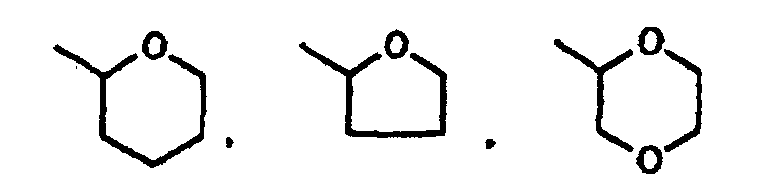 dans laquelle p est un entier de 0 à 5 ; R5 à R8 représentent chacun indépendamment des autres un atome d'hydrogène, un groupe alkyle en C1 à C20 à chaíne droite et ramifiée, -(CH2)nC(O)OR, -(CH2)nOR, - (CH2)nOC(O)R, -(CH2)nC(O)R et -(CH2)nOC(O)OR où R est un groupe alkyle en C1 à C10 à chaíne droite ou ramifiée, sous réserve qu'au moins l'un des radicaux R5 à R8 soit choisi parmi un groupe fonctionnel protégé représenté par -(CH2)nOG, -(CH2)nC(O)OG et -(CH2)n-(aryle en C6 à C14)-OG' où n est un entier de 0 à 10 et G est un groupe protecteur choisi parmi les radicaux Si(R15)3 où les radicaux R15 représentent chacun indépendamment des autres un groupe alkyle en C1 à C10 à chaíne droite ou ramifiée, aryle en C6 à C14 et aryle en C6 à C14 substitué où lesdits substituants sont choisis parmi les groupes alkyle en C1 à C5 à chaíne droite ou ramifiée, et G' représente G ou -C(O)CH3.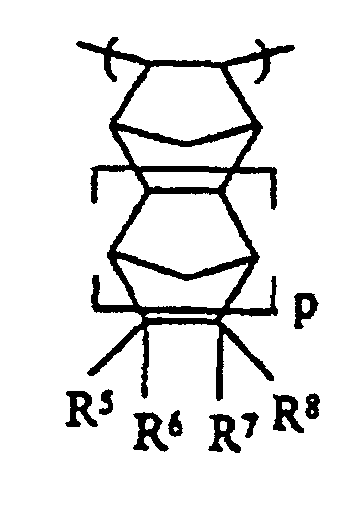
- Polymère selon la revendication 4, qui comprend en outre un motif récurrent représenté par la structure :dans laquelle q est un entier de 0 à 5 ; R9 à R12 représentent chacun indépendamment des autres un atome d'hydrogène, un groupe alkyle en Ci à C10 à chaíne droite ou ramifiée ou un substituant choisi dans l'ensemble -(A)n-C(O)OR", -(A)nOR", -(A)n-OC(O)R", -(A)n-OC(O)OR", -(A)n-C(O)R", -(A)n-OC(O)C(O)OR", -(A)n-O-A'-C(O)OR", -(A)n-OC(O)-A'-C(O)OR", -(A)n-C(O)O-A'-C(O)OR", -(A)n-C(O)-A'-OR", -(A)n-C(O)O-A'-OC(O)OR", -(A)n-C(O)O-A'-O-A'-C(O)OR", -(A)n-C(O)O-A'-OC(O)C(O)OR", -(A)n-C(R")2CH(R")(C(O)OR"), et -(A)n-C(R")2CH(C(O)OR")2, R9 et R12 peuvent être pris ensemble avec les atomes de carbone nucléaires auxquels ils sont liés pour représenter un groupe anhydride cyclique ; A et A' représentent chacun indépendamment de l'autre un radical pontant ou espaceur divalent choisi parmi les radicaux hydrocarbonés divalents choisis parmi les groupes alkylène en C1 à C10 à chaíne droite ou ramifiée ; les radicaux hydrocarbonés cycliques divalents choisis parmi les fragments cycloaliphatiques en C3 à C8 substitués et non substitués de formule :
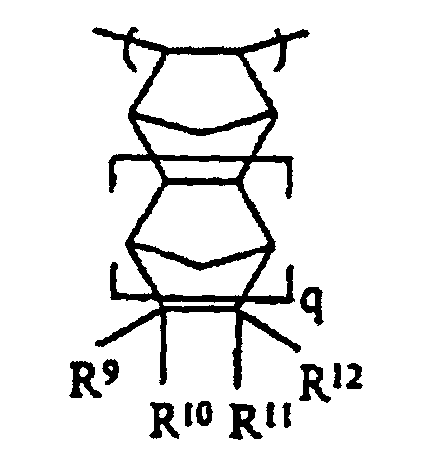 dans laquelle "a" est un entier de 2 à 7, et Rq, s'il est présent, représente un groupe alkyle en C1 à C10 à chaíne droite ou ramifiée ; des radicaux oxygénés divalents choisis parmi les oxydes d'alkylène en C2 à C10 et les polyéthers de formule :
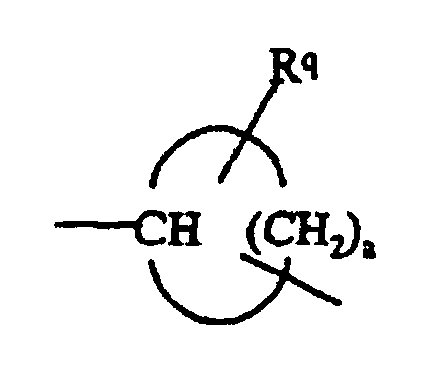 les radicaux R" représentent chacun d'une manière indépendante un radical alkyle en C1 à C10 à chaíne droite ou ramifiée, alcoxyalkylène en C1 à C10 à chaíne droite ou ramifiée, des polyéthers, des fragments cycloaliphatiques en C4 à C20 monocycliques et polycycliques, des éthers cycliques, des cétones cycliques et des esters cycliques.
- Procédé pour post-fonctionnaliser un polymère contenant des motifs récurrents cycliques, comprenant les étapes de :a) mise à disposition d'un polymère de base comprenant des motifs répétitifs cycliques contenant des groupes fonctionnels latéraux labiles aux acides et des motifs récurrents cycliques contenant des groupes fonctionnels latéraux contenant des fragments hydroxyle protégés, ledit fragment hydroxyle protégé contenant un groupe protecteur capable d'élimination sélective par des agents de déprotection qui n'attaquent pas lesdits groupes fonctionnels labiles aux acides ;b) déprotection des fragments hydroxyle protégés, pour donner des groupes fonctionnels contenant un groupe hydroxyle libre ;c) réaction du groupe hydroxyle libre avec un fragment coréactif pour donner un produit polymère post-fonctionnalisé.
- Procédé selon la revendication 6, dans lequel le fragment hydroxyle protégé est choisi dans l'ensemble comprenant les silyléthers, les esters silyliques, les acétates et leurs mélanges.
- Procédé selon la revendication 7, dans lequel le groupe fonctionnel contenant le fragment hydroxyle protégé est choisi dans l'ensemble comprenant -(CH2)nOG, -(CH2)nC(O)OG et -(CH2)n-(aryle en C6 à C14)OG' où n est un entier de 0 à 10, et G est un groupe protecteur silyle de formule -Si(R15)3 dans laquelle les radicaux R15 représentent chacun indépendamment des autres un groupe alkyle en C1 à C10 à chaíne droite ou ramifiée, aryle en C6 à C14 et aryle en C8 à C14 substitué où lesdits substituants sont choisis parmi les groupes alkyle en C1 à C5 à chaíne droite ou ramifiée ; et G' représente G ou -C(O)CH3.
- Procédé selon la revendication 6, dans lequel le fragment hydroxyle déprotégé est choisi dans l'ensemble comprenant un alcool, un acide carboxylique et leurs mélanges.
- Procédé selon la revendication 9, dans lequel le groupe déprotégé est un alcool, et ledit polymère est mis à co-réagir avec un fragment co-réactif choisi dans l'ensemble comprenant l'anhydride succinique, les isocyanates de formule R16-NCO, les esters sulfonates de formule R16SO2-O-SO2-R16, et les fragments co-réactifs de formule R16-C(O)O(O)C-R16 dans laquelle les radicaux R16 représentent chacun indépendamment de l'autre un groupe alkyle en C1 à C10 à chaíne droite ou ramifiée, aryle en C6 à C20, aralkyle en C7 à C24, ou un groupe silyle représenté par la formule -(CH2)n-Si(R19)3, dans laquelle les radicaux R19 représentent chacun indépendamment des autres un groupe alkyle en C1 à C10 à chaíne droite ou ramifiée, aryle en C6 à C20, aralkyle en C7 à C24, et n est un entier de 0 à 10.
- Procédé selon la revendication 9, dans lequel le groupe déprotégé est un acide carboxylique, et ledit polymère est mis à co-réagir avec un fragment co-réactif choisi dans l'ensemble comprenant les acétals à chaíne droite et ramifiée, les acétals cycliques, les orthocarbonates, les vinyléthers et leurs mélanges.
- Procédé de préparation d'un polymère cyclique post-fonctionnalisé, qui comprend la réaction d'un polymère de base contenant des motifs répétitifs de formuledans laquelle p est un entier de 0 à 5 ; R5 à R8 représentent chacun indépendamment des autres un atome d'hydrogène, un groupe alkyle en C1 à C20 à chaíne droite et ramifiée, -(CH2)nC(O)OR, -(CH2)nOR, -(CH2)nOC(O)R, -(CH2)nC(O)R et -(CH2)nOC(O)OR où R est un groupe alkyle en C1 à C10 à chaíne droite ou ramifiée, sous réserve qu'au moins l'un des radicaux R5 à R8 soit choisi indépendamment parmi un groupe fonctionnel déprotégé représenté par -(CH2)nOH, -(CH2)nC(O)OH et - (CH2)n-(aryle en C6 à C14)-OH, où est un entier de 0 à 10 avec un fragment coréactif avec ledit groupe fonctionnel déprotégé.

- Procédé selon la revendication 12, dans lequel ledit groupe fonctionnel déprotégé est choisi dans l'ensemble comprenant -(CH2)nOH, - (CH2)n-(aryle en C6 à C14)-OH et leurs mélanges, et ledit fragment co-réactif est choisi dans l'ensemble comprenant l'anhydride succinique, les isocyanates de formule R16-NCO, les esters sulfonates de formule R16SO2-O-SO2-R16, et les fragments co-réactifs de formule R16-C(O)O(O)C-R16 dans laquelle les radicaux R16 représentent chacun indépendamment de l'autre un groupe alkyle en C1 à C10 à chaíne droite ou ramifiée, aryle en C6 à C20, aralkyle en C7 à C24, ou un groupe silyle représenté par la formule - (CH2)n-Si(R19)3, dans laquelle les radicaux R19 représentent chacun indépendamment des autres un groupe alkyle en C1 à C10 à chaíne droite ou ramifiée, aryle en C6 à C20, aralkyle en C7 à C24, et n est un entier de 0 à 10.
- Procédé selon la revendication 12, dans lequel ledit groupe fonctionnel déprotégé est -(CH2)nC(O)OH, et ledit fragment co-réactif est choisi dans l'ensemble comprenant les acétals à chaíne droite ou ramifiée, les acétals cycliques, les orthocarbonates, les vinyléthers et leurs mélanges.
- Procédé selon la revendication 12, 13 ou 14, dans lequel ledit polymère de base comprend en outre un motif récurrent de formule :m est un entier de 0 à 10, où R1 à R4 représentent chacun indépendamment des autres un substituant choisi parmi -(A)nC(O)OR*, -(A)n-C(O)OR, -(A)n-OR, -(A)n-OC(O)R, -(A)n-C(O)R, -(A)n-OC(O)OR, - (A)n-OCH2C(O)OR*, -(A)n-C(O)O-A'-OCH2C(O)OR*, -(A)n-OC(O)-A'-C(O)OR*, -(A)n-C(R)2CH(R)(C(O)OR**) et -(A)n-C(R)2CH(C(O)OR**)2, sous réserve qu'au moins l'un des radicaux R1 à R4 soit choisi parmi un groupe labile aux acides contenant R* ; A et A' représentent chacun indépendamment de l'autre un radical pontant ou espaceur divalent choisi parmi les radicaux hydrocarbonés divalents choisis parmi les radicaux alkylène en C1 à C10 à chaíne droite ou ramifiée ; les radicaux hydrocarbonés cycliques divalents choisis parmi les fragments cycloaliphatiques en C3 à C8 substitués et non substitués, ayant la formule :
 dans laquelle a est un entier de 2 à 7, et Rq, s'il est présent, représente des groupes alkyle en C1 à C10 à chaíne droite ou ramifiée ; des radicaux oxygénés divalents choisis parmi les oxydes d'alkylène en C2 à C10 et les polyéthers de formule :
 et R* est un groupe labile aux acides choisi parmi dicyclopropylméthyle, diméthylcyclopropylméthyle, -C(CH3)3, -CH(RP)OCH2CH3, - CH(Rp)OC(CH3)3 et le groupe cyclique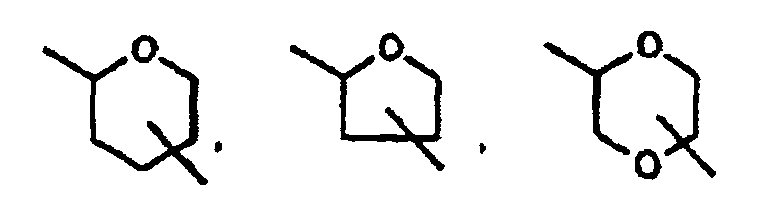
 ou leurs mélanges, où Rp représente un atome d'hydrogène et un groupe alkyle en C1 à C5 à chaíne droite ou ramifiée.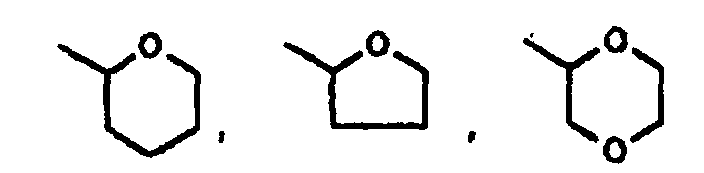
- Procédé selon la revendication 15, dans lequel ledit polymère de base comprend en outre un motif répétitif de formule :dans laquelle q est un entier de 0 à 5 ; R9 à R12 représentent chacun indépendamment des autres un atome d'hydrogène, un groupe alkyle en C1 à C10 à chaíne droite ou ramifiée ou un substituant choisi dans l'ensemble - (A)n-C(O)OR", -(A)nOR", -(A)n-OC(O)R", -(A)n-OC(O)OR", -(A)n-C(O)R", -(A)n-OC(O)C(O)OR", -(A)n-O-A'-C(O)OR", -(A)n-OC(O)-A'-C(O)OR", -(A)n-C(O)O-A'-C(O)OR", -(A)n-C(O)-A'-OR", -(A)n-C(O)O-A'-OC(O)OR", -(A)n-C(O)O-A'-O-A'-C(O)OR", -(A)n-C(O)O-A'-OC(O)C(O)OR", -(A)n-C(R")2CH(R")(C(O)OR"), et -(A)n-C(R")2CH(C(O)OR")2, R9 et R12 peuvent être pris ensemble avec les atomes de carbone nucléaires auxquels ils sont liés pour représenter un groupe anhydride cyclique ; A et A' représentent chacun indépendamment de l'autre un radical pontant ou espaceur divalent choisi parmi les radicaux hydrocarbonés divalents choisis parmi les groupes alkylène en C1 à C10 à chaíne droite ou ramifiée ; les radicaux hydrocarbonés cycliques divalents choisis parmi les fragments cycloaliphatiques en C3 à C8 substitués et non substitués de formule :
 dans laquelle "a" est un entier de 2 à 7, et Rq, s'il est présent, représente un groupe alkyle en C1 à C10 à chaíne droite ou ramifiée ; des radicaux oxygénés divalents choisis parmi les oxydes d'alkylène en C2 à C10 et les polyéthers de formule :
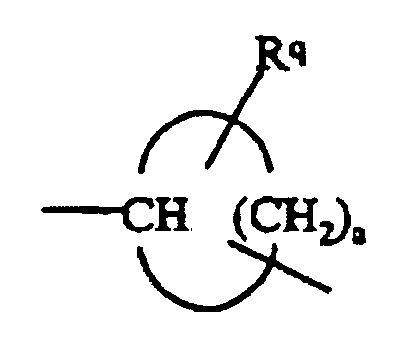 les radicaux R" représentent chacun d'une manière indépendante un radical alkyle en C1 à C10 à chaíne droite ou ramifiée, alcoxyalkylène en C1 à C10 à chaíne droite ou ramifiée, des polyéthers, des fragments cycloaliphatiques en C4 à C20 monocycliques et polycycliques, des éthers cycliques, des cétones cycliques et des esters cycliques.
Applications Claiming Priority (3)
| Application Number | Priority Date | Filing Date | Title |
|---|---|---|---|
| US7555898P | 1998-02-23 | 1998-02-23 | |
| US75558P | 1998-02-23 | ||
| PCT/US1999/003771 WO1999042510A1 (fr) | 1998-02-23 | 1999-02-19 | Polymeres polycycliques modifies |
Publications (2)
| Publication Number | Publication Date |
|---|---|
| EP1060206A1 EP1060206A1 (fr) | 2000-12-20 |
| EP1060206B1 true EP1060206B1 (fr) | 2004-04-14 |
Family
ID=22126537
Family Applications (1)
| Application Number | Title | Priority Date | Filing Date |
|---|---|---|---|
| EP99909541A Expired - Lifetime EP1060206B1 (fr) | 1998-02-23 | 1999-02-19 | Polymeres polycycliques modifies |
Country Status (11)
| Country | Link |
|---|---|
| US (2) | US6451945B1 (fr) |
| EP (1) | EP1060206B1 (fr) |
| JP (1) | JP2002504577A (fr) |
| KR (1) | KR100555605B1 (fr) |
| CN (1) | CN1315906C (fr) |
| AT (1) | ATE264352T1 (fr) |
| AU (1) | AU2872499A (fr) |
| DE (1) | DE69916434T2 (fr) |
| ID (1) | ID26364A (fr) |
| TW (1) | TW565575B (fr) |
| WO (1) | WO1999042510A1 (fr) |
Families Citing this family (22)
| Publication number | Priority date | Publication date | Assignee | Title |
|---|---|---|---|---|
| ATE542837T1 (de) * | 1998-02-23 | 2012-02-15 | Sumitomo Bakelite Co | Polycyclische resistzusammensetzungen mit verbesserter ätzbeständigkeit |
| JP4714955B2 (ja) * | 1999-09-29 | 2011-07-06 | 日本ゼオン株式会社 | 環状オレフィン系付加重合体およびその製造方法 |
| JP3734012B2 (ja) * | 1999-10-25 | 2006-01-11 | 信越化学工業株式会社 | レジスト材料及びパターン形成方法 |
| JP5095048B2 (ja) * | 1999-11-15 | 2012-12-12 | 信越化学工業株式会社 | 高分子化合物、レジスト材料及びパターン形成方法 |
| KR100389912B1 (ko) * | 1999-12-08 | 2003-07-04 | 삼성전자주식회사 | 지환식 감광성 폴리머 및 이를 포함하는 레지스트 조성물 |
| US6406828B1 (en) * | 2000-02-24 | 2002-06-18 | Shipley Company, L.L.C. | Polymer and photoresist compositions |
| EP1130468A3 (fr) * | 2000-02-25 | 2003-07-30 | Shipley Company LLC | Polymères et compositions photosensibles |
| EP1127899A1 (fr) * | 2000-02-25 | 2001-08-29 | Shipley Company LLC | Polymère et compositions pour photoréserves |
| JP4544389B2 (ja) * | 2000-04-28 | 2010-09-15 | 信越化学工業株式会社 | 高分子化合物、レジスト材料及びパターン形成方法 |
| WO2003075092A2 (fr) * | 2002-03-01 | 2003-09-12 | Massachusetts Institute Of Technology | Groupes protecteurs pour compositions de photoresine lithographique |
| US6756180B2 (en) | 2002-10-22 | 2004-06-29 | International Business Machines Corporation | Cyclic olefin-based resist compositions having improved image stability |
| US20050058606A1 (en) * | 2002-12-16 | 2005-03-17 | Boehringer Ingelheim Pharma Gmbh & Co. Kg | Tiotropium containing HFC solution formulations |
| JP2006083361A (ja) * | 2003-10-24 | 2006-03-30 | Jsr Corp | アイオノマー及びその製造方法並びに成形品 |
| WO2005049668A1 (fr) * | 2003-11-18 | 2005-06-02 | Jsr Corporation | Nouveau (co)polymere, son procede de production et procede de production d'un (co)polymere carboxyle |
| JP2005171234A (ja) * | 2003-11-18 | 2005-06-30 | Jsr Corp | 新規な(共)重合体およびその製造方法並びにカルボキシル基含有(共)重合体の製造方法 |
| US7101654B2 (en) * | 2004-01-14 | 2006-09-05 | Promerus Llc | Norbornene-type monomers and polymers containing pendent lactone or sultone groups |
| US7147986B2 (en) * | 2004-03-31 | 2006-12-12 | Intel Corporation | Resist compounds including acid labile groups attached to polymeric chains at anhydride linkages |
| JP2007131704A (ja) | 2005-11-09 | 2007-05-31 | Fujifilm Corp | 環状オレフィン系重合体、およびそれを用いた光学材料、偏光板および液晶表示装置 |
| US7727705B2 (en) * | 2007-02-23 | 2010-06-01 | Fujifilm Electronic Materials, U.S.A., Inc. | High etch resistant underlayer compositions for multilayer lithographic processes |
| US8753790B2 (en) * | 2009-07-01 | 2014-06-17 | Promerus, Llc | Self-imageable film forming polymer, compositions thereof and devices and structures made therefrom |
| JP5117484B2 (ja) * | 2009-12-28 | 2013-01-16 | 東京応化工業株式会社 | 新規な化合物、及びその製造方法 |
| US10623846B2 (en) * | 2016-12-06 | 2020-04-14 | Bose Corporation | Earpieces employing viscoelastic materials |
Family Cites Families (7)
| Publication number | Priority date | Publication date | Assignee | Title |
|---|---|---|---|---|
| JPS6052845A (ja) * | 1983-09-02 | 1985-03-26 | Japan Synthetic Rubber Co Ltd | パタ−ン形成材料 |
| US5340696A (en) * | 1993-01-29 | 1994-08-23 | Shipley Company Inc. | Photoresist compositions with copolymer binder having phenolic and nonaromatic cyclic alcohol units where the distribution of the cyclic alcohol concentration is less than 8 mole percent |
| JPH07140666A (ja) * | 1993-06-04 | 1995-06-02 | Internatl Business Mach Corp <Ibm> | マイクロリトグラフィックレジスト組成物、酸不安定化合物、マイクロリトグラフィックレリーフ画像形成方法及び酸感知性ポリマー組成物 |
| US5912313A (en) * | 1995-11-22 | 1999-06-15 | The B. F. Goodrich Company | Addition polymers of polycycloolefins containing silyl functional groups |
| JP3804138B2 (ja) | 1996-02-09 | 2006-08-02 | Jsr株式会社 | ArFエキシマレーザー照射用感放射線性樹脂組成物 |
| DE69733469T2 (de) * | 1996-03-07 | 2006-03-23 | Sumitomo Bakelite Co. Ltd. | Photoresist zusammensetzungen mit polycyclischen polymeren mit säurelabilen gruppen am ende |
| ATE542837T1 (de) * | 1998-02-23 | 2012-02-15 | Sumitomo Bakelite Co | Polycyclische resistzusammensetzungen mit verbesserter ätzbeständigkeit |
-
1999
- 1999-02-19 CN CNB998045152A patent/CN1315906C/zh not_active Expired - Fee Related
- 1999-02-19 EP EP99909541A patent/EP1060206B1/fr not_active Expired - Lifetime
- 1999-02-19 AU AU28724/99A patent/AU2872499A/en not_active Abandoned
- 1999-02-19 ID IDW20001890A patent/ID26364A/id unknown
- 1999-02-19 JP JP2000532461A patent/JP2002504577A/ja active Pending
- 1999-02-19 DE DE69916434T patent/DE69916434T2/de not_active Expired - Lifetime
- 1999-02-19 WO PCT/US1999/003771 patent/WO1999042510A1/fr not_active Ceased
- 1999-02-19 KR KR1020007009302A patent/KR100555605B1/ko not_active Expired - Fee Related
- 1999-02-19 AT AT99909541T patent/ATE264352T1/de not_active IP Right Cessation
- 1999-02-19 US US09/253,499 patent/US6451945B1/en not_active Expired - Lifetime
- 1999-04-07 TW TW088102555A patent/TW565575B/zh not_active IP Right Cessation
-
2002
- 2002-08-21 US US10/224,994 patent/US6794459B2/en not_active Expired - Lifetime
Also Published As
| Publication number | Publication date |
|---|---|
| KR100555605B1 (ko) | 2006-03-03 |
| DE69916434T2 (de) | 2005-03-24 |
| TW565575B (en) | 2003-12-11 |
| ATE264352T1 (de) | 2004-04-15 |
| KR20010041217A (ko) | 2001-05-15 |
| HK1036290A1 (en) | 2001-12-28 |
| EP1060206A1 (fr) | 2000-12-20 |
| US20030018153A1 (en) | 2003-01-23 |
| DE69916434D1 (de) | 2004-05-19 |
| CN1295587A (zh) | 2001-05-16 |
| US6451945B1 (en) | 2002-09-17 |
| AU2872499A (en) | 1999-09-06 |
| CN1315906C (zh) | 2007-05-16 |
| ID26364A (id) | 2000-12-14 |
| JP2002504577A (ja) | 2002-02-12 |
| US6794459B2 (en) | 2004-09-21 |
| WO1999042510A1 (fr) | 1999-08-26 |
Similar Documents
| Publication | Publication Date | Title |
|---|---|---|
| US6794459B2 (en) | Modified polycyclic polymers | |
| US6147177A (en) | Polycyclic resist compositions with increased etch resistance | |
| EP0885405B1 (fr) | Compositions de photoresist comprenant des polymeres polycycliques avec des groupes pendants labiles acides | |
| US6656659B1 (en) | Resist composition suitable for short wavelength exposure and resist pattern forming method | |
| AU747516C (en) | Photoresist compositions comprising polycyclic polymers with acid labile pendant groups | |
| KR100271419B1 (ko) | 화학증폭형 레지스트 제조용 중합체 및 이를 함유하는 레지스트조성물 | |
| KR100274119B1 (ko) | 감방사선성 레지스트 제조용 중합체 및 이를 함유하는 레지스트조성물 | |
| US20050153240A1 (en) | Norbornene-type monomers and polymers containing pendent lactone or sultone groups | |
| US6143466A (en) | Chemically amplified photoresist composition | |
| KR20010083547A (ko) | 저분자 화합물 첨가제를 포함하는 화학증폭형 레지스트조성물 | |
| KR100647379B1 (ko) | 신규의 포토레지스트용 단량체, 그의 공중합체 및 이를 이용한포토레지스트 조성물 | |
| US5212047A (en) | Resist material and process for use | |
| US5206317A (en) | Resist material and process for use | |
| HK1036290B (en) | Modified polycyclic polymers | |
| KR20000015410A (ko) | 신규한 포토레지스트 중합체 및 이를 이용한 포토레지스트 조성물 | |
| HK1017442B (en) | Photoresist compositions comprising polycyclic polymers with acid labile pendant groups | |
| HK1003127B (en) | Resist material and process for use |
Legal Events
| Date | Code | Title | Description |
|---|---|---|---|
| PUAI | Public reference made under article 153(3) epc to a published international application that has entered the european phase |
Free format text: ORIGINAL CODE: 0009012 |
|
| 17P | Request for examination filed |
Effective date: 20000822 |
|
| AK | Designated contracting states |
Kind code of ref document: A1 Designated state(s): AT BE CH CY DE DK ES FI FR GB GR IE IT LI LU MC NL PT SE |
|
| RAP1 | Party data changed (applicant data changed or rights of an application transferred) |
Owner name: INTERNATIONAL BUSINESS MACHINES CORPORATION Owner name: GOODRICH CORPORATION |
|
| 17Q | First examination report despatched |
Effective date: 20020916 |
|
| RAP1 | Party data changed (applicant data changed or rights of an application transferred) |
Owner name: INTERNATIONAL BUSINESS MACHINES CORPORATION Owner name: SUMITOMO BAKELITE CO., LTD. |
|
| GRAP | Despatch of communication of intention to grant a patent |
Free format text: ORIGINAL CODE: EPIDOSNIGR1 |
|
| GRAS | Grant fee paid |
Free format text: ORIGINAL CODE: EPIDOSNIGR3 |
|
| GRAA | (expected) grant |
Free format text: ORIGINAL CODE: 0009210 |
|
| AK | Designated contracting states |
Kind code of ref document: B1 Designated state(s): AT BE CH CY DE DK ES FI FR GB GR IE IT LI LU MC NL PT SE |
|
| PG25 | Lapsed in a contracting state [announced via postgrant information from national office to epo] |
Ref country code: NL Free format text: LAPSE BECAUSE OF FAILURE TO SUBMIT A TRANSLATION OF THE DESCRIPTION OR TO PAY THE FEE WITHIN THE PRESCRIBED TIME-LIMIT Effective date: 20040414 Ref country code: LI Free format text: LAPSE BECAUSE OF FAILURE TO SUBMIT A TRANSLATION OF THE DESCRIPTION OR TO PAY THE FEE WITHIN THE PRESCRIBED TIME-LIMIT Effective date: 20040414 Ref country code: IT Free format text: LAPSE BECAUSE OF FAILURE TO SUBMIT A TRANSLATION OF THE DESCRIPTION OR TO PAY THE FEE WITHIN THE PRESCRIBED TIME-LIMIT;WARNING: LAPSES OF ITALIAN PATENTS WITH EFFECTIVE DATE BEFORE 2007 MAY HAVE OCCURRED AT ANY TIME BEFORE 2007. THE CORRECT EFFECTIVE DATE MAY BE DIFFERENT FROM THE ONE RECORDED. Effective date: 20040414 Ref country code: FI Free format text: LAPSE BECAUSE OF FAILURE TO SUBMIT A TRANSLATION OF THE DESCRIPTION OR TO PAY THE FEE WITHIN THE PRESCRIBED TIME-LIMIT Effective date: 20040414 Ref country code: CH Free format text: LAPSE BECAUSE OF FAILURE TO SUBMIT A TRANSLATION OF THE DESCRIPTION OR TO PAY THE FEE WITHIN THE PRESCRIBED TIME-LIMIT Effective date: 20040414 Ref country code: BE Free format text: LAPSE BECAUSE OF FAILURE TO SUBMIT A TRANSLATION OF THE DESCRIPTION OR TO PAY THE FEE WITHIN THE PRESCRIBED TIME-LIMIT Effective date: 20040414 Ref country code: AT Free format text: LAPSE BECAUSE OF FAILURE TO SUBMIT A TRANSLATION OF THE DESCRIPTION OR TO PAY THE FEE WITHIN THE PRESCRIBED TIME-LIMIT Effective date: 20040414 |
|
| REG | Reference to a national code |
Ref country code: GB Ref legal event code: FG4D |
|
| REG | Reference to a national code |
Ref country code: CH Ref legal event code: EP |
|
| REF | Corresponds to: |
Ref document number: 69916434 Country of ref document: DE Date of ref document: 20040519 Kind code of ref document: P |
|
| REG | Reference to a national code |
Ref country code: IE Ref legal event code: FG4D |
|
| PG25 | Lapsed in a contracting state [announced via postgrant information from national office to epo] |
Ref country code: SE Free format text: LAPSE BECAUSE OF FAILURE TO SUBMIT A TRANSLATION OF THE DESCRIPTION OR TO PAY THE FEE WITHIN THE PRESCRIBED TIME-LIMIT Effective date: 20040714 Ref country code: GR Free format text: LAPSE BECAUSE OF FAILURE TO SUBMIT A TRANSLATION OF THE DESCRIPTION OR TO PAY THE FEE WITHIN THE PRESCRIBED TIME-LIMIT Effective date: 20040714 Ref country code: DK Free format text: LAPSE BECAUSE OF FAILURE TO SUBMIT A TRANSLATION OF THE DESCRIPTION OR TO PAY THE FEE WITHIN THE PRESCRIBED TIME-LIMIT Effective date: 20040714 |
|
| PG25 | Lapsed in a contracting state [announced via postgrant information from national office to epo] |
Ref country code: ES Free format text: LAPSE BECAUSE OF FAILURE TO SUBMIT A TRANSLATION OF THE DESCRIPTION OR TO PAY THE FEE WITHIN THE PRESCRIBED TIME-LIMIT Effective date: 20040725 |
|
| NLV1 | Nl: lapsed or annulled due to failure to fulfill the requirements of art. 29p and 29m of the patents act | ||
| REG | Reference to a national code |
Ref country code: CH Ref legal event code: PL |
|
| ET | Fr: translation filed | ||
| PLBE | No opposition filed within time limit |
Free format text: ORIGINAL CODE: 0009261 |
|
| STAA | Information on the status of an ep patent application or granted ep patent |
Free format text: STATUS: NO OPPOSITION FILED WITHIN TIME LIMIT |
|
| PG25 | Lapsed in a contracting state [announced via postgrant information from national office to epo] |
Ref country code: LU Free format text: LAPSE BECAUSE OF NON-PAYMENT OF DUE FEES Effective date: 20050219 Ref country code: CY Free format text: LAPSE BECAUSE OF FAILURE TO SUBMIT A TRANSLATION OF THE DESCRIPTION OR TO PAY THE FEE WITHIN THE PRESCRIBED TIME-LIMIT Effective date: 20050219 |
|
| PG25 | Lapsed in a contracting state [announced via postgrant information from national office to epo] |
Ref country code: IE Free format text: LAPSE BECAUSE OF NON-PAYMENT OF DUE FEES Effective date: 20050221 |
|
| PG25 | Lapsed in a contracting state [announced via postgrant information from national office to epo] |
Ref country code: MC Free format text: LAPSE BECAUSE OF NON-PAYMENT OF DUE FEES Effective date: 20050228 |
|
| 26N | No opposition filed |
Effective date: 20050117 |
|
| REG | Reference to a national code |
Ref country code: IE Ref legal event code: MM4A |
|
| PG25 | Lapsed in a contracting state [announced via postgrant information from national office to epo] |
Ref country code: PT Free format text: LAPSE BECAUSE OF NON-PAYMENT OF DUE FEES Effective date: 20040914 |
|
| PGFP | Annual fee paid to national office [announced via postgrant information from national office to epo] |
Ref country code: FR Payment date: 20130311 Year of fee payment: 15 Ref country code: DE Payment date: 20130227 Year of fee payment: 15 Ref country code: GB Payment date: 20130227 Year of fee payment: 15 |
|
| REG | Reference to a national code |
Ref country code: DE Ref legal event code: R119 Ref document number: 69916434 Country of ref document: DE |
|
| GBPC | Gb: european patent ceased through non-payment of renewal fee |
Effective date: 20140219 |
|
| REG | Reference to a national code |
Ref country code: FR Ref legal event code: ST Effective date: 20141031 |
|
| REG | Reference to a national code |
Ref country code: DE Ref legal event code: R119 Ref document number: 69916434 Country of ref document: DE Effective date: 20140902 |
|
| PG25 | Lapsed in a contracting state [announced via postgrant information from national office to epo] |
Ref country code: DE Free format text: LAPSE BECAUSE OF NON-PAYMENT OF DUE FEES Effective date: 20140902 Ref country code: GB Free format text: LAPSE BECAUSE OF NON-PAYMENT OF DUE FEES Effective date: 20140219 Ref country code: FR Free format text: LAPSE BECAUSE OF NON-PAYMENT OF DUE FEES Effective date: 20140228 |