EP1060731A1 - Matériau de comblement bio-actif, procédé d'utilisation de ce matériau et appareil pour la mise en oeuvre du procédé - Google Patents
Matériau de comblement bio-actif, procédé d'utilisation de ce matériau et appareil pour la mise en oeuvre du procédé Download PDFInfo
- Publication number
- EP1060731A1 EP1060731A1 EP99630053A EP99630053A EP1060731A1 EP 1060731 A1 EP1060731 A1 EP 1060731A1 EP 99630053 A EP99630053 A EP 99630053A EP 99630053 A EP99630053 A EP 99630053A EP 1060731 A1 EP1060731 A1 EP 1060731A1
- Authority
- EP
- European Patent Office
- Prior art keywords
- paste
- bone
- vibratory
- pusher
- bio
- Prior art date
- Legal status (The legal status is an assumption and is not a legal conclusion. Google has not performed a legal analysis and makes no representation as to the accuracy of the status listed.)
- Withdrawn
Links
- 238000000034 method Methods 0.000 title claims abstract description 19
- 239000000203 mixture Substances 0.000 title claims abstract description 16
- 230000000975 bioactive effect Effects 0.000 title claims description 17
- 239000000463 material Substances 0.000 title claims description 12
- 239000000945 filler Substances 0.000 title 1
- 238000011049 filling Methods 0.000 claims abstract description 40
- 210000000988 bone and bone Anatomy 0.000 claims abstract description 29
- 239000007788 liquid Substances 0.000 claims abstract description 14
- 239000000843 powder Substances 0.000 claims abstract description 13
- 239000007943 implant Substances 0.000 claims abstract description 9
- 239000008187 granular material Substances 0.000 claims abstract description 8
- 239000013060 biological fluid Substances 0.000 claims abstract description 5
- 230000000694 effects Effects 0.000 claims abstract description 5
- 229910052500 inorganic mineral Inorganic materials 0.000 claims abstract description 4
- 239000011707 mineral Substances 0.000 claims abstract description 4
- XYJRXVWERLGGKC-UHFFFAOYSA-D pentacalcium;hydroxide;triphosphate Chemical compound [OH-].[Ca+2].[Ca+2].[Ca+2].[Ca+2].[Ca+2].[O-]P([O-])([O-])=O.[O-]P([O-])([O-])=O.[O-]P([O-])([O-])=O XYJRXVWERLGGKC-UHFFFAOYSA-D 0.000 claims description 13
- 229910052588 hydroxylapatite Inorganic materials 0.000 claims description 12
- 239000012530 fluid Substances 0.000 claims description 10
- 239000011230 binding agent Substances 0.000 claims description 8
- 239000004568 cement Substances 0.000 claims description 8
- 238000009434 installation Methods 0.000 claims description 8
- 239000001506 calcium phosphate Substances 0.000 claims description 7
- 239000013078 crystal Substances 0.000 claims description 7
- 239000012071 phase Substances 0.000 claims description 7
- QORWJWZARLRLPR-UHFFFAOYSA-H tricalcium bis(phosphate) Chemical compound [Ca+2].[Ca+2].[Ca+2].[O-]P([O-])([O-])=O.[O-]P([O-])([O-])=O QORWJWZARLRLPR-UHFFFAOYSA-H 0.000 claims description 7
- 230000002787 reinforcement Effects 0.000 claims description 6
- 235000019731 tricalcium phosphate Nutrition 0.000 claims description 6
- 229940078499 tricalcium phosphate Drugs 0.000 claims description 6
- 229910000391 tricalcium phosphate Inorganic materials 0.000 claims description 6
- VTYYLEPIZMXCLO-UHFFFAOYSA-L Calcium carbonate Chemical compound [Ca+2].[O-]C([O-])=O VTYYLEPIZMXCLO-UHFFFAOYSA-L 0.000 claims description 5
- 229910052587 fluorapatite Inorganic materials 0.000 claims description 5
- 230000004927 fusion Effects 0.000 claims description 5
- 238000011065 in-situ storage Methods 0.000 claims description 5
- 238000002156 mixing Methods 0.000 claims description 5
- OYPRJOBELJOOCE-UHFFFAOYSA-N Calcium Chemical compound [Ca] OYPRJOBELJOOCE-UHFFFAOYSA-N 0.000 claims description 4
- 229910019142 PO4 Inorganic materials 0.000 claims description 4
- 229910052586 apatite Inorganic materials 0.000 claims description 4
- 239000011575 calcium Substances 0.000 claims description 4
- 229910052791 calcium Inorganic materials 0.000 claims description 4
- VSIIXMUUUJUKCM-UHFFFAOYSA-D pentacalcium;fluoride;triphosphate Chemical compound [F-].[Ca+2].[Ca+2].[Ca+2].[Ca+2].[Ca+2].[O-]P([O-])([O-])=O.[O-]P([O-])([O-])=O.[O-]P([O-])([O-])=O VSIIXMUUUJUKCM-UHFFFAOYSA-D 0.000 claims description 4
- 239000010452 phosphate Substances 0.000 claims description 4
- NBIIXXVUZAFLBC-UHFFFAOYSA-K phosphate Chemical compound [O-]P([O-])([O-])=O NBIIXXVUZAFLBC-UHFFFAOYSA-K 0.000 claims description 4
- 230000006641 stabilisation Effects 0.000 claims description 4
- 238000011105 stabilization Methods 0.000 claims description 4
- 239000000126 substance Substances 0.000 claims description 4
- 239000003153 chemical reaction reagent Substances 0.000 claims description 3
- 239000003999 initiator Substances 0.000 claims description 3
- 239000007790 solid phase Substances 0.000 claims description 3
- QAOWNCQODCNURD-UHFFFAOYSA-L Sulfate Chemical compound [O-]S([O-])(=O)=O QAOWNCQODCNURD-UHFFFAOYSA-L 0.000 claims description 2
- 210000002805 bone matrix Anatomy 0.000 claims description 2
- 230000006835 compression Effects 0.000 claims description 2
- 238000007906 compression Methods 0.000 claims description 2
- 238000005342 ion exchange Methods 0.000 claims description 2
- 230000011164 ossification Effects 0.000 claims description 2
- 230000000278 osteoconductive effect Effects 0.000 claims description 2
- 238000001556 precipitation Methods 0.000 claims description 2
- 102000004169 proteins and genes Human genes 0.000 claims description 2
- 108090000623 proteins and genes Proteins 0.000 claims description 2
- 239000007787 solid Substances 0.000 claims description 2
- 210000000130 stem cell Anatomy 0.000 claims description 2
- BVKZGUZCCUSVTD-UHFFFAOYSA-L Carbonate Chemical compound [O-]C([O-])=O BVKZGUZCCUSVTD-UHFFFAOYSA-L 0.000 claims 1
- 238000006073 displacement reaction Methods 0.000 claims 1
- 238000004090 dissolution Methods 0.000 claims 1
- 238000003780 insertion Methods 0.000 claims 1
- 230000037431 insertion Effects 0.000 claims 1
- 238000010883 osseointegration Methods 0.000 claims 1
- 210000001519 tissue Anatomy 0.000 description 5
- 235000021317 phosphate Nutrition 0.000 description 3
- 229920000642 polymer Polymers 0.000 description 3
- XLYOFNOQVPJJNP-UHFFFAOYSA-N water Substances O XLYOFNOQVPJJNP-UHFFFAOYSA-N 0.000 description 3
- 229910004298 SiO 2 Inorganic materials 0.000 description 2
- 238000010521 absorption reaction Methods 0.000 description 2
- AWUCVROLDVIAJX-UHFFFAOYSA-N alpha-glycerophosphate Natural products OCC(O)COP(O)(O)=O AWUCVROLDVIAJX-UHFFFAOYSA-N 0.000 description 2
- 229910000019 calcium carbonate Inorganic materials 0.000 description 2
- 210000004027 cell Anatomy 0.000 description 2
- 239000011521 glass Substances 0.000 description 2
- 230000010354 integration Effects 0.000 description 2
- JVTAAEKCZFNVCJ-UHFFFAOYSA-N lactic acid Chemical compound CC(O)C(O)=O JVTAAEKCZFNVCJ-UHFFFAOYSA-N 0.000 description 2
- 235000015250 liver sausages Nutrition 0.000 description 2
- 239000002245 particle Substances 0.000 description 2
- 230000002093 peripheral effect Effects 0.000 description 2
- 229920005989 resin Polymers 0.000 description 2
- AWUCVROLDVIAJX-GSVOUGTGSA-N sn-glycerol 3-phosphate Chemical compound OC[C@@H](O)COP(O)(O)=O AWUCVROLDVIAJX-GSVOUGTGSA-N 0.000 description 2
- 239000011734 sodium Substances 0.000 description 2
- GBNXLQPMFAUCOI-UHFFFAOYSA-H tetracalcium;oxygen(2-);diphosphate Chemical compound [O-2].[Ca+2].[Ca+2].[Ca+2].[Ca+2].[O-]P([O-])([O-])=O.[O-]P([O-])([O-])=O GBNXLQPMFAUCOI-UHFFFAOYSA-H 0.000 description 2
- 229910004261 CaF 2 Inorganic materials 0.000 description 1
- 235000014653 Carica parviflora Nutrition 0.000 description 1
- 235000008733 Citrus aurantifolia Nutrition 0.000 description 1
- 241000243321 Cnidaria Species 0.000 description 1
- 206010017076 Fracture Diseases 0.000 description 1
- DGAQECJNVWCQMB-PUAWFVPOSA-M Ilexoside XXIX Chemical compound C[C@@H]1CC[C@@]2(CC[C@@]3(C(=CC[C@H]4[C@]3(CC[C@@H]5[C@@]4(CC[C@@H](C5(C)C)OS(=O)(=O)[O-])C)C)[C@@H]2[C@]1(C)O)C)C(=O)O[C@H]6[C@@H]([C@H]([C@@H]([C@H](O6)CO)O)O)O.[Na+] DGAQECJNVWCQMB-PUAWFVPOSA-M 0.000 description 1
- 206010028980 Neoplasm Diseases 0.000 description 1
- 208000001132 Osteoporosis Diseases 0.000 description 1
- 235000011941 Tilia x europaea Nutrition 0.000 description 1
- PNEYBMLMFCGWSK-UHFFFAOYSA-N aluminium oxide Inorganic materials [O-2].[O-2].[O-2].[Al+3].[Al+3] PNEYBMLMFCGWSK-UHFFFAOYSA-N 0.000 description 1
- 208000037873 arthrodesis Diseases 0.000 description 1
- 239000012620 biological material Substances 0.000 description 1
- 235000011010 calcium phosphates Nutrition 0.000 description 1
- 239000000919 ceramic Substances 0.000 description 1
- 229910010293 ceramic material Inorganic materials 0.000 description 1
- 238000006243 chemical reaction Methods 0.000 description 1
- 239000000470 constituent Substances 0.000 description 1
- 230000003412 degenerative effect Effects 0.000 description 1
- 239000011350 dental composite resin Substances 0.000 description 1
- 239000004053 dental implant Substances 0.000 description 1
- 229940082150 encore Drugs 0.000 description 1
- 238000005429 filling process Methods 0.000 description 1
- 238000002347 injection Methods 0.000 description 1
- 239000007924 injection Substances 0.000 description 1
- 239000004310 lactic acid Substances 0.000 description 1
- 235000014655 lactic acid Nutrition 0.000 description 1
- 239000004571 lime Substances 0.000 description 1
- 239000011159 matrix material Substances 0.000 description 1
- 230000004820 osteoconduction Effects 0.000 description 1
- 230000002188 osteogenic effect Effects 0.000 description 1
- 230000004819 osteoinduction Effects 0.000 description 1
- 230000003647 oxidation Effects 0.000 description 1
- 238000007254 oxidation reaction Methods 0.000 description 1
- 239000004848 polyfunctional curative Substances 0.000 description 1
- 239000011414 polymer cement Substances 0.000 description 1
- 239000002952 polymeric resin Substances 0.000 description 1
- 230000000379 polymerizing effect Effects 0.000 description 1
- 230000008929 regeneration Effects 0.000 description 1
- 238000011069 regeneration method Methods 0.000 description 1
- 230000003014 reinforcing effect Effects 0.000 description 1
- 239000011347 resin Substances 0.000 description 1
- 238000000926 separation method Methods 0.000 description 1
- 229910052708 sodium Inorganic materials 0.000 description 1
- 239000002904 solvent Substances 0.000 description 1
- 241000894007 species Species 0.000 description 1
- 239000000725 suspension Substances 0.000 description 1
- 239000000057 synthetic resin Substances 0.000 description 1
- 229920003002 synthetic resin Polymers 0.000 description 1
- 229920001187 thermosetting polymer Polymers 0.000 description 1
- 230000001988 toxicity Effects 0.000 description 1
- 231100000419 toxicity Toxicity 0.000 description 1
Images
Classifications
-
- A—HUMAN NECESSITIES
- A61—MEDICAL OR VETERINARY SCIENCE; HYGIENE
- A61B—DIAGNOSIS; SURGERY; IDENTIFICATION
- A61B17/00—Surgical instruments, devices or methods
- A61B17/56—Surgical instruments or methods for treatment of bones or joints; Devices specially adapted therefor
- A61B17/58—Surgical instruments or methods for treatment of bones or joints; Devices specially adapted therefor for osteosynthesis, e.g. bone plates, screws or setting implements
- A61B17/68—Internal fixation devices, including fasteners and spinal fixators, even if a part thereof projects from the skin
-
- A—HUMAN NECESSITIES
- A61—MEDICAL OR VETERINARY SCIENCE; HYGIENE
- A61B—DIAGNOSIS; SURGERY; IDENTIFICATION
- A61B17/00—Surgical instruments, devices or methods
- A61B17/56—Surgical instruments or methods for treatment of bones or joints; Devices specially adapted therefor
- A61B17/58—Surgical instruments or methods for treatment of bones or joints; Devices specially adapted therefor for osteosynthesis, e.g. bone plates, screws or setting implements
- A61B17/88—Osteosynthesis instruments; Methods or means for implanting or extracting internal or external fixation devices
- A61B17/8802—Equipment for handling bone cement or other fluid fillers
- A61B17/8805—Equipment for handling bone cement or other fluid fillers for introducing fluid filler into bone or extracting it
- A61B17/8822—Equipment for handling bone cement or other fluid fillers for introducing fluid filler into bone or extracting it characterised by means facilitating expulsion of fluid from the introducer, e.g. a screw pump plunger, hydraulic force transmissions, application of vibrations or a vacuum
-
- A—HUMAN NECESSITIES
- A61—MEDICAL OR VETERINARY SCIENCE; HYGIENE
- A61F—FILTERS IMPLANTABLE INTO BLOOD VESSELS; PROSTHESES; DEVICES PROVIDING PATENCY TO, OR PREVENTING COLLAPSING OF, TUBULAR STRUCTURES OF THE BODY, e.g. STENTS; ORTHOPAEDIC, NURSING OR CONTRACEPTIVE DEVICES; FOMENTATION; TREATMENT OR PROTECTION OF EYES OR EARS; BANDAGES, DRESSINGS OR ABSORBENT PADS; FIRST-AID KITS
- A61F2/00—Filters implantable into blood vessels; Prostheses, i.e. artificial substitutes or replacements for parts of the body; Appliances for connecting them with the body; Devices providing patency to, or preventing collapsing of, tubular structures of the body, e.g. stents
- A61F2/02—Prostheses implantable into the body
- A61F2/30—Joints
- A61F2/46—Special tools for implanting artificial joints
- A61F2/4601—Special tools for implanting artificial joints for introducing bone substitute, for implanting bone graft implants or for compacting them in the bone cavity
-
- A—HUMAN NECESSITIES
- A61—MEDICAL OR VETERINARY SCIENCE; HYGIENE
- A61K—PREPARATIONS FOR MEDICAL, DENTAL OR TOILETRY PURPOSES
- A61K6/00—Preparations for dentistry
- A61K6/15—Compositions characterised by their physical properties
- A61K6/17—Particle size
-
- A—HUMAN NECESSITIES
- A61—MEDICAL OR VETERINARY SCIENCE; HYGIENE
- A61K—PREPARATIONS FOR MEDICAL, DENTAL OR TOILETRY PURPOSES
- A61K6/00—Preparations for dentistry
- A61K6/80—Preparations for artificial teeth, for filling teeth or for capping teeth
- A61K6/831—Preparations for artificial teeth, for filling teeth or for capping teeth comprising non-metallic elements or compounds thereof, e.g. carbon
- A61K6/838—Phosphorus compounds, e.g. apatite
-
- A—HUMAN NECESSITIES
- A61—MEDICAL OR VETERINARY SCIENCE; HYGIENE
- A61K—PREPARATIONS FOR MEDICAL, DENTAL OR TOILETRY PURPOSES
- A61K6/00—Preparations for dentistry
- A61K6/80—Preparations for artificial teeth, for filling teeth or for capping teeth
- A61K6/849—Preparations for artificial teeth, for filling teeth or for capping teeth comprising inorganic cements
- A61K6/858—Calcium sulfates, e.g, gypsum
-
- A—HUMAN NECESSITIES
- A61—MEDICAL OR VETERINARY SCIENCE; HYGIENE
- A61K—PREPARATIONS FOR MEDICAL, DENTAL OR TOILETRY PURPOSES
- A61K6/00—Preparations for dentistry
- A61K6/80—Preparations for artificial teeth, for filling teeth or for capping teeth
- A61K6/849—Preparations for artificial teeth, for filling teeth or for capping teeth comprising inorganic cements
- A61K6/873—Carbonates
-
- A—HUMAN NECESSITIES
- A61—MEDICAL OR VETERINARY SCIENCE; HYGIENE
- A61L—METHODS OR APPARATUS FOR STERILISING MATERIALS OR OBJECTS IN GENERAL; DISINFECTION, STERILISATION OR DEODORISATION OF AIR; CHEMICAL ASPECTS OF BANDAGES, DRESSINGS, ABSORBENT PADS OR SURGICAL ARTICLES; MATERIALS FOR BANDAGES, DRESSINGS, ABSORBENT PADS OR SURGICAL ARTICLES
- A61L27/00—Materials for grafts or prostheses or for coating grafts or prostheses
- A61L27/02—Inorganic materials
- A61L27/12—Phosphorus-containing materials, e.g. apatite
-
- A—HUMAN NECESSITIES
- A61—MEDICAL OR VETERINARY SCIENCE; HYGIENE
- A61B—DIAGNOSIS; SURGERY; IDENTIFICATION
- A61B17/00—Surgical instruments, devices or methods
- A61B17/56—Surgical instruments or methods for treatment of bones or joints; Devices specially adapted therefor
- A61B17/58—Surgical instruments or methods for treatment of bones or joints; Devices specially adapted therefor for osteosynthesis, e.g. bone plates, screws or setting implements
- A61B17/68—Internal fixation devices, including fasteners and spinal fixators, even if a part thereof projects from the skin
- A61B17/70—Spinal positioners or stabilisers, e.g. stabilisers comprising fluid filler in an implant
- A61B17/7094—Solid vertebral fillers; devices for inserting such fillers
- A61B17/7095—Solid vertebral fillers; devices for inserting such fillers the filler comprising unlinked macroscopic particles
-
- A—HUMAN NECESSITIES
- A61—MEDICAL OR VETERINARY SCIENCE; HYGIENE
- A61B—DIAGNOSIS; SURGERY; IDENTIFICATION
- A61B17/00—Surgical instruments, devices or methods
- A61B2017/00681—Aspects not otherwise provided for
- A61B2017/00685—Archimedes screw
-
- A—HUMAN NECESSITIES
- A61—MEDICAL OR VETERINARY SCIENCE; HYGIENE
- A61F—FILTERS IMPLANTABLE INTO BLOOD VESSELS; PROSTHESES; DEVICES PROVIDING PATENCY TO, OR PREVENTING COLLAPSING OF, TUBULAR STRUCTURES OF THE BODY, e.g. STENTS; ORTHOPAEDIC, NURSING OR CONTRACEPTIVE DEVICES; FOMENTATION; TREATMENT OR PROTECTION OF EYES OR EARS; BANDAGES, DRESSINGS OR ABSORBENT PADS; FIRST-AID KITS
- A61F2/00—Filters implantable into blood vessels; Prostheses, i.e. artificial substitutes or replacements for parts of the body; Appliances for connecting them with the body; Devices providing patency to, or preventing collapsing of, tubular structures of the body, e.g. stents
- A61F2/02—Prostheses implantable into the body
- A61F2/28—Bones
-
- A—HUMAN NECESSITIES
- A61—MEDICAL OR VETERINARY SCIENCE; HYGIENE
- A61F—FILTERS IMPLANTABLE INTO BLOOD VESSELS; PROSTHESES; DEVICES PROVIDING PATENCY TO, OR PREVENTING COLLAPSING OF, TUBULAR STRUCTURES OF THE BODY, e.g. STENTS; ORTHOPAEDIC, NURSING OR CONTRACEPTIVE DEVICES; FOMENTATION; TREATMENT OR PROTECTION OF EYES OR EARS; BANDAGES, DRESSINGS OR ABSORBENT PADS; FIRST-AID KITS
- A61F2/00—Filters implantable into blood vessels; Prostheses, i.e. artificial substitutes or replacements for parts of the body; Appliances for connecting them with the body; Devices providing patency to, or preventing collapsing of, tubular structures of the body, e.g. stents
- A61F2/02—Prostheses implantable into the body
- A61F2/28—Bones
- A61F2002/286—Bone stimulation by mechanical vibrations for enhancing ossification
-
- A—HUMAN NECESSITIES
- A61—MEDICAL OR VETERINARY SCIENCE; HYGIENE
- A61F—FILTERS IMPLANTABLE INTO BLOOD VESSELS; PROSTHESES; DEVICES PROVIDING PATENCY TO, OR PREVENTING COLLAPSING OF, TUBULAR STRUCTURES OF THE BODY, e.g. STENTS; ORTHOPAEDIC, NURSING OR CONTRACEPTIVE DEVICES; FOMENTATION; TREATMENT OR PROTECTION OF EYES OR EARS; BANDAGES, DRESSINGS OR ABSORBENT PADS; FIRST-AID KITS
- A61F2/00—Filters implantable into blood vessels; Prostheses, i.e. artificial substitutes or replacements for parts of the body; Appliances for connecting them with the body; Devices providing patency to, or preventing collapsing of, tubular structures of the body, e.g. stents
- A61F2/02—Prostheses implantable into the body
- A61F2/30—Joints
- A61F2002/30001—Additional features of subject-matter classified in A61F2/28, A61F2/30 and subgroups thereof
- A61F2002/30003—Material related properties of the prosthesis or of a coating on the prosthesis
- A61F2002/3006—Properties of materials and coating materials
- A61F2002/30062—(bio)absorbable, biodegradable, bioerodable, (bio)resorbable, resorptive
-
- A—HUMAN NECESSITIES
- A61—MEDICAL OR VETERINARY SCIENCE; HYGIENE
- A61F—FILTERS IMPLANTABLE INTO BLOOD VESSELS; PROSTHESES; DEVICES PROVIDING PATENCY TO, OR PREVENTING COLLAPSING OF, TUBULAR STRUCTURES OF THE BODY, e.g. STENTS; ORTHOPAEDIC, NURSING OR CONTRACEPTIVE DEVICES; FOMENTATION; TREATMENT OR PROTECTION OF EYES OR EARS; BANDAGES, DRESSINGS OR ABSORBENT PADS; FIRST-AID KITS
- A61F2/00—Filters implantable into blood vessels; Prostheses, i.e. artificial substitutes or replacements for parts of the body; Appliances for connecting them with the body; Devices providing patency to, or preventing collapsing of, tubular structures of the body, e.g. stents
- A61F2/02—Prostheses implantable into the body
- A61F2/30—Joints
- A61F2002/30001—Additional features of subject-matter classified in A61F2/28, A61F2/30 and subgroups thereof
- A61F2002/30003—Material related properties of the prosthesis or of a coating on the prosthesis
- A61F2002/3006—Properties of materials and coating materials
- A61F2002/30084—Materials having a crystalline structure
-
- A—HUMAN NECESSITIES
- A61—MEDICAL OR VETERINARY SCIENCE; HYGIENE
- A61F—FILTERS IMPLANTABLE INTO BLOOD VESSELS; PROSTHESES; DEVICES PROVIDING PATENCY TO, OR PREVENTING COLLAPSING OF, TUBULAR STRUCTURES OF THE BODY, e.g. STENTS; ORTHOPAEDIC, NURSING OR CONTRACEPTIVE DEVICES; FOMENTATION; TREATMENT OR PROTECTION OF EYES OR EARS; BANDAGES, DRESSINGS OR ABSORBENT PADS; FIRST-AID KITS
- A61F2/00—Filters implantable into blood vessels; Prostheses, i.e. artificial substitutes or replacements for parts of the body; Appliances for connecting them with the body; Devices providing patency to, or preventing collapsing of, tubular structures of the body, e.g. stents
- A61F2/02—Prostheses implantable into the body
- A61F2/30—Joints
- A61F2002/30001—Additional features of subject-matter classified in A61F2/28, A61F2/30 and subgroups thereof
- A61F2002/30621—Features concerning the anatomical functioning or articulation of the prosthetic joint
- A61F2002/30622—Implant for fusing a joint or bone material
-
- A—HUMAN NECESSITIES
- A61—MEDICAL OR VETERINARY SCIENCE; HYGIENE
- A61F—FILTERS IMPLANTABLE INTO BLOOD VESSELS; PROSTHESES; DEVICES PROVIDING PATENCY TO, OR PREVENTING COLLAPSING OF, TUBULAR STRUCTURES OF THE BODY, e.g. STENTS; ORTHOPAEDIC, NURSING OR CONTRACEPTIVE DEVICES; FOMENTATION; TREATMENT OR PROTECTION OF EYES OR EARS; BANDAGES, DRESSINGS OR ABSORBENT PADS; FIRST-AID KITS
- A61F2210/00—Particular material properties of prostheses classified in groups A61F2/00 - A61F2/26 or A61F2/82 or A61F9/00 or A61F11/00 or subgroups thereof
- A61F2210/0004—Particular material properties of prostheses classified in groups A61F2/00 - A61F2/26 or A61F2/82 or A61F9/00 or A61F11/00 or subgroups thereof bioabsorbable
-
- A—HUMAN NECESSITIES
- A61—MEDICAL OR VETERINARY SCIENCE; HYGIENE
- A61F—FILTERS IMPLANTABLE INTO BLOOD VESSELS; PROSTHESES; DEVICES PROVIDING PATENCY TO, OR PREVENTING COLLAPSING OF, TUBULAR STRUCTURES OF THE BODY, e.g. STENTS; ORTHOPAEDIC, NURSING OR CONTRACEPTIVE DEVICES; FOMENTATION; TREATMENT OR PROTECTION OF EYES OR EARS; BANDAGES, DRESSINGS OR ABSORBENT PADS; FIRST-AID KITS
- A61F2310/00—Prostheses classified in A61F2/28 or A61F2/30 - A61F2/44 being constructed from or coated with a particular material
- A61F2310/00005—The prosthesis being constructed from a particular material
- A61F2310/00179—Ceramics or ceramic-like structures
- A61F2310/00293—Ceramics or ceramic-like structures containing a phosphorus-containing compound, e.g. apatite
-
- A—HUMAN NECESSITIES
- A61—MEDICAL OR VETERINARY SCIENCE; HYGIENE
- A61F—FILTERS IMPLANTABLE INTO BLOOD VESSELS; PROSTHESES; DEVICES PROVIDING PATENCY TO, OR PREVENTING COLLAPSING OF, TUBULAR STRUCTURES OF THE BODY, e.g. STENTS; ORTHOPAEDIC, NURSING OR CONTRACEPTIVE DEVICES; FOMENTATION; TREATMENT OR PROTECTION OF EYES OR EARS; BANDAGES, DRESSINGS OR ABSORBENT PADS; FIRST-AID KITS
- A61F2310/00—Prostheses classified in A61F2/28 or A61F2/30 - A61F2/44 being constructed from or coated with a particular material
- A61F2310/00005—The prosthesis being constructed from a particular material
- A61F2310/00353—Bone cement, e.g. polymethylmethacrylate or PMMA
Definitions
- the present invention relates to a material for bio-active filling, a process for using this material and apparatus for implementing the process.
- the bio-active filling paste according to the invention includes a phosphocalcic hydraulic binder, grains hydroxyapatite of size chosen between 10 and 2000 ⁇ m (microns) depending on the desired properties, and a liquid preferably aqueous biocompatible reagent, the viscosity can be reduced and made fluid by a process and vibratory device, to allow filling of cavities or spaces, with a view to filling them for provide reinforcement, tissue fusion repair dental or bone, for example, or the stabilization of an implant, after hardening of said implant paste in situ.
- a phosphocalcic hydraulic binder grains hydroxyapatite of size chosen between 10 and 2000 ⁇ m (microns) depending on the desired properties
- a liquid preferably aqueous biocompatible reagent the viscosity can be reduced and made fluid by a process and vibratory device, to allow filling of cavities or spaces, with a view to filling them for provide reinforcement, tissue fusion repair dental or bone, for example, or the stabilization of an implant, after hardening of
- filling paste according to the invention include, without be limited to these: surgical implants, dental, veterinary; osteoporosis, tumors, fractures, joint replacements, revisions, repair, reinforcement, filling, bone tissue; arthrodesis of joint spaces degenerative, seals, anchors, osteo-induction, osteoconduction, grafts, fusion.
- the cements used in implantology are derived dental composites obtained by mixing a powder synthetic resin and a hardener more or less liquid. Besides their exothermic reaction which necroses them peripheral tissues during the curing phase, the toxicity of solvents allowing setting is a cause significant and well documented intraoperative risk.
- Thermosetting resins, or polymerizing under the action of ultraviolet is impossible to put in works in sterile surgical environment.
- the granules used to fill the cavities are of two types:
- inert like alumina ceramics, associated with grafting bone, preferably autogenous.
- EP-A-0 422 719 describes a filling biomaterial bone or dental apatite-based, phosphate-based oxygenated calcium with an apatic structure which has oxygenated species at higher oxidation states or equal to - 2.
- EP-A-0 401 793 describes a replacement material for living hard tissues comprising a ceramic material containing CaO and SiO 2 as main constituents and optionally MgO and does not contain calcium phospate.
- FR-A-2 684 003 describes an implantable material bio-degradable consisting of a mixture of hydroxylapatite or apatite containing other calcium phosphates or lime which mixed with lactic acid and water gives a malleable pâté which then hardens.
- a gelatin-apatite-glycerol-water mixture gives by treatment at low pressure a bone sponge of density and hardness variables.
- EP-A-0 564 369 describes a material for prosthesis bioresorbable bone, containing particles of calcium carbonate, for example from the skeleton of coral, dispersed within a polymer matrix, said particles with dimensions less than 1 mm and representing from 40 to 70% of the total weight, and said polymer being a bioresorbable polymer.
- EP-A-0 417 018 discloses a bioreactive material of the glass or partially crystallized glass type, for bone prosthesis or dental implant, which contains in% by weight, 5 to 14 of Na 2 O, 0 to 12% of P 2 O 5 , 49 to 57% of SiO 2 , the balance consisting of at most 33% of a mixture of CaO and CaF 2 , the latter being between 0.5 and 7%.
- FR-A-2 693 716 describes a process for obtaining phosphocalcic hydroxylapatite (PAH).
- This process consists in mixing, in powder form, a phosphate monocalic (MCP), a tricalcium phosphate (TCP) and a tetracalcium phosphate (TTCP), and to react the mixing with water in the presence of a glycerophosphate soluble in water, in particular glycerophosphate sodium (NaGP).
- MCP phosphate monocalic
- TCP tricalcium phosphate
- TTCP tetracalcium phosphate
- the method of the invention makes it possible to obtain stoichiometric or almost hydroxyapatite stoichiometric, with flexible setting times compatible with surgical use, filling in particular.
- the purpose of the invention is to allow the implementation place in bone cavities of difficult access and by a minimal incision or if possible percutaneously by a arthroscopic process, of a filling paste comprising a powder and granules mixed in a low amount of reactive liquid, including high viscosity associated with the presence of grains makes the injection impossible without the action of vibratory waves whose length or frequency are chosen according to the proportions mixture; said paste has a physico-chemical composition allowing its hardening in the presence of biological fluids and substantially reproducing the phase mineral bone to allow its osteointegration.
- the bio-active filling paste of this The invention is described in claim 1.
- the bio-active filling block (1) of this invention is obtained by mixing a bioactive material synthetic comprising a hydraulic binder phosphocalcic in powder form (6) and grains hydroxypatite (7), or fluoroapatite, preferably hexagonal crystal structure stoichiometric therefore weakly absorbable, of size between 10 and 2000 ⁇ m (microns) depending on the properties sought, in a setting initiator reactive liquid (8), so as to form a medium setting cement aqueous whose mechanical properties in compression are reinforced and maintained during its assimilation by the organism, thanks to the presence of said grains (7).
- the grains of hydroxyapatite (7) or fluoroapatite, constituting the hard elements, slightly absorbable can be composed of crystals preferably oriented elongated in the form, for example, of needles, solid or hollow, reinforcing said cement.
- the hydraulic phosphocalcic binder in powder form (6) is preferably made by assembling small crystals from 1 to 100 nanometers, said assembly having a micro porosity between 10 and 20,000 nanometers, so to facilitate the circulation of the setting reactive liquid (8) during the hardening phase, then the circulation of biological fluids during the absorption phase allowing to obtain their saturation triggering the precipitation of non-stoichiometric apatites integrating specific proteins in the bone matrix.
- Elements or materials can be added to to organize a macro-porosity between 50 and 600 micrometers in the mass of cement to facilitate ion exchange, vascularization or the capture of osteopoietic stem cells allowing by an effect osteoconductive bone formation.
- the phosphocalcic hydraulic binder in the form of powder (6) preferably consists partly of bicalcium phosphate (BCP), tricalcium phosphate (TCP), carbonated apatite, hydroxyapatite (HA) not stoichiometric, calcium carbonate, semi sulfate hydrated calcium, or at least two of these.
- BCP bicalcium phosphate
- TCP tricalcium phosphate
- HA hydroxyapatite
- the viscosity of the filling paste according to the invention is reduced and made more fluid (2) by a method using a vibratory device (3) in order to allow reinforcement, separation by fusion of tissues dental or bone (5) or the stabilization of a implant (9) after hardening of said paste in situ.
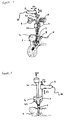
- FIG. 1 shows an installation to put implementing the filling process according to the invention, a cavity (4) in a bone (5).
- a cavity can be find for example an implant (9) to fix in place.
- a vibratory device (3) creates a series of vibratory waves (V1, V2) along a pusher (31) which transmits the vibrations to the mixture that is formed by putting in suspension of the solid phase (6, 7) in the reactive liquid plug (8) in an introducer (32).
- This makes the dough (1) fluid (2) and under the influence of the thrust (P) which is created by the assembly, the vibratory apparatus (3) and pusher (31) the fluid dough flows easily in the cavity (4) and around the implant (9) which it contributes to stabilize after hardening in situ.
- the pâté de filling (1) consists of a mixture of binder phosphocalcic hydraulic in powder form (6) and grains of hydroxyapatite (7), or of fluoroapatite, crystal structure to which a reactive liquid is added plug initiator (8).
- Figure 2 shows another embodiment for filling a cavity (4) in a bone (5) by the filling paste (1) comprising a powder (6) and granules (7) mixed in a small amount of reactive liquid (8) whose viscosity can be reduced and made fluid (2) to allow filling of cavities (4) by a vibratory process.
- the vibratory device (3, V1 and V2) is fixed directly on the introducer (32) and the pusher (31) exerts pressure (8) on the dough (1) in the fluid state (2) to inject it into the cavity.
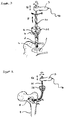
- Figure 3 shows an embodiment guide for filling a bone cavity (5), similar to that of Figure 1 except that the vibratory movement (V1, V2) is transmitted to a pusher (31) in the form of an Archimedes screw whose rotation (R) drives the filling paste (1) into the introducer (32) and then to the cavity (4).
- the device vibratory incorporates a motor allowing the rotation of said pusher in the shape of an Archimedes screw.
Landscapes
- Health & Medical Sciences (AREA)
- Life Sciences & Earth Sciences (AREA)
- Oral & Maxillofacial Surgery (AREA)
- Animal Behavior & Ethology (AREA)
- General Health & Medical Sciences (AREA)
- Public Health (AREA)
- Veterinary Medicine (AREA)
- Orthopedic Medicine & Surgery (AREA)
- Epidemiology (AREA)
- Chemical & Material Sciences (AREA)
- Surgery (AREA)
- Engineering & Computer Science (AREA)
- Transplantation (AREA)
- Plastic & Reconstructive Surgery (AREA)
- Inorganic Chemistry (AREA)
- Biomedical Technology (AREA)
- Heart & Thoracic Surgery (AREA)
- Medical Informatics (AREA)
- Molecular Biology (AREA)
- Nuclear Medicine, Radiotherapy & Molecular Imaging (AREA)
- Physical Education & Sports Medicine (AREA)
- Cardiology (AREA)
- Vascular Medicine (AREA)
- Neurology (AREA)
- Dermatology (AREA)
- Medicinal Chemistry (AREA)
- Materials For Medical Uses (AREA)
- Prostheses (AREA)
Abstract
Pâte de comblement (1) bio-active comprenant une
poudre (6) de liant hydraulique phosphocalcique et des
granulés (7) d'hydroxyapatite ou de fluoroapatite à
structure cristalline de préférence hexagonale
stoéchiométrique de taille entre 10 et 2000 microns
mélangés dans une faible quantité de liquide réactif (8).
L'invention concerne également un procédé d'introduction de
la pâte de comblement bio-active pour le remplissage de
cavités ou d'espaces pour assurer le renfort, la réparation
par fusion de tissus dentaires ou osseux ou la
stabilisation d'un implant ainsi qu'une installation pour
la mise en oeuvre du procédé.
Description
La présente invention concerne un matériau de
comblement bio-actif, un procédé d'utilisation de ce
matériau et des appareils pour la mise en oeuvre du
procédé.
La pâte de comblement bio-active selon l'invention
comprend un liant hydraulique phosphocalcique, des grains
d'hydroxyapatite de taille choisie entre 10 et 2000 µm
(microns) selon les propriétés recherchées, et un liquide
réactif biocompatible de préférence aqueux, dont la
viscosité peut être réduite et rendue fluide par un procédé
et appareil vibratoire, afin de permettre le remplissage de
cavités ou d'espaces, en vue de leur comblement pour
assurer le renfort, la réparation par fusion des tissus
dentaires ou osseux, par exemple, ou encore la
stabilisation d'un implant, après durcissement de ladite
pâte in situ.
Comme domaines d'applications et d'utilisations de la
pâte de comblement selon l'invention on peut citer, sans
être limité à ceux-ci: les implants chirurgicaux,
dentaires, vétérinaires; ostéoporose, tumeurs, fractures,
arthroplasties, révisions, réparation, renfort, comblement,
des tissus osseux; arthrodèse d'espaces articulaires
dégénératifs, scellements, ancrages, ostéo-induction,
ostéo-conduction, greffes, fusion.
Les substances permettant le comblement de cavités
osseuses existent sous deux familles génériques selon leur
mode de mise en oeuvre:
- Des ciments polymères ou des résines, à effet de durcissement.
- Des granulés ou des blocs à tailler, à effet d'intégration cellulaire.
1/ Les ciments utilisés en implantologie sont dérivés
des composites dentaires obtenus par mélange d'une poudre
de résine de synthèse et d'un durcisseur plus ou moins
liquide. Outre leur réaction exothermique qui nécrose les
tissus périphériques pendant la phase de durcissement, la
toxicité des solvants permettant la prise est une cause
importante et bien documentée de risque per-opératoire.
Les résines thermodurcissable, ou polymérisant sous
l'action des ultra violets sont impossibles à mettre en
oeuvre en milieu chirurgical stérile.
De plus ces ciments de synthèse de par leur
composition chimique relativement inerte, s'ils sont
tolérés par l'os et les tissus vivants, ne peuvent
prétendre participer à leur régénération ou leur
réparation.
2/ Les granulés utilisés pour combler les cavités
osseuses sont de deux types:
- soit inertes, comme les céramiques d'alumine, donc
associés à de l'os de greffe de préférence autogène.
- soit bio-actifs car leur composition est proche de
la phase minérale de l'os et sont reconnus par les cellules
ostéogènes. Sous forme de granulés, ils s'incorporent
lentement par colonisation et résorption, au détriment de
leur résistance mécanique. Sous forme de blocs, ils offrent
une meilleure tenue mécanique dans le temps, mais au
détriment d'une intégration médiocre principalement
périphérique.
Dans tous les cas ces matériaux bio-actifs, blocs ou
granulés, ne peuvent assurer une stabilité immédiate et
nécessitent une immobilisation complémentaire, le temps de
leur assimilation par l'organisme.
Le EP-A-0 422 719 décrit un biomatériau de comblement
osseux ou dentaire à base d'apatite, à base de phosphate de
calcium oxygéné ayant une structure apatique qui possède
des espèces oxygénées à des degrés d'oxydation supérieurs
ou égaux à - 2.
Le EP-A-0 401 793 décrit un matériau de remplacement
de tissus durs vivants comprenant un matière céramique
contentant du CaO et SiO2 comme constituants principaux et
facultativement du MgO et ne contient pas de phospate de
calcium.
Le FR-A-2 684 003 décrit un matériau implantable
bio-dégradable constitué par un mélange d'hydroxylapatite
ou d'apatite contenant d'autres phosphates de calcium ou de
la chaux qui mélangés avec de l'acide lactique et de l'eau
donne une pâté malléable qui durcit par la suite. Un
mélange gélatine-apatite-glycérol-eau donne par traitement
à basse pression une éponge osseuse de densité et dureté
variables.
Le EP-A-0 564 369 décrit un matériau pour prothèse
osseuse biorésorbable, contenant des particules de
carbonate de calcium, provenant par exemple de squelette de
corail, dispersées au sein d'une matrice polymère, lesdites
particules ayant des dimensions inférieures à 1 mm et
représentant de 40 à 70% du poids total, et ledit polymère
étant un polymère biorésorbable.
Le EP-A-0 417 018 divulgue un matériau bioréactif du
type verre ou verre partiellement cristallisé, pour
prothèse osseuse ou implant dentaire, qui contient en %
poids, 5 à 14 de Na2O, 0 à 12% de P2O5, 49 à 57% de SiO2, le
solde étant constitué d'au plus 33% d'un mélange de CaO et
CaF2, ce dernier étant compris entre 0,5 et 7%.
Le FR-A-2 693 716 décrit un procédé d'obtention
d'hydroxylapatite phosphocalcique (HAP). Ce procédé
consiste à mélanger, sous forme de poudre, un phosphate
monocalique (MCP), un phosphate tricalcique (TCP) et un
phosphate tétracalcique (TTCP), et à faire réagir le
mélange avec de l'eau en présence d'un glycérophosphate
soluble dans l'eau, en particulier glycérophosphate de
sodium (NaGP). Le procédé de l'invention permet d'obtenir
une hydroxyapatite stoéchiométrique ou quasi
stoéchiométrique, avec des temps de prise modulables
compatibles avec une utilisation chirurgicale, en
comblement en particulier.
Le propos de l'invention est de permettre la mise en
place dans les cavités osseuses d'accès difficile et par
une incision minimale ou si possible en percutané par un
procédé arthroscopique, d'une pâte de comblement comprenant
une poudre et des granulés mélangés dans une faible
quantité de liquide réactif, dont la forte viscosité
associée à la présence de grains rend l'injection
impossible sans l'action d'ondes vibratoires dont la
longueur ou fréquence sont choisies selon les proportions
du mélange ; ladite pâte présente une composition physico-chimique
permettant son durcissement en présence des
fluides biologiques et reproduisant sensiblement la phase
minérale de l'os afin de permettre son ostéo-intégration.
Le pâte de comblement bio-active de la présente
invention est décrite dans la revendication 1.
Le procédé d'application de la pâte de comblement
bio-active de la présente invetion est décrit dans la
revendication 7.
L'appareil pour la mise en oeuvre du procédé selon
l'invention et décrit dans la revendication 8.
Pour que l'invention puisse être mieux comprise,
référence est faite aux dessins, dnas lesquels:
- la figure 1 représente une installation pour le remplissage d'une cavité dans un os par la pâte de comblement selon la présente invention.
- la figure 2 représente un autre mode de réalisation pour le remplissage d'une cavité dans un os par la pâte de comblement selon la présente invention.
- la figure 3 réprésente encore un troisième mode de réalisation pour le remplissage d'une cavité dans un os par la pâte de comblement selon la présente invention.
- la figure 4 réprésente un quatrième mode de réalisation pour le remplissage d'une cavité dans un os par la pâte de comblement selon la présente invention.
La pâté de comblement (1) bio-active de la présente
invention est obtenue par le mélange d'un matériau bio-actif
de synthèse comprenant un liant hydraulique
phosphocalcique sous forme de poudre (6) et des grains
d'hydroxypatite (7), ou encore de fluoroapatite, à
structure cristalline de préférence hexagonale
stoéchiométrique donc faiblement résorbables, de taille
chosie entre 10 et 2000 µm (microns) selon les propriétés
recherchées, dans un liquide réactif initiateur de prise
(8), de manière à former un ciment à prise en milieu
aqueux dont les propriétés mécaniques en compression sont
renforcées et maintenues pendant son assimilation par
l'organisme, grâce à la présence desdits grains (7).
Les grains d'hydroxyapatite (7) ou de fluoroapatite,
constituant les éléments durs, faiblement résorbables
peuvent être composés de cristaux de préférence orientés de
manière allongée sous forme par exemple d'aiguilles,
pleines ou creuses, réalisant l'armature dudit ciment. Le
liant hydraulique phosphocalcique sous forme de poudre (6)
est réalisé de préférence par assemblage de petits cristaux
de 1 à 100 nanomètres, ledit assemblage présentant une
micro porosité comprise entre 10 et 20000 nanomètres, afin
de faciliter la circulation du liquide réactif de prise (8)
pendant la phase de durcissement, puis la circulation des
fluides biologiques pendant la phase de résorption
permettant d'obtenir leur saturation déclenchant la
précipitation d'apatites non stoéchiométriques intégrant
les protéines spécifiques de la matrice osseuse.
Des éléments ou matériaux peuvent être ajoutés afin
d'organiser une macro-porosité comprise entre 50 et 600
micromètres dans la masse du ciment afin de faciliter les
échanges ioniques, la vascularisation ou la capture de
cellules souches ostéopoïétiques permettant par un effet
ostéoconducteur la formation d'os.
Le liant hydraulique phosphocalcique sous forme de
poudre (6) est constitué de préférence pour partie de
phosphate bicalcique (BCP), de phosphate tricalcique (TCP),
d'apatite carbonatée, d'hydroxyapatite (HA) non
stoéchiométrique, de carbonate de calcium, de sulfate semi
hydraté de calcium, ou d'au moins deux de ces éléments.
La viscosité de la pâte de comblement selon
l'invention est réduite et est rendue plus fluide (2) par
un procédé utilisant un appareil vibratoire (3) afin de
permettre le renfort, la séparation par fusion des tissus
dentaires ou osseux (5) ou encore la stabilisation d'un
implant (9) après durcissement in situ de ladite pâte.
La figure 1 réprésente une installation pour mettre
en oeuvre le procédé de remplissage, selon l'invention,
d'une cavité (4) dans un os (5). Dans cette cavité peut se
trouver par exemple un implant (9) à fixer en place. Un
appareil vibratoire (3) crée une série d'ondes vibratoires
(V1, V2) le long d'un poussoir (31) qui transmet les
vibrations au mélange qui est formé en mettant en
suspension la phase solide (6, 7) dans le liquide réactif
de prise (8) dans un introducteur (32). Ceci rend la pâte
(1) fluide (2) et sous l'influence de la poussée (P) qui
est créée par l'ensemble, l'appareil vibratoire (3) et
poussoir (31) la pâte fluide s'écoule facilement dns la
cavité (4) et autour de l'implant (9) qu'elle contribue à
stabiliser après durcissement in situ.
Ainsi qu'on l'a indiqué ci-dessus, la pâté de
comblement (1) est constituée d'un mélange de liant
hydraulique phosphocalcique sous forme de poudre (6) et de
grains d'hydroxyapatite (7), ou encore de fluoroapatite, à
structure cristalline auquel est ajouté un liquide réactif
initiateur de prise (8).
La figure 2 représente un autre mode de réalisation
d'installation pour remplissage d'une cavité (4) dans un os
(5) par la pâte de comblement (1) comprenant une poudre (6)
et des granulés (7) mélangés dans un faible quantité de
liquide réactif (8) dont la viscosité peut être réduite et
rendue fluide (2) afin de permettre le remplissage de
cavités (4) par un procédé vibratoire. Dans ce mode de
réalisation l'appareil vibratoire (3, V1 et V2) est fixé
directement sur l'introducteur (32) et le poussoir (31)
exerce une pression (8) sur la pâte (1) à l'état fluide (2)
pour l'injecter dans la cavité.
La figure 3 représents un mode de réalisation
d'installation pour le remplissage d'une cavité d'un os
(5), similaire à celui de la figure 1 à l'exception que le
mouvement vibratoire (V1, V2) est transmit à un poussoir
(31) en forme de vis d'Archimède dont la rotation (R)
entraíne la pâte de comblement (1) dans l'introducteur (32)
et ensuite vers la cavité (4). Dans ce cas l'appareil
vibratoire incorpore un moteur permettant la rotation dudit
poussoir en forme de vis d'Archimède.
Dans le mode de réalisation de la figure 4 on utilise
un introducteur (32) courbe et un poussoir (31) flexible.
Ce dernier transmet les vibrations (V1, V2) au mélange et
son déplacement (P1 à P2) jusque dans l'os (5) facilite le
remplissage de la cavité (4) même dans une position
rétrograde.
L'invention a été décrite par des modes de
réalisation préférés mais il est bien entendu que d'autres
modifications peuvent être faites dans le cadre de
l'invention qui n'est limitée que par les revendications.
Claims (12)
- Pâte de comblement (1) bio-active comprenant une poudre (6) et des granulés (7) mélangés dans une faible quantité de liquide réactif (8) dont la viscosité peut être réduite et rendue fluide (2) par un appareil et procédé vibratoire (V1 et V2), afin de permettre le remplissage de cavités (4) ou d'espace, pour assurer le renfort, la réparation par fusion des tissus dentaires ou osseux (5), ou encore la stabilisation d'un implant (9), après durcissement in situ de ladite pâte (1), celle-ci présentant une composition physico-chimique permettant son durcissement en présence des fluides biologiques et reproduisant sensiblement la phase minérale de l'os afin de permettre son ostéo-intégration.
- Pâte de comblement (1) bio-active selon la revendication 1 obtenue par le mélange d'un matériau bio-actif de synthèse comprenant un liant hydraulique phosphocalcique sous forme de poudre (6) et des grains d'hydroxyapatite (7), ou encore de fluoroapatite, à structure cristalline de préférence hexagonale stoéchiométrique donc faiblement résorbables, de taille choisie entre 10 et 2000 microns selon les propriétés recherechées, dans un liquide réactif initiateur de prise (8) de préférence aqueux, de manière à former un ciment dont les propriétés mécaniques en compression sont renforcées, et maintenues pendant son assimilation par l'organisme, grâce à la présence desdits grains (7).
- Pâte de comblement (1) bio-active selon les revendications 1 et 2 comprenant des grains d'hydroxyapatite (7), ou de fluoroapatite à structure cristalline de préférence hexagonale stoéchiométrique, de taille choisie entre 10 et 2000 microns, constituant les éléments durs, faiblement résorbables composés de cristaux de préférence orientés de manière allongée sous forme par exemple d'aiguilles, pleines ou creuses, réalisant l'armature dudit ciment, le choix du type d'aiguilles et/ou de leur diamètre permettant de réguler la vitesse de leur dissolution selon leur rapport masse/surface.
- Pâte de comblement (1) bio-active selon les revendications 1 à 3 comprenant un liant hydraulique phosphocalcique sous forme de poudre (6) réalisé de préférence par assemblage de petits cristaux de 1 à 100 nanomètres, afin de faciliter la circulation du liquide réactif de prise pendant la phase de durcissement, puis la circulation des fluides biologiques pendant la phase de résorption permettant d'obtenir leur saturation déclenchant la précipitation d'apatites non stoéchimétriques intégrant les protéines spécifiques de la matrice osseuse.
- Pâte de comblement (1) bio-active selon les revendications 1 à 4 à laquelle peuvent être ajoutés des éléments ou matériaux permettant d'organiser une macro-porosité comprise entre 50 et 600 micromètres dans la masse du ciment afin de faciliter les échanges ioniques, la vascularisation ou la capture de cellules souches ostéopoïétiques permettant par un effet ostéoconducteur la formation d'os.
- Pâte de comblement (1) bio-active selon les revendications 1 à 5 comprenant un liant hydraulique phosphocalcique sous forme de poudre (6) constitué de préférence pour partie de phosphate bicalcique (BCP), de phosphate tricalcique (TCP), d'apatite carbonatée, d'hydroxyapatite (HA) non stoéchiométrique, de carbonate de calcium, de sulfate semihydraté de calcium, ou d'au moins deux de ces éléments.
- Procédé d'introduction de la pâte de comblement bio-active des revendications 1 à 6 pour le remplissage de cavités (4) ou d'espaces pour assurer le renfort, la réparation par fusion des tissus dentaires ou osseux (5) ou la stabilisation d'un implant (9), après durcissement in situ de ladite pâte (1), ce procédé consistant à introduire la pâte par un effet vibratoire (V1 et V2) qui réduit la viscosité et rend la pâte plus fluide.
- Installation pour la mise en oeuvre du procédé de la revendication 7 comprenant un appareil vibratoire (3) et éventuellement rotatoire créant des ondes vibratoires (V1, V2) transmettant les vibrations à un mélange formé en mettant en suspension une phase solide (6,7) dans le liquide réactif de prise (8) dans un introducteur (32) et comprenant un poussoir (31) pour faciliter l'introduction du mélange dans la cavité (4).
- Installation selon la revendication 8, l'appareil vibratoire étant fixé au poussoir (31) créant une série d'ondes vibratoires qui transmet les vibrations au mélange formé en mettant en suspension la phase solide (6,7) dans le liquide réactif de prise (8) dans un introducteur (32) rendant aussi la pâte (1) fluide (2) et sous l'influence de la poussée (P) qui est créée par l'ensemble, appareil vibratoire (37) et poussoir (31) le pâte fluide s'écoule facilement dans la cavité (4).
- Installation selon la revendication 8, l'appareil vibratoire (3) étant fixé directement à l'introducteur (32), le poussoir exerçant un pression (P) sur la pâte (1) pour l'injecter dans la cavité (4).
- Installation selon la revendication 9, le poussoir (31) étant flexible pour pouvoir introduire la pâte dans un introducteur (32) ayant une forme courbée, le déplacement (P1 et P2) du poussoir jusque dans l'os facilitant le remplissage de la cavité (4) même dans une position rétrograde.
- Installation selon la revendication 9, le poussoir étant en forme de vis d'Archimède dont la rotation (R) entraíne la pâte dans l'introducteur (32) vers la cavité (4). L'appareil vibratoire incorporant un moteur permettant la rotation dudit poussoir en forme de vis d'Archimède.
Priority Applications (1)
| Application Number | Priority Date | Filing Date | Title |
|---|---|---|---|
| EP99630053A EP1060731A1 (fr) | 1999-06-18 | 1999-06-18 | Matériau de comblement bio-actif, procédé d'utilisation de ce matériau et appareil pour la mise en oeuvre du procédé |
Applications Claiming Priority (1)
| Application Number | Priority Date | Filing Date | Title |
|---|---|---|---|
| EP99630053A EP1060731A1 (fr) | 1999-06-18 | 1999-06-18 | Matériau de comblement bio-actif, procédé d'utilisation de ce matériau et appareil pour la mise en oeuvre du procédé |
Publications (1)
| Publication Number | Publication Date |
|---|---|
| EP1060731A1 true EP1060731A1 (fr) | 2000-12-20 |
Family
ID=8242582
Family Applications (1)
| Application Number | Title | Priority Date | Filing Date |
|---|---|---|---|
| EP99630053A Withdrawn EP1060731A1 (fr) | 1999-06-18 | 1999-06-18 | Matériau de comblement bio-actif, procédé d'utilisation de ce matériau et appareil pour la mise en oeuvre du procédé |
Country Status (1)
| Country | Link |
|---|---|
| EP (1) | EP1060731A1 (fr) |
Cited By (9)
| Publication number | Priority date | Publication date | Assignee | Title |
|---|---|---|---|---|
| FR2843295A1 (fr) * | 2001-12-06 | 2004-02-13 | Hiromi Matsuzaki | Instrument pour le traitement de fracture de tassement de corps vertebraux |
| WO2004012614A3 (fr) * | 2002-08-02 | 2004-06-10 | Scimed Life Systems Inc | Appareil d'injection d'un milieu dans des structures osseuses |
| WO2004112661A1 (fr) * | 2003-06-20 | 2004-12-29 | Myers Thomas H | Procede et appareil de renforcement des proprietes biochimiques d'implants |
| WO2008003962A1 (fr) * | 2006-07-04 | 2008-01-10 | University Of Southampton | procédé et appareil pour le compactage d'une greffe d'os |
| EP1673023A4 (fr) * | 2003-09-29 | 2009-01-21 | Depuy Spine Inc | Dispositif de vertebroplastie possedant un piston flexible |
| US20090293772A1 (en) * | 2005-12-07 | 2009-12-03 | Edouard Dumoulin | Method for stabilising soluble metastable soluble anhydrite iii, method for preparing stabilised soluble anhydrite iii hydraulic binder, the obtained hydraulic binder, use of this binder and industrial facility for carrying out such a method |
| US20120253351A1 (en) * | 2003-09-11 | 2012-10-04 | Duran Yetkinler | Use of Vibration with Orthopedic Cements |
| US9707024B2 (en) | 2004-03-09 | 2017-07-18 | Skeletal Kinetics, Llc | Use of vibration in composite fixation |
| WO2019075584A1 (fr) * | 2017-10-17 | 2019-04-25 | Nicolas Perren | Dispositif d'induction non invasive de la déformation dynamique de tissu corporel pour la différenciation de cellules tissulaires |
Citations (5)
| Publication number | Priority date | Publication date | Assignee | Title |
|---|---|---|---|---|
| US3890713A (en) * | 1972-09-27 | 1975-06-24 | Nils Villadsen Nielsen | Dental devices |
| JPH0351051A (ja) * | 1989-07-20 | 1991-03-05 | Mitsubishi Materials Corp | 骨欠損部及び骨空隙部充てん材 |
| EP0445951A2 (fr) * | 1990-03-09 | 1991-09-11 | Howmedica Inc. | Outil pour mélanger et dépenser des adhésifs chirurgicaux |
| US5525148A (en) * | 1993-09-24 | 1996-06-11 | American Dental Association Health Foundation | Self-setting calcium phosphate cements and methods for preparing and using them |
| US5605713A (en) * | 1991-11-22 | 1997-02-25 | Boltong; Maria G. | Process for the preparation of calcium phosphate cements and its application as bio-materials |
-
1999
- 1999-06-18 EP EP99630053A patent/EP1060731A1/fr not_active Withdrawn
Patent Citations (5)
| Publication number | Priority date | Publication date | Assignee | Title |
|---|---|---|---|---|
| US3890713A (en) * | 1972-09-27 | 1975-06-24 | Nils Villadsen Nielsen | Dental devices |
| JPH0351051A (ja) * | 1989-07-20 | 1991-03-05 | Mitsubishi Materials Corp | 骨欠損部及び骨空隙部充てん材 |
| EP0445951A2 (fr) * | 1990-03-09 | 1991-09-11 | Howmedica Inc. | Outil pour mélanger et dépenser des adhésifs chirurgicaux |
| US5605713A (en) * | 1991-11-22 | 1997-02-25 | Boltong; Maria G. | Process for the preparation of calcium phosphate cements and its application as bio-materials |
| US5525148A (en) * | 1993-09-24 | 1996-06-11 | American Dental Association Health Foundation | Self-setting calcium phosphate cements and methods for preparing and using them |
Non-Patent Citations (1)
| Title |
|---|
| DATABASE WPI Section Ch Week 199115, Derwent World Patents Index; Class D22, AN 1991-107420, XP002121569 * |
Cited By (15)
| Publication number | Priority date | Publication date | Assignee | Title |
|---|---|---|---|---|
| FR2852820A1 (fr) * | 2001-12-06 | 2004-10-01 | Hiromi Matsuzaki | Instrument et ensemble d'instruments pour le traitement de fractures par tassement du corps vertebral |
| US7160306B2 (en) | 2001-12-06 | 2007-01-09 | Pentax Corporation | Surgical instruments and a set of surgical instruments for use in treatment of vertebral bodies |
| FR2843295A1 (fr) * | 2001-12-06 | 2004-02-13 | Hiromi Matsuzaki | Instrument pour le traitement de fracture de tassement de corps vertebraux |
| US7901407B2 (en) | 2002-08-02 | 2011-03-08 | Boston Scientific Scimed, Inc. | Media delivery device for bone structures |
| WO2004012614A3 (fr) * | 2002-08-02 | 2004-06-10 | Scimed Life Systems Inc | Appareil d'injection d'un milieu dans des structures osseuses |
| WO2004112661A1 (fr) * | 2003-06-20 | 2004-12-29 | Myers Thomas H | Procede et appareil de renforcement des proprietes biochimiques d'implants |
| US9833274B2 (en) * | 2003-09-11 | 2017-12-05 | Skeletal Kinetics, Llc | Use of vibration with orthopedic cements |
| US20120253351A1 (en) * | 2003-09-11 | 2012-10-04 | Duran Yetkinler | Use of Vibration with Orthopedic Cements |
| EP1673023A4 (fr) * | 2003-09-29 | 2009-01-21 | Depuy Spine Inc | Dispositif de vertebroplastie possedant un piston flexible |
| US7909833B2 (en) | 2003-09-29 | 2011-03-22 | Depuy Acromed, Inc. | Vertebroplasty device having a flexible plunger |
| US9707024B2 (en) | 2004-03-09 | 2017-07-18 | Skeletal Kinetics, Llc | Use of vibration in composite fixation |
| US20090293772A1 (en) * | 2005-12-07 | 2009-12-03 | Edouard Dumoulin | Method for stabilising soluble metastable soluble anhydrite iii, method for preparing stabilised soluble anhydrite iii hydraulic binder, the obtained hydraulic binder, use of this binder and industrial facility for carrying out such a method |
| WO2008003962A1 (fr) * | 2006-07-04 | 2008-01-10 | University Of Southampton | procédé et appareil pour le compactage d'une greffe d'os |
| WO2019075584A1 (fr) * | 2017-10-17 | 2019-04-25 | Nicolas Perren | Dispositif d'induction non invasive de la déformation dynamique de tissu corporel pour la différenciation de cellules tissulaires |
| US11986572B2 (en) | 2017-10-17 | 2024-05-21 | Nicolas Perren | Device for the non-invasive induction of dynamic deformation of body tissue to differentiate tissue cells |
Similar Documents
| Publication | Publication Date | Title |
|---|---|---|
| EP0881920B1 (fr) | Procede de preparation d'un materiau composite implantable, materiau obtenu, implant comprenant ce materiau et kit de mise en oeuvre | |
| EP2365994B1 (fr) | Compositions organophosphorées à base de phosphate tétracalcique et procédés d'utilisation de celles-ci | |
| US20130122057A1 (en) | Organophosphorous, Multivalent Metal Compounds, and Bioactive Glass Material Macromolecular Network Compositions and Methods | |
| Kokubo | Bioactive glass ceramics: properties and applications | |
| Wang et al. | Bone repair in radii and tibias of rabbits with phosphorylated chitosan reinforced calcium phosphate cements | |
| US6005162A (en) | Methods of repairing bone | |
| US10286102B2 (en) | Organophosphorous, multivalent metal compounds, and polymer adhesive interpenetrating network compositions and methods | |
| US11925722B2 (en) | Composition of a calcium phosphate and an additive compound containing a phosphate or phosphonate group | |
| US5605713A (en) | Process for the preparation of calcium phosphate cements and its application as bio-materials | |
| JP2007537844A (ja) | 迅速に硬化するリン酸カルシウムセメント | |
| Nishimura et al. | A new bioactive bone cement: Its histological and mechanical characterization | |
| US20260102536A1 (en) | Bioadhesive composition | |
| AU8387498A (en) | Moldable bioactive compositions | |
| JP2004224696A (ja) | 水酸化リン灰石への前駆体としてのカルシウム及びホスフェート源の均質混合物 | |
| JPH03178652A (ja) | 人工骨補綴部材 | |
| JP2018153300A (ja) | リン酸カルシウムセメント組成物、リン酸カルシウムセメントキットおよびリン酸カルシウムセメント硬化体の製造方法 | |
| JP2023529113A (ja) | 生体材料組成物及びその使用方法 | |
| Lin et al. | Mechanical testing and osteointegration of titanium implant with calcium phosphate bone cement and autograft alternatives | |
| WO1996029144A1 (fr) | Agglomerat particulaire sec formant de l'hydroxyapatite et procedes afferents | |
| Dan-Jae et al. | Mechanical testing and osteointegration of titanium implant with calcium phosphate bone cement and autograft alternatives | |
| Flynn | Bioresorbable inorganic setting systems for bone repair |
Legal Events
| Date | Code | Title | Description |
|---|---|---|---|
| PUAI | Public reference made under article 153(3) epc to a published international application that has entered the european phase |
Free format text: ORIGINAL CODE: 0009012 |
|
| AK | Designated contracting states |
Kind code of ref document: A1 Designated state(s): BE LU NL |
|
| AX | Request for extension of the european patent |
Free format text: AL;LT;LV;MK;RO;SI |
|
| 17P | Request for examination filed |
Effective date: 20010310 |
|
| AKX | Designation fees paid |
Free format text: BE LU NL |
|
| STAA | Information on the status of an ep patent application or granted ep patent |
Free format text: STATUS: THE APPLICATION HAS BEEN WITHDRAWN |
|
| 18W | Application withdrawn |
Effective date: 20030411 |
|
| REG | Reference to a national code |
Ref country code: DE Ref legal event code: 8566 |