EP1061760A1 - Procédé et système d'allocation des canaux - Google Patents
Procédé et système d'allocation des canaux Download PDFInfo
- Publication number
- EP1061760A1 EP1061760A1 EP99304782A EP99304782A EP1061760A1 EP 1061760 A1 EP1061760 A1 EP 1061760A1 EP 99304782 A EP99304782 A EP 99304782A EP 99304782 A EP99304782 A EP 99304782A EP 1061760 A1 EP1061760 A1 EP 1061760A1
- Authority
- EP
- European Patent Office
- Prior art keywords
- resource
- call
- network
- request
- cell
- Prior art date
- Legal status (The legal status is an assumption and is not a legal conclusion. Google has not performed a legal analysis and makes no representation as to the accuracy of the status listed.)
- Withdrawn
Links
- 238000000034 method Methods 0.000 title claims description 11
- 230000001413 cellular effect Effects 0.000 claims abstract description 8
- 238000013468 resource allocation Methods 0.000 description 2
- 238000010586 diagram Methods 0.000 description 1
- 238000005562 fading Methods 0.000 description 1
- 230000007794 irritation Effects 0.000 description 1
- 238000007726 management method Methods 0.000 description 1
Images

Classifications
-
- H—ELECTRICITY
- H04—ELECTRIC COMMUNICATION TECHNIQUE
- H04W—WIRELESS COMMUNICATION NETWORKS
- H04W28/00—Network traffic management; Network resource management
- H04W28/16—Central resource management; Negotiation of resources or communication parameters, e.g. negotiating bandwidth or QoS [Quality of Service]
- H04W28/26—Resource reservation
-
- H—ELECTRICITY
- H04—ELECTRIC COMMUNICATION TECHNIQUE
- H04W—WIRELESS COMMUNICATION NETWORKS
- H04W28/00—Network traffic management; Network resource management
- H04W28/02—Traffic management, e.g. flow control or congestion control
- H04W28/10—Flow control between communication endpoints
- H04W28/14—Flow control between communication endpoints using intermediate storage
-
- H—ELECTRICITY
- H04—ELECTRIC COMMUNICATION TECHNIQUE
- H04W—WIRELESS COMMUNICATION NETWORKS
- H04W72/00—Local resource management
- H04W72/20—Control channels or signalling for resource management
- H04W72/21—Control channels or signalling for resource management in the uplink direction of a wireless link, i.e. towards the network
-
- H—ELECTRICITY
- H04—ELECTRIC COMMUNICATION TECHNIQUE
- H04W—WIRELESS COMMUNICATION NETWORKS
- H04W72/00—Local resource management
- H04W72/20—Control channels or signalling for resource management
- H04W72/23—Control channels or signalling for resource management in the downlink direction of a wireless link, i.e. towards a terminal
-
- H—ELECTRICITY
- H04—ELECTRIC COMMUNICATION TECHNIQUE
- H04W—WIRELESS COMMUNICATION NETWORKS
- H04W72/00—Local resource management
- H04W72/50—Allocation or scheduling criteria for wireless resources
- H04W72/56—Allocation or scheduling criteria for wireless resources based on priority criteria
-
- H—ELECTRICITY
- H04—ELECTRIC COMMUNICATION TECHNIQUE
- H04W—WIRELESS COMMUNICATION NETWORKS
- H04W84/00—Network topologies
- H04W84/02—Hierarchically pre-organised networks, e.g. paging networks, cellular networks, WLAN [Wireless Local Area Network] or WLL [Wireless Local Loop]
- H04W84/04—Large scale networks; Deep hierarchical networks
- H04W84/042—Public Land Mobile systems, e.g. cellular systems
Definitions
- This invention relates to a cellular telephone network, and relates especially to a network having an improved perceived quality of service.
- a waiting period for a connection of up to 20 seconds is a built-in feature of some Global Mobile Systems - than for a call to fail part way through before it is deliberately ended; the latter position causes far greater user irritation than the former.
- a method of managing resources in a cell comprises allocating available resources on request up to a predetermined level, and if a subsequent request for a new call is made, placing that call in a queue while reserving the allocated resource.
- the resource to be allocated may be codes in a Code Division Multiplex Access (CDMA) network or time slots in a Time Division Multiplex Access (TDMA) network.
- CDMA Code Division Multiplex Access
- TDMA Time Division Multiplex Access
- the predetermined level of resource may be selected by a network operator, and may depend on the type of network and on the level of quality of service required. For example, the predetermined amount may be set at one level for a highly congested, high throughput urban network, and at a different level for a network associated, for example, with a motorway. The predetermined amount may be set mainly by a required quality of service or mainly by a statistically predicted number of urgent call handover requests likely to be made.
- a cellular radio telecommunications network comprising a plurality of mobile stations; a plurality of base stations arranged to define radio cells; and resource management means arranged to manage resources within each cell so as to allocate available resources on request up to predetermined level, and if a subsequent request for a new call is made, placing that call in a queue while reserving the unallocated resource.
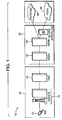
- a wireless telecommunications system 10 comprises a number of mobile stations (MS) 12 and a number of base transceiver stations (node B) 14 connected through a Radio Network Controller (RNC) 16, (all in the Radio Access Network (RAN) 18) to a Core Network (CN) 20.
- RNC Radio Network Controller
- RAN Radio Access Network
- CN Core Network
- the CN 20 is connected via a PSTN gateway 26 to the Public Switched Telephone Network (PSTN).
- PSTN Public Switched Telephone Network
- the RAN 18 and CN 20 are shown in more detail.
- the base stations 14 are connected by interface connections I UB 30 to the RNC 16, which contains a Radio Resource Manager 32.
- a Mobile Switching Centre 34 and a Serving GPRS Support Node 36 are connected by interface connections Iu 38 to the RMC 16.
- Each base station 14 has a fixed number of codes to use across the interface to the mobiles 12. In the UMTS reference model, throughput is limited by these codes.
- the RNC 16 maintains the links, manages power control, manages call handover etc, and also contains the Radio Resource Manager 32; the RRM contains a logical representation of the array of codes; when a code is selected, the RRM 32 notes this; the resource actually used is radio-based, the RMM represents this in software.
- the RRM 32 When the RRM 32 notices that, in a particular cell, codes have been allocated up to a level preset by the network operator, the RRM reserves the unallocated code, withholding the code from any user attempting to set up a new call, and placing that attempted call in a queue. However, if an urgent request for resource is made, such as an urgent handover request, the RRM makes the reserved unallocated code available for that urgent handover.
- the attempted call is held in a queue either until previously allocated resource becomes available for use in connecting that call, or until a timeout is reached; this may be the usual period set in a GMS system, which is 20 seconds. At the end of that period, a visible or audible indication can be given to a calling mobile that there is congestion.
- the level at which resource is reserved will vary with the type of network. In a highly congested, high throughput urban network, the resource may be reserved e.g., as a small number of codes in a CDMA network or as one time slot in a TDMA network.
- the level of resource reservation will be decided empirically, depending on the network conditions.
- the reservation of resource may in some special conditions not be made: suppose a request for urgent handover is statistically likely to be made every thirty seconds; if the predetermined level at which resource reservation is made is reached just after a request for an urgent handover, then there is a good chance that allocated resource will become available within the next 30 seconds, and a decision may be made by the RRM 32 not to reserve resource; in contrast, if the predetermined level is reached towards the end of a 30 second period since a last urgent request, then the next urgent request is statistically likely to be made imminently, and the RRM reserves resource to meet it.
- the decision can be made on the basis of the statistical frequency of urgent calls per minute or per hour, or the frequency of call handovers.
- a further factor which may be taken into consideration in programming the RRM 32 so as to reserve or allocate resource is the priority level of existing and incoming calls, including calls in soft handover. Different criteria may be set, if the network operator wishes, for mobile-terminated calls with caller being a mobile; for mobile calling to a fixed user, etc.
- RRM 32 Another option for the RRM 32 is to hand the new call to another cell, a directed retry, or to push existing calls with lower priority into another cell.
- a radio leg or legs within a cell which relate to an existing call can be removed or re-established in a new cell.
Landscapes
- Engineering & Computer Science (AREA)
- Quality & Reliability (AREA)
- Computer Networks & Wireless Communication (AREA)
- Signal Processing (AREA)
- Mobile Radio Communication Systems (AREA)
Priority Applications (3)
| Application Number | Priority Date | Filing Date | Title |
|---|---|---|---|
| EP99304782A EP1061760A1 (fr) | 1999-06-18 | 1999-06-18 | Procédé et système d'allocation des canaux |
| AU35667/00A AU3566700A (en) | 1999-06-18 | 2000-03-28 | Method and system for radio resource management |
| PCT/GB2000/001188 WO2000079824A1 (fr) | 1999-06-18 | 2000-03-28 | Procede et systeme pour la gestion d'une ressource de radiocommunications |
Applications Claiming Priority (1)
| Application Number | Priority Date | Filing Date | Title |
|---|---|---|---|
| EP99304782A EP1061760A1 (fr) | 1999-06-18 | 1999-06-18 | Procédé et système d'allocation des canaux |
Publications (1)
| Publication Number | Publication Date |
|---|---|
| EP1061760A1 true EP1061760A1 (fr) | 2000-12-20 |
Family
ID=8241464
Family Applications (1)
| Application Number | Title | Priority Date | Filing Date |
|---|---|---|---|
| EP99304782A Withdrawn EP1061760A1 (fr) | 1999-06-18 | 1999-06-18 | Procédé et système d'allocation des canaux |
Country Status (3)
| Country | Link |
|---|---|
| EP (1) | EP1061760A1 (fr) |
| AU (1) | AU3566700A (fr) |
| WO (1) | WO2000079824A1 (fr) |
Cited By (2)
| Publication number | Priority date | Publication date | Assignee | Title |
|---|---|---|---|---|
| SG104953A1 (en) * | 2000-12-22 | 2004-07-30 | Ntt Docomo Inc | Radio resource allocation method and base station using the same |
| FR2855008A1 (fr) * | 2003-05-12 | 2004-11-19 | Nortel Networks Ltd | Procede de controle d'allocation de codes orthogonaux a facteur d'etalement variable dans un reseau radio cellulaire, et equipements de controle pour la mise en oeuvre du procede. |
Citations (2)
| Publication number | Priority date | Publication date | Assignee | Title |
|---|---|---|---|---|
| EP0666699A1 (fr) * | 1994-02-04 | 1995-08-09 | Ntt Mobile Communications Network Inc. | Système de communication mobile avec schéma autonome et distribué d'allocation dynamique de canaux |
| DE19649653A1 (de) * | 1996-11-29 | 1998-06-10 | Siemens Ag | Verfahren und Basisstationssystem zum Zuteilen funktechnischer Ressourcen bei einer Verbindungsaufbauanforderung für eine Mobilstation |
-
1999
- 1999-06-18 EP EP99304782A patent/EP1061760A1/fr not_active Withdrawn
-
2000
- 2000-03-28 AU AU35667/00A patent/AU3566700A/en not_active Abandoned
- 2000-03-28 WO PCT/GB2000/001188 patent/WO2000079824A1/fr not_active Ceased
Patent Citations (2)
| Publication number | Priority date | Publication date | Assignee | Title |
|---|---|---|---|---|
| EP0666699A1 (fr) * | 1994-02-04 | 1995-08-09 | Ntt Mobile Communications Network Inc. | Système de communication mobile avec schéma autonome et distribué d'allocation dynamique de canaux |
| DE19649653A1 (de) * | 1996-11-29 | 1998-06-10 | Siemens Ag | Verfahren und Basisstationssystem zum Zuteilen funktechnischer Ressourcen bei einer Verbindungsaufbauanforderung für eine Mobilstation |
Non-Patent Citations (1)
| Title |
|---|
| GUERIN R: "Queueing-blocking system with two arrival streams and guard channels", IEEE TRANSACTIONS ON COMMUNICATIONS, FEB. 1988, USA, vol. 36, no. 2, pages 153 - 163, XP002121652, ISSN: 0090-6778 * |
Cited By (3)
| Publication number | Priority date | Publication date | Assignee | Title |
|---|---|---|---|---|
| SG104953A1 (en) * | 2000-12-22 | 2004-07-30 | Ntt Docomo Inc | Radio resource allocation method and base station using the same |
| US7130638B2 (en) | 2000-12-22 | 2006-10-31 | Ntt Docomo, Inc. | Radio resource allocation method and base station using the same |
| FR2855008A1 (fr) * | 2003-05-12 | 2004-11-19 | Nortel Networks Ltd | Procede de controle d'allocation de codes orthogonaux a facteur d'etalement variable dans un reseau radio cellulaire, et equipements de controle pour la mise en oeuvre du procede. |
Also Published As
| Publication number | Publication date |
|---|---|
| AU3566700A (en) | 2001-01-09 |
| WO2000079824A1 (fr) | 2000-12-28 |
Similar Documents
| Publication | Publication Date | Title |
|---|---|---|
| KR100426357B1 (ko) | 이동통신시스템의 서비스품질 및 자원관리를 위한스케줄링 방법 | |
| EP1016298B1 (fr) | Utilisation optimale de canaux logiques dans un reseau de telecommunication mobile | |
| US7333441B2 (en) | Method to control the packet switching traffic in digital cellular communication systems | |
| NZ338052A (en) | Enhanced preemption within a mobile telecommunications network | |
| WO1998046031A2 (fr) | Procede et dispositif permettant de commander l'affectation de voies de trafic dans des reseaux de telecommunications a macrocellules/microcellules | |
| EP1023814B1 (fr) | Procedes permettant d'initier une reconfiguration d'une cellule d'un reseau radio mobile | |
| US20080311924A1 (en) | Method for Allocating Communication Resources and Radiocommunication System Therefor | |
| US7894813B2 (en) | Method and apparatus for utilizing historical network information for mitigating excessive network updates when selecting a communications channel | |
| EP1061760A1 (fr) | Procédé et système d'allocation des canaux | |
| KR100688437B1 (ko) | 통신 시스템의 용량 관리를 위한 장치 및 방법 | |
| WO2006062729A2 (fr) | Systeme de communication cellulaire, station de base et procede d'attribution de ressources | |
| CN1901741B (zh) | Cdma系统中无线空口寻呼信道自适应调整方法 | |
| EP1090522B1 (fr) | Procedure d'attribution de support de trafic | |
| GB2343593A (en) | Radio channel allocation storing call information when channel unavailable | |
| KR19990047320A (ko) | 코드분할 다중접속 셀룰러 시스템에서 우선순위큐를이용한 핸드오버 채널할당 방법 | |
| EP1402750B1 (fr) | Transfert de cellule dans un systeme de communication cellulaire | |
| WO2002007469A1 (fr) | Reservation de canaux dans une zone de localisation | |
| CA2340893C (fr) | Configuration d'emetteur-recepteur adaptatif double mode | |
| AU2002249207A1 (en) | Handover in a cellular communication system | |
| GB2322520A (en) | Method for Allocating a Communications Resource for a Group Call | |
| Konstantinopoulou et al. | Radio resource management schemes for combined GSM/GPRS mobile systems |
Legal Events
| Date | Code | Title | Description |
|---|---|---|---|
| PUAI | Public reference made under article 153(3) epc to a published international application that has entered the european phase |
Free format text: ORIGINAL CODE: 0009012 |
|
| AK | Designated contracting states |
Kind code of ref document: A1 Designated state(s): GB |
|
| AX | Request for extension of the european patent |
Free format text: AL;LT;LV;MK;RO;SI |
|
| 17P | Request for examination filed |
Effective date: 20010607 |
|
| AKX | Designation fees paid |
Free format text: GB |
|
| 17Q | First examination report despatched |
Effective date: 20040126 |
|
| REG | Reference to a national code |
Ref country code: DE Ref legal event code: 8566 |
|
| STAA | Information on the status of an ep patent application or granted ep patent |
Free format text: STATUS: THE APPLICATION IS DEEMED TO BE WITHDRAWN |
|
| 18D | Application deemed to be withdrawn |
Effective date: 20040608 |