EP1061761A1 - Réduction du nombre de lignes louées dans un réseau de communication mobile - Google Patents
Réduction du nombre de lignes louées dans un réseau de communication mobile Download PDFInfo
- Publication number
- EP1061761A1 EP1061761A1 EP99440145A EP99440145A EP1061761A1 EP 1061761 A1 EP1061761 A1 EP 1061761A1 EP 99440145 A EP99440145 A EP 99440145A EP 99440145 A EP99440145 A EP 99440145A EP 1061761 A1 EP1061761 A1 EP 1061761A1
- Authority
- EP
- European Patent Office
- Prior art keywords
- network
- lines
- leased
- handover
- new connection
- Prior art date
- Legal status (The legal status is an assumption and is not a legal conclusion. Google has not performed a legal analysis and makes no representation as to the accuracy of the status listed.)
- Withdrawn
Links
- 238000010295 mobile communication Methods 0.000 title claims description 6
- 230000005540 biological transmission Effects 0.000 claims abstract description 9
- 238000000034 method Methods 0.000 claims description 11
- 238000010586 diagram Methods 0.000 description 4
- 230000003044 adaptive effect Effects 0.000 description 1
- 230000011664 signaling Effects 0.000 description 1
Images


Classifications
-
- H—ELECTRICITY
- H04—ELECTRIC COMMUNICATION TECHNIQUE
- H04W—WIRELESS COMMUNICATION NETWORKS
- H04W92/00—Interfaces specially adapted for wireless communication networks
- H04W92/04—Interfaces between hierarchically different network devices
- H04W92/12—Interfaces between hierarchically different network devices between access points and access point controllers
-
- H—ELECTRICITY
- H04—ELECTRIC COMMUNICATION TECHNIQUE
- H04Q—SELECTING
- H04Q3/00—Selecting arrangements
- H04Q3/64—Distributing or queueing
- H04Q3/66—Traffic distributors
Definitions
- the invention relates to a method for reducing the number of lines which are permanently leased from a network operator by the service provider of a mobile communications network, or to reduce the bandwidth of the leased lines.
- the invention furthermore relates to a management module suitable for implementing this method and to a mobile communications network with transmission lines which are partly permanently leased by the provider and partly added on as required.
- leased lines are a significant part of the total operating costs.
- the service provider can either use its own, i.e., self-installed, lines or add additional network operator lines (so-called “switched lines”) for a fee as required.
- WO 98/45998 proposes to reduce the number of leased lines by using public lines in addition to the leased lines whenever the latter are overloaded or there is trouble with the lines. The switching of the lines, however, remains under the control of the network operator.
- U.S. patent 5,483,589 furthermore provides for a control device to decide whether a connection to a public telephone network via leased lines is allowed.
- This object is attained by the initially defined method in that, for the setup of a new connection with the network, for a handover within the network, or for macro diversity connections within the network, those base stations of the network which still have free leased lines available are used first and that only if all leased lines usable for the new connection setup are utilized, additional network operator lines or so-called “switched lines" are added.
- the majority of the permanently leased lines are replaced by switched lines as required.
- the bandwidth of the remaining leased lines is reduced to a reasonable value, for example to the average load instead of the current peak load. Additional lines are added only if the actually required bandwidth exceeds this value. Before these additional lines are added, all usable leased lines should be utilized for transmissions.
- the call In a handover of a mobile station, the call, if possible, is switched to a base station that does not require an additional switched line for the call.
- the request of a mobile station which is already connected to a base station and wants to establish a macro diversity state by connecting to additional base stations, is rejected if this access would require an additional switched line.
- the network tries to reduce the number of connections that support macro diversity so as to minimize the number of additional switched lines.
- existing and/or newly to be established connections are checked for a priority feature and are interrupted or rejected if the priority feature is absent.
- a priority feature can be, for example, whether an existing connection is a macro diversity connection and thus can possibly be disconnected.
- a newly established connection, a handover, or a macro diversity connection can also be rejected, respectively, as a function of the utilization of the leased lines if this connection would require an additional switched line. For if the utilization rate of the network is low, it is likely that a leased line can be used at a later instant.
- the bit rate at which the data on a switched line is transmitted should be the maximum possible rate to utilize the switched line as quickly as possible.
- the initially defined network is provided with a management unit of the service provider, which controls the add-on of switched lines.
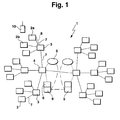
- Fig. 1 shows a mobile network 1, which is known per se (e.g. a GSM network), with base stations 2, with base station controllers 3 controlling these base stations 2 and with two mobile switching centers 4 between the two base station controllers 3.
- Each mobile switching center 4 has a CC/BC unit (CallControl/BearerControl) 5.
- an operation and maintenance center 6 of the network operator is connected to each mobile switching center 4.
- SLRM Switched Line Resource Management
- network 1 which optimally utilizes the permanently leased lines 7 and keeps the number of switched lines 8 as low as possible.
- management unit 9 is connected with CC/BC unit 5 as well as with the mobile switching center 4 via the operation and maintenance center 6.
- Management unit 9 based on the actual load distribution of network 1, adds on or releases additional switched lines 8, which can be accomplished either by standard signaling or by direct requests to the network operator.
- Management unit 9 is preferably installed in areas where experience shows traffic fluctuations to be high.
- management unit 9 switches the call to a base station 2 that does not require an additional switched line 8 for the call. If in Fig. 1 an additional switched line 8 would have to be added for a handover to base station 2a, the handover would instead be executed to base station 2b if a leased line 7 could be used for this purpose.
- management unit 9 In networks, in which mobile station 10 can be simultaneously connected to several base stations (a "macro diversity state"), particularly if utilization of network 1 is high, management unit 9 will both prevent mobile station 10 from being connected to a further base station 2 and will also interrupt existing macro diversity connections in order to make leased line 7 available for new connections. Management unit 9 will always try to reduce the number of switched lines 8 and thus reduce the cost incurred by the service provider. Management unit 9 will also ensure that the transmission rate during transmission via additional switched lines 8 will be the maximum rate, particularly for packet data services.
- Fig. 2 shows a flow diagram of a program that is executed in network 1 during a handover.
- network 1 is in an IDLE state (step 21), ready for registering new mobile stations 10.
- step 21 first verifies whether an additional switched line 8 is required for this purpose. If the answer is no, the handover is allowed in step 24 and the program goes back to step 21. If it is determined in step 23 that an additional line 8 is required for the handover, step 25 first attempts a handover with a different base station 2 that can be used for this purpose. If the handover with a different base station is successful (step 26) the program goes to step 24.
- step 26 the handover with another base station is unsuccessful
- the program goes to step 27, which queries whether a load reduction in the network is expected. If the answer is yes, the program goes to step 28 in which the mobile station is initially rejected and the program jumps back to step 21. Only if the answer in step 27 is no, a new line 8 is added in step 29 and the handover is accepted in step 24.
- step 30 The flow diagram in Fig. 3 shows a different program, which during a handover is executed in management unit 9 either as an alternative or in addition to the program according to Fig. 2.
- step 30 the network is in an IDLE state (step 31) ready for registering new mobile stations. If it is determined in step 32 that a mobile station has left the network, step 33 checks whether switched line 8 can now be released. If the answer is yes, this line 8 is released in step 34 and the program goes back to IDLE (step 31). If the answer in step 33 is no, the program goes to step 35 to check the situation for a handover. It then checks in step 36 whether capacity can be freed for the handover, e.g., by interrupting existing macro diversity connections. If "No” the program goes back to IDLE (step 31). If "Yes,” the free capacity is created, the handover is executed (step 37) and a possibly superfluous line 8 is released in step 34.
Landscapes
- Engineering & Computer Science (AREA)
- Computer Networks & Wireless Communication (AREA)
- Signal Processing (AREA)
- Mobile Radio Communication Systems (AREA)
- Data Exchanges In Wide-Area Networks (AREA)
Priority Applications (1)
| Application Number | Priority Date | Filing Date | Title |
|---|---|---|---|
| EP99440145A EP1061761A1 (fr) | 1999-06-18 | 1999-06-18 | Réduction du nombre de lignes louées dans un réseau de communication mobile |
Applications Claiming Priority (1)
| Application Number | Priority Date | Filing Date | Title |
|---|---|---|---|
| EP99440145A EP1061761A1 (fr) | 1999-06-18 | 1999-06-18 | Réduction du nombre de lignes louées dans un réseau de communication mobile |
Publications (1)
| Publication Number | Publication Date |
|---|---|
| EP1061761A1 true EP1061761A1 (fr) | 2000-12-20 |
Family
ID=8242338
Family Applications (1)
| Application Number | Title | Priority Date | Filing Date |
|---|---|---|---|
| EP99440145A Withdrawn EP1061761A1 (fr) | 1999-06-18 | 1999-06-18 | Réduction du nombre de lignes louées dans un réseau de communication mobile |
Country Status (1)
| Country | Link |
|---|---|
| EP (1) | EP1061761A1 (fr) |
Cited By (1)
| Publication number | Priority date | Publication date | Assignee | Title |
|---|---|---|---|---|
| EP2040421A1 (fr) * | 2007-09-19 | 2009-03-25 | Nokia Siemens Networks Oy | Procédés, appareils, système et produit de programme informatique correspondant pour autorisation d'équipement d'utilisateur |
Citations (4)
| Publication number | Priority date | Publication date | Assignee | Title |
|---|---|---|---|---|
| EP0615391A1 (fr) * | 1993-03-09 | 1994-09-14 | ALCATEL BELL Naamloze Vennootschap | Réseau de communication mobile |
| US5566227A (en) * | 1993-02-26 | 1996-10-15 | Astronet | System and method for connection of cellular base stations to a mobile switching center using dial up telephone circuits |
| WO1997004615A1 (fr) * | 1995-07-21 | 1997-02-06 | British Telecommunications Public Limited Company | Systeme radiotelephonique mobile |
| JPH0951569A (ja) * | 1995-08-09 | 1997-02-18 | N T T Ido Tsushinmo Kk | 移動通信網システム |
-
1999
- 1999-06-18 EP EP99440145A patent/EP1061761A1/fr not_active Withdrawn
Patent Citations (4)
| Publication number | Priority date | Publication date | Assignee | Title |
|---|---|---|---|---|
| US5566227A (en) * | 1993-02-26 | 1996-10-15 | Astronet | System and method for connection of cellular base stations to a mobile switching center using dial up telephone circuits |
| EP0615391A1 (fr) * | 1993-03-09 | 1994-09-14 | ALCATEL BELL Naamloze Vennootschap | Réseau de communication mobile |
| WO1997004615A1 (fr) * | 1995-07-21 | 1997-02-06 | British Telecommunications Public Limited Company | Systeme radiotelephonique mobile |
| JPH0951569A (ja) * | 1995-08-09 | 1997-02-18 | N T T Ido Tsushinmo Kk | 移動通信網システム |
Non-Patent Citations (1)
| Title |
|---|
| PATENT ABSTRACTS OF JAPAN vol. 1997, no. 06 30 June 1997 (1997-06-30) * |
Cited By (1)
| Publication number | Priority date | Publication date | Assignee | Title |
|---|---|---|---|---|
| EP2040421A1 (fr) * | 2007-09-19 | 2009-03-25 | Nokia Siemens Networks Oy | Procédés, appareils, système et produit de programme informatique correspondant pour autorisation d'équipement d'utilisateur |
Similar Documents
| Publication | Publication Date | Title |
|---|---|---|
| JP4109695B2 (ja) | 通信システムのためのルーティング手順 | |
| JP4026118B2 (ja) | 移動端末、緊急呼管理装置、緊急呼管理システム及び緊急呼の管理方法 | |
| EP1701576B1 (fr) | Transmission de données entre des terminaux par l'intermédiaire d'une connexion à commutation de paquet ou à commutation de circuit | |
| US6745049B1 (en) | Mobile communication system | |
| JP3431527B2 (ja) | 無線通信ネットワークにおけるソフトハンドオフの間のフォワードリンク電力レベルの最適化のための方法 | |
| US8395987B2 (en) | Indicating availability status of services provided by a mobile communication network | |
| US20050221825A1 (en) | Mobile telecommunication system capable of executing handover and relocation involving plural radio network controllers (RNC) without using lur interface | |
| KR100556164B1 (ko) | Cdma형 통신 시스템 및 그 통신 방법 | |
| KR20000019821A (ko) | 이동통신시스템에서의트래픽부하제어방법 | |
| AU698235B2 (en) | Mobile telephone system | |
| US7328008B2 (en) | Means and method for measuring the status of a core interface between two core subnetworks in a telecommunication system | |
| JP2000232670A (ja) | 通信装置、通信システムおよびその方法 | |
| US7388882B2 (en) | Method for dynamically reconfiguring wireless network capacity | |
| US20010034231A1 (en) | Mobile telephone networks | |
| KR100535644B1 (ko) | 이동통신 시스템에서의 호 절단율 감소 방법 | |
| KR100542923B1 (ko) | Ndss를 이용한 트래픽에 따른 통신망 분산 방법 및 그시스템 | |
| KR100326565B1 (ko) | 무선 가입자 망 시스템에서의 다중 코드 설정방법 | |
| KR100628745B1 (ko) | 삼세대 지피알에스 망에서 트래픽 부하 분산 처리 장치 및방법 | |
| RU2127900C1 (ru) | Способ передачи и способ приема данных, способ реализации протокола х.25 в электронной аппаратуре обмена данными | |
| KR19990013262A (ko) | 통신 시스템의 상보 서비스장치 및 방법 | |
| KR20030085404A (ko) | 이동통신 망에서 패킷데이터 호 서비스가 가능한 셀렉터 | |
| KR20020057264A (ko) | 이동통신 단말기의 원격 전원 차단장치 및 방법 | |
| HK1087294B (en) | Communication system, method thereof, switching center thereof and base station control station thereof | |
| HK1087295B (en) | Communication system, method thereof, switching center thereof and base station control station thereof | |
| HK1087296B (en) | Communication system, method thereof, switching center thereof and base station control station thereof |
Legal Events
| Date | Code | Title | Description |
|---|---|---|---|
| PUAI | Public reference made under article 153(3) epc to a published international application that has entered the european phase |
Free format text: ORIGINAL CODE: 0009012 |
|
| AK | Designated contracting states |
Kind code of ref document: A1 Designated state(s): DE ES FR GB IT |
|
| AX | Request for extension of the european patent |
Free format text: AL;LT;LV;MK;RO;SI |
|
| AKX | Designation fees paid |
Free format text: DE ES FR GB IT |
|
| STAA | Information on the status of an ep patent application or granted ep patent |
Free format text: STATUS: THE APPLICATION IS DEEMED TO BE WITHDRAWN |
|
| 18D | Application deemed to be withdrawn |
Effective date: 20010621 |